


1. Introduction
Shallow-water carbonate platforms with Urgonian-type sedimentation existed in various regions of the Mediterranean Tethys during Early Cretaceous time (e.g. Arnaud-Vanneau et al. Reference Arnaud-Vanneau, Arnaud, Charollais, Conrad, Cotillon, Ferry, Masse and Peybernes1979, Reference Arnaud-Vanneau, Arnaud, Boisseau, Darsac, Thieuloy and Vieban1982; Philip, Masse & Bessais, Reference Philip, Masse and Bessais1989; Michalík & Soták, Reference Michalík and Soták1990; Babinot et al. Reference Babinot, Barbaroux, Tronchetti, Philip, Canerot, Kouyoumontzakis and Redondo1991). The sequences of these facies were documented among others from the Western Carpathians, including the Tatric successions (Michalík, Reference Michalík1994). In the latter locality, carbonate platform sedimentation containing biohermal and lagoonal facies took place on the Tatric Ridge (Passendorfer, Reference Passendorfer1930; Lefeld, Reference Lefeld1968, Reference Lefeld1974; Michalík & Vašiček, Reference Michalík, Vašíček and Wiedmann1989; Michalík & Soták, Reference Michalík and Soták1990; Mišik, Reference Mišik1990), an internal part of the Central Western Carpathian region (e.g. Plašienka, Reference Plašienka1997, Reference Plašienka1999). The palaeomagnetic data (Grabowski, Reference Grabowski1997) from the Tatra Mountains indicate their proximity to the European plate at least in the post-early Aptian – early Turonian time span. Since early Aptian, time regional tectonic processes have resulted in the subsequent lowering of this platform below the photic zone (Michalík, Reference Michalík1994); the Urgonian-type benthic organisms (containing rudist and orbitolinids) finally died on the Tatric Ridge during middle Albian time (Masse & Uchman, Reference Masse and Uchman1997). Pelagic and hemipelagic carbonate sediments deposited under open marine conditions replaced the shallow-water facies in this area (e.g. Passendorfer, Reference Passendorfer1930; Lefeld, Reference Lefeld1968; Mišik, Reference Mišik1990; Krajewski, Reference Krajewski2003). Due to tectonic processes, relief of the carbonate platform was significantly changed during late–middle Albian time. The occurrence of tectonic breccias and neptunian dykes, lying mainly at the top of the Urgonian facies, indicate rapid tectonic processes at that time which caused changes in the palaeogeography of the Tatric Ridge (Krajewski, Reference Krajewski2003). Elevated blocks with steep slopes and deep troughs were interpreted for this region on the basis of facies patterns and large differences in the thickness of underlying Albian carbonate sediments (Krajewski, Reference Krajewski1981). In such troughs, the relatively quick sedimentation of carbonate material was interrupted by subsequent tectonic movements (earthquakes), which is exemplified by an occurrence of younger neptunian dykes inside of lower–middle Albian echinoderm limestones in such settings (Krajewski, Reference Krajewski2003).
The characteristic feature of the neptunian dykes in the lower Albian Tatric sequences is their red colouration, related to the occurrence of iron oxides. According to Krajewski (Reference Krajewski2003), many of them are filled with recrystallization products of the original land-derived iron hydroxides, formed during the emergence and karstification of the Tatric Ridge. As a consequence, the sediment in the dykes contains washed-out karstic residuum incorporated into marine limestone. In addition to the brecciated horizons with neptunian dykes lying at the base of the carbonate open-marine succession, there were also younger brecciated horizons with neptunian dykes red to pinkish in colour. They were found in thick successions of white echinodermal-foraminiferal limestone, which infilled the submarine trough. The sediment in these dykes is enriched with iron oxides and there is also crystal of quartz inside. The origin of these infillings remains unknown. The aim of this study is to elucidate the source of the iron and silica enrichments in this type of neptunian dyke. We hypothesized that these enrichments could be related to hypergenic marine processes at the basin floor (weathering in marine environment). Nonetheless, hydrothermal sources of iron and silica cannot be excluded here, due to an occurrence of ocean-floor alteration processes at and near the Tatric Ridge (Hovorka & Spišiak, Reference Hovorka and Spišiak1988; Spišiak et al. Reference Spišiak, Arvensis, Linkešová, Pitoňák and Caňo1991; Spišiak & Balogh, Reference Spišiak and Balogh2002; Madzin, Sýkora & Soták, Reference Madzin, Sýkora and Soták2014).
2. Geological setting
The Tatra Mountains belong to the Tatric unit (Tatricum), one of the major units of the Central Western Carpathians (Fig. 1a; Passendorfer, Reference Passendorfer1930; Andrusov, Reference Andrusov1968; Plašienka, Reference Plašienka1997, Reference Plašienka1999). They consist of a pre-Alpine crystalline basement composed of Variscan metamorphic rocks and granites, overlain by sedimentary cover sequences and nappes. The sedimentary cover is of ?Permian – Late Cretaceous age, with a total thickness of up to 2000 m (Nemčok et al. Reference Nemčok, Bezák, Janák, Kahan, Ryka, Kohút, Lehotský, Wieczorek, Zelman, Mello, Halouzka, Rączkowski, Kotański and Reichwalder1993). It consists of sedimentary sequences deposited on the crystalline basement and overthrusted sediments (nappes) originating from marginal marine environments (e.g. Rabowski, Reference Rabowski1959; Kotański, Reference Kotański1961; Passendorfer, Reference Passendorfer1978).
(a) Simplified geological map of the Carpathians. (b, c) Location of the Sucha Woda Valley in the Tatra Mountains (Inner Carpathians) (contour map after Bryndal, Reference Bryndal2014). (d) Geological map of the study area (map after Guzik & Jaczynowska, Reference Guzik and Jaczynowska1978). WTLF – Wysoka Turnia Limestone Formation; ZB – Zabijak Formation. GPS data based on EPSG: 2180. (e) Barremian–Albian lithostratigraphic scheme and lithologic log of the section studied (lithostratigraphy after Krajewski, Reference Krajewski2003; occurrence of Favusella washitensis Carsey, this study).

The Lower Cretaceous sediments, deposited directly on the crystalline basement of the Tatric Ridge, consist of the Urgonian platform limestones and related slope sediments (e.g. Passendorfer, Reference Passendorfer1930; Morycowa & Lefeld, Reference Morycowa and Lefeld1966; Lefeld, Reference Lefeld1968, Reference Lefeld1974; Michalík & Vašiček, Reference Michalík, Vašíček and Wiedmann1989; Michalík & Soták, Reference Michalík and Soták1990; Masse & Uchman, Reference Masse and Uchman1997). In the western part of this area, a few small lenticular bodies and bands (2–30 m thick) of alkaline volcanic rocks classified as hyalobasanites occur (Kotański & Radwański, Reference Kotański and Radwański1959; Hovorka & Spišiak, Reference Hovorka, Spišiak, Bajaník and Hovorka1981; Spišiak & Hovorka, Reference Spišiak and Hovorka1997; Hovorka, Dostál & Spišiak, Reference Hovorka, Dostál and Spišiak1999; Ivan, Hovorka & Méres, Reference Ivan, Hovorka and Méres1999; Staniszewska & Ciborowski, Reference Staniszewska and Ciborowski2000). They are sandwiched with carbonate breccia containing calpionellid microfaunas, whose stratigraphic position corresponds at the latest to the Tithonian through the ?early Valanginian (Madzin, Sýkora & Soták, Reference Madzin, Sýkora and Soták2014). These shallow-water Urgonian-type carbonate sediments (locally with volcanic rocks) partially emerged during late Aptian – early Albian time. They were subsequently covered by the Albian basal sandstone bed or breccia and overlain with dyke infillings by fossiliferous phosphate- and glauconite-rich limestone, passing into upper Albian – Cenomanian marlstone and a rhythmic marlstone-siltstone-sandstone sequence (Zabijak Formation; Krajewski, Reference Krajewski2003; Bąk & Bąk, Reference Bąk and Bąk2013). The brecciated zone containing the neptunian dykes, classified as the Ku Stawku Bed of the Zabijak Formation (Fig. 1e; Krajewski, Reference Krajewski2003), lies within the light grey limestones (Żeleźniak Member) c. 3 m above the top of the light grey organodetrital limestones (Wysoka Turnia Limestone Formation; Lefeld, Reference Lefeld1968, Reference Lefeld, Lefeld, Gaździcki, Iwanow, Krajewski and Wójcik1985) of Aptian – middle Albian age (Masse & Uchman, Reference Masse and Uchman1997).
3. Materials and methods
The studied section was found in the abandoned quarry at the Hala Gąsienicowa Alp within the Sucha Woda Valley, which is a part of the High Tatra Mountains (Fig. 1b–d). Twenty-three samples were collected from the brecciated zone containing the neptunian dykes and from the surrounded limestone (Figs 1e, 2a). The standard optical examinations of the transmitted light of the thin and polished sections were carried out under a BA310POL polarizing microscope with photo capture using Panasis software.
(a) Photograph of the abandoned quarry at Hala Gąsienicowa Alp (Sucha Woda Valley, Tatra Mountains) with location of the sediments studied. (b) Echinoderm-foraminiferal packed biomicrite (pb) and sparse biomicrite (sb) as typical microfacies of the host sediment containing neptunian dykes, consisting of echinoderm plates with jagged edges after dissolution and/or recrystallization (Ep) and benthic foraminiferal test (F); small neptunian dyke enriched in iron oxides (central part of photomicrograph). (c, d) Favusella washitensis Carsey, stratigraphically important planktonic foraminiferal species from the host limestone: (c) HGas-9; (d) HGas-11. (e–k) Microfossils in echinoderm-foraminiferal biomicrites: (e) fragment of echinoderm plate; (f) fragment of rudist shell; (g, h) benthic foraminifers ((g) ?Dentalina sp.; (h) ?Nodosaria sp.) as a residue clast partly surrounded by reddish filling from the micro-dyke; (i–k) planktonic foraminifers from genus Hedbergella. All photomicrographs from sample HGas-15b.

Analyses of the main minerals (hematite, quartz, calcite, dolomite) were carried out using a FEI Quanta 200 FEG scanning electron microscope (SEM), equipped with an energy-dispersive (EDS) detector and a Hitachi-S 4700 SEM with a Voyager 3100 EDS spectrometer (NORAN). In both cases, the time of analysis was 100 s for each point and the resolution was 1.5 nm. The data were corrected using the ZAF/PB program. The SEM observations and EDS analyses were made in the Scanning Electron Microscopy Laboratory at the AGH University of Science and Technology and at the Institute of Geological Sciences at Jagiellonian University.
The mineral composition of the red-coloured sediment infilling the dykes was determined by X-ray diffraction (XRD) analysis at the Institute of Geological Science, Jagiellonian University. These analyses were conducted on a Philips X'Pert diffractometer with the PW 1870 generator and the PW 3020 vertical goniometer, using filtered CuKα radiation. The instrument settings were electric potential U 40 kV, current I 30 mA, a scanning speed of 1°/min and a chart speed of 10 mm/min.
Three samples of sediment (containing a little admixture of surrounding rock) and one sample from the surrounding unaltered limestone were analysed for major and minor element concentrations at the Bureau Veritas Minerals Laboratories, Vancouver, Canada. Total abundances of the major oxides, several minor elements, rare Earth and refractory elements were analysed by inductively coupled plasma (ICP) emission spectrometry, following lithium metaborate/tetraborate fusion and dilute nitric acid digestion. Loss on ignition (LOI) was determined by the weight difference after ignition at 1000°C for >2 h. Moreover, separate 0.5 g samples were digested in Aqua Regia and analysed by ICP mass spectrometry to determine the precious and base metals. The detection limits ranged from 0.002 wt % to 0.01 wt % for major oxides, from 0.1 ppm to 20 ppm for trace elements and from 0.01 ppm to 0.1 ppm for the rare Earth elements. The CANMET- and USGS-certified reference materials were used as monitors of data quality.
4. Results
4.a. Microfacies and age of the host rock
The sediments studied macroscopically contained a sequence of monotonous, poorly laminated, grey limestones and consisted of two types of microfacies: packed biomicrite passing to sparse biomicrite (Fig. 2b). Allochem content varied from 30 % up to 70 % in the thin-sections under view. They were mainly disarticulate, fragmented echinoderm skeletons, 50–200 µm across (Fig. 2e), which represent various types of singular, porous plates belonging predominantly to holothurids, asteroids and echinoids. Most of the plates possessed jagged edges revealing evidence of dissolution and later recrystallization (Fig. 2b). Additionally, the limestone consisted of benthic and planktonic foraminifers (Fig. 2b, g–k), fragments of rudist shales (Fig. 2f) and clasts of Lower Cretaceous organodetrical limestones.
The microfacies studies showed that among the planktonic foraminiferal assemblages, only Favusella washitensis Carsey (Fig. 2c, d) was a stratigraphically important species that could help determine the position of the studied limestones containing neptunian dykes. This species was found in the limestone succession below and above the horizon with dykes (Fig. 1e). Its stratigraphic range was discussed by Rösier, Lutze & Pflaumann (Reference Rősier, Lutze, Pflaumann, von Rad, Ryan and Arthur1979) and confirmed by Caron (Reference Caron, Bolli, Saunders and Perch-Nielsen1985) and Koutsoukos, Leary & Hart (Reference Koutsoukos, Leary and Hart1989) as of lower Albian (Ticinella primula Zone) through middle Cenomanian (Rotalipora reicheli Zone); however, its detection in lower Albian deposits is restricted to epicontinental seas (Risch, Reference Risch1971; Michael, Reference Michael1972; Ascoli, Reference Ascoli1976; Koutsoukos, Leary & Hart, Reference Koutsoukos, Leary and Hart1989). In the same locality (Wysoka Turnia Limestone Formation; compare Fig. 1), this species was noticed by Masse & Uchman (Reference Masse and Uchman1997) in an upper part of the Urgonian-type facies. On the other hand, planktonic assemblages do not include keeled taxa (Pseudothalmanninella and Parathalmanninella) which are known to have appeared during late Albian time (e.g. Gale et al. Reference Gale, Bown, Caron, Crampton, Crowhurst, Kennedy, Petrizzo and Wray2011). All of these data may suggest that the sediments containing neptunian dykes are of middle Albian age.
4.b. Description of the neptunian dykes
The dykes were found in the brecciated part of the limestone, showing various shapes and sizes (Fig. 3). Most of them were connected to each other and filled with the same type of sediment, including mainly red infill (Fig. 3a–f). Some of them contained internal breccia (Fig. 3d). In cross-sections, most of the dykes were a few centimetres thick; locally, the thickest parts were up to 20 cm. Silica encrustation of a few centimetres thickness has been observed in the wider parts of the dykes (Fig. 3g). The orientation of the dykes varied due to numerous branches which rapidly thinned out in various directions; however, the thickest dykes were generally vertical. The walls appeared to be sharp when viewed macroscopically and were covered by ferruginous encrustations and/or calcite cements (Fig. 3a–d).
Photographs of neptunian dykes in the Albian limestones at the Gąsienicowa Alp section, Sucha Woda Valley, Tatra Mountains. (a–f) Dykes with iron oxide encrustations; (f) shows iron oxide dykes which are crossed by another system of dykes filled with calcite. (g) Silica encrustation inside of wider part of the dyke.

Study of the microfacies showed that the limestones also contained several generations of cross-cutting microchannels (Fig. 4a, b) from less than several micrometres up to several millimetres in width, which were usually secondarily filled in by calcite spar (CS). Two sets of such channels, which crossed at least two previously formed generations of channels filled with CS, were unique because they were partially or completely filled with red, opaque, microcrystalline material (RS) (Fig. 4a, b). These channels continued from main dykes and were filled with red material; they were visible in outcrop walls and were observed branching through the host limestones even on the microscopic scale. The red-filled channels (RS) cut host biomicrites as well as previous channels filled in by calcite (CS), and they were cut by subsequent generations of channels also filled with calcite (CS). The spatial and temporal relations between the CS and RS were clearly visible as the systems of channels intersected at a sharp angle. However, in some cases the RS and CS appeared to have developed perpendicularly as CS inside RS or CS next to RS (Fig. 4d–f).
(a) Two generations of channels filled with red opaque microcrystalline material (RS1, RS2) and two generations of channels filled with calcite spar (CS1, CS2) developed in sparse biomicrite. (b) Cross-cutting of two generations of channels filled with calcite spar (CS1, CS2). This system was crossed by channels filled with Fe encrustations (RS), which were partly secondarily filled with calcite. Texture of neptunian dykes containing Fe-bearing minerals (dark brown) which filled the dykes: (c, d) almost completely, (e, f) partially, containing residue after dissolution of host limestone where elements containing sparite left after this process, or (g, h) as rounded material left after stepwise dissolution of sparitic clasts derived from host limestone or (i) micro-dykes opened by stepwise leaching of micrite in host rock with sparitic bioclasts, which might have formed after the internal breccia.

4.c. Petrography of host rock
From a petrographic point of view echinoderm-foraminiferal packed biomicrite, which is typical of the microfacies of the host limestone, consisted of calcite crystals, skeletal debris and rare crystals of hematite. The dimensions of the carbonate particles ranged from less than 25 µm to 2 mm. Rounded low crystalline silica and microcrystalline quartz concentrations (up to 2 mm) were also found in the biomicrites (Fig. 5a, b). Their brown colouration was due to the occurrence of scattered hematite crystals (Fig. 5a, c), which were also found along the straight fractures (Fig. 5).
(a) Phosphates (p), hematite (h) and echinoderm plates (Ep) in packed biomicrite. (b, c) Rounded low crystalline silica containing scattered hematite. (d) Hematite microplates (arrows) arranged along the straight fracture (backscattered electron image). (e) The thinnest infillings visible as reddish seams (ferric oxyhydroxides; rs) bordering fragments of bivalve shells, which usually consist of calcite spare (HGas-13). (f) Reddish seams in place of contact of calcitic bioclast (echinoderm plate; Ep) with micrite (HGas-14). (g) Seams opened further (expanded) by replacing (leaching) micrite from the host limestone; more resistant calcitized or sparitic particles left as residue (res) (HGas-13).

4.d. Texture and petrography of infilling material
There were two types of micro-dyke fillings. The first type contained almost pure, homogeneous, opaque reddish material which filled the micro-space of the dykes completely (Fig. 4d). The second type comprised reddish, opaque material similar to that of the first type but mixed with rounded sparitic clasts (Fig. 4c), which in some cases were gravitationally segregated. The clasts displayed the same features as the sparitic components of the host limestone. These included corroded and/or regenerated echinoderm plates, partly with their original porosity, rare calcareous benthic foraminifers and pithonellids. In the widest micro-dykes, the sparitic clasts were situated close to the walls of the dyke (Fig. 4g). Others were filled with internal breccia, where host-rock fragments constituted a more than 50 % of the primary caverns and the reddish opaque material was the main matrix (Fig. 4g–i). Microprobe analyses of the reddish material from the dykes indicated a predominant occurrence of hematite (Table 1). They were detected in crystalline thin plates, which were densely packed and may have entirely filled the dyke or encircle the quartz and calcite grains (Fig. 6a). Locally, densely packed hematite crystals formed clearly visible lamination, intercalating laminae with clasts coming from the host rock (Fig. 6b). The hematite microcrystals exhibited trigonal symmetry, and their sizes ranged from 0.5 to 1.0 µm (Fig. 6c).
Microprobe chemical analyses of reddish infill of the neptunian dykes (sample HGas-15a). Numbers of cations (ions) calculated on the basis of 6 (O); CO2 has not been determined.

Morphological SEM backscatter and SEM images of components inside the neptunian dykes. (a) Various sizes of quartz (dark grey zones) and hematite crystals (light grey zone) (sample HGas-15a). (b) CS developed inside previous RS visible as iron oxide encrustations on the edge of a dyke (light grey zone) which is filled with calcite (sample HGas-15a). (c) Densely packed plates of hematite (sample HGas-15a). (d) Single crystal of dolomite between calcite, quartz and hematite crystals (sample HGas-15a). (e) Calcite crystal formed by recrystallization of previous echinoderm plate (r-cl) with numerous caverns left from original porosity (arrows) (sample HGas-13).

EDS analysis of the crystals and clasts from the internal breccia, which were surrounded by the reddish, hematite-bearing matrix, enabled the detection of calcite, quartz and dolomite inside (Table 2). The calcite crystals (up to 10 μm) were strongly corroded, with several sharp-edged caverns (Fig. 6e). The sizes of the individual quartz crystals were 1–10 µm (Fig. 6a). The associated dolomite crystals (Fig. 6d) had similar dimensions to the quartz crystals (up to 10 µm).
Microprobe chemical analyses of brecciated carbonate material filled the neptunian dyke. Dolomite grain: sample HGas-15a/13a; calcite grains: samples HGas-15a/13b, HGas-14-4, HGas-13-5.

4.e. XRD analysis of infilling material
XRD of the reddish filling confirmed the microscopic observations and EDS analysis. Based on the XRD patterns of samples (HGas 13, 14 and 15a), the presence of hematite, calcite, quartz and dolomite were verified (Table 3; Fig. 7). Hematite was recognized based on the appearance of following d(hkl) characteristic for α-hematite (diffraction data for α-hematite 06–0502): 2.69 Å (I = 100), 2.51 Å (I = 80), 1.691 Å (I = 80), 3.68 Å (I = 70), 1.837 Å (I = 70), 1.484 Å (I = 70). The strong peak signals are typical of well-crystallized quartz (diffraction data for quartz 03–0444). The presence of calcite was established on the basis of the following diffraction peaks: 3.03 Å, 3.852 Å, 1.8726 Å, 2.094 Å. Finally, a minor phase of dolomite (2.90 Å, I = 100) was confirmed on the basis of its strongest diffraction peak. The proportion of hematite to calcite varied between the samples studied, which is related to the various types of dyke fillings visible in the thin-sections.
The bulk X-ray diffraction patterns of reddish infill from three neptunian dykes (A) with a list of the detected phases in the analysed material (B). Data in bold indicate crystalline silica. d hkl is lattice spacing; I is intensity.

The comparison of XRD patterns of reddish infill from three neptunian dykes.

4.f. Geochemistry of infilling material
All samples representing the neptunian dykes together with the host rock from the immediate vicinity displayed a high content of CaO and various admixtures of major elements (SiO2, Fe2O3, Al2O3, MgO, P2O5), trace elements (Sr, V, Cu, Ni, Zn, Co, As) and rare Earth elements or REE + Y (Table 4). There were small differences in the chemical compositions of the filling of the neptunian dykes (samples HGas-13, 14 and 15a) and the host rock (sample HGas-15c). The reddish filling was depleted in P2O5 (value lower by c. 60 %), Co (by 50 %), Ni (by 60 %), Sr (by 10–20 %), V (by 40 %), Zr (by 30 %), Cu (by 75 %), Zn (by 30 %), As (by 50 %) and REE (by 20–40 %).
Major- and trace-element chemistry for the reddish infill of the Albian neptunian dykes (HGas-13, 14 and 15a) and the host rock (HGas-15c). MDL – method detection level.

aTotal iron as Fe2O3; bLOI: loss on ignition
The ΣREE content in the host rock was higher than in the dykes (by 20–40 %). The chondrite- and PAAS-normalized REE + Y patterns were similar between the dykes and the host rock, emphasized by Ce negative anomaly with Gd and Y positive anomalies (Table 5). All of the materials studied exhibited super chondritic Y/Ho ratios (38–46.7) near to the values of seawater (44–74; Bau, Reference Bau1996). The Ce/Ce* values (0.29–0.34) were similar to oceanic water values, which range from <0.1 to 0.4 (Elderfield & Greaves, Reference Elderfield and Greaves1982; Piepgras & Jacobsen, Reference Piepgras and Jacobsen1992).
Elemental ratios and anomalies of the samples studied.

Ce/Ce* = CeSN/(LaSN)0.667 + (NdSN)0.333, where SN represents normalization of Ce, La and Nd to PASS using the data (Gd/Gd*) = 2(Gd/Gdshale)/(Eu/Eushale + Tb/Tbshale) and shale is Post-Archean Australian Shales (PAAS)
5. Discussion
5.a. Spatial relation between dykes and host rock
Taking into account the pattern of the dykes, their dimensions and the composition of the clasts, it should be stressed that the dykes visible in the outcrop at Hala Gąsienicowa Alp represent the internal system of the underwater fissures formed in lithified limestone (Fig. 8a). The fissures were infilled with local carbonate material, crystals of quartz, and were impregnated by iron oxides, silica and calcite cement (Figs 3–6). The total vertical dimensions of the dykes are unknown due to a lack of open initial parts. Fracturing was induced by extension processes of the platform, which could be responsible for its subsequent lowering.
Successive steps of dyke propagation in biomicrite-type host rock. (a) Photomicrograph of biomicrite host rock before formation of the fractures and dykes. (b) The first step of dyke formation, where Fe- and silica-bearing fluids removed micrite at the contact with sparitic grains. (c) The precipitation of Fe and silica coatings formed on sparitic grains after micrite removing. (d, e) The successive precipitation of Fe and silica precipitates in a space after micrite when fluids are still active; sparitic grains left after dissolution of micrite. (f) Photomicrograph of vein completely filled with Fe and silica precipitates; sparitic grains (sp) are the only remnants after original biomicrite.

The microfacies analysis of the reddish fillings in the dykes (i.e. their spatial relation) and shape of the walls show that their origin is partly related to the dissolution process inside the fissures (Figs 4g–i, 8b–e). The thinnest infillings were developed as seams bordering bioclasts, which usually consist of calcite spare, while they were surrounded by micrite (Fig. 5e, f). Reddish (iron oxides) seams started to develop in places where calcitic bioclast contacted with micrite. This shows that fissures can be opened (expanded) by leaching micrite from the host limestone and successively filling them with iron oxides, which are partly associated with quartz crystals (Fig. 8c–e). The more resistant calcitized or sparitic particles were left as residue (Figs 5g, 8e, f); these were usually recrystallized echinoid plates or the calcite infillings of previous channels (Fig. 5f). This interpretation is confirmed by the microsculpture of opposite walls of dykes, which are curved and do not match each other because of the dissolution processes. Additionally, the sparitic clasts are rounded indicating their stepwise dissolution and removal.
5.b. REE signatures of hydrogenic provenance
REE signatures may provide information on the changes in input source flux and oxygenation, thereby elucidating changes related to continental weathering, geochemical evolution, water depth, oceanic circulation and stratification and palaeogeography (e.g. German & Elderfield, Reference German and Elderfield1990; Holser, Reference Holser1997; Webb & Kamber, Reference Webb and Kamber2000; Nothdurft, Webb and Kamber, Reference Nothdurft, Webb and Kamber2004; Haley, Klinkhammer & Mix, Reference Haley, Klinkhammer and Mix2005; Piper & Bau, Reference Piper and Bau2013). The data from various types of limestones from Precambrian and Phanerozoic successions (e.g. Bellanca, Masetti & Neri, Reference Bellanca, Masetti and Neri1997; Kamber & Webb, Reference Kamber and Webb2001; Nothdurft, Webb and Kamber Reference Nothdurft, Webb and Kamber2004) have been shown to have REE distributions very similar to that of modern Pacific seawater. Original REE signatures with the distinctive characteristics of seawater may therefore be retained in ancient marine limestones.
5.b.1. Source of REEs
Consistent chondrite- and PAAS-normalized REE + Y patterns for the material filling the neptunian dykes and the surrounding limestone (Fig. 9) indicate a similar source for the REEs. This source could generally be influenced by various processes including: (1) authigenic removal of REEs from a water column and early diagenesis (e.g. Sholkovitz, Reference Sholkovitz1988; Koeppenkastrop & De Carlo, Reference Koeppenkastrop and De Carlo1992; Sholkovitz, Landing & Lewis, Reference Sholkovitz, Landing and Lewis1994; Koschinsky & Hein, Reference Koschinsky and Hein2003; Roberts et al. Reference Roberts, Piotrowski, Elderfield, Eglinton and Lomas2012); (2) scavenging processes related to various environmental parameters such as oxygen level, depth and salinity (e.g. Byrne & Kim, Reference Byrne and Kim1990; Bertram & Elderfield, Reference Bertram and Elderfield1993); and (3) the addition of terrigenous particles from land, both by fluvial and aeolian transport (e.g. Piper, Reference Piper1974 a; McLennan, Reference McLennan1989; Greaves, Elderfield & Sholkovitz, Reference Greaves, Elderfield and Sholkovitz1999) and biogenic sedimentation from seawater (e.g. Palmer, Reference Palmer1985; Sholkovitz & Shen, Reference Sholkovitz and Shen1995; Reynard, Lécuyer & Grandjean, Reference Reynard, Lécuyer and Grandjean1999; Picard et al. Reference Picard, Lécuyer, Barrat, Garcia, Dromart and Sheppard2002; Lécuyer, Reynard & Grandjean, Reference Lécuyer, Reynard and Grandjean2004; Kocsis, Trueman & Palmer, Reference Kocsis, Trueman and Palmer2010). Most limestones from various environments have low REE content close to that of normal seawater; this is interpreted as a direct co-precipitation of REEs from seawater with no diagenetic redistribution (e.g. Parekh et al. Reference Parekh, Möller, Dulski and Bausch1977). However, due to contamination by Fe-Mn oxides, phosphates and silicates, their concentration could be higher.
REE curves of host carbonate rock and three neptunian dykes with their immediate surroundings, normalized to chondrites (McDonough & Sun, Reference McDonough and Sun1995) and Post-Archean Australian Shale standards (Taylor & McLennan, Reference Taylor and McLennan1985; McLennan, Reference McLennan2001).
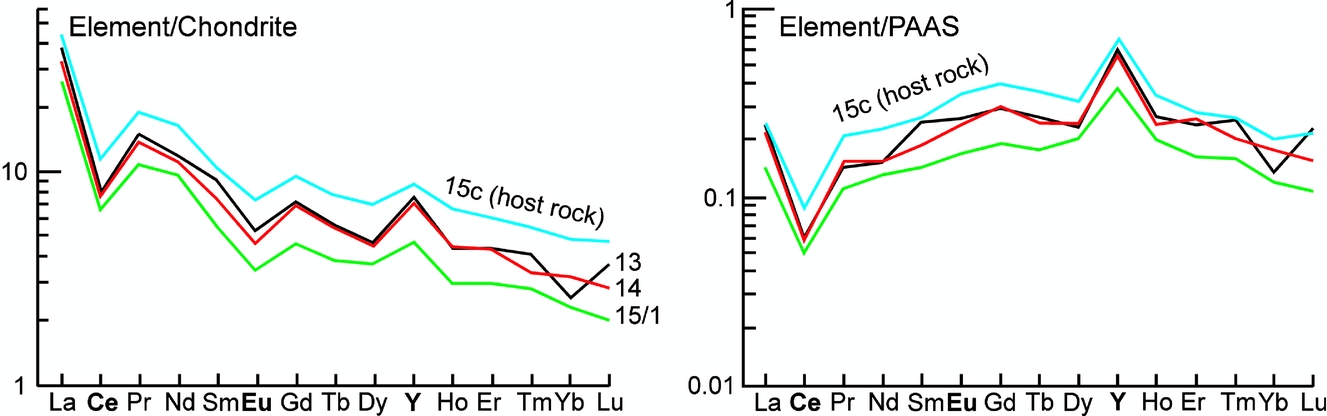
The material from the neptunian dykes under study had a total REE content comparable to that of normal seawater (25–26 ppm; Table 5; e.g. Piepgras & Jacobsen, Reference Piepgras and Jacobsen1992) or even lower in the case of the Si-enriched dyke (20 ppm). The same conclusion as above is suggested here on the basis of the PAAS-normalized REE patterns of the material from the dykes which were more or less flat, excluding the Y enrichment. This is similar to carbonate and authigenic marine phases, which mainly produced a seawater-like REE pattern (e.g. Piper, Reference Piper1991; Piper & Bau, Reference Piper and Bau2013). The ΣREE of the host rock was slightly higher (c. 20 %; Table 5), which may reflect the contamination of phosphates in the echinoderm-foraminiferal limestone (Table 5) observed in thin-sections of the rock (Fig. 4).
The post-depositional early diagenetic processes related to redox variations may have caused the remobilization and/or fractionation of REEs between the sediment and water (Sholkowitz, Shaw & Schneider, 1992). During REE fractionation, the relative rate of release increases from Lu to La (light REEs > heavy REEs). Similarly, during reoxygenation, removal of dissolved REEs from both the water column and upper pore waters has the same relative rates from light REEs (LREEs) to heavy REEs (HREEs). Such redox changes in the semi-enclosed environment of fractures could be responsible for variations in the relative abundance of LREEs v. HREEs during precipitation of Fe-rich material into the fractures studied.
5.b.2. Ce anomaly
The characteristic feature of the REE curve is a negative Ce anomaly relative to La and Pr when carbonate minerals precipitate in equilibrium with seawater (e.g. Elderfield & Greaves, Reference Elderfield and Greaves1982; De Baar, Bacon & Brewer, Reference De Baar, Bacon and Brewer1985; Piepgras & Jacobsen, Reference Piepgras and Jacobsen1992; Sholkovitz, Landing & Lewis, Reference Sholkovitz, Landing and Lewis1994). It indicates the oxidation of Ce3+ to the strongly insoluble Ce4+ under oxic to suboxic redox conditions in the open ocean (e.g. Piper & Bau, Reference Piper and Bau2013). The Ce ions are fractionated from each other by their complexation with CO3 2− and HPO4 2− and adsorb on the surfaces of suspended particles (Byrne & Kim, Reference Byrne and Kim1990; Sholkowitz, Shaw & Schneider, 1992; Luo & Byrne, Reference Luo and Byrne2004). The reaction in seawater could be bacterially mediated, especially during warmer periods (Moffett, Reference Moffett1990, Reference Moffett1994). However, in strictly inorganic solutions, the Ce anomaly occurs due to oxidative scavenging on fresh Mn-oxide surfaces (De Carlo, Wen & Irving, Reference De Carlo, Wen and Irving1998). Fractionation of Ce ions in seawater is also related to the depth; the Ce anomaly in seawater becomes increasingly more negative from the surface to abyssal depths, as documented both in ancient sediments (e.g. Jarvis, Reference Jarvis, Rao, Dasgupta, Pant and Choudhuri1984; Mazumdar et al. Reference Mazumdar, Tanaka, Takahashi and Kawabe2004) and modern environments (Piper & Bau, Reference Piper and Bau2013).
The Ce/Ce* values of the material from the neptunian dykes ranged from 0.28 to 0.32 (Table 5), which is typical of oceanic seawater (e.g. Elderfield & Greaves, Reference Elderfield and Greaves1982; Wang, Liu & Schmitt, Reference Wang, Liu and Schmitt1986; Piepgrass & Jacobsen, Reference Piepgras and Jacobsen1992; Piper & Bau, Reference Piper and Bau2013). Similar values were obtained from the lower Turonian limestones (Scaglia Bianca) of a deep carbonate platform in the Umbria–Marche Basin (Hu, Cheng & Ji, Reference Hu, Cheng, Ji, Hu, Wang, Scott, Wagreich and Jansa2009), deposited under a low accumulation rate. With LaN/SmN ratios of 0.97–1.18 (Table 5) the material studied did not have similar Ce anomaly values, which indicates that diagenesis had no effect on the Ce anomaly.
5.b.3. Y/Ho ratio
The Y/Ho ratio is considered an indicator of Y fractionation and the relative continental influence on the REE content of carbonate sediments. Ho belongs to the third tetrad and behaves coherently, whereas Y fractionates from them in marine reaction systems. The carbonates, which are free from terrigenous components, displayed values from 44 to 74 (Kawabe, Kitahara & Naito, Reference Kawabe, Kitahara and Naito1991; Bau, Reference Bau1996; Nothdurft, Webb & Kamber, Reference Nothdurft, Webb and Kamber2004). In the samples studied the Y/Ho ratio was high (38.0–46.7; Table 5), close to the values of seawater.
In summary, the low REE content and chondrite- and PAAS-normalized REE + Y patterns with a negative Ce anomaly and high Y/Ho ratio indicate the authigenic removal of REEs from the water column and early diagenesis. There is a lack of data suggesting terrigenous or hydrothermal REE sources for the infilling material (e.g. Piper, Reference Piper1974 a, b; Palmer, Reference Palmer1985; Bąk, Reference Bąk2007).
5.c. Possible hydrothermal source of Fe and silica
5.c.1. Geochemical indices
The most characteristic feature of the material filling the dykes is the presence of hematite as aggregates or single microcrystals, which are associated with low crystalline silica or microcrystalline quartz. They create encrustations along all dyke walls.
The formation of hematite in the dykes could be related to the fluid transportation of iron as FeCl3 together with silica gel and the precipitation of iron hydroxide and later hematite (Fe2O3), according to the reaction: 2FeCl3 + 3H2O → Fe2O3 + 6 HCl. At low pH, the precipitation of silica can be achieved because the iron hydroxide will adsorb greater quantities of silicic acid (Harder, Reference Harder1964). This process could additionally be responsible for dissolution of calcium carbonate (according to reaction CaCO3 + 2HCl → CaCl2 + CO2 + H2O), suggested earlier based on microfacies analysis. Hematite from ferric chloride media precipitates at temperatures below 100 °C (Riveros & Dutrizac, Reference Riveros and Dutriyzac1997; Liu et al. Reference Liu, Etschmann, Brugger, Spiccia, Foran and Mcinnes2006). This would suggest that a low-temperature hydrothermal solution is the carrier of Fe ions.
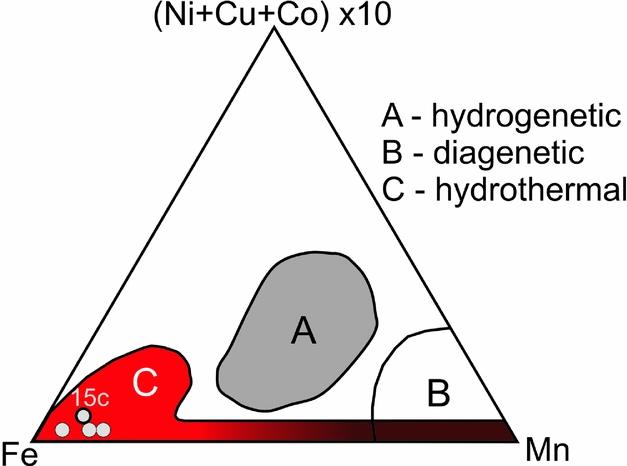
The possibility of a hydrothermal origin of the Fe and Si encrustations is supported here by the chemical composition of the dykes, that is, very low concentrations of Ti (Table 5) and transition elements, and their position in the hydrothermal-origin region of the Mn–Fe–(Co + Ni + Cu)x10 ternary diagram (Fig. 10).
Partial bulk chemical compositions of Fe–Mn encrustations of neptunian dykes (circles) and host rock (HGas-15c) plotted on conventional ternary diagram from Bonatti, Kraemer & Ryde (Reference Bonatti, Kraemer, Ryde and Horn1972) and Bonatti et al. (Reference Bonatti, Zerbi, Kay and Rydell1976).
Fe and Si enrichments are known to originate from hydrothermal vents including mid-ocean ridge settings, intraplate submarine volcanoes, continental margins and island arcs (e.g. Alt, Reference Alt1988; Hekinian et al. Reference Hekinian, Hoffert, Larque, Cheminee, Stoffers and Bideau1993; Fortin, Ferris & Scott, Reference Fortin, Ferris and Scott1998; Kennedy, Scott & Ferris, Reference Kennedy, Scott and Ferris2003; Dekov et al. Reference Dekov, Petersen, Garbe-Schonberg, Kamenov, Perner, Kuzmann and Schmidt2010; Zeng et al. Reference Zeng, Ouyang, Yin, Chen, Wang and Wu2012). They also occur as components of hydrothermal vents in shallow-water environments in close proximity to submarine volcanic activity (e.g. Tarasov et al. Reference Tarasov, Propp, Propp, Zhirmunsky, Namsaraev, Gorlenko and Starynin1990, Reference Tarasov, Gebruk, Mironov and Moskalev2005; Fitzsimons et al. Reference Fitzsimons, Dando, Hughes, Thiermann, Akoumianaki and Pratt1997; Dando, Stüben & Varnavas, Reference Dando, Stüben and Varnavas1999; Pichler, Veizer & Hall, Reference Pichler, Veizer and Hall1999; Savelli, Marani & Gamberi, Reference Savelli, Marani and Gamberi1999; Prol-Ledesma et al. Reference Prol-Ledesma, Canet, Torres-Vera, Forrest and Armienta2004).
5.c.2. Palaeoenvironmental indices
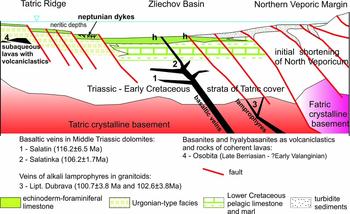
We propose that the Fe and Si enrichments in the neptunian dykes studied could be related to the migration of hydrothermal fluids connected with submarine volcanic activity at a neighbouring basin, which took place during middle Albian time. Such activity occurred during Aptian – late Albian time in the Zliechov Basin (Fig. 11), an adjacent sedimentary area for the Tatric Ridge. The volcanic activity was documented by the K–Ar radiometric ages of basalts occurring as veins in the Middle Triassic dolomites of the Križna Nappe (116.2 ± 6.5 Ma and 106.2 ± 1.7 Ma; Saltin Mountain and Salatinka Mountain in the Nizke Tatra Mountains: Bujnovský, Kantor & Vozäft, Reference Bujnovský, Kantor and Vozäft1981), which were accompanied by volcanoclastics. Similar radiometric data came from alkali lamprophyre veins crossing the granitoids, which directly underlay the sedimentary strata in the same area (100.7 ± 3.8 Ma and 102.6 ± 3.8 Ma; Liptovska Dubrava in the Nizke Tatra Mountains; Spišiak & Balogh, Reference Spišiak and Balogh2002) (Fig. 11).
Schematic middle Albian cross-section displaying position of suspended hydrothermal activity near the Tatric Ridge, related to magmatic and volcanic processes in the surroundings. Interpretation based on data from the Tatra Mountains (Madzin, Sýkora & Soták, Reference Madzin, Sýkora and Soták2014) and the Križna Nappe (Bujnovský, Kantor & Vozäft, Reference Bujnovský, Kantor and Vozäft1981; Spišiak & Balogh, Reference Spišiak and Balogh2002); geology after Michalík (Reference Michalík2007) and Prokešová, Plašienka & Milovský (Reference Prokešová, Plašienka and Milovský2012).
The radiometric ages of basalts with volcanoclastics (Križna Nappe; Nizke Tatry Mountains) were confirmed by palaeontological studies (summary in Bujnovský, Kantor & Vozäft, Reference Bujnovský, Kantor and Vozäft1981). The youngest volcanic episode was recorded there within carbonate sediments, which contained stratigraphically important planktonic foraminiferal species Ticinella roberti (Gandolfi) and Thalmannammina ticinensis Gandolfi. Both species are found in upper Albian volcanoclastic rocks, based on the correlation of the foraminiferal zonation with other biozonations and chronostratigraphy (Gale et al. Reference Gale, Bown, Caron, Crampton, Crowhurst, Kennedy, Petrizzo and Wray2011).
The volcanic and hydrothermal activities were linked to extensional faults (Fig. 11) during Triassic – middle Cretaceous times, documented by the occasional occurrences of limestone breccia in the Zliechov Basin (Michalík, Reference Michalík2007). The exhalative hydrothermal vents along such extensional faults with accumulated Fe–Mn crusts occurred here much earlier during Toarcian time (Jach & Dudek, Reference Jach and Dudek2005). The age and palaeogeographic position of volcanic activity in the Zliechov Basin and their chemical composition is similar to other Lower Cretaceous alkaline basalts occurring in the Outer (Silesian Nappe) and Central Western Carpathians, including the Tatric Ridge (Madzin, Sýkora & Soták, Reference Madzin, Sýkora and Soták2014), and also in the Eastern Alps, Eastern Carpathians and Pannonian Basin (summary in Spišiak et al. Reference Spišiak, Plašienka, Bucová, Mikuš and Uher2011). This alkaline volcanism coincided with an extensional/rifting tectonic regime that finally led to the opening of the Penninic oceanic rift arms (Froitzheim, Plašienka & Schuster, Reference Froitzheim, Plašienka, Schuster and McCann2008; Prokešová, Plašienka & Milovský, Reference Prokešová, Plašienka and Milovský2012). The extensional character of the faults with hydrothermal vents lasted until late Albian time in the Zliechov Basin and its surroundings. Iron hydroxides of that age, in the form of covers, coatings and fillings, are present inside upper Albian stromatolites and the underlying echinoderm-foraminiferal limestone within the Tatric sediments (Bąk et al. Reference Bąk, Bąk, Górny and Stożek2015). The extensional regime in the Zliechov Basin and the Tatric Ridge could be related to the initiation of a convergent zone along the Fatric–Veporic margin (Fig. 11), where the Zliechov basement (crust of the Fatric Nappe) was thrust underneath the North Veporic orogenic wedge (Plašienka, Reference Plašienka1997), and the pelagic sedimentation in the Zliechov Basin and the Tatric area was gradually replaced by fine-grained turbidites of the Poruba Formation and the Pisana Member of the Zabijak Formation; the latter type of sedimentation occurred at greater depths. On the Tatric Ridge, an increasing depth began to form starting during middle Albian time when the seafloor was generally within the epipelagic zone (Masse & Uchman, Reference Masse and Uchman1997). During late Albian time, the bottom deepened to the mesopelagic zone (Bąk, Reference Bąk2015) and remained at that depth during the entire Cenomanian Age with gradual continued deepening.
6. Conclusions
Initiation of orogenic processes along the North Veporic orogenic wedge during early–middle Albian time (Central Western Carpathians) caused extensional deformation of sedimentary strata and their crystalline basements in the Zliechov Basin and Tatric Ridge (Michalík, Reference Michalík2007; Plašienka, Reference Plašienka1997). The extensional character of these deformations led to volcanic activity in the Zliechov Basin (Bujnovský, Kantor & Vozäft, Reference Bujnovský, Kantor and Vozäft1981; Spišiak et al. Reference Spišiak, Plašienka, Bucová, Mikuš and Uher2011), which could be associated with hydrothermal vents. In our interpretation, the iron and silica fluids from such vents migrated to the submerged Tatric Ridge; in the mesopelagic zone, the deepest part of this submerged ridge was characterized by carbonate sedimentation. In the areas that underwent extensional fracturing, fissures opening in the solid middle Albian carbonate substrate were filled with iron oxyhydroxides, amorphous silica and various clasts derived both from overlying sediment and, due to the leaching of micrite from the host limestone, inside the dykes. The microfacies study and chemical data of the filling in the neptunian dykes confirmed an absence of terrigenous components inside the dykes. The REE signatures from the reddish fillings suggested their authigenic removal from the water column. Taking into account the hydrothermal–hydrogenetic source of filling material in the dykes studied, we predict that further study of other dykes in the Albian Tatric sediments will result in the discovery of similar filling origins, which have been regarded so far as recrystallization products of emergence and karstification.
Acknowledgements
The study was supported by the National Science Centre, Poland to KB (grant 2011/01/B/ST10/07405) and the Ministry of Science and Higher Education to MB (Project DS-AGH University of Science and Technology, WGGiOŚ-KGOiG No. 11.11.140.173) and LNN (WGGiOŚ-KMPiG No. 11.11.140.139). We would like to thank two anonymous reviewers and the journal editor Phil Leat for constructive comments and suggestions.
Declaration of interest
None



