

1. Introduction
In the 1960s, the federal TRIO programs were created as part of the War on Poverty. Designed to complement the federal financial aid system, TRIO originally included Upward Bound, Talent Search, and Student Support Services (Maxfield, Cahalan, Silva, Humphrey & Thomas, Reference Maxfield, Cahalan, Silva, Humphrey and Thomas2000). The goal of these programs was to provide more equitable opportunities for students from low-income households to attend college. As of 2014, federal funds support eight TRIO programs, seven of which serve youth (U.S. Department of Education, 2014).Footnote 2 Together, TRIO programs supported 760,000 individuals with $786 million in federal spending from 2013 to 2014.Footnote 3 Recently, as policymakers work toward the reauthorization of the Higher Education Act, debate has ensued over how TRIO should be restructured, revised, or even terminated (Haskins & Rouse, Reference Haskins and Rouse2013; Harris, Reference Harris, Kelly and Carey2013, Reference Harris2014; Harris, Nathan & Marksteiner, Reference Harris, Nathan and Marksteiner2014).
Despite their long history and scale, TRIO programs have received little attention from economic evaluators.Footnote 4 In a recent working paper on Upward Bound, Harris et al. (Reference Harris, Nathan and Marksteiner2014) reanalyze the evaluation data published by Seftor, Mamun and Schirm (Reference Seftor, Mamun and Schirm2009) and show that the economic benefits exceed the costs. While Upward Bound received the most funding per student (over $4,200) in 2013, Student Support Services received the largest budget allocation ($274.7 million) and Talent Search served the largest number of participants, 299,683 youth (U.S. Department of Education, 2014). Related evidence suggests that there are potentially many disadvantaged students under-enrolling in college (Hoxby & Avery, Reference Hoxby and Avery2013), that these students would gain especially large benefits, and that counseling programs may be especially helpful in boosting achievement in high school (see respectively, Dale & Krueger, Reference Dale and Krueger2011; Carrell & Hoekstra, Reference Carrell and Hoekstra2014). Hence this paper provides a comprehensive evaluation of the Talent Search TRIO program, focussing on its costs, benefits, and cost-effectiveness.
Talent Search, provided by postsecondary institutions and community organizations at over 500 sites nationally, targets high school completion, applying for financial aid, applying to postsecondary institutions, and enrolling in college. The program is grant-funded by site, allowing flexibility with respect to resource use (e.g., staff, materials), services provided, service location, length of participation, and the grade levels served. In 2010, the U.S. Department of Education funding allocated to Talent Search program sites was about 17% of all TRIO funding and, at $142 million, represents 2% of all federal funding on postsecondary education. However, funding per student has remained close to $400 per student each year since 2000.Footnote 5 While the funding per student has not varied substantially on average, the site-level per student funding in 2010 ranged from $230 to $800.
Importantly, these federal investment amounts are unlikely to cover all the resources used to provide Talent Search across the different sites. Talent Search programs rely on, and take advantage of, resources within schools and across college campuses, as well as solicit in-kind resources (such as community volunteers). These resource amounts, which may be influential in making the program successful, are an important consideration when calculating the social return to Talent Search and when deciding on the optimal level of program funding.
In an impact evaluation of Talent Search, the program was found to increase high school completion, applications for financial aid, postsecondary enrollment, and enrolling in a 4-year versus a 2-year postsecondary institution (Constantine, Seftor, Martin, Silva & Myers, Reference Constantine, Seftor, Martin, Silva and Myers2006). The results varied substantially among sites, ranging from large positive impacts to negative impacts, with an overall conclusion that Talent Search is effective. However, to our knowledge, and despite the program’s 50-year history, no prior study has investigated the resources required for Talent Search and how actual resource amounts might vary across sites. Thus, it is unclear whether the higher performance reported by Constantine et al. (Reference Constantine, Seftor, Martin, Silva and Myers2006) justifies the costs, that is, whether Talent Search passes a cost-benefit test. Given its flexibility and the variability in site-level impacts, it seems plausible that some Talent Search sites will utilize more resources than other sites and hence that some sites will be more cost-effective than others. Thus, an important component of an economic evaluation of Talent Search is a site-specific cost-effectiveness analysis.
In this paper, we address each of these issues. First, we describe the main features of Talent Search. Next, we report on a detailed cost analysis that follows the widely accepted ingredients method for costing (Levin & McEwan, Reference Levin and McEwan2001). Based on the impacts identified by Constantine et al. (Reference Constantine, Seftor, Martin, Silva and Myers2006) we calculate shadow prices for attainment, derive total present value social and fiscal benefits, and estimate the net present value (NPV) of Talent Search. Next, we draw on site-specific variation in costs and effects to derive cost-effectiveness ratios. These ratios are subject to further sensitivity testing, drawing on the methodological advances in cost-effectiveness analysis in health research (Briggs, O’Brien & Blackhouse, Reference Briggs, O’Brien and Blackhouse2002; Gray, Clarke, Wolstenholme & Wordsworth, Reference Gray, Clarke, Wolstenholme and Wordsworth2011). In the final section, we consider key methodological issues and how economic evaluation of educational programs might be improved with respect to shadow pricing, statistical testing, and treatment contrast.
2. Talent Search
Talent Search is intended to help students who have interest in attending and the potential to go on to college but come from disadvantaged backgrounds that may not adequately prepare them for the demands of completing high school, enrolling in postsecondary school, and obtaining higher education qualifications. More specifically, the program targets low-income first generation (LIFG) students who would be the first generation in their families to attend college and who are from impoverished households.Footnote 6 At least two thirds of the students served by each Talent Search program site must qualify as LIFG.Footnote 7 Students can be in either middle or high school.
Once students are recruited to participate, the Talent Search program provides a range of services to increase rates of high school graduation and postsecondary enrollment and to increase awareness of financial aid and knowledge of money management. The theory is that targeted assistance – instruction and guidance regarding career opportunities and financial aid, as well as clear information about the requirements for college – better prepares students to complete high school, apply for financial aid, and enroll in postsecondary education.
Each program site has considerable flexibility in how they operate their Talent Search program. Applications for funding must identify a target area and propose how Talent Search will operate at that site based on the demographics and needs of the targeted population. The site proposal must also designate targeted schools and describe the student populations in those schools (including the proportion of LIFG students). The proposal should specify the number of counselors who will provide services to students and the administrative organization of the program site. Overall, this leaves discretion to the Talent Search providers so that they can design their programs to best suit their population’s needs and achieve the program’s main goals: high school completion and postsecondary enrollment.
Program variation reflects the demographic characteristics of the population of students served. Obviously a national program will exhibit regional variation that reflects local school quality, college availability, and local labor markets. Providers also have considerable discretion as to which students to serve. For example, each site has the authority to determine the one third of students served who do not need to qualify as LIFG. Some sites also enforce a participation criterion based on grades earned in school. Student recruitment practices may also differ. Generally, students are recruited to participate by the Talent Search counselors, but guidance counselors and teachers at the target schools also play a role.
Sites can serve students across the range of grades, from grades 6 through 12. All sites target high school students but some sites focus more on middle school students and others on providing services across grades (i.e., when a given student progresses through 10th, 11th, and then 12th grades rather than just when a student is in 12th grade). For example, one site in our sample granted services to all grade levels, but provided more frequent meetings for students in high school and more intensive follow-up with seniors during the application process. Another site served only grades 8 through 12, providing the same number of meetings across grades but with differentiated materials for each grade.
The longitudinal nature of the program focussing on a cohort of students varies with site as well. Some sites try to form a strong cohort of students who participate as a group through graduation. Other sites must accommodate many new students in targeted high schools who did not attend a targeted middle or junior high school. This may depend on the way the site targets schools and the number of high schools served versus middle or junior high schools.
Sites can serve few or many schools. While the total number of schools targeted typically depends on the local population density, most sites serve around 15 or fewer schools. For example, one site may serve a large portion of the target students at a few rural schools while another may serve a few students in clusters at many schools (up to 30 schools or more). Most sites serve more high schools than middle schools, junior high schools, or intermediate schools. However, three sites served similar numbers of each type of school. Because the program can follow students through school, some sites follow students across and out of their schools. For example, some sites serve youth who have dropped out of school; others continue to serve target students who are temporarily relocated to a nontarget school.
Fundamentally, the programs vary with respect to the content of the sessions directed by each Talent Search counselor. Although these sessions are intended to impact the main objectives of the program (e.g., high school graduation for college enrollment), the specific services and the amount of time spent with Talent Search counselors vary. Talent Search counselors provide services such as counseling; informing students of career options; financial awareness training; taking students on cultural trips and college tours; assisting students and families with the Free Application for Federal Student Aid; preparation or tutoring for college entrance exams; and assistance in selecting, applying to, and enrolling in college. Some sites provide these services at schools by pulling students out of class; others provide services at the Talent Search site office outside of school.
These differences in program design will almost certainly translate into differences in resource use. Sites can determine the organization, qualifications, and responsibilities of personnel. Some directors are responsible for a caseload of students, while others focus solely on managing the program. Some sites employ an assistant director while others do not. The use of facilities will vary depending on whether Talent Search is delivered through schools or on college campuses.
In summary, Talent Search is a large-scale program that allows each site the flexibility to mold the design of the program to fit the contours of their sponsoring organization and the needs of the target population. These characteristics strongly validate an economic perspective for evaluation of costs, benefits, and effects. First, analysis of costs yields direct evidence on the inputs used; this provides a detailed description of the program and allows policymakers to better understand its components and design optimal funding formulas. Second, a large-scale, permanent program raises the stakes as to whether the program yields benefits that justify the expenditures.Footnote 8 Third, the variability of the program makes cost-effectiveness analysis important because when sites vary in resource use and in effectiveness, it is unclear which sites will be the most efficient.
3. Costs of Talent Search
For our cost analysis, we apply the ingredients method to estimate the costs of Talent Search (Levin, Reference Levin, Guttentag and Struening1975; Levin & McEwan, Reference Levin and McEwan2001). The ingredients method was developed to provide a straightforward but rigorous method to conduct cost-effectiveness analyses in education and other public sectors (Levin, Reference Levin, Guttentag and Struening1975, Reference Levin and Light2001, Reference Levin and Alkin2013; on the many errors and inaccuracies in cost accounting, see Harrington, Morgenstern & Nelson, Reference Harrington, Morgenstern and Nelson2000). The method is intended to provide detailed information about all of the ingredients required to replicate an implementation of a program (not what is spent at each specific site). This method requires collection of data on each of the inputs used at the site level and (separately) data on the opportunity cost of each input. Generally, this method is more accurate than reliance on budgetary data (Harris, Reference Harris2009, Reference Harris, Kelly and Carey2013).Footnote 9 In the case of Talent Search, budgetary data will not include all the resources provided by the sponsoring organization, the targeted middle and high schools, or the local community volunteers; it may also mask variation in resource use by site.
This analysis examines the costs of Talent Search from the perspective of resource use at the project sites (so federal government spending on monitoring and compliance is not included). The costs of the program are estimated as incremental to secondary school. In the absence of alternative information, we follow the impact evaluation and assume that the students in the comparison group received no incremental resources beyond those made available to Talent Search participants. Also, the costs of student time are not included as the wages lost for participation are likely minor due to the age of the children served and the majority of services occurring during school time.
3.1. Applying the ingredients method
Data on ingredients were collected from interviews with personnel at nine Talent Search sites. These sites were selected because they were part of the 2006 program evaluation and so it is possible for us to link the cost analysis to evidence on effectiveness. The evaluation included 15 sites in Texas (10) and Florida (5). This analysis includes all nine sites that continue to receive funding and that had a senior staff member who was able to participate in the interview process.Footnote 10
The nine sites were in Texas (6) and Florida (3). All nine sites were hosted by colleges and had been operating for over 15 years. Based on each site’s annual performance report submitted to the U.S. Department of Education from 2005 to 2008, about 20% of the students served annually were in middle school; 70% of the students served were minorities; and (as required) 75% of the students served met the criteria for LIFG status. Seven sites served grades 6 through 12 (with one starting in grade 7 and the other in grade 8). On average, the sites served 15 schools and 800 students but ranged from 10 to more than 30 schools and from around 600 to over 1,000 students. While site-level data are not available for project sites nationally, the national average number of students served per site was 780 in 2010.
Ingredients data were collected from publicly available documents and from interviews with site-level staff. Ingredients were categorized according to type such as personnel, materials, facilities, and other inputs. The analysis distinguishes between costs that were contributed in-kind and the costs borne by the Talent Search program site directly to illustrate how the costs of the program were financed.
Each ingredient was matched with a national market price (2010 dollars) that was selected to reflect the qualitative characteristics of the ingredient. Prices were collected from publicly available databases (e.g., the Department of Labor’s Bureau of Labor Statistics, the National Center for Education Statistics [NCES], and the College and University Professional Association for Human Resources). When a national price did not exist for a specific ingredient, the price of the most similar ingredient available, a shadow price, was used (Levin & McEwan, Reference Levin and McEwan2001). For costly ingredients, such as Talent Search staff, available budget data were reviewed when selecting shadow prices from national databases to ensure that the prices selected were representative of actual expenditures. Ingredients that lasted longer than a year, such as facilities and computers, were amortized using a rate of 5%.Footnote 11
After each ingredient was described, quantified, and given a cost based on the quantity described and price data available, all ingredients were summed to provide a total site-level cost per year. Each site’s total annual cost was divided by the total number of students served by the site in 2010 to calculate the cost per student for 1 year of Talent Search. While the annual average cost per student is useful, Talent Search is a multiyear program that serves some students for up to 7 years. Therefore, the annual cost per student was transformed into a present value at age 18 to account for the program’s length of treatment exceeding 1 year, using a continuous discounting formula and a 3% discount rate.
Critically, the number of years of treatment students received was not clear from the impact evaluation; some students received 2 years of treatment and others may have received many. Thus, during interviews on ingredients, participants were asked to report the average number of years students participated at each site. Sites reported that students participated between 4 and 7 years on average. No site reported as little as 1 year and all sites reported that students typically remained in the program after joining.Footnote 12
3.2. Ingredients and site-level variability in resource allocation
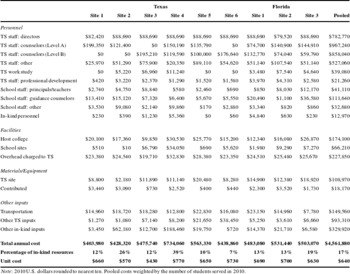
Table 1 shows the ingredients for the categories of personnel, facilities, materials and equipment, and other inputs used to implement Talent Search at each site for 1 year in 2010 national prices. Per year, Talent Search costs $640 per student on average, weighted for differences in the number of students served by each site in 2010. Notably, sites were using differing bundles of ingredients and obtained differing levels of contributed ingredients based on the local resources available.
Personnel. Personnel ingredients, such as Talent Search staff, school staff, and community volunteers, were the largest category of ingredients, accounting for almost two thirds of costs on average. All sites employed a director and program counselors. The student-to-counselor ratio ranged from 150 to 375 (with a mean of around 250 students). There were two types of program counselors or advisors due to differences in education levels, which was related to differences in experience and responsibilities. The first, level A, indicates that the Talent Search counselor has a master’s degree. The second, level B, indicates that the Talent Search counselor has a bachelor’s degree. These differences, as well as years of experience, were accounted for in pricing. Sites tended to utilize differing combinations of the two levels of Talent Search counselors. Two sites had only level A counselors and two sites had only level B counselors. Five sites had a mix of both.
Ingredients by site.

Note: 2010 U.S. dollars rounded to nearest ten. Pooled costs weighted by the number of students served in 2010.
Sites employed different numbers or types of other personnel, such as administrative support, IT support, tutors, other college staff, or Federal Work Study students. Notably, there was wide variation in utilization of support staff and professional development activities for Talent Search staff, such as attending regional conferences and other TRIO conferences. Spending per student varied by a factor of more than five for these ingredients.
School staff at the target schools who were not paid from Talent Search funding, such as guidance counselors and principals, were involved in the day-to-day operations of Talent Search. Some teachers invited Talent Search into their classrooms, offered free tutoring to Talent Search students, and aided in program recruitment. The involvement of school principals varied from cursory relations to formal meetings. Some sites were able to readily access student data, such as attendance and grades; other sites required the assistance of office staff to obtain regular reports on students’ progress in school. All sites found the schools’ guidance counselors to be an integral part of the program’s success. The guidance counselors often served as liaisons between the schools and Talent Search counselors, assisting with recruitment, pulling out students, obtaining assistance for students, obtaining data on students, and attending a field trip or a program event. The time guidance counselors devoted to the program varied substantially, ranging from 18 to 600 hours per year with an average of around 200 hours per year. Sites also varied in their reliance on community leaders or other personnel.Footnote 13
Facilities. Program sites utilized two types of facilities: office space at the host college and space for implementation at the target schools. Some schools designated space and time for the program to serve students, such as an empty classroom during an elective. Other schools were not able to designate space or time for the program; in those schools, the students would be served in a corner of the lunchroom or a corner of the library, or they would use the auditorium.Footnote 14
Materials and equipment. Materials and equipment varied quite substantially across sites. The two sites with the highest direct costs in this category had high quantities of ingredients such as school supplies for students, technology and computing equipment, printed materials, and postage. Almost all sites reported using some kind of student data management software to keep track of students as they progressed through the program.
Other inputs. All sites provided some transportation for students. Mostly, transportation was provided to students for a day trip or a longer overnight stay to visit colleges. Some sites provided transportation to program events. One site provided transportation for students to take the college entrance exams. All costs for transportation were assigned as direct costs to the Talent Search program. If some costs of transportation were in fact completely contributed by the school system or the host college, the distribution of costs to Talent Search may be overestimated. However, the costs are real costs to the program and were most likely borne by the program itself rather than contributed in-kind.
Some programs were able to secure in-kind contributions from the college hosting the program or other organizations for admission fee waivers, college scholarships, or college housing waivers. One host college provided scholarships to low-income Talent Search students to cover tuition and fees.
Direct costs versus in-kind contributions. About 83% of the costs of Talent Search were borne directly by the program. The remaining 17% of the program’s costs were for ingredients contributed to the program in-kind. As described above, the in-kind contributions were ingredients such as school staff time, space at the targeted schools, community volunteers, scholarships, test fee waivers, admission fee waivers, and give-away items. The distribution of the financial burden varied widely from 7% to 39% of resources not directly funded by the Talent Search site.
Hence, funding allocations – which only cover direct expenditures – are estimated to be below the full resource requirement by one fifth. Moreover, this shortfall varied because some sites utilized or had access to a more resource-rich environment with volunteers and scholarships than others. Because access to scholarships and other in-kind contributions are part of the intervention and likely related to the effects, these ingredients are included in the program’s costs and in our examination of the program’s NPV and cost-effectiveness. Therefore, although federal funding does not vary substantially per site, resource use for Talent Search implementation does.
3.3. Present value costs per participant
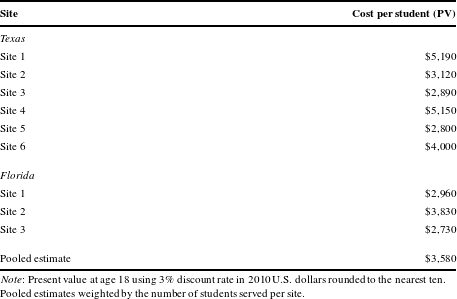
The bottom row of Table 1 shows the average cost per participant per year. However, students in Talent Search do not typically participate for just 1 year and so the cost per youth must be multiplied by the average number of years enrolled in the program.
Present value cost per student.

Note: Present value at age 18 using 3% discount rate in 2010 U.S. dollars rounded to the nearest ten. Pooled estimates weighted by the number of students served per site.
Table 2 shows the cost per student adjusted to present values to account for multiple years of receiving the intervention. The pooled cost per student is $3,580. This is the amount of resource required per average Talent Search enrollee and hence the relevant amount against which any impact evaluation should be compared. Table 2 also shows how this amount varies with site, from a low of $2,730 to an upper bound of $5,190. During interviews, each site reported the average number of years students participated in 2010, ranging from 4 to 7 years. Because there is uncertainty in this estimate, we include a sensitivity test examining how the pooled cost and cost-effectiveness estimates change when the present value costs are estimated with 1 year (the same as the annual cost reported above) and 3 years of participation.
4. Impact evaluation of Talent Search
At the request of the U.S. Congress, Mathematica Policy Research evaluated the effect of Talent Search on high school completion, applying for financial aid, enrolling in postsecondary education, and enrolling in a 4-year versus a 2-year institution (Constantine et al., Reference Constantine, Seftor, Martin, Silva and Myers2006). The evaluation sample was 6,186 students from 22 Talent Search project sites in three states.Footnote 15 The study estimated a propensity score matching model to longitudinally follow these students from grade 9 through high school completion and entry into college.Footnote 16 The propensity score matching model paired participants with all nonparticipants who had a similar likelihood of participating in the program and were from the same high schools as participants.Footnote 17 The impacts of Talent Search in each state were then estimated with an ordinary least squares regression model with robust standard errors to account for clustering of students by project site (Constantine et al., Reference Constantine, Seftor, Martin, Silva and Myers2006, pp. 14 and 15).
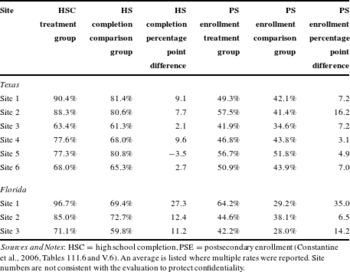
This analysis utilizes the results from the evaluations conducted in Texas and Florida of the effect of Talent Search on high school graduation and postsecondary enrollment.Footnote 18 In both states, Talent Search had positive impacts on both high school completion and postsecondary enrollment.Footnote 19 However, the effects varied widely among sites in both states.
Site-level effectiveness results for the cost study sample.

Sources and Notes: HSC
 $=$
high school completion, PSE
 $=$
postsecondary enrollment (Constantine et al., Reference Constantine, Seftor, Martin, Silva and Myers2006, Tables 111.6 and V.6). An average is listed where multiple rates were reported. Site numbers are not consistent with the evaluation to protect confidentiality.
Site-level effectiveness estimates and the pooled effectiveness estimates for both high school completion and postsecondary enrollment for our sample are shown in Table 3. Overall, across the 7,146 participants in our 2010 sample, Talent Search yields 590 new high school graduates and 768 new college enrollees.Footnote 20 Notably, the sites varied in effectiveness: one site in Florida was highly effective; one site in Texas had a negative effect; some sites ranked higher on postsecondary enrollment than high school graduation; and not all sites had statistically significant impacts across the two measures. We use these results – both the average and variance – for the cost-benefit analysis and cost-effectiveness analysis.
5. Benefit-cost analysis for Talent Search
5.1. Method
To derive the economic benefits of Talent Search we apply the well-established lifetime model of high school failure – following the methods and principles listed in Karoly (Reference Karoly2012).Footnote 21 Specifically, we compare lifetime profiles by education level and take the difference between the profiles for a high school graduate or college enrollee and a dropout. We use national earnings data, adjusted for the sex and racial demographics of the Talent Search population. On average, dropouts with low skills face worse economic, social, and personal outcomes, both immediately and over a lifetime. These outcomes, including lower incomes, worse health, greater welfare reliance, and more criminality, can be calculated from social and fiscal perspectives. Here we focus on the social perspective and look at the earnings differences by attainment level.Footnote 22
Students who fail to complete high school by age 18 are classed as dropouts. Assuming Talent Search is purely directed toward improving high school graduation, the comparison group is dropouts versus graduates. If we assume Talent Search is also directed to improve postsecondary enrollment, the relevant comparison group is those who complete high school but do not enroll in a postsecondary institution. The economic consequences of these comparisons are calculated in present value (2010 dollars) at age 18 using a discount rate of 3%. These benefits can then be adjusted for the costs of Talent Search from Table 2 to derive the NPV.
We derive gross earnings profiles by education level. High school dropouts have much lower incomes than graduates, even accounting for ability differences (Altonji, Blom & Meghir, Reference Altonji, Blom and Meghir2012). Many estimates of the annual and lifetime benefit of high school graduation and college are available (Belfield & Levin, Reference Belfield and Levin2007; Oreopoulos & Petronijevic, Reference Oreopoulos and Petronijevic2013; Autor, Reference Autor2014), although few are broken down by race and gender. For this analysis, we use data from the merged March Supplements of the Current Population Survey (CPS) for the years 2009 through 2013. This yields a sample of 1.03 million persons who are categorized into four levels of attainment: high school dropouts, high school graduates, those with some college, and those with a BA degree or above. Using 5-year age bands, lifetime earnings profiles for each attainment level are created up to age 65 and then discounted back to a present value at age 18.Footnote 23 Calculations are performed separately for males and females across four race groups. The average profile for each attainment level is based on the weighting for each sex and race group in Talent Search (predominantly female and minority).Footnote 24
Expressed as present values at age 18, the predicted gross lifetime earnings are $280,900 for high school dropouts, $517,000 for high school graduates, $641,900 for those with some college, and $985,000 for college graduates with BA degrees. These are substantial gaps by education level. These estimates are similar to those calculated elsewhere. Expressed as present values at age 18 in 2010 dollars, the average earnings gain net of college costs for a college graduate over a high school graduate has been estimated at $220,000 (Agan, Reference Agan2013); $377,000 (Webber, Reference Webber2014); and $437,000 (Avery & Turner, Reference Avery and Turner2012). Our equivalent figure – weighted for the demographics of Talent Search participation but not adjusting for the costs of college – is $468,000. Shadow prices for attainment vary because of assumptions about parameter values (e.g., discount rates and productivity growth) and across samples of respondents.
Next, we derive induced additional education costs from staying in school and enrolling in college. We subtract these from gross earnings. We assume 1 year of high school for graduates. We divide postsecondary enrollees into some college and BA-degree groups based on NCES rates and apportion costs of college for each group accordingly.Footnote 25
5.2. Benefit-cost results
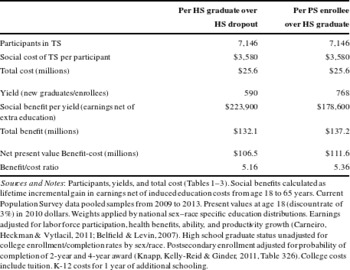
The costs and benefits of Talent Search are summarized in Table 4. For the students in our sample sites, the total social cost of Talent Search is $25.6 million (present value at age 18). From this investment, there is a yield of 590 additional high school graduates. The lifetime earnings gain per high school graduate net of additional education spending is $223,900 (present value at age 18). Therefore, the total social benefit of Talent Search is $132.1 million. This yields an NPV of $106.5 million and a benefit-cost ratio of 5.2.
Net present value of Talent Search.

Sources and Notes: Participants, yields, and total cost (Tables 1–3). Social benefits calculated as lifetime incremental gain in earnings net of induced education costs from age 18 to 65 years. Current Population Survey data pooled samples from 2009 to 2013. Present values at age 18 (discount rate of 3%) in 2010 dollars. Weights applied by national sex–race specific education distributions. Earnings adjusted for labor force participation, health benefits, ability, and productivity growth (Carneiro, Heckman & Vytlacil, Reference Carneiro, Heckman and Vytlacil2011; Belfield & Levin, Reference Belfield and Levin2007). High school graduate status unadjusted for college enrollment/completion rates by sex/race. Postsecondary enrollment adjusted for probability of completion of 2-year and 4-year award (Knapp, Kelly-Reid & Ginder, Reference Knapp, Kelly-Reid and Ginder2011, Table 326). College costs include tuition. K-12 costs for 1 year of additional schooling.
For postsecondary enrollment, the yield from the program is 768 new college enrollees. The lifetime earnings gain per college enrollee net of additional spending on college is $178,600. Therefore, the total social benefit of Talent Search is $137.2 million. The NPV is $111.6 million and the benefit-cost ratio is 54.
On average, Talent Search has a very high benefit-cost ratio when viewed either as an intervention to increase high school completion or college enrollment.
5.3. Sensitivity testing
It is likely that the predicted benefits of Talent Search exceed the amounts calculated here. First, our calculations omit several benefits. Three other benefits of attainment – on health, crime, and welfare – might also be included; see discussions in Trostel (Reference Trostel2010). However, these benefits are much less precisely defined than the gains in earnings. Also, these calculations exclude labor productivity spillovers, the deadweight loss of distortionary taxes, and other consequences (such as intrafamily effects) that cannot be accurately monetized in this analysis. Second, they assume nonmarginal students (those who would have graduated or enrolled in college without the program) receive no benefit from the program. Finally, future projections suggest greater adversity for dropouts Autor (Reference Autor2014); by using current cross-sectional data, we have not incorporated this projection.
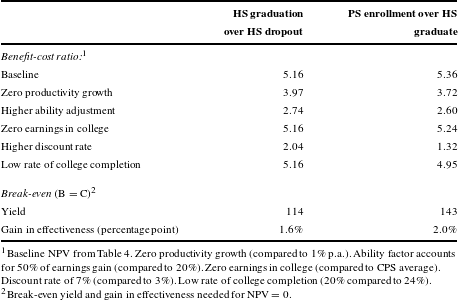
We perform a series of sensitivity tests to illustrate the range of possible benefits and hence the range of possible NPVs. We consider parameter uncertainty by varying the discount rate, labor productivity growth, and the adjustment for ability (alpha factor). We consider model uncertainty by looking at whether Talent Search actually increases college completion Finally, we identify the break-even level of effectiveness, that is, level of effectiveness that would ensure costs and benefits are equal.
Benefit-cost ratio sensitivity tests.

1 Baseline NPV from Table 4. Zero productivity growth (compared to 1% p.a.). Ability factor accounts for 50% of earnings gain (compared to 20%). Zero earnings in college (compared to CPS average). Discount rate of 7% (compared to 3%). Low rate of college completion (20% compared to 24%).
2 Break-even yield and gain in effectiveness needed for NPV
 $=$
0.
The benefit-cost ratios are reported in Table 5. In all tests, the benefits exceed the costs. Unsurprisingly, the most sensitive assumption is the discount rate. When the discount rate is increased to 7%, the benefit-cost ratio falls to 2.0 and 1.3, respectively. Talent Search does not have to be especially effective to pass a cost-benefit test. The bottom panel of Table 5 shows break-even, that is, how effective Talent Search would have to be for the benefits to equal the costs. The yield of new graduates would have to be 114 (not 590) and the yield of new postsecondary enrollments would have to be 143 (not 768). For break-even, we estimate that Talent Search would have to increase the high school completion rate by 1.6 percentage points (from 71%) or increase the college enrollment rate by 2.0 percentage points (from 39%).Footnote 26
6. Cost-effectiveness analysis
We now consider the cost-effectiveness of Talent Search by merging the site-level data on costs with the site-level impact measures on high school completion and postsecondary enrollment from Constantine et al. (Reference Constantine, Seftor, Martin, Silva and Myers2006). Having established that Talent Search has social benefits that exceed its costs, we now focus on the variation in cost-effectiveness across the sites.
Cost-effectiveness of Talent Search by site.

Note: Present values at age 18 using a discount rate of 3% in 2010 U.S. dollars rounded to the nearest ten. Pooled estimates weighted by number of students served per site.
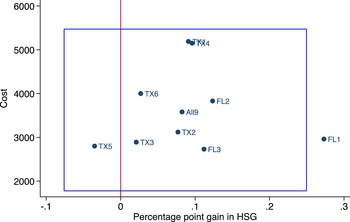
Cost-effectiveness plane Talent Search (HS graduation).

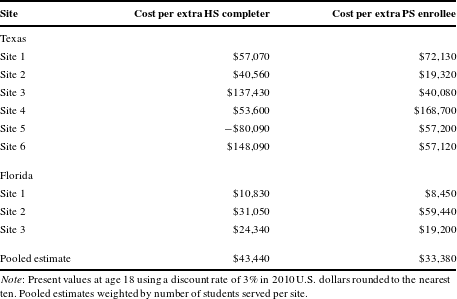
Table 6 shows the costs per youth and the yields in terms of additional high school graduation and postsecondary enrollment. On average, the estimated cost to produce an additional high school completer is $43,440 and the cost to produce an additional postsecondary enrollee is $33,380. These amounts are of course significantly below the present value benefits of Talent Search.
Yet, even within this small sample, there is considerable variation in cost-effectiveness. The cost-effectiveness ratios for high school graduation range from
 $-$
$80,090 to
 $+$
$148,090 and the cost-effectiveness ratios for postsecondary education range from $8,450 to $168,700. Looking at rankings, there is no obvious efficiency ordering across the sites for both outcomes. Site rankings in cost-effectiveness were not stable for all sites across the two outcomes.Footnote
27
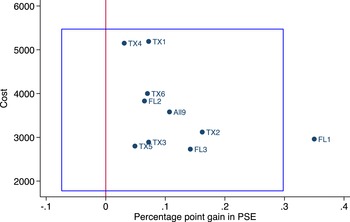
As an illustration, we show in Figures 1A and 1B the variation in cost-effectiveness across the sites (when effectiveness is measured as yield per enrollee rather than absolute yields). One site in particular (FL1) appears to be highly effective despite spending close to the average amount per participant. However, as shown by the box, the standard error on effects crosses the zero horizontal axes and so may not be a statistically significant difference from zero.Footnote
28
Cost-effectiveness plane Talent Search (postsecondary enrollment).

Sensitivity testing for cost-effectiveness ratios.

Note: Present values at age 18 using a discount rate of 3% in 2010 U.S. dollars rounded to the nearest ten. Pooled estimates weighted by number of students served per site.
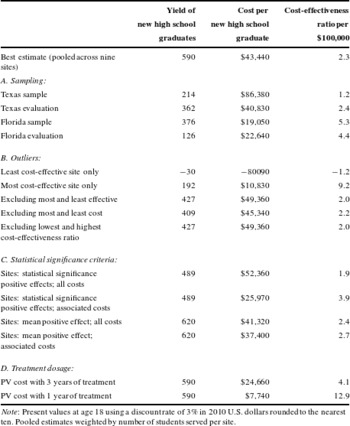
To further illustrate the variation, we apply a series of approaches that are typically used in health cost-effectiveness analysis (Briggs et al., Reference Briggs, O’Brien and Blackhouse2002; Gray et al., Reference Gray, Clarke, Wolstenholme and Wordsworth2011). Table 7 shows a range of possible sensitivity tests for estimating cost-effectiveness ratios. For illustration, we look only at high school graduation. We report the cost-effectiveness ratios and, for ease of comparison, the additional number of high school graduates produced from an investment of $100,000 (the effectiveness-to-cost ratio). The first row shows the best expectation of the cost-effectiveness ratio at $43,440 and the effectiveness-to-cost ratio at 2.3. We consider four classes of sensitivity analysis: sampling, outliers, statistical significance criteria, and dosage.
Panel A of Table 7 shows the variation by sampling. As described above, this analysis utilizes 9 of the 15 sites from the 2006 impact evaluation because all sites were not able to participate. Thus, there are some differences when examining pooled effectiveness measures based on our sample or on the sample utilized in the impact evaluation. The effectiveness-to-cost ratio ranges from 1.2 to 5.3, that is, by more than a factor of four. As shown in Panel B of Table 7, the two outlier sites show the best-case and worst-case scenario. In the worst case, Talent Search is very cost-ineffective; in the best case, it yields over nine additional high school graduates per $100,000. Alternative scenarios – trimming extreme outliers based on effects, costs, and cost-effectiveness ratios – yield results very close to the best estimate.
One area of particular concern for cost-effectiveness analysis is the interpretation of results that are not statistically significant.Footnote 29 To illustrate, panel C of Table 7 includes four sensitivity tests. The most restrictive test is where we consider the effects from only the five sites where the treatment effects are statistically significant, but costs from all nine sites are included (as this was the program designex ante). This reduces the effectiveness-to-cost ratio to 19. Other tests (looking only at sites with statistical significance or ones with positive effects) are equally valid.Footnote 30 Unsurprisingly, these yield much higher effectiveness-to-cost ratios.
Finally, we look at sensitivity with respect to treatment dosage. Our cost analysis had identified dosage as a critical driver of costs per participant and our baseline estimate assumes students participate in Talent Search based on the average length of participation. If the impacts can be achieved with a shorter treatment dosage, the effectiveness-to-cost ratios are substantially larger.
The second approach to analyzing variability is to calculate confidence intervals for the cost-effectiveness ratios using Fieller’s theorem.Footnote
31
Using high school graduation, the 95% confidence intervals for the cost-effectiveness ratios are
 $-$
$4,260 and
 $+$
$46,700 (located around a mean cost-effectiveness ratio of $41,590). For college graduation, the 95% confidence intervals are
 $-$
$10,120 and
 $+$
$44,690 (located around a mean cost-effectiveness ratio of $32,290). Although derived from only nine sites, these confidence intervals also suggest baseline cost-effectiveness ratios should be interpreted carefully.Footnote
32
Cost-effectiveness plane Talent Search (simulated HS graduation).

Cost-effectiveness plane Talent Search (simulated postsecondary enrollment).

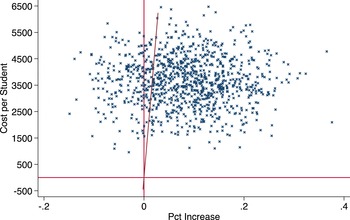
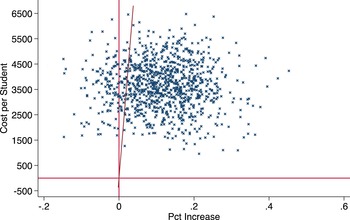
Our final approach is to depict costs and effects for each site graphically. We use the data as shown in Figures 1A and 1B to estimate the range of outcomes. We then simulate 1,000 observations for costs and effects; these observations are drawn from normally distributed variables with the mean and variance equal to that from the nine sites. These simulated cost and effect pairings are shown in Figures 2A and 2B. Also included in the figures is a positively sloped line that represents the ceiling ratio for passing a cost-benefit test (i.e., the combination of costs and effects that would yield a positive NPV). There is a small but nontrivial mass in the north-west quadrant, where Talent Search is less effective and more costly than business-as-usual.Footnote 33 The benefit-cost analysis results further narrow the cost-effectiveness set: Only those interventions to the right of the positively sloped line pass a benefit-cost test. Overall, 78% of the simulations for high school graduation and 85% of the simulations for postsecondary enrollment are in the north-east quadrant and to the right of the cost-benefit threshold line. However, for both high school graduation and postsecondary enrollment, there is a modest probability that Talent Search is inefficient (either because it is costly but has adverse effects or because it is too costly, given its weak effects).
7. Conclusions and recommendations
Despite being in operation for almost five decades and expending over $140 million annually, Talent Search has not received the requisite attention from evaluators. This neglect has been deleterious from at least two perspectives. On one side, critics can plausibly claim that TRIO is ineffective and either should be closed down or replaced with evidence-based programs (Haskins & Rouse, Reference Haskins and Rouse2013). Little rebuttal evidence has been available. From another perspective, there is no mechanism by which research can lead to improvements in program design or implementation. There is almost no information on the optimal dosage of Talent Search, the value of targeting middle over high school students, the importance of partnering with school-based guidance counselors, or the optimal enrollment at each site. Potential efficiency gains – through redesigned funding formulas, shared best practices, or restructured incentives – have not been exploited.
In this paper, we have attempted to address these issues by performing a rigorous cost analysis and accompanying benefit-cost and cost-effectiveness analyses. These analyses yield a comprehensive evaluation of the efficiency of Talent Search. We find that Talent Search utilizes resources contributed in-kind to finance approximately 17% of the program’s costs and that the amount of additional resource varies substantially across sites. Based on the best available effectiveness data, there is a plausible case that Talent Search has a positive NPV although this result is driven by the very high returns to attending college. Talent Search sites vary substantially in their cost-effectiveness (regardless of how effectiveness is measured). Sensitivity testing shows that cost-effectiveness ratios cannot be bounded with precision and may even result in negative ratios.
Moreover, this form of economic analysis has significant conceptual and methodological implications for evaluation research. In the case of Talent Search, our analysis prompts two fundamental conceptual questions. First, what is the goal of Talent Search? And second, what is the alternative to Talent Search?Footnote 34
Our interviews highlighted basic differences as to the ultimate goal of Talent Search. Specifically, some program providers were motivated toward college enrollment and others to ensure students graduated from high school (regarding this as a necessary condition for college readiness). Other providers included – or even gave referral preference to – students seeking GEDs (regardless of evidence that GED recipients are not comparable to high school graduates).
Indeed, the heterogeneity in our findings may reflect both the design and implementation of Talent Search. The grant system is intended to allow each site to adapt the program to the needs of the target population. Thus, variability is expected in each site’s selection and use of ingredients, as well as organizational structure and relationships with the schools and community. Implementation research points to such adaptability as a strong indicator of a program’s success (Durlak & DuPre, Reference Durlak and DuPre2008; McLaughlin, Reference McLaughlin and Lieberman2005). However, such site variability most likely leads to some very cost-effective sites and some sites that are not cost-effective. Thus, considerable attention must be paid to understanding costs, establishing the benefits of the program, and interpreting cost-effectiveness across sites, as well as calculating the uncertainty associated with these economic metrics It also suggests caution in extrapolating from our evidence – on nine sites in two states – to Talent Search provision nationally in the current policy context. Moreover, heterogeneity implies that, for evaluative purposes, sample selection procedures must be appropriate and the sample design should explicitly incorporate cost variation as well as other population variations. To our knowledge, cost variation is almost never included in sample design for educational evaluation (Belfield & Levin, Reference Belfield and Levin2015). More generally, when providers are choosing divergent goals for their program and implementing their programs accordingly, this is a significant challenge for evaluation research.
Our second fundamental issue is that, in order to properly evaluate Talent Search, it is essential to specify the counterfactual. Indeed, given the heterogeneity of youth behaviors (and the array of public, private, and nonprofit support services), this counterfactual should be specified in as much detail as the treatment. Yet, very little information is available on what students would do in the absence of Talent Search. The impact evaluation relied on here assumed (implicitly) that the comparison group attended school, but that no other programs were provided to aid in completion of high school or enrollment in college. This implicit assumption conflicts with the basic economic concept of opportunity cost, that is, valuing resources based on the next best alternative use. Information on the resources used by the counterfactual group is essential to ensure that the cost and cost-effectiveness estimates accurately measure incremental spending. This information should be collected using the economic methods illustrated here.