Introduction
Recent years have brought massive academic interest (Stan and Turcescu Reference Stan and Turcescu2004; Eckert Reference Eckert2015; Tudoroiu Reference Tudoroiu2017; Ertl Reference Ertl2018; Herrmann and Tepe Reference Herrmann and Tepe2018; Abalkina and Libman Reference Abalkina and Libman2020) in very delicate cases of thesis plagiarism by high-ranking politicians in many European countries: Romania (Health Minister, Mircea Beuran; PM Victor Ponta), Germany (Defence Minister, Karl-Theodor zu Guttenberg; Education Minister, Annette Schavan), Hungary (President, Pál Schmitt), Russia (Culture Minister, Vladimir Medinsky), Ukraine (PM, Arseniy Yatsenyuk), and Slovakia and the Czech Republic (many examples, see later). In 2018, the authenticity and originality of Spanish PM Pedro Sánchez’s doctoral thesis defended at the University of Madrid was challenged as well. Moreover, this is not just a European problem. A few years ago, in the USA, the then-Democratic Senator John Walsh faced suspicion that his Master’s thesis was just a compilation of others’ works. Unsurprisingly, all these events were accompanied by adequate media coverage in the respective countries. This is quite understandable since the topic of thesis plagiarism is, on the one hand, a political phenomenon arousing considerable havoc and, on the other hand, a challenge for tertiary education, provoking a public debate on the quality of university studies and ways of its formal completion. Anyway, each of these cases has led to different political and legal consequences.
In this paper, the attention is focused on the cases of two Central European countries which used to share the federation of Czechoslovakia; the Czech Republic and Slovakia. There are several reasons for choosing a comparative view of these two countries: (i) they have seen a notable increase in the number of cases of public officials’ thesis plagiarism in recent years; (ii) in neither of the countries have these cases led to a significant transformation or self-reflection on the part of higher education institutions (hereinafter HEIs); (iii) after 1989, both countries undertook a similar democratic transition of their political institutions, including the transformation and reform of higher education institutions. Thus, the main goal of the paper is an in-depth exploration and analysis of the cases, bearing in mind that when it comes to path dependence, no systematic or analytical overview of the cases has been done which would have made it possible to make relevant evidence-based policy decisions.
The structure of this paper is as follows. In the next section, the term plagiarism is conceptualized in terms of academic ethics. Consequently, various theoretical approaches to political accountability are presented that comprise the main analytical framework for the current cross-country comparative case study. Clarification of this ambiguous concept appears to be necessary as it, on the one hand, evokes individual responsibility of a person (in this case a political representative) and, on the other hand, contains ‘an appeal to change the public’s view of itself from authoritarian collectivist, excluding the other, to a community of all people based on universal solidarity’ (Muránsky Reference Muránsky2019, 248). Subsequently, specific cases of plagiarism of diploma theses exposed in the Czech Republic and Slovakia during the last few years, mainly by the media, are presented. These high-profile cases have been identified through searches of news articles over the past few years, with their penetration into public debate being the main criterion. This enables us to illustrate different approaches to political accountability. In the final section, it is explained that the only substantial solution in both cases was to adopt legislation allowing subsequent withdrawal of a university degree once acquired. The article answers the following research questions: (a) which types of cases occurred in both countries, (b) how they were publicly exposed, and (c) what consequences they had for specific agents, as well as for the tertiary education system as a whole.
Undoubtedly, cases of plagiarism involving politicians could be related not only to political accountability, but also to (academic) dishonesty, to political efficiency, to good governance, or to reforms of the higher education system. However, narrowing the theoretical framework seems to be necessary for several reasons. First, accountability or, more precisely, political accountability is perceived as one of the key principles of good governance (Addink Reference Addink2019, chap. 11). It is, then, important to focus the research on this part of the broadly-defined concept. Furthermore, it was political accountability that appeared in the media coverage of individual cases in both countries as the most frequently referenced term. Second, the academic misbehaviour or breach of academic integrity can take many forms. Generally speaking, it is ‘a complex issue with a variety of contributing factors and with general disagreement about how it can be managed’ (MacLeod and Eaton Reference MacLeod and Eaton2020, 359). In all analysed cases, there were at least suspicions of plagiarism. Although in some cases (e.g. Slovak PM, Matovič) it was later revealed that other types of misconduct were present (thesis written by another person). Third, past and present situation of HEIs, as well as their attitude to the cases will be taken into account. However, any more extensive reflections on tertiary education reform go far beyond this article.
Plagiarism as Academic Misconduct
Research on academic ethics and the prevalence of misbehaviour of individual agents is relatively extensive. Special attention is paid to plagiarism. Although there are different definitions of (Pecorari Reference Pecorari, Pecorari and Shaw2018) and manifold approaches to plagiarism (Gregory Reference Gregory2021), it is generally viewed as a particular sub-category of academic misconduct/dishonesty (Trost Reference Trost2009), as well as ‘a social wrong, defined and enforced extra-legally by different social groups in different ways’ (Frye Reference Frye2016, 141). In general, it is ‘the act of “stealing” or “abducting” somebody else’s proposition and depicting it as one’s own without properly acknowledging the source of inspiration’ (Weyland Reference Weyland2007, 375). It may include acts of textual borrowing (Luke and Kearins Reference Luke and Kearins2012; Heckler and Forde Reference Heckler and Forde2015) or incorrect citations (Batane Reference Batane2010), as well as a broad range of other types of misbehaviour (Marsden et al. Reference Marsden, Carroll and Neill2005). Values and culture in society (Mahmud et al. Reference Mahmud, Bretag and Foltýnek2019) could heavily influence its prevalence in higher education. In this article, the aforementioned kind of plagiarism related to elected representatives is somewhat specific and cannot be assigned to any type recently presented by Martin (Reference Martin and Bretag2016, 915–922); it is neither competitive plagiarism, misinterpretation, exploitation, ghost-writing, nor bureaucratic plagiarism.
Conceptualizing Political Accountability
Political accountability has often been empirically analysed in terms of retrospective assessment of elected officials by voters in democratic elections. This helps us illuminate how voters judge their political representatives on election day, considering the outcomes of their policies (Fox and Shotts Reference Fox and Shotts2009). This is closely linked with the separation of powers, with potential abuse of power by political leaders at the expense of ordinary citizens (Persson et al. Reference Persson, Roland and Tabellini1997). The main explanatory line of accountability relations goes alongside voters and their representatives in a democratic political regime, where ‘politicians are expected to provide accurate and consistent information to the voters about their educational, economic and political background, and to talk about their feasible pledges from the beginning of the election campaign to the end’ (Geçer Reference Geçer2018, 5). They can be viewed, in a sense, as ‘stewards and must be able to show that they have exercised their powers and discharged their duties properly’ (Robertson Reference Robertson2004, 3).
Other academic approaches take into account a complex system of governance in highly differentiated and fragmented societies, where it is important to implement accountability mechanisms between the political majority and the minority (Papadopoulos Reference Papadopoulos2001). However, this may seem like a narrow notion of responsibility. It is often considered a trait of a well-functioning democratic system when voters ‘will hold leaders to high standards of accountability. Reformist leaders achieve change by modifying citizens’ beliefs about the standards of accountability that their compatriots have’ (Bidner and Francois Reference Bidner and Francois2013, 1435). Obviously, this type of political leader is mostly not available; and their availability very much depends on the nature of the prevailing political culture in a country (Ušiak Reference Ušiak, Maron and Pozarlik2011; Cevárová and Ondria Reference Cevárová, Ondria, Horváth and Pekník2017), as well as on existing power relations (Moncrieffe Reference Moncrieffe1998, 399–400). It this sense, accountability can be viewed as ‘a matter of the existing political culture in society, the opportunity to freely express one’s opinion, [and] the influence, or effectiveness, of public opinion on the behaviour of politicians’ (Kanárik Reference Kanárik1995, 450). Therefore, the form of the relationship between the citizen and her representative is important, as well as the overall social perception of the relationship. The shifts in the area of political accountability occur often either as a result of significant political scandals (Roussel Reference Roussel2008), or within the transformation and implementation of new forms of public administration management (Scott Reference Scott2000).
A distinction should be made between political accountability and responsibility. The more a civic forum relies on accountability (i.e., the mechanisms of external regulation), the more it ‘undermines’ internal responsibility based on independent judgement. On the contrary, if such a forum wants to rely more on internal responsibility, the mechanisms of external regulation should be loosened because where ‘there is no accountability, then naturally there is no culprit, which gives rise to an immense field of indirect responsibility without guilt in civil service’ (Delsolová Reference Delsolová2001, 933). Accountability could, then, lead to resignation from one’s own thinking and submission to the requirements of the forum.
Political accountability in general is ‘a relationship between an actor and a forum, in which the actor has an obligation to explain and to justify his or her conduct, the forum can pose questions and pass judgment, and the actor may face consequences’ (Veselý Reference Veselý2012, 766). In other words, it is a social relation between two entities, where entity P can hold entity Q to account. This is based on the desirability of respecting societal values and norms, ones that entity P protects and requires entity Q to abide by. Such values and norms can exist formally (be enshrined in constitution and laws), as well as informally (certain actions are considered inappropriate, violating societal values, although not regulated by law).
As mentioned above, accountability relations tend to be defined by law. Thus, liability arises when the powers defined by law are abused. In order to fully understand political accountability, it is necessary to emphasize the relationship between an impersonal institution, conceived in institutional theory as the ‘rules of the game’, and individual conduct. In a democratic regime, technically speaking, if elected officials fail to answer for their actions to a wider public, they ‘can be substituted in democratic elections. This constant threat forces the ruling government to respond to the demands of a constituency, who can thus hold their government to account’ (Erkkilä Reference Erkkilä2007, 10). This is sometimes called ex-post accountability (Moncrieffe Reference Moncrieffe2001, 27). In any case, political institutions do not work separately from civil society. Institutions form merely a framework for action; they set the boundaries of what is and is not possible, what kind of action is and is not acceptable. They influence the behaviour and actions of political representatives, especially their preferred strategy to promote the interests they represent. Institutions can also impact accountability processes ‘through opportunity and incentive structures, by influencing identities, normative standards, and causal beliefs, and by providing resources and action capabilities’ (Olsen Reference Olsen2017b, 8).
In fully functioning liberal democracies, political accountability is based on the notion of representative government where political representatives
must in some way render account to those on whose behalf they claim to act. First, in the course of election, they are expected to establish both that they have the requisite formal qualifications (age, nationality, etc.) and that they stand for some version of the public good which they are required to articulate. Second, as office-holders they are expected to make themselves available to public scrutiny concerning the discharge of their duties, and act in accordance with the rules or conventions attaching to their office (e.g. to attend parliament, to uphold its law, to relinquish office voluntarily on completion of the set term, etc.). (Whitehead Reference Whitehead2002, 93)
For a properly functioning democracy it is essential for people’s representatives to accept even informal rules and to respect institutions. Democracy can be viewed as disrupted when they break the rules, abuse power or adapt them for their own purposes. Therefore, political accountability ‘assumes (near) consensus about political order and normative standards and implies enacting a polity’s repertoire of routines and fulfilling role expectations, duties, and commitments’ (Olsen Reference Olsen2017a, 520).
Acceptance of and adherence to these rules and commitments, together with their effective enforcement, testify to the quality of a democracy (Dunn Reference Dunn, Przeworski, Stokes and Manin1999). A serious problem occurs when non-compliance with the rules is not penalized in any way, let alone when it is accepted and considered normal. To ensure political accountability, it is necessary to force a political actor to appear before another actor, to be subject to scrutiny or to adequately explain his or her actions and intentions. A conduct may be considered inappropriate, or even an abuse of statutory powers, no matter if it is subject to any formal sanctions. As will be shown on the cases of thesis plagiarism presented in this comparative study, public officials have not always applied elementary ethical standards or been able and willing to explain their actions and the motivations that had led them to such misconduct.
A Cross-country Comparative Case Study
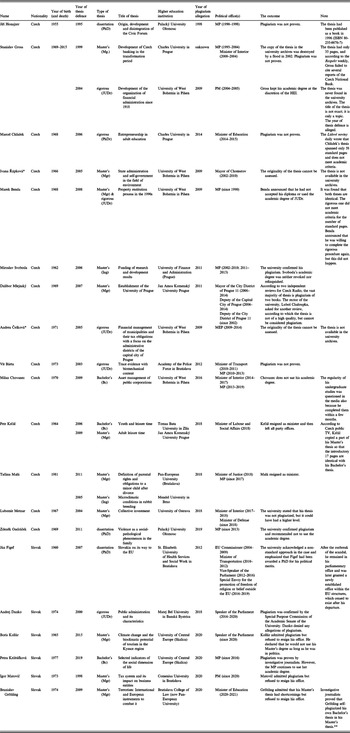
There is a surprising number and extent of cases of thesis plagiarism among politicians in both Slovakia and the Czech Republic. Owing to limited space, it is impossible to describe in detail all the cases that have occurred since the 1990s. They are summarized in a table annexed to this article. There are also some other circumstances related to specific cases, including the type of academic misconduct that did not always take the form of plagiarism, as had originally been assumed by reporting media. Let us, then, look at the most striking examples that can illustrate the issue of political accountability in both countries. This can help us understand how the HEIs responded, or failed to respond, to the different cases and how they affected their reputation and the overall perception of tertiary education in each country.
It should be emphasized that not all media-reported suspicions of academic misbehaviour were later proven, for example as a result of an internal investigation of the HEIs. Anyway, the cases were systematized on the basis of their media coverage in both countries for the period from the early 1990s up to the present. It is not known whether there have been court hearings. Therefore, these types of documents cannot be covered in the research. Although there is no room to explain extensively the tertiary education system in both countries, in terms of terminology, four types of final theses can be distinguished: Bachelor’s thesis, Diploma thesis (holders of master’s or engineer degrees), Dissertation (PhD thesis), and Rigorous thesis. When it comes to the latter, its successful defence allows the alumnus to use the so-called small doctorate.
This type of doctorate is an academic degree preceding the holder’s name and can be obtained by all those who successfully passed the so-called rigorous examination in a scientific field and defended, in front of a special commission, a rigorous thesis aimed at a scientific issue. It is one of the types of state final examination, which can be taken within university studies in Slovakia and the Czech Republic. The determination of specific conditions for passing the rigorous examination is in the competence of faculties. The rigorous examination can be taken only by graduates of master’s study programmes. A small doctorate replaces a master’s degree and can be obtained in the form of Doctor of Philosophy (PhDr), Doctor of Law (JUD), Doctor of Science (RNDr), Doctor of Pharmacy (PharmDr), Licentiate of Theology (ThLic), and Doctor of Theology (ThDr). It should be noted that this type of doctorate is not the equivalent of a PhD (see Hanzelínová Reference Hanzelínová2019, 223).
The Slovak Cases
In Slovakia in particular, the cases illuminated the reluctance of politicians to adhere to the principles of political accountability and at the same time how they undermined the integrity and credibility of Slovak HEIs (Palaščáková and Vlčková Reference Palaščáková and Vlčková2013), which have been struggling with underfunding and the declining interest of Slovak students, who increasingly prefer universities located west of Slovakia (Gajdošová and Orosová Reference Gajdošová and Orosová2019).
A few years ago, the scandal of the then Speaker of Parliament, Andrej Danko, attracted media attention and shook public opinion in Slovakia. The Matej Bel University in Banská Bystrica awarded him a ‘small doctorate’ of law after a successful defence of the required ‘rigorous thesis’ in 2000. He did not hold any political office at that time. Eighteen years later, the Slovak media revealed that his thesis was most likely a plagiarism. According to the January 2019 findings of the Special Purpose Commission of the Academic Senate of the University, his thesis contained parts that were slightly modified versions of the literature he used. In some parts, the division of chapters and subchapters of the used literature was preserved; up to 63 of the total number of 72 pages of his thesis showed a high degree of match with the literature. Danko claimed that he had not submitted any plagiarism and refused to resign from his position, which is ranked the second highest political office after the President within the Slovak political system. Coalition partners left the decision up to him and only a part of the opposition unsuccessfully called for political accountability. The university was unable to withdraw the degree as Slovak legislation did not allow for it.
Two years later, in June 2020, Danko’s successor, Boris Kollár, was also accused of plagiarism. The plagiarism detection system provided by the government assessed that his thesis was a 24.45% match with other sources. However, the Czech ‘Odevzdej.cz’ plagiarism detection system used by Denník N daily evaluated the match to be up to 52%. Unlike Danko, Kollár admitted his plagiarism in a public statement. The official reason was to make his work easier due to time constraints. Subsequently, on 7 July 2020, he survived the vote of confidence in parliament, which he himself motioned for after being accused of plagiarism. Part of the coalition had previously called for his resignation as part of political accountability, but the motion to remove him from office did not obtain the required majority in a secret ballot.
In June 2020, Miroslav Beblavý, a former chairman of the ‘Together’ party and a scholar, analysed the Bachelor’s thesis of Petra Krištúfková, an MP of the ‘We Are a Family’ party chaired by Boris Kollár. Beblavý exposed her thesis as a plagiarist mix of several other works with missing citations. Of the 25 pages of her text, 16 were literally copied from other works. Krištúfková denied the allegations, claiming that a different, less stringent set of requirements applied to Bachelor’s theses than to Master’s theses. Krištúfková remained an MP; even in her case, no political accountability was applied.
The case of plagiarism of PM, Igor Matovič, the founder and chairman of the ‘Ordinary People and Independent Personalities’ movement, attracted massive media attention in 2020. According to Denník N daily, in 1998, when he did not hold any political position, Matovič adopted for his diploma thesis of 79 pages the near-full text of some pages of two books, including tables, while only citing the sources at a few instances. He plagiarized almost everything except the introduction and conclusion. ‘Honestly, I have no idea if I failed to cite something in my diploma thesis 22 years ago and how much there was. If this is the case, I stole something that did not belong to me, then I am de facto a thief in this matter, which is sad and certainly nothing to be praised for,’ Matovič remarked on his Facebook profile (ČT 24 2020). He added that he had neglected the last two years of his studies, when he was already running a business. He apologized to all honest students who were able to graduate without plagiarizing, prompting and other tricks. In his defence, he said that he did not use his degree anywhere, not even on his ID card. ‘Am I going to resign because of this? I am. As soon as I fulfil everything I promised to the people before the election. Then I will go back to enjoying my private life. With a clear conscience and without a degree,’ he wrote (ČT 24 2020). At the beginning of 2021, the Student Council for Higher Education called on Igor Matovič to give up his degree as he had repeatedly promised (Petriková Reference Petriková2021). It is unknown whether Matovič did so. Moreover, he did not apply the principles of political accountability and remained in office until the culmination of a later coalition crisis of March 2021, when he became finance minister. The pressure exerted on him by some coalition partners because of his plagiarism scandal was rather symbolic.
In the same year, Denník N daily informed that even the Minister of Education, Branislav Gröhling, had failed to cite various articles and book passages used in his thesis. Some authors were cited by him, but some others not. His Master’s thesis contained a part of his Bachelor’s one because he wrote on the same topic. Gröhling, who studied law at the private Pan-European University, boasted on social media that he had checked his thesis via a plagiarism detection system and found a 31% match. He claimed that he had duly defended his thesis and obtained his degree more than a decade ago after passing state exams. According to him, at the time of his studies, the university allowed up to 50% of a Master’s thesis to be a Bachelor’s thesis of the same author. Exactly as in previous cases, no political accountability was applied in his case.
Another case does not directly involve thesis plagiarism but raises some doubts not only about the fairness and transparency of Slovak HEIs but also about the political accountability of a politician, who was, paradoxically, responsible for education at the EU level. In 2012, a SME daily investigation found that the then chairman of the Christian Democratic Movement and Vice-Speaker of Parliament Ján Figeľ had highly benefited from his previous position as a European Commissioner when awarded his PhD degree in 2007. Both the rector of the private St. Elisabeth University of Health Services and Social Work in Bratislava and dissertation committee members Professor Vladimír Krčméry and Alžbeta Mrázová admitted that Figeľ received the degree despite some shortcomings in his dissertation. The university took into account his previous position with the European Commission. He defended his doctoral thesis in the field of social work, which, however, he had not pursued professionally. Figeľ did not even analyse the topic of social work in his dissertation. Surprisingly, he received the degree for a co-authored book on the integration of Slovakia into the European Union.
According to the daily’s findings, the university had two academic works marked as a dissertation in the file on Figeľ’s doctoral study. In his 74-page work, he just transcribed 85% of the aforementioned book written with Miroslav Adamiš. It described the accession negotiations for which Figeľ was responsible as Slovakia’s chief negotiator. The book was published in 2003 as part of the campaign preceding the Slovak EU membership referendum. Social issues such as employment, education, and science are discussed on merely four pages. The rest is devoted to tax and monetary policy, transport, the environment, or the European firearms licence. In his second work of 160 pages, he only photocopied the second edition of the mentioned book from 2004. The Student Council for Higher Education asked the relevant public administration bodies to thoroughly investigate the case and, subsequently, to draw consequences and sanctions against the university that awarded him the degree (Webnoviny 2012). Although the then Social Democratic Minister of Education, Dušan Čaplovič, announced that he would withdraw the university’s prerogative to award doctoral degrees in social work, he did nothing. On the contrary, he retained in force the prerogative which had been granted to the university in 2010. His decision closed the case of Figeľ’s PhD degree.
It should be noted that the role of HEIs in most cases was reactive; sometimes the diploma theses in question were difficult to access and only after massive media pressure did the universities take a stand. Due to the legislation of the time, it was impossible to withdraw degrees once awarded. Universities limited themselves to examining the content of the theses and the procedure of their defence. Even this was only done in some cases. There has been no effective enforcement of the rules and standards of political accountability in either of the cases analysed.
The Czech Cases
In comparison with the Slovak cases, the situation in the Czech Republic seems to be much more complex – not only in terms of the relatively long history and overall number of the cases but also in the ways political accountability was applied. One of the first cases dates back to 1998, when Jiří Honajzer, the then MP for the Civic Forum and later for the Civic Democratic Party and the Freedom Union, allegedly plagiarized a part of his dissertation from the Bachelor’s thesis of student Jiří Křečan. However, the politician denied any allegations and claimed that they were an attempt to discredit him before an upcoming election. Over a year later, the Scientific Council of the Palacký University in Olomouc, where the thesis had been defended, failed to reach a verdict and referred the matter of alleged plagiarism to possible court proceedings. Before that, however, the management of the Faculty of Arts of the University confirmed that Honajzer’s thesis had been partially plagiarized. Paradoxically, the thesis was published as a book two years before its defence.
The case of former Social Democratic PM Stanislav Gross aroused much greater public interest. In 1999, he graduated from the Faculty of Law of Charles University in Prague where he was awarded a Master’s degree, and from the Faculty of Law of the University of West Bohemia in Pilsen where he obtained his ‘small doctorate’ in law (JUDr). When he became a prominent politician in Prague, his thesis attracted media attention. He was suspected of failure to cite several reports of the Czech National Bank. However, the copy of the thesis in the university’s library was destroyed by a flood in 2002. Doubts also arose the in case of his ‘rigorous thesis’ defended at the ‘Faculty of Law of the University of West Bohemia in Pilsen, which was notable for its non-standard procedures, unclear rules and administrative misconduct (e.g. loss of some diploma theses, etc.)’ (Smolík, Reference Smolík, Koziak, Ruman and Šutajová2019, 250).
Several other plagiarism cases of politicians were associated with this faculty. Let us mention, for example, the case of MP Marek Benda, who studied there in the years 2003–2008. In October 2009, Czech public TV stated that he obtained the titles of Mgr (Master) and JUDr (‘small doctorate’ in law) for the same thesis. It added that his ‘rigorous thesis’ was almost 50 pages shorter than prescribed by the rules. He achieved the required number of at least one hundred pages by increasing the font size and line spacing. Benda, who has been an MP continuously from 1993 to present (with a short break from 2002 to 2004), then stated that he never accepted the diploma or used the degree.
In 2009, Milan Chovanec, a former government minister and at that time council member of the city of Pilsen, graduated from the same faculty. The regularity of his studies was questioned by the media, among other things, because he completed them in just 9 months. Formally, he had completed a lifelong learning course that allowed him to enrol directly in the third year. In October 2016, shortly before a parliamentary election, the Czech Pirate Party drew attention to the discrepancies around his Bachelor’s thesis. Chovanec rejected any accusations of plagiarism.
The example of the former social-democratic MP Miroslav Svoboda is also noteworthy. Due to suspicions of plagiarism in his thesis, in July 2011 he was urged by the party presidency to resign from party functions. The presidency did not demand of him to leave the Chamber, but said that the case would be taken into account when it was included in the list of candidates in the next general elections. Svoboda refused to resign. He rejected the suspicion of plagiarism of his thesis as unfounded and purposefully formulated by internal party opponents. According to press reports, it was largely plagiarized. There was a section of ten pages plagiarized from another thesis. Svoboda reacted to the revelation: ‘It is extremely embarrassing for me. But I will not return the degree, because I graduated properly. I went there for five and a half years. Now I’m looking for a way to see if I can open the thesis and redo it so that everything is in order’ (ČTK 2011). In the following general elections in 2013, he was 13th in the list of candidates in the Prague electoral district, but was not elected an MP.
In 2018, the Czech media exposed several cases of plagiarism that were said to have been committed by various politicians before they became politically active. In July, the Seznamzpravy.cz online newspaper reported that the Bachelor’s thesis of the then new Minister of Labour and Social Affairs, Petr Krčál, contained many pages of another author’s text. The thesis was defended at the Tomáš Baťa University in Zlín. The minister claimed that he could not explain the match and that he had worked honestly on his thesis. However, shortly after this, he resigned as minister.
In the same year, the then MP Taťána Malá was appointed Minister of Justice. In her Master’s thesis, which she wrote in 2011 at the Pan-European University in Bratislava (Slovakia), a plagiarism detection system found matches with some online publications and with another author’s thesis. Later, similar suspicions appeared in the case of Malá’s second thesis defended at the Mendel University in Brno, where she wrote on rabbit breeding. Malá resigned shortly after the exposure, whilst rejecting any plagiarism and labelling the whole case as a campaign.
A year later, the media reported that communist MP Zdeněk Ondráček had violated citation rules in his dissertation, by failing to cite the sources or stating them inaccurately and incorrectly. He compiled most of the theoretical part, which makes up more than half of the text, from pieces of information that was known at the time of writing, without proper analysis or critical assessment of relationships between those pieces. Although the Palacký University in Olomouc, where he had defended his dissertation in 2011, advised him not to use the degree, Ondráček continues to use his PhD publicly. All these and other cases of (proven, as well as unproven) allegations of plagiarism are summarized in the table annexed to this article.
Legislative Consequences
As has been shown, the ability to explain and justify a politician’s misconduct, as part of political accountability, has not always been demonstrated. Only in some cases were the politicians who had clear proven plagiarism in their theses been held accountable for their actions, typically in the form of resignation, but overwhelmingly under external pressure. It was not a voluntary action and the principles of political accountability were only partially, if at all, fulfilled. Likewise, these politicians–perpetrators were not pressured by their respective political parties, but mostly only by the opposition, or some of their coalition partners in the case of government politicians.
HEIs also responded only ex post to these cases, due to media pressure. Sometimes they attempted to hide the controversial theses from media inquiry. Even if they had the willingness to act and ‘punish’ the plagiarist in some way, the latter was not legally possible. Thus, such a perpetrator could continue to use his or her degree lawfully, even after a public confession. From the procedural point of view, the thesis, after its proper defence before the university committee, was recognized as plausible and allowed its ‘author’ to obtain a university degree. However, as the above-mentioned scandals put enormous pressure on the HEIs to increase their transparency and improve the overall degree awarding system, both countries adopted some legislative changes allowing withdrawal of those degrees that were obtained via defence of a thesis that was later found to be plagiarism. Such legislation was enacted quite recently.
In Slovakia, Act no. 131/2002 Coll. on HEIs has been amended by Act no. 410/2020 Coll. of 9 December 2020. As the Slovak legislator admits in the explanatory memorandum, this amendment was partly inspired by Czech Act no. 111/1998 Coll. on HEIs. According to the amendment, the rector of the university shall invalidate a state examination or its part, inter alia, even if the thesis or its part was not demonstrably prepared by the graduate, or the graduate misappropriated the intellectual property of another person, and in doing so obtained an advantage that affected the proper completion of their study or the fulfilment of the conditions for admission to this study.
A similar provision applies to the ‘rigorous examination’ (enabling the award of a ‘small doctorate’), the award of a scientific-pedagogical degree or the artistic-pedagogical degree of Associate Professor (docent) and the award of the title of professor. In the Slovak (and Czech) tertiary education system, associate professorships are not considered as job positions, but as degrees awarded by the university. Or, in the case of a professor, the award is the President’s discretional power based on the proposal of a university. The amendment also allows a person who had obtained a degree in the past to relinquish it irrevocably by a written statement with an officially certified signature delivered to the rector of the HEI which awarded the degree or submitted the professorship proposal. In the case of a degree related to a HEI that has ceased to exist without any legal successor, the written statement shall be delivered to the Ministry of Education.
In the Czech Republic, the situation of thesis plagiarism is addressed by an amendment to the above-mentioned Higher Education Act, which was adopted as Act No. 137/2016 Coll. Its explanatory memorandum explicitly mentions the case of the Faculty of Law of the University of West Bohemia in Pilsen, ‘which constituted a flagrant violation of obligations under the Higher Education Act, the Study and Examination Code and in which the good faith of the students/graduates concerned has been safely ruled out’ (PS PČR 2015, 120–121). According to the new wording of the Higher Education Act, the rector shall invalidate a state examination or its part or a dissertation defence if the person whose state examination or its part or dissertation defence is in question, through intentional illegitimate use of another person’s work in gross violation of intellectual property laws or through other intentional conduct against good morals, has not met or has only seemingly met the conditions or prerequisites stipulated by the Higher Education Act, the study programme or the study and examination code for holding and successfully passing a state examination or its part or defending a dissertation, if this was a continuous or repeated conduct against good morals or if it significantly impaired the ability to acquire the standard knowledge and skills of a graduate of the study programme.
Invalidity proceedings may be initiated by the rector no later than 3 years from the date of defence or apparent passing of the state examination or its last part or dissertation defence. The rector shall decide in the invalidity proceedings within 150 days from the day of its commencement. A special Review Committee shall deliver its opinion within 90 days of the rector’s request. If the rector deviates from the opinion of the Committee in the invalidity proceedings, she is obliged to justify this in her decision.
Conclusions and Discussions
This article opened by pointing to the number of recent scandals concerning thesis plagiarism committed by democratically elected political representatives, in many cases before the beginning of their political careers. The effort to answer the research questions formulated in the introduction is hampered by the lack of standard conceptualization or systemization of these cases; they are all quite individual and differ from one another. What they all have in common is that (i) over time it has come to light that a thesis has been plagiarized or written fraudulently, (ii) the thesis author is a person who was not yet involved in politics at the time of writing (with some exceptions), (iii) his or her misconduct was exposed ex post by investigative journalists. As a consequence, (iv) this provoked a considerable reaction in the media and society. The role of investigative journalists appears to be crucial in this process, as they ‘are independent monitors of governmental decision making who actively seek and report information about what elected officials are doing in office,’ as well as ‘conveyors of information from all sorts of interested parties’ (Arnold Reference Arnold2004, 7).
The article was focused on a comparison of two countries: Slovakia and the Czech Republic. Especially in the latter, this problem has not been solved for almost 20 years, although cases of this type have been appearing on an ongoing basis. It should be emphasized that not all cases of academic misconduct were directly related to plagiarism (e.g. the cases of Benda or Chovanec) and some of them, despite high media interest, did not lead to the final proof of guilt of the accused politician. In any case, politicians significantly differed in their reactions to the exposure of their historic plagiarism cases; no common type of reaction or shared behavioural pattern can be found. While they often denied or downplayed the facts, they relinquished their political functions only sporadically and under great social (i.e. not political) pressure. And even when they partially admitted their misconduct, they perceived the media attention on them as a political campaign. Only a few cases can be found when a (proven) plagiarism scandal has (definitively?) ended a plagiarist’s political career. Such is the example of Minister Krčál, who not only resigned from his governmental office (2018), but also no longer ran in the general elections of 2021.
As for HEIs, it cannot be said that the exposure of plagiarism cases would significantly damage the reputation of a university. Yet some emblematic local cases have already become part of the vernacular; for example, the use of the phrase ‘Pilsen Legal School’ in the Czech media clearly refers to numerous cases concerning the above-mentioned Faculty of Law of the University of West Bohemia in Pilsen, and implicitly refers to unfair practices in tertiary education. The HEIs responded, like politicians, under external media and social pressure. As there was no adequate legislation to withdraw degrees until recently, the HEIs argued that they had no competence to punish perpetrators of plagiarism.
When it comes to Pilsen, the cases showed some signs of organized crime. In its Annual Report for 2010, the Security and Information Service of the Czech Republic stated that ‘the connection of part of the teaching staff of the Faculty of Law of the University of West Bohemia in Pilsen with some representatives of police, advocacy, state administration and self-government’ has become ‘a great example of clientelism and corruption’ (BIS 2011, 11). Nevertheless, in 2010, the press reported that although the police had received a number of criminal reports and other submissions to the former faculty management, the commission of a crime had not been confirmed in any of them (Vaculík Reference Vaculík2010). Two years later, police ended the investigation, saying it had failed to obtain enough evidence (jum, ČTK 2012). Therefore, no one was punished for non-standard distribution of academic degrees at the Faculty of Law in Pilsen.
It has been argued that political accountability is, in general, an adequate explanatory concept. This could be inferred by the plagiarist him or herself, often under external pressure that reflects unwillingness to tolerate and accept such actions by a holder of public office. Anyway, this does not solve the structural problem in tertiary education, including thesis defence at the graduation phase of studies. Plagiarism has been there for many years. And although current plagiarism detection systems are partially effective, plagiarism cannot be expected to completely disappear in a foreseeable future. Apparently, in response to the aforementioned revelations, specific legislative measures were recently adopted in both countries in order to prevent thesis plagiarism and, in the case of Slovakia, also allow the degree to be relinquished by its holder.
Although all these measures have not been taken solely for the sake of politicians, they clearly anticipate that the commitments, responsibilities and expectations associated with political accountability will not always be met by the convicted plagiarist-politicians. There is no effective enforcement of the normative standards of accountability on which democratic institutions are based. Furthermore, legal regulation does not address the very essence of thesis defence and creates neither a motivating environment nor a pressure on HEIs to improve the thesis preparation process. Any impact assessment performed by state authorities or HEIs regarding the legal regulation is lacking as well. It must be added that the obligation to have a thesis checked by an online plagiarism detection system before the defence, which has been in existence for many years in both countries, or the possibility of subsequent withdrawal of a degree, does not address the quality of the theses. Moreover, these systems do not increase the credibility and quality of HEIs in any way.
Acknowledgement
This article was supported by the institutional support for research organization of the Ministry of Education, Youth and Sports of the Czech Republic, No. 52-RVO/2019.
An earlier version of this article was presented at the following academic conferences in Brno, Czech Republic: International Scientific Conference ICOLLE 2021 (8 September 2021) and 8th Congress of the Czech Political Science Association (9–10 September 2021).
About the Author
Marián Sekerák studied political science at the Matej Bel University in Banská Bystrica (Slovakia) and obtained his PhD from the Institute of Political Studies of the Faculty of Social Sciences, Charles University (Czech Republic). He is a lecturer at the AMBIS College, Prague and a researcher at the Centre for Higher Education Studies. He specializes in political theory, the theory of democracy, and public policy issues in the field of tertiary education. He has been a visiting researcher (2016) and a visiting lecturer (the summer term 2019/2020) at the Heinrich Heine University in Düsseldorf.
An overview of (alleged) plagiarism cases of politicians

*This was not an accusation of plagiarism, but a suspicion of fraudulent acquisition of an academic degree, as the existence of the thesis cannot be proved.
**As a result of this and other cases, the Government of the Slovak Republic approved an amendment to the Act on Higher Education Institutions which addressed plagiarism. Slovak universities will be able to withdraw a university degree from their future graduates if it is proven that the thesis or a part was not written by the student independently and properly.