Introduction
What does it take to get an academic article published? One solution is to start a new journal. ‘It is simple,’ explained Adesewa during a Zoom chat, reflecting on her time as an education lecturer at a Nigerian federal university. ‘Our academic department was plagued with divisions. It split into two. As soon as we split, we had to create a journal for each new department. It is about reputation … you are not reputable without a journal.’Footnote 1
Adesewa’s anecdote captured a shared perception of the prominent role that faculty journals have long played within Nigerian universities. Their history can be traced back to the 1950s and the arrival of Nigeria’s ‘university age’ (Livsey Reference Livsey2017). In our research on the African publishing economy, Nigerian university-hosted journals became a key field site. Even Nigeria’s newest private universities – and there are now more than a hundred – have been quick to set up their own ‘open access’ online journals. In many universities, each faculty, if not department, has its own academic journal. If the major Nigerian university presses are largely moribund, university journal publishing is alive and well.
We began to wonder if a university could have too many journals. Was this multiplication the result of the spiralling appointment and promotion expectations placed by Nigerian universities on staff? ‘Publishing by numbers’, as Adesewa put it, has led to ‘huge competition and publication bragging’. Everyone, she insisted, wants to publish more than their mentor, but publication rivalries extend not just between individuals but also between journals.
Adesewa was blunt. ‘Yes, there is bound to be competition between journals; the system fosters it. So you begin to try to market your journal. There is lots of talk of “we don’t trust those other journals”. But perhaps this is also about boosting your own journal. And then there are those agreements about publishing in each other’s journals.’ Adesewa went on: ‘These intense webs of networks and rivalries mean that new journals keep appearing.’
But what about expectations on staff to publish ‘internationally’? ‘At our university, we were given a whole list of journals you can’t publish in,’ she explained. ‘The universities are trying to guard against commercial journals.’ At the same time, she admitted that ‘Nigerians fear publishing in international journals; they feel that they [the journals] are beyond them.’ While the global academic publishing economy is now dominated by five highly profitable multinational conglomerates, many Nigerian academics distrust what they see as the ‘commercial’ motives of ‘local’ Nigerian-run publishers. Echoing a long-running debate in Nigeria about the importance of publishing in ‘foreign’ journals (Adomi and Mordi Reference Adomi and Mordi2003), ‘local’ and ‘international’ were regularly contrasted as glosses for journal quality, even if the terms themselves were left vague and undefined.
This article makes a contribution to African journalology (Couzin-Frankel Reference Couzin-Frankel2018), the study of journals and knowledge dissemination. It explores why Nigerian universities continue to launch new journals while simultaneously expecting their staff to publish ‘internationally’. It is part of a larger project analysing the changing status of Africa’s academic journals within a global ecosystem of academic knowledge production, informed by postcolonial critiques of epistemic injustice and growing evidence of the metricized exclusions enacted by citation indexes. Related work includes a detailed analysis of Ghanaian academic publishing strategies, based on interviews with around fifty faculty and many journal editors (Mills et al. Reference Mills, Kingori, Branford, Chatio, Robinson and Tindana2022), and an analysis of the discourses that brand certain journals as ‘fake’ (Mills et al. Reference Mills, Robinson, Branford, Inouye and Kingori2021; Mills and Inouye Reference Mills and Inouye2020).
Our research seeks to understand the impact of the global science system and its metrics-driven culture on the Nigerian academy, as well as the resourcefulness and agency of the country’s own researchers and publishers. Amidst calls for African Open Science, few have empirically researched the challenging logistics of journal publishing on the continent: attracting strong submissions, recruiting reviewers and, most difficult of all, building credibility. Studying academic publishing means seeing journals, articles, websites, editors and the review and production process as a composite empirical field. With travel limited by the Covid-19 pandemic, our analysis is based on Zoom interviews with more than a dozen Nigeria-based editors and publishers, together with analyses of online journal content and university websites.Footnote 2 These interviews enabled us to look beyond the journal webpages to understand the research cultures and knowledge communities their editors have assembled and curated. We draw on the insights and expert commentaries of a wide range of Nigerian actors and stakeholders, and we analysed the (very limited) inclusion of Nigerian journals in the main global citation indexes (Bell and Mills Reference Bell and Mills2020).
At the core of the paper are four journal case studies. The first two are open access journals published by Nigerian university faculties; the second two are published by independent presses. We use them to describe the everyday demands and challenges of ‘getting by’ as a journal editor and publisher in Nigeria, working in the ‘global shadows’ created by the multinational publishing conglomerates (Posada and Chen Reference Posada and Chen2018; Ferguson Reference Ferguson2006). Serving a range of disciplinary fields, the two groups face many of the same challenges. We show how the vision and commitment of journal editors are key as they strive to sustain quality in the eyes of both local and international peers, despite the disadvantages of Nigeria’s symbolic geography, and amid financial, organizational and infrastructural constraints. We recognize that the four case studies provide only a small glimpse into the challenges facing Nigerian academic publishing, and the institutions chosen are mostly in the more prosperous southern states. However, they do enable us to offer a detailed empirical account of publishing logistics and journal infrastructures, attentive to disciplinary and institutional differences.
We end by reflecting on the long-term sustainability and credibility of these new journals. University-hosted journals are often edited by individual academics, some with relatively little publishing expertise. Not all have a long-term vision or sustainable business model. Excluded from international citation indexes, they risk disappearing, along with the research they contain, or being rendered invisible by the global citation economy. At worst, they are classed as predatory or fake. We explore the aspirations and barriers shaping this fragile and hyperlocal publishing ecosystem, and publishers’ struggle for recognition within the logics of the global publishing and bibliometric economy.Footnote 3
Nigerian journalology 101 and the changing academic publishing economy
From the 1950s to the 1970s, Nigeria’s universities launched a fleet of new academic journals, complementing a corpus of colonial-era medical and museum journals (McLean Rathgeber Reference McLean Rathgeber1979; Murray and Clobridge Reference Murray and Clobridge2014). The presence of many international scholars in West Africa’s universities gave these journals a global profile. Africa-based academics were prolific in African studies and many other fields (McCracken Reference McCracken1993), and scientific work from Ibadan was highly cited internationally (Rabkin et al. Reference Rabkin, Eisemon, Lafitte-Houssat and Rathgeber1979). Craggs and Neate (Reference Craggs and Neate2020) depict the vibrancy of Ibadan’s research cultures in the 1960s, with geographers editing influential African-focused journals, including the Nigerian Journal of Geography (founded in 1957). Other faculty journals such as Odu: The Journal of West African Studies, published by the Institute of African Studies at Ile-Ife from 1955, and Orita: Ibadan Journal of Religious Studies, from Ibadan, became widely known. One legacy of this model of faculty publishing is the sense of responsibility for such journals among the senior Nigerian university leaders to whom we spoke.
African academic publishing has long been supported by the international Africanist community. A pioneering UNESCO-sponsored conference at the University of Ife in 1973 launched several Nigerian university presses (Oluwasanmi et al. Reference Oluwasanmi, McLean and Zell1975; Zell Reference Zell2017). Soon, a practitioner literature developed to support African academic publishing, with reviews and good-practice guidelines (see, for example, Zell Reference Zell2002; Reference Zell2008). There were regular surveys of the health of African scholarly publishing (e.g. Ngobeni Reference Ngobeni2010; Murray and Clobridge Reference Murray and Clobridge2014). The African Books Collective, set up in 1990 to support independent African publishers, pioneered new models of distribution and co-publishing (Mlambo Reference Mlambo2007), as did the book publisher James Currey (Currey Reference Currey and Ngobeni2010). More recently, the International African Institute has championed African digital research repositories.
The political instability and financial crises of the 1980s and 1990s – including military rule, structural adjustment, authoritarian rule, and attacks on the Nigerian academy – saw many Nigerian publishing initiatives collapse (Olukojo Reference Olukoju, Zeleza and Olukoju2004). The curtailing of press freedoms and the hounding of journalists during the 1990s led mainstream trade publishers to withdraw, wary of publishing anything critical of the government. Nigerian authors and activists turned to what many called ‘self-publishing’ (Umezurike Reference Umezurike2020). They handled the whole process of printing and distribution, hosting book launches, organizing book fairs and running book clubs. Umezurike (ibid.) shows how several of these authors went on to be published by global publishing houses. Since the 2000s, there has been a renaissance in Nigerian trade publishing. Yet Nigeria’s university presses have remained dormant (Van Schalkwyk and Luescher Reference Van Schalkwyk and Luescher2017). The institutional emphasis on ‘international’ journal publishing, even in the humanities and social sciences, has made monograph publishing less of a priority. With little, if any, financial support from their universities, these presses have made ends meet by printing school textbooks rather than reinventing themselves as digital publishers (Zell Reference Zell2017).
A key challenge for Nigerian universities is the systematic underfunding of the research infrastructure. The country spends less than 0.1 per cent of GDP on research and development, low in comparison with the African average of 0.4 per cent, and lower still in comparison with a global average of 1.7 per cent. There is no national research council offering research funding on a competitive basis, and research management support is largely non-existent (Research Consulting 2019). The Ministry of Education’s TETfund (Tertiary Education Trust Fund), set up in 2011, funds research capacity building in public universities, supporting new journal start-ups along with scholarships and building projects. It offers less to state than to federal universities, and the process of applying for funds is difficult to navigate. Private universities are excluded from applying, despite growing lobbying (e.g. Oke Reference Oke2021). Awards are time-limited and for one-off projects, which limits long-term planning. There is also growing media attention to the misuse of TETfund resources.Footnote 4
From the 1990s, there was growing attention to university rankings and academic publishing (Bodomo Reference Bodomo and Habomugisha1999). In response, Nigeria’s top research universities introduced new guidance for staff, such as Ibadan in 2004 requiring 70 per cent of outputs to be published in journals of an ‘international’ standard (Adomi and Mordi Reference Adomi and Mordi2003; Omobowale et al. Reference Omobowale, Sawadogo, Sawadodo-Compaoré and Ugbem2013). Linking promotions to the perceived quality of journal ‘outputs’ was designed to incentivize publication, but it also made the concept of ‘international’ highly contested. Over time, universities such as Ibadan developed elaborate policy circumlocutions, such as the statement that ‘international’ was ‘not location-bound’ (Omobowale et al. Reference Omobowale, Sawadogo, Sawadodo-Compaoré and Ugbem2013). Some felt that the international rule had been introduced by senior professors to prevent others from rising up the ranks, enabling them to extend their contracts after retirement. An unintended consequence was the drop in the reputation of long-established national journals. Omobowale et al. (Reference Omobowale, Akanle, Adeniran and Adegboyega2014: 672) point to the paradox of Nigerian academics opting for ‘sub-standard paid-for foreign journals’, often inferior in quality to ‘so-called local journals’, in order to ensure that their research gained a ‘foreign-published’ imprimatur.
The situation was further contorted by credibility geographies. An international journal published in the ‘global South’ is widely regarded by Nigerian scholars as less valid – and so less ‘international’ – than one published in Europe or North America. Even when a ‘Southern’ journal has been approved as sufficiently ‘international’, publishing in it might not always lead to the visibility the rule was supposedly meant to foster. One education researcher we talked to bemoaned having to pay 60,000 Naira (US$150) to publish in what she described as a ‘poor-quality international journal based in India’ in order to graduate. She felt that ‘the articles are invisible and it’s a waste of my intellectual life’. Where, she asked rhetorically, is the ‘international’?
Increasingly, inclusion in Elsevier’s Scopus citation index or Clarivate Web of Science, and the accompanying ‘impact factor’ this generates, defines a journal’s ‘international’ standing. Analysing the citation of African-based computer science research, Harsh et al. (Reference Harsh, Bal, Weryha, Whatley, Onu and Negro2021: 305) underscore the ‘invisible’ nature of much of this work, arguing that ‘peripheral’ journals will continue to remain hidden if ‘traditional’ bibliometric databases are used to analyse the research productivity of African countries. Boshoff and Akanmu’s (Reference Boshoff and Akanmu2017) study of the pharmaceutical research produced at Obafemi Awolowo University shows how the limited coverage of these indexes is inadequate for assessing that faculty’s research performance.
One can measure academic peripheralization quantitatively: only twenty of the more than 36,000 journal titles currently indexed in Elsevier’s Scopus citation database are published from Nigeria. Despite Nigeria being Africa’s biggest economy and having the world’s seventh largest population, twenty amounts to just 0.06 per cent of Scopus journals. Of these, twelve are medical journals, and bar the respected Calabar philosophy journal Filosofia Theoretica and the Nigerian Journal of Economic and Social Studies (founded in 1957), the rest are science and technology journals. With the exception of Filosofia Theoretica, all are ranked in the third or, more typically, fourth quartile in their field. Five are directly published by universities or faculties, five by independent companies or organizations, and the rest by professional associations. Some of the commercial publishers are Nigeria-based, but several of the medical journals are published by Medknow, an Indian subsidiary of Walter Kluwers, a top-ten global publishing house. The journals published by the Nigerian professional associations and scholarly societies are primarily print journals and so are behind subscription paywalls or are hard to find online. In the Clarivate Web of Science Core collection, thirteen Nigerian journals are currently indexed (out of a total of 21,000 journals in the collection) but only four have been given a journal impact factor for 2021. Again, these are nearly all medical and science journals. Even DOAJ, the community-owned Directory of Open Access Journals, with its more inclusive and supportive application and selection process, has only eleven Nigerian journals out of a total of 16,500. All except one of these is published by a Nigerian university faculty, including several technology journals, such as NIJOTECH, discussed below.
Nigeria’s academic publishing economy is inevitably shaped by global developments in digital publishing technologies, the internet and the open access movement. Yet research on the corporate consolidation of publishing infrastructures – and the emphasis on publications for doctoral graduation, appointment and promotion procedures – focuses primarily on developments in the global North (e.g. Posada and Chen Reference Posada and Chen2018). This consolidation has a major impact on global knowledge flows. The emergence of a vibrant community of ‘scholar-led’, not-for-profit diamond open access journals in the European humanities and social sciences (Herman Reference Herman2021; Bosman et al. Reference Bosman2021) is made possible by a well-funded research and library ecosystem. The economics and logics of journal publishing in a resource-constrained Nigerian university system are rather different and need to be studied on their own terms.
Nigeria’s university-hosted open access journals
Most of Nigeria’s 170 federal, state and private universities now host online open access academic journals. A sample of twenty-five public and private universities across the reputational spectrum in May 2021 revealed that more than 80 per cent publish one or more institutional journals. Nearly all those universities that were ranked in the top 50 per cent by web presence and page hits had their own institutional academic journals; some had several. Those without a journal tended to be the very newest or lowest ranked universities.
Nigeria’s top-ranked universities have the most online journals, the majority founded in the last decade. Many rely on the free Open Journal Systems (OJS) software developed by the Public Knowledge Project (a collaboration of several North American universities), with sites hosted on university websites. The University of Lagos has a dedicated journal site hosting thirty-one open access university-sponsored journals, of which seventeen are currently active. An Ibadan University webpage lists fifty-eight journals, but there are no hyperlinks and most seem to be dormant. A more recently created Ibadan site lists six online journals, of which four are active. Several Ibadan-run faculty journals have their own sites, with no reference to the university. The University of Nigeria hosts twenty-five journals, most of which are active. The top-ranked private university – Covenant – publishes fourteen academic journals, with most being current in 2021 and all having been set up since 2018. Most mid-ranked public and private universities publish at least one academic journal. These build the research reputation – and credibility – of the institution and help academic staff meet promotion requirements. Most are online-only, but promotion boards expect staff to submit hard copies of their articles, which the journals provide on request.
Any web search uncovers a plethora of broken links, legacy sites and dormant publications. Some university open access journals are available only on the AJOL (African Journals Online) platform, a South Africa-based not-for-profit journal aggregator. Of the 222 Nigerian journals listed on the AJOL site, almost half (108) are currently listed as inactive; this is indicative of the difficulty of sustaining an academic journal over time.
Assembling a complete list of all Nigerian university online journals would be a near-impossible task. The web pages and figures described here are a 2021 snapshot of a rapidly fluctuating picture as journals appear and disappear. The apocryphal ‘Vol. 1 No. 1’ jokes capture the dangers of publishing in an inaugural issue of a journal; there might not be a second issue, undermining the perceived value (and visibility) of the article. Two journal case studies illustrate the technical, resource and reputational challenges of sustaining publishing initiatives over the long term.
African Journal of Science and Nature
African Journal of Science and Nature (AJSN) was established in 2015 as one of two ‘house’ journals for Olabisi Onabanjo University, a mid-ranking public university in Ogun State. The deputy vice chancellor at that time, Professor Adewale Sule-Odu, was concerned that the existing university journal had no disciplinary remit and published ‘work from every faculty’, as he put it. As a result, he felt that it ‘didn’t look tidy’. It also had a large backlog of submissions and lacked strong editorial oversight. Sule-Odu sought to ‘bring the sciences together’ in a revamped version. He also brokered a second Olabisi Onabanjo University journal: AGOGO: Journal of Humanities. In doing so, his aim was to ‘streamline the publication process … creating standards that the journals must meet’. His model was based on an existing successful medical journal run by the university’s teaching hospital, and he aimed to ensure that researchers had the opportunity to ‘publish in a good journal’, knowing that its ‘university affiliation is attractive’.
AJSN is a multidisciplinary science journal, published using the freely available OJS software. It appears once or twice a year, with between five and ten articles in each issue, covering all science disciplines. The most recent volume (2020) has seventeen articles, while the 2019 volume has only four. In 2018, three issues were published, with a total of twenty-four articles that year. While the journal’s stated ambition is to publish ‘peer-reviewed papers that move beyond the shore of this nation in all fields of Science’, nearly all authors are staff at Olabisi Onabanjo University, with occasional external collaborators. Applied topics dominate, and the most recent issue includes papers from biotechnology researchers exploring the medicinal applications of natural herbs, from a group of environmental scientists on changing land use and woodland, and two papers on urban architecture, to name but a few. The authors may be ‘local’ to the institution but the topics speak to science and environmental policy issues facing Nigeria as a whole.
Sule-Odu emphasized his concerns about the ‘sharp practices’ that he felt characterized some Nigerian journal publishing. He described journals being set up by someone in their bedroom, or publishing papers that were little more than a few pages long, or students being forced to buy copies of journals to make the finances work, and a general lack of quality standards. Sule-Odu also bemoaned the existence of what he called ‘predatory’ journals all over the world, ‘even in the USA and UK’, pointing to their plagiarism of existing journal identities (‘such as the British Journal of Medical Sciences, copying the BMJ’) and their rapid publication promises. He felt that these ‘were not real journals’, complaining that they even ‘publish husbandry and carpentry, they just publish’. He introduced university oversight procedures, ensuring that all published papers were peer reviewed, with at least two positive reviews, all with the aim of bringing the journal to ‘international standards’. The university-run journal was also a way, as he saw it, for colleagues who had good papers (‘with statistics’) to not send articles to ‘bad’ journals. The journal, in Sule-Odu’s eyes, had greatly strengthened his university’s research culture.
Balancing the books is key to the success of any publishing initiative. AJSN and AGOGO were both successfully nominated by Olabisi Onabanjo University for a TETfund grant. Sule-Odu pointed out that AJSN was published regularly and was not costly (with article processing charges (APCs) of only 10,000 Naira, or US$4). He compared this with the African Journal of Reproductive Health, a bilingual journal run by the Nigerian Women’s Health and Action Research Centre, which has an APC of US$500. On the other hand, Sule-Odu recognized that the journal needed to have a circulation manager; he had also been considering including adverts in the journal as a way of covering publication costs: ‘Ten adverts would bring in a million naira.’ While bemoaning the spiralling costs of publishing hard copies of the journal (often hard copies are a stipulation of promotion boards), he accepted that journals had to survive, even if costs were kept low by no one being paid: ‘Sacrifices are part of academic life.’
Sule-Odu went on to describe his university’s promotion criteria: academic staff can publish only 70 per cent of their work in national journals; they are limited to publishing two articles in one journal; and, for promotion to senior lecturer positions, at least 10 per cent of articles have to be in ‘offshore’ journals. Yet the latter also presented challenges, as people ‘ran to Ghana’ to get letters of acceptance from what he called ‘poor-quality’ journals based there. For him, it raised questions about what counted as an ‘international’ journal.
Faculty journals were, he felt, ‘appropriate for supporting the teaching needs of the faculty’; here, he was referring to setting journal articles as course reading for students. However, departmental journals would be ‘unwieldy’, with people ‘sacrificing too much time to them’. Countering any criticism that there were too many journals, he insisted that it was fine to start a new journal, but that it ‘needed to start at a high note’ given the difficulty of standing alongside older journals. Invoking a construction metaphor, he pointed out: ‘If you start a company and are building a bridge, you won’t be able to compete with a company established a long time ago.’
Sule-Odu admitted that impact factors were a problem for Nigeria’s university journals. Getting the journals indexed in international databases and citation indexes was a challenge, and he complained about tardy responses from their advisory boards. But fighting these battles for credibility were worth it for Sule-Odu, as ‘it would not be proper to not have a journal that you can call your own … to maintain the good name of the hospital and the university’.
Nigerian Journal of Technology
Nigerian Journal of Technology (NIJOTECH) was set up in 1975 by Professor Mike Nwachukwu, an engineering professor at the Federal University of Nigeria, Nsukka. Despite the team’s initial enthusiasm, the second issue only came out three years later. It published intermittently during the 1980s and 1990s, given political and financial instability and a ‘mass exodus of academics from Nigeria’, as a short history of the journal on its website notes. Its ‘reappearance’, it goes on, ‘was not due to any marginal improvement in the academic staff remunerations but due to the doggedness of our Engineering Faculty’.
The journal finally resumed an annual publication cycle from 2000. In 2010, the university’s new dean of engineering – Professor Emeka Obe – became editor-in-chief and transformed the journal’s fortunes. His commitment was unstinting. He took the journal online in 2012, using OJS software and with financial support from the faculty (and a TETfund grant) and technical support from AJOL (including access to digital object identifiers (DOIs), unique strings of letters and numbers that can be assigned to online articles and books). He oversaw the scanning and uploading of back issues. As Obe commented in an interview: ‘We needed to show that the journal was older than many of these journals coming up, and that there was a passion that the journal should not die off.’Footnote 5
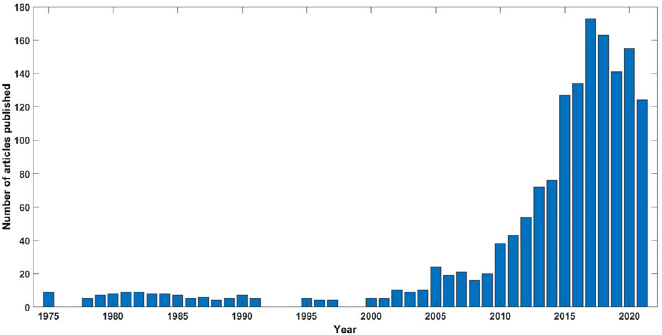
His 2014 journal editorial was optimistic about the journal’s future as a ‘unique publication’ that was ‘proud to be reporting original research findings from technologies that are just evolving and more relevant to the tropics’. It felt like only a matter of time before the ‘big indexing bodies like Scopus®, Thomson Reuters etc. will key into our citations’ (Obe Reference Obe2014). Figure 1 traces this history, showing the impact of the move online.
Articles published in NIJOTECH, 1975–2021. Source: Obe (personal communication).

Obe explained how reaching out to faculties of engineering across sub-Saharan African had ‘really ramped up our submissions’. The number of articles published in NIJOTECH each year went from around twenty in 2010 to more than 100 in 2015. In 2018, 155 out of 360 submissions were published, an acceptance rate of around 40 per cent, and the journal had almost 118,000 downloads from AJOL during nine months in 2017.
NIJOTECH currently publishes four issues a year, each with between twenty-five and forty articles ‘looking at local problems’ in different fields of engineering. More than half of the submissions are from Nigeria, with 25 per cent from other African countries, and less than 10 per cent from outside Africa. The journal has a large editorial board of around 150 academics whom it relies on for reviews – Obe called them the ‘heroes of Nijotech’ (Obe Reference Obe2016). The majority are based in Nigeria, but eight are in the UK and a few are in Cameroon and neighbouring countries. Reviewers are incentivized with mobile phone credit to respond within a few weeks. In conversation, Obe put his success down to what he called ‘personal effort: you have to keep talking, such as making voice calls to reviewers because people tend to forget so quickly’. Obe described how networking and constant chasing were the most important – if time-consuming – aspects of his job: ‘If authors write and don’t get a response, they feel that they aren’t being looked after.’ He went on to talk about the challenge of encouraging reviewers and dealing with ‘impatient’ authors: ‘When I can’t sleep and turn on my laptop there are usually many emails to answer … once an author submits an article they want a review response the following day: he will take six months to do a review but will want a response in twenty-four hours.’ Proud of his achievements, Obe judges each article on its own merits, not according to the ‘section editor’s interest’. He disparaged those who ‘use a journal just to build up a publication profile to get a promotion or to get a particular appointment’. In those cases, he felt that, in due course, ‘the journal would have served its aim and is bound to die’.
The journal has been supported by the TETfund via the University of Nigeria. These grants have enabled it to reduce its publication charges, but support is not assured or ongoing; reapplication is required each year. Obe described how, internally in the university, ‘We have a little competition of who has got funding before and who has not got before, who is more viable and then the universities will decide which ones to ask that fund to support.’ He noted that they ‘normally don’t give you all that you ask for’ because they say that ‘it is just an intervention’. While the OJS software is free to use, the associated web hosting and technical support offered by OJS costs around US$900 per year. NIJOTECH charges US$100 in APCs, but some authors are unable to afford this charge and there have been challenges with international transfers. There are also more prosaic problems: regular power failures mean that ‘one has to run a generator just to be able to continue working, otherwise you can be for ten hours without work … These are not ways to run a journal.’
The biggest challenge facing NIJOTECH is inclusion in the major scholarly citation indexes. Its application to Scopus did not meet the benchmarks for the international diversity of authorship and editorial board. This presented Obe with a challenge, as ‘there are few places in Africa with active research profiles in engineering’, noting that in Nigeria there is ’90 per cent more engineering than in Ghana’. Obe described it as a ‘catch-22’ situation: one can’t get indexed without international authors, but these authors are disinclined to publish in a journal that isn’t indexed. ‘It’s a chicken and egg kind of thing … so you see the loop; nobody can break it.’ These ‘indexing problems’, as he put it, ‘are also not placing us where we should. The journal is over forty years old and it’s still trying to get into all those.’ He was ever optimistic: ‘It will happen in time.’ Obe felt that Nigeria needed to ‘adopt her own metrics and standards of indexing while still looking up to the international ones’. At the same time, he worried about ‘all these new journals springing up’ and wondered how they could ‘cope’. ‘Do they just emerge because a new department or faculty is created?’ he asked.
Obe’s dealings with Scopus were demanding and time-consuming. ‘I think it’s getting harder and harder,’ he explained. Complaints about the inclusion of ‘poor-quality’ journals (what Obe described as ‘whatever-whatever-whatever’) have led the indexes to intensify their monitoring and gatekeeping practices. The Scopus selection board requires at least two years of regular publications and evidence that journals already in Scopus cite articles from the applicant journal. The process also requires journals to adopt integrity codes. This all makes it hard for Nigerian university-based journals to increase their international visibility. As Obe notes, ‘When somebody says it is something to do with Nigeria, those from Europe look at you twice even if you are telling them the truth.’
Obe was also sceptical about independent publishers, feeling that ‘many of those journals are going to die off’. He felt that they are overly entrepreneurial and ‘just after the APCs … They have no robust provision’ and are ‘too multidisciplinary … they take everything … Standards are not helped by these journals.’ It is to these publishers, and these prejudices, that we now turn.
Nigeria’s independent journal publishers
There is a small community of academics who have launched independent presses in Nigeria since the 1990s. For those frustrated by ‘Northern’ editorial gatekeeping and publication costs, and the editorial delays of university-run journals, these presses offer a more efficient and lower-cost publication route (Tonukari Reference Tonukari2004; Smart et al. Reference Smart, Pearce and Tonukari2005). If there is no institutional funding to cover APCs, choosing an independent commercial publisher can mean paying out of one’s own pocket. A senior lecturer in Nigeria earns 314,000 Naira (US$750) per month (Tade Reference Tade2021); the APC charges of the Nigerian journals we reviewed in this project ranged from US$20 to US$500, depending on their status and global visibility. Few would be able to afford anything other than those charging the lowest APCs.
In Nigeria today, a range of independent academic publishing houses publish open access online journals. These publishers vary widely in size and approach, and they work across a range of geographies and credibility economies. They have different business models and approaches to editorial control. One – Medknow – an Indian-based subsidiary of Walter Kluwers, a large global publishing conglomerate, publishes around thirty Nigerian medical journals for their professional associations. Overseeing the production process, it charges a page rate for its services, but the journals are owned and edited by the societies and hosted on their websites. Editors are given training in the use of Medknow software and retain control of the review process. Medknow charges for additional services to authors (including manuscript preparation and copyediting) and to journals (e.g. uploading back issues).
Dr Lawson Obanezu, editor of Nigerian Journal of Medicine (the journal of the Nigerian Association of Resident Doctors), helped his journal migrate to Medknow after watching other medical journals do so. Submissions had increased fourfold in one year from 100 to 400, with a growing range of international authors and bimonthly publication. He was pleased with the quality of copyediting but wished for more proactive marketing. His main complaint was with the high APCs (US$160) that the journal now charged to meet Medknow’s costs; he felt that ‘if those APCs could be brought down that would be a big impact’. He was hopeful that the publisher would ‘sell’ the journal and get it back into DOAJ (it had lost its listing as a result of having a legacy website still visible – this sort of duplication is a ‘red flag’ for the open access database). Feeling that ‘Nigeria is migrating to commercial from local’, he worried that university presses would be left behind unless they could compete and ‘come up with their own platforms’.
In contrast to Medknow, smaller Nigerian-based commercial academic publishers have centralized editorial and publishing workflow. Their strategy has been to scale up and expand. Cultures of peer review vary widely within this group. One of the largest of these presses is called Academic Journals, founded in 2005 by Nyerhovwo Tonukari, with his launch of Journal of African Biotechnology. It now publishes around 120 journals; Google Scholar highlights that some are highly cited. The publisher offers 75 per cent waivers on its stated publication fees of between US$550 and US$700 for those in low-income countries (Mills et al. Reference Mills, Robinson, Branford, Inouye and Kingori2021).
Other entrepreneurial Nigerian presses pursue similar models of inclusive open access publishing, with less editorial peer review. These include International Scholars’ Journal, an Abuja-based publisher with more than eighty journals in all areas of agriculture and applied sciences, from poultry management to wood science, as well as many covering medical sciences. Its stated APCs are US$300, reduced for those in developing countries. Some journals provide editorial emails but most do not, and often the editorial board is not based in Nigeria. In several cases, the ‘international’ editors listed appear to have inappropriate qualifications or subject specialisms.
Work published by International Scholars’ Journal and other such publishers ranges widely in quality. A similar-looking publishing portal, International Research Journals,Footnote 6 based in Sapele, claims to publish nineteen journals. Several of these are currently dormant while others publish very short submissions. Other examples include e3journals,Footnote 7 which publishes six journals, and Science Journal Publication,Footnote 8 publishing sixteen journals on an irregular basis. Several provide no physical addresses, and it can be hard to discern whether these companies are even based in Nigeria. Such publishers have faced the most criticism for their quality control and publishing practices. In 2013, several of these journals were trapped by an elaborate publishing sting, described below.
A few independent Nigerian publishers have closer ties to local universities. These include ICIDR (International Centre for Integrated Development Research) founded in 2007 in Ikot Ipene. It hosts seventeen online open access journals (although some are dormant or have yet to publish an issue), all with Nigerian editors and editorial boards, charging APCs of US$160. It provides a long and detailed list of its academic trustees and their biographies, all senior Nigerian academics. The Global Journals series,Footnote 9 founded by Professor Barth Ekwueme in 1995, operates from an office in the Department of Geology, University of Calabar. It publishes ten online journals but access requires payment of a subscription fee. The journal also generates income from charging APCs of 25,000 Naira (US$60). Despite the academic profiles and connections of the editors, both struggle to sustain a regular journal publication schedule and several are dormant or have not yet published an issue. We became particularly interested in two thriving independent presses – Adonis and Abbey and Credence Press – which had strong links to Nigerian universities and benefited from the credibility economies created through scholarly networks. Both were set up to promote the research interests and commitments of their founders and editors, echoing the ‘scholar-led’ model of Northern open access publishing (Herman Reference Herman2021; Barnes Reference Barnes2021).
Adonis and Abbey
Adonis and Abbey was set up in 2003 by Jideofor Adibe, currently Professor of Political Science and International Relations at Nasarawa State University, Keffi, Nigeria. Adibe’s original aim was to publish fiction, but, frustrated by Afro-pessimism and the racist discourse of the UK tabloid papers, he decided to focus on Pan-Africanist scholarship, publishing his first book in 2003. Having studied and worked in the UK, Adibe registered the company in London, choosing a name that stood out by being first in the alphabet. The business is registered in the UK and its journals and books are also published there. In 2012, the company developed a Nigerian arm, which oversees some of the production processes, and in 2021 it launched a ‘Nigerian-focused’ imprint, called PCJ Press. Its marketing for the new imprint highlights the importance of a ‘properly published’ book, against ‘the triumph of self-publishing and printers calling themselves publishers’.
Adibe’s first journal, African Renaissance, was launched in 2004 and is now indexed in Scopus. Unlike many of the other journals discussed in this article, the sixteen Adonis journals (including several launched in 2020 or 2021) are not published open access but available only via subscription. Most focus on African studies and Pan-African scholarship. The press has also published more than 100 books. The publisher’s website claims that Adonis is ‘probably the largest African publisher of accredited journals’ and draws attention to the fact that many are indexed. The site provides names and contact details for all Adonis journal editors: reflecting its Pan-African commitment, they are based across the continent and beyond. Only two of the sixteen are affiliated to a Nigerian university. In conversation, Adibe is clear that his professorship helps legitimize the press: ‘I can say that I am an academic.’ Adibe recognizes that ‘he can’t fight the Elseviers’; instead, he adopts what he calls ‘asymmetric tactics’, making the most of regional distribution networks, such as South Africa’s Sabinet, as well as the US-based EBSCO. Over almost twenty years, Adibe has slowly fought to get his journals into the major global indexes – and has increasingly succeeded. His encyclopaedic knowledge of the indexes’ different approaches to quality assurance and vetting is key, along with the patience this requires (some allow reapplication only after several years). He insists that being indexed in Scopus provides far more credibility than an institutional affiliation: ‘You can’t tell me that a university brand is better than that.’
Mouzayian Khalil-Babatunde is founding editor of Nation-building and Policy Studies, an Adonis and Abbey journal established in 2017 that is indexed in IBSS and Proquest (but not yet in Scopus or Web of Science). Currently employed at a UK university, Adibe offered her the opportunity to edit the new journal after meeting her. Aware that Adibe was, as she put it, ‘passionate about publishing and had lots of experience’, she agreed. She described how Adibe had established other journals by approaching colleagues, and she knew that Adonis and Abbey had an ‘international presence’ and that authors want their work to be found internationally. This journal’s origins lie in the work of a Nigerian think tank – the Rogan Leadership Foundation – to bring together academics, policymakers and civil society activists interested in nation building. Khalil-Babatunde drew on her personal contacts to set up an international editorial board, emphasizing to them that the task would not require a lot of work but was more about contributing ideas.
Initially, Khalil-Babatunde sent out calls for papers and solicited submissions, but she found the editorial workload exhausting: ‘I was feeling overwhelmed. I had to do everything.’ As a result, the journal began using a central pool of reviewers, with reviews sent to her for final decision. The publisher handles all aspects of journal production, and authors pay a US$200 APC on acceptance. While somewhat uncomfortable about these costs, Khalil-Babatunde recognized that, for Nigerian academics, ‘it is important to have your work known internationally … It doesn’t make sense for your journals only to be known in Nigeria.’ On the other hand, she recognized that ‘international’ was something of a ‘construct’. She admitted that for some Nigerian authors who publish a lot of monographs, the international ‘didn’t seem to matter that much’ but that it was a ‘shame that access to such knowledge remains limited by these spatial barriers’.
Khalil-Babatunde felt that the publisher’s transnational footprint and London-registered address gave ‘extra validity’, even if she disliked this sense of having to be ‘externally validated’. Being based in the UK, she valued being connected to Nigerian policy debates, fostering conversations that allowed for more intergenerational dialogue. One of her aims was to challenge the sometimes conservative and ‘time-warped’ conversations around methodology and theory she encountered in Nigerian dissertation defences, sustained by limited exposure – and access – to different academic traditions and practices.
By having a London base, by publishing work by academics based in Nigeria and across the Nigerian diaspora, and by ensuring global distribution and indexing, Adonis and Abbey has managed to bridge the local–global gap. It is a gap that other Nigerian journals and presses struggle to cross.
Credence Press Limited
Credence Press is a small independent open access publisher based in Delta State. Set up in 2019 by a library and information scientist, it currently publishes seven journals, with four more yet to publish their first issue. Journal of Library Services and Technologies has published the most issues. Most journal editors are Nigeria-based academics, but one is attached to a university in Cape Town. Having a range of publishing and editing experience himself, a representative for the press described how Nigerian academics were looking for ‘accessibility and visibility’, and that institutional journals were not sufficiently visible. His goal for Credence was to ‘carve our own niche … our goal is to become global, rather than to rely on university credibility’. He pointed out that this article would help Credence’s reputation. He acknowledged that ‘authors want credibility and authenticity’, and they also fear publishers with ‘no credible journals and no editorial boards’. Two markers of credibility, he felt, were Credence’s membership of Crossref (key to issuing DOIs) and its ‘indexing’ in Google Scholar.
To attract initial submissions, Credence distributed flyers at a number of different Nigerian universities. The press has its own online publishing platform, as the costs of using OJS technical support were prohibitive. The founder acts as a managing editor. The biggest challenges were attracting strong submissions from different parts of the world, sustaining a five-year publication record, and establishing international editorial boards, all requirements for inclusion in the two main global citation indexes.
The Credence representative pointed out that the APCs charged by Credence journals were ‘paltry’ (currently 20,000 Naira or US$50), so this was not about making money. The press pays reviewers with mobile airtime (5,000 Naira or US$12) to acknowledge their commitment and encourage more thorough reviews. He felt that these rates could go up with time, but he did not want to be seen as predatory or exploitative: ‘We need to build our reputation.’ While Credence is only three years old and has a very long way to go to match the reputation and profile of Adonis and Abbey, its very name underscores the importance of this credibility economy.
Commercial open access publishing and the ‘predatory publishing discourse’
The term ‘predatory’ publishing, with all its negative connotations, was first used by a US academic librarian (Beall Reference Beall2012). Since then it has been amplified across the science system, especially by the major global publishers (Mills et al. Reference Mills, Robinson, Branford, Inouye and Kingori2021). During our research, people constantly worried about the reputation and credibility of academic journals. Nearly everyone framed so-called ‘predatory’ publishing as a threat to the Nigerian research and publishing economy. Nigerian editors and publishers repeatedly disparaged the ‘sharp practices’ of commercially oriented open access publishing houses, especially those based in Africa or South Asia. One described them as ‘one man and his laptop’, another as ‘cowboys’.
We understood this strength of feeling, but began to wonder whether ‘predatory’ publishing was an unhelpful concept. Instead of dismissing such journals as the rogue outlaws in an otherwise reputable science system, it felt important to track the emergence of new publishing infrastructures in the shadows of an unequal global science system. Across Africa, universities have made an ‘international’ journal publishing profile a requirement for promotion, attentive to the influence of global university rankings. Nigerian universities encourage academics to think and act in terms of numerical ‘outputs’. Responding to these pressures, new journals and publishers emerge. Open access principles, digital production flows and freely available online publishing software make it easy and cheap to start up a new journal, even if credibility is much harder to acquire. Charging APCs is often crucial to survival in the absence of institutional support or other income streams. To dismiss all ‘pay-to-publish’ models as exploitative is to ignore the political economy of global science. Journals such as Nature now charge more than US$9,500 to publish an article open access, mainly because most scientists in well-resourced Euro-American universities have institutional support to cover these charges, and funders are increasingly requiring open access publication. The ‘integrity’ challenges facing academic publishing economies have been cast in a way that occludes this broader political economy of academic publishing.
A range of factors have amplified a powerful and emotive discourse of suspicion of so-called ‘predatory’ publishers (Mills and Inouye Reference Mills and Inouye2020). West Africa – along with India and Pakistan – is represented as a key site of academic ‘fakes’ (Mills et al. Reference Mills, Robinson, Branford, Inouye and Kingori2021). This blanket dismissal of geographies conflates questions of quality with duplicity. The evidence from Ghana suggests that relatively few scholars are ‘duped’ (Mills et al. Reference Mills, Kingori, Branford, Chatio, Robinson and Tindana2022). Most are making difficult choices in the face of institutional pressures, editorial gatekeeping, slow peer-review decisions, prohibitive open access costs and a lack of interest in regional studies.
‘Predatory journals take a bite out of Nigerian education research’ ran the headline in Research Professional (Van de Merwe Reference Van de Merwe2020), reporting on a claim that more than a third of Nigeria’s educational research from 2010 to 2018 was not being published in ‘reputable’ journals (Mitchell et al. Reference Mitchell, Rose and Asare2020). The Cambridge-based research team defined ‘reputable’, its minimum quality threshold, as articles in journals indexed in either Scopus or Web of Science, with an impact factor greater than 0.1. Publications in journals with a lower impact factor or not indexed were categorized as ‘low status’ and ‘not reputable’. Media reports described these other journals as ‘predatory’.
To brand one-third of Nigeria’s education journals as ‘predatory’ is to efface a whole corpus of research and to ignore these journals’ role in opening up publishing opportunities. A recent UNRISD (United Nations Research Institute for Social Development) policy paper on access to higher education in Africa (Lebeau and Oanda Reference Lebeau and Oanda2020) cited several articles from journals that would be excluded by the 0.1 criteria.
From the start, Jeffrey Beall’s list of what he called ‘predatory’ commercial open access publishers (Beall Reference Beall2012) targeted publishers based in Nigeria and South Asia. An elaborate publishing ‘sting’ carried out by a US-based journalist at Science (Bohannon Reference Bohannon2013) revealed that sixteen Nigerian-based commercial publishers accepted a spoof article Bohannon sent to them, seeming to affirm Beall’s dismissive assessment of ‘bogus’ publishers. This discourse about ‘predatory’ publishers continues to be propagated by the major journals and the science media (Inouye and Mills Reference Inouye and Mills2021). It casts doubt on long-established scholarly journals that have not been able to meet the exacting demands of the journal citation indexes, and it makes succeeding in new African publishing initiatives even more difficult. West African academics have also adopted this terminology, researching the ‘penetration’ of Nigerian medical journals by ‘predatory’ publishers (Nwagwu and Ojemeni Reference Nwagwu and Ojemeni2015) and the awareness of ‘predatory’ publishing practices among Ghanaian researchers (Tella and Onyancha Reference Tella and Onyancha2021; Atiso et al. Reference Atiso, Kammer and Bossaller2019). In the face of this discourse of suspicion – and its amplification by Nigerian researchers themselves – more journals risk being labelled as potentially ‘predatory’, and the quality thresholds set for inclusion in Scopus or Web of Science become ever more demanding.
The existing publishing conglomerates have a vested economic interest in perpetuating these emotive discourses and perspectives. As the five major global publishers compete to create dominant publishing platforms, some see their championing of open access as the promotion of academic ‘platform capitalism’ (Mirowski Reference Mirowski2018). In this race to consolidate market share, it also makes sense to promote doubts about the credibility of other publishing models, including those offered by small independent publishers.
Making sense of hyperlocal credibility economies
This article has described the everyday logics of academic credibility in a fragile, hyperlocal Nigerian publishing ecosystem. We have described how Nigeria’s universities are launching online open access journals while simultaneously requiring ‘international’ publications for promotion and PhD graduation. Independent presses and university journals stabilize and support local – often vibrant – ‘credibility economies’ within and between Nigerian universities. These institutional and faculty journals offer a way of ‘getting by’ in the shadows of this bibliometric economy. They provide low-cost and accessible publication opportunities, promote the university’s reputational ‘brand’, and reduce the perceived risk of exploitation – reputational and financial – by supposedly ‘untrusted’ independent publishers. Our interviews also highlight the tenacity, creativity and commitment of editors and publishers. Many of these journals are largely uncited by scholars beyond their host institutions and are rendered invisible by global publishing infrastructures. They are at constant risk of disappearing, along with the knowledge they contain.
Latour and Woolgar (Reference Latour, Woolgar, Barnes and Edge1982) were the first to write about the academic credibility ‘cycle’, tracking how laboratory scientists invest and accumulate ‘credibility’ through research, publications, funding, staffing and prizes. Internationally, disciplinary fields have differing credibility economies and approaches to measuring credibility (Hessels et al. Reference Hessels, Franssen, Scholten and de Rijcke2019), but all have been impacted by how global citation metrics have reinforced a journal ‘prestige economy’ (Kwiek Reference Kwiek2021), making indexes ‘trusted’ proxies of credibility. This consolidation of publishing infrastructures – and associated metrics – has been described as neo-colonial gatekeeping (Boshoff Reference Boshoff2009). It is reducing disciplinary heterogeneity as well as reinforcing normative distinctions and dependency relations between ‘international’ and ‘local’ science (Omobowale et al. Reference Omobowale, Akanle, Adeniran and Adegboyega2014). The exacting technical demands of the indices make inclusion protracted and difficult, even for those with publishing expertise. There is little support and guidance available, and, despite calls to decolonize publishing infrastructures (Meagher Reference Meagher2021; Okune et al. Reference Okune2021), there are few alternative avenues to international recognition. It is no surprise that many Nigerian researchers feel that they are competing on an uneven – and even racialized – playing field (Tella and Onyancha Reference Tella and Onyancha2021).
Two different value economies – one based on trust and the other on Nigerian Naira – mediate Nigerian academic publishing strategies. In a highly localized credibility economy, trust is almost impossible to convert into a globally accepted currency measured by citation metrics. In Nigeria’s underfunded research economy, universities struggle to build research infrastructures. These two economies restrict and localize the flow of academic knowledge and credibility, limiting articulation with the global science system. Despite university policies prioritizing ‘international’ publishing, only a small proportion of Nigerian academics are able to access elite global journals.
Across the global science system, a rich diversity of academic publishing cultures and research practices is under threat from bibliometric coloniality. Local and national research ecosystems struggle to survive, with journals caught between invisibility and being branded as ‘predatory’. Global citation indexes reinforce this gap between ‘international’ and ‘local’ science. Our interviews with Nigerian editors and publishers highlight the everyday challenges of building academic credibility in the shadow of these metricized judgements.
David Mills is Associate Professor in the Department of Education at the University of Oxford. Work on African academic publishing is a facet of his research interests in the geopolitics of academic knowledge production.
Abigail Branford is a doctoral student in the Department of Education at the University of Oxford. Her work examines the politics of knowledge production in education, particularly how postcolonial relationships are negotiated in educational institutions.