INTRODUCTION
Political behavior and attitudes cannot be made intelligible without studying the meaning of pre-modern reinterpretations of religious or ethnic-religious identities in democratic societies, whose legitimacy is based on the idea and ideal of citizenship, its institutions, and practices (Schnapper, Bordes-Benayoun, and Raphaël Reference Schnapper, Bordes-Benayoun and Raphaël2010, 7).
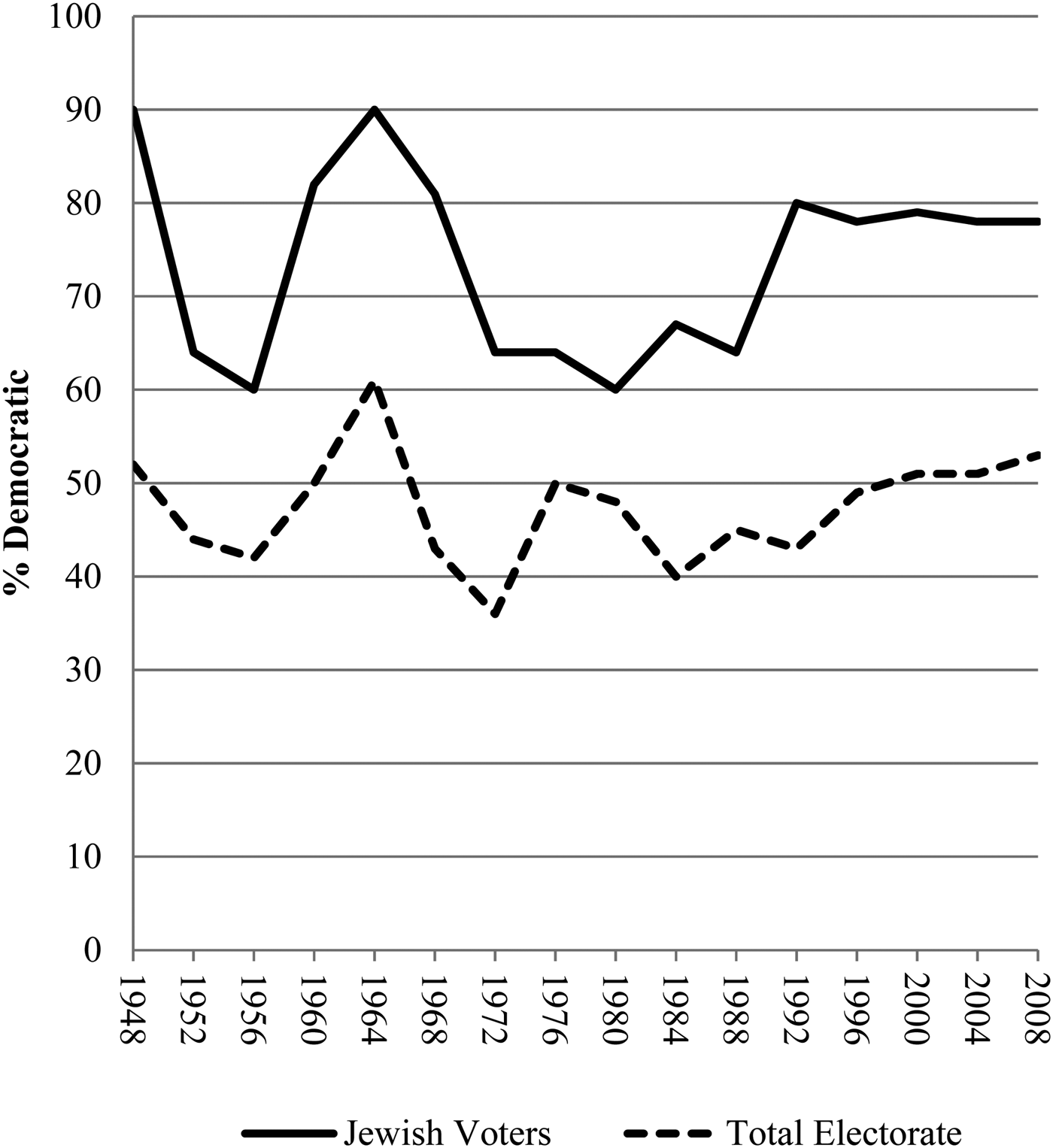
Since at least the New Deal, American Jews have exhibited strong attachment to the Democratic Party, typically giving Democratic presidential candidates 20–30% more of their vote than the entire electorate (Greenberg and Wald Reference Greenberg, Wald, Maisel and Forman2001). This pattern, portrayed graphically in presidential voting from 1948–2008 (see Fig. 1), is puzzling for three reasons.Footnote 1 First, American Jews have a socio-economic profile that, at least for other groups, promotes conservative partisanship and political loyalties. Second, Jews in other societies are not noticeably to the left of their fellow citizens in the manner of American Jews. Finally, the pattern is dynamic as American Jews appeared to move to the right in the late 1960s and 1970s and then back to the left in the 1990s.
Neither the usual models of American political behavior nor extant theories of Jewish liberalism can account adequately for these puzzles. The dominant economic model in political science, posits that voters with substantial economic resources are more likely to favor conservative parties).Footnote 2 This model, with a self-interested, materialist calculus at its core, cannot encompass the counter-intuitive pro-Democratic voting of American Jews, on the whole an affluent and well-educated constituency. “Judaic” explanations of this deviant political behavior based on religious values (sacred or secularized), historical heritage, and minority consciousness do not address the political divergence between American Jews and their coreligionists elsewhere (the second puzzle). Neither do the essentially static Judaic theories provide any purchase to comprehend dynamism in American Jewish voting over time (the third puzzle.)
Collectively, these three puzzles reveal the political behavior of American Jewry as a deviant case, deviant from the dominant models of electoral choice in political science, the behavior of Jews in other nations, and the logic of “Judaic” explanations. As such, this deviant case study presents an opportunity to identify causal mechanisms of ethno-religious political behavior “not suspected” in other accounts (Molnar Reference Molnar1967, 10–11). In this case, the anomalies call our attention to the importance of the United States as a context in which Jewish political behavior takes a very different path than observed elsewhere.
My situational model emphasizes citizenship as the principal source of these paradoxical political orientations. American Jews define their political self-interest not principally in terms of economic resources, as do most affluent groups, but rather by giving priority to defending a political system that prohibits religious distinctions in law and policy. Jews are attracted to the classical liberal polity of the United States because they believe that its disregard of religion as a basis for citizenship/legal status has permitted them — more wholeheartedly and consistently than elsewhere — to participate fully in society. They vote and choose political allies on the basis of who most strongly defends — and who attacks — the liberal nature of the political system. Because the American “regime” of religion and state is not immutable, neither are the American Jews' political preferences. When the regime is perceived to be threatened by the left, Jews move to the right but they move to the left when the danger to a liberal polity appears to emanate principally from the right. This approach helps explain why Jews don't vote their economic self-interest to the same degree as other groups, why they differ politically from their counterparts elsewhere, and why their political behavior is not static.
I unpack this argument in four steps. First, I review Jewish political behavior, focusing particularly closely on the period from 1972–2008 when exit polls provide the most reliable data. The second section reviews “Judaic” explanations for these anomalies, concluding that their attempt to explain the central puzzle of Jewish liberalism (the first anomaly) actually lays bare the second and third puzzles, the political divergence between American Jews and their coreligionists elsewhere and short-term oscillations in American Jewish electoral patterns. The following section first develops the foundation of an argument about the role of citizenship in producing a politically distinctive American Jewish politics. Using Jewish political discourse, organizational behavior, and public opinion data, I then trace the development and expression of Jewish views about the liberal polity since the American founding. After noting some limitations of the model, I conclude with suggestions about the broader implications of the findings for research on religion and political behavior.
THE CONUNDRUM OF AMERICAN JEWISH POLITICAL BEHAVIOR
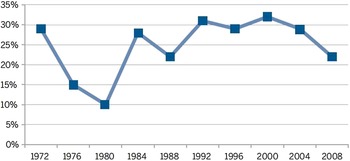
The distinctive Democratic slant of American Jewish voting is clearly revealed in Figure 2, which summarizes the Jewish/non-Jewish Democratic gap in presidential elections between 1972 and 2008.Footnote 3 In only two of the 10 elections — both involving Jimmy Carter — did the gap in Democratic support between Jews and other voters drop below 20%. In parallel analysis of the generic Congressional vote (not shown) in the 17 elections between 1976 and 2008, there are comparable or even larger Jewish/non-Jewish disparities than in the presidential vote (Mellman, Strauss, and Wald Reference Mellman, Strauss and Wald2012). In each case, the data disclose a large Democratic surplus among Jewish voters.
Self-reported Presidential Vote of Jews and the Entire Electorate, 1948–2008. Source: See Note 1.

Distinctive is not necessarily deviant. The even more extreme pro-Democratic slant of African-American voters is perfectly explicable within the framework of economic self-interest as is the Republican disposition of high status religious groups such as Episcopalians. The deviant nature of American Jewish politics is not simply their strong liberal voting habits but rather the political gap between Jewish voters and the non-Jews who they resemble socio-economically.Footnote 4
To document the puzzle, I compare Jewish partisanship with the partisanship of a matched sample of non-Jews. I draw data from the party identification time series in the surveys conducted for the Roper Political Report from 1973 to 1994.Footnote 5 Unlike most commercial pollsters who had reduced their sample sizes to 1000 or fewer by this time, producing very small subsamples of Jews who constitute only 2% of the population, Roper surveyed approximately 2000 respondents 10 times each year. The survey asked the same partisan question in the same language and in the same location on the interview schedule in each monthly survey. With Jewish subsamples that ranged from 50–100 per survey, it is a relatively simple matter to aggregate surveys to generate a composite Jewish subsample for reliable analysis. I use 35 surveys conducted between January, 1989 and October, 1992.Footnote 6 The dataset comprised approximately 69,000 respondents of whom 2,279 selected “Jewish” when asked about their religious affiliation.
To compare Jewish respondents with a comparable non-Jewish subsample, I used the MatchIt program (Ho et al. Reference Ho, Imai, King and Stuart2011) to calculate a propensity score that represents in one single variable the manifold factors that distinguish Jews from non-Jews. This matching technique generated a “balanced” group of non-Jewish respondents who resemble a randomly selected control group in a classic experimental design.Footnote 7 The non-Jewish subsample was matched to the Jewish subsample on the basis of geography (state, region, city size, metropolitan residence), socio-economic resources (employment, occupational status, education, income, labor union membership), demography (race, Hispanicity, household size, marital status, age, gender), and year of survey. The nearest neighbor matching process generated very similar Jewish and non-Jewish subsamples as indicated by the standardized mean difference in propensity scores of just 0.0003.
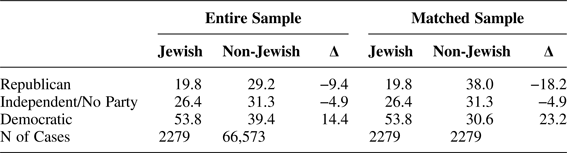
Table 1 demonstrates the magnitude of the puzzle when controlling for socio-economic factors. Compared to the entire non-Jewish subsample, Jews were “only” 14.4% more Democratic. But when the comparison was narrowed to non-Jews who most closely resembled Jews, the surplus in Jewish Democratic partisanship increased to 23.2% and the percentage of Jewish Republicans was only half that of the selected non-Jews. Looking only at declared partisans, the pro-Democratic gap between Jews and their sociological equivalents becomes a gulf of more than 40%. These data confirm that the first puzzle of American Jewish politics rests on firm empirical footing.
Jewish Partisanship Compared to All Non-Jews and Matched Sample of Non-Jews with Propensity Score Matching, 1988–1992
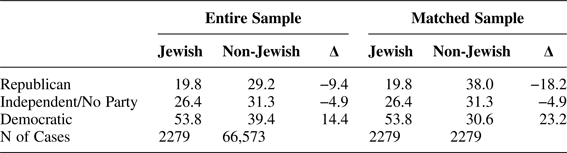
Source: Calculated from Roper Political Report as described in text.
WHY JUDAIC EXPLANATIONS DON'T WORK
The puzzle of American Jews voting unlike those who share their socio-economic status has dominated empirical research on Jewish political behavior. Despite all of the ink devoted to this anomaly, existing explanations for Jewish liberalism only deepen the mystery by making Jewish political behavior even more anomalous.
I use the term “Judaic” for approaches that locate the source of American Jewish liberalism in the distinctive experiences and culture of Judaism. They find in the Jewish tradition specific developments and forces that, it is argued, promote an elective affinity with a specific (in this case, left-liberal) political outlook. These factors may not be intrinsic to Judaism but they became associated with it due to particular developmental circumstances. I divide the various theories of intrinsic liberalism into three broad categories.
Jewish values theories, popularized by Lawrence Fuchs (Reference Fuchs1956), identify religious norms said to promote a liberal or leftist orientation to politics. Chief among these is the emphasis in the Jewish tradition on tzedakah, translated as “deeds of loving-kindness” or, more simply, as charity. The idea of communal responsibility for the widow and orphan, a staple of ancient Jewish communities, has been broadened into the notion of a responsibility to heal the world (tikkun olam) that emphasizes the obligation of those with resources to contribute to the good of the commonwealth. With this orientation, Fuchs suggests, Jews were naturally disposed to support public efforts to address social needs by collective action. Jewish policy activists were important figures in the creation of the American welfare state and Jewish donors continue to contribute out of all proportion to their size to educational, cultural, and other welfare activities.
Other scholars have called attention to historical experience in explaining Jewish attraction to left-wing politics. The struggle for Jewish inclusion in European societies after the Enlightenment generated a predictable coalition of forces opposing and supporting what was called Jewish emancipation (Birnbaum and Katznelson Reference Birnbaum and Katznelson1995). From the late 18th–early 20th centuries, the full admission of Jews to European societies was resisted by the forces of order and tradition, specifically the nobility, aristocracy, police, military, clergy, and the wealthy. The advocates of Emancipation were typically journalists, communists, socialists, liberals, trades unionists, intellectuals, and others in the progressive sector of the time. From this, Jews are said to have discerned that their friends were on the left and their opponents on the right, an association carried in Jewish immigrants' mental baggage as they crossed the Atlantic (Sorin Reference Sorin1985).
Social marginality theories, the final category of Judaic explanations of Jewish liberalism, stress the importance of minority status on Jewish political outlooks. From the time of their expulsion from Rome in 49 AD until the recreation of a Jewish commonwealth in 1948, Jews were a small minority in the societies they inhabited. As an oft despised minority, subject to the whims of rulers and publics, Jews are said to have developed a sense of empathy for other marginal groups that suffered discrimination and humiliation. They thus found it easy to make common cause with these fellow sufferers and were attracted to left-wing movements that promised to end invidious distinctions based on religion, ethnicity, or race. The tendency of Jews to identify with the downtrodden appears to account for the strong support, active and passive, given by Jews to the African-American civil rights movement (Mendes Reference Mendes2009; Glaser Reference Glaser1997).
Each of these theories has been subjected to penetrating critiques (Levey Reference Levey1996). Dissenters from the “values” theory argue that Judaism is in fact doctrinally compatible with a variety of political positions and note that those who adhere most strongly to traditional norms, the Orthodox in particular, are the least left-wing segment of the Jewish community. The alignment of forces at the time of the struggle for Jewish emancipation may have left a lasting imprint on Jewish partisanship, consistent with historical theories, but such “primordial” loyalties must be reinforced continuously or they will decay (Beck Reference Beck1979). Historians have not explained how or why Jews have persisted in their liberalism, defying social changes many expected to usher in a Jewish partisan realignment (Fisher Reference Fisher1979). The attraction of some oppressed minorities to right wing or fascist movements belies the core assumption of social marginality theories that minority status inevitably encourages left-wing sympathies. It can just as easily promote “over-identification” with the dominant forces in a society as a means of asserting membership in the national community.
The Judaic theories share a more fundamental problem: In asserting that Jewish liberalism inheres in certain durable elements of the Jewish experience, they imply that Jewish political loyalties should not vary across space or over time. Jewish religious values, historical experience, and social marginality have been constants, imposing their influence on Jews for four millennia. As static and universalistic perspectives, these Judaic theories cannot explain either spatial variations in Jewish political behavior (puzzle 2) or shifts in party loyalties over time (puzzle 3).
Spatial variability, the source of the second puzzle, has been strikingly apparent. Excluding the unique case of Israel, where Jews are a dominant majority in what has been described as an ethnic democracy (Peled Reference Peled1992), comparative survey data about recent Jewish political behavior in the diaspora disclose distinctive national patterns. French Jews remain in the center of the French political spectrum, supporting moderate parties of the right, center, and left (Schnapper, Bordes-Benayoun, and Raphaël Reference Schnapper, Bordes-Benayoun and Raphaël2010; Greilsammer Reference Greilsammer1978) while Canadian Jews tend toward center-left preferences (LaPonce Reference Laponce1988), and South Africa Jews seem more center-right (Kotler-Berkowitz Reference Kotler-Berkowitz2002). Jews in Britain tend to divide their votes in a manner quite comparable to the general population (Kotler-Berkowitz Reference Kotler-Berkowitz2002) whereas Australian Jews are disproportionately on the right (Rubinstein Reference Rubinstein1982). In none of these countries do we find anything comparable to the American pattern of a largely left-wing political orientation yet the Jewish populations in these polities inherited the same religious values, historical experience, and minority status as American Jews.Footnote 8
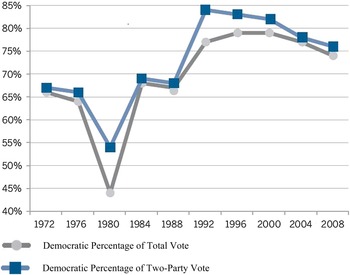
Even in the United States, where the Jewish attachment to Democrats has been distinctive, there is measurable volatility over time that Judaic theories cannot explain. Figure 3 documents one such striking shift in Jewish partisanship in the middle of the 1972–2008 time series. Roughly two out of three Jews who voted for a major party favored the Democratic candidate in the first five elections; from 1992 to 2008, by contrast, almost four out of five Jews cast a ballot for the Democratic nominee. As Jewish values, historical experience or minority status did not change much in this time period, Judaic theories are at a loss to account for the sharp upward tick in the pro-Democratic voting after 1988.
(Color online) Jewish Democratic Percentage Minus Total Democratic Percentage, 1972–2008. Source: Mellman, Strauss, and Wald (Reference Mellman, Strauss and Wald2012, 7).

THE CENTRALITY OF CITIZENSHIP
What is it about the United States that encourages Jews to vote disproportionately for a party that appears less responsive than the opposition to their economic interests, a pattern that is not duplicated by Jews elsewhere and is subject to short-term electoral swings that sometimes mimic and other times confound broader political trends? I find the foundation of American Jewish preferences for the more liberal national party in the norms of citizenship established at the founding. By uncoupling religious identity and membership in the national community, adopting a classic liberal polity that disclaimed a religious identity for the state, the United States accorded Jews the opportunity (denied elsewhere) to participate fully in society. Following a calculus of self-interest that is not primarily economic, their political choices are driven by party positions toward the liberal tradition. Because the American liberal “regime” is a moving target, Jews adjust their political preferences in response to changing political circumstances, rewarding parties who defend the regime, punishing those that attack it. In sum, American Jews define their political self-interest in a different manner than other groups, behave distinctly because they alone of Jews live in a liberal polity, and respond politically to the behavior of left and right toward the core values of the regime.
This model was inspired by a disparate group of “political interests” explanations of Jewish liberalism (Levey Reference Levey1996). While scholars have identified some components relevant to this approach, it has not been fashioned into a comprehensive theory to account for the three empirical puzzles associated with American Jewish political behavior. To do so, I exploit Leonard Fein's (Reference Fein1988) observation about how Jews calculate political self-interest, Paula Hyman's (Reference Hyman and Gitelman1992) discussion of geographic context in Jewish politics, Peter Medding's (Reference Medding1977) interpretation of Jewish political behavior as a reaction to threats emanating from the political system, Liebman and Cohen's (Reference Liebman and Cohen1990) instructive comparison of American and Israeli Jews, and Kramnick and Moore's (Reference Kramnick and Moore1996) insistence on the importance of the Constitution's Article VI. Weaving these strands together, I suggest, improves our understanding of the puzzles that animate this inquiry.
In social science, we often ask our research subjects to tell us more than they know or are willing to say. Given that many people have difficulty articulating the values that underlie their own preferences, what kind of evidence can be adduced to sustain the argument that citizenship is the core political concern of the American Jewish community? I draw initially on the discourse of Jewish leaders from the Founding Era through the late 19th century when Jews remained a tiny minority consisting mostly of immigrants from western and central Europe. Because many of them had been raised in times and places where Jews were not accorded the status of citizenship, Jewish leaders before the 20th century marveled aloud at their good fortune in being full participants in the American polity. Almost as if they were participating in depth interviews, their private correspondence and public writings are awash with discussions about safeguarding the secular character of the regime. As citizenship status assumed some degree of normality by the 20th century, entering the “taken for granted” universe, it becomes more difficult to find overt expressions regarding liberal citizenship. Still, there are important clues about the basis of Jewish political priorities for the post-World War II period in the words and actions of the organized Jewish community, a term denoting the rich network of voluntary organizations that characterizes Jewish life in the United States. Hence, I will examine how the advocacy work of Jewish agencies — both domestically and internationally — was nested within a classic liberal perspective. In documenting the Democratic resurgence among Jews in the late 20th and early 21st centuries, I review relevant data on Jewish public opinion. Although Jewish political behavior seems consistent with a overriding concern to defend the liberal citizenship regime, the evidence does not allow a critical test of the hypothesis about the salience of citizenship. Nonetheless, it strongly suggests such a worldview underlies American Jews' distinctive approach to the public square.
From the Founding to the Late 19th Century
In discussing the origins of the American regime of religion and state, we start with James Madison's definition of a liberal regime in his Memorial and Remonstrance. Protesting a Virginia statute that would pay Christian religious teachers from state funds, Madison echoed John Locke's understanding of the state's proper relationship to religion:
Before any man can be considered as a member of Civil Society, he must be considered as a subject of the Governour of the Universe: And if a member of Civil Society, do it with a saving of his allegiance to the Universal Sovereign. We maintain therefore that in matters of Religion, no man's right is abridged by the institution of Civil Society and that Religion is wholly exempt from its cognizance.
A properly constituted state, following this logic, did not claim authority over religion or demand certain beliefs or behavior as a condition of admission to full citizenship. Nor did it prefer religion by providing the state's imprimatur or funding. Fundamentally, liberal theory adjudges the state incompetent in all matters of religion. In writing the Constitution, Madison intended to insure that “no legitimate claims could be made by the state against the individual” regarding religious beliefs or requiring assent to any doctrine (Kloppenberg Reference Kloppenberg1998, 45). The fear that his Antifederalist opponents intended to put such language in the law prompted Madison to change his long-held opposition to a Bill of Rights.
The initial arena of debate involved the right of Jews and other religious minorities to enjoy the “full immunities” of membership in the civic community. Under liberal democratic theory, citizenship is conditional on “the abstraction of self from particularity” (Peled Reference Peled1992, 433). That is, citizenship is a right to be conferred on individuals as individuals without regard to any “extraneous” trait other than the basic competence to participate in society. By contrast, Republican/ethnocultural approaches assume that societies require “ethnic homogeneity and common cultural backgrounds” as sources of social integration. These often take the form of Romantic regimes, sometimes called ethnic democracies, which define the nation in terms of “blood, religion and soil” (Jaher Reference Jaher2002, 40–41). In such regimes, the dominant “nation” exhibits a pervasive sense of “owning” the polity (Brubaker 1996). Drawing on the Enlightenment project, liberal regimes condition citizenship instead upon acceptance of the polity's legitimacy and consent to core political values (Smith Reference Smith1988, 227). As Jaher (Reference Jaher2002, 4) notes, these differing approaches reflect competing forms of nationalism, one essentially territorial and civic, the other “organic” and “volkisch.”
This philosophy of liberal citizenship for the new American state was implemented in the Constitutional Convention just two years after the Memorial through both positive and negative action. The positive statement was contained in Article VI, Clause 3: “. . . no religious Test shall ever be required as a Qualification to any Office or public Trust under the United States.” That language reflected the Madisonian perception that fitness for public office — and by extension full membership in the civic community — did not require any particular set of religious values or patterns of behavior. Arguably even more compelling as an indication of the document's embrace of liberalism was the absence of any reference to God which “suggested to many that the Constitution was manifestly nonreligious and, perhaps, even hostile towards traditional religion” (Dreisbach 1996, 274). Although the religious test language was apparently non-controversial in Philadelphia, it generated some serious criticism during ratifying conventions among those who felt that the success of the new state required a more explicit grounding in Christianity. As the clause applied only at the national level, states were free to maintain their own test oaths and all but two continued to exclude Jews from the full rights of citizenship (Chyet Reference Chyet1958).
American Jews embraced Clause 3 as their emancipation proclamation (Wald Reference Wald, Rayside and Wilcox2011, 249–252). Although they had long enjoyed religious and economic rights, progress in political rights had lagged. The link between test oaths, office holding, and citizenship was evident to Jewish community leaders in Philadelphia who complained in 1783 that restricting public office to Christians deprived Jews of “the most important and honourable part of the rights of a free citizen” (Jaher Reference Jaher2002, 162). Concerned that the same restrictive language in the Pennsylvania constitution might find its way into the national constitution, Jonas Phillips, a Philadelphia merchant, petitioned the Constitutional Convention to avoid it.
The language on religious tests earned plaudits from the Jewish communities of the time who venerated the Constitution four years before the first amendment was added. A 1789 sermon in a New York synagogue noted that “we are . . . made equal partners of the benefits of government by the constitution of these states” (Kramer Reference Kramer, Wirth-Nesher and Kramer2003, 17). In a paean to George Washington, Savannah's Jews noted that the government he helped create had “enfranchised us with all the privileges and immunities of free citizens” (Rabinove Reference Rabinove1990, 136). Their coreligionists in four cities told Washington in 1790 that the freedom won in the Revolution was not “perfectly secure, till your hand gave birth to the Federal Constitution.” In the same year, New York's Shearith Israel, the first Jewish congregation in the United States, adopted a constitution acknowledging its location in a nation based on the principle of “equal liberty civil and religious” (Sarna Reference Sarna2004, 43). Rhode Island Jews thanked the new president for making them “equal parts of the great governmental machine” (Kramer Reference Kramer, Wirth-Nesher and Kramer2003, 18). The author of the tribute emphasized that the new document did more than accord them mere toleration, a flimsy guarantee at best, but rather assured them something rather more precious, “invaluable rights as free citizens.” According to an influential spiritual leader, the credit was not due to humans alone but to divine will. In a 1798 sermon, Gershon Seixas asserted that God “established us in this country where we possess every advantage that other citizens of these states enjoy” (Schappes Reference Schappes1971, 92). Like their fellow citizens, he elaborated, Jews enjoyed “participating of equal rights and immunities.” As such comments attest, the contemporary Jewish community construed the Constitution's prohibition on religious tests to confer on them full citizenship, something no other society had offered (or offered without demanding conversion as the price of admission).
It is not difficult to understand why the liberal conception of citizenship resonated so powerfully with American Jews. Without reducing Jewish history to one long pogrom, it is nonetheless important to understand that Jewish experience under non-liberal regimes brought home the value of liberal citizenship. A subject people for most of their history, lacking sovereignty, and agency, Jews were unusually dependent on the goodwill of rulers (Yerushalmi Reference Yerushalmi2005). Beneficent rulers could provide guarantees of residence, shield Jews against religiously-inspired violence, provide opportunities for their welfare, and allow them some self-government. Jews were often treated better if they could provide services that benefited the state by filling essential positions debarred to others (such as tax farming or money lending), offer access to global credit through international familial connections, or supply court physicians. But rulers who needed scapegoats could and did expel Jews, promote physical attacks on their communities, tax Jews at rates that effectively impoverished them, and deny them many forms of autonomy. Even under the most benign leaders, Jews experienced a precarious existence because favors bestowed on a whim could equally suddenly be withdrawn. Only in the new United States, at least at the federal level, was political equality something Jews held “as of right together with all other citizens” (Marcus Reference Marcus1989, 83). Whereas Jews on the Continent might be tolerated or protected, Hannah Adams wrote (Reference Adams1817, 132), the United States had gone further by vesting them with “all the rights of citizens.”
The contrast with the European heritage could not have been starker. Examining expulsions and anti-Jewish violence in late medieval Europe, Kenneth Stow detected an important underlying factor — the degree to which rulers conceived of themselves as Christian sovereigns. As monarchs consolidated centralized rule, they increasingly vested their legitimacy in a mystical bond sanctified by divine will. Fusing religion with nationalism provided France with “the vision of itself and its people as constituting an unblemished corpus mysticum, propaganda was destined eventually to become accepted as fact . . .” (Stow Reference Stow1992, 296). Jews, the eternal alienated people who rejected the Christian God, could not be a permanent fixture in such a society. Hence, the limited tolerance granted them in earlier periods grew increasingly anachronistic and subject to revocation. By the mid-16th century, Europe was largely devoid of professing Jews. Even when they returned to the continent in the 18th and 19th centuries, Jews were still not considered equal. In the words of Benjamin Nones (Schappes Reference Schappes1971, 95), “Among the nations of Europe we are inhabitants everywhere — but Citizens no where [sic] unless in Republics” [emphasis in original].
In the immediate aftermath of the Founding, Jews may not have pushed for purely secular laws (Sarna Reference Sarna, Sarna and Dalin1997, 4–8) but they soon began to articulate principled opposition to legal distinctions based on religion. One such effort arose from the aborted appointment of Mordecai Noah as United States Consul to Tunis in 1815. Informed by Secretary of State James Monroe that his professed religion “would produce a very unfavorable effect” and his appointment was thus revoked, Noah responded incredulously “. . . my religion an object of hostility? I thought I was a citizen of the United States” (Marcus Reference Marcus1996a; Reference Marcus1996b, 110–111). As such, his dismissal “violated one of the most sacred and delicate rights of a citizen.” Noah chided James Madison, the president who appointed and then terminated Noah, for forgetting Madison's own insight that “the religion of a citizen is not a legitimate object of official notice from government.” Like many of Noah's defenders, Isaac Harby of Charleston reminded Secretary of State Monroe that the Constitution forbade imposing disabilities based on religion:
It is upon the principle, not of toleration . . . but upon the principle of equal inalienable, constitutional Rights, that we see Jews appointed to offices, that we seem them elected in our State Representation . . . They are by no means to be considered as a Religious sect, tolerated by the government; they constitute a portion of the People. They are, in every respect, woven in and compacted with the citizens of the Republic. Quakers and Catholics, Episcopalians and Presbyterians, Baptist and Jews, all constitute one great political family (Blau and Baron Reference Blau and Baron1963b, 320–321, emphasis in original).
This discourse would recur in subsequent controversies.
Using the federal constitution as a model, the Jewish community's advocates devoted most of their energy to removing from state constitutions various disabilities and Christian test oaths. By 1833, after intense battles, all states had eliminated their formal religious establishments but this did not end the debate over Jewish inclusion. The Civil War presented three potent challenges to Jew's perceptions of their standing in the United States. In 1861, as part of an attempt to regularize military chaplaincy, Congress passed legislation requiring a chaplain to be a “regularly ordained minister of some Christian denomination.” Stung by their exclusion, the nascent Jewish community organized to reverse this decision (Korn Reference Korn1961, 62). Barely a year later, the Jewish community was similarly aggravated by news that Ulysses S. Grant, then a major-general who had wrested control of three Southern states from Confederate armies, ordered the expulsion of Jews “as a class” from the territory under his command (Sarna, Reference Sarna2012). Grant wanted to rid the region of Jewish speculators who he felt were principally responsible for a thriving black market in Southern cotton. The breadth of the order swept up not only the speculators but also long-time Jewish residents who had no hand in the black market. Finally, the War stimulated a continuing movement to adopt a constitutional amendment that would define the nation as explicitly Christian (Borden Reference Borden1984, 58–74).
In each case, the Jewish community mobilized to challenge these actions. While success was uneven, the constant was a discourse that emphasized how these actions undermined a constitution meant to insure that “an Israelite is placed on the same footing with any other citizen of the Union and can be elevated to the highest station in the gift of government or in the people . . .” (Blau and Baron Reference Blau and Baron1963a, 34). The Board of Delegates, an ad hoc coalition of rabbis who coordinated the chaplaincy protest during the Civil War, explicitly called the exclusion of Jews a form of “religious test” prohibited by Article VI (“Memorial” 1861). Their emissary to Congress saw the prohibition on Jewish chaplains as a sinister step on a slippery slope that could end with “further restrictions on further occasions” and, ultimately to “oppressive laws as will deprive them of the full privileges enjoyed by other citizens” (Display Ad #4 1861, 10). Private correspondence among the activists emphasized the need to avoid language calling for tolerance and instead emphasize equality of citizenship under the Constitution. The coordinator of the lobbying campaign against the chaplaincy restriction told his patron:
The great principle the Jews have to contend for is, that the Constitution takes no cognizance of religious sects and that consequently we do not want special legislation for the Jews, as is the case in England, but all legislation must be general for all American citizens without any regard to their faith (Zola Reference Zola2014, 87, emphasis mine).
The editors of the Jewish Messenger framed the campaign against Grant's expulsion order as essential to “maintain our rights as American citizens” (“Grant's Order” 1863, 20). The order seemed so portentous because it reminded Jews of their treatment in the Middle Ages as a corporate body with delimited rights rather than a group of individual citizens to be judged on their own merits (Sarna Reference Sarna2012, 32).
The cancellation of the order by President Lincoln removed the immediate threat but the issue persisted into the election of 1868. Whether they favored or opposed Grant's election, many Jewish leaders would have endorsed the claim of one influential rabbi that upon casting a ballot, “I am not a Jew, but I feel and act as a citizen of the republic” (Sarna Reference Sarna2012, 73). Chastened by the severe reaction to his order, Grant himself later recognized implicitly that it violated the norms of a nation which knew “no distinction of her own citizens on account of religion or nativity . . .” (“President Grant Pleads” Reference Marcus1996, 202). The comment was all the more striking because it came in Grant's letter of introduction for a new Consul to Romania, a Jew who was appointed in part because of his role in fighting against the repression of Jews in Eastern Europe.
In much the same manner, the proposed Christian Amendment to the Constitution was perceived by American Jews as virtual revocation of their citizenship status. It would lead Jews to be “deprived of the rights of full citizenship” (“The Constitutional Amendment” 1864, 178). In The Occident and American Jewish Advocate, Isaac Leeser warned his readers that the attempt to “engraft Christianity onto the Constitution” meant that non-Christians “may well be excluded from every participation in the government of the country” (Zola Reference Zola2014, 127). The Amendment, a stalking horse for stronger Sunday closing laws, religious oaths, Christian education in public schools and other projects, threatened Jews and other non-Christians alike with a “loss of their political and religious equality” (Zola Reference Zola2014, 128). Its passage, he argued, would transform American Jewry from full members of the polity into the status they had suffered outside the United States: “aliens in a land where we had hoped for permanent freedom and equality” (Zola Reference Zola2014, 134). Memorializing Congress, the Board of Deputies of American Israelites said the Jewish community considered the revised preamble nothing less than the “total withdrawal of their precious rights as citizens equal with any others” (Zola Reference Zola2014, 136). The opposition was not only about a loss of religious freedom but rather a campaign against devaluing the fundamental status of American Jews as citizens entitled to equality with their fellow Americans.
Although the campaign for a Christian Amendment persisted into the 1890s and beyond, the proposal lost any realistic chance of passage and never advanced to even a Congressional hearing after 1874. Indeed, for all the issues that engaged Jewish concern throughout the remainder of the 19th century, most formal-legal constraints based on religious identity had been nullified by the end of the 19th century. In 1924, on the occasion of Independence Day, a New York Yiddish daily argued that July 4th really celebrated independence “from the idea that a Government is an ethnic instrument, that political institutions are the reflex of racial instincts, that to be a member of a certain country one had to have a certain ancestry” (Marcus Reference Marcus1996a; Reference Marcus1996b, 312).
Thus the secular American state became for Jews a lodestone of the constitutional order. Little wonder that Jews perceived a religious definition of the state as a permanent threat to their citizenship status and proved so receptive to a liberal regime that disclaimed any religious character. The message was repeated and reinforced. A Yiddish/English textbook aimed at Eastern European immigrants who poured into the United States from the 1880s through 1920 instructed the newcomers that Jewish well-being in the United States rested in large part on “the secularity of the Government” (Wiernik Reference Wiernik1912, 428–429), a foundation that protected Jews from the “unfavorable conditions” faced by their co-religionists everywhere else. Any attempt to incorporate Christianity into the law was resisted because it threatened the equal status of Jews and their full citizenship in the Republic granted by virtue of Article VI. Defending and extending this secular definition of the American state became the (often unstated) core political priority of America's organized Jewish community.
The 20th Century
In the early 20th century, American Jews turned their attention from constitutional issues to combating anti-Semitism in the social realm, fighting against the restrictive immigration quotas championed by nativists, and assisting Jews fleeing anti-Semitism in Europe. These fights could take the form of defending a liberal regime as when Maurice Samuel (Reference Samuel1924, 218–219) argued that immigration restrictions targeting Jews instantiated a volkisch regime in the United States.Footnote 9 When they did emphasize Jewish rights, the discourse increasingly used Thomas Jefferson's language about separation of church and state and the religion clauses of the First Amendment rather than Article VI's invocation of equal citizenship. The Jewish organizations that emerged, displacing rabbis as public spokespersons for the community, may have used different language than their predecessors but one can still find without much probing an abiding commitment to the tenets of liberal citizenship.
While religious congregations and denominations originated in the late 18th century, Jews began building and expanding their civil society in the late 19th and early 20th centuries. They developed an incredibly dense and variegated network of associations to address Jewish group interests in the United States. Particularly in the post-World War II era, some of these organizations pursued policies underlain by the same concerns about citizenship that animated Jewish leadership during the Founding. That was particularly true of what became known as the community relations or communal defense sphere of organized Jewry. With a mission “to safeguard the civil and religious rights of individual Jews and the Jewish people as a whole” (Rubin Reference Rubin and Lipset1990, 193), this sector was populated by such well-known national groups as the American Jewish Committee and Anti-Defamation League of B'nai B'rith. In addition to these national organizations, the geographically organized Jewish federations sponsored community-level agencies with similar mandates and the Jewish religious denominations also maintained offices to secure religious and civil rights for their members.
While the term “communal defense” connotes a concern with anti-Semitism, a major issue for American Jewry, those most involved in this sphere often took a broader perspective on the underlying values animating their activities. Rubin (Reference Rubin and Lipset1990, 193) noted a common “public affairs” culture permeated by a commitment “to create, sustain and assure a moderate, constitutional government in the United States . . . mindful of the rights of minorities.” That rationale rested on the same worldview that inspired 18th century Jewish enthusiasm for the Constitution. In the words of one Jewish community relations leader:
Jewish security in the U.S. is not assured by eliminating antisemitism. There will always be antisemitism. The criterion for Jewish security is how Jews as individuals and as a group function in our society, and the extent to which they are able to participate in the workings of our society [emphasis mine]. That is the criterion for me. The one dynamic that ensures Jewish security is American pluralism, because a pluralistic society assures that you, as a minority group member, can fully participate in society (Cohen Reference Cohen2001).
This echoes the words of Leonard Fein that liberalism is “good for the Jews” because it builds conditions that shield them from discrimination and marginalization. Liberal regimes, it bears repeating, are understood to refrain from imposing a religious identity on the state that would deny legitimacy to citizens who do not embrace the dominant identity.
In the 1950s, Jewish organizations increasingly turned to the courts to reinforce the liberal character of the regime in matters of religion and state. They took the lead in identifying and recruiting plaintiffs and funding cases that would secularize the public sphere (Ivers Reference Ivers1995). Looking just at the period from 1969–1988, Jewish groups produced more than 40% of the amicus briefs filed in cases that arose under the religion clauses of the First Amendment and more than half of all briefs submitted in favor of separationist positions in cases involving the Establishment Clause (Ivers Reference Ivers1990). Broadening the database to the 1953–2005 periods and looking only at groups with major interest in the religion clauses, Oates (Reference Oates2010) found that Jewishly-identified organizations and secular organizations with a strong Jewish presence (indicated by the founders, staff and coalition members) raises the percentage to nearly 50%. Jews were represented in virtually all cases involving school prayer, religious displays and government funding and outdistanced other groups significantly in lawsuits about religious exemptions and blue laws. These lawsuits targeted public actions that would grant some resource, privilege, or legal recognition based on religious affiliation, actions that almost all these Jewish organizations rejected as a threat to the liberal regime. In a very real sense, watchfulness became the political project of American Jewry.
Alongside the community relations/communal defense realm, a second sphere of organizational life has revealed the American Jewish community's commitment to liberal principles of citizenship: the “Israel-Overseas” domain. Even in a case where we might reasonably expect particularistic concerns to trump political differences, where tribalism and narrow self-interest should drive the relationship, Israel's emergence as an “ethnic democracy” has seemingly distanced some American Jews from the homeland. Put another way, support for Israel among Jewish elites and organizations has apparently diminished somewhat precisely because Israel has pursued policies that contradict the core political culture of American Jewry. Among the issues that account for this alienation, Steven Rosenthal (Reference Rosenthal2001, 134) concluded, the legal status of Judaism in the Zionist state has generated “the most bitter and protracted of all the conflicts between American Jews and Israel.”
Zionism appealed to many American Jews partly because of its potential as a laboratory to implement basic liberal tenets. Upon Israel's creation in 1948, many American Jews were heartened to learn that the new state did not condition citizenship on religious affiliation and accepted as fully Jewish those immigrants who had converted to Judaism under the auspices of non-Orthodox rabbis. Although Israel departed from liberal tenets in allocating state resources and authority to religious organizations, its bold claim of providing religious equality to all communities stood out in a region with strong theocratic tendencies. Ironically however, by channeling funds allocated to the Jewish sector exclusively to Orthodox religious authorities, this policy eventually became a major source of tension between American Jews and the Israeli government. That tension escalated with the fervent religious nationalism on display during the period of Likud dominance from the late 1970s onward.
When Israeli religious parties demanded that the state define Jewishness by Orthodox standards as their price for joining governing coalitions, American Jewish organizations mobilized their financial and political resources to resist. Since the turn to the right in Israel, Shain notes (Reference Shain2000, 164), American Jews
. . . have been instrumental in the struggle to challenge the Israeli Orthodox monopoly over Jewish marriage and conversion and its domination of religious councils. Such groups have also played a role in the fight for the rights of non-Orthodox Jews to be buried in non-denominational cemeteries and have taken the lead in redirecting Jewish diasporic fundraising away from general funds for Israel to targeted assistance of institutions and programs aimed at promoting tolerance, democracy, and religious pluralism.
Many of these campaigns achieved legal success in Israel due to the support of Supreme Court president Aharon Barak. A close friend and associate of the American legal scholar Alan Dershowitz, Barak effected a constitutional revolution built on “the enunciation of liberal-individualistic values and . . . utilization of American precedents” regarding religion and state. As the American precedents in question were often the work of Jewish lawyers and legal scholars imbued with the classic liberal understanding of citizenship, the leading American authority on the Israeli legal system described the result as the “Americanization” of Israeli law (Edelman Reference Edelman2000, 209). Even to an Israeli admirer (Lorberbaum Reference Lorberbaum2013, 292), Barak's “liberal judicial activism” had the effect of effacing “the particular cultural and religious character of the Jewish public space of Israeli society.” That conclusion would not have disturbed many American Jews and their organizations who gave classic liberal values pride of place when they constructed their image of a self-described Jewish state.
March Right, March Left
By the late 1960s, with the passage of civil rights laws that extended the nondiscrimination principle to most spheres of life, the liberal regime of religion and state seemed fully consolidated. Yet Jews remained alert to what they perceived as threats to the liberal principle of state religious neutrality. No group other than the expressly non-religious comes close to the level of separationist sentiment embraced by American Jews (Cohen Reference Cohen2001). Medding (Reference Medding1989) is correct to note that American Jews reacted with alarm to any signs of predation but tends to interpret such efforts as reflecting antipathy toward Christianity rather than a positive embrace of classic liberalism because of its possibilities for Jewish self-realization in all spheres of society. Jews reacted intensely to any sign that the generic principle of liberalism, citizenship of the “unencumbered self,” was threatened by the identification of the state with any form of particularism. Christianity may well have been perceived as one such threat but it was not the only factor that appeared to undermine full citizenship.
In the aftermath of the 1960s, the threat to Jewish civic equality seemed to originate with forces on the left. In New York, the immediate issue was the demand for “community control” of schools by activists in Brooklyn's Ocean Hill-Brownsville area. This conflict pitted a largely Jewish public education system against advocates of race-conscious hiring and was perceived by many as a choice between meritocracy and quotas. The issue went national in the guise of debates over the larger principle of affirmative action, perceived by many Jews as a perversion of liberalism because it enshrined group privilege in the law. Other concerns about Jewish survival, manifested in a variety of causes that included Israel and Russian Jewry, also seemed to range Jewish interests against the predominant ethos of 1960s liberalism (Staub Reference Staub2002).
The turn to the right in mass political behavior was eventually blunted in the late 1980s when Jews sensed another challenge to the liberal regime — newly-resurgent Christian traditionalists in the Republican Party. While careful to couch its policy preferences in the language of “Judeo-Christian” values and to swear unstinting allegiance to Israel, the social movement nonetheless appeared to embrace a sectarian conception of citizenship and national identity that privileged the values and institutions of evangelical Protestant Christianity.
To examine this transformation, I turn to empirical research based on survey data. Christian Right adherents stood out in opinion surveys by their eagerness to use the state to promote or reject specific religious groups (Smith Reference Smith1996). Even Jewish Republicans were concerned about this constituency: When Christian Right stalwart Pat Robertson ran for the Republican Party presidential nomination in 1980, Jewish Republicans were as likely to consider deserting the Republican Party if Robertson became its presidential nominee as were Jewish Democrats to forsake their party when asked about the prospect of Jesse Jackson on the Democratic ticket (Wald and Sigelman Reference Wald, Sigelman, Smidt and Penning1997). A 2004 survey indicated that Jews both disliked the Christian Right and rejected the Republican Party because it was seen as too close to a movement committed to Christianizing the public square (Uslaner and Lichbach Reference Uslaner and Lichbach2009).
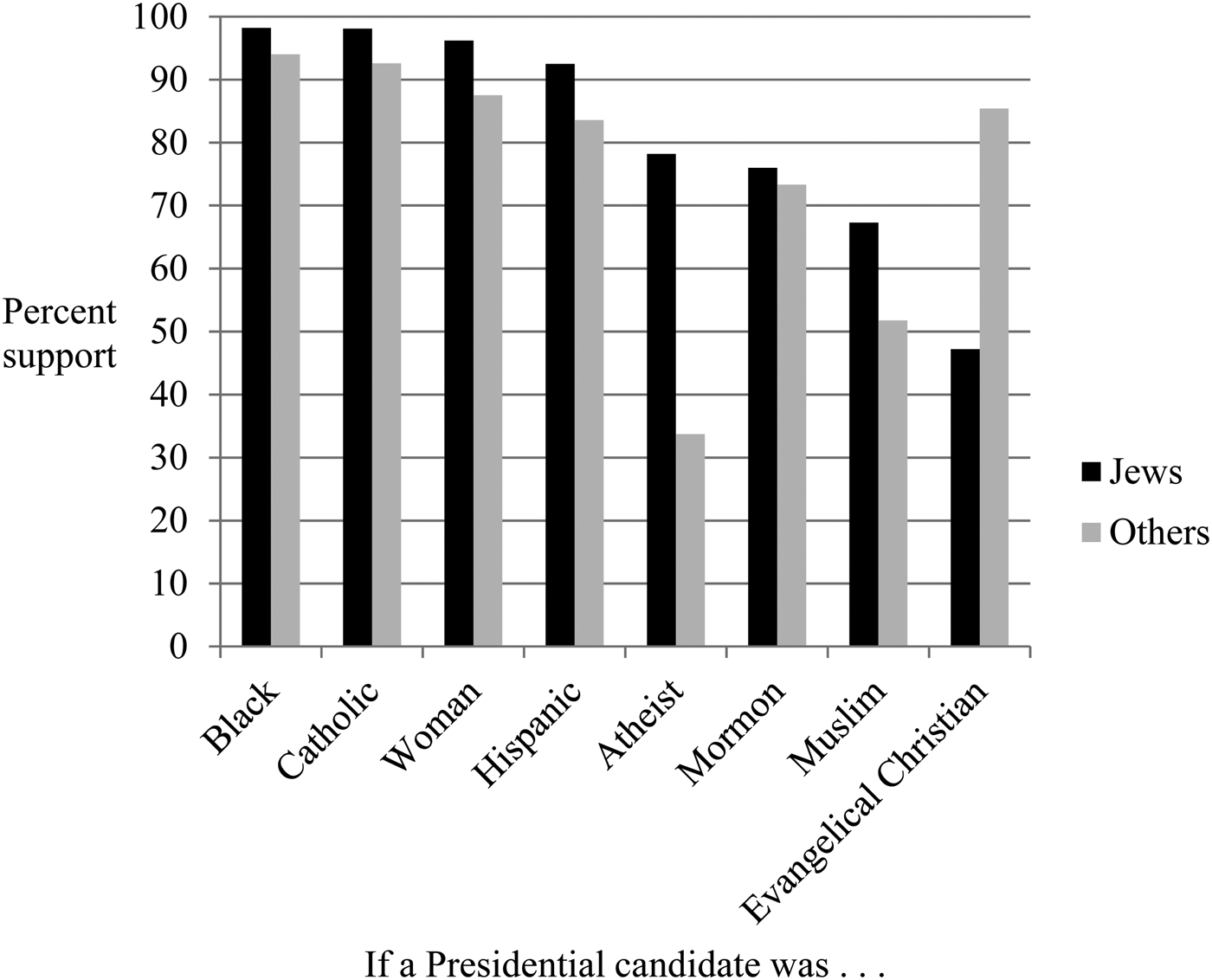
To what extent is this merely an anti-Christian reaction, as Medding and others (Bolce and De Maio Reference Bolce and De Maio1999) have suggested, rather than a policy-related vote based on concerns about the movement's political commitment to a Christian America? Consider data from a 2007 survey by the Pew Organization reported in Figure 4.Footnote 10 The survey asked respondents about their willingness to support presidential candidates with specific ethnic, racial, gender, and religious traits. Figure 4 compares the percentage of Jews and the entire sample that indicated they would be more or just as likely to support a presidential candidate with each trait. Jews showed a slightly greater inclination to support black, Hispanic, female, and/or Catholic candidates and were considerably more receptive than the population to the prospect of a Muslim or atheist nominee. Yet the otherwise tolerant and politically ecumenical Jewish subsample strikingly resisted an Evangelical Protestant candidate, being 36% less supportive of such a nominee when compared with the entire sample.
(Color online) Democratic Percentage of the Jewish Total Vote and Two-Party Vote for President, 1972–2008. Source: Mellman, Strauss, and Wald (Reference Mellman, Strauss and Wald2012, 6).

Willingness of Jews and Non-Jews to Support Presidential Candidates by Different Traits (Percentage saying trait would make them more likely or make no difference). Source: See Note 10.

If this was hostility to Christianity or religion in general, it's hard to understand why Jews had no trouble with a Catholic candidate and proved even more receptive than the population to a Mormon. And while Jews may have substantial political differences with Muslims over the Arab-Israeli conflict, they did not express that by showing any more reluctance than the general population to the prospect of a Muslim president. Rather than indicate a religious animus, the negative feelings about an Evangelical Protestant candidate (and the corresponding willingness to support an atheist) suggest that this was an expression of concern about the maintenance of the liberal regime of religion and state. Analysis of other questions in the survey confirm that it is not religion but invocation of religion in candidate discourse, something common among Evangelical Protestants, that worries Jews and accounts for their particularly negative reaction to an evangelical candidate and, by extension, to a Republican party that now has an evangelical base. Democrats who belonged to evangelical denominations but avoided most “God talk” — Harry Truman, Lyndon Johnson, Bill Clinton, Al Gore — did well among Jews but those who sounded more particularistic to Jewish ears — Jimmy Carter in particular — had a more difficult time mobilizing the Jewish base.Footnote 11
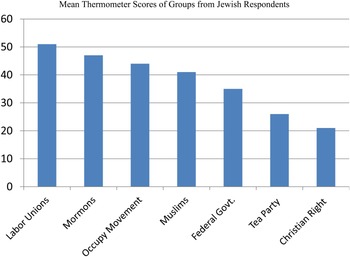
This concern continues to animate Jewish political behavior. In early 2012, the Public Religion Research Institute conducted a pre-election survey of American Jews. Given the importance of group heuristics in partisanship and vote choice, the survey asked Jews to rate a variety of organizations and constituencies with a feeling thermometer. The results (see Fig. 5) reveal that the Christian Right and the Tea Party were the two least popular groups among Jewish respondents. While the strong Republican Party partisanship of both organizations undoubtedly played a role in alienating some Jews, the much more positive assessment of Mormons, a group as Republican as Jews are Democratic, suggests again that religious animus is not the main determinant. Most likely, the perceived sectarianism of the Christian Right and the Tea Party (about half of whose supporters self-identify as Christian Right sympathizers) continues to keep Jews wary of Republicans and committed to Democrats who largely defend the liberal church-state regime.
(Color online) Mean Thermometer Scores of Groups from Jewish Respondents. Source: 2012 American Jewish Values Study at publicreligion.org/site/wp-content/uploads/2012/03/Jewish-Values-Topline.pdf.

CONCLUSION
Does this approach explain why Jews are more Democratic than equivalent voter groups, why this pattern is unique to American Jews, and why they adapt and adjust their liberalism from time to time? In terms of the first puzzle, I argue that Jews do indeed vote consistently with their self-interest as they understand it but that interest is largely defined as maintaining the liberal regime of religion and state. The salience of the goal explains the distinctiveness of Jewish voting. The uniqueness of this pattern among American Jews reflects the unique secular quality of the American political system. Jews defend the liberal regime because they believe it has allowed them unparalleled success and comfort. In democratic polities with state religions, Jews try only to claim the benefits and privileges that accrue to the dominant religion. Finally, Jewish support for the Democratic Party varies over time according to the direction of the perceived threat to the liberal regime. This approach thus addresses the skew in Jewish political behavior, its unique manifestation among American Jewry, and temporal oscillations in the magnitude of the partisan gap. Having argued that case, I want to address two implications of this essay for the way we study religion and political behavior.
First, lest I commit the same essentialist sin that I criticized in Judaic theories, it is important to recognize that not all American Jews understand religion and state in the same terms nor do they necessarily emphasize the need to separate the two spheres as thoroughly as the most fervent advocates of classic liberalism. That raises a question about what conditions prompt Jews to deviate from the liberal perspective on citizenship. We can make reasonable inferences from the behavior of two exceptional groups among American Jewry, the Orthodox and the Russian Jews who arrived in the United States in the 1980s and after. A variety of sources suggest that these two sub-communities are on the whole less committed to Democratic and liberal policy values than other American Jews. Social identity and political socialization, respectively, are the most theoretically promising mechanisms to explain the Orthodox and Russian patterns.
The political differences between the Orthodox and other American Jews stem largely from different social identities. Heilman and Cohen (1989, 5) described one inward-turning face of Jewish Orthodoxy that prioritizes faith, tradition, and observance and largely rejects “many of the essentials of contemporary secular American society and culture.” Those most imbued with this “parochial” perspective, who live outside the purview of the dominant American (and Jewish) society, have tended to practice a form of ethnic particularism that trades electoral support for tangible policy benefits. Like voters in the days of urban political machines, they care less for ideology and more for the tangible resources they can accrue in exchange for their votes. Rather than worry about state actions that accord benefits based on religion or that give legal recognition to certain religiously-based social values, a preoccupation of Jews who defend the liberal regime, the Orthodox parochials often perceive some of the state programs sought by Christian religious conservatives — particularly state funding for religious education — as tools to facilitate communal integrity.Footnote 12 This style of exchange conforms closely to clientelistic politics wherein groups trade political support for selective benefits. Precisely because they do not wish to assimilate, the practitioners are less concerned about the state's religious identity.
For the most recent cohort of Russian Jewish immigrants to the United States, a theory of political socialization may be most helpful in explaining their apparent attraction to Republicanism. In particular, exposure to Soviet communism may have imbued them with an overriding hostility to the left and a preference for market solutions to social and economic problems. That tendency was accentuated by admiration for the Republican Party's more assertive military stance against the Soviet Union during the Reagan era and its perceived position on Israel (Kliger Reference Kliger2011). To the extent the children of this cohort converge with American Jews, the current political orientation may well be a transitory phenomenon.
The analysis of the sources of Jewish political cohesion in the discussion of the Orthodox and Russian immigrants follows the guidelines laid down by Alan Zuckerman (Reference Zuckerman1999) when he urged scholars of Jewish political life to draw on general theories of behavior to explicate the Jewish case. In the same way, the idea that American Jewish political behavior is unique among Jewish communities due to differing national circumstances or that it oscillates in the short-term is entirely compatible with theories of contextual politics and rational choice. Both assert that individuals and groups strategically adapt their political choices to the particularities of their environment (Brown Reference Brown1981). By embracing the liberal regime on offer in the United States and responding to short-term challenges to that regime by altering their votes to defend the regime, Jews are behaving in a manner that comports with how we understand the political choices of other groups. That is the first implication.
For the field of religion and politics, Zuckerman's argument has a second implication. Beyond claiming that Jewish case studies would improve by drawing on the theoretical concerns of the discipline, he argued the conjunction would enable such studies to “address fundamental questions of political science and the scientific understanding of contemporary political and social life” (Zuckerman Reference Zuckerman1999, 937). This study has implications about the way scholars approach the political behavior of religious groups. Instead of explaining distinctive political loyalties and choices by reference to “internal” factors, a political science perspective counsels us to examine more carefully structural factors such as political regimes and the political attitudes of potential allies and opponents (which can be considered part of the political opportunity structure). It amounts to bringing the state back in to the analysis of political behavior by religious groups.
The Jewish case illustrates the importance of thinking about the state as a religious actor which structures opportunities and imposes limits that may affect the nature of political expression by religious communities. In addition, this study emphasizes the importance of focusing on political variability across both time and space rather than assuming static patterns. Admittedly, this kind of framework may raise challenges in terms of sources and render it difficult to remain as closely tied to survey data as we might wish. Despite these limitations, this approach extends the theoretical reach of citizenship as a factor that may promote or retard political cohesion among ethno-cultural groups.