Introduction
Grown in temperate as well as tropical areas, cucumber, Cucumis sativus (L.) (Cucurbitaceae), is favoured by a warm and dry climate and, as a result, is usually attacked by a wide variety of insect pests, from the seedling to the fruiting stage (Randall, Reference Randall2004). Earlier study carried out by Alalade (Reference Alalade2005) in Nigeria has indicated that insect pests at the fruiting stage are most destructive, causing a yield loss of about 60%. These pests include the flea beetle Podagrica uniforma Jac. (Coleoptera: Chrysomelidae), the melon lady beetle Epilachna chrysomelina (F.) (Coleoptera: Coccinellidae), the lesser pumpkin fly Dacus ciliatus (Loew) and the invasive fruit fly Bactrocera invadens Drew, Tsuruta & White (Diptera: Tephritidae).
Epilachna chrysomelina adults and larvae feed on young seedlings, causing poor stands and reduced yield. They gnaw holes on the fruits when feeding. Damaged fruits keep badly and decay in a few days (Taylor and Schrader, Reference Taylor and Schrader1984). Adults of Podagrica uniforma and P. sjostedti chew small round holes (shot holes) in leaves, giving them a sieve-like appearance. In contrast, Dacus and Bactrocera spp. lay their eggs under the skin of ripening or ripe fruits. Their larvae tunnel through the fruit, causing direct damage to fruit by contaminating it with frass and accelerating its decomposition by secondary bacteria and fungi, thus reducing the market value (McKinlay, Reference McKinlay1992).
Problems associated with insecticide use, which is the current practice for the control of cucumber pests (Jinadu, Reference Jinadu2005), have created a need for an alternative control method that is safe, affordable, environmentally friendly and reliable (McKinlay, Reference McKinlay1992). Eco-friendly approaches already tested on other crops include the use of natural products (Kawuki et al., Reference Kawuki, Agona, Nampala and Adipala2005), plant spacing (Pitan and Odebiyi, Reference Pitan and Odebiyi2002; Asiwe et al., Reference Asiwe, Nokoe, Jackai and Ewete2005), resistant varieties (Koona et al., Reference Koona, Osisanya, Jackai, Tamo and Markham2002) and other cultural methods such as intercropping (Schipper, Reference Schipper2000; Echezona and Mbah, Reference Echezona, Mbah, Mbah and Baiyeri2001; Pitan and Olatunde, Reference Pitan and Olatunde2006).
Intercropping is the cultivation of two or more crops simultaneously in the same field. Rationales for intercropping are that the different crops planted are unlikely to share the same insect pests and disease-causing pathogens; in addition, intercropping restores soil fertility (Anonymous, 2009). Although such an agricultural system is more commonly used in low-income countries, the sustainability of such an approach supports its general value. The practice is of economic benefit to the farmers because of continuous returns and reduced cost of inputs (Ofuya, Reference Ofuya1991). Intercropping of compatible plants also encourages biodiversity by providing a habitat for a variety of insects and soil organisms that would not be present in a single crop environment. This biodiversity can in turn help to limit the outbreaks of crop pests by increasing the diversity or abundance of natural enemies, such as spiders or parasitic wasps (Altieri, Reference Altieri and Hawksworth1991). Increasing the complexity of the crop environment through intercropping also limits the places where pests can find optimal foraging or reproductive conditions (Anonymous, 2009).
Cucumbers are mostly intercropped with carrot, tomato, lettuce and radish, but occasionally with broccoli and squash (Wright and Hoffman, Reference Wright and Hoffman2001). Studies on the effects of companion cropping on insect pests have, for the most part, been conducted in systems involving cucumber–maize and cucumber–okra (Wright and Hoffman, Reference Wright and Hoffman2001). Reports from such studies indicated that when cucumber is intercropped, the densities of several pests are reduced, and yield increased (Hummel et al., Reference Hummel, Walgenbach, Hoyt and Kennedy2002; Ofosu-Anim and Limbani, Reference Ofosu-Anim and Limbani2007). Also, the potential of maize in controlling some insect pests when intercropped with certain crops has been demonstrated. For example, studies conducted in Nigeria by Perfect et al. (Reference Perfect, Cook and Critchley1979), and in Tanzania by Karel et al. (1982) showed that the populations of Empoasca dolichi, Sericothrips occipitalis and Callosobruchus maculatus were reduced in cowpea–maize intercrops. Similarly, Karel et al. (1982) reported a higher incidence of Maruca in monocrops of cowpea than when cowpea was intercropped with maize. A decrease in the population of pod-sucking bugs in cowpea–maize plots has also been reported (Perfect et al., Reference Perfect, Cook and Critchley1979; Matteson, Reference Matteson1982; Pitan and Odebiyi, Reference Pitan and Odebiyi2002; Pitan et al., Reference Pitan, Odebiyi, Adeoye and Osisanya2002).
Maize and cucumber have dissimilar insect pests, diseases and architecture, thus making them good components of intercropping in a system. Studies on the existing designs and models of intercropping regarding insect pest management would be useful to improve on current practice. Therefore, this study investigated the effectiveness of maize planted at different times in reducing the densities of four insect pests on two cucumber varieties.
Materials and methods
The experiment was carried out at the Teaching and Research Farm of the University of Agriculture, Abeokuta, Nigeria (7°15′N and 3°25′E; 159 m above sea level). The site was located in the derived savannah zone of southwestern Nigeria with an annual rainfall of about 963.3 mm, characterized by a bimodal rainfall pattern that peaks in June and September, with a dry spell in August. The study started during the late season of 2007 and was repeated in the early season of 2008. The cucumber cultivars used were Marketmore and Hybrid F1, while the maize variety used was Suwan-1.
The experiment was laid out in a split–split plot arrangement fitted into a randomized complete block design with three replicates. The two main plots were 34 × 28 m (952 m2) each consisting of the two cucumber cultivars. The two subplots were 16 × 28 m (448 m2) each and comprised (a) cucumber sole and (b) intercrop of maize and cucumber. The three sub-subplots that measured 4 × 8 m (32 m2) each represented the three different times cucumber or maize was introduced into the system: (i) planting of maize 2 weeks after cucumber (2WAC); (ii) the same day with cucumber (SDC); and (iii) 2 weeks before cucumber (2WBC). In the intercrop plots, one row of cucumber was alternated with one row of maize, and a 100:100 ratio of maize and cucumber was maintained. In 2007, cucumber was planted into the 2WBC, SDC and 2WAC plots on 13 September, while maize was introduced into the 2WBC, SDC and 2WAC plots on 31 August, 13 September and 27 September, respectively. In the second trial in 2008, cucumber was planted into the 2WBC, SDC and 2WAC plots on 4 June, while maize was introduced into the 2WBC, SDC and 2WAC plots on 21 May, 4 June and 18 June, respectively. A 2 m border between the plots was maintained to reduce pest movements across the adjacent plots. Two or three seeds of cucumber or maize were initially planted at a spacing of 100 × 50 cm and later thinned to one plant per stand at 14 days after planting to give a population of 20,000 plants/ha for each crop. Weeding was carried out manually at 3 and 6 weeks after planting (WAP) cucumber. There was no pesticide or fertilizer application.
The assessment of the densities of P. uniforma and E. chrysomelina commenced at 2 WAP cucumber by visual counting on 10 randomly selected plants in the middle row of each sub-subplot in both seasons. This was done at weekly intervals until fruit maturity at 8 WAP between 07.00 and 09.00 h when the insects were relatively inactive. The assessment of the densities of fruit flies was based on the number of exit holes on damaged fruits per replicate per treatment. Data on vine length and the number of branches were collected from 10 randomly selected cucumber plants from the middle row of each sub-subplot at 6 WAP. To correctly determine the identity of fruit fly species on the field, larvae found within the attacked fruits were also reared to the adult stage. Fruit flies were identified using their morphometric characteristics (Daly, Reference Daly1985).
Harvesting of cucumber fruits commenced at their full maturity (8–9 WAP) when their dull green colour changed from dull to glossy green, and fruits were collected from 10 randomly selected tagged plants within each sub-subplot. The harvested fruits were sorted into pest-damaged and undamaged fruits. Damage by Epilachna beetles was characterized by the presence of grooves on cucumber fruits, while fruit fly damage on a fruit was characterized by one or more exit holes or tunnels along its length and showing frass contamination. Evaluation of yield was based on the weight and number of undamaged cucumber fruits.
All data collected were subjected to the analysis of variance; insect counts were square root-transformed while percentage damage values were arcsine-transformed before such analysis was carried out. Where significant differences were found, Tukey's honestly significant difference (HSD) was used to separate the means. The relative yield of cucumber was calculated to assess the productivity and efficiency of intercropping on cucumber.
Results
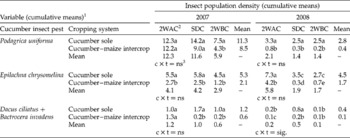
The fruit flies reared and identified were D. ciliatus and B. invadens in the ratio of approximately 40:60. The population densities of P. uniforma, E. chrysomelina and the fruit flies were neither influenced by cucumber variety nor by any varietal interactions (P>0.05) in either year (data not shown). However, the densities of P. uniforma and E. chrysomelina were significantly influenced (P< 0.05) by intercropping (in 2007 and 2008), and time of maize introduction (in 2008) (Table 1). The infestation level of P. uniforma was lower in the intercrop plots than in the plots of cucumber alone. The density was 150 and 700% higher in 2007 and 2008, respectively, in the cucumber monocrop compared with the intercrop (Table 1). In both years, there was a significant reduction (P< 0.05) by at least 50% in the density of E. chrysomelina in the intercrop relative to cucumber alone (Table 1). The lowest density of the pest was recorded in the intercrops established on the same day or when maize was planted earlier than cucumber. Also, in both years, the number of fruit flies was significantly influenced (P< 0.05) by intercropping, with population densities significantly lower (P< 0.05) in the intercrops than in the cucumber monocrop. There was also a significant effect of the interaction between intercropping and time of maize introduction on the density of insect pests in 2008 (Table 1).
Population of cucumber insect pests in both intercrop and cucumber sole during the 2007 and 2008 planting seasons

Means followed by different letters within a year and variable are significantly different (P< 0.05; Tukey's HSD). Data on insect counts were transformed using √(x+0.5) before analysis. Values are means of three replicates.
1 Means/10 plants.
2 2WAC, planting of maize 2 weeks after cucumber; SDM, planting of maize on the same day with cucumber; 2WBC, planting of maize 2 weeks before cucumber.
3 t, Time of introducing maize into the cucumber–maize intercrop; c, cropping system; t × c, combination of time of introducing maize and cropping system; ns, not significant at P< 0.05; sig., significant at P< 0.05.
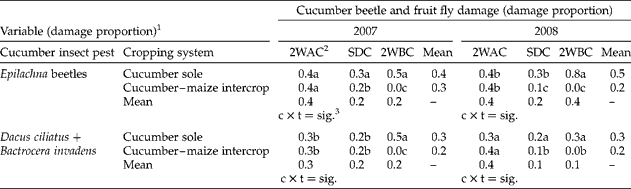
Fruit damage induced by E. chrysomelina, characterized by scars on the fruits, was significantly influenced (P< 0.05), in both years, by intercropping, time of maize introduction, and the interaction between the two factors (Table 2). A significantly (P< 0.05) lower number of damaged fruits was recorded in the intercrop. A reduction in damage of about 50 and >60% was observed in the intercrop over the cucumber alone in 2007 and 2008, respectively (Table 2). In both years, fruit fly-induced damage typified by exit holes on the fruits was jointly influenced (P< 0.05) by time of maize introduction, intercropping and their interaction (Table 3). A significantly higher damage by the fruit flies was observed in the cucumber plots compared with the intercrop (P< 0.05), while the lowest damage was observed in the intercrop at SDC.
Damage by cucumber beetles and fruit flies in both intercrop and cucumber sole during the 2007 and 2008 planting seasons

Means followed by different letters within a year and variable are significantly different (P< 0.05; Tukey's HSD). Data on insect counts were transformed using √(x+0.5) before analysis. Values are means of three replicates.
1 Means/10 plants.
2 2WAC, planting of maize 2 weeks after cucumber; SDC, planting of maize on the same day with cucumber; 2WBC, planting of maize 2 weeks before cucumber.
3 t, Time of introducing maize into the cucumber–maize intercrop; c, cropping system; t × c, combination of time of introducing maize and cropping system; ns, not significant at P< 0.05; sig., significant at P< 0.05.
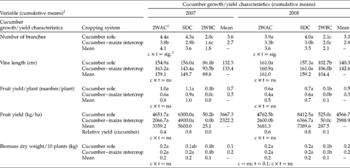
Growth characteristics of cucumber in both intercrop and cucumber sole during the 2007 and 2008 planting seasons

Means followed by different letters within a year and variable are significantly different (P< 0.05; Tukey's HSD). Data on insect counts were transformed using √(x+0.5) before analysis. Values are means of three replicates.
1 Means/10 plants.
2 2WAC, planting of maize 2 weeks after cucumber; SDC, planting of maize on the same day with cucumber; 2WBC, planting of maize 2 weeks before cucumber.
3 t, Time of introducing maize into the cucumber–maize intercrop; c, cropping system; t × c, combination of time of maize introduction and cropping system; ns, not significant at P< 0.05; sig., significant at P< 0.05.
A significantly higher number of branches (P< 0.05) was produced in the sole plots relative to the intercrop. However, in 2008, there was no significant difference in the number of branches produced at 2WBC either in the intercrop or sole (Table 3). In 2007 and 2008, vine length and total biomass yield of cucumber varied significantly (P< 0.05) with time of planting in the two cropping systems. The vine length and total biomass of cucumber were significantly lower (P< 0.05) at 2WBC in both years (Table 3).
In both cropping systems, fruit yield of cucumber varied significantly with time of planting in 2007 and 2008. Fruit yields were significantly higher at 2WAC and SDC (P< 0.05) but lower at 2WBC (P< 0.05) in both years. At 2WAC, SDC and 2WBC, fruit yield in the intercrop was not significantly different from that of cucumber alone (P>0.05). However, the highest fruit yield and relative yield of cucumber were obtained at SDC, while the lowest yield was obtained at 2WBC in both years (Table 3). The number of fruits produced per plant was influenced by time of planting only, and yields per plant in both intercrop and cucumber plots were not different (P>0.05), and therefore comparable (Table 3). A higher relative yield for cucumber was obtained at SDC (0.9 and 0.9) in both years compared with 2WAC (0.6 and 0.6) in both years and 2WBC (0.1) in 2008.
Discussion
In this study, densities of P. uniforma, E. chrysomelina and fruit flies (D. ciliatus and B. invadens) were significantly reduced in a cucumber–maize system, especially at SDC and 2WAC. Fruit damage at 2WBC in the intercrop was significantly reduced by at least 50%, and fruit yield was comparable to that of the cucumber alone. This result is similar to the findings of John et al. (Reference John, Mini, Joseph and Savithri2004) who recorded a reduction in the population densities of cucumber beetles and melon fly on cucumber intercropped with okra, and to those of Wright and Hoffman (Reference Wright and Hoffman2001) who reported higher infestation by cucumber beetles in squash than in the intercropped plots. Experiments conducted by Hummel et al. (Reference Hummel, Walgenbach, Hoyt and Kennedy2002) and Ofosu-Anim and Limbani (Reference Ofosu-Anim and Limbani2007) in America and Ghana, respectively, showed that the density of cucumber beetles was greatly reduced in the cucumber–maize intercrop. In addition, the infestation rate of Podagrica spp. was reduced when okra was intercropped with tomato (Pitan and Olatunde, Reference Pitan and Olatunde2006). This reduction in pest population in intercropped plots can be attributed mostly to the micro-environmental effects of the associated crops such as visual or olfactory interference, low resource concentration, landing disruption and enhanced natural enemy population (Trenbath, Reference Trenbath1993).
Given that visual and chemical stimuli emitted from host plants are known to direct fruit flies to host plants (Papadopoulos et al., Reference Papadopoulos, Kouloussis, Katsoyannos, Sugayam, Zucchi, Ovruski and Sivinski2008), visual disruption and olfactory interference by maize plants in insects' host finding are likely to be responsible for the reduction in density of fruit flies observed in this study. The reduction in cucumber fruit damage due to cucumber beetles and fruit flies at 2WBC and SDC indicated that time of planting affects the control of insect pests. This reduction in fruit damage can be explained by the fact that cucumber plants might have been hidden under the greenery of the well-established maize at these planting times during the vegetative stage when cucumber vigorously starts to flower and fruit, unlike at other times when cucumber is exposed. For cucumber beetles, it has been reported that maize could cause a reduction in their populations by physical interference, i.e. by getting in their way and thus disrupting their life cycles (Organic Garden Information Communication, 2007). This is possible because of the dissimilarity between maize and cucumber in relation to architecture; tall crops such as traditional cereal varieties are able to disrupt the visual search of insects for the preferred host (Ogenga-Latigo et al., Reference Ogenga-Latigo, Baliddawa and Ampofo1992), or the presence of lower storey crops can similarly affect visual search (Altieri et al., Reference Altieri, Glaser, Schmidt and Gliessman1990; Ezueh and Taylor, 1983; Iragavarapu and Randall, Reference Iragavarapu and Randall1996; Pitan and Odebiyi, Reference Pitan and Odebiyi2001; Pitan and Olatunde, Reference Pitan and Olatunde2006). In contrast, Valenzuela et al. (Reference Valenzuela, Hamasaki and Fukuda1994) reported that maize borders are more effective as trap crops to attract melon flies in fields where alternative weed hosts are not prevalent around the field margins. Maize as a trap crop encourages melon flies to congregate, which makes it easier for beneficial insects to prey on them, and for handpicking of infested fruits and flowers.
Chemical protection (cues) offered by maize may also adversely affect the behaviour of cucumber insect pests (Ofuya, Reference Ofuya1991). Olfactory interference by strongly aromatic crops such as garlic and tomato has been reported to provide an olfactory camouflage against certain insects by masking their normal host finding or feeding cues. In addition, when a crop gives an apparently repellent odour, an associated crop can be strongly protected from some insect pest species. For instance, olfactory interference has been implicated in less feeding by flea beetle larvae on collards in a collard–tomato intercrop (Tahvanainen and Root, Reference Tahvanainen and Root1972). Odours have also been reported to stimulate more frequent pest emigration from intercrops or cause poor growth and low fecundity in pests (Trenbath, 1993).
However, the reduction in the level of pest infestation and damage on cucumber at 2WBC compared with the other times did not translate to a higher cucumber fruit yield in that plot. The number of branches and flowers produced, leaf area, vine length and total biomass were also significantly reduced. Consequently, fruit yield reduced severely in 2008 and was nil in 2007. Apart from being significantly reduced in number, the fruits produced at 2WBC did not meet up to the market fresh fruit size of diameter 6.10 cm and length 13.97–22.9 cm, which was used for yield calculations.
Although there have been reports of the negative effects of intercropping on cucumber (e.g. Mohamed et al., Reference Mohamed, Dokashi, Mousa and Elnobi2007; Mousa et al., Reference Mousa, Mohammed, Dokashi and Elnobi2007), intercropping could not be the cause of poor growth and yield observed at 2WBC because such observations have also been recorded in the cucumber plot. Therefore, it can be implied that cucumber is sensitive to the time of planting irrespective of being a sole or a mixed crop.
The zero damage recorded on poorly developed fruits at 2WBC suggests that the fruit condition might have adversely affected the pests' behaviour, thereby preventing such fruits from being attacked or selected for oviposition by melon beetles and the fruit flies. Poorly developed (or immature) fruits of certain plants are known to exude low concentrations of compounds that could be attractive to insects. At the same time, insects also discriminate for oviposition based on fruit maturity as well as types and concentrations of volatiles and other plant chemicals produced. For example, in muskmelon and peach fruit, the concentrations of volatile components and esters believed to have a flavour impact increased with advancing maturity (Beaulieu and Grimm, Reference Beaulieu and Grimm2001; Do et al., 2006). Similarly, mature mated medfly (Ceratitis capitata) females search for ripening or ripe fruits for oviposition. Upon landing on a host plant, the shape, size and colour of the fruit and other visual properties attract female medflies for oviposition (Papadopoulos et al., Reference Papadopoulos, Kouloussis, Katsoyannos, Sugayam, Zucchi, Ovruski and Sivinski2008). Fruit density may also play a role. Physical properties of the fruit surface, gustatory and/or short-range olfactory stimuli influence the decision to accept or reject the specific fruit for oviposition (Papadopoulos et al., Reference Papadopoulos, Kouloussis, Katsoyannos, Sugayam, Zucchi, Ovruski and Sivinski2008).
There is enough evidence from this study that intercropping facilitated a reduction in insect pest infestation on cucumber. The time of maize introduction and the intercropping system jointly influenced flea beetle, melon beetle and fruit fly damage. This suggests that the prospect of optimizing the use of a cucumber–maize mixture for the control of these insect pests requires a careful management of temporal and spatial structures and elements involved in intercropping, such as time. Definitely the ‘same day system’ is better than the other two times, because the density of cucumber pests was reduced under the intercropping system.
It is also evident from this study that there is an agronomic disadvantage of late sowing of cucumber either in the sole or intercropping system as cucumber fruit yield was reduced at 2WBC. The highest yield proportion of 0.8 was obtained for cucumber at SDC in both years. This shows a high productivity of cucumber in the system since the relative yield of cucumber was high. Therefore, there was a yield advantage in intercropping cucumber with maize when planted simultaneously. Consequently, cucumber must be planted early since the crop responds to climatic conditions at the time of planting irrespective of the cropping system used. More research is also necessary to investigate pest reduction at other mixing ratios to fully understand the interaction between cucumber and maize.