




No CrossRef data available.
Article contents
Cost effectiveness of tension-free vaginal tape for the surgical management of female stress incontinence
Published online by Cambridge University Press: 01 November 2004
Abstract
Objectives: Stress urinary incontinence affects between 10 percent and 50 percent of women. Surgery is commonly recommended for troublesome incontinence that does not respond to nonsurgical management. Tension-free vaginal tape (TVT) is a newer, minimal access surgical sling procedure, which is being increasingly adopted worldwide. The cost-effectiveness of TVT in comparison with other surgical procedures, particularly open colposuspension, is assessed.
Methods: Effectiveness estimates came from a systematic review of TVT compared with other surgical procedures (open and laparoscopic colposuspension, traditional slings, and injectables). Deterministic and probabilistic analyses were used to assess the likelihood of TVT being cost-effective. Sensitivity analyses assessed the impact of changing assumptions about cure rates and costs for TVT, cure rates for retreatment open colposuspension, and proportions of women who choose retreatment.
Results: Reliable estimates of relative effectiveness were difficult to derive because the few randomized controlled comparisons had not been optimally analyzed or fully reported. Results of the economic model suggested that TVT dominates open colposuspension (lower cost and same quality of life years[QALYs]) within 5 years after surgery. Stochastic analysis indicated that the likelihood of TVT being cost-effective was 100 percent if decision-makers are unwilling to pay for additional QALYs. TVT's dominance depended on the assumption fact that retreatment open colposuspension has lower cure rates than a first colposuspension.
Conclusions: Analysis based on current short-term data indicates dominance of TVT over open colposuspension from approximately 5 years. There is a need for longer-term follow-up data from methodologically rigorous randomized trials to provide a sounder basis for estimating the relative benefits and cost implications.
Information
- Type
- GENERAL ESSAYS
- Information
- International Journal of Technology Assessment in Health Care , Volume 20 , Issue 4 , November 2004 , pp. 455 - 463
- Copyright
- © 2004 Cambridge University Press
Urinary incontinence is a common and potentially debilitating problem. It has been estimated that there are three million sufferers in the United Kingdom. However, the true prevalence of urinary incontinence is difficult to estimate due to variations in the definitions of incontinence, populations sampled and study methodologies. Furthermore, it is possible that underreporting masks the magnitude of this problem. The overall prevalence of incontinence is reported to be between 10 percent and 52 percent of adult women and is considered severe in approximately 3 to 17 percent (7).
Stress urinary incontinence (SUI) occurs when the relationship between the lower urinary tract components is disrupted, due to nerve damage or direct mechanical trauma. It is characterized by involuntary loss of urine when the intra-abdominal pressure is increased, such as during coughing or exertion. Surgery may be recommended when other management techniques such as pelvic floor muscle training have failed or are unsuitable. Various surgical procedures (colposuspension, traditional slings, and injectables) are commonly used, but these procedures are associated with significant morbidity and resource use or low success rates (2;10).
Tension-free vaginal tape (TVT) is a minimal-access surgical sling procedure for treating SUI in women that may address some of the limitations of current treatments. The tape is passed beneath the urethra to restore it to its normal position. Minimal tension is used, and the support is achieved by causing a tissue reaction with a subsequent collagen scar. The advantages advanced for TVT are that it is a less-invasive surgical procedure than those already in use, it can be performed as a day case under local anesthesia with intravenous sedation, and it can be performed by a surgeon assisted by only a single nurse. It can be carried out as either a primary or a secondary (after a previous incontinence) procedure, although clinical experience of TVT as a secondary procedure is relatively limited. The option of a less-invasive surgical procedure than those currently in use is attractive to women, and this finding may explain its rapid adoption into clinical practice.
Few robust studies have considered the effectiveness of TVT, and only one has considered its cost-effectiveness (13;17). The largest trial is that of Ward et al. (2002), and cost-effectiveness was reported separately by Manca et al. (2003) (13;17). This trial has several shortcomings that include the sample size not being as large as planned. Of the recruited patients, only 89 percent in the TVT arm and 78 percent in open colposuspension arm were successfully followed-up at 6 months (there were more dropouts from the open colposuspension arm after randomization but before surgery). The reported analysis assumed that all patients who dropped out after randomization were treatment failures. As Maddern et al. pointed out, this approach is likely to bias the findings in favor of TVT, because the women who dropped out tended to have less-severe SUI on entry to the study (12). A more plausible assumption is that they would have been treatment successes, in which case open colposuspension would improve relative to TVT. These biases also have implications for cost-effectiveness, which were not reflected in the study by Manca et al. (13). Furthermore, the trial by Ward et al. only compared TVT with open colposuspension, but other surgical treatments are also sometimes used.
We report an assessment of the effectiveness and cost-effectiveness of TVT in comparison with other surgical procedures such as traditional open slings and injectables, as well as open colposuspension. Based on the data available, we modeled the results for a longer follow-up period (10 years). Although clinical experts agree that patients can be retreated with any of the surgical procedures available, this study assumed that patients receive only open colposuspension as a secondary procedure. Evidence indicates that the effectiveness of a repeat open colposuspension is less than when it is performed for the first time (2). The study is based on a payer perspective (the UK National Health Service) and the intent is to provide patients, health professionals, and the public with authoritative, robust, and reliable guidance on current “best practice.”
METHODS
Clinical-Effectiveness
The estimates of clinical-effectiveness were generated by carrying out a systematic review of comparisons of TVT with other surgical procedures and covered all available years for each database. Reports of randomized trials were obtained from the Cochrane Incontinence Review Group's register of trials, and further searches were carried out on the following databases: MEDLINE, PreMEDLINE, EMBASE, CINAHL, the HealthSTAR, the Cochrane Controlled Trials Register (CCTR), the Cochrane Database of Systematic Reviews (CDSR), the Database of Abstracts of Reviews of Effectiveness (DARE), HTA database and reports, NHS EED, BIOSIS, Science Citation Index, ISI—Scientific & Technical Proceedings, ZETOC, ICS Web-based conference abstracts (2000 and 2001), UK National Research Register, Current Controlled Trials/metaRegister of Controlled Trials, ClinicalTrials.gov, CRISP (including FDA, etc), ACP Journal Club, AMED, and SPORTDiscus (6). Experts in the field were also contacted. The three types of studies included were randomized trials, nonrandomized comparative studies, and case series. The study participants were women who were affected by stress urinary incontinence and for whom nonsurgical procedures had failed or were not suitable. Pregnant women or those who planned to have children were excluded, as TVT and traditional sling operations are not recommended for them.
The review of effectiveness data had a primary outcome of subjective (self-reported) cure and used objective cure (using methods of measuring urine loss such as pad weights) as a secondary outcome. The review focused on subjective cure rates, as they were consistently reported and are the most important to the women themselves (although the results for objective measures were virtually identical). The other outcome used was quality of life, which was generally based on women's responses to standardized questionnaires.
Cost Estimates
Resource use data were identified from existing studies, relevant literature such as reports from manufacturers and advice from experts in this field. Cost data were extracted from the literature or from relevant sources such as manufacturer price lists and NHS reference costs. Costs were measured in pounds Sterling (£) for the year 2001. The estimates for TVT and open colposuspension were those used in Manca et al. (13). Cost estimates of slings, injectables, and laparoscopic colposuspension were calculated by using published data on average length of stay and operation time for these procedures. The resource use of the different interventions was combined with effectiveness data to calculate incremental cost-effectiveness ratios.
Quality Adjusted Life Year Estimates
A search of the Harvard database of cost utility analysis yielded no estimates of the quality of life of women with stress incontinence. Quality adjusted life years (QALYs) estimates, therefore, were calculated using the EQ-5D scores obtained at baseline and at 6 months along with the rates of cure at 6 months reported by Manca et al. (13). The direction of effect was consistent with that reported in other studies considered in the systematic review of effectiveness, which used measures of health-related quality of life inappropriate for incorporation in an economic evaluation.
Economic Analysis
Cost-effectiveness analysis (CEA) was used. A Markov model was developed to compare initial treatment by TVT with each of the following comparators: (i) open abdominal retropubic colposuspension (the most common surgical intervention used to treat female urinary stress incontinence); (ii) laparoscopic retropubic colposuspension; (iii) traditional suburethral sling procedures; and (iv) periurethral injectables. Details of the parameters used to populate the model are provided in Table 1. The Markov model incorporated both the temporal and logical sequences of treatment, including the events that follow from the procedure and the outcomes for the patient associated with each possible scenario. The model provided estimates of total NHS costs and patient outcomes. Although effectiveness data from the trials were only available for a 2-year period after the procedure, follow-up periods of up to 10 years were modeled in the CEA. Per annum discount rates of 6 percent were applied to costs and 1.5 percent to QALY values (15).

The model was composed of defined health states between which a patient could move over specified time periods. After their initial surgery, patients moved into one of four states: (i) cured or dry (continent) by subjective measures; (ii) failed but proceeding to retreatment (as patients can be offered a repeat procedure if their initial one fails); (iii) permanent state of incontinence (e.g., resorting to containment management of their incontinence by using pads); and (iv) death. All-cause mortality was not included in the model as it was not expected to vary significantly across the treatments, but the low risk of perioperative death that occurs for open colposuspension or traditional sling procedures was incorporated.
A probabilistic analysis using Monte Carlo simulation was used to assess the likelihood of TVT being cost-effective at various values for decision-makers' willingness to pay for an additional QALY. Sensitivity analysis was carried out using both the deterministic and probabilistic models to consider uncertainty in the model parameters. The effect of higher costs, higher TVT cure rates, higher and lower retreatment rates after procedure, and similar success rates for repeat open colposuspension procedures similar to a primary procedure were explored.
RESULTS
Clinical-Effectiveness
Table 2 summarizes the clinical effect sizes in terms of cure of incontinence for TVT and open colposuspension derived from the review of effectiveness. The estimates are based on data available from Ward et al. (16). Published data from conference abstracts about the trial by Ward et al. allowed the estimation of cure rates after TVT at 1 and 2 years (17;18). However, the only estimates of relative cure rates for TVT versus open colposuspension available were at 6 months (16).

The first estimate (Model 1) makes the assumption that withdrawals will have the same outcomes as those for whom data are available. There were in fact more withdrawals in the open colposuspension group than in the TVT group in the trial by Ward et al., and the second estimated effect size (Model 2) uses the same data but adjusts for the differential presurgery withdrawals by assuming that withdrawals were cured. This strategy gives a slightly higher cure rate after TVT but a lower relative cure rate between TVT and open colposuspension.
No data were available comparing TVT directly with the other SUI surgical treatments, so data comparing them with open colposuspension were sought. On the basis of the evidence found, the following assumptions were made: traditional slings would perform the same as open colposuspension (10); laparoscopic colposuspension would perform the same as open colposuspension or possibly worse (14); and injectables would have poorer cure rates (10).
QALY Estimates
It was assumed that the woman would have a utility score on average of 0.78 for each year after surgery that failed to achieve a cure and 0.82 per year if cured. These values were calculated using the EQ-5D scores obtained at 6 months by Manca et al. (13). Therefore, in the analysis, differences in QALYs between treatments were driven primarily by differences in cure rates.
Cost Estimates
The estimated procedure costs were £1,058 for TVT, £1,301 for open colposuspension, £1340 for traditional sling, and £1305 for injectables (excluding theater costs). Based on data on average length of stay and theater time, laparoscopic colposuspension was assumed to cost more than £1,317 because of the additional theater equipment required. Because open colposuspension most likely costs less than any of the other comparators and had at least as good or better (injectables) effectiveness (2–4;8;10;14), all further analyses reported focused on comparing TVT with open colposuspension only. The base-case analysis assumed that 75 percent of women whose initial treatment (either TVT or open colposuspension) failed would choose retreatment (which was assumed to be open colposuspension in this model). Patients were assumed to have retreatment up to two times and to remain incontinent if the third procedure failed.
Economic Analysis
For the deterministic analysis of Model 1, TVT was slightly less-effective than open colposuspension in terms of QALYs for the first 4 years after initial treatment as illustrated in Table 3. Beyond 5 years, however, the cumulative QALYs from TVT in Model 1 exceeded the cumulative QALYs from open colposuspension, making TVT dominant. It is important to note that the ultimate dominance of TVT occurs because of the assumption that retreatment open colposuspension is not as effective as the first open colposuspension, so that people who initially receive open colposuspension and are not cured automatically proceed to a less-effective retreatment, whereas people initially receiving TVT who are not cured proceed to the relatively effective first open colposuspension.

Probabilistic estimations were made for 1- to 10-year follow-up periods given the limited length of follow-up after TVT from the existing randomized clinical trials (RCTs) and case-series studies. Table 4 provides results for Model 1 (1–10 years), which are the percentages from the simulation results. Results for Model 1 indicate that the mean costs per patient of TVT are always less than those of open colposuspension (last column in the table). However, again, these cost-effectiveness results depend on the assumption that retreatment open colposuspension cure rates are less-effective than those of first open colposuspension.

TVT is more likely to dominate open colposuspension for the base-case model than for the model adjusted for withdrawals (which has higher cure rates for open colposuspension). This point is emphasized in Figure 1, which presents cost-effectiveness acceptability curves showing the probability that TVT would be considered cost-effective for different threshold values of a decision-maker's willingness to pay for an additional QALY. Specifically, the curves show that, if the decision-maker is unwilling to pay anything extra for an additional QALY, then TVT should be preferred due to its lower cost. If the decision-maker is willing to pay up to £30,000 per additional QALY, there is still approximately an 86 percent chance that TVT is cost-effective relative to open colposuspension based the data used in Model 1.

Cost-effectiveness acceptability curves for tension-free vaginal tape (TVT) versus open colposuspension for Models 1 and 2 for 2 years of follow-up. QALY, quality-adjusted life year.
Sensitivity Analyses: Retreatment Effectiveness and Rates of Retreatment
As noted earlier, the ultimate dominance of TVT over open colposuspension in the base case models is due to the assumption that retreatment open colposuspension is less effective than the first open colposuspension received. Sensitivity analysis based on re-running Model 1 under the assumption that retreatment open colposuspension is as effective as the first open colposuspension results in a situation in which TVT is never dominant over open colposuspension during the 10-year follow-up period in the deterministic model (right-hand column, Table 3).
Another sensitivity analysis assessed the impact of changing the assumption that 75 percent of women whose initial treatment failed would choose retreatment (which was assumed to be open colposuspension in this model). When a sensitivity analysis was run based on the assumption that 85 percent of the women would opt for retreatment, TVT was dominant from the fourth year, whereas when the likelihood of retreatment was reduced to 40 percent, TVT dominated only from the seventh year.
Sensitivity Analyses: Costs and Cure Rates
Sensitivity analyses were also conducted according to various assumptions or parameters in the model for the stochastic versions of Models 1 and 2 (5). The first of these relates to the revised costs for TVT and open colposuspension based on evidence from the systematic review. The revised estimates were derived by using the average of theater times and the hospital length of stay in England and Wales. Details of the estimates are included in Table 1. The results showed that changing these assumptions made relatively little difference.
A second sensitivity analysis related to the use of higher cure rates for TVT. When the cure rate for TVT was increased to 90 percent, the probability that TVT would be cost-effective was nearly 100 percent for all the models considered, if the decision-maker was unwilling to pay anything more for an additional QALY. However, the probability of TVT being considered cost-effective reduced to less than 50 percent if the decision-maker would be willing to pay approximately £50,000 for an additional QALY. These results could be attributed to the fact that, when a high cure rate for TVT was used, the cure rate for open colposuspension was bounded at 1 (i.e., open colposuspension did not fail), because the same relative risks were used.
DISCUSSION
The economic modeling contributed to the evidence available for assessing TVT versus alternative treatments (especially open colposuspension) by estimating, under various assumptions, the cost-effectiveness of TVT over a longer follow-up period than has been done previously. Furthermore, because women who withdrew from the open colposuspension group before surgery may have had less-severe incontinence, an alternative analysis was presented (Model 2), which assumed that those who withdrew before surgery would have been cured if they had received surgery.
The first-year deterministic results were consistent with the results from those of Manca et al., largely because much of the data in this analysis came from that study and from the trial by Ward et al. on which it was based (13;16;17) . Taken as a whole, the additional economic modeling indicates TVT is more likely than not to be cost-effective relative to open colposuspension and could even dominate. These conclusions were not substantially dependent on what assumptions were made about women who withdrew before surgery. The conclusions, however, are reliant upon assumptions about effectiveness of retreatment and retreatment rates. First, based on published evidence, retreatment open colposuspension was assumed not to be as effective as primary open colposuspension. Second, data were not available on the rates at which women would seek surgical retreatment if the operation failed (so the base case assumed a rate of 75 percent).
The models rely on several other key assumptions. In particular, TVT surgery was assumed not to have a worsening failure rate or serious complications at some future point in time (not yet detected by the RCT or case series) that would either significantly reduce TVT's effectiveness or even preclude its use. The models assume that TVT is predominantly performed as an inpatient operation, and increased use as an outpatient procedure might reduce costs and, hence, improve cost-effectiveness. The models also assume that, if TVT ultimately fails for some proportion of women who receive it, the women can then proceed to treatment with open colposuspension and have the benefit of experiencing the assumed greater effectiveness of first rather than retreatment open colposuspension. This beneficial scenario could, of course, be altered if TVT is ultimately found to fail in a way that compromises the success of subsequent open colposuspension.
A major limitation was the absence of data on direct comparisons between TVT and the comparators other than open colposuspension. The assumption that traditional slings had similar effectiveness to open colposuspension made it unlikely that traditional slings would be considered more cost-effective than TVT. Higher estimated costs and lower cure rates for injectables and lower (or similar) cure rates and a lengthier, more costly, procedure for laparoscopic colposuspension point toward dominance by TVT.
The lack of long-term data necessitated extrapolation of relatively short-term data to 10 years for the deterministic analysis and 5 years for the stochastic analysis. These results would only apply in a situation where relative differences in effectiveness of TVT compared with the comparators do not change with longer follow-up. It is not known at this stage whether this assumption is valid. Lack of long-term cost data also necessitated use of unit costs from the study by Manca et al. However, when costs were re-estimated using data on operation time and length of stay from the effectiveness evidence, the estimated incremental cost per QALY was not greatly different from that generated by the published study.
The long-term performance of TVT in terms of both continence and unanticipated adverse effects is not known reliably at the moment. Yet, some potential benefits of TVT versus other procedures were not incorporated into the analysis. For example, short-term benefits of less invasive surgery (TVT) were not valued. Despite relatively little robust comparative data, it appears that, in the short- to medium-term, the effectiveness of TVT approaches that of alternative surgical procedures currently available and is of lower cost. This review was limited to women for whom nonsurgical management had been unsuccessful. However, as TVT is a less-invasive procedure, it is likely that some women who are currently managed nonsurgically may be considered for TVT.
CONCLUSION
Analysis based on short-term data indicates the likely dominance of TVT over open colposuspension. This conclusion could change in light of further information, particularly success rates for further treatment after failed TVT. Monitoring is needed on possible long-term complications of TVT to provide reassurance of safety or early warning of unanticipated adverse effects. Unbiased assessments of long-term performance for at least 5 years after surgery from follow-up of controlled trials would be helpful in increasing the reliability of the estimates provided by this analysis. On-going surveillance of TVT would be enhanced by access to a regularly updated systematic summary of evidence from controlled trials, such as through the Cochrane Collaboration.
POLICY IMPLICATIONS
Despite relatively little robust comparative data, it appears that, in the short- to medium-term, TVT's effectiveness approaches that of alternative procedures currently available, and it is of lower cost. However, the long-term performance of TVT in terms of both continence and unanticipated adverse effects is not known reliably at the moment. The conclusions of this study, particularly in respect of cost-effectiveness, could well change in light of new evidence. Therefore, although TVT appears at this stage to be a useful intervention for women with SUI, research is needed on possible long-term complications of TVT; this information would either provide reassurance of safety or earlier warning of unanticipated adverse effects. If the indications for TVT are likely to be broadened to include women who are currently managed conservatively, this finding should be formally evaluated, ideally in a randomized controlled trial, before widespread adoption into clinical practice. The threshold at which TVT treatment is provided could have important implications for total resource use but is beyond the scope of this analysis.
We acknowledge the help of Laura Wyness, James N. Dow, Kevin Cooper, Saatchi Swami, Paul Hilton, Douglas Tincello, the project steering committee (John Cairns, Peter Fayers, Adrian Grant, and Cairns Smith), June Younes, and Kathleen McIntosh. The UK National Health Service's Research and Development Health Technology Assessment Programme commissioned and funded the review on behalf of the National Institute for Clinical Excellence. The Health Services Research Unit and the Health Economics Research Unit are both core funded by the Chief Scientist Office of the Scottish Executive Health Department. The views expressed in this study are those of the authors and not the funding bodies.
References
Downs S,
Black N.
1996.
Systematic review of the literature on the effectiveness of surgery for stress incontinence in women.
London:
Department of Public Health & Policy Publications, London School of Hygiene & Tropical Medicine;
Report no. 21.
Duckett JRA.
1998
The use of periurethral injectables in the treatment of genuine stress incontinence.
Br J Obstet Gynaecol.
105:
390–
396.Google Scholar
Foote AJ.
2001
Which is the best minimally invasive procedure? TVT versus laparoscopic colposuspension. Abstract.
Proceedings of the 31st Annual Meeting of the International Continence Society, 2001, September 18-21,
Seoul, Korea. Abstract no 268.
Glick H,
Briggs A,
Polsky D.
2001
Quantifying stochastic uncertainty, and presenting results of cost-effectiveness analyses.
Expert Rev Pharmacoeconomics Outcomes Res.
1:
25–
36.Google Scholar
Hunskaar S,
Arnold E,
Burgio K, et al.
1999.
Recommendations of the International Scientific Committee: The evaluation and treatment of urinary incontinence. Epidemiology and natural history of urinary incontinence (UI).
1st International Consultation on Incontinence, 1998. June 28-July 1,
Monaco.
Kung RC,
Lie K,
Lee P,
Drutz HP.
1996
The cost-effectiveness of laparoscopic versus abdominal Burch procedures in women with urinary stress incontinence.
J Am Assoc Gynecol Laparoscop
3:
537–
544.Google Scholar
Leach GE,
Dmochowski RR,
Appell RA, et al.
1997
Female stress urinary incontinence clinical guidelines panel summary report on surgical management of female stress urinary incontinence.
J Urol.
158:
875–
880.Google Scholar
Lapitan MC,
Cody DJ.
2003.
Open retropubic colposuspension for urinary stress incontinence in women (Cochrane Review),
In: The Cochrane Library, Issue 1,
Oxford,
Update Software.
Liapis A,
Bakas P,
Creatsas G.
2002
Burch colposuspension and tension-free vaginal tape in the management of stress urinary incontinence in women.
Eur Urol.
41:
469–
473.Google Scholar
Maddern GJ,
Middleton PF,
Grant A.M.
2002
Urinary stress incontinence.
BMJ.
325:
789–
790.Google Scholar
Manca A,
Sculpher MJ,
Ward K, et al.
2003
A cost-utility analysis of tension-free vaginal tape versus colposuspension for primary urodynamic stress incontinence.
Br J Obstet Gynaecol.
110:
255–
262.Google Scholar
Lehrer B,
Ellis G,
Carey M, et al.
2002.
Laparoscopic colposuspension for urinary incontinence in women (Cochrane Review)
in: The Cochrane Library Issue 2,
Oxford,
Update Software.
National Institute for Clinical Excellence.
Guide to the Methods of Technology Appraisal.
Available at: http://www.nice.org.uk.
Ward K,
Hilton P, on behalf of the UK & Ireland TVT trial group.
2002
Prospective multicentre randomised trial of tension-free vaginal tape and open colposuspension as primary treatment for stress incontinence.
BMJ.
325:
67–
69.17.Google Scholar
Ward KL,
Hilton P,
Browning J on behalf of the UK and Ireland TVT Trial Group.
2000.
Changes in quality of life following surgery with tension free vaginal tape (TVT) or colposuspension for genuine stress incontinence. Abstract.
Proceedings of the 3rd Annual Meeting of the International Incontinence Society. August 28-31,
Tampere, Finland.
Ward KL,
Hilton P,
Browning J on behalf of the UK and Ireland TVT Trial Group.
2001
A randomised trial of colposuspension and tension free vaginal tape (TVT) for primary genuine stress incontinence—2 year follow-up.
Abstract.
Int Urogynecol J Pelvic Floor Dysfunct.
12
(Suppl 3):
S7.Google Scholar

Parameters Used
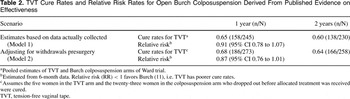
TVT Cure Rates and Relative Risk Rates for Open Burch Colposuspension Derived From Published Evidence on Effectiveness

Base Case Results for Deterministic Analysis of TVT Versus Open Colposuspension

Monte Carlo Simulation Results for TVT Versus Open Colposuspension

Cost-effectiveness acceptability curves for tension-free vaginal tape (TVT) versus open colposuspension for Models 1 and 2 for 2 years of follow-up. QALY, quality-adjusted life year.
 You have
Access
- 38
- Cited by