It can be difficult to help students understand complex issues such as civil rights, civil liberties, and the law-making process through traditional teaching methods such as lectures. Although active learning is undervalued in the political science classroom (Archer and Miller Reference Archer and Miller2011), scholars have found abundant evidence supporting its effectiveness. Active learning promotes students’ learning and knowledge retention (Deslauriers, Schelew, and Wieman Reference Deslauriers, Schelew and Wieman2011; Freeman et al. Reference Freeman, Eddy, McDonough, Smith, Okoroafor, Jordt and Wenderoth2014), critical-thinking skills (Waitkus Reference Waitkus2011), and interest (Shellman Reference Shellman2006). Simulations, in particular, promote student engagement and learning (Baranowski and Weir Reference Baranowski and Weir2015; Hertel and Mils Reference Hertel and Millis2002), civic competence (Bernstein Reference Bernstein2008), and knowledge retention (Frederking Reference Frederking2005; Wunische Reference Wunische2019).
In American government courses, several simulations have been developed about discrete political institutions and processes, including Congress (Ciliotta-Rubery and Levy Reference Ciliotta-Rubery and Levy2000; Sands and Shelton Reference Sands and Shelton2010), the judiciary (Fliter Reference Fliter2009; Williams and Chergosky Reference Williams and Chergosky2019), and elections (Alberda Reference Alberda2016; Carpenter and Dunn Reference Carpenter and Dunn2018). However, few simulations of an interactive process among multiple institutions have been published, despite findings that simulations in US politics courses can be especially useful to illustrate how multiple political institutions interact to shape law and policy (Auerbach Reference Auerbach2013; Kahn and Perez Reference Kahn and Perez2009). Moreover, no published simulation (to our knowledge) has integrated multiple interacting political institutions with insights from normative political arguments and detailed subject matter on a specific policy issue.
This article describes the structure of an original simulation developed for an introductory US politics course and presents data that we gathered from students on that simulation’s effectiveness (Britt and Williams Reference Britt and Williams2021). Unlike longer activities, this simulation is designed to fit into a single class period.Footnote 1 The three goals of this simulation are for students to (1) see how federal political institutions interact to form the political process by which laws and policies are made; (2) understand how normative political reasons and principles become arguments used in the political process; and (3) explore a case study in a particular policy area. We focused on pipelines and eminent domain, but instructors can substitute this case study for any relevant civil rights or liberties issue that might reasonably involve opposing interest groups, congressional action, and judicial review.Footnote 2 Our study used pretests and posttests to assess the effectiveness of the simulation, with the expectation that both the knowledge checks and the students’ self-reported knowledge of and interest in the topics covered would increase from the pretest to the posttest.
The three goals of this simulation are for students to (1) see how federal political institutions interact to form the political process by which laws and policies are made; (2) understand how normative political reasons and principles become arguments used in the political process; and (3) explore a case study in a particular policy area.
SIMULATION DESIGN
In the summer and fall of 2016, protests against the Dakota Access Pipeline drew national attention from both mainstream news media and social media. By the fall of 2018, similar opposition arose among environmentalists, Native American communities, and local landowners to the Atlantic Coast Pipeline, slated to run through West Virginia, Virginia, and North Carolina. These protests coincided with our civil rights and liberties lesson in a survey-level US government course; therefore, land seizure for natural gas and oil pipelines was an appropriate case study through which we could examine the ideas and processes that shape law and policy.
This simulation is designed for an introductory US government course with 25 to 45 students, although it is adaptable to smaller seminars and larger lecture classes. We developed this activity at a large Southeastern university in Fall 2018 and then tested its effectiveness at a small Southeastern university in Spring 2020.
This simulation is designed for an introductory US government course with 25 to 45 students, although it is adaptable to smaller seminars and larger lecture classes.
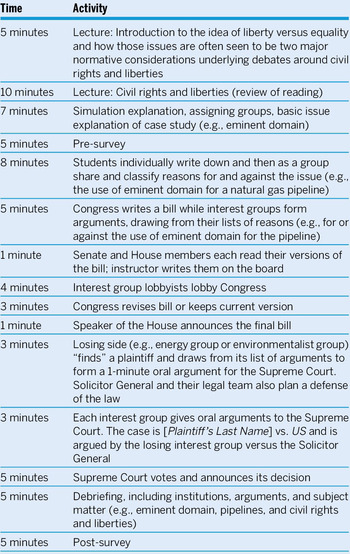
The simulation is divided into a series of steps meant to fit into a 75-minute class period (65 minutes without the pretests and posttests) (table 1).Footnote 3 Prior to the simulation, students are assigned reading material on civil rights and liberties. The instructor briefly lectures on the normative foundations of political arguments and then discusses the foundational tensions in American politics among themes such as liberty, equality, rights, and the public good. Next, the instructor quickly recaps the assigned reading about the essentials of civil rights and liberties in the United States.
Simulation Activity

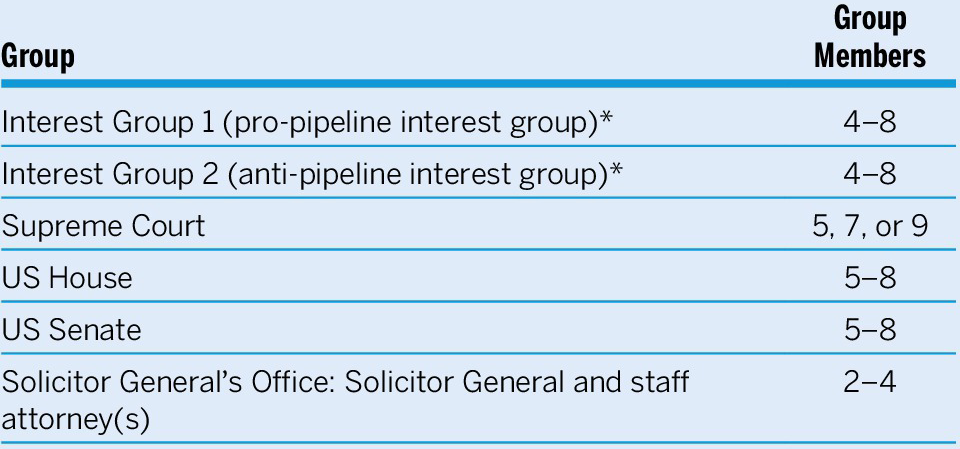
The instructor then explains the simulation, assigns students to groups (table 2), and provides a basic overview of the specific civil rights and liberties policy that will be analyzed in the simulation (i.e., the use of eminent domain for natural gas pipelines). The instructor introduces eminent domain, associated Supreme Court rulings, and its use in the construction of the Atlantic Coast Pipeline. (Instructors can adapt the pipeline example to their institution’s region.) Next, students take a pretest to assess initial subject-matter knowledge and interest before the simulation. We administer the pretest between the lecture and the simulation in order to isolate the effects of the simulation. The pretests and posttests are an optional assessment for instructors who want to measure the effectiveness of the simulation.
Simulation Roles (25–45 Students)

Note: *The two interest groups should be seated on opposite sides of the classroom.
By following research that finds exercises combining initial individual work with subsequent group activities to be more effective than traditional lecture (Kaddoura Reference Kaddoura2013), the simulation builds from silent individual reflection to entire-class simulation on normative political arguments. This challenges students to think critically about the foundational ideological and ethical principles behind political and policy positions, such as conservatism’s emphasis on liberty and progressivism’s emphasis on equality and equity. Students individually complete a brief writing exercise in which they brainstorm as many reasons as possible for and against the seizure of private land via eminent domain for pipelines. The class then shares these arguments and the instructor writes them on the board. Together as a class, students classify the arguments into their normative ethical bases. For example, an argument against the seizure of land on the basis that individuals should be free from government intrusion might be considered a liberty-based argument. Students will use these lists in the interest-group strategizing, congressional law-making, and Supreme Court case argument and decision-making phases of the simulation.
The remainder of the simulation consists of the law- and policy-making process. This exercise demonstrates the multiple steps by which policies are created, shaped, and succeed or fail legal challenges. It involves both federal governmental institutions and private groups, which emphasizes the strategic considerations of various players and shows how the public can pressure the government using various types of arguments. The two opposing interest groups—an environmental advocacy group and a lobbying arm of a large utilities company—each draw on their list of arguments while strategizing about the reasons and arguments they plan to use when lobbying for or against the seizure of land for a pipeline. Meanwhile, the two houses of Congress write a bill about eminent domain. For example, the chambers can choose to clarify what “public use” means, expand the power of the government to use eminent domain, or limit the power of the government to use eminent domain.
Next, interest groups have an opportunity to lobby each chamber of Congress, drawing on the reasons they selected in the previous phase, before switching to lobby the other chamber. Both houses of Congress then meet briefly to consider whether to revise their bill based on the arguments made by either interest group before reconciling their bills, and the Speaker of the House (a student from the House group) announces the draft bill to the class.
Depending on which side the policy favors, the final bill will have produced a “winning” and a “losing” interest group. Whichever is the “losing” group (i.e., the environmentalist group or the utilities company) has the opportunity to “find” a plaintiff (i.e., a member of their own group) with standing for a case that eventually will be argued in court. Simultaneously, the Solicitor General and their team of lawyers plan arguments to defend the law. Reflecting on which arguments have been most successful thus far and drawing on arguments they have chosen as a team, each side argues before the Supreme Court. The losing group brings the case, [Plaintiff’s Last Name] vs. US, and the Solicitor General defends the law. After oral arguments, the Supreme Court justices deliberate, vote, and announce their decision on the constitutionality of the law.
The instructor then leads students in a debriefing session, prompting them to think critically about which arguments were the most successful at the lobbying, legislating, and litigating stages and what the normative foundations of those political arguments were; how the policy-making process shapes civil rights and liberties; and how institutions shape political outcomes. Instructors can encourage students to focus on the effectiveness of the arguments rather than partisan structures within Congress and other institutions. The debriefing is especially important, given that simulations with a debriefing have been found to be more effective for knowledge retention than either simulations alone or non-simulation traditional classroom formats (Levin-Banchik Reference Levin-Banchik2018). Finally, students take a posttest to assess any change in knowledge and interest in the topics covered by the simulation.
SIMULATION EFFECTIVENESS
We designed the assessment tool to match our learning objectives for the simulation, as recommended by Raymond and Usherwood (Reference Raymond and Usherwood2013). To achieve this, we combined (1) knowledge-check questions on the case study (i.e., eminent domain), on normative arguments, and on political institutions with (2) measures of students’ self-reported knowledge about these three areas. By combining self-reports with checks of student knowledge, we increased the validity of our evaluation instrument. Whereas self-reported knowledge questions are useful measures of student perceptions of the material (Sidelinger Reference Sidelinger2010), pretest and posttest knowledge checks are also reliable measures of the effectiveness of active-learning exercises (Chin, Dukes, and Gamson Reference Chin, Dukes and Gamson2009; Gosen and Washbush Reference Gosen and Washbush2004).
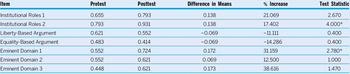
In the surveys, students answer 13 questions, seven of which are knowledge-check questions and six of which are self-reported knowledge and interest questions using a 1-to-5 scale, with 5 representing the highest values. The exact wording of these 13 questions is in the online appendix. We chose to use pretest and posttest survey questionnaires to test the effectiveness of this simulation, an assessment design that has precedent among political science simulations (Alberda Reference Alberda2016; Levin-Banchik Reference Levin-Banchik2018). Specifically, we expected student knowledge and interest to improve from pretest to posttest on each item. As a result of this directional hypothesis, we used one-tailed, paired t-tests for the self-report questions to assess whether the differences in the means of pretest and posttest ratings are statistically different from zero. For the knowledge-check questions, we used McNemar’s Test to evaluate whether there is a statistically significant difference in proportions between paired groups.
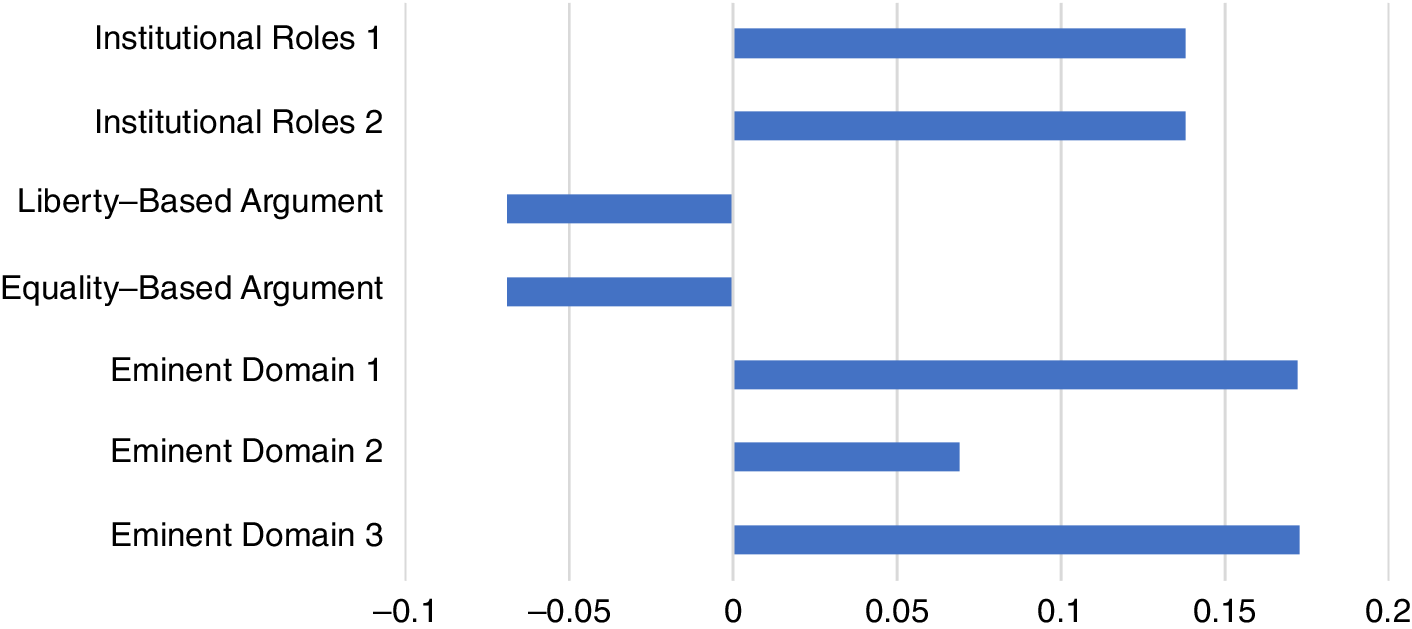
The results for the self-report and knowledge-check questions are in tables 3 and 4, respectively. In tables 3 and 4, columns 2 and 3 show the means of students’ answers in the pretests and posttests; column 4 presents the difference between these two means; and column 5 lists the percentage change from pretest to posttest. Column 6 in table 3 presents the standard deviation of the difference of means, and column 7 in table 3 lists the t-statistic obtained from the one-tailed, paired t-tests. In table 4, column 6 presents the test statistic from the one-tailed McNemar’s Tests. Overall, our expectations were supported for eight of the 13 survey items—that is, for most of the questions, students’ knowledge of or interest in the topics covered increased from before to after the simulation. Specifically, all of the self-reported knowledge and interest items yielded statistically significant increases, and two of the seven knowledge-check items yielded statistically significant differences between the pretest and posttest. The largest effects among statistically significant items were the students’ self-reported knowledge about eminent domain (i.e., a 32.96% increase from before the simulation to after), and one of the three knowledge-check questions about eminent domain (i.e., a 31.16% increase across the surveys). In the knowledge-check questions, students’ knowledge of US political institutions and their role in the political process also increased by approximately 20% from the pretest to the posttest. Five items did not result in statistically significant increases from pretest to posttest, and two of those four were signed in the opposite direction. This surprising finding is addressed in the following discussion.
Self-Report Results

Notes: Number of students=29 for items 1–3, 5, and 6, and 28 students for item 4. ∗Indicates significance at p<0.1.
Knowledge Check Results

Notes: Number of students=29. ∗Indicates significance at p<0.1.
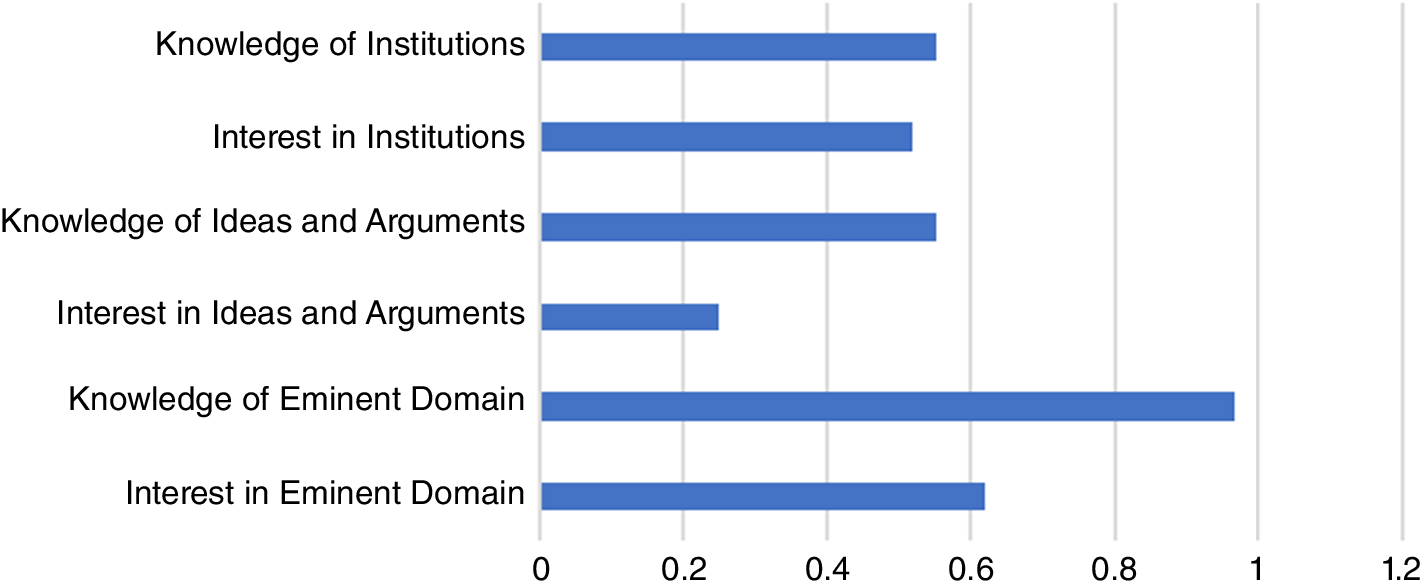
In summary, the simulation was effective regarding our first goal: to increase knowledge of and interest in federal political institutions’ role in the policy-making process. It was not effective regarding the second goal: to increase knowledge of and interest in the normative principles behind political arguments. It was mostly effective regarding the third goal: to increase knowledge of and interest in a policy case study. Figures 1 and 2 illustrate the changes in mean responses across surveys for each of the 13 items.
Difference from Pretest to Posttest: Self-Reported Knowledge and Interest

Difference from Pretest to Posttest: Self-Reported Knowledge and Interest

DISCUSSION AND CONCLUSION
US government courses often provide separate lessons on political institutions, including Congress, the judiciary, and the executive branch. Therefore, conveying to students how multiple political institutions work together to shape policy can be challenging. This simulation allows students to act out a multistep political process that emphasizes the interdependence of governmental and civil society institutions in shaping policy. Our simulation gives US government instructors the ability to adjust the primary focus of the activity (e.g., civil rights and liberties) and the specific case study (e.g., eminent domain) while also emphasizing the interactive nature of American institutions. Because the exercise focuses on the institutional arrangements and political arguments that structure the policy-making process without focusing on parties, it could complement another activity that emphasizes partisanship, such as a simulation about congressional party politics. Moreover, because the simulation can fit into a typical class session rather than requiring multiple sessions, it can work within instructors’ existing semester plans.
This simulation allows students to act out a multistep political process that emphasizes the interdependence of governmental and civil society institutions in shaping policy.
The results support our expectations for all of the self-report items and two of seven of the knowledge-check questions. The use of both knowledge-check and self-report questions provides a robust evaluation of our survey instruments. In all, the results indicate that this simulation was effective at accomplishing its learning outcomes of increasing students’ knowledge and interest in the covered topics. Of particular note are the questions on eminent domain because students heard a traditional lecture on the topic immediately before the pretest; this highlights the effectiveness of the simulation beyond the lecture.
Two of the four items that produced insignificant results were in the area of political reasons and arguments, an area for improvement. The statistically insignificant results for these questions indicate that teaching a complex concept such as normative claims behind political arguments through a simulation can be challenging. If students do not have background knowledge about the meanings of equality and freedom and how they are used in American political rhetoric, they may need more than only a brief introduction to these concepts at the beginning of the simulation. One approach that might improve the effectiveness of the simulation in this area would be to discuss the normative basis for political arguments throughout the American politics course, using this topic—or the tension between liberty and equality—as a central theme of the semester. This way, the simulation would reinforce a concept already learned rather than introducing a new one.
Furthermore, to increase this simulation’s effectiveness in teaching students about normative political arguments, instructors could adapt it in several ways. One possibility is a more in-depth class discussion of the arguments based on freedom or equality immediately following the students’ brainstorming session. During this discussion, instructors could color-code or otherwise categorize arguments according to their underlying normative ideas, such as equality, liberty, public good, and rights. Instructors can refer to this visual aid throughout the simulation, including in the stages when interest groups brainstorm lobbying arguments and lobby Congress, when Congress debates bills, and when the interest group and Solicitor General litigate in front of the Supreme Court. The debriefing at the end of the simulation could return to this list and add to or amend it if necessary. Additionally, to improve the measurement rigor of this simulation, instructors who want to further test its effectiveness for long-term retention can add another posttest several weeks later. Extra-credit pop quizzes with a several-month delay from the simulation have been shown to be a useful assessment tool (Levin-Banchik Reference Levin-Banchik2018).
This simulation’s emphasis on the holistic political process and on normative political ideas integrates several core ideas from US politics, public policy, and political theory. Its emphasis on the workings of government and civil society in shaping political outcomes place it within a tradition of civic education, which has been found to increase student knowledge about and interest in constitutional rights and civil liberties (Green et al. Reference Green, Aronow, Bergan, Greene, Paris and Weinberger2011). It provides a useful tool for instructors who want to make connections across different areas of political science and across major themes of introductory US politics courses, including freedom versus equality, the role of arguments and reasons in the policy-making process, interactions among various political institutions, and the role of power in US politics and government.
DATA AVAILABILITY STATEMENT
Research documentation and data that support the findings of this study are openly available at the PS: Political Science & Politics Harvard Dataverse at https://doi.org/10.7910/DVN/M2SCN0.
Supplementary Materials
To view supplementary material for this article, please visit http://dx.doi.org/10.1017/S1049096521001013.