1 Introduction
Within the field of historical linguistics, approaches may differ a great deal with respect to the emphasis put on theory and data, respectively. We might envisage a scale from purely descriptive to purely theoretical accounts. At one extreme, empirical, data-driven studies are entirely descriptive, and have little or nothing to say about regularities and systems in the language. Purely theoretical studies, at the other extreme, will not consider linguistic evidence and will base hypotheses and theories on conjecture alone.
It is probably safe to say that the two extremes exist only as models and not in reality. There is, arguably, no such thing as a purely descriptive approach performed in a theoretical vacuum: even a basic decision like the specific object of study presupposes some theoretical abstraction. Similarly, it is hard to imagine theories about language change which do not in any way take actual language data into consideration.
In other words, a starting point which most historical linguists can probably agree upon is that there must be some sort of interplay between data and theory. The following is a selection of statements made about this issue in historical linguistics:
Warner (Reference Warner1982: 8):
[A]ny account of the grammar of a dead language must necessarily present and discuss the surface syntax and only rather cautiously attempt more abstract analyses.
Pintzuk (Reference Pintzuk1999: 20):
[T]heoretical analyses, both synchronic and diachronic, must be based on accurate and precise descriptive and statistical information, which leads to and supports the theoretical claims.
Fischer (Reference Fischer, Christian, Horobin and Smith2004: 57):
The historical linguist has only one firm knowledge base and that is the historical documents.
Although the above scholars are not entirely in unison, we may at this stage posit that the historical data should always be primary, and form the basis of models and theories.
This article takes a critical look at the use of data in Lightfoot's (Reference Lightfoot1991, Reference Lightfoot2006) degree-0 theory, and is organised as follows: section 2 outlines previous research; in section 3 Lightfoot's degree-0 theory is discussed; section 4 scrutinises data used as evidence for that theory; a recent quantitative study of OE and ME word order is presented in section 5; some concluding remarks are made in section 6.
2 Background
There is an abundance of literature on word order in Old and Middle English, and it is not within the scope of this article to give anything resembling an exhaustive overview. Some sort of background for the following sections is called for, however.
2.1 A note on terminology
Students of word order in earlier English can be forgiven if they find confusing the plethora of terminology used by different linguistic schools in studies on this topic. In the following, frequent mention will be made of three key word order concepts which deserve some explanation.
OV and VO are fundamental parameters in much of the generative literature, and are normally used to refer to the relative order of main verbs and their objects. Some use a wide definition of the terms (e.g. Foster & van der Wurff Reference Foster and van der Wurff1995), while others calculate OV and VO only from clauses containing a periphrastic verb phrase (Pintzuk Reference Pintzuk1999; Allen Reference Allen, Bermudez-Otero, Denison, Hogg and McCully2000; Fischer et al. Reference Fischer, van Kemenade, Koopman and van der Wurff2000; Koopman Reference Koopman2005; Pintzuk & Taylor Reference Pintzuk, Taylor, van Kemenade and Los2006).Footnote 1 Moreover, these terms sometimes carry a more general typological meaning, equalling Greenberg's (Reference Greenberg and Greenberg1963) SOV/SVO classification.
SV order, sometimes referred to as subject–verb order, is generally used about word order patterns with the finite verb immediately following the subject, and complements following the verb.
verb-final often denotes absolute clause-final position for the finite verb. In some frameworks a distinction is made between verb-final and infl-final, the latter entailing final position for the finite verb, and the former describing instances of the non-finite verb in final position preceded by e.g. objects and particles (Allen Reference Allen, Bermudez-Otero, Denison, Hogg and McCully2000: 13).
The relationship between these concepts is complicated, and it is especially important to emphasise that OV and verb-final are in fact two fundamentally different phenomena. A clause can be OV without being verb-final, and vice versa. The two word order labels will no doubt tend to overlap in the large majority of cases, i.e. a language which is largely verb-final will also be predominantly OV. However, the two categories are not co-extensive. Example (1) below is a clause with the object placed between the finite and main verb, while the clause in (2) also has an object preceding the main verb, which in turn is followed by a PP. Thus, both examples are OV, but neither have the finite verb in final position.
(1)

(2)

In the same vein, VO and SV order do not necessarily coincide, since clauses with the string SXVX are not strictly subject–verb but may have VO order. Example (3) has an adverbial element before the main verb, and the object in postverbal position.
(3)
2.2 Old English
Regardless of theoretical stance, there appears to be general agreement that OE is not a consistent V2 language like Modern German, Dutch or Norwegian, but rather a language with a strong V2 constraint.Footnote 2 Inversion is almost obligatory after certain initial elements, such as þa, þonne and ne, but the relatively high proportion of clauses with the XSV order typical of Present-day English is an important reason why OE is not usually considered a ‘true’ V2 language.
The main focus in the remainder of this article is the word order of subordinate clauses, which is arguably somewhat understudied in comparison with main clause word order, and which forms an important part of the degree-0 theory. The literature on Old English word order contains numerous references to subordinate clauses, many of which point to a strong tendency for verb-final and OV order.Footnote 3 However, the variation between verb-final and other orders, especially SV, is frequently commented on as well.Footnote 4 It is nevertheless the verb-final and OV tendency rather than the variation which has traditionally received most attention.
Despite all the claims made in the literature about subordinate clause order, large-scale empirical studies are few and far between. One was carried out by Gorrell (Reference Gorrell1895), who followed up the work of Smith (Reference Smith1893) with a comprehensive study of subordinate clauses in a number of OE texts. His work will be discussed in sections 3 and 4.
There are a number of other studies which are empirical in character, but which tend either to be based on only one or two texts, or to be made up of relatively small samples, or both. Barrett (Reference Barrett1952) looks at about 1,800 subordinate clauses in Ælfric's Catholic Homilies (ÆCHom) and Lives of Saints, and finds that verb-final order occurs in between 35 and 44 per cent of all clauses. So-called ‘direct order’, i.e. SV syntax, constitutes between 38 and 44 per cent.
Kohonen's (Reference Kohonen1978) OE data comprise approximately 800 clauses from ÆCHom and show a rate of 55 per cent for the combination SXV/SXVX and 42 per cent for SV. Unfortunately, no separate statistics are provided for SXV clauses.Footnote 5
Bean's (Reference Bean1983) study has around 480 subordinate clauses, and is arguably of limited use as empirical evidence. Nevertheless, the emerging picture is one of a mix between SV and verb-final order (1983: 102ff.). We will return to Bean in sections 3 and 4.
Davis & Bernhardt (Reference Davis and Bernhardt2002) compare the word order of OE and Old High German (OHG) word order, and analyse in excess of 11,500 clauses from Ælfric's Catholic Homilies and Supplementary Homilies. The statistics provided are scarce and at times incomplete, but the findings nonetheless indicate considerable variation between pre- and postverbal position for objects and predicatives.
The novelty in Pintzuk's (Reference Pintzuk1995, Reference Pintzuk1999) work compared to most other formalist approaches lies in her assumption of a double base in OE, i.e. synchronic variation in phrase structure in both main and subordinate clauses. The theory was first formulated by Kroch (Reference Kroch1989), and is tested by Pintzuk in both main and subordinate clauses from numerous texts,Footnote 6 the database consisting of a little over 1,000 clauses of each type.
Pintzuk's study, which was carried out in the Principles and Parameters framework, supports the double base hypothesis, i.e. that there is variation between INFL-medial and INFL-final phrase structure in both main and subordinate clauses (Reference Pintzuk1995: 254). Moreover, she argues that INFL-medial structure increases with the same rate in main and subordinate clauses during the OE period (Reference Pintzuk1995: 235), in accordance with Kroch's (Reference Kroch1989) Constant Rate Hypothesis. In contrast to the standard generative account of OE word order (van Kemenade Reference Kemenade1987; Lightfoot Reference Lightfoot1991), Pintzuk assumes that OE was a symmetric V2 language with verb movement to INFL in both superordinate and embedded settings, as a general rule (1999: 118).Footnote 7
Pintzuk & Taylor (Reference Pintzuk, Taylor, van Kemenade and Los2006) look at OV rates for different types of object (positive, negative and quantified) in OE main and subordinate clauses. In the latter clause type, positive nominal objects occur preverbally in 60 per cent of over 2,100 cases. No statistics are given for quantified and negative objects in subordinate clauses, but overall these object types are preverbal more often than positive objects (2006: 255).
In sum, the empirical studies of word order in OE subordinate clauses only partly confirm the impression given in the non-empirical literature. Final position for the finite verb is no doubt a characteristic feature of subordinate clauses, but the same can be said about SV order, which appears to be almost equally as common. Thus, verb-final order is really only ‘dominant’ in subordinate clauses in comparison with main clause order, but not internally, where the overall picture is one of considerable variation. It is not inconceivable that the verb-final tendency in subordinate clauses is often somewhat exaggerated, precisely because of the main clause – subordinate clause contrast, and that other aspects of subordinate clause order are consequently overlooked.
2.3 The change from Old English to Middle English
There is little doubt that word order changed considerably during the Middle English period, and that around the year 1500 English had largely become an SV language like Present-day English in both main and subordinate settings. Yet the nature and speed of the transformation in Middle English has been a matter of controversy.
The word order change in subordinate clauses from OE to ME has traditionally been described as much more rapid than the change in main clauses, and Canale (Reference Canale1978),Footnote 8 Lightfoot (Reference Lightfoot1979, Reference Lightfoot1991, Reference Lightfoot2006) and van Kemenade (Reference Kemenade1987) all suggest a dramatic fall in the rate of verb-final order in the course of the twelfth century. These works may roughly be subsumed under the label ‘absolutist’. Over the last couple of decades, however, this view has been challenged by more or less ‘variationist’ approaches which point to the heterogeneity of word order in both OE and ME, and the gradual nature of word order change in English. Pintzuk (Reference Pintzuk1995, Reference Pintzuk1999) was mentioned above, while a number of other generative studies have explored the nature and extent of OV order in Middle English. Allen (Reference Allen, Bermudez-Otero, Denison, Hogg and McCully2000) and Kroch & Taylor (Reference Kroch, Taylor, Pintzuk, Tsoulas and Warner2000) point to the frequent occurrence of OV order in early Middle English, and it has also been demonstrated that OV was productive in limited contexts later in the Middle English period (Foster & van der Wurff Reference Foster and van der Wurff1995; Moerenhout & van der Wurff Reference Moerenhout and van der Wurff2000) and even into early Modern English (Moerenhout & van der Wurff Reference Moerenhout and van der Wurff2005). Pintzuk & Taylor (Reference Pintzuk, Taylor, van Kemenade and Los2006: 272) conclude that the loss of OV order took place over a long period of time, and at different rates for different object types.
There are few quantitative studies of general aspects of word order in Middle English subordinate clauses. Kohonen's (Reference Kohonen1978) work includes some 800 clauses from Vices and Virtues (VV) and Sawles Warde (SW), texts written around 1200. His data, though limited in scope, show that while SV order has become predominant in early ME, verb-late and verb-final orders are still fairly frequent.
Swieczkowski (Reference Swieczkowski1962) studied more than 6,000 clauses in two late fourteenth-century texts, Middle English Sermons (prose) and Piers Plowman (poetry). In the latter, verb-late (SXVX) and verb-final (SXV) orders are still very frequent in subordinate clauses, and constitute more than half of the total (1962: 53). The prose text, however, has the subject–verb order in 97 per cent of all clauses (1962: 75).Footnote 9
3 The degree-0 theory
The next two sections are devoted to Lightfoot's (Reference Lightfoot1991, Reference Lightfoot2006) degree-0 theory and his use of data from OE and ME to substantiate his claims. As seen above, there is an increased focus today on variation and slow, gradual change. Nevertheless, since Lightfoot's section on OE and ME word order from 1991 is basically repeated in his 2006 book in a somewhat different framework, and since his theory still appears to be influential,Footnote 10 a critical assessment seems in order.
Lightfoot (Reference Lightfoot1991, Reference Lightfoot2006) formulates a theory of language change based on the role of main and subordinate clauses in language acquisition. In his cue-based approach, Lightfoot assumes that children are degree-0 learners. This entails ‘that children learn only from data in unembedded domains. That means simple clauses and the topmost elements of embedded clauses (complementisers and the subjects of infinitival clauses)’ (Reference Lightfoot2006: 125). In other words, the argument is that children use the grammatical input from main clauses when learning a language and constructing their grammar, while subordinate clauses are in practice ignored.
The hypothesis is partly based on the history of English word order, in particular the studies performed by Gorrell (Reference Gorrell1895), Bean (Reference Bean1983) and Hiltunen (Reference Hiltunen1983). For the Old English period, Lightfoot posits underlying object–verb/verb-final/XP–V order, whose surface realisation is most readily observed in subordinate clauses. Main clauses had the option of verb-seconding by moving the finite verb to C (2006: 29). Using Gorrell's (Reference Gorrell1895) study as evidence, Lightfoot argues that ‘embedded clauses showed verbs in final position 80–90 per cent of the time in all prose texts examined and there seems to be no change at work in this regard’ (2006: 132). Verb-final order is not found to a great extent in main clauses, due to the optional V2 rule.
Lightfoot interprets Bean's (Reference Bean1983) data as indicating that V–XP orders increased gradually in frequency in main clauses throughout the Old English period, whereas subordinate clauses experienced a sudden and catastrophic drop of XP–V orders around 1100. This is taken as evidence that children must have relied on data from main clauses when their internal grammar changed from XP–V to V–XP. As Lightfoot puts it: ‘The mere fact that the change took place strongly suggests degree-0 learning’ (1991: 76). We shall return to both Gorrell's and Bean's data in section 4.
With respect to terminology, it must be noted that while the name of the relevant section in Lightfoot's 2006 book is ‘Object–verb to verb–object’, he appears to use the term ‘object–verb’ to refer not only to the position of the verb relative to its object, but to other element types as well, since ‘object–verb’ is used interchangeably with ‘verb-final’ and ‘XP–V’ (Reference Lightfoot1991: 64ff., Reference Lightfoot2006: 132ff.). XP ‘refers to any phrasal category: DP, PP, AP, VP’, and Lightfoot's point of departure seems to be that ‘verbs may precede or follow their direct object or preposition phrase, an adverbial phrase, or another VP’ (Lightfoot Reference Lightfoot2006: 125).
There has been some criticism of the degree-0 theory. Baker (Reference Baker1989: 334) argues that it is too restrictive, citing e.g. infinitive clauses with gaps as evidence that learners also rely on data from subordinate settings. Various aspects of the theory are discussed by Hale (Reference Hale2007), who claims that the relationship between parameter-setting operations and ‘peripheral’ grammatical operations is not sufficiently clarified by Lightfoot. The option of invoking ‘peripheral’ grammar to explain counterevidence serves ‘to isolate the hypothesis of degree-0+ learnability from empirical evaluation’ (2007: 166).
It is worth noting that Lightfoot has been criticised for careless data use and interpretation also in addressing other changes in the history of English, most notably the reanalysis of modals as auxiliaries. Aitchison (Reference Aitchison1980: 141) points out that Lightfoot's (Reference Lightfoot1979) own data suggest a much earlier date for the change than early Modern English. Harris & Campbell (Reference Harris and Campbell1995: 177ff.) argue that not only did the reanalysis take place centuries earlier than Lightfoot posits, but it must also have occurred gradually and at a different rate for different modals. This view is shared by Warner (Reference Warner1982). A general and rather damaging criticism of Lightfoot's use of historical data is found in Romaine (Reference Romaine1983: 479): ‘Committed to a theory which explains changes as if they took place by means of sudden catastrophes, Lightfoot does not concern himself with the difficulties of accounting for the rich variety of textual evidence in English.’
4 The data revisited
4.1 Weaknesses in the data
There are certain weaknesses connected with all three of Lightfoot's main data sources from OE and ME. Gorrell (Reference Gorrell1895) only gives comprehensive statistics for ‘indirect discourse’, that is clauses after verbs of saying, knowing, believing etc. These chiefly encompass nominal declarative þæt-clauses or interrogative clauses (Reference Gorrell1895: 2). Adverbial and adjectival (including relative) clauses are not considered. Furthermore, no distinction is made in Gorrell's data between pronominal and full NP objects, which are well known to behave differently in Old English.
Allen (Reference Allen, Bermudez-Otero, Denison, Hogg and McCully2000) argues against the idea of a ‘sudden death’ of verb-final order in subordinate clauses, and criticises Lightfoot for his choice of data. Allen focuses especially on the fact that part of the evidence from both Hiltunen (Reference Hiltunen1983) and Bean (Reference Bean1983) stems from different dialect areas, something which Lightfoot does not take into account. For instance, the sharp drop in XP–V order observed between sections 7 and 8 of the Anglo-Saxon Chronicle in Bean's study could be down to dialectal differences rather than a change in grammar. Allen (Reference Allen, Bermudez-Otero, Denison, Hogg and McCully2000: 6–7) argues that the comparison between the Peterborough Chronicle Continuations (East Midlands) and other parts of the Anglo-Saxon Chronicle (West-Saxon) may be a comparison between apples and pears, since these texts come from different dialect areas. According to Allen, ‘The Peterborough Chronicle Continuations have nothing to tell us about how sudden the loss of verb-final was in this area’ (Reference Allen, Bermudez-Otero, Denison, Hogg and McCully2000: 7).
Allen's own data show that ‘verb-final order was still robust in subordinate clauses in southern early Middle English, although decreasing in frequency’. She concludes that there is no evidence in the history of English for ‘degree-0 learnability’ (Reference Allen, Bermudez-Otero, Denison, Hogg and McCully2000: 18f).
Failure to take dialectal differences into account also applies to Lightfoot's use of Hiltunen's (Reference Hiltunen1983) study of the order of verbs and particles. Hiltunen's material primarily has West Saxon texts representing late OE and West Midlands texts representing early Middle English, and according to Allen, his figures thus ‘do not prove a sudden change in any dialect’ (Reference Allen, Bermudez-Otero, Denison, Hogg and McCully2000: 17).
4.2 Incorrect data interpretation
In both Lightfoot (Reference Lightfoot1991) and (Reference Lightfoot2006), Gorrell's (Reference Gorrell1895) study of word order in indirect declarative clauses is used as evidence that embedded clauses remained consistently ‘object–verb’ (1991: 68) and ‘XP–V’ (2006: 132) throughout Old English.
The percentages for each of Gorrell's ten examined texts are given in Lightfoot (Reference Lightfoot1991: 68), all ranging from 80 to 90 per cent object–verb order. These figures do not correspond to the conclusion Gorrell reaches himself. Crucially, Gorrell's word order categories and statistics (Reference Gorrell1895: 129) are adopted from Smith (Reference Smith1893), and a closer look reveals that Lightfoot's interpretation of the data cannot be correct. Lightfoot appears to have counted all but three categories as object–verb/verb-final/XP–V. Included as verb-final/XP–V are Gorrell's following categories, all having some element other than the verb(s) finally, and all classified by Smith as ‘verb non-final’ (1893: 227–8):
b′: object + verb + something
d′: verb + something (not object)
g: object + aux. + verb + something
h: aux. + object + verb + something
j: aux. + verb + something (not object)
k: object + verb + aux. + something
l: verb + object + aux. + something
n: verb + aux. + something (not object)Footnote 11
At least when it comes to categories d′ and j, it is extremely hard to see how they evidence verb-final, object–verb or XP–V order, regardless of theory, assumptions about movement or how the terms are defined. None of the listed categories are verb-final for either auxiliary or main verb, while b′, g, h and k have OV order but some other element following the main verb. These categories are all minor and infrequent, though, and the most frequent of the listed categories are precisely the ones that I argue cannot be analysed as either verb-final, OV or XP–V, namely d′ and j. The only categories analysed as V–XP by Lightfoot are:
c′: verb + object
i: aux. + verb + object
m: verb + aux. + object
The remainder of Gorrell's categories have a clause element preceding the main verb, and an auxiliary or main verb (in simple and complex VPs) finally:
a′: something (including objects) + verb
a: object + aux. + verb
b: aux. + object + verb
c: aux. + something (not object) + verb
d: object + verb + aux.
f: something (not object) + verb + aux.
How could Smith's verb non-final categories, especially d′ and j, have been misinterpreted like this by Lightfoot? The most likely explanation is that Gorrell's category names (Reference Gorrell1895: 129) were taken literally, without checking the actual word order patterns as described and exemplified in Smith (Reference Smith1893: 227–8).Footnote 12 Category d′, for instance, is labelled by Gorrell as ‘vb . . . .’, when in fact it should read ‘verb + some element other than object’. As a consequence of the misinterpretation, Lightfoot has counted as XP–V all clauses except those unambiguously verb–object. Thus, a considerable number of clauses that have an element other than the verb(s) in final position are included as XP–V.
In the following, Gorrell's statistics are presented in various ways, to allow for different interpretations and use of terminology. XP–V is of primary interest for a comparison with Lightfoot's percentages, while different ways of calculating OV may be of interest to the reader and are therefore also included, as is a wide definition of verb-final. Finally, I have also included a group with all counterexamples to XP–V.
With respect to calculations of the OV frequency, special mention must be made of Gorrell's category a′. This is verb-final but unspecified with respect to the preverbal element; thus, there is no way of telling how many of these clauses contain objects. Based on my own analysis of 935 OE verb-final clauses from six different texts, I have projected that 45 per cent of the clauses in a′ contain an object.Footnote 13 a′ is a major category whose exclusion would arguably skew the data and give a much lower overall OV rate (simple and complex VPs) than is actually the case. The groups are defined as follows:
1. OV1, defined as object before main verb in all clauses containing an object. This includes Gorrell's categories b′, a, b, d, g, h and k.
2. OV2, where clauses with a simple verb phrase are excluded. This groups is thus defined as OV1 minus b′.
3. OV3, where an attempt is made to include Gorrell's category a′. OV3 thus encompasses b′, a, b, d, g, h, k, plus a projected object rate (45 per cent) from a′.
4. Verb-final (V-fin) in a wide sense, i.e. any verb, finite or non-finite, in absolute clause-final position. The relevant categories are a′, a, b, c, d and f.
5. XP–V, encompassing clauses where the main verb is preceded by any element, i.e. objects, predicatives or adverbials. a′, b′, a, b, c, d, f, g, h and k are included in this group.
6. V–XP. These clauses neither have an element before the main verb nor any of the verbs in absolute clause-final position, and are therefore both V–XP and verb non-final. The categories are c′, d′, i, j, l, m, n.
It is worth noting that there is a great deal of overlap between these groups; see the discussion of terminology in section 2.1.
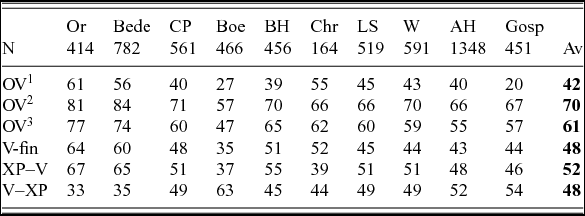
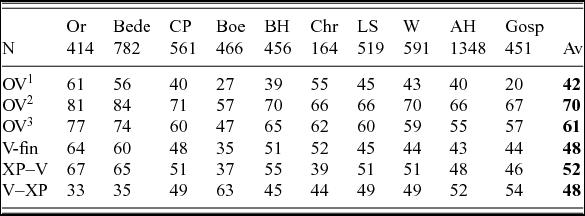
In table 1, frequencies for the six groups are given for all of Gorrell's ten examined texts.Footnote 14 For OV1, the percentages are calculated only from clauses which explicitly contain objects: b′, c′, a, b, d, g, h, i, k, l and m. OV2 is the same except for the exclusion of b′ and c′, while the percentages in OV3 are based on the same overall number as OV1 plus 45 per cent of the clauses in category a′. For the final three groups the percentages are calculated from the total number of clauses in each text, indicated in the top row.
Word order frequencies (percentage) in Gorrell's (Reference Gorrell1895) study
Despite the conjecture involved in the calculation of the percentage of OV3, I argue that this group gives a more precise and representative picture of the rate of OV in all clauses with an object than is the case with OV1. The latter group will not be commented on further.
We can see from the table that the OV rate in clauses with a complex VP (OV2) ranges from 57 (Boethius) to 84 per cent (Bede), the two earliest texts having the highest frequency. The average, given in the rightmost column, is 70 per cent. In OV3 the frequency ranges from 46 (Boethius) to 77 per cent (Orosius), and the two earliest texts again have the highest rate of object–verb order. On average, 61 per cent of the clauses have OV3 order. The same pattern is repeated in the verb-final group, where Orosius contains most verb-final clauses (64 per cent) and Boethius the least (35 per cent). Here, the average is 48 per cent.
As the table demonstrates, verb-final and XP–V are not coextensive, due to the existence of clauses which have clause elements both before and after the main verb (categories b′, g, h and k). These are here analysed as XP–V but not verb-final. Thus, the verb-final average (48 per cent) is a little lower than that for XP–V (52 per cent).
What conclusions may we draw from these calculations? In Gorrell's data objects certainly do precede their verbs in the majority of cases, and more so in clauses with complex verbs phrases. Nevertheless, the average of 61 per cent in group OV3 (and a corresponding VO rate of 39 per cent) suggests there was a great deal of variation with respect to object position. Lightfoot's report of 80–90 per cent XP–V is strongly contradicted by the above calculations, which show an average XP–V/V–XP ratio of 52/48. With respect to the purported degree-0 learning, there is clearly plenty of evidence for V–XP order in subordinate clauses. Consequently, children may well have relied on evidence from embedded domains when the shift towards V–XP order took place, and the data do not indicate that they must necessarily have been degree-0 learners.
Let us turn to Bean's (Reference Bean1983) data from the Anglo-Saxon Chronicle, more specifically her table 4.2 (p. 67), which is used as evidence for degree-0 learning (see section 3). Lightfoot classifies not only SXV and SXVX clauses, but also X’SV and OSV clauses as having XP–V order, or more precisely, ‘the verb remaining in its VP’ (Lightfoot Reference Lightfoot2006: 131).Footnote 15 This is surprising, since X’SV clauses have an initial adverbial followed by the subject and the simple or complex verb phrase, with objects and predicatives placed to the right of the verb. These are described by Bean as the sentences ‘which most closely resemble Modern English’ (Bean Reference Bean1983: 61). The OSV pattern is similar to PDE clauses with a fronted object. Moreover, clauses in the SXVX category may have verb–object order, as illustrated by Bean's example 12b (Reference Bean1983: 63), here given as (4):
(4)
Even if we accept Lightfoot's analysis of all these four patterns (SXV, SXVX, X’SV, OSV) as ‘XP–V’, it is not altogether clear that the percentages 50-37-25-23-13-12-18-17-22 evidence ‘a steady decline of XP–V order in matrix clauses’ (2006: 131). There is a marked decline from period I (50 per cent) to period III (25 per cent), and then a stabilisation between 12 and 25 per cent in the last seven periods. A chi-square goodness-of-fit test shows that the difference between periods I and II combined on the one hand and III-IX on the other is highly significant. However, none of the differences between the periods spanning from III to IX are statistically significant at the 0.05 level.Footnote 16 Notice that not even the seemingly sharp drop from 25 per cent in period II to 13 per cent in V and 12 per cent in VI is statistically significant, due to the overall low number of tokens.
If we only stick to clear examples of verb-final and verb-late, i.e. the patterns SXV and SXVX, the data show the following percentages: 10-14-22-7-8-7-7-9-8. This does not seem to indicate a steady decline either. For the two patterns in question, moreover, the number of tokens in the last six of Bean's periods (IV-IX) is extremely low, ranging from 3 to 14. For this reason nearly all the diachronic differences are either insignificant or impossible to test statistically due to expected frequencies of less than 5. As mentioned earlier, since Bean's overall database is limited in size, her findings must be treated with a great deal of care.
In this section, Old English and Middle English data referred to in Lightfoot (Reference Lightfoot1991, Reference Lightfoot2006) has been closely scrutinised. The data in question were used by Lightfoot to support the degree-0 theory. It has been demonstrated that Gorrell's (Reference Gorrell1895) Old English data do not indicate a massive dominance of either OV, verb-final or XP–V order in subordinate clauses, but rather a fair degree of variation between pre- and postverbal position of clause elements other than subject and verbal. Therefore, it does not seem feasible to conclude that subordinate clauses could not have supplied language learners with evidence for the V–XP order which eventually took over in the course of the Middle English period. The data provided by Bean (Reference Bean1983) do not show a gradual reduction of XP–V orders in main clauses. All in all, the word order situation appears to have been relatively stable in both main and subordinate clauses in the Old English period, and the data do not support Lightfoot's degree-0 theory.
It may be added that Lightfoot's misinterpretation of Gorrell's and Bean's data appears to have two explanations. First, he does not fully appreciate the meaning of all of Gorrell's and Bean's categories. Second, as far as Bean's data are concerned, conclusions are drawn from very small samples.
5 Presentation of some recent findings
We saw in section 2.3 that several studies in recent years have pointed to the variation in word order in both main and subordinate clauses in Old and Middle English, as well as the gradual nature of word order change, challenging earlier ‘absolutist’ works focusing more on sudden changes in parameter settings. However, there still appears to be a lack of large-scale quantitative studies examining subordinate clause word order in a variety of texts. In this section the main findings of one such study are presented.Footnote 17
5.1 The material
My corpus consists of 9,600 clauses, drawn from a total of 14 texts from early Old English (eOE, 800–950), late Old English (lOE, 950–1100), early Middle English (eME, 1100–1300) and late Middle English (lME, 1300–1500). An equal number of subordinate and main clauses have been excerpted from each text. It must be emphasised that subordinate clauses are the primary object of study, while main clauses chiefly serve as a point of comparison. The texts are as follows:Footnote 18
eOE: The Old English Orosius (Or), Alfred's Cura Pastoralis (CP)
lOE: Ælfric's Catholic Homilies, Second Series (ÆCHom II), The Blickling Homilies (BlHom), The Old English Apollonius of Tyre (ApT), The C-text of the Anglo-Saxon Chronicle (ChronC)
eME: The Peterborough Chronicle Continuations (PC), Kentish Homilies (Kentish), Katherine, Margaret, Vices and Virtues (VV), Ancrene Wisse (AW)Footnote 19
lME: Mandeville's Travels (Mandeville), Middle English Sermons (MES)
5.2 The results
The study is surface-based and no assumptions about extraposition or other movement operations are made. This also applies to the material (Gorrell Reference Gorrell1895; Bean Reference Bean1983) used as evidence for the degree-0 theory discussed in sections 3 and 4, and a comparison should therefore be feasible.
Some examples of the different word order patterns are provided below.Footnote 20 Example (5) has SXV order, (6) SXVX, (7) SVX and (8) SvXV. The subordinate clauses are boldfaced.
(5) Also is of ðe manne ðe ðese eadi mihte mid him haueð
just-so is [it] concerning the man who this blessed virtue with him has
‘It is the same concerning the man who has this blessed virtue with him.’ [VV 29,21]
(6)
(7)
(8)
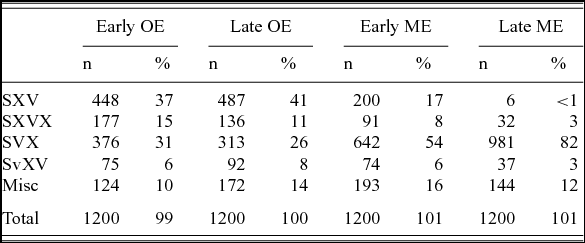
Table 2 shows the shows the distribution of word order patterns in subordinate clauses in all four periods under investigation.
Word order patterns in early OE, late OE, early ME and late ME subordinate clauses
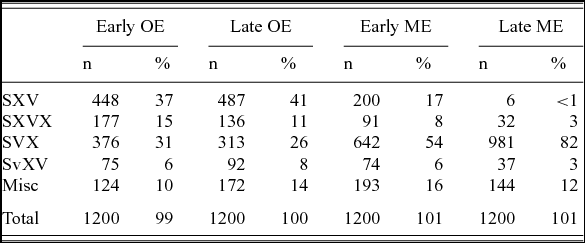
Under the assumption that the word order change to SV order is unidirectional, we would expect there to be a decrease in SXV order, and a corresponding increase in SVX order, throughout Old English. Table 2, however, shows that there is actually a small increase in the proportion of SXV clauses and a decrease in SVX order from early to late OE. The latter change is statistically significant. The decline in the SXVX pattern is also statistically significant. Nevertheless, although the diachronic development brings a few surprises, the overall picture of word order in OE subordinate clauses as relatively heterogeneous by and large confirms the findings of some previous works involving quantitative data, such as Kohonen (Reference Kohonen1978) and Davis & Bernhardt (Reference Davis and Bernhardt2002). Considering the numerous claims of verb-final order being dominant in OE (see section 2.2), the proportions of 37 and 41 per cent in the two OE subperiods are lower than expected. SXV order is certainly dominant in the sense that it is the most frequent pattern, but one must not forget that three out of five subordinate clauses in OE are not verb-final.
It is noteworthy that these figures are a far cry from Lightfoot's claims of 80–90 per cent verb-final in Gorrell's (Reference Gorrell1895) material, but only a little lower than the average verb-final rate of 48 per cent calculated from Gorrell's data in the previous section. Recall that verb-final in table 1 was defined widely, to include both finite and non-finite verbs.
For the present purpose it is of interest to estimate the proportion of clauses which have SV order, i.e. those patterns in which the subject directly precedes the finite verb, and at least one other element follows the finite verb. The patterns SVX and SvXV are of this type. In early OE these patterns constitute 38 per cent of the total (451/1,200), whereas the corresponding number for late OE is 34 per cent (405/1,200). The difference is not statistically significant (χ2 = 2.36, p = .12). It is important to note, however, that a number of SvXV clauses would be unacceptable today, e.g. those with an object between the finite and non-finite verbs. Thus, the SV label does not fully correspond with another common label in word order studies, viz VO, although the two for the most part overlap. The position of objects is treated separately later in this section.
In contrast to the relative stability of the Old English period, the development from late OE to early ME shows significant changes in many respects. We see that the proportion of SXV order is strongly reduced, from 41 to 17 per cent (χ2 = 119.06, p < .0001). It must nonetheless be emphasised that since the order still occurs in one in six clauses, there is arguably little in the present data to support the idea of a catastrophic decline and near-disappearance of verb-final order. On the other hand, while I argue that several previous accounts have overestimated the speed with which word order developed from Old English to early Middle English, there is little doubt that the two centuries before and after 1100 were a time of marked and relatively quick changes. SVX has become the most frequent pattern in early ME, recorded in 54 per cent of the total, while the combination of SVX and SvXV clauses has a proportion of 60 per cent (716/1,200). Overall, therefore, the data signal that significant word order changes took place from OE to early ME.
The developments and trends observed between late OE and early ME are carried on into late ME; both SXV and SXVX clauses have now become marginalised, together constituting less than 4 per cent of the total, while the SVX pattern makes up more than four-fifths of all clauses. At this stage, therefore, subordinate clause word order has clearly become strongly standardised, and is not much different from what we find in Present-day English. Considering that the four patterns SXV, SXVX, SVX and SvXV all go through statistically highly significant changes from early to late ME, it is surprising that word order change during the Middle English period has not received even more attention than is the case. Indeed, it could be argued that at least as far as the development of verb-final order is concerned, the near-disappearance in late ME is as drastic as the strong reduction in early ME.
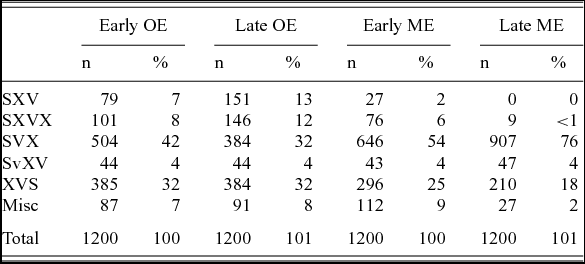
It is often claimed that main and subordinate clauses developed in different ways and at different speeds from Old to Middle English (see section 2.3). In order to test this claim properly, we need a large amount of clauses of both types, and preferably from the same texts.Footnote 21Table 3 shows the shows the distribution of word order patterns in main clauses.
Word order patterns in early OE, late OE, early ME and late ME main clauses
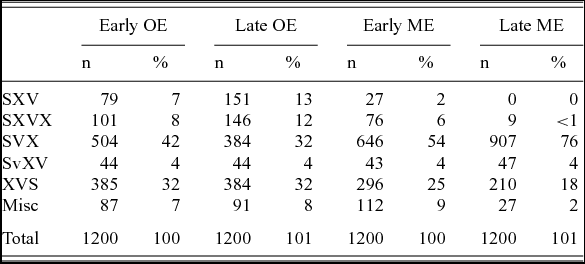
The patterns are the same as for table 2 above, with the exception of clauses with the string XVS. These are not particularly interesting for the present purpose since both topicalisation and inversion are rare in subordinate clauses, but are nevertheless included in the table due to their high frequency in main clauses.
A comparison with table 2 shows that verb-final is much less frequent in main clauses than in subordinate clauses. The table shows that SXV and SXVX clauses are more frequent in late OE than in early OE, while the proportion of SVX clauses decreases between these two periods. With the exception of SXVX clauses, the diachronic development is strikingly similar to that observed in subordinate clauses.
For subordinate clauses the development of the combination SVX and SvXV, i.e. typical SV orders, was calculated. To the extent that subordinate and main clause word orders are comparable, the diachronic development of the corresponding main clause patterns is of interest. From early OE to late OE, the two relevant main clause patterns SVX and SvXV combined actually decrease, from 46 (548/1,200) to 36 per cent (428/1,200), and the reduction is even more pronounced than in subordinate clauses. For the transition from late OE to early ME the same patterns increase from 36 to 58 per cent (689/1,200), only a little less than in subordinate clauses (34 (405/1,200) to 60 per cent (716/1,200)). The difference between subordinate and main clauses is not statistically significant.
Next, it is interesting to note the complete disappearance of SXV order and the considerable reduction of SXVX order from early to late ME. SVX order, on the other hand, increases from 54 (646/1,200) to 76 per cent (907/1,200) between these two periods. The findings underline that the changes taking place during ME were significant not only for subordinate but also for main clauses. Hitherto, the OE/ME divide has been the focus of most research on earlier English word order, whereas the development in the thirteenth and fourteenth centuries has been somewhat neglected as far as empirical investigations go.Footnote 22
Finally in this section the relative position of objects and verbs is treated. Recall from section 2.1 that SV order and VO order are not co-extensive, and that verb-final and OV order do not always match. The analysis applied here is based on the position of objects (accusative, dative and genitive) relative to the lexical verb, whether or not that verb is finite. Thus, both clauses with a single verb and those with a periphrastic verb phrase have been analysed. Only clauses with an overt subject are included.
Examples of various cases of the two orders are given below. Two SXV clauses with one pronominal object are cited in (9), while clauses with two pronominal and two nominal objects can be seen in (10) and (11), respectively. (12) is an SXVX clause with a nominal object before the verb, while (13) has an SXVX clause with VO order. SVX clauses with pronominal and full NP objects are given in (14) and (15), respectively. The SvXV pattern, like SXVX, can be either OV or VO, illustrated by (16) and (17). Subordinate clauses are boldfaced, and the relevant objects underlined.
(9)
(10)
(11)
(12)
(13)
(14)
(15)
(16)
(17)
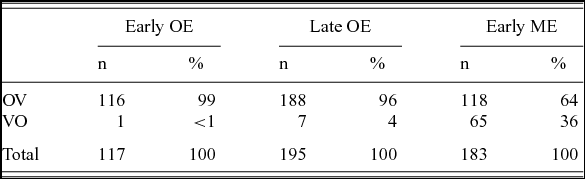
Since pronominal and full NP objects behave differently in OE, these are given in separate tables. Table 4 shows the proportion of OV and VO in clauses with pronominal objects. Late ME, with merely four cases of OV order, is left out.
The position of pronominal objects relative to the main verb in subordinate clauses
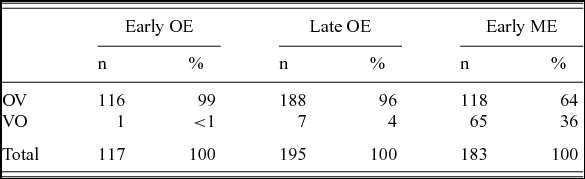
As expected, pronominal objects are preferred preverbally in OE, but there are some exceptions. In the early period the one VO instance has the modified and thus fairly heavy pronoun him selfum, given in example (18) below. In late OE seven object pronouns occur after the verb. One is the demonstrative þis, seen in example (19), while the remaining six postverbal pronouns are indirect objects occurring immediately after the verb and before a heavy direct object, exemplified in (20).
The table shows that the occasional use in late OE of postverbal pronominal objects is considerably strengthened in the early ME period, with a 64/36 ratio of OV and VO structures.
(18)
(19)
(20)
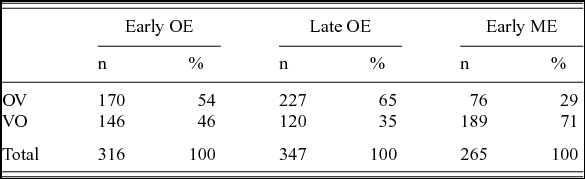
Table 5 shows the OV/VO distribution of objects realised as full noun phrases. Full NP objects are clearly not positionally restricted in the same way that pronouns are in OE, since they are frequent both before and after the verb. As for the diachronic development, it is perhaps not surprising to see that the proportion of OV order actually increases between early OE and late OE, from 54 to 65 per cent. After all, a small increase in SXV order from early OE to late OE was reported in table 2, and the majority of OV clauses are found in the SXV pattern. The increase of OV reported here is not statistically significant, but the decrease of VO order is.
The position of full NP objects relative to the main verb
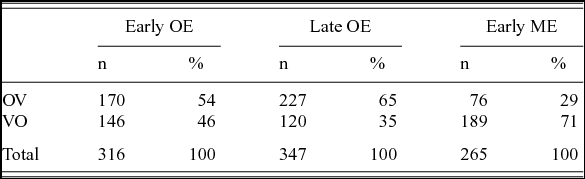
The development from late OE to early ME shows a marked decrease of OV order and a corresponding increase of VO order. Nevertheless, the OV proportion of 29 per cent in early Middle English strengthens the impression that the transition from OE to ME must have been fairly gradual, and indicates that OV order was still productive in the early thirteenth century. The most dramatic changes appear to have taken place not between 1100 and 1200, but rather somewhere between 1200 and 1400, since it was not until late Middle English that OV order became so infrequent as to be nearly negligible (4 instances out of 395, i.e. 1 per cent).
6 Concluding remarks
Lightfoot's (2006) degree-0 theory posits that there was very little evidence of SV/V–XP/VO order in Old English subordinate clauses, and that children must have relied on grammatical cues from main clauses in the period when English word order changed. The reanalysis of Gorrell's (Reference Gorrell1895) data in section 4, and the findings presented in section 5, strongly indicate that Lightfoot's interpretation of OE data is incorrect. The following points may be noted:
• The average proportions of OV, verb-final and XP–V orders in Gorrell's material range from 48 to 61 per cent (see table 1). Gorrell's data do not support a degree-0 analysis.
• In my own OE data, verb-final order occurs in about two in five subordinate clauses, while the OV rate is 54 and 65 per cent in early OE and late OE, respectively. 38 per cent (early OE) and 34 per cent (late OE) of the clauses have SV order. Thus, there is a considerable proportion of OE clauses that are verb-non-final, VO and/or SV.
• From OE to ME there is a marked decrease of verb-final and OV order, while SV and VO become the dominant orders. However, nothing in the data suggests a rapid and sudden word order shift. It is not until the late ME period that the ‘old’ word orders are reduced to a minimum.
• Although subordinate and main clauses are clearly different on the synchronic level in both early OE, late OE and early ME, the diachronic development of the two clause types is very similar.
All in all, the various English historical data revisited and presented in this article do not lend support to the degree–0 theory or the notion of sudden word order change in English. Furthermore, this article may be read as a cautionary tale for students of language change. First, theories and hypotheses about change need to be solidly founded in the historical data; second, using data originally collected and categorised by others requires painstaking precision and comprehensive knowledge about the categories and labels involved.
Appendix 1. Word order patterns
All clause patterns contain one or more X elements, i.e. elements other than the subject and verb(s). Notice the special cases in the SXV and SVX patterns given below.
SXV: this is the so-called verb-final pattern, in which the finite verb occupies absolute clause-final position. Consequently, in complex verb phrases the non-finite verb must precede the finite verb. One or more X elements may precede the subject, and, most importantly, there must be at least one element separating the subject and the finite verb. Clauses with only a non-finite verb separating the subject and the finite verb, i.e. SVv, have also been included in this pattern.
SXVX: this pattern differs from the SXV pattern in having one or more elements in post-verbal position. The subject and the verb must be separated by at least one element, and one or more elements may precede the subject. Complex verb phrases must be contiguous.
SVX: clauses belonging to the SVX pattern are first and foremost characterised by having the subject immediately before the finite verb, which in turn must be followed by one or more X elements, including non-finite verbs. The subject may be preceded by one or more X elements. If the verb phrase is complex, it has to be contiguous, i.e. the non-finite verb must follow the finite verb immediately.
SvXV: in the SvXV pattern, the finite and the non-finite verbs are separated by one or more X elements. The subject may be preceded by X elements, but must always be followed immediately by the finite verb. The non-finite verb may be followed by one or more X elements.
XVS: this pattern has one or more initial X elements, followed immediately by the finite verb. The subject must follow the verb, but there may be intervening elements between the verb and the subject, and the subject may in turn be followed by one or more elements. Complex verb phrases need not be contiguous, i.e. elements may intervene between the finite and the non-finite verb.
misc: the most frequent word order classified as ‘miscellaneous’ is the string SV-, i.e. clauses with no element after the subject–verb nexus. A limited number of subordinate clauses have inverted order, and those are also subsumed under this category. A number of other clauses do not fit into any of the categories in table 2, the string SXvXV being most frequent. Such clauses are neither SXVX nor SvXV.
Appendix 2. Statistics
Page 22, Bean's (1983) table 4.2: Period I vs period II: χ2 = 3.27, p = .071. II vs III: χ2 = 3.18, p = .075. I vs III: χ2 = 39.56, p < .0001. III vs V: χ2 = 3.29, p = .07. III vs VI: χ2 = 1.92, p = .166. IV vs V: χ2 = 1.86, p = .173. III vs VII: χ2 = 1.19, p = .275. V vs IX: χ2 = 1.9, p = .168. I–II vs III–IX: χ2 = 62, p < .0001. III vs IV–IX: χ2 = 1.99, p = .158.
Page 27, re table 2, eOE vs lOE: SXV: χ2 = 1.54, p = .21; SVX: χ2 = 5.58, p = .02; SXVX: χ2 = 5.12, p = .02.
Page 28, re table 2, lOE vs eME: SXV: χ2 = 119.06, p < .0001; SXVX: χ2: 8.52, p = .004; SVX: χ2 = 112.66, p < .0001; SVX/SvXV: χ2 = 85.72, p < .0001.
Page 28, re table 2, eME vs lME: SXV: χ2 = 180.82, p = < .0001; SXVX: χ2 = 27.34, p < .0001; SVX: χ2 = 38.54, p < .0001; SvXV: χ2 = 10.78, p = .001.
Page 30, Contingency test, SV order in subordinate vs main clauses from lOE to eME: χ2 = 1.06, p = .3, Cramér's V = .02.
Pages 36–7, eOE vs lOE, OV: χ2 = 3.61, p = .057; VO: χ2 = 5.22, p = .02. The combination of the two shows highly significant change according to the contingency test: χ2 = 8.82, p = .003, Cramér's V = .12.
Page 38, Contingency, OV and VO from lOE to eME: χ2 = 76.21, p < .0001, Cramér's V = .27.