


Introduction
Bipolar disorder (BD)Footnote 1 is a chronic, recurrent illness characterized by periods of depression interspersed with periods of elevated mood known as (hypo)manic episodes. It affects at least 1% of the population (Merikangas et al., Reference Merikangas, Akiskal, Angst, Greenberg, Hirschfeld, Petukhova and Kessler2007) with community prevalence rates of 5% or more (Mansell and Pedley, Reference Mansell and Pedley2008). BD accounts for up to 10% of the global health burden of mental health and substance misuse disorders (Whiteford et al., Reference Whiteford, Harris, McKeon, Baxter, Pennell, Barendregt and Wang2013), and has the highest risk of completed suicide amongst all psychiatric disorders (Hawton et al., Reference Hawton, Sutton, Haw, Sinclair and Harriss2005). Despite the severity and impact of BD, treatment is inadequate at present, with both pharmacological and psychological approaches showing limited success. For example, review and meta-analysis data show that treatment with lithium (the gold standard intervention for overall relapse prevention in BD, see Miura et al., Reference Miura, Noma, Furukawa, Mitsuyasu, Tanaka and Stockton2014) reduces the risk of relapse by only 34% (Severus et al., Reference Severus, Taylor, Sauer, Pfennig, Ritter, Bauer and Geddes2014), while individual psychological interventions (in addition to medication) for BD are associated with a 26% reduction in risk at follow-up (Oud et al., Reference Oud, Mayo-Wilson, Braidwood, Schulte, Jones and Morriss2016). Accordingly, recent clinical guidelines for BD call for improvements in psychological treatment, in particular for tackling symptoms of anxiety, as well as a focus on hitherto neglected cognitive features of the disorder such as emotional mental imagery (Goodwin, Reference Goodwin2016)
BD is primarily treated pharmacologically (Goodwin, Reference Goodwin2016). Lithium is the gold standard, but is satisfactory for only a minority of patients (Alda, Reference Alda2015). Adding psychoeducation or psychotherapy to pharmacological treatment may improve clinical outcomes (Geddes and Miklowitz, Reference Geddes and Miklowitz2013), and this is now recommended by the National Institute for Health and Care Excellence [National Institute for Health and Care Excellence (NICE), 2014] and the British Association for Psychopharmacology (Goodwin, Reference Goodwin2016). Cognitive behavioural therapy (CBT) is a treatment of choice for unipolar depression and has been adapted for BD (Lam et al., Reference Lam, Watkins, Hayward, Bright, Wright and Kerr2003, Reference Lam, Hayward, Watkins, Wright and Sham2005; Scott and Colom, Reference Scott and Colom2008; Scott et al., Reference Scott, Paykel, Morriss, Kinderman, Johnson, Abbott and Hayhurst2006). However, the results of large-scale randomized controlled trials (RCTs) have proved disappointing (see Szentagotai and David, Reference Szentagotai and David2010 for a discussion) and the recommendation of CBT for BD remains controversial (Jauhar et al., Reference Jauhar, McKenna and Laws2016). Recent-onset BD may offer the most tractable target for psychological treatments and one recent pilot study has reported positive results versus treatment as usual, presenting one possible avenue for further research (Jones et al., Reference Jones, Smith, Mulligan, Lobban, Law and Dunn2015). There are few theory-driven intervention approaches to BD and they are all still at an early stage. Developments are therefore welcome. First, the interpersonal and social rhythms therapy (IPSRT; Frank et al., Reference Frank, Swartz and Kupfer2000) posits that a key driver of psychopathology in BD is the combined dysfunction in circadian social rhythms and interpersonal difficulties. However, despite great promise, a recent review suggested results of IPSRT to be inconclusive (Oud et al., Reference Oud, Mayo-Wilson, Braidwood, Schulte, Jones and Morriss2016). Second, a novel cognitive therapy model, the integrative cognitive model for BD (Palmier-Claus et al., Reference Palmier-Claus, Dodd, Tai, Emsley and Mansell2016) proposes that extreme appraisals of changes in internal state and their impact on behaviour provide a core mechanism in maintaining and escalating bipolar symptoms (Searson et al., Reference Searson, Mansell, Lowens and Tai2012). An RCT is currently in progress (Mansell et al., Reference Mansell, Tai, Clark, Akgonul, Dunn and Davies2014). There is clearly a need for novel approaches to innovation in treatment for BD, and for symptoms of anxiety in particular (Stratford et al., Reference Stratford, Blackwell, Di Simplicio, Cooper and Holmes2015).
Some of the reasons that treatment success in BD is limited, and that treatment innovation remains a challenge, relate to particular features of the disorder: namely (1) syndromal and subsyndromal mood instability, (2) comorbid anxiety symptoms and (3) identifying how to target key mechanisms that drive these features. The first of these, mood instability, refers to persistent fluctuations in depressive and manic symptoms over time at both syndromal and subsyndromal levels, and is a key problem that has a negative impact on functioning in BD (Marangell et al., Reference Marangell, Dennehy, Miyahara, Wisniewski, Bauer, Rapaport and Allen2009). Here we consider the duration and frequency of mood episodes pre- and post-treatment using routinely captured data from a mood disorders clinic. Second, a key neglected factor that complicates the treatment of BD is the frequent lifetime comorbidity of anxiety disorders (up to 90%) (Merikangas et al., Reference Merikangas, Akiskal, Angst, Greenberg, Hirschfeld, Petukhova and Kessler2007) and anxiety symptoms in general (Stratford et al., Reference Stratford, Blackwell, Di Simplicio, Cooper and Holmes2015). Anxiety symptoms have been related to worse prognostic factors such as rapid mood cycles, higher illness severity, less euthymic days and higher suicidality (Simon et al., Reference Simon, Hunkeler, Fireman, Lee and Savarino2007), in addition to poorer functioning and worse treatment response (Goodwin, Reference Goodwin2016). Recently, a new diagnostic specifier was introduced in the Diagnostic and Statistical Manual, 5th edition (DSM-5; American Psychiatric Association, 2013) described as an anxious distress specifier. This aims to identify patients with BD with anxiety symptoms additional to the BD criteria, which may include (although not exclusively) those who meet full criteria for an additional anxiety disorder. Third, to address mood instability and anxiety in BD, treatments need to target key cognitive mechanisms (Bilderbeck et al., Reference Bilderbeck, Reed, McMahon, Atkinson, Price and Geddes2016; Holmes et al., Reference Holmes, Deeprose, Fairburn, Wallace-Hadrill, Bonsall, Geddes and Goodwin2011; O'Garro-Moore et al., Reference O'Garro-Moore, Adams, Abramson and Alloy2015) that are hypothesized to drive these features.
The Oxford Mood Action Psychology Programme (OxMAPP) offered clinical psychology input for BD within a tertiary psychiatry-led service (the Professorial Mood Disorders Clinic, Oxford Health NHS Foundation Trust). OxMAPP aimed to address the challenges to treatment in BD with three areas of innovation: (1) a fine-grained method of capturing treatment outcome, (2) focus on anxiety, and (3) use of techniques to target a key hypothesized cognitive mechanism in BD: mental imagery. First, we measured outcome over repeated time points (weekly) via a remote mood monitoring system ‘True Colours’ (Miklowitz et al., Reference Miklowitz, Price, Holmes, Rendell, Bell and Budge2012), rather than at single assessments pre- and post-therapy. This allows a better characterization of illness course than that measured at a single time point (Judd et al., Reference Judd, Akiskal, Schetteler, Endicott, Maser and Solomon2002; Malik et al., Reference Malik, Goodwin and Holmes2012). Second, our psychology input aimed to focus on anxiety symptoms, following emerging evidence that psychological treatments can address anxiety in BD (Stratford et al., Reference Stratford, Blackwell, Di Simplicio, Cooper and Holmes2015).
Third, our treatment aimed to target mental imagery as a promising mechanism thought to drive both mood instability and anxiety in BD. Mental imagery is the experience of a sensory stimulus in the absence of a percept (‘seeing in the mind's eye’) (Pearson et al., Reference Pearson, Naselaris, Holmes and Kosslyn2015). Whilst mental imagery often involves a visual component, it can include any of the five senses. For example, an individual who has been in a road traffic accident might experience a vivid visual image of a car coming towards them, accompanied by the sound of screeching tyres and the smell of rubber burning. All of these modality components are forms of mental imagery. Emotional mental imagery is prevalent in BD (Di Simplicio et al., Reference Di Simplicio, Renner, Blackwell, Mitchell, Stratford and Watson2016; Hales et al., Reference Hales, Deeprose, Goodwin and Holmes2011; Ng et al., Reference Ng, Burnett Heyes, McManus, Kennerley and Holmes2016a). Imagery has been found to have a more powerful effect on emotion than verbal thought of the same content, and is implicated in the maintenance of anxiety disorders (see Hirsch and Holmes, Reference Hirsch and Holmes2007 for a review). We have hypothesized that imagery might act as an ‘emotional amplifier’ in BD, intensifying states of anxiety, depression and mania (Holmes et al., Reference Holmes, Geddes, Colom and Goodwin2008; Malik et al., Reference Malik, Goodwin, Hoppitt and Holmes2014; Ng et al., Reference Ng, Di Simplicio and Holmes2016b). Therefore targeting emotional mental images may reduce anxiety, depression and manic symptoms. Drawing on this theoretical model, we provided psychological treatment via imagery-focused cognitive therapy (ImCT) for people with BD (including non-visual modalities if appropriate). This targeted mental imagery using a variety of therapy techniques (see Method section), following the hypothesis that this would lead to reductions in anxiety and mood instability.
To evaluate the OxMAPP psychological treatment input we conducted an audit. Procedures were executed in compliance with relevant institutional guidelines; accordingly the audit was registered and approved by the Oxford Health NHS Foundation Trust Quality and Audit team [Oxford Health National Health Service (NHS) Foundation Trust, 2013] and did not require additional ethical approval from a committee. The audit had the following aims:
• To assess the number of patients referred and key presenting problems;
• To assess change in mood in terms of weekly mania and depression scores (as measured by the local mood monitoring system – see footnote in ‘Outcome measures’ section) before and after the psychological intervention;
• To assess anxiety as a further patient outcome before and after the psychological intervention;
• To collect indications of patient satisfaction.
The outcomes of the audit were intended to refine our clinical treatment, with the aim of reaching a state from which a formal evaluation would be possible (Holmes et al., Reference Holmes, Bonsall, Hales, Mitchell, Renner and Blackwell2016).
Method
Participants
Patients were referred to OxMAPP via their psychiatrist in The Oxford Professorial Mood Disorders Clinic. Referral criteria were: (a) 18–65 years old, (b) Diagnostic and Statistical Manual of Mental Disorders (4th edition, text revision) (American Psychiatric Association, 2000) diagnosis of bipolar disorder (I, II or NOS), assessed via the Structured Clinical Interview for DSM-IV-TR, (c) adequate English language fluency to complete assessment measures and intervention, (d) residing in the geographical area of the local NHS trust, and (e) having ongoing clinical contact with a named psychiatrist for risk management and overall clinical care. Exclusion criteria were: (a) learning difficulties, organic brain disease, severe neurological impairment, (b) current severe substance or alcohol misuse, (c) current manic episode, (d) current active psychotic symptoms, (e) high risk of suicide or self-harm, (f) unwilling to engage actively in treatment or to use an imagery-focused approach, and (g) taking part in concurrent treatment studies for BD.
Outcome measures
Changes in mood (depression and mania)
Self-report measures of depression and mania, each rated over the past 7 days, were: the Quick Inventory of Depressive Symptomatology, Self-Report (QIDS-SR; Rush et al., Reference Rush, Trivedi, Ibrahim, Carmody, Arnow and Klein2003), a widely used 16-item questionnaire assessing the nine DSM IV-TR (American Psychiatric Association, 2000) major depressive disorder symptoms; and the Altman Self-Rating Scale for Mania (ASRM; Altman et al., Reference Altman, Hedeker, Peterson and Davis1997), a commonly used five-item scale designed to assess the frequency and severity of manic symptoms. The QIDS-SR and ASRM were completed weekly (online or via text message) using the True Colours mood monitoring systemFootnote 2 (Miklowitz et al., Reference Miklowitz, Price, Holmes, Rendell, Bell and Budge2012), in which all patients were enrolled as part of routine clinical care in the Professorial Mood Disorders Clinic. Data were available for a period of 6 months prior to the start of OxMAPP input (hereafter referred to as ‘baseline’ period), during OxMAPP assessment and treatment, and for 6 months after OxMAPP treatment completion (hereafter referred to as ‘follow-up’ period). For each patient, we calculated for the baseline and follow-up period:
(a) As a simple indicator of mood instability, the duration and number of depression and (hypo)mania episodes. A depressive episode was defined by a QIDS-SR score ≥10 on two consecutive weekly ratings; a manic episode was defined by an ASRM score of ≥ 10 on a single weekly rating. Episode duration was scored in number of weeks.
(b) The severity of self-reported symptoms of depression and mania by pooling weekly scores on the QIDS and ASRM in each time period to obtain mean values.
Anxiety
Self-reported symptoms of anxiety were measured using the Beck Anxiety Inventory (BAI; Beck and Steer, Reference Beck and Steer1993), a 21-item questionnaire assessing common symptoms of anxiety (such as numbness and tingling; fear of the worst happening) over the past week. The BAI was completed weekly via pen and paper from the first OxMAPP assessment session until 1 month after treatment completion. The severity of self-reported symptoms of anxiety was computed for each patient by pooling weekly BAI scores in each time period (assessment, treatment and 1 month after treatment completion) to obtain mean values.
Indications of patient satisfaction
Patient satisfaction was indicated using the OxMAPP Patient Experience Questionnaire, designed specifically for OxMAPP. The questionnaire consisted of 31 questions, each rated on a 5-point Likert scale, assessing seven domains: (i) overall satisfaction with OxMAPP; (ii) satisfaction with the treatment programme as a whole (including assessment, treatment and follow-up), (iii) satisfaction with the clinical outcomes of treatment; (iv) satisfaction with the relationship with OxMAPP therapists; (v) the impact of OxMAPP post-treatment in terms of quality of life; (vi) the perceived importance of use of co-therapists; and (vii) the perceived importance of the imagery-based focus of therapy. Scores of individual items in each domain were averaged into a single combined domain score. The questionnaire was either given to the patient in person by a psychology assistant or sent via post after the final follow-up session. Therapists were not present whilst the questionnaires were completed. Feedback interviews were also conducted with a subset of patients to gain further qualitative information on how the treatment was perceived (data not presented here).
OxMAPP procedure and treatment
Therapists
Five experienced clinical psychologists (E.H., S.H., S.B., L.I. and K.Y.) and one psychiatrist with post-qualification training in cognitive behaviour therapy (M.D.S.) conducted the treatment. All sessions were conducted with two therapists present (known as co-therapists), the combination of which varied throughout treatment. There were several benefits of this approach – it enabled new colleagues to be trained and supervised closely in the therapeutic procedure, and we hypothesized that using co-therapists enhanced a non-hierarchical, collaborative problem-solving relationship between the patient and therapists.Footnote 3
Assessment
Patients completed a four-session structured assessment, which identified their priorities for treatment, the history and course of their BD and other life events, prodromes of depressive/(hypomanic) episodes, and current positive coping strategies. As part of this, an imagery target was identified as a focus for the treatment. This could be a recurrent single image or small set of images, a paucity of positive imagery, or a problematic relationship with imagery (such as believing that having an image of an event makes it real). The target was selected on the following criteria: (i) it was distressing or had a significant impact on the patient in its own right, (ii) it was discrete, definable and judged by the therapists to be tractable in a brief intervention based on prior experience of working within a time-limited cognitive behavioural paradigm, and (iii) it held a plausible link with the patient's mood instability (Hales et al., Reference Hales, Blackwell, Di Simplicio, Iyadurai, Young, Holmes, Brown and Clark2015).
Treatment: Imagery-focused Cognitive Therapy (ImCT)
In the first treatment session, an imagery microformulation (Hales et al., Reference Hales, Blackwell, Di Simplicio, Iyadurai, Young, Holmes, Brown and Clark2015) was collaboratively completed with each patient, to describe the content, meaning, emotional impact and behavioural response to the target imagery symptom. Imagery techniques were used alone or in combination, according to the individuals’ formulation, and included (1) imagery rescripting, (2) positive imagery techniques, (3) imagery competing tasks, and (4) meta-cognitive imagery techniques. In imagery rescripting, distressing or maladaptive images are transformed into more functional, benign ones. Positive imagery strategies help the patient to form soothing or mood enhancing images and to increase access to these through practice. In imagery competing strategies, concurrent visuospatial tasks (such as a computer game or art activity) are used to dampen down problematic imagery. Metacognitive strategies demonstrate that images are simply mental representations (‘an image is just an image’) rather than possessing emotionally significant meaning.
Imagery techniques were used as the primary treatment intervention, supported by other over-arching cognitive behavioural principles known to be particularly important for this population according to the research literature. These included ‘scaffolding’ of therapy, strategies to aid stabilization of mood (‘blip management’) and therapist promotion of a self-compassionate stance. Clear communication and liaison with other mental health professionals was integral to the approach.
The term ‘scaffolding’ refers to techniques designed to compensate for cognitive impairments present in BD and to support the client to fully engage in the therapy. For instance, creating visual aids like postcards for key pieces of learning, or providing reminders of therapy sessions via letter or text message. Given that the key feature of BD is chronic mood instability, management of problematic mood ‘blips’ was a key skill modelled over the course of the OxMAPP sessions. Examples of ‘blip management’ strategies include (re)instatement of behavioural routines that promote mood stability, and identification or strategies that have previously been effective in managing mood. Promotion of a compassionate stance aimed to compensate for self-criticism and low self-esteem, frequently documented in this population and a transdiagnostic risk factor for mental health problems. Traditional cognitive therapy techniques focusing on verbal cognitions, such as verbal thought records and verbal thought challenging, were not used. Further description of all techniques used are detailed in the MAPP manual, available via the authors on request.
Treatment consisted of three to eight one-hour sessions completed weekly or fortnightly (number of sessions determined by clinical need, mean = 6.27, SD = 1.68). Average therapy duration was 31.6 weeks (SD = 8.88), including both assessment and treatment sessions. Throughout treatment, the focus was on targeting identified distressing/problematic mental imagery, following our hypothesis that this would result in reduced anxiety and mood instability. At the end of treatment, two consolidation sessions were held during which patients prepared a video record of important parts of their learning, as a visual therapy ‘blueprint’. Patients were given a DVD copy of the video for future reference. A case study of treatment anonymized in line with good practice guidelines (BPS, 2008) is presented in Box 1 for illustrative purposes (see also Hales et al., Reference Hales, Blackwell, Di Simplicio, Iyadurai, Young, Holmes, Brown and Clark2015; Holmes et al., Reference Holmes, Hales, Di Simplicio and Youngin press).
Box 1: Case example of using ImCT
Ben was a 44-year-old business executive and a married father of one. He had been diagnosed with bipolar I disorder at the age of 35 following a manic episode during which he had almost bankrupted his business. He had experienced periods of severe depression since he was a teenager, interspersed with times of ‘high energy’ during which he slept for only three hours per night, started multiple creative projects and often quarrelled with colleagues. These were retrospectively identified as hypomanic episodes. At the time the OxMAPP sessions began, Ben met criteria for generalized anxiety disorder (GAD) and his scores on a standardized measure of anxiety [the Beck Anxiety Inventory (BAI; Beck and Steer, Reference Beck and Steer1993] were in the ‘severe’ range.
During our assessment Ben reported that he was highly anxious about his work and relationships with his work colleagues. It was identified that Ben frequently experienced intrusive imagery of an email inbox constantly being filled with new messages. This visual image was rated as very vivid and was accompanied by the sound of each new email ‘pinging’ into the inbox. The image would intrude when Ben went to bed at night and he involuntarily began to ruminate over the events of his day at work. In response to the image, Ben would think, ‘I will never be able to keep up, it's impossible’, ‘They [his colleagues] are deliberately trying to oust me’, and ‘I'm a failure’. Understandably, this made him feel anxious, angry and low. When the image intruded, Ben would not be able to disengage from it and frequently felt compelled to check his email account, sometimes writing inappropriately hasty email responses which he regretted the next day. Consequently, his sleep was severely disrupted and he would often need to write further emails to rectify his responses. This had a significant impact on his mood and perpetuated his anxiety.
The above image was micro-formulated carefully during the extended assessment phase. During treatment, a combination of meta-cognitive and imagery rescripting techniques were used to modify the image and reduce its impact. Meta-cognitive strategies were initially used to illustrate to Ben that ‘an image is just an image’ rather than imbued with significant meaning. Ben experimented with changing the image of the email inbox by imagining it shrinking in size, being placed inside a balloon and the balloon subsequently ‘popped’. This resulted in a reduction in the emotional impact of the image. Following this, an imagery rescripting technique was used to change the original image into a more benign one. Ben practised imagining himself shutting down the email inbox, swiping the image away, and replacing it with a multi-sensory image of having dinner with his close family and friends in a beautiful garden. This rescripted image was associated with the cognitions, ‘My family love me, I am doing ok’ and ‘I am more than just my working life’, which promoted feelings of calm and contentment. A week after the imagery rescripting procedure, Ben reported that the original image was intruding only once per day, and he could easily dismiss it. He ceased checking his email in the night and reported sleeping better. His score on the BAI also fell to within the ‘low’ range.
Follow-up
Patients were offered spaced follow-up sessions over a mean period of 17 months (SD = 8.77), to further consolidate their learning (number of sessions determined by clinical need, mean = 5.27, SD = 3.95). In these sessions only previous strategies were re-visited to allow generalization to new situations where appropriate.
Data analysis
For changes in mood (indicators of mood instability), duration and number of relapse episodes for depression and mania were compared using non-parametric Wilcoxon related samples signed rank tests. For the analysis of the severity of repeated weekly self-reported symptoms of mood and anxiety, effect sizes of change of each individual case were calculated using Cohen's d (Cohen's d for each case = (mean at baseline – mean after treatment)/pooled group within-subject SD for that case, where the pooled group within-subject SD for that case = √[(SD2 for that case at baseline + SD2 for that case after treatment)/2]). A mean effect size was then calculated across all cases. For weekly data collected via True Colours (QIDS-SR and ASRM), the 6 months prior to assessment and 6 months post-treatment were used as ‘baseline’ and ‘post-treatment’. For the BAI (completed from start of assessment to 1 month post-treatment), the assessment period and 1 month post-treatment were used as ‘baseline’ and ‘post-treatment’. For indication of patient satisfaction, descriptive statistics were computed for the domains of the Patient Experience Questionnaire.
Results
Participant characteristics
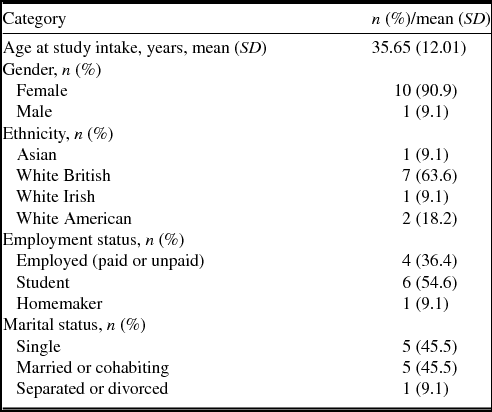
Twenty-two patients were referred to OxMAPP, of whom nineteen met referral criteria (see Method section) and were offered assessment. One declined to attend assessment due to work commitments and one failed to attend. Of the remaining seventeen who were assessed, five were not offered OxMAPP treatment for the following reasons: current manic episode (1), current suicidality (2), current severe depressive episode requiring hospitalization (1), and no obvious target for ImCT (1). Twelve patients started ImCT, but one dropped out after two sessions citing work difficulties. Eleven patients (mean age = 35.65 years, SD = 12.01) completed treatment and follow-up sessions, and gave written consent for their data to be included in the audit. For demographic characteristics, see Table 1.
Demographic characteristics of the study cohort (N = 11)

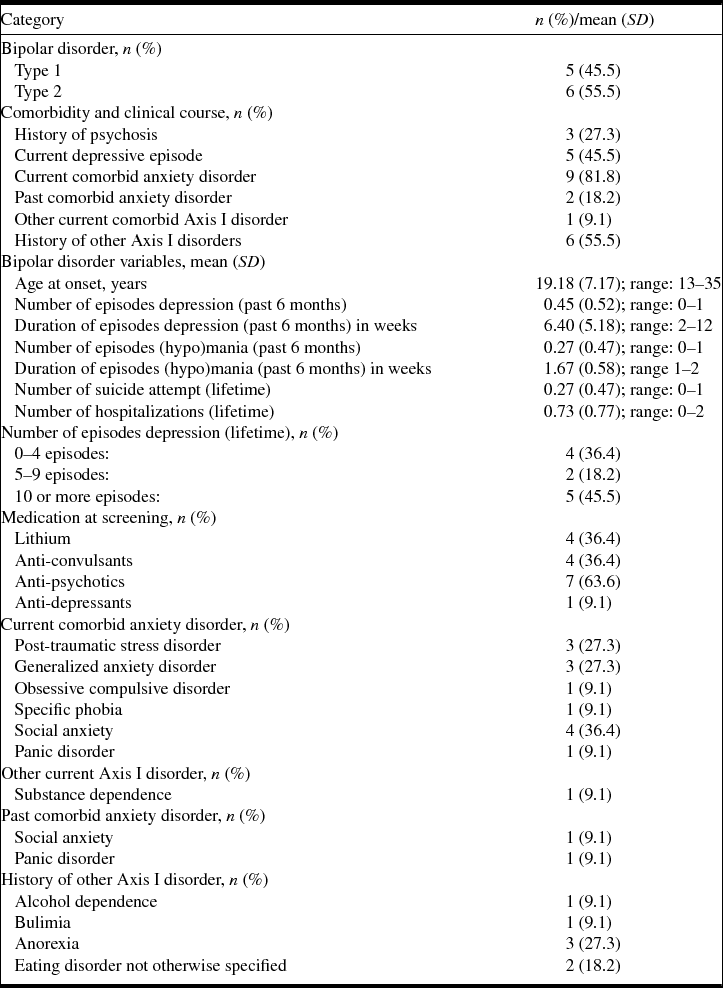
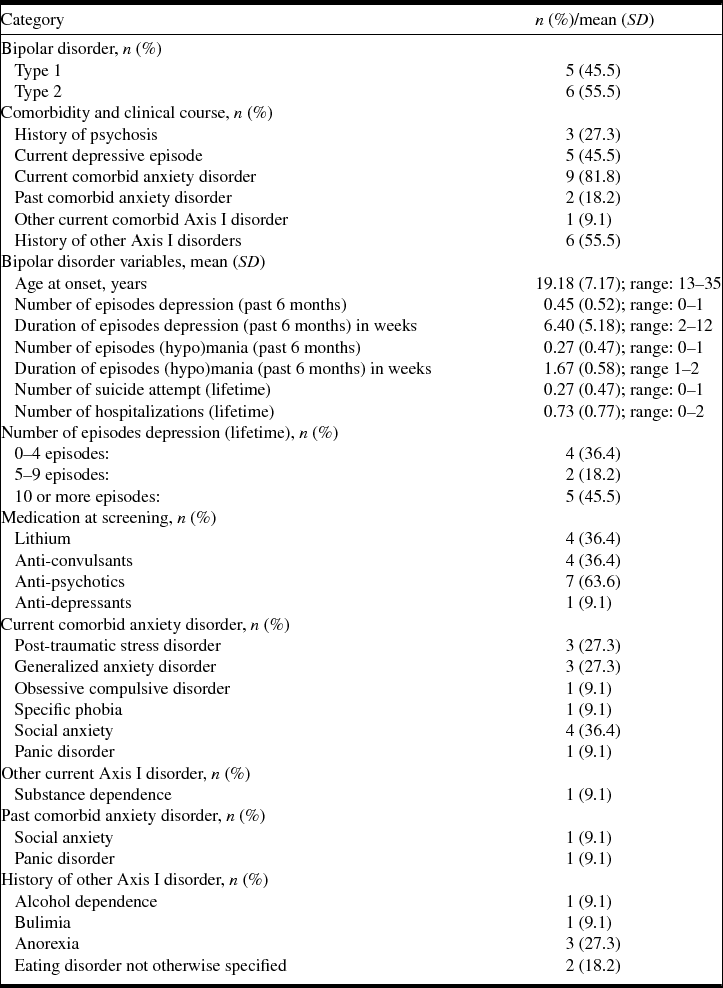
Clinical characteristics, medication and presenting problems are detailed in Table 2: nine patients had a current comorbid anxiety disorder and five were currently experiencing an episode of depression. Ten of the eleven patients were currently being treated with medication.
Presenting clinical problems of the study cohort (N = 11)
Clinical outcomes: change in mood
Out of 11 cases, one patient had stopped the mood monitoring via True Colours prior to starting treatment; therefore no baseline data for depression and mania were available. Final analysis was run on 10 patients. The average number of missing weekly data points was 2.3 (SD = 3.7) during baseline and 2.1 (SD = 2.9) during follow up. Given the few missing values, we conducted a complete case analysis based on the assumption that few missing data are missing completely at random (Everitt and Dunn, Reference Everitt and Dunn1991).
Duration and number of depressive and manic episodes
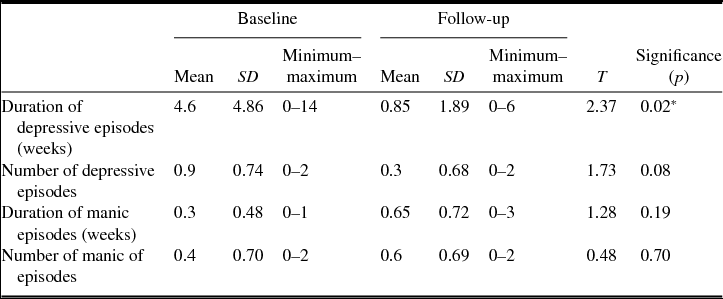
Episode duration and mean number of episodes during baseline and follow-up are described in Table 3.
Duration and number of depressive and manic episodes during 6 month baseline and 6 month follow-up in 10 patients with bipolar disorder

*p < .05.
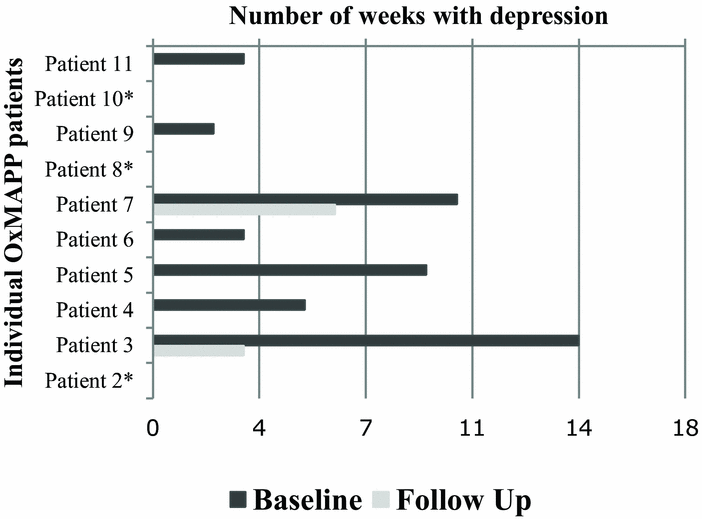
Comparing depressive episodes from baseline to follow-up, results showed a statistically significant reduction in the duration of episodes (non-parametric Wilcoxon related samples signed rank test: T = 2.37, p = .02), and a non-significant trend towards a reduction in the number of episodes (non-parametric Wilcoxon related samples signed rank test: T = 1.73, p = .08). In particular, out of seven patients experiencing a depressive episode during the 6 month baseline, only two had a depressive relapse during follow-up and all relapses were of shorter duration (Fig. 1). There were no statistically significant changes in the duration and number of manic episodes from baseline to follow-up (all p values > .1; see Table 3).
Mean duration of depressive episodes during 6 months of baseline period and 6 months of follow-up period after OxMAPP treatment completion per each patient with bipolar disorder. Data from one patient (Patient 1) were not available due to discharge from the clinic. *Patients 2, 8 and 10 had no depressive episode during baseline or follow-up.

Severity of repeated weekly self-reported symptoms of depression and mania
Results showed a small reduction in depressive symptoms indexed by a small to medium effect size for change in QIDS-SR scores from baseline to follow-up (d = 0.38), while for mania scores the effect size for change was negligible (ASRM d = 0.07).
Clinical outcomes: anxiety
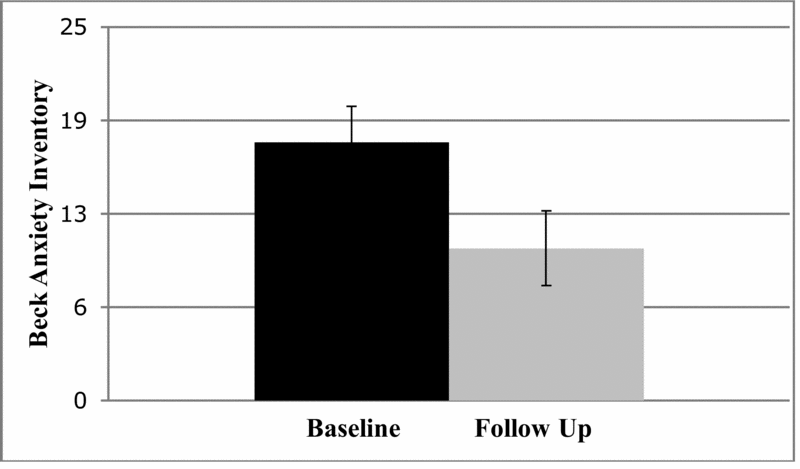
Results showed a large reduction in anxiety indexed by a large effect size for change on BAI scores (d = 2.82) from assessment to 1 month follow-up after treatment completion (Fig. 2).
Mean scores on anxiety measure (BAI) collected weekly during 1 month assessment period and 1 month follow-up period after OxMAPP treatment completion in 11 patients with bipolar disorder.

Indications of patient satisfaction
Ten patients (nine females) filled in the OxMAPP Patient Experience Questionnaire. We were unable to contact the remaining patient due to discharge from the mood disorders clinic.
The mean overall level of satisfaction with OxMAPP was 4.80 (SD = 0.63), where 5 is the highest rating possible. High levels of satisfaction were also reported for the treatment programme as a whole (mean = 4.65, SD = 0.53), and for its individual components: assessment (mean = 4.80, SD = 0.42), treatment (mean = 4.60, SD = 0.70) and follow-up (mean = 4.60, SD = 0.70).
In terms of clinical outcomes, patients expressed overall satisfaction (mean = 4.29, SD = 0.78), with OxMAPP, with high ratings of satisfaction (all means > 4.20) in particular for: ‘feeling more in control of my mood’, ‘helped me to cope in a crisis’, ‘helped me to treat my distressing imagery flashbacks and/or flashforwards’, and ‘helped me to find positive/ helpful ways of thinking’. Overall, patients rated OxMAPP as having a positive impact on their quality of life post-treatment (mean = 4.00, SD = 0.98).
Patient satisfaction in terms of their relationships with the OxMAPP therapists was high (mean = 4.98, SD = 0.53) and the use of co-therapists was also reported to be helpful (mean = 4.5, SD = 0.85). Patients rated the imagery focus of the therapy as important (mean = 4.7, SD = 0.68).
Discussion
We conducted a clinical audit of a novel clinical psychology input for BD, the Oxford Mood Action Psychology Programme (OxMAPP), within a tertiary psychiatry-led service for bipolar disorders. OxMAPP delivered imagery-focused cognitive therapy, a novel intervention based on our expertise in cognitive therapy utilizing mental imagery (Holmes et al., Reference Holmes, Arntz and Smucker2007, Reference Holmes, Bonsall, Hales, Mitchell, Renner and Blackwell2016; Holmes et al., Reference Holmes, Hales, Di Simplicio and Youngin press), to 11 patients with BD. Referral and treatment uptake rates indicated acceptability to referrers and patients. From pre- to post-treatment, there was (i) a significant reduction in the duration of depressive episode relapses, and (ii) a non-significant trend towards a reduction in the number of episodes, with small to medium effect size. There was a large effect size for the reduction in weekly anxiety symptoms from assessment to 1 month follow-up. Patient feedback indicated high levels of satisfaction with ImCT, and underscored the importance of the mental imagery focus. Further detail is given below.
First, we examined referral rates. Of the patients referred for ImCT, a high proportion (19 out of 22) were considered suitable for assessment and 11 of 12 participants who were then offered treatment completed all sessions. This indicates that ImCT for BD was well accepted by patients.
Second, we explored if ImCT would produce changes in mood both in terms of acute illness episodes and of continuous presence of symptoms measured weekly over time, as indicators of mood instability. Using the True Colours system (www.truecolours.nhs.uk) we measured our intervention against repeated symptom scores, rather than against single assessments pre- and post-therapy. Our data show a promising indication that ImCT could significantly reduce the duration of acute depressive episodes. A small effect was also found on the reduction of depressive symptoms – including subsyndromal ones – over 6 month follow-up compared with 6 month baseline, consistent with previous imagery-based protocols in unipolar depression (Brewin et al., Reference Brewin, Wheatley, Patel, Fearon, Hackmann and Wells2009).
Third, in terms of other patient outcomes, we explored the impact of ImCT on anxiety, as this remains a major problem for bipolar patients (Marangell et al., Reference Marangell, Dennehy, Miyahara, Wisniewski, Bauer, Rapaport and Allen2009; Otto et al., Reference Otto, Simon, Wisniewski, Miklowitz, Kogan and Reilly-Harrington2006) with as yet poor treatment options (Stratford et al., Reference Stratford, Blackwell, Di Simplicio, Cooper and Holmes2015). ImCT produced a large reduction in self-reported anxiety measured over repeated weekly assessments for 1 month after the end of treatment compared with during the initial assessment phase. These preliminary findings are in keeping with the literature on the association between mental imagery and anxiety (Hirsch and Holmes, Reference Hirsch and Holmes2007) and on imagery-based therapy approaches for anxiety (Arntz et al., Reference Arntz, Tiesema and Kindt2007; Clark and Wells, Reference Clark, Wells, Heimberg, Liebowitz, Hope and Schneier1995; Patel et al., Reference Patel, Brewin, Wheatley, Wells, Fisher and Myers2007). Therefore, an imagery-focused approach in treating anxiety symptoms in the context of BD should be further investigated.
Finally, we examined patient satisfaction. Overall, satisfaction with the OxMAPP input was high. In particular, high importance was attributed to the imagery focus in therapy and there was high appreciation for the treatment of imagery flashbacks and flashforwards. These evaluations support the idea that distressing intrusive mental imagery could contribute to maintaining mood instability and anxiety symptoms in BD, as suggested by previous findings (Holmes et al., Reference Holmes, Deeprose, Fairburn, Wallace-Hadrill, Bonsall, Geddes and Goodwin2011). Important clinical outcomes highlighted by patients included developing strategies to control mood and a positive impact on their daily quality of life. Therefore, ImCT could be further developed in particular to target persistent subsyndromal symptoms impacting on daily functioning (Strejilevich et al., Reference Strejilevich, Martino, Murru, Teitelbaum, Fassi and Marengo2013). Interestingly, satisfaction with usefulness of two co-therapists, rather than a single therapist, was rated highly. In addition, patient feedback indicated that the co-therapists had explained the treatment approach in such a way that it was very understandable. This collaborative approach and effort to enhance patient understanding of the techniques used may have aided the efficacy of the therapy. Further qualitative analysis of these unique aspects of treatment would prove helpful to better understand the factors contributing to patient satisfaction. Given the resource implications of the co-therapy model, future studies should also establish whether our two therapist approach is cost-effective compared with a single therapist.
Addressing anxiety symptoms remains a crucial unmet need of this population (Goodwin, Reference Goodwin2016; Stratford et al., Reference Stratford, Blackwell, Di Simplicio, Cooper and Holmes2015) that only one trial has recently attempted to target (Jones et al., Reference Jones, McGrath, Hampshire, Owen, Riste and Roberts2013) with results forthcoming. Further work is therefore called for. Based on this so-far promising imagery based intervention, and consistent with experimental evidence on the association between biases in emotional mental imagery and anxiety in bipolar patients (Di Simplicio et al., Reference Di Simplicio, Renner, Blackwell, Mitchell, Stratford and Watson2016), further efforts at treatment innovation for anxiety in BD could capitalize on targeting imagery as a maintenance mechanism.
Mania represents another challenge for psychological interventions in BD, in particular in young people where pharmacological treatment is more problematic (Vallarino et al., Reference Vallarino, Henry, Etain, Gehue, Macneil and Scott2015). While mental imagery might theoretically be associated with amplification of manic symptoms (Holmes et al., Reference Holmes, Geddes, Colom and Goodwin2008), the ImCT protocol did not target mania symptoms in this study. Accordingly no significant change in the number and duration of manic episode was observed; however, experimental studies (O'Donnell et al., Reference O'Donnell, Di Simplicio, Brown, Holmes and Burnett Heyes2017) suggest that positive imagery is involved in positive mood escalation and ImCT adaptations for mania could be explored.
While the clinical outcomes in the audit show promise for the ImCT treatment approach, collection of outcome data from clinical practice limits the conclusions that can be drawn about potential efficacy of the treatment investigated. For example, the design does not rule out the possibility that the improvements observed could be due to factors other than the specific treatment received, such as generic therapeutic effects including expectancy and the passage of time. It is also possible that other psychological interventions focusing on the anxiety symptoms or comorbid disorders, such as specific treatment protocol for social anxiety or post-traumatic stress disorder (PTSD), could have similar effects on reducing anxiety symptoms. We further note that the patients receiving the treatment described in the current paper had initially been assessed and seen within a psychiatry service, as will commonly be the case in BD given that medication is the first-line treatment (Goodwin, Reference Goodwin2016; NICE, 2014). However, some individuals who would meet diagnostic criteria for BD may reject a psychiatric treatment context and the use of terms such as ‘bipolar disorder’ or ‘illness’ (as used in this article) in relation to themselves [see e.g. British Psychological Society (BPS) Division of Clinical Psychology, 2015] and our audit does not provide information as to whether our psychological treatment can be generalized.
While bipolar treatment guidelines (NICE, 2014) extrapolate from data on depression, few psychological therapeutic approaches have attempted to address truly bipolar-specific processes with notable exceptions such as circadian/social rhythms (Frank et al., Reference Frank, Swartz and Boland2007). In this vein, ImCT attempts to address imagery linked to anxiety and mood instability. In the future, therapeutic options for individuals with BD could be further advanced by offering a modular combination of these elements tailored on their needs (circadian routine, anxious imagery, etc.).
Conclusions
Our audit results show that an imagery-focused psychological intervention targeting mood and anxiety symptoms in BD was promising in terms of clinical symptom reduction, and was well accepted and rated as highly satisfactory by patients with BD. This brings us a step closer towards developing improved psychological interventions for BD that aim to address some of the challenges that are inherent in treatment innovation. Most notably, imagery provides a particular treatment target because of its apparently central role in some aspects of psychopathology. It also raises the challenge of how to meaningfully measure outcome in BD: mood instability cannot be captured using single assessments pre- and post-treatment. Based on these preliminary indications, further studies should formally evaluate the efficacy of ImCT in reducing mood episodes and instability and anxiety in patients with BD. As a step towards an efficacy trial of ImCT, and based on the positive outcome of the OxMAPP audit, we have developed a novel, more refined approach to measuring mood instability in bipolar patients, applying a time-series analysis to daily mood fluctuations (Bonsall et al., Reference Bonsall, Geddes, Goodwin and Holmes2015; Holmes et al., Reference Holmes, Bonsall, Hales, Mitchell, Renner and Blackwell2016). A much shorter-term read-out of treatment effects appears to us to be a critical step in streamlining innovation in bipolar treatment.
Acknowledgements
Thanks to Peter Watson for advice on statistical aspects of the audit. We would also like to thank Aiysha Malik, Ella James, Ian Clark and Sophie Wallace-Hadrill for assistance in collecting the outcome measures. The authors also thank the Oxford Professorial Mood Disorders Clinic and NIHR Oxford Cognitive Health Clinical Research Facility. G.M.G. and J.R.G. are NIHR Senior Investigators. The views expressed in this publication are those of the authors and not necessarily those of the NIHR, the Medical Research Council, the National Health Service or the Department of Health.
Conflicts of interest: E.A.H. held a Wellcome Trust Clinical Fellowship (WT088217) supporting S.A.H. and K.Y. E.A.H. and S.E.B. were also supported by the Medical Research Council (United Kingdom) intramural programme (MC-A060-5PR50 to E.A.H.) including a Medical Research Council Career Development Fellowship to M.D.S. C.G.F. holds a Principal Research Fellowship from the Wellcome Trust (046386). L.I. was supported by the National Institute for Health Research (NIHR-DRF-2011-04-076 to L.I.). G.M.G. holds a grant from the Wellcome Trust, holds shares in P1vital and has served as consultant, advisor or CME speaker for AstraZeneca, MSD, Eli Lilly, Lundbeck (/Otsuka or /Takeda), Medscape, P1Vital, Pfizer, Servier. The remaining authors declare no conflicts of interest.



Comments
No Comments have been published for this article.