AN INTRODUCTION TO THE PROBLEM
Every language family has its trouble spots in reconstruction, elements in language history that defy scholarly consensus. Such sticking points seem to generate conflicting and contradictory accounts, each as unsatisfying as the last. The optimist will observe that, over time, such problem areas often do yield to the rigor of the analyst and conform to some sensical, or even lawful pattern. They eventually attain explanation. An outstanding example is Verner's Law (Verner Reference Verner1875), which successfully elucidated, after several failed attempts, the troubling residue of cases that Grimm's Law failed to clarify in Indo-European (see below).
A related problem is those hypotheses that pass into the canon of established historical particulars without regular reevaluation as new data and theoretical models become available. Research on the history of underdocumented language families is vulnerable to this problem because the number of scholars with sufficient data to assess hypotheses tends to be low. The evidence reviewed below suggests that one case that merits revisiting is the palatalization and affricativization of the proto-Mayan (pM) velar stops *k and *k' to /ch/ and /ch'/, respectively, in the Cholan and Tseltalan languages of the Mayan language family. This sound change is held by Mayanists to be a significant piece of evidence for reconstructing the historical relationship among several different branches of the Mayan language family (Justeson et al. Reference Justeson, Norman, Campbell and Kaufman1985; Kaufman and Norman Reference Kaufman, Norman, Justeson and Campbell1984). Indeed, in their influential work on the history of the Cholan branch of Mayan, Kaufman and Norman (Reference Kaufman, Norman, Justeson and Campbell1984:83) assert that “the single phonological innovation that sets off the Greater Tseltalan [Cholan-Tseltalan] subgroups from all other subgroups of Mayan is the shift of the proto-Mayan velar stops *k and *k' to the affricates ch and ch'.”
The sound change has played a central role in efforts to reconstruct the history of language contact in the Mayan region as well. Yukatekan and Cholan are two very divergent branches of the Mayan language family that have been connected to the Classic Maya civilization (a.d. 250 to 900). Cholan loanwords in Yukatekan are often identified as such because they have undergone the *k(') to ch(') sound change. Lowland lexical items that have not experienced the sound change (particularly in Cholan or Tseltalan languages) are often assumed to be of Yukatekan provenience, since Yukatekan languages did not undergo this sound change, except in more limited contexts.
A strong case can be made that the sound change occurred as an areally diffused innovation, not a shared inheritance from Common Cholan-Tseltalan. The argument derives from newly available data in ancient Maya hieroglyphic texts and longstanding sources of evidence in contemporary Mayan languages understood in a different light. Its persuasiveness as a hypothesis depends crucially on advances in the typology of language contact phenomena, particularly regarding the areal diffusion of sound changes; advances that have revised the nineteenth century Neogrammarian creed (Osthoff and Brugmann Reference Osthoff and Brugmann1878:xiii) that “[s]ound laws allow no exceptions.”
On a more theoretical plane, this article concerns processes of sound change, both contact-induced and internally motivated, and the role that written records can play in our elucidation of such historical changes. It provides a useful case of a sound change that took place over the span of at least several centuries, crossed several firmly established linguistic boundaries in different ways and most likely at different times, and resulted in both exceptionless and exceptional realizations of the shift. All of these facts underscore the observation made by others (Enfield Reference Enfield2003; Robertson Reference Robertson1977) that, when perceived under a close lens, sound change, and perhaps linguistic change more generally, engage the same range of possible processes—whether the change crosses language boundaries or takes place within a single language variety. The present study also brings to the fore fundamental differences between the processes of change in speech communities (Labov Reference Labov1994) and the diffusion and spread of changes in written language.
THEORETICAL ANTECEDENTS
Sound change has always enjoyed a privileged place in the study of language change. The comparison of lexical items and the identification of regular sound correspondences helped identify systematic similarities among languages almost from the beginning of the historical-comparative tradition. Early philologists noted similarities between languages, but it was Jacob Grimm (Reference Grimm1822) who provided the first thorough and detailed account of a major series of sound changes. Other significant changes were identified shortly after; all framed as sound ‘laws’ (for further discussion see Collinge Reference Collinge1985).
The belief was that such laws of language change captured the ordered workings of the natural world much like Newton's Laws of Motion. If a sound change that applied to a language did appear to be irregular, this was either the result of incomplete analysis (as Verner's Law had shown for the exceptions to Grimm's Law) or the result of a different process of change, such as the borrowing of words from a language or dialect that had not undergone the sound change. The regularity hypothesis enjoyed general acceptance among scholars. As larger data sets and information on more languages became available, however, counterexamples to the regularity hypothesis grew difficult to ignore. In a review of the comparative method, Ross and Durie (Reference Ross, Durie, Durie and Ross1996:13) noted that, “[c]omparativists find themselves moving from the quasi-Darwinian Neogrammarian paradigm which underlies the regularity hypothesis to a speaker-oriented paradigm which has a place for both regularity and irregularity.”
Wang (Reference Wang1969, Reference Wang1977) and Wang and Cheng (Reference Wang, Cheng and Wang1977) offered perhaps the most comprehensive counter to the Neogrammarian hypthothesis. They used sociolinguistic variation data for Chinese to argue that sound change diffused gradually through the lexicon, moving from word to word, rather than, according to the dominant model, affecting all words with the relevant phonetic conditions at the same time. In this view, the apparent regularity of sound change is simply the end-stage of an otherwise long process of gradual change, a process that Wang and Cheng (Reference Wang, Cheng and Wang1977) termed “lexical diffusion.” William Labov, in a presidential address to the Linguistic Society of America in 1979 (Labov Reference Labov1981, Reference Labov1994) proposed a resolution to the apparently contradictory positions of the Neogrammarians and lexical diffusionists. He suggested that both types of change happened, and that they took place in very different contexts. The regular and exceptionless sound changes of the Neogrammarians, he suggested, involve “low level output rules,” essentially incremental shifts in how segments were realized phonetically (Labov Reference Labov1981:299). Irregular changes, which proceeded through lexical diffusion, are “not sound changes in a literal sense” but, rather, “they are changes of membership in abstract classes” (Labov Reference Labov1981:299). In other words, lexically diffused changes, rather than being shifts in the phonetic realization of a phoneme, involve the recategorization of specific segments in particular lexical items. In such cases, the phonetic features of a segment do not change gradually, as was hypothesized for ‘normal’ sound change but, rather, transform abruptly so as to conform to the phonological specifications of the new phoneme class in which it is placed.
Labov further distinguished between regularity in a particular speaker at a specified time, and the regularity of changes that spread through a community of language speakers. It is helpful to consider the actual epidemiological processes by which linguistic innovations spread in speech communities (Enfield Reference Enfield2003). Innovations in language, whether through language contact (in fact, bilingualism), or innovated by speakers in a thoroughly monolingual environment must still be adopted by other members of the community at gradual and variables rates. Milroy (Reference Milroy1987, Reference Milroy, Chambers, Trudgill and Schilling-Estes2002) and Milroy and Milroy (Reference Milroy and Milroy1985) make the important observation that some individuals excel at innovation, whereas others, after the act of coinage, prove adept (for reasons as ill-defined as ‘prestige’ or ‘charisma’) at spreading an innovation. Any community has early and late adopters, and those who will actively resist particular innovations, even after the numbers of adopters reaches a critical mass. Under this model of language change, the crucial difference between internal language change and external influence has to do with how an innovator or independent innovators contrive an innovation, and what place those innovators might have in the community. Resistance to “borrowings,” then, would result less from how innovations diffused across language “boundaries,” than from the limits of individual creativity and the status and influence that bilingual speakers enjoy in a community (for more on language boundaries see Auer [Reference Auer, Filipula, Klemola, Palander and Penttila2005] and Law [Reference Law2014]).
THE MAYA CASE
Most languages of the world are unwritten, leaving scholars without the imperfect, but expressly helpful medium of writing to investigate prior stages of a language. For the Mayan languages, the primary resource for uncovering the linguistic history of the family was linguistic data gathered from fieldwork on modern languages, complemented by valuable, if often under-appreciated information found in Colonial-era manuscripts. In recent years, however, scholarship has built strongly on a new source of linguistic material—the recently deciphered corpus of Maya hieroglyphic inscriptions. These extend the written attestation of at least one branch of the Mayan language family by more than one thousand years, centuries before other sources. This body of linguistic data affords new perspectives on language change through time and space, which in turn compel reconsideration of previous accounts of the historical development of the Mayan language family.
A notable example involves a seemingly unassuming sound change: the palatalization and affricativization of proto-Mayan *k and *k' to /ch/ and /ch'/in differing phonological environments in different Mayan languages. This case is of special interest because of its reflection in the hieroglyphic corpus and in turn, what that reflection suggests about its realization and integration across various languages.
Background of Mayan Languages and Social History
Considering the frequency of the process of palatalization—a shift in the place of articulation of a vowel or consonant toward the palate—across the languages of the world, it is perhaps unsurprising that palatalization of voiceless and glottalized velar stops has occurred in several different branches of the Mayan language family. In some cases this innovation was clearly independent.Footnote 1 Mayan languages are often divided into highland and lowland languages, a division that, contrary to the labels, is more culturally and linguistically defined than conditioned by geography, since some lowland languages are spoken principally in highland regions, and at least one highland language, Q'eqchi', is currently spoken throughout a large swath of the Maya lowlands. The case of palatalization relevant to this discussion involves primarily lowland languages, and especially Cholan (including modern Ch'ol, Chontal, and Ch'orti') and Tseltalan languages (Tseltal and Tsotsil), which together form the Cholan-Tseltalan or Greater Tseltalan branch of the Mayan language family. Cholan, in particular, has been linked unequivocally to the language of the Classic Maya, recorded on thousands of hieroglyphic texts from the first millennium a.d. (Bricker Reference Bricker1986; MacLeod Reference MacLeod, Justeson and Campbell1984; Schele Reference Schele1982; Wald Reference Wald1994). Houston et al. (Reference Houston, Robertson and Stuart2000) presented evidence that the language of the hieroglyphs can be placed as a daughter of proto-Cholan, Ch'olti'an, which is in turn a linear ancestor of modern-day Ch'orti'. Another proposal (see Mora-Marín Reference Mora-Marín2009), considers the glyphic corpus to reflect proto-Cholan itself. Though the distinction is consequential, the conclusions of this paper do not hinge on one or the other of these interpretations.
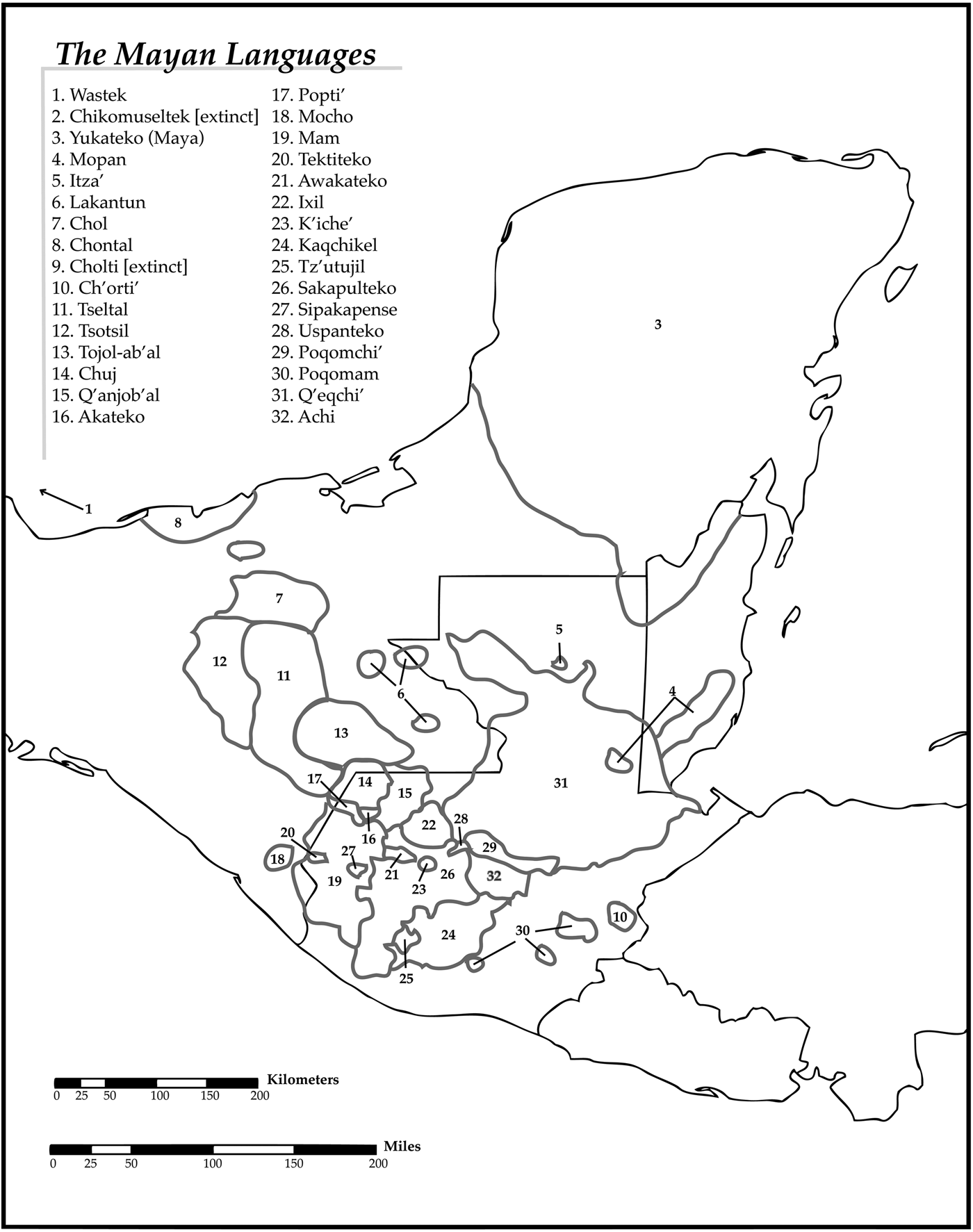
Another group of languages, equally important to the linguistic history of the Maya lowlands is the Yukatekan branch (including Yukatek Maya, Itza', Mopan and Lakandon), which is genetically distant from proto-Cholan-Tseltalan, but participated with both Cholan and Tseltalan languages in an intensive zone of contact known to scholars as the Lowland Mayan Linguistic Area (Justeson et al. Reference Justeson, Norman, Campbell and Kaufman1985; Law Reference Law2014). Current scholarship affirms that the glyphic texts were not written in Yukatekan, although some very late, intriguing exceptions do exist (Lacadena Reference Lacadena1997; Lacadena and Wichmann Reference Lacadena, Wichmann, Blos, Cobas and Robertson2002; Wald Reference Wald and Wichmann2004) It is often believed that Yukatekan speakers were influential throughout the lowland region during the Classic period. The current geographical distribution of Mayan languages can be seen in Figure 1.
Map of contemporary Mayan languages (from Law Reference Law2011).

The modern-day linguistic geography of the Maya region (Figure 1) is different in several important ways from what was likely the distribution of Mayan languages during the Maya Classic period (approximately a.d. 250–900). Perhaps most significant for this paper is that the language Cholti, which was spoken in a large swathe of the Maya lowlands, in present day Peten, Guatemala, is no longer spoken, and the formerly highland language Q'eqchi' has, in recent years, expanded significantly to the north in the area formerly occupied by Cholti speakers.
BACKGROUND OF THE *K(')>CH(') SOUND CHANGE
Early on, researchers noted the strong correspondence between certain terms with /ch/ or /ch'/ in Cholan and Tseltalan languages, and /k/ or /k'/ in other Mayan languages. Vexingly, these correspondences were imperfect: /k(')/ in other Mayan languages variably corresponded to /k(')/ or /ch(')/ in Cholan and Tseltalan. This led some scholars (Halpern Reference Halpern1942) to posit two sets of velars for proto-Mayan (in addition to the uvular /q/ and /q'/ that are readily reconstructible for proto-Mayan and will be discussed in more detail later). Although the precise phonetic distinction between these two hypothetical phonemes was unclear, the proposal held that the reflexes of these two phonemes would have merged in other Mayan languages, but resulted in /k(')/ and /ch(')/, respectively, in Cholan and Tseltalan (McQuown Reference McQuown1956).
A breakthrough in the interpretation of these data came from Terrence Kaufman (Kaufman and Norman Reference Kaufman, Norman, Justeson and Campbell1984:141), who noted that out of a hundred proto-Mayan cognate sets only 10 supported the putative proto-contrast. For Kaufman, a more economical approach was to reconstruct only */k(')/ for proto-Mayan and postulate a set of conditions under which /k(')/ would have palatalized in Cholan-Tseltalan. Determining a set of conditions that might trigger the change at first proved fruitless, but, after a careful review of the data, he discerned the following pattern (Kaufman and Norman Reference Kaufman, Norman, Justeson and Campbell1984:142):
*k(') becomes /ch(')/ except in the following environments:
A) when /k(')/ is word initial, and is followed by a vowel other than /i/ and an apical consonant or /p/. (#_V[¬/i/]C[+apical, /p/])
B) when /k(')/ is word final and is preceded by any vowel and an apical consonant or /p/. (C[+apical, /p/]V_#)
C) when /k(')/ follows /Vh/, but not /Vj/ (Vh_#).
D) when it is between two vowels in a single root, unless the first vowel is /i/. (V[¬/i/]_V)
This formulation does not account for every lexeme in the Cholan-Tseltalan language family, yet it is a robust statement and accounts for much of the variation of the 89 cognate sets: only three elude Kaufman's explanation. In addition to the *k(') to /ch(')/ sound change, Cholan and Tseltalan share phonological, grammatical, and lexical similarities that prompted Kaufman to propose a Greater Tseltalan subgroup within the Mayan language family. Because of the prominence of the *k(') to /ch(')/ sound change, it was soon labeled “the most important phonological innovation distinguishing proto-Cholan-Tzeltalan from other subgroups of Mayan” (Justeson et al. Reference Justeson, Norman, Campbell and Kaufman1985:13; Kaufman and Norman Reference Kaufman, Norman, Justeson and Campbell1984:83). The sound change was assumed to be both abrupt and uniform; the few exceptions (for example, *k'ooj ‘mask’; *kok ‘turtle’; *kuhkay ‘firefly’) were taken to be later borrowings from neighboring Yukatekan, or some other language that had not undergone the sound change (Kaufman and Norman Reference Kaufman, Norman, Justeson and Campbell1984:85).
Justeson and colleagues (Justeson et al. Reference Justeson, Norman, Campbell and Kaufman1985:13), in their study of foreign influence on the Lowland Mayan Linguistic Area, went on to propose that “the complexity of the conditions [that inhibit this sound change] precludes the possibility that it diffused between separate speech communities.” Crosslinguistic comparison, however, suggests that the complexity of the conditions inhibiting this sound change may not present as great an obstacle to contact-induced language change as was previously supposed. Within the Mayan language family, for instance, another, clearly unrelated case of the palatalization of *k('), described by Campbell (Reference Campbell1977), several dialects of K'ichee' and Mamean have undergone palatalization of *k(') before a low vowel and a uvulars /aq(')/, which some Mamean languages later extended to contexts before glottal stops /'/ and velar fricatives /j/ (Campbell Reference Campbell1977, Reference Campbell1998:74). Additionally, in a paper on the borrowing of rules, Thomason (Reference Thomason and Brown2006) cites several examples of what she sees as good candidates for ‘borrowed’ sound rules. The application of Turkish vowel harmony rules in Asia Minor Greek may be one example (Thomason and Kaufman Reference Thomason and Kaufman1988:218), and the Bantu languages KiShambaa and Gonja KiPare share “an innovative tone-spreading rule but little or no borrowed lexicon' (Thomason Reference Thomason2002:13). The fact that in other languages and contexts fairly complex conditioned sound change rules have been adopted through language contact opens up the possibility that this sound change in Cholan-Tseltalan might likewise have resulted from language contact.
If the complexity of a sound change gives insufficient reason to reject the possibility that the *k(') to ch(') sound change was areally diffused, what positive evidence exists to support the proposal? There are two main types of evidence. The first has to do with the geographical distribution of similar sound changes. The second has to do with the form that the relevant lexical items take in the hieroglyphic corpus.
Geographic contiguity can provide strong evidence against an innovation being inherited or independently developed. In addition to Cholan and Tseltalan, several other contiguous, but more distantly related languages participated in the lowland Mayan sphere of linguistic interaction—specifically Yukatekan, Tojol-ab'al, and Chuj (of the Q'anjob'alan branch of Mayan). All of these underwent palatalization of /k(')/, though in different phonetic environments. Even geographically distant Wastek, which Robertson and Houston (Reference Robertson, Houston, Laporte, Arroyo, Escobedo and Mejía2003, Reference Robertson, Houston, Faust and Richter2015), building on proposals by Campbell (Reference Campbell1988:211), have suggested on other grounds was an active participant in the lowland Mayan sphere of linguistic interaction, has undergone almost universal palatalization of */k(')/ (Kaufman Reference Kaufman, Kalr, Langdon and Silver1980; Robertson 1992; Robertson and Houston Reference Robertson, Houston, Laporte, Arroyo, Escobedo and Mejía2003, Reference Robertson, Houston, Faust and Richter2015).
In Yukatekan, as with Mam and K'ichee', mentioned above, */k(')/ palatalizes to /ch(')/ “when followed by */a/ or */aa/ and */q/ or */q'/” (Kaufman and Norman Reference Kaufman, Norman, Justeson and Campbell1984:88), so that, for example, Mopan chäk ‘red’ derived from pM *kaq. In addition, /k'/ (but not /k/) become /ch'/ in Yukatekan languages when followed by a front vowel, as with Yukatek ch'e'en from pM *k'e'n ‘cave,’ or Mopan ch'ib ‘palm tree,’ from pM *k'iib (Kaufman and Norman Reference Kaufman, Norman, Justeson and Campbell1984:88). In Tojol-ab'al and Chuj, palatalization is restricted primarily to /k/. For example, in Tojol-ab'al, glottalized /k'/ is preserved (thorn k'i'ix; cave, rock outcropping k'e'en) while pM *k is realized as /ch/: sky scha'anil; two chabe, schabil; four chane; honey bee chab'). The differences in the phonological contexts in which palatalization rules occurred in each language suggest that the innovation may be the result of several discrete, areally spread waves of sound change, each of which affected a different set of languages. Languages, such as members of the Cholan-Tseltalan subgroup, in which the change applied in a greater number of phonological contexts, would have participated in more of these areal innovations than Chuj or Tojol-'ab'al.Footnote 2
Given the strong areal tendency towards palatalization of /k(')/, the parallel palatalization found in Cholan and Tseltalan could well have resulted from contact rather than from common inheritance. To investigate this possibility, we turn to the language of hieroglyphic inscriptions, a Cholan tongue, whose existence significantly postdates the breakup of its proto-Cholan-Tseltalan ancestor. The glyphic data are especially significant because, patently, they do not conform to the proposal (Kaufman and Norman Reference Kaufman, Norman, Justeson and Campbell1984:83) that *k(') > ch(') occurred before the division of Cholan-Tseltalan. Rather, they show a gradual spread to new lexical items with similar phonological contexts over the course of several hundred years of written history.
GLYPHIC SOURCES
The corpus of Maya hieroglyphic inscriptions is unique in the New World. It provides a reasonably large body (in the neighborhood of 15,000 texts and text fragments) of linguistic data from a pre-Columbian language spanning several centuries.Footnote 3 This writing system recorded linguistic details of morphology and phonology through a mixture of logographic and syllabic signs. At times, lexical items were written solely with logographs, which, while indicating a specific word in a specific language (not, as was once believed, an abstract, language-independent idea or concept), fail to deliver the phonological details that give solid clues about pronunciation. It was also a common practice, however, to spell certain words entirely with phonetic (syllabic) signs, or to complement a logograph with a phonetic sign. This effectively clarifies the pronunciation of individual logographs, though phonetic clarity was not necessarily the only motivation for using such spellings.
What this means is that while certain terms may be frequent in the corpus of inscriptions, only a subset of those attestations provide evidence of sound changes, namely, those tokens that are accompanied by phonetic complements or that are spelled out entirely with phonetic signs. The glyphic spellings that do cue phonology are more restricted, but they display a sensitive, or in any case a variable representation of sounds. Perhaps because of the optional nature of the system, phonological change is reflected in changing spelling practices over the course of the Classic period. These changes include a loss of contrastive vowel length (Houston et al. Reference Houston, Stuart, Robertson and Wichmann2004; Stuart et al. Reference Stuart, Houston and Robertson1999), the merger of voiceless velar and glottal fricatives (Grube Reference Grube and Wichmann2004), and, in the Early Classic period (a.d. 300–550), the raising of long ee to ii (Stuart et al. Reference Stuart, Houston and Robertson1999). Writing has a notorious tendency to be conservative in that a written form is not always ‘updated’ to reflect changes in vernacular speech. Data from Maya writing, however, are exceptional in showing patent adaptation in supple response to shifts in spoken language.
The hieroglyphic evidence, though scanty by the standards of modern sociolinguistic studies of variation, plainly point to areal spreads in the k(') > ch(') shifts. These are much more recent than previously believed, proceeding gradually within the language from word to word. As with many sound changes, it did not occur all at once (Labov Reference Labov1981; Wang Reference Wang1969). The hieroglyphic corpus provides two clues to the late and gradual nature of this change. First, the Classic inventory of syllabic signs suggests a late sound change. Syllabic signs with the segment /ch/ or /ch'/ all seem to have been introduced into the syllabary in the Late Classic period, consistent with what would have been a dramatic increase in the frequency of the use of that segment if the sound change became widely applied. Second, explicit phonetic spellings or phonetic complementation on logographs identify lexical items that have undergone the sound change, and others that have not, despite fulfilling the predicted phonological criteria.
The first line of evidence for the late increase in the implementation of this sound change can be seen in the syllabic signs. Both the implementation and the iconographic origins of particular syllabic signs point to a late increase in the use of chV and ch'V syllabic signs. While proto-Mayan can be reconstructed as having palatal affricates, the frequency of these segments would have increased drastically with the shift of *k(') to /ch(')/. At least six syllabic signs (cha, che, chi, cho, chu, ch'a) out of the 10 possible combinations (/ch/ and /ch'/ with each of the five basic vowels) have been deciphered. All ten of the possible consonant-vowel combinations with the segments /k/ and /k'/ have been identified in the glyphic corpus. Interestingly, at least one of these, the sign for the syllable ka, clearly has its iconographic origins in the form of a fish, which is chay in modern Cholan languages, but it served as the rebus source of this sign when the word was *kay, prior to being affected by the sound change. The syllable appears in the Early Classic period, first, probably, in a stucco text at Aguacatal, Campeche (Houston et al. Reference Houston, Nelson, Ware, Mesick, Taube, Matheny and Matheny2005:Figure 15).
The earliest ch(')V syllabic sign appears to be the syllable chi, attested in an early spelling of chi-K'IN (‘east’—importantly, this is an erosion of ochi-k'in ‘enter sun’, which displays the k to ch sound change ochi [from pM *okik] on an unprovenanced early lidded tripod vessel [Fields and Reents-Budet Reference Fields and Reents-Budet2005:Figure 109]), and in a somewhat opaque chi-hi as part of a proper name on an Early Classic stone vessel from Santa Rita. This is consistent with the crosslinguistic tendency for velar sounds to palatalize before high front vowels. Other early spellings with ch(')V syllables are all from the beginning of the Late Classic period: ch'a-CH'AHBch'ahb ‘penance, sacrifice’ at the beginning of the Late Classic (Caracol Stela 3:B19, B20; a.d. 620s), followed not long after by ch'a-CH'AMch'am ‘to receive’ (Piedras Negras Panel 2:H1; a.d. 667). The overt marking of ‘sky’ (chan) and its near homophones (‘snake’ and ‘four’) with cha are in the final decades of the eighth and early years of the ninth centuries a.d. The term for maternal uncle, ichaan (pM *ikaan) occurs at Yaxchilan (Lintel 58:C1 [yi-cha-ni], and Lintel 9:C2, as well) at about a.d. 750. The cho syllable appears to be generated by the early seventh century (Copan Structure 13:D8) and the chu (“breast variant”) in the eighth century a.d. (see, for example, the Altar vase [Smith Reference Smith1972:259] and Piedras Negras Stela 14, sculptor's signature). The pattern of syllabic sign introduction, then, seems to have k(')V syllables and the syllable chi appearing first, in the Early Classic period, followed, at the beginning of the Late Classic period, with ch'a and the remaining syllables in the seventh and eighth centuries. While some of this is no doubt due in part to the increase in the overall number of texts available in the Late Classic period, the pattern is consistent with what we would expect for a sound change in progress, which started out affecting segments before high vowels first, and later spread to other contexts.
Of the chV and ch'V syllabic signs, two have apparent iconographic origins that involve terms relevant to this sound change. The syllable cho is represented by a jawbone (proto-Cholan *choj, proto-Mayan *kooh), which only occurs in Late Classic inscriptions, and chi, which is represented by a hand with fingers upwards and thumb touching fingertips to make a rounded shape. While this sign itself is not iconographically transparent, early use of this sign within a cartouche for the day sign ‘manik’ or ‘deer’ in the pan-Mesoamerican calendar suggests that this sign takes its value from the word chij ‘deer’ (from proto-Mayan *keeh). Since the earliest uses of this sign are logographic, representing a day in the calendar round, however, it is entirely possible that it indicated ‘deer’ prior to the sound change (*kiih or *keeh) but was only recruited as a syllabic sign after the sound change had affected that word. As noted above, chi is the earliest attested ch(')V syllable and words with a high vowel i were likely the very first to undergo palatalization.
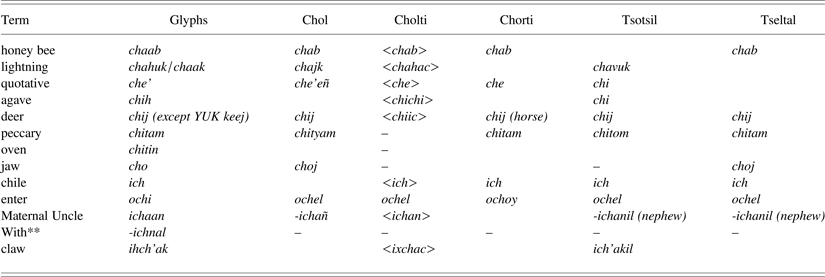
Another line of evidence that the shift from *k(') to ch(') was a late, areal innovation is the presence of several spellings, including several fairly frequent ones, that do not reflect the sound change. A subset of these forms are variably attested, in some instances written with the archaic /k(')/ and in others with the innovative /ch(')/. Tables 1 through 3 summarize these data.
Terms with both /k/ and /ch/ spellings attested*
* ka-ba: Palenque Bench 1:E1, Comalcalco Urn 26, Spine 1:A4, Copan Altar G:B2, Caracol Stela 17:B2 (among others); cha-ba: Halakal Lintel 1:H7; k'a-ma: Palenque Temple 19, platform:F2; ch'a-CH'AM-wa: Piedras Negras Panel 2:H1; ka-KA'N-na: Bagaces Mirror:B3; cha-CHA'N-na: Dzibilchaltun Structure 42 burial, Bone:B3; ka-ta-li (second): Chichen Itza Casa Colorada Text; ka-yo-ma (fisherman): Palenque Creation Tablet; ka-ya: Cancuen Panel:K9; cha-ya: Cancuen Panel 1:J10, Yaxchilan Hieroglyphic Stairway 3:D6.
About a fourth of the relevant terms (words with a proto-Mayan */k(')/ that would have changed under the conditions specified by Kaufman) are attested with both /k/ and /ch/. Interestingly, all of these forms have a low vowel /a/ (Table 1).
Another quarter of the relevant terms are only attested with the archaic form. All of these terms have back vowels (Table 2). This seems to contrast somewhat, though not perfectly, with the terms that are attested with the sound change in place (Table 3).
Terms that changed in later languages, but did not change in glyphs*
* yu-k'i-bi (drinking vessel): K5018,Footnote 4 many others (extremely common in Primary Standard Sequences on ceramic vessels); k'u: Early Classic Shell Gorget (Stuart et al. Reference Stuart, Houston and Robertson1999:Figure 187); ka-KAAN: Tonina Monument 144:p F1, Copan Altar G:B2 (and numerous Calakmul Emblem Glyph); k'u-hu: unprovenienced jade (K1505), Yaxchilan Lintel 37:D7; k'o-jo: Palenque area Panel:A4 (K6593).
Terms with pM /*k/ that are only attested with /*ch/ in glyphs*
* cha-bi: La Corona Panel 2:E5; cha-hu-ku: Piedras Negras Throne 1, proper left support; cha-ki: Piedras Negras Panel 12, Dresden Codex, pages 10 and 15; che: Xkalumkin vase (K8017); che-e-na: Copan Stela 34; che-he-na: K7459:J1; chi-hi: K1092, K2286, Dresden Codex; chi-ji: K1991, K1092, Naj Tunich, Randall Stela; chi-ta-ma: Randall Stela; chi-ti-ni-li: Palenque Temple of the Foliated Cross Tablet:M2; cho “jawbone” syllabic sign: Copan Stela 13:D8; yi-chi: Calakmul ‘Chile Bowl’; OCH-chi: Palenque Temple 19, Panel F:D7, Copan Structure10 L-22:N2; chi-K'IN-ni: Kimbell Panel, early tripod vessel (Fields and Reents-Budet Reference Fields and Reents-Budet2005:Figure 109); yi-cha-ni: Yaxchilan Lintel 58:C1, Yaxchilan Lintel 9:C2; yi-chi-NAL: Copan Stela J:20, Caracol Stela 17, Copan Stela 7:F9; yi-ch'a-ki: Piedras Negras Lintel 2.
** While -ichnal is not attested in other Cholan languages, its relevance to the sound change is apparent in comparison with the Yukatek form -iknal ‘around/near’
With the exception of choh jaw (only evident in the ‘jawbone’ form of the syllabic sign cho), none of the terms attested with the innovative /ch/ spelling in the hieroglyphs have back vowels. Two (chaab ‘bee, honey’, and chahk ‘Thunder/Deity Name’) have a low vowel /a/, which, as mentioned above, is one which displays a high degree of variation in the hieroglyphs. The term chaab is quite rare in the glyphic corpus, so it is quite possible that spellings of this term with /k/ might still surface. The term Chahk, as the name for an important deity, is extremely common and universally spelled with /ch/, so an alternate spelling would be unlikely to surface. It is worth noting, however, that Yukatek and Mamean-K'ichee'an have the same kaq palatalization. It could well be that *kaq underwent palatalization very early on. A much rarer use of the etymological source of this deity's name, chahuk ‘thunder,’ however, might still be found with alternate spellings. Nevertheless, the clear majority of the changed terms are in the environment of a high or mid front vowel, obviously the context in which any stop would be most likely, crosslinguistically, to undergo palatalization. This suggests that the variation is not entirely random, but has its basic beginnings in the phonetic context.
This variation in spellings is clear evidence of a change in progress, one in which phonetic environment conditions to some degree. The hieroglyphic evidence cited above also hints at temporal variation in the realization of this segment, indicative of a change in progress, not a sound change completed centuries earlier, as previous models of the change have suggested. But what can this variation tell us about the spoken language(s) on which the written form was based? Even in a script tradition that seems attentive to phonemic variation, scribes cannot escape the inherent difficulties of inferring qualities of a spoken language through the filter of writing. One unavoidable problem is the temporal relationship between the appearance of a form in speech and its attestation in writing. Even so, the relationship must be unidirectional, naturally—the spoken vernacular generated the change, regardless of when the script began to reflect the new pronunciation. Because of this directionality, even a data set of a single item offers compelling evidence against the proposal that the *k(') > ch(') sound change was fully in place by the time Cholan-Tseltalan began to differentiate into separate languages. Because morphological and syntactic evidence show the language of Maya hieroglyphs to be not just Cholan-Tseltalan, but a member of a daughter branch of Cholan-Tseltalan, the Cholan subgroup, the sound change would have to have already been completed centuries before the emergence of the script.
As the preceding discussion illustrates, the available data manifest a great deal of variation with respect to this particular segment. Anyone familiar with the history of English spelling conventions will know that archaic spellings persist today, no longer reflective of how those words are pronounced (knight is the quintessential example). These archaic spellings, however, were fixed in English because of very particular historical changes, especially the introduction of the printing press, leading to increased standardization and crystallization of conventions. All evidence from the Maya hieroglyphic script, however, suggests that it remained adaptive to regional and temporal variation in pronunciation throughout the Classic period, adjusting to phonological changes that are much more recent, by Kaufman's model, than the shift of *k(') to ch('). In addition, there is evidence in the evolution of the syllabary and in the frequency of the spellings themselves, showing that the /ch(')/ segment became more frequent towards the end of the Classic period.
DISCUSSION
The presence of these unexpected spellings (with /k(')/ rather than /ch(')/) has been known among epigraphers for some time, though the frequency with which they are found has only recently been appreciated. The most common explanation of these unexpected forms is that they represent borrowings from Yukatek Mayan, a neighboring Mayan language that did not undergo this sound change except in a much more limited context (see above). Some details of this sound change, however, argue against this scenario. One is that several of these terms (kab ‘earth,’ k'am ‘take,’ kan ‘snake,’ ka'n ‘sky,’ ka' ‘two,’ kay ‘fish,’ k'uh ‘god, holy,’ k'o ‘mask’) are attested with the sound change in place in modern Cholan languages. Labeling these forms as borrowings requires us to posit that the terms were borrowed into the language of the glyphs, then that the borrowed terms were subsequently lost in the language and replaced by the original term with the expected sound change in place. A language might maintain synonyms with different etymological sources over time, but it is unlikely that this pattern would have happened with so many terms relevant to this sound change, or with such a marked tendency to borrow words with back and mid vowels. A simpler explanation is that these terms register either a change in progress or are archaic retentions, maintained from an earlier linguistic stage.
Another difficulty with the Yukatekan borrowing hypothesis is that the geographical distribution of borrowings does not relate in a straightforward way to the assumed geographical extent of Yukatekan during the Classic period. Some of the clearest spellings of /ch/ forms are found in Late and Terminal Classic inscriptions from areas sure to have had a Yukatek-speaking population, including the northern sites of Uxmal, Halakal, and Chichen Itza, in the core region of these languages. This hints toward a process of hypercorrection on the part of nonnative speakers of the glyphic language, who desired to identify with what was almost certainly a prestige language (Wichmann and Davletshin Reference Wichmann, Davletshin and Sachse2006). Moreover, the areas with the highest number of phonetic spellings with /k(')/—Palenque and Copan—are not adjacent to the northern Yucatan Peninsula, nor, in fact, are they near to one another. The lack of a clear, consistent geographical clustering of the /k(')/ spellings is another line of evidence supporting the proposal that such forms are conservations of an archaic feature, rather than borrowings.
The thrust of these data is that the change of *k(') to ch(') in Cholan, and by implication, Tseltalan languages as well, was areally diffused. Languages with this sound change have a clear geographical distribution, and belong to several different subgroups of the Mayan language family. The glyphic data confirm the scenario suggested by this distribution, and intimate that the innovation was areally diffused somewhat later than we might otherwise expect, and consequently diffused across more language boundaries than would have existed at an earlier date.
The assertion that this sound change was not a proto-Cholan-Tseltalan innovation has several implications for the history of the Mayan language family. As noted by Kaufman and Norman (Reference Kaufman, Norman, Justeson and Campbell1984:83) and Justeson et al. (Reference Justeson, Norman, Campbell and Kaufman1985:13), the *k(') > ch(') sound change has often been held to be one of the clearest indicators of genetic relationship between the Cholan and Tseltalan subgroups. The arguments of this study suggest that this innovation cannot serve as an indicator of genetic relationship. That is not to say that Cholan-Tseltalan should no longer be considered a genetic subgroup—other phonological and morphological indicators help bolster this affiliation. Several forms in Cholan or Tseltalan languages, however, have been identified as loanwords from Yukatekan based on the lack of the of *k(') > ch(') change (Justeson et al. [1985:13–14] identify at least kab ‘earth’ and kan ‘to learn’). Given the late, areal spread of this innovation proposed here, these are more likely archaic retentions in Cholan languages, rather than Yukatekan borrowings. This reduces the number of loanwords in Cholan that may be shown to come from Yukatekan and further emphasizes the relative linguistic dominance of Cholan over Yukatekan in the region.
Another, slightly less obvious implication of the proposal that this sound change was late and areally diffused has to do with its relationship to another sound change evident in the Cholan-Tseltalan languages, as well as other lowland languages. This is the fronting of the uvular *q(') to a velar place of articulation. These two sound changes have a clear relative chronology, since only reflexes of proto-Mayan *k(') shifted to /ch(')/, not reflexes of pM *q('). If the *k(') > ch(') sound change was still underway during the Classic period, the velar/uvular contrast must still have been present in these languages. The loss of that contrast would logically need to be reconstructed as areally shared through contact, as has been proposed for the shift from *k(') to ch('). This is clearly supported by comparative data. Law (Reference Law2011:105–106), in a study of language contact phenomena in the Maya lowlands, presents evidence that this sound change was areally shared among the Cholan-Tseltalan and Yukatekan languages, Tojol-ab'al and Chuj. Other Q'anjob'alan languages, including Q'anjob'al and Akateko, are also losing this distinction for unglottalized consonants. To date, there is no evidence of a velar/uvular distinction in the hieroglyphic corpus, in spite of the fact that there is evidence of an ongoing sound change that only appears to affect reflexes of proto-Mayan velars. Of course, the possibility that such a distinction was actually present and is simply unrecognized at the current state of decipherment remains a possibility, though it seems unlikely. A more probable explanation is that the writing system did not map perfectly to the phonemic inventory of the language, something that is common in writing systems of the world. If true, this would be the first clear example of a proposed phonemic distinction in the language of the hieroglyphs that is not distinguished in the glyphic orthography.
CONCLUSION
Taken together, the evidence from both comparative data and hieroglyphs suggests that the shift of proto-Mayan *k(') to ch(') in Cholan-Tseltalan is better understood as a later, areally diffused sound change, rather than an inherited attribute of a common ancestor. The clear geographical distribution of several languages that have undergone a shift from *k(') to ch(') in different environments, in and of itself, is sufficient to raise this possibility. The hieroglyphic data strengthen the hypothesis and lend additional details. The sound change proceeded in the hieroglyphs in a gradual fashion from word to word, but also proceeded in a gradual fashion in terms of the conditioning environment. The very earliest terms to be affected (ochi ‘enter,’ chij ‘deer,’ chih ‘agave,’ etc.), and the majority of the terms that are consistently represented in the glyphic corpus with /ch/ have a high front vowel. Terms with a low mid vowel /a/ display the greatest amount of variability in Late Classic inscriptions, suggesting that this was the next phonetic environment to be affected, followed by back vowels.
A consideration of the relationship between writing and spoken language suggests a possible explanation for both tendencies in the highly variable and slow progression of the *k(') > ch(') sound change evident in hieroglyphic inscriptions. Labov (Reference Labov1981, Reference Labov1994) argues that sound changes that are regular and incremental are the types of changes learned by children, while sound changes that are inconsistent, slow, and variable are often learned by adults and are applied word by word, rather than applying in the same way to all identical contexts. In the case of writing, all of the linguistic elements, and therefore all types of linguistic change, including sound change, are learned by adults. If Labov's distinction is correct, we would, in fact, expect linguistic change in written systems to be much more like linguistic change in adult-learned contexts for spoken language than the types of changes unconsciously adopted by children learning their first language.
On a more theoretical level, as mentioned earlier, the distinction proposed by Labov is between change in ‘output rules’ or pronunciation, which evolve gradually but uniformly across phonological contexts, and change in abstract class affiliation, that is to say, changes regarding the underlying phonemic representation of a lexical item, which affect individual words, one at a time. The hieroglyphic data suggest that the *k(') > ch(') innovation spread through the lexicon of the hieroglyphic language in this lexeme-by-lexeme fashion. That pattern may well be artificial, the result of regular attempts to correlate the written system with an incrementally changing spoken language, in which the sound change gradually applied to expanding phonetic contexts.
RESUMEN
Avances en el desciframiento jeroglífico y la tipología de contacto lingüístico proporcionan nuevos datos y nuevas teorías para investigar y reevaluar hipótesis sobre la historia de idiomas mayas. El presente estudio considera el caso del desarrollo de un cambio de sonido que impactó varios idiomas mayas, el cambio del proto-maya (pM) *k y *k' a /ch/ y /ch'/ en ciertos contextos fonológicos. Explicaciones anteriores de la historia de este cambio fonológico lo trataban como una innovación realizada en el idioma proto-cholano-tseltalano, antes de su diversificación. Las innovaciones parecidas que ocurrieron en idiomas contiguos se atribuyeron a procesos de cambio independientes. Proponemos que esta innovación se difundió entre estos idiomas a través del contacto lingüístico alrededor de la época clásica o al inicio de la posclásica. Los idiomas de las tierras bajas, yukatekanos y cholanos-tseltalanos, los idiomas wastekanos, y también el chuj y el tojol-ab'al manifiestan este cambio pero en contextos diferentes. En los idiomas wastekanos, *k(') cambió a ch(') en todo contexto fonológico. Cholano y tseltalano, cambio en un contexto un poco más limitado, en chuj y en tojol-ab'al el cambio solo afectó los obstruyentes velares no-glotalizados y en los idiomas yukatekanos, solo afectó pM *k(') ante la secuencia _aq (un proceso de disimulación) y el fonema glotalizado *k’ también cambió a ch’ ante vocales altas (/i/ y /e/). A pesar de las diferencias en el nivel al que esta africativización y palatalización afectó estos idiomas, es de notar que todos (con la excepción del wasteko) forman un grupo geográfico distintivo. Esta distribución geográfica en sí sugiere que un proceso geográfico de cambio ocurrió. Esta posibilidad halla apoyo en la ocurrencia de palabras con /k(')/ o /ch(') en el corpus de escritura jeroglífica maya clásica, que documenta un nivel sorprendente de variación respecto a este sonido. En primer lugar, algunos signos silábicos tienen su raíz iconográfica (proceso denominado rebus en inglés) en palabras que tiene /k(')/ o /ch(')/. Por ejemplo, el signo silábico ka muestra la forma de un pez, que en proto-maya se puede reconstruir como *kar ‘pez', aunque en idiomas cholanos esta palabra ya se encuentra con /ch/ (por ejemplo, cholti <chai> ‘pez'). Otros signos silábicos, por lo visto todos inventados hacia el fin del periodo clásico, se crearon por rebus de palabras que tenían *k(') en el proto-maya, pero que se usan como signos silábicos ch(')V: cho < pM *kooh ‘mandíbula.’ Además de las evidencias de signos silábicos, hay varias palabras que se registran en los textos jeroglíficos que se encuentran o con la forma antigua con /k(')/ o, en algunos casos, en algunas ocasiones con /k(')/ y en otras con /ch(')/: ‘tierra’ cha-ba, ka-ba; ‘agarrar’ k'a-ma, ch'a-CH'AM-wa. La variación en los datos jeroglíficos es evidencia de que este cambio fonológico todavía estaba en el proceso de afectar el idioma jeroglífico. También muestra una innovación que fue adoptada en el idioma de los jeroglíficos palabra-por-palabra y no afectó el idioma exclusivamente segύn el contexto fonológico.