As an important naval port town, and despite being geographically restricted, Portsmouth had a large population at the period under review, standing at approximately 250,000.Footnote 1 The town was subject to population fluctuations, particularly during times of war, when transitory migrant communities of naval personnel were stationed there. Ordnance Survey maps reveal that about 20 per cent of the town was occupied by naval installations and the Royal Naval Dockyard. The majority of these were located alongside the densely populated district of Portsea. Due to the district's reliance on the Dockyard for employment, the socio-economic experiences of its inhabitants varied considerably over this period. Economically stable in times of war, the district was severely affected by shipbuilding contraction in the inter-war period, particularly during the 1930s when male unemployment in Portsmouth reached 23 per cent.Footnote 2 As this article will show, these socio-economic factors played a key role in determining the cinema-going habits of this urban community.
Cinema-going was the mass leisure activity in Britain during the early twentieth century, particularly for the inhabitants of urban communities, where the majority of cinemas were located. In 1934, the first national survey of cinema-going found that 40 per cent of the British population regularly visited the cinema; by 1943, that figure was 70 per cent.Footnote 3 While cinema-going appealed to people from a broad social spectrum, the types of film people went to see, and where they went to see them, was determined by, and also helped to further determine, their social and cultural identity. In fact, film trade personnel expected audience tastes to be predicated on social position, and habitually graded audiences according to their social status, recommending films for particular social groups, often in specific locations.Footnote 4 This article will analyse film booking patterns at the Queens Cinema, Portsmouth, in order to identify the film preferences of its patrons, who consisted primarily of naval personnel, and local dockyard workers and their families. Once established, these film preferences can be used as indicators of the popular mentalités and social attitudes of the inhabitants of this important port town community.
Recent research on society's cinema-going habits has shown that a number of determinants structured people's participation in this leisure medium. Age, class, gender, geographical location and income have all been identified as shaping people's cinema-going habits.Footnote 5 This research is part of a broader trend in the historiography of leisure which has likewise argued that people's leisure-going activities were influenced by these various determinants.Footnote 6 This article is designed to build on this work by exploring the localized nature of film provision and consumer tastes, while assessing what other determinants helped shape film popularity in this location. In fact, the period in which this cinema operated – 1914–51 – saw cinema-goers in Portsmouth face some extremely traumatic experiences: two world wars, economic downturn and post-war reconstruction and rehabilitation. These tumultuous events had a significant impact on the leisure habits of people across the country, and Portsmouth was no exception. In fact, at times, Portsmouth's residents faced conditions – the heavy bombing raids in 1940–41, for example – that were far more debilitating than those facing people in other areas of the country. As this article will show, these social forces were expected to have a significant impact on the film preferences of the Queens Cinema's patrons.
Cinema-going in Portsmouth in the early twentieth century
Portsmouth's cinema culture flourished in the early twentieth century. At the peak of the leisure habit's popularity during the 1930s and 1940s, the town was home to 29 cinemas.Footnote 7 These ranged from the plush ‘picture palaces’, such as the Regent, which accommodated 1,770 patrons, to the many smaller cinemas, such as the Queens, which accommodated fewer than 600 patrons, and were frugally adorned in comparison to the larger halls. The smaller halls were principally located in working-class areas of the town, and the films that were shown in them answered directly to the tastes of their patrons. The Queens Cinema, for example, was located in Queen Street, Portsea, a wholly working-class district, and was situated alongside and opposite the naval barracks, with the Dockyard just along the road. It thus attracted cinema-goers who lived in the immediate vicinity, along with those working in and around the Dockyard and naval barracks. Because of its location, the managers of the Queens would have known they had to show films which they believed would be popular with this highly specific clientele; the cinema was too small and lowbrow to attract cinema-goers from across the town.
The Queens Cinema opened in 1914, and remained in business until 1951.Footnote 8 Initially, it accommodated 452 patrons, but after a refit in the 1940s it seated 547.Footnote 9 Unlike many of the town's other cinemas, the Queens changed ownership and management frequently, especially during the latter years of its operation.Footnote 10 The Queens also had an unsettling history. In April 1931, its owner and manager Mr H.E. Bingham committed suicide after a second feature failed to arrive in time for the undoubtedly busy Easter holiday weekend.Footnote 11 The event had been precipitated by recent changes in the council's housing policy.Footnote 12 Slum clearance in Portsea, and the relocation of large numbers of naval and working-class families to a new housing estate in Hilsea, in the northern area of the town, ensured that Bingham lost a large number of his regular patrons. According to reports, he had repeatedly threatened to close the cinema due to falling box-office takings.Footnote 13 Despite these troubled conditions, the cinema was taken over later in the year by Mrs L.H. Scott (who introduced a sound system to accommodate talking pictures and re-named it the New Queens Cinema).Footnote 14 After her (natural) death in 1935, the cinema changed hands again.Footnote 15 It was now owned and managed by J. Petters; it retained the latter name.Footnote 16 During its frequent changes of ownership during the 1940s the cinema's name alternated between the Queens and the New Queens Cinema.
Befitting a cinema of its size, admission prices were low. During the 1920s, prices ranged from 5d to 1s.Footnote 17 They fluctuated more in the 1930s, probably due to the straitened circumstances of its customers.Footnote 18 In the 1940s, prices ranged from 5d to 2s 3d.Footnote 19 Until the introduction of Sunday opening in 1933, films changed twice weekly.Footnote 20 After 1933, films changed thrice weekly; Sunday showings differed from those booked during the week. Saturday matinees were introduced in 1923.Footnote 21 In this period, films were booked in different ‘runs’. First-run cinemas would show films – at a greater cost – before second-run cinemas, and so forth. The Queens operated as a third- and fourth-run cinema.Footnote 22
Rather frustratingly for the historian, advertising in the local press was kept to a minimum, particularly during the cinema's early years. In fact, between 1914 and 1918, the cinema did not advertise at all. This is unusual. The town's other cinemas advertised regularly, including those of a similar size. The Queens’ managers clearly expected to rely on local custom during this period and did not feel the need to draw in patrons from across the town. During the 1920s and 1930s, and again during the post-war period, the Queens advertised more regularly, but the decision to spend money on advertising, in the local press at least, appears to have depended on who ran the cinema. For example, Bingham did not advertise at all. Scott began advertising in December 1931, and regular advertisements were placed in Portsmouth's local paper, the Evening News, until the cinema was acquired by Petters. After that, and until 1946, advertisements were sporadic. In fact, during World War II the cinema rarely advertised, despite remaining open.Footnote 23
Because of these inconsistencies, it is not possible to get a full picture of what films were exhibited throughout the cinema's operating lifetime. We have no way of knowing, for example, what features Bingham booked. It is also interesting to note that while the Evening News' film critic reviewed all films being shown at Portsmouth's other cinemas, the films being exhibited at the Queens were never considered. Of course, local newspaper owners often made arrangements with cinema managers to review films once an advertisement had been paid for, but even when the Queens did advertise in the local paper, the films being shown were not reviewed. This says much about how low this cinema was on the critic's cultural register. Indeed, in this regular column, the critic often discussed the major film releases followed with a list of ‘other kinemas showing good programmes’; the Queens never featured, even though some good-quality films were shown there.Footnote 24 Despite these irregularities, though, there is ample material to identify exhibition patterns.
Distribution practices at the Queens were similar to other locally owned cinemas. The Queens’ managers thus booked films from a number of American and British distributors. During the 1920s, British films were supplied by a range of companies, such as Britannia, Gaumont-British, Stoll and Welsh-Pearson; Fox was the major supplier of American films (‘Another fine Fox film’ was a recurrent claim in advertisements).Footnote 25 During the 1930s, the honour of supplying American films shifted to Radio-Keith-Orpheum (RKO). The majority of British films supplied in the 1930s were by British International Pictures (BIP); few films were now booked from the Gaumont-British production stable. The strong showing of BIP productions suggests that, in the 1930s, the Queens’ managers privileged films from the Associated British Picture Corporation (ABPC), which owned two medium-sized cinemas in the town.Footnote 26 The Gaumont-British subsidiary Associated Provincial Picture Houses (APPH) owned Portsmouth's two largest cinemas (Regent and Plaza), which may explain why fewer of their films were chosen. Perhaps the Queens’ managers were concerned that many potential customers would have already travelled to the town's plushest cinemas to see their favourite films. In fact, the Queens exhibited far fewer ‘big’ films than other cinemas in the town, especially in the 1930s. The combination of higher booking costs and lower audience numbers may well have deterred the cinema's managers from booking films that were undoubtedly more expensive, especially at a time when money was tight. Whatever the reasons, many of the films exhibited at the Queens were cheaply made, low-status productions.Footnote 27
The Queens Cinema, 1918–48: film booking patterns
In all the years for which evidence is available, American films outnumber British productions. In fact, only in 1924, 1932–34 and 1947 did the latter get booked in respectable numbers (roughly half the films booked in 1924, 1932, 1934 and 1947 were British; in 1933, British films accounted for around a third of bookings).Footnote 28 Between 1935 and 1937, and again in 1946, British films made up a quarter of films booked – just enough, then, to meet the quota, a system established in 1927 to ensure that British films were given greater prominence on the British screen. There are occasions when there is an impressive run of British film exhibition. In November 1932, for example, four British productions were shown consecutively. Nevertheless, the ratio of films shown that month still favoured the American product (5:4). More impressive is the run of British films exhibited in June 1946. Of the 14 first features booked that month, 7 were British productions. However, the ratio of British to American films booked across the whole year ran contrary to these figures: only a quarter of films shown were British productions. The Queens’ managers must have believed that their customers preferred to watch the American product.
Thus far, the data has been analysed across the whole period during which the Queens operated. In order to consider the data regarding film genre popularity in more detail, the following analyses will separate the material into three time-periods: 1918–29, 1932–37 and 1945–48.Footnote 29 Dividing the material into these three historical periods allows a more profitable comparison to be made into patterns of film exhibition, and thus permits a clearer assessment of the effect that broad social changes had on the tastes of the Queens’ patrons.
Genre preferences: 1918–29
Booking practices suggest that dramas were the most popular film genre with the Queens’ patrons in the 1918–29 period. In all these years, dramas outnumber all other genre categories, accounting for a third of films shown. Comedy films were the next most booked category, but the number of comedies booked was roughly half the number of dramas. In 1928, for example (where we have a full run of film exhibition from January through to October), 55 dramas were exhibited, while comedies accounted for 29 bookings. Romantic films were also popular during these years, invariably accounting for a quarter of films shown. Westerns were the next most popular genre, but the numbers in which they were booked are insignificant when compared to these other genres. In 1928, for example, only nine Westerns were booked; in other words, less than 6 per cent of films exhibited. The least booked film genre at the Queens during the 1918–29 period was the musical. While this undoubtedly had much to do with the nature of cinema in these early years – until the late 1920s all films were silent productions – musicals were never booked with much frequency until the post-war period, and even then their numbers were few. The musical, then, appeared to have – or was expected to have – limited appeal to these cinema-goers.
Queens Cinema: films shown by genre category, 1918–29
Soource: advertisements in the Portsmouth Evening News.

By far the most booked type of dramatic film at the Queens during this period was the patriotic drama. The cinema's managers clearly expected this type of film to appeal to their patrons, for they were often advertised with an explicit endorsement of their patriotic qualities. In November 1919, for example, the American epic For Liberty (1917) was advertised as a ‘Patriotic Play’.Footnote 30Miss U.S.A. (1917) was similarly described as a ‘Patriotic Drama’.Footnote 31 Significantly, both of these films were ‘war-touched’.Footnote 32 In other words, they drew on events in the World War I to drive their narrative. For Liberty features an American expatriate who responds to the Allied cause; Miss U.S.A. is an espionage tale in which a wronged woman helps to capture a German spy. Booking patterns reveal that the exhibition of ‘war-touched’ films at the Queens was not unusual. In fact, the sheer number of dramas that were shown from late 1919 which focused on the recent conflict suggests that these cinema-goers favoured their dramatic films to use events from World War I – whether based on fact or fiction – to form a central ingredient of their narrative. Interestingly, the exhibition of ‘war-touched’ films appears to have reached a peak in 1928. Of course, the increased number of advertisements placed in that year may skew the results slightly, but it would seem that the ten-year anniversary of the conflict encouraged the cinema's manager to book an even greater number of films which dealt with it.Footnote 33
The events of World War I were not only represented in feature films. Documentary films which covered significant battles in the war, such as The Surrender of the German Fleet and The True Story of the Battle of Jutland, were also exhibited. It would seem, though, that the documentary and feature films functioned in a slightly different manner. While documentary films drew on real events in order to celebrate British heroism and endeavour, many ‘war-touched’ feature films drew on fictional events that offered to help cinema-goers recover from the traumatic psychological effects of the conflict, while also letting them come to terms with the war's effect on class and gender relations.Footnote 34 Interestingly, many feature films – Blighty (1927), for example – also displayed bitterness towards the conflict. It would seem, then, that patrons of this cinema were expected to use the documentary films to help them celebrate both their participation in the war and their place on the world stage, while using the feature films both to honour their involvement in the conflict and to help them negotiate a path through society in the post-war world.Footnote 35
The other type of drama booked with frequency during this period, especially during the early 1920s, was the morality tale. As with the patriotic dramas, advertisements similarly noted these qualities. Souls Redeemed (1917) was thus described as ‘The Great Moral Play’.Footnote 36As a Man Thinks (1919) was said to capture the ‘double standard of morality’.Footnote 37 ‘Human appeal’ dramas were likewise championed. The Unborn (1916) was described as ‘George Eliot's social welfare drama’.Footnote 38What Becomes of the Children? (1918) was said to have ‘big human appeal’.Footnote 39Over the Hill (1920) was simply the ‘greatest human story ever told’.Footnote 40 If we consider thematic patterns in these films, one strand is common: they can be read as a warning against sexual transgression. In fact, infidelity, and the dangers associated with it, is a recurrent theme in the films being exhibited. At times, films of this type were booked with astonishing frequency. In the space of three weeks in November/December 1920, for example, As a Man Thinks, Should a Husband Forgive? (1919) and When Men Betray (1918) were exhibited.
Almost all of the ‘morality tales’ shown had strong religious overtones. Souls Redeemed begins with a re-creation of Adam and Eve's fall from grace (as did many of the films made in this period which dealt with infidelity). As a Man Thinks drew narrative inspiration from the religious saying ‘As a man thinketh in his heart, so is he.’ Religious allegory was thus being deployed by film-makers to warn against sexual transgression. Indeed, at times this was done in a very heavy handed manner: Souls Redeemed featured the characters Henry Goode and John Evil. Audiences were clearly expected to understand the message. Crucially, though, the erring characters in these films were not irredeemable; they could be saved. The redemption motif was, in fact, central to many of these morality tales. It could be argued, then, that in the early 1920s the Queens’ managers were attempting to use this type of film to address contemporary concerns about post-war gender relations.Footnote 41 The fact that they were repeatedly booked suggests, too, that the Queens’ patrons were not averse to them, and that they were turning to this type of fare to help them negotiate a path between acceptable and improper behaviour.
Significantly, the Portsea area of Portsmouth had a historically disreputable image. As a naval port town, Portsmouth had for centuries been associated with licentiousness and immoral behaviour.Footnote 42 Thus, as it was at the heart of the naval town, Portsea was most closely associated with these elements of social malaise. In the Victorian period, for example, Portsmouth, and specifically the district of Portsea, came to the attention of a growing number of social investigators and reformers, and became subject to their strong moralizing forces.Footnote 43 These earlier, but long-standing, concerns regarding the population's preferred leisure pursuits would have been exacerbated in the early twentieth century by the increasing popularity of cinema as a leisure activity in the town. Indeed, the supposed demoralizing forces at work in the film medium led to a number of morality campaigns by religious and purity crusaders across Britain to protect the more ‘susceptible’ cinema patrons – the working classes and children – from cinema's harmful influences.Footnote 44 While these campaigns declined in the late 1910s, the film medium remained under constant surveillance, and moral panics about cinema continued to prevail.Footnote 45 The Queens’ managers – aware of their business's negative associations – could thus use this increasingly popular leisure medium to urge their patrons to adhere to strong moralistic social protocols. More importantly, while overly didactic attempts to moralize the working classes often failed, the repeated booking of this type of film suggests that the Queens’ patrons were not deterred by them. It was the manner in which these films handled their subject matter that made them successful. They were not overly didactic, and they always offered solutions to what were at times extremely troubling circumstances.
This point is further underlined if we consider the repeated booking of social conscience films during this period. What Becomes of the Children?, for example, addressed child welfare issues; The Unborn was an anti-abortion film with significant punch. Over the Hill, which was adapted from Will Carleton's poems Over the Hill to the Poorhouse and Over the Hill from the Poorhouse, dealt with the loss of kinship, social humiliation and redemption. The booking of this type of fare suggests that the patrons of the Queens Cinema were not afraid to watch films that tackled challenging social issues. However, for films such as these to be successful, they had to package their critique in an acceptable manner, and it was the redemption motif that appeared to satisfy these cinema-goers, enabling them to seek resolution to the problems addressed in these films.
If we turn to the next most popular film genre at the Queens during the 1918–29 period – comedy – we find that, once again, a film's likelihood of being exhibited depended on how it dealt with its subject matter. Booking patterns reveal that the biggest draw for these cinema-goers was Charlie Chaplin; an artist whose work frequently dealt with contentious social issues, but whose use of humour served to mask his particular brand of cutting social criticism. In fact, so inviting was Chaplin's name to these cinema-goers that at times the title of the film was not listed, only the star's name featured in advertisements.Footnote 46Shoulder Arms, meanwhile, was booked ‘by Special Request’.Footnote 47 Chaplin's style of social critique – pathos mixed with humour – must have been well received by the Queens’ patrons. Like the above-mentioned social conscience tales, these films offered audiences a safe environment in which to address often challenging contemporary issues.
It would appear, therefore, that the Queens’ patrons were using cinema to deal with the realities of their day-to-day lives. Films could help them honour the country's successes on the world stage, they could offer to resolve moral ambiguities and they could suggest ways in which to deal with the sweeping changes taking place in the post-war world. In such ways, these cinema-goers could use films to gain comfort and reassurance. In fact, one type of film which was consistently booked by the Queen's managers during this period – regardless of genre – that could be argued to have had a soothing effect on these cinema-goers was the sea-faring tale. Of course, the regular booking of sea-faring films in a naval-town cinema is perhaps predictable, but the consistency with which such films were exhibited at the Queens is quite staggering, and is certainly a product of this cinema's close connections with naval life. Unsurprisingly, the films’ sea-faring qualities were regularly endorsed in advertisements. When a Man Sees Red (1917) and The Romany Rye (1921) were thus each advertised as a ‘drama of the sea’, while The Flag Lieutenant (1926) was promoted as ‘The Great British Naval Film’.Footnote 48 Despite their different genres, and their varying narrative drives, it would appear that these types of film were booked by the cinema's managers to remind their patrons of their close connections with the sea. As such, they provided recognition. They were signifiers of the audiences’ shared way of life, and could thus offer comfort and reassurance in a changed and frequently challenging world.
Booking patterns in the 1918–29 period, then, reveal that the Queens’ managers expected their patrons to prefer American films over British productions, dramas over all other genres, and in particular dramas which took events from World War I as part of their narrative, along with morality tales and sea-faring stories, many of which both reminded audiences of their patriotic duty, and helped them to come to terms with changes in post-war society. If we consider the war's socio-economic effects on British society in this period – gender challenges, employment crises – we can understand why the Queens’ managers thought these types of film would be favoured: they responded directly to the concerns of the inhabitants of this community.Footnote 49
Genre preferences: 1932–37
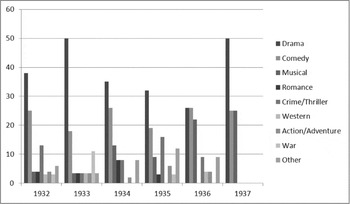
As with the 1918–29 period, booking practices during the 1930s suggest that dramas were the most popular film genre with the Queens’ patrons, with comedies running a close second. In fact, dramas were booked in even greater numbers during the 1930s, especially during the early part of the decade. In 1932, for example, roughly 50 per cent of films booked were dramas, while comedies accounted for around a third of films shown. Significantly, though, the number of dramas exhibited declined as the decade progressed, with other film genres gaining popularity.
Queens Cinema: films shown by genre category, 1932–37
Source: advertisements in the Portsmouth Evening News.

While the erratic nature of the evidence towards the end of the decade ensures that any firm conclusions cannot be drawn, it is clear that the most frequently booked type of drama during this period was the crime drama.Footnote 50 All these films featured tough men and feisty women: Walter Huston in The Ruling Voice (1931) and Beast of the City (1932); Spencer Tracy in The Painted Woman (1932) and The Murder Men (1935); Jean Harlow in Enemies of the Public (1931 (US title: The Public Enemy)) and Beast of the City; Peggy Shannon in The Painted Woman and False Faces (1935). As is clear from these few examples, many of these films also featured the same popular stars. And most importantly, these stars played very similar roles. Indeed, one of the most significant points about these films is that they share very similar thematic patterns. This cinema's audiences would certainly have known what to expect from them. Crime dramas opened up a space in which audiences could imagine a world with very few, if any, restrictions. However, those individuals who transgressed social boundaries were always punished or redeemed. Consider the tag-line for one of the crime dramas booked: ‘The final reward is DEATH.’Footnote 51 These films could thus perform a dual function. They let cinema-goers enjoy a sense of abandon and they acted as a moral compass. The Queens’ patrons could use them to gain a sense of proportion.
Some of the comedy films booked in this period functioned in a similar manner, for they allowed audiences to mock the existing social system, but in a way that did not threaten it. There are, however, stylistic differences between American and British films. In American productions, such as Wheeler and Woolsey's Half Shot at Sunrise (1930) or Joe E. Brown's Alibi Ike (1935), the world is presented as a chaotic place where anything goes. These films portray social institutions as highly ineffective, while their protagonists triumph through a combination of bluff, shrewdness and good fortune. The British comedies, such as Leslie Fuller's Why Sailors Leave Home (1930), were never this anarchic; their characters were never that impudent. Certainly, Fuller's films were structured around a similar premise as the American productions, but they were gently mocking, not outrageously so.Footnote 52
Interestingly, British comedy stars who were expected to have a national appeal in the 1930s – Will Hay, the Crazy Gang, Jack Buchanan – and whose films were similar in style to the American productions, did not feature here. The Travers farces are also absent. Many of these comedies featured working-class characters who were deeply disrespectful to their social superiors and vigorously anti-authoritarian. The incomplete nature of the evidence may skew the results slightly, but it seems that the Queens’ patrons could only tolerate this type of comedy if it was produced in America. They seem to have preferred British comedies to show a little more respect for these institutions. This surely had much to do with the patrons’ naval connections, where a strict social structure, with a clear order, and where an unambiguous respect for authority, is expected. Certainly, Ernie Lotinga's Josser Joins the Navy (1932), in which ‘Josser’ displays a lack of respect for any authority figure, was also shown here, but it appears that this film was booked principally for its title, for while, according to the data, no other Lotinga film was shown, many films with a sea-faring theme (or title) were.
The regular booking of sea-faring films in the 1918–29 period thus continued in the 1930s. In fact, the data suggests that films of this type were booked in even higher numbers in this decade. Once again, their sea-faring qualities were endorsed in advertisements. The Battle (1934), for example, was advertised as a ‘Thrilling Naval Drama’.Footnote 53 As in the 1918–29 period, these films had varying narrative drives, but this cinema's managers clearly continued to believe that their patrons wanted to watch films that reminded them of their association with the sea. We also need to remember, though, that booking patterns in the 1930s suggest that these cinema-goers seemed to prefer films that did not challenge the social order; films depicting a life at sea, with its rigorous social structures, were hardly likely to do that.
One further point needs to be made regarding booking patterns at the Queens in the 1930s: they suggest that the majority of the cinema's patrons were male. Crime dramas – typically male-targeted fare – were the most frequently booked genre, while sea-faring films – again, usually targeted towards the male cinema-goer – were also regularly exhibited. The types of comedy booked in the 1930s, meanwhile, would have also been more likely to attract male cinema-goers. Of course, women could enjoy these films too, but it seems as though they were never really the target audience. Indeed, the limited number of musical and romance films shown at the Queens during the 1930s confirms that this cinema's managers were not really aiming to attract female cinema-goers in this period. No, the Queens’ location ensured that the majority of its patrons were more than likely to be male, and the types of film booked in the 1930s reflected the male-dominated nature of the audience. It would seem, then, that while the gender transformations precipitated by World War I encouraged a greater number of women to frequent this cinema, and thus ensured that the cinema's managers had to respond to their tastes by booking a significant number of romances and similar female-orientated fare, the gender composition of the audience gradually shifted as the 1920s drew to a close. The changing nature of the audience's demographic suggested by these booking patterns may, then, be a reflection of the post-war ‘return to domesticity’ that was expected of women once society was returning to ‘normality’.Footnote 54
So, while there were a number of continuities in booking patterns with the 1918–29 period – the dominance of American-produced films; the continued popularity of dramas – there were also a number of subtle differences. The thematic patterns in the dramas shifted from patriotic and morality tales to crime dramas. However, while the mode in which these films tackled their narratives altered, the principal motif remained constant: redemption. A similar constancy can be identified with the type of British comedy booked. Between 1918 and 1929 Chaplin's style of comedy dominated. In this period, the most frequently booked comedies continued Chaplin's style of social comment: mocking and critical, but not too critical. It would appear, then, that these cinema-goers were not that willing to challenge the status quo. They were a little fearful of rocking the boat. Indeed, the continued popularity of sea-faring films across these years suggests that the tastes of the Queens’ patrons were highly conservative. In the 1930s, of course, this had much to do with the socio-economic effects of the Depression, when the Naval Dockyard experienced economic contraction, affecting the town's political denomination.Footnote 55 But it also had much to do with the cinema's location and the type of patron expected to visit it – naval personnel and dockyard workers – who were more likely to be patriotic and hold a strong service ethic.
Genre preferences: 1945–48
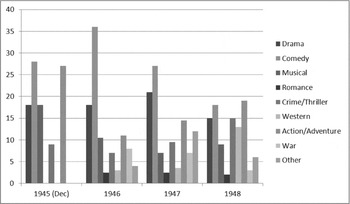
The trauma of World War II, during which Portsmouth came under sustained air attack from the German forces in a series of blitzes, appears to have had a significant impact on the tastes of the Queens’ patrons.Footnote 56 Booking patterns for the post-war period reveal that, unlike the periods analysed above, it was comedies, not dramas, which were the biggest draw. In each year, from 1945 to 1948 (no advertisements were placed after 1949), comedies outnumbered all other film genres. In 1946, for example, twice as many comedies were booked than dramas, accounting for a third of films exhibited. The number of comedies booked did dip as the years progressed, but even in 1948 they still outnumbered dramas. Booking patterns thus suggest that the exigencies of war required a different type of film to be shown to ease audience concerns in the immediate post-war period, and it was only after post-war reconstruction began in earnest in the late 1940s when the cinema's managers felt that their patrons would be willing to watch a diet of less light-hearted film fare. Interestingly, these patterns of taste do not pertain across the whole of Portsmouth. At the town's Regent cinema, for example, dramas continued to dominate in the post-war period. Comedies were booked in respectable numbers, but, unlike at the Queens, they were never the preferred draw.Footnote 57 It seems likely that the location of the Queens Cinema ensured that responses to the film product were very different. Indeed, due to its proximity to the naval barracks and Dockyard, Portsea experienced extensive devastation during the air-raids, and while morale was low in the whole of Portsmouth, it was undoubtedly expected to be lower in this district.Footnote 58
Queens Cinema: films shown by genre category, 1945–48
Source: advertisements in the Portsmouth Evening News.

A number of thematic patterns dominate in the comedies exhibited at the Queens in the post-war period. The most recurrent theme concerned the subject of duplicity. Films in which dishonest and fraudulent behaviour was displayed were regularly booked. There is political corruption in Knickerbocker Holiday (1944) and He Snoops to Conquer (1944); there are con artist protagonists in Higher and Higher (1943), Mr. Lucky (1943), and Her Primitive Man (1944). Significantly, though, in all these films those in the wrong were either punished or redeemed, while those who were morally upstanding were rewarded for their virtuous behaviour. In fact, many of the films exhibited featured characters who were determined to ‘go straight’. In Mr. Lucky, for example, Cary Grant's character, planning to cheat money from the War Relief Fund, stops when he recognizes the error of his ways. We can see continuities with the pre-World War II period here; redemption continued to be a regular motif.
Films dealing with the recent conflict or its aftermath account for the second most booked type of comedy at the Queens in the post-war period. Consider the run of George Formby films, all booked in 1946, which feature the popular star working for various services: in Bell-Bottom George (1944) he is serving in the Navy, in It's in the Air (1938) the RAF and in Get Cracking (1943) he is in the Home Guard. Some ‘war-touched’ comedies dealt with the issue of women in wartime: Dixie Dugan (1943) featured Lois Andrews struggling to be accepted at work in a government office. Post-war concerns were also broached: The Sailor Takes a Wife (1945) features a medically discharged sailor struggling to adapt to his new life. As with the immediate post-World War I period, then, it appears that the Queens’ managers were trying to use certain films to reassure their patrons of their place in the post-war world. These films may have reminded the audience of their recent troubled history, but they did so in an overtly patriotic and supportive manner. They offered to help cinema-goers deal with the trauma of the war itself, and allowed them to find solutions to problems in the post-war world.
In fact, solutions to post-war difficulties were regularly addressed in the third most booked type of comedy at the Queens: the romantic comedy. The majority of these films dealt with the issue of infidelity or marital breakdown. Consider Twin Beds (1942), which explored an extra-marital affair; or Topper Takes a Trip (1938), which was a supernatural comedy of failed marriages. As with the post-World War I period, this cinema's managers were booking films which implicitly dealt with the war's effect on society's relationships. The resolutions offered in these films suggest that audiences were expected to use them when negotiating the tricky return to normality. As noted earlier, comedies could tackle difficult issues more successfully than dramas because the humour contained within would soften the harshness of the issues being addressed. Cinema-goers could thus be confronted with their concerns, but offered solutions to help them negotiate a way through without being challenged too harshly. It is significant to note, though, that this type of comedy was only booked with any frequency in 1946. In 1947 and 1948, the first two types of comedy dominated. It would appear that this cinema's manager wanted to show these films in the immediate post-war period to help his patrons repair their, perhaps fractured, relationships as soon as the men returned home.
While booking patterns suggest that this cinema's audiences were drawing more satisfaction from comedies than dramas in the post-war period, the latter were still booked in very respectable numbers. In addition, of the dramas exhibited, the recent war clearly functioned as a source of much encouragement. In fact, the percentage of dramas booked which depicted events from the recent conflict was even higher than that of films featuring World War I in the years following that conflict.Footnote 59 However, the type of film booked with most frequency in this period presented only positive interpretations of World War II, which surely reveals much about the audience's need for reassurance. Moreover, these films usually dealt with the war at one step removed from the European side of the conflict. The majority, such as Manila Calling (1942), Gung Ho! (1943) and Two Man Submarine (1944) depicted events in the Pacific region. Some films drew on the European conflict – The Seventh Cross (1944), for example, was set in Germany – but only a few of the ‘war-touched’ dramas booked were set in Britain.
All these films addressed a range of highly topical issues: military life; crimes against humanity; the war at sea. It would seem that the Queens’ patrons were expected to need the distancing technique offered by the majority of them to be able to deal with the challenges presented in their narratives. Moreover, because these films championed allied endeavour and heroic behaviour, they allowed audiences to gain reassurance and comfort from watching them. The regular booking of such fare at the Queens Cinema suggests that they were performing their task with its patrons. This point is further underlined if we consider the large number of sea-faring films that continued to be booked in the post-World War II period. As with the previously discussed periods, films about the navy or containing a sea-faring theme or title were booked with considerable frequency, regardless of their genre, country of origin or, if the antediluvian British-productions Midshipman Easy (1935) and Full Fathom Five (1937) can be taken as evidence, their year of release.Footnote 60 Once again, then, it appears that these cinema-goers were expected to look for recognizable motifs in these films to gain comfort and reassurance.
These booking patterns are again at odds with patterns of exhibition at the town's Regent cinema. Certainly, films of a sea-faring nature were booked here, but never with the same frequency as at the Queens. Moreover, the number of ‘war-touched’ films booked at the Queens between 1945 and 1948 far outstrips the number exhibited at the Regent in the same period. As Harper has noted, the Regent's patrons preferred to watch films which broached their concerns symbolically, rather than directly.Footnote 61 At the Queens, booking patterns suggest that these cinema-goers were prepared to watch films which dealt more directly with their experiences. They may have preferred them to do so through various distancing techniques, but they were more willing to watch their war-time and post-war experiences being played out on the cinema screen more openly. Once again, it seems that the location of the Queens and the type of patron it attracted predicted what films the managers could book.
Booking patterns do suggest that the war triggered another significant change from pre-war trends: more films were exhibited in the immediate post-war years that would have attracted female cinema-goers. Ladies Courageous (1944), for example, depicted the exploits of the Women's Auxiliary Ferrying Service in America, and included a nearly all-female cast. Musicals, a primarily female-targeted genre, were also booked with increased frequency in this period. While musicals only accounted for approximately 10 per cent of the total number of films booked, they were shown more frequently in this period than any other. Moreover, they were booked in greater numbers than specifically male-targeted fare, such as Westerns, in both 1946 and 1947. The changing aspirations of women during the war thus seemed to have had an effect on the expectations of both this cinema's managers and its clientele in the immediate post-war years, for these patterns of exhibition suggest that both male and female cinema-goers were being targeted in this period.Footnote 62 The increased booking of female-targeted fare did not last long, however. In 1948, Westerns outnumbered musicals by a third, while the booking of crime and action films – other primarily male-targeted genres – were booked in greater numbers. It would seem that the ‘return to normality’ implied by both the decline of comedy film bookings and the increased exhibition of dramas in that year was further evidenced in the return of other primarily male-targeted genres.
The experiences of World War II thus appear to have caused a number of significant shifts in taste among the Queens Cinema's patrons. Booking patterns suggest that these cinema-goers, undoubtedly damaged by their wartime experiences, were less likely to appreciate dramas, and instead turned towards comedies to gain pleasure. These films allowed them to look at their troubles head-on, but they were mediated through the safety of humour. Cinema-goers could laugh along with the films’ protagonists knowing that a satisfactory resolution would be offered to their tribulations. When they did watch dramas, they preferred them to address their concerns through various distancing techniques. Regardless of genre, though, these cinema-goers sought reassurance from the films they watched, and clearly appreciated being reminded of their successes on the cinema screen. Female cinema-goers, many undoubtedly freed by their experiences during the war, expected their tastes to be answered, and thus a more gender-equal film programme was offered in the immediate post-war years. While booking patterns shifted again during the cinema's final year of operation, one thing is certain, people's cinema-going tastes were never static, and this cinema's managers had to be fully responsive to their patrons’ demands.
Conclusion
This article's evaluation of the films exhibited in one small cinema in southern Britain has underlined the localized nature of film taste. While film booking patterns at the Queens shared many similarities with cinemas across the country, there were a number of differences which were undoubtedly influenced by this cinema's port town location. Moreover, because the Queens was used primarily by patrons with close links to the Navy and Dockyard, booking patterns even differed from cinemas elsewhere in the town, where the clientele would have been drawn from a wider social base. The influence of naval life on the people in this urban locality was thus extremely important.
Booking patterns also reveal that external factors were expected to change cinema-goers’ tastes significantly. Thus ‘war-touched’ films and female-targeted fare were only booked with any regularity in the years immediately following a conflict; the exhibition of social conscience and morality tales declined once society began to return to normal in the post-World War I period; the booking of crime films and comedies that mocked the system increased during the unsettled years of the Depression; and the devastating effects of World War II resulted in a swing away from drama to comedy films. There were, of course, continuities in booking patterns. American films always outnumbered the British product; sea-faring films were a continual draw. As well as their shared social status, therefore, the collective experiences of these cinema-goers were expected to have an effect on their film tastes.
Of course, we cannot say for certain why particular films were favoured by the Queens’ patrons, but the quantitative evidence available allows us substantively to identify which films were expected to be popular, and provides useful data from which to gauge their popular mentalités and social attitudes. Clearly, the cinema-going habits of these patrons were shaped partly by the effects of external forces on their urban environment. However, the evidence suggests that the Queens’ managers booked films that they believed answered directly to their patrons’ tastes, whatever the social circumstances. Moreover, it is clear that their choices were principally determined by their understanding of their patrons’ specific social and cultural identity. This article, then, has revealed that, even within the small urban space studied, the relationship between cultural provision and cultural pleasure is complex, and that consumer tastes could be highly volatile, even over quite short periods of time.