This paper reports a significant new find reported to the Portable Antiquities Scheme (PAS), a fragment of monumental bronze sculpture discovered just outside Lincoln in 2015.Footnote 77 This fragment is one of several such finds reported to the PAS over the last two decades. Although they are typically small pieces, cumulatively they may demand some revision to the impression that the ‘sculptural habit’ manifested in honorific bronze statuary took only a limited hold in the towns and military camps of Roman Britain.Footnote 78 In the case of the Lincoln find, it may be possible to suggest the original subject of the sculpture, despite its limited survival.
DESCRIPTION
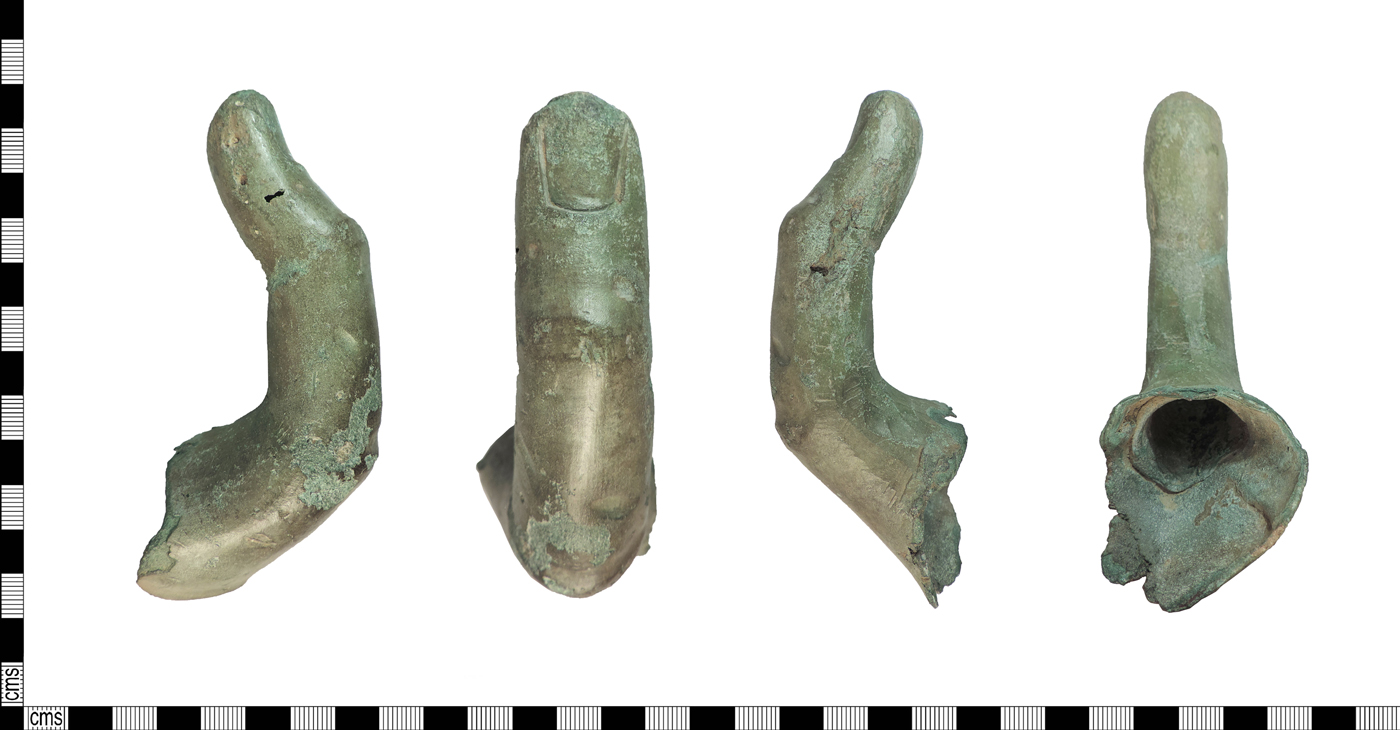
A digit from a larger than life-size statue, the fragment in question is a finger rather than a thumb (despite having more than a passing resemblance to the latter), due to its tapering slenderness and its division into three sections.Footnote 79 Enough metal survives at the base of the finger to show that anatomically it is most likely to be the right index finger, bending at the first and second joints. It is cast solid nearly up to the second joint, as is usual for fingers.Footnote 80 More unusually, this digit was clearly made separately from the rest of the hand and then attached by means of an applied layer of bronze, hammered on and smoothed over on the top, since a rim is visible inside the finger. The generous strapping may have ensured such a heavy digit would have remained attached to the rest of the hand, though the wide base to the finger gives the appearance of a more bulky right thumb. While difficult to be certain, it would appear this strapping is primary, and not part of a repair, especially since the metal composition here is consistent with the rest of the object (see further under XRF results below). The irregular edges show that the finger was broken from the hand of a statue (fig. 18).
A larger than life-size finger found near Lincoln (LIN-C6AFB3). (Photo: Adam Daubney, used under a Creative Commons licence)

The surface is generally smooth and has a mid-green patina, though with paler sections of abrasion or damage. Some of the latter were probably originally flaws in casting, especially the small hole to the left of the nail on the side of the finger, but there are also dents that probably reflect later damage. The underside of the finger carries smoothing marks and slight perpendicular scratches, which could be associated with the process of finishing the statue with abrasives after casting. The fingernail is carefully incised, though the joints are shown largely through the bending of the finger rather than any incised lines. On the back of the hand, just below the base of the finger, is a ridge presumably indicating wrinkling of the skin at the knuckle; the finger-tip is slightly curved upwards or backwards. There are no traces of gilding.
XRF By K. Libby, with comments by P. Coombe
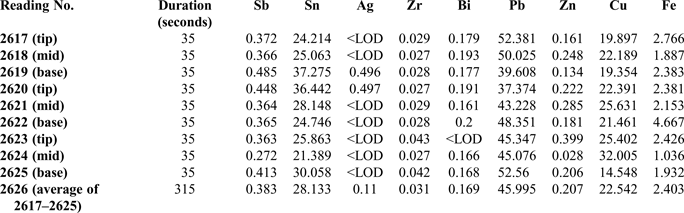
The pXRF (portable X-Ray fluorescence) spectrometer is a non-destructive method for determining the elemental composition of an item, thus informing the researcher of the composition of manufactured metals. The pXRF analyses were undertaken using a NITON Hand Held XL3T detector using only a ‘main filter’ with a detector live-time of 35 seconds. The different filters determine the metals the pXRF will scan. The primary filter can detect all possible metal from the Roman period, therefore all other filters were redundant. A total of nine readings were taken at regular intervals around the full circumference and along the length of the finger. The sequence of readings began at the fingertip and worked down toward the base of the finger and then started at the tip again for the next set of readings. The results of the nine readings were then averaged out in order to create an unbiased result of the metal analysis (while still showing the original data) (table 3). This frequency and variation of readings helps to prevent overlays caused by corrosion or tin pooling in the metal from creating results that would appear to suggest discrepancies in the composition.
PXRF ANALYSIS RESULTS OF THE BRONZE FINGER FROM LINCOLN

The nine readings gave homogeneous results concerning the metal composition. Metals present include antimony, tin, silver, zirconium, bismuth, lead, zinc, copper and iron. The levels of antimony, silver, zirconium, bismuth, zinc and possibly iron are significantly lower than the tin, copper and lead levels. These extremely low levels suggest that those are the residual trace elements left over from the smelting process. The pXRF results also show the item was not gilded, since the silver results were quite low and gilding typically presents as a very high percentage of silver.
The ratios of copper and tin reveal that the finger is bronze with a high lead content ranging from 37 to 52 per cent, resulting in an average of 45.9 per cent. Lead is more commonly used in Greek and Roman bronze statuary in the range 0 to 25 per cent, with a few pieces having a higher lead content of 30 to 35 per cent.Footnote 81 On the German Limes, large copper-alloy statues contained on average around 20 per cent lead and 7 per cent tin,Footnote 82 while those Roman statues from London which have been tested also fall within this range.Footnote 83 High lead content would have had many advantages for an item such as a larger than life statue: lead would have been cheap, locally sourcedFootnote 84 and would have reduced viscosity in casting while creating a stronger finished product than bronze alone. It is possible that the metal pooled in the extremity of the hand, explaining the high proportion seen in this finger. Alternatively, since Pliny notes use of a high lead-tin alloy (tertiarum, composed of two parts lead and one part tin) in soldering lead water pipes,Footnote 85 one wonders also whether this composition of material allowed the digit to be affixed to the statue and is consistent with the bulky application.
FRAGMENTS OF LIFE-SIZE BRONZE STATUES FROM ROMAN BRITAIN
This is a remarkable find as evidence for bronze statues of such a size in Britain is rare. None survives complete, but a growing quantity of fragments from figures of around life-size offers a glimpse at the original corpus.Footnote 86 We may cite the heads of Hadrian and Nero, from London and Suffolk respectively; a colossal hand from Lower Thames Street, London; ‘super-sized’ fingers from Caerleon; and fragments, perhaps also from large-scale figures, from Gloucester, Verulamium, Silchester, Caernarfon and Caerleon.Footnote 87 More recent discoveries in London, Yorkshire and near Gloucester add further examples.Footnote 88 Fragments of bronze horses, including pieces from North Carlton around 3 miles north of the find currently under discussion, also suggest the original presence of at least a few equestrian statues.Footnote 89 The bronze foot from the Kingsway area in London is of larger than life-size proportions, but, given the find location, may be a later import and not from Londinium. Footnote 90 The Lincoln fragment most closely resembles the fingers of the hand from Lower Thames Street, mentioned above.
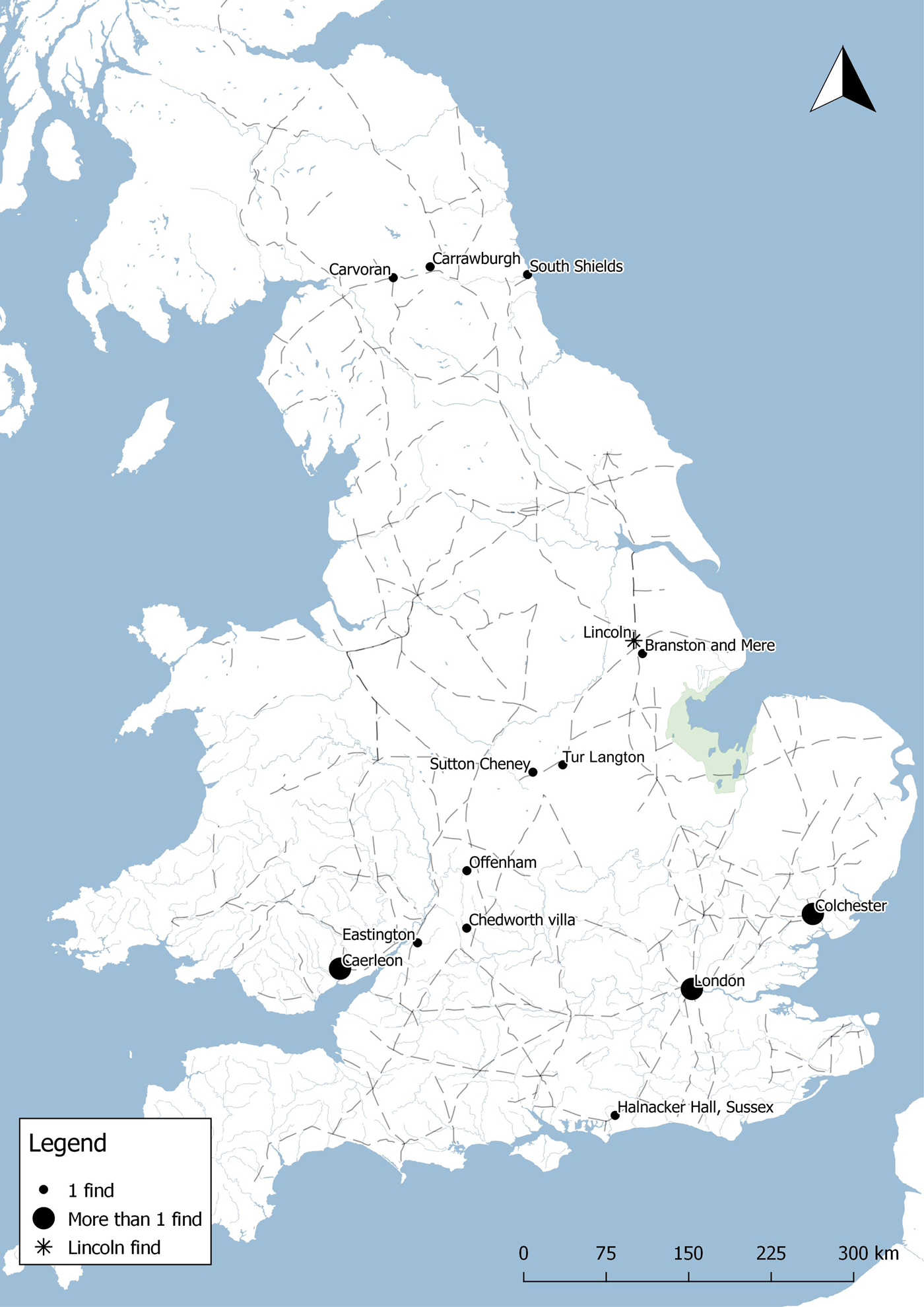
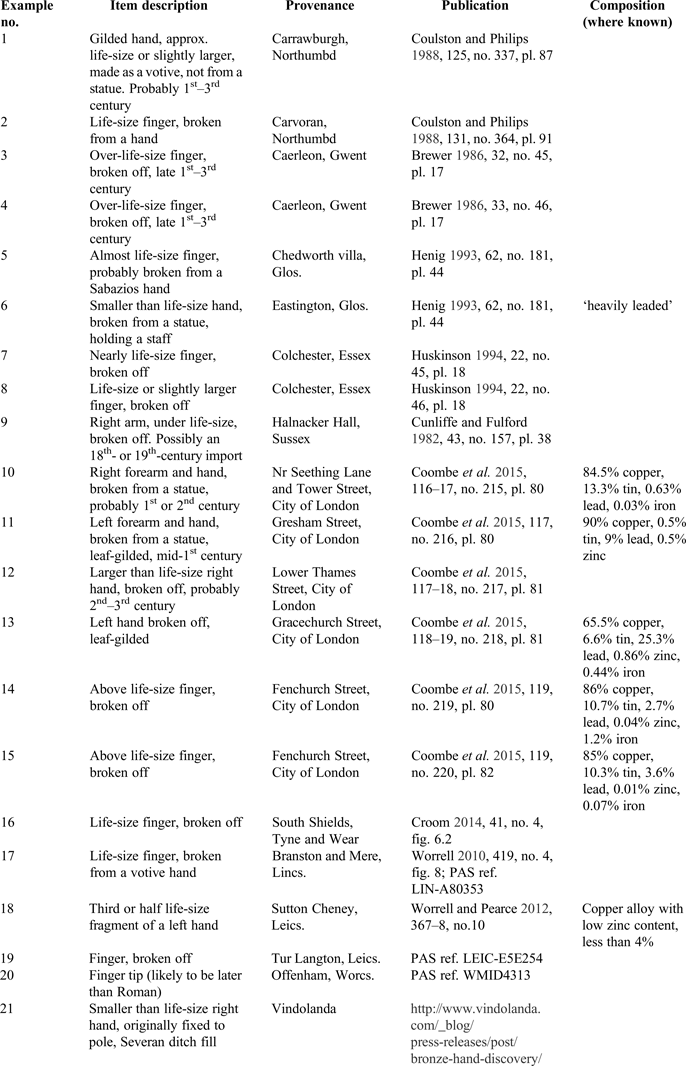
Around 20 other fingers, hands or arms in bronze are currently known from the province (table 4, fig. 19). Croxford noted that of all large-scale bronze statuary found in Britain, these elements survive most often.Footnote 91 Such extremities are easily broken and a good size for the melting pot, but the conscious retention of a particular fragment from a destroyed statue can also be hypothesised. Some seem to have been deliberately deposited in watery locations, as is also a possibility in this case (see below).Footnote 92 While such conditions may simply have ensured their survival, skewing our perception, deposition in water could also point to a (secondary) role as a votive. A gilded left arm from Gresham Street may have been deposited in the Walbrook stream, and a right arm, also from London near Seething Lane, was found in a well. The bronze heads of the emperors Hadrian and Nero mentioned above were famously pulled from rivers.Footnote 93 Anatomical ex votos include some of bronze or other metal, though these were often made exclusively for this purpose, not from statuary, and are associated with healing sought at sanctuaries.Footnote 94 The bronze hand recently unearthed at Vindolanda was also made for votive purposes rather than statuary.Footnote 95
Map showing findspots of fingers, hands and arms from Roman bronze statuary found in Great Britain. (Drawn by Federico Ugolini)

FRAGMENTS OF BRONZE FINGERS, HANDS AND ARMS FROM ROMAN STATUARY, FOUND IN BRITAINi

i This list does not include the bronze ‘thumb’ clamps from London, Verulamium and Springhead (see Coombe et al. Reference Coombe, Grew, Hayward and Henig2015, 119–20, nos 221–2, pls 82–3), since these are not statuary but instead are identified as fixings.
CONTEXT AND FUNCTION OF THE FINGER
The identity of the figure to which the finger belonged is not easily established. Its size indicates that it was clearly from the statue of an important figure, perhaps an important official, but more likely either imperial or divine. Statues of gods and men on a life-size or greater scale were certainly erected in the province, though very few have been securely identified. Suetonius’ comment in his Life of Titus that the emperor was honoured with many statues in Britain and Germany is often cited as evidence of the quantity of imperial figures now lost.Footnote 96 Inscriptions also reveal the erection in Britain of monumental statues on a similar scale to other north-western provinces, for example Germania Superior.Footnote 97 Fragments of large bronze statues, like the pieces cited above found in Britain, are found at numerous sites in Germania Superior, Germania Inferior and Gallia Belgica, especially associated with frontier garrisons.Footnote 98 The bronze head of Minerva from Bath reminds us of the presence of large cult pieces in Britain, too.Footnote 99
Recreating the specific gesture from such a small piece with certainty is difficult, but the right index finger can be diagnostic for the form of the lost body. In the oratorical adlocutio pose, for example, this digit is extended. Best known on the statue of Augustus from Prima Porta, this gesture can also be seen on other statues such as the portrait of Aulus Metellus (better known as the Arringatore), dated between the end of the second and the early first century b.c., the equestrian statue of Augustus pulled from the Aegean Sea, or the bronze figure of Germanicus from Ameria.Footnote 100 Unlike the tendon ridges that confirm the original pose of the Prima Porta Augustus,Footnote 101 however, the wrinkled ridge on the back of the Lincoln finger is perpendicular to the extended digit, and in both the adlocutio pose and the likely clementia gesture of the famous equestrian statue of Marcus Aurelius in Rome, the right index finger does not seem as bent as ours.Footnote 102 Perhaps therefore the Lincoln finger is more likely to be from a figure holding a staff or the shaft of a spear, perhaps like the larger than life-size bronze statue of the emperor Trebonianus Gallus (a.d. 251–3) now in the Metropolitan Museum in New York, which has a very similar flexion of the digit,Footnote 103 or that of Augustus as Jupiter from Herculaneum now in the Museo Archeologico Nazionale in Naples.Footnote 104 The same pose can be seen in the statuette of an emperor, perhaps Nero, said to be from Barking Hall, near Coddenham, Suffolk.Footnote 105 This could even explain the heavy strapping noted above, perhaps employed to add additional solidity for a digit holding an attribute. Alternatively, the figure derives from a statue of a god in the pose from which the imperial examples draw their inspiration, namely the standing figure of Mars with a spear (or sword), as represented for example in the reliefs which seem to replicate the pediment sculpture and cella statues of the temple of Mars Ultor from the Forum of Augustus.Footnote 106 Large statues in this form are not yet known from the province, but figurines are documented widely, including the nearby examples of the famous Foss Dyke statuette dedicated by two brothers (probably holding a sword in its right hand) and a nude helmeted figure from Blankney, 10 km south-east of Lincoln.Footnote 107
The findspot is just over a mile north-west of the centre of Roman Lincoln. Currently a pasture field south of the A46 bypass, the site is often waterlogged and no other Roman objects have been found during detecting here. Nearby, however, evidence for a Roman rural settlement has been documented on more than one occasion. A watching-brief in advance of the construction of the A46 Lincoln bypass in 1984 noted pitched limestone foundations as well as burials in the field to the south of the findspot.Footnote 108 Further evidence for a farmstead or similar was documented in excavation in 2008–9, in an area a little further to the south-west now serving as a municipal cemetery. This established a chronological sequence for a rural settlement occupied from the second to early fifth century a.d., with masonry buildings and corn-driers being constructed in the third century and probably in use into the fourth. Finds of hypocaust tiles and a possible apsidal structure provide limited evidence for architectural pretension, but there is nothing here to indicate the existence of a complex which might have housed a statue of this scale.Footnote 109
Instead it is tempting to suggest the statue stood within the colonia at Lincoln itself, founded in the later first century a.d.Footnote 110 The majority of the Roman town lies under the modern city but sufficient traces of major public buildings have been observed to show that the colonia possessed a monumental core. Much remains unknown concerning the form and development of the colony's forum-basilica complex — the presence of a major temple is hinted at but not yet definitively established — but its overall scale and the documentation of substantial statue bases in situ on the east side of the forum clearly indicate its fitness for housing an image of this type and size, whether of a god or emperor.Footnote 111 Where identifiable to type, the surviving inscriptions from Lincoln are mainly on funerary stelae and altars and do not offer possible candidates for dedicatory inscriptions on bases on which the statue might have been set, but there may be others not yet discovered.Footnote 112 The size of the bronze foreleg of a horse, possibly once part of an imperial equestrian statue thought to come from the Bailgate area, makes its association with our finger unlikely, though it may be connected to the North Carlton find (noted above).Footnote 113 The head of Hadrian and other statuary from London, the head of Nero from the river Alde in Suffolk (probably originally from Colchester) and the fragments of a large bronze statue from Gloucester, which may have come from an equestrian statue of an emperor, perhaps Nerva its formal founder (all mentioned and referenced above), are all likely to have stood in similar, monumentalised public settings.
The Lincoln statue may therefore have been associated with the founding of the colonia by Domitian at the end of the first century a.d. or with the development of the town into the second century, though it is just possible it could be earlier and relate to the foundation of the military camp in the mid-first century a.d.Footnote 114 A military context would also be appropriate for an imperial statue: Stoll has shown that statues of emperors were set up in the basilicas and courtyards of legionary and auxiliary principia as well as at camp gates; the statue fragments at Caerleon, mentioned above, provide a British example from a headquarters building.Footnote 115
Still, the possibility that the statue was originally located in the environs of the city rather than its intramural civic spaces should not be entirely excluded; directly or indirectly complexes are attested around Lincoln which serve as possible candidates for housing an image on this scale. Among the villas documented in the city's environs, those at Scampton five miles north-west with its double courtyard complex explored in 1795, or at Greetwell a mile to the east, for example, stand out in terms of their size and architectural sophistication.Footnote 116 The discovery at Nettleham, approximately three miles from the colonia, of a massive inscription recording an arch dedicated at the temple of Mars Rigonemetos hints at the existence of a major extramural sanctuary in the hinterland of the colonia which could well have housed a large-scale image of the god.Footnote 117 As well as the elements of a horse's head from an equestrian image at North Carlton noted above, there is a fragment of a finger from a monumental bronze statue found at Branston, approximately four miles south of Lincoln.Footnote 118
However, it is equally if not more plausible that these fragments were moved as spolia from the city rather than remaining close to the setting where the statues from which they originate were erected. The finger might have been brought to its findspot at a later date when the statue had already been broken up. Most likely taken for re-use as scrap metal, the fragment could also have been retained as a keepsake or amulet,Footnote 119 or had a secondary use as a votive. In this context, the origin of the finger from the right hand might point to its retention as an auspicious piece, though this preference is not generally seen among the other bronze fragments of extremities.Footnote 120 The waterlogged character of the findspot makes it tempting to speculate that the statue was deposited as a votive, perhaps like the statuette of Mars noted above, which was found in or near the Foss Dyke at Torksey a few miles north-west of Lincoln.Footnote 121