From 1527 until 1606, there was nearly constant fighting on the long frontier in Hungary and Croatia that divided the Ottoman Empire from the Habsburg monarchy. The conflict began when Sultan Suleiman the Lawgiver invaded Hungary in 1526 and defeated King Louis II Jagellio, who died trying to escape. Thereafter, Hungary was claimed by Suleiman,Footnote 1 by Archduke Ferdinand of Austria,Footnote 2 and by the vojvod of Transylvania, Janós Szapolyai.Footnote 3 Apart from the “Long” Turkish WarFootnote 4 of 1593–1606, major invasions from either side were infrequent. The Habsburg monarchy and the Ottoman Empire also agreed to several multiyear treaties of peace, starting in 1547.Footnote 5 When a treaty had elapsed, both powers usually accepted truces in the interim. Yet the 1547 Treaty of Edirne reflected the priorities of distant capitals. Emperor Charles V had to have calm in Hungary in order to pursue his plans against the Protestant Schmalkaldic League in Germany; Suleiman needed quiet in the west, so as to march east against Shi'ite Iran, the Ottoman Empire's main enemy.Footnote 6 But neither Charles nor Suleiman required more than a semblance of peace in Hungary. Hence, Ferdinand, like his new adversary, the paşa or governor-general of Buda,Footnote 7 had to deal with border garrisons eager for booty and angry subjects demanding retaliation. The counterpart of imperial peace was Kleinkrieg in Hungary and Croatia.
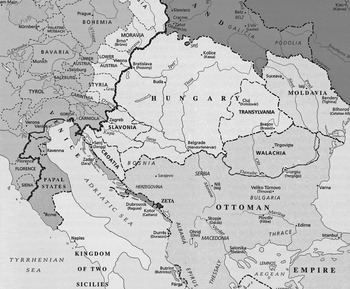
East Central Europe, ca. 1480. Reprinted with permission from Paul Robert Magocsi, Historical Atlas of East Central Europe, 2nd revised and expanded edition (Seattle: University of Washington Press, 2002), 32, map 10. Adapted by Daniel Pinkerton.

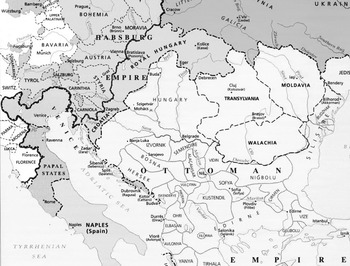
Raids that resulted in permanent gains came mostly from the Ottoman side.Footnote 8 The two accompanying maps show the advances made by Ottoman forces in the half century after the Battle of Mohács. Although many fortresses were captured in campaigns that fall under the rubric of Kleinkrieg, the most important territorial acquisitions resulted from seven Ottoman invasions of Hungary, including four led by Sultan Suleiman.Footnote 9 By contrast, none of the four attacks that Ferdinand launched into Ottoman-held Hungary achieved a lasting conquest.Footnote 10 Under Emperor Rudolf II (r. 1576–1612) and his nephews, the Habsburgs managed to harden their defensive frontier. The Treaty of Zitva-Török, ending the Long Turkish War,Footnote 11 confirmed a stalemate: the Habsburgs held on to about a third of Hungary and about a fourth of Croatia. In the seventeenth century, following decades of peace,Footnote 12 the Ottoman siege of Vienna in 1683 touched off a second phase of the struggle, ending in 1719. By the Treaty of Passarowitz, the Habsburgs recovered Hungary and most of Croatia.Footnote 13
East Central Europe, ca. 1570. Reprinted with permission from Paul Robert Magocsi, Historical Atlas of East Central Europe, 2nd revised and expanded edition (Seattle: University of Washington Press, 2002), 47, map 14. Adapted by Daniel Pinkerton.

Habsburg historians have paid more attention to the glorious second phase of the struggle than to the first. There is, for example, no general history of the Long Turkish War.Footnote 14 For the two Turkish sieges of Vienna in 1529 and 1683, WorldCat has 113 entries for the first and 1,099 for the second. This essay will thus be a small step toward redressing the balance. Because my work has dealt with the frontier in Croatia, examples will mainly come from that region. For the period between 1526 and 1593, I focus on what seem to be the main issues: How does one account for Ottoman success, and Habsburg failure, over a span of fifty years? And how were the Habsburgs eventually able to solidify their military frontier? My contention is that these questions lead us to fundamental differences in the political organization of the Ottoman Empire and the Habsburg monarchy. Ottoman successes resulted in no small part from unity of command, emanating from the sultan and his key officials.Footnote 15 Conversely, disunity of command contributed to the failures of Ferdinand's reign; generals took orders not just from the sovereign and his council, but also from the various provincial estates, or the Imperial Diet. In the end, however, Habsburg rulers learned to exploit more effectively the cumbersome procedures of consultation that tied this composite monarchyFootnote 16 together.
A contrast framed in these terms has wider application. Consultation between a ruler and his estates was common in early modern Western Europe.Footnote 17 In the contemporary Islamic world, the three “Gunpowder Empires”—the Ottomans, the Safavids of Iran, and the Mughals of India—had all-powerful sovereigns who ruled by decree.Footnote 18 The Latin Christian West and the Islamic East were hence divided not just by religion, but also by fundamental differences in how the body politic was organized. This was why conflicts between the Ottoman Empire and its Christian neighbors—the naval wars of the sixteenth-century MediterraneanFootnote 19 and fighting along the Hungarian-Croatian frontierFootnote 20 —were understood on both sides as involving much more than a contest between states. In other words, the Habsburg-Ottoman conflict of the sixteenth century was, among other things, a clash of civilizations. But the very idea of a clash of civilizations has recently been the subject of intense debate. Paying due attention to every serious argument would require an essay much longer than this one, if not a book.Footnote 21 Yet given the present state of discussion, I cannot ignore the controversial nature of my assertion. Accordingly, this essay will have two parts. First, I will argue that the rhythm of military events—initial Ottoman success, then a partial Habsburg success—cannot be explained without reference to the two very different styles of government. Second, I will briefly review, and endeavor to discredit, four salient objections to the idea of a clash of civilizations in the early modern era.
1. The Habsburg-Ottoman Conflict, 1527–1593
The Ottoman Advantage
On a field of battle, superior resources do not necessarily entail victory. In 1593, at Sisak, near Zagreb, Bosnia's Hasan Paşa had far more men, but he lost his army and his life, in part because of a tactical error: he put his elite troops across a steep-banked river, with only one bridge-of-boats to connect them to their base-camp.Footnote 22 In 1596, at Mezőkeresztes, northeast of Buda, Habsburg firepower had seemingly defeated Sultan Mehmed III and his main army, until ill-disciplined troops chose to amuse themselves by dancing on the sultan's treasure chests, thus giving the Ottomans time to regroup and claim a great victory.Footnote 23 Still, careful preparation for war does have a bearing on the outcome. In this case, Ottoman conquests in Hungary reflected clear advantages, most obviously in the numbers of troops. At Mohács, in 1526, Hungary's Louis II led some 25,000 men against an Ottoman force conservatively estimated at 80,000.Footnote 24
In the Habsburg system of border defense, Austrian and Bohemian provinces paid the expenses for the nearest frontier sector. For example, the so-called Inner Austrian duchies—Styria, Carniola, and Carinthia—took responsibility for the two frontier sectors in Croatia, Slavonia in the north and Croatia proper in the south.Footnote 25 In the 1540s, Ferdinand's spokesmen informed the Hungarian Diet that the Bohemian Lands paid for 10,000 men on the frontier and the Austrian lands for 5,000; what His Majesty himself paid for was the fleet of gunboats, based at Komáron, downriver from Vienna.Footnote 26 Meanwhile, the sultan had a standing army of 90,000, counting Janissaries paid four times a year by the state treasury, and Spahi cavalry holding timars, grants of land and local taxes.Footnote 27 As of 1576, the Austrian duchies maintained about 4,000 paid men in the two parts of Croatia, Slavonia in the north and Croatia proper in the south; Ottoman fortresses facing them were thought to have about 6,500 paid men.Footnote 28 To the rear, Habsburg anchor fortresses at Karlovac and Varaždin each had garrisons of 1,000, while Bosnia's governor maintained a retinue of perhaps 4,000 in Banja Luka.Footnote 29 In 1578, when neighboring sandçakbegs brought their retinues to join with his, Ferhat Beg invaded Croatia with a reported 24,000 men,Footnote 30 a force the Habsburgs could not match without months of preparation.
Larger armies required superior logistics. As of 1500, the Ottoman state had an established commissariat and a network of supply depots, institutions that the Habsburg lands only began to develop after about 1550.Footnote 31 To my knowledge, only one Habsburg-Austrian army of this era marched as far as 300 miles to reach its objective.Footnote 32 France, the richest European monarchy, was able to send as many as 30,000 men across the Alps to Milan, 400 miles from Paris. The Ottomans sent armies of well over 100,000 as far west as Vienna, 950 miles from Istanbul, and as far east as Tabriz, 1,150 miles from the capital. The Habsburgs expected their suppliers to extend credit, but the Ottomans paid cash. In 1596, for example, one of the veziers brought the equivalent of 720,000 Venetian ducats to Buda to buy what was needed for the siege of a major Habsburg fortress, including victuals and boats for pontoon-bridges.Footnote 33 Ready money—and good communications throughout a vast empire—enabled the Ottomans to mount elaborate operations. In 1569, Grand Vezier Mehmed Paşa Sokolović had thousands of troops posted on the left bank of the Don River, protecting thousands of workers who were digging a canal toward the Volga. The plan, ultimately frustrated by Russian attacks, was to build a waterway for invading Iran by way of the Caspian Sea.Footnote 34 For an invasion of Wallachia in 1595, the Grand Vezier of the time had grain brought from Egypt to a point south of Bucharest, where 500 boats had been collected for pontoon-bridges across the Danube.Footnote 35
These differences reflect huge disparities in population and in state income. In 1500, the Austrian and BohemianFootnote 36 lands that Ferdinand would come to rule had a combined population of around 3,500,000; for the years 1520–1535, the population of the Ottoman Empire has been estimated at 12,000,000.Footnote 37 In 1560, near the end of a long reign, during which his estates had increased their subsidy grants, Ferdinand's lands yielded the equivalent of 1,720,000 Venetian ducats.Footnote 38 In 1527/1528, near the beginning of Suleiman's long reign, Ottoman account books show an annual income equivalent to 10,075,000 ducats, including timar-revenues collected locally by the Spahis. For 1560, about 3,660,000 ducats in cash were remitted to the central treasury, not counting the timar incomes.Footnote 39 While European monarchs were always in debt, the sultan's treasury was able to dispense huge sums of cash. At the celebration of Sultan Murad III's enthronement in 1574, the customary distribution to soldiers and officials required 110 bags of gold coin, or about 1,100,000 ducats, a sum equal to half the annual income of the Venetian Republic.Footnote 40 When Ottoman armies went to war, chests of silver akçe accompanied them, for the quarterly wages of those who served for pay.Footnote 41 In 1597, for example, a grand vezier on the march into Hungary brought along 100,000,000 akçe (two million ducats).Footnote 42
An expanding state needed more than large armies and vast resources. What is perhaps most striking about Ottoman campaigns is the strategic planning that consistently guided them. As a rule, the conquest of a new province took place in two stages. First, the target area was devastated by akinçi raiders. These men served for the booty they took away—cattle and slaves. The strategic goal of their attacks was to spread terror, and thus depopulate the enemy's countryside. Next, a sizable army came to beat down the resistance of a weakened foe. Meanwhile, the akinçi were already extending their raids farther afield.Footnote 43
There was also, it seems, contingency planning for specific theaters of conflict. After an interval of peace, dictated by imperial priorities, commanders on particular fronts would pick up where their predecessors had left off. In the Mediterranean, over about a century, the Ottomans picked off the naval bases that supported Venetian sea power: Negroponte (Euboea) in 1470, Modon in 1499, Corfu in 1537 (a failed attempt), and Cyprus in 1570/1571.Footnote 44 On land, along the Habsburg frontier, advances into Croatia indicate that successive governors of Bosnia pursued a hierarchy of objectives. The fertile plain of Slavonia, between the Drava and Sava, was an obvious priority. This was where Ghazi Husrev Beg directed his attacks in the 1530s.Footnote 45 His successor, Ulama Beg (1541–1546), reportedly had orders to conquer Slavonia “up to the borders of Germany,” that is, the duchy of Styria.Footnote 46 By the 1550s, however, the Habsburgs had stabilized the frontier here along a chain of fortresses forty miles east of Styria. Hence, Malkoc Beg turned south, toward the fortress towns of the Zrinski family, which blocked Ottoman advance across the Una. The conquest of this region was completed by Mehmed Paşa Sokolović (1568–1574).Footnote 47 Ferhat Beg Sokolivić (1574–1587) used new Ottoman bases west of the Una to attack fortresses that defended Turopolje, the last well-populated district of Croatia proper; in 1593, Hasan Paşa met his death in pursuing the same objective.Footnote 48
Ottoman government was not despotic. In the high councils of state, it was recognized that even the sultan ought to be guided by the “objective rules” of established law. Yet the law itself recognized “the absolute independence” of the sultan's “supreme authority.”Footnote 49 In most parts of the empire,Footnote 50 local interests of the kind that were firmly anchored in European law and custom had no institutional basis for resisting orders from above. Towns did not have elected magistrates; typically, the fortress commander (dizdar) served as town governor.Footnote 51 The provinces had representation only insofar as each governor had at the Porte a secretary who looked out for his interests.Footnote 52 Like France, the Ottoman Empire had a vast bureaucracy; unlike French officials, Ottoman officials “never constituted a corporate group,” or a “legally autonomous sodality.”Footnote 53
Regional military forces were commanded by the governors-general (paşas) and the governors (sandçakbegs) serving under them.Footnote 54 These officials were expected to seek advice from their subordinates,Footnote 55 but they were in no way responsible to the civilian population. Governors and their men marched on orders that came from the Sublime Porte. In 1525, Ghazi Husrev Beg, despite his previous successes, and despite his marriage to a sultan's daughter, was removed from his post as governor of Bosnia: he had failed to execute the sultan's command to capture a key Hungarian fortress.Footnote 56 Most Ottoman historians find that this top-down chain of command worked in practice and not just in theory, despite regional idiosyncrasies.Footnote 57 The consistent strategy that Ottoman commanders followed will thus have reflected the unquestioned authority of orders from the center. In sum, rule by decree was the keystone in the arch of Ottoman military success in the sixteenth century.
Habsburg Weakness
The Habsburg monarchy had a clear strategic interest in establishing a buffer in Hungary and Croatia against Ottoman expansion toward Bohemia and Austria. But Charles V, the head of the family, was evidently not persuaded that the dynasty had real interests in this remote region. Even as Ferdinand attempted to establish his rule in Hungary, Charles, from Vallodolid, urged him to make the best peace he could, rather than “undertaking a war, and submitting yourself to fortune.”Footnote 58 Ferdinand defended his willingness to challenge the sultan. He preferred, he said, an honorable death to a shameful peace: better “liberty more precious than gold than a bestial and perpetual servitude.” Another letter evokes his duty as a Christian prince: “never will I give so many men and women, boys and girls, images of God, into the hands of the Turks.”Footnote 59 These letters bring us as close as we are likely to get to the reasons why, despite all obstacles, Ferdinand pursued his claim to Hungary “with unbelievable tenacity.”Footnote 60
As Ferdinand's treasurer said, “the fisc of any one king, no matter how potent,” would not suffice to resist the sultan.Footnote 61 Ferdinand himself did not have a potent fisc.Footnote 62 Mining rights belonging to the royal domain were coveted by bankers like the Fuggers. But in Austria these incomes were already pledged to the debts of Ferdinand's grandfather, Maximilian I; in Hungary, they had been seized by his rival, Janós Szapolyai.Footnote 63 Ferdinand also had annual subsidy grants from his Austrian and Bohemian lands, but the provincial estates not only approved these taxes; they also collected the money and set limits to its use.Footnote 64 As in other parts of Europe, local parliaments were loath to see their taxes expended beyond their borders.Footnote 65 Styria, for example, was initially reluctant to support troops permanently based beyond its border. Later, when the Styrians accepted the wisdom of defending Croatia, their preferred way of doing so was to station troops along the border between Croatia and Styria, not along Croatia's Ottoman border.Footnote 66 Without money, a prince hoping to establish his rule in a new realm had a hard time making friends among the great men. In Slavonia, Szapolyai had already given away choice royal lands before Ferdinand's men arrived on the scene.Footnote 67 In Croatia, the sabor would not elect him as king without a promise to support 1,000 light cavalry; in response, Ferdinand's men made on his behalf a commitment they knew he could not keep.Footnote 68
Ferdinand sought to defend his frontier by engaging the self-interest of the great men. If a vital city or fortress escheated to the Crown, he could not afford the costs of protecting it. Instead, he transferred it to a loyal magnate, often in part-payment for loans to the Crown by the gentleman in question. Varaždin, for example, was assigned to the overall commander of the Croatian frontier. Two important fortresses west of Zagreb were assigned to the Ban of Croatia, and later to the commander of Styrian troops in Slavonia.Footnote 69 East of Zagreb, along the Sava, Ferdinand bargained with the gentlemen-canons of the Cathedral Chapter of Zagreb: in return for exemption from certain taxes, they agreed to build a new fortress on their estates at Sisak.Footnote 70 Yet, the interests of the great men were not always consistent with Ferdinand's. Simon Erdödy, the bishop of Zagreb until 1541, was a devoted partisan of Szapolyai. At one point, Ferdinand contemplated an attack on the bishop's stronghold, but his commander recommended against it: “it would cost Your Majesty a great deal,” he said, to conquer the bishop's lands, only to grant them out again to another magnate.Footnote 71
Meanwhile, Hungary was a separate kingdom, whose laws Ferdinand had to respect if he wished to retain the loyalty of the Hungarian aristocracy. As a result, even minor questions might go down an Austrian chain of command, up a Hungarian chain of command, and back down again. When an Austrian commander in Croatia sent reinforcements to Bihac, they were denied entrance: the captain would admit them only on orders from his superior, who awaited instructions from the council of Hungary in Pozsony [Posonia], by way of the ban of Croatia.Footnote 72 Finally, the complications of a composite monarchy were spiced by national prejudices. Hungarians were not fond of “Germans” (Austrians); support for Szapolyai among Hungarian nobles reflected an unwillingness to accept a “German” as their king.Footnote 73 The Austrians in turn regarded the Hungarians as unstable, and they harbored deep suspicions about Croatian nobles who had once bargained with the Ottomans in hopes of sparing their family lands from attack.Footnote 74
In 1537, these problems combined to produce a disaster. Ferdinand accepted a plan by Hans Katzianer, his commander for the Croatian frontier, to roll back Ottoman gains in Slavonia by attacking Osijek. Mortgaging his lands and investments, Katzianer raised money for twelve companies of Swiss infantry; the various Habsburg lands mobilized 16,000 infantry and 8,000 cavalry.Footnote 75 In Katzianer's telling of the story, the leaders disagreed from the start. As the army set off, the Bohemian commander chose a separate route. At a town where 350 supply wagons were to be waiting, fifty were found. “The Hungarians” (Slavonians) insisted on moving forward nonetheless. More supplies did come, but much was lost in attacks by Ottoman skirmishers. When the commanders got a look at Osijek's gun emplacements, they saw they could not attack from the west. “The Hungarians” proposed a quick-march around the city so as to attack from the east. When Katzianer and others expressed reservations about leaving their supply train behind, “the Hungarians” accused “the Germans” of leaving them in the lurch. Hence, the plan was adopted. But as the men advanced, Ottoman units blocked their route and pushed them toward swampy ground. Retreat was the only option. Even before the signal was given, Ferdinand's “mighty army” melted into the darkness, leaving their artillery behind.Footnote 76
The monarchy could not hope to match Ottoman power without the full support of the Holy Roman Empire. Counting Bohemia, and not the Austrian lands, the empire had about 10,000,000 people in 1500 and about 14,000,000 in 1550.Footnote 77 There was also a system of imperial taxation. In 1521, the Diet of Worms levied quotas on 383 free cities and princely territories, for infantry and cavalry to escort Emperor-elect Charles V, if and when he should proceed to Rome for his coronation by the pope.Footnote 78 Yet this same diet issued the edict that placed Martin Luther beyond the protection of the law. In 1522, the tax was collected as a “Turk tax,” for the needs of the Hungarian frontier. But as tension grew between the religious parties, the Evangelical estates hesitated to fund military operations: If the Catholic Habsburgs were given an army, what would they do with it? Nonetheless, as Sultan Suleiman led an army of more than 100,000 men toward Vienna in the summer of 1529, the diet sent two regiments of infantry under the command of Prince Philip, a younger son of the Count Palatine of the Rhine; these men warded off Ottoman attacks at crucial points along Vienna's walls, including the Kärntner Tor.Footnote 79 Another “Turk tax” was voted in 1530, to be collected only in case of real danger. In 1532, the money was not released until emissaries from the diet had actually laid eyes on Ottoman troops marching through Hungary. Imperial troops accompanying Charles V's Danube war-flotilla had strict instructions not to advance into Hungary, beyond the empire's borders.Footnote 80 Ferdinand, as King of the Romans, did not even bother summoning another diet until 1542.Footnote 81
Suleiman's 1541 campaign, making Buda an Ottoman outpost, changed the mood in Germany.Footnote 82 In 1542, the diet raised a splendid army of 50,000. After besieging Pest for a few months, imperial troops pulled back in December. There had reportedly been an outbreak of fever, but Ferdinand's border commander gave another reason in writing privately to Charles V: the army was running short on supplies.Footnote 83 Poor logistics was perhaps the most important explanation for the inability of Habsburg armies to match their adversaries in siege warfare. Although Ottoman attacks against Habsburg fortresses were often successful, it was rare for an Ottoman fortress to succumb to a Habsburg assault.Footnote 84
The next year, the Ottomans made further gains in Hungary. The diet once again voted for troops, but Germans and Bohemians troops again refused to advance into Hungary.Footnote 85 With his credibility as defender of the realm at a new low, Ferdinand convened the Diet of Hungary at Banská Bistrica in 1543. The resolutions of the diet indicate that Ferdinand's representatives promised that Charles V himself would bring troops to Hungary the following spring.Footnote 86 This was a desperate ploy, because, as Ferdinand surely knew, Charles had plans to invade France in 1544. In the fall of that year, after France had agreed to a treaty of peace, Ferdinand asked Charles to send a trusted adviser to the next diet in Hungary. Charles sent Geraard Veltwijck, a Flemish diplomat. On his arrival, Ferdinand pleaded with Veltwijck not to let it slip that Charles was not coming to Hungary; in fact, the emperor was now meditating a strike against Germany's Protestant princes. As instructed by Charles, Veltwijck proceeded to the Ottoman court, where he eventually concluded, on Ferdinand's behalf, the 1547 Treaty of Edirne. Meanwhile, Charles achieved his objectives in Germany, or so it seemed, by defeating the Schmalkaldic League.Footnote 87 The ensuing Diet of Augsburg obligingly voted a Türkenhilfe.Footnote 88 But Charles's attempt to settle Germany's religious divisions by force also meant that Ferdinand could not expect much help from the Protestant estates for campaigns in Hungary.
Ferdinand now learned the rudiments of Ottoman diplomatic protocol.Footnote 89 The Treaty of Edirne obliged him to pay the sultan 30,000 Hungarian florins a year for the right to hold his lands in Hungary and Croatia. Although Habsburg protocol called this a voluntary gift, everyone understood that it was a tribute.Footnote 90 It was also a proper recognition of Ferdinand's military weakness. For the remainder of his reign, his ambassadors at the Sublime Porte were instructed to represent their sovereign as a dutiful son, wholly dependent on the benevolent good will of his “gracious father,” Sultan Suleiman.Footnote 91
Hardening of the Military Frontier
In April 1552, Ferdinand seized the initiative in imperial politics. In Passau, he met privately with Elector Moritz, the Lutheran ruler of Saxony, an erstwhile Habsburg ally who had now rebelled against Charles V. Ferdinand and Moritz agreed that Lutheran and Catholic princes should henceforth have the same rights in determining the religion of their territories. In return, Moritz promised to send troops in support of Ferdinand's efforts in Transylvania.Footnote 92 This bargain had consequences for the ensuing Diet of Passau. Instead of discussing religious questions first, as they had hitherto insisted, the Protestant estates agreed to discuss the Türkenhilfe first, a procedure that henceforth became the norm.Footnote 93 Charles V firmly opposed his brother's concessions to heresy, but after a disastrous defeat before Metz in late 1552 he was a broken man. Under the 1555 Peace of Augsburg, the compact between Ferdinand and Moritz was enshrined in imperial law.Footnote 94 In 1556, when Charles abdicated, Ferdinand persuaded him not to publish his decision in Germany; this gave the electoral princesFootnote 95 time to devise procedures for an abdication.Footnote 96 Ferdinand's respect for the empire's consultative traditions was probably one reason why the diets began voting larger grants for Hungary.Footnote 97
Meanwhile, Habsburg raiders, notably from the fortresses of Szigetvár, were attacking Ottoman shipping along the Danube.Footnote 98 Early in 1557, word came that the Porte would grant Ferdinand a renewal of the 1547 peace treaty, on the condition that Szigetvár would be “razed to the ground.”Footnote 99 A new treaty would not stop Kleinkrieg, but it would afford hope that the sultan would not invade Hungary in force. On the other hand, attacks along the Danube, threatening the supply corridor from Belgrade, made it less likely that Buda could be used as a staging ground for attacks. Ferdinand was thus confronted with a momentous decision.
He chose to seek advice, first from the Hungarian Diet, then from the Austrian and Bohemian estates, and finally from the Imperial Diet. Each body received copies of pertinent diplomatic correspondence, and of the opinions already handed in. In this way, Ferdinand postponed a possible day of reckoning along the frontier: the Ottomans were now used to his habit of always needing to consult somebody or other. He also acted in a manner likely to rally the greatest possible consensus behind his ultimate decision. The Habsburg monarchy, a composite polity made up of composite polities,Footnote 100 was held together as much by the process of consultation as by the person of the sovereign. Finally, many of those consulted had experience of the frontier, and they understood that Szigetvár and its raiders meant a sensible strategy of forward defense. After eighteen months, Ferdinand had a reply to the sultan's demand: his answer was no.
This decision proved to be a misreading of the balance of forces; sooner or later, the Ottomans would have to react to a threat to their lines of supply and communications. In 1566, one Ottoman army captured Szigetvár, while another took Gyula and a good portion of eastern Hungary. Meanwhile, the 80,000 men assembled near Győr by Emperor Maximilian II (r. 1564–1576) broke up without doing anything.Footnote 101 After this humiliating defeat, Maximilian apparently decided to avoid all further provocation.Footnote 102 In response to incursions from the paşaluk of Buda, for example, he took the path of least resistance: instead of sending his grievances to Buda, he forwarded them to Istanbul, since the paşa “took it very ill” if presented with complaints.Footnote 103 Even though the Ottomans were from 1578 engaged in a series of campaigns against Iran,Footnote 104 they kept up the pressure in Hungary.Footnote 105 In Croatia, Bosnia's Ferhat Beg Sokolović, often invaded with 5,000 men.Footnote 106 After a favorable peace with Iran in 1590, Hasan Paşa attacked Croatia with such force that some scholars date the Long Turkish War from 1591, not 1593.Footnote 107
In 1576, Emperor Rudolf II succeeded Maximilian II as king in Bohemia and Hungary, while Archduke Ernst ruled in Lower Austria, Archduke Ferdinand in Tirol, and Archduke Karl in Inner Austria. In 1577, Rudolf authorized a “high consultation” (Hauptberatschlagung) on border defense, presided over by his uncles. In the fall, provincial deputies and military experts met in Vienna for two months. Copies of their recommendations fill folio volumes of about 750 pages.Footnote 108 Details were then modified by local discussions, as at the Inner Austrian diet in Bruck-an-der-Mur in 1578.Footnote 109 The end result was a master plan for the defense of 130 frontier strongholds, with anchor-fortresses and supply depots to the rear. For each position, it was specified how many soldiers of different types were needed, and which province would pay the bill. On the Slavonian and Croatian frontiers, the plan called for increasing the complement of troops on the border by about 40 percent, and the taxes to pay for them by about 60 percent.Footnote 110 In return for their cooperation, the mainly Lutheran local estates demanded freedom of worship in the towns, not just on noble estates, and the Habsburg princes had to comply.Footnote 111 Meanwhile, the Imperial Diet increased its contributions. “Turk taxes” averaged 190,000 gulden a year between 1530 and 1551, and 600,000 a year from 1556 to 1587.Footnote 112
Implementation of the reforms was difficult. The master plan was itself defective in some respects. For example, owing to a dispute between Styria and Lower Austria, the question as to which province was responsible for the critical anchor-fortress of Kanisza was not resolved.Footnote 113 Moreover, the estates were slow as ever in collecting the taxes to which they assented. At a remote outpost like Senj, on the Adriatic, garrison wages were seldom paid on time; as before, the uskoks of Senj were left to support themselves by raiding Ottoman targets.Footnote 114 Fortresses on the Slavonian frontier, about forty miles from Styria, were better provided for, if only because the Styrian estates contracted loans to cover shortfalls in tax receipts.Footnote 115 Finding soldier-colonists for the frontier was another issue. The likeliest recruits were Orthodox Vlachs who had hitherto served as Ottoman auxiliaries. They demanded not just freedom from taxes, but freedom from feudal dues. The ensuing clash with the aristocracy was not resolved until Emperor Ferdinand II overruled the objections of the estates in 1630.Footnote 116 Finally, the dynasty itself pursued conflicting objectives. Although their military men were mostly Lutheran, Habsburg rulers sought to reimpose Catholic worship on burghers and peasants, if not the nobles. In Inner Austria, where Lutheran preachers stressed obedience to the ruler, this policy proved harmful if not fatal to the war effort.Footnote 117 In Transylvania, however, Rudolf II's decision to impose Catholic worship on the towns provoked a successful Calvinist rebellion under István Bocskay.Footnote 118
Nonetheless, the reforms of 1577/1578 marked a turning point. Habsburg troops were more likely than their Ottoman foes to be equipped with firearms.Footnote 119 This development began earlier but was furthered by the Hauptberatschlagung. For example, companies of mounted arquebusiers were for the first time posted to the frontier.Footnote 120 Although Ottoman incursions continued, they were often as not repelled with losses.Footnote 121 In the treaty that ended the Long Turkish War, the Ottoman Empire gained two key fortresses. But Rudolf II gained recognition as a sovereign equal in stature to the sultan. After a one-time remittance, the Habsburgs no longer paid tribute for their lands in Hungary.Footnote 122 Diplomatic parity reflected military parity.
The Habsburgs had an edge in finance as well as in firepower. Quotas for the annual subsidies of the three Inner Austrian duchies rose by about 300 percent between 1546 and 1578.Footnote 123 Assuming an inflation rate of 2 percent per annum, prices would have risen over these years by about 180 percent. There was thus a gain in real income for the Habsburgs, and it was not matched at the Porte. Linda Darling calculates that Ottoman state income rose by 217 percent between 1560 and 1660, whereas inflation rose by 225 percent.Footnote 124 It may seem surprising that the less autocratic government was better able to increase taxes, but the underlying principle has long been recognized. As Montesquieu observed in his Spirit of the Laws, “One can raise taxes higher in proportion to the liberty of the subjects.”Footnote 125
Taxes were only half the story. No government could sustain a major war year after year without resorting to credit in some form.Footnote 126 The Ottoman state imposed forced loans on officials and wealthy subjects and borrowed from the imperial kitchen and from the surplus funds of charitable foundations.Footnote 127 But by comparison with Europe's public-subscription loans, “the scale of Ottoman borrowing was insignificant.”Footnote 128 In a pinch, the sultan would authorize loans from his private treasury to the state treasury.Footnote 129 In 1604, for example, the private treasury was apparently the only source of funding for campaigns in Hungary.Footnote 130 By contrast, Habsburg Austria, like other European governments, was utterly dependent on private credit markets, especially in times of war. Most lenders did not deal directly with the sovereign. Instead, they dealt with intermediaries acting on the sovereign's behalf, like provincial estates and town governments.Footnote 131
In sum, if government by decree made for a highly effective chain of command, government by consultation made for a flow of private credit to the public chest. From 1593 to 1606, two mega-states endowed with these differing advantages fought to a standstill. But one advantage was more easily replicated than the other. Over the course of the seventeenth century, the Habsburgs tightened their chain of command, as the monarchy grew stronger while the estates declined. The Ottoman Empire did not have a European-style public debt until the nineteenth century.Footnote 132 In the end, the Ottoman system was better at commanding from its subjects an obedience that never failed to impress European observers. The Habsburg system was better at mobilizing the wealth and resources of its subjects.
2. A Clash of Civilizations
Concerning our contemporary world, Samuel Huntington's Clash of Civilizations has provoked a debate in which a sixteenth-century historian does not have a great deal to contribute.Footnote 133 Can Huntington's ideas on civilizational conflict be projected back into the past? He makes it easier to do so by using a definition that is behavioral rather than essentialist: a civilization is simply “the broadest level of identification” with which people strongly identify.Footnote 134 Some of the conflicts Huntington sees in the present are hard if not impossible to discern in the past.Footnote 135 In this case, however, early modern Europeans perceived what would now be called a clash of civilizations between Latin Christendom and the Islamic world represented by Ottoman power.
The mountain of broadsides, pamphlets, and sermons on the Turkish threat has produced in recent decades a small mound of modern scholarship.Footnote 136 The Turks were of concern for illiterate peasants as well, at least in frontier zones. In both of Hungary's major peasant revolts during the sixteenth century, the failure of the nobles to protect Christians from the Turk was one of the grievances put forward by rebels.Footnote 137 To be sure, if the medieval ideal of the Crusade still had meaning for Catholics,Footnote 138 it was now rejected by Protestants, who followed Luther in asserting that no war could be holy. Nonetheless, Lutheran commanders of Habsburg armies saw it as a religious duty to defend their land from attack, until God in his mercy called off the infidel scourge.Footnote 139 In Reformed centers like Zurich and Geneva, theologians wondered whether an Ottoman victory might not be preferable to a triumph for Catholic idolaters. On the Hungarian frontier, however, Calvinist preachers urged believers to resist the Ottomans.Footnote 140 For all of these reasons, the role of Ottoman pressure in shaping Europe's sense of its own collective identity has become a commonplace in the literature on European identity: “the dominant other in the history of the European state system remains the Turk.” Indeed, it was apparently “under the strain of the Ottoman onslaught,” starting from the fifteenth century, that “the term ‘Europe” began to be used frequently.”Footnote 141
There are, however, objections to the idea of an early modern clash of civilizations. First, was the threat of continuing Ottoman expansion a real threat? Or was it more the product of a fevered European imagination, stoked by propagandists who may have had motives of their own? Secondly, even if the threat was real, how can one speak of Europe acting in concert, when important states—notably France—allied with the Ottomans against their European foes? Third, if one is of a mind to argue for a cultural unity that transcended Europe's political differences, must it not be acknowledged that the religious foundations of this cultural unity were even now breaking apart? A final objection specifically addresses the argument made in the first half of this essay: since the Habsburg monarchy became more centralized in the seventeenth century, while the principle of the supremacy of the law gained clearer recognition at the Ottoman court, what sense does it make to insist on a sixteenth-century contrast between consensual government, on one side, and rule by decree, on the other?Footnote 142
The Ottoman Threat
Sultan Mehmed II's capture of Constantinople in 1453 seemed to Europeans the first step in a grand plan of conquest.Footnote 143 Similar fears recurred with each major Ottoman advance.Footnote 144 Yet Ottoman objectives were open to debate in the sixteenth century and they still are. It seems the empire did have a grand strategy, at least by the time of Suleiman the Lawgiver (1520–1566).Footnote 145 But it has been argued that Suleiman's campaigns in Hungary were merely a reaction to the imperial overreach of the Habsburg dynasty: he would have tolerated János Szapolyai as king, but not the brother of Charles V.Footnote 146 Szapolyai's partisans espoused this view,Footnote 147 and it is echoed in an important strand of modern Hungarian historiography.Footnote 148 In this reading of the conflict, Suleiman's first invasion of Hungary in 1521 was prompted by an insult to his ambassador. Moreover, he chose in 1541 to occupy Buda, relegating Szapolyai's widow to Transylvania, only because Ferdinand had sent an army in hopes of taking Buda.
Yet one reason Sultan Suleiman turned west after campaigns in Iran was to content his fighting men. For the rank and file, going to war still meant fighting the infidel,Footnote 149 even if Sunni scholars had now decided that fighting heretic Shi'ites was just as important.Footnote 150 For individual campaigns in Hungary, recently discovered Ottoman documents shed light on Suleiman's motives. A “victory declaration” (fethname) issued by the sultan after his capture of Belgrade in 1521 indicates that the Hungarian campaign was decided on at a divan held shortly after his accession in 1520, and thus prior to the maltreatment of his envoy at the Hungarian court. In other words, Suleiman planned from the outset to replicate in the west the great conquests achieved in the east by his father, Selim I. In 1541, Suleiman carried with him a list of important fortresses in Hungary, most of them occupied by Ottoman troops as he marched toward Buda.Footnote 151 The Ottoman state had outgrown its origins as a federation of ghazi warriors;Footnote 152 it was a complex state, with multiple strands of legitimation.Footnote 153 But the advance of Islam's frontier, at the expense of the infidel, remained a settled objective, even in the seventeenth century.Footnote 154 Ottoman campaigns in Hungary thus had a dual aspect. They were preceded by European provocations, but they also served a larger purpose.
As for war propaganda, it never fails to overshoot the mark. The countless descriptions of Turkish atrocities are treated gingerly by scholars, and rightly so.Footnote 155 The basic problem is that lack of documentation from the Ottoman sideFootnote 156 makes it impossible to put accounts of Habsburg and Ottoman atrocities side-by-side for purposes of comparison. Yet there is such a thing as rational fear. Consider what it meant for the Habsburgs when Buda became an Ottoman bulwark. The paşa had 5,000 garrison soldiers, including 2,000 Janissaries, and a fleet of gunboats.Footnote 157 Fifteen sandçakbegs reported to him, each with a military retinue of his own.Footnote 158 Buda was also connected to Istanbul, along the Danube corridor. In 1556, for example, “30,000 cannon balls” were loaded onto five galleys and shipped across the Black Sea and up the river to Buda.Footnote 159 Before proceeding to Istanbul, Habsburg ambassadors had to present themselves to the paşa and his magnificent court. In the 1550s, Ali Paşa Semiz called Ferdinand his “son” and presented himself as a kind of vice-sultan: “I am a servant of the blessed Padishah, and my word holds true just like his.”Footnote 160 A government based in Vienna, 130 miles upstream, would have been foolish not to regard Buda as a springboard for further advance.
Reason of State
As Suleiman marched on Vienna in 1532, Charles V commanded a war-flotilla headed down the Danube from Regensburg; yet, the sultan turned back before the imperial army reached Vienna, and there would be no further occasion for a direct confrontation. The sultan and the emperor were indeed rivals, but each gave more attention to an enemy within his own cultural world, Iran in the one case, France in the other.Footnote 161 In Europe, propagandists for the Habsburgs and the Valois each blamed the other side for obstructing a union of Christian princes against the infidel, Charles because of his alleged ambition to dominate all of EuropeFootnote 162 and France because of its open alliance with the sultan. Across Europe, local conflicts were drawn into the vortex of this great rivalry.Footnote 163 Venice, a French ally, feared Habsburg hegemony in Italy and needed Ottoman goodwill to preserve its trade with the east.Footnote 164 Poland-Lithuania, another French ally, maintained peace with the Porte both in order to focus on Muscovy, its main enemy, and to have an ally against possible Habsburg expansion.Footnote 165
These are the main chapters in a story with many subplots, including one starring the Habsburg Emperor Maximilian I (d. 1519), who sent an envoy to Sarajevo in hopes of persuading the sandçakbeg of Bosnia to invade Venice.Footnote 166 The Reformation only highlighted these political divisions. Protestant England courted favor at the Porte by importing contraband material that Catholic states had long been forbidden to send to Istanbul. Queen Elizabeth's ambassador represented her nation as aligned with Turkish Muslims in a joint detestation of Catholic idolatry.Footnote 167 To my knowledge, France was the only European power that ever conducted joint naval operations with the Ottomans.Footnote 168 But since the late Byzantine era, Christian states great and small allied with the Turks in wars with other Christian states. One might conclude that the idea of Christendom was little more than a propaganda tool that governments found useful from time to time. Some scholars take the argument a step farther: because the Turks were so often involved in Europe's wars, the Ottoman Empire should be seen not as the external enemy of Europe, but rather as an integral part of the European state system.Footnote 169
The need for accommodation with the Ottoman Empire does seem to have had an impact on the development of diplomacy in Europe, starting from fifteenth-century Italy. As Daniel Goffman points out, Venice had a permanent representative at the Porte from 1454, earlier than at any Italian or European capital.Footnote 170 But the contention that the Ottomans were part of the European state system is dismantled in a recent essay by Arno Strohmayer. As he points out, European and Ottoman diplomatic protocols were incompatible. Beginning with Venice in the 1480s, many European powers had representation at the Porte, but the sultan had no resident ambassador in Europe until 1793. Diplomatic immunity was unknown among the Ottomans. The practice of clapping an ambassador into prison when his prince displeased the sultan did not end until the reign of Selim III, who came to the throne in 1789. Although European rulers made treaties with one another as among equals, the sultan did not recognize even the Holy Roman emperor as his equal.Footnote 171 Strohmayer thinks that an exception was made for treaties with France, but he cites the French texts. As one French ambassador found out in the 1580s, the Turkish-language texts simply commanded Frances's king to do as the sultan wished.Footnote 172 In seventeenth- and eighteenth-century diplomatic manuals, the Ottoman Empire was not counted among European powers.Footnote 173
The real question is whether a collection of warring states may be said to constitute a civilization. On this point, I agree with Huntington: “civilizations are cultural and not political entities.” He mentions Japan as a rare example of a civilization that is also a state, and one might put China in the same category.Footnote 174 But for the Europe that emerged in the early Middle Ages,Footnote 175 the ancient Roman dream of unity never took a firm hold. Even in the era of the Crusades, individual states pursued their own objectives,Footnote 176 or refused altogether to join in the war against the infidel. Early modern sources show that people felt a sense of identity at multiple levels, the broadest and most diffuse of which was as Christians, or Europeans. Even in France, the sultan's closest European ally, the government made no attempt to counteract popular anti-Turkish sentiment. Instead, the king's pamphleteers made the case that Christian people would have suffered even more horribly had His Majesty's men not restrained the cruelty of their allies. King Charles IX, despite his fear of Spain, had a Te Deum sung in thanksgiving for the Christian victory at Lepanto in 1571.Footnote 177
Early Modern Western European Civilization
Most scholars no longer argue for a simplistic connection between secularism and modernity.Footnote 178 Nonetheless, it remains broadly true that religious categories became gradually less influential in shaping the ways in which people understood their world. In regard to the Crusade, Géraud Poumarède offers a sympathetic portrait of an ideal in decline. The idea of holy war still had “undeniable vigor” in the sixteenth century, yet stirring exhortations began to sound routine. What had been a vibrant and inspired culture “slid more and more into a disembodied rhetoric.”Footnote 179 In the careers of particular commanders, like the duke of Mercoeur, who served in Hungary with the French king's permission, one finds consciousness of a religious duty to fight the infidel, but also a keen awareness of the personal advantages to be gained thereby.Footnote 180
Meanwhile, Italian humanists represented the Ottomans in terms that were classical rather than Christian. The Turks were barbarians who threatened the civilized world, much as the Goths had threatened ancient Rome. Searching for a pedigree among the uncivilized peoples of antiquity, some humanist scholars fixed on the Scythians as likely ancestors of the Turks. There are a few texts that describe the Turks as brave men of simple faith, but after the fall of Constantinople, humanists drove home the theme of Ottoman barbarism “to the point of fetishism.”Footnote 181 In vernacular-language travelers' accounts of the Ottoman Empire, there was also a turning away from religious categories. From around 1500, the strangeness of the Ottomans was presented more in terms of their daily life and customs.Footnote 182 In the dispatches of Venetian ambassadors, one finds a dark reading of the Ottoman body politic, one that saw the obedience of subjects as resting entirely on their fear of terrible and arbitrary punishment. The idea of barbarism thus brought in its wake the idea of despotism.Footnote 183
One diplomat who articulated what may be called a secular view of the Ottoman state was Oghier Ghislain de Busbecq, a Flemish humanist who was Ferdinand's ambassador at the Porte from 1554 to 1562. Busbecq speaks at times of divine providence but gives no hint of a personal religious preference, either in his dispatches or in his later published writings.Footnote 184 He described Ottoman statecraft in terms he had learned from his study of Roman history, and he had detailed suggestions about how to thwart the devious aims of his interlocutors.Footnote 185 He found things to admire in the Ottoman way of life, but he also begged to be relieved of the duty of living among these barbarous folk. What he meant by their barbarism is perhaps best displayed in a passage from his published Literae Turcicae. As Busbecq traveled through Asia Minor, he collected ancient coins. In one town, a coppersmith told he had, a few days previously, melted down a pile of useless old coins to make two good pots. Busbecq got back at the man by saying how much gold he would have paid had these useless coins still been available.Footnote 186 This contrast between two worlds had nothing to do with religion: civilized Europeans, not barbarous Turks, were the proud heirs of ancient Greece and Rome.
Let us postulate, then, that there was, already in the sixteenth century, an incipient chasm between secular and Christian ways of seeing the world. The point is that a civilization is not an answer; it is more like a question: Who are “we,” as distinct from “them”? Human ingenuity has likely supplied multiple answers to such questions in every age and for every civilization. In sixteenth-century Europe, a rather idiosyncratic answer was provided by Busbecq's contemporary, Guillaume Postel, a humanist, a mystic, and a sometime Jesuit who had lived for two periods in Ottoman lands. He was also a Frenchman, whose king was of course a firm ally of the sultan. In his Des Histoires Orientales, et principalement des Turcs, Postel concentrates on describing the virtues of the Ottomans, because, he says, their vices have been more than sufficiently described by other authors. From this perspective, he does not wish to define the Turks as infidels or barbarians, so he finds an alternate terminology: the sultan's subjects are “Levantines,” people of the east, as distinct from “Ponentines,” or people of the west.Footnote 187 This was but one of many names for the world in which Postel lived, and probably not a very common one. But all of the names marked Europe off from an alien and, for many people, deeply threatening Ottoman world. This was the larger context for the Habsburg-Ottoman conflict.
Evolving Governments
No government functioned exactly the same way century after century. In the Habsburg lands of the early seventeenth century, the internal balance of power was very different from what it had been under Ferdinand I. If the Ottoman wars enhanced the sovereign's role in setting a direction for the monarchy as a whole,Footnote 188 the influence of the provincial estates diminished; they apparently reached a limit in their capacity or willingness to raise taxes and shoulder state debt.Footnote 189 The triumph of Catholicism, in provinces where Catholics had been a minority, was also in large part the dynasty's triumph.Footnote 190 Meanwhile, the Ottoman Empire experienced both a dilution of the sultan's personal authority and a concentration of power at the center of government. Sultan Murad III (r. 1574–1595) governed through a circle of personal advisers, bypassing the Grand Vezier and other high officials, and thus arguably reasserted his control of affairs. But because sultans now seldom left the confines of the harem, key personages of the inner palace, like the valide sultana (mother of the reigning sovereign), gained real political influence.Footnote 191 At the same time, the sultan's household military corps, 40,000 men in 1570, grew to 85,000 by 1600. Because these men were paid from the state treasury, there was a corresponding drain of income to the center. Many of the timar grants were attached to the state treasury, or farmed out; this meant a loss of importance for the provincial governors who commanded the Spahis.Footnote 192 On the other hand, a governor-general who had the resources to support a large military retinue might be strong enough to defy the Porte.Footnote 193 Finally, the long-term conflict with Shi'ite Iran fostered a growing identification with Sunni orthodoxy, at least among the Ottoman elite, a development that strengthened the position of court officials who argued for the supremacy of shariah, religious law.Footnote 194
One can make the case that there was still a fundamental contrast in center-periphery relations, even as both mega-states moved in different ways toward greater centralization. Although a Habsburg sovereign might impose his religious preference on the estates, he still depended on these privileged bodies to approve and collect his taxes, and thus faced a kind of complexity that was unknown to Ottoman rulers.Footnote 195 But the larger point is that everything human does indeed change over time. So long as fighting along the frontier continued, the Ottoman Empire was seen in Habsburg lands as the “hereditary enemy” (Erbfeind) of Christendom; this view may well have faded during the nearly sixty years of calm that followed the peace treaty of 1606.Footnote 196 Conversely, the war that resumed with the second siege of Vienna in 1683 had, on both sides, an element of religious conflict.Footnote 197 In other words, the appropriateness of any general conception of relations between Europe and the Islamic world depends on the circumstances of a given period. When peace prevails, one may speak of an underlying hostility, tempered by the pragmatic need for collaboration.Footnote 198 When war is in the ascendant, it may make sense to speak of a clash of civilizations, as I believe it does for the sixteenth century. In the end, the categories through which we try to understand the past are meant as descriptors of what has been, not as predictors of what may come.
3. Conclusion
I conclude by raising a question I cannot answer. If we grant that a civilization's sense of identity can be shaped by a threat from outside, how were the Ottoman Empire and the Habsburg monarchy affected by the long conflict between them? The question of whether European pressure helped bring about change in the early modern Ottoman Empire is not discussed by Ottomanists, except in special cases.Footnote 199 Early modern Turkish historians were of course aware of Europe, but for them “Europe did not have a history worth recounting.”Footnote 200 There was apparently not much serious study of European ways until the Tanzimat reforms of the nineteenth century.Footnote 201
The possibility of an Ottoman impact on early modern Europe has not drawn much attention either. For example, in regard to the reform of military discipline, starting from the late sixteenth century, some contemporary authors, like Busbecq, argued that the superior discipline of Ottomans pointed to a need for fundamental changes in how European soldiers were trained.Footnote 202 Nonetheless, the change that came about is usually attributed to a closer study of Roman military manuals, without reference to the Ottomans.Footnote 203 It was an Ottomanist, not a Europeanist, who pointed out that Istanbul had a permanent European diplomatic representative before any European capital did.Footnote 204 Given that European governments were becoming more centralized, during a period when reports on the Ottoman Empire often stressed the sultan's absolute power, might there have been some borrowing from or imitation of Ottoman practice? The question has not been raised, save in a passing remark by Friedrich Meinecke, and in an article published by an Austrian scholar fifty years ago.Footnote 205
There are, however, scholars who have noticed this problem. Europe is often differentiated from other civilizations because it generated successive waves of profound cultural change, including the Renaissance, the Reformation, and the Enlightenment. These developments are commonly described as arising from within Europe's own history. For example, growing calls for a reform of the Catholic Church, evident from the middle decades of the fifteenth century, are linked to lay piety, or schools of scholastic theology, or the dysfunctional habits of clerical elites. But Christopher Ocker has noticed that the calls for reform coincided with something else:
Looming large on the 15th century landscape was a clarifying beam of disruptive energy from the eastern Mediterranean, associated with Sultan Mehmed II, Mohammad redivivus, proof positive that Christian repentance was about as urgent as crusades proved to be impossible. We ought to give more attention to the ways Muslim conflict affected religious identities, acknowledging the entanglement of Christian sensibilities in Europe with cultures across the Roman lake. Beware the rhetoric of religious reform. Its moral or spiritual calculus cannot bear the weight of our growing, complex body of evidence.Footnote 206
This suggestion opens the door to a way of seeing European history and Ottoman history as two parts of a larger story. But the door remains open only if we recognize that the two worlds came together in opposition—a conflict of worlds, or a clash of civilizations.