1. Introduction
If FOG were non-existent, all lines would appear equally and indistinguishably clear; and this is actually the case in those unhappy countries in which the atmosphere is perfectly dry and transparent. (Edwin A. Abbott, 1884, Flatland – A Romance in Many Dimensions)
The existence of vague or flawed entries in the access commitments scheduled under the General Agreement on Trade in Services (GATS) has been widely ignored in the literature to date. The only publication, to the authors' knowledge, dealing with entries that cannot be associated with any of the relevant provisions of Article XVI (market access) or Article XVII (national treatment) of the GATS dates from 2005.Footnote 1 It refers to four catch-all categories of such measures: national treatment limitations erroneously scheduled under market access, a residual category of ‘other’ market access limitations that cannot be associated with any of the relevant GATS provisions (Article XVI:2(a)–(f)), a similar category of restrictions under national treatment that do not seem to fall within the relevant definitions (Article XVII), and market access limitations inscribed under national treatment. The respective shares are quite impressive. For example, ‘other’ market access limitations were found to represent over one-quarter of all limitations WTO Members had put into the relevant column of their schedules of specific commitments.
The inscription of vague (or ‘foggy’) entries may be due, to some extent, to the novelty of the Agreement and Members' inexperience with a framework of trade obligations that is essentially non-tariff based.Footnote 2 GATS schedules of commitments guarantee the absence, in full or in part, of numerical limitations, restrictions on the form of legal incorporation, foreign-equity barriers, and other departures from national treatment for specified sectors and forms of transaction (modes of supply). This is without equivalence in the tariff-based regime governing conventional merchandise trade, cross-border, as covered by the General Agreement on Tariffs and Trade (GATT): a tariff is a tariff is a tariff…
By the same token, the existence of FOG in service schedules is at odds with one of the basic purposes of undertaking commitments, that is to ensure transparency, predictability, and stability in trade and investment conditions and, thus, promote international economic integration. Tellingly, ‘foggy’ entries played a key role in at least one out of a handful of services disputes adjudicated by WTO Panels to date, Mexico–Telecoms.Footnote 3 In other GATS-related disputes, such as US–Gambling and China–Audiovisual Services, findings hinged on determining the meaning of sectoral entries that departed from the widely used classification system, contained in document MTN.GNS/W/120, without the schedules concerned providing alternative definitions.Footnote 4
The existence of scheduling problems, and the need for amendments, was acknowledged by WTO Members when they set up, in 2002, the drafting conventions for the services offers to be submitted in the Doha Round. The relevant explanatory document explicitly provides for the possibility – in addition, inter alia, to the inclusion of new subsectors (or segments thereof), inscriptions of new commitments, and improvements to existing commitments – to inscribe ‘other technical refinements that do not alter the scope or substance an existing commitment’. The importance of ensuring clarity, certainty, and coherence in the scheduling and classification of commitments, including through adherence to the commonly adopted Scheduling Guidelines, was also stressed in the Hong Kong Ministerial Declaration.Footnote 5 And these objectives remain relevant regardless of what might be achieved in terms of new or enhanced commitments.
A cursory glance at the offers submitted under the Doha Development Agenda (DDA) between 2003 and 2007 shows that the situation would not have improved significantly if the proposed changes had entered into effect. The removal of some existing flaws, through technical refinements or deletion of existing limitations, would almost be offset by the inscription of new problematic entries. However, corrections are still possible – in the context of the DDA or beyond. This paper is intended to motivate, and provide guidance for, such an endeavour.
The following section starts with an overview of key GATS provisions governing the scheduling of commitments in order then to discuss why FOG has emerged and what could or, rather, should be done in the interest of clarity, consistency, and transparency. The third section tries to identify main categories of FOG and other scheduling flaws that can be found across, and tend to blur the contours of, a significant number of services commitments. The focus will be on the commitments governing market access under mode 3 (commercial presence). This is complemented, in the fourth section, by a closer look into current GATS schedules and Doha Round offers with a view to assessing the relative importance of different types of FOG. The concluding fifth section summarizes main findings and policy proposals.
2. FOG in services schedules: causes, consequences, and remedies
2.1 The GATS: a complex structure
Among the defining features of the GATS is its particularly broad coverage, if compared to its counterpart in merchandise trade, the General Agreement on Tariffs and Trade (GATT). The GATT's focus on cross-border trade, mode 1 in GATS' speak, was widened to include three more modes of supply: consumption abroad (mode 2), commercial presence (mode 3, mostly involving foreign direct investment), and mode 4 (presence of natural persons, essentially consisting of the services supplied by foreign professionals in a host market).Footnote 6 Reflecting this modal extension, the Agreement's disciplines apply to the treatment not only of foreign-originating products, but also of the suppliers. Otherwise, given the continued need for direct interaction between suppliers and consumers in many services transactions, despite the rapid expansion of e-commerce, the GATS would have been of very limited economic importance. Tellingly, mode 3 is estimated to account for 55–60% of the transactions covered by the Agreement, followed by mode 1 with some 25–30%.Footnote 7
In turn, given the diversity of trade and investment conditions across WTO Members, the GATS' extension in scope was matched by a high degree of flexibility to allow governments to accommodate country-specific policy conditions. This starts with the most-favoured-nation (MFN) obligation, the centrepiece of WTO law. In services trade, Members were afforded the possibility to list exemptions for non-conforming measures with a view to maintaining these during a loosely defined ten-year period.Footnote 8 Moreover, the key trade obligations of the GATS, in terms of market access (Article XVI) and national treatment (Article XVII), apply only to the subsectors for which a Member has undertaken specific commitments and only to the extent that no exclusions or qualifications (‘limitations’) have been inscribed under one or more of the modes of supply. Pursuant to GATS Article XX:1, each WTO Member is required to submit a schedule specifying the sectors in which it undertakes such commitments and the respective levels of market access and national treatment. However, the Agreement is silent concerning the scope of commitments, that is the type and range of the services selected, and their content, that is the levels of access provided. This is widely referred to as the positive-list, or bottom-up, approach to undertaking commitments whereby no sector is subject to access obligations unless specifically included.
Article XVI contains an exhaustive list of six types of restrictions that, in scheduled sectors, may be employed if inscribed under the relevant mode of supply.Footnote 9 In other words, once a sector has been selected, the Member concerned needs to specify the market access-inconsistent measures it might want to maintain or introduce in future. If the Member seeks to retain full policy discretion, it would inscribe ‘unbound’ under the mode concerned, while the absence of any limitation (‘full commitment’) would be indicated by ‘none’. The same goes for the national-treatment obligation.
Market access limitations can be discriminatory or non-discriminatory. Four of the six types of measures listed in Article XVI:2 are quantitative in nature, concerning limitations on: (a) the total number of service suppliers, (b) the total value of service transactions or assets, (c) the total number of service operations or total quantity of service output, and (d) the total number of natural persons that may be employed in a particular service sector or that a service supplier may employ. Relevant measures could consist not only of numerical quotas or, in the case of XVI:2(a), of monopolies and exclusivity arrangements, but include the requirement of an economic needs test. (Over 90 Members have inscribed such tests, totalling some 260 of which over 150 relate to mode 3.Footnote 10 In the majority of cases, the underlying criteria are not clearly indicated – contrary to a recommendation in the Scheduling Guidelines (Table A1, para. 9) – thus providing significant scope for discretion.) Minimum thresholds, such as minimum size or minimum capital requirements, are not covered.Footnote 11 In addition, Article XVI:2(e) captures measures which restrict or require specific types of legal entity or joint venture, while Article XVI:2(f) relates to limitations on foreign-equity participation in terms of maximum percentage limits on foreign shares or the value of foreign investment.
In contrast, the national-treatment obligation pursuant to Article XVII is open-ended and captures any measure, even if it does not formally discriminate, that ‘modifies the conditions of competition in favour of services or service suppliers of the Member compared to like services or service suppliers of any other Member’ (Article XVII:3).Footnote 12
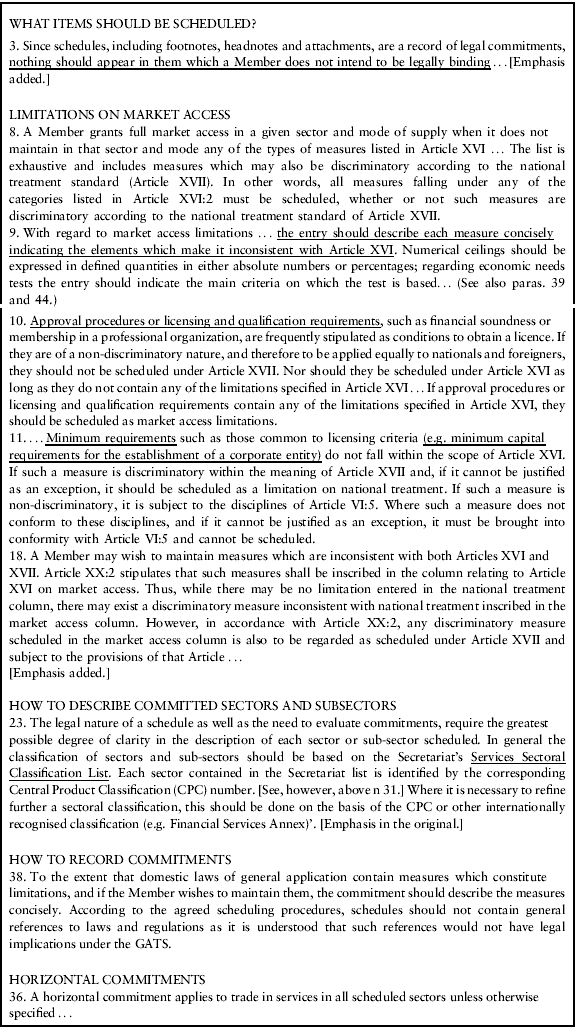
The intention of the drafters to cover both discriminatory and non-discriminatory restrictions under Article XVI:2(a)–(d) is reflected in the terms chosen. Only XVI:2(e) and (f) explicitly refer to national-treatment inconsistent measures, that is joint-venture requirements and restrictions on the participation of foreign capital, respectively. In contrast, the numerical limitations falling under XVI:2(a)–(d) are couched in neutral terms. Had the intention been to confine the scope of these limitations to the number of foreign service suppliers or the value of the foreign services provided, etc., this certainly would have been indicated in the same way as under (e) and (f). Further, the question arises what useful function the market access obligation under Article XVI would perform if it were confined to measures that are fully captured by Article XVII. Finally, Article XX:2 explicitly stipulates that ‘[m]easures inconsistent with both Articles XVI and XVII shall be inscribed in the column relating to Article XVI. In this case the inscription will be considered to provide a condition or qualification to Article XVII as well’. Again, this clearly points out the relevance of Article XVI:2(a)–(d) also for non-discriminatory measures; Article XX:2 would otherwise serve no reasonable purpose. In the same vein, the Scheduling Guidelines (S/L/92, para. 8) explicitly confirm not only that the list of market access limitations in Article XVI:2 is exhaustive, but also that ‘all measures falling under any of the categories listed … must be scheduled, whether or not such measures are discriminatory according to the national treatment standard of Article XVII’ (Annex Table).Footnote 13
2.2 The origins of FOG
It would certainly be difficult to claim, in Abbott's language, that all current commitments appear ‘equally and indistinguishably clear’. Indeed, there is FOG. As indicated before, its existence can be attributed, inter alia, to the novelty of the Agreement and its conceptualization of services trade as well as a lack of experience and, possibly, internal coordination on the part of the administrations finalizing the original Uruguay Round schedules. It is true that relevant information was already available in the form of an early version of the Scheduling Guidelines that the then GATT Secretariat had developed in 1993.Footnote 14 However, the full scope of the new Agreements, in services and many other areas, was certainly difficult to digest within a relatively short period at the end of the Round by all administrations involved.
Some Members might have felt that vague entries would afford them leeway in interpreting their commitments. FOG might have appeared preferable to ensuring ‘dry and transparent’ conditions. Why firmly tie your hands and, possibly, compromise scope for future action under an Agreement that has not yet been tested in practice? Similar considerations might have caused more than a dozen Members not to use classification numbers in specifying the sectors inscribed in their schedules, despite a clear recommendation in the Scheduling Guidelines.Footnote 15 However, the Panel and Appellate Body in US–Gambling did not lend support to such expectations; they found that the omission of classification numbers was insufficient to ensure the flexibility that might have been sought by the United States.Footnote 16 Equally interesting in this context are the Panel and Appellate Body decisions in EC–Computer Equipment and EC–Chicken Cuts, which also confirm the view that Members cannot achieve more flexibility through unclear entries in their schedules. Accordingly, a Member's unilateral object and purpose for the conclusion of a (tariff) commitment cannot form the sole basis for interpretation.Footnote 17 Commitments, whether for goods or services, reflect the common intention of the Membership.
Another factor contributing to ‘foggy’ entries relates to the absence of benchmarks in the GATS as to the level of access that should be granted through schedules. Whereas negative-list type agreements (e.g., the North American Free Trade Agreement (NAFTA) and many other preferential trade agreements in services) largely provide that the commitments undertaken reflect the restrictions applied in practice, GATS commitments need not reflect the status quo.Footnote 18 Such greater flexibility as to what needs to appear in schedules has taken its toll in terms of lesser precision and clarity.
Further, unlike in merchandise trade, competencies for services trade are not vested in a small number of national administrations, in particular those in charge of trade, industry, and agriculture. Rather, a multitude of ministries and agencies are concerned, responsible for finance, transport, communication, construction, justice, education, and so forth, each of which possibly has as much political clout, if not more, than the coordinating ministry. The officials concerned might have insisted, as a condition for accepting commitments in ‘their’ sectors, on relevant legislation being duly reflected in the national services schedule, regardless of what the GATS or the Scheduling Guidelines say.Footnote 19
Acceding countries are confronted with particular challenges. First, faced with requests from 20 or more interested Members, they tend to commit a far higher number of subsectors, some 100 on average, than Uruguay Round participants at comparable levels of development. This necessarily complicates inter-ministerial coordination. Second, unlike the Uruguay Round schedules of 1993/94, which were essentially a first attempt at undertaking bindings in a limited number of services, accession schedules reflect a negotiating outcome. There are certainly cases in which the parties have sought to bridge substantive differences about the commitments to be made with linguistic compromises that do not pay particular attention to relevant terms of the Agreement.
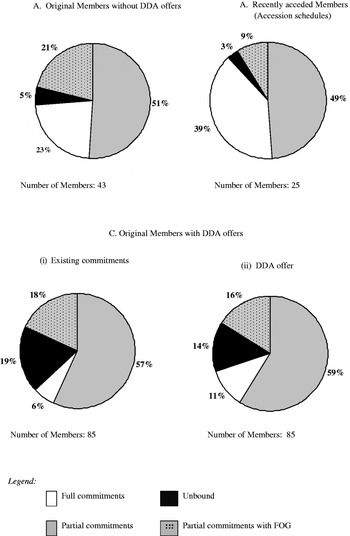
Nevertheless, despite these challenges, it is interesting to see that, on average, the acceded Members' schedules contain significantly less FOG than the DDA offers submitted by the original WTO Members since 2003. The relative clarity of the 25 schedules concerned (as of end October 2011) might be due to a combination of factors, including the pressure on the administrations in charge, confronted with ambitious requests from ‘old’ Members in a multi-annual negotiating process, to familiarize themselves particularly closely with relevant GATS provisions. Further, given the large number of subsectors subjected to full commitments, the risk of technical flaws in these schedules was more limited in any event; their share of full commitments is more than twice as high as in the DDA offers submitted by original Members. Nevertheless, there is a clear indication of improved ‘technical language’ as well: the ratio of properly scheduled partial commitments to those containing FOG, 49% to 9%, is also significantly higher than for other groups of Members (Figure 1).
2.3 Consequences
Even a cursory look at current GATS commitments, frequently replicated in PTAs and DDA offers, reveals obvious inconsistencies with the scheduling standards set out in the Agreement and the Scheduling Guidelines (S/L/92). The existence of such ‘foggy’ entries can have serious legal, political, and commercial ramifications.
The predictability of market conditions and, in more general terms, the transparency of a country's trade regime are undermined. Tellingly, the Preamble to the GATS refers to Members' wish ‘to establish a multilateral framework of principles and rules for trade in services with a view to the expansion of such trade under conditions of transparency and progressive liberalization’. However, what is the significance of commitments that, for most Uruguay Round participants, are not only modest in sector scope and economic substance,Footnote 20 but often fail to comply with commonly binding scheduling standards? In this regard, certain types of ‘foggy’ services commitments could be compared to entries in a tariff schedule that do not reflect the relevant rates, but the title of the enabling legislation some decades ago or the name of the office that is in charge of implementation.
Recent research on the effect of preferential trade agreements (PTAs) on investment flows indeed suggests that the content and structure of commitments matter: PTAs providing for negative listing of existing non-conforming measures in relation to the establishment of foreign enterprises tended to boost investment flows between the parties, while others did not leave measurable traces. Among negative-list agreements, those with the most transparent and comprehensive admission guarantees were found to be most effective in this regard.Footnote 21 This implies, in turn, that FOG reduces the potential of commitments to promote trade and investment flows.Footnote 22 Given the momentum of many services markets, driven by technological and commercial innovations, the associated losses might increase significantly over time.
An equally serious source of frustration, from a Member's point of view, is the damage caused by ‘foggy’ entries that, if challenged by trading partners, are interpreted by Panels or the Appellate Body to imply ambitious bindings. A reference to non-specified licensing requirements, possibly intended by the scheduling government to allow for as much discretion as a poorly specified economic needs test, might ultimately amount to an unlimited access commitment.Footnote 23 The brief history of GATS-related trade disputes already suggests that this is a real risk (see Mexico–Telecoms, Section 3.1.1 below). What might have started as a mere formality, submitting a services schedule as required by the relevant GATS provision (Article XX:1), could prove quite painful in the end.
2.4 Remedial action
Governments should be interested, therefore, in identifying and correcting dubious entries in their schedules before trade frictions actually arise. It would be easier, in a non-confrontational setting, to argue that envisaged changes are intended to clarify existing commitments, rather than reduce these in scope. A simple certification procedure, to be completed after a waiting period of 45 days, would be available if no objections are raised by potentially disadvantaged Members.Footnote 24 By end April 2011, this procedure had been used in four instances to correct editorial flaws in schedules.Footnote 25 Yet, in no case has a Member sought to address problems of the type discussed in this paper, that is inconsistencies between scheduling language and relevant GATS provisions. In turn, this may be due to reasons internal to the administrations concerned – it might prove difficult to mobilize all entities concerned in the absence of outside pressure – and to latent doubts about trading partners' willingness to accept proposed amendments in good faith.
Administration-internal reticence might play a lesser role in comprehensive trade negotiations, as in the DDA context, when all WTO Members are offered the opportunity to schedule technical refinements as one option in preparing their offers. By the same token, however, the coincidence of what essentially constitutes a bargaining process (related to new or improved commitments) with a commitment-clarification and -refinement exercise risks moving the goalposts to the detriment of the latter. In order to prompt the ministries and agencies in charge of particular sectors or modes to ‘concede’ new or improved commitments in their respective areas, the coordinating entities might be tempted to tolerate not only existing patches of FOG but also their further extension.
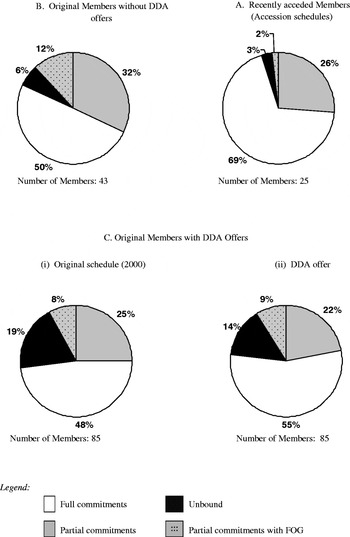
Indeed, some 16% of the sector commitments offered in the DDA contain one or more elements of FOG. Of these, a significant share is due to problematic limitations in the horizontal section that apply across all scheduled subsectors (Figures 1 and A1). Moreover, some FOG has been introduced in the form of new commitments at the sectoral level. A closer look reveals that the percentage of ‘foggy’ commitments is significantly higher among the newly included subsectors than the average share of 9% across all subsectors contained in the offer (Figure A1.C(ii)).Footnote 26 This is not necessarily indicative of a (further) deterioration in scheduling literacy, however. It could have been a deliberate decision; for instance, some Members might have wanted to retain ‘negotiating coinage’ for subsequent stages of the DDA process, or reflect specificities of those services that are relatively well represented among the newly offered commitments (e.g., postal and courier services, environmental services, education, and maritime transport).
Several factors might explain the persistence of scheduling problems in particular among the original WTO Members:
First, the relative weakness within the governmental machinery of the coordinating ministries or agencies. If the acceptance of GATS-inconsistent scheduling language was a pre-condition for other ministries' acceptance of commitments in ‘their’ sectors, the coordinators might have preferred, in the absence of external prodding, to condone such language. In the same vein, the introduction of new FOG might have been a condition, in certain instances, for broadening the sectoral and modal coverage of some Uruguay Round schedules. By comparison, the coordinating entities in acceding countries tend to be in a stronger position insofar as the attainment of WTO membership, a commonly shared objective across all government levels, adds political impetus to their efforts.
Second, certain existing flaws might have developed a life of their own, through repetition in the preferential agreements concluded by an ever-increasing number of WTO Members. Many of these agreements, following a GATS-type scheduling approach, are essentially based on the signatories' GATS schedules. Governments might simply be deterred by the administrative burden involved in modifying, without immediate need, an ever-expanding number of treaties and re-submitting them to the competent bodies. They may also be concerned that deviating from the language used in the original GATS schedules could create uncertainty, with differences in wording being taken to indicate different levels of access guaranteed.
Third, while scheduling problems might prove easy to identify, it could be far more difficult for Members to agree on appropriate solutions. Strictly speaking, the point could be made that mere references in schedules to existing national legislation or licensing and qualification requirements – often inscribed in the form of horizontal limitations – do not provide legal cover for measures a Member might want to maintain under relevant laws and regulations. A rigid interpretation would thus undermine the relevance of the concept of ‘technical refinements that do not alter the scope or substance an existing commitment’. If there was no substance in the first place, nothing short of a full commitment might be deemed equivalent. Thus, in assessing whether a proposed change constitutes a technical refinement only or, rather, reduces the substance of an existing commitment, potentially affected trading partners would need to deliver a sound dose of pragmatism. However, not everybody might want to bet on that.
3. A closer look at FOG and other scheduling flaws
3.1 Overview
The examination of scheduling problems in this paper focuses on commitments inscribed for market access under mode 3 (commercial presence). This was done essentially for three reasons. First, denials of market access, whether discriminatory or not, tend to be more economically significant than ‘pure’ denials of national treatment. In particular, numerical limitations are more restrictive, in all likelihood, than discriminatory taxes, subsidies, restrictions on foreign land ownership, and the like. Second, as noted before, Article XX:2 provides that measures inconsistent with both market access and national treatment must be inscribed under market access only. Foggy entries in the market-access column, including general references to licensing requirements, might thus disguise – non-identifiable – departures from national treatment as well. Third, commercial presence clearly is the economically dominant mode of supply, representing more than one-half of all services trade under the GATS.Footnote 27
The following observations do not deal with compliance problems that might arise from commitments that are more ambitious than actual market conditions (‘over-commitments’).Footnote 28 It would certainly not be possible to address such problems via technical refinements in schedules. The only viable solutions would be policy reforms or, if not within reach, renegotiations of existing commitments under Article XXI of the GATS.Footnote 29 Also excluded from the discussion are obvious scheduling errors, such as inconsistent cross-references between sectoral and horizontal entries, that would simply need to be corrected.Footnote 30
In a similar vein, in the interest of a focused discussion, no particular attention is given to classification issues. Ignoring a recommendation in the Scheduling Guidelines (Table A1, para. 23), some schedules are partly or, in more than a dozen cases, completely without references to the UN Provisional Central Product Classification (CPC) or other classification systems or definitions. Moreover, 14 Members have undertaken a total of 25 commitments on not-further-specified categories of ‘other services' contained in the Classification List that the then GATT Secretariat had developed in the early 1990s (W/120) without providing further guidance.Footnote 31 It is conceivable in these cases that the scheduling Member's interpretation of the breadth of a commitment differs from that of a trading partner and, possibly, a WTO dispute panel. Since the borderlines are not ‘equally and indistinguishably clear’, to use Abbott's language, there is definitely scope for technical refinement. Indeed, most of those Members that had omitted CPC numbers in their original schedules acted accordingly and used their DDA offers to insert these numbers. Interestingly, no similar efforts can be found in relation to non-specified ‘other services’. This is understandable insofar as the transformation of a residual category into a clearly circumscribed subsector might prove more difficult to associate with a technical refinement that does not alter the scope of a commitment than the addition of CPC numbers to an existing sector name.
A particular scheduling problem – non-specified economic needs tests (ENTs) – is up for negotiation in the DDA. Among other objectives, Annex C of the Hong Kong Ministerial Declaration calls for removing or substantially reducing the ENTs inscribed under modes 3 and 4 and ensuring that any remaining tests adhere to the Scheduling Guidelines (S/L/92). As already mentioned, contrary to a clear recommendation in the Scheduling Guidelines, most ENTs do not provide any criteria. Moreover, some tests fail to indicate to which market access limitations under Article XVI:2 (a)–(d) they actually apply. The elimination or clarification of such tests would not constitute a simple technical refinement, but undoubtedly improve the quality – or more precisely, the commercial content – of the commitment concerned. They are thus not further discussed in this paper.
The assessment of four types of FOG in the following section is complemented by a brief discussion of other scheduling flaws in Section 3.3.Footnote 32 Apart from ill-assigned national-treatment limitations, these are superfluous entries that should not cause FOG-type interpretation problems. Cases in point are simple references to GATS provisions that would apply in any event, including the prudential carve-out in financial services.
3.2 Types of FOG – and potential implications
FOG has been defined in a conservative manner in the context of this paper so as not to include all entries that lack clarity or precision. Rather, the scope of ‘foggy’ limitations has been limited to four categories, which appear particularly pernicious insofar as they could create the impression or, rather, illusion in the administrations concerned of being effectively protected from legal challenge. At the same time, there is a serious risk of inconsistency with a trading partner's interpretation of the same commitment and, possibly, of a Panel or the Appellate Body. Of course, this risk materializes only to the extent that a Member actually employs measures that fall within the foggy patches contained in its schedule.
3.2.1 Non-specified licensing and qualification requirements
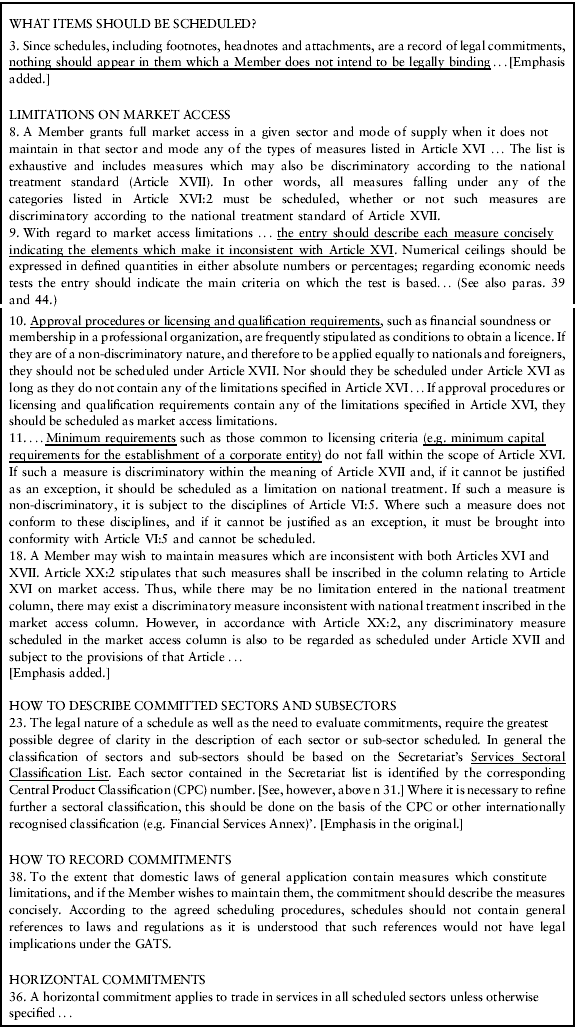
As noted before, Article XVI:2 contains an exhaustive list of measures that must not be maintained in scheduled sectors unless inscribed as limitations on market access. The Scheduling Guidelines unequivocally confirm that approval procedures or licensing and qualification requirements should not be scheduled under this Article as long as they do not contain any of those limitations (Annex Table).Footnote 33 Otherwise, the relevant limitations – rather than an implementing licensing mechanism – ought to be inscribed.
The Panel Report in Mexico – Telecoms confirms this reading. For various telecommunication services, Mexico's schedule provides, under market access for mode 3, that a permit issued by the competent regulator is required. According to the Panel, this language ‘does not indicate that Mexico maintains a quantitative limitation “on the number of suppliers”. On the contrary, it suggests that any supplier who is set up in accordance with Mexican law is eligible for a permit.’ In other words, in view of the Panel, the inscription of a non-specified approval requirement serves no legal purpose under Article XVI of the Agreement.
3.2.2 References to laws and regulations
Quite a number of schedules contain entries indicating that market access is provided ‘in accordance with existing legislation’, with ‘relevant investment regulations’, and similar qualifications. However, the Scheduling Guidelines are as unambiguous with regard to such entries as they are in the case of non-specified licensing requirements: ‘According to the agreed scheduling procedures, schedules should not contain general references to laws and regulations as it is understood that such references would not have legal implications under the GATS’ (Annex Table, para. 38). This is because an entry should ‘describe each measure concisely, indicating the elements which make it inconsistent’ with market access or national treatment (para. 9). It appears unlikely that a Panel or the Appellate Body would arrive at different conclusions.
The same might be said of references to specified pieces of legislation. Entries such as ‘according to Investment Law [title] of [date]’ are by no means rare. In the abstract, it is difficult to assess the implications, however. For example, even if a measure provided for under a particular law were deemed to be covered, what would happen if this law was modified at a later date: would the original entry prove completely irrelevant from that date or only to the extent that the new law departs in scope and content?Footnote 34
3.2.3 Inconsistencies with Part II of the GATS
In various instances, scheduled entries seem to depart from the General Obligations and Disciplines as established in Part II of the GATS. Two types of inconsistencies were found in the context of this paper: the inscription of foreign exchange restrictions, which, in scheduled sectors, are inconsistent with Article XI:1 of the GATS, and of measures potentially contravening the most-favoured-nation requirement of Article II:1. The latter entries are typically targeted at suppliers (natural persons) whose home-country policy regimes or educational systems are not compatible with those of the scheduling Member, rather than focusing on the educational or professional degrees held by the individual applicant. In turn, such ‘limitations’ are not only (potentially) inconsistent with Article II of the GATS,Footnote 35 but also with Article XVI which obliges each Member to accord ‘services and service suppliers of any other Member treatment no less favourable than that provided for under the terms, limitations and conditions agreed and specified in its Schedule’ (emphasis added).Footnote 36 As noted before, the range of admissible limitations is exhaustively listed in Article XVI:2(a)–(f).
Similar inconsistencies between scheduled measures and general treaty obligations have been examined in the context of at least one dispute under the GATT. In a 1989 case concerning the United States' sugar regime, the Panel found that the scheduling of measures that are inconsistent with other provisions of the GATT does not permit contracting parties to qualify their obligations under these provisions. Consequently, the Panel ruled that the reference to quantitative restrictions, inconsistent with GATT Article XI (General Elimination of Quantitative Restrictions), in the US tariff schedule could not justify their use.Footnote 37
3.2.4 Additional cases of FOG: membership requirements, exhortatory language, minimum capital requirements
Some entries relating to professional services require suppliers, whether foreign or national, to be members of the competent professional association. In certain regards, such limitations might be compared to non-specified licensing requirements, with the main distinction being, however, that it is possibly not the government, but a delegated body that calls the tune, that is defines the relevant membership conditions. The authors are aware of cases where these conditions even include MFN-inconsistent reciprocity requirements: foreigners are accepted only if the competent associations of their home countries accept foreign participants as well.
Quite a number of limitations use soft language in defining the numerical quotas, forms of legal incorporation or foreign equity limits that ‘should’ be respected or ‘may not’ be ignored. Are such recommendation-type entries actually binding, nevertheless? On various occasions, Panels and the Appellate Body have sought to specify the levels of flexibility implied by the use of such soft terms in lieu of ‘shall’ and other conceivable options. For example, in US–Foreign Sales Corporations, the Appellate Body opined that ‘many binding legal texts employ the word “should” and, depending on the context, the word may imply either an exhortation or express an obligation’.Footnote 38 Obviously, the precise meaning can be established only case-by-case.
According to the Scheduling Guidelines (Annex Table, para. 11), minimum capital and similar non-discriminatory regulatory requirements do not fall under Article XVI and, therefore, should not be scheduled as market access limitations. Some of those Members that have done so, nevertheless, might have sought protection from legal challenges under potentially relevant GATS provisions, including regulatory disciplines under Article VI:5. Again, however, the ruling in US–Sugar Imports suggests that scheduling a GATS-inconsistent limitation would not survive a challenge before a Panel or the Appellate Body.
3.3 Other scheduling flaws
As indicated before, there are further entries in schedules that may warrant closer attention in the current context, though they should not normally create FOG-type interpretation problems. Particularly frequent is the use of superfluous language that cannot be associated with limitations falling under Articles XVI:2 as well as the inscription of national-treatment limitations in the market access column. Not surprisingly, given the very nature of FOG, the borderline between the four types of entries discussed before and the following scheduling flaws is blurred in some cases.
Explanatory language that essentially replicates provisions of the Agreement is a more frequent occurrence in schedules than any of the types of FOG discussed before. Typical examples are simple references to the existence of prudential regulations in financial services, universal service requirements in telecommunications, or, typically in the horizontal section, the exclusion of ‘governmental services’ from the scope of commitments. It is difficult to see what would be lost if such entries were to be dropped since the underlying measures are compatible with full commitments under Article XVI as well as with other potentially relevant GATS provisions. (For example, pursuant to Article I:3 of the GATS, services that are supplied ‘in the exercise of governmental authority’ are excluded per se from the definitional scope of the Agreement.) The elimination of superfluous language could improve a schedule's clarity and internal consistency, and avoid any possible doubts about the situation in sectors without similar entries.
Almost equally widespread are descriptions of domestic regulatory or institutional conditions that do not seem to restrict market access in the sense of Article XVI. Again, it appears that such ‘limitations’ serve no particular purpose under the Agreement. Cases in point are entries explaining that the employees of a supplier must be qualified professionals in the sector concerned, the level of qualification must be in accordance with relevant domestic legislation, juridical persons are legally independent from their owners, or the issuance of licences is subject to fees. There are even cases where the relevant licensing fees are actually specified, for an indefinite future, possibly creating misperceptions of the binding effects that might be involved.
A third, relatively frequent scheduling problem consists of the inscription of national-treatment limitations in the market-access column.Footnote 39 This is understandable insofar as Article XX:2 explicitly requires Members to inscribe measures that are inconsistent at the same time with Articles XVI (market access) and XVII (national treatment) under Article XVI only; see Section 2.1. It might thus be tempting for the authorities concerned, in cases of doubt, to prefer scheduling under Article XVI since inconsistencies with Article XVII appear to be covered in any event. While possibly not the optimal solution in all cases, this is unlikely to create FOG-type problems of interpretation as long as the measures themselves are properly specified.
4. Actual patterns of FOG
As indicated before, the following assessment of the extent of FOG is based on the market-access commitments different groups of WTO Members have scheduled under mode 3 of the GATS. Figure 1 presents the main results, distinguishing between four types of entries per subsector: (a) full commitments (i.e., commitments without any limitations (‘none’); (b) no commitments (‘unbound’); (c) commitments with limitations containing one or more elements of FOG as described in Section 3.2; and (d) commitments with limitations not containing FOG.Footnote 40
Results in Figures 1 and A1 are presented for three groups: original Members that have not submitted services offers in the DDA, Members that joined the WTO after the Uruguay Round (‘recently acceded Members’), and original Members that have made offers in the DDA. For the latter category, results are presented for existing schedules of commitments and for offers. Figure 1 includes horizontal limitations, while Figure A1 solely takes into account sector-specific entries. Obviously, there are significant proportions of FOG: on average, about one-fifth (or more precisely: 21% and 18%) of the limitations in committed subsectors contain one or more scheduling flaws as explained in Section 3.2. The shares are particularly high in the schedules of original WTO Members that have not submitted DDA offers. As already mentioned before (Section 3.2), instances of FOG are rarer in the case of acceded Members, discernible in 9% of the limitations made. This could be due in part to the higher portion of full commitments undertaken by these Members, a stronger government-internal position of the coordinating entity, given the stakes involved in WTO accession, and improved ‘scheduling techniques’. In turn, such improvements may be attributed to the sheer duration of the accession process, over one decade in some cases, the ensuing space for technical assistance and advice, and the learning effects associated with some dispute cases, not least Mexico–Telecoms (Section 3.2.1).
The importance of FOG is further evidenced if only partial commitments are taken into account, thus ignoring entries, whether ‘none’ or ‘unbound’, that are necessarily clear and transparent. For original Members without DDA offers, 29% of the scheduled partial commitments contain FOG, as compared to 24% for the partial commitments scheduled by original Members that have made offers.
When ignoring horizontal limitations (Figure A1), which apply equally across all committed subsectors and modes, the proportion of FOG is naturally lower overall, given that more commitments are then without limitations. However, the incidence of FOG among partial commitments has remained essentially unchanged: 27% for original Members without offers, 24% for those that have made offers, and 7% for the recently acceded Members. A comparison of Figures 1 and A1 highlights the contaminating effect associated with ‘foggy’ horizontal limitations and underscores the importance, in refining schedules and offers, of paying particular attention to these limitations.
Somewhat surprisingly, the share of FOG in DDA offers has not shrunk significantly compared to the same Members' existing commitments: from 18% to 16% of the subsectors committed or from 24% to 21% of the limitations made (Figures 1 and A1 (C (i) and (ii)). While some FOG would be cleared by way of technical refinements and the reduction or elimination of existing limitations, new patches would be introduced by the limitations attached to the newly offered subsectors (see also Section 2.4).Footnote 41
FOG in GATS schedules (commitments on market access, Mode 3), by groups of Members

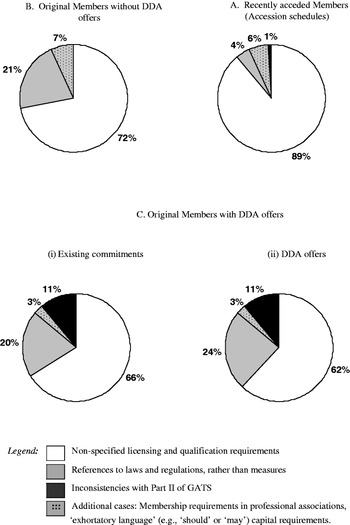
Non-specified licensing and qualification requirements clearly are the dominant category of FOG across all groups of Members (Figure 2). However, there is a significant degree of variation. While some two-thirds of the entries scheduled as sectoral limitations by original Members that have submitted DDA offers consist of such non-specified requirements, the respective share for the recently acceded countries comes close to 90%. The second most frequent category of FOG in the schedules of original Members, whether with or without DDA offers, are references to existing laws and regulations that provide no guidance as to the limitations covered.
Categories of FOG in GATS schedules – sectoral limitations only

Entries inconsistent with obligations under Part II of the GATS are virtually absent in the schedules of acceded Members, but more frequent among the original Members, in particular those that have submitted DDA offers (11% of all entries inscribed as sectoral limitations, see Figure 2 (C(i) and C(ii)). In most cases, access is made contingent on the existence of certain institutional or regulatory conditions in a foreign suppliers' home market, which, for the reasons indicated before (Section 3.2.3), have been treated as being inconsistent with the MFN obligation under Article II:1 of the GATS. The share of ‘additional cases’, which were found to consist mostly of exhortatory language (‘should’, ‘may’, etc.) whose binding nature remains uncertain, varied between nil for the original Members without DDA offers and 6% for the post-Uruguay Round accession countries.
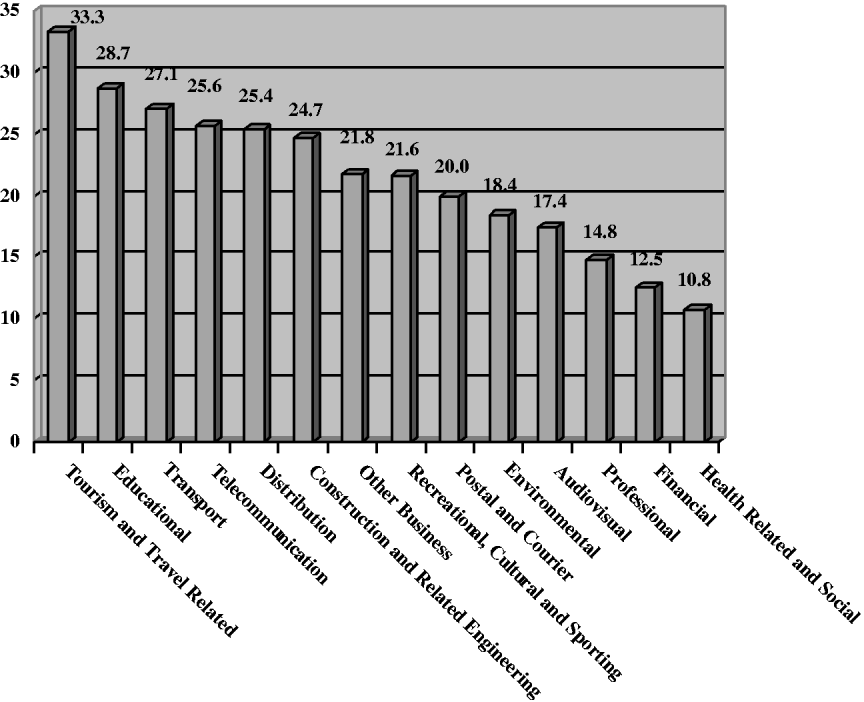
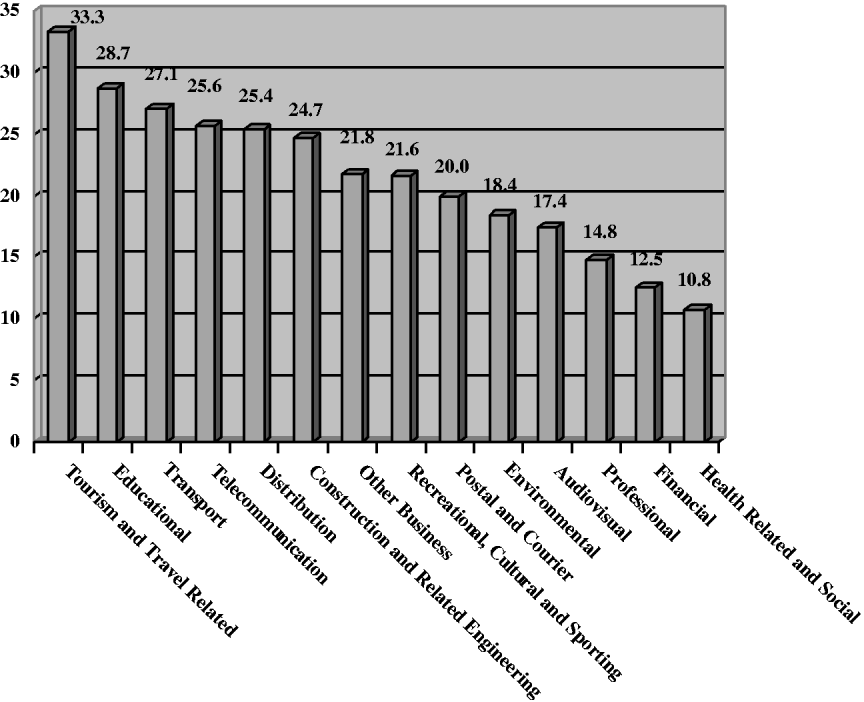
There are remarkable inter-sectoral variations in the incidence of FOG. Looking at the current schedules of those Members that submitted DDA offers, excluding the EU member States (EU 25), it is somewhat surprising that the ‘foggiest’ commitments are to be found in tourism and travel-related services. This is certainly a sector that should not pose major scheduling challenges, in particular if compared to technically and institutionally more complex sectors, such as financial or telecommunication services. One possible explanation is the fact that tourism is the most frequently committed of all service sectors and that the lion's share of the commitments dates from the early 1990s when many participants, out of inexperience, might have been excessively cautious in formulating their schedules. In contrast, the commitments on telecommunication and financial services are somewhat more limited in number, though still significant, and date mostly from the Uruguay Round extended negotiations concluded in February and December 1997, respectively. Also, there seems to be an inverse relationship between the existence of FOG and other scheduling flaws, such as simple references to existing GATS provisions, including the prudential carve-out, and descriptions of domestic regulatory or institutional conditions (Section 3.3). Such flaws are particularly frequent in health-related and social services, professional services, and financial services.
5. Conclusions
Abbott's praise of FOG, and his sense of pity for ‘those unhappy countries in which the atmosphere is perfectly dry and transparent’, reflects the situation of people living in a two-dimensional world. Without a natural sense of distance, on a completely level surface (‘Flatland’), FOG comes as a blessing. It helps inhabitants to distinguish between more remotely situated, and therefore less clearly visible, objects and others located in their proximity that they must steer clear of in order to avoid potentially painful collisions. This is distinctly different, however, from the situation of a government that undertakes commitments, with a view to defining the country's trade regime, in the four-modal world of the GATS. The creation of FOG in such circumstances might be instrumental in achieving consensus at the administration-internal scheduling stage, with potentially affected domestic industries and with interested trading partners, but this comes at a longer-term risk. If challenged, ‘foggy’ entries might prove of dubious legal value. As argued before (Section 2.3), if all commitments were ‘equally and indistinguishably clear’, to use Abbott's language, the Members concerned may well be happier, that is less vulnerable, than those engulfed in FOG. Quite apart from their unintended legal consequences, such entries also reduce the transparency and predictability that economic actors seek. Corrective action would thus enhance the GATS' potential to promote trade and investment flows.
An overview of existing commitments, frequently replicated in GATS-type PTAs, and DDA offers is sobering in two regards: first, if the latter were to enter into force, significant patches of the FOG would remain. And this is due not only to many Members' apparently hesitant recourse to the option of technical refinements, but also to the possible introduction of new flaws in the subsectors that had been proposed for inclusion. Second, those Members whose schedules would benefit mostly from technical refinements remained on the side-lines. The schedules of original Members without DDA offers, mostly least-developed countries, contain relatively more FOG than those of the recently acceded WTO Members and the original Members with DDA offers. However, LDCs were explicitly exempt, in the Hong Kong Ministerial Declaration (para. 26) from the expectation to undertake new commitments in the DDA. While this certainly did not amount to an invitation to refrain from correcting technical scheduling problems by way of an offer, it likely had the effect of taking attention away from this opportunity.
It is important to reiterate that the focus of the preceding discussion was only on one possible, though highly economically relevant, manifestation of FOG: GATS commitments on market access under mode 3 (commercial presence). Yet, there are certainly more ‘foggy’ spots in schedules that might warrant attention, including vague or deficient sector definitions. Two GATS-related disputes, US–Gambling and China–Audiovisual Services, should be warning enough. Another unexplored area is the commitments undertaken in preferential trade agreements. At least in the case of positive-list agreements, GATS-type, it can hardly be expected that relevant entries have been more carefully considered than those contained in the parties' GATS schedules. Rather, the expanded sectoral coverage of many PTAs entails additional risks.
Of course, Members are free at any time to clear their schedules of FOG. As noted before, existing commitments can be rectified under a relatively simple certification procedure, if no objections are raised by Members that consider themselves to be adversely affected.Footnote 42 However, the relevant provisions have not been used to date to remove the types of FOG discussed above. This is understandable insofar as administrations are normally ill-equipped to identify latent scope for conflict and take pre-emptive action. Who would earn laurels by drawing a superior's attention to what seems to be a low-profile issue, which, nevertheless, could take an unexpected turn should another Member object to an envisaged technical change?
The situation in comprehensive trade negotiations, when many schedules are open for change, is somewhat different. It can be expected, first, that individual administrations find it easier to co-ordinate internally than it would be in a non-negotiating context. Second, the discussion in this paper suggests that many Members would have something to gain, since the main types FOG identified in Section 3 can be found in very many schedules. In turn, this could help prevent governments from bickering over whether or not proposed technical refinements involve elements of backtracking. Nevertheless, the DDA is not a sine qua non for such a project. The same (disciplining) effect might arise from a clarification and refinement process that is conducted in a horizontal way, open to all Members, without pursuing a liberalizing objective. The Committee on Specific Commitments, established immediately after the Uruguay Round, would provide the appropriate forum – if there is a will…Footnote 43
To further facilitate the review of ‘foggy’ commitments, Members might agree, tacitly at least, on how to deal with such cases. Concerning the two main categories of FOG – non-specified licensing requirements and general references to national legislation – a common understanding could provide, for example, that relevant entries can be replaced by limitations under Article XVI:2 as long as these remain confined to what would have been needed at the time of the commitment. Of course, in quite a number of cases, it might be possible to delete ‘foggy’ entries altogether, without replacement, since the Members concerned do not envisage maintaining measures in the sense of Articles XVI or XVII of the GATS. Nevertheless, the proposed understanding would require a considerable dose of good faith and pragmatism in order not to deter governments that might actually benefit from technical refinements, but are afraid of critical questions or even legal challenges.
Purists might argue in quite a number of cases that the introduction of actually enforceable limitations, in lieu of FOG, would be difficult to associate with the GATS' basic negotiating objective of progressive liberalization. Yet, as indicated before, this is not the only relevant perspective. In the authors' view, the clarification of ‘foggy’ (that is, non-transparent) entries deserves equivalent attention. This is already reflected in the Preamble to the GATS. Tellingly, it refers to the expansion of services trade under conditions of transparency and progressive liberalization. In this respect, regardless of the fate of the DDA, it remains incumbent on Members to improve the legal quality of commitments, in line with basic provisions of Agreement and common guidelines, and thus achieve more sustainable and transparent trading conditions.
Annex
FOG in GATS schedules (commitments on market access, Mode 3), by groups of Members – sectoral limitations only

Share of ‘foggy’ entries by sector (market access, Mode 3)*
What the Scheduling Guidelines say