INTRODUCTION
The taxonomy of deep-sea fishes of India was pioneered by the outstanding works of A.W. Alcock, based on the samples collected during the voyage of the Indian marine survey steamer, HMS ‘Investigator’. Alcock's publications (1889–1907) are the major detailed work on the deep-sea fauna of Indian waters. Recent studies on deep-sea fishes from the Indian exclusive economic zone has resulted in the description of many new species and new records from Indian waters (Oommen, Reference Oommen1978; Sajeevan et al., Reference Sajeevan, Somvanshi and Nair2009; Akhilesh et al., Reference Akhilesh, Hashim, Bineesh, Shanis and Ganga2010; Bineesh et al., Reference Bineesh, Manju, Akhilesh and Pillai2010; Kurup et al., Reference Kurup, Cubelio, Joseph and Venu2010; Anderson & Bineesh, Reference Anderson and Bineesh2011).
The longfin escolar, Scombrolabrax heterolepis Roule, Reference Roule1921 (Scombrolabracidae) originally described from south of Madeira, eastern Atlantic is a monotypic member of the suborder Scombrolabracoidei (Nelson, Reference Nelson2006). Also known as the black mackerel, S. heterolepis is a widespread but uncommon deep-sea fish known from tropical and subtropical areas of the Pacific, Indian and Atlantic Oceans, but not known from the eastern Pacific and south-eastern Atlantic. Scombrolabrax heterolepis inhabits continental shelves and slopes at depths between 130 and 1374 m (Higgins et al., Reference Higgins, Mori and Uyeno1970; Filho et al., Reference Filho, Marcovaldi, Sampaio, Paiva and Duarte2010). To date no specimens have ever been reported from Indian waters. This paper confirms the presence of S. heterolepis in Indian waters.
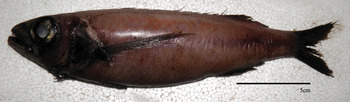
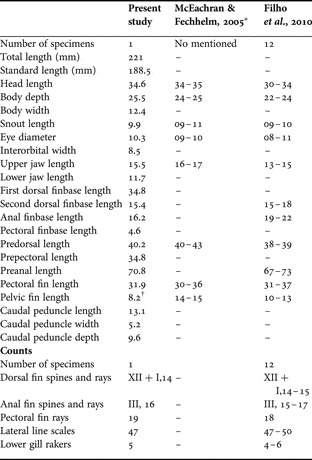
One specimen of S. heterolepis (188.5 mm standard length (SL)) was collected on 16 October 2010 from a commercial deep-sea shrimp trawler operated at 220 to 350 m depths in the Arabian Sea off Trivandrum (Figures 1 & 2). The specimen was deposited in the National Marine Biodiversity Referral Museum at Central Marine Fisheries Research Institute (CMFRI), Cochin, India under the Accession Number GB.43.6.16.10. The morphometric and meristic characters of the specimen agree well with data from previous studies (McEachran & Fechhelm, Reference McEachran and Fechhelm2005; Filho et al., Reference Filho, Marcovaldi, Sampaio, Paiva and Duarte2010) (Table 1). This is the first record from the west coast of India and confirms the widespread distribution of this species.
Scombrolabrax heterolepis (188.5 mm standard length) from the Arabian Sea off the south-western coast of India.

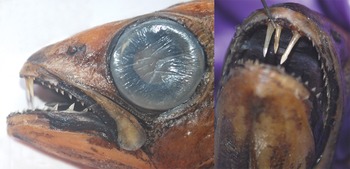
Close-up of teeth and upper fangs.

Scombrolabrax heterolepis. Proportional measurements in percentage of standard length.

*, no original data; data of several authors including juveniles and larvae; †, broken.
DIAGNOSIS
Dorsal fin spines and rays XII + I, 14; anal fin spines and rays III, 16; pectoral fin rays 19; lateral line scales 47; lower limb of first gill arch with 5 well-developed gill rakers, about 10 clusters of minute spines on upper limb. Body moderately elongate and compressed; head large, 34.6% of SL; the interorbital region flat, 8.5% of SL; very large eye, 10.3% of SL, its diameter almost as long as the conical snout, snout 3.5 in head length; large terminal mouth, the upper jaw protractile, the lower projecting slightly beyond the upper; teeth in upper jaw in a row of small to moderate, compressed canines, with three very large, stout canines in front; teeth of lower jaw larger without large canines; two large nasal openings each side of snout. Two dorsal fins, base of first dorsal fin about twice as long as base of second dorsal fin; origin of first dorsal fin slightly posterior to pectoral-fin base. Caudal fin forked and moderately small. Very long pectoral fins, 31.9% of SL, reaching a vertical at anal-fin origin. Pelvic fins originating below origin of pectoral fins; lateral line running closely to dorsal base, ending slightly before end of second dorsal fin. The morphometric characteristics of the present specimen match with the representatives described by previous studies except anal finbase length, which was less (16.2% of SL in the present study) than that (19–22% of SL) reported by Filho et al. (Reference Filho, Marcovaldi, Sampaio, Paiva and Duarte2010).
Colour: body uniformly dark brown without distinct markings, fins darker.
ACKNOWLEDGEMENTS
We are grateful to Dr G. Syda Rao, Director, Central Marine Fisheries Research Institute, Kochi for their support. We thank the Centre for Marine Living Resources and Ecology and the Ministry of Earth Sciences, India for providing funding support.