INTRODUCTION
Preparations of amphetamine have been used medicinally in the United States for nearly a century, originating with Benzedrine, intended for use as a decongestant. Initial marketing of amphetamine compounds focused on treatment of narcolepsy, postencephalitic parkinsonism, and depression, while a large unregulated market developed for diet pills containing amphetamine. The cognition-enhancing properties of amphetamine were recognized early in development, but it was not marketed for this purpose due to concerns of addiction and safety (for a review, see Rasmussen, Reference Rasmussen2006). In the late 1950s, however, amphetamine began to gain favor as a treatment for “minimal brain dysfunction,” a pediatric condition characterized by hyperactivity, inattention, and poor impulse control (for a review, see Lange, Reichl, Lange, Tucha, & Tucha, Reference Lange, Reichl, Lange, Tucha and Tucha2010). This diagnosis served as a precursor to the modern diagnosis of attention deficit hyperactivity disorder (ADHD), for which amphetamine and related stimulants are accepted treatments (Huang & Tsai, Reference Huang and Tsai2011).
Meta-analyses have confirmed the short-term effectiveness of amphetamines in the treatment of ADHD for children, adolescents (Punja et al., Reference Punja, Shamseer, Hartling, Urichuk, Vandermeer, Nikles and Vohra2016), and adults (Castells, Ramos-Quiroga, Bosch, Nogueira, & Casas, Reference Castells, Ramos-Quiroga, Bosch, Nogueira and Casas2011). The studies included in both of these reviews compared amphetamine preparations to placebo on validated ADHD symptom rating measures provided by the patient, parent, clinician, or experimenter. The effectiveness of amphetamine in the treatment of ADHD has also been studied using objective behavioral assessment for phenotypes of the disorder. A popular approach has been to evaluate effects on attention as measured by computerized tests of attention/vigilance such as the Continuous Performance Test (CPT). The CPT, introduced by Rosvold et al. (Reference Rosvold, Mirsky, Sarason, Bransome and Beck1956), presents stimuli (e.g., letters or numbers) consecutively and requires participants to respond only when an infrequent “target” stimulus (e.g., the letter X) appears. Variants of the CPT include requiring responses to the target (e.g., “X”) only when it is preceded by a separate specific stimulus (e.g., “A”). Although many variants exist, each task includes target stimuli (requiring a response) and non-target stimuli (e.g., Connors CPT).
CPTs have been developed as a result of concerns that cross-study comparisons were hindered by varying design parameters (Corkum & Siegel, Reference Corkum and Siegel1993). The Conners’ CPT uses a “not-x” format in which targets (any letter except “x”) are more frequent than non-targets (“x”) allowing for a greater number of responses and hence more reliable estimates of response RTs. Such standardized tests enabled normative data on Conners’ CPT performance to be collected for children and adults (Conners, Reference Conners2000; Conners, Epstein, Angold, & Klaric, Reference Conners, Epstein, Angold and Klaric2003), enabling assessment relative to age- and sex-matched peers. Modern versions of the Conners’, such as the CPT-2, use normative data and a combination of response measures to provide an “ADHD confidence interval.” This measure uses a function of weighted measures from the CPT to suggest the likelihood of ADHD given the respondents’ performance and is increasingly being used to aid in diagnosis. The CPT-2, as with other CPTs, also assess variability in reaction time (RT), which may relate most closely with ADHD symptoms (Epstein et al., Reference Epstein, Conners, Hervey, Tonev, Arnold and Abikoff2006).
The CPT aids in characterizing attentional deficits in children with ADHD, who generally produce greater omission (failing to respond to a target) and commission (responding to a non-target) errors, as well as slowed RTs (Epstein et al., Reference Epstein, Conners, Hervey, Tonev, Arnold and Abikoff2006; Fischer, Barkley, Edelbrock, & Smallish, Reference Fischer, Barkley, Edelbrock and Smallish1990; Halperin et al., Reference Halperin, Wolf, Pascualvaca, Newcorn, Healey, O’Brien and Young1988; Klee & Garfinkel, Reference Klee and Garfinkel1983; Sykes, Douglas, & Morgenstern, Reference Sykes, Douglas and Morgenstern1973) and increased RT variability (Epstein et al., Reference Epstein, Conners, Hervey, Tonev, Arnold and Abikoff2006; Tamm et al., Reference Tamm, Epstein, Denton, Vaughn, Peugh and Willcutt2014). Importantly, stimulant medications including dextroamphetamine (D-amp) remediate such CPT impairments in children (Losier, McGrath, & Klein, Reference Losier, McGrath and Klein1996; Riccio, Waldrop, Reynolds, & Lowe, Reference Riccio, Waldrop, Reynolds and Lowe2001; Sostek, Buchsbaum, & Rapoport, Reference Sostek, Buchsbaum and Rapoport1980) and adults (Matochik et al., Reference Matochik, Nordahl, Gross, Semple, King, Cohen and Zametkin1993) with ADHD. In contrast with methylphenidate, the most popular pharmacological treatment for ADHD, the effects of amphetamine on human attention has received less focus. As such, there remains a paucity of data on the attentional effects of amphetamine in healthy participants.
In an early trial of D-amp among 14 healthy prepubertal boys, Rapoport and colleagues (Reference Rapoport, Buchsbaum, Zahn, Weingartner, Ludlow and Mikkelsen1978) reported that D-amp (0.50 mg/kg) improved attention on the Rosvold’s CPT by reducing errors of omission. In a mixed sex sample of 46 healthy young adults, participants reported perceived enhancement of cognition with mixed amphetamine salts, but enhancement was not observed on a cognitive battery which included several tasks related to attention (e.g., digit span forward, Go/No-go; Ilieva, Boland, & Farah, Reference Ilieva, Boland and Farah2013). In a large within-subject trial of 165 young adults, D-amp decreased lapses of attention as reflected by reduced RTs on the simple RT task, and reduced impulsive action on the stop task (Weafer & de Wit, Reference Weafer and de Wit2013).
Results have also been mixed in the few studies in which amphetamine has been tested with healthy participants on modern CPT variants. Among nine male volunteers, 5-, 10-, and 20-mg doses of D-amp failed to produce effects on a visual CPT (Slattum, Venitz, & Barr, Reference Slattum, Venitz and Barr1996). In a mixed sex sample of 13 healthy participants (8 female), D-amp altered glucose metabolism in brain regions implicated in attentional processing but failed to improve CPT performance (Ernst et al., Reference Ernst, Zametkin, Matochik, Schmidt, Jons, Liebenauer and Cohen1997). A 0.25-mg/kg dose of D-amp speeded RT but not accuracy on a CPT in 17 healthy individuals (Fleming, Bigelow, Weinberger, & Goldberg, Reference Fleming, Bigelow, Weinberger and Goldberg1995). The lack of evidence for amphetamine facilitation of CPT performance in healthy adult participants is particularly notable in that D-amp has been reported to improve CPT performance in prepubescent, but not older children, whom generally exhibit better performance (Sostek, Bushbaum, & Rapoport, Reference Sostek, Buchsbaum and Rapoport1980).
It is conceivable that CPT performance in fully mature healthy adults is sufficiently accurate as to preclude the detection of facilitation effects. Alternatively, the attention-facilitating effect of amphetamine may be restricted to augmenting immature attentional processes and attention-related pathophysiology. Evaluating these possibilities remains important; if amphetamine is only efficacious in the context of psychopathology, it may serve as a useful tool for delineating the pathophysiology of the condition. Conversely, if amphetamine improves CPT performance in healthy adults, then such findings would be informative with regard to the neural substrates of attention; to the extent that attention can be dissociated from other task-relevant processes such as arousal, impulsivity, or perseveration, which can be assessed through alternative cognitive tasks.
It is important to keep in mind, however, that an ADHD diagnosis can be met with a presentation of inattentive symptoms, hyperactive/impulsive symptoms, or their combination. Accordingly, deficits in behavioral measures of impulsivity, and risk taking are also observed in individuals with ADHD. For example, ADHD has been associated with poor performance on the Iowa Gambling Task (IGT) in children/adolescents (Garon, Moore, & Waschbusch, Reference Garon, Moore and Waschbusch2006; Hobson, Scott, & Rubia, Reference Hobson, Scott and Rubia2011; Masunami, Okazaki, & Maekawa, Reference Masunami, Okazaki and Maekawa2009; Miller, Sheridan, Cardoos, & Hinshaw, Reference Miller, Sheridan, Cardoos and Hinshaw2013; Toplak, Jain, & Tannock, Reference Toplak, Jain and Tannock2005) and adults (Abouzari, Oberg, Gruber, & Tata, Reference Abouzari, Oberg, Gruber and Tata2015; Malloy-Diniz, Fuentes, Leite, Correa, & Bechara, Reference Malloy-Diniz, Fuentes, Leite, Correa and Bechara2007). However, there are data to suggest that deficits in adults with ADHD may be more indicative of co-morbid problematic gambling (Abouzari et al., Reference Abouzari, Oberg, Gruber and Tata2015; Abouzari, Oberg, & Tata, Reference Abouzari, Oberg and Tata2016). While experimental studies evaluating the effect of amphetamine or other stimulants on IGT performance among patients with ADHD are lacking, there is, however, some evidence suggesting that IGT deficits are absent in adults with ADHD who are medicated (Abouzari et al., Reference Abouzari, Oberg, Gruber and Tata2015).
Children with ADHD also exhibit deficits on the Wisconsin Card Sorting Test (WCST; Biederman et al., Reference Biederman, Petty, Ball, Fried, Doyle, Cohen and Faraone2009; Li et al., Reference Li, He, Li, Chen, Huang, Lui and Gong2014; Martel, Nikolas, & Nigg, Reference Martel, Nikolas and Nigg2007; Uran & Kilic, Reference Uran and Kilic2015; Vaurio, Riley, & Mattson, Reference Vaurio, Riley and Mattson2008), a measure of set-shifting, perseveration, and feedback-based learning. Results in adults with ADHD are mixed (Antshel et al., Reference Antshel, Faraone, Maglione, Doyle, Fried, Seidman and Biederman2010; Biederman et al., Reference Biederman, Petty, Ball, Fried, Doyle, Cohen and Faraone2009; Silva et al., Reference Silva, Rovaris, Guimaraes-da-Silva, Victor, Salgado, Vitola and Bau2014; Weyandt & DuPaul, Reference Weyandt and DuPaul2006; Weyandt, Linterman, & Rice, Reference Weyandt, Linterman and Rice1995); thus, it remains unclear whether the WCST deficits observed with ADHD persist into adulthood. While there is some evidence that stimulant medications may improve WCST performance in children with ADHD (Ince Tasdelen, Karakaya, & Oztop, Reference Ince Tasdelen, Karakaya and Oztop2015; Kempton et al., Reference Kempton, Vance, Maruff, Luk, Costin and Pantelis1999; Tannock & Schachar, Reference Tannock and Schachar1992; Yildiz, Sismanlar, Memik, Karakaya, & Agaoglu, Reference Yildiz, Sismanlar, Memik, Karakaya and Agaoglu2011; Zheng et al., Reference Zheng, Liang, Gao, Yang, Jia, Liang and Zhuo2015), limited study in adults does not support stimulant medications enhancing WCST performance (Advokat, Reference Advokat2010). Clarification on the effect of D-amp on these domains in healthy adults is required.
The present study, therefore, sought to evaluate the effects of D-amp on vigilance in healthy adult participants using the Conners’ CPT-2 (version 5). Healthy adult participants—after receiving placebo or D-amp (10 or 20 mg)—performed the CPT-2, and computerized versions of the IGT and WCST, the latter to evaluate effects on other ADHD-relevant domains (e.g., impulsivity, risk-taking, learning, and perseverative responding), which may potentially be augmented by D-amp confounding CPT results. We hypothesized that D-amp would enhance vigilance on the CPT-2 while producing little or no impact on IGT and WCST measures.
METHODS
Participants
Healthy adults between the age of 18 and 35 were recruited from the San Diego community and screened for psychiatric illness by a trained clinician using the Structured Clinical Interview for DSM-IV (SCID-CT; First, Williams, Spitzer, & Gibbon, Reference First, Williams, Spitzer and Gibbon2007). Participants were excluded if they met criteria for an axis I or II disorder, a substance use disorder within the past month, reported a current neurological condition, or presented with impaired motor function. Participants provided a urine sample for toxicological analysis and were excluded for recent substance use. Participants were excluded if their sample tested positive for pregnancy or if they reported a possibility of becoming pregnant during the study. During study intake, participants were queried with regard to gender and responses are qualified as sex here and throughout this report. All study procedures were approved by the UC San Diego Human Research Protections Program and were conducted in accordance with the Helsinki Declaration.
Procedures
A single-session, double-blind, placebo-controlled design was used. Research staff reviewed study procedures and received consent from participants before data collection. To reduce the potential impact of expectancies regarding D-amp effects, participants were informed that, during the study, they may receive caffeine, amphetamine, modafinil, or placebo. Participants meeting inclusion/exclusion requirements were subsequently evaluated by a study physician who reviewed health history, and physiological measures (e.g., ECG, blood pressure, heart rate) to verify medical appropriateness. Participants then ingested an oral dose of amphetamine (10 or 20 mg) or placebo and were tested by research staff who were blind to the participants’ condition. Randomization of participants to dose conditions was completed by the UCSD investigational pharmacy to maintain experimenter blinding. During the latter phases of data collection, the pharmacy was instructed to oversample the placebo and 20-mg conditions as these groups were anticipated to produce the hypothesized contrasts. Participants began the Conners’ CPT-2 at ~80, IGT at ~95, and the WCST at ~120 min post treatment ingestion.
Behavioral Assessment
Conners’ Continuous Performance Test
The Conners’ CPT-2 (V5; Conners, Reference Conners2000) is a computerized vigilance task in which participants are presented with a series of letters sequentially and instructed to respond on a keyboard to all letters except “X,” for which they are instructed to withhold responses. Each letter presentation is separated by an interstimulus interval (ISI) of 1, 2, or 4 s and participants complete 18 blocks of 20 trials for a total of 360 trials. During the task, the non-target stimulus (“X”) appears on 10% of trials. Target trials are categorized as a hit (response) or an omission (no response) and non-target trials are categorized as an error of commission (false alarm) when followed by a response, or a correct rejection (non-response). Response latencies are recorded trials in response trials.
The primary measures of inattention evaluated in the present study included errors of omission, errors of commission, hit reaction time (HRT), HRT error, D’, and RT variability. RT Variability is a measure of the consistency of HRT error across segments of the CPT relative to the participants own level of HRT error. D’ [z(false alarms)+z(misses)] is a measure of vigilance performance. The β measure [z(misses)–z(false alarms) / z(total errors) was analyzed to evaluate responsivity; bias toward response versus non-response. Perseverations, responses occurring less than 100 ms after stimulus onset, were evaluated as a measure of impulsivity, which can also impact attention measures, most notably false alarms and HRT. The change in HRT and HRT across blocks of the task were included to assess vigilance, the ability to maintain attention for infrequent stimuli across time. Performance across time (vigilance decrement) was evaluated by combining blocks 1 & 2, 3 & 4, and 5 & 6 of the original task.
The original 6 blocks of the CPT are composed of 18 sub-blocks (3 per block), such that a group of trials from each ISI level (1, 2, and 4 s) appear once in each block, counterbalanced so that each of the 6 blocks has a unique order of ISI presentations. Thus, groupings of trials from each ISI level appear twice in each of the aggregated blocks; however, the order of ISI level presentation varies between block. Lastly, the ADHD confidence interval was included as a global measure of attention/vigilance. The ADHD confidence interval is derived from a discriminant function of the following variables listed in order of weighting (from least to greatest): standard error (SE) by ISI, SE by block, D’, perseverations, HRT SE, RT by ISI, ß, age, sex, percent omissions. The ADHD confidence function yields a value which reflects the percentage of respondents with this performance profile likely to meet criteria for ADHD diagnosis.
Iowa Gambling Task
In the IGT (Bechara, Damasio, Damasio, & Anderson, Reference Bechara, Damasio, Damasio and Anderson1994), participants are presented with four decks of cards (A–D) on a computer screen and instructed that they will be selecting cards sequentially from the deck(s) of their choosing. Each deck contains cards that indicate a theoretical amount of money won or lost (no actual money was provided). Decks A and B frequently result in a modest reward ($1.00) and occasionally in a large loss ($2.50–12.50), while decks C and D frequently provide a small reward ($0.50) and occasionally a modest to large loss ($0.25–2.50). Selecting from deck A or deck B exclusively results in a net loss, while selecting exclusively from decks C or D results in a net gain. Given that the order of cards in each deck is random, overall reward is generally maximized by selecting cards from decks C and D and avoiding decks A and B.
Participants are informed that they will receive feedback on the amount won/loss after each choice, which will subsequently be added to or subtracted from a bar on the screen representing the overall amount won/lost during the task. While participants are told that some decks are worse than others, no information is provided about the amount or frequency of reward associated with each deck. The IGT provides a total score as well as well as the net gains/losses five times across the task and the number of selections from each of the four decks. Measures derived from the IGT provide an index of risk-taking and/or learning.
Wisconsin Card Sorting Test
Completion of the computerized WCST (WCST-64; Greve, Reference Greve2001) requires participants to sort consecutively presented cards into one of four piles based upon a particular feature of the figure on the card. Each card presents —one to four repetitions of a shape (a circle, star, square, or plus), in one of four colors (red, green, blue, or yellow). At the beginning of the task, participants are presented with four “target cards” presenting a single red circle, two green stars, three blue squares, or four yellow pluses. Instructions are to sort each new card into a pile below the target card that it matches. Thus, each new card can be matched to a target card based on either a consistent shape, color, or number of symbols.
Participants are not told what attribute to match cards based upon but, are given feedback (correct/incorrect) after each match. Based upon this feedback, participants can determine which attribute is being matched and respond accordingly; however, unbeknownst to the participant, the match attribute changes after every tenth consecutive correct match. Accurate responding depends upon repeatedly learning which attribute is being matched through the feedback provided after each match. Measures derived from the WCST included total correct matches, total errors, perseverative errors, non-perseverative errors, conceptual level responses, categories completed, trials to first category completed, and failure to maintain set. These measures reflect learning, set-shifting, and perseveration.
Drug Treatment
Unmarked pills containing D-amp (10 or 20 mg) and an identical placebo preparation were provided by an Investigational Pharmacist who conducted study randomization. Participants were offered a small snack to minimize the risk of gastrointestinal discomfort following oral drug ingestion, which was monitored by the pharmacist. Given the pharmacokinetic profile of D-amp, plasma concentrations were expected to peak at approximately 1.5–2.0 hr post-ingestion (Wong et al., Reference Wong, Wang, Hartman, Simcoe, Chen, Laughton and Grebow1998). Thus, it was expected that testing would occur primarily during the ascending limb of drug distribution.
Statistical Analyses
Equivalence of demographic characteristics across groups were evaluated with analysis of variance (ANOVA) for continuous variables (age and years of education) and Chi Squared tests of independence for categorical variables (sex, race, and ethnicity). Outcome measures derived from each task were submitted to a two-way (dose by sex) between-subjects ANOVA with age included as a covariate. For each of the three tasks, the significance threshold was adjusted by dividing α (set at 0.05) by the number of measures evaluated from each task. Thus, the adjusted significance level was <.005 for CPT measures, and<.006 for the IGT and WCST.
Significant effects of D-amp were followed with Tukey’s post hoc analyses. To evaluate the a priori hypothesis regarding the effects of D-amp on vigilance in the CPT, performance was aggregated into three time blocks (120 trials per block). After aggregation, data were submitted to three-way (dose by sex by block) mixed ANOVAs with age entered as a covariate. A traditional significance level (α<0.05) was used to evaluate the a priori hypothesis of an interaction between dose and block (reflecting drug augmentation of the vigilance decrement). Significant interactions with dose were followed-up with one-way ANOVAs evaluating the effect of block or sex at each dose. All post hoc tests related to significant effects of dose compared each active dose (10 or 20 mg amphetamine) to placebo.
RESULTS
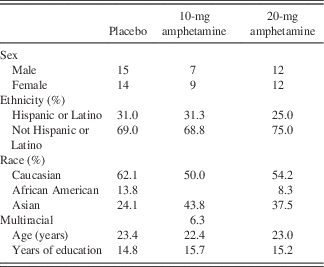
Sixty-nine participants (34 males) met study inclusion/exclusion criteria and completed all three experimental tasks. Participants ranged from 18 to 34 years of age with a median age of 22. Experimental groups did not significantly differ with regard to age, sex, years of education, or ethnic/racial composition. Characteristics are presented in Table 1.
Demographic characteristics

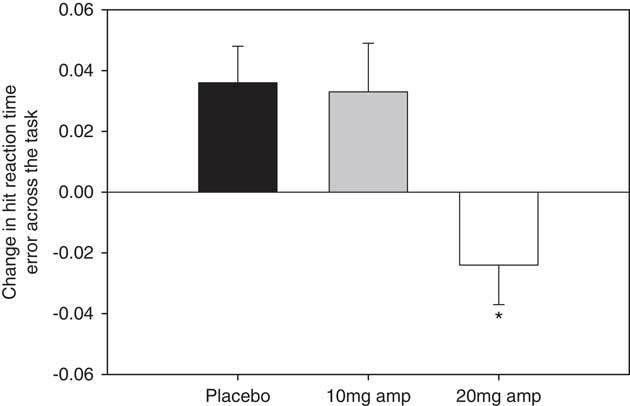
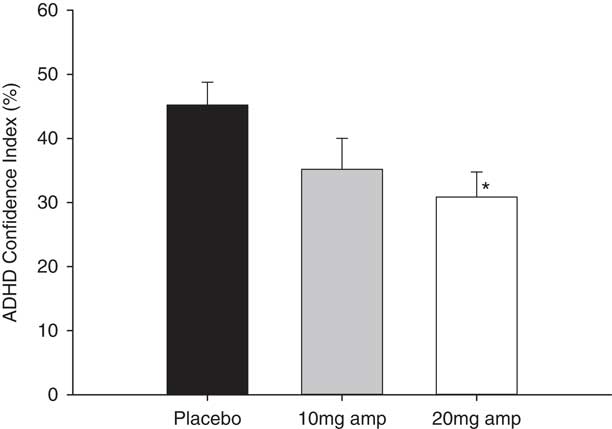
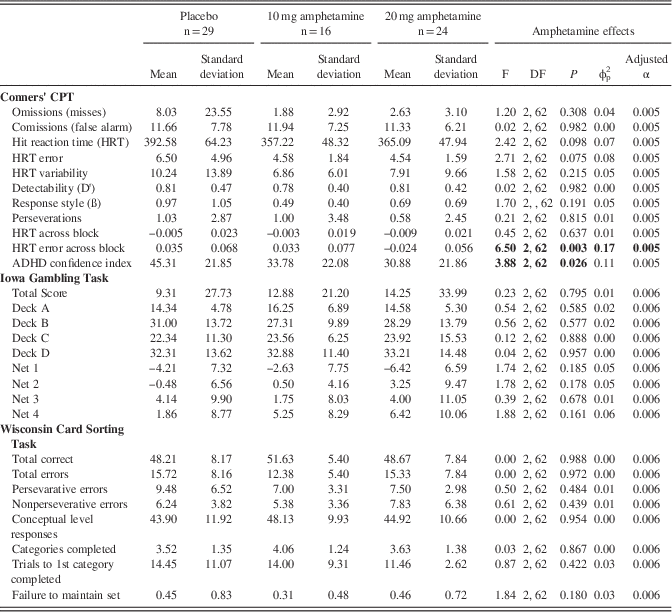
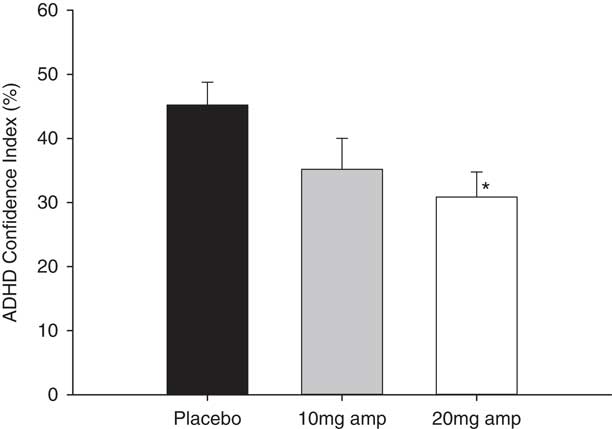
Significant effects of D-amp were detected on change in HRT error across the task (F (2,62)=6.5; p=.003; ϕp 2=.17), with post hoc analyses revealing a significant difference between placebo, wherein HRT error increased across the task, compared with the 20-mg dose of D-amp, for which a reduction in HRT error was observed (p<.042; see Figure 1 and Table 2). As presented in Figure 2, D-amp also impacted the ADHD Confidence Index measure (F (2,62)=3.9; p=.026; ϕp 2=.11) with a lower confidence index observed at the 20-mg dose relative to placebo (p=.009). This effect is considered trend level, however, as the adjusted α threshold (<.005) was not met. A significant effect of sex was detected on the CPT with male participants producing a higher ADHD confidence Index (F (1,62)=22.9; p<.001; ϕp 2=.27). This effect was expected as sex is a weighted variable included in the discriminant function which produces the ADHD confidence Index. A trend was also observed in which males produced more perseverative responses on the CPT (F (1,62)=4.7; p=.033; ϕp 2=.07). Significant effects were not observed on any other measure of the CPT with regard to sex (p range: .319–.877) or interactions between dose and sex (p range: .147–.991). No effects were detected on the IGT or WCST with regard to dose (p range: .161–.957), sex (p range: .057–.988), or their interaction (p range: .122–.990).
Amphetamine reduced the variability in HRT across trial blocks of healthy human participants performing the Conners’ CPT-2 irrespective of sex. Asterisks represent a significant difference from placebo (p<.05).

Amphetamine treatment reduced ADHD Confidence Index produced by the Conners’ CPT-2 in healthy human participants, irrespective of sex. Asterisks represent a significant difference from placebo (p<.05).
Descriptive statistics and analysis of primary outcome measures

Note. Statistical tests meeting traditional significance have been highlighted in bold. Effect size and the Bonferroni corrected significance are also highlighted in bold when adjusted significance criteria were met.
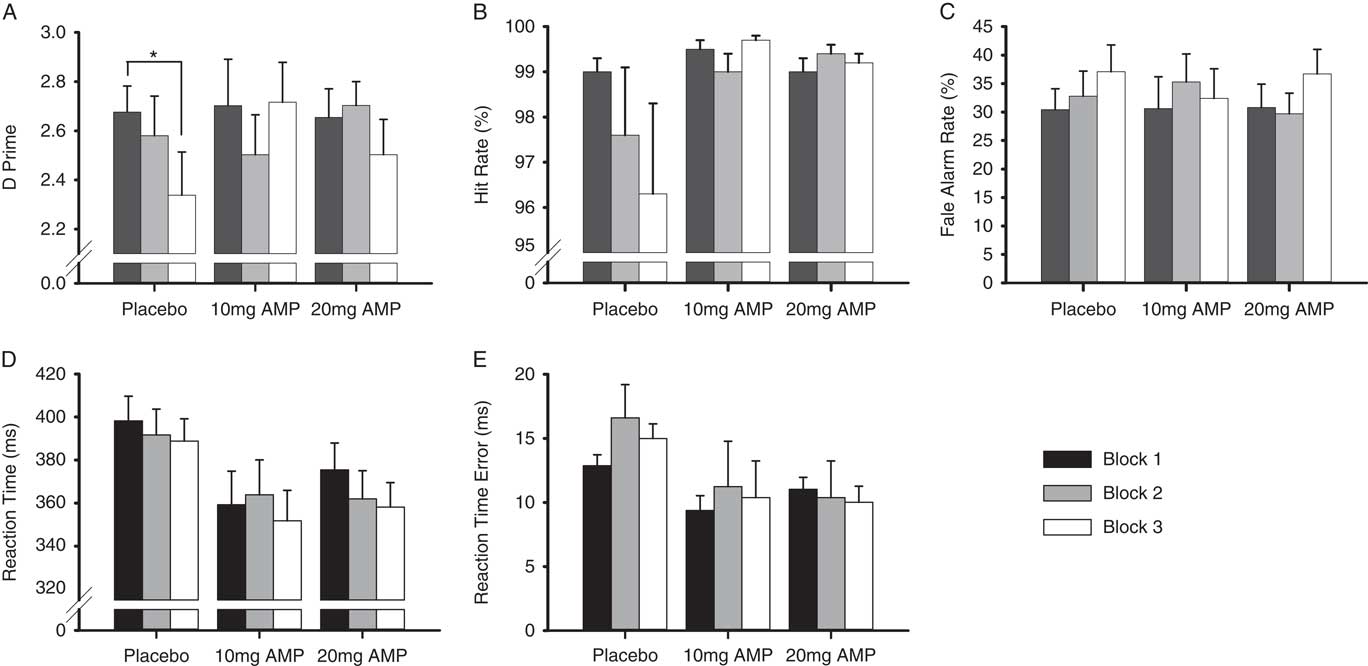
Given that D-amp is reputed to exert effects on the maintenance of attention over time, with vigilance decrements commonly observed in CPTs, select measures (D’, Hit Rate, False Alarm Rate, HRT, and HRT Error) from the task were additionally evaluated across three trial blocks. Significant main effects were not detected on any CPT measure with regard to dose (p range: .294–.985), sex (p range: .778–.918), or trial block (p range: .285–.710). In contrast, and consistent with our a priori hypothesis, a significant dose by block interaction on D’ was observed (F (4,124)=2.7; p=.036; ϕp 2=.08). One-way ANOVAs revealed a significant effect of trial block on D’ for participants receiving placebo (F (2,56)=5.0; p=.010; ϕp 2=.15), that is, a vigilance decrement, but not for those receiving either the 10 mg (F (2,30)=2.1; p=.14; ϕp 2=.12) or 20 mg (F (2,46)=2.3; p=.11; ϕp 2=0.09) doses of D-amp, as illustrated in Figure 3A.
Vigilance decrement was observed in placebo- but not amphetamine-treated healthy human participants performing the Conners’ CPT-2 as measured by D’ (A), driven in part by changes in target responding (Hit Rate; B) and responses to non-targets (False Alarm Rate; C), across trial blocks. RT and RT variability are presented in panels D and E, respectively. Asterisks represent a significant difference from block 1 performance (p<.05).

DISCUSSION
The present findings demonstrate that, in addition to improving attention in disease states, D-amp at 10 and 20 mg was effective for the enhancement of attention in healthy adults. D-amp enhanced vigilance by blocking the progressive deterioration of attentional performance over time; the classic vigilance decrement (for a review, See Howe, Warm, & Dember, Reference See, Howe, Warm and Dember1995). Consistent with improved vigilance, participants receiving the 20-mg dose of D-amp also exhibited statistically significant reductions in magnitude of HRT error across the task. A dose-dependent reduction in the ADHD Confidence Index was also observed, although this trend did not meet the adjusted significance threshold.
Prior studies have demonstrated D-amp-induced improvement of CPT performance among children (Sostek et al., Reference Sostek, Buchsbaum and Rapoport1980), but not adults (Ernst et al., Reference Ernst, Zametkin, Matochik, Schmidt, Jons, Liebenauer and Cohen1997; Slattum et al., Reference Slattum, Venitz and Barr1996; Sostek et al., Reference Sostek, Buchsbaum and Rapoport1980), while global reductions in RT have been observed with both D-amp (Fleming et al., Reference Fleming, Bigelow, Weinberger and Goldberg1995), and another ADHD-approved stimulant medication, methylphenidate (Cooper et al., Reference Cooper, Keage, Hermens, Williams, Debrota, Clark and Gordon2005; Klorman et al., Reference Klorman, Bauer, Coons, Lewis, Peloquin, Perlmutter and Strauss1984; Strauss et al., Reference Strauss, Lewis, Klorman, Peloquin, Perlmutter and Salzman1984). The present study benefitted from a larger sample size than is typical of studies stimulant effects on CPT performance in healthy adults. Given the strong performance of healthy participants under placebo conditions, it is not surprising that facilitative effects were somewhat subtle, potentially explaining the failure of prior studies to detect performance-enhancing effects.
The present findings, however, do support the feasibility of detecting pro-cognitive drug effects with a standardized CPT in healthy adults. The most prominent effect of amphetamine was a reduction of the change in HRT error across the task which is consistent with recent reports of amphetamine improving simple RT task performance by reducing the occurrence of long RTs, considered to reflect lapses of attention (Weafer & de Wit, Reference Weafer and de Wit2013). Notably, increased RT variability is a prominent feature of ADHD (Gu, Gau, Tzang, & Hsu, Reference Gu, Gau, Tzang and Hsu2013; Lin, Hwang-Gu, & Gau, Reference Lin, Hwang-Gu and Gau2015) that significantly impairs reading ability (Tamm et al., Reference Tamm, Epstein, Denton, Vaughn, Peugh and Willcutt2014). While reRT variability may serve as a useful endophenotype of ADHD, amphetamine effects appear nonspecific to individuals with deficits in this domain.
Although not marketed for this purpose, reports of amphetamine and other stimulant use for cognitive enhancement among students, academics, and other professions requiring vigilance has long been reported (Smith & Farah, Reference Smith and Farah2011). The relative paucity of positive findings regarding cognitive enhancement in modern studies of healthy individuals, however, has led investigators to question whether such use is even effective (Ilieva & Farah, Reference Ilieva and Farah2013). The present study lends support for acute enhancement of vigilance in healthy individuals, but further work is required to establish who benefits most from stimulant treatment, whether such gains are maintained with extended use, and to evaluate the balance of these gains with adverse side effects (see Farah, Reference Farah2015).
Notably, a prominent trend toward dose-dependent reduction of the ADHD confidence index was observed. The confidence index is a composite of demographic and performance measures (sex, age, percent omissions, SE by ISI, HRT, response style, D’, and RT by block), which has been demonstrated to prospectively predict ADHD diagnosis from childhood performance (Breaux, Griffith, & Harvey, Reference Breaux, Griffith and Harvey2016). This trend suggests that, in healthy adults, D-amp may enhance those aspects of CPT performance that are related to impairment in individuals with ADHD. Hence, the neuro-enhancing properties of amphetamine are likely not constrained to rectifying attentional deficits associated with ADHD.
Of the Conner’s CPT measures, RT variability has been reported to have the strongest relationship to ADHD symptoms, with evidence that stimulant treatment has an enduring effect on RT deficits (Epstein et al., Reference Epstein, Conners, Hervey, Tonev, Arnold and Abikoff2006). It is important to consider, however, accuracy and RT in conjunction since faster RTs may result in more errors, reflecting a speed-accuracy trade-off. In the present study, improvements were observed with regard to vigilance (D’) at both doses, without a significant RT cost and in the context of reduced RT error variability at 20 mg. The beneficial effect of D-amp could relate to its greater selectivity of norepinephrine versus dopamine transporters (NET and DAT, respectively), but mechanistic studies using more selective treatments are required.
It is also critical to consider whether the effect of D-amp is selective to attention or whether the observed enhancement of attention derives from an effect on other task-relevant processes such as impulsivity or arousal. Importantly, while D-amp improved measures of attention and vigilance (D’ and change in RT variability), it did not affect response style (β; tendency toward responding or non-responding). D-amp also did not affect response inhibition (i.e., false alarms), or perseverative responses on the CPT, which are indicative of impulsivity. Prior studies in healthy adults have found D-amp to reduce impulsivity as measured by false alarms on a Go/No-Go task (de Wit, Enggasser, & Richards, Reference de Wit, Enggasser and Richards2002), relative stop RT on the stop task (de Wit et al., Reference de Wit, Enggasser and Richards2002; Hamidovic, Dlugos, Skol, Palmer, & de Wit, Reference Hamidovic, Dlugos, Skol, Palmer and de Wit2009; Weafer & de Wit, Reference Weafer and de Wit2013) and delay discounting (de Wit et al., Reference de Wit, Enggasser and Richards2002).
These findings are further supported by preclinical data demonstrating D-amp induced reduction of impulsive responses on a fixed consecutive number schedule in mice (Rivalan, Gregoire, & Dellu-Hagedorn, Reference Rivalan, Gregoire and Dellu-Hagedorn2007) and delay discounting in mice (Helms, Reeves, & Mitchell, Reference Helms, Reeves and Mitchell2006) and rats (Bizot, David, & Trovero, Reference Bizot, David and Trovero2011). In the present study, the lack of an amphetamine effect on impulsivity-related measures may have resulted from a floor effect as healthy subjects produced few false alarms and perseverations. It should also be noted that, in both humans and rodents, general performance and the effects of amphetamine across disparate measures of impulsivity are inconsistent, suggesting the influence of distinct neural correlates on aspects of impulsivity.
Effects of D-amp were not detected on the WCST, a task sensitive to learning, set-shifting, and perseveration effects, consistent with prior studies in healthy adults (Fleming et al., Reference Fleming, Bigelow, Weinberger and Goldberg1995; Mattay et al., Reference Mattay, Berman, Ostrem, Esposito, Van Horn, Bigelow and Weinberger1996, Reference Mattay, Goldberg, Fera, Hariri, Tessitore, Egan and Weinberger2003). Additionally, no effect of D-amp was observed on IGT performance, a task sensitive to effects on perseveration, learning, and risk-taking. With regard to arousal, a prior report on the effects of the D-amp on activity in healthy adults with the doses used presently revealed that the 20-mg dose protected individuals from significant declines in activity during behavioral pattern monitoring (Minassian et al., Reference Minassian, Young, Cope, Henry, Geyer and Perry2016). This effect was not observed, however, at the 10-mg dose and neither dose produced effects on exploration or the pattern of spatial of spatial movement. Thus, while D-amp-induced enhancement of CPT performance is not easily accounted for by effects on response strategy, perseveration, impulsivity, or risk-taking, it may not be dissociable from increased arousal in healthy adults.
As a whole, the present data support the conclusion that D-amp improves the vigilance of healthy adults in a manner similar to effects observed in patients with ADHD. Thus, in addition to clarifying that D-amp improves attention alone and may not simply be remediating pathological processes involved in ADHD, it also reveals neurobiological substrates underlying attentional control. Amphetamine increases synaptic availability of both dopamine and norepinephrine in large part through its inhibitory action on catecholamine transporters (i.e., DAT and NET). With regard to vigilance, the relative contributions of dopaminergic and noradrenergic signaling remain ambiguous and critical circuits have yet to be delineated. A full understanding of these processes is likely to require animal models in which relevant physiological assessments and manipulations can be performed.
This effort can be significantly aided by the use of cross-species tasks that enable analogous testing in humans and animals, such as the 5-Choice CPT (5C-CPT). The 5C-CPT is available for testing in mice (Young, Light, Marston, Sharp, & Geyer, Reference Young, Light, Marston, Sharp and Geyer2009), is human functional magnetic resonance imaging (McKenna, Young, Dawes, Asgaard, & Eyler, Reference McKenna, Young, Dawes, Asgaard and Eyler2013) and electroencephalogram (Young et al., Reference Young, Bismark, Sun, Zhang, McIlwain, Grootendorst and Light2017) compatible, and is sensitive to clinical pathology (Young et al., Reference Young, Geyer, Rissling, Sharp, Eyler, Asgaard and Light2013; Reference Young, Bismark, Sun, Zhang, McIlwain, Grootendorst and Light2017). Thus, the use of the 5C-CPT is likely to aid in delineating the contribution of dopaminergic and noradrenergic signaling to vigilance performance. For example, mice with reduced D4 receptor expression exhibit response disinhibition and poor vigilance on the 5C-CPT (Young, Powell, Scott, Zhou, & Geyer, Reference Young, Powell, Scott, Zhou and Geyer2011), suggesting a potential therapeutic target. Indeed when Hayward, Tomlinson, and Neill (Reference Hayward, Tomlinson and Neill2016) treated rats with high response disinhibition with a dopamine D4 receptor agonist remediated their deficits. Conducting human within-subject dose-response studies with potential catecholaminergic treatments may also reveal individuals sensitive to such treatments. Evidence that amphetamine can improve human and rodent 5C-CPT performance consistent with the present studies is first required.
Several limitations are worth noting. For example, at the doses used, D-amp produced physiological and psychological effects that may be detectable to participants and spoil the blinding tactic. Participants were informed, however, that they may receive caffeine, amphetamine, modafinil, or placebo, limiting the potential expectancy confound. Although we previously reported D-amp inducing modest hyperactivity in healthy human participants (Minassian et al., Reference Minassian, Young, Cope, Henry, Geyer and Perry2016), no effect on response bias was detected in the current study and it is unlikely that the pro-cognitive effects observed resulted from changes in learning, perseveration, or non-specific arousal. In sum, we report that D-amp enhanced vigilance among healthy adult participants, consistent with reports on its effects in patients with ADHD. Detection of these subtle effects required a sample size larger than typical of earlier studies.
Acknowledgments
We thank all of the participants who volunteered for these studies, which were made possible by funding from NIMH grants R01MH104344-03, and R01 MH071916, as well as by the Veteran’s Administration VISN 22 Mental Illness Research, Education, and Clinical Center. The authors do not have a financial relationship with the funding organizations, and had full control of all primary data. The authors thank Dr. Harriet De Wit for her assistance in designing this study, and Dustin Kreitner, Mahalah Buell, Elise Winbrock, and Karen Kloezeman for their contributions to data collection and analysis.