Introduction
The boundary of Everglades National Park extends into Florida Bay, which comprises c. 162 000 hectares of the Park (Hallac et al. Reference Hallac, Sadle, Pearlstine and Herling2008). Most of the Bay is shallow, averaging about a metre in depth, and navigational charts plus local knowledge are necessary to avoid running aground on mudflats. During the Wisconsin Glaciation, when sea level was nearly 100 m lower than at present, all of the Bay was exposed and subject to erosional forces (Petuch & Roberts Reference Petuch and Roberts2007). Thus a person could have walked over dry ground from today's southern tip of mainland Florida in a direct line to Key West. Over the last 5000 years, as sea levels rose, the whole area became inundated except for c. 200 marl outcroppings called keys (or cays) in the local vernacular (Robertson Reference Robertson1955; Petuch & Roberts Reference Petuch and Roberts2007). The origin of these is still a subject of debate and no one theory is universally accepted. They range in size from one to over 50 hectares and are ringed by mangrove with interior prairies dominated by grasses, halophytic plants or mudflats. Scattered buttonwood (Conocarpus erectus) and trees of West Indian origin (Tomlinson Reference Tomlinson1980) often inhabit the interior portions. Many keys are ringed by extensive shallow mudflats and are accessible only by canoe, kayak or by wading ashore.
The corticolous and lignicolous lichen flora of the keys is abundant, frequently with a 30 cm2 area harbouring 15 or more species, often with no interspaces. Botanically and meteorologically most of Everglades National Park can be considered tropical or subtropical, and lichen genera such as Enterographa Fée, which are largely restricted to the tropics, are well represented here. Sparrius (Reference Sparrius2004) monographed the genus, accepting 35 species. As often happens after a generic monograph, a large number of additional species (16 exclusive of this paper) have rapidly been described. Therefore, building upon the previous work of Sparrius, an updated world key is provided that now includes 55 species. Twenty-one of these are known only from either the type specimen or the type locality. However, many species of Enterographa form only small thalli and are somewhat cryptic. It is quite possible that species are frequently overlooked by collectors and are more widespread than believed. During the years 2010–2012, we made lichen inventories at 27 of the keys. Eight species of Enterographa were identified from these collections, the four described as new below plus Enterographa anguinella (Nyl.) Redinger, E. pallidella (Nyl.) Redinger, E. subserialis (Nyl.) Redinger, and E. tropica Sparrius. Of the 11 species currently known from Everglades National Park, six are restricted to the keys, two to the mainland with three inhabiting both areas. A discussion of the Everglades mainland, including topography, plant communities capable of harbouring lichens and difficulties of collecting, was provided in a previous work (Seavey & Seavey Reference Seavey and Seavey2011).
Materials and Methods
All collections were examined using standard stereoscopic and light microscope techniques. A Leica DFC295 compound microscope and a Leica S8APO inspection microscope were used to examine hand-cut sections and thalline superficial structures, respectively. All macroscopic and microscopic images were captured via computer using Leica Application Suite V4.2.0 28 software. Water mounts of sections were observed in a 10% aqueous solution of potassium hydroxide, Lugol's solution (1% iodine in 10% potassium iodide) and phloxine (1% aqueous solution). Measurements of internal structures were computer-generated and obtained from water mounts. The software's automatic setting was employed and may have enhanced some of the images. No additional enhancement was used unless noted. Spot test abbreviations used are C (sodium hypochlorite), I (iodine), K (potassium hydroxide) and P (para-phenylenediamine). Thin-layer chromatography (TLC) was carried out in accordance with Orange et al. (Reference Orange, James and White2001), using systems A and C. All collections are corticolous from Everglades National Park and were made by the authors unless otherwise noted. They will be curated at the South Florida Collection Management Center (FNPS) except for isotypes as indicated.
The New Species
Enterographa bradleyana F. Seavey & J. Seavey sp. nov.
MycoBank No.: MB804776
Similar to Enterographa divergens but ascospores smaller, perispore wider, differing also by containing gyrophoric acid.
Type: USA, Florida, Monroe County, Everglades National Park, Bradley Key, 25°08′ N, 80°57′ W, corticolous on Avicennia germinans in upland zone with halophytic understorey, 4 April 2010, F. Seavey & J. Seavey, 8153E (FNPS—holotype; FLAS—isotype).
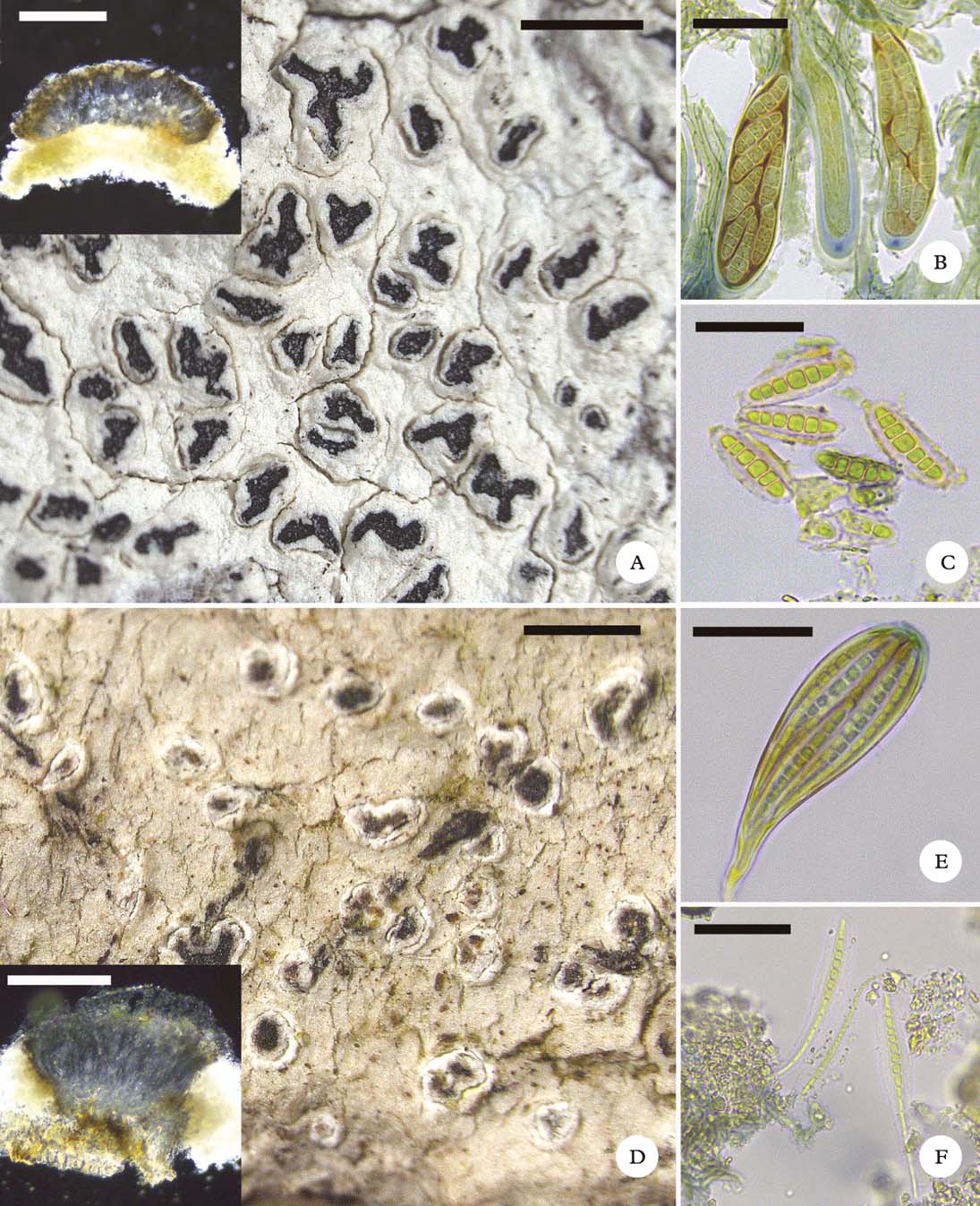
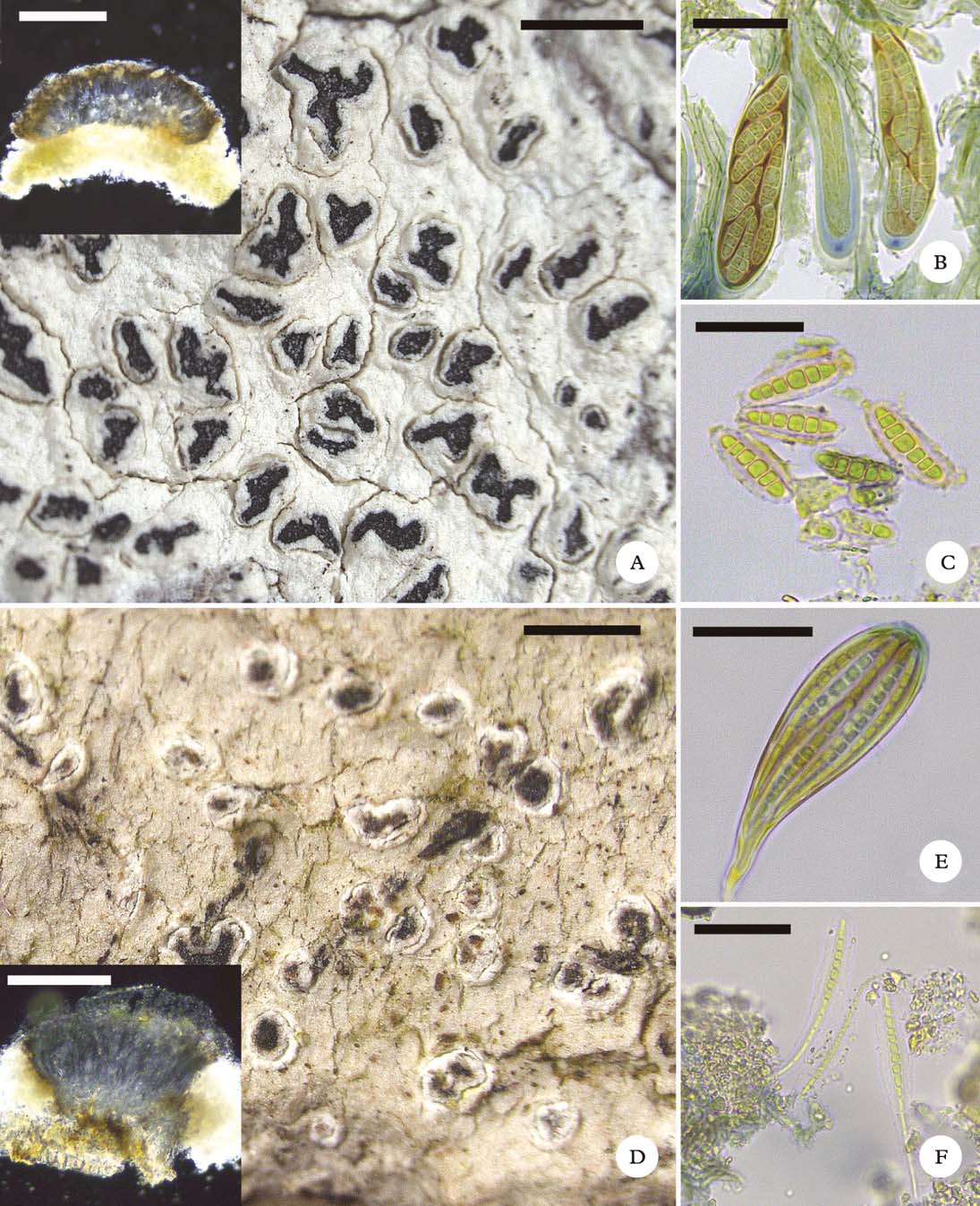
A–C, Enterographa bradleyana; A, thallus and ascomata in thalline verrucae (insert: ascoma section showing crystalline encrusted epithecium); B, asci at 3 stages of development; C, mature ascospores with distinct perispore. D–F, E. caudata; D, thallus and ascomata in thalline verrucae (insert: ascoma section with thalline margin); E, ascus; F, ascospores with long acicular tail. Scales: A & D inserts=200 µm; A & D=1 mm; B, C, E & F=20 µm.
Thallus ecorticate, 1–5 cm diam., continuous, verrucose, pale greyish white, 60–150 µm thick, medulla white, inspersed with small oxalate crystals, prothallus absent. Photobiont Trentepohlia.
Ascomata black, encrusted with large white crystals, broadly open, round, ellipsoid, or linear and often short-branched, 0·30–0·60×0·15–0·50 mm, immersed in thalline verrucae, 0·4–0·7 mm wide, not in pseudostromata; thalline margin present, 0·05–0·10 mm wide. Exciple pale brown, 15–25 µm wide. Hypothecium pale brown, lightly oil inspersed, 40–65 µm tall. Hymenium hyaline, 80–110 µm tall, paraphysoids 0·95–1·05 µm wide, branched and anastomosing. Epithecium c. 15 µm tall, brown, K−. Asci 70–80×16–18 µm, cylindrical, 8-spored. Ascospores ellipsoid/fusiform (17–)19–23 (–25)×4·5–5·5 µm, 5–7-celled, perispore 1·5–1·7 µm wide.
Pycnidia brown to dark brown, walls orange-brown in section, 65–75 µm, often found inside the carbonized margin between two lichens; conidia hyaline, simple, 4–6×1 µm.
Chemistry
Thallus K−, C+ pink-red (gyrophoric acid), P−; amyloidy: epihymenium and hypothecium I+ blue, KI+ blue, exciple I+ weakly blue, KI+ blue, hymenium and asci I+ red, KI+ blue.
Etymology
The name commemorates Guy Bradley, an Audubon warden, murdered in Florida Bay by plume hunters in the first decade of the 20th century.
Ecology and distribution
Enterographa bradleyana is common in the interior of most keys visited, usually in full sun. It inhabits both bark and lignum but apparently avoids the peripheral red mangrove tidal zone of the islands.
Discussion
The thin-walled ascospores of this species are more diagnostic of Chiodecton than Enterographa. However, Chiodecton is described as having a carbonaceous hypothecium, perithecioid ascomata and normally roccellic acid, all absent from E. bradleyana. Furthermore, ascospores of Chiodecton are not known to possess perispores which are quite pronounced in E. bradleyana (Fig. 1C). Visually, E. bradleyana is somewhat similar to E. caudata, E. divergens, E. elixii and E. mesomela. However, E. divergens contains no substances, has larger ascospores and a considerably narrower perispore. Enterographa elixii also has larger ascospores and a narrower perispore, while containing psoromic acid and an I+ blue reacting hymenium. Enterographa caudata, described below, has a different chemistry and dramatically larger, differently shaped ascospores with greater septation. Enterographa mesomela differs by having confluentic acid, an I+ blue hymenium and smaller ascospores without a long acicular tail.
Additional specimens examined. USA: Florida: Monroe Co., Buoy Key, on Avicennia germinans, 2011, Hernandez 9011E; Rankin Key, on Avicennia germinans, 2011, 6611E; Clive Key, on Cocos nucifera, 2010, 3481E; Johnson Key, on Avicennia germinans, 2011, 5214E; Big Key, on Avicennia germinans, 2011, 8067E; End Key, on Avicennia germinans, 2011, 6541E; Dump Key, on Avicennia germinans, 2011, 6915E.
Enterographa caudata F. Seavey & J. Seavey sp. nov.
MycoBank No.: MB804777
Thallus grey, continuous, with effuse margins. Apothecia open, round to angular, 0·09–0·23×0·08–0·17 mm, not in pseudostromata. Hymenium I+ red. Ascospores (37–)45–60(–67)×3–4 µm, 9–14 septate, with long acicular tails, perispore 2·5–3·5 µm wide. Containing schizopeltic acid and lichexanthone.
Type: USA, Florida, Miami-Dade County, Everglades National Park, 2 miles west of abandoned missile base, 25°22′N, 80°43′W, corticolous on Ilex cassine in hardwood scrub zone, 3 March 2012, F. Seavey & J. Seavey, 12931E (FNPS—holotype; FLAS—isotype).
Thallus ecorticate, 1·0–2·5 cm diam., pale grey, continuous, smooth, margins effuse, 130–180 µm thick, medulla white, prothallus absent. Photobiont Trentepohlia.
Ascomata black, open, round to more commonly angular, epruinose, with or without large white crystals, immersed in low thalline verrucae, these often ringed by white powdery/granular thalline material; disc 0·09–0·23×0·08–0·17 mm, not in pseudostromata, thalline margin present 0·01–0·02 mm wide. Exciple pale brown, c. 15 µm wide. Hypothecium hyaline or pale yellow, 45–55 µm tall. Hymenium hyaline, 95–120 µm tall, paraphysoids 1·4–1·9 µm wide, branched and anastomosing. Epithecium c. 20 µm tall, brown, K+ olive-green. Asci 60–75×17–25 µm, clavate, 8-spored. Ascospores fusiform (37–)45–60(–67)×3–4 µm, 10–15-celled usually with a long acicular often hook-shaped tail, perispore 2·5–3·5 µm wide.
Pycnidia not detected.
Chemistry
Thallus K−, C−, P−, UV+ yellow (schizopeltic acid, lichexanthone); amyloidy: epihymenium, hypothecium, hymenium and asci I+ red, KI+ blue.
Etymology
Name referring to long tails of the ascospores.
Ecology and distribution
Enterographa caudata is currently known from hardwood scrub zones in well-lit areas and widely distributed, at least in the eastern half of the Park.
Discussion
Enterographa caudata is characterized by its unique chemistry within the genus, long ascospores with acicular tails and its I+ red hymenium. For a comparison of similar species, see discussion at E. bradleyana above. Also similar is a synonym of E. anguinella, formerly known as E. lecanoroides, which contains psoromic acid and lacks a prominent ascospore acicular tail.
Additional specimens examined. USA: Florida: Miami-Dade Co., south of Tamiami Trail near Blue Shanty canal, on Salix caroliniana, 2005, 12927E; 2 km west of abandoned missile base, on Ilex cassine, 2012, 12928E; glade trail west of Long Pine Key, on bark of dead tree, 2013, 12929E.
Enterographa murrayana F. Seavey & J. Seavey sp. nov.
MycoBank No.: MB804778
Similar to Enterographa anguinella but ascospores wider with more septa, perispore wider and containing gyrophoric acid.
Type: USA, Florida, Monroe County, Everglades National Park, Murray Key, 25°06′N, 80°56′W, corticolous on Rhizophora mangle in tidal zone of mixed mangrove species, 24 February 2010, F. Seavey & J. Seavey, 4949E (FNPS—holotype).
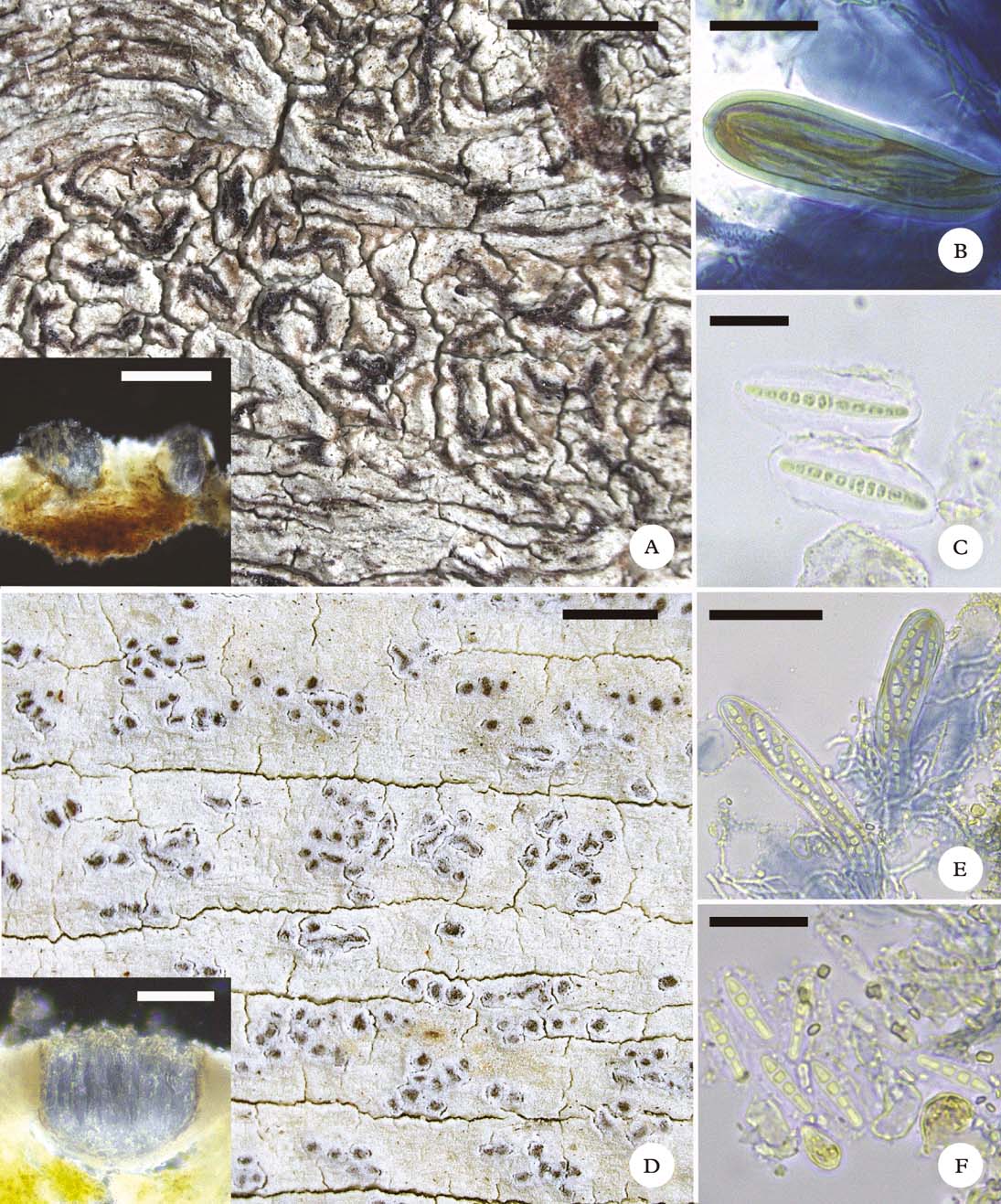
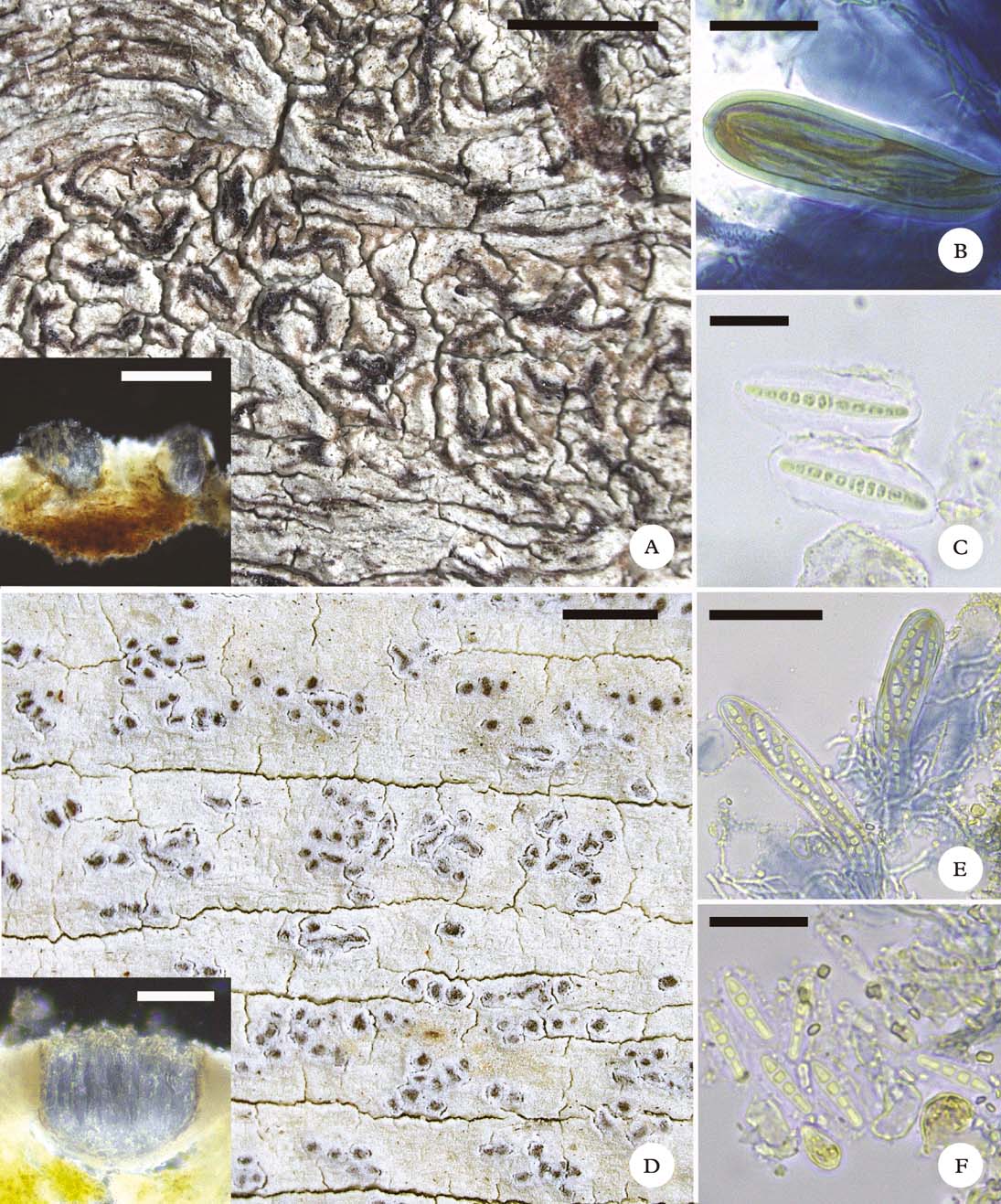
A–C, Enterographa murrayana; A, thallus with lirelliform ascomata (insert: ascoma section); B, ascus with well-developed ocular chamber; C, ascospores with characteristic broad perispore. D–F, E. nitidula; D, smooth, shiny thallus with punctate ascomata (insert: ascoma section); E, asci; F, consistently 4-celled ascospores. Scales: A & D inserts=200 µm; A & D=1 mm; B, C, E & F=20 µm.
Thallus ecorticate, 2–3 cm diam., continuous, smooth, pale grey, 120–260 µm thick, medulla white, prothallus absent. Photobiont Trentepohlia.
Ascomata brown to brown-black, epruinose, closed to tardily open, immersed, lirelliform following bark fissures, unbranched, 0·4–0·6×0·08–0·14 mm, not in pseudostromata, thalline margin absent. Exciple thin, hyaline to pale brown, 12–15 µm wide. Hypothecium hyaline to pale brown, 30–44 µm tall. Hymenium hyaline, 100–125 µm tall, paraphysoids 1·0–1·2 µm wide, branched and anastomosing. Epithecium c. 12 µm tall, hyaline to pale brown, K−. Asci 55–65×15–18 µm, narrowly clavate, 8-spored. Ascospores fusiform (37–)40–49(–58)×4·5–5·5 µm, 10–15-celled, perispore 4·0–4·5(–5·0) µm wide.
Pycnidia not detected.
Chemistry
Thallus K−, C+ pink-red (gyrophoric acid), P−; amyloidy: epihymenium, hymenium and asci I+ red, KI+ blue. Hypothecium I+ blue, KI+ blue.
Etymology
The name commemorates a Mrs Murray who resided on the Key as a squatter for many years in the early part of the 20th century and raised five fatherless children there. Her full name does not appear in any historical documents of the time.
Ecology and distribution
Currently known only from the one collection. However, superficially E. murrayana closely resembles E. anguinella and several species of Arthonia, all of which are common at the collection site. Thus, it seems eminently possible that subsequent investigation will show E. murrayana to be more common than currently indicated.
Discussion
Enterographa murrayana is distinguished by its long ascospores, extremely wide perispore and the presence of gyrophoric acid. Among other corticolous Enterographa lacking pseudostroma with an I+ red hymenium, only E. bradleyana (this paper) and E. pallidella, recently reported for North America (Seavey & Seavey Reference Seavey and Seavey2012), have a similar chemistry. However, the former has black apothecia immersed in thalline verrucae, smaller ascospores and a narrower perispore, while the latter has paler apothecia and smaller ascospores with a perispore rarely exceeding 1 µm wide.
Enterographa nitidula F. Seavey & J. Seavey sp. nov.
MycoBank No.: 804779
Similar to Enterographa inthanonensis but differing by its smaller ascospores, lack of true pseudostromatic tissue and a different chemistry.
Type: USA, Florida, Everglades National Park, Monroe County, Rankin Key, 25°07′N, 80°47′W, lignicolous on lignum of Conocarpus erectus in open prairie with halophytic herbaceous layer, 11 May 2012, F. Seavey & J. Seavey 12970E (FNPS—holotype).
Thallus ecorticate, 3–4 cm diam., continuous, smooth, white, with a somewhat glossy sheen, 200–300 µm thick, medulla white, prothallus absent. Photobiont Trentepohlia.
Ascomata black, epruinose, open, punctiform, immersed, 0·04–0·12 mm wide, randomly arranged in unraised bright white parts of the thallus, not in pseudostromata, thalline margin absent or occasionally present, 0·015–0·020 mm wide. Exciple thin, hyaline to pale brown, 8–16 µm wide. Hypothecium hyaline, 20–30 µm tall. Hymenium hyaline, 80–100 µm tall, paraphysoids 1·5–1·8 µm wide, branched and anastomosing. Epithecium 12–18 µm tall, pale brown, K+ olive-green. Asci 65–78×13–14 µm, narrowly clavate, 8-spored. Ascospores fusiform 16–19×4·0–4·5 µm, 4-celled, perispore c. 2·0 µm wide.
Pycnidia not detected.
Chemistry
Thallus K+ yellow (unknown substance: see below), C−, P−; amyloidy: epihymenium, hypothecium, hymenium and asci I+ red, KI+ blue.
Etymology
Name refers to the thallus sheen.
Ecology and distribution
Enterographa nitidula was collected only once from the lignum of Concarpus erectus, fully exposed to sunlight but out of the tidal zone and away from salt spray.
Discussion
Enterographa nitidula is characterized by its punctiform ascomata, small 4-celled spores, hymenium reacting I+ red and an unknown substance similar to 4-0-methylcryptochlorophaeic acid (solvent system C=26–27, solvent system A=31–32, spot brownish orange after char, green in long wave ultraviolet light). Although the thallus reacts strongly K+ yellow, no yellow effusion or crystal formation was observed in section. Further investigation via TLC may degrade the integrity of the type collection. A definitive metabolite identification will have to await HPLC analysis. Among other consistently 4-celled Enterographa, E. compunctula differs in having larger ascospores, a narrower perispore and a different chemistry.
World key to the species within Enterographa
The foundation of this key is based upon the work of Sparrius (Reference Sparrius2004). As stated above, subsequent to that work many new species have been described. Furthermore, recent data suggests that two species (Enterographa subcervina and E. zonata) with partially carbonized exciples nest within Enterographa and two others, E. anguinella and E. subserialis, are best placed in other genera. For convenience, all four have been included in this key with their Enterographa epithets followed by the citation explaining their relocation.
-
1 Species obligately foliicolous (infrequently corticolous on bamboo with E. multiseptata) ... 2
Species appearing on other substrata. ... 14
-
2(1) Ascospores 4-celled; thallus P+ yellow (psoromic acid). ... 3
Ascospores 6 or more celled; thallus P+ or P− ... 4
-
3(2) Thallus pale grey, circular, disjunct or several coalescing; ascospores 23–27×2·5–3·0 µm, perispore to 2·5 µm; known only from type locality, Chile ... E. falcata Lücking & V. Wirth
Thallus pale grey-green, effuse, not in circular pattern; ascospores 17–23×3–4 µm, perispore to 1·5 µm; Central America, eastern Paleotropics ... E. angustissima (Vain.) R. Sant.
-
4(2) Thallus C+ pink to red, (gyrophoric acid) ... 5
Thallus C−, P+ yellow (psoromic acid) or epithecium K+ yellow-orange, ... (E. batista) ... 6
-
5(4) Ascospores 18–24×2–5 µm, 6-celled; conidia filiform, 20×1 µm; ... Christmas Island, Papua New Guinea ... E. deslooveri Sérus.
Ascospores 23–30×2·5–4·0 µm, 6(8)-celled; conidia bacilliform, 3×1 µm; known only from type locality, Oregon, USA. ... E. oregonensis Sparrius & Björk
-
6(4) Epithecium K+ yellow-orange, containing pale orange pigment; ascospores 24–33× 3·5–4·5 µm, 8-celled; known only from the type locality, Brazil ... E. batistae Lücking & Sérus.
Epithecium K–, not containing orange pigment ... 7
-
7(6) Hypothecium dark brown; ascomatal disc chocolate brown; Costa Rica ... E. foliicola Matzer & Lücking
Hypothecium pale; ascomatal disc not chocolate brown ... 8
-
8(7) Thalline margin white, byssoid; disc pale orange; Central America ... E. byssoidea Lücking
Thalline margin not byssoid; disc not pale orange ... 9
-
9(8) Ascomata black, lirelliform, stellately branched; ascospores 8–12-celled, 22–36 µm long; tropical Asia, East Africa ... E. multiseptata R. Sant.
Ascomata not black, not stellately branched ... 10
-
10(9) Ascospores>30 µm long; ascomata pale yellow without brown tint; Seychelles ... E. seawardii Lücking & Henssen
Ascospores<30 µm long; ascomata darker, distinctly brown-tinted ... 11
-
11(10) Ascospores<23 µm long; thallus white; known only from the type collection, ... New Zealand ... E. bartlettii Sérus.
Ascospores>25 µm long; thallus greyish green to yellowish green ... 12
-
12(11) Photobiont (Phycopeltis) without cells in radiating plates; ascospores 8–10-celled; known only from the type locality, Mexico ... E. perez-higaredae Herrera-Campos & Lücking
Photobiont (Phycopeltis) with cells in radiating plates; ascospores 8-celled. ... 13
-
13(12) Thalline margin orange-brown, smooth; disc closed; Australia, New Zealand ... E. bella R. Sant.
Thalline margin grey-green, crenulate; disc open; Tanzania ... E. vezdae Sparrius
-
14(1) Species obligately lichenicolous ... 15
Species corticolous, lignicolous or saxicolous ... 20
-
15(14) Lichenicolous on Coenogonium ... 16
Lichenicolous on other genera ... 18
-
16(15) Ascomata apothecioid, raised, not forming in pseudostromatic tissue; ascospores 15–18 µm long, 8-celled; known only from the type locality, Kenya ... E. fellhaneroides Yeshitela et al.
Ascomata forming in pseudostromatic tissue ... 17
-
17(16) Ascospores averaging>17 µm long, consistently 8-celled; Papua New Guinea, Costa Rica, Brazil ... E. epiphylla (Sérus.) Ertz et al.
Ascospores averaging<17 µm long, 5–6-celled; known only from the type locality; Kenya ... E. meklitiae Yeshitela et al.
-
18(15) Lichenicolous on Lobaria; ascomata inducing gall formation; ascospores 17–21 µm long, 4-celled; known only from the type collection; Sri Lanka ... E. punctata Ertz & Diederich
Lichenicolous on other genera; ascomata not gall-inducing ... 19
-
19(18) Lichenicolous on foliicolous Mazosia; ascospores 4–5-celled; South-East Asia, Orient ... E. mazosiae R. Sant. ex Matzer & R. Sant.
Lichenicolous on Porina; ascospores 5–7-celled; British Isles, France ... E. brezhonega Sparrius & Aptroot
-
20(14) Exciple well developed apically, at least partially carbonized ... 21
Exciple poorly developed, never carbonized ... 22
-
21(20) Thallus K−, sorediate; ascospores<40 µm long; Pan-temperate ... E. zonata (Körb.) Källsten ex Torrente & Egea (Ertz et al. Reference Ertz, Miądlikowska, Lutoni, Dessein, Raspe, Vigneron, Hofstetter and Diederich2009)
Thallus K+ red (norstitic acid), esorediate; ascospores>40 µm long; known only from the type collection, Hawaii ... E. subcervina (Zahlbr.) Ertz (Ertz Reference Ertz2009)
-
22(20) Thallus sorediate ... 23
Thallus not sorediate ... 24
-
23(22) Thallus C+ pink-red, P−; ascospores>11 µm long, 4-celled; known only from the type locality; French Guiana ... E. zephyri Sparrius
Thallus C−, P+ red; ascospores<11 µm long, 5–6-celled; Great Britain ... E. sorediata Coppins & P. James
-
24(22) Thallus C+ pink-red (gyrophoric acid or erythrin) ... 25
Thallus C− ... 30
-
25(24) Ascospores averaging>40 µm long, 10–18-celled ... 26
Ascospores averaging<40 µm long (usually considerably less), 4–12-celled ... 27
-
26(25) Thallus P+ yellow (psoromic acid); thalline margin C+ pink-red; ascospores 2·5–4·0 µm wide; coastal, Black Sea, Mediterranean, Western Europe, Canary Islands ... E. elaborata (Leight.) Coppins & P. James
Thallus P−, ascospores 4·5–5·5 µm wide; Florida Keys, USA ... E. murrayana F. Seavey & J. Seavey
-
27(25) Disc pale yellow or pale brown; ascomata lirelliform, not prominent; thalline margin absent ... 28
Disc brown to black; ascomata rounded, prominent; thalline margin present ... 29
-
28(27) Saxicolous on volcanic rock; thallus thick and areolate; ascospores 18–25 µm long, 4–6-celled; Pantropical, coastal. ... E. leucolyta (Nyl.) Redinger
Corticolous (occasionally on Si rock but then thallus thin, i.e. not as above); ascospores 23–33 µm long, 7–13-celled; Pantropical ... E. pallidella (Nyl.) Redinger
-
29(27) Ascospores 17–23 µm long, 5–7-celled; disc black; Florida Keys, USA ... E. bradleyana F. Seavey & J. Seavey
Ascospores 25–40 µm long, 8-celled, disc brown; known only from the type locality, Chile ... E. lecanoracea Sipman
-
30(24) Ascospores 4-celled ... 31
Ascospores 5–25-celled ... 37
-
31(30) Ascomata arranged in pseudostromatic tissue ... 32
Ascomata not arranged in pseudostromatic tissue ... 35
-
32(31) Thallus P+ yellow (psoromic acid) ... 33
Thallus P− ... 34
-
33(32) Ascospores>25 µm long; ascomata ellipsoid, dark brown-black; known only from the type locality, Australia ... E. elixii Sparrius
Ascospores<25 µm long; ascomata lirelliform, stellately branched, brown; known only from the type locality, Indonesia ... E. pertusarioides Groenhart ex Sparrius
-
34(32) Ascospores<30 µm long; thallus K− (or brownish); ascomatal sections K+ yellow-orange precipitating norstictic acid crystals; Hawaii, Australia, Florida, USA. ... E. compunctula (Nyl.) Redinger
Ascospores>40 µm long; thallus K+ red (norstictic acid); ascomatal sections K+ green; Thailand ... E. inthanonensis Sparrius
-
35(31) Thallus P−; ascomata punctiform; ascospores 16–20 µm long; Florida Keys, USA ... E. nitidula F. Seavey & J. Seavey
Thallus P+ yellow (psoromic acid) ... 36
-
36(35) Ascospores>25 µm long; ascomata round to long lirelliform, pale brown; Cuba, Florida, USA ... E. albopunctata Sparrius
Ascospores<18 µm long; ascomata punctiform, dark brown to black; Seychelles ... E. aldabrensis Sparrius
-
37(30) Ascomata arranged in pseudostromatic tissue clearly differentiated in colour and/or structure from the rest of the thallus ... 38
Ascomata arranged otherwise ... 43
-
38(37) Thallus P+ yellow (psoromic acid); ascomatal sections emitting K+ yellow effusion and precipitating norstictic acid crystals; ascospores 25–40 µm long; Pantropical ... E. subserialis (Nyl.) Redinger (Ertz & Tehler Reference Ertz and Tehler2011)
Thallus P− ... 39
-
39(38) Thallus UV+ yellow (lichexanthone); Brazil ... E. kalbii Sparrius
Thallus UV− ... 40
-
40(39) Sections of pseudostroma emitting K+ yellow effusion, precipitating norstictic acid crystals ... 41
Sections of pseudostroma K−, not precipitating norstictic acid crystals ... 42
-
41(40) Averaging 5–15 ascomata per pseudostroma; excipulum dark brown; hymenium I+ blue; known only from the type collection, Brazil. ... E. subquassiicola Cáceres & Lücking
Averaging 5 or less ascomata per pseudostroma; excipulum pale orange; hymenium I+ red; Central and South America, Florida, USA ... E. quassiicola Fée
-
42(40) Ascomata apothecioid; ascospores averaging>35 µm long, consistently 8-celled; Brazil ... E. chiodectonoides Cáceres & Lücking
Ascomata perithecioid; ascospores averaging<35 µm long, 4–7-celled; known only from type collection, Zambia ... E. diederichiana Ertz
-
43(37) Thallus P+ yellow (psoromic acid) ... 44
Thallus P− ... 47
-
44(43) Ascospores averaging<30 µm long, 4–8-celled ... 45
Ascospores averaging>30 µm long, 8–17-celled ... 46
-
45(44) Thalline margin of ascomata often C+ pink-red; ascospores 20–25 µm long, 6–8-celled; saxicolous; Australia, New Zealand ... E. subgelatinosa (Stirt.) Redinger
Thalline margin of ascomata C−; ascospores 15–25 µm long, 4(–6)-celled; corticolous; India, Australia ... E. micrographa (Nyl.) Redinger
-
46(44) Ascomata black, punctiform; ascospores 13–17-celled; known only from type collection, India ... E. bengalensis Jagadeesh et al.
Ascomata pale to dark red-brown, lirelliform; ascospores 6–12-celled; Pantropical ... E. anguinella (Nyl.) Redinger (Ertz et al. Reference Ertz, Miądlikowska, Lutoni, Dessein, Raspe, Vigneron, Hofstetter and Diederich2009)
-
47(43) Thallus UV+ yellow; ascospores 45–60 µm long with acicular tail; Florida, USA ... E. caudata F. Seavey & J. Seavey
Thallus UV− or at least not yellow; ascospores without acicular tail ... 48
-
48(47) Ascospores>50 µm long, 15–20-celled; Brazil, Barbados ... E. multilocularis (Müll. Arg.) Sparrius
Ascospores<40 µm long, 5–12-celled ... 49
-
49(48) Ascomata broad, round to irregular ... 50
Ascomata punctiform to lirelliform ... 51
-
50(49) Ascospores<30 µm long, 6–8-celled; ascomata red-brown to black; South-East Asia, East Africa ... E. divergens (Müll. Arg.) Redinger
Ascospores>30 µm long, 8–10-celled; ascomata black; Thailand, Vietnam ... E. mesomela Sparrius et al.
-
51(49) Containing no substances ... 52
Containing confluentic acid ... 53
-
52(51) Conidiomata prominent, black, crater-like; ascomata lirelliform, brown; ascospores 6–12-celled; South-East Asia ... E. tropica Sparrius
Conidiomata inconspicuous, immersed; ascomata punctiform; ascospores consistently 8-celled; known only from the type locality, French Guyana ... E. sipmanii Sparrius
-
53(51) Ascomata comma-shaped to lirelliform, often branched; ascospores 25–32 µm long; Europe and eastern North America ... E. hutchinsiae (Leight.) A. Massal.
Ascomata punctiform to ellipsoid, not branched ... 54
-
54(53) Thallus lead grey to dark brownish grey; ascospores 27–35 µm long, 6–7-celled; conidia 6–8×1 µm; Mediterranean Europe, north-west Africa, Azores ... E. pitardii (B. de Lesd.) Redinger
Thallus olive-green; ascospores 30–38 µm, 5–8-celled; conidia 4–6×1 µm; western Europe, north-west Africa ... E. crassa (DC.) Fée
The authors are grateful to Dr Laurens Sparrius and Dr James Lendemer for their thorough reviews, comments and suggestions, which improved the manuscript greatly. Everglades National Park provided financial and logistical support for this project. Thanks also to Oren “Sonny” Bass for allowing us to tag along during his annual migratory bird surveys in the Everglade Keys.