Twiddler’s syndrome is a rare complication after pacemaker implantation referring to pacemaker malfunction due to patient’s deliberate or unintentional manipulation of the generator, resulting in coiling of the pacemaker leads with consequent dysfunction caused by dislodgement, lead fracture, or insulation defects. It is a well-recognised condition in adults and is suspected to be more prevalent in females, elderly, obese, and psychiatric patients.Reference Morales, Nava and Marquez1,Reference Fahraeus and Hoijer2 Its exact incidence is unknown but is estimated to be approximately 0.07–1.1% in 10 years with most cases occurring within the first year after implantation.Reference Morales, Nava and Marquez1–Reference Hill3 In children however, Twiddler’s syndrome has only occasionally been described.
Case report
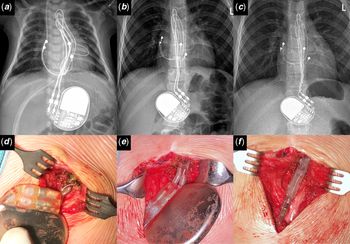
A 7.5-year-old girl (25.5 kg, 128 cm) with Down’s syndrome was incidentally diagnosed with Twiddler’s syndrome during routine follow-up. She had a history of surgical correction of a complete atrioventricular septal defect at the age of 2.5 months with subsequent complete heart block and implantation of a dual-chamber pacemaker generator with bipolar epicardial leads (Medtronic Sensia SEDRO1, CapsureEPI 4968-25 cm; Medtronic, Minneapolis, Minnesota, United States of America). Lead parameters during current follow-up were good (bipolar sensing P wave 2.8 mV, capture threshold 0.5 V at 0.40 ms, impedance 500 ohm for the atrial and capture threshold 1 V at 0.40 ms, impedance 432 ohm for the ventricular lead, respectively) and had not changed since the previous pacemaker interrogation. Since the patient had no detectable ventricular escape rhythm, intrinsic R wave could not be tested. However, in the routine chest X-ray performed due to patients’ growth, a 3.5-times axial rotation of the pacemaker generator located in a subcutaneous epigastric pocket was documented, having resulted in apparent lead coiling (Fig 1c). Retrospectively, it became evident that already in the previous radiogram at 6 years of age the generator has been turned half a revolution rightwards compared to the initial generator position (Fig 1b) which had not been noticed at that time. Additional prior radiograms did not show signs of device manipulation. Due to safety reasons, revision of the electrodes was decided. Surprisingly, after dissection of the pacemaker pocket, a 4 mm segment fracture of the ventricular lead insulation was noted (Fig 1d,e) despite regular lead function. After uncoiling of the leads (Supplementary video), the insulation defect was repaired (Fig 1e). In addition, the generator was exchanged (Boston Scientific Essentio DR L101, Boston, Marlborough, Massachusetts, United States of America) since the remaining estimated lifespan was only 22 months. To prevent recurring manipulation, it was positioned in a newly created sub-rectus pocket and thoroughly fixated with non-absorbable sutures. After the uneventful procedure, unchanged lead parameters were recorded.
(a–c) Chest radiography after pacemaker implantation at the age of 2.5 months (a), at previous follow-up at the age of 6 years (b) and at current follow-up at the age of 7.5 years (c), where coiling of the leads is clearly visible. Note that already in the previous radiogram (b) the generator has been turned half a revolution rightwards compared to the initial generator position (a). (d–f): Intraoperative findings with coiled leads (d) and after uncoiling (e). Note the clearly visible defect of the ventricular lead insulation (d and e) which was repaired using a silicon tubing (f).

Discussion
In Twiddler’s syndrome, manipulation of the generator by the patient, deliberately or unintentionally, results in coiling of the leads with eventual malfunction by dislodgement, lead fracture, or insulation defects. Our presented case is remarkable for several reasons. Reported cases of Twiddler’s syndrome in children are exceptionally rare with only a handful of published cases.Reference Abrams and Peart4–Reference Udink Ten Cate, Adelmann, Schmidt and Sreeram7 Moreover, to our knowledge, there is only one previous report of Twiddler’s syndrome in a pacemaker system with epicardial leads in a child.Reference Ellis, Reed and Fairbrother6 In addition, most cases of Twiddler’s syndrome are reported to occur early, within the first year after pacemaker implantation; however, as demonstrated by our case, it may also be observed several years after implantation. Also, the duration of device manipulation for more than 1.5 years was unusually long. Importantly, early subtle radiological signs of pulse generator rotation remained unnoticed. Finally, it emphasises the importance of pacemaker revision since lead defects may be present despite normal lead parameters. Unnoticed lead damages may result in acute pacemaker malfunction which is potentially lethal in pacemaker-dependent patients.
Conclusion
Though rare, Twiddler’s syndrome in children may occur during long-term follow-up after pacemaker implantation and also in pacemaker systems with epicardial leads and abdominal generator pocket. Lead revision is warranted regardless of lead function since unnoticed lead damages may be present which could result in acute and potentially lethal malfunction.
Supplementary Material
To view supplementary material for this article, please visit https://doi.org/10.1017/S1047951120001031
Acknowledgements
None.
Financial Support
This research received no specific grant from any funding agency, commercial or not-for-profit sectors.
Conflicts of Interest
None.