


I. Introduction: the EU’s Digital Omnibus as an acceleration of AI technosolutionism
There is a longstanding narrative that the European Union (EU) has been at the forefront of holding Big Tech accountable, pushing these companies to maintain certain standards in areas such as data protection or Artificial Intelligence not just in the EU, but globally. This so-called “Brussels effect”Footnote 1 has become a regular reference point in the literature, wherein the EU is conceived as a global leader in setting the normative and legal standards of the digital age (albeit not without contestation in the case of AI).Footnote 2 Through this framing, the academic community contributes to constructing the EU’s image as that of a “regulatory superpower,”Footnote 3 advancing a democratic and “human-centric” digital model. This narrative came to an abrupt end with the European Commission’s proposal of the “Digital Omnibus” on 19 November 2025, barely one year after the entry into force of the AI Act, prompting Politico Europe to claim that “the Brussels Effect is dead” and that “Brussels is done being the world’s digital policeman.”Footnote 4
The omnibus packages introduced by the second von der Leyen Commission are part of a broader deregulatory agenda that extends beyond digital policy to areas such as sustainability and business regulation. Within this broader shift, an omnibus proposal is a package of legislative proposals through which the EU can simultaneously amend multiple EU legal acts at the same time (albeit usually within the same policy area), bundling together reforms that would otherwise be addressed separately. From January 2025 until June 2026, the Commission has put forward twelve Omnibus packages,Footnote 5 each addressing a different area – our article focuses on Omnibus VII, the Digital Omnibus package, that encompasses two proposals: the ‘Digital Omnibus’ (which we will refer to as the ‘Data Omnibus’), which addresses mostly GDPR, and the ‘Digital Omnibus on AI’, which targets primarily the AI Act. While not inherently incompatible with EU law, the recent use of the Omnibus procedure marks a shift from a tool of technical consolidation to a vehicle for substantive and cross-sectoral policy change, raising concerns about its compatibility with constitutional principles such as proportionality and legislative participation.Footnote 6 In this context, the cross-sectoral logic is particularly consequential in the digital domain, where regulatory frameworks are deeply interconnected – for instance, AI has a massive environmental footprint and has led to resistance to data centres by grassroots and indigenous groups.Footnote 7
In the specific case of AI within Omnibus VII, it does not merely propose a revision of the AI Act, but has the potential to directly affect multiple elements of the EU digital acquis, notably the General Data Protection Regulation (GDPR) and the AI Act itself. Moreover, the procedures leading to the Digital Omnibus have been particularly problematic, considering that the “consultation timelines have been extraordinarily short, ‘reality checks’ focused almost exclusively on industry voices, and impact assessment assumptions implausibly optimistic, claiming no negative effect on fundamental rights despite clear evidence to the contrary.”Footnote 8 The Omnibus is hence the latest example of what has been labeled as the EU’s “post-regulatory state,”Footnote 9 whereby the role of policy-makers is increasingly oriented towards deregulating existing laws in order to increase the “competitiveness” of companies.
In this article, we examine specifically the Digital Omnibus package put forward by the European Commission focusing on the specific dimension of AI, and ask: What is the underlying socio-technical imaginary in relation to AI embedded in the European Commission’s Digital Omnibus initial proposal? We argue that the Digital Omnibus (Omnibus VII) package is not simply a neutral legislative technique aimed at simplification, but a device that produces institutional imaginaries and reconfigures the normative foundations of European digital governance. In doing so, it operates as an instrument of accelerated technosolutionism that reshapes the constitutional balance between rights protection, procedural integrity, and industrial competitiveness. In the case of AI, our analysis shows how the proposal to lower safeguards in the AI Act and GDPR articulates and normalises the imaginary that the EU can only join the “AI race” if it lowers its democratic and fundamental rights standards. In this sense, following the geopolitical and AI-first logic set up in the Commission’s April 2025 AI Continent Action Plan, the Digital Omnibus package proposal consolidates a competitiveness-driven imaginary and facilitates the expansion of data-intensive AI development models, notably through changes to the GDPR that enable broader access to personal data for training purposes.Footnote 10
However, while the Digital Omnibus package is certainly an attempt to deregulate EU digital laws, we argue that it represents an acceleration of a particular trajectory rather than a breaking point. The EU has never been the “world’s digital policeman” nor its digital laws have been particularly stringent on the surveillance capitalistFootnote 11 business models of Big Tech companies, as previous research has highlighted.Footnote 12 Indeed, during the past decade Big Tech lobbyists have become the biggest sectorial presence in Brussels. An October 2025 report by Corporate Europe Observatory confirmed that “Meta is the largest lobby spender in the EU for a single company. Notably, five of the top six companies who spend most on lobbying in Europe are tech companies.”Footnote 13 From this perspective, the Digital Omnibus package is the logical consequence of the larger pro-business trajectory that the EU has had vis-à-vis Big Tech companies, combined with a much more right-wing European Parliament after the 2024 EU elections, and the arrival of the second Trump presidency in January 2025. Hence, on AI the Digital Omnibus reproduces a more radical version of the Silicon Valley technosolutionism,Footnote 14 upon which the 2024 AI Act was built. The EU continues to see technology in general, and AI in particular, as an efficient way to address social, political and economic “problems,” which are conceived to be “technical” rather than political. Such an “AI-first” perspective represents a corporate takeover that puts “democracy-last.”
After this introduction, we put forward our theoretical framework, rooted in the notion of socio-technical imaginaries in relation to the ongoing discussions on the EU’s post-regulatory state. Third, we present our methods and data. Fourth, we narrate our empirical results on the Digital Omnibus. Finally, our conclusion lays out the normative implications of our analysis, emphasising the importance of conceiving AI and technology across the stack in order to address the oligarchic nature of Big Tech’s political economy and the dangerous threat to democracy it represents.
II. Socio-technical imaginaries in the Digital Omnibus and governing AI: desirable futures, depoliticisation, and technosolutionism
This section draws on the concept of socio-technical imaginaries to analyse how the Digital Omnibus package articulates and stabilises particular visions of Europe’s digital future. Socio-technical imaginaries are understood as “collectively held, institutionally stabilised and publicly performed visions of desirable futures, animated by shared understandings of forms of social life and social order attainable through, and supportive of, advances in science and technology”.Footnote 15 From this perspective, not every projection of the future constitutes a vision of the future: to be recognised as such, it must strike a chord with different groups, mobilise resources and be incorporated into practices relating to innovation, governance and social action.Footnote 16
The November 2025 Digital Omnibus package proposal represents a point of condensation of pre-existing tensions in EU digital policy: between the imaginary of the EU as a “regulatory superpower” and an emerging agenda of competitiveness and simplification that redefines what counts as good governance. The Omnibus should not be read merely as a technical correction or a contingent turn, but as part of a trajectory in which two structural promises of legitimacy coexist and compete: a normative one tied to fundamental rights and the containment of private power, and a strategic one oriented towards competitiveness, technological autonomy, and geopolitical capacity. As Broeders, Cristiano and KaminskaFootnote 17 argue, European digital governance is traversed by persistent frictions between fundamental rights, market principles, and geopolitical concerns, with the risk that strategic ambitions come into conflict with the EU’s normative commitments.Footnote 18
What the Digital Omnibus package reopens is not simply the dilemma of “rights versus markets,” but the question of which future is invoked to justify the redistribution of regulatory costs and the weakening of safeguards barely one year after the AI Act’s entry into force. To understand this rebalancing, it is necessary to attend to the future-oriented visions and institutional vocabularies (competitiveness, urgency, simplification, efficiency) that render acceleration politically defensible and transform democratic concessions into “necessary costs.” While often justified by the fast-paced development of digital technologies, such claims may also normalise trade-offs that weaken democratic safeguards.
At this level, socio-technical imaginaries become analytically central. They operate as a normative infrastructure that organises what is considered desirable, inevitable or urgent, and delimits which conflicts are interpreted as political and which are translated into “technical” problems. Their performative dimension implies that imaginaries do not merely describe possibilities but actively structure institutional and regulatory action.Footnote 19 From a semiotic and material perspective, imaginaries operate simultaneously across two registers. Through semiosis, they stabilise signifiers such as “trustworthy AI” or “human-centred AI” and organise legitimate frames of meaning, often in deliberately open-ended ways that allow for flexibility while projecting coherence. Through structuration, these meanings are embedded in material architectures such as agencies, compliance procedures and institutional routines.Footnote 20 This instituting function resonates with Castoriadis’ understanding of imaginaries as the creative source of social institutionsFootnote 21 and with Taylor’s emphasis on imaginaries as shared background conditions of legitimacy.Footnote 22 This dynamic is particularly intensified in the case of artificial intelligence. As a general-purpose and scalable technology, AI is not confined to a single domain but reconfigures socio-economic systems, while its epistemic opacity and the asymmetries of expertise between public authorities and private actors make governance especially dependent on future-oriented narratives. Hence, socio-technical imaginaries may contribute to normalising AI deployment as both necessary and inevitable,Footnote 23 reinforcing technosolutionist logics.Footnote 24
In the EU context, AI governance has been primarily organised around an imaginary of anticipatory risk management, which provides normative orientation for intervention before harms fully materialise.Footnote 25 The AI Act crystallises this rationality through a classificatory architecture that ranks systems by levels of risk and subjects high-risk uses to conformity obligations, certification and registration,Footnote 26 aligning with precaution as a legitimating basis for intervention under uncertainty.Footnote 27 At the same time, this architecture can generate democratic tensions when conflicts over values and distribution are displaced into technical solutions and expert procedures. Coeckelbergh warns of a “democratic deficit” when signifiers such as “trustworthy AI” or “human-centred AI” function less as substantive democratic commitments and more as legitimising devices that close down conflict through technical framing.Footnote 28 This critique connects with broader debates on technological solutionism. Morozov describes the tendency to frame social problems as technical ones, thereby obscuring their structural causes,Footnote 29 while Gillespie cautions that faith in technical solutions evades crucial questions about their social foundations.Footnote 30 In this sense, risk rationality can operate as a mechanism of depoliticisation, transforming normative disputes into issues of compliance and efficiency.
These imaginaries do not unfold in a political–economic vacuum. The literature on lobbying and regulatory capture has shown the capacity of major technology firms to influence agendas, produce expertise, and co-define standards.Footnote 31 Under conditions of epistemic asymmetry and dependence on private infrastructures, imaginaries are anchored in material capacities that privilege solutions compatible with dominant business models. If socio-technical imaginaries explain why certain futures and trade-offs become legitimate, the debate on the EU’s post-regulatory state helps explain how such reprogramming can be enacted. Traditionally, the EU has been interpreted as a regulatory state in the Majonean sense, where legitimacy is sustained through legality, proportionality and procedural guarantees.Footnote 32 The shift towards a “post-regulatory state”Footnote 33 does not imply withdrawal, but a mutation in governance: the blurring of public and private boundaries, the growing role of co-regulation and technical standards, and the centrality of private expertise.Footnote 34 This transformation is accompanied by a reorientation towards competitiveness and simplification, particularly visible under the second von der Leyen Commission.
It is in this context that omnibus legislation becomes theoretically salient as a technique inherent to the post-regulatory state. Alemanno shows that the omnibus has evolved from an occasional tool of technical consolidation into a “preferred vehicle” for implementing comprehensive deregulatory agendas while circumventing procedural integrity.Footnote 35 The omnibus packages bundle substantive amendments, functioning as instruments of cross-sector deregulation, postponement, and selective repeal. More decisively, the omnibus as a procedure operates as a “legislative infrastructure” that enables rapid shifts in regulatory orientation by reducing deliberative safeguards and evidentiary requirements that would normally accompany discrete amendments. This gives the omnibus a quasi-constitutional dimension: by compressing democratic time, it weakens participatory guarantees and strains the ideal of evidence-based and consultative lawmaking, particularly when urgency is invoked to justify limited impact assessments or restricted consultations.Footnote 36
This dynamic enables the article’s central analytical bridge. Socio-technical imaginaries delimit which futures are desirable and which costs are acceptable; the omnibus technique and the post-regulatory state delimit how those futures can be institutionalised under conditions of acceleration and reduced contestability. In other words, when technological governance is justified through narratives of urgency, global competition or simplification, the omnibus packages help stabilise and operationalise that semiosis: they translate these future-oriented narratives (competitiveness, simplification, efficiency) into transversal recalibrations of the regulatory framework under compressed timelines and diminished democratic contestation, where contestation is increasingly framed as inefficient.
From this articulation, we propose to understand the Digital Omnibus package focused on AI as a mechanism of institutional acceleration. Our contribution shifts the focus from what the omnibus “breaks” to what it accelerates and normalises. The omnibus does not itself create the turn towards competitiveness and deregulation, but intensifies and consolidates this turn as a dominant horizon. In terms of imaginaries, acceleration is not merely a procedural strategy; it is an operation on the future that reconfigures temporal horizons and expectations, rendering certain policy choices both urgent and inevitable. By reordering rhythms, priorities and thresholds of contestation, the Digital Omnibus package helps stabilise the expectation that “better regulation” means “faster regulation” with fewer consultation processes and the sidelining of contestatory actors such as trade unions and civil society organisations. This dynamic is reinforced in an ecosystem of hybrid governance in which regulatory agency is redistributed. Public–private cooperation, epistemic asymmetries and dependence on corporate infrastructures – discussed in the literature on hybrid governance and regulatory captureFootnote 37 – create structural conditions under which “accelerating” can be framed as a neutral solution and contestation as an “unproductive” and “inefficient” cost.
Taken together, this theoretical framework situates the Digital Omnibus as a fully intelligible episode within the evolution of EU digital governance: (i) a politics of futures in which socio-technical imaginaries emphasise urgency and geopolitical competition, and where social and digital rights are conceived as acceptable trade-offs; (ii) a technocratic risk rationality that can depoliticise democratic conflicts by translating them into technical fixes; and (iii) an institutional mutation towards EU post-regulatory governance in which the omnibus operates as a political technology of temporal compression and accelerated deregulation.
III. Methods and data: the coding scheme to trace the socio-technical imaginary on AI embedded in the Digital Omnibus
The analysis followed an abductive research logic.Footnote 38 Guided by socio-technical imaginaries, and combining deductive and inductive coding, we identify patterns in how AI is framed in the Digital Omnibus. This ensures sensitivity to the empirical material. The article analyses the text of the two proposed regulations that compose the Digital Omnibus package (Omnibus VII): the first version of the Digital OmnibusFootnote 39 (in this article we use the term “Data Omnibus” for this proposal in order to avoid confusion with the name of the “Digital Omnibus” package) and the Digital Omnibus on AI,Footnote 40 both published on 19 November 2025 by the European Commission. The reasoning to take both texts is that the former sets the broader framework, while the latter targets the AI Act. Both therefore shape EU AI policy. We have also examined the European Commission’sFootnote 41 Staff Working Document, which accompanies Omnibus VII, albeit primarily as background rather than analysing the socio-technical imaginary embedded in it. Our strategy is narrowed to the European Commission because it is leading the Omnibus charge, but does not lose sight of the fact that other institutions are likely to reshape it. For instance, the European Parliament’sFootnote 42 Committee on the Internal Market and Consumer Protection published in February 2026 a commissioned study, which highlighted that the GDPR amendments (oriented towards facilitating the training of AI) were the most far-reaching proposals when it comes to deregulation. Hence, to be sure, in this article we only analyse the initial package proposal put forward by the Commission, and the final version of the proposals included within the Digital Omnibus package are likely to be slightly different.
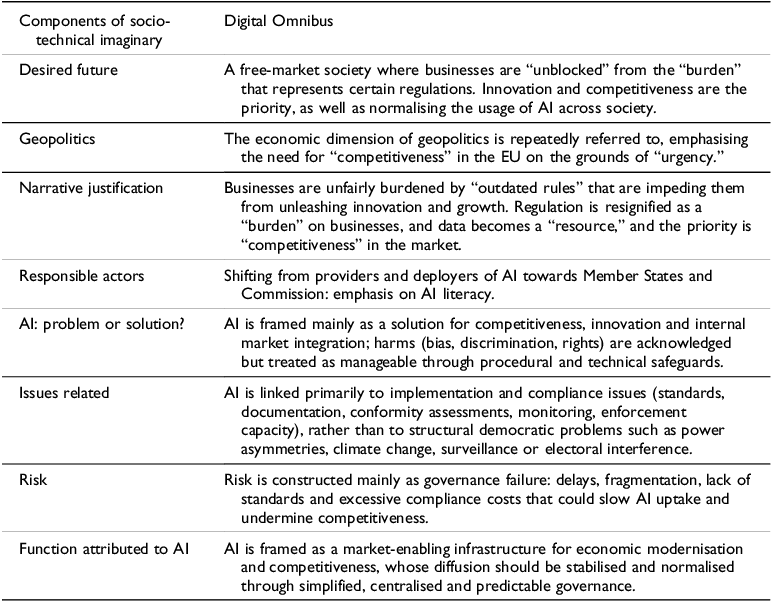
The coding scheme to analyse the two Digital Omnibus proposals was organised around eight analytical dimensions specifically adapted to the study of socio-technical imaginaries: (1) desired future, referring to the visions of the social order or desirable outcomes that AI is expected to bring about; (2) geopolitics, encompassing references to global competition, strategic autonomy or the EU’s regulatory leadership; (3) narrative justification, capturing the values invoked to legitimise intervention, such as security, democracy, resilience, competitiveness and trust; (4) responsible actor, identifying the entities portrayed as legitimate to govern or implement AI (EU institutions, the AI Office, Big Tech, civil society, users); (5) AI as problem or solution, capturing how AI is framed in the discourse as a source of risk, a governance tool, or a dual object simultaneously presented as both problem and solution; (6) issues related, indicating the specific policy domains linked to AI, such as elections, content moderation, systemic risk management, compliance or innovation; (7) risk, referring to the specific types of threats identified in relation to AI, including fundamental rights violations, systemic risks, geopolitical risks or social harms; and (8) function attributed to AI, capturing what AI is expected to do in practice, from ensuring transparency and detecting harmful content to enforcing compliance and strengthening security.
Both authors close read both documents in order to identify and code relevant passages, which we have summarised in a table within the empirical section. Coding was conducted independently by both authors and subsequently compared, with any discrepancies discussed and resolved through deliberation. We performed the analysis from an interpretive perspective, which entails not only a subjective component in tracing the different dimensions of the socio-technical imaginary, but also in putting the pieces of the puzzle together to articulate the imaginary as a whole. We argue that such an imaginary operates as a structuring presence shaping institutional expectations, governance practices and legitimising narratives, even when not explicitly named. We mobilise multiple quotes to illustrate the different components of the imaginary. While the analysis is guided by distinct analytical dimensions drawn from the literature on socio-technical imaginaries, these dimensions are empirically intertwined in the Commission’s discourse. For this reason, the following section reconstructs the Digital Omnibus package narrative as a coherent storyline, rather than as a set of isolated categories.
IV. Free-market AI technosolutionism in the Digital Omnibus’ socio-technical imaginary
Echoing what Bareis and Katzenbach (2021) describe as the framing of technological advancement as a necessity in the face of international competition, the main narrative put forward by the Commission to justify the Digital Omnibus is that regulations often have a negative effect on competitiveness and innovation. This is the classical “red tape” argument: regulators are creating too many unnecessary rules that are “burdening” businesses. This argument is supported by references to the Draghi and Letta reports. For instance, the Data Omnibus argued that as “highlighted in the Draghi and Letta reports, the accumulation of rules has sometimes had an adverse effect on competitiveness. Fast and visible improvements are needed for people and businesses, through a more cost-effective and innovation-friendly implementation of our rules – all the while maintaining high standards and agreed objectives.”Footnote 43
The Commission’s narrative assumes that regulations are blocking certain innovations by business actors, particularly in the area of AI, as “the amendments focus on unlocking opportunities in the use of data, as a fundamental resource in the EU economy, not least in view of supporting the development and use of trustworthy artificial intelligence solutions in the EU market.”Footnote 44 Therefore, the Data Omnibus “proposes to repeal outdated rules.”Footnote 45 The resignification of data as a “resource” is a first indication of the prioritisation of competitiveness and innovation over democracy and fundamental rights. It follows the logic of the popular phrase “data is the new oil.” Unfortunately, as Kate Crawford suggests, this conception of data as crude material for extraction is “rarely used to emphasize the costs of the oil and mining industries: indentured labor, geopolitical conflicts, depletion of resources, and consequences stretching beyond human timescales.”Footnote 46
The Data Omnibus proposal “entails very strong burden reduction for businesses, as well as for public administrations and citizens,”Footnote 47 including not just direct savings from the simplification amendments but also additional “business opportunities created through the regulatory approach proposed.”Footnote 48 Such framing is closely aligned with Big Tech lobbyists’ positions. For example, in a letter to the Danish Government, the Big Tech lobby organisation Dot Europe argued that “GDPR Article 9 strictly limits the processing of special category data (e.g., race, ethnicity, health), posing challenges for AI development, particularly in healthcare. AI models need access to sensitive data to ensure accuracy, fairness, and cultural relevance.”Footnote 49 Such proposal matches the Data Omnibus proposal to water down GDPR to facilitate AI training. This data-as-resource framing is positioned as part of a broader agenda of simplifying the “digital acquis” through cost-saving and burden reduction, with the proposal’s general objective explicitly stated as “simplification (…) and cost savings for businesses.”Footnote 50 In this sense, the Data Omnibus connects AI to an ecosystem of policy issues centred on data governance, compliance costs, and the administrative organisation of enforcement.
Another substantive illustration of the competitiveness prioritisation over fundamental rights and AI-first approach of the Digital Omnibus on AI is the deletion of paragraph 2 of Article 49 of the AI Act. Initially, the AI Act obliged companies to “self-assess” whether an AI system was high-risk, but still had to register all AI systems in a public database. The Omnibus suggests to delete this latter obligation, externalising to Big Tech companies the oversight and accountability regarding AI systems. Unsurprisingly, this is an explicit win from Big Tech lobbyists. The organisation Digital Europe (which represents several Big Tech companies) suggested to “abolish the mandatory registration of AI systems, along with the related EU and Member State databases.”Footnote 51 In the Staff Working Document accompanying the Digital Omnibus, the Commission suggests that such registration will save 100 euros per company,Footnote 52 a rather insignificant figure considering the negative externalities that may arise from it. In practice, this entails yet another step in the privatisation of AI governance, as the Commission suggests to outsource to the companies the decision to exempt themselves from high-risk requirements without even having to register the reason in a public register Table 1.
Components of the socio-technical imaginary related to AI in the Digital Omnibus.

Table 1. Long description
The table has two columns and nine rows. The first column lists components of socio-technical imaginary, and the second column describes their relation to AI in the Digital Omnibus. Row 1: Components of socio-technical imaginary, Digital Omnibus. Row 2: Desired future, A free-market society where businesses are unblocked from the burden that represents certain regulations. Innovation and competitiveness are the priority, as well as normalizing the usage of AI across society. Row 3: Geopolitics, The economic dimension of geopolitics is repeatedly referred to, emphasizing the need for competitiveness in the EU on the grounds of urgency. Row 4: Narrative justification, Businesses are unfairly burdened by outdated rules that are impeding them from unleashing innovation and growth. Regulation is resignified as a burden on businesses, and data becomes a resource, and the priority is competitiveness in the market. Row 5: Responsible actors, Shifting from providers and deployers of AI towards Member States and Commission: emphasis on AI literacy. Row 6: AI: problem or solution, AI is framed mainly as a solution for competitiveness, innovation and internal market integration; harms (bias, discrimination, rights) are acknowledged but treated as manageable through procedural and technical safeguards. Row 7: Issues related, AI is linked primarily to implementation and compliance issues (standards, documentation, conformity assessments, monitoring, enforcement capacity), rather than to structural democratic problems such as power asymmetries, climate change, surveillance or electoral interference. Row 8: Risk, Risk is constructed mainly as governance failure: delays, fragmentation, lack of standards and excessive compliance costs that could slow AI uptake and undermine competitiveness. Row 9: Function attributed to AI, AI is framed as a market-enabling infrastructure for economic modernization and competitiveness, whose diffusion should be stabilized and normalized through simplified, centralized and predictable governance.
The geopolitical argument is present, albeit is mainly an economic argument by emphasising the need for “competitiveness” in the EU on the grounds of “urgency.” The Digital Omnibus on AIFootnote 53 proposal by the Commission argues that it is based on the document “Communication on a Simpler and Faster Europe,” which aims to “promote forward-looking, innovative policies that strengthen the EU’s competitiveness and lighten the regulatory burdens on people, businesses and administrations, while maintaining the highest standard in promoting its values.”Footnote 54 While China or the United States are not directly mentioned as geopolitical rivals in the AI race, they remain implicitly present in the background and in the logic with which the Digital Omnibus on AI is conceived by the Commission. The attempt to build “European sovereignty” in this global AI race is operationalised by centralising the accountability at the EU level through the AI Office, rather than in multiple national AI authorities. This would allow companies “to deal with one regulator, rather than multiple national authorities. This would reduce the complexity and administrative burden associated with navigating different regulatory frameworks, allowing companies to focus on innovation and growth.” The sense of urgency is implicitly geopolitical. If the EU does not act swiftly, its geopolitical competitors (the US and China) will impose their respective “Digital Empires.”Footnote 55
The ultimate desired future related to AI outlined throughout the Commission’s Digital Omnibus is that of a free-market society where there are less rules and businesses are “unblocked” from the “burden” that represents certain regulations in order to foster innovation and competitiveness. Innovation and competitiveness are the priority, as well as normalising the usage of AI across society. Building on this free-market and innovation-first narrative, the Digital Omnibus contributes to consolidate a specific imaginary of AI and its governance. AI is framed as an instrumental infrastructure for competitiveness, innovation and internal market integration, whose value lies in its capacity to be developed, deployed and scaled within a predictable and streamlined regulatory environment. Rather than being constructed as a social or democratic challenge requiring political containment, AI appears primarily as a strategic asset whose expansion must be enabled and stabilised to maximise the competitiveness of European companies.
The dominant function attributed to AI is therefore economic and market-making. The Commission emphasises the need to “promote innovation and the uptake of AI” and to “accelerate AI development and deployment in Europe,”Footnote 56 explicitly linking AI to the ambition of positioning Europe as the “AI continent.”Footnote 57 This ambition is presented as compatible with the AI Act’s dual objective of “promot[ing] innovation and the uptake of AI” while ensuring “a high level of protection for health, safety and fundamental rights, including democracy and the rule of law.”Footnote 58 AI systems are constructed as economic assets whose deployment should be facilitated to improve “the functioning of the internal market” and to “enable access to the Union market for AI systems,”Footnote 59 particularly for SMEs. In this configuration, AI’s societal relevance is measured less through its democratic implications than through its contribution to productivity, growth and competitiveness. This market-enabling function is discursively stabilised through the Commission’s insistence on an “innovation-friendly” implementation of the AI Act.Footnote 60
Beyond acceleration, the Digital Omnibus package also consolidates a normalising function of AI by redistributing responsibility for its societal integration. Instead of maintaining direct obligations on providers and deployers to ensure AI literacy,Footnote 61 as established in the AI Act, the Digital Omnibus on AI proposal shifts towards requiring Member States and the Commission to encourage AI literacy in cooperation with stakeholders. The Omnibus argues that a “one-size-fits-all solution” is unsuitable, and that such a horizontal obligation is a “burden,” particularly for SMEs. It therefore proposes amending the AI Act so that it “should be amended to require the Member States and the Commission, without prejudice to their respective competences, to individually, collectively and in cooperation with relevant stakeholders encourage providers and deployers to provide a sufficient level of AI literacy of their staff and other persons dealing with the operation and use of AI systems on their behalf.” In consequence, public authorities are conceived as almost “ambassadors” of AI in normalising this technology in our everyday life, while Big Tech has no specific obligations in this regard. Public authorities are thus repositioned as facilitators of AI uptake and normalisation, while obligations on private actors are softened and reframed as regulatory burdens. Paradoxically, this literacy measure is presented as a regulatory simplification. Instead, it does not eliminate the underlying responsibility but relocates it, shifting the responsibility of providing training from private providers to public authorities. This redistribution reinforces an imaginary in which AI is treated as an inevitable and desirable technology whose diffusion should be actively supported by public institutions. In the Commission’s own framing, this shift is explicitly presented as replacing a non-specific obligation on providers and deployers with a duty for the Commission and Member States to “foster AI literacy.”Footnote 62
This functional framing has direct consequences for how AI is positioned as a problem or a solution. Across the Omnibus proposals, AI itself is not primarily constructed as a problem in ontological terms. Instead, it is overwhelmingly framed as a solution to economic modernisation and internal market integration. In this sense, the “problem” is not AI itself, but the conditions that may hinder its deployment, such as regulatory fragmentation or administrative burden. As a result, political attention shifts away from whether AI should expand, towards ensuring that regulatory frameworks do not hinder its uptake. AI-related harms such as discrimination and bias are not denied, but are reframed as governable challenges within the deployment of AI, rather than as reasons to limit its expansion. The proposal explicitly frames “the detection and correction of bias” as a matter of “substantial public interest” because it protects individuals from adverse effects such as “discrimination.”Footnote 63 Rather than using these harms as grounds for restricting AI development, the Digital Omnibus package translates them into procedural and compliance-oriented solutions, notably by enabling the exceptional processing of special categories of personal data for bias detection and correction, under detailed technical safeguards.Footnote 64
Accordingly, the issues associated with AI are framed mainly as matters of implementation and operability: documentation requirements, conformity assessments, post-market monitoring, enforcement procedures and administrative burden. The Digital Omnibus package prioritises simplification, harmonisation and centralisation as policy responses, rather than expanding democratic oversight or strengthening substantive constraints. The Commission explicitly lists its “specific simplification measures” as targeting issues such as (i) linking the application timeline for high-risk obligations to the availability of standards and support tools, (ii) simplifying technical documentation for SMEs and small mid-caps, (iii) increasing flexibility in post-market monitoring by removing the requirement of a harmonised monitoring plan, and (iv) softening AI literacy obligations.Footnote 65 In other words, the core “issues” attached to AI are not framed as electoral interference, climate change, labour exploitation, disinformation, surveillance capitalism or structural power asymmetries, but questions of compliance infrastructure: standards, guidance, documentation templates, monitoring procedures and the institutional capacity of regulators to implement the Act.
By contrast, when risk is explicitly articulated in the proposals, it refers not to how AI is framed as a problem, but to the specific types of threats identified in relation to its governance and implementation. Risk is articulated in a selective and hierarchised manner. While fundamental rights risks are formally acknowledged, the dominant risk narrative concerns implementation failure, regulatory delay and excessive compliance burden. The Digital Omnibus on AI proposal repeatedly foregrounds “implementation challenges that could jeopardise the effective entry into application” of the AI Act,Footnote 66 framing delays and complexity as risks because they may “significantly increase compliance costs for businesses and public authorities and slow down innovation.”Footnote 67 In this configuration, the central risk is not AI-driven societal harm, but the possibility that governance inefficiency undermines speed, predictability and competitiveness. The Commission reinforces this by naming as key risks not only “delays” but also the “lack of harmonised standards” and the absence of “guidance and compliance tools” for high-risk systems, which are presented as factors that can jeopardise effective application.Footnote 68
Overall, the Digital Omnibus stabilises an AI-first imaginary in which artificial intelligence is constructed as a strategic infrastructure to be enabled, normalised and accelerated. Risks to democracy and fundamental rights remain present at a declarative level, but are primarily managed through technical safeguards and procedural adjustments. The dominant horizon of concern is instead the risk that regulation itself becomes an obstacle to AI deployment, thereby weakening Europe’s ambition to become the “AI continent” as developed in the 2025 AI Continent Action Plan. There is a perceived “AI race” and, if the EU does not water down its own established legislation, the EU is bound to lose it to China and the United States.
V. Conclusion: the Digital Omnibus as an “urgent” operation for an AI-led future
This article has argued that the European Commission’s Digital Omnibus in relation to AI should not be understood merely as a deregulatory intervention or a technical exercise in legislative simplification. Rather, it constitutes an operation on the future: a political and institutional device that contributes to redefining what counts as legitimate, urgent and necessary in European digital governance. Situated within the broader proliferation of omnibus legislation under the second von der Leyen Commission, the Digital Omnibus package does not appear as an anomaly or an exceptional deviation, but as a fully intelligible mechanism of institutional acceleration: technosolutionism on steroids. It functions simultaneously as a technology of temporal compression on the grounds of geopolitical “urgency,” and a means of reprogramming the regulatory balance between democracy, rights protection, procedural integrity and industrial competitiveness.
Our analysis on the Digital Omnibus, with a focus on AI, exemplifies how the post-regulatory state operates not by formally dismantling the EU’s regulatory architecture, but by reconfiguring it from within. “Simplification,” “innovation,” “urgency” and “competitiveness” are mobilised as dominant justificatory principles, allowing substantive changes to be enacted under compressed timelines and a systemic sidelining of contestatory actors such as civil society actors or trade unions, who have collectively denounced that the Digital Omnibus package would represent “the biggest rollback of digital fundamental rights in EU history. It is being done under the radar, using rushed and opaque processes designed to avoid democratic oversight.”Footnote 69 The contribution of our article has been to show that this acceleration is not neutral: it is anchored in a specific socio-technical imaginary consolidation that presents participation, precaution and democratic contestation as inefficient in the pursuit of innovation and geopolitical relevance.
These dynamics have direct implications for the legality and democratic quality of EU lawmaking. By bundling heterogeneous amendments into a single legislative package, the Digital Omnibus weakens reviewability by fragmenting the object of judicial and political scrutiny. The proportionality of individual measures becomes harder to assess when safeguards are recalibrated transversally, evidentiary requirements are reduced and impact assessments are partial or simply eliminated. At the same time, the compression of consultation timelines and the selective inclusion of stakeholders undermine the participatory guarantees enshrined in Article 11 TEU, making democratic contestation more difficult. The result is a reconfiguration of the architecture of responsibility in EU digital governance, in which accountability is increasingly externalised to private actors through self-assessment, technical standards and supervised self-regulation.
Importantly, these developments do not occur in an institutional or political vacuum. As Mügge has argued, claims of European digital sovereignty and competitiveness raise a fundamental question: sovereignty for whom, and competitiveness for whose benefit?Footnote 70 The Digital Omnibus package reinforces existing structural dependencies on private technological infrastructures and data-intensive business models, thereby privileging dominant corporate actors while narrowing the scope of democratic choice. Behind the language of strengthening “European digital sovereignty” (a language that is increasingly relevant after the introduction of the EU’s “Tech Sovereignty package” in June 2026 by the Commission) the Digital Omnibus package appears to benefit the sovereignty of Big Tech companies, including some European ones such as French Mistral. Illustrating the corporate capture of the EU by Big Tech, in February 2026 Aura Salla – a Finnish MEP from the centre-right EPP group – was named as the European Parliament (EP) rapporteur for the Digital Omnibus (the Data Omnibus) in the Industry, Research and Energy (ITRE) committee. Salla worked as the Head of EU Affairs for Meta in Brussels between 2020 and 2023, a period in which multiple digital files were negotiated (including the DSA, DMA or the AI Act). While the Council position is difficult to predict, this is an indication that the EP will not necessarily soften a lot the Commission’s Digital Omnibus package proposal. Emerging evidence suggests that this regulatory trajectory is increasingly intertwined with broader political realignments. While Big Tech firms initially cultivated a centrist lobbying strategy focused on centre-left and centre-right actors, recent analyses indicate growing convergence with far-right political forces in Europe, particularly around deregulatory agendas framed in terms of competitiveness, speed and burden reduction.Footnote 71
These undemocratic patterns are not limited to digital policy. The adoption of Omnibus I on sustainability and corporate due diligence legislation provides a revealing parallel. In that case, the centre-right European People’s Party joined forces with far-right groups in the European Parliament to reopen and weaken core elements of the EU’s corporate sustainability framework, effectively breaking the traditional centrist coalition between social-democrats, liberals and centre-right. Such a move implies a radicalisation of the centre-right towards the far right on the grounds of privileging corporate interests. Taken together, these developments point to a broader transformation in EU governance in which deregulatory agendas, corporate capture and far-right political dynamics increasingly reinforce one another, in addition of the pressure coming from the second Trump administration.
This perspective allows us to specify the shift described in the introduction. The Digital Omnibus package may not represent merely a rhetorical change, but a rearticulation of the desirable future: alongside the semantics of trust and human-centredness, signifiers such as competitiveness, technological race, urgency, speed and leadership gain prominence, reordering what counts as urgent and normalising trade-offs. Within this frame, regulation is recast as friction or burden, and the weakening of safeguards as a functional requirement for economic and geopolitical survival. The article’s empirical focus on the socio-technical imaginary within the EU’s Digital Omnibus in relation to AI thus becomes a broader theoretical-analytical one: how an authorised “language of the future” is stabilised in ways that render accelerated deregulation a reasonable and even necessary solution to foster AI innovation. This imaginary is not only discursively reproduced but also materialised through legal and institutional arrangements.Footnote 72 This is illustrated by the proposals to remove the public registration requirement under Article 49(2) of the AI Act or the redistribution of AI literacy obligations from providers and deployers to Member States and the Commission. From the second von der Leyen Commission’s perspective, technosolutionism at all costs is the way to go.
This acceleration of an already existing desirable future has entrenching effects and deepens existing power relations. In the context of the Digital Omnibus, this implies that the prioritisation of competitiveness, speed and technological leadership does not merely recalibrate regulatory objectives, but redistributes power towards actors best positioned to operate under accelerated and flexibilised regimes: Big Tech companies. This dynamic is further reinforced when competitiveness and innovation are articulated through security-inflected narratives. The securitisation of digital technology regulation often deepens, rather than mitigates, public authorities’ dependence on private infrastructures and expertise, thereby strengthening corporate influence over regulatory trajectories.Footnote 73 Read through this lens, the convergence between deregulatory agendas, corporate capture and emerging alliances between Big Tech and far-right political forces does not appear accidental, but structurally facilitated by governance frameworks that privilege urgency, efficiency, and strategic competition over democratic contestation. In this context, crucial elements are left aside: the massive amount of energy that AI requires, the labour exploitation (particularly in the Global Souths) on which it relies (Cant et al. 2024), the critical raw materials that are necessary, the increasing amount of data centers that are built across the world (and the environmental costs it entails) or the billionaires it empowers.
Overall, the Digital Omnibus package put forward by the Commission (and likely to be amended by the European Parliament and the Council of the EU) appears less as an anomaly and more as a device that renders the recalibration of the balance between rights, procedure and competitiveness governable: faster and less democratically contestable. The central risk, therefore, is not deregulation per se, but the normalisation of a governance paradigm in which accelerating, simplifying and competing are elevated above deliberating, protecting and democratising.

 Open access

