



1 Introduction
Maximal almost disjoint familiesFootnote 1 (or MAD families) are a fascinating concept in infinite combinatorics and have a large number of uses and applications. From general topology with the Mrówka–Isbell spaces, through forcing theory with the almost disjoint coding and even in functional analysis in the construction of Banach spaces with different geometries, we can find applications of (maximal) almost disjoint families. Although these families have been studied extensively in the past, there are still many open questions about them that we have not been able to answer. The initial motivation for this research were the following problems (still unsolved), the first attributed to Roitman and the second to the first and fourth authors.
Problem 1.1 (Roitman)
Does
 $\mathfrak {d}=\omega _{1}$
imply
 $\mathfrak {a}=\omega _{1}$
?
Problem 1.2 (Brendle–Raghavan [Reference Brendle and Raghavan18])
Does
 $\mathfrak {b}=\mathfrak {s}=\omega _{1}$
imply
 $\mathfrak {a}=\omega _{1}$
?
Of course, if the second problem has a positive solution, so does the first. One way to attack these problems is to find forcing notions that destroy MAD families (i.e., they are no longer maximal after performing the forcing extension) while preserving the relevant properties of the ground model. In this way, the two previous questions motivate the following ones.
Problem 1.3. For every MAD family, is there a proper forcing that destroys it and does not add unbounded reals?
Problem 1.4. For every MAD family, is there a proper forcing that destroys it and does not add dominating or unsplit reals?
If the answer to Problems 1.3 and 1.4 were positive (at least under the Continuum Hypothesis), we could perform a countable support iteration and provide negative answers to the first questions. In this way, we are naturally led to the study of the indestructibility of MAD families. Once again, there are two very relevant open questions, due to Steprāns and the third author, which are the second motivation for this work.
Problem 1.5 (Steprāns [Reference Steprāns77])
Is there a MAD family that is Cohen indestructible?
Problem 1.6 (Hrušák)
Is there a MAD family that is Sacks indestructible?Footnote 2
Having these problems in mind, we decided to find the strongest notion of indestructibility for maximal almost disjoint families that we could imagine. This notion is what we call Shelah–Steprāns, which is very closely related to the notion of almost strongly separable introduced by Raghavan in [Reference Raghavan66] and motivated by the work of Shelah and Steprāns in [Reference Shelah and Steprāns74]. We will formally define a Shelah–Steprāns MAD family in the main text (Section 5), but roughly speaking, this notion tells us that for every “large” collection of finite sets, there exists an element in the ideal generated by the MAD family that contains infinitely many elements of this collection. This notion is strong enough to imply the indestructibility of the MAD family by Cohen, Sacks, Miller, random forcings, and much more. Nevertheless, we prove in Corollary 7.8 that Shelah–Steprāns MAD families can be destroyed without adding dominating or unsplit reals (providing hope for a negative solution to Problem 1.2).
Although our initial motivation concerned almost disjoint families, we realized that the Shelah–Steprāns property (as well as other notions we study in this text) is also of interest in general for ideals, so we choose to use this more general framework. In Section 5, we define the Shelah–Steprāns property for ideals and prove a game-theoretic equivalence (Corollary 5.11). We conclude that for Borel ideals, the Shelah–Steprāns property is equivalent to being Katětov above fin
 $\times $
fin (Theorem 5.12). This result is then extended to analytic ideals (and more) under Large Cardinal assumptions. In Section 6, we study and compare some strong properties of ideals and MAD families (some of the properties are new, while others already appear in the literature). Throughout the text, we will be looking at implications between these properties, as well as constructing counterexamples to the non-implications. The strongest of the properties we will study is called raving. Another property of ideals that we will pay special attention to is the Hurewicz property, which we first state in a purely combinatorial way; then we show that the ideals with this property are exactly the ideals that have the Hurewicz property as topological spaces. In Section 7, we prove that ideals with the Hurewicz property can be destroyed without adding dominating or unsplit reals. With these results, we can build a model where
 $\mathfrak {c=} \omega _{2}, \mathfrak {b=s}=\omega _{1}$
and no MAD family of size
 $\omega _{1}$
can be extended to a Hurewicz ideal (Theorem 7.11). Thus, if we were able to prove that (at least under CH) every MAD family can be extended to a Hurewicz ideal, we would be able to solve Problem 1.2. However, this is not true: in Section 8, we show that consistently, there is a MAD family that cannot be extended to a Hurewicz ideal (Theorem 8.7).
In Section 9, we introduce the forcing
 $\mathbb{P} _{ {\textsf {MAD}}}$
, which consists of countable almost disjoint families ordered by inclusion. The generic filter of this forcing adds a generic MAD family (which we call
 $\mathcal {A}_{ {\textsf {gen}}}$
). We show that this MAD family is raving. Our motivation for studying this forcing comes from the following results about generic ultrafilters (by LC we denote a large cardinal assumption).
Theorem 1.7 (Todorcevic, see [Reference Farah28])
(LC) An ultrafilter
 $\mathcal {U}$
is
 ${\mathcal P}\left ( \omega \right )/\textsf {fin}$
generic over L
 $\left ( \mathbb{R}\right ) $
if and only if
 $\mathcal {U}$
is Ramsey.
Theorem 1.8 (Chodounský and Zapletal [Reference Chodounský and Zapletal26])
(LC) Let
 $\mathcal {I}$
be an
 $F_{\sigma }$
-ideal and
 $\mathcal {U}$
an ultrafilter.
 $\mathcal {U}$
is
 ${\mathcal P}\left ( \omega \right )/\mathcal {I}$
generic over L
 $\left ( \mathbb{R}\right ) $
if and only if
 $\mathcal {U}$
is a P-point,
 $\mathcal {I\cap U=\emptyset }$
and for every closed set
 $\mathcal {C}$
if
 $\mathcal {C}\cap \mathcal {U=\emptyset }$
then there is
 $A\in \mathcal {U}$
such that
 $A\cap Y\in \mathcal {I}$
for every
 $Y\in \mathcal {C}.$
We are very interested in knowing if there is a combinatorial property that characterizes the generic MAD families over L
 $\left ( \mathbb{R}\right ) $
added by
 $\mathbb{P}_{ {\textsf {MAD}}}.$
In Section 10, we consider the non-existence of certain types of MAD families in specific models, the existence of such families under additional axioms, as well as examples for non-implications between various properties.
While we know that Hurewicz ideals can be destroyed without increasing
 $\mathfrak {b}$
and
 $\mathfrak {s},$
we show in Section 12 that Shelah–Steprāns MAD families can be destroyed without increasing the uniformity of the meager ideal. In this way, we are able to build a model where non
 $\left ( \mathcal {M}\right ) =\omega _{1}$
and there are no Shelah–Steprāns MAD families of size
 $\omega _{1}$
(Theorem 12.18). In order to build such model, we are required to develop some new machinery to keep non
 $\left ( \mathcal {M}\right ) $
small, which we do in Section 11. This framework is presented in a very general setting and we expect it to have more applications in the future.
In the hope of making this article as accessible as possible, we included two sections with preliminaries (Sections 3 and 4). The first one is on Borel ideals and the Katětov order and the second one is on destructibility of ideals and MAD families. The reader may skip these sections and come back as needed.
2 Notation and definitions
Given a set
 $X,$
by
 $\mathcal {P}\left ( X\right ) $
we will denote its power set. We now start with the definition of ideal, which is crucial in the text.
Definition 2.1. Let X be a set. We say
 $\mathcal {I}\subseteq \mathcal {P}\left ( X\right ) $
is an ideal on X if the following conditions hold:
-
(1)
 $\emptyset \in \mathcal {I}$
and
$X\notin \mathcal {I}.$
-
(2) If
$A\in \mathcal {I}$
and
$B\subseteq A,$
then
$B\in \mathcal {I}.$
-
(3) If
$A,B\in \mathcal {I},$
then
$A\cup B\in \mathcal {I}.$
-
(4) Every finite subset of X is in
$\mathcal {I}.$


Most of the ideals we are interested in will be based on
 $\omega $
or any other countable set, but we will also be interested in ideals on Polish spaces. If
 $\mathcal {I}$
is an ideal on
 $\omega ,$
we denote by
 $\mathcal {I}^{+}$
the family of subsets of
 $\omega $
that are not in
 $\mathcal {I}.$
The dual filter of
 ${\mathcal {I}}$
is defined as
 ${\mathcal {I}}^{\ast } =\{\omega \setminus A:A\in {\mathcal {I}}\}$
. For
 $A\subseteq \omega ,$
we define the restriction of
 $\mathcal {I}$
to A as
 $\mathcal {I}\upharpoonright A=\left \{ X\cap A\mid X\in \mathcal {I}\right \} .$
We will say that
 $\mathcal {I}$
is tall if for every
 $A\in \left [ \omega \right ] ^{\omega },$
there is an infinite
 $B\in \mathcal {I}$
such that
 $B\subseteq A.$
In other words,
 $\mathcal {I}$
is tall if every infinite subset contains an infinite set in
 $\mathcal {I}$
(equivalently, every infinite set has infinite intersection with an element of
 $\mathcal {I}).$
A
 $\sigma $
-ideal is an ideal that is closed under countable unions. We will be particularly interested in the following
 $\sigma $
-ideals:
 $\mathcal {M}$
(the ideal of all meager sets in
 $2^{\omega }$
),
 $\mathcal {N}$
(the ideal of all subsets of
 $2^{\omega }$
of Lebesgue/Haar measure zero), ctble (the ideal of countable subsets of
 $2^{\omega }$
), and
 $\mathcal {K}_{\sigma }$
(the
 $\sigma $
-ideal generated by the compact sets in
 $\omega ^{\omega }$
).
A family
 $\mathcal {A}\subseteq \left [ \omega \right ] ^{\omega }$
is almost disjoint (a.d.) if it is infinite and the intersection of any two different elements of
 $\mathcal {A}$
is finite. Moreover,
 $\mathcal {A}$
is a
MAD family if it is a maximal almost disjoint family. Given
 $\mathcal {A}$
an almost disjoint family, we denote by
 $\mathcal {I}\left ( \mathcal {A}\right ) $
the ideal generated by
 $\mathcal {A}$
and all finite sets of
 $\omega .$
By
 $\mathcal {A}^{\perp }$
we denote the collection of all subsets of
 $\omega $
that are almost disjoint with every element of
 $\mathcal {A}.$
Evidently, an almost disjoint family
 $\mathcal {A}$
is maximal if and only if
 $\mathcal {A}^{\perp }$
consists of only the finite sets.
We say a tree
 $p\subseteq 2^{<\omega }$
is a Sacks tree if every node in p can be extended to a splitting node. If p is a tree, denote split
 $\left ( p\right ) $
the set of splitting nodes of
 $p.$
By
 $\mathbb{S}$
we denote Sacks forcing, which consists of all Sacks trees ordered under inclusion.
 $\mathbb{C}$
denotes Cohen forcing, which is
 $2^{<\omega }$
ordered by inclusion.
 $\mathbb{B}$
denotes random forcing, which consists of all Borel sets of positive measure. The partial order
 $\mathbb{PT}$
is Miller forcing, which consists of all trees
 $p\subseteq \omega ^{<\omega }$
such that every node can be extended to a node that is infinitely branching. Let
 $p\subseteq \omega ^{<\omega }$
be a tree. We say
 $s\in p$
is the stem if s is compatible with every other node of p and is maximal with this property. In case p has a stem, we denote it by st
 $\left ( p\right ) .$
For
 $t\in p,$
define
 $p_{t}=\left \{ s\in p\mid s\subseteq t\vee t\subseteq p\right \} $
and suc
 $_{p}\left ( t\right ) $
denotes the collection of all immediate successors of t that are in
 $p.$
We denote by
 $\left [ p\right ] $
the set of all branches through
 $p.$
For
 $s,t\in \omega ^{<\omega },$
by
 $s^{\frown }t$
we denote the concatenation of s and
 $t.$
Let
 $\mathcal {I}$
be a
 $\sigma $
-ideal on a Polish space
 $X.$
The forcing
 $\mathbb{P}_{\mathcal {I}}$
is defined as the
 $\mathcal {I}^{+}$
Borel sets of
 $X,$
the order being inclusion modulo
 $\mathcal {I}.$
The books [Reference Zapletal79, Reference Zapletal80] are dedicated to this topic. It is easy to see that
 $\mathbb{P}_{\mathcal {I}}$
naturally adds a generic real and we say that
 $\mathbb{P}_{\mathcal {I}}$
has the continuous reading of names if every new real is the continuous image of the generic real under a ground model function. We leave it to the reader to consult the previously mentioned books for more formal definitions. It is known that
 $\mathbb{S}$
is equivalent to
 $\mathbb{P}_{ {\textsf {ctble}}}, \mathbb{C}$
is equivalent to
 $\mathbb{P}_{\mathcal {M}}, \mathbb{B}$
is equivalent to
 $\mathbb{P}_{\mathcal {N}}$
, and
 $\mathbb{PT}$
is equivalent to
 $\mathbb{P}_{\mathcal {K}_{\sigma }}.$
We now review the notions related to cardinal invariants of the continuum that we will use in the text. We refer the reader to [Reference Blass7] for a deeper treatment. The cardinality of the real numbers is denoted by
 $\mathfrak {c}.$
The almost disjointment number
 $\mathfrak {a}$
is the smallest size of a MAD family. Letting
 $f,g\in \omega ^{\omega }$
, define
 $f\leq g$
if and only if
 $f\left ( n\right ) \leq g\left ( n\right ) $
for every
 $n\in \omega $
and
 $f\leq ^{\ast }g$
if and only if
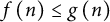 $f\left ( n\right ) \leq g\left ( n\right ) $
holds for all
 $n\in \omega $
except finitely many. We say a family
 $\mathcal {B}\subseteq \omega ^{\omega }$
is unbounded if
 $\mathcal {B}$
is unbounded with respect to
 $\leq ^{\ast }.$
A family
 $\mathcal {D}\subseteq \omega ^{\omega }$
is a dominating family if for every
 $f\in \omega ^{\omega },$
there is
 $g\in \mathcal {D}$
such that
 $f\leq ^{\ast }g.$
The bounding number
 $\mathfrak {b}$
is the size of the smallest unbounded family and the dominating number
 $\mathfrak {d}$
is the smallest size of a dominating family. We say that S splits X if
 $S\cap X$
and
 $X\setminus S$
are both infinite. A family
 $\mathcal {S\subseteq } \left [ \omega \right ] ^{\omega }$
is a splitting family if for every
 $X\in \left [ \omega \right ] ^{\omega }$
, there is
 $S\in \mathcal {S}$
such that S splits
 $X.$
The splitting number
 $\mathfrak {s}$
is the smallest size of a splitting family. By cov
 $\left ( \mathcal {M}\right ) $
we denote the smallest size of a family of meager sets that covers the Baire space and non
 $\left ( \mathcal {M}\right ) $
is the least size of a subset of
 $2^{\omega }$
that is not meager. Given
 $A,B$
sets, define
 $A\subseteq ^{\ast }B$
(A is almost contained in B) if
 $A\setminus B$
is finite. Let
 $\mathcal {H}\subseteq \left [ \omega \right ] ^{\omega }$
and
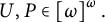 $U,P\in \left [ \omega \right ] ^{\omega }.$
We say P is a pseudointersection of
 $\mathcal {H}$
if P is almost contained in every member of
 $\mathcal {H},$
likewise U is a pseudounion of
 $\mathcal {H}$
if U almost contains every element of
 $\mathcal {H}.$
We say that
 $\mathcal {H}$
is centered if for every
 $n\in \omega $
and
 $A_{0} ,\ldots ,A_{n}\in \mathcal {H},$
it is the case that
 $A_{0}\cap \cdots \cap A_{n}$
is infinite. The pseudointersection number
 $\mathfrak {p}$
is the smallest size of a centered family with no infinite pseudointersection.
We will use the following notational conventions for iterated forcing in Sections 11, 12.1, and 12.2. Let
 $\left \langle \mathbb{P}, {\leq }_{\mathbb{P}} \right \rangle $
and
 $\left \langle \mathbb{Q}, {\leq }_{\mathbb{Q}} \right \rangle $
be posets and let
 $\pi : \mathbb{Q} \rightarrow \mathbb{P}$
be a projection. Here, we use the definition of projection found in [Reference Abraham1, p. 335]. If
 $G \subseteq \mathbb{P}$
is a
 $({\mathbf {V}}, \mathbb{P})$
-generic filter, then in
 ${{\mathbf {V}}[G],}$
we define the poset
 ordered by
 ${\leq }_{\mathbb{Q}}$
. In
 ${\mathbf {V}}$
, we let
 be a full
 $\mathbb{P}$
-name for
 . The definition of full name can be found in [Reference Kunen48, p. 292]. We will also frequently use the maximal principle, which can be found, for example, in [Reference Kunen48, p. 226].
Suppose
 $\langle {\mathbb{P}}_{\alpha }; {\mathring {\mathbb{Q}}}_{\alpha }: \alpha \leq \gamma \rangle $
is an iteration. If
 ${G}_{\gamma }$
is a
 $({\mathbf {V}}, {\mathbb{P}}_{\gamma })$
-generic filter, then for any
 $\alpha \leq \gamma $
,
 ${G}_{\alpha }$
denotes
 $\{p \mathord \upharpoonright \alpha : p \in {G}_{\gamma }\}$
, and it is a
 $({\mathbf {V}}, {\mathbb{P}}_{\alpha })$
-generic filter. Furthermore, if
 $\mathring {x}$
is any
 ${\mathbb{P}}_{\alpha }$
-name, then
 $\mathring {x}$
is also a
 ${\mathbb{P}}_{\beta }$
-name for every
 $\alpha \leq \beta \leq \gamma $
and
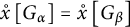 $\mathring {x}\left [{G}_{\alpha }\right ] = \mathring {x}\left [{G}_{\beta }\right ]$
.
If
 $\langle {\mathbb{P}}_{\alpha }; {\mathring {\mathbb{Q}}}_{\alpha }: \alpha \leq \gamma \rangle $
is an iteration, then for each
 $\alpha \leq \gamma ,$
the map
 ${\pi }_{\gamma \alpha }: {\mathbb{P}}_{\gamma } \rightarrow {\mathbb{P}}_{\alpha }$
given by
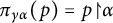 ${\pi }_{\gamma \alpha }(p) = p \mathord \upharpoonright \alpha $
is a projection. Therefore, if
 $\alpha \leq \gamma $
and if
 ${G}_{\gamma } \subseteq {\mathbb{P}}_{\gamma }$
is a
 $({\mathbf {V}}, {\mathbb{P}}_{\gamma })$
-generic filter, then there is a
 -generic filter H so that in
 ${\mathbf {V}}\left [{G}_{\gamma }\right ]$
,
 ${G}_{\gamma } = {G}_{\alpha } \ast H$
holds. In fact, this H is equal to
 ${G}_{\gamma }$
.
Suppose
 $\langle {\mathbb{P}}_{\alpha }; {\mathring {\mathbb{Q}}}_{\alpha }: \alpha \leq \gamma \rangle $
is an iteration and let
 $\alpha \leq \gamma $
. We may think of any
 ${\mathbb{P}}_{\gamma }$
-name as a
 ${\mathbb{P}}_{\alpha }$
-name for a
 -name. Thus, given a
 ${\mathbb{P}}_{\gamma }$
name
 $\mathring {x}$
, we use
 ${\mathring {x}}[{\mathring {G}}_{\alpha }]$
to denote a canonical
 ${\mathbb{P}}_{\alpha }$
-name for a
 -name representing
 $\mathring {x}$
. If
 ${G}_{\alpha }$
is a
 $({\mathbf {V}}, {\mathbb{P}}_{\alpha })$
-generic filter, we will write
 ${\mathring {x}}\left [{G}_{\alpha }\right ]$
to denote the evaluation of
 ${\mathring {x}}[{\mathring {G}}_{\alpha }]$
by
 ${G}_{\alpha }$
. Therefore, if
 ${G}_{\gamma }$
is a
 $({\mathbf {V}}, {\mathbb{P}}_{\gamma })$
-generic filter, then in
 ${\mathbf {V}}\left [{G}_{\gamma }\right ]$
,
 ${\mathring {x}}\left [{G}_{\gamma }\right ] = {\mathring {x}}\left [{G}_{\alpha }\right ]\left [{G}_{\gamma }\right ]$
holds.
3 Preliminaries on Borel ideals and the Katětov order
We equip
 $\mathcal {P}\left ( \omega \right ) $
with its natural Polish topology (which is homeomorphic to
 $2^{\omega }$
by identifying a set with its characteristic function). All topological terms (concretely the notions of Borel, analytic, or meager) will refer to this topology. A major topic in descriptive set theory is that definable subsets of a Polish space have nicer or more desirable properties than arbitrary subsets. This is no different for ideals on
 $\omega .$
We will now list the Borel ideals that will appear most prominently in this text. The reader may read [Reference Hrušák38, Reference Hrušák40] to learn more about them.
For the next definitions, given
 $n\in \omega $
, denote the column
 $C_{n} =\left \{ \left ( n,m\right ) \mid m\in \omega \right \} $
and
 $\mathcal {C} =\left \{ C_{n}\mid n\in \omega \right \} .$
Given
 $f\in \omega ^{\omega },$
denote
 $D\left ( f\right ) =\left \{ \left ( n,m\right ) \mid m\leq f\left ( n\right ) \right \} .$
-
• The ideal fin is the ideal of finite subsets of
$\omega .$
-
• The ideal fin
$\times $
fin is the ideal on
$\omega ^{2}$
generated by
$\mathcal {C\cup }\left \{ D\left ( f\right ) \mid f\in \omega ^{\omega }\right \} .$
-
• The eventually different ideal
$\mathcal {ED}$
is the ideal on
$\omega ^{2}$
generated by
$\mathcal {C}$
and the graphs of functions from
$\omega $
to
$\omega .$
-
• The ideal
$\mathcal {ED}_{ {\textsf {fin}}}$
is the restriction of
$\mathcal {ED}$
to
$\left \{ \left ( n,m\right ) \mid m\leq n\right \} .$
-
• The ideal conv is the ideal on
$\mathbb{Q}\cap \left [ 0,1\right ] $
generated by all convergent sequences. -
• The nowhere dense ideal, nwd is the ideal of nowhere dense subsets of the rational numbers.
-
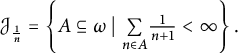
• The summable ideal is the ideal
$\mathcal {J}_{\frac {1}{n} }=\left \{ A\subseteq \omega \mid {\textstyle \sum \limits _{n\in A}} \frac {1}{n+1}<\infty \right \} .$
-
• The density zero ideal is
$\mathcal {Z=}\left \{ A\subseteq \omega \mid \lim _{n\longrightarrow \infty }\frac {\left \vert A\cap \lbrack 2^{n},2^{n+1})\right \vert }{2^{n}}=0\right \} .$








An important class of ideals is the so-called “trace ideals,”which were studied by Brendle and Yatabe in [Reference Brendle and Yatabe20] and then by Hrušák and Zapletal in [Reference Hrušák and Zapletal44].
Definition 3.1. For every
 $a\subseteq \omega ^{<\omega }$
, we define
 $\pi \left ( a\right ) =\left \{ f\in \omega ^{\omega }\mid \exists ^{\infty }n\left ( f\upharpoonright n\in a\right ) \right \} .$
If
 $\mathcal {I}$
is a
 $\sigma $
-ideal in
 $\omega ^{\omega }$
(or
 $2^{\omega }$
), we define the trace ideal
 $tr\left ( \mathcal {I}\right ) $
of
 $\mathcal {I}$
(which will be an ideal in
 $\omega ^{<\omega }$
or
 $2^{<\omega }$
) such that
 $a\in tr\left ( \mathcal {I} \right ) $
if and only if
 $\pi \left ( a\right ) \in \mathcal {I}.$
While both
 $tr\left ( \mathcal {M}\right ) $
and
 $tr\left ( \mathcal {N}\right ) $
are Borel, most of the trace ideals are not [Reference Hrušák and Zapletal44]. It is well-known that every uncountable Borel subset of
 $2^{\omega }$
contains the branches of a Sacks tree, while every Borel subset of
 $\omega ^{\omega }$
is either in
 $\mathcal {K}_{\sigma }$
or contains the branches of a Miller tree (see the book [Reference Kechris47, Corollary 21.23]). In this way, for
 $a\subseteq 2^{<\omega },$
we have that
 $a\in tr($
ctble
 $)^{+}$
if and only if
 $\pi \left ( a\right ) $
contains the branches of a Sacks tree, while for
 $b\subseteq \omega ^{<\omega },$
it is the case that
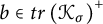 $b\in tr\left ( \mathcal {K}_{\sigma }\right ) ^{+}$
if and only if
 $\pi \left ( b\right ) $
contains the branches of a Miller tree.
The following cardinal invariant is very important to understand the structure of ideals on countable sets.
Definition 3.2. Let
 $\mathcal {I}$
be a tall ideal on
 $\omega .$
Define cov*
 $\left ( \mathcal {I}\right ) $
as the smallest size of a family
 $\mathcal {D\subseteq I}$
such that for every
 $X\in \left [ \omega \right ] ^{\omega },$
there is
 $D\in \mathcal {D}$
for which
 $D\cap X$
is infinite.
The following (in)equalities are known and/or easy to prove (see [Reference Hernández-Hernández and Hrušák36, Reference Hrušák38, Reference Hrušák, Meza-Alcántara and Minami42, Reference Hrušák and Zapletal44, Reference Meza58]).
Proposition 3.3
-
(1) cov*
$($
nwd
$)=$
cov
$\left ( \mathcal {M} \right ) .$
-
(2) cov*
$($
fin
$\times $
fin
$)=\mathfrak {b.}$
-
(3) cov*
$\left ( \mathcal {ED}\right ) =$
non
$\left ( \mathcal {M}\right ) .$
-
(4) cov*
$($
conv
$)= \mathfrak {c}.$
-
(5) cov*
$(tr($
ctble
$))=\mathfrak {c}.$
-
(6) cov*
$(tr(\mathcal {K}_{\sigma }))=\mathfrak {d}.$
-
(7) cov
$\left ( \mathcal {N}\right ) \leq $
cov*
$\left ( tr\mathcal {(N)}\right ) \leq \max \{$
cov
$\left ( \mathcal {N}\right ) ,\mathfrak {d}\}.$
-
(8) If
$\mathcal {A}$
is a MAD family, then cov*
$(\mathcal {I(A)})=\left \vert \mathcal {A}\right \vert .$








There are still open questions regarding cov
 $^{\ast }\left ( \mathcal {Z}\right ) .$
The fourth author made important contributions on this topic in [Reference Raghavan67, Reference Raghavan and Shelah68].
Definition 3.4. Let
 $\mathcal {I}$
be an ideal on
 $\omega .$
We say
 $\mathcal {I}$
is a P-ideal if for every
 $\left \{ A_{n}\mid n\in \omega \right \} \subseteq \mathcal {I},$
there is
 $B\in \mathcal {I}$
such that
 $A_{n} \subseteq ^{\ast }B,$
for every
 $n\in \omega $
.
It turns out that
 $F_{\sigma }$
-ideals and analytic P-ideals have very nice representations that make them easy to work with.
Definition 3.5. We say
 $\varphi :{\mathcal P} \left ( \omega \right ) \longrightarrow \mathbb{R\cup }\left \{ \infty \right \} $
is a lower semicontinuous submeasure if the following hold:
-
(1)
$\varphi \left ( \emptyset \right ) =0.$
-
(2)
$\varphi \left ( A\right ) \leq \varphi \left ( B\right ) $
whenever
$A\subseteq B.$
-
(3)
$\varphi \left ( A\cup B\right ) \leq \varphi \left ( A\right ) +\varphi \left ( B\right ) $
for every
$A,B\subseteq X.$
-
(4) (lower semicontinuity) if
$A\subseteq \omega ,$
then
$\varphi \left ( A\right ) = \sup \left \{ \varphi \left ( A\cap n\right ) \mid n\in \omega \right \} .$







We assume that all singletons have finite measure. Given a lower semicontinuous submeasure
 $\varphi ,$
we define
 $\mathsf{fin} \left ( \varphi \right ) $
as those subsets of
 $\omega $
with finite submeasure and
 $\mathsf{Exh}\left ( \varphi \right ) =\left \{ A\subseteq \omega \mid \lim \left ( \varphi \left ( A\setminus n\right ) \right ) =0\right \} .$
The following are two fundamental results.
Proposition 3.6 Let
 $\mathcal {I}$
be an ideal in
 $\omega .$
-
(1) (Mazur [Reference Mazur55])
$\mathcal {I}$
is an
$F_{\sigma }$
-ideal if and only if there is a lower semicontinuous submeasure
$\varphi $
such that
$\mathcal {I=} \mathsf{fin}\left ( \varphi \right ) .$
-
(2) (Solecki [Reference Solecki75])
$\mathcal {I}$
is an analytic P-ideal if and only if there is a lower semicontinuous submeasure
$\varphi $
such that
$\mathcal {I=} \mathsf{Exh} \left ( \varphi \right ) $
(in particular, every analytic P-ideal is
$F_{\sigma \delta }$
).


The summable ideal,
 $\mathcal {Z}$
and
 $tr\left ( \mathcal {N}\right ) $
are analytic P-ideals (for the summable ideals and
 $\mathcal {Z}$
this is easy, for
 $tr\left ( \mathcal {N}\right ) $
this was noted in [Reference Hernández-Hernández and Hrušák36] and a concrete submeasure appears in [Reference Borodulin-Nadzieja, Farkas and Plebanek8]).
In order to study and classify ideals on countable sets, the Katětov order is extremely helpful. We review its definition.
Definition 3.7. Let
 $X$
and Y be two countable sets,
 $ \mathcal {I},\mathcal {J}$
ideals on X and
 $Y,$
respectively, and
 $f:Y\longrightarrow X$
.
-
(1) We say f is a Katětov morphism from
$\left ( Y,\mathcal {J} \right ) $
to
$\left ( X,\mathcal {I}\right ) $
if
$f^{-1}\left ( A\right ) \in \mathcal {J}$
for every
$A\in \mathcal {I}.$
-
(2) We define
$\mathcal {I}\leq _{ {\textsf {K}}} \mathcal {J}$
(
$\mathcal {I}$
is Katětov smaller than
$\mathcal {J}$
or
$\mathcal {J}$
is Katětov above
$\mathcal {I}$
) if there is a Katětov morphism from
$\left ( Y,\mathcal {J}\right ) $
to
$\left ( X,\mathcal {I}\right ) .$
-
(3) We define
$\mathcal {I\simeq }_{ {\textsf {K}}} \mathcal {J}$
(
$\mathcal {I}$
is Katětov equivalent to
$\mathcal {J}$
) if
$\mathcal {I}\leq _{ {\textsf {K}}} \mathcal {J}$
and
$\mathcal {J} \leq _{ {\textsf {K}}} \mathcal {I}.$
-
(4) We say f is a Katětov–Blass morphism from
$\left ( Y,\mathcal {J}\right ) $
to
$\left ( X,\mathcal {I}\right ) $
if f is a finite to one Katětov morphism from
$\left ( Y,\mathcal {J}\right ) $
to
$\left ( X,\mathcal {I}\right ) .$
-
(5) We define
$\mathcal {I}\leq _{ {\textsf {KB}}} \mathcal {J}$
if there is a Katětov–Blass morphism from
$\left ( Y,\mathcal {J}\right ) $
to
$\left ( X,\mathcal {I}\right ) .$
-
(6)
$\mathcal {I}$
is Katětov–Blass equivalent to
$\mathcal {J}$
if
$\mathcal {I}\leq _{ {\textsf {KB}}} \mathcal {J}$
and
$\mathcal {J} \leq _{ {\textsf {KB}}} \mathcal {I}.$


The Katětov order has been applied successfully in classifying non-definable objects, such as ultrafilters and MAD families. Just to mention a couple of examples, an ultrafilter
 $\mathcal {U}$
is a P-point if and only if the dual ideal
 $\mathcal {U}^{\ast }$
is not Katětov above the ideal fin
 $\times $
fin and
 $\mathcal {U}$
is a Ramsey ultrafilter if and only if
 $\mathcal {U}^{\ast }$
is not Katětov above the ideal
 $\mathcal {ED}$
(see [Reference Hrušák38]). In fact, most of the usual properties of ultrafilters can be characterized with the Katětov order. In the case of ultrafilters, the upward cones of definable ideals in the Katětov order play a fundamental role, while the downward cones of definable ideals are very important in the study of MAD families. We list some of the properties of the Katětov order. All the proofs are elementary.
Lemma 3.8 Let
 $\mathcal {I}, \mathcal {J}$
be ideals on
 $\omega $
and
 $X\subseteq \omega .$
-
(1) If
$\mathcal {I\subseteq J},$
then
$\mathcal {I}\leq _{ {\textsf {KB}} }\mathcal {J}.$
-
(2) fin
$\leq _{ {\textsf {KB}}}\mathcal {I}.$
-
(3)
$\mathcal {I}$
is Katětov equivalent to fin if and only if
$\mathcal {I}$
is not tall. -
(4) If
$\mathcal {I}\leq _{ {\textsf {K}}}\mathcal {J},$
then cov*
$\left ( \mathcal {J}\right ) \leq $
cov*
$\left ( \mathcal {I} \right ) .$
-
(5) If
$X\in \mathcal {I}^{+},$
then
$\mathcal {I} \leq _{ {\textsf {KB}} }\mathcal {I}\upharpoonright X.$


The following equivalence of the Katětov order is often useful.
Lemma 3.9 Let
 $X,Y$
be two sets,
 $\mathcal {I}$
an ideal on X,
 $\mathcal {J}$
an ideal on
 $Y,$
and
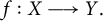 $f:X\longrightarrow Y.$
The following are equivalent:
-
(1) f is a Katětov function from
$\mathcal {I}$
to
$\mathcal {J}.$
-
(2) For every
$A\subseteq X,$
if
$A\in \mathcal {I}^{+},$
then
$f\left [ A\right ] \in \mathcal {J}^{+}.$


In the following proof, by
 $\mathcal {M}\left ( 2^{\omega }\right ) $
we denote the ideal of meager subsets of
 $2^{\omega }$
and
 $\mathcal {M}\left ( \omega ^{\omega }\right ) $
denotes the ideal of meager subsets of
 $\omega ^{\omega }.$
Lemma 3.10
 $tr\left ( \mathcal {M}\left ( 2^{\omega }\right ) \right ) , tr\left ( \mathcal {M}\left ( \omega ^{\omega }\right ) \right ) $
, and nwd are Katětov–Blass equivalent.
Proof In Proposition 1 of [Reference Brendle and Montoya17], it is proved that nwd and
 $tr\left ( \mathcal {M}\left ( 2^{\omega }\right ) \right ) $
are Katětov–Blass equivalent. We now show that nwd and
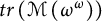 $tr\left ( \mathcal {M}\left ( \omega ^{\omega }\right ) \right ) $
are equivalent. For this proof, given
 $t\in \omega ^{<\omega }$
, define
 $\left \langle t\right \rangle _{<\omega }=\left \{ s\in \omega ^{<\omega }\mid t\sqsubseteq s\right \} $
and
 $\left \langle t\right \rangle =\left \{ f\in \omega ^{\omega }\mid t\subseteq f\right \} .$
Fix a well-order
 $\preceq $
of the rational numbers. We now recursively define the sets
 $\left \{ U_{s}\mid s\in \omega ^{<\omega }\right \} $
and
 $\left \{ q_{s}\mid s\in \omega ^{<\omega }\right \} \subseteq \mathbb{Q}$
as follows:
-
(1) Each
$U_{s}$
is a clopen interval of the rational numbers and
$q_{s}=min_{\preceq }\left ( U_{s}\right ) .$
-
(2)
$U_{\emptyset }=\mathbb{Q}.$
-
(3)
$\left \{ U_{s^{\frown }i}\mid i\in \omega \right \} $
is a partition (into clopen sets) of
$U_{s}\setminus \left \{ q_{s}\right \} .$
-
(4)
$\mathbb{Q}=\left \{ q_{s}\mid s\in \omega ^{<\omega }\right \} $
and
$\left \{ U_{s}\mid s\in \omega ^{<\omega }\right \} $
is a
$\pi $
-base of open sets.








Define
 $f:\omega ^{<\omega }\longrightarrow \mathbb{Q}$
given by
 $f\left ( s\right ) =q_{s}.$
We will prove that f is a Katětov-function from
 $\left ( \omega ^{<\omega },tr\left ( \mathcal {M}\left ( \omega ^{\omega }\right ) \right ) \right ) $
to
 $(\mathbb{Q},$
nwd
 $).$
Let
 $N\subseteq \mathbb{Q}$
be a nowhere dense set, we show that
 $\pi \left ( f^{-1}\left ( N\right ) \right ) $
is a nowhere dense set of
 $\omega ^{\omega }.$
Let
 $s\in \omega ^{<\omega }$
and since N is nowhere dense and
 $\left \{ U_{s}\mid s\in \omega ^{<\omega }\right \} $
is a
 $\pi $
-base of open sets, we can find
 $t\in \omega ^{<\omega }$
extending s such that
 $U_{t}\cap N=\emptyset .$
It then follows that
 $\left \langle t\right \rangle \cap \pi \left ( f^{-1}\left ( N\right ) \right ) =\emptyset .$
Now, we will prove that
 $f^{-1}$
is a Katětov-function from
 $(\mathbb{Q},$
nwd
 $)$
to
 $\left ( \omega ^{<\omega },tr\left ( \mathcal {M}\left ( \omega ^{\omega }\right ) \right ) \right ) .$
It is enough to prove that if
 $a\in tr\left ( \mathcal {M}\left ( \omega ^{\omega }\right ) \right ) ,$
then
 $f\left [ a\right ] \in $
nwd
 $.$
Let
 $s\in \omega ^{<\omega }$
and since
 $\pi \left ( a\right ) \cap \left \langle s\right \rangle $
is a
 $G_{\delta }$
meager set in
 $\left \langle s\right \rangle $
, it cannot be dense, so there is
 $t\in \omega ^{<\omega }$
extending s such that
 $\left \langle t\right \rangle \cap \pi \left ( a\right ) =\emptyset ,$
which implies that
 $a\cap \left \langle t\right \rangle _{<\omega }$
has finite intersection with every branch, so we can then find an extension r of t such that
 $a\cap \left \langle r\right \rangle _{<\omega }=\emptyset ,$
which then implies
 $f\left [ a\right ] \cap U_{r}=\emptyset .$
From now on, we will simply write
 $tr\left ( \mathcal {M}\right ) $
and use either
 $tr\left ( \mathcal {M}\left ( 2^{\omega }\right ) \right ) $
or
 $tr\left ( \mathcal {M}\left ( \omega ^{\omega }\right ) \right ) ,$
depending on which one is more convenient at the moment.
Lemma 3.11 Let
 $\mathcal {J},\mathcal {K}$
be
 $\sigma $
-ideals on
 $2^{\omega }.$
-
(1) If
$\mathcal {J\subseteq K},$
then
$tr\left ( \mathcal {J}\right ) \subseteq tr\left ( \mathcal {K}\right ) ,$
so in particular
$tr\left ( \mathcal {J}\right ) \leq _{ {\textsf {KB}}}tr\left ( \mathcal {K}\right ) .$
-
(2)
$tr($
ctble
$\mathsf{)}\leq _{ {\textsf {KB}}}tr\left ( \mathcal {K}_{\sigma }\right ) \leq _{ {\textsf {KB}}}tr\left ( \mathcal {M} \right ) $
and
$tr($
ctble
$\mathsf{)}\leq _{ {\textsf {KB}} }tr\left ( \mathcal {N}\right ) .$







We now need the following notions for ideals.
Definition 3.12. Let
 $\mathcal {I}$
be an ideal on
 $\omega .$
-
(1) We say
$\mathcal {I}$
is
$\omega $
-hitting if for every
$\left \{ X_{n}\mid n\in \omega \right \} \subseteq \left [ \omega \right ] ^{\omega }$
, there is
$A\in \mathcal {I}$
such that
$A\cap X_{n}$
is infinite for all
$n\in \omega .$
-
(2) We say
$\mathcal {I}$
is weakly
$\omega $
-hitting if for every
$\left \{ X_{n}\mid n\in \omega \right \} \subseteq \left [ \omega \right ] ^{\omega }$
, there is
$A\in \mathcal {I}$
such that
$A\cap X_{n}$
is infinite for infinitely many
$n\in \omega .$








Obviously every
 $\omega $
-hitting ideal is weakly
 $\omega $
-hitting and weakly
 $\omega $
-hitting ideals are tall. Moreover, every tall P-ideal is
 $\omega $
-hitting. Note that in the definition above, we may assume that the family
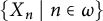 $\left \{ X_{n}\mid n\in \omega \right \} $
is actually a partition of
 $\omega $
; this is because we can take a disjoint refinement. Moreover, if
 $\mathcal {I}$
is tall, we may assume that
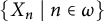 $\left \{ X_{n}\mid n\in \omega \right \} $
is a partition of
 $\omega $
and
 $X_{n}\in \mathcal {I}$
for every
 $n\in \omega .$
Lemma 3.13 Let
 $\mathcal {I}$
be an ideal on
 $\omega .$
If
 $\mathcal {I}$
is
 $\omega $
-hitting, then
 $\mathcal {I} \nleq _{ {\textsf {K}}}$
nwd.
Proof Assume
 $\mathcal {I}$
is
 $\omega $
-hitting and
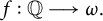 $f:\mathbb{Q}\longrightarrow \omega .$
We will prove that f is not a Katětov function from (
 $\mathbb{Q},$
nwd) to
 $\left ( \omega ,\mathcal {I}\right ) .$
If there is an open non-empty set of
 $\mathbb{Q}$
whose image is finite, then the preimage of that finite set is not in nwd. Assume that each non-empty open set has infinite image. Let
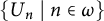 $\left \{ U_{n}\mid n\in \omega \right \} $
be a base of open sets of
 $\mathbb{Q}.$
Since each
 $f\left [ U_{n}\right ] $
is infinite and
 $\mathcal {I}$
is
 $\omega $
-hitting, we find
 $A\in \mathcal {I}$
that has infinite intersection with all of them. Hence,
 $f^{-1}\left ( A\right ) $
is dense, in particular not nowhere dense.
We also have the following.
Lemma 3.14 Every tall P-ideal is
 $\omega $
-hitting.
Proof Let
 $\mathcal {I}$
be a tall P-ideal and
 $\left \{ A_{n}\mid n\in \omega \right \} \subseteq \left [ \omega \right ] ^{\omega }.$
Since
 $\mathcal {I}$
is tall, for every
 $n\in \omega ,$
we choose
 $B_{n}\subseteq A_{n}$
with
 $B_{n}\in \mathcal {I}.$
Using that
 $\mathcal {I}$
is a P-ideal, we find
 $B\in \mathcal {I}$
that almost contain every
 $B_{n}.$
It follows that B has infinite intersection with each
 $A_{n}.$
In particular, the summable ideal,
 $\mathcal {Z}$
, and
 $tr\left ( \mathcal {N}\right ) $
are
 $\omega $
-hitting.
Proposition 3.15 Let
 $\mathcal {I},\mathcal {J}$
be ideals on
 $\omega .$
-
(1) If
$\mathcal {I}\leq _{ {\textsf {K}}}\mathcal {J}$
and
$\mathcal {I}$
is weakly
$\omega $
-hitting, then
$\mathcal {J}$
is weakly
$\omega $
-hitting. -
(2) If
$\mathcal {I}\leq _{ {\textsf {KB}}}\mathcal {J}$
and
$\mathcal {I}$
is
$\omega $
-hitting, then
$\mathcal {J}$
is
$\omega $
-hitting. -
(3) fin
$\times $
fin is not weakly
$\omega $
-hitting. -
(4) The following are equivalent:
-
(a)
$\mathcal {I}$
is weakly
$\omega $
-hitting. -
(b)
$\mathcal {I}\nleq _{ {\textsf {K}}}$
fin
$\times $
fin.
-


Proof We start with the first point. Assume that
 $\mathcal {I}$
is weakly
 $\omega $
-hitting and
 $f:\omega \longrightarrow \omega $
is a Katětov morphism from
 $\left ( \omega ,\mathcal {J}\right ) $
to
 $\left ( \omega ,\mathcal {I}\right ) $
. Let
 $\mathcal {A=}\left \{ A_{n}\mid n\in \omega \right \} \subseteq [\omega ]^\omega $
. We want to find an element of
 $\mathcal {J}$
that has infinite intersection with infinitely many of them. Consider the set
 $S=\left \{ n\mid \left \vert f\left [ A_{n}\right ] \right \vert <\omega \right\}$
. We proceed by cases, first assume that S is infinite. For every
 $n\in S,$
we can find
 $b_{n}\in \omega $
such that
 $A_{n}\cap f^{-1}\left ( \left \{ b_{n}\right \} \right ) $
is infinite. If there is a
 $b\in \omega $
such that there are infinitely many
 $n\in S$
for which
 $b_{n}=b,$
then
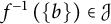 $f^{-1}\left ( \left \{ b\right \} \right ) \in \mathcal {J}$
and has infinite intersection with infinitely many elements of
 $\mathcal {A}.$
If there is no such
 $b,$
then the set
 $B=\left \{ b_{n}\mid n\in S\right \} $
is infinite. Since
 $\mathcal {I}$
is tall, we find
 $X\in \mathcal {I}$
such that
 $X\cap B$
is infinite. It follows that
 $f^{-1}\left ( X\right ) \in \mathcal {J}$
and has infinite intersection with infinitely many elements of
 $\mathcal {A}.$
We are now in the case that S is finite. We look at
 $B=\left \{ f\left [ A_{n}\right ] \mid n\notin S\right \} \subseteq \left [ \omega \right ] ^{\omega }.$
Since
 $\mathcal {I}$
is weakly
 $\omega $
-hitting, we find
 $X\in \mathcal {I}$
such that
 $X\cap b$
is infinite for every
 $b\in B$
. Once again, we get that
 $f^{-1}\left ( X\right ) \in \mathcal {J}$
and has infinite intersection with infinitely many elements of
 $\mathcal {A}.$
For the second point, note that the same proof as above works, since now S is the empty set, because f is finite to one.
The third point is trivial since no set in fin
 $\times $
fin can have an infinite intersection with infinitely many of the columns of
 $\omega ^{2}.$
We move to the fourth point. We will prove that
 $\mathcal {I}$
is not weakly
 $\omega $
-hitting if and only if
 $\mathcal {I}\leq _{ {\textsf {K} }}$
fin
 $\times $
fin. It is enough to prove that if
 $\mathcal {I}$
is not weakly
 $\omega $
-hitting, then
 $\mathcal {I}\leq _{ {\textsf {K}}}$
fin
 $\times $
fin since the other implication follows by the previous points. If
 $\mathcal {I}$
is not tall, there is nothing to do, so assume
 $\mathcal {I}$
is tall but not weakly
 $\omega $
-hitting. Thus, we find a partition
 $\mathcal {P} =\left \{ X_{n}\mid n\in \omega \right \} \subseteq \mathcal {I}$
of
 $\omega $
into infinite sets witnessing that
 $\mathcal I$
is not weakly
 $\omega $
-hitting. Let
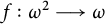 $f:\omega ^{2}\longrightarrow \omega $
be any bijection such that
 $f^{-1}\left ( X_{n}\right ) =\left \{ \left ( n,m\right ) \mid m\in \omega \right \} .$
It is easy to see that f is a Katětov morphism from
 $(\omega ^{2},$
fin
 $\times $
fin
 $)$
to
 $\left ( \omega ,\mathcal {I}\right ) .$
Given a partition P of
 $\omega $
, we say that
 $S\subseteq \omega $
is a (partial) selector for P if S intersects every element of P in exactly (at most) one point. We will need the following result, which is Corollary 2.3 of [Reference Michael, Meza-Alcántara, Thümmel and Uzcátegui59].
Proposition 3.16 [Reference Michael, Meza-Alcántara, Thümmel and Uzcátegui59]
Let
 $\mathcal {I}$
be an analytic ideal. The following are equivalent:
-
(1)
$\mathcal {I}$
is
$\omega $
-hitting. -
(2)
$\mathcal {ED}_{ {\textsf {fin}}}\leq _{ {\textsf {KB}}} \mathcal {I}.$
-
(3) There is a partition P of
$\omega $
into finite sets such every (partial) selector for P is in
$\mathcal {I}.$





In the main text, we will find a combinatorial characterization of the Borel ideals that are Katětov above fin
 $\times $
fin. Note that if
 $\mathcal {A}$
is an a.d. family, then
 $\mathcal {I(A)}$
is not weakly
 $\omega $
-hitting (no element of
 $\mathcal {I(A)}$
can have infinite intersection with infinitely many elements of
 $\mathcal {A}$
). Hence, we conclude the following.
Corollary 3.17 The ideal generated by any a.d. family is Katětov below fin
 $\times $
fin.
In order to study Sacks destructibility of ultrafilters, Yiparaki introduced the following notion in her thesis (see [Reference Yiparaki78]). The topic was later further developed in [Reference Chodounský, Guzmán and Hrušák24].
Definition 3.18. Let
 $\mathcal {I}$
be an ideal on
 $\omega .$
We say
 $\mathcal {I}$
is a Halpern–Läuchli ideal (HL for short) if for every
 $c:2^{<\omega }\longrightarrow 2,$
there are
 $p\in \mathbb{S}$
and
 $A\in \mathcal {I}^{+}$
such that
 $p\upharpoonright A= {\textstyle \bigcup \limits _{m\in A}} \left ( p\cap 2^{m}\right ) $
is monochromatic.
The following was proved in [Reference Chodounský, Guzmán and Hrušák24].
Theorem 3.19 [Reference Chodounský, Guzmán and Hrušák24]
Let
 $\mathcal {I},\mathcal {J}$
be ideals on
 $\omega .$
-
(1) If
$\mathcal {J}$
is HL and
$\mathcal {I}\leq _{ {\textsf {K}} }\mathcal {J},$
then
$\mathcal {I}$
is HL. -
(2) Every
$F_{\sigma }$
-ideal is HL. -
(3)
$tr\left ( \mathcal {N}\right ) $
is HL. -
(4)
$\mathcal {Z}$
is not HL.


An important property of the ideals nwd and conv is their invariance (up to Katětov–Blass equivalence) with respect to the choice of copy of the rational numbers in which they are defined.
Proposition 3.20
-
(1)
$tr\left ( \mathcal {N}\right ) <_{ {\textsf {K}}}\mathcal {Z}.$
-
(2)
$\mathcal {Z}$
is not Katětov below any
$F_{\sigma }$
ideal. -
(3)
$tr\left ( \mathcal {N}\right ) $
and nwd are Katětov incomparable. -
(4) fin
$\times $
fin is Katětov incomparable with both
$tr($
ctble
$\mathsf{)}$
and nwd. -
(5) conv
$<_{ {\textsf {K}}}$
fin
$\times $
fin. -
(6) conv
$<_{ {\textsf {K}}}tr($
ctble
$\mathsf{)} <_{ {\textsf {K}}}$
nwd,
$tr\left ( \mathcal {N}\right ) .$
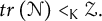


Proof In [Reference Hernández-Hernández and Hrušák36], it is proved that
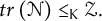 $tr\left ( \mathcal {N}\right ) \leq _{ {\textsf {K}}}\mathcal {Z}.$
Since
 $tr\left ( \mathcal {N}\right ) $
is HL and
 $\mathcal {Z}$
is not, it follows that
 $tr\left ( \mathcal {N}\right ) $
is strictly below
 $\mathcal {Z}.$
By the same reason,
 $\mathcal {Z}$
cannot be below any
 $F_{\sigma }$
ideal.
By Lemmas 3.13 and 3.14, we conclude that
 $tr\left ( \mathcal {N}\right ) \nleqslant _{ {\textsf {K}} }$
nwd. Now, assume that nwd
 $\leq _{ {\textsf {K}}} tr\left ( \mathcal {N}\right ) ,$
then cov
 $\left ( \mathcal {N}\right ) \leq $
cov
 $^{\ast }(tr\left ( \mathcal {N} \right ) )\leq $
cov
 $^{\ast }($
nwd
 $)=$
cov
 $\left ( \mathcal {M}\right ) $
(see Proposition 3.3), which we know is not true in ZFC. Since the Katětov order is absolute between Borel ideals (see [Reference Hrušák40]), we get a contradiction. This shows (3).
Katětov incomparability of fin
 $\times $
fin and nwd is proved in [Reference Hrušák40]. Since
 $tr($
ctble
 $) \subseteq tr({\mathcal M})$
and nwd and
 $tr\left (\mathcal {M}\right ) $
are Katětov equivalent (Lemma 3.10), we see
 $tr($
ctble
 $) \leq _{ {\textsf {K}}}$
nwd and fin
 $\times $
fin
 $\nleqslant _{ {\textsf {K}} } tr($
ctble
 $)$
. On the other hand, in Proposition 76 of [Reference Guzmán31], it was proved that
 $tr($
ctble
 $)$
is weakly
 $\omega $
-hitting, and
 $tr($
ctble
 $)\nleqslant _{ {\textsf {K}} }$
fin
 $\times $
fin follows by Proposition 3.15. This shows (4).
In order to prove that conv
 $\leq _{ {\textsf {K}}}$
fin
 $\times $
fin, by Proposition 3.15, it is enough to prove that conv is not weakly
 $\omega $
-hitting. This is easy, just take countably many convergent sequences converging to different points.
We now prove that conv
 $\leq _{ {\textsf {K}}}tr($
ctble). For this proof,
 $\mathbb{Q}_{0}$
will denote the set of all functions
 $f\in 2^{\omega }$
that are eventually constant
 $0.$
It is easy to see that
 $\mathbb{Q}_{0}$
is homeomorphic to the rational numbers. Let conv
 $(\mathbb{Q}_{0})$
be the ideal generated by all the convergent sequences of
 $\mathbb{Q}_{0}$
(the point of convergence does not need to be in
 $\mathbb{Q}_{0}$
). As discussed before, conv
 $(\mathbb{Q}_{0})$
and conv are Katětov–Blass equivalent. Define
 $f:2^{<\omega }\longrightarrow \mathbb{Q}_{0}$
by
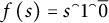 $f\left ( s\right ) =s^{\frown }1^{\frown }\overline {0}$
(where
 $\overline {0}$
denotes the constant
 $0$
function and
 $^{\frown }$
is the concatenation operation). It is easy to see that f is a Katětov-function from
 $(2^{<\omega },tr($
ctble)) to
 $(\mathbb{Q}_{0} ,$
conv
 $(\mathbb{Q}_{0})).$
Since fin
 $\times $
fin and
 $tr($
ctble
 $) $
are Katětov incomparable, it follows that conv is strictly below both of them. Finally, since nwd and
 $tr\left ( \mathcal {N}\right ) $
are Katětov incomparable, it follows that
 $tr($
ctble
 $\mathsf{)}$
is strictly below both of them.
We also have the following.
Proposition 3.21
nwd
 $\nleq _{ {\textsf {K}}} tr(\mathcal {K}_{\sigma }).$
Proof Let
 $f:\omega ^{<\omega }\longrightarrow \mathbb{Q},$
we will prove that f is not a Katětov function from
 $(\omega ^{<\omega },tr(\mathcal {K}_{\sigma }))$
to
 $(\mathbb{Q},$
nwd
 $).$
We need the following.
Claim 3.22 Let
 $s\in \omega ^{<\omega }, a\subseteq \omega ^{<\omega }$
, and
 $p\in \mathbb{PT}$
such that
 $\left [ p\right ] \subseteq \pi \left ( a\right ) $
and st
 ${\left ( p\right ) =s.}$
For every non-empty
 $U\subseteq \mathbb{Q}$
clopen set, there are
 $C, b$
, and q with the following properties:
-
(1)
$C\subseteq U$
is a non-empty clopen set. -
(2)
$b\subseteq a$
and
$f\left [ b\right ] \cap C=\emptyset .$
-
(3)
$q\leq p$
and st
$\left ( q\right ) =s$
. -
(4)
$\left [ q\right ] \subseteq \pi \left ( b\right ) .$





Choose any non-empty clopen set
 $C_{0}\subseteq U$
for which
 $C_{1}=U\setminus C_{0}\neq \emptyset .$
We introduce some notation, given
 $q\in \mathbb{PT}$
and
 $X\subseteq \omega ^{<\omega },$
we will say that X is dense in q if every node of q can be extended to an element of
 $X.$
Define D as the set of all
 $t\in $
suc
 $_{p}\left ( s\right ) $
for which there is
 $z\in p_{t}$
such that
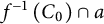 $f^{-1}\left ( C_{0}\right ) \cap a$
is dense in
 $p_{z}.$
If D is infinite, we can find
 $b\subseteq a$
and q as above for which
 $f\left [ b\right ] \subseteq C_{0},$
hence
 $f\left [ b\right ] \cap C_{1}=\emptyset $
. On the other hand, if D is finite, we can find
 $b\subseteq a$
and q such that
 $f\left [ b\right ] \cap C_{0}=\emptyset .$
We want to recursively construct
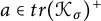 $a\in tr(\mathcal {K} _{\sigma })^{+}$
whose image is a nowhere dense set. We introduce some notation for the rest of the proof. Given
 $L\subseteq \omega ^{<\omega },$
by
 $\left \langle L\right \rangle $
we denote the tree closure of
 $L,$
in other words,
 $\left \langle L\right \rangle =\left \{ t\in \omega ^{<\omega }\mid \exists s\in L\left ( t\subseteq s\right ) \right \} .$
Claim 3.23 Let
 $s\in \omega ^{<\omega }, a\subseteq \omega ^{<\omega }, L\subseteq a$
finite, and
 $p\in \mathbb{PT}$
such that
 $\left [ p\right ] \subseteq \pi \left ( a\right ) , L\subseteq p,$
and st
 $\left ( p\right ) =s.$
For every non-empty
 $U\subseteq \mathbb{Q}$
clopen set, there are
 $C, b,$
and q with the following properties:
-
(1)
$C\subseteq U$
is a non-empty clopen set. -
(2)
$b\subseteq a, L\subseteq b,$
and
$f\left [ b\right ] \cap C=\emptyset .$
-
(3)
$q\leq p, L\subseteq q,$
and st
$\left ( q\right ) =s$
. -
(4)
$\left [ q\right ] \subseteq \pi \left ( b\right ) .$
-
(5)
$\left \langle L\right \rangle \cap $
split
$\left ( p\right ) =\left \langle L\right \rangle \cap $
split
$\left ( q\right ) .$






First, find
 $U_{0}\subseteq U$
a non-empty clopen set such that
 $f\left [ L\right ] \cap U_{0}=\emptyset .$
This is easy since L is finite. Let K be the set of all
 $t\in \omega ^{<\omega }$
such that either
 $t\in L$
and is maximal with this property or
 $t\in \left \langle L\right \rangle \cap $
split
 $\left ( p\right ) .$
For
 $t\in K,$
choose
 $p^{t}$
a Miller tree with the following properties:
-
(1)
$p^{t}\leq p$
and
$t\subseteq $
st
$(p^{t}).$
-
(2) For every
$z\in \omega ^{<\omega },$
if
$z\in p^{t}\cap L,$
then
$z\subseteq t.$
-
(3) If
$t\in $
split
$\left ( p\right ) ,$
then st
$(p^{t})=t.$


We can now apply iteratively the previous claim finitely many times and find
 $C\subseteq U_{0}$
a non-empty clopen set and
 $\{(b^{t},q^{t})\mid t\in K\}$
with the following properties:
-
(1)
$b^{t}\subseteq \left \{ z\in a\mid t\subseteq z\right \} $
and
$f[b^{t}]\cap C=\emptyset .$
-
(2)
$q^{t}\leq p^{t}$
and st
$(q^{t})=$
st
$(p^{t}).$
-
(3)
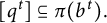
$[q^{t}]\subseteq \pi (b^{t}).$




Define
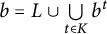 $b=L\cup \bigcup \limits _{t\in K}b^{t}$
and
 $q=\bigcup \limits _{t\in K}q^{t}.$
It is clear that
 $b,q$
, and C have the desired properties.
We can now construct a set
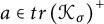 $a\in tr\left ( \mathcal {K}_{\sigma }\right ) ^{+}$
such that
 $f\left [ a\right ] \in $
nwd
 $.$
Using the claim, do a Miller type fusion (preserving only finitely many nodes at each step) and build the desired
 $a.$
Definition 3.24. Let
 $\mathcal {I}$
be an ideal. We say that
 $\mathcal {I}$
is Katětov uniform if for every
 $X\in \mathcal {I}^{+},$
the ideals
 $\mathcal {I}$
and
 $\mathcal {I}\upharpoonright X$
are Katětov equivalent.
Note that
 $\mathcal {I}$
is Katětov uniform if and only if
 $\mathcal {I} \upharpoonright X\leq _{ {\textsf {K}}}\mathcal {I}$
for all
 $X\in \mathcal {I}^{+}$
(see Lemma 3.8). We encourage the reader to verify that nwd, fin
 $\times $
fin, and
 $\mathcal {ED}_{ {\textsf {fin}}}$
are Katětov uniform. On the other hand, conv and
 $\mathcal {ED}$
are not (for conv, see the comment below Corollary 9.6 and for
 $\mathcal {ED,}$
note that it has
 $\mathcal {ED}_{ {\textsf {fin}}}$
as a restriction, and these two ideals are not equivalent, see [Reference Hrušák40]).
4 Preliminaries on destructibility of ideals
If
 $\mathcal {I}$
is an ideal on
 $\omega $
and
 $\mathbb{P}$
is a partial order, we say that
 $\mathbb{P}$
destroys
 $\mathcal {I}$
if
 $\mathbb{P}$
forces that
 $\mathcal {I}$
is no longer tall, i.e.,
 $\mathbb{P}$
adds a new subset of
 $\omega $
that is almost disjoint with every element of
 $\mathcal {I}.$
If
 $\mathbb{P}$
does not destroy
 $\mathcal {I},$
we say that
 $\mathcal {I}$
is
 $\mathbb{P}$
-indestructible. The theory of destructibility of ideals is very important in forcing theory, since many important forcing properties may be stated in these terms. The following proposition is an example of this fact (see [Reference Chodounský and Guzmán23]).
Proposition 4.1 Let
 $\mathbb{P}$
be a partial order.
-
(1)
$\mathbb{P}$
adds new reals if and only if
$\mathbb{P}$
destroys
$tr($
ctble
$).$
-
(2)
$\mathbb{P}$
adds unbounded reals if and only if
$\mathbb{P}$
destroys
$tr\left ( \mathcal {K}_{\sigma }\right ) $
. -
(3)
$\mathbb{P}$
adds dominating reals if and only if
$\mathbb{P}$
destroys fin
$\times $
fin
$.$
-
(4)
$\mathbb{P}$
adds eventually different reals if and only if
$\mathbb{P}$
destroys
$\mathcal {ED}.$


Trace ideals are critical for studying the destructibility of ideals.
Theorem 4.2 (Brendle–Yatabe [Reference Brendle and Yatabe20], Hrušák–Zapletal [Reference Hrušák and Zapletal44])
Let
 $\mathcal {I}$
be a
 $\sigma $
-ideal on
 $\omega ^{\omega }$
such that
 $\mathbb{P}_{\mathcal {I}}$
is proper and has the continuous reading of names. If
 $\mathcal {J}$
is an ideal on
 $\omega ,$
then the following are equivalent:
-
(1) There is a condition
$B\in \mathbb{P}_{\mathcal {I}}$
such that B forces that
$\mathcal {J}$
is not tall. -
(2) There is
$a\in tr\left ( \mathcal {I}\right ) ^{+}$
such that
$\mathcal {J}\leq _{ {\textsf {K}}} tr\left ( \mathcal {I}\right ) \upharpoonright a.$



One may wonder if the restriction in the above theorem is necessary. One can produce examples to show that it is. However, in practice, it is often not needed. This is related to the homogeneity of the forcing in question. The proofs of the following statements can be found in [Reference Brendle and Yatabe20, Reference Kurilić49, Reference Meza58].
Theorem 4.3 Let
 $\mathcal {J}$
be an ideal on
 $\omega .$
-
(1) The following are equivalent:
-
(a)
$\mathcal {J}$
is
$\mathbb{S}$
-destructible. -
(b)
$\mathcal {J}\leq _{ {\textsf {K}}}tr($
ctble
$).$
-
(c) Every forcing that adds a new real destroys
$\mathcal {J}.$
-
-
(2) The following are equivalent:
-
(a)
$\mathcal {J}$
is
$\mathbb{PT}$
-destructible. -
(b)
$\mathcal {J}\leq _{ {\textsf {K}}}tr(\mathcal {K}_{\sigma }).$
-
(c) Every forcing that adds an unbounded real destroys
$\mathcal {J}.$
-
-
(3) The following are equivalent:
-
(a)
$\mathcal {J}$
is
$\mathbb{C}$
-destructible. -
(b)
$\mathcal {J}\leq _{ {\textsf {K}}}$
nwd
$.$
-
-
(4) The following are equivalent:
-
(a)
$\mathcal {J}$
is
$\mathbb{B}$
-destructible. -
(b)
$\mathcal {J}\leq _{ {\textsf {K}}}tr(\mathcal {N}).$
-





From this, it follows that
 $\mathbb{C}$
indestructibility entails both Miller and Sacks indestructibility (which is particularly interesting since
 $\mathbb{C}$
does not add generics for
 $\mathbb{S}$
or
 $\mathbb{PT}$
). It also follows that
 $\mathbb{B}$
indestructibility or Miller indestructibility implies
 $\mathbb{S}$
indestructibility. We will need the following.
Proposition 4.4
 $tr($
ctble
 $)$
and
 $tr\left ( \mathcal {K}_{\sigma }\right ) $
are Katětov uniform.
Proof We prove the proposition for
 $tr($
ctble
 $),$
a similar argument works for
 $tr\left ( \mathcal {K}_{\sigma }\right ) .$
Let
 $a\in tr($
ctble
 $)^{+}.$
Since
 $\pi \left ( a\right ) $
is an uncountable Borel set, we know that there is
 $p\in \mathbb{S}$
such that
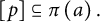 $\left [ p\right ] \subseteq \pi \left ( a\right ) .$
It follows that forcing with Sacks below p destroys
 $tr($
ctble
 $)\upharpoonright a.$
Since
 $\mathbb{S}$
is a homogeneous forcing, we conclude that Sacks forcing destroys
 $tr($
ctble
 $)\upharpoonright a.$
By Theorem 4.3, we conclude that
 $tr($
ctble
 $)\upharpoonright a\leq _{ {\textsf {K}} }tr($
ctble
 $).$
For almost disjoint families, we have the following notion.
Definition 4.5. Let
 $\mathcal {A}$
be a MAD family and
 $\mathbb{P}$
a forcing notion. We say that
 $\mathbb{P}$
destroys
 $\mathcal {A}$
if
 $\mathcal {A}$
is no longer maximal after forcing with
 $\mathbb{P}.$
If
 $\mathbb{P}$
does not destroy
 $\mathcal {A},$
we say that
 $\mathcal {A}$
is
 $\mathbb{P}$
-indestructible.
Equivalently,
 $\mathbb{P}$
destroys
 $\mathcal {A}$
if and only if it destroys
 $\mathcal {I(A)}.$
Regarding destructibility of MAD families, the following is known.
Theorem 4.6
-
(1) There is a MAD family
$\mathcal {A}$
that is destroyed by Sacks forcing (equivalently, by any forcing adding new reals). -
(2) If
$\mathbb{P}$
adds a dominating real, then it destroys every MAD family. -
(3) (Laflamme [Reference Laflamme52]) Every MAD family that can be extended to an
$F_{\sigma }$
ideal can be destroyed without adding unbounded reals. However, under CH, there are MAD families that cannot be extended to an
$F_{\sigma }$
ideal. -
(4) (Hrušák [Reference Hrušák45]) Assume CH. For every proper
$\omega ^{\omega }$
-bounding forcing
$\mathbb{P}$
of size
$\omega _{1}$
, there is a MAD family that is
$\mathbb{P}$
-indestructible. -
(5) (Shelah [Reference Shelah71], see also [Reference Brendle9, Reference Brendle and Fischer14, Reference Brendle and Raghavan18, Reference Zdomskyy81]) Assume CH. Every MAD family can be destroyed by a proper forcing that does not add dominating reals. Hence, it is consistent that
$\omega _{1}=\mathfrak {b<a}=\omega _{2}.$
-
(6) (Brendle [Reference Brendle9]) Assume
$\mathfrak {b=c.}$
Every MAD family can be destroyed by a ccc forcing that does not add dominating reals. Hence, it is consistent that for every regular
$\kappa ,$
it is consistent that
$\mathfrak {b=} \kappa <\mathfrak {a=c}=\kappa ^{+}.$
-
(7) (Shelah [Reference Shelah72], see also [Reference Brendle10, Reference Brendle12]). It is consistent that
$\omega _{1}<\mathfrak {d<a}$
and assuming the existence of a measurable cardinal, it is consistent that
$\omega _{1}<\mathfrak {u<a}.$
-
(8) (Brendle [Reference Brendle11]) It is consistent that
$\mathfrak {a}$
has countable cofinality. -
(9) (Guzmán and Kalajdzievski [Reference Guzmán and Kalajdzievski34]) Every MAD family can be destroyed by a proper forcing that preserves P-points. Hence, it is consistent that
$\omega _{1}=\mathfrak {u<a}.$
-
(10) (Fischer and Mejía [Reference Fischer and Mejía30], see also [Reference Fischer, Friedman, Mejía and Montoya29, Reference Mejía57]) It is consistent that
$\omega _{1}<\mathfrak {s<b<a}.$








We know that
 $\mathbb{S}$
-destructible MAD families exist (in ZFC), so we are interested in indestructible MAD families. As noted in the introduction, we do not even know if Sacks indestructible MAD families exist (which is the weakest notion of indestructibility). It is possible to build such families under certain hypotheses on cardinal invariants (see [Reference Brendle and Yatabe20, Reference Hrušák and Ferreira41, Reference Kurilić49]), but we are still far away from a ZFC theorem. For more about destructibility, the reader may consult [Reference Brendle and Yatabe20, Reference Hrušák and Zapletal44] or [Reference Chodounský and Guzmán23].
5 Shelah–Steprāns ideals
Let
 $\mathcal {I}$
be an ideal on
 $\omega $
. By
 ${\mathcal I}^{< \omega }$
we denote the ideal of subsets X of
 $[\omega ]^{<\omega } \setminus \{ \emptyset \}$
for which there exists
 $A \in {\mathcal I}$
such that
 $s \cap A \neq \emptyset $
for all
 $s \in X$
. Thus,
 $\left ( \mathcal {I}^{<\omega }\right ) ^{+}$
is the set of all
 $X\subseteq \left [ \omega \right ] ^{<\omega }\setminus \left \{ \emptyset \right \} $
such that for every
 $A\in \mathcal {I,}$
there is
 $s\in X$
such that
 $s\cap A=\emptyset .$
The following notion will play a fundamental role in this article.
Definition 5.1. An ideal
 $\mathcal {I}$
is called Shelah–Steprāns if for every
 $X\in \left ( \mathcal {I}^{<\omega }\right ) ^{+}$
, there is
 $Y\in \left [ X\right ] ^{\omega }$
such that
 $\bigcup Y\in \mathcal {I}.$
In other words, an ideal
 $\mathcal {I}$
is Shelah–Steprāns if for every
 $X\subseteq \left [ \omega \right ] ^{<\omega }\setminus \left \{ \emptyset \right \} $
either there is
 $A\in \mathcal {I}$
such that
 $s\cap A\neq \emptyset $
for every
 $s\in X$
or there is
 $B\in \mathcal {I}$
that contains infinitely many elements of
 $X.$
For almost disjoint families, this notion is very similar to the following concept, introduced by Shelah and Steprāns (see Question 5 of [Reference Shelah and Steprāns74]) and further studied by Raghavan in [Reference Raghavan66].
Definition 5.2. Let
 $\mathcal {A}$
be an a.d. family. We say
 $\mathcal {A}$
is almost strongly separable, if for every
 $X\in (\mathcal {I(A)}^{<\omega })^{+},$
there is
 $A\in \mathcal {A}$
that contains infinitely many elements of X.
Definition 5.3. An a.d. family
 $\mathcal {A}$
is said to be Shelah–Steprāns if
 $\mathcal {I}(\mathcal {A})$
is a Shelah–Steprāns ideal.
The difference between
 $\mathcal {A}$
being almost strongly separable and
 $\mathcal {A}$
being Shelah Steprāns is that in the former one, the required witness is in
 $\mathcal {A}$
, while in the latter one, in the ideal generated by
 $\mathcal {A}.$
We shall prove at the end of this section that the question of existence for almost strongly separable and Shelah–Steprāns MAD families is the same under
 $\mathfrak {b} = \mathfrak {c}$
(Theorem 5.15). Recall the following notions.
Definition 5.4. Let
 $\mathcal {A}$
be a MAD family.
-
(1)
$\mathcal {A}$
is completely separable if for every
$X\in \mathcal {I}\left ( \mathcal {A}\right ) ^{+},$
there is
$A\in \mathcal {A}$
such that
$A\subseteq X.$
-
(2)
$\mathcal {A}$
has true cardinality
$\mathfrak {c}$
if for every
$X\in \mathcal {I}\left ( \mathcal {A}\right ) ^{+},$
we have that the set
$\{A\in \mathcal {A\mid }\left \vert A\cap X\right \vert =\omega \mathcal {\}}$
has size
$\mathfrak {c}.$


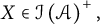


Completely separable MAD families were introduced by Hechler in [Reference Hechler35] and studied by Erdős and Shelah in [Reference Erdős and Shelah27]. It is easy to see that every completely separable MAD family has true cardinality
 $\mathfrak {c},$
and if there is a MAD family of true cardinality
 $\mathfrak {c},$
then there is a completely separable one (see [Reference Shelah73] for more details). In [Reference Shelah and Steprāns74], Shelah and Steprāns introduced the following definition.
Definition 5.5. Let
 $\mathcal {A}$
be a MAD family.
 $\mathcal {A}$
is strongly separable if for every
 $X\in (\mathcal {I(A)}^{<\omega })^{+},$
there are
 $\mathfrak {c}$
many
 $A\in \mathcal {A}$
such that each one of them contains infinitely many disjoint elements of
 $X.$
Clearly every strongly separable MAD family has true cardinality
 $\mathfrak {c}$
and is almost strongly separable. The motivation for Shelah and Steprāns to introduce their notion comes from operator algebras, mainly from the study of masas in the Calkin algebra. We warn the reader that there are no implications between completely separable and almost strongly separable (or Shelah–Steprāns): we will see below that almost strongly separable MAD families are Cohen indestructible (see Proposition 7.1), while this is not necessarily the case for completely separable MAD families. Completely separable MAD families have size
 $\mathfrak {c}$
, whereas this is not the case for almost strongly separable ones. In the Cohen model, both types of families exist: a completely separable one (as shown in [Reference Shelah73]) and an almost strongly separable one (as established by Theorem 10.6). However, they exhibit completely different behavior: every almost strongly separable MAD family has size
 $\omega _{1}$
(and is Cohen indestructible), while every completely separable MAD family is Cohen destructible and has size
 $\mathfrak {c}$
(see Proposition 10.4).
Proposition 5.6 Every non-meager ideal is Shelah–Steprāns.
Proof Let
 $\mathcal {I}$
be a non-meager ideal and
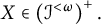 $X\in \left ( \mathcal {I}^{<\omega }\right ) ^{+}.$
Note that since
 $X\in \left ( \mathcal {I}^{<\omega }\right ) ^{+}$
(and
 $\mathcal {I}$
contains every finite set) for every
 $n\in \omega ,$
there is
 $s\in X$
such that
 $s\cap n=\emptyset .$
Thus, we can find
 $Z=\left \{ s_{n}\mid n\in \omega \right \} \subseteq X$
such that if
 $n\neq m,$
then
 $s_{n}\cap s_{m}=\emptyset .$
We then define
 $M=\left \{ A\subseteq \omega \mid \forall ^{\infty }n\left ( s_{n}\nsubseteq A\right ) \right \} $
which is clearly a meager set and thus there must be
 $A\in \mathcal {I}$
such that
 $A\notin M$
. Hence, there is
 $Y\in \left [ X\right ] ^{\omega }$
such that
 $\bigcup Y\subseteq A\in \mathcal {I}.$
Nevertheless, there are meager ideals that are also Shelah–Steprāns as the following result shows.
Lemma 5.7
fin
 $\times $
fin is Shelah–Steprāns.
Proof It is easy to see that if
 $X\in (($
fin
 $\times $
fin
 $)^{<\omega })^{+}$
, then there must be infinitely many elements of X that are below the graph of a function, so there must be
 $Y\in \left [ X\right ] ^{\omega }$
such that
 $\bigcup Y\in $
fin
 $\times $
fin.
We now show that the property of being Shelah–Steprāns is upward closed in the Katětov order.
Lemma 5.8 Let
 $\mathcal {I}$
and
 $\mathcal {J}$
be two ideals on
 $\omega .$
If the ideal
 $\mathcal {I}$
is Shelah–Steprāns and
 $\mathcal {I}\leq _{K} \mathcal {J,}$
then
 $\mathcal {J}$
is also Shelah–Steprāns.
Proof Let
 $f:\omega \longrightarrow \omega $
be a Katětov-morphism from
 $\left ( \omega ,\mathcal {J}\right ) $
to
 $\left ( \omega ,\mathcal {I}\right ) .$
Letting
 $X\in \left ( \mathcal {J}^{<\omega }\right ) ^{+}$
, we must find
 $Y\in \left [ X\right ] ^{\omega }$
such that
 $\bigcup Y\in \mathcal {J}.$
Defining
 $X_{1}=\left \{ f\left [ s\right ] \mid s\in X\right \} ,$
we will first argue that
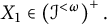 $X_{1}\in \left ( \mathcal {I}^{<\omega }\right ) ^{+}.$
To prove this fact, let
 $A\in \mathcal {I}.$
Since f is a Katětov-morphism,
 $f^{-1}\left ( A\right ) \in \mathcal {J}$
so there is
 $s\in X$
for which
 $s\cap f^{-1}\left ( A\right ) =\emptyset $
and then
 $f\left [ s\right ] \cap A=\emptyset .$
Since
 $\mathcal {I}$
is Shelah–Steprāns, there is
 $Y_{1} \in \left [ X_{1}\right ] ^{\omega }$
such that
 $\bigcup Y_{1}\in \mathcal {I}.$
Finally, if
 $Y\in \left [ X\right ] ^{\omega }$
is such that
 $Y_{1}=\left \{ f\left [ s\right ] \mid s\in Y\right \} $
, then
 $\bigcup Y\in \mathcal {J}.$
We will need the following game designed by Claude Laflamme: Letting
 $\mathcal {I}$
be an ideal on
 $\omega ,$
define the game
 $\mathcal {L}\left ( \mathcal {I} \right ) $
between players
 $\mathsf{I}$
and
 $\mathsf{II}$
as follows:
 $$ \begin{align*} \begin{array}[c]{|l|l|l|l|l|l|} \hline \mathsf{I} & \dots & A_{n} & & \dots & \\\hline \mathsf{II} & \dots & & s_{n} & \dots & \bigcup s_{n}\in\mathcal{I}^{+} \\\hline \end{array} \end{align*} $$
At round
 $n\in \omega ,$
player
 $\mathsf{I}$
plays
 $A_{n}\in \mathcal {I}$
and
 $\mathsf{II}$
responds with
 $s_{n}\in \lbrack \omega \backslash A_{n} ]^{<\omega }.$
Player
 $\mathsf{II}$
wins in case
 $\bigcup s_{n} \in \mathcal {I}^{+}$
. The following is mainly a result of Laflamme (see [Reference Laflamme53]).
Proposition 5.9 Let
 $\mathcal {I}$
be an ideal on
 $\omega .$
-
(1) The following are equivalent:
-
(a)
$\mathsf{I}$
has no winning strategy in
$\mathcal {L}\left ( \mathcal {I}\right ) .$
-
(b) For every
$\left \{ F_{s}\mid s\in \omega ^{<\omega }\right \} \subseteq \mathcal {I}^{\ast },$
there is a strictly increasing function
$f\in \omega ^{\omega }$
such that
$ {\textstyle \bigcup \limits _{n\in \omega }} \left ( F_{f\upharpoonright n}\cap f\left ( n\right ) \right ) \in \mathcal {I}^{+}.$
-
(c) Every countable subset of
$\mathcal {I}^{\ast }$
has a pseudointersection in
$\mathcal {I}^{+}.$
-
(d) fin
$\times $
fin
$\nleq _{ {\textsf {K}}} \mathcal {I}.$
-
-
(2) The following are equivalent:
-
(a)
$\mathsf{II}$
has a winning strategy in
$\mathcal {L}\left ( \mathcal {I}\right ) .$
-
(b) There is
$\left \{ X_{n}\mid n\in \omega \right \} \subseteq \left ( \mathcal {I}^{<\omega }\right ) ^{+}$
such that for every
$A\in \mathcal {I}$
, there is
$n\in \omega $
such that
$\left [ A\right ] ^{<\omega }\cap X_{n}=\emptyset .$
-
(c) There is
$\left \{ X_{n}\mid n\in \omega \right \} \subseteq \left ( \mathcal {I}^{<\omega }\right ) ^{+}$
such that for every
$A\in \mathcal {I}$
, there is
$n\in \omega $
such that
$\left [ A\right ] ^{<\omega }\cap X_{n}$
is finite.
-














Proof We start with the first point. The equivalence of
 $a)$
and
 $c)$
is proved in [Reference Laflamme53]. The equivalence of
 $b)$
and
 $c)$
is claimed in that same paper without proof (see the definition of weak P-filter in [Reference Laflamme53]). We provide a sketch of the proof. It is easy to see that
 $b)$
implies
 $c).$
We now prove the other implication.
Let
 $\left \{ F_{s}\mid s\in \omega ^{<\omega }\right \} \subseteq \mathcal {I} ^{\ast }.$
Without loss of generality, we may assume that for every
 $s,t\in \omega ^{<\omega },$
if
 $t\subseteq s,$
then
 $F_{s}\subseteq F_{t}.$
For every
 $n\in \omega ,$
define:
 $$ \begin{align*} \begin{array}[c]{l} H_{n}= {\textstyle\bigcap} \{F_{s}\mid s\in (n+1)^{\leq n} \}. \end{array} \end{align*} $$
Note that
 $H_{n}\in \mathcal {I}^{\ast }$
for every
 $n\in \omega .$
By point (c), there is
 $X\in \mathcal {I}^{+}$
a pseudointersection of
 $\left \{ H_{n}\mid n\in \omega \right \} .$
We now find a sequence
 $\left \langle n_{i}\right \rangle _{i\in \omega }$
such that for every
 $i\in \omega ,$
the following holds:
-
(1)
$n_{i}<n_{i+1}.$
-
(2)
$X\setminus n_{i+1}\subseteq H_{n_{i}}.$


We now define the following sets:
 $$ \begin{align*} \begin{array}[c]{c} Y_{0}=X\cap\left( {\textstyle\bigcup} \{[n_{i},n_{i+1})\mid i\text{ is even}\}\right)\\ Y_{1}=X\cap\left( {\textstyle\bigcup} \{[n_{i},n_{i+1})\mid i\text{ is odd}\}\right). \end{array} \end{align*} $$
Since
 $X\in \mathcal {I}^{+},$
there is
 $i\in 2$
such that
 $Y_{i}\in \mathcal {I}^{+}$
. If
 $Y_{0}\in \mathcal {I}^{+}$
, define
 $f\in \omega ^{\omega }$
, where
 $f\left ( m\right ) =n_{2m+1}$
and if
 $Y_{1}\in \mathcal {I}^{+},$
define f by
 $f\left ( m\right ) =n_{2\left ( m+1\right ) }.$
In either case, it is easy to see that
 $ {\textstyle \bigcup \limits _{m\in \omega }} \left ( F_{f\upharpoonright m}\cap f\left ( m\right ) \right ) \in \mathcal {I}^{+}.$
For the equivalence of
 $c)$
and
 $d),$
see [Reference Hrušák40].
We now move to the second point. The equivalence of
 $a)$
and
 $c)$
was proved in [Reference Laflamme53]. For the equivalence of items
 $b)$
and
 $c)$
, just note that we can add all finite modifications of each
 $X_{n}.$
If
 $s_{0},\ldots ,s_{n}$
are finite non-empty subsets of
 $\omega $
, we say
 $a=\left \{ k_{0},\ldots ,k_{n}\right \} \in \left [ \omega \right ] ^{<\omega }$
is a selector of
 $\left ( s_{0},\ldots ,s_{n}\right ) $
if
 $k_{i}\in s_{i}$
for every
 $i\leq n.$
Proposition 5.10 If
 $\mathcal {I}$
is Shelah–Steprāns, then
 $\mathsf{II}$
does not have a winning strategy in
 $\mathcal {L}\left ( \mathcal {I}\right ) .$
Proof Let
 $\mathcal {I}$
be an ideal for which
 $\mathsf{II}$
has a winning strategy in
 $\mathcal {L}\left ( \mathcal {I}\right ) .$
We will prove that
 $\mathcal {I}$
is not Shelah–Steprāns. Let
 $\left \{ X_{n}\mid n\in \omega \right \} \subseteq \left ( \mathcal {I}^{<\omega }\right ) ^{+}$
such that for every
 $A\in \mathcal {I,}$
there is
 $n\in \omega $
such that A does not contain any element of
 $X_{n}.$
For every
 $n\in \omega ,$
enumerate
 $X_{n}=\left \{ t_{n}^{i}\mid i\in \omega \right \} $
and
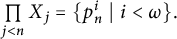 $\prod \limits _{j<n}X_{j}=\{p_{n} ^{i}\mid i<\omega \}.$
For every
 $n,m\in \omega $
and every selector
 $a\in \left [ \omega \right ] ^{<\omega }$
of
 $\left ( t_{n}^{0},\ldots ,t_{n}^{m}\right ) $
, we define
 $F_{\left ( n,m,a\right ) }=p_{n}^{m}\left ( 0\right ) \cup \cdots \cup p_{n}^{m}\left ( n-1\right ) \cup a$
(recall
 $p_{n}^{m}\in \prod \limits _{j<n}X_{j}$
). Clearly, each
 $F_{\left ( n,m,a\right ) }$
is a non-empty finite set. Let X be the collection of all the
 $F_{\left ( n,m,a\right ) };$
we will prove that X witnesses that
 $\mathcal {I}$
is not Shelah–Steprāns.
We will first prove that
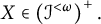 $X\in \left ( \mathcal {I}^{<\omega }\right ) ^{+}.$
Letting
 $A\in \mathcal {I,}$
we first find
 $n\in \omega $
such that A does not contain any element of
 $X_{n}.$
Since each
 $X_{j}\in \left ( \mathcal {I} ^{<\omega }\right ) ^{+}$
, for every
 $j<\omega ,$
there is
 $m\in \omega $
such that A is disjoint with
 $p_{n}^{m}\left ( 0\right ) \cup \cdots \cup p_{n}^{m}\left ( n-1\right ) .$
Finally, by the assumption on
 $X_{n}$
, we can find a selector b of
 $\left ( t_{n}^{0},\ldots ,t_{n}^{m}\right ) $
such that
 $b\cap A=\emptyset $
and therefore
 $A\cap F_{\left ( n,m,b\right ) }=\emptyset .$
Letting
 $Y\in \left [ X\right ] ^{\omega }$
, we will show that
 $B=\bigcup Y\in \mathcal {I}^{+}.$
There are two cases to consider: first assume there is
 $n\in \omega $
for which there are infinitely many
 $\left ( m,a\right ) $
such that
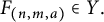 $F_{\left ( n,m,a\right ) }\in Y.$
In this case, B intersects every element of
 $X_{n},$
hence
 $B\in \mathcal {I}^{+}.$
Now assume that for every
 $n\in \omega ,$
there are only finitely many
 $\left ( m,a\right ) $
such that
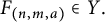 $F_{\left ( n,m,a\right ) }\in Y.$
In this case, there must be infinitely many
 $n\in \omega $
for which there is
 $\left ( m,a\right ) $
such that
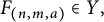 $F_{\left ( n,m,a\right ) }\in Y,$
hence B must contain (at least) one element of every
 $X_{k}.$
We can then conclude that
 $B\in \mathcal {I}^{+}.$
As a consequence, we obtain the following result (the equivalence of items 2 and 3 was proved by Laczkovich and Recław in [Reference Laczkovich and Recław51]; we include the proof for the convenience of the reader).
Corollary 5.11 Let
 $\mathcal {I}$
be an ideal on
 $\omega .$
The following are equivalent:
-
(1)
$\mathcal {I}$
is not Shelah–Steprāns. -
(2) Player
$\mathsf{II}$
has a winning strategy in
$\mathcal {L}\left ( \mathcal {I}\right ) .$
-
(3) There is an
$F_{\sigma }$
set
$F\subseteq \mathcal P\left ( \omega \right ) $
such that
$\mathcal {I} \subseteq F$
and
$\mathcal {I}^{\ast }\cap F=\emptyset .$


Proof By the previous result, we know that 2 implies 1. We first prove that 1 implies 3. Assume that
 $\mathcal {I}$
is not Shelah–Steprāns, so there is
 $X=\left \{ s_{n}\mid n\in \omega \right \} \in \left ( \mathcal {I}^{<\omega }\right ) ^{+}$
such that
 ${\textstyle \bigcup } Y\in \mathcal {I}^{+}$
for every
 $Y\in \left [ X\right ] ^{\omega }.$
We now define the set
 $F=\left \{ W\subseteq \omega \mid \forall ^{\infty }n \left ( s_{n} \nsubseteq W\right ) \right \} .$
It is easy to see that F has the desired properties.
We finally prove that 3 implies 2. Assume there is an increasing sequence of closed sets
 $\left \langle C_{n}\mid n\in \omega \right \rangle $
such that
 $F= {\textstyle \bigcup \limits _{n\in \omega }} C_{n}$
contains
 $\mathcal {I}$
and is disjoint from
 $\mathcal {I}^{\ast }.$
We will now describe a winning strategy for Player
 $\mathsf{II}$
in
 $\mathcal {L} ({\mathcal I})$
: In the first round, if Player
 $\mathsf{I}$
plays
 $A_{0}\in \mathcal {I}$
then Player
 $\mathsf{II}$
finds an initial segment
 $s_{0}$
of
 $\omega \setminus A_{0}$
such that
 $\left \langle s_{0}\right \rangle =\left \{ Z\mid s_{0}\sqsubseteq Z\right \} $
is disjoint from
 $C_{0}$
(where
 $s_{0}\sqsubseteq Z$
means that
 $s_{0}$
is an initial segment of Z). At round
 $n+1,$
if Player
 $\mathsf{I}$
plays
 $A_{n+1}\in \mathcal {I}$
then Player
 $\mathsf{II}$
finds
 $s_{n+1}$
such that
 $t={\textstyle \bigcup \limits _{i\leq n+1}} s_{i}$
is an initial segment of
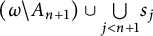 $\left ( \omega \setminus A_{n+1}\right ) \cup {\textstyle \bigcup \limits _{j<n+1}} s_{j}$
and
 $\left \langle t\right \rangle $
is disjoint from
 $C_{n+1}.$
It is easy to see that this is a winning strategy.
Since every game with Borel payoff is determined, we can give a characterization of the Borel ideals that are Shelah–Steprāns.
Theorem 5.12 If
 $\mathcal {I}$
is a Borel ideal, then
 $\mathcal {I}$
is Shelah–Steprāns if and only if fin
 $\times $
fin
 $\leq _{K}\mathcal {I}.$
The theorem is also true for analytic ideals (and even more) under Large Cardinal assumptions.Footnote
3
Fix a tree T of height
 $\omega , f:\left [ T\right ] \longrightarrow \mathcal P\left ( \omega \right ) $
a continuous function (where
 $\left [ T\right ] $
denotes the set of branches of T) and
 $\mathcal {W}\subseteq \mathcal P\left ( \omega \right ) .$
We then define the game
 $\mathcal {G}\left ( T,f,\mathcal {W} \right ) $
as follows:
 $$ \begin{align*} \begin{array} [c]{|l|l|l|l|l|}\hline \mathsf{I} & \dots & x_{n} & & \dots\\\hline \mathsf{II} & \dots & & y_{n} & \dots\\\hline \end{array} \end{align*} $$
At round
 $n\in \omega ,$
player
 $\mathsf{I}$
plays
 $x_{n}$
and
 $\mathsf{II}$
responds with
 $y_{n}$
with the requirement that
 $\left \langle x_{0} ,y_{0},\ldots ,x_{n},y_{n}\right \rangle \in T.$
Player
 $\mathsf{I}$
wins if
 $f\left ( b\right ) \in \mathcal {W,}$
where b is the branch constructed during the game. The following is a well-known extension of Martin’s result (see [Reference Zapletal80]).
Proposition 5.13 (LC)
If
 $\mathcal {W}\in $
L
 $\left ( \mathbb{R}\right ) $
, then
 $\mathcal {G}\left ( T,f,\mathcal {W}\right ) $
is determined (L
 $\left ( \mathbb{R}\right ) $
denotes the least transitive class model of
 $\mathsf{ZFC}$
that contains all reals).
Recall that LC denotes a large cardinal assumption. In this case, it is enough to assume that there is a proper class of Woodin cardinals. The reader may consult the first chapter of [Reference Zapletal80] for more information. We can conclude the following.
Theorem 5.14 (LC)
-
(1) Let
$\mathcal {I}\in $
L
$\left ( \mathbb{R}\right ) $
be an ideal on
$\omega .$
Then,
$\mathcal {I}$
is Shelah–Steprāns if and only if fin
$\times $
fin
$\leq _{K}\mathcal {I}.$
-
(2) Let
$\mathcal {J}$
be a
$\sigma $
-ideal on
$\omega ^{\omega }$
such that
$\mathcal {J}\in $
L
$\left ( \mathbb{R}\right ) $
and
$X\in tr\left ( \mathcal {J}\right ) ^{+}.$
Then,
$tr\left ( \mathcal {J}\right ) \upharpoonright X$
is Shelah–Steprāns if and only if fin
$\times $
fin
$\leq _{K}tr\left ( \mathcal {J}\right ) \upharpoonright X.$


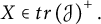



Proof To prove the first item, let Y be the set of all sequences
 $\left \langle A_{0},s_{0},\ldots ,A_{n},s_{n}\right \rangle $
such that
 $A_{n}\in \mathcal {I}$
and
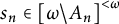 $s_{n}\in \left [ \omega \setminus A_{n}\right ] ^{<\omega }$
and
 $\max \left ( s_{i}\right ) \subseteq A_{i+1}$
if
 $i<n.$
Let T be the tree obtained by closing Y under restrictions. We define
 $f:\left [ T\right ] \longrightarrow \mathcal P\left ( \omega \right ) $
by
 $f\left ( b\right ) = {\textstyle \bigcup \limits _{n\in \omega }} b\left ( 2n+1\right ) $
, where
 $b\in \left [ T\right ] .$
Clearly,
 $\mathcal {L} \left ( \mathcal {I}\right ) $
is a game equivalent to
 $\mathcal {G}\left ( T,f,\mathcal {I}\right ) $
, so the result follows from the previous results. The second item is a consequence of the first.
We now come back to the relationship between almost strongly separable and Shelah–Steprāns MAD families.
Theorem 5.15 Assume
 $\mathfrak {b} = \mathfrak {c}$
. Then, there exists an infinite almost strongly separable a.d. family if and only if there exists an infinite Shelah–Steprāns a.d. family.
Proof Assume
 $\mathfrak {b} = \mathfrak {c}$
. It is clear that every almost strongly separable a.d. family is Shelah–Steprāns. Suppose
 $\mathscr {B}$
is an infinite Shelah–Steprāns a.d. family. The following claim is a simple consequence of Proposition 5.10 and Item (2) of Proposition 5.9. However, we include the argument for completeness.
Claim 5.16 For every
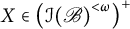 $X \in {\left ( {\mathcal {I}(\mathscr {B})}^{< \omega } \right )}^{+}$
, there are
 $B \in \mathcal {I}(\mathscr {B})$
and
 $c: \omega \rightarrow \left (X \cap \mathcal {P}(B)\right )$
such that
 $\forall i \in \omega \left [\max (c(i)) < \min (c(i+1))\right ]$
.
Proof For each n, let
 ${X}_{n} = \{s \in X: s \cap (n+1) = \emptyset \}$
. Clearly,
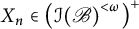 ${X}_{n} \in {\left ( {\mathcal {I}(\mathscr {B})}^{< \omega } \right )}^{+}$
, for all
 $n \in \omega $
. So by Proposition 5.10 and Item (2) of Proposition 5.9, there exists
 $B \in \mathcal {I}(\mathscr {B})$
such that for each
 $n \in \omega $
, there exists
 $s \in {X}_{n}$
with
 $s \subseteq B$
. Now, let
 $c(0) \in {X}_{0} \cap \mathcal {P}(B)$
and
 $c(n+1) \in {X}_{\max (c(n))} \cap \mathcal {P}(B)$
.
 $\left | \mathscr {B} \right | = \mathfrak {c}$
because being an infinite Shelah–Steprāns a.d. family implies being MAD and because
 $\mathfrak {b} = \mathfrak {c}$
. Let
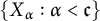 $\{{X}_{\alpha }: \alpha < \mathfrak {c}\}$
enumerate
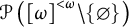 $\mathcal {P}\left ( {\left [\omega \right ]}^{< \omega } \setminus \{\emptyset \} \right )$
. Construct families
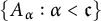 $\{{A}_{\alpha }: \alpha < \mathfrak {c}\}$
and
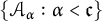 $\left \{ {\mathcal {A}}_{\alpha }: \alpha < \mathfrak {c} \right \}$
such that the following hold:
-
(1) each
${\mathcal {A}}_{\alpha }$
is a non-empty finite subset of
$\mathscr {B}$
and
${A}_{\alpha } = \bigcup {\mathcal {A}}_{\alpha }$
; -
(2)
${\mathcal {A}}_{\alpha } \cap {\mathcal {A}}_{\beta } = \emptyset $
, for all
$\alpha < \beta < \mathfrak {c}$
; -
(3) either
${X}_{\alpha } \in {\mathcal {I}\left ( \left \{{A}_{\xi }: \xi \leq \alpha \right \} \right )}^{< \omega }$
or
$\left | {X}_{\alpha } \cap {\left [ {A}_{\alpha } \right ]}^{< \omega } \right | = {\aleph }_{0}$
.


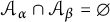



Suppose for a moment that this can be done. Let
 $\mathscr {A} = \{{A}_{\alpha }: \alpha < \mathfrak {c}\}$
.
 $\mathscr {A}$
is a.d. because of (1), (2), and the fact that
 $\mathscr {B}$
is a.d. If
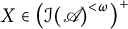 $X \in {\left ( {\mathcal {I}(\mathscr {A})}^{< \omega } \right )}^{+}$
, then
 $X = {X}_{\alpha }$
, for some
 $\alpha < \mathfrak {c}$
, and since
 $X \notin {\mathcal {I}\left ( \left \{{A}_{\xi }: \xi \leq \alpha \right \} \right )}^{< \omega }$
,
 $\left | {X}_{\alpha } \cap {\left [ {A}_{\alpha } \right ]}^{< \omega } \right | = {\aleph }_{0}$
by (3). This shows
 $\mathscr {A}$
is almost strongly separable.
To construct such families, fix
 $\alpha < \mathfrak {c}$
and assume that
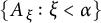 $\{{A}_{\xi }: \xi < \alpha \}$
and
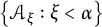 $\left \{{\mathcal {A}}_{\xi }: \xi < \alpha \right \}$
are given. Define
 $\mathcal {A}\left [\alpha \right ] = {\bigcup }_{\xi < \alpha }{{\mathcal {A}}_{\xi }}$
and
 $\mathscr {B}\left [\alpha \right ] = \mathscr {B} \setminus \mathcal {A}\left [\alpha \right ]$
. Note that
 $\mathcal {A}\left [\alpha \right ]$
and
 $\mathscr {B}\left [\alpha \right ]$
are subsets of
 $\mathscr {B}$
,
 $\left | \mathcal {A}\left [\alpha \right ] \right | < \mathfrak {c}$
, and
 $\left | \mathscr {B}\left [\alpha \right ] \right | = \mathfrak {c}$
. First, suppose that
 ${X}_{\alpha } \in {\mathcal {I}(\{{A}_{\xi }: \xi < \alpha \})}^{< \omega }$
. Then, choose any
 $B \in \mathscr {B}\left [\alpha \right ]$
, define
 ${\mathcal {A}}_{\alpha } = \{B\}$
, and
 ${A}_{\alpha } = \bigcup {\mathcal {A}}_{\alpha }$
– i.e.,
 ${A}_{\alpha } = B$
. Then, it is clear that (1)–(3) hold.
Next suppose that
 ${X}_{\alpha } \in {\left ( {\mathcal {I}(\{{A}_{\xi }: \xi < \alpha \})}^{< \omega } \right )}^{+}$
, but
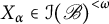 ${X}_{\alpha } \in {\mathcal {I}(\mathscr {B})}^{< \omega }$
. Let
 $l \in \omega $
and
 $\mathcal {B} \subseteq \mathscr {B}$
be a finite set such that
 $\forall s \in {X}_{\alpha }\left [ s \cap \left ( l \cup \left ( \bigcup \mathcal {B} \right ) \right ) \neq \emptyset \right ]$
. Define
 ${\mathcal {A}}_{\alpha } = \mathcal {B} \setminus \mathcal {A}\left [\alpha \right ]$
and
 ${A}_{\alpha } = \bigcup {\mathcal {A}}_{\alpha }$
.
 ${\mathcal {A}}_{\alpha } \neq \emptyset $
because
 ${X}_{\alpha } \notin {\mathcal {I}\left (\{{A}_{\xi }: \xi < \alpha \}\right )}^{< \omega }$
. Hence, (1) and (2) hold. (3) holds because
 ${X}_{\alpha } \in {\mathcal {I}(\left \{ {A}_{\xi }: \xi \leq \alpha \right \})}^{< \omega }$
.
Finally, suppose that
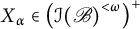 ${X}_{\alpha } \in {\left ( {\mathcal {I}(\mathscr {B})}^{< \omega } \right )}^{+}$
.
Claim 5.17 There exist sequences
 $\left \langle {\mathcal {B}}_{l}: l < \omega \right \rangle $
,
 $\left \langle {B}_{l}: l < \omega \right \rangle $
, and
 $\left \langle {c}_{l}: l < \omega \right \rangle $
such that the following hold:
-
(4)
${\mathcal {B}}_{l}$
is a finite non-empty subset of
$\mathscr {B}$
and
${B}_{l} = \bigcup {\mathcal {B}}_{l}$
, for all
$l < \omega $
; -
(5)
${\mathcal {B}}_{k} \cap {\mathcal {B}}_{l} = \emptyset $
, for all
$k < l < \omega $
; -
(6)
${c}_{l}: \omega \rightarrow \left ( {X}_{\alpha } \cap \mathcal {P}({B}_{l}) \right )$
, for all
$l < \omega $
; -
(7)
$\forall l \in \omega \forall i \in \omega \left [ \max ({c}_{l}(i)) < \min ({c}_{l}(i+1)) \right ]$
.







Proof The construction is similar to the one in the proof of Lemma 12.15. Fix
 $l \in \omega $
and suppose that
 $\left \langle {\mathcal {B}}_{l'}: l' < l \right \rangle , \left \langle {B}_{l'}: l' < l \right \rangle $
, and
 $\left \langle {c}_{l'}: l' < l \right \rangle $
are given. Since
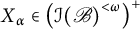 ${X}_{\alpha } \in {\left ( {\mathcal {I}(\mathscr {B})}^{< \omega } \right )}^{+}$
,
 $$ \begin{align*} X = \left\{ s \in {X}_{\alpha}: s \cap \left( {\bigcup}_{l' < l}{{B}_{l'}} \right) = \emptyset \right\} \in {\left( {\mathcal{I}(\mathscr{B})}^{< \omega} \right)}^{+}. \end{align*} $$
Therefore, Claim 5.16 applies and implies that there are a finite set
 $\mathcal {B} \subseteq \mathscr {B}$
, an
 $n \in \omega $
, and a
 $c: \omega \rightarrow X$
such that
 $$ \begin{align*} \forall i \in \omega\left[\max(c(i)) < \min(c(i+1)) \wedge c(i) \subseteq \left(n \cup \left( \bigcup \mathcal{B} \right) \right)\right]. \end{align*} $$
Let
 ${\mathcal {B}}_{l} \subseteq \mathscr {B}$
be a finite set of minimal cardinality for which there are n and c like this. Define
 ${B}_{l} = \bigcup {\mathcal {B}}_{l}$
. Suppose
 $B \in {\mathcal {B}}_{l'} \cap {\mathcal {B}}_{l}$
, for some
 $l' < l$
. Let
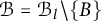 $\mathcal {B} = {\mathcal {B}}_{l} \setminus \{B\}$
. As
 ${\mathcal {B}}_{l}$
was chosen to be of minimal cardinality, there exists
 $i \in \omega $
so that
 $c(i) \not \subseteq \left (n \cup \left ( \bigcup \mathcal {B} \right )\right )$
, whence
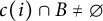 $c(i) \cap B \neq \emptyset $
. However,
 $B \subseteq {B}_{l'}$
, whence
 $c(i) \cap {B}_{l'} \neq \emptyset $
, contradicting
 $c(i) \in X$
. Therefore, (5) holds. Now define
 ${c}_{l}(i) = c(i+n)$
, for every
 $i \in \omega $
. Then, since
 $\min ({c}_{l}(i)) = \min (c(i+n)) \geq i+n \geq n$
,
 ${c}_{l}(i) \subseteq {B}_{l}$
, for every
 $i \in \omega $
. Since
 $X \subseteq {X}_{\alpha }$
, we have that
 ${c}_{l}: \omega \rightarrow \left ( {X}_{\alpha } \cap \mathcal {P}({B}_{l}) \right )$
, and (6) and (7) are satisfied. Finally,
 ${\mathcal {B}}_{l}$
cannot be empty as
 ${c}_{l}(0) \subseteq {B}_{l}$
and
 ${c}_{l}(0) \in {X}_{\alpha } \subseteq {\left [\omega \right ]}^{< \omega } \setminus \{\emptyset \}$
. Thus, (4) is satisfied. This concludes the induction and the proof of the claim.
For every
 $\xi < \alpha $
, there exists
 ${l}_{\xi } < \omega $
such that for every
 $l \geq {l}_{\xi }$
,
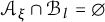 ${\mathcal {A}}_{\xi } \cap {\mathcal {B}}_{l} = \emptyset $
because of (1) and (5). Hence, for all
 $l \geq {l}_{\xi }$
,
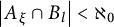 $\left | {A}_{\xi } \cap {B}_{l} \right | < {\aleph }_{0}$
, and we can define
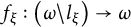 ${f}_{\xi }: \left ( \omega \setminus {l}_{\xi } \right ) \rightarrow \omega $
so that
 ${A}_{\xi } \cap {B}_{l} \subseteq {f}_{\xi }(l)$
, for every
 $l \in \omega \setminus {l}_{\xi }$
. As
 $\mathfrak {b} = \mathfrak {c}$
, find
 $f: \omega \rightarrow \omega $
so that for each
 $\xi < \alpha $
,
 ${\forall }^{\infty } l \in \left ( \omega \setminus {l}_{\xi } \right )\left [ {f}_{\xi }(l) < f(l) \right ]$
and f is strictly increasing – in other words,
 $\forall n \in \omega \left [f(n) < f(n+1)\right ]$
. For each
 $m \in \omega $
, define
 ${Y}_{m} = \left \{{c}_{l}(i): l \geq m \wedge i \geq f(l)\right \}$
.
Claim 5.18
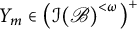 ${Y}_{m} \in {\left ( {\mathcal {I}(\mathscr {B})}^{< \omega } \right )}^{+}$
.
Proof Fix
 $n \in \omega $
and a finite set
 $\mathcal {B} \subseteq \mathscr {B}$
. Because of (5), there exists
 $l \geq m$
with
 $\mathcal {B} \cap {\mathcal {B}}_{l} = \emptyset $
. As
 $\mathscr {B}$
is an a.d. family, we can find
 $i \geq \max \{n, f(l)\}$
such that
 $\left ( \bigcup \mathcal {B} \right ) \cap {B}_{l} \subseteq i$
. Then,
 ${c}_{l}(i) \in {Y}_{m}$
. Suppose
 $x \in {c}_{l}(i) \cap \left (n \cup \left (\bigcup \mathcal {B}\right )\right )$
. Then, since
 $x \geq \min ({c}_{l}(i)) \geq i \geq n$
and
 ${c}_{l}(i) \subseteq {B}_{l}$
,
 $x \in \left ( \bigcup \mathcal {B} \right ) \cap {B}_{l} \subseteq i$
, a contradiction. This shows
 ${c}_{l}(i) \cap \left (n \cup \left (\bigcup \mathcal {B}\right )\right ) = \emptyset $
, as required.
By Proposition 5.10 and Item (2)(c) of Proposition 5.9, there exists
 $B \in \mathcal {I}(\mathscr {B})$
such that for every
 $m \in \omega $
,
 $\left | {\left [ B \right ]}^{< \omega } \cap {Y}_{m} \right | = {\aleph }_{0}$
. Fix
 $n \in \omega $
and a finite set
 $\mathcal {B} \subseteq \mathscr {B}$
such that
 $B = n \cup \left ( \bigcup \mathcal {B} \right )$
. Define
 ${\mathcal {A}}_{\alpha } = \mathcal {B} \setminus \mathcal {A}\left [\alpha \right ]$
and
 ${A}_{\alpha } = \bigcup {\mathcal {A}}_{\alpha }$
.
Claim 5.19
 ${\mathcal {A}}_{\alpha } \neq \emptyset $
and
 $\left | {X}_{\alpha } \cap {\left [ {A}_{\alpha } \right ]}^{< \omega } \right | = {\aleph }_{0}$
.
Proof Find a finite set
 $F \subseteq \alpha $
such that
 $\mathcal {B} \cap \mathcal {A}\left [\alpha \right ] \subseteq {\bigcup }_{\xi \in F}{{\mathcal {A}}_{\xi }}$
. Fix
 ${m}_{0} \in \omega $
such that
 ${m}_{0} \geq n$
,
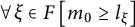 $\forall \xi \in F\left [{m}_{0} \geq {l}_{\xi }\right ]$
, and
 $\forall \xi \in F \forall l \geq {m}_{0}\left [{f}_{\xi }(l) < f(l)\right ]$
. Define
 $c: \omega \rightarrow {X}_{\alpha }$
by induction as follows. Fix
 $j \in \omega $
and assume that
 $c(j') \in {X}_{\alpha }$
has been defined for all
 $j' < j$
. Find
 $m \geq {m}_{0}$
such that
 $\forall j' < j\left [c(j') \subseteq m\right ]$
. Since
 ${\left [B\right ]}^{< \omega } \cap {Y}_{m} \neq \emptyset $
, find
 $l \geq m$
and
 $i \geq f(l)$
such that
 ${c}_{l}(i) \subseteq B$
. Define
 $c(j) = {c}_{l}(i) \in {X}_{\alpha }$
. First, observe that for each
 $j' < j$
,
 $\max (c(j')) < m \leq l \leq f(l) \leq i \leq \min ({c}_{l}(i)) = \min (c(j))$
. Next, we verify that
 $c(j) \subseteq {A}_{\alpha }$
. Suppose not. Choose
 $x \in c(j)$
with
 $x \notin {A}_{\alpha }$
. Then
 $x \in B$
because
 $c(j) \subseteq B$
. Since
 $x \geq \min (c(j)) \geq m \geq {m}_{0} \geq n$
,
 $x \in A$
, for some
 $A \in \mathcal {B}$
. As
 $x \notin {A}_{\alpha }$
,
 $A \notin {\mathcal {A}}_{\alpha }$
, whence
 $A \in \mathcal {B} \cap \mathcal {A}\left [\alpha \right ]$
. Let
 $\xi \in F$
be such that
 $A \in {\mathcal {A}}_{\xi }$
. Then,
 $x \in {A}_{\xi }$
and since
 $c(j) = {c}_{l}(i) \subseteq {B}_{l}$
,
 $x \in {A}_{\xi } \cap {B}_{l}$
. Since
 $l \geq m \geq {m}_{0} \geq {l}_{\xi }$
,
 ${A}_{\xi } \cap {B}_{l} \subseteq {f}_{\xi }(l) \subseteq f(l)$
, whence
 $x < f(l)$
. However, this is a contradiction because
 $x \geq \min (c(j)) \geq f(l)$
. This contradiction shows that
 $c(j) \subseteq {A}_{\alpha }$
. This concludes the construction of c. By construction, we have
 $\forall j \in \omega \left [\max (c(j)) < \min (c(j+1))\right ]$
, and we have
 $\{c(j): j \in \omega \} \subseteq {X}_{\alpha } \cap {\left [{A}_{\alpha }\right ]}^{< \omega }$
. Therefore,
 $\left | {X}_{\alpha } \cap {\left [{A}_{\alpha }\right ]}^{< \omega } \right | = {\aleph }_{0}$
. Finally, of course,
 $c(0)$
is a non-empty set and
 $c(0) \subseteq {A}_{\alpha }$
, so
 ${A}_{\alpha } \neq \emptyset $
, so
 ${\mathcal {A}}_{\alpha } \neq \emptyset $
.
Thus,
 ${\mathcal {A}}_{\alpha }$
and
 ${A}_{\alpha }$
satisfy (1)–(3). This concludes the construction and the proof.
Question 5.20. Can the hypothesis
 $\mathfrak {b} = \mathfrak {c}$
be removed from Theorem 5.15?
6 Strong properties of ideals and MAD families
We will study some strong combinatorial properties of MAD families and we will clarify the relationship between them. The basic notions and implications will be presented in the more general context of ideals in this section, and for existence, non-existence (see Section 10 and in particular Sections 10.1 and 10.2), and non-implications (Section 10.3), we will consider the special case of MAD families. We shall also consider generic MAD families (Section 9).
We start with:
Definition 6.1. Let
 ${\mathcal I}$
be an ideal on
 $\omega $
.
-
(1)
${\mathcal I}$
is tight if for every
$\left \{ X_{n}\mid n\in \omega \right \} \subseteq \mathcal {I}^{+}$
, there is
$A\in \mathcal {I}$
such that
$A\cap X_{n}\neq \emptyset $
for every
$n\in \omega .$
-
(2)
${\mathcal I}$
is weakly tight if for every
$\left \{ X_{n}\mid n\in \omega \right \} \subseteq \mathcal {I}^{+}$
, there is
$A\in \mathcal {I}$
such that
$|A\cap X_{n}| = \omega $
for infinitely many
$n\in \omega .$
-
(3)
${\mathcal I}$
is strongly tight if for every
$\left \{ X_{n}\mid n\in \omega \right \} \subseteq [\omega ]^\omega $
such that
$\{ n \mid X_n \subseteq ^* Y\}$
is finite for every
$Y \in {\mathcal I}$
, there is
$A\in \mathcal {I}$
such that
$A\cap X_{n}\neq \emptyset $
for every
$n\in \omega .$
-
(4) We say a family
$X=\left \{ X_{n}\mid n\in \omega \right \} $
such that
$X_{n}\subseteq \left [ \omega \right ] ^{<\omega }$
is locally finite according to
$\mathcal {I}$
if for every
$B\in \mathcal {I}$
for almost all
$n\in \omega ,$
there is
$s\in X_{n}$
such that
$s\cap B=\emptyset .$
-
(5)
$\mathcal {I}$
is raving if for every family
$X=\left \{ X_{n}\mid n\in \omega \right \} $
that is locally finite according to
$\mathcal {I,}$
there is
$A\in \mathcal {I}$
such that A contains at least one element of each
$X_{n}.$






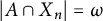












Obviously, strongly tight implies tight, which in turn implies weakly tight. Also, it is easy to see that raving implies both Shelah–Steprāns and strongly tight. Furthermore, by Proposition 5.9, every Shelah–Steprāns ideal is tight. We shall see later on (in particular in Section 10.3) that all these properties are (consistently) distinct, even for MAD families.
For an a.d. family
 ${\mathcal A}$
and a property X of ideals, we say
 ${\mathcal A}$
has property X whenever the corresponding ideal
 ${\mathcal I} ({\mathcal A})$
has property X.
Tight MAD families are Cohen indestructible. Although Cohen indestructibility does not imply tightness (Proposition 10.14), it is true that every Cohen indestructible MAD family has a restriction that is tight (see [Reference Hrušák and Ferreira41]). Thus, existence-wise, the two properties are on the same level. In [Reference Mildenberger, Raghavan and Steprāns60, Reference Raghavan and Steprāns69], it was proved that weakly tight MAD families exist under
 $\mathfrak {s}\leq\mathfrak {b}.$
Like the Shelah–Steprāns property, the properties considered here are upward closed in the Katětov order (see Lemma 5.8).
Lemma 6.2 Assume
 ${\mathcal I}$
and
 ${\mathcal J}$
are ideals on
 $\omega $
.
-
(1) If
${\mathcal I} \leq _K {\mathcal J}$
and
${\mathcal I}$
is tight (weakly tight, raving, resp.), then so is
${\mathcal J}$
. -
(2) If
${\mathcal I} \leq _{KB} {\mathcal J}$
and
${\mathcal I}$
is strongly tight, then so is
${\mathcal J}$
. -
(3) Assume
${\mathcal A}$
and
${\mathcal B}$
are MAD families. If
$\mathcal {A}$
is strongly tight and
$\mathcal {I}\left ( \mathcal {A}\right ) \leq _{K}\mathcal {I}\left ( \mathcal {B}\right ) $
, then
$\mathcal {B}$
is strongly tight.




Proof 1. This is a standard argument. Let
 $f : \omega \to \omega $
be a Katětov reduction. Assume first
 ${\mathcal I}$
is tight. Take
 $\{ X_n \mid n \in \omega \} \subseteq {\mathcal J}^+$
and let
 $Y_n = f [X_n]$
. Clearly, the
 $Y_n$
belong to
 ${\mathcal I}^+$
, and therefore there is
 $B \in {\mathcal I}$
such that
 $B \cap Y_n \neq \emptyset $
for all n. Letting
 $A = f^{-1} [B] \in {\mathcal J,}$
we see that
 $A \cap X_n \neq \emptyset $
for all n. The proofs for “weakly tight” and “raving” are similar.
2. This is also similar.
3. Fix a Katětov-morphism f from
 $\left ( \omega ,\mathcal {I}\left ( \mathcal {B}\right ) \right ) $
to
 $\left ( \omega ,\mathcal {I}\left ( \mathcal {A}\right ) \right ) $
and a family
 $\mathcal {W}=\left \{ X_{n}\mid n\in \omega \right \} $
such that for every
 $n\in \omega ,$
there is
 $B_{n} \in \mathcal {B}$
such that
 $X_{n}\subseteq B_{n}$
and for every
 $B\in \mathcal {B,}$
the set
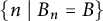 $\left \{ n\mid B_{n}=B\right \} $
is finite. Let
 $\mathcal {W}_{1}=\left \{ X\in \mathcal {W}\mid f\left [ X\right ] \in \left [ \omega \right ] ^{<\omega }\right \} $
and for every
 $X\in \mathcal {W}_1$
, we choose
 $b_{X}\in f\left [ X\right ] $
such that
 $f^{-1}\left ( \left \{ b_{X}\right \} \right ) $
is infinite. We first claim that the set
 $Y=\left \{ b_{X}\mid X\in \mathcal {W}_1\right \} $
is finite. If this was not the case, we could find
 $A\in \mathcal {A}$
such that
 $A\cap Y$
is infinite. Since f is a Katětov-morphism, we conclude that
 $f^{-1}\left ( A\right ) \in \mathcal {I}\left ( \mathcal {B}\right ) $
and
 $\left \{ X\in \mathcal {W}\mid f^{-1}\left ( A\right ) \cap X\in \left [ \omega \right ] ^{\omega }\right \} $
is infinite, but this is a contradiction. Using that Y is finite, it is easy to see that
 $\mathcal {W}_{1}$
must also be finite.
Letting
 $\mathcal {W}_{2}=\mathcal {W}\setminus \mathcal {W}_{1},$
for every
 $X\in \mathcal {W}_{2}$
, we choose
 $A_{X}\in \mathcal {I}\left ( \mathcal {A} \right ) $
such that
 $Y_{X}=A_{X}\cap f\left [ X\right ] $
is infinite. Note that if
 $A\in \mathcal {A,}$
then the set
 $\left \{ X\in \mathcal {W}_{2}\mid A=A_{X}\right \} $
must be finite. Since
 $\mathcal {A}$
is strongly tight we can find
 $A\in \mathcal {I}\left ( A\right ) $
such that
 $A\cap Y_{X} \neq \emptyset $
for every
 $X\in \mathcal {W}_{2}.$
Since f is a Katětov-morphism, we may conclude that
 $B=f^{-1}\left ( A\right ) $
belongs to
 $\mathcal {I}\left ( \mathcal {B}\right ) $
and
 $B\cap X\neq \emptyset $
for every
 $X\in \mathcal {W}_{2}.$
Clearly,
 $B\cup {\textstyle \bigcup } \mathcal {W}_{1}$
has the desired properties.
We next define properties of ideals
 ${\mathcal I}$
relevant for the investigation of Mathias forcing
 ${\mathbb M} ({\mathcal I})$
.
Definition 6.3. Let
 $\mathcal {I}$
be an ideal in
 $\omega .$
-
(1) We say
$\mathcal {I}$
is Canjar if and only if for every
$\left \{ X_{n}\mid n\in \omega \right \} \subseteq \left ( \mathcal {I}^{<\omega }\right ) ^{+}$
, there are
$Y_{n}\in \left [ X_{n}\right ] ^{<\omega }$
such that
$ {\textstyle \bigcup \limits _{n\in \omega }} Y_{n}\in \left ( \mathcal {I}^{<\omega }\right ) ^{+}$
. -
(2) We say
$\mathcal {I}$
is Hurewicz if and only if for every
$\left \{ X_{n}\mid n\in \omega \right \} \subseteq \left ( \mathcal {I}^{<\omega }\right ) ^{+}$
, there are
$Y_{n}\in \left [ X_{n}\right ] ^{<\omega }$
such that
$ {\textstyle \bigcup \limits _{n\in A}} Y_{n}\in \left ( \mathcal {I}^{<\omega }\right ) ^{+}$
for every
$A\in \left [ \omega \right ] ^{\omega }.$



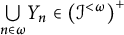



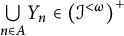

We include a proof of the following well-known fact (implicit in [Reference Brendle9]).
Proposition 6.4 Every
 $F_{\sigma }$
ideal is Hurewicz.
Proof Let
 $\mathcal {I}$
be an
 $F_{\sigma }$
ideal and let
 $\left \{ X_{n}\mid n\in \omega \right \} \subseteq (\mathcal {I}^{<\omega })^+.$
First, find
 $\mathcal {C}=\left \{ C_{n}\mid n\in \omega \right \} $
a family of closed sets such that
 $\mathcal {I} = {\textstyle \bigcup \limits _{n\in \omega }} C_{n}$
and
 $C_{n}\subseteq C_{n+1}$
for every
 $n\in \omega .$
Letting
 $n\in \omega ,$
we claim that there is a finite
 $Y_{n}\subseteq X_{n}$
such that for every
 $B\in C_{n},$
there is
 $s\in Y_{n}$
such that
 $s\cap B=\emptyset .$
This is an easy consequence of the compactness of
 $C_{n}.$
Fix such
 $Y_{n}\subseteq X_{n}$
for every
 $n\in \omega .$
We claim that the family is
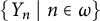 $\left \{ Y_{n}\mid n\in \omega \right \} $
is as desired. Let
 $A\in \left [ \omega \right ] ^{\omega },$
we need to prove that
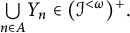 $ {\textstyle \bigcup \limits _{n\in A}} Y_{n}\in (\mathcal {I}^{<\omega })^{+}.$
Let
 $B\in \mathcal {I}.$
Let
 $n\in \omega $
be minimal such that
 $B\in C_{n}.$
Since A is infinite, there is
 $m\in A$
larger than
 $n.$
Since
 $\mathcal {C}$
is increasing, it follows that
 $B\in C_{m}.$
By our choice of
 $Y_{m},$
it follows that B is disjoint from an element of
 $Y_{m}$
and we are done.
Clearly, every Hurewicz ideal is Canjar. Also, every Borel Canjar ideal is
 $F_{\sigma }$
[Reference Chodounský, Repovš and Zdomskyy25, Reference Guzmán, Hrušák and Martínez-Celis33], so that for Borel ideals,
 $F_\sigma $
, Canjar, and Hurewicz agree. In general, the two notions are quite different: Canjar [Reference Canjar21] constructed Canjar ultrafilters (i.e., ultrafilters whose dual maximal ideals are Canjar) under CH, while it is easy to see that no maximal ideal can be Hurewicz.
If
 $\mathcal {I}$
is an ideal, we denote by
 $\mathbb{M}\left ( \mathcal {I}\right ) $
the Mathias forcing with
 $\mathcal {I}$
, that is, the set of all pairs
 $\left ( s,A\right ) $
such that
 $s\in \left [ \omega \right ] ^{<\omega }$
and
 $A\in \mathcal {I}$
, ordered by
 $\left ( s,A\right ) \leq \left ( t,B\right ) $
if
 $t\subseteq s, B\subseteq A$
and
 $\left ( s\setminus t\right ) \cap B=\emptyset ,$
where
 $\left ( s,A\right ) , \left (t,B\right ) \in {\mathbb M} ({\mathcal I})$
. It is easy to see that
 $\mathbb{M}\left (\mathcal {I}\right ) $
destroys the tallness of
 $\mathcal {I}.$
We mention the following important results regarding Canjar and Hurewicz ideals.
Theorem 6.5 Let
 $\mathcal {I}$
be an ideal on
 $\omega .$
-
(1) [Reference Hrušák and Minami43]
$\mathcal {I}$
is Canjar if and only if
$\mathbb{M(\mathcal {I})}$
does not add dominating reals. -
(2) [Reference Chodounský, Repovš and Zdomskyy25]
$\mathcal {I}$
is Hurewicz if and only if
$\mathbb{M(\mathcal {I})}$
preserves all unbounded families of the ground model. -
(3) [Reference Chodounský, Repovš and Zdomskyy25]
$\mathcal {I}$
is Canjar if and only if
$\mathcal {I}$
is a Menger subspace of
$\mathcal {P}\left ( \omega \right ) .$


The last point of the theorem is a topological characterization of Canjar filters. We will provide a similar characterization for Hurewicz filters. Although the characterization is not explicit in [Reference Chodounský, Repovš and Zdomskyy25], all the ideas are taken from that paper.
Definition 6.6. Let
 $S\subseteq \omega .$
Define
 $S^{\uparrow }=\left \{ A\subseteq \omega \mid S\subseteq A\right \} .$
Note that
 $S^{\uparrow }$
is a closed set, moreover, if S is finite, then
 $S^{\uparrow }$
is clopen. The following is Claim 2.1 of [Reference Chodounský, Repovš and Zdomskyy25].
Lemma 6.7 Let
 $\mathcal {F}$
be a filter on
 $\omega $
and
 $\mathcal {U}$
an open cover of
 $\mathcal {F}.$
Then, there is an
 $X\subseteq \left [ \omega \right ] ^{<\omega }$
such that:
 $$ \begin{align*} \begin{array}[c]{l} \mathcal{F\subseteq} {\textstyle\bigcup\limits_{s\in X}} s^{\uparrow}\subseteq {\textstyle\bigcup} \mathcal{U}. \end{array} \end{align*} $$
We now recall some fundamental notions from infinite combinatorial topology. Let X be a topological space and
 $\mathcal {U}=\left \{ U_{n}\mid n\in \omega \right \} $
be an open cover of
 $X.$
We say that
 $\mathcal {U}$
is a
 $\gamma $
-cover if for every
 $x\in X,$
the set
 $\left \{ n\in \omega \mid x\notin U_{n}\right \} $
is finite.
Definition 6.8. Let X be a topological space. We say X has the Hurewicz property if for every sequence
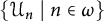 $\left \{ \mathcal {U}_{n}\mid n\in \omega \right \} $
of open covers of
 $X,$
there is
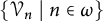 $\left \{ \mathcal {V}_{n}\mid n\in \omega \right \} $
such that:
-
(1)
$\mathcal {V}_{n}\subseteq \mathcal {U}_{n}$
is finite for every
$n\in \omega .$
-
(2)
$\left \{ {\textstyle \bigcup } \mathcal {V}_{n}\mid n\in \omega \right \} $
is a
$\gamma $
-cover of
$X.$





We now have the following.
Theorem 6.9 Let
 $\mathcal {I}$
be an ideal on
 $\omega .$
The following are equivalent:
-
(1)
$\mathcal {I}$
is Hurewicz. -
(2)
$\mathcal {I}$
has the Hurewicz property (as a subspace of
$\mathcal {P} \left ( \omega \right ) $
).


Proof First, assume that
 $\mathcal {I}$
has the Hurewicz property, and let
 $\left \{ X_{n}\mid n\in \omega \right \} \subseteq (\mathcal {I}^{<\omega })^{+}.$
Given
 $s\in \left [ \omega \right ] ^{<\omega },$
define
 $U_{s}=\left \{ A\subseteq \omega \mid A\cap s=\emptyset \right \} .$
Since s is finite, it follows that
 $U_{s}$
is open. Now, for every
 $n\in \omega ,$
define
 $\mathcal {U}_{n}=\left \{ U_{s}\mid s\in X_{n}\right \} .$
Since
 $X_{n}\in (\mathcal {I}^{<\omega })^{+},$
it follows that
 $\mathcal {U}_{n}$
is an open cover of
 $\mathcal {I}.$
We now use the Hurewicz property and find
 $Y_{n}\in \left [ X_{n}\right ] ^{<\omega }$
such that letting
 $\mathcal {V}_{n}=\left \{ U_{s}\mid s\in Y_{n}\right \} ,$
we get that
 $\{ {\textstyle \bigcup } \mathcal {V}_{n}\mid n\in \omega \}$
is a
 $\gamma $
-cover of
 $\mathcal {I}.$
We claim that
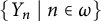 $\left \{ Y_{n}\mid n\in \omega \right \} $
is the family we were looking for. Let
 $W\in \left [ \omega \right ] ^{\omega }$
, we need to prove that
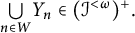 $ {\textstyle \bigcup \limits _{n\in W}} Y_{n}\in (\mathcal {I}^{<\omega })^{+}.$
Pick
 $A\in \mathcal {I}.$
Since
 $\{ {\textstyle \bigcup } \mathcal {V}_{n}\mid n\in \omega \}$
is a
 $\gamma $
-cover of
 $\mathcal {I}$
and W is infinite, there is
 $n\in W$
such that
 $A\in {\textstyle \bigcup } \mathcal {V}_{n}.$
Thus, there is
 $s\in Y_{n}$
such that
 $A\in U_{s},$
which means that
 $A\cap s=\emptyset .$
We now assume that
 $\mathcal {I}$
is Hurewicz. Since
 $\mathcal {I}$
and
 $\mathcal {I}^{\ast }$
are isomorphic, it is enough to prove that
 $\mathcal {I} ^{\ast }$
has the Hurewicz property. Let
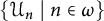 $\left \{ \mathcal {U}_{n}\mid n\in \omega \right \} $
be a sequence of open covers. Using the lemma above, we find
 $X_{n}\subseteq \left [ \omega \right ] ^{<\omega }$
such that
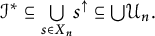 $\mathcal {I}^{\ast }\subseteq {\textstyle \bigcup \limits _{s\in X_{n}}} s^{\uparrow }\subseteq {\textstyle \bigcup } \mathcal {U}_{n}.$
It follows that
 $X_{n}\in (\mathcal {I}^{<\omega })^{+}.$
Since
 $\mathcal {I}$
is Hurewicz, we find
 $Y_{n}\in \left [ X_{n}\right ] ^{<\omega }$
such that
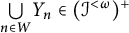 $ {\textstyle \bigcup \limits _{n\in W}} Y_{n}\in (\mathcal {I}^{<\omega })^{+}$
for every
 $W\in \left [ \omega \right ] ^{\omega }.$
Let
 $n\in \omega $
and
 $s\in X_{n}.$
We know that
 $s^{\uparrow }\subseteq {\textstyle \bigcup } \mathcal {U}_{n}$
and since
 $s^{\uparrow }$
is compact, we can cover it with only finitely many elements of
 $\mathcal {U}_{n}.$
In this way, we can find a finite
 $\mathcal {V}_{n}\subseteq \mathcal {U}_{n}$
such that
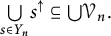 $ {\textstyle \bigcup \limits _{s\in Y_{n}}} s^{\uparrow }\subseteq {\textstyle \bigcup } \mathcal {V}_{n}.$
We claim that
 $\left \{ {\textstyle \bigcup } \mathcal {V}_{n}\mid n\in \omega \right \} $
is a
 $\gamma $
-cover of
 $\mathcal {I}^{\ast }.$
Assume this is not the case, so there is
 $B\in \mathcal {I}^{\ast }$
such that
 $W=\{n\mid B\notin {\textstyle \bigcup } \mathcal {V}_{n}\}$
is infinite. However, we know that
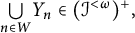 $ {\textstyle \bigcup \limits _{n\in W}} Y_{n}\in (\mathcal {I}^{<\omega })^{+},$
so there is
 $n\in W$
and
 $s\in Y_{n}$
such that
 $s\subseteq B.$
Thus,
 $B\in s^{\uparrow }\subseteq {\textstyle \bigcup } \mathcal {V}_{n},$
so
 $B\in {\textstyle \bigcup } \mathcal {V}_{n},$
which is a contradiction.
For MAD families, we have the following.
Proposition 6.10 Every Shelah–Steprāns MAD family is Hurewicz.
Proof Let
 $\mathcal {A}$
be a Shelah–Steprāns MAD family and
 $\left \{ X_{n}\mid n\in \omega \right \} \subseteq \left ( \mathcal {I}\left ( \mathcal {A}\right ) ^{<\omega }\right ) ^{+}.$
Note that if
 $B\in \mathcal {I}\left ( \mathcal {A}\right ) $
, then
 $\left \{ X_{n}\cap \left [ \omega \setminus B\right ] ^{<\omega }\mid n\in \omega \right \} \subseteq (\mathcal {I(A)}^{<\omega })^{+}.$
Using Proposition 5.9, we can thus recursively find
 $\left \{ B_{n}\mid n\in \omega \right \} \subseteq \mathcal {I}\left ( \mathcal {A}\right ) $
with the following properties:
-
(1) If
$n\neq m,$
then there is no
$A\in \mathcal {A}$
that has infinite intersection with both
$B_{n}$
and
$B_{m}.$
-
(2)
$X_n \cap [B_m \setminus k]^{< \omega }$
is infinite for all
$n,m,k \in \omega $
.




For every
 $n\in \omega ,$
let
 $Y_{n}\in \left [ X_{n}\right ] ^{<\omega }$
such that
 $Y_{n}\cap \left [ B_{i}\setminus n\right ] ^{<\omega }\neq \emptyset $
for every
 $i\leq n$
. It is then easy to see that if
 $D\in \left [ \omega \right ] ^{\omega }$
, then
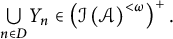 ${\textstyle \bigcup \limits _{n\in D}} Y_{n}\in \left ( \mathcal {I}\left ( \mathcal {A}\right ) ^{<\omega }\right ) ^{+}.$
This implication clearly fails for ideals in general because, for example, fin
 $\times $
fin is Shelah–Steprāns, but not Canjar.
Definition 6.11. Let
 $\mathcal {I}$
be an ideal on
 $\omega .$
-
(1) Let
$\mathcal {J}$
be an ideal. We say that
$\mathcal {I}$
is
$\mathcal {J}$
-wide if
$\mathcal {I}\nleqslant _{ {\textsf {K}} }\mathcal {J}.$
-
(2) Let
$\mathcal {S}$
be a class of ideals. We say that
$\mathcal {I}$
is
$\mathcal {S}$
-wide (or wide for
$\mathcal {S}$
) if
$\mathcal {I}$
is
$\mathcal {J}$
-wide for every
$\mathcal {J}\in \mathcal {S}.$


Let
 $\mathcal {A}$
be a MAD family. We will say
 $\mathcal {A}$
is
 $\mathcal {J}$
-MAD if
 $\mathcal {I(A)}$
is
 $\mathcal {J}$
-wide. In a similar way,
 $\mathcal {A}$
is
 $\mathcal {S}$
-MAD if
 $\mathcal {I(A)}$
is
 $\mathcal {S}$
-wide. The terminology in the case of MAD families was chosen to mimic the classifications of ultrafilters due to Baumgartner ([Reference Baumgartner6], see also [Reference Brendle and Flašková15]). Note however that in the case of ultrafilters, we are interested in the upper cones of Borel ideals under the Katětov order, while for MAD families, we are interested in the lower cones. In general, we would like to understand for which ideals
 $\mathcal {I}$
, does ZFC imply the existence of
 $\mathcal {I}$
-MAD families. Note that by Theorem 4.2, this project encompasses the one of indestructibility for various forcings. As mentioned in the preliminaries, no MAD family is fin
 $\times $
fin-MAD. Also, the nwd-MAD families are precisely the Cohen indestructible ones. We will now prove that conv-MAD families exist in ZFC. Since conv
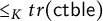 $\leq _K tr (\mathsf{ctble})$
(Proposition 3.20), every Sacks indestructible MAD family is conv-MAD. However, later we will see that is consistent that there are Sacks destructible conv-MAD families (see Proposition 9.9).
Lemma 6.12 Let
 $\mathcal {A}$
be an a.d. family of size less than
 $\mathfrak {c}$
. If f is a Katětov-morphism from
 $(\left [ 0,1\right ] \cap \mathbb{Q} ,$
conv
 $)$
to
 $\left ( \omega ,\mathcal {I}\left ( \mathcal {A}\right ) \right ) $
, then there is
 $B\in \mathcal {A}^{\perp }$
such that
 $f^{-1}\left ( B\right ) \notin $
conv.
Proof For every
 $A\in \mathcal {A,}$
let
 $F_{A}$
be the set of accumulation points of
 $f^{-1}\left ( A\right ) ,$
and note that each
 $F_{A}$
is finite since
 $f^{-1}\left ( A\right ) $
can be covered by finitely many converging sequences. Since
 $\left [ 0,1\right ] $
can be partitioned into
 $\mathfrak {c} $
-many perfect pairwise disjoint sets, we can find a perfect set
 $C\subseteq \left [ 0,1\right ] $
such that
 $C\cap F_{A}=\emptyset $
for every
 $A\in \mathcal {A}.$
Let
 $D \subseteq [0,1] \cap {\mathbb Q}$
be such that C is the set of accumulation points of D and note that
 $D \cap f^{-1} (A)$
is finite for all
 $A \in \mathcal {A}$
. It is easy to see that
 $B=f\left [ D\right ] $
has the desired properties.
We conclude the following.
Corollary 6.13 There is a conv-MAD family.
This is so far the best-known result asserting the ZFC existence of
 $\mathcal {I}$
-MAD families.
Definition 6.14. Let
 $\mathcal {J}$
be an ideal.
-
(1)
$\mathcal {J}$
is Laflamme if
$\mathcal {J}$
is wide for the class of
$F_{\sigma }$
ideals
$.$
-
(2)
$\mathcal {J}$
is P-wide if
$\mathcal {J}$
is wide for the class of analytic P-ideals
$.$
-
(3)
$\mathcal {J}$
is
fin
$\times $
fin-like if
$\mathcal {J}$
is
$\mathcal {I}$
-wide for all analytic ideals
${\mathcal I}$
such that fin
$\times $
fin
$\nleq _{K}\mathcal {I}$
.


By the results of Solecki, Laczkovich, and Recław, it can be proved that no
 $F_{\sigma \delta }$
ideal is Katětov above fin
 $\times $
fin (see [Reference Laczkovich and Recław51, Reference Solecki76]). Since every analytic P-ideal is
 $F_{\sigma \delta }$
(see [Reference Solecki75]), it follows that every fin
 $\times $
fin- like ideal is P-wide. Furthermore, in Lemma 2.6 of [Reference Sakai70], it is proved that every
 $F_{\sigma }$
ideal is contained in an analytic P-ideal, so every P-wide ideal is Laflamme. By Theorem 5.14, under a Large Cardinal assumption, every Shelah–Steprāns ideal is fin
 $\times $
fin- like. Note that if in the definition of fin
 $\times $
fin- like, we only quantified over Borel ideals, then this implication would be true in ZFC by Theorem 5.12.
The definition of wide for a class involves the Katětov order. However, in some instances, we can replace
 $ \nleq _{K}$
by
 $\not \subseteq $
.Footnote
4
Lemma 6.15 Let
 $\mathcal {J}$
be an ideal.
-
(1)
$\mathcal {J}$
is Laflamme if and only if
$\mathcal {J} \nsubseteq \mathcal {I}$
for every
$F_{\sigma } $
-ideal
$\mathcal {I}.$
-
(2)
$\mathcal {J}$
is P-wide if and only if
$\mathcal {J} \nsubseteq \mathcal {I}$
for every analytic P-ideal
$\mathcal {I}.$
-
(3)
$\mathcal {J}$
is fin
$\times $
fin-like if and only if
$\mathcal {J} \nsubseteq \mathcal {I}$
for every analytic ideal
${\mathcal I}$
such that fin
$\times $
fin
$\nleq _{K}\mathcal {I}$
.


Proof Assuming that the ideal
 $\mathcal {J}$
cannot be extended to an
 $F_{\sigma }$
ideal, we will prove that it is a Laflamme ideal. Let
 $\mathcal {I}$
be an
 $F_{\sigma }$
ideal, and let
 $f:\omega \longrightarrow \omega $
. We must show that f is not a Katětov-morphism from
 $\left ( \omega ,\mathcal {I}\right ) $
to
 $\left ( \omega ,\mathcal {J} \right ).$
Define
 $\mathcal {I'=}\left \{ X\mid f^{-1}\left ( X\right ) \in \mathcal {I}\right \} .$
Let
 $\varphi $
be a lower semicontinuous submeasure such that
 $\mathcal {I}=$
fin
 $\left ( \varphi \right ) .$
For every
 $n\in \omega ,$
we define
 $C_{n}=\left \{ X\mid \varphi \left ( f^{-1}\left ( X\right ) \right ) \leq n\right \} .$
It is easy to see that each
 $C_{n}$
is a closed set and
 $\mathcal {I'}= {\textstyle \bigcup \limits _{n\in \omega }} C_{n}.$
Since
 $\mathcal {J} $
is not contained in
 $\mathcal {I'}$
the result follows.
Assume there is
 $\mathcal {I}$
an analytic P-ideal for which
 $\mathcal {J} \leq _{ {\textsf {K}}}\mathcal {I}.$
Let
 $f\in \omega ^{\omega }$
be a Katětov morphism from
 $\left ( \omega ,\mathcal {I}\right ) $
to
 $\left ( \omega ,\mathcal {J}\right ) .$
As before, define
 $\mathcal {I}^{\prime }=\left \{ X\subseteq \omega \mid f^{-1}\left ( X\right ) \in \mathcal {I}\right \} .$
It follows that
 $\mathcal {J\subseteq I}^{\prime }.$
It is easy to see that
 $\mathcal {I}^{\prime }$
is an analytic ideal, we will prove that it is also a P-ideal. Evidently, this will be a contradiction.
Let
 $\left \{ B_{n}\mid n\in \omega \right \} \subseteq \mathcal {I}^{\prime }.$
Since each
 $f^{-1}\left ( B_{n}\right ) $
is in
 $\mathcal {I},$
we can find
 $A\in \mathcal {I}$
such that
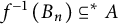 $f^{-1}\left ( B_{n}\right ) \subseteq ^{\ast }A$
for every
 $n\in \omega .$
The following claim will finish the proof.
Claim 6.16
-
(1)
$\omega \setminus f\left [ \omega \setminus A\right ] \in \mathcal {I} ^{\prime }.$
-
(2)
$B_{n}\subseteq ^{\ast }\omega \setminus f\left [ \omega \setminus A\right ] $
for every
$n\in \omega .$



We start with the first point. It is enough to show that
 $f^{-1}\left ( \omega \setminus f\left [ \omega \setminus A\right ] \right ) \subseteq A.$
Let
 $x\in f^{-1}\left ( \omega \setminus f\left [ \omega \setminus A\right ] \right ) .$
We have the following:
 $$ \begin{align*} \begin{array}[c]{lll} x\in f^{-1}\left( \omega\setminus f\left[ \omega\setminus A\right] \right) & \Longrightarrow & f\left( x\right) \in\omega\setminus f\left[ \omega\setminus A\right] \\ & \Longrightarrow & f\left( x\right) \notin f\left[ \omega\setminus A\right] \\ & \Longrightarrow & x\in A. \end{array} \qquad\qquad\qquad \end{align*} $$
We now prove the second point. Let
 $x\in B_{n}$
such that
 $x\notin \omega \setminus f\left [ \omega \setminus A\right ] .$
Thus,
 $x\in f\left [ \omega \setminus A\right ] $
, which means that there is
 $y_{x}\in \omega \setminus A$
such that
 $f\left ( y_{x}\right ) =x.$
It follows that
 $y_{x}\in f^{-1}\left ( B_{n}\right ) \setminus A.$
Furthermore, note that if
 $x,z\in B_{n}$
with
 $x,z\notin \omega \setminus f\left [ \omega \setminus A\right ] $
and are different, then
 $y_{x}\neq y_{z}.$
Since
 $f^{-1}\left ( B_{n}\right ) \setminus A$
is finite, the result follows.
To see the nontrivial direction of (3), assume there is an analytic ideal
 ${\mathcal I}$
such that fin
 $\times $
fin
 $\nleq _K {\mathcal I}$
and
 ${\mathcal J} \leq _K {\mathcal I}$
as witnessed by the Katětov reduction f. Define
 ${\mathcal I} ' = \{ A | f^{-1} [A] \in {\mathcal I} \}$
and note that
 ${\mathcal J} \subseteq {\mathcal I}' \leq _K {\mathcal I}$
, that fin
 $\times $
fin
 $\nleq _K {\mathcal I} '$
, and that
 ${\mathcal I}'$
is still analytic.
Notice that all three properties defined here are (trivially) upward closed in the Katětov order.
We now investigate the connection between fin
 $\times $
fin-likeness and weak tightness. Define
 $C_{n}=\left \{ \left ( n,m\right ) \mid m\in \omega \right \} .$
The following ideal was introduced by Kwela in [Reference Kwela50], and is critical in his study of “boring ideals.” In [Reference Kwela50], this ideal is called
 $\mathcal {BI}$
but we will refer to it as
 $\mathcal {WT},$
to emphasize its connection with weakly tight almost disjoint families.
Definition 6.17. Define the ideal
 $\mathcal {WT}$
on
 $\omega \times \omega $
as follows:
-
(1)
$\mathcal {WT}\upharpoonright C_{n}$
is a copy of fin
$\times $
fin (for every
$n\in \omega $
). -
(2)
$A \in \mathcal {WT}$
iff
$A \cap C_n \in \mathcal {WT}\upharpoonright C_{n}$
for all n and
$A \cap C_n$
is finite for all but finitely many n.




Clearly,
 $\mathcal {WT}$
is not weakly tight as witnessed by the
 $C_n$
. Also note that if
 $B\subseteq \omega \times \omega $
has infinite intersection with infinitely many columns then
 $B\in \mathcal {WT}^{+}.$
Proposition 6.18
 $\mathcal {WT}$
is strictly Katětov below fin
 $\times $
fin
 $.$
Proof Note that the identity mapping witnesses
 $\mathcal {WT}\leq _{K}$
fin
 $\times $
fin
 $.$
Now, we will show
 $\mathsf{II}$
has a winning strategy in
 $\mathcal {L}\left ( \mathcal {WT}\right ) .$
This is easy, since no
 $C_{n}$
belongs to
 $\mathcal {WT}$
and therefore
 $\mathsf{II}$
can play in such a way that the set she constructed at the end intersects infinitely often all the
 $C_{n},$
so it cannot be an element of
 $\mathcal {WT}.$
We will need the following simple equivalence of weak tightness.
Lemma 6.19 Let
 $\mathcal {A}$
be a MAD family. The following are equivalent:
-
(1)
$\mathcal {A}$
is weakly tight. -
(2) If
$X=\left \{ X_{n}\mid n\in \omega \right \} \subseteq \mathcal {I}\left ( \mathcal {A}\right ) ^{+}$
is a partition, then there is
$A\in \mathcal {A}$
such that
$A\cap X_{n}$
is infinite for infinitely many
$X_{n}.$
-
(3) If
$X=\left \{ X_{n}\mid n\in \omega \right \} \subseteq \mathcal {I}\left ( \mathcal {A}\right ) ^{+}$
are pairwise disjoint, then there is
$A\in \mathcal {A}$
such that
$A\cap X_{n}$
is infinite for infinitely many
$X_{n}.$







Proof Obviously, 1 implies 2. Moreover, it is easy to see that 2 and 3 are equivalent since from an infinite family of pairwise disjoint sets, we can get a partition by performing only finite changes. We will now prove that 3 implies 1. Let
 $\mathcal {A}$
be a MAD family that satisfies 3, we will show that
 $\mathcal {A}$
is weakly tight. Let
 $X=\left \{ X_{n}\mid n\in \omega \right \} \subseteq \mathcal {I}\left ( \mathcal {A}\right ) ^{+},$
we now define the forcing
 $\mathbb{P}$
whose elements are functions p with the following properties:
-
(1)
$p:n_{p}\times m_{p}\longrightarrow 2.$
-
(2) If
$\left ( i,j\right ) \in dom\left ( p\right ) $
and
$j\notin X_{i}$
then
$p\left ( i,j\right ) =0.$




If
 $p,q\in \mathbb{P}$
, then
 $p\leq q$
if
 $q\subseteq p$
and the following holds: if
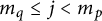 $m_{q}\leq j<m_{p}$
and
 $i_{1},i_{2}$
are two distinct elements of
 $n_{q}$
either
 $p\left ( i_{1},j\right ) =0$
or
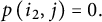 $p\left ( i_{2},j\right ) =0.$
It is easy to see that
 $\mathbb{P}$
adds an almost disjoint family
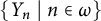 $\left \{ Y_{n}\mid n\in \omega \right \} $
such that
 $Y_{n}\subseteq X_{n}.$
Moreover, each
 $Y_{n}$
is forced to be in
 $\mathcal {I}\left ( \mathcal {A}\right ) ^{+}$
and we only need to meet countably many dense sets to achieve this. The result clearly follows.
For MAD families, we have the following characterization of weak tightness.
Lemma 6.20 If
 $\mathcal {A}$
is a MAD family, then
 $\mathcal {A}$
is weakly tight if and only if
 $\mathcal {I}\left ( \mathcal {A}\right ) \mathcal {\nleq }_{K} \mathcal {WT}.$
Proof We will prove that
 $\mathcal {A}$
is not weakly tight if and only if
 $\mathcal {I}\left ( \mathcal {A}\right ) \mathcal {\leq }_{K} \mathcal {WT}.$
One direction follows from the fact that
 $\mathcal {WT}$
is not weakly tight and from the upward closure of weak tightness in the Katětov order (see Lemma 6.2).
So assume
 $\mathcal {A}$
is not weakly tight. So there is a partition
 $X=\left \{ X_{n}\mid n\in \omega \right \} \subseteq \mathcal {I}\left ( \mathcal {A}\right ) ^{+}$
such that if
 $A\in \mathcal {A,}$
then
 $A\cap X_{n}$
is finite for almost all
 $n\in \omega .$
Since
 $\mathcal {A}\upharpoonright X_{n}$
is an a.d. family, we know
 $\mathcal {A}\upharpoonright X_{n} \mathcal {\leq }_{KB}$
fin
 $\times $
fin, so for each
 $n\in \omega ,$
fix a Katětov–Blass-morphism
 $h_{n}:C_{n}\longrightarrow X_{n}$
from
 $\left ( C_{n},\mathcal {WT\upharpoonright }C_{n}\right ) $
to
 $\left ( X_{n} ,\mathcal {A}\upharpoonright X_{n}\right )$
(in fact, it is well-known that we can choose one to one
 $h_n$
). Letting
 $h={\textstyle \bigcup } h_{n}$
, we will show that h is a Katětov-morphism from
 $\left ( \omega \times \omega ,\mathcal {WT}\right ) $
to
 $\left ( \omega ,\mathcal {A}\right ) .$
If
 $A\in \mathcal {A,}$
then we can find
 $B\in X^{\perp }$
and a finite set
 $F\subseteq \omega $
such that
 $A={\textstyle \bigcup \limits _{n\in F}} \left ( A\cap X_{n}\right ) \cup B.$
Clearly,
 $h^{-1}\left ( B\right ) \in \mathcal {WT}$
since
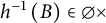 $h^{-1}\left ( B\right ) \in \emptyset \times $
fin and
 $h^{-1}\left ( A\cap X_{n}\right ) =h_{n}^{-1}\left ( A\cap X_{n}\right ) $
, which is an element of
 $\mathcal {WT}$
since
 $h_{n}$
is a Katětov-morphism. Therefore,
 $h^{-1}\left ( A\right ) \in \mathcal {WT}.$
We conclude the following.
Corollary 6.21 If
 $\mathcal {A}$
is fin
 $\times $
fin-like, then
 $\mathcal {A}$
is weakly tight.
This implication fails for ideals in general.
Proposition 6.22 There is a fin
 $\times $
fin-like ideal that is not weakly tight.
Proof Let
 ${\mathcal J}$
be any ideal not contained in an analytic ideal (e.g., any maximal ideal). Define the ideal
 $\mathcal {WT} ({\mathcal J})$
on
 $\omega \times \omega $
as follows:
-
(1)
$\mathcal {WT} ({\mathcal J})\upharpoonright C_{n}$
is a copy of
${\mathcal J}$
. -
(2)
$A \in \mathcal {WT} ({\mathcal J})$
iff
$A \cap C_n \in \mathcal {WT}({\mathcal J})\upharpoonright C_{n}$
for all n and
$A \cap C_n$
is finite for all but finitely many n.
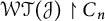




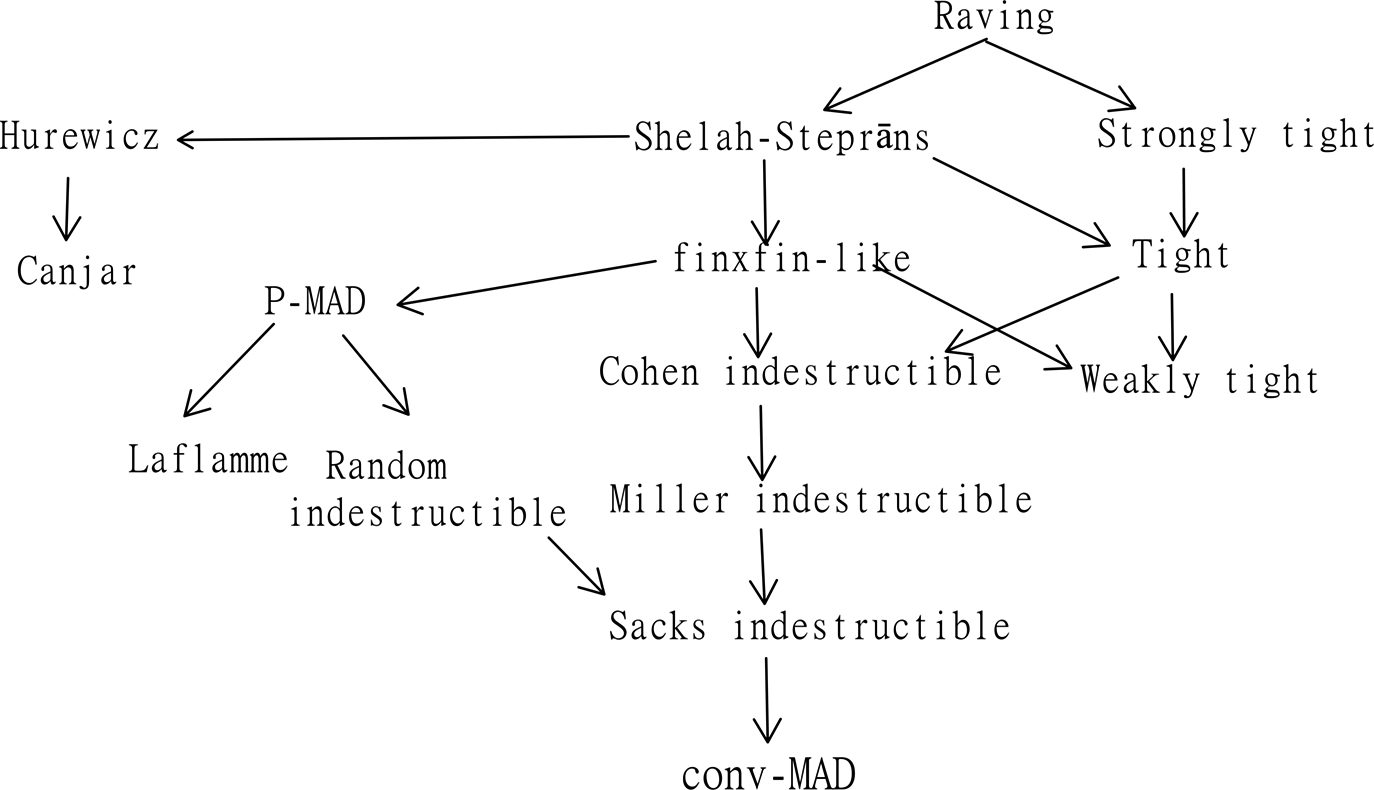
As for
 $\mathcal {WT}$
, we see that the
 $C_n$
witness that
 $\mathcal {WT}({\mathcal J})$
is not weakly tight. Also note that as in Proposition 6.18, we see that
 $\mathcal {WT}({\mathcal J})$
is strictly Katětov below fin
 $\times $
fin. To see that
 $\mathcal {WT}({\mathcal J})$
is fin
 $\times $
fin-like, let
 ${\mathcal I}$
be an analytic ideal on
 $\omega \times \omega $
with fin
 $\times $
fin
 $ \nleq _K {\mathcal I}$
. We need to see that
 $\mathcal {WT}({\mathcal J}) \not \subseteq {\mathcal I}$
. Since fin
 $\times $
fin
 $ \nleq _K {\mathcal I}$
, there is
 $A \in $
fin
 $\times $
fin with
 $A \notin {\mathcal I}$
, say
 $A = B \cup C,$
where B meets only finitely many
 $C_n$
and
 $C \cap C_n$
is finite for all n. If
 $C \notin {\mathcal I}$
, we are done because
 $C \in \mathcal {WT}({\mathcal J})$
. So assume
 $B \notin {\mathcal I}$
. Thus, for some n,
 $B \cap C_n \notin {\mathcal I}$
and
 ${\mathcal I} \upharpoonright C_n$
is a proper analytic ideal. Then,
 $\mathcal {WT} ({\mathcal J})\upharpoonright C_{n} \not \subseteq {\mathcal I} \upharpoonright C_{n}$
, and we are also done.
7 Destructibility by forcing
We now discuss the connection between the properties introduced so far and indestructibility by forcing.
Proposition 7.1 Let
 ${\mathcal I}$
be an ideal. Also let
 $\mathcal {J}$
be a
 $\sigma $
-ideal in
 $\omega ^{\omega }$
for which the forcing
 $\mathbb{P}_{\mathcal {J}}=Borel\left ( \omega ^{\omega }\right ) /\mathcal {J}$
is proper, has the continuous reading of names, and does not add a dominating real (below any condition).
-
(1) Assume
${\mathcal I}$
is fin
$\times $
fin-like and
$tr ({\mathcal J})$
is an analytic ideal. Then,
$\mathcal {I}$
is
$\mathbb{P}_{\mathcal {J}}$
-indestructible. -
(2) (LC) If
${\mathcal I}$
is Shelah–Steprāns and
$\mathcal {J}\in $
L
$\left ( \mathbb{R}\right ) $
, then
$\mathcal {I}$
is
$\mathbb{P}_{\mathcal {J}}$
-indestructible. -
(3) In particular, if
${\mathcal I}$
is Shelah–Steprāns (or just fin
$\times $
fin-like), then
${\mathcal I}$
is Cohen, random, and Sacks indestructible. -
(4) If
${\mathcal I}$
is a P-wide ideal, then
${\mathcal I}$
is random and Sacks indestructible.


Proof 1. Let
 $\mathcal {J}$
be a
 $\sigma $
-ideal in
 $\omega ^{\omega }$
such that
 $\mathbb{P}_{\mathcal {J}}$
is proper and has the continuous reading of names. If there is
 $B\in \mathbb{P}_{\mathcal {J}}$
such that forcing below B destroys
 $\mathcal {I},$
then there is
 $X\in tr\left ( \mathcal {J} \right ) ^{+}$
such that
 $\mathcal {I} \leq _{K}tr\left ( \mathcal {J}\right ) \upharpoonright X$
(see Theorem 4.2). Since
 ${\mathcal I}$
is fin
 $\times $
fin-like and
 $tr ({\mathcal J})$
is analytic, fin
 $\times $
fin
 $\leq _{\mathsf{K}}tr\left ( \mathcal {J}\right ) \upharpoonright X$
follows, and so
 $\mathbb{P}_{\mathcal {J}}$
must add a dominating real below some condition.
2. This is similar, using Theorem 5.14.
3. Noting that the ideals
 $tr ({\mathcal M})$
and
 $tr ({\mathcal N})$
are Borel, we get the result from the previous items for Cohen and random indestructibility. For Sacks, just recall that Cohen indestructibility implies Sacks indestructibility.
4. It is known that
 $tr\left ( \mathcal {N}\right ) $
is a P-ideal (see [Reference Hernández-Hernández and Hrušák36]). Since the restriction of a P-ideal is a P-ideal, the result follows for random indestructibility. Since random indestructibility entails Sacks indestructibility, the result follows.
As mentioned in the introduction, the problem of Roitman is connected to whether every MAD family can be destroyed by a proper forcing not adding unbounded reals, while the problem of the first and fourth authors is connected to whether every MAD family can be destroyed without adding dominating or unsplitted reals. Recall that Shelah–Steprāns MAD families
 ${\mathcal A}$
are indestructible for many definable forcings that do not add dominating reals. Perhaps surprisingly, such families can be destroyed by forcings that do not add dominating reals or unsplit reals. In fact, we will see that the Mathias forcing associated with
 $\mathcal {I}\left ( \mathcal {A}\right ) $
has these properties.
7.1 Destroying Hurewicz ideals
Recall that for Hurewicz ideals
 ${\mathcal I}$
, Mathias forcing
 ${\mathbb M} ({\mathcal I})$
preserves unbounded families from the ground model (Theorem 6.5 (2)). We now proceed to strengthen this.
Definition 7.2.
-
(1) Let
$P=\left \{ s_{n}\mid n\in \omega \right \} \subseteq \left [ \omega \right ] ^{<\omega }$
be a collection of finite disjoint sets and
$S\in \left [ \omega \right ] ^{\omega }.$
We say that S block splits P if both of the sets
$\left \{ n\mid s_{n}\subseteq S\right \} $
and
$\left \{ n\mid s_{n}\cap S=\emptyset \right \} $
are infinite. -
(2) We say that
$\mathcal {S}\subseteq \left [ \omega \right ] ^{\omega }$
is a block splitting family if for every infinite
$P\subseteq \left [ \omega \right ] ^{<\omega }$
of disjoint sets, there is
$S\in \mathcal {S}$
such that S block splits
$P.$






Note that every block splitting family is a splitting family. It is known that the least size of a block splitting family is
 $\max \left \{ \mathfrak {b} ,\mathfrak {s}\right \} $
(see [Reference Kamburelis and Weglorz46]). Our goal now is to prove that the Mathias forcing of a Hurewicz ideal preserves the ground model as a block splitting family. We originally had a direct proof, but one of the referees suggested following the approach of [Reference Brendle, Cardona and Mejía13] due to the first author, Cardona, and Mejía. The presentation became much more elegant and we thank the referee for his or her suggestion. We will use definitions and results from the mentioned paper, but we warn the reader that we are only using particular cases of their work and their results are much more general.
Definition 7.3. We say that
 $\mathbb{R} =\left ( X,Y,\longrightarrow \right ) $
is a Polish relational system if:
-
(1) X and Y are perfect Polish spaces.
-
(2)
$\longrightarrow \subseteq X\times Y$
is an
$F_{\sigma }$
relation. Moreover, there is a sequence
$\left \langle \longrightarrow _{n}\right \rangle _{n\in \omega }$
with the following properties:-
(a)
$\longrightarrow = {\textstyle \bigcup \limits _{n\in \omega }} \longrightarrow _{n}.$
-
(b) Each
$\longrightarrow _{n}\subseteq X\times Y$
is closed. -
(c) If
$n<m,$
then
$\longrightarrow _{n}\subseteq \longrightarrow _{m}.$
-
(d) If
$y\in Y$
and
$n\in \omega ,$
then the set
$\left \{ x\in X\mid x\longrightarrow _{n}y\right \} $
is closed and nowhere dense.
-


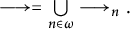






Denote by
 $Dis$
the set of all infinite
 $P\subseteq \left [ \omega \right ] ^{<\omega }$
that consist of disjoint sets. Note that
 $Dis$
has a natural Polish topology. The Polish relational system we are interested in is the following.
Definition 7.4. Let
 $\mathbb{BR}=\left ( \left [ \omega \right ] ^{\omega },Dis,\longrightarrow ^{ns}\right ) $
, where
 $S\longrightarrow ^{ns}P$
if S does not block split
 $P.$
It is easy to see that
 $\mathbb{BR}$
is a Polish relational system. The following definition comes from [Reference Brendle, Cardona and Mejía13].
Definition 7.5. Let
 $\mathbb{R} =\left ( X,Y,\longrightarrow \right ) $
be a Polish relational system and
 $\mathbb{P}$
a partial order.
 $\mathbb{P}$
is
 $\mathbb{R}$
-good if for every
 $\mathbb{P}$
-name
 $\dot {h}$
such that
 $\mathbb{P}\Vdash $
“
 $\dot {h}\in Y$
,” there is
 $H\in \left [ Y\right ] ^{\omega }$
(in the ground model) such that for every
 $x\in X,$
if
 $x\nrightarrow y$
for every
 $y\in H,$
then
 $\mathbb{P}\Vdash $
“
 $x\nrightarrow \dot {h}$
.”
Thus,
 $\mathbb{P}$
is
 $\mathbb{BR}$
-good if for every
 $\mathbb{P}$
-name
 $\dot {P} =\{\dot {p}_{n}\mid n\in \omega \}$
of an infinite set of disjoint subsets of
 $\omega ,$
there is
 $H\in \left [ Dis\right ] ^{\omega }$
such that for every
 $S\in \left [ \omega \right ] ^{\omega },$
if S block splits every element of
 $H,$
then
 $\mathbb{P}\Vdash $
“S block splits
 $\dot {P}$
.”
Proposition 7.6 Let
 $\mathcal {I}$
be a Hurewicz ideal.
 $\mathbb{M(\mathcal {I})}$
is
 $\mathbb{BR}$
-good.
Proof Let
 $\mathcal {I}$
be a Hurewicz ideal and
 $\dot {P} \mathcal {=\{}\dot {p} _{n}\mid n\in \omega \}$
be a name for an infinite set of pairwise disjoint finite subsets of
 $\omega $
. We may assume
 $\dot {p}_{n}$
is forced to be disjoint from n. For every
 $s\in \left [ \omega \right ] ^{<\omega }$
and
 $m\in \omega ,$
we define
 $X_{m}\left ( s\right ) $
as the set of all
 $t\in \left [ \omega \right ] ^{<\omega }$
such that
 $\max \left ( s\right ) <\min \left ( t\right ) $
and there are
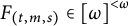 $F_{\left ( t,m,s\right ) }\in \left [ \omega \right ] ^{<\omega }$
and
 $B\in \mathcal {I}$
such that
 $\left ( s\cup t,B\right ) \Vdash "\dot {p}_{m}=F_{\left ( t,m,s\right ) }.$
” It is easy to see that
 $\left \{ X_{m}\left ( s\right ) \mid m\in \omega \right \} \subseteq \left ( \mathcal {I}^{<\omega }\right ) ^{+}$
and since
 $\mathcal {I}$
is Hurewicz, we may find
 $Y_{m}\left ( s\right ) \in \left [ X_{m}\left ( s\right ) \right ] ^{<\omega }$
such that if
 $W\in \left [ \omega \right ] ^{\omega }$
, then
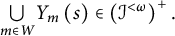 ${\bigcup \limits _{m\in W}}Y_{m}\left ( s\right ) \in \left ( \mathcal {I}^{<\omega }\right ) ^{+}.$
Let
 $Z_{m}\left ( s\right ) ={\bigcup \limits _{t\in Y_{m}\left ( s\right ) }}F_{\left ( t,m,s\right ) }.$
For every
 $s\in \left [ \omega \right ] ^{<\omega }$
, we can then find
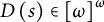 $D\left ( s\right ) \in \left [ \omega \right ] ^{\omega }$
such that
 $R\left ( s\right ) =\left \{ Z_{m}\left ( s\right ) \mid m\in D\left ( s\right ) \right \} $
is pairwise disjoint. Define
 $H=\left \{ R\left ( s\right ) \mid s\in \left [ \omega \right ] ^{<\omega }\right \} .$
We claim that H is the family we were looking for. Let
 $S\in \left [ \omega \right ] ^{\omega }$
that block splits every element of
 $H.$
We want to prove that
 $\mathbb{M}\left ( \mathcal {I}\right ) \Vdash $
“S block splits
 $\dot {P}$
.” Assume this is not the case, so there is
 $\left ( s,A\right ) \in \mathbb{M}\left ( \mathcal {I}\right ) $
and
 $n\in \omega $
such that either
 $\left ( s,A\right ) \Vdash "\left \{ m\mid \dot {p}_{m}\subseteq S\right \} \subseteq n$
” or
 $\left ( s,A\right ) \Vdash "\left \{ m\mid \dot {p}_{m}\cap S=\emptyset \right \} \subseteq n.$
” Assume the first case holds (the other one is similar). Since S block splits
 $R\left ( s\right ) ,$
we know that the set
 $W=\left \{ m>n\mid m \in D(s) \text { and } Z_{m}\left ( s\right ) \subseteq S\right \} $
is infinite. Since
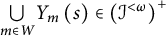 ${\bigcup \limits _{m\in W}}Y_{m}\left ( s\right ) \in \left ( \mathcal {I}^{<\omega }\right ) ^{+}$
, there is
 $m\in W$
and
 $t\in Y_{m}\left ( s\right ) $
such that
 $t\cap A=\emptyset .$
By definition, there is
 $B\in \mathcal {I}$
such that
 $\left ( s\cup t,B\right ) \Vdash "\dot {p} _{m}=F_{\left ( t,m,s\right ) }.$
” Since
 $t\cap A=\emptyset $
, we have
 $\left ( s\cup t,A\cup B\right ) \leq \left ( s,A\right ) .$
But
 $\left ( s\cup t,A\cup B\right ) $
forces that
 $\dot {p}_{m}$
is a subset of
 $S,$
which is a contradiction.
We can then conclude the following.
Corollary 7.7 Let
 $\mathcal {I}$
be a Hurewicz ideal.
 $\mathbb{M(\mathcal {I})}$
preserves that the ground model
 $[\omega ]^\omega $
is a block splitting family.
In particular, if
 $\mathcal {I}$
is a Hurewicz ideal, then
 $\mathbb{M}\left ( \mathcal {I}\right ) $
preserves
 $\mathbf {V}\cap \left [ \omega \right ] ^{\omega }$
as a splitting family (this result has also been noted by Lyubomyr Zdomskyy). Since Shelah–Steprāns MAD families are Hurewicz (Proposition 6.10), we conclude the following.
Corollary 7.8 If
 $\mathcal {A}$
is Shelah–Steprāns, then
 $\mathcal {A}$
can be destroyed with a ccc forcing that does not add dominating nor unsplit reals.
In fact, such forcings can be iterated without adding unsplit reals. We need the following theorem from [Reference Brendle, Cardona and Mejía13].
Theorem 7.9 [Reference Brendle, Cardona and Mejía13]
Let
 $\mathbb{R} =\left ( X,Y,\longrightarrow \right ) $
be a Polish relational system. The finite support iteration of ccc forcings that are
 $\mathbb{R}$
-good is
 $\mathbb{R}$
-good.
The reader may consult [Reference Brendle and Hrušák16, Reference Brendle and Switzer19, Reference Cardona and Mejía22, Reference Mejia and Cardona56] for more results. Using this result, we can conclude the following.
Corollary 7.10 Assume
 $\mathbf {V}\models $
CH. Let
 $\langle \mathbb{P}_{\alpha },\mathbb{\dot {Q}}_{\alpha }\mid \alpha \leq \kappa \rangle $
be a finite support iteration of Mathias forcings of Hurewicz ideals. Then,
 $\mathbb{P}_{\kappa }\Vdash $
“
 $\mathfrak {b=s=} \omega _{1}$
.”
With the previous results, we can prove the following.
Theorem 7.11 There is a model in which the following statements hold:
-
(1)
$\mathfrak {c}=\omega _{2}.$
-
(2)
$\mathfrak {b=s}=\omega _{1}.$
-
(3) No MAD family of size
${\aleph }_{1}$
can be extended to a Hurewicz ideal.


Proof We start with a ground model
 $\mathbf {V}$
such that
 $\mathbf {V}\models $
GCH
 $+ \Diamond \left ( S_{1}^{2}\right ) ,$
where
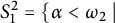 $S_{1}^{2}=\{\alpha <\omega _{2} \mid $
cof
 $\left ( \alpha \right ) =\omega _{1}\}.$
Let
 $\left \langle I_{\alpha }\mid \alpha \in S_{1}^{2}\right \rangle $
be a
 $\Diamond \left ( S_{1}^{2}\right ) $
sequence. We construct
 $\langle \mathbb{P}_{\alpha },\mathbb{\dot {Q}}_{\alpha }\mid \alpha <\omega _{2}\rangle $
a finite support iteration such that for every
 $\alpha <\omega _{2}:$
-
(1) If
$\alpha \in S_{1}^{2}$
and
$I_{\alpha }$
codes a
$\mathbb{P}_{\alpha } $
-name
$\mathcal {I}$
for a Hurewicz ideal, then
$\mathbb{\dot {Q}}_{\alpha }$
is a
$\mathbb{P}_{\alpha }$
-name for
$\mathbb{M(\mathcal {I})}.$
-
(2) In any other case,
$\mathbb{\dot {Q}}_{\alpha }$
is a
$\mathbb{P}_{\alpha }$
-name for Cohen forcing.


Let
 $G_{\omega _{2}}\subseteq \mathbb{P}_{\omega _{2}}$
be a generic filter. It is clear that
 $\mathbf {V}\left [ G_{\omega _{2}}\right ] \models \mathfrak {c}=\omega _{2}$
and by our previous results, we also get that
 $\mathbf {V}\left [ G_{\omega _{2}}\right ] \models \mathfrak {b=s=} \omega _{1}.$
We want to prove that there are no MAD families of size
 $\omega _{1}$
that can be extended to a Hurewicz ideal. Aiming toward a contradiction, assume that in
 $\mathbf {V}\left [ G_{\omega _{2} }\right ] $
, there is
 $\mathcal {A}$
a MAD family of size
 $\omega _{1}$
and
 $\mathcal {J}$
a Hurewicz ideal such that
 $\mathcal {A\subseteq J}.$
Now, by a standard closing off argument, there is
 $C\subseteq S_{1}^{2}$
a club relative to
 $S_{1}^{2}$
such that for every
 $\alpha \in C:$
-
(1)
$\mathcal {A}\in \mathbf {V}\left [ G_{\alpha }\right ] .$
-
(2)
is a Hurewicz ideal,” where
$\mathcal {J}_{\alpha }=\mathbf {V}\left [ G_{\alpha }\right ] \cap \mathcal {J}$
and
$\mathcal {A} \subseteq \mathcal {J}_\alpha .$
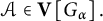
 is a Hurewicz ideal,” where


In this way, there is
 $\alpha \in C$
such that
 $\mathbb{\dot {Q}}_{\alpha }$
is a
 $\mathbb{P}_{\alpha }$
-name for
 $\mathbb{M(\mathcal {J}}_{\alpha }\mathbb{)}.$
Hence, at the next step, we destroyed
 $\mathcal {J}_{\alpha }.$
In particular, we destroyed
 $\mathcal {A},$
so it cannot be maximal. We have a contradiction.
We do not know the value of
 $\mathfrak {a}$
in the previous model. Naturally, if every MAD family could be extended to a Hurewicz ideal (at least under CH), then we would be able to solve Problem 1.2. Unfortunately, this may not be the case, as we will prove in Theorem 8.7.
Problem 7.12. What is the value of
 $\mathfrak {a}$
in the model of Theorem 7.11?
8 A MAD family that cannot be extended to a Hurewicz ideal
We know that every Shelah–Steprāns MAD family is Hurewicz (Proposition 6.10). Non-Canjar MAD families can be constructed in ZFC (see [Reference Chodounský, Repovš and Zdomskyy25] or [Reference Guzmán, Hrušák and Martínez-Celis33]). In order to solve the Problem 1.2, it would be enough to show that every MAD family can be extended to a Hurewicz ideal. Unfortunately, we will see that it is consistent with CH that this is not the case. No later result depends on this section.
Definition 8.1.
-
(1) By Part we denote the set of partitions of
$\omega $
into infinitely many infinite pieces. -
(2) Given
$\mathcal {D}\in $
Part we define fin
$\times $
fin
$\left ( \mathcal {D}\right ) =\left \{ B\subseteq \omega \mid \forall ^{\infty }D\in \mathcal {D}\left ( \left \vert D\cap B\right \vert <\omega \right ) \right \} .$
-
(3) Given two elements
$\mathcal {D=} \left \{ D\left ( n\right ) \mid n\in \omega \right \} ,\mathcal {C=}\left \{ C\left ( n\right ) \mid n\in \omega \right \} $
of Part, we say
$\mathcal {C\longrightarrow D}$
if one of the following conditions holds:-
(a)
$C\left ( n\right ) $
is almost disjoint with every
$D\left ( m\right ) $
for almost all
$n\in \omega $
or -
(b) there is
$m\in \omega $
such that
$C\left ( n\right ) \subseteq ^{\ast }D\left ( m\right ) $
for almost all
$n\in \omega $
or -
(c) for almost every
$n\in \omega $
there is
$m_{n}\in \omega $
such that
$C\left ( n\right ) \subseteq ^{\ast }D\left ( m_{n}\right ) $
and
$m_{k}\neq m_{r}$
whenever
$k\neq r.$
-












Note that if
 $\mathcal {C\longrightarrow D}$
then almost every element of
 $\mathcal {C}$
is in fin
 $\times $
fin
 $\left ( \mathcal {D} \right ) .$
Now we define the following:
Definition 8.2. Let
 $\mathbb{P}$
be the set of all
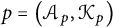 $p=\left ( \mathcal {A}_{p},\mathcal {K} _{p}\right ) $
such that
 $\mathcal {A}_{p}$
is a countable a.d. family and
 $\mathcal {K}_{p}$
is a countable subset of Part. We say that
 $p= \left ( \mathcal {A}_{p},\mathcal {K}_{p}\right ) \leq q=\left ( \mathcal {A} _{q},\mathcal {K}_{q}\right ) $
if the following conditions hold:
-
(1)
$\mathcal {A}_{q}\subseteq \mathcal {A}_{p}$
and
$\mathcal {K}_{q} \subseteq \mathcal {K}_{p}.$
-
(2) If
$\mathcal {C\in K}_{p}\setminus \mathcal {K}_{q}$
and
$\mathcal {D\in K}_{q}$
, then
${\mathcal {C}}\longrightarrow \mathcal {D}.$
-
(3) If
$A\in \mathcal {A}_{p}\setminus \mathcal {A}_{q}$
and
$\mathcal {D\in K}_{q}$
, then
$A\in $
fin
$\times $
fin
$\left ( \mathcal {D} \right ) .$


It is easy to see that
 $\mathbb{P}$
is a
 $\sigma $
-closed forcing (so it does not add new reals). Let
 $\mathcal {\dot {A}}_{gen}$
be the name of
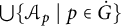 ${\textstyle \bigcup } \{\mathcal {A}_{p}\mid p\in \dot {G}\}$
(where
 $\dot {G}$
is the name for the generic filter). It is easy to see that
 $\mathcal {\dot {A}}_{gen}$
is forced to be an almost disjoint family, and we will see that
 $\mathcal {\dot {A}}_{gen}$
is forced to be a MAD family that cannot be extended to a Hurewicz ideal. Recall that a family
 $\mathcal {H}\subseteq \left [ \omega \right ] ^{\omega }$
is open dense in
 $\mathcal {P} \left ( \omega \right ) /$
fin if for every
 $A\in \left [ \omega \right ] ^{\omega }$
, there is a
 $B\in \mathcal {H}$
such that
 $B\subseteq ^{\ast }A$
and
 $\mathcal {H}$
is closed under almost inclusion. It is well-known and easy to see that every tall ideal on
 $\omega $
is open dense in
 $\mathcal {P} \left ( \omega \right ) /$
fin and the intersection of countably many open dense sets is open dense.
Lemma 8.3
 $\mathcal {\dot {A}}_{gen}$
is forced to be a MAD family.
Proof Letting
 $p=\left ( \mathcal {A}_{p},\mathcal {K}_{p}\right ) \in \mathbb{P}$
and
 $X\in \left [ \omega \right ] ^{\omega },$
we must find
 $q=\left ( \mathcal {A} _{q},\mathcal {K}_{q}\right ) \leq p$
such that X is not a.d. from
 $\mathcal {A}_{q}$
(this is enough since
 $\mathbb{P}$
does not add new reals). Assume that X is a.d. from
 $\mathcal {A}_{p}.$
By the previous remarks, we can find
 $A\subseteq ^{\ast }X$
such that
 $A\in $
fin
 $\times $
fin
 $\left ( \mathcal {D}\right ) $
for every
 $\mathcal {D\in K}_{p}.$
It is clear that
 $q=\left ( \mathcal {A}_{p}\cup \left \{ A\right \} ,\mathcal {K}_{p}\right ) $
has the desired properties.
Recall that an ideal
 $\mathcal {I}$
on a countable set is a
 $P^{+}$
-ideal if for every decreasing family
 $\left \{ X_{n}\mid n\in \omega \right \} \subseteq \mathcal {I}^{+}$
, there is
 $X\in \mathcal {I}^{+}$
such that
 $X\subseteq ^{\ast }X_{n}$
for every
 $n\in \omega .$
We will need the following.
Lemma 8.4 Let
 $p=\left ( \mathcal {A}_{p},\mathcal {K}_{p}\right ) \in \mathbb{P}$
,
 $\mathcal {\dot {J}}$
be a name for a
 $P^{+}$
-ideal such that
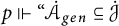 $p\Vdash "\mathcal {\dot {A}}_{gen}\subseteq \mathcal {\dot {J}}$
” and
 $X\in \left [ \omega \right ] ^{\omega }$
such that
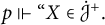 $p\Vdash "X\in \mathcal {\dot {J}}^{+}.$
” There are
 $q\leq p$
and
 $Y\in \left [ X\right ] ^{\omega }$
such that the following conditions hold:
-
1.
$Y\in \mathcal {A}_{p}^{\perp }.$
-
2. For every
$\mathcal {D}\in \mathcal {K}_{p}$
, either Y is a.d. from all elements of
$\mathcal {D}$
or there is
$D\in \mathcal {D}$
such that
$Y\subseteq ^{\ast }D.$
-
3.
$q\Vdash "Y\in \mathcal {\dot {J}}^{+}.$
”


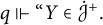
Proof We first note that if
 $\mathcal {I}$
is a
 $P^{+}$
-ideal,
 $Z\in \mathcal {I}^{+}$
and
 $\mathcal {C}=\left \{ C\left ( n\right ) \mid n\in \omega \right \} \in $
Part, then there is
 $W\in \left [ Z\right ] ^{\omega }\cap \mathcal {I}^{+}$
such that either W is a.d. with
 $\mathcal {C}$
or there is
 $C\in \mathcal {C}$
such that
 $W\subseteq C.$
Indeed, if there is
 $n\in \omega $
such that
 $Z\cap C\left ( n\right ) \in \mathcal {I}^{+}$
, then we define
 $W=Z\cap C\left ( n\right ) ,$
and if this is not the case, then
 $\{Z\setminus {\textstyle \bigcup \limits _{i\leq n}} C\left ( i\right ) \mid n\in \omega \}\subseteq \mathcal {I}^{+}$
forms a decreasing sequence, and we just let
 $W\subseteq Z$
be a pseudointersection in
 $\mathcal {I}^{+}.$
To prove the lemma, note that if
 $A\in \mathcal {A}_{p},$
then p forces that
 $X\setminus A$
is in
 $\mathcal {\dot {J}}^{+}.$
Since both
 $\mathcal {A}_{p}$
and
 $\mathcal {K}_{p}$
are countable, the result then follows by the previous remarks.
With the lemma, we can now prove the following.
Lemma 8.5 Let
 $p=\left ( \mathcal {A}_{p},\mathcal {K}_{p}\right ) \in \mathbb{P}$
,
 $\mathcal {\dot {J}}$
be a name for a
 $P^{+}$
-ideal such that
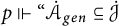 $p\Vdash "\mathcal {\dot {A}}_{gen}\subseteq \mathcal {\dot {J}}$
” and
 $\left \{ X_{n}\mid n\in \omega \right \} \subseteq \left [ \omega \right ] ^{\omega }$
such that
 $X_{n}\cap X_{m}=\emptyset $
whenever
 $n\neq m$
and
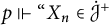 $p\Vdash "X_{n}\in \mathcal {\dot {J}}^{+}$
” for every
 $n\in \omega .$
There are
 $q=\left ( \mathcal {A}_{q},\mathcal {K}_{q}\right ) \leq p, W\in \left [ \omega \right ] ^{\omega }$
and
 $\left \{ Y_{n}\mid n\in W\right \} \in $
Part such that the following conditions hold:
-
(1)
$Y_{n}\subseteq ^{\ast }X_{n}$
for every
$n\in W.$
-
(2)
$\mathcal {Y=} \left \{ Y_{n}\mid n\in W\right \} \in \mathcal {K}_{q}$
and
${\mathcal Y} \longrightarrow {\mathcal D}$
for every
${\mathcal D} \in {\mathcal K}_q $
. -
(3)
$q\Vdash "Y_{n}\in \mathcal {\dot {J}}^{+}$
” for every
$n\in W.$
-
(4) q forces that every element in
$\mathcal {\dot {A}}_{gen}$
has infinite intersection with only finitely many elements in
$\mathcal {Y}.$





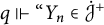


Proof Using the previous lemma, we recursively construct a sequence
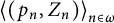 $\left \langle \left ( p_{n},Z_{n}\right ) \right \rangle _{n\in \omega }$
with the following properties:
-
(1)
$\left \langle p_{n}\right \rangle _{n\in \omega }$
is decreasing and
$p_{0}\leq p.$
-
(2)
$Z_{n}\in \left [ X_{n}\right ] ^{\omega }$
. -
(3)
$p_{n}\Vdash "Z_{n}\in \mathcal {\dot {J}}^{+}.$
” -
(4)
$Z_{n}\in \mathcal {A}_{p_{n-1}}^{\perp }$
(where
$p_{-1}=p$
). -
(5) For every
$\mathcal {D}\in \mathcal {K}_{p_{n-1}}$
either
$Z_{n}$
is a.d. with
$\mathcal {D}$
or there is
$D\in \mathcal {D}$
such that
$Z_{n}\subseteq ^{\ast }D.$


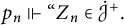


The construction is straightforward. Let
 $p_{\omega }=\left ( \mathcal {A}_{p_{\omega }},\mathcal {K}_{p_{\omega }}\right ) $
, where
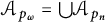 $\mathcal {A}_{p_{\omega }}={\textstyle \bigcup } \mathcal {A}_{p_{n}}$
and
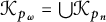 $\mathcal {K}_{p_{\omega }}={\textstyle \bigcup } \mathcal {K}_{p_{n}}$
. By our construction,
 $p_{\omega }$
has the following properties:
-
(1) If
$A\in \mathcal {A}_{p_{\omega }}$
, then
$A\cap Z_{n}$
is finite for almost every
$n\in \omega .$
-
(2) If
$\mathcal {D}\in \mathcal {K}_{p_{\omega }}$
, then for almost all
$n\in \omega ,$
either
$Z_{n}$
is a.d. with
$\mathcal {D}$
or there is
$D\in \mathcal {D}$
such that
$Z_{n}\subseteq ^{\ast }D.$


We can then find
 $W\in \left [ \omega \right ] ^{\omega }$
and
 $\mathcal {Y} =\left \{ Y_{n}\mid n\in W\right \} $
such that the following conditions hold:
-
(1)
$Y_{n}=^{\ast }Z_{n}$
for every
$n\in W.$
-
(2)
$\mathcal {Y}\in $
Part
$\mathsf{.}$
-
(3)
$\mathcal {Y}\longrightarrow \mathcal {D}$
for every
$\mathcal {D} \in \mathcal {K}_{p_{\omega }}.$


Such W can be found since its construction only requires intersecting countably many open dense subsets of
 $\mathcal {P} \left ( \omega \right ) /$
fin
 $.$
Letting
 $q=\left ( \mathcal {A}_{p_{\omega }},\mathcal {K} _{p_{\omega }}\cup \left \{ \mathcal {Y}\right \} \right ) ,$
it is easy to see that q has the desired properties.
It is well-known that every Canjar ideal is a
 $P^{+}$
-ideal (see [Reference Chodounský, Repovš and Zdomskyy25, Reference Hrušák and Minami43] or [Reference Guzmán, Hrušák and Martínez-Celis33]). We now have the following result, which is the heart of the construction.
Proposition 8.6 Let
 $G\subseteq \mathbb{P}$
be a generic filter. The following holds in
 $\mathbf {V}\left [G\right ]:$
If
 $\mathcal {J}$
is a Canjar ideal such that
 $\mathcal {A}_{\mathsf{gen}}\subseteq \mathcal {J},$
then there are no
 $\left \{ X_{n}\mid n\in \omega \right \} \subseteq \mathcal {J}^{+}$
such that
 $X_{n}\cap X_{m}=\emptyset $
for every distinct
 $n,m\in \omega .$
Proof Let
 $p\in \mathbb{P}, \mathcal {\dot {J}}$
a name for a
 $P^{+}$
-ideal extending
 $\mathcal {\dot {A}}_{gen}$
and
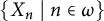 $\left \{ X_{n}\mid n\in \omega \right \} $
a pairwise disjoint family such that
 $p\Vdash "\left \{ X_{n}\mid n\in \omega \right \} \subseteq \mathcal {\dot J}^{+}.$
” We will find an extension of p that forces that
 $\mathcal {\dot {J}}$
is not Canjar. By the previous lemma, let
 $q=\left ( \mathcal {A}_{q},\mathcal {K}_{q}\right ) \leq p, W\in \left [ \omega \right ] ^{\omega }$
, and
 $\left \{ Y_{n}\mid n\in \omega \right \} \subseteq \left [ \omega \right ] ^{\omega }$
be such that the following conditions hold:
-
(1)
$Y_{n}\subseteq ^{\ast }X_{n}$
for every
$n\in W.$
-
(2)
$\mathcal {Y=} \left \{ Y_{n}\mid n\in W\right \} \in \mathcal {K}_{q}$
and
${\mathcal Y} \longrightarrow {\mathcal D}$
for every
${\mathcal D} \in {\mathcal K}_q $
. -
(3)
$q\Vdash "Y_{n}\in \mathcal {\dot {J}}^{+}$
” for every
$n\in W.$
-
(4) q forces that every element in
$\mathcal {\dot {A}}_{gen}$
has infinite intersection with only finitely many elements in
$\mathcal {Y}.$





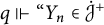


Let
 $W=\left \{ w_{n}\mid n\in \omega \right \} .$
For every
 $n\in \omega ,$
we define
 $F_{n}$
to be the set of all
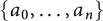 $\left \{ a_{0},\ldots ,a_{n}\right \} $
such that
 $a_{0}<a_{1}<\cdots <a_{n}$
and
 $a_{i}\in Y_{w_{i}}$
for every
 $i\leq n.$
It is easy to see that
 $q\Vdash "F_{n}\in (\mathcal {\dot {J} }^{<\omega })^{+}$
” for every
 $n\in \omega .$
We claim that q forces that
 $\left \langle F_{n}\mid n\in \omega \right \rangle $
witnesses that (in the extension)
 $\mathcal {\dot {J}}$
is not a Canjar ideal. It is enough to prove the following: For every
 $q_{1}\leq q$
and
 $\left \langle H_{n} \right \rangle _{n\in \omega }$
such that
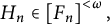 $H_{n}\in \left [ F_{n}\right ] ^{<\omega },$
there is
 $q_{2}=\left ( \mathcal {A}_{q_{2}},\mathcal {K}_{q_{2} }\right ) \leq q_{1}$
and
 $A\in \mathcal {I}\left ( \mathcal {A}_{q_{2}}\right ) $
such that A has non empty intersection with every element of
 $H_{n}$
for every
 $n\in \omega $
(recall that
 $\mathcal {\dot {J}}$
is forced to extend
 $\mathcal {\dot {A}}_{gen}$
).
Let
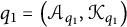 $q_{1}=\left ( \mathcal {A}_{q_{1}},\mathcal {K}_{q_{1}}\right ) $
be an extension of q and let
 $\left \langle H_{n}\right \rangle _{n\in \omega }$
be such that
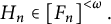 $H_{n}\in \left [ F_{n}\right ] ^{<\omega }.$
We fix the following items:
-
(1) Let
$\mathcal {A}_{q_{1}}=\left \{ A_{n}\mid n\in \omega \right \} $
and define
$B_{n}={\textstyle \bigcup \limits _{i\leq n}} A_{i}$
for every
$n\in \omega .$
-
(2) Let
$\mathcal {L=}\left \{ \mathcal {C\in K}_{q_{1}}\mid \mathcal {Y\longrightarrow C}\right \} .$
-
(a) Let
$\mathcal {L}_{\text {a.d.}}$
be the family of all
$\mathcal {C}\in \mathcal {L}$
such that almost every element of
$\mathcal {Y}$
is a.d. with
$\mathcal {C}.$
Fix an enumeration
$\mathcal {L} _{\text {a.d.}}=\{{\mathcal {C}}_{n}^{\text {a.d.}}\mid n\in \omega \}$
, where
${\mathcal {C}}_{n}^{\text {a.d.}}=\{C_{n}^{\text {a.d.}}\left ( m\right ) \mid m\in \omega \}.$
Let
$\overline {C}_{n}^{\text {a.d.}}\left ( m\right ) =C_{n}^{\text {a.d.}}\left ( 0\right ) \cup \cdots \cup C_{n} ^{\text {a.d.}}\left ( m\right ) .$
-
(b) Let
$\mathcal {L}_{=}$
be the family of all
$\mathcal {C}\in \mathcal {L}$
such that there is
$C\in \mathcal {C}$
such that almost all elements of
$\mathcal {Y}$
are almost contained in
$C.$
Fix an enumeration
$\mathcal {L}_{\mathsf{=} }=\{{\mathcal {C}}_{n}^{\mathsf{=}}\mid n\in \omega \}$
, where
${\mathcal {C}}_{n}^{\mathsf{=}} =\{C_{n}^{\mathsf{=}}\left ( m\right ) \mid m\in \omega \}$
and let
$c_{n} ^{=}\in \omega $
be such that almost every element of
$\mathcal {Y}$
is almost contained in
$C_{n}^{=}\left ( c_{n}^{=}\right ) .$
-
(c) Let
$\mathcal {L}_{\neq }$
be the family of all
$\mathcal {C}\in \mathcal {L}$
such that for almost all
$n\in W$
, the
$Y_n$
are almost contained in pairwise distinct members of
${\mathcal {C}}$
. Fix an enumeration
$\mathcal {L}_{\neq }=\{{\mathcal {C}}_{n}^{\neq }\mid n\in \omega \}$
, where
${\mathcal {C}}_{n}^{\neq }=\{C_{n}^{\neq }\left (m\right ) \mid m\in \omega \}.$
Note that
${\mathcal L}$
is the disjoint union of
${\mathcal L}_ {\text {a.d.}}$
,
${\mathcal L}_=$
, and
${\mathcal L}_{\neq }$
. -
-
(3) Let
$\mathcal {R} =\left \{ \mathcal {D\in K}_{q_{1}}\mid \mathcal {D\longrightarrow Y}\right \} .$
-
(a) Let
$\mathcal {R}_{\text {a.d.}}$
be the family of all
$\mathcal {D}\in \mathcal {R}$
such that almost every element of
$\mathcal {D}$
is a.d. with
$\mathcal {Y}.$
Fix an enumeration
$\mathcal {R} _{\text {a.d.}}=\{{\mathcal D}_{n}^{\text {a.d.}}\mid n\in \omega \}$
, where
${\mathcal D}_{n}^{\text {a.d.}}=\{D_{n}^{\text {a.d.}}\left ( m\right ) \mid m\in \omega \}.$
Let
$d_{n}^{\text {a.d.}}\in \omega $
such that if
$d_{n}^{\text {a.d.}}\leq m,$
then
$D_{n}^{\text {a.d.}}\left ( m\right ) $
is a.d. with
$\mathcal {Y}$
and let
$\overline {D} _{n}^{\text {a.d.}}\left ( m\right ) ={\textstyle \bigcup } \{D_{n}^{\text {a.d.}}\left ( i\right ) \mid d_{n}^{\text {a.d.} }\leq i\leq m\}.$
-
(b) Let
$\mathcal {R}_{=}$
be the family of all
$\mathcal {D}\in \mathcal {R}$
such that there is
$Y_{n}\in \mathcal {Y}$
such that almost all elements of
$\mathcal {D}$
are almost contained in
$Y_{n}.$
Fix an enumeration
$\mathcal {R}_{\mathsf{=}}=\{{\mathcal D}_{n}^{\mathsf{=}}\mid n\in \omega \}$
, where
${\mathcal D}_{n}^{\mathsf{=}}=\{D_{n}^{\mathsf{=}}\left ( m\right ) \mid m\in \omega \},$
and let
$d_{n}^{=},e_{n}^{=}\in \omega $
such that
$D_{n}^{=}\left ( m\right ) \subseteq ^{\ast }Y_{d_{n}^{=}}$
for every
$m\geq e_{n}^{=}.$
-
(c) Let
$\mathcal {R}_{\neq }$
be the family of all
$\mathcal {D}\in \mathcal {R}$
such that almost all
$D\in \mathcal {D}$
are almost contained in pairwise distinct members of
${\mathcal Y}$
. Fix an enumeration
$\mathcal {R}_{\neq } =\{{\mathcal D}_{n}^{\neq }\mid n\in \omega \},$
where
${\mathcal D}_{n}^{\neq }=\{D_{n}^{\neq }\left ( m\right ) \mid m\in \omega \}.$
Note that
${\mathcal R}$
is the disjoint union of
${\mathcal R}_ {\text {a.d.}}$
,
${\mathcal R}_=$
, and
${\mathcal R}_{\neq }$
. -
-
(4) Let
$h:\omega \longrightarrow \omega $
be an increasing function such that for every
$n\in \omega ,$
the following conditions hold:-
(a) If
$h\left ( n\right ) \leq m,$
then
$B_{n}$
is almost disjoint with
$Y_{w_m}.$
-
(b) If
$h\left ( n\right ) \leq m,$
then
$Y_{w_m}$
is almost disjoint with every element of
${\mathcal {C}}_{n}^{\text {a.d.}}.$
-
(c) If
$h\left ( n\right ) \leq m,$
then
$Y_{w_m}\subseteq ^{\ast }C_{n} ^{=}\left ( c_{n}^{=}\right ) .$
-
(d) If
$h\left ( n\right ) \leq m<k,$
then
$Y_{w_m}$
and
$Y_{w_k}$
are almost subsets of different elements in
${\mathcal {C}}_{n}^{\neq }.$
-
(e) If
$h\left ( n\right ) \leq m,$
then
$D_{n}^{\text {a.d.}}\left ( m\right ) $
is a.d. with
$\mathcal {Y}$
(i.e.,
$d_n^{\text {a.d.}} \leq h(n)$
). -
(f) If
$h\left ( n\right ) \leq m,$
then
$D_{n}^{\mathsf{=}}\left ( m\right ) \subseteq ^{\ast }Y_{d_{n}^{=}}$
(i.e.,
$e_n^= \leq h(n)$
). -
(g) If
$h\left ( n\right ) \leq m<k,$
then
$D_{n}^{\neq }\left ( m\right ) $
and
$D_{n}^{\neq }\left ( k\right ) $
are almost subsets of different elements in
$\mathcal {Y}.$
-
















































Note that
 ${\mathcal K}_{q_1} = {\mathcal L} \cup {\mathcal R} \cup \{ {\mathcal Y} \}$
. This follows from the construction of
 ${\mathcal Y}$
and
 $q_1 \leq q$
.
We will say that a finite sequence
 $\left \langle \left ( P_{0},s_{0}\right ) ,\dots ,\left ( P_{n},s_{n}\right ) \right \rangle $
is suitable if the following conditions hold:
-
(1)
$P_{0},\ldots ,P_{n}$
are non-empty finite consecutive intervals of
$\omega .$
-
(2)
$\min \left ( P_{0}\right ) =0.$
-
(3)
$s_{0}=P_{0}\cap \left ({\textstyle \bigcup } \left \{ Y_{w_j}\mid j<h\left ( 0\right ) \right \} \right ) .$
-
(4)
$s_{i+1}=P_{i+1}\cap \left ({\textstyle \bigcup } \left \{ Y_{w_j}\mid h\left ( i\right ) \leq j<h\left ( i+1\right ) \right \} \right ) .$
-
(5)
$s_{i}\neq \emptyset $
for every
$i\leq n.$
-
(6) If
$m<h\left ( n\right ) $
, then
${\textstyle \bigcup \limits _{i\leq n}} s_{i}$
has non-empty intersection with every element of
$H_{m}.$
-
(7)
$B_{i}\cap \left ({\textstyle \bigcup } \left \{ Y_{w_j}\mid h\left ( i\right ) \leq j<h\left ( i+1\right ) \right \} \right ) \subseteq \max \left ( P_{i}\right ) .$
-
(8)
$\overline {C}_{l}^{\text {a.d.}}\left ( h\left ( i\right ) \right ) \cap \left ({\textstyle \bigcup } \left \{ Y_{w_j}\mid h\left ( i\right ) \leq j<h\left ( i+1\right ) \right \} \right ) \subseteq \max \left ( P_{i}\right ) $
for every
$l\leq i.$
-
(9)
${\textstyle \bigcup } \left \{ Y_{w_j}\mid h\left ( i\right ) \leq j<h\left ( i+1\right ) \right \} \setminus C_{l}^{=}\left ( c_{l}^{=}\right ) \subseteq \max \left ( P_{i}\right ) $
for every
$l\leq i.$
-
(10) For every j such that
$h\left ( i\right ) \leq j<h\left ( i+1\right ) ,$
if
$Y_{w_j}$
is not an almost subset of
$C_{k}^{\neq }\left ( l\right ) $
with
$k,l<i,$
then
$Y_{w_j}\cap C_{k}^{\neq }\left ( l\right ) \subseteq \max \left ( P_{i}\right ) $
. -
(11)
$\overline {D}_{l}^{\text {a.d.}}\left ( h\left ( i\right ) \right ) \cap \left ({\textstyle \bigcup } \left \{ Y_{w_j}\mid h\left ( i\right ) \leq j<h\left ( i+1\right ) \right \} \right ) \subseteq \max \left ( P_{i}\right ) $
for every
$l\leq i.$
-
(12) If
$l\leq i$
and
$e_{l}^{=}\leq j\leq h\left ( i\right ) $
, then
$D_{l}^{=}\left ( j\right ) \setminus \max \left ( P_{i}\right ) \subseteq Y_{d_{l}^{=}}.$
-
(13) For every j such that
$h\left ( i\right ) \leq j<h\left ( i+1\right ) ,$
if
$D_{k}^{\neq }\left ( l\right ) $
is not an almost subset of
$Y_{w_j}$
with
$k,l<i,$
then
$Y_{w_j}\cap D_{k}^{\neq }\left ( l\right ) \subseteq \max \left ( P_{i}\right ) $
.



















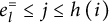





Although the list of requirements needed to be verified is excessively long, it is not hard to see that for every suitable
 $\left \langle \left ( P_{0},s_{0}\right ) ,\dots ,\left ( P_{n},s_{n}\right ) \right \rangle $
, there is
 $\left ( P_{n+1},s_{n+1}\right ) $
such that
 $\left \langle \left ( P_{0},s_{0}\right ) ,\dots ,\left ( P_{n} ,s_{n}\right ) ,\left ( P_{n+1},s_{n+1}\right ) \right \rangle $
is suitable. Therefore, we can recursively construct
 $\left \langle \left ( P_{0} ,s_{0}\right ) ,\dots ,\left ( P_{n},s_{n}\right ) ,\dots \right \rangle _{n\in \omega }$
such that every initial segment is suitable. Letting
 $A={\textstyle \bigcup \limits _{n\in \omega }} s_{n}$
, it is easy to see that
 $q_{2}=\left ( \mathcal {A}_{q_{1}}\cup \left \{ A\right \} ,\mathcal {K}_{q_{1}}\right ) $
is a condition extending
 $q_{1},$
which is the extension we were looking for. Indeed, A is almost disjoint with each
 $B_{i}$
by points
 $4)$
and
 $7).$
We have that A intersects every
 $H_{i}$
by point
 $6.$
We now need to prove that if
 $\mathcal {D}\in \mathcal {K}_{q_{1}},$
then
 $A\in $
fin
 $\times $
fin (
 $\mathcal {D}$
).In case that
 $\mathcal {D} =\mathcal {Y},$
this follows by points
 $3)$
and
 $4).$
If
 $\mathcal {D}\in \mathcal {L} _{\text {a.d.}},$
this follows by point
 $8).$
If
 $\mathcal {D} \in \mathcal {L}_{=}$
, this is by point
 $9).$
All the other cases are similar.
We now obtain the main result of this section.
Theorem 8.7 Let
 $G\subseteq \mathbb{P}$
be a generic filter. If
 $\mathcal {J}$
is a Canjar ideal extending
 $\mathcal {I}\left ( \mathcal {A}_{\mathsf{gen}}\right )$
in
 $\mathbf {V}[G]$
, then the following hold:
-
(1) For every
$X\in \mathcal {J}^{+}$
, there is
$Y\in \mathcal {J}^{+}\cap \left [ X\right ] ^{\omega }$
such that
$\mathcal {J}^{\ast }\upharpoonright Y$
is an ultrafilter. -
(2) Forcing with
$\mathbb{M}\left ( \mathcal {J}\right ) $
diagonalizes an ultrafilter. -
(3)
$\mathcal {J}$
is not a Hurewicz ideal.




Proof It is easy to see that 2 follows from 1 and 3 is a consequence of 2 (this follows, e.g., from Corollary 7.7), so we only prove 1. Assume this is not the case, so for every
 $Y\in \mathcal {J} ^{+}\cap \left [ X\right ] ^{\omega }$
, it is the case that
 $\mathcal {J}^{\ast }\upharpoonright Y$
is not an ultrafilter. We can then recursively construct a pairwise disjoint family
 $\left \{ X_{n}\mid n\in \omega \right \} \subseteq \mathcal {J}^{+}\cap \left [ X\right ] ^{\omega },$
which contradicts the previous result.
We point out that under the Continuum Hypothesis, every MAD family can be extended to the dual of a Canjar ultrafilter (Zdomskyy has a very elegant and short proof in [Reference Zdomskyy81]). Finally, we will prove the following result.
Proposition 8.8
 $\mathcal {\dot {A}}_{gen}$
is forced to be a Cohen-destructible MAD family.
Proof Recall that every Cohen indestructible MAD family has a restriction that is tight (see [Reference Hrušák and Ferreira41]). In fact, we will prove that no restriction of
 $\mathcal {A}_{\mathsf{gen}}$
is weakly tight. Let
 $p\in \mathbb{P}$
and
 $X\in \left [ \omega \right ] ^{\omega }$
such that
 $p\Vdash "X\in \mathcal {I(\dot {A}}_{gen}\mathcal {)}^{+}.$
” Since the ideals generated by MAD families are hereditarily meager, we may assume that there is a pairwise disjoint family
 $\left \{ X_{n}\mid n\in \omega \right \} \subseteq \left [ X\right ] ^{\omega }$
such that
 $p\Vdash "X_{n}\in \mathcal {I(\dot {A}}_{gen}\mathcal {)}^{+}$
” for every
 $n\in \omega .$
Since the ideals generated by a.d. families are
 $P^{+}$
-ideals (see [Reference Mathias54] or [Reference Hrušák39]), we know by Lemma 8.5, there are
 $q\leq p, W\in \left [ \omega \right ] ^{\omega }$
, and
 $\left \{ Y_{n}\mid n\in W\right \} \subseteq \left [ \omega \right ] ^{\omega }$
such that the following conditions hold:
-
(1)
$Y_{n}\subseteq ^{\ast }X_{n}$
for every
$n\in W.$
-
(2)
$q\Vdash "Y_{n}\in \mathcal {I(\dot {A}}_{gen}\mathcal {)}^{+} $
” for every
$n\in W.$
-
(3) q forces that every element in
$\mathcal {\dot {A}}_{gen}$
has infinite intersection with only finitely many elements in
$\mathcal {Y}.$





Clearly, q forces that the family
 $\left \{ Y_{n}\mid n\in W\right \} $
witnesses that
 $\mathcal {\dot {A}}_{gen} \upharpoonright X$
is not weakly tight.
The result raises the following question.
Problem 8.9. Is there (consistently) a Cohen indestructible MAD family that cannot be extended to a Hurewicz ideal?
9 Generic MAD families
Let
 $\mathcal {I}$
be a (perhaps improper) tall ideal. We define
 $\mathbb{P} _{\mathsf{MAD}}\left ( \mathcal {I}\right ) $
as the set of all countable a.d. families contained in
 $\mathcal {I}$
, ordered by inclusion. It is easy to see that this is a
 $\sigma $
-closed forcing adding a MAD family contained in
 $\mathcal {I},$
which we will denote by
 $\mathcal {A}_{\mathsf{gen}}\left ( \mathcal {I}\right ) .$
By
 $\mathbb{P}_{\mathsf{MAD}}$
, we denote
 $\mathbb{P} _{\mathsf{MAD}}\left ( {\mathcal P} \left ( \omega \right ) \right ) ,$
which is the set of all countable a.d. families ordered by inclusion;
 $\mathcal {A}_{\mathsf{gen}}$
denotes the generic MAD family. We shall use such generic objects later for non-implications (see Section 10.3).
Definition 9.1. Let
 $\mathcal {I}$
be an ideal. We say that
 $\mathcal {I}$
is nowhere Shelah–Steprāns if no restriction of
 $\mathcal {I}$
is Shelah–Steprāns.
We have the following examples.
Lemma 9.2 The ideals nwd,
 $tr($
ctble
 $), tr\left ( \mathcal {N} \right ) , tr\left ( \mathcal {K}_{\sigma }\right ) $
, and every
 $F_{\sigma }$
ideal are nowhere Shelah–Steprāns.
Proof It is known that any forcing diagonalizing fin
 $\times $
fin adds a dominating real. Since random forcing does not add dominating reals, it follows that no restriction of
 $tr\left ( \mathcal {N}\right ) $
can be Katětov above fin
 $\times $
fin. The same argument works for nwd. For
 $F_{\sigma }$
ideals, it is enough to note that any restriction of an
 $F_{\sigma }$
ideal is an
 $F_{\sigma }$
ideal, and these are not Katětov above fin
 $\times $
fin.
It remains to prove that
 $tr($
ctble
 $)$
and
 $tr\left ( \mathcal {K} _{\sigma }\right ) $
are nowhere Shelah–Steprāns. By Proposition 4.4, it is enough to prove that they are not Shelah–Steprāns. Since
 $tr($
ctble
 $), tr\left ( \mathcal {K} _{\sigma }\right ) \leq _{ {\textsf {K}}}$
nwd (see Lemma 3.11), and nwd is not Shelah–Steprāns, the desired conclusion follows by Lemma 5.8.
We now prove the following.
Lemma 9.3 Let
 $\mathcal {I},\mathcal {J}$
be two ideals such that
 $\mathcal {I}$
is nowhere Shelah–Steprāns and
 $\mathcal {J}\nleq _{K}\mathcal {I}.$
Let
 $\mathcal {A}$
be a countable a.d. family and let
 $f:\left ( \omega ,\mathcal {I}\right ) \longrightarrow \left ( \omega ,\mathcal {I}\left ( \mathcal {A}\right ) \right ) $
be a Katětov-morphism. Then, there is
 $B\in \mathcal {J}\cap \mathcal {A}^{\perp }$
such that
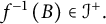 $f^{-1}\left ( B\right ) \in \mathcal {I}^{+}.$
Proof Let
 $\mathcal {A}=\left \{ A_{n}\mid n\in \omega \right \} .$
We know f is a Katětov-morphism, so the set
 $\left \{ f^{-1}\left ( A_{n}\right ) \mid n\in \omega \right \} $
is contained in
 $\mathcal {I}.$
Since
 $\mathcal {J} \nleq _{K}\mathcal {I,}$
there is
 $D\in \mathcal {J}$
such that
 $C=f^{-1}\left ( D\right ) \in \mathcal {I}^{+}.$
Since
 $\mathcal {I}\upharpoonright C$
is not Shelah–Steprāns, there is
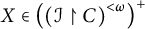 $X\in \left ( \left ( \mathcal {I}\upharpoonright C\right ) ^{<\omega }\right ) ^{+}$
such that no element of
 $\mathcal {I}$
contains infinitely many elements of
 $X.$
For each
 $n\in \omega ,$
we choose
 $s_{n}\in X$
such that
 $s_{n}\cap \left ( f^{-1}\left ( A_{0}\cup \cdots \cup A_{n}\right ) \right ) =\emptyset .$
We then know that
 $E={\textstyle \bigcup } s_{n}\in \mathcal {I}^{+}.$
It is easy to see that
 $B=f\left [ E\right ] $
has the desired properties.
We conclude the following.
Corollary 9.4 Let
 $\mathcal {I},\mathcal {J}$
be ideals such that
 $\mathcal {I}$
is nowhere Shelah–Steprāns and
 $\mathcal {J}\nleq _{K}\mathcal {I}.$
-
(1)
$\mathbb{P}_{\mathsf{MAD}}\left ( \mathcal {J}\right ) $
forces that
$\mathcal {A}_{\mathsf{gen}}\left ( \mathcal {J}\right ) $
is not Katětov below
$\mathcal {I}.$
-
(2) The Continuum Hypothesis implies that there is a MAD family
$\mathcal {A}\subseteq \mathcal {J}$
such that
$\mathcal {I}\left ( \mathcal {A} \right ) \nleq _{K}\mathcal {I}.$


In particular,
 $\mathcal {A}_{\mathsf{gen}}($
nwd
 $)$
is a Cohen destructible MAD family that is Miller and random indestructible. This holds because nwd
 $\nleq _K tr ({\mathcal K}_\sigma )$
and nwd
 $\nleq _K tr ({\mathcal N})$
(see Propositions 3.20 and 3.21), by Corollary 9.4, and by Theorem 4.3. For more on this type of results, the reader may consult [Reference Brendle and Yatabe20].
We now prove a result similar to Lemma 9.3, but with a different hypothesis.
Lemma 9.5 Let
 $\mathcal {I},\mathcal {J}$
be two ideals such that fin
 $\times $
fin
 $\nleq _{ {\textsf {K}}} \mathcal {J}$
and
 $\mathcal {I} \nleq _{ {\textsf {K}}}\mathcal {J}\upharpoonright X$
for every
 $X\in \mathcal {J}^{+}.$
Let
 $\mathcal {A}$
be a countable a.d. family and let
 $f:\left ( \omega ,\mathcal {J}\right ) \longrightarrow \left ( \omega ,\mathcal {I}\left ( \mathcal {A}\right ) \right ) $
be a Katětov function. Then, there is
 $B\in \mathcal {I}\cap \mathcal {A}^{\perp }$
such that
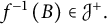 $f^{-1}\left ( B\right ) \in \mathcal {J}^{+}.$
Proof
 $\mathcal {A}$
is a countable almost disjoint family, so the ideal generated by
 $\mathcal {A\cup A}^{\perp }$
is Katětov equivalent to fin
 $\times $
fin. Since fin
 $\times $
fin
 $\nleq _{ {\textsf {K} }} \mathcal {J},$
it follows that there is
 $C_{0}\in \mathcal {J}^{+}$
such that
 $f\left [ C_{0}\right ] $
is in the ideal generated by
 $\mathcal {A\cup A}^{\perp }.$
Furthermore, since f is a Katětov function from
 $\left ( \omega ,\mathcal {J}\right ) $
to
 $\left ( \omega ,\mathcal {I}\left ( \mathcal {A}\right ) \right ) ,$
we get that there is
 $C\subseteq C_{0}$
in
 $\mathcal {J}^{+}$
for which
 $f\left [ C\right ] \in \mathcal {A}^{\perp }.$
Finally, since
 $f\upharpoonright C$
is not a Katětov function from
 $\left ( C,\mathcal {J}\upharpoonright C\right ) $
to
 $\left ( \omega ,\mathcal {I}\right ) ,$
we can find
 $B\in \mathcal {I}$
with
 $B\subseteq f\left [ C\right ] $
such that
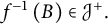 $f^{-1}\left ( B\right ) \in \mathcal {J}^{+}.$
In the same way as before, we conclude the following.
Corollary 9.6 Let
 $\mathcal {I},\mathcal {J}$
be two ideals such that fin
 $\times $
fin
 $\nleq _{ {\textsf {K}}}\mathcal {J}$
and
 $\mathcal {I} \nleq _{ {\textsf {K}}}\mathcal {J}\upharpoonright X$
for every
 $X\in \mathcal {J}^{+}.$
-
(1)
$\mathbb{P}_{\mathsf{MAD}}\left ( \mathcal {I}\right ) $
forces that
$\mathcal {A}_{ {\textsf {gen}}}(\mathcal I)$
is not Katětov below
$\mathcal {J}.$
-
(2) The Continuum Hypothesis implies that there is a MAD family
$\mathcal {A}\subseteq \mathcal {I}$
such that
$\mathcal {I}\left ( \mathcal {A} \right ) \nleq _{ {\textsf {K}}} \mathcal {J}.$


While the ideal conv is not Shelah–Steprāns (since it is Katětov below nwd), it is not nowhere Shelah–Steprāns (in fact, it has restrictions that are equivalent to fin
 $\times $
fin). Nevertheless, there is a version of Lemma 9.3 that applies to conv.
Lemma 9.7 Let
 $\mathcal {J}$
be an ideal on
 $\omega $
such that
 $\mathcal {J} \nleq _{ {\textsf {K}}}$
conv,
 $\mathcal {A\subseteq J}$
a countable almost disjoint family and
 $f:\mathbb{Q}\longrightarrow \omega $
a Katětov function from
 $(\mathbb{Q},$
conv
 $)$
to
 $\left ( \omega ,\mathcal {I} \left ( \mathcal {A}\right ) \right ) .$
There is
 $B\in \mathcal {A}^{\perp } \cap \mathcal {J}$
such that
 $f^{-1}\left ( B\right ) \in $
conv
 $^{+}.$
Proof Take an enumeration
 $\mathcal {A}=\left \{ A_{n}\mid n\in \omega \right \} $
and by (performing small changes if needed), we may assume that
 $\mathcal {A}$
is a partition of
 $\omega .$
Since
 $f^{-1}\left ( A_{n}\right ) $
can be cover by finitely many convergent sequences, it follows that its closure (in the real numbers) is a compact set. In this way, we can find
 $F_{n}\in \left [ A_{n}\right ] ^{<\omega }$
such that
 $f^{-1}\left ( A_{n}\right ) \subseteq \bigcup \limits _{q\in f^{-1}\left ( F_{n}\right ) }B(q,\frac {1}{2^{n+1}}),$
where
 $B(q,\frac {1}{2^{n+1}})$
denotes the open ball with center q and radius
 $\frac {1}{2^{n+1}}.$
Define
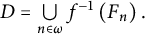 $D=\bigcup \limits _{n\in \omega }f^{-1}\left ( F_{n}\right ) .$
We claim that D is a dense subset of
 $\mathbb{Q}.$
Let
 $x\in \mathbb{Q}.$
We find
 $\left \{ x_{n}\mid n\in \omega \right \} \subseteq \mathbb{Q}$
such that for every
 $n\in \omega ,$
the following conditions hold:
-
(1)
$\left \langle x_{m}\right \rangle _{m\in \omega }$
converges to
$x.$
-
(2)
$d\left ( x_{n},x\right ) \leq \frac {1}{2^{n+1}}$
(where d denotes the usual metric of the rational numbers). -
(3)
$f\left ( x_{n}\right ) \notin A_{0}\cup \cdots \cup A_{n}.$


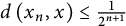

This is possible because
 $f^{-1}\left ( A_{0}\cup \cdots \cup A_{n}\right ) \in $
conv, so in particular it is nowhere dense (and then its compliment is dense). Given
 $n\in \omega ,$
find
 $l_{n}>n$
such that
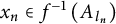 $x_{n}\in f^{-1}\left ( A_{l_{n}}\right ) $
(recall that
 $\mathcal {A}$
is a partition of
 $\omega $
). We can now find
 $q_{n}\in f^{-1}\left ( F_{l_n}\right ) \subseteq D$
for which
 $d\left ( x_{n},q_{n}\right ) \leq \frac {1}{2^{n+1}}.$
It follows that
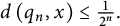 $d\left ( q_{n},x\right ) \leq \frac {1}{2^{n}}.$
In this way,
 $\left \langle q_{n}\right \rangle _{n\in \omega }$
converges to
 $x,$
so x is in the closure of
 $D.$
Let
 $B_{0}=\bigcup \limits _{n\in \omega }F_{n}.$
It follows that
 $B_{0} \in \mathcal {A}^{\perp }$
and
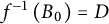 $f^{-1}\left ( B_{0}\right ) =D$
is dense (in particular, it is not in conv). But we are not done yet, since it might be the case that
 $B_{0}\notin \mathcal {J}.$
To solve this issue, note that since D is homeomorphic to
 $\mathbb{Q}$
, we know that conv
 $ \upharpoonright D$
is Katětov equivalent to conv. Since
 $\mathcal {J}\nleq _{ {\textsf {K}}}$
conv, we can now find
 $B\subseteq B_{0}$
with
 $B\in \mathcal {J}$
for which
 $f^{-1}\left ( B\right ) \in $
conv
 $^{+}.$
We now get the following.
Corollary 9.8 Let
 $\mathcal {J}$
be an ideal on
 $\omega $
such that
 $\mathcal {J} \nleq _{ {\textsf {K}}}$
conv.
-
(1)
$\mathbb{P}_{\mathsf{MAD}}\left ( \mathcal {J}\right ) $
forces that
$\mathcal {A}_{ {\textsf {gen}}}\left ( \mathcal {J}\right )$
is not Katětov below conv. -
(2) The Continuum Hypothesis implies that there is a MAD family
$\mathcal {A}\subseteq \mathcal {J}$
such that
$\mathcal {I}\left ( \mathcal {A} \right ) \nleq _{ {\textsf {K}}}$
conv.


As an application, we obtain the following.
Proposition 9.9 If
 ${\mathcal A}$
is a
 ${\mathbb P}_{\mathsf{MAD}} (tr (\mathsf{ctble}))$
-generic MAD family, then
 ${\mathcal A}$
is a Sacks destructible conv-MAD family.
Proof Recall from the preliminaries (Proposition 3.20) that
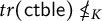 $tr (\mathsf{ctble}) \not \leq _K $
conv.
Another combinatorial property that we need to consider in this context is the following.
Definition 9.10. Let
 $\mathcal {A}$
be a MAD family. We say
 $\mathcal {A}$
is completely inhomogeneous if for every
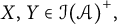 $X,Y\in \mathcal {I(A)}^{+},$
if
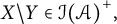 $X\setminus Y\in \mathcal {I(A)}^{+},$
then
 $\mathcal {I}\left ( \mathcal {A} \right ) \upharpoonright Y\nleqslant _{ {\textsf {K}}}\mathcal {I}\left ( \mathcal {A}\right ) \upharpoonright X.$
The property diametrically opposed to complete inhomogeneity (Katětov uniformity) was studied in [Reference Arciga-Alejandre, Hrušák and Martinez-Ranero2, Reference Guzmán31, Reference Hrušák and Ferreira41].
Proposition 9.11
 $\mathbb{P}_{\mathsf{MAD}}$
forces that
 $ \mathcal {A}_{\mathsf{gen}}$
is a raving, completely inhomogeneous MAD family.
Proof We first show that it is raving. Let
 $\mathcal {B\in } \mathbb{P}_{\mathsf{MAD}}$
and
 $X=\left \{ X_{n}\mid n\in \omega \right \} $
such that
 $\mathcal {B}$
forces that X is locally finite according to
 $\mathcal {I}\left ( \mathcal {A}_{\mathsf{gen}}\right ) .$
Let
 $\mathcal {B}=\left \{ B_{n}\mid n\in \omega \right \} $
and we define
 $E_{n}=B_{0}\cup \cdots \cup B_{n}\cup n$
for every
 $n\in \omega .$
We can then find an interval partition
 $\mathcal {P}=\left \{ P_{n}\mid n\in \omega \right \} $
of
 $\omega $
such that if
 $i\in P_{n+1}$
, then
 $E_{n}$
does not intersect every element of
 $X_{i}.$
For every
 $i\in \omega ,$
we choose
 $s_{i}\in X_{i}$
as follows: if
 $i\in P_{0}$
, let
 $s_{i}$
be any element of
 $X_{i}$
and if
 $i\in P_{n+1}$
, we choose
 $s_{i}\in X_{i}$
such that
 $s_{i}\cap E_{n}=\emptyset .$
Let
 $A={\textstyle \bigcup \limits _{n\in \omega }} s_{n}$
; then
 $A\in \mathcal {B}^{\perp }$
and the condition
 $\mathcal {B\cup }\left \{ A\right \} \in \mathbb{P}_{\mathsf{MAD}}$
is the extension of
 $\mathcal {B}$
we were looking for.
We now prove that the generic MAD family is completely inhomogeneous. Let
 $\mathcal {A}\in \mathbb{P}_{ {\textsf {MAD}}}$
and
 $X,Y\in \left [ \omega \right ] ^{\omega }$
such that
 $\mathcal {A}$
forces that
 $X,Y$
and
 $X\setminus Y$
are in
 $\mathcal {I(A}_{ {\textsf {gen}}}\mathcal {)}^{+}.$
We need to prove that for any
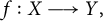 $f:X\longrightarrow Y,$
there is
 $\mathcal {B} \leq \mathcal {A}$
such that
 $\mathcal {B}$
forces that f is not a Katětov morphism from
 $(X,\mathcal {I(A}_{ {\textsf {gen}}})\upharpoonright X)$
to
 $(Y,\mathcal {I(A}_{ {\textsf {gen}}})\upharpoonright Y)$
(this is enough since
 $\mathbb{P}_{ {\textsf {MAD}}}$
does not add new reals). Since
 $\mathcal {A}$
is countable, we can find an infinite
 $C\subseteq X\setminus Y$
such that
 $C\in \mathcal {A}^{\perp }.$
We now look at
 $f\left [ C\right ] $
and consider two cases.
First assume that
 $f\left [ C\right ] \in \mathcal {I(A)}.$
Pick
 $\mathcal {C} =\left \{ C_{n}\mid n\in \omega \right \} \subseteq \left [ C\right ] ^{\omega }$
a partition of
 $C.$
Define
 $\mathcal {B}=\mathcal {A\cup C}.$
It follows that
 $\mathcal {B}\Vdash $
“
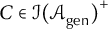 $C\in \mathcal {I(A}_{ {\textsf {gen}} }\mathcal {)}^{+}$
” and
 $\mathcal {B}\Vdash $
“
 $f\left [ C\right ] \in \mathcal {I(A}_{ {\textsf {gen}}}\mathcal {)} $
,”so f cannot be a Katětov morphism and we are done. Now assume that
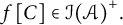 $f\left [ C\right ] \in \mathcal {I(A)}^{+}.$
Since
 $\mathcal {A}$
is countable, we can find an infinite
 $B\subseteq f\left [ C\right ] $
such that
 $B\in \mathcal {A}^{\perp }.$
Note that the set
 $D=f^{-1}\left ( B\right ) \cap C$
is infinite. Find
 $\mathcal {D}=\left \{ D_{n}\mid n\in \omega \right \} \subseteq \left [ D\right ] ^{\omega }$
a partition of D and define
 $\mathcal {B}=\mathcal {A\cup D\cup }\left \{ B\right \} .$
It follows that
 $\mathcal {B}\Vdash $
“
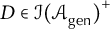 $D\in \mathcal {I(A}_{ {\textsf {gen}}}\mathcal {)}^{+}$
” and
 $\mathcal {B}\Vdash $
“
 $f\left [ D\right ] \in \mathcal {I(A}_{ {\textsf {gen}}}\mathcal {)}$
,”so f cannot be a Katětov morphism and we finished the proof.
It would be interesting to find a characterization similar to Theorems 1.7 and 1.8 of the
 $\mathbb{P}_{\mathsf{MAD}}$
generics over L
 $\left ( \mathbb{R} \right ). $
Problem 9.12. (LC)
Is there a combinatorial characterization of
 $\mathcal {A}$
(or of
 $\mathcal {I}\left ( \mathcal {A}\right ) $
), where
 $\mathcal {A}$
is
 $\mathbb{P}_{\mathsf{MAD}}$
generic over L
 $\left ( \mathbb{R}\right ) $
?
A natural candidate would be raving and complete inhomogeneity, but even these strong properties might still be too weak to capture the full extent of genericity.
Let
 $\mathbb{P}$
be a partial order and
 $\kappa $
a cardinal.
 $\mathbb{P}$
is
 $\kappa $
-distributive if
 $\mathbb{P}$
forces that every subset of size
 $\kappa $
of a ground model set is in
 $V.$
The distributivity number of
 $\mathbb{P}$
(denoted by
 $\mathfrak {h}\left ( \mathbb{P}\right ) $
) is the least
 $\mu $
for which
 $\mathbb{P}$
is not
 $\mu $
-distributive. We say that
 $\mathbb{P}$
is height-homogenous if for every
 $p\in \mathbb{P},$
we have that
 $\mathfrak {h}\left ( \mathbb{P}\upharpoonright p\right ) =\mathfrak {h}\left ( \mathbb{P}\right ) ,$
where
 $\mathbb{P}\upharpoonright p=\left \{ q\in \mathbb{P}\mid q\leq p\right \}. $
Lemma 9.13
 ${\mathbb{P}}_{\mathsf{MAD}}$
is height-homogenous and
 $\mathfrak {h}( {\mathbb{P}}_{\mathsf{MAD}})=\omega _{1}.$
Proof Since
 ${\mathbb{P}}_{\mathsf{MAD}}$
is
 $\sigma $
-closed, we know that
 $\omega _{1}\leq \mathfrak {h}({\mathbb{P}}_{\mathsf{MAD}}).$
Assume there is
 $\mathcal {B\in } {\mathbb{P}}_{\mathsf{MAD}}$
such that
 $\mathfrak {h}({\mathbb{P}}_{\mathsf{MAD}}\upharpoonright \mathcal {B})$
is at least
 $\omega _{2}.$
Let
 $\mathcal {\dot {A}}$
be a name for any subset of
 $\mathcal {\dot {A}}_{ {\textsf {gen}}}$
of size
 $\omega _{1}.$
Once again, since
 ${\mathbb{P}}_{\mathsf{MAD}}$
does not add new reals,
 $\mathcal {\dot {A} }$
is forced to be a subset of a ground model set. Hence, we can find
 $\mathcal {B}_{0}\leq \mathcal {B}$
and
 $\mathcal {C\subseteq } \left [ \omega \right ] ^{\omega }$
of size
 $\omega _{1}$
for which
 $\mathcal {B} _{0}\Vdash $
“
 $\mathcal {C=\dot {A}}$
.”In particular,
 $\mathcal {B}_{0}\Vdash $
“
 $\mathcal {C\subseteq \dot {A}}_{gen}$
.”Pick any
 $C\in \mathcal {C\setminus B}_{0}$
and find
 $C_{0}\in \left [ C\right ] ^{\omega }$
such that
 $C\setminus C_{0}$
is infinite. Define
 $\mathcal {B}_{1} =\mathcal {B}_{0}\mathcal {\cup }\left \{ C_{0}\right \} .$
It follows that
 $\mathcal {B}_{1}\leq \mathcal {B}_{0}$
and
 $\mathcal {B}_{1}\Vdash $
“
 $C\notin \mathcal {\dot {A}}_{gen}$
,”which is clearly a contradiction.
We will now prove that
 $\mathbb{P}_{ {\textsf {MAD}}}$
forces CH.
Proposition 9.14
 $\mathbb{P}_{ {\textsf {MAD}}}$
collapses
 $\mathfrak {c}$
to
 $\omega _{1}.$
Proof We only provide a sketch for the proof, which is inspired by the construction of Balcar, Pelant, and Simon in [Reference Balcar, Pelant and Simon4] to find a tree
 $T\subseteq \mathbb{P}_{ {\textsf {MAD}}}$
that is dense,
 $\sigma $
-closed and every node has
 $\mathfrak {c}$
immediate successors (see Theorem 2.1 of [Reference Balcar, Doucha and Hrušák3]). By the previous result, the height of the tree is
 $\omega _{1}.$
Finally, since every node of T has
 $\mathfrak {c}$
immediate successors, it is easy to see that T adds a surjection from
 $\omega _{1}$
to
 $\mathfrak {c}$
(see [Reference Balcar, Doucha and Hrušák3] for more details).
10 Existence and non-existence of certain MAD families
An important result of the fourth author says the following.
Theorem 10.1 [Reference Raghavan66]
It is consistent that there are no Shelah–Steprāns MAD families.
Proof Theorem 4 of [Reference Raghavan66] exhibits a model of
 $\mathrm {ZFC}$
satisfying
 $\mathfrak {b} = \mathfrak {c}$
and the statement “there are no almost strongly separable m.a.d. families.”
 $\mathfrak {b} = \mathfrak {c}$
holds in this model because it is obtained by a finite support iteration of forcing notions of the form
 $\mathbb{L}(\mathcal {F})$
, where
 $\mathcal {F}$
is a non-principal filter on some countably infinite set, and it is well-known that such forcing notions always add dominating reals. Hence by Theorem 5.15, there are no Shelah–Steprāns MAD families in the model constructed in Theorem 4 of [Reference Raghavan66].
We will now work with strongly tight almost disjoint families. Strongly tight MAD families have the following characterization.
Lemma 10.2
 ${\mathcal A}$
is strongly tight iff whenever
 $\{ B_n \mid n \in \omega \} \subseteq [\omega ]^\omega $
is such that there is
 $\{ A_n \mid n \in \omega \} \subseteq {\mathcal A}$
such that:
-
•
$B_n \subseteq A_n$
for all n, -
• for all
$A \in {\mathcal A}$
, the set
$\{ n \mid A_n = A \}$
is finite,



there is
 $A \in {\mathcal I} ({\mathcal A})$
such that
 $A \cap B_n \neq \emptyset $
for all n.
Proof First assume
 ${\mathcal A}$
is strongly tight. Assume
 $B_n$
is given as in the lemma. Clearly,
 $X_n = B_n$
satisfies the assumption in the definition of “strongly tight” and we obtain
 $A \in {\mathcal I} ({\mathcal A})$
as required.
On the other hand, if
 $X_n$
are given as in the definition of “strongly tight,” first use the maximality of
 ${\mathcal A}$
to find
 $A_n \in {\mathcal A}$
such that
 $A_n \cap X_n$
is infinite and let
 $B_n = A_n \cap X_n$
. Whenever possible, choose
 $A_n$
distinct from
 $A_i, i < n$
. If this is not possible, we require that
 $A_{n}=A_{j}$
, where
 $j<n$
is the largest such that
 $A_{j}\cap X_{n}$
is infinite. The assumption on the
 $X_n$
then guarantees that every
 $A \in {\mathcal A}$
is chosen only finitely often. The
 $A \in {\mathcal I} ({\mathcal A})$
given by the lemma is as required.
We now have the following.
Proposition 10.3 If
 $\mathcal {A}$
is strongly tight, then
 $\mathfrak {d}\leq \left \vert \mathcal {A}\right \vert .$
Proof Let
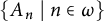 $\left \{ A_{n}\mid n\in \omega \right \} $
be subfamily of
 $\mathcal {A}$
and for each
 $n\in \omega ,$
let
 $P_{n}=\left \{ A_{n}\left ( i\right ) \mid i\in \omega \right \} $
be a partition of
 $A_{n}$
into infinite pieces. Given
 $A\in \mathcal {I}\left ( \mathcal {A}\right ) $
, we define a function
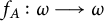 $f_{A}:\omega \longrightarrow \omega $
given by
 $f_{A}\left ( n\right ) =0$
if
 $A\cap A_{n}$
is infinite and in the other case,
 $f_{A}\left ( n\right ) =\sup \left \{ i\mid A\cap A_{n}\left ( i\right ) \neq \emptyset \right \} +1.$
We claim that
 $\left \{ f_{A}\mid A\in \mathcal {I}\left ( \mathcal {A}\right ) \right \} $
is a dominating family. Assume this is not the case, so there is
 $g:\omega \longrightarrow \omega $
not dominated by any of the
 $f_{A}.$
For each
 $n\in \omega ,$
define
 $X_{n}=A_{n}\left ( g\left ( n\right ) \right ) $
and
 $X=\left \{ X_{n}\mid n\in \omega \right \} .$
Since
 $\mathcal {A}$
is strongly tight, there must be
 $A\in \mathcal {I}\left ( \mathcal {A}\right ) $
such that
 $A\cap X_{n}\neq \emptyset $
for every
 $n\in \omega .$
Pick any m such that
 $f_{A}\left ( m\right ) <g\left ( m\right ) $
and
 $A \cap A_m$
is finite; then
 $A\cap A_{m}\left ( g\left ( m\right ) \right ) =\emptyset $
so that
 $A\cap X_{m}=\emptyset $
, which is a contradiction.
In the proof of the following corollary, we will use the following.
Proposition 10.4 (CH)
Let
 $\kappa $
be a regular cardinal and
 $\mathbb{C}_{\kappa }$
the forcing for adding
 $\kappa $
many Cohen reals with finite support. Let
 $G\subseteq \mathbb{C}_{\kappa }$
be a generic filter. In
 $V\left [ G\right ] ,$
the following holds:
-
(1) Every MAD family has size
$\omega _{1}$
or
$\mathfrak {c}.$
-
(2) A MAD family is Cohen indestructible if and only if it has size
$\omega _{1}.$


For the first assertion, the reader may consult Proposition 3.1 of [Reference Brendle10] and the second one can be found in Proposition 7 of [Reference Hrušák37].
Corollary 10.5 There are no strongly tight MAD families in the Cohen model.
Proof If there were a strongly tight MAD, it would have size continuum, by the previous proposition. But since it would also be tight, it should have size
 $\omega _{1}$
(recall that tight MAD families are Cohen indestructible).
We will later prove that there are Shelah–Steprāns MAD families in the Cohen model, so Shelah–Steprāns does not imply strong tightness (see the discussion after Theorem 10.6). As mentioned in the Introduction (Problem 1.5), it is still open whether tight MAD families exist in ZFC.
10.1 Existence under diamond principles
Parametrized diamonds are strong guessing principles which can be used to construct MAD families with strong combinatorial properties. We first recall the principles
 $\Diamond \left ( \mathfrak {b}\right ) $
and
 $\Diamond \left ( \mathfrak {d}\right ) $
from [Reference Moore, Hrušák and Džamonja63].
-
♢ (𝔟) For every
$\left \langle F_{\alpha }:2^{\alpha }\longrightarrow \omega ^{\omega }\right \rangle _{\alpha <\omega _{1}}$
such that each
$F_{\alpha }$
is Borel, there is
$g:\omega _{1}\longrightarrow \omega ^{\omega }$
such that for every
$R\in 2^{\omega _{1}},$
the set
$\{\alpha \mid F_{\alpha }\left ( R\upharpoonright \alpha \right ) ^{\ast }\ngeq g\left ( \alpha \right ) \}$
is stationary. -
♢ (𝔡) For every
$\left \langle F_{\alpha }:2^{\alpha }\longrightarrow \omega ^{\omega }\right \rangle _{\alpha <\omega _{1}}$
such that each
$F_{\alpha }$
is Borel, there is
$g:\omega _{1}\longrightarrow \omega ^{\omega }$
such that for every
$R\in 2^{\omega _{1}},$
the set
$\{\alpha \mid F_{\alpha }\left ( R\upharpoonright \alpha \right ) \leq ^{\ast }g\left ( \alpha \right ) \}$
is stationary.










Clearly
 $\Diamond \left ( \mathfrak {d}\right ) $
implies
 $\Diamond \left ( \mathfrak {b}\right ) .$
In [Reference Moore, Hrušák and Džamonja63], it was proved that
 $\Diamond \left ( \mathfrak {b}\right ) $
implies that
 $\mathfrak {a}=\omega _{1}$
and in [Reference Guzmán, Hrušák, Martínez and Ramos32], it was shown that
 $\Diamond \left ( \mathfrak {b}\right ) $
implies the existence of a tight MAD family. We will now improve this result.
Theorem 10.6
-
(1)
$\Diamond \left ( \mathfrak {b}\right ) $
implies that there is a Shelah–Steprāns MAD family (even an almost strongly separable MAD family). -
(2)
$\Diamond \left ( \mathfrak {d}\right ) $
implies that there is a raving MAD family.


Proof For every
 $\alpha <\omega _{1}$
, fix an enumeration
 $\alpha =\left \{ \alpha _{n}\mid n\in \omega \right \} .$
We will first show that
 $\Diamond \left ( \mathfrak {b}\right ) $
implies that there is an almost strongly separable MAD family. With a suitable coding, the coloring C will be defined for pairs
 $t=\left ( \mathcal {A}_{t},X_{t}\right ) $
, where
 $\mathcal {A}_{t}=\left \langle A_{\xi }\mid \xi <\alpha \right \rangle $
and
 $X_{t}\subseteq \left [ \omega \right ] ^{<\omega }$
. We define
 $C\left ( t\right ) $
to be the constant
 $0$
function in case
 $\mathcal {A}_{t}$
is not an almost disjoint family or
 $X_{t} \notin \left ( \mathcal {I}\left ( \mathcal {A}_{t}\right ) ^{<\omega }\right ) ^{+}.$
In the other case, define an increasing function
 $C\left ( t\right ) :\omega \longrightarrow \omega $
such that if
 $n\in \omega ,$
then there is
 $s\in X_{t}$
such that
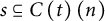 $s\subseteq C\left ( t\right ) \left ( n\right ) $
and
 $s\cap \left ( A_{\alpha _{0}}\cup \cdots \cup A_{\alpha _{n}}\cup n\right ) =\emptyset .$
Using
 $\Diamond \left ( \mathfrak {b}\right ) $
, let
 $G:\omega _{1}\longrightarrow \omega ^{\omega }$
be a guessing sequence for
 $C.$
By changing G if necessary, we may assume that all the
 $G\left ( \alpha \right ) $
are increasing and if
 $\alpha <\beta ,$
then
 $G\left ( \alpha \right ) <^{\ast }G\left ( \beta \right ) .$
We will now define our MAD family: start by taking
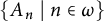 $\left \{ A_{n}\mid n\in \omega \right \} $
a partition of
 $\omega .$
Having defined
 $A_{\xi }$
for all
 $\xi <\alpha ,$
we proceed to define
 $A_{\alpha } =\bigcup \limits _{n\in \omega }\left ( G\left ( \alpha \right ) \left ( n\right ) \backslash A_{\alpha _{0}}\cup \cdots \cup A_{\alpha _{n}}\right ) $
in case this is an infinite set, otherwise just take any
 $A_{\alpha }$
that is almost disjoint from
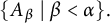 $\{ A_\beta \mid \beta < \alpha \}.$
We will see that
 $\mathcal {A}$
is an almost strongly separable MAD family. Let
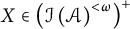 $X\in \left ( \mathcal {I}\left ( \mathcal {A}\right ) ^{<\omega }\right ) ^{+}$
. Consider the branch
 $R=\left ( \left \langle A_{\xi }\mid \xi <\omega _{1}\right \rangle ,X\right ) $
and pick
 $\beta>\omega $
such that
 $C\left ( R\upharpoonright \beta \right ) ^{\ast }\ngeq G\left ( \beta \right ) .$
It is easy to see that
 $A_{\beta }$
contains infinitely many elements of
 $X.$
Now, we will prove that
 $\Diamond \left ( \mathfrak {d}\right ) $
implies that there is a raving MAD family. With a suitable coding, the coloring C will be defined for pairs
 $t=\left ( \mathcal {A}_{t},X_{t}\right ) $
, where
 $\mathcal {A}_{t}=\left \langle A_{\xi }\mid \xi <\alpha \right \rangle $
and
 $X_{t}=\left \{ X_{n}^{t}\mid n\in \omega \right \} \subseteq \left [ \omega \right ] ^{<\omega }$
. We define
 $C\left ( t\right ) $
to be the constant
 $0$
function in case
 $\mathcal {A}_{t}$
is not an almost disjoint family or
 $X_{t}$
is not locally finite according to
 $\mathcal {I}\left ( \mathcal {A} _{t}\right ) .$
We will describe what to do in the other case. For every
 $n\in \omega ,$
define
 $B_{n}=\bigcup \limits _{i<n}A_{\alpha _{i}}$
(hence
 $B_{0}=\emptyset $
) and let
 $d\left ( n\right ) $
be the smallest
 $k\geq n$
such that if
 $\ell \geq k,$
then
 $B_{n}$
does not intersect every element of
 $X_{\ell }^{t}.$
We define an increasing function
 $C\left ( t\right ) :\omega \longrightarrow \omega $
such that for every
 $n,i\in \omega ,$
if
 $d\left ( n\right ) \leq i<d\left ( n+1\right ) $
, then
 $C\left ( t\right ) \left ( n\right ) \backslash B_{n}$
contains an element of
 $X_{i}^t.$
The rest of the proof is similar as in the case of
 $\Diamond \left ( \mathfrak {b} \right ) .$
It is known that
 $\Diamond \left ( \mathfrak {b}\right ) $
holds in the Cohen model (see [Reference Moore, Hrušák and Džamonja63]) so there are Shelah–Steprāns MAD families in this model but as we saw earlier (Corollary 10.5), there is no strongly tight MAD family, so being Shelah–Steprāns does not imply being strongly tight. We will later see that strong tightness does not imply being Shelah–Steprāns (see Proposition 10.13).
10.2 Existence under forcing axioms
We will now prove two results:
 $\mathfrak {p=c}$
, which is equivalent to MA(
 $\sigma $
-centered), implies the existence of a Shelah–Steprāns MAD family and of a strongly tight MAD family. In [Reference Minami and Sakai62], it was proved that Laflamme MAD families exist under
 $\mathfrak {p=c}.$
The following is a strengthening.
Proposition 10.7 If
 $\mathfrak {p=c,}$
then every a.d. family of size less than
 $\mathfrak {c}$
can be extended to a Shelah–Steprāns MAD family.
Proof Let
 $\mathcal {A}$
be an a.d. family of size less than
 $\mathfrak {c}$
and
 $X=\left \{ s_{n}\mid n\in \omega \right \} \in \left ( \mathcal {I}\left ( \mathcal {A}\right ) ^{<\omega }\right ) ^{+}.$
We define the forcing
 $\mathbb{P}$
as the set of all
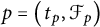 $p=\left ( t_{p},\mathcal {F}_{p}\right ) $
, where
 $t_{p}\in 2^{<\omega }$
and
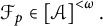 $\mathcal {F}_{p}\in \left [ \mathcal {A}\right ] ^{<\omega }.$
If
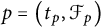 $p=\left ( t_{p},\mathcal {F}_{p}\right ) $
and
 $q=\left ( t_{q},\mathcal {F}_{q}\right ) $
, then
 $p\leq q$
if the following holds:
-
(1)
$t_{q}\subseteq t_{p}$
and
$\mathcal {F}_{q}\subseteq \mathcal {F}_{p}.$
-
(2) In case
$n\in dom\left ( t_{p}\right ) \backslash dom\left ( t_{q}\right ) $
and
$A\in \mathcal {F}_{q}$
if
$t_{p}\left ( n\right ) =1,$
then
$s_{n}\cap A=\emptyset .$





For any
 $n\in \omega $
and
 $A\in \mathcal {A,}$
let
 $D_{n,A}\subseteq \mathbb{P}$
be the set of conditions
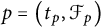 $p=\left ( t_{p},\mathcal {F}_{p}\right ) $
such that
 $t_{p}^{-1}\left ( 1\right ) $
has size at least n and
 $A\in \mathcal {F} _{p}.$
Since
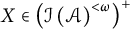 $X\in \left ( \mathcal {I}\left ( \mathcal {A}\right ) ^{<\omega }\right ) ^{+}$
, each
 $D_{n,A}$
is open dense. Clearly,
 $\mathbb{P}$
is
 $\sigma $
-centered and since
 $\mathcal {A}$
has size less than
 $\mathfrak {p}$
we can then force and find
 $Y\in \left [ X\right ] ^{\omega }$
such that
 $\bigcup Y$
is almost disjoint with every element of
 $\mathcal {A}.$
We prove a similar result for strongly tight MAD families.
Lemma 10.8 Let
 $\mathcal {A}$
be an a.d. family of size less than
 $\mathfrak {p}.$
Let
 $\left \{ X_{n}\mid n\in \omega \right \} \subseteq \left [ \omega \right ] ^{\omega }$
such that there is
 $\mathcal {B}=\left \{ A_{n}\mid n\in \omega \right \} \subseteq {\mathcal A}$
with the following properties:
-
(1)
$X_{n}\subseteq A_{n}$
for all
$n\in \omega .$
-
(2) For all
$A\in \mathcal {A},$
the set
$\left \{ n\mid A_{n}=A\right \} $
is finite.



Then, there is
 $B\in \mathcal {A}^{\perp }$
such that
 $B\cap X_{n}\neq \emptyset $
for every
 $n\in \omega .$
Proof Let
 $\mathcal {D}=\mathcal {A}\setminus \mathcal {B}.$
We now define the forcing
 $\mathbb{P}$
whose elements are sets of the form
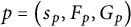 $p=\left ( s_{p},F_{p},G_{p}\right ) $
with the following properties:
-
(1)
$s_{p}\in \omega ^{<\omega }, F_{p}\in \left [ \mathcal {D}\right ] ^{<\omega }$
, and
$G_{p}\in \left [ \mathcal {B}\right ] ^{<\omega }.$
-
(2) If
$i\in dom\left ( s_{p}\right ) $
, then
$s_{p}\left ( i\right ) \in X_{i}.$

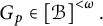
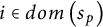

For
 $p,q\in \mathbb{P,}$
we let
 $p\leq q$
if the following conditions hold:
-
(1)
$s_{q}\subseteq s_{p}, F_{q}\subseteq F_{p}$
, and
$G_{q}\subseteq G_{p}.$
-
(2) For every
$i\in dom\left ( s_{p}\right ) \setminus dom\left ( s_{q}\right ) $
, the following holds:-
(a)
$s_{p}\left ( i\right ) \notin {\textstyle \bigcup } F_{q}.$
-
(b) If
$B\in G_{q}$
and
$A_{i}\neq B,$
then
$s_{p}\left ( i\right ) \notin B.$
-



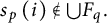


It is easy to see that
 $\mathbb{P}$
is a
 $\sigma $
-centered forcing and adds a set almost disjoint with
 $\mathcal {A}$
that intersects every
 $X_{n}.$
Since
 $\mathcal {A}$
has size less than
 $\mathfrak {p},$
the result follows.
With the previous lemma, Lemma 10.2, and a standard recursive construction, we conclude the following.
Proposition 10.9 If
 $\mathfrak {p=c,}$
then every a.d. family of size less than
 ${\mathfrak c}$
can be extended to a strongly tight MAD family.
We strongly conjecture the following has a positive answer.
Problem 10.10. Does
 ${\mathfrak p} = {\mathfrak c}$
imply the existence of a raving MAD family?
In fact, we do not even know the following.
Problem 10.11. Is it consistent that there exists a raving MAD family of size larger than
 $\omega _{1}$
?
Note that since
 $\mathbb{P}_{ {\textsf {MAD}}}$
forces the Continuum Hypothesis, we cannot use this forcing to solve the previous problem.
10.3 Non-implications
Under CH, we provide a number of examples for MAD families satisfying some of the properties of Section 6 while failing others. We already saw some non-implications earlier, e.g., Proposition 9.9 or the existence (in the Cohen model) of a Shelah–Steprāns MAD that is not strongly tight (Corollary 10.5 and Theorem 10.6).
First, we show that (consistently) strong tightness does not imply being Laflamme or random indestructible. We will use Lemma 10.2. We start with the following lemma.
Lemma 10.12 Let
 $\mathcal {I}$
be an
 $\omega $
-hitting analytic ideal and
 $\mathcal {A} \subseteq \mathcal {I}$
a countable almost disjoint family. Let
 $X=\left \{ X_{n}\mid n\in \omega \right \} \subseteq \left [ \omega \right ] ^{\omega }$
such that all
 $X_{n}$
are contained in some member of
 $\mathcal {A}$
and
 $\left \{ n\mid X_{n}\subseteq A\right \} $
is finite for all
 $A\in \mathcal {A}.$
There is
 $D\in \mathcal {A}^{\perp }\cap \mathcal {I}$
such that
 $D\cap X_{n} \neq \emptyset $
for every
 $n\in \omega .$
Proof By Proposition 3.16, we know that there is a partition
 $P=\left \{ P_{n}\mid n\in \omega \right \} $
of
 $\omega $
into finite sets such that every selector for P is in
 $\mathcal {I}.$
Recursively, we construct D a partial selector for P such that
 $D\in \mathcal {A}^{\perp }$
and
 $D\cap X_{n} \neq \emptyset $
for every
 $n\in \omega .$
This is easy to do since
 $\mathcal {A}$
is a countable almost disjoint family and every
 $A\in \mathcal {A}$
contains only finitely many elements of
 $X.$
It follows that D is as desired.
In particular, the previous lemma holds for every tall analytic P-ideal (see Lemma 3.14).
In [Reference Hernández-Hernández and Hrušák36], it was proved that random forcing destroys the summable ideal (in fact,
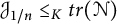 ${\mathcal J}_{1/n} \leq _K tr({\mathcal N})$
). We therefore conclude, using Lemma 10.2, the following.
Proposition 10.13 (CH)
There is a strongly tight MAD family contained in the summable ideal
 $\mathcal {J}_{1/n}$
(in particular, it is random destructible and not Laflamme).
Note that the
 ${\mathbb P}_{\mathsf{MAD}} ({\mathcal J}_{1 / n} )$
-generic MAD family has all these properties.
We saw that every fin
 $\times $
fin-like MAD family is Cohen indestructible (Proposition 7.1). However, we will now show that fin
 $\times $
fin-like does not imply tightness (so in particular, it is a weaker notion than Shelah–Steprāns).
Proposition 10.14 (CH)
There is a fin
 $\times $
fin-like MAD family that is not tight.
Proof Let
 $\left \{ \mathcal {I}_{\alpha }\mid \omega \leq \alpha <\omega _{1}\right \} $
be an enumeration of all analytic ideals
 ${\mathcal I}$
with fin
 $\times $
fin
 $\not \leq _K {\mathcal I}$
and let
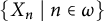 $\left \{ X_{n}\mid n\in \omega \right \} $
be a partition of
 $\omega $
into infinite sets. We will recursively construct an a.d. family
 $\mathcal {A}=\left \{ A_{\alpha }\mid \alpha <\omega _{1}\right \} $
such that for every
 $\alpha ,$
the following conditions hold:
-
(1)
$\left \{ A_{n}\mid n\in \omega \right \} $
is a partition of
$\omega $
refining
$\left \{ X_{n}\mid n\in \omega \right \} $
and every
$X_{n}$
contains infinitely many of the
$A_{m}.$
-
(2) There is
$\xi \leq \alpha $
such that
$A_{\xi }\notin \mathcal {I}_{\alpha }.$
-
(3) If
$B\in \mathcal {I}\left ( \mathcal {A}\right ) $
, then there is
$n\in \omega $
such that
$B\cap X_{n}$
is finite.
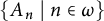

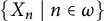


Note that by Lemma 6.15 (3),
 ${\mathcal A}$
will indeed be fin
 $\times $
fin-like while the
 $X_n$
witness the failure of tightness.
Let
 $\mathcal {A}_{\alpha }=\left \{ A_{\xi }\mid \xi <\alpha \right \} $
and assume
 $\mathcal {A}_{\alpha }\subseteq \mathcal {I}_{\alpha }.$
Let
 $\alpha =\left \{ \alpha _{n}\mid n\in \omega \right \} $
and define
 $L_{n}=A_{\alpha _{0}} \cup \cdots \cup A_{\alpha _{n}}.$
Define
 $E_{n}=\left \{ m\mid \left \vert L_{n}\cap X_{m}\right \vert <\omega \right \} $
and note that
 $E=\left \langle E_{n}\right \rangle _{n\in \omega }$
is a decreasing sequence of infinite sets. Find a pseudointersection D of E such that
 $\omega \setminus D$
also contains a pseudointersection of
 $E.$
Define
 $T_{0}={\textstyle \bigcup \limits _{n\in D}} X_{n}$
and
 $T_{1}={\textstyle \bigcup \limits _{n\notin D}} X_{n}.$
Since fin
 $\times $
fin
 $\mathcal {\nleq }_{K} \mathcal {I}_{\alpha }$
, we know that either fin
 $\times $
fin
 $\mathcal {\nleq }_{K} \mathcal {I}_{\alpha }\upharpoonright T_{0}$
or fin
 $\times $
fin
 $\mathcal {\nleq }_{K} \mathcal {I}_{\alpha }\upharpoonright T_{1}.$
First assume fin
 $\times $
fin
 $\mathcal {\nleq }_{K} \mathcal {I}_{\alpha }\upharpoonright T_{0}$
. Then, we can choose
 $A_{\alpha }\in \left ( \mathcal {I}_{\alpha }\upharpoonright T_{0}\right ) ^{+}$
that is almost disjoint with
 $\mathcal {A}_{\alpha }\mathcal {\upharpoonright }T_{0}$
which implies it is a.d. with
 $\mathcal {A}_\alpha .$
We now need to prove that for every
 $n<\omega ,$
there is
 $X_{m}$
such that
 $\left ( L_{n}\cup A_{\alpha }\right ) \cap X_{m}$
is finite. Since
 $\omega \setminus D$
contains a pseudointersection of
 $E,$
there is
 $m\in E_{n}\setminus D$
and then both
 $L_{n}$
and
 $A_{\alpha }$
are almost disjoint with
 $X_{m}.$
The other case is similar.
Recall the ideal
 $\mathcal {Z}$
is not Katětov below any
 $F_{\sigma }$
-ideal (Proposition 3.20). Thus, from Lemma 9.3, we obtain the following.
Corollary 10.15 Let
 $\mathcal {A}$
be a countable a.d. family contained in
 $\mathcal {Z}.$
If
 $\mathcal {I}$
is an
 $F_{\sigma }$
-ideal and
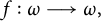 $f:\omega \longrightarrow \omega ,$
then there is a countable a.d. family
 $\mathcal {B}$
such that
 $\mathcal {A\subseteq B\subseteq Z}$
and there is
 $B\in \mathcal {I}\left ( \mathcal {B}\right ) $
such that
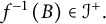 $f^{-1}\left ( B\right ) \in \mathcal {I}^{+}.$
Using a suitable bookkeeping device, we conclude the following.
Proposition 10.16 (CH)
There is a Laflamme MAD contained in
 $\mathcal {Z}.$
In particular, it is not a P-wide MAD family. Additionally, this MAD family is strongly tight and random indestructible.
Indeed, the
 ${\mathbb P}_{\mathsf{MAD}} ({\mathcal Z})$
-generic MAD family has all these properties. To see strong tightness, use Lemma 10.12. Since
 ${\mathcal Z} \not \leq _K tr ({\mathcal N})$
(Proposition 3.20), random indestructibility follows from Theorem 4.2 and Corollary 9.4. We shall come back to this generic object in the next section (Theorem 10.23).
10.4 Variants of the Shelah–Steprāns property
Given two non-empty finite subsets
 $s,t$
of
 $\omega ,$
we write
 $s<t$
if
 $\max \left ( s\right ) <\min \left ( t\right ) .$
We say that
 $\mathcal {B}=\left \{ s_{n}\mid n\in \omega \right \} \subseteq \left [ \omega \right ] ^{<\omega }\setminus \left \{ \emptyset \right \} $
is a block sequence if
 $s_{n}<s_{n+1}$
for every
 $n\in \omega .$
The following are natural weakenings of being Shelah–Steprāns.
Definition 10.17. Let
 $\mathcal {A}$
be an a.d. family.
-
(1) We say that
$\mathcal {A}$
is block Shelah–Steprāns if for every block sequence
$\mathcal {B}=\left \{ s_{n}\mid n\in \omega \right \} \in \left ( \mathcal {I}\left ( \mathcal {A}\right ) ^{<\omega }\right ) ^{+},$
there is
$W\in \left [ \omega \right ] ^{\omega }$
such that
$ {\textstyle \bigcup \limits _{n\in W}} s_{n}\in \mathcal {I}\left ( \mathcal {A}\right ) .$
-
(2) We say that
$\mathcal {A}$
is
$\omega $
-block Shelah–Steprānsif for every sequence
$\left \langle {\mathcal B}_{n}\right \rangle _{n\in \omega }$
of block sequences with
${\mathcal B}_{n}\in \left ( \mathcal {I}\left ( \mathcal {A}\right ) ^{<\omega }\right ) ^{+},$
there is
$C\in {\mathcal I} ({\mathcal A})$
such that for every
$n\in \omega ,$
there are infinitely many
$s\in {\mathcal B}_{n}$
such that
$s\subseteq C.$



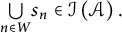





Note that by Proposition 5.9, every Shelah–Steprāns MAD family is
 $\omega $
-block Shelah–Steprāns, and
 $\omega $
-block Shelah–Steprāns implies block Shelah–Steprāns. One may wonder if these concepts are the same. We are going to prove that Shelah–Steprāns and
 $\omega $
-block Shelah–Steprāns might and might not agree. We do not know whether block Shelah–Steprāns and
 $\omega $
-block Shelah–Steprāns are the same. First we have the following result.
Lemma 10.18 Let
 $\mathcal {A}$
be a MAD family such that
 $\left \vert \mathcal {A}\right \vert <$
cov
 $\left ( \mathcal {M}\right ) .$
If
 $\mathcal {A}$
is block Shelah–Steprāns, then
 $\mathcal {A}$
is Shelah–Steprāns.
Proof Let
 $\mathcal {A}$
be a MAD family of size less than cov
 $\left ( \mathcal {M}\right )$
that is block Shelah–Steprāns. Letting
 $X=\left \{ s_{n}\mid n\in \omega \right \} \in \left ( \mathcal {I}\left ( \mathcal {A}\right ) ^{<\omega }\right ) ^{+},$
we must show that there is
 $B\in \mathcal {I}\left ( \mathcal {A}\right ) $
such that B contains infinitely many elements of
 $X.$
We define the forcing notion
 $\mathbb{P} \left ( X\right ) $
as the set of all p with the following properties:
-
(1) There is
$n_{p}\in \omega $
such that
$p:n_{p}\longrightarrow X.$
-
(2) If
$i<j<n_{p}$
, then
$\max \left ( p\left ( i\right ) \right ) <\min \left ( p\left ( j\right ) \right ) .$




We order
 $\mathbb{P}\left ( X\right ) $
by inclusion. Since
 $\mathbb{P}\left ( X\right ) $
is countable and has no atoms, it is forcing equivalent to Cohen forcing. Note that
 $\mathbb{P}\left ( X\right ) $
adds a block sequence contained in
 $X.$
Furthermore, since
 $\left \vert \mathcal {A}\right \vert <$
cov
 $\left ( \mathcal {M}\right ) ,$
we can find
 $g:\omega \longrightarrow X$
such that
 $g\left [ \omega \right ] $
is a block sequence and for every
 $B\in \mathcal {I}\left ( \mathcal {A}\right ) $
, there is
 $n\in \omega $
such that
 $g\left ( n\right ) \cap B=\emptyset .$
Since
 $\mathcal {A}$
is block Shelah–Steprāns, we conclude that there is
 $B\in \mathcal {I}\left ( \mathcal {A}\right ) $
such that B contains infinitely many elements of
 $X.$
It is easy to see that MAD families that are
 $\omega $
-block Shelah–Steprāns are tight, so in particular, they are Cohen-indestructible. As we mentioned earlier (before Corollary 10.5), every Cohen indestructible MAD has size
 $\omega _{1}$
in the Cohen model, so we conclude the following.
Corollary 10.19 In the Cohen model, every MAD family that is
 $\omega $
-block Shelah–Steprāns is Shelah-Steprāns.
We will see now that the conclusion of the corollary is false under the Continuum Hypothesis (Theorem 10.23).
Given
 $n\in \omega ,$
let
 $R_{n}=[2^{n},2^{n+1})$
and for an
 $A\subseteq \omega $
let
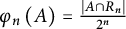 $\varphi _{n}\left ( A\right ) =\frac {\left \vert A\cap R_{n}\right \vert }{2^{n}}$
. We also define the function
 $\varphi _{\max }:\left [ \omega \right ] ^{<\omega }\longrightarrow \mathbb{Q,}$
where
 $\varphi _{\max }\left ( A\right ) =\max \left \{ \varphi _{n}\left ( A\right ) \mid n\in \omega \right \} .$
Lemma 10.20 Let
 $X=\left \{ s_{n}\mid n\in \omega \right \} $
be a block sequence and
 $\mathcal {A}$
a countable a.d. family such that
 $\mathcal {A} \subseteq \mathcal {Z}.$
If there is
 $m>0$
such that
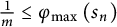 $\frac {1}{m}\leq \varphi _{\max }\left ( s_{n}\right ) $
for every
 $n\in \omega ,$
then there is
 $B\in \mathcal {A}^{\perp }\cap \mathcal {Z}$
such that
 $B\cap s_{n}\neq \emptyset $
for every
 $n\in \omega .$
Proof For every
 $n\in \omega ,$
we choose
 $l_{n}\in \omega $
such that
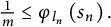 $\frac {1}{m} \leq \varphi _{l_n}\left ( s_{n}\right ) .$
Since X is pairwise disjoint, for every
 $l\in \omega ,$
the set
 $\left \{ n\mid l_{n}=l\right \} $
has size at most
 $m.$
Let
 $\mathcal {A}=\left \{ A_{n}\mid n\in \omega \right \} $
and define
 $B_{n}=A_{0}\cup \cdots \cup A_{n}.$
Fix an increasing function
 $f:\omega \longrightarrow \omega $
such that for every
 $n,i\in \omega ,$
if
 $f\left ( n\right ) \leq i,$
then
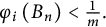 $\varphi _{i}\left ( B_{n}\right ) <\frac {1}{m}.$
We can then find
 $B=\left \{ y_{n}\mid n\in \omega \right \} $
such that for every
 $n\in \omega ,$
the following holds:
-
(1)
$y_{n}\in s_{n}\cap R_{l_{n}}.$
-
(2) If
$f\left ( k\right ) \leq l_n$
, then
$y_{n}\notin B_{k}.$



It is easy to see that
 $B\in \mathcal {A}^{\perp }$
and
 $B\cap s_{n}\neq \emptyset $
for every
 $n\in \omega .$
Finally,
 $B\in \mathcal {Z}$
since
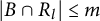 $\left \vert B\cap R_{l}\right \vert \leq m$
for every
 $l\in \omega .$
We conclude the following.
Lemma 10.21 Let
 $\overline {X}=\left \{ X_{n}\mid n\in \omega \right \} $
be a countable collection of block sequences and
 $\mathcal {A}\in \mathbb{P}_{\mathsf{MAD} }\left ( \mathcal {Z}\right ) .$
If
 $\mathcal {A}\Vdash "\overline {X} \subseteq (\mathcal {I(\dot {A}}_{\mathsf{gen}}(\mathcal {Z)})^{<\omega })^{+} $
,” then there is
 $\mathcal {B\in } \mathbb{P}_{\mathsf{MAD} }\left ( \mathcal {Z}\right ) $
such that
 $\mathcal {A\subseteq B}$
and there is
 $B\in \mathcal {I}\left ( \mathcal {B}\right ) $
such that B contains infinitely many elements of each
 $X_{n}.$
Proof Let
 $\mathcal {A}=\left \{ A_{n}\mid n\in \omega \right \} $
and define
 $B_{n}=A_{0}\cup \cdots \cup A_{n}.$
Given
 $n,k\in \omega ,$
we define
 $X_{n}\left ( k\right ) =\left \{ s\in X_{n}\mid s\cap B_{k}=\emptyset \right \} $
and note that each
 $X_{n}\left ( k\right ) $
is infinite. We claim that for every
 $n,m,k\in \omega , m>0$
, there are infinitely many
 $s\in X_{n}\left ( k\right ) $
such that
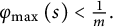 $\varphi _{\max }\left ( s\right ) <\frac {1}{m}.$
Assuming this is not the case, there are
 $n,m,k\in \omega , m>0$
such that
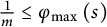 $\frac {1}{m}\leq \varphi _{\max }\left ( s\right ) $
for almost all
 $s\in X_{n}\left ( k\right ) .$
Let
 $Y=\left \{ s\in X_{n}\left ( k\right ) \mid \varphi _{\max }\left ( s\right ) <\frac {1}{m}\right \} $
and
 $Z=X_{n}\left ( k\right ) \setminus Y.$
By the previous lemma, there is
 $B\in \mathcal {A} ^{\perp }\cap \mathcal {Z}$
such that B intersects every element of
 $Z.$
It follows that
 $B\cup B_{k}\cup {\textstyle \bigcup } Y$
intersects every element of
 $X_n.$
Therefore,
 $\mathcal {A\cup }\left \{ B\right \} $
is an extension of
 $\mathcal {A}$
forcing that
 $X_{n}$
is not positive, which is a contradiction.
Thus, we know that for every
 $n,m,k\in \omega , m>0,$
there are infinitely many
 $s\in X_{n}\left ( k\right ) $
such that
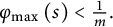 $\varphi _{\max }\left ( s\right ) <\frac {1}{m}.$
By an easy diagonalization argument, we can find
 $B\in \mathcal {A}^{\perp }\cap \mathcal {Z}$
such that B contains infinitely many elements of each
 $X_{n}.$
Let
 $Z\left ( n,m\right ) =\left \{ s\subseteq R_{m}\mid \varphi _{m}\left ( R_{m}\setminus s\right ) <\frac {1}{2^{n+1}}\right \} $
and define
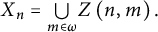 $X_{n}={\textstyle \bigcup \limits _{m\in \omega }} Z\left ( n,m\right ) .$
It is easy to see that
 $X_{n}\in \left ( \mathcal {I} \left ( \mathcal {Z}\right ) ^{<\omega }\right ) ^{+}.$
Lemma 10.22 Let
 $\mathcal {A} \mathcal {\in } \mathbb{P}_{\mathsf{MAD}}\left ( \mathcal {Z}\right ) $
and for every
 $n\in \omega ,$
let
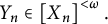 $Y_{n}\in \left [ X_{n}\right ] ^{<\omega }.$
There is
 $B\in \mathcal {A}^{\perp }\cap \mathcal {Z}$
such that
 $B\cap s\neq \emptyset $
for every
 $s\in Y_{n}$
and
 $n\in \omega .$
Proof Let
 $\mathcal {A}=\left \{ A_{n}\mid n\in \omega \right \} $
and
 $B_{n}=A_{0} \cup \cdots \cup A_{n}.$
We first find an increasing function
 $f:\omega \longrightarrow \omega $
such that for every
 $n\in \omega ,$
the following conditions hold:
-
(1)
$f\left ( n\right ) $
is of the form
$2^{m_{n}+1}$
for some
$m_{n}.$
-
(2) If
$f\left ( n\right ) \leq i,$
then
$\varphi _{i}\left ( B_{n}\right ) <\frac {1}{2^{n+2}}.$
-
(3) If
$s\in Y_{n}$
and
$s\subseteq R_{j},$
then
$j<f\left ( n\right ) $
and
$\varphi _{j}\left ( s\right )>1-\frac {1}{2^{n+1}}.$


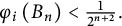



We now define a sequence
 $\left \langle t_{n}\right \rangle _{n\in \omega }$
such that for every
 $n\in \omega ,$
the following conditions hold:
-
(1)
$t_{n}\subseteq R_{n}.$
-
(2) If
$n<f\left ( 0\right ) $
, then
$\varphi _{n}\left ( t_{n}\right ) =\frac {1}{2}.$
-
(3) If
$f\left ( k\right ) \leq n<f\left ( k+1\right ) $
, then
$t_{n}\cap B_{k}=\emptyset .$
-
(4) If
$f\left ( k\right ) \leq n<f\left ( k+1\right ) $
, then
$\varphi _{n}\left ( t_{n}\right ) =\frac {1}{2^{k+2}}.$





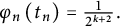
Letting
 $B={\textstyle \bigcup \limits _{n\in \omega }} t_{n},$
it is easy to see that B has the desired properties.
We thus obtain the following.
Theorem 10.23
-
(1)
$\mathbb{P}_{\mathsf{MAD}}\left ( \mathcal {Z}\right ) $
forces that
$\mathcal {A}_{\mathsf{gen}}\left ( \mathcal {Z}\right ) $
is an
$\omega $
-Shelah–Steprāns MAD family for block sequences that is not Canjar. -
(2) The Continuum Hypothesis implies that there is a non Canjar,
$\omega $
-Shelah–Steprāns MAD family for block sequences
$\mathcal {A}$
such that
$\mathcal {A}\subseteq \mathcal {Z}.$
In particular,
$\mathcal {A}$
is not Shelah–Steprāns.


To see that
 ${\mathcal A}$
is not Shelah–Steprāns, either use
 ${\mathcal A} \subseteq {\mathcal Z}$
(since
 $\mathcal {Z}$
is a P-ideal, every MAD family contained in it is not P-wide) or the fact that
 ${\mathcal A}$
is not Canjar, and recall that every Shelah–Steprāns MAD family is Hurewicz (Proposition 6.10) and thus Canjar. For other properties of this generic MAD family, see the earlier Proposition 10.16.
We say that a block sequence
 $\mathcal {B}=\left \{ s_{n}\mid n\in \omega \right \} $
witnesses that
 $\mathcal {A}$
is not block Shelah–Steprāns if
 ${\mathcal B} \in \left ( {\mathcal I} ({\mathcal A})^{< \omega } \right )^+$
and there is no
 $W \in [\omega ]^\omega $
such that
 $\bigcup _{n \in W} s_n \in {\mathcal I} ({\mathcal A})$
. We will say that
 $\mathcal {B}=\left \{ s_{n}\mid n\in \omega \right \} $
is an increasing block sequence if for every
 $n\in \omega ,$
the set
 $\left \{ m\mid \left \vert s_{m}\right \vert =n\right \} $
is finite.
Lemma 10.24 Let
 $\mathcal {A}$
be a MAD family. If a block sequence
 $\mathcal {B} =\left \{ s_{n}\mid n\in \omega \right \} $
witnesses that
 $\mathcal {A}$
is not block Shelah–Steprāns, then
 $\mathcal {B}$
is an increasing block sequence.
Proof Assume this is not the case. So there is
 $m\in \omega $
such that the set
 $W=\left \{ n\mid \left \vert s_{n}\right \vert =m\right \} $
is infinite. By applying that
 $\mathcal {A}$
is maximal m-many times, we can find
 $W_{0} \in \left [ W\right ] ^{\omega }$
and
 $B\in \mathcal {I}\left ( \mathcal {A} \right ) $
such that
 ${\textstyle \bigcup \limits _{n\in W_{0}}} s_{n}\subseteq B,$
which is a contradiction.
The following result is well-known, but we prove it here for the convenience of the reader.
Proposition 10.25 Let
 $\mathcal {A}$
be an a.d family. The ideal
 $\mathcal {I(A)}$
is meager.
Proof Pick
 $\left \{ A_{n}\mid n\in \omega \right \} \subseteq \mathcal {A}$
that are all distinct. We now define the set
 $M=\left \{ S\subseteq \omega \mid \exists n\left ( \left \vert S\cap A_{n}\right \vert <\omega \right ) \right \} .$
It is easy to see that M is a meager set and
 $\mathcal {I(A)}\subseteq M.$
We need the following notation.
Definition 10.26. Let
 $\mathcal {B}=\left \{ s_{n}\mid n\in \omega \right \} $
be an increasing block sequence. We define the ideal
 $\mathcal {J}\left ( \mathcal {B}\right ) $
as the set of all
 $A\subseteq \omega $
such that
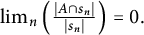 $\lim _n \left ( \frac {\left \vert A\cap s_{n}\right \vert }{\left \vert s_{n}\right \vert }\right ) =0.$
Note that the density zero ideal has the previous form. Given an increasing block sequence
 $\mathcal {B} =\left \{ s_{n}\mid n\in \omega \right \} $
and
 $X\in \left [ \omega \right ] ^{\omega },$
we define
 $\mathcal {B}_{X}=\left \{ s_{n}\mid n\in X\right \} .$
Note that if
 ${\mathcal A}$
is MAD, then
 ${\mathcal I} ({\mathcal A})$
is meager and therefore by Talagrand’s Theorem, there is an increasing interval partition
 $\mathcal {B} =\left \{ s_{n}\mid n\in \omega \right \} $
such that there is no
 $W \in [\omega ]^\omega $
with
 $\bigcup _{n \in W} s_n \in {\mathcal I} ({\mathcal A})$
. We can now prove the following result.
Proposition 10.27 Let
 $\mathcal {A}$
be a MAD family and let
 $\mathcal {B} =\left \{ s_{n}\mid n\in \omega \right \} $
be an increasing block sequence such that there is no
 $W \in [\omega ]^\omega $
with
 $\bigcup _{n \in W} s_n \in {\mathcal I} ({\mathcal A})$
. There are
 $X\in \left [\omega \right ] ^{\omega }$
and
 $\mathcal {A}_{0}\in \left [ \mathcal {A}\right ] ^{\leq \omega }$
such that
 $\mathcal {A}\setminus \mathcal {A}_{0}\subseteq \mathcal {J}\left ( \mathcal {B}_{X}\right ) .$
Proof We argue by contradiction, so assume this is not the case.
By
 $\mathbb{Q}^{+}$
we denote the set of all positive rational numbers. We will now recursively define
 $\left \langle A_{\alpha },q_{\alpha },X_{\alpha }\right \rangle _{\alpha \in \omega _{1}}$
such that for every
 $\alpha <\omega _{1}$
, the following hold:
-
(1)
$A_{\alpha }\in \mathcal {A}, q_{\alpha }\in \mathbb{Q}^{+}$
and
$X_{\alpha }\in \left [ \omega \right ] ^{\omega }.$
-
(2) If
$\alpha \neq \beta ,$
then
$A_{\alpha }\neq A_{\beta }.$
-
(3) If
$\beta <\alpha ,$
then
$X_{\alpha }\subseteq ^{\ast }X_{\beta }.$
-
(4) If
$n\in X_{\alpha },$
then
$q_{\alpha }\leq \frac {\left \vert A_{\alpha }\cap s_{n}\right \vert }{\left \vert s_{n}\right \vert }.$



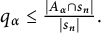
Let
 $\alpha <\omega _{1}$
and assume we have already constructed
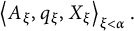 $\left \langle A_{\xi },q_{\xi },X_{\xi }\right \rangle _{\xi <\alpha }.$
We will see how to find
 $A_{\alpha },q_{\alpha }$
, and
 $X_{\alpha }.$
Since
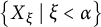 $\left \{ X_{\xi }\mid \xi <\alpha \right \} $
is a
 $\subseteq ^{\ast }$
-decreasing sequence, we may find
 $Y\in \left [ \omega \right ] ^{\omega }$
such that
 $Y\subseteq ^{\ast }X_{\xi }$
for every
 $\xi <\alpha .$
By our assumption, the set
 $\mathcal {C} =\mathcal {A\setminus J}\left ( \mathcal {B}_{Y}\right ) $
is uncountable. Note that if
 $A\in \mathcal {C},$
then there is
 $q_{A}\in \mathbb{Q}^{+}$
such that the set
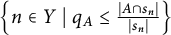 $\left \{ n\in Y\mid q_A \leq \frac {\left \vert A\cap s_{n}\right \vert }{\left \vert s_{n}\right \vert }\right \} $
is infinite. Since
 $\mathcal {C}$
is uncountable, we may find
 $q_{\alpha }\in \mathbb{Q}^{+}$
such that
 $\mathcal {C}_{1}=\left \{ A\in \mathcal {C\mid }q_{A}=q_\alpha \right \} $
is uncountable. We can then find
 $A_{\alpha }\in \mathcal {C}_{1}$
such that
 $A_{\alpha }\neq A_{\xi }$
for every
 $\xi <\alpha .$
Finally, let
 $X_{\alpha }=\left \{ n\in Y\mid q_{\alpha }\leq \frac {\left \vert A_{\alpha }\cap s_{n}\right \vert }{\left \vert s_{n}\right \vert }\right \} .$
Clearly,
 $A_{\alpha },q_{\alpha }$
, and
 $X_{\alpha }$
have the desired properties.
We can now find
 $W\in \left [ \omega _{1}\right ] ^{\omega _{1}}$
and
 $q\in \mathbb{Q}^{+}$
such that
 $q_{\alpha }=q$
for every
 $\alpha \in W.$
Let
 $m\in \omega $
such that
 $\frac {1}{q}<m$
and choose
 $\alpha _{1},\ldots ,\alpha _{m}\in W.$
Let
 $X=X_{\alpha _{1}}\cap \cdots \cap X_{\alpha _m}$
and note that X is an infinite set. By construction, if
 $n\in X$
and
 $i\leq m,$
then
 $q\leq \frac {\left \vert A_{\alpha _{i}}\cap s_{n}\right \vert }{\left \vert s_{n}\right \vert }.$
Since
 $\frac {1}{q}<m,$
for each
 $n\in X,$
there must be
 $i_{n},j_{n}\leq m$
such that
 $i_{n}\neq j_{n}$
and
 $A_{\alpha _{i_{n}}}\cap A_{\alpha _{j_{n}}}\cap s_{n}\neq \emptyset .$
Since X is infinite, there are
 $i,j\leq m$
and
 $Y\in \left [ X\right ] ^{\omega }$
such that
 $i=i_{n}$
and
 $j=j_{n}$
for every
 $n\in Y.$
This implies that
 $A_{\alpha _{i}}\cap A_{\alpha _{j}}$
is infinite, which is a contradiction.
We also have the following.
Lemma 10.28 If
 $\mathcal {B}$
is an increasing block sequence, then
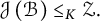 $\mathcal {J}\left ( \mathcal {B}\right ) \leq _{K}\mathcal {Z}.$
Proof This is a folklore fact that follows, for example, from Corollary 5.6 of [Reference Hrušák40] as
 $\mathcal {J}\left ( \mathcal {B}\right ) $
is trivially a non-pathological P-ideal.
Therefore, every MAD family is “nearly Katětov-below”
 $\mathcal {Z}$
. By these results, it would be tempting to conjecture the following: If
 $\mathcal {Z}$
can be destroyed without increasing
 ${\mathfrak b}$
and
 ${\mathfrak s},$
then every MAD family can be destroyed without increasing
 $\mathfrak {b}$
or
 $\mathfrak {s}.$
Unfortunately, it seems that the density zero ideal cannot be destroyed without increasing
 $\mathfrak {b}$
or
 $\mathfrak {s}.$
Recently, the fourth author showed that cov
 $^{\ast }\left ( \mathcal {Z}\right ) \leq \max \left \{ \mathfrak {b},\mathfrak {s}\left ( \mathfrak {pr}\right ) \right \} $
(
 $\mathfrak {s}\left ( \mathfrak {pr}\right ) $
is the promptly splitting number, which is a cardinal invariant closely related to
 $\mathfrak {s},$
see [Reference Raghavan67] for more details). This improves an earlier work of the fourth author and Shelah (see [Reference Raghavan and Shelah68]) where they showed that cov
 $^{\ast }\left ( \mathcal {Z}\right ) \leq \mathfrak {d}.$
We know that every MAD family is contained up to a countable subfamily in an ideal
 $\mathcal {J}\left ( \mathcal {B}\right ) $
(where
 $\mathcal {B}$
is an increasing block sequence). We will now show that (consistently) this is best possible, that is, one cannot disregard the countable family in Proposition 10.27 (see Theorem 10.31).
Let
 $\mathcal {B}=\left \{ P_{n}\mid n\in \omega \right \} $
be the interval partition of
 $\omega $
with
 $\left \vert P_{n}\right \vert =n+1.$
Given
 $X\subseteq \omega $
and
 $n\in \omega ,$
we define
 $\mathcal {B}\left ( X,n\right ) =\left \{ m\mid \left \vert P_{m}\setminus X\right \vert \leq n\right \} .$
We will say a family
 $\mathcal {A}$
is
 $\mathcal {B}$
-a.d. if the following conditions hold:
-
(1)
$\mathcal {A}$
is a countable a.d. family. -
(2) If
$B\in \mathcal {I}\left ( \mathcal {A}\right ) $
, then
$\mathcal {B} \left ( B,n\right ) $
is finite for every
$n\in \omega .$
-
(3) If
$B\in \mathcal {I}\left ( \mathcal {A}\right ) $
, then there is
$n\in \omega $
such that
$P_{n}\cap B=\emptyset .$


Note that if
 $\mathcal {A}$
is
 $\mathcal {B}$
-a.d., then for every
 $B\in \mathcal {I}\left ( \mathcal {A}\right ) $
, there are, in fact, infinitely many
 $n\in \omega $
such that
 $P_{n}\cap B=\emptyset $
(recall every finite set is in
 $\mathcal {I}\left ( \mathcal {A}\right ) $
).
Lemma 10.29 Let
 $\mathcal {A}$
be a
 $\mathcal {B}$
-a.d. family and
 $X\in \mathcal {A}^{\perp }.$
There is
 $A\in \left [ X\right ] ^{\omega }$
such that
 $\mathcal {A\cup }\left \{ A\right \} $
is
 $\mathcal {B}$
-a.d. family.
Proof Letting
 $\mathcal {A}=\left \{ A_{n}\mid n\in \omega \right \} ,$
we may assume that
 $n\in A_{n}$
for every
 $n\in \omega .$
For every
 $n\in \omega ,$
we define
 $B_{n}= {\textstyle \bigcup } \left \{ A_{i}\mid i\leq \max \left ( P_{n}\right ) \right \} $
(note that
 $P_{0}\cup \cdots \cup P_{n}\subseteq B_{n}$
and
 $B_{n}\in \mathcal {I}\left ( \mathcal {A}\right ) $
). We recursively construct a sequence
 $\left \langle \left ( y_{n},u_{n},x_{n}\right ) \right \rangle _{n\in \omega }$
with the following properties:
-
(1)
$y_{n}<u_{n}<y_{n+1}$
for every
$n\in \omega .$
-
(2)
$\left \{ x_{n}\mid n\in \omega \right \} \subseteq X.$
-
(3)
$x_{n}\in P_{y_{n}}.$
-
(4)
$x_{n}\notin B_{n}.$
-
(5)
$y_{n}\notin \mathcal {B}\left ( B_{n},n+1\right ) .$
-
(6)
$B_{n}\cap P_{u_{n}}=\emptyset .$







Assuming we have constructed
 $\left ( y_{i},u_{i},x_{i}\right ) $
for every
 $i<n,$
we will see how to define
 $\left ( y_{n},u_{n},x_{n}\right ) .$
We first find
 $r\in \omega $
such that the following hold:
-
(1)
$\max \left ( P_{u_{i}}\right ) <r$
for every
$i < n$
. -
(2)
$B_{n}\cap X\subseteq r.$
-
(3)
$\mathcal {B}\left ( B_{n},n+1\right ) \subseteq r.$




Since X is an infinite set, we can find
 $y_{n}$
such that
 $r<\min \left ( P_{y_{n}}\right ) $
and
 $X\cap P_{y_{n}}\neq \emptyset .$
Choose any
 $x_{n}\in X\cap P_{y_{n}}$
. Finally, let
 $u_{n}$
such that
 $y_{n}<u_{n}$
and
 $B_{n}\cap P_{u_{n}}=\emptyset .$
We now define
 $A=\left \{ x_{n}\mid n\in \omega \right \} .$
Clearly, A is almost disjoint with every element of
 $\mathcal {A}$
and A is an infinite subset of
 $X.$
Letting
 $\mathcal {A}_{1}=\mathcal {A\cup }\left \{ A\right \} ,$
we need to argue that
 $\mathcal {A}_{1}$
is a
 $\mathcal {B}$
-a.d. family. Letting
 $n\in \omega ,$
note that if
 $m>n,$
then
 $\left ( A\cup B_{n}\right ) \cap P_{u_{m}}=\emptyset ,$
so
 $A\cup B_{n}$
is disjoint with infinitely many elements of
 $\mathcal {B}.$
Finally, note that if
 $m>n,$
then
 $y_{m} \notin \mathcal {B}\left ( A\cup B_{n},n\right ) .$
We can now prove the following.
Lemma 10.30 Let
 $\mathcal {A}$
be
 $\mathcal {B}$
-a.d. If
 $f:\omega \longrightarrow \omega $
is a Katětov-morphism from
 $\mathcal {Z}$
to
 $\mathcal {I}\left ( \mathcal {A}\right ) $
, then there is
 $A\in \mathcal {A}^{\perp }$
such that
 $\mathcal {A}_{1}=\mathcal {A\cup }\left \{ A\right \} $
is
 $\mathcal {B} $
-a.d. and f is no longer a Katětov-morphism from
 $\mathcal {Z}$
to
 $\mathcal {I}\left ( \mathcal {A}_{1}\right ) .$
Proof As before, let
 $\mathcal {A}=\left \{ A_{n}\mid n\in \omega \right \} $
(we assume again that
 $n\in A_{n}$
for every
 $n\in \omega $
) and for every
 $n\in \omega ,$
we define
 $B_{n}= {\textstyle \bigcup } \left \{ A_{i}\mid i\leq \max \left ( P_{n}\right ) \right \} .$
We recursively construct a sequence
 $\left \langle \left ( y_{n},u_{n},s_{n}\right ) \right \rangle _{n\in \omega }$
with the following properties:
-
(1)
$y_{n}<y_{n+1}$
for every
$n\in \omega .$
-
(2)
$s_{n}\subseteq f\left [ R_{y_{n}}\right ] $
(recall that
$R_{n}=[2^{n},2^{n+1})$
and for every
$A\subseteq \omega ,$
we defined
$\varphi _{n}\left ( A\right ) =\frac {\left \vert A\cap R_{n}\right \vert }{2^{n}}$
). -
(3)
$\varphi _{y_{n}}\left ( f^{-1}\left ( s_{n}\right ) \right ) \geq \frac {1}{3}.$
-
(4)
$s_{n}\cap B_{n}=\emptyset .$
-
(5) If
$P_{m}\cap s_{n}\neq \emptyset ,$
then
$m\notin \mathcal {B}\left ( B_{n},3n\right ) $
for every
$m\in \omega .$
-
(6) If
$P_{m}\cap s_{n}\neq \emptyset ,$
then
$n\leq \left \vert P_{m} \setminus \left ( s_{n}\cup B_{n}\right ) \right \vert .$
-
(7)
$P_{u_{n}}\cap B_{n}=\emptyset .$
-
(8)
$\max \left ( P_{u_{n}}\right ) <\min \left ( s_{n+1}\right ) \leq \max \left ( s_{n+1}\right ) <\min \left ( P_{u_{n+1}}\right ) .$




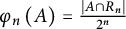









Assuming we have constructed the triple
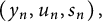 $\left ( y_{n},u_{n},s_{n}\right ) ,$
we will show how to construct
 $\left ( y_{n+1},u_{n+1},s_{n+1}\right ) .$
Let
 $D=B_{n+1}\cup {\textstyle \bigcup } \left \{ P_{m}\mid m\in \mathcal {B}\left ( B_{n+1},3(n+1) \right ) \right \} \cup \max \left ( P_{u_{n}}\right ) .$
Clearly,
 $D\in \mathcal {I}\left ( \mathcal {A} \right ) $
, hence
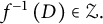 $f^{-1}\left ( D\right ) \in \mathcal {Z}.$
Let
 $y_{n+1}>y_{n}$
with the property that
 $\varphi _{y_{n+1}}\left ( f^{-1}\left ( D\right ) \right ) <\frac {1}{3}.$
Let
 $z=f\left [ R_{y_{n+1}}\setminus f^{-1}\left ( D\right ) \right ] $
and note that if
 $m\in \omega $
and
 $P_{m}\cap z\neq \emptyset ,$
then
 $m\notin \mathcal {B}\left ( B_{n+1},3(n+1)\right ) $
and
 $\max \left ( P_{u_{n} }\right ) <\min \left ( P_{m}\right ) .$
Let
 $K=\left \{ m\mid P_{m}\cap z\neq \emptyset \right \} $
which clearly is a finite set. For every
 $m\in K,$
let
 $t_{m}=P_{m}\setminus B_{n+1}$
and define
 $K_{1}=\left \{ m\in K\mid \left \vert t_{m}\setminus z\right \vert <n+1\right \} .$
Note if
 $m\in K_{1},$
then
 $\left \vert t_{m}\right \vert>3(n+1)$
hence
 $2(n+1)\leq \left \vert t_{m}\cap z\right \vert .$
For
 $m \in K_1$
, we can now choose distinct
 $x_{0}^{m},\ldots ,x_{n}^{m},w_{0}^{m} ,\ldots ,w_{n}^{m}\in t_{m}\cap z$
such that
 $\varphi _{y_{n+1}}\left ( f^{-1}\left ( \left \{ x_{0}^{m},\ldots ,x_{n}^{m}\right \} \right ) \right ) \geq \varphi _{y_{n+1}}\left ( f^{-1}\left ( \left \{ w_{0}^{m},\ldots ,w_{n} ^{m}\right \} \right ) \right ) .$
Given
 $m\in K,$
we now define the set
 $s_{n} ^{m}=\left ( t_{m}\cap z\right ) \setminus \left \{ w_{0}^{m},\ldots ,w_{n} ^{m}\right \} $
if
 $m\in K_{1}$
and
 $s_{n}^{m}=t_{m}\cap z$
if
 $m\in K\setminus K_{1}.$
Let
 $\overline {s}_{n}^{m}= \left \{ w_{0}^{m} ,\ldots ,w_{n}^{m}\right \} $
for every
 $m\in K_{1}$
and we define
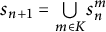 $s_{n+1}= {\textstyle \bigcup \limits _{m\in K}} s_{n}^{m}$
and
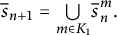 $\overline {s}_{n+1}= {\textstyle \bigcup \limits _{m\in K_{1}}} \overline {s}_{n}^{m}.$
Note that
 $R_{y_{n+1}}=R_{y_{n+1}}\cap \left ( f^{-1}\left ( D\right ) \cup f^{-1}\left ( s_{n+1}\right ) \cup f^{-1}\left ( \overline {s}_{n+1}\right ) \right ) .$
Now,
 $\varphi _{y_{n+1}}\left ( f^{-1}\left ( D\right ) \right ) <\frac {1}{3}$
and
 $\varphi _{y_{n+1}}\left ( f^{-1}\left ( \overline {s}_{n+1}\right ) \right ) \leq \varphi _{y_{n+1}}\left ( f^{-1}\left ( s_{n+1}\right ) \right ) ,$
hence
 $\varphi _{y_{n+1}}\left ( f^{-1}\left ( s_{n+1}\right ) \right ) \geq \frac {1}{3}.$
It is easy to see that
 $s_{n+1}$
has all the desired properties. Finally, we choose
 $u_{n+1}$
accordingly.
Letting
 $A={\textstyle \bigcup \limits _{n\in \omega }} s_{n},$
it is easy to see that
 $f^{-1}\left ( A\right ) \notin \mathcal {Z}$
and
 $\mathcal {A\cup }\left \{ A\right \} $
is
 $\mathcal {B}$
-a.d.
With a suitable bookkeeping device, we conclude the following.
Theorem 10.31 (CH)
There is a
 $\mathcal {Z}$
-MAD family that is not block Shelah–Steprāns.
Therefore, the countable family mentioned in Proposition 10.27 is indeed needed. Theorem 10.31 motivates the following questions.
Problem 10.32.
-
1. Do
$\mathcal {Z}$
-MAD families exist (in ZFC)? -
2. Is it consistent that every MAD family that is not Shelah–Steprāns (or block Shelah–Steprāns) is Katětov below
$\mathcal {Z}$
?


11 A strategy for producing models with small non-meager sets
A general strategy for preserving certain non-meager sets from the ground model is provided in this section. Usual methods of producing models of
 $\operatorname {\mathrm {non}}(\mathcal {M}) = {\aleph }_{1}$
with a countable support iteration rely on the preservation of stronger properties such as
 ${\sqsubseteq }_{\mathrm {Cohen}}$
(the reader may consult page 295 of the book [Reference Bartoszyński and Judah5] for the definition of
 ${\sqsubseteq }_{\mathrm {Cohen}}$
). Our results here allow us to keep
 $\operatorname {\mathrm {non}}(\mathcal {M}) = {\aleph }_{1}$
in countable support iterations where the iterands do not enjoy any of these additional preservation properties. The results of this section will be used in Section 12 to produce a model of
 $\operatorname {\mathrm {non}}(\mathcal {M}) = {\aleph }_{1}$
where there are no block Shelah–Steprāns a.d. families of size
 ${\aleph }_{1}$
. However, our results here are quite general and we expect they will have further applications going beyond almost disjoint families.
Definition 11.1. An interval partition or IP is a sequence
 $I = \left \langle {i}_{n}: n \in \omega \right \rangle \in {\omega }^{\omega }$
such that
 ${i}_{0} = 0$
and
 $\forall n \in \omega \left [{i}_{n} < {i}_{n+1}\right ]$
.
Given an IP I and
 $n \in \omega $
,
 ${I}_{n}$
denotes
 $\left [ {i}_{n}, {i}_{n+1} \right ) = \{l \in \omega : {i}_{n} \leq l < {i}_{n+1} \}$
.
The following is a slight variation of a well-known connection between eventually different reals and meagerness of the ground model. We give a proof even though the argument is similar to the arguments in Miller [Reference Miller61] or Bartoszynski and Judah [Reference Bartoszyński and Judah5].
Lemma 11.2 Let
 ${{\mathbf {V}}}_{0} \subseteq {{\mathbf {V}}}_{1}$
be transitive models of a sufficiently large fragment of
 $\mathrm {ZFC}$
. Assume that
 $$ \begin{align*} \forall f \in {H(\omega)}^{\omega} \cap {{\mathbf{V}}}_{1} \ \exists g \in {H(\omega)}^{\omega} \cap {{\mathbf{V}}}_{0} \ {\exists}^{\infty} n \in \omega \left[f(n) = g(n)\right]. \end{align*} $$
Then, the following hold:
-
(1) for each
$f \in {H(\omega )}^{\omega } \cap {{\mathbf {V}}}_{1}$
and each
$X \in {\left [\omega \right ]}^{\omega } \cap {{\mathbf {V}}}_{1}$
, there exists a
$g \in {H(\omega )}^{\omega } \cap {{\mathbf {V}}}_{0}$
so that
$$ \begin{align*} {\exists}^{\infty} n \in X \left[f(n) = g(n)\right]; \end{align*} $$
-
(2) for each IP
$I = \left \langle {i}_{n}: n \in \omega \right \rangle \in {\omega }^{\omega } \cap {{\mathbf {V}}}_{1}$
, there is an IP
$J = \left \langle {j}_{n}: n \in \omega \right \rangle \in {\omega }^{\omega } \cap {{\mathbf {V}}}_{0}$
so that
$$ \begin{align*} {\exists}^{\infty} l \in \omega \ \exists n \in \omega\left[{I}_{n} \subseteq {J}_{l}\right]; \end{align*} $$
-
(3) for any
$M \in {{\mathbf {V}}}_{1}$
, if
${\left ( M \subseteq {2}^{\omega } \ \text {is a meager set} \right )}^{{{\mathbf {V}}}_{1}}$
, then there exists
$x \in {2}^{\omega } \cap {{\mathbf {V}}}_{0}$
with
$x \notin M$
.











Proof For (1): working in
 ${{\mathbf {V}}}_{1}$
, fix
 $f \in {H(\omega )}^{\omega }$
and
 $X \in {\left [\omega \right ]}^{\omega }$
. Let
 $\left \langle {x}_{n}: n \in \omega \right \rangle $
be the strictly increasing enumeration of X. Recall that whenever
 $A \in H(\omega )$
, then
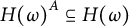 ${H(\omega )}^{A} \subseteq H(\omega )$
. For each
 $n \in \omega $
,
 $\{{x}_{i}: i < n\}$
, being a finite subset of
 $\omega $
, is a member of
 $H(\omega )$
. Therefore,
 $f \mathord \upharpoonright \{{x}_{i}: i < n\} \in {H(\omega )}^{\{{x}_{i}: i < n\}} \subseteq H(\omega )$
. So we may define a function
 $F: \omega \rightarrow H(\omega )$
by setting
 $F(n) = f \mathord \upharpoonright \{{x}_{i}: i < n\}$
, for each
 $n \in \omega $
. By hypothesis, there is a function
 $G \in {{\mathbf {V}}}_{0}$
so that
 $G: \omega \rightarrow H(\omega )$
and
 ${\exists }^{\infty } n \in \omega \left [F(n) = G(n)\right ]$
. Observe that whenever
 $F(n) = G(n)$
,
 $G(n)$
is a function and
 $\operatorname {\mathrm {dom}}(G(n)) \in {\left [\omega \right ]}^{n}$
. Thus, working in
 ${{\mathbf {V}}}_{0}$
, we see that the set
 $Y = \left \{n \in \omega : G(n) \ \text {is a function and} \ \operatorname {\mathrm {dom}}(G(n)) \in {\left [\omega \right ]}^{n} \right \}$
is infinite. Let
 $\left \langle {y}_{n}: n \in \omega \right \rangle $
be the strictly increasing enumeration of Y. Define a function
 $e \in {\omega }^{\omega }$
by induction as follows. Let
 $n \in \omega $
and assume that
 $e(m)$
has been defined for all
 $m < n$
. Then,
 $\left | \{e(m): m < n\} \right | \leq n$
, while
 $\left | \operatorname {\mathrm {dom}}(G({y}_{n+1})) \right | = {y}_{n+1} \geq n+1> n$
. So define
 $e(n) = \min (\operatorname {\mathrm {dom}}(G({y}_{n+1})) \setminus \{e(m): m < n\})$
. Note that e is a 1–1 function and that
 $e(n) \in \operatorname {\mathrm {dom}}(G({y}_{n+1}))$
, which means that
 $G({y}_{n+1})(e(n))$
is defined and is a member of
 $H(\omega )$
. Define
 $g: \omega \rightarrow H(\omega )$
so that
 $g(e(n)) = G({y}_{n+1})(e(n))$
, for all
 $n \in \omega $
, while
 $g(k) = 0$
, for all
 $k \notin \operatorname {\mathrm {ran}}(e)$
. We check that g is as needed. We know
 $Z = \{n \in \omega : F({y}_{n+1}) = G({y}_{n+1})\}$
is infinite. If
 $n \in Z$
, then
 $\operatorname {\mathrm {dom}}(G({y}_{n+1})) \subseteq X$
, whence
 $e(n) \in X$
and
 $g(e(n)) = G({y}_{n+1})(e(n)) = F({y}_{n+1})(e(n)) = f(e(n))$
. Thus,
 $e"Z \subseteq \{k \in X: g(k) = f(k)\}$
. As e is a 1–1 function,
 $\{k \in X: g(k) = f(k)\}$
is an infinite set.
For (2): working in
 ${{\mathbf {V}}}_{1}$
, fix an IP
 $I = \left \langle {i}_{n}: n \in \omega \right \rangle $
. Define
 $f: \omega \rightarrow H(\omega )$
by
 $f(n) = {i}_{n+2}$
, for all
 $n \in \omega $
. By the hypothesis, there is a
 $g \in {{\mathbf {V}}}_{0}$
so that
 $g: \omega \rightarrow H(\omega )$
and
 ${\exists }^{\infty } n \in \omega \left [g(n) = {i}_{n+2}\right ]$
. Working in
 ${{\mathbf {V}}}_{0}$
, define an IP
 $J = \left \langle {j}_{l}: l \in \omega \right \rangle $
as follows.
 ${j}_{0} = 0$
. Fix
 $l \in \omega $
and suppose that
 ${j}_{l} \in \omega $
is given. Define
 ${j}_{l+1} = \max \left ( \{{j}_{l} + 1\} \cup \left ( \{g(n): n \leq {j}_{l} \} \cap \omega \right ) \right )$
. Note
 ${j}_{l+1} \geq {j}_{l} + 1> {j}_{l}$
, so we have an IP. To check that it is as needed, fix any
 $M \in \omega $
. Choose
 $n> {j}_{M+1}$
with
 $g(n) = {i}_{n+2}$
. There is a unique
 $k \in \omega $
with
 $n \in {J}_{k}$
, that is,
 ${j}_{k} \leq n < {j}_{k+1}$
. Observe
 $k \geq M+1> M$
. If
 ${i}_{n+1} < {j}_{k+1}$
, then we have
 ${j}_{k} \leq n \leq {i}_{n} < {i}_{n+1} < {j}_{k+1}$
, implying that
 ${I}_{n} \subseteq {J}_{k}$
. If
 ${j}_{k+1} \leq {i}_{n+1}$
, then by the definition of
 ${j}_{k+2}$
, we have
 ${j}_{k+1} \leq {i}_{n+1} < {i}_{n+2} \leq {j}_{k+2}$
, implying that
 ${I}_{n+1} \subseteq {J}_{k+1}$
. Thus, we have found an
 $l> M$
, namely, either
 $l = k$
or
 $l = k+1$
, and an
 $n'$
, namely, either
 $n' = n$
or
 $n' = n+1$
, so that
 ${I}_{n'} \subseteq {J}_{l}$
.
For (3): working in
 ${{\mathbf {V}}}_{1}$
, fix a meager set
 $M \subseteq {2}^{\omega }$
. Let
 $\left \langle {F}_{n}: n \in \omega \right \rangle $
be a sequence of closed nowhere dense subsets of
 ${2}^{\omega }$
such that
 $\forall n \in \omega \left [{F}_{n} \subseteq {F}_{n+1}\right ]$
and
 $M \subseteq {\bigcup }_{n \in \omega }{{F}_{n}}$
. Build an IP
 $I = \left \langle {i}_{n}: n \in \omega \right \rangle $
and a sequence
 $\left \langle {\tau }_{n}: n \in \omega \right \rangle $
as follows. Put
 ${i}_{0} = 0$
. Let
 $n \in \omega $
and assume that
 ${i}_{n} \in \omega $
is given and that
 ${\tau }_{m}$
has been defined for all
 $m < n$
. Find
 ${i}_{n+1}> {i}_{n}$
and a function
 ${\tau }_{n}: \left [{i}_{n}, {i}_{n+1}\right ) \rightarrow 2$
such that for each
 $\sigma : {i}_{n} \rightarrow 2$
,
 $\left [\sigma \cup {\tau }_{n}\right ] \cap {F}_{n} = 0$
. This is possible because
 ${F}_{n}$
is closed nowhere dense. Note that
 $y = {\bigcup }_{n \in \omega }{{\tau }_{n}}: \omega \rightarrow 2$
. Using (2), find an IP
 $J = \left \langle {j}_{l}: l \in \omega \right \rangle \in {{\mathbf {V}}}_{0}$
with the property that
 ${\exists }^{\infty } l \in \omega \exists n \in \omega \left [{I}_{n} \subseteq {J}_{l}\right ]$
. In
 ${{\mathbf {V}}}_{1}$
, define a function
 $F: \omega \rightarrow H(\omega )$
by setting
 $F(l) = y\mathord \upharpoonright \left [ {j}_{l}, {j}_{l+1} \right )$
, for all
 $l \in \omega $
. Note that if
 ${I}_{n} \subseteq {J}_{l}$
, then
 ${\tau }_{n} = y\mathord \upharpoonright {I}_{n} \subseteq y \mathord \upharpoonright {J}_{l} = F(l)$
. Let
 $X = \{l \in \omega : \exists n \in \omega \left [{I}_{n} \subseteq {J}_{l}\right ]\}$
. Applying (1), find
 $G \in {{\mathbf {V}}}_{0}$
such that
 $G: \omega \rightarrow H(\omega )$
and
 ${\exists }^{\infty } l \in X\left [G(l) = F(l)\right ]$
. Working in
 ${{\mathbf {V}}}_{0}$
, define
 $x: \omega \rightarrow 2$
such that for each
 $l \in \omega $
, if
 $G(l): {J}_{l} \rightarrow 2$
, then
 $x\mathord \upharpoonright {J}_{l} = G(l)$
, while if not, then
 $x\mathord \upharpoonright {J}_{l}$
is constantly
 $0$
. Suppose
 $l \in X$
and that
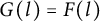 $G(l) = F(l)$
. Choose
 $n \in \omega $
with
 ${I}_{n} \subseteq {J}_{l}$
. Let
 $\sigma = x \mathord \upharpoonright {i}_{n}: {i}_{n} \rightarrow 2$
. By the choice of
 ${\tau }_{n}$
,
 $\left [\sigma \cup {\tau }_{n}\right ] \cap {F}_{n} = 0$
. Since
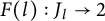 $F(l): {J}_{l} \rightarrow 2$
,
 ${I}_{n} \subseteq {J}_{l}$
, and
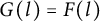 $G(l) = F(l)$
,
 ${\tau }_{n} \subseteq F(l) = G(l) \subseteq x$
. So
 $x \in \left [\sigma \cup {\tau }_{n}\right ]$
, whence
 $x \notin {F}_{n}$
. Thus, we conclude that
 ${\exists }^{\infty } n \in \omega \left [x \notin {F}_{n}\right ]$
. As the
 ${F}_{n}$
are increasing,
 $x \notin {\bigcup }_{n \in \omega }{{F}_{n}}$
, and so
 $x \notin M$
.
Definition 11.3.
 $S: \omega \rightarrow H(\omega )$
is called a slalom if
 $\forall n \in \omega \left [\left | S(n) \right | \leq (n+1){2}^{n+1}\right ]$
.
 $S: \omega \rightarrow H(\omega )$
is called a small slalom if
 $\forall n \in \omega \left [\left | S(n) \right | \leq {2}^{n+1}\right ]$
.
Definition 11.4. Let
 $f \in {H(\omega )}^{\omega }$
. For
 $n \in \omega $
,
 $A_{f,n} = \{k \leq n: f(k) \ \text {is a function} \ \wedge n \in \operatorname {\mathrm {dom}}(f(k)) \wedge \left | f(k)(n) \right | \leq {2}^{n+1} \}$
.
Define
 ${S}_{f}(n) = \bigcup \left \{ f(k)(n): k \in A_{f,n} \right \}$
,
 $\forall n \in \omega $
. We observe that
 $$ \begin{align*} \forall n \in \omega \left[{S}_{f}(n) \in H(\omega) \ \text{and} \ \left| {S}_{f}(n) \right| \leq (n+1){2}^{n+1}\right]. \end{align*} $$
Thus,
 ${S}_{f}: \omega \rightarrow H(\omega )$
and
 ${S}_{f}$
is a slalom.
Lemma 11.5 Assume
 ${\mathcal {F}} \subseteq {H(\omega )}^{\omega }$
is such that
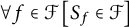 $\forall f \in {\mathcal {F}} \left [{S}_{f} \in {\mathcal {F}}\right ]$
. Then, if
 $\forall f \in {H(\omega )}^{\omega } \exists g \in {\mathcal {F}} {\exists }^{\infty } n \in \omega \left [f(n) = g(n)\right ]$
, then for any small slalom
 $S: \omega \rightarrow H(\omega )$
and any sequence
 $\left \langle {X}_{l}: l \in \omega \right \rangle \subseteq {\left [\omega \right ]}^{\omega }$
, there is a slalom
 $T: \omega \rightarrow H(\omega )$
so that
 $T \in {\mathcal {F}}$
and
 $\forall l \in \omega {\exists }^{\infty } n \in {X}_{l}\left [S(n) \subseteq T(n)\right ]$
.
Proof Let
 $I = \left \langle {i}_{k}: k \in \omega \right \rangle $
be an IP such that
 $\forall k \in \omega \forall l \leq k\left [{X}_{l} \cap {I}_{k} \neq \emptyset \right ]$
. Define
 $f: \omega \rightarrow H(\omega )$
by
 $f(k) = S\mathord \upharpoonright {I}_{k}$
, for all
 $k \in \omega $
. Note that for each
 $k \in \omega $
,
 ${H(\omega )}^{{I}_{k}} \subseteq H(\omega )$
, and so
 $f: \omega \rightarrow H(\omega )$
. By hypothesis, fix
 $g \in {\mathcal {F}}$
so that
 ${\exists }^{\infty } k \in \omega \left [f(k) = g(k)\right ]$
. Let
 $T = {S}_{g}$
, which by definition means that T is a slalom. Also by hypothesis,
 $T \in {\mathcal {F}}$
. To see that T is as required, fix
 $l \in \omega $
. Let
 $M \in \omega $
be given. Let
 $K = \max \{M, l\} \in \omega $
. Choose
 $k> K$
with
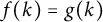 $f(k) = g(k)$
. Since
 $l \leq K < k$
,
 ${X}_{l} \cap {I}_{k} \neq \emptyset $
. Choose
 $n \in {X}_{l} \cap {I}_{k}$
. Thus,
 $n \in {X}_{l}$
and
 $M \leq K < k \leq {i}_{k} \leq n$
. As
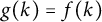 $g(k) = f(k)$
, we have that
 $k \in {A}_{g, n}$
, whence
 $S(n) = g(k)(n) \subseteq {S}_{g}(n) = T(n)$
. This is as needed because
 $n \in {X}_{l}$
and
 $n> M$
.
Definition 11.6. Let
 ${<}_{\mathtt {wo}}$
be a well-ordering of
 $H(\omega )$
. For
 $A \in H(\omega )$
,
 $\left \langle A, {<}_{\mathtt {wo}}\restriction A \right \rangle $
is a finite well-order, and therefore there is a unique function
 ${e}_{A, {<}_{\mathtt {wo}}}: \left | A \right | \rightarrow A$
which is an order isomorphism from
 $\left \langle \left | A \right |, \in \right \rangle $
to
 $\left \langle A, {<}_{\mathtt {wo}} \right \rangle $
. Define an IP
 $I = \left \langle {i}_{n}: n \in \omega \right \rangle $
as follows.
 ${i}_{0} = 0$
. Given
 ${i}_{n} \in \omega $
,
 ${i}_{n+1} = {i}_{n} + (n+1){2}^{n+1}$
.
Now suppose
 $S: \omega \rightarrow H(\omega )$
is a slalom. Define
 ${f}_{S, {<}_{\mathtt {wo}}}: \omega \rightarrow H(\omega )$
as follows. Given
 $x \in \omega $
, there exist unique
 $n, j \in \omega $
satisfying
 ${i}_{n} \leq x < {i}_{n+1}$
,
 $j < (n+1){2}^{n+1}$
, and
 $x={i}_{n}+j$
. If
 $j \geq \left | S(n) \right |$
, then
 ${f}_{S, {<}_{\mathtt {wo}}}(x) = 0 \in H(\omega )$
. If
 $j < \left | S(n) \right |$
, then
 ${e}_{S(n), {<}_{\mathtt {wo}}}(j) \in H(\omega )$
. If
 ${e}_{S(n), {<}_{\mathtt {wo}}}(j)$
is a function and
 $\operatorname {\mathrm {dom}}({e}_{S(n), {<}_{\mathtt {wo}}}(j)) = \left [{i}_{n}, {i}_{n+1} \right )$
, then
 ${f}_{S, {<}_{\mathtt {wo}}}(x) = {e}_{S(n), {<}_{\mathtt {wo}}}(j)(x) \in H(\omega )$
. Otherwise,
 ${f}_{S, {<}_{\mathtt {wo}}}(x) = 0 \in H(\omega )$
.
The point of this somewhat cumbersome definition is the following lemma.
Lemma 11.7 Assume
 ${\mathcal {F}} \subseteq {H(\omega )}^{\omega }$
has the property that for every slalom
 $S: \omega \rightarrow H(\omega )$
, if
 $S \in {\mathcal {F}}$
, then
 ${f}_{S, {<}_{\mathtt {wo}}} \in {\mathcal {F}}$
. Then, if for every
 $f \in {H(\omega )}^{\omega }$
, there is an
 $S \in {\mathcal {F}}$
such that
 $S: \omega \rightarrow H(\omega )$
is a slalom and
 ${\exists }^{\infty } k \in \omega \left [f(k) \in S(k)\right ]$
, then
 $\forall f \in {H(\omega )}^{\omega } \exists g \in {\mathcal {F}} {\exists }^{\infty } k \in \omega \left [f(k) = g(k)\right ]$
.
Proof Let
 $f: \omega \rightarrow H(\omega )$
be given. Define the IP
 $I = \left \langle {i}_{n}: n \in \omega \right \rangle $
as follows:
 ${i}_{0} = 0$
; given
 ${i}_{n} \in \omega $
,
 ${i}_{n+1} = {i}_{n} + (n+1){2}^{n+1}$
. Define
 $F: \omega \rightarrow H(\omega )$
by setting
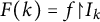 $F(k) = f \mathord \upharpoonright {I}_{k}$
. By hypothesis, find a slalom
 $S \in {\mathcal {F}}$
such that
 ${\exists }^{\infty } k \in \omega \left [F(k) \in S(k)\right ]$
. Consider any
 $k \in \omega $
such that
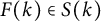 $F(k) \in S(k)$
. There exists a unique
 $j < \left | S(k) \right | \leq (k+1){2}^{k+1}$
with
 ${e}_{S(k), {<}_{\mathtt {wo}}}(j) = F(k)$
. Let
 $x = {i}_{k} + j$
. Then,
 ${i}_{k} \leq x < {i}_{k+1}$
and by definition
 ${f}_{S, {<}_{\mathtt {wo}}}(x) = {e}_{S(k), {<}_{\mathtt {wo}}}(j)(x) = F(k)(x) = f(x)$
. Thus, for each
 $k \in \omega $
such that
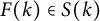 $F(k) \in S(k)$
, there exists
 ${x}_{k} \in {I}_{k}$
such that
 ${f}_{S, {<}_{\mathtt {wo}}}({x}_{k}) = f({x}_{k})$
. Since there are infinitely many such k and since
 ${I}_{k} \cap {I}_{k'} = \emptyset $
whenever
 $k \neq k'$
,
 ${\exists }^{\infty } x \in \omega \left [{f}_{S, {<}_{\mathtt {wo}}}(x) = f(x)\right ]$
. We are done because
 ${f}_{S, {<}_{\mathtt {wo}}} \in {\mathcal {F}}$
by hypothesis.
Definition 11.8. Let
 ${<}_{\mathtt {wo}}$
be fixed. A family
 ${\mathcal {F}} \subseteq {H(\omega )}^{\omega }$
is called well-closed w.r.t.
 ${<}_{\mathtt {wo}}$
if it satisfies the following:
-
(1)
$\forall f \in {\mathcal {F}} \left [{S}_{f} \in {\mathcal {F}}\right ]$
; -
(2) for every
$S \in {\mathcal {F}}$
, if
$S: \omega \rightarrow H(\omega )$
is a slalom, then
${f}_{S, {<}_{\mathtt {wo}}} \in {\mathcal {F}}$
; -
(3) for every set
$\{{f}_{n}: n \in \omega \} \subseteq {\mathcal {F}}$
, there is a slalom
$S \in {\mathcal {F}}$
so that
$\forall n \in \omega {\forall }^{\infty } k \in \omega \left [{f}_{n}(k) \in S(k)\right ]$
.
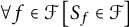






Remark 11.9. Suppose
 ${{\mathbf {V}}}_{0} \subseteq {{\mathbf {V}}}_{1}$
are transitive models of a sufficiently large fragment of
 $\mathrm {ZFC}$
with
 ${<}_{\mathtt {wo}} \in {{\mathbf {V}}}_{0}$
. Then, for any
 $A \in H(\omega )$
, the map
 ${e}_{A, {<}_{\mathtt {wo}}}: \left | A \right | \rightarrow A$
is the same whether it is calculated in
 ${{\mathbf {V}}}_{0}$
or in
 ${{\mathbf {V}}}_{1}$
. Also, if
 $S \in {{\mathbf {V}}}_{0}$
, then S is a slalom in
 ${{\mathbf {V}}}_{0}$
if and only if S is a slalom in
 ${{\mathbf {V}}}_{1}$
, and the computation of
 ${f}_{S, {<}_{\mathtt {wo}}}$
does not change. Similarly, for any
 $f \in {H(\omega )}^{\omega } \cap {{\mathbf {V}}}_{0}$
,
 ${S}_{f}$
is the same when calculated in
 ${{\mathbf {V}}}_{0}$
or
 ${{\mathbf {V}}}_{1}$
. So we conclude that if
 ${\mathcal {F}} \in {{\mathbf {V}}}_{0}$
and
 $$ \begin{align*} {\left( {\mathcal{F}} \subseteq {H(\omega)}^{\omega} \ \text{satisfies (1) and (2) of Definition 11.8 w.r.t.} \ {<}_{\mathtt{wo}} \right)}^{{{\mathbf{V}}}_{0}}\text{, then} \end{align*} $$
 $$ \begin{align*} {\left( {\mathcal{F}} \subseteq {H(\omega)}^{\omega} \ \text{satisfies (1) and (2) of Definition 11.8 w.r.t.} \ {<}_{\mathtt{wo}} \right)}^{{{\mathbf{V}}}_{1}}. \end{align*} $$
If the models
 ${{\mathbf {V}}}_{0} \subseteq {{\mathbf {V}}}_{1}$
satisfy the further condition that
 $$ \begin{align*} \forall X \in {{\mathbf{V}}}_{0} \forall Y \in {\left( {\left[X\right]}^{\leq \omega} \right)}^{{{\mathbf{V}}}_{1}} \exists Z \in {\left( {\left[X\right]}^{\leq \omega} \right)}^{{{\mathbf{V}}}_{0}} \left[Y \subseteq Z\right], \end{align*} $$
then for any
 ${\mathcal {F}} \in {{\mathbf {V}}}_{0}$
, if


In particular, this holds whenever
 ${{\mathbf {V}}}_{1}$
is a forcing extension of
 ${{\mathbf {V}}}_{0}$
by a proper poset.
Remark 11.9 will be used several times in what follows.
Definition 11.10.
 ${\mathcal {F}} \subseteq {H(\omega )}^{\omega }$
is called big if
 $$ \begin{align*} \forall f \in {H(\omega)}^{\omega} \exists g \in {\mathcal{F}} {\exists}^{\infty} k \in \omega \left[f(k) = g(k) \right]. \end{align*} $$
The proof of the following lemma is elementary, so we omit the proof.
Lemma 11.11 Suppose
 ${\mathcal {F}} \subseteq {H(\omega )}^{\omega }$
is big. Let
 $\mathbb{P}$
be a forcing notion such that
 ${\Vdash }_{\mathbb{P}} \; {{\mathcal {F}} \ \text {is big}}$
. Let
 $\mathring {\mathbb{Q}}$
be a
 $\mathbb{P}$
-name for a forcing such that
 ${\Vdash }_{\mathbb{P}} \; {"{\Vdash }_{\mathring {\mathbb{Q}}} \; {{\mathcal {F}} \ \text {is big}}}$
.” Then,
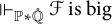 ${\Vdash }_{\mathbb{P} \ast \mathring {\mathbb{Q}}} \; {{\mathcal {F}} \ \text {is big}}$
.
The next lemma is a variation of Theorem 61 of Raghavan [Reference Raghavan65] (see also Raghavan [Reference Raghavan64]).
Lemma 11.12 Let
 ${<}_{\mathtt {wo}}$
be a well-ordering of
 $H(\omega )$
. Suppose
 ${\mathcal {F}} \subseteq {H(\omega )}^{\omega }$
is well-closed w.r.t.
 ${<}_{\mathtt {wo}}$
and big. Let
 $\gamma $
be a limit ordinal and let
 $\langle {\mathbb{P}}_{\alpha }; {\mathring {\mathbb{Q}}}_{\alpha }: \alpha \leq \gamma \rangle $
be a CS iteration such that
 $\forall \alpha < \gamma \left [{\Vdash }_{\alpha } \; {{\mathring {\mathbb{Q}}}_{\alpha } \ \text {is proper}}\right ]$
. Suppose that for all
 $\alpha < \gamma $
,
 ${\Vdash }_{\alpha } \; {{\mathcal {F}} \ \text {is big}}$
. Then,
 ${\Vdash }_{\gamma } \; {{\mathcal {F}} \ \text {is big}}$
.
Proof Let
 $\mathring {f} \in {{\mathbf {V}}}^{{\mathbb{P}}_{\gamma }}$
be such that
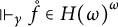 ${\Vdash }_{\gamma } \; {\mathring {f} \in {H(\omega )}^{\omega }}$
and let
 ${p}_{0} \in {\mathbb{P}}_{\gamma }$
. Fix a sufficiently large regular
 $\theta $
and a countable
 $M \prec H(\theta )$
with
 ${\mathcal {F}}, \langle {\mathbb{P}}_{\alpha }; {\mathring {\mathbb{Q}}}_{\alpha }: \alpha \leq \gamma \rangle , \mathring {f}, {p}_{0} \in M$
. Since
 ${\mathcal {F}}$
satisfies (3) of Definition 11.8, we can find a slalom
 $S \in {\mathcal {F}}$
so that for all
 $f \in {\mathcal {F}} \cap M$
,
 ${\forall }^{\infty } k \in \omega \left [f(k) \in S(k)\right ]$
. We will find a
 $q \in {\mathbb{P}}_{\gamma }$
such that
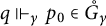 $q \; {\Vdash }_{\gamma } \; {p}_{0} \in {\mathring {G}}_{\gamma }$
and
 $q \; {\Vdash }_{\gamma } \; {{\exists }^{\infty } n \in \omega \left [\mathring {f}(n) \in S(n)\right ]}$
. Put
 $\gamma ' = \sup (M \cap \gamma )$
and let
 $\left \langle {\gamma }_{n}: n \in \omega \right \rangle \subseteq M \cap \gamma $
be an increasing sequence that is cofinal in
 $\gamma '$
. We build two sequences
 $\left \langle {q}_{n}: n \in \omega \right \rangle $
and
 $\left \langle {\mathring {p}}_{n}: n \in \omega \right \rangle $
satisfying the following conditions for all
 $n \in \omega $
:
-
(1)
${q}_{n} \in {\mathbb{P}}_{{\gamma }_{n}}$
,
${q}_{n}$
is
$(M, {\mathbb{P}}_{{\gamma }_{n}})$
-generic, and
${q}_{n+1} \mathord \upharpoonright {\gamma }_{n} = {q}_{n}$
; -
(2)
${\mathring {p}}_{0} = {\check {p}}_{0}$
,
${\mathring {p}}_{n} \in {{\mathbf {V}}}^{{\mathbb{P}}_{{\gamma }_{n}}}$
, and
${q}_{n} \; {\Vdash }_{{\gamma }_{n}} \; {"{\mathring {p}}_{n} \in M \cap {\mathbb{P}}_{\gamma } \wedge {\mathring {p}}_{n} \mathord \upharpoonright {\gamma }_{n} \in {\mathring {G}}_{{\gamma }_{n}}}$
”; -
(3)
${q}_{n+1} \; {\Vdash }_{{\gamma }_{n+1}} \; {{\mathring {p}}_{n+1} \leq {\mathring {p}}_{n}}$
; -
(4)
.”







 .”
Assume for a moment that such sequences have been constructed. Then,
 ${\bigcup }_{n \in \omega }{{q}_{n}}$
is a condition in
 ${\mathbb{P}}_{\gamma '}$
. We extend
 ${\bigcup }_{n \in \omega }{{q}_{n}}$
to a condition q in
 ${\mathbb{P}}_{\gamma }$
by setting
 for all
 $\gamma ' \leq \alpha < \gamma $
. By standard arguments,
 $\forall n \in \omega \left [q \; {\Vdash }_{\gamma } \; {{\mathring {p}}_{n} \in {\mathring {G}}_{\gamma }}\right ]$
. In particular,
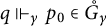 $q \; {\Vdash }_{\gamma } \; {{p}_{0} \in {\mathring {G}}_{\gamma }}$
. We will check that
 $q \; {\Vdash }_{\gamma } \; {{\exists }^{\infty } n \in \omega \left [\mathring {f}(n) \in S(n)\right ]}$
.
Suppose not. Then,
 $\exists r \leq q \exists n \in \omega \left [r \; {\Vdash }_{\gamma } \; {\forall k \geq n \left [\mathring {f}(k) \notin S(k)\right ]}\right ]$
. Let
 ${G}_{\gamma }$
be
 $({\mathbf {V}}, {\mathbb{P}}_{\gamma })$
-generic with
 $r \in {G}_{\gamma }$
. It is a standard fact that
 ${G}_{{\gamma }_{n+1}}$
is
 $({\mathbf {V}}, {\mathbb{P}}_{{\gamma }_{n+1}})$
-generic, that
 ${G}_{\gamma }$
is
 -generic, and that in
 ${\mathbf {V}}\left [{G}_{\gamma }\right ]$
:
 ${G}_{\gamma } = {G}_{{\gamma }_{n+1}} \ast {G}_{\gamma }$
. So in
 ${\mathbf {V}}\left [{G}_{{\gamma }_{n+1}}\right ]$
:
 and

Since
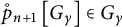 ${\mathring {p}}_{n+1}\left [{G}_{\gamma }\right ] \in {G}_{\gamma }$
, in
 ${\mathbf {V}}\left [{G}_{\gamma }\right ] = {\mathbf {V}}\left [{G}_{{\gamma }_{n+1}}\right ]\left [{G}_{\gamma }\right ]$
: there exists
 $k \geq n+1$
such that
 $\mathring {f}\left [{G}_{{\gamma }_{n+1}}\right ]\left [{G}_{\gamma }\right ](k) \in S(k)$
. Since
 $\mathring {f}\left [{G}_{{\gamma }_{n+1}}\right ]\left [{G}_{\gamma }\right ] = \mathring {f}\left [{G}_{\gamma }\right ]$
, so
 $\mathring {f}\left [{G}_{\gamma }\right ](k) \in S(k)$
, and we have a contradiction.
To build
 $\left \langle {q}_{n}: n \in \omega \right \rangle $
and
 $\left \langle {\mathring {p}}_{n}: n \in \omega \right \rangle $
, proceed by induction on n. Let
 ${\mathring {p}}_{0} = {\check {p}}_{0}$
, the canonical
 ${\mathbb{P}}_{{\gamma }_{0}}$
-name for
 ${p}_{0}$
. Note that
 ${p}_{0} \mathord \upharpoonright {\gamma }_{0} \in M \cap {\mathbb{P}}_{{\gamma }_{0}}$
and
 ${\mathbb{P}}_{{\gamma }_{0}} \in M$
. By the properness of
 ${\mathbb{P}}_{{\gamma }_{0}}$
, there is
 ${q}_{0} \in {\mathbb{P}}_{{\gamma }_{0}}$
which is
 $(M, {\mathbb{P}}_{{\gamma }_{0}})$
-generic with
 ${q}_{0} \leq {p}_{0} \mathord \upharpoonright {\gamma }_{0}$
. Then,
 ${\mathring {p}}_{0}$
and
 ${q}_{0}$
satisfy (1)–(4). Now suppose
 ${\mathring {p}}_{n}$
and
 ${q}_{n}$
are given, for some
 $n \in \omega $
. By the Properness Extension Lemma (see, for example, Lemma 2.8 of Abraham [Reference Abraham1]), there is an
 $(M, {\mathbb{P}}_{{\gamma }_{n+1}})$
-generic condition
 ${q}_{n+1} \in {\mathbb{P}}_{{\gamma }_{n+1}}$
such that
 ${q}_{n+1} \mathord \upharpoonright {\gamma }_{n} = {q}_{n}$
and
 ${q}_{n+1} \; {\Vdash }_{{\gamma }_{n+1}} \; {{\mathring {p}}_{n} \mathord \upharpoonright {\gamma }_{n+1} \in {\mathring {G}}_{{\gamma }_{n+1}}}$
.
To find
 ${\mathring {p}}_{n+1}$
, we proceed as follows. Fix a
 $({\mathbf {V}}, {\mathbb{P}}_{{\gamma }_{n+1}})$
-generic filter
 ${G}_{{\gamma }_{n+1}}$
with
 ${q}_{n+1} \in {G}_{{\gamma }_{n+1}}$
. Recall that
 $M\left [{G}_{{\gamma }_{n+1}}\right ] \prec H(\theta )\left [{G}_{{\gamma }_{n+1}}\right ] = {H}^{{\mathbf {V}}\left [{G}_{{\gamma }_{n+1}}\right ]}(\theta )$
. Note that
 and that in
 ${\mathbf {V}}\left [{G}_{{\gamma }_{n+1}}\right ]$
,
 . Since
 ${q}_{n+1} \in {G}_{{\gamma }_{n+1}}$
,
 ${\mathring {p}}_{n}\left [{G}_{{\gamma }_{n+1}}\right ] \mathord \upharpoonright {\gamma }_{n+1} \in {G}_{{\gamma }_{n+1}}$
. So in
 ${\mathbf {V}}\left [{G}_{{\gamma }_{n+1}}\right ]$
,
 . By elementarity, find a sequence
 $\langle {p}^{i}: i \in \omega \rangle \in M\left [{G}_{{\gamma }_{n+1}}\right ]$
and a function
 $f \in {H(\omega )}^{\omega } \cap M\left [{G}_{{\gamma }_{n+1}}\right ]$
satisfying the following for each
 $i \in \omega $
:
-
(5)
; -
(6)
${p}^{i+1} \leq {p}^{i} \leq {\mathring {p}}_{n}\left [{G}_{{\gamma }_{n+1}}\right ]$
; -
(7)
.
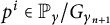 ;

 .
By hypothesis,
 ${\mathcal {F}}$
is big in
 ${\mathbf {V}}\left [{G}_{{\gamma }_{n+1}}\right ]$
. So by elementarity and by the fact that
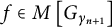 $f \in M\left [{G}_{{\gamma }_{n+1}}\right ]$
, we can find
 $g \in {\mathcal {F}} \cap M\left [{G}_{{\gamma }_{n+1}}\right ]$
so that
 ${\exists }^{\infty } k \in \omega \left [f(k) = g(k)\right ]$
. Since
 ${q}_{n+1}$
is an
 $(M, {\mathbb{P}}_{{\gamma }_{n+1}})$
-generic condition with
 ${q}_{n+1} \in {G}_{{\gamma }_{n+1}}$
and since
 ${\mathcal {F}} \in {\mathbf {V}}$
,
 ${\mathcal {F}} \cap M = {\mathcal {F}} \cap M\left [{G}_{{\gamma }_{n+1}}\right ]$
. So
 $g \in {\mathcal {F}} \cap M$
. By the choice of S,
 ${\forall }^{\infty } k \in \omega \left [g(k) \in S(k)\right ]$
. Hence, we can fix
 $k \geq n+1$
such that
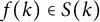 $f(k) \in S(k)$
. Note that
 ${p}^{k} \in {\mathbb{P}}_{\gamma } \cap M\left [{G}_{{\gamma }_{n+1}}\right ]$
, and that
 ${\mathbb{P}}_{\gamma } \cap M\left [{G}_{{\gamma }_{n+1}}\right ] = {\mathbb{P}}_{\gamma } \cap M$
similarly to
 ${\mathcal {F}}$
. Thus,
 ${p}^{k}$
has the following properties:
-
(8)
${p}^{k} \in M \cap {\mathbb{P}}_{\gamma }$
and
${p}^{k} \mathord \upharpoonright {\gamma }_{n+1} \in {G}_{{\gamma }_{n+1}}$
; -
(9)
${p}^{k} \leq {\mathring {p}}_{n}\left [{G}_{{\gamma }_{n+1}}\right ]$
; -
(10)
.
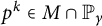
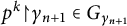
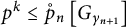
 .
Since
 ${G}_{{\gamma }_{n+1}}$
was an arbitrary
 $({\mathbf {V}}, {\mathbb{P}}_{{\gamma }_{n+1}})$
-generic filter with
 ${q}_{n+1} \in {G}_{{\gamma }_{n+1}}$
, we can use the Maximality Principle in
 ${\mathbf {V}}$
to find a
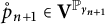 ${\mathring {p}}_{n+1} \in {{\mathbf {V}}}^{{\mathbb{P}}_{{\gamma }_{n+1}}}$
so that in
 ${\mathbf {V}}$
:
-
(11)
${q}_{n+1} \; {\Vdash }_{{\mathbb{P}}_{{\gamma }_{n+1}}} \; {"{\mathring {p}}_{n+1} \in M \cap {\mathbb{P}}_{\gamma } \wedge {\mathring {p}}_{n+1} \mathord \upharpoonright {\gamma }_{n+1} \in {\mathring {G}}_{{\gamma }_{n+1}}}$
”; -
(12)
${q}_{n+1} \; {\Vdash }_{{\mathbb{P}}_{{\gamma }_{n+1}}} \; {{\mathring {p}}_{n+1} \leq {\mathring {p}}_{n}}$
; -
(13)
.”


 .”
This concludes the inductive construction.
To complete the proof, fix an arbitrary
 $({\mathbf {V}}, {\mathbb{P}}_{\gamma })$
-generic filter
 ${G}_{\gamma }$
. In
 ${\mathbf {V}}\left [{G}_{\gamma }\right ]$
, by what has been proved above, for every
 $f \in {H(\omega )}^{\omega }$
, there exists a slalom
 $S \in {\mathcal {F}}$
so that
 ${\exists }^{\infty } k \in \omega \left [f(k) \in S(k)\right ]$
. Since
 ${\mathbb{P}}_{\gamma }$
is proper and since
 ${\mathcal {F}}$
is well-closed w.r.t.
 ${<}_{\mathtt {wo}}$
in
 ${\mathbf {V}}$
,
 ${\mathcal {F}}$
is still well-closed w.r.t.
 ${<}_{\mathtt {wo}}$
in
 ${\mathbf {V}}\left [{G}_{\gamma }\right ]$
. So Lemma 11.7 applies in
 ${\mathbf {V}}\left [{G}_{\gamma }\right ]$
and implies that
 $\forall f \in {H(\omega )}^{\omega } \exists g \in {\mathcal {F}} {\exists }^{\infty } k \in \omega \left [f(k) = g(k)\right ]$
.
Corollary 11.13 Let
 ${<}_{\mathtt {wo}}$
be a well-ordering of
 $H(\omega )$
. Suppose
 ${\mathcal {F}} \subseteq {H(\omega )}^{\omega }$
is well-closed w.r.t.
 ${<}_{\mathtt {wo}}$
and is big. Let
 $\gamma $
be any ordinal. Suppose
 $\langle {\mathbb{P}}_{\alpha }; {\mathring {\mathbb{Q}}}_{\alpha }: \alpha \leq \gamma \rangle $
is a CS iteration such that
 $\forall \alpha < \gamma \left [{\Vdash }_{\alpha } \; {{\mathring {\mathbb{Q}}}_{\alpha } \ \text {is proper}}\right ]$
. Suppose also that for each
 $\alpha < \gamma {\Vdash }_{\alpha } \; {"{\Vdash }_{{\mathring {\mathbb{Q}}}_{\alpha }} \; {{\mathcal {F}} \ \text {is big}}}$
.” Then
 ${\Vdash }_{\gamma } \; {{\mathcal {F}} \ \text {is big}}$
.
Proof The proof is by induction on
 $\gamma $
. If
 $\gamma = 0$
, then
 ${\mathbb{P}}_{\gamma }$
is the trivial forcing. By hypothesis, in
 ${\mathbf {V}}$
,
 ${\mathcal {F}}$
is big, so there is nothing to do. Suppose
 $\gamma = \gamma ' + 1$
and that the statement is true for
 $\gamma '$
. So
 ${\Vdash }_{\gamma '} \; {{\mathcal {F}} \ \text {is big}}$
. Now
 ${\mathbb{P}}_{\gamma '+1}$
is forcing equivalent to
 ${\mathbb{P}}_{\gamma '} \ast {\mathring {\mathbb{Q}}}_{\gamma '}$
. By hypothesis,
 ${\Vdash }_{{\mathbb{P}}_{\gamma '}} \; {"{\Vdash }_{{\mathring {\mathbb{Q}}}_{\gamma '}} \; {{\mathcal {F}} \ \text {is big}}}$
.” By Lemma 11.11, we have
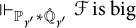 ${\Vdash }_{{\mathbb{P}}_{\gamma '} \ast {\mathring {\mathbb{Q}}}_{\gamma '}} \; {{\mathcal {F}} \ \text {is big}}$
. So
 ${\Vdash }_{\gamma } \; {{\mathcal {F}} \ \text {is big}}$
as required. Finally suppose that
 $\gamma $
is a limit ordinal and that the statement is true for all
 $\beta < \gamma $
. So
 $\forall \beta < \gamma \left [{\Vdash }_{\beta } \; {{\mathcal {F}} \ \text {is big}} \right ]$
. By Lemma 11.12,
 ${\Vdash }_{\gamma } \; {{\mathcal {F}} \ \text {is big}}$
. This concludes the induction and the proof.
Lemma 11.14 Suppose
 ${<}_{\mathtt {wo}}$
is a well-ordering of
 $H(\omega )$
. If
 ${\mathcal {F}} \subseteq {H(\omega )}^{\omega }$
is well-closed w.r.t.
 ${<}_{\mathtt {wo}}$
and is big, then
 ${\Vdash }_{{\mathbb{C}}} \; {{\mathcal {F}} \ \text {is big}}$
.
Proof Let
 $\mathring {f}$
be a
 ${\mathbb{C}}$
-name and suppose that
 ${\Vdash }_{{\mathbb{C}}} \; {\mathring {f}: \omega \rightarrow H(\omega )}$
. Enumerate
 ${\mathbb{C}}$
as
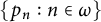 $\left \{ {p}_{n}: n \in \omega \right \}$
in a 1-1 way. Define a small slalom
 $S: \omega \rightarrow H(\omega )$
as follows. Given
 $n \in \omega $
, find
 ${q}_{n} \leq {p}_{n}$
and
 ${x}_{n} \in H(\omega )$
so that
 ${q}_{n} \; {\Vdash }_{{\mathbb{C}}} \; {\mathring {f}(n) = {x}_{n}}$
, and define
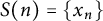 $S(n) = \{{x}_{n}\}$
. Note that for each
 $l \in \omega $
,
 ${X}_{l} \in {\left [\omega \right ]}^{\omega }$
, where
 ${X}_{l} = \{ n \in \omega : {p}_{n} \leq {p}_{l} \}$
. Since
 ${\mathcal {F}}$
is big, Lemma 11.5 applies and implies that there is a slalom
 $T: \omega \rightarrow H(\omega )$
so that
 $T \in {\mathcal {F}}$
and
 $\forall l \in \omega {\exists }^{\infty } n \in {X}_{l}\left [S(n) \subseteq T(n)\right ]$
. Now we check that
 ${\Vdash }_{{\mathbb{C}}} \; {{\exists }^{\infty } n \in \omega \left [\mathring {f}(n) \in T(n)\right ]}$
. To see this, fix
 $p \in {\mathbb{C}}$
and
 $N \in \omega $
. Then
 $p = {p}_{l}$
for some
 $l \in \omega $
. Find
 $n \in {X}_{l}$
with
 $n> N$
and
 $S(n) \subseteq T(n)$
. By the definition of S and
 ${X}_{l}$
,
 ${q}_{n} \leq {p}_{n} \leq {p}_{l}$
and
 ${q}_{n} \; {\Vdash }_{{\mathbb{C}}} \; {\mathring {f}(n) = {x}_{n} \in \{{x}_{n}\} = S(n) \subseteq T(n)}$
. This is as required.
Now to complete the proof, fix a
 $({\mathbf {V}}, {\mathbb{C}})$
-generic filter G. As
 ${\mathbb{C}}$
is proper,
 ${\mathcal {F}}$
is well-closed w.r.t.
 ${<}_{\mathtt {wo}}$
in
 ${{\mathbf {V}}[G]}$
. By what has been proved in the previous paragraph, we have in
 ${{\mathbf {V}}[G]}$
that whenever
 $f: \omega \rightarrow H(\omega )$
, then there is a slalom
 $T \in {\mathcal {F}}$
with the property that
 ${\exists }^{\infty } n \in \omega \left [f(n) \in T(n)\right ]$
. As
 ${\mathcal {F}}$
is well-closed w.r.t.
 ${<}_{\mathtt {wo}}$
in
 ${{\mathbf {V}}[G]}$
, Lemma 11.7 tells us that
 ${\mathcal {F}}$
is big in
 ${{\mathbf {V}}[G]}$
.
Corollary 11.15 Suppose
 ${<}_{\mathtt {wo}}$
is a well-ordering of
 $H(\omega )$
. If
 ${\mathcal {F}} \subseteq {H(\omega )}^{\omega }$
is well-closed w.r.t.
 ${<}_{\mathtt {wo}}$
and is big, then
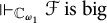 ${\Vdash }_{{{\mathbb{C}}}_{{\omega }_{1}}} \; {{\mathcal {F}} \ \text {is big}}$
.
Proof Suppose G is
 $\left ( {\mathbf {V}}, {{\mathbb{C}}}_{{\omega }_{1}} \right )$
-generic. Consider any
 $f \in {H(\omega )}^{\omega } \cap {{\mathbf {V}}[G]}$
. It is well-known that for some
 $({\mathbf {V}}, {\mathbb{C}})$
-generic filter H,
 $f \in {\mathbf {V}}\left [H\right ]$
. By Lemma 11.14,
 ${\mathcal {F}}$
is big in
 ${\mathbf {V}}\left [H\right ]$
. So there is
 $g \in {\mathcal {F}}$
so that
 ${\exists }^{\infty } n \in \omega \left [f(n) = g(n)\right ]$
. Therefore,
 ${\mathcal {F}}$
is big in
 ${{\mathbf {V}}[G]}$
.
12 Shelah–Steprāns families and non-meager sets
In Subsections 12.1 and 12.2, we show that it is consistent to have
 $\operatorname {\mathrm {non}}(\mathcal {M}) = {\aleph }_{1}$
and no Shelah–Steprāns or block Shelah–Steprāns a.d. families of size
 ${\aleph }_{1}$
. This also shows that even though Shelah–Steprāns a.d. families are hard to destroy, they can still be diagonalized without increasing
 $\operatorname {\mathrm {non}}(\mathcal {M})$
(see Corollary 12.17). The question of whether it is possible to do this for every maximal almost disjoint family, at least consistently, is open.
12.1 The partial order
In
 ${\mathbf {V}}$
, let
 ${\mathscr {A}} \subseteq {\left [\omega \right ]}^{\omega }$
be a fixed block Shelah–Steprāns a.d. family. Let
 ${\mathbf {W}}$
denote the extension of
 ${\mathbf {V}}$
by
 ${\omega }_{1}$
Cohen reals (i.e. by
 ${{\mathbb{C}}}_{{\omega }_{1}}$
). We assume that
 ${\mathscr {A}}$
remains block Shelah–Steprāns in
 ${\mathbf {W}}$
. Actually, Shelah–Steprāns a.d. families remain Shelah–Steprāns after adding Cohen reals, but this does not seem to hold in general for block Shelah–Steprāns a.d. families. However, since we are mainly interested in the minimal cardinality of Shelah–Steprāns and block Shelah–Steprāns a.d. families, this is not relevant for our main result in the next section.
Definition 12.1. If F and G are non-empty sets of ordinals, we write
 $F < G$
as an abbreviation for
 $\forall x \in F \ \forall y \in G\left [x < y\right ]$
.
We use
 $\mathrm {FIN}$
to denote
 $\mathsf{fin}\setminus \{\emptyset \}$
.
Lemma 12.2 Shelah–Steprāns a.d. families remain Shelah–Steprāns after adding Cohen reals.
Proof Let
 $\mathscr {B}$
be a Shelah–Steprāns a.d. family. It suffices to show that
 $$ \begin{align*} {\Vdash}_{{\mathbb{C}}} \; {"\mathscr{B} \ \text{is Shelah}-\text{Stepr}\bar{\rm a}\text{ns}}.\text{"} \end{align*} $$
To this end, let
 $\mathring {X}$
be a
 ${\mathbb{C}}$
-name such that
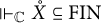 ${\Vdash }_{{\mathbb{C}}} \; {\mathring {X} \subseteq \mathrm {FIN}}$
and
 $$ \begin{align*} {\Vdash}_{{\mathbb{C}}} \; {"\forall B \in {\mathcal{I}}(\mathscr{B}) \exists s \in \mathring{X}\left[s \cap B = \emptyset\right]}.\text{"} \end{align*} $$
Let
 $\left \langle {p}_{n}: n \in \omega \right \rangle $
enumerate
 ${\mathbb{C}}$
. For each
 $n \in \omega $
, let
 $$ \begin{align*} {X}_{n} = \left\{s \in \mathrm{FIN}: \exists q \leq {p}_{n}\left[q \; {\Vdash}_{{\mathbb{C}}} \; {s \in \mathring{X}}\right] \right\}. \end{align*} $$
By hypothesis, for any
 $n \in \omega $
and any
 $B \in {\mathcal {I}}(\mathscr {B})$
, there exists
 $q \leq {p}_{n}$
and
 $s \in \mathrm {FIN}$
such that
 $s \cap B = \emptyset $
and
 $q \; {\Vdash }_{{\mathbb{C}}} \; {s \in \mathring {X}}$
, whence
 $s \in {X}_{n}$
. Since
 $\mathscr {B}$
is a Shelah–Steprāns a.d. family, there exists
 $B \in {\mathcal {I}}(\mathscr {B})$
with the property that
 $\forall n \in \omega \left [{\left [B\right ]}^{< \omega } \cap {X}_{n} \ \text {is infinite}\right ]$
(see Proposition 5.9 (2)). We check that
 ${\Vdash }_{{\mathbb{C}}} \; {"{\left [B\right ]}^{< \omega } \cap \mathring {X} }$
is infinite.” To this end, fix
 $p \in {\mathbb{C}}$
and some
 $k \in \omega $
. Then,
 $p={p}_{n}$
for some
 $n \in \omega $
, and there exists
 $s \in {\left [B\right ]}^{< \omega } \cap {X}_{n}$
such that
 $s \notin \mathcal {P}(k)$
. By definition of
 ${X}_{n}$
,
 $q \; {\Vdash }_{{\mathbb{C}}} \; {s \in \mathring {X}}$
, for some
 $q \leq {p}_{n}=p$
. Thus, we have proved that for each
 $p \in {\mathbb{C}}$
and
 $k \in \omega $
, there exist
 $s \in {\left [B\right ]}^{< \omega }$
and
 $q \leq p$
such that
 $s \notin \mathcal {P}(k)$
and
 $q \; {\Vdash }_{{\mathbb{C}}} \; {s \in \mathring {X}}$
, which proves that
 ${\Vdash }_{{\mathbb{C}}} \; {"{\left [B\right ]}^{< \omega } \cap \mathring {X} \ \text {is infinite}}$
.”
We work in
 ${\mathbf {W}}$
for the remainder of this section unless the contrary is explicitly stated. As stated above,
 ${\mathscr {A}} \subseteq {\left [\omega \right ]}^{\omega }$
is a fixed block Shelah–Steprāns a.d. family which is a member of
 ${\mathbf {V}}$
and remains block Shelah–Steprāns in
 ${\mathbf {W}}$
.
Definition 12.3 Working in
 ${\mathbf {W}}$
, define a forcing
 $\mathbb{P}({\mathscr {A}})$
as follows. A pair
 $p=\left \langle {s}_{p}, {c}_{p} \right \rangle $
belongs to
 $\mathbb{P}({\mathscr {A}})$
if and only if:
-
(1)
${s}_{p} \in {\left [\omega \right ]}^{< \omega }$
; -
(2)
${c}_{p}: \omega \rightarrow \mathrm {FIN}$
such that:-
(2a)
$\forall i \in \omega \left [{c}_{p}(i) < {c}_{p}(i+1)\right ]$
; -
(2b)
$\forall x \in {s}_{p} \forall y \in {c}_{p}(0)\left [x < y\right ]$
;
-
-
(3)
$\forall B \in {\mathcal {I}}({\mathscr {A}}) \exists i \in \omega \left [B \cap {c}_{p}(i) = \emptyset \right ]$
.





For
 $q, p \in \mathbb{P}({\mathscr {A}})$
,
 $q \leq p$
if and only if:
-
(4)
${s}_{q} \supseteq {s}_{p}$
; -
(5)
$\exists {F}_{q, p} \in {\left [\omega \right ]}^{< \omega }\left [{s}_{q} \setminus {s}_{p} = {\bigcup }_{i \in {F}_{q, p}}{{c}_{p}(i)}\right ]$
; -
(6)
$\forall i \in \omega \exists {G}_{q, p, i} \in {\left [\omega \right ]}^{< \omega }\left [{c}_{q}(i) = {\bigcup }_{j \in {G}_{q, p, i}}{{c}_{p}(j)}\right ]$
.



For
 $n \in \omega $
and
 $q, p \in \mathbb{P}({\mathscr {A}})$
,
 $q \; {\leq }_{n} \; p$
if and only if
 $\left ( q \leq p \ \text {and} \ {c}_{q} \mathord \upharpoonright n = {c}_{p} \mathord \upharpoonright n \right )$
. It is easy to see that
 $\leq $
and
 ${\leq }_{n}$
are transitive.
The following lemma lists some elementary consequences of the definitions which are easy to verify.
Lemma 12.4 Let
 $p, q \in \mathbb{P}({\mathscr {A}})$
. The following hold:
-
(1)
$q \; {\leq }_{0} \; p \iff q \leq p$
; -
(2) for all
$n> 0$
, if
$q \; {\leq }_{n} \; p$
, then
${s}_{q} = {s}_{p}$
; -
(3) if
$q \leq p$
, then for all
$i < j < \omega $
,
${G}_{q, p, i} < {G}_{q, p, j}$
; -
(4)
$\forall n < m < \omega \left [q \; {\leq }_{m} \; p \implies q \; {\leq }_{n} \; p\right ]$
.





Lemma 12.5
 $\mathbb{P}({\mathscr {A}})$
is non-empty.
Proof Just take
 $s_{p}=\emptyset $
and
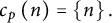 $c_{p}\left ( n\right ) =\left \{ n\right \} .$
The relations
 ${\leq }_{n}$
do not define an Axiom A structure on
 $\mathbb{P}({\mathscr {A}})$
because the limit of a fusion sequence will not, in general, satisfy clause (3) of Definition 12.3. However, the next lemma says that clause (3) of Definition 12.3 is the only obstruction. The proof is straightforward and left to the reader.
Lemma 12.6 Suppose
 $\left \langle {p}_{n}: n \in \omega \right \rangle $
is a sequence of members of
 $\mathbb{P}({\mathscr {A}})$
so that
 $\forall n \in \omega \left [{p}_{n+1} \; {\leq }_{n} \; {p}_{n}\right ]$
. Define
 $p = \left \langle {s}_{p}, {c}_{p} \right \rangle $
by setting
 ${s}_{p} = {s}_{{p}_{1}}$
and
 ${c}_{p}(n) = {c}_{{p}_{n+1}}(n)$
, for all
 $n \in \omega $
. Then, clauses (1) and (2) of Definition 12.3 are satisfied. If clause (3) of Definition 12.3 is also satisfied, then
 $p \in \mathbb{P}({\mathscr {A}})$
and
 $\forall n \in \omega \left [p \; {\leq }_{n} \; {p}_{n}\right ]$
.
Definition 12.7 Let
 $p \in \mathbb{P}({\mathscr {A}})$
and suppose
 $k \in \omega $
and
 $F \subseteq k$
. Define
 $p(k, F) = \left \langle {s}_{p(k, F)}, {c}_{p(k, F)} \right \rangle $
by
 ${s}_{p(k, F)} = {s}_{p} \cup \left ( {\bigcup }_{j \in F}{{c}_{p}(j)} \right )$
and
 ${c}_{p(k, F)}(i) = {c}_{p}(i+k)$
, for all
 $i \in \omega $
. It is easy to check that
 $p(k, F) \in \mathbb{P}({\mathscr {A}})$
and that
 $p(k, F) \leq p$
.
Definition 12.8 Let
 $p \in \mathbb{P}({\mathscr {A}})$
,
 $k \in \omega $
, and
 $F \subseteq k$
. Note that
 ${p(k+1, F\cup \{k\}) \leq p}$
. Suppose that some
 $q \leq p(k+1, F\cup \{k\}) \leq p$
is given. Define
 $q(p, k, F) = \left \langle {s}_{q(p, k, F)}, {c}_{q(p, k, F)} \right \rangle $
as follows. Put
 ${s}_{q(p, k, F)} = {s}_{p}$
. For
 $i < k$
, define
 ${c}_{q(p, k, F)}(i) = {c}_{p}(i)$
, define
 ${c}_{q(p, k, F)}(k) = \bigcup \left \{ {c}_{p}(j): j \in {F}_{q, p} \setminus k \right \}$
, and for
 $i> k$
, define
 ${c}_{q(p, k, F)}(i) = {c}_{q}(i-k-1)$
.
It is easy to check that
 $q(p, k, F) \in \mathbb{P}({\mathscr {A}})$
and
 $q(p, k, F) \; {\leq }_{k} \; p$
.
Lemma 12.9 Let
 $p \in \mathbb{P}({\mathscr {A}})$
,
 $k \in \omega $
, and
 $F \subseteq k$
. Suppose
 $q \leq p(k+1, F\cup \{k\})$
. If
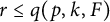 $r \leq q(p, k, F)$
and
 $i \in \omega $
are such that
 $k = \min \left ({G}_{r, q(p, k, F), i}\right )$
and
 ${F}_{r, q(p, k, F)} = F$
, then
 $r(i+1, \{i\}) \leq q$
.
Proof Note that
 ${c}_{r}(i) = \bigcup {\left \{ {c}_{q(p, k, F)}(j): j \in {G}_{r, q(p, k, F), i} \right \}}$
. Let
 $$ \begin{align*} J = \left\{ j \in {G}_{r, q(p, k, F), i}: j> k \right\}. \end{align*} $$
Then,
 $$ \begin{align*} {s}_{r(i+1, \{i\})} = {s}_{q} \cup \bigcup {\left\{ {c}_{q(p, k, F)}(j): j \in J \right\}} = {s}_{q} \cup \bigcup {\left\{ {c}_{q}(j-k-1): j \in J \right\}}. \end{align*} $$
This confirms both (4) and (5) of Definition 12.3. For
 $l \in \omega $
, we have
 ${c}_{r(i+1, \{i\})}(l) = {c}_{r}(l+i+1) =$
 $$ \begin{align*} \bigcup {\left\{ {c}_{q(p, k, F)}(j): j \in {G}_{r, q(p, k, F), l+i+1} \right\}} = \bigcup {\left\{ {c}_{q}(j-k-1): j \in {G}_{r, q(p, k, F), l+i+1} \right\}}. \end{align*} $$
This confirms (6) of Definition 12.3. Therefore,
 $r(i+1, \{i\}) \leq q$
.
Lemma 12.10 Let
 $p \in \mathbb{P}({\mathscr {A}})$
and
 $k \in \omega $
. Suppose
 $\mathring {x} \in {\mathbf {W}}^{\mathbb{P}({\mathscr {A}})}$
and
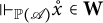 ${\Vdash }_{\mathbb{P}({\mathscr {A}})}{\mathring {x} \in {\mathbf {W}}}$
. Then, there are
 $q \; {\leq }_{k} \; p$
and
 $X \in {\mathbf {W}}$
so that:
-
(1)
$\left | X \right | \leq {2}^{k}$
,
${s}_{p} = {s}_{q}$
, and
${c}_{q}(k) \supseteq {c}_{p}(k)$
; -
(2) for any
$q' \; {\leq }_{k+1} \; q$
,
$F \subseteq k$
,
$r \leq q'$
, and
$i \in \omega $
, if
${F}_{r, q'} = F$
and
$k = \min \left ( {G}_{r, q', i} \right )$
, then
$r(i+1, \{i\}) \; {\Vdash } \; {\mathring {x} \in X}$
.


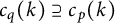




Proof Let
 $\left \langle {F}_{l}: l < {2}^{k} \right \rangle $
enumerate
 $\mathcal {P}(k)$
. We define by induction two sequences
 $\left \langle {q}_{l}: l \leq {2}^{k} \right \rangle $
and
 $\left \langle {x}_{l}: l < {2}^{k} \right \rangle $
satisfying the following:
 ${q}_{0} = p$
and
 $$ \begin{align*} \forall l' < l \left[{q}_{l} \; {\leq}_{k} \; {q}_{l'}\text{, } {s}_{{q}_{l}} = {s}_{{q}_{l'}}\text{, and } {c}_{{q}_{l}}(k) \supseteq {c}_{{q}_{l'}}(k)\right]. \end{align*} $$
Define
 ${q}_{0} = p$
and note that the induction hypothesis is vacuously satisfied. Now suppose
 $l < {2}^{k}$
and that
 ${q}_{l}$
satisfying the induction hypothesis is given. Then,
 ${q}_{l}(k+1, {F}_{l} \cup \{k\}) \leq {q}_{l}$
. Find
 ${r}_{l} \leq {q}_{l}(k+1, {F}_{l} \cup \{k\})$
and
 ${x}_{l} \in {\mathbf {W}}$
with
 ${r}_{l} \; {\Vdash }_{\mathbb{P}({\mathscr {A}})} \; {\mathring {x} = {x}_{l}}$
, and define
 ${q}_{l+1} = {r}_{l}({q}_{l}, k, {F}_{l})$
. Note that
 ${q}_{l+1} \; {\leq }_{k} \; {q}_{l}$
and
 ${s}_{{q}_{l+1}} = {s}_{{r}_{l}({q}_{l}, k, {F}_{l})} = {s}_{{q}_{l}}$
. Further,
 ${c}_{{q}_{l}}(k) \subseteq {s}_{{q}_{l}(k+1, {F}_{l} \cup \{k\})} \setminus {s}_{{q}_{l}} \subseteq {s}_{{r}_{l}} \setminus {s}_{{q}_{l}}$
, and
 $k \in {F}_{{r}_{l}, {q}_{l}} \setminus k$
. Thus,
 ${c}_{{q}_{l}}(k) \subseteq {c}_{{q}_{l+1}}(k)$
. Hence, by the induction hypothesis,
 $$ \begin{align*} \forall l' \leq l \left[{q}_{l+1} \; {\leq}_{k} \; {q}_{l} \; {\leq}_{k} \; {q}_{l'}\text{, } {s}_{{q}_{l+1}} = {s}_{{q}_{l}} = {s}_{{q}_{l'}}\text{, and } {c}_{{q}_{l+1}}(k) \supseteq {c}_{{q}_{l}}(k) \supseteq {c}_{{q}_{l'}}(k)\right]. \end{align*} $$
This concludes the inductive construction.
Now define
 $q = {q}_{{2}^{k}}$
and
 $X = \{{x}_{l}: l < {2}^{k}\}$
. Then, (1) is satisfied by construction. To verify (2), fix any
 $q' \; {\leq }_{k+1} \; q$
,
 $F \subseteq k$
,
 $r \leq q'$
, and
 $i \in \omega $
, and assume that
 ${F}_{r, q'} = F$
and that
 $k = \min \left ( {G}_{r, q', i} \right )$
. Then,
 $F = {F}_{l}$
, for some
 $l < {2}^{k}$
. Since
 $q \; {\leq }_{k} \; {q}_{l+1}$
,
 ${s}_{q} = {s}_{{q}_{l+1}}$
, and
 ${c}_{q}(k) \supseteq {c}_{{q}_{l+1}}(k)$
, it follows that
 ${F}_{r, {q}_{l+1}} = F$
and that
 $\min \left ( {G}_{r, {q}_{l+1}, i} \right ) = k$
. By definition,
 ${r}_{l} \leq {q}_{l}(k+1, F \cup \{k\})$
and
 ${q}_{l+1} = {r}_{l}({q}_{l}, k, F)$
. Therefore, by Lemma 12.9,
 $r(i+1, \{i\}) \leq {r}_{l}$
. Therefore,
 $r(i+1, \{i\}) \; {\Vdash }_{\mathbb{P}({\mathscr {A}})} \; {\mathring {x} = {x}_{l} \in X}$
.
Lemma 12.11 Work in
 ${\mathbf {W}}$
. Let
 $\theta $
be a sufficiently large regular cardinal. Suppose
 $M \prec H(\theta )$
is countable with M containing all relevant parameters. Let
 $f: \omega \rightarrow M$
be such that
 $$ \begin{align*} \forall k \in \omega \left[f(k) \in {\mathbf{W}}^{\mathbb{P}({\mathscr{A}})} \wedge {\Vdash}_{\mathbb{P}({\mathscr{A}})} \; {f(k) \in {\mathbf{W}}}\right]. \end{align*} $$
For any
 $p \in \mathbb{P}({\mathscr {A}}) \cap M$
, there exist q and S satisfying the following:
-
(1)
$q \leq p$
; -
(2) S is a function,
$\operatorname {\mathrm {dom}}(S) = \omega $
, and
$\forall k \in \omega \left [S(k) \subseteq M \wedge \left | S(k) \right | \leq {2}^{k} \right ]$
; -
(3) for any
$k \in \omega $
, any
$F \subseteq k$
, any
$r \leq q$
, and any
$i \in \omega $
, if
${F}_{r, q} = F$
and
$\min \left ( {G}_{r, q, i} \right ) = k$
, then
$r(i+1, \{i\}) \; {\Vdash }_{\mathbb{P}({\mathscr {A}})} \; {f(k) \in S(k)}$
.

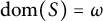



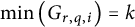

Proof Let
 $\bar {M}$
denote the transitive collapse of M. Let
 $\pi : M \rightarrow \bar {M}$
be the collapsing map and
 ${\pi }^{\ast }: \bar {M} \rightarrow M$
be the inverse of
 $\pi $
. Say that a is an approximation if:
-
(4)
$a \in {\left ( \mathbb{P}({\mathscr {A}}) \cap M \right )}^{< \omega } \times {\bar {M}}^{< \omega }$
; -
(5) writing
$a = \left \langle {\sigma }_{a}, {\tau }_{a} \right \rangle $
,
$\operatorname {\mathrm {dom}}({\sigma }_{a}) = \operatorname {\mathrm {dom}}({\tau }_{a})+1$
; -
(5)
${\sigma }_{a}(0) = p$
and
$\forall n < n+1 < \operatorname {\mathrm {dom}}({\sigma }_{a})\left [{\sigma }_{a}(n+1) \; {\leq }_{n} \; {\sigma }_{a}(n) \right ]$
; -
(7) for all
$k < \operatorname {\mathrm {dom}}({\tau }_{a})$
,
$\left | {\tau }_{a}(k) \right | \leq {2}^{k}$
; -
(8) for any
$k+1 < \operatorname {\mathrm {dom}}({\sigma }_{a})$
, any
$q' \; {\leq }_{k+1} \; {\sigma }_{a}(k+1)$
,
$F \subseteq k$
,
$r \leq q'$
, and
$i \in \omega $
, if
${F}_{r, q'} = F$
and
$k = \min \left ( {G}_{r, q', i} \right )$
, then
$$ \begin{align*} r(i+1, \{i\}) \; {\Vdash}_{\mathbb{P}({\mathscr{A}})} \; { f(k) \in \left\{ {\pi}^{\ast}(x): x \in {\tau}_{a}(k) \right\} }. \end{align*} $$













Let
 ${\mathbb{A}} = \{a: a \ \text {is an approximation}\}$
. Define a partial order on
 ${\mathbb{A}}$
by setting
 $\leq = \{\left \langle b, a \right \rangle \in {\mathbb{A}} \times {\mathbb{A}}: {\sigma }_{b} \supseteq {\sigma }_{a} \wedge {\tau }_{b} \supseteq {\tau }_{a}\}$
. It is easy to see that
 $\left \langle {\mathbb{A}}, \leq \right \rangle \in H({\aleph }_{1})$
. Note that even though M is a countable set, it does not belong to an intermediate extension by the first
 $\delta $
Cohen reals, for any
 $\delta < {\omega }_{1}$
. On the other hand,
 $\bar {M}$
, which is coded by a real, does appear in such an intermediate extension. The reason for using
 $\bar {M}$
instead of M is to ensure that both
 $\langle \mathbb{A}, \leq \rangle $
and the family of
 ${\aleph }_{1}$
many dense sets defined below appear in an extension by countably many Cohen reals.
For each
 $B \in {{\mathcal {I}}}^{{\mathbf {V}}}({\mathscr {A}})$
, define
 $$ \begin{align*} D(B) = \left\{ b \in {\mathbb{A}}: \exists l \in \omega \left[ l+1 \in \operatorname{\mathrm{dom}}({\sigma}_{b}) \wedge {c}_{{\sigma}_{b}(l+1)}(l) \cap B = \emptyset \right] \right\}. \end{align*} $$
Claim 12.12
 $D(B)$
is dense in
 $\left \langle {\mathbb{A}}, \leq \right \rangle $
.
Proof Let
 $a \in {\mathbb{A}}$
be given and put
 $k = \operatorname {\mathrm {dom}}({\tau }_{a})$
. Let
 $p' = {\sigma }_{a}(k)$
and
 $\mathring {x} = f(k)$
. Note that
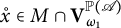 $\mathring {x} \in M \cap {{\mathbf {V}}}^{\mathbb{P}({\mathscr {A}})}_{{\omega }_{1}}$
and that
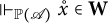 ${\Vdash }_{\mathbb{P}({\mathscr {A}})} \; {\mathring {x} \in {\mathbf {W}}}$
. Note also that
 $p' \in M$
. Let
 $Z = \{ z \in \omega : z \geq k \wedge {c}_{p'}(z) \cap B = \emptyset \}$
. By the definition of
 $\mathbb{P}({\mathscr {A}})$
,
 $Z \in {\left [\omega \right ]}^{\omega }$
. Let
 $\left \langle {z}_{l}: l \in \omega \right \rangle $
be the strictly increasing enumeration of Z. Define
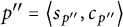 $p" = \left \langle {s}_{p"}, {c}_{p"} \right \rangle $
by setting
 ${s}_{p"} = {s}_{p'}$
,
 ${c}_{p"}(i) = {c}_{p'}(i)$
, for all
 $i < k$
, and
 ${c}_{p"}(k+l) = {c}_{p'}({z}_{l})$
, for all
 $l \in \omega $
. Then, it is clear that
 $p" \in \mathbb{P}({\mathscr {A}})$
and that
 $p" \; {\leq }_{k} \; p'$
. Applying Lemma 12.10 with p,” k, and
 $\mathring {x}$
, find
 ${q}^{\ast } \; {\leq }_{k} \; p" \; {\leq }_{k} \; p'$
and
 ${X}^{\ast } \in {\mathbf {W}}$
satisfying (1) and (2) of Lemma 12.10 with respect to p,” k, and
 $\mathring {x}$
. Notice that
 ${c}_{{q}^{\ast }}(k) \cap B = \emptyset $
. p” may not be in M, and so
 ${q}^{\ast }$
and
 ${X}^{\ast }$
may not be in M either. However,
 $p', \mathring {x}, {c}_{{q}^{\ast }}(k) \in M$
. Therefore, by elementarity and by the fact that M contains all the relevant parameters, there exist
 $q, X \in M$
satisfying the following properties:
-
(9)
$q \; {\leq }_{k} \; p'$
and
$\left | X \right | \leq {2}^{k}$
; -
(10) for any
$q' \; {\leq }_{k+1} \; q$
,
$F \subseteq k$
,
$r \leq q'$
, and
$i \in \omega $
, if
${F}_{r, q'} = F$
and
$k = \min \left ( {G}_{r, q', i} \right )$
, then
$r(i+1, \{i\}) \; {\Vdash }_{\mathbb{P}({\mathscr {A}})} \; {\mathring {x} \in X}$
; -
(11)
${c}_{q}(k) = {c}_{{q}^{\ast }}(k)$
.





Define
 ${\sigma }_{b} = {\sigma }_{a} \cup \left \{ \left \langle k+1, q \right \rangle \right \}$
. Next,
 $X \subseteq M$
, and so
 $\{\pi (x): x \in X\} \subseteq \bar {M}$
and
 $\left | \{\pi (x): x \in X\} \right | = \left | X \right | \leq {2}^{k}$
. Since
 $\bar {M}$
is a transitive model of a sufficiently large fragment of
 $\mathrm {ZFC} - \mathrm {P}$
and since
 $\{\pi (x): x \in X\}$
is a finite subset of
 $\bar {M}$
,
 $\{\pi (x): x \in X\} \in \bar {M}$
. Define
 ${\tau }_{b} = {\tau }_{a} \cup \left \{ \left \langle k, \{\pi (x): x \in X\} \right \rangle \right \}$
. Observe that
 $\left \{ {\pi }^{\ast }(y): y \in {\tau }_{b}(k) \right \} = X$
. Using these observations and (10), it is easy to verify that
 $b = \left \langle {\sigma }_{b}, {\tau }_{b} \right \rangle $
satisfies (4)–(8). Therefore,
 $b \in {\mathbb{A}}$
and
 $b \leq a$
. Finally,
 ${c}_{{\sigma }_{b}(k+1)}(k) \cap B = {c}_{{q}^{\ast }}(k) \cap B = \emptyset $
because of (11). Therefore,
 $l=k$
witnesses that
 $b \in D(B)$
, establishing the density of
 $D(B)$
.
Now note that
 ${\mathbb{A}}$
is non-empty because
 $\left \langle \left \{ \left \langle 0, p \right \rangle \right \}, \emptyset \right \rangle \in {\mathbb{A}}$
. As we have observed earlier,
 $\left \langle {\mathbb{A}}, \leq \right \rangle \in H({\aleph }_{1})$
. Hence, there exists
 $\delta < {\omega }_{1}$
such that
 $\left \langle {\mathbb{A}}, \leq \right \rangle \in {{\mathbf {V}}}_{\delta }$
, where
 ${{\mathbf {V}}}_{\delta }$
is the extension of
 ${\mathbf {V}}$
by the first
 $\delta $
Cohen reals. Further, for
 $B \in {{\mathcal {I}}}^{{\mathbf {V}}}({\mathscr {A}})$
,
 $D(B) \in {{\mathbf {V}}}_{\delta }$
because
 $D(B)$
has an absolute definition in terms of the parameters
 ${\mathbb{A}}$
and B. Since
 $\left \langle {\mathbb{A}}, \leq \right \rangle $
is a countable forcing notion, there exists
 $H \in {\mathbf {W}}$
which is
 $\left ( {{\mathbf {V}}}_{\delta }, {\mathbb{A}} \right )$
-generic. Define
 $P = \bigcup \left \{ {\sigma }_{a}: a \in H \right \}$
and
 $T = \bigcup \left \{ {\tau }_{a}: a \in H \right \}$
. Then, P and T are functions and
 $\operatorname {\mathrm {dom}}(P) = \sup \left \{ \operatorname {\mathrm {dom}}({\sigma }_{a}): a \in H \right \}$
.
Claim 12.13
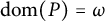 $\operatorname {\mathrm {dom}}(P) = \omega $
.
Proof The construction in the proof of Claim 12.12 shows that for every
 $a \in \mathbb{A}$
, there exists
 $b \leq a$
with
 ${\mathrm {dom}}({\tau }_{b}) = {\mathrm {dom}}({\tau }_{a})+1$
. This claim can be proved by iterating this construction. However, we prefer an argument that refers only to the statement of Claim 12.12 instead of its proof.
Suppose not. Then,
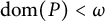 $\operatorname {\mathrm {dom}}(P) < \omega $
. Let
 $B = \bigcup \left \{ {c}_{P(l+1)}(l): l+1 \in \operatorname {\mathrm {dom}}(P) \right \}$
. Since
 $\operatorname {\mathrm {dom}}(P)$
is finite, B is a finite subset of
 $\omega $
, whence
 $B \in {{\mathcal {I}}}^{{\mathbf {V}}}({\mathscr {A}})$
. Consider
 $a \in H \cap D(B)$
. By definition of
 $D(B)$
, there exists
 $l+1 \in \operatorname {\mathrm {dom}}({\sigma }_{a})$
such that
 ${c}_{{\sigma }_{a}(l+1)}(l) \cap B = \emptyset $
. It follows that
 $l+1 \in \operatorname {\mathrm {dom}}(P)$
and
 $B \supseteq {c}_{P(l+1)}(l) = {c}_{{\sigma }_{a}(l+1)}(l)$
, whence
 ${c}_{{\sigma }_{a}(l+1)}(l) = \emptyset $
. But this is impossible by Clause (2) of Definition 12.3.
For
 $n \in \omega $
, define
 ${p}_{n} = P(n)$
. Then,
 ${p}_{0} = p$
,
 $\forall n \in \omega \left [{p}_{n} \in \mathbb{P}({\mathscr {A}})\right ]$
, and
 $\forall n \in \omega \left [{p}_{n+1} \; {\leq }_{n} \; {p}_{n}\right ]$
. Define
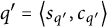 $q' = \left \langle {s}_{q'}, {c}_{q'} \right \rangle $
by setting
 ${s}_{q'} = {s}_{{p}_{1}}$
and
 ${c}_{q'}(n) = {c}_{{p}_{n+1}}(n)$
, for all
 $n \in \omega $
. Now, if
 $B \in {{\mathcal {I}}}^{{\mathbf {V}}}({\mathscr {A}})$
, then for some
 $b \in H$
and for some
 $l \in \omega $
,
 ${c}_{{p}_{l+1}}(l) \cap B = \emptyset $
, whence
 ${c}_{q'}(l) \cap B = \emptyset $
. Thus, by Lemma 12.6,
 $q' \in \mathbb{P}({\mathscr {A}})$
and
 $\forall n \in \omega \left [q' \; {\leq }_{n} \; {p}_{n}\right ]$
. In particular,
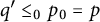 $q' \; {\leq }_{0} \; {p}_{0} = p$
, which is to say that
 $q' \leq p$
. Next, for each
 $k \in \omega $
,
 $T(k) \in \bar {M}$
and
 $\left | T(k) \right | \leq {2}^{k}$
.
 $T(k) \subseteq \bar {M}$
because
 $\bar {M}$
is transitive. Defining
 $S(k) = \{{\pi }^{\ast }(y): y \in T(k)\} \subseteq M$
,
 $\left | S(k) \right | = \left | \{{\pi }^{\ast }(y): y \in T(k)\} \right | = \left | T(k) \right | \leq {2}^{k}$
. Thus, (1) and (2) are satisfied by
 $q'$
and S. To see that (3) is satisfied, fix
 $k \in \omega $
,
 $F \subseteq k$
,
 $r \leq q'$
, and
 $i \in \omega $
. Assume that
 ${F}_{r, q'} = F$
and
 $\min \left ( {G}_{r, q', i} \right ) = k$
. Note that
 $q' \; {\leq }_{k+1} \; {p}_{k+1}$
and that
 ${p}_{k+1} = {\sigma }_{a}(k+1)$
, for some
 $a \in H$
. Hence, by (8),
 $$ \begin{align*} r(i+1, \{i\}) \; {\Vdash}_{\mathbb{P}({\mathscr{A}})} \; {f(k) \in \left\{ {\pi}^{\ast}(x): x \in {\tau}_{a}(k) \right\} = \left\{ {\pi}^{\ast}(x): x \in T(k) \right\} = S(k)}. \end{align*} $$
This concludes the proof.
We remark that even though the filter H and the function T belong to an intermediate extension of the form
 ${{\mathbf {V}}}_{\delta }$
, for some
 $\delta < {\omega }_{1}$
, this is not the case for S. This is because the functions
 $\pi $
and
 ${\pi }^{\ast }$
are not in any intermediate
 ${{\mathbf {V}}}_{\delta }$
with
 $\delta < {\omega }_{1}$
.
Corollary 12.14
 $\mathbb{P}({\mathscr {A}})$
is proper.
Proof Working in
 ${\mathbf {W}}$
, fix a countable
 $M \prec H(\theta )$
, where
 $\theta $
is a sufficiently large regular cardinal and M contains the relevant parameters. Let
 $\left \langle {\mathring {\alpha }}_{n}: n \in \omega \right \rangle $
be an enumeration of all
 $\mathring {\alpha } \in M$
such that
 $\mathring {\alpha }$
is a
 $\mathbb{P}({\mathscr {A}})$
-name and
 ${\Vdash }_{\mathbb{P}({\mathscr {A}})} \; {"\mathring {\alpha } \ \text {is an ordinal}}$
.” Define a function
 $f: \omega \rightarrow M$
as follows. Suppose
 $k \in \omega $
. Consider a
 $\left ( {\mathbf {W}}, \mathbb{P}({\mathscr {A}}) \right )$
-generic filter G. In
 ${\mathbf {W}}\left [G\right ]$
,
 $\{{\mathring {\alpha }}_{0}\left [G\right ], \dotsc , {\mathring {\alpha }}_{k}\left [G\right ]\}$
is a finite set of ordinals and so
 $\{{\mathring {\alpha }}_{0}\left [G\right ], \dotsc , {\mathring {\alpha }}_{k}\left [G\right ]\} \in {\mathbf {W}}$
. Applying the Maximality Principle in
 ${\mathbf {W}}$
, there is a
 $\mathbb{P}({\mathscr {A}})$
-name
 $\mathring {x}$
such that
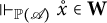 ${\Vdash }_{\mathbb{P}({\mathscr {A}})} \; {\mathring {x} \in {\mathbf {W}}}$
and
 $$ \begin{align*} {\Vdash}_{\mathbb{P}({\mathscr{A}})} \; {"\forall y\left[y \in \mathring{x} \leftrightarrow \left( y = {\mathring{\alpha}}_{0} \vee \dotsb \vee y = {\mathring{\alpha}}_{k} \right)\right]}.\text{"} \end{align*} $$
Since
 ${\mathring {\alpha }}_{0}, \dotsc , {\mathring {\alpha }}_{k} \in M$
, we may choose such an
 $\mathring {x} \in M$
. Define
 $f(k) = \mathring {x} \in M$
. Notice that
 ${\Vdash }_{\mathbb{P}({\mathscr {A}})} \; {"f(k) \ \text {is finite}}$
” and that
 ${\Vdash }_{\mathbb{P}({\mathscr {A}})} \; {{\mathring {\alpha }}_{l} \in f(k)}$
, for every
 $l \leq k$
.
Unfix k from the previous paragraph. Fix any
 $p \in \mathbb{P}({\mathscr {A}}) \cap M$
. We must find
 $q \leq p$
which is
 $(M, \mathbb{P}({\mathscr {A}}))$
-generic. Applying Lemma 12.11, find q and S satisfying (1)–(3) of Lemma 12.11. We argue that q is
 $(M, \mathbb{P}({\mathscr {A}}))$
-generic. To this end, it suffices to show that for any
 $\mathring {\alpha } \in M$
, if
 ${\Vdash }_{\mathbb{P}({\mathscr {A}})} \; {"\mathring {\alpha } \ \text {is an ordinal}}$
,” then
 $q \; {\Vdash }_{\mathbb{P}({\mathscr {A}})} \; {\mathring {\alpha } \in M}$
. Let a relevant
 $\mathring {\alpha }$
be given. Then,
 $\mathring {\alpha } = {\mathring {\alpha }}_{l}$
, for some
 $l < \omega $
. Suppose
 $r \leq q$
. Let
 $F = {F}_{r, q}$
. Since
 $\left \langle \min \left ( {G}_{r, q, i} \right ): i \in \omega \right \rangle $
is a strictly increasing sequence, it is possible to find
 $k, i \in \omega $
such that
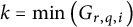 $k = \min \left ( {G}_{r, q, i} \right )$
,
 $F \subseteq k$
, and
 $k \geq l$
. By (3) of Lemma 12.11,
 $r(i+1, \{i\}) \; {\Vdash }_{\mathbb{P}({\mathscr {A}})} \; {f(k) \in S(k) \subseteq M}$
. Find
 $r' \leq r(i+1, \{i\}) \leq r$
and
 $X \in M$
with
 $r' \; {\Vdash }_{\mathbb{P}({\mathscr {A}})} \; {f(k)=X}$
. Since we know
 ${\Vdash }_{\mathbb{P}({\mathscr {A}})} \; {"f(k) \ \text {is finite}}$
,” it follows that X is finite, and since
 $X \in M$
,
 $X \subseteq M$
. Thus,
 $r' \; {\Vdash }_{\mathbb{P}({\mathscr {A}})} \; {{\mathring {\alpha }}_{l} \in f(k)=X \subseteq M}$
, whence
 $r' \; {\Vdash }_{\mathbb{P}({\mathscr {A}})} \; {{\mathring {\alpha }}_{l} \in M}$
. Thus, we have proved that
 $\forall r \leq q \exists r' \leq r\left [r' \; {\Vdash }_{\mathbb{P}({\mathscr {A}})} \; {{\mathring {\alpha }}_{l} \in M}\right ]$
, whence
 $q \; {\Vdash }_{\mathbb{P}({\mathscr {A}})} \; {{\mathring {\alpha }}_{l} \in M}$
. This proves that
 $\mathbb{P}({\mathscr {A}})$
is proper.
Lemma 12.15 In
 ${\mathbf {V}}$
, suppose
 ${<}_{\mathtt {wo}}$
is a well-ordering of
 $H(\omega )$
, and that
 ${\mathcal {F}} \subseteq {H(\omega )}^{\omega }$
is well-closed w.r.t.
 ${<}_{\mathtt {wo}}$
and is big. Then, in
 ${\mathbf {W}}$
,
 ${\Vdash }_{\mathbb{P}({\mathscr {A}})} \; {{\mathcal {F}} \ \text {is big}}$
.
Proof Work in
 ${\mathbf {W}}$
.
 ${\mathcal {F}}$
is well-closed w.r.t.
 ${<}_{\mathtt {wo}}$
because
 ${{\mathbb{C}}}_{{\omega }_{1}}$
is proper and
 ${\mathcal {F}}$
is big by Corollary 11.15. Fix a
 $\mathbb{P}({\mathscr {A}})$
name
 $\mathring {g}$
and assume that
 ${\Vdash }_{\mathbb{P}({\mathscr {A}})} \; {\mathring {g}: \omega \rightarrow H(\omega )}$
. Let
 $p \in \mathbb{P}({\mathscr {A}})$
be fixed. Let
 $\theta $
be a sufficiently large regular cardinal. Suppose
 $M \prec H(\theta )$
is countable with M containing all the relevant parameters. In particular,
 $\mathring {g}, p \in M$
. Define
 $f: \omega \rightarrow M$
as follows. For each
 $k \in \omega $
, find a
 $\mathbb{P}({\mathscr {A}})$
-name
 $\mathring {x} \in M$
such that
 ${\Vdash }_{\mathbb{P}({\mathscr {A}})} \; {\mathring {x} \in H(\omega )}$
and
 ${\Vdash }_{\mathbb{P}({\mathscr {A}})} \; {\mathring {g}(k)=\mathring {x}}$
, and define
 $f(k) = \mathring {x}$
. Applying Lemma 12.11, find q and S satisfying (1)–(3) of Lemma 12.11. Note that for each
 $k \in \omega $
,
 $\left | S(k) \cap H(\omega ) \right | \leq \left | S(k) \right | \leq {2}^{k}$
, and so
 $S(k) \cap H(\omega )$
is a finite subset of
 $H(\omega )$
, which implies that
 $S(k) \cap H(\omega ) \in H(\omega )$
. Hence, we may define a small slalom
 ${S}^{\ast }: \omega \rightarrow H(\omega )$
by
 ${S}^{\ast }(k) = S(k) \cap H(\omega )$
, for all
 $k \in \omega $
.
Next, define sequences
 $\left \langle {{\mathscr {A}}}_{l}: l \in \omega \right \rangle \subseteq {\left [{\mathscr {A}}\right ]}^{< \omega }$
and
 $\left \langle {Y}_{l}: l \in \omega \right \rangle \subseteq {\left [\omega \right ]}^{\omega }$
as follows. Fix
 $l \in \omega $
and suppose that
 $\left \langle {{\mathscr {A}}}_{l'}: l' < l \right \rangle \subseteq {\left [{\mathscr {A}}\right ]}^{< \omega }$
and
 $\left \langle {Y}_{l'}: l' < l \right \rangle \subseteq {\left [\omega \right ]}^{\omega }$
are already given. By the definition of
 $\mathbb{P}({\mathscr {A}})$
, the family
 $$ \begin{align*} {\mathcal{E}} = \left\{s \in \operatorname{\mathrm{ran}}({c}_{q}): s \cap \left( \bigcup{\left( {\bigcup}_{l' < l}{{{\mathscr{A}}}_{l'}} \right)} \right) = \emptyset \right\} \end{align*} $$
has the property that
 $\forall B \in {\mathcal {I}}({\mathscr {A}}) \exists s \in {\mathcal {E}}\left [s \cap B = \emptyset \right ]$
. Since
 ${\mathscr {A}}$
is assumed to be block Shelah–Steprāns in
 ${\mathbf {W}}$
, there exists
 $B \in {\mathcal {I}}({\mathscr {A}})$
with the property that
 $\{y \in \omega : {c}_{q}(y) \in {\mathcal {E}} \wedge {c}_{q}(y) \subseteq B\}$
is infinite. Clearly, for every
 $F \in {\left [\omega \right ]}^{< \omega }$
, the set
 $\{y \in \omega : {c}_{q}(y) \in {\mathcal {E}} \wedge {c}_{q}(y) \subseteq B \setminus F\}$
is still infinite. Therefore, there exists
 ${{\mathscr {A}}}^{\ast } \in {\left [{\mathscr {A}}\right ]}^{< \omega }$
such that
 $\{y \in \omega : {c}_{q}(y) \in {\mathcal {E}} \wedge {c}_{q}(y) \subseteq \bigcup {{{\mathscr {A}}}^{\ast }}\}$
is infinite. Let
 ${{\mathscr {A}}}_{l}$
be such an
 ${{\mathscr {A}}}^{\ast }$
of minimal cardinality. Define
 ${Y}_{l} = \{y \in \omega : {c}_{q}(y) \in {\mathcal {E}} \wedge {c}_{q}(y) \subseteq \bigcup {{{\mathscr {A}}}_{l}}\} \in {\left [\omega \right ]}^{\omega }$
. Suppose that
 $A \in {{\mathscr {A}}}_{l'} \cap {{\mathscr {A}}}_{l}$
, for some
 $l' < l$
. Then, for each
 $y \in {Y}_{l}$
,
 ${c}_{q}(y) \cap A = \emptyset $
and
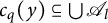 ${c}_{q}(y) \subseteq \bigcup {{{\mathscr {A}}}_{l}}$
, whence
 ${c}_{q}(y) \subseteq \bigcup {\left ( {{\mathscr {A}}}_{l} \setminus \{A\} \right )}$
, contradicting the minimality of
 ${{\mathscr {A}}}_{l}$
. Therefore,
 $\forall l' < l\left [{{\mathscr {A}}}_{l'} \cap {{\mathscr {A}}}_{l} = \emptyset \right ]$
. This concludes the definition of
 $\left \langle {{\mathscr {A}}}_{l}: l \in \omega \right \rangle $
and
 $\left \langle {Y}_{l}: l \in \omega \right \rangle $
.
Since
 ${\mathcal {F}}$
is big and is well-closed w.r.t.
 ${<}_{\mathtt {wo}}$
in
 ${\mathbf {W}}$
, Lemma 11.5 applies and implies that there exists
 $T \in {\mathcal {F}}$
such that
 $T: \omega \rightarrow H(\omega )$
is a slalom and
 $\forall l \in \omega {\exists }^{\infty } y \in {Y}_{l}\left [{S}^{\ast }(y) \subseteq T(y)\right ]$
. Define
 ${Z}_{l} = \{ y \in {Y}_{l}: {S}^{\ast }(y) \subseteq T(y) \} \in {\left [\omega \right ]}^{\omega }$
, for all
 $l \in \omega $
. Let
 $Z = {\bigcup }_{l \in \omega }{{Z}_{l}}$
and let
 $\left \langle {z}_{j}: j < \omega \right \rangle $
be the strictly increasing enumeration of Z. Define
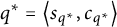 ${q}^{\ast } = \left \langle {s}_{{q}^{\ast }}, {c}_{{q}^{\ast }} \right \rangle $
by
 ${s}_{{q}^{\ast }} = {s}_{q}$
and
 ${c}_{{q}^{\ast }}(j) = {c}_{q}({z}_{j})$
, for all
 $j \in \omega $
. Consider any
 $B \in {{\mathcal {I}}}^{{\mathbf {V}}}({\mathscr {A}})$
. Since
 $\forall l' < l < \omega \left [{{\mathscr {A}}}_{l'} \cap {{\mathscr {A}}}_{l} = \emptyset \right ]$
, there exists
 $l, m \in \omega $
such that
 $B \cap \left ( \bigcup {{{\mathscr {A}}}_{l}} \right ) \subseteq m$
. As
 ${Z}_{l}$
is infinite, we can find
 $y \in {Z}_{l}$
with
 $\min ({c}_{q}(y)) \geq m$
. As
 $y \in {Y}_{l}$
,
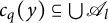 ${c}_{q}(y) \subseteq \bigcup {{{\mathscr {A}}}_{l}}$
, whence
 $B \cap {c}_{q}(y) = \emptyset $
. Now,
 $y = {z}_{j}$
for some
 $j < \omega $
because
 $y \in Z$
. Therefore,
 ${c}_{{q}^{\ast }}(j) \cap B = {c}_{q}({z}_{j}) \cap B = {c}_{q}(y) \cap B = \emptyset $
. This shows that
 ${q}^{\ast } \in \mathbb{P}({\mathscr {A}})$
and that
 ${q}^{\ast } \leq q$
.
We will now argue that
 ${q}^{\ast } \; {\Vdash }_{\mathbb{P}({\mathscr {A}})} \; {{\exists }^{\infty } k \in \omega \left [\mathring {g}(k) \in T(k)\right ]}$
. To this end, fix
 $r \leq {q}^{\ast }$
and some
 $l \in \omega $
. As
 $r \leq q$
,
 $\left \langle \min \left ( {G}_{r, q, i} \right ): i < \omega \right \rangle $
is a strictly increasing sequence. Let
 ${F}_{r, q} = F$
. Find
 $k, i \in \omega $
such that
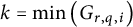 $k = \min \left ( {G}_{r, q, i} \right )$
,
 $F \subseteq k$
, and
 $k \geq l$
. It follows from the fact that
 $r \leq {q}^{\ast } \leq q$
and from the definition of
 ${q}^{\ast }$
that
 $k \in Z$
. In particular,
 ${S}^{\ast }(k) \subseteq T(k)$
. By (3) of Lemma 12.11,
 $$ \begin{align*} r(i+1, \{i\}) \; {\Vdash}_{\mathbb{P}({\mathscr{A}})} \; {\mathring{g}(k) = f(k) \in S(k) \cap H(\omega) = {S}^{\ast}(k) \subseteq T(k)}, \end{align*} $$
whence
 $r(i+1, \{i\}) \; {\Vdash }_{\mathbb{P}({\mathscr {A}})} \; {\mathring {g}(k) \in T(k)}$
. Since
 $r(i+1, \{i\}) \leq r$
, we have proved that for each
 $r \leq {q}^{\ast }$
and
 $l \in \omega $
, there exists
 $k \geq l$
and
 $r' \leq r$
with
 $r' \; {\Vdash }_{\mathbb{P}({\mathscr {A}})} \; {\mathring {g}(k) \in T(k)}$
. This proves that
 ${q}^{\ast } \; {\Vdash }_{\mathbb{P}({\mathscr {A}})} \; {{\exists }^{\infty } k \in \omega \left [\mathring {g}(k) \in T(k)\right ]}$
. Since
 ${q}^{\ast } \leq q \leq p$
, we have now proved that for any
 $\mathring {g} \in {{\mathbf {V}}}^{\mathbb{P}({\mathscr {A}})}_{{\omega }_{1}}$
and any
 $p \in \mathbb{P}({\mathscr {A}})$
, if
 ${\Vdash }_{\mathbb{P}({\mathscr {A}})} \; {\mathring {g}: \omega \rightarrow H(\omega )}$
, then there exist
 ${q}^{\ast } \leq p$
and
 $T \in {\mathcal {F}}$
such that
 $T: \omega \rightarrow H(\omega )$
is a slalom and
 ${q}^{\ast } \; {\Vdash }_{\mathbb{P}({\mathscr {A}})} \; {{\exists }^{\infty } k \in \omega \left [\mathring {g}(k) \in T(k)\right ]}$
.
To complete the proof, let G be a
 $\left ( {\mathbf {W}}, \mathbb{P}({\mathscr {A}}) \right )$
-generic filter. As
 $\mathbb{P}({\mathscr {A}})$
is proper,
 ${\mathcal {F}}$
is well-closed w.r.t.
 ${<}_{\mathtt {wo}}$
in
 ${\mathbf {W}}\left [G\right ]$
. By what has been proved above, we have in
 ${\mathbf {W}}\left [G\right ]$
that for every
 $g: \omega \rightarrow H(\omega )$
, there exists
 $T \in {\mathcal {F}}$
such that
 $T: \omega \rightarrow H(\omega )$
is a slalom and
 ${\exists }^{\infty } k \in \omega \left [g(k) \in T(k)\right ]$
. As
 ${\mathcal {F}}$
is well-closed w.r.t.
 ${<}_{\mathtt {wo}}$
in
 ${\mathbf {W}}\left [G\right ]$
, Lemma 11.7 tells us that
 ${\mathcal {F}}$
is big in
 ${\mathbf {W}}\left [G\right ]$
.
Note the similarity in the proofs of Lemmas 11.14 and 12.15. Also, the proof of Lemma 12.15 is the only place where we use the assumption that
 ${\mathscr {A}}$
is block Shelah–Steprāns.
Lemma 12.16
 $\mathbb{P}({\mathscr {A}})$
diagonalizes
 ${\mathscr {A}}$
.
Proof Let
 $\mathring {A}$
be a
 $\mathbb{P}({\mathscr {A}})$
-name such that
 ${\Vdash }_{\mathbb{P}({\mathscr {A}})} \; {\mathring {A} = \bigcup \left \{ {s}_{p}: p \in \mathring {G} \right \}}$
, where
 $\mathring {G}$
is the canonical
 $\mathbb{P}({\mathscr {A}})$
-name for a generic filter over
 $\mathbb{P}({\mathscr {A}})$
. Suppose
 $p \in \mathbb{P}({\mathscr {A}})$
and
 $B \in {\mathscr {A}}$
are given. Then,
 $Z = \{z \in \omega : {c}_{p}(z) \cap B = \emptyset \} \in {\left [\omega \right ]}^{\omega }$
. Let
 $\left \langle {z}_{j}: j < \omega \right \rangle $
be the strictly increasing enumeration of Z. Define
 $q = \left \langle {s}_{q}, {c}_{q} \right \rangle $
by setting
 ${s}_{q} = {s}_{p}$
and
 ${c}_{q}(j) = {c}_{p}({z}_{j})$
, for all
 $j < \omega $
. Then,
 $q \leq p$
and
 $q \; {\Vdash }_{\mathbb{P}({\mathscr {A}})} \; {\left | \mathring {A} \cap B \right | < \omega }$
.
The following corollary is worth stating even though it is not directly used in the proof of our main result in the next section.
Corollary 12.17 Any Shelah–Steprāns a.d. family in
 ${\mathbf {V}}$
can be diagonalized without increasing
 $\operatorname {\mathrm {non}}(\mathcal {M})$
. Any block Shelah–Steprāns a.d. family in
 ${\mathbf {V}}$
which remains block Shelah–Steprāns after adding Cohen reals can be diagonalized without increasing
 $\operatorname {\mathrm {non}}(\mathcal {M})$
.
Proof If
 ${\mathscr {A}}$
is a Shelah–Steprāns a.d. family, then
 ${\mathscr {A}}$
remains Shelah–Steprāns, and hence block Shelah–Steprāns, after adding Cohen reals (see Lemma 12.2). Hence,
 ${{\mathbb{C}}}_{{\omega }_{1}} \ast \mathring {\mathbb{P}}({\mathscr {A}})$
will diagonalize
 ${\mathscr {A}}$
and not increase
 $\operatorname {\mathrm {non}}(\mathcal {M})$
.
12.2 A model where the uniformity of
$\mathcal {M}$
is
$\aleph _{1}$
and there are no block Shelah–Steprāns a.d. families of size
$\aleph _{1}$


Theorem 12.18 There is a model in which
 $\mathsf{non}(\mathcal {M}) = \aleph _1$
and there are no block Shelah–Steprāns a.d. families of size
 $\aleph _1$
.
Proof Shelah–Steprāns a.d. families are block Shelah–Steprāns. We will produce a model where
 $\operatorname {\mathrm {non}}(\mathcal {M}) = {\aleph }_{1}$
and there are no block Shelah–Steprāns a.d. families of size
 ${\aleph }_{1}$
. Let
 ${\mathbf {V}}$
be a universe satisfying
 $\mathrm {GCH}$
(in fact, we just need CH and
 $2^{\omega _{1}}=\omega _{2}$
). In
 ${\mathbf {V}}$
, let
 ${<}_{\mathtt {wo}}$
be a well-ordering of
 $H(\omega )$
and let
 ${\mathcal {F}} = {\mathbf {V}} \cap {H(\omega )}^{\omega }$
. Then,
 ${\mathcal {F}}$
is well-closed w.r.t.
 ${<}_{\mathtt {wo}}$
in
 ${\mathbf {V}}$
.
 ${\mathcal {F}}$
is also big in
 ${\mathbf {V}}$
. Build a CS iteration
 $\left \langle {\mathbb{P}}_{\alpha }; {\mathring {\mathbb{Q}}}_{\alpha }: \alpha \leq {\omega }_{2} \right \rangle $
as follows. Using
 $\mathrm {GCH}$
in
 ${\mathbf {V}}$
, fix a bookkeeping device which has the property that any
 ${\mathbb{P}}_{{\omega }_{2}}$
-name for a set of reals of size
 ${\aleph }_{1}$
will be enumerated cofinally often. At a stage
 $\alpha < {\omega }_{2}$
, suppose
 ${\mathbb{P}}_{\alpha }$
is given. Assume
 ${\mathbb{P}}_{\alpha }$
is proper and
 ${\Vdash }_{\alpha } \; {{\mathcal {F}} \ \text {is big}}$
. Suppose the bookkeeping device hands us a
 ${\mathbb{P}}_{\alpha }$
-name
 $\mathring {{\mathscr {A}}}$
such that
 $$ \begin{align*} {\Vdash}_{\alpha} \; {"\mathring{{\mathscr{A}}} \subseteq {\left[\omega\right]}^{\omega} \ \text{is an infinite a.d. family}}.\text{"} \end{align*} $$
Let
 ${G}_{\alpha }$
be a
 $\left ( {\mathbf {V}}, {\mathbb{P}}_{\alpha } \right )$
-generic filter. In
 ${\mathbf {V}}\left [{G}_{\alpha }\right ]$
, either
 $$ \begin{align*} {\Vdash}_{{{\mathbb{C}}}_{{\omega}_{1}}} \; {"\mathring{{\mathscr{A}}}\left[{G}_{\alpha}\right] \ \text {is not block Shelah}-\text{Stepr}\bar{a}\text{ns}\text{"}} \end{align*} $$
or
 ${\Vdash }_{{{\mathbb{C}}}_{{\omega }_{1}}} \; {"\mathring {{\mathscr {A}}}\left [{G}_{\alpha }\right ] \ \text {is not block Shelah}-\text{Stepr}\bar{a}\text{ns}}$
” because
 ${{\mathbb{C}}}_{{\omega }_{1}}$
is almost homogeneous. If the first alternative happens, then let
 $\mathbb{Q}$
be
 ${{\mathbb{C}}}_{{\omega }_{1}} \ast \mathring {\mathbb{P}}(\mathring {{\mathscr {A}}}\left [{G}_{\alpha }\right ])$
. If the second alternative happens, then let
 $\mathbb{Q}$
be
 ${{\mathbb{C}}}_{{\omega }_{1}}$
. Back in
 ${\mathbf {V}}$
, let
 ${\mathring {\mathbb{Q}}}_{\alpha }$
be a full
 ${\mathbb{P}}_{\alpha }$
-name for
 $\mathbb{Q}$
. If the bookkeeping device does not hand us a
 ${\mathbb{P}}_{\alpha }$
-name of the form
 $\mathring {{\mathscr {A}}}$
, then we let
 ${\mathring {\mathbb{Q}}}_{\alpha }$
be a full
 ${\mathbb{P}}_{\alpha }$
-name for the trivial forcing. Observe that
 ${\Vdash }_{\alpha } \; {"{\Vdash }_{{\mathring {\mathbb{Q}}}_{\alpha }} \; {\mathring {{\mathscr {A}}} \ \text {is not block Shelah}-\text{Stepr}\bar{a}\text{ns}}}$
” (if an appropriate
 $\mathring {{\mathscr {A}}}$
is given) and that
 ${\Vdash }_{\alpha } \; {"{\Vdash }_{{\mathring {\mathbb{Q}}}_{\alpha }} \; {{\mathcal {F}} \ \text {is big}}}$
.” This concludes the construction.
Let
 ${G}_{{\omega }_{2}}$
be a
 $\left ( {\mathbf {V}}, {\mathbb{P}}_{{\omega }_{2}} \right )$
-generic filter. In
 ${\mathbf {V}}\left [{G}_{{\omega }_{2}}\right ]$
, by Corollary 11.13,
 ${\mathcal {F}}$
is big. Therefore, by Lemma 11.2,
 ${2}^{\omega } \cap {\mathbf {V}}$
is non-meager in
 ${\mathbf {V}}\left [{G}_{{\omega }_{2}}\right ]$
. Therefore,
 $\operatorname {\mathrm {non}}(\mathcal {M}) = {\aleph }_{1}$
in
 ${\mathbf {V}}\left [{G}_{{\omega }_{2}}\right ]$
.
Next, suppose for a contradiction that in
 ${\mathbf {V}}\left [{G}_{{\omega }_{2}}\right ]$
, there exists
 ${\mathscr {A}} \subseteq {\left [\omega \right ]}^{\omega }$
which is a block Shelah–Steprāns a.d. family with
 $\left | {\mathscr {A}} \right | = {\aleph }_{1}$
. For
 $\gamma \leq {\omega }_{2}$
,
 ${G}_{\gamma }$
denotes the restriction of
 ${G}_{{\omega }_{2}}$
to
 ${\mathbb{P}}_{\gamma }$
. There exists
 $\xi < {\omega }_{2}$
such that
 ${\mathscr {A}} \in {\mathbf {V}}\left [{G}_{\xi }\right ]$
. Since the property of being a block Shelah–Steprāns a.d. family is downward absolute,
 ${\mathscr {A}}$
is a block Shelah–Steprāns a.d. family in
 ${\mathbf {V}}\left [{G}_{\gamma }\right ]$
, for all
 $\xi \leq \gamma \leq {\omega }_{2}$
. The bookkeeping device ensured that for some
 $\xi \leq \alpha < {\omega }_{2}$
, a
 ${\mathbb{P}}_{\alpha }$
-name
 $\mathring {{\mathscr {A}}}$
such that
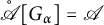 $\mathring {{\mathscr {A}}}\left [{G}_{\alpha }\right ] = {\mathscr {A}}$
was considered at stage
 $\alpha $
. By the choice of
 ${\mathring {\mathbb{Q}}}_{\alpha }$
,
 ${\Vdash }_{\alpha +1} \; {"\mathring {{\mathscr {A}}} \ \text {is not block Shelah}-\text{Stepr}\bar{a}\text{ns}}$
.” This is a contradiction because
 ${\mathscr {A}} = \mathring {{\mathscr {A}}}\left [{G}_{\alpha }\right ] = \mathring {{\mathscr {A}}}\left [{G}_{\alpha +1}\right ]$
is block Shelah–Steprāns in
 ${\mathbf {V}}\left [{G}_{\alpha +1}\right ]$
.
Note that since
 $\max \{\mathfrak {b}, \mathfrak {s}\} \leq \operatorname {\mathrm {non}}(\mathcal {M})$
,
 $\mathfrak {b} = \mathfrak {s} = {\aleph }_{1}$
holds in the model
 ${\mathbf {V}}\left [{G}_{{\omega }_{2}}\right ]$
constructed above. We do not know the value of the almost disjointment number in this model.
Problem 12.19 What is the value of
 $\mathfrak {a}$
in the model of Theorem 12.18?
We also do not know the following.
Conjecture 12.20 There are Shelah–Steprāns a.d. families in the model
 ${\mathbf {V}}\left [{G}_{{\omega }_{2}}\right ]$
constructed in the proof of Theorem 12.18 (necessarily of size
 ${\aleph }_{2}$
).
A model with no Shelah–Steprāns MAD families is constructed in [Reference Raghavan66]. As noted in the proof of Theorem 10.1, this follows from Theorem 5.15 and the fact that the model constructed in [Reference Raghavan66] satisfies
 $\mathfrak {b} = \mathfrak {c}$
. This model is gotten by iterating posets of the form
 ${\mathbb{L}}({\mathcal {G}})$
, where
 ${\mathcal {G}}$
is some non-principal filter on a countably infinite set. Since posets of this form always add dominating reals,
 $\mathfrak {c} = \mathfrak {b}> {\aleph }_{1}$
holds in the model of [Reference Raghavan66]. Hence, the following question would need a new type of model with no Shelah–Steprāns m.a.d. families.
Question 12.21 Is it consistent that there are no Shelah–Steprāns m.a.d. families and
 $\operatorname {\mathrm {non}}(\mathcal {M}) = {\aleph }_{1}$
?
Acknowledgements
We would like to thank both referees for their comments. Their suggestions greatly improved the article.



