Introduction
Childhood maltreatment is one of the most prevalent early adverse experiences (Stoltenborgh et al., Reference Stoltenborgh, Bakermans-Kranenburg, Alink and van Ijzendoorn2015), which includes physical neglect, physical abuse, emotional neglect, emotional abuse, and sexual abuse (Bernstein et al., Reference Bernstein, Stein, Newcomb, Walker, Pogge, Ahluvalia, Stokes, Handelsman, Medrano, Desmond and Zule2003). Empirical evidence has linked childhood maltreatment to mental health symptoms among adolescents, especially internalizing problems (Wu et al., Reference Wu, Liu, Chan, Wang, Zhao, Sun, Shen and Wang2022; Zhang et al., Reference Zhang, Liao, Gu and Wang2022). For adolescents, depression and anxiety emerge as the two most prevalent internalizing problems (Zahn-Waxler et al., Reference Zahn-Waxler, Shirtcliff and Marceau2008), and both are positively associated with childhood maltreatment (Zhang et al., Reference Zhang, Liao, Gu and Wang2022). Childhood maltreatment was also a distal risk factor of maladaptive cognitive emotion regulation strategies (MCERS) (Morris et al., Reference Morris, Silk, Steinberg, Myers and Robinson2007), which are generally conceptualized as a contributing factor to internalizing problems (Dawel et al., Reference Dawel, Shou, Gulliver, Cherbuin, Banfield, Murray, Calear, Morse, Farrer and Smithson2021; Garnefski et al., Reference Garnefski, Kraaij and Spinhoven2001; Gross & John, Reference Gross and John2003). Consequently, numerous studies have highlighted MCERS as a key mediator in explaining why childhood maltreatment induces internalizing problems (Guo et al., Reference Guo, Gu, Gaskin, Yin, Zhang and Wang2023; Huh et al., Reference Huh, Kim, Lee and Chae2017; Wu et al., Reference Wu, Liu, Chan, Wang, Zhao, Sun, Shen and Wang2022). However, previous studies may overlook the potential bidirectional relationship between MCERS and internalizing problems (Dawel et al., Reference Dawel, Shou, Gulliver, Cherbuin, Banfield, Murray, Calear, Morse, Farrer and Smithson2021), as well as an alternative outcome: internalizing problems mediate the relationship between childhood maltreatment and MCERS (De France et al., Reference De France, Lennarz, Kindt and Hollenstein2019; Larsen et al., Reference Larsen, Vermulst, Geenen, van Middendorp, English, Gross, Ha, Evers and Engels2013; Spyropoulou & Giovazolias, Reference Spyropoulou and Giovazolias2022). Given these complex relationships, the present study proposed to use a two-wave longitudinal study to simultaneously test both of these potential outcomes. Specifically, examining whether childhood maltreatment leads to a reciprocal relationship between MCERS and internalizing problems.
Maladaptive cognitive emotion regulation strategies as a mediator
MCERS refer to the types of strategies that individuals employ in monitoring, evaluating, and modifying their emotional responses, which can result in negative psychological outcomes, including the four types of self-blame, rumination, catastrophizing, and other-blame (Garnefski et al., Reference Garnefski, Kraaij and Spinhoven2001). The Tripartite Model of the Impact of the Family on Children’s Emotion Regulation and Adjustment (Morris et al., Reference Morris, Silk, Steinberg, Myers and Robinson2007) suggests that children’s emotion regulation is influenced by parenting styles, parent-child attachment, and the emotional climate of the family. Warm, supportive parenting styles and family relationships promote children’s acquisition of more adaptive cognitive emotion regulation strategies (Brumariu, Reference Brumariu2015). Conversely, exposure to physical or psychological abuse and neglect will contribute to more emotional dysregulation (Gruhn & Compas, Reference Gruhn and Compas2020). A recent study also found that childhood maltreatment was negatively associated with adolescents’ adaptive cognitive emotion regulation strategies and positively associated with MCERS (Guo et al., Reference Guo, Gu, Gaskin, Yin, Zhang and Wang2023). Thus, childhood maltreatment may promote adolescents’ more frequent use of MCERS.
Regular use of MCERS may further increase the risk of internalizing problems, such as depression (Huh et al., Reference Huh, Kim, Lee and Chae2017) and anxiety (Wu et al., Reference Wu, Liu, Chan, Wang, Zhao, Sun, Shen and Wang2022). According to McLaughlin et al. (Reference McLaughlin, Hatzenbuehler, Mennin and Nolen-Hoeksema2011), adolescents who are unable to effectively regulate their emotions in the face of stressful events will experience long periods of psychological distress. Frequent use of MCERS has also been found to positively predict internalizing problems in adolescents six months later (Kokonyei et al., Reference Kokonyei, Kovács, Szabó and Urbán2023). Furthermore, several types of MCERS (e.g., rumination, and suppression) have been found to explain the longitudinal association between childhood maltreatment and internalizing problems (Heleniak et al., Reference Heleniak, Jenness, Stoep, McCauley and McLaughlin2016; Miu et al., Reference Miu, Szentágotai-Tătar, Balázsi, Nechita, Bunea and Pollak2022; Rek et al., Reference Rek, Reinhard, Bühner, Freeman, Adorjan, Falkai and Padberg2022). Therefore, MCERS may longitudinally mediate the relationship between childhood maltreatment and internalizing problems.
An alternative model: internalizing problems as a potential mediator
While prior empirical evidence indicates the mediating role of MCERS between childhood maltreatment and internalizing problems, relevant theories and emerging longitudinal studies advocate for exploring the link between childhood maltreatment and MCERS, which may be explained by internalizing problems (Dawel et al., Reference Dawel, Shou, Gulliver, Cherbuin, Banfield, Murray, Calear, Morse, Farrer and Smithson2021).
The Broaden-and-Build Theory of Positive Emotions (Fredrickson, Reference Fredrickson2001) suggests that positive emotions can broaden attention and cognition, yet negative emotions (e.g., depression, and anxiety) will hinder the construction of cognitive and psychological resources. Additionally, adaptive cognitive emotion regulation strategies typically demand more cognitive resources than MCERS (Joormann & Stanton, Reference Joormann and Stanton2016). Thus, experiencing childhood maltreatment may increase susceptibility to internalizing problems, which would further make adolescents more inclined to use MCERS rather than adaptive cognitive emotion regulation strategies (Heesen et al., Reference Heesen, Rasing, Vermulst, Tak, Engels and Creemers2020).
Empirical studies provide more direct evidence of the association between internalizing problems and MCERS. A longitudinal study has found that adolescents’ levels of depression are prospectively predictive of expressive suppression one year later, and not vice versa (De France et al., Reference De France, Lennarz, Kindt and Hollenstein2019; Larsen et al., Reference Larsen, Vermulst, Geenen, van Middendorp, English, Gross, Ha, Evers and Engels2013). Moreover, Spyropoulou and Giovazolias (Reference Spyropoulou and Giovazolias2022) found that depression at a previous time positively predicted anger rumination among adolescents one year later, but anger rumination did not prospectively predict their depression levels. However, a three-wave longitudinal study conducted by Dawel et al. (Reference Dawel, Shou, Gulliver, Cherbuin, Banfield, Murray, Calear, Morse, Farrer and Smithson2021) found a bidirectional relationship between expressive suppression and both depression and anxiety in adults during the COVID-19 pandemic. Although empirical studies have not reached consistent conclusions, it is rational to assume that MCERS are not only antecedents of internalizing problems but may also be outcomes of internalizing problems (Dawel et al., Reference Dawel, Shou, Gulliver, Cherbuin, Banfield, Murray, Calear, Morse, Farrer and Smithson2021; Spyropoulou & Giovazolias, Reference Spyropoulou and Giovazolias2022). Therefore, it is necessary to test the prospective effects of internalizing problems on MCERS.
Based on the above evidence, we proposed an alternative explanation: childhood maltreatment may also link MCERS through the longitudinal mediation of depression and anxiety.
Gender differences
According to previous studies, the association between childhood maltreatment, MCERS, and internalizing problems may vary according to gender (Zhang et al., Reference Zhang, Hou, Lin, Geng and Kong2024). Some studies found that exposure to childhood maltreatment, especially emotional abuse, exerts a more detrimental effect on females, potentially leading to more severe internalizing problems (Auslander et al., Reference Auslander, Sterzing, Threlfall, Gerke and Edmond2016). However, there are also studies reporting no gender difference in the relation between childhood maltreatment and depression (Arnow et al., Reference Arnow, Blasey, Hunkeler, Lee and Hayward2011). Moreover, Nolen-Hoeksema (Reference Nolen-Hoeksema2012) suggested that females are more likely to be observed with depression and anxiety possibly due to their increased reliance on MCERS such as rumination. However, other studies suggest no gender differences in the association between MCERS and depression (Calvete et al., Reference Calvete, Orue and Hankin2015; Guo et al., Reference Guo, Gu, Gaskin, Yin, Zhang and Wang2023). The mixed findings above suggest the necessity of further investigating the potential impact of gender on the longitudinal model of childhood maltreatment affecting MCERS and internalizing problems.
The present study
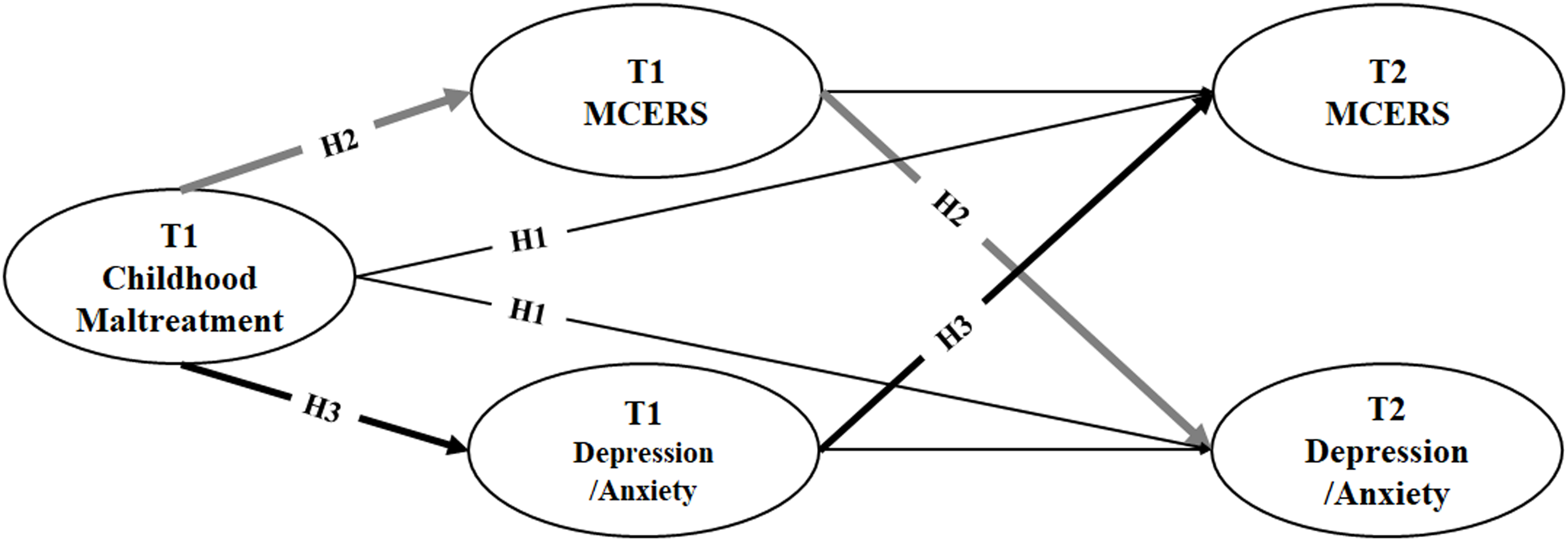
To reveal the long-term negative effects of childhood maltreatment and the potential bidirectional relationship between MCERS and internalizing problems, the present study proposed to use a two-wave longitudinal study to explore whether childhood maltreatment induces internalizing problems through MCERS, or, conversely, leads to MCERS through internalizing problems. Additionally, we investigated whether there were gender differences in the associations between the above variables. Putting these together, we proposed four hypotheses: Childhood maltreatment would have positive and longitudinal associations with MCERS and internalizing problems (hypothesis 1); MCERS would mediate the longitudinal relationship of childhood maltreatment with internalizing problems (hypothesis 2); Internalizing problems would mediate the longitudinal relationship of childhood maltreatment with MCERS (hypothesis 3); The relationships mentioned above would be influenced by gender (hypothesis 4). The conceptual longitudinal model is shown in Figure 1.
The conceptual longitudinal model. Note: MCERS = Maladaptive cognitive emotion regulation strategies.

Method
Participants and procedure
We recruited adolescents from a high school in Chongqing, China to participate in a longitudinal mental health survey. The studies involving human participants were reviewed and approved by the corresponding author’s university ethics committee. Informed consent was obtained from students and their parents before the survey. In October 2021 (T1), a total of 1,155 participants completed an online survey about childhood maltreatment, MCERS, depression, anxiety, and demographic information. We conducted the second survey in April 2023 (T2) and collected 892 responses, resulting in an attrition rate of 22.77%. The results of the attrition analysis showed no significant difference in T1 childhood maltreatment (t = −1.72, p = 0.08), T1 MCERS (t = −0.76, p = 0.45), T1 depression (t = −0.96, p = 0.34), and T1 anxiety (t = −1.50, p = 0.13) between attrition participants and those who participated in both two surveys. This result suggests that the attrition of participants was random. Finally, 892 adolescents (487 females, 405 males; M age = 15.36, SD age = 1.43) were included in subsequent analyses.
Measures
Childhood maltreatment
Childhood maltreatment, including physical neglect, emotional neglect, emotional abuse, physical abuse, and sexual abuse was measured by the Short Form of the Childhood Trauma Questionnaire (CTQ-SF; Bernstein et al., Reference Bernstein, Stein, Newcomb, Walker, Pogge, Ahluvalia, Stokes, Handelsman, Medrano, Desmond and Zule2003). 25 items (e.g., “People in my family said hurtful or insulting things to me.”) were rated and scored on a 5-point Likert scale (1 = Never to 5 = Always). The higher total scores represented higher levels of childhood maltreatment. It has been demonstrated good reliability and validity among Chinese adolescents (Guo et al., Reference Guo, Gu, Gaskin, Yin, Zhang and Wang2023). The Cronbach’s α of this scale in this study was 0.91.
Maladaptive cognitive emotion regulation strategies
The Maladaptive Cognitive Emotion Regulation Strategies Questionnaire (MCERSQ; Garnefski et al., Reference Garnefski, Kraaij and Spinhoven2001) was used to assess how participants think after experiencing threatening or stressful life events, including the four MCERS subtypes of self-blame, rumination, catastrophizing, and other-blame. It contains 16 items (e.g., “I feel largely responsible for what happened.”) and responses are based on a 5-point Likert scale ranging from 1 (almost never) to 5 (almost always). The higher total score represented a more severe level of MCERS. This scale has shown good reliability and validity in Chinese adolescents (Gu et al., Reference Gu, Guo and Wang2024). In this study, Cronbach’s α of this scale were 0.93 and 0.95, respectively, at T1 and T2.
Depression
Depression was measured by the Self-rating Depression Scale (SDS; Zung, Reference Zung1965). It contains 20 items and participants rated each item from 1 (a little of the time) to 4 (most of the time). One sample item is “I felt that life was meaningless,” with higher scores indicating higher levels of depression. This scale has shown good reliability and validity in Chinese adolescents (Zhang et al., Reference Zhang, Liao, Gu and Wang2022). In this study, Cronbach’s α of this scale were 0.94 and 0.95, respectively, at T1 and T2.
Anxiety
Anxiety was measured by the Self-Rating Anxiety Scale (SAS; Zung, Reference Zung1971). It is a 20-item unidimensional scale and adolescents indicated how much they agree with it on a 4-point scale ranging from 1 (a little of the time) to 4 (most of the time). An example item is “I get upset easily or feel panicky.” Higher scores represent higher levels of anxiety. This scale has shown good reliability and validity in Chinese culture (Zhang et al., Reference Zhang, Liao, Gu and Wang2022). In this study, Cronbach’s α of this scale were 0.92 and 0.93, respectively, at T1 and T2.
Covariates
According to previous studies (Guo et al., Reference Guo, Gu, Gaskin, Yin, Zhang and Wang2023; Wu et al., Reference Wu, Liu, Chan, Wang, Zhao, Sun, Shen and Wang2022; Zhang et al., Reference Zhang, Hou, Lin, Geng and Kong2024), gender and age were found to be associated with childhood maltreatment, MCERS, and internalizing problems. Therefore, we collected demographic information on participants’ gender and age.
Data analysis
All analyses were conducted in R version 4.3.3. The packages of bruceR and lavaan were used for primary and main analyses, respectively. Specifically, our data analysis followed the following three steps.
First, for primary analyses, we conducted descriptive statistics and correlation analyses. Moreover, regression analyses were used to examine the longitudinal association of study variables.
Second, we tested the longitudinal measurement invariance of MCERS and internalizing problems across two waves, a prerequisite for conducting cross-lagged analyses (Mackinnon et al., Reference Mackinnon, Curtis and O’Connor2022). After establishing a baseline unconstrained model with good fit as configural invariance, we progressively conducted three more constrained models: (1) the metric invariance model, including equality of factor loadings, (2) the scalar invariance model, further including equality of observed variable intercepts, and (3) the residual invariance model, further including equality of observed variable error terms. In the construction of latent variable structural equation modeling, the mean scores of subscales of MCERSQ were used to create observed variables representing MCERS. In addition, the 20 items of SDS and SAS were used to create observed variables representing depression and anxiety, respectively. According to previous studies (Chen, Reference Chen2007), a decrease in CFI larger than 0.01 and an increase in RMSEA larger than 0.015 indicate a lack of invariance. Therefore, based on ΔCFI and ΔRMSEA, we compared these models and chose the best-fit model. Moreover, the minimum requirement for cross-lagged panel analysis is to satisfy metric invariance (Mackinnon et al., Reference Mackinnon, Curtis and O’Connor2022).
Finally, latent structural equation modeling was used to test the conceptual longitudinal models. In step 1, we further examined the potential indirect effects of MCERS and internalizing problems. Childhood maltreatment was a latent variable, and the average scores of the CTQ-SF’s five subscales were used to create observed variables representing it (Guo et al., Reference Guo, Gu, Gaskin, Yin, Zhang and Wang2023). In step 2, multi-group analysis was used to test the potential effect of gender in the conceptual longitudinal models. Guided by Hu and Bentler (Reference Hu and Bentler1999), if the χ 2/df <3, RMSEA <0.08, CFI >0.90, TLI >0.90, SRMR <0.08, then the structural equation modeling is well-fitted.
Results
Preliminary analysis
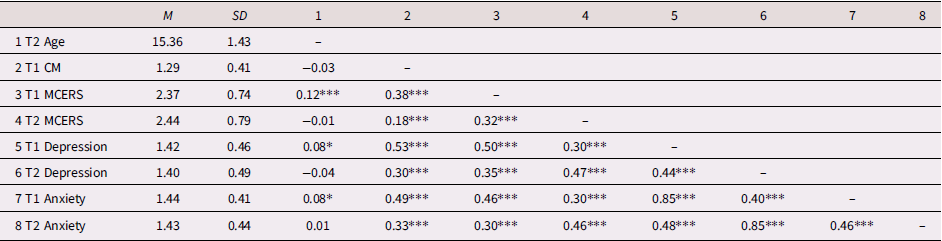
The results of means, standard deviations, and inter-correlations are presented in Table 1. The correlation analysis revealed that childhood maltreatment at T1, MCERS at T1 and T2, depression at T1 and T2, and anxiety at T1 and T2 were significantly positively correlated (p s <0.001). Since T2 age was significantly correlated with some study variables, and thus was controlled for in subsequent analyses.
Descriptive statistics and correlations among variables

Note: *p <0.05. ***p < 0.001. CM = Childhood maltreatment. MECRS = Maladaptive cognitive emotion regulation strategies.
Furthermore, we examined whether T1 childhood maltreatment predicted T2 MCERS and T2 internalizing problems. After controlling for T2 age and T1 MCERS, T1 childhood maltreatment significantly predicted T2 MCERS (β = 0.07, p = 0.04). Moreover, after controlling for T2 age and T1 internalizing problems, the effects of T1 childhood maltreatment on T2 depression (β = 0.08, p = 0.02) and T2 anxiety (β = 0.14, p <0.001) were significant.
Longitudinal measurement invariance analysis
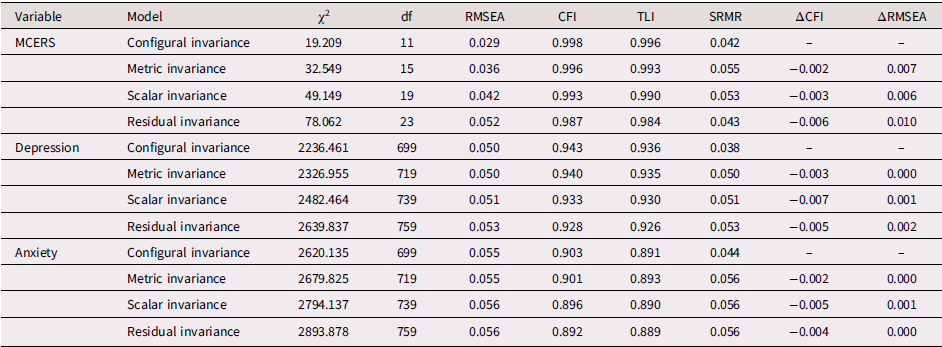
We examined the longitudinal measurement invariance of MCERS. As shown in Table 2, the decreases in CFI and the increase in RMSEA between metric invariance model - configural invariance model, scalar invariance model - metric invariance model, and residual invariance model - scalar invariance model were all less than 0.01. Therefore, the residual invariance model was established, surpassing the requirement of at least metric invariance. Similarly, longitudinal measurement invariance of depression and anxiety satisfied residual invariance. Thus, our all measures satisfied the prerequisite for interpreting cross-lagged results.
The longitudinal measurement invariance of MCERS and internalizing problems

Note: MCERS = Maladaptive cognitive emotion regulation strategies.
Longitudinal mediation analysis
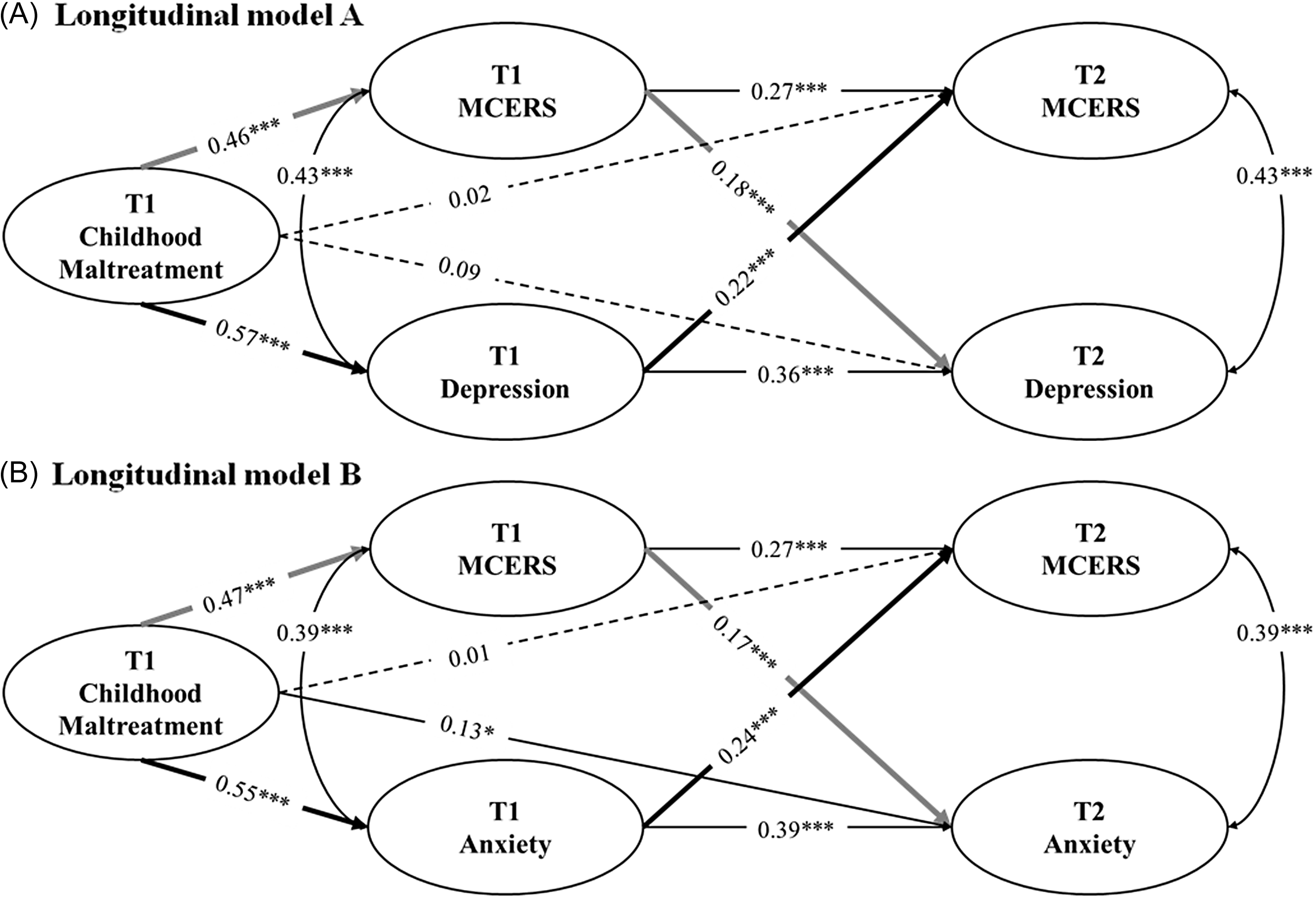
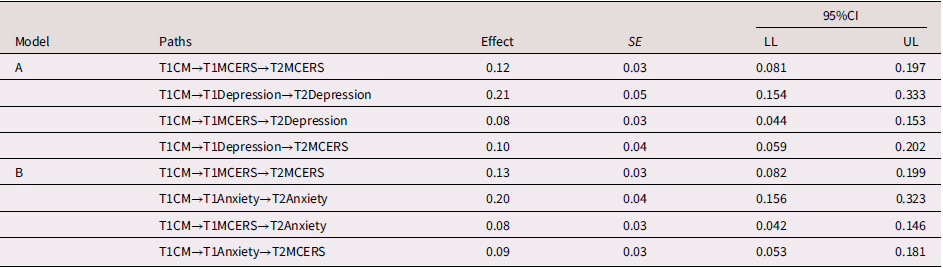
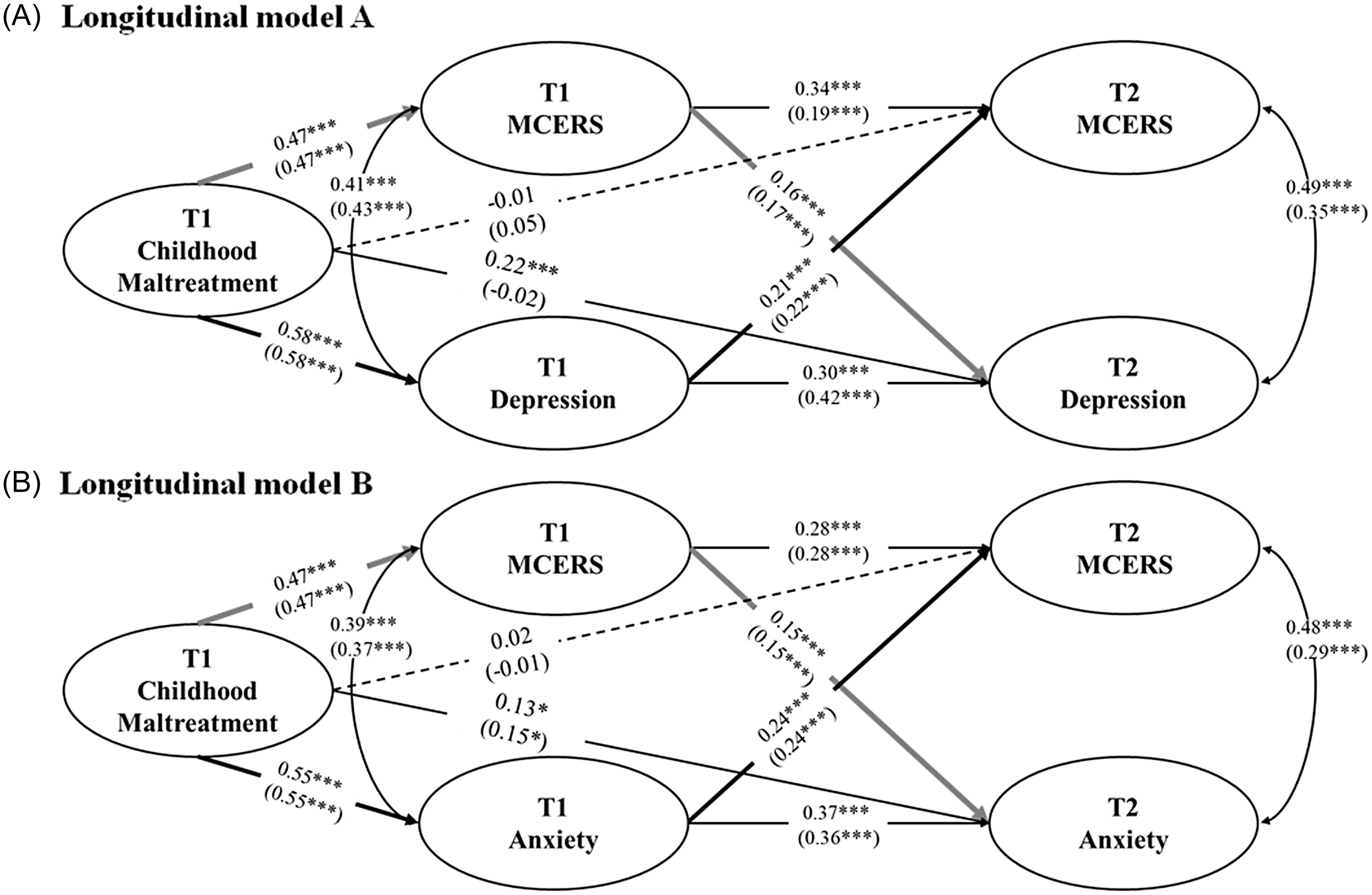
As shown in Figure 2A, we first tested the longitudinal model A of childhood maltreatment, MCERS, and depression, with T2 age used as a control variable. The model fit was adequate, with indices of χ 2 = 3936.929, df = 1388, χ 2/df = 2.836, RMSEA = 0.045, CFI = 0.924, TLI = 0.922 and SRMR = 0.056. T1 childhood maltreatment was positively associated with T1 MCERS and T1 depression (β = 0.46, p <0.001; β = 0.57, p <0.001, respectively), while was not associated with MCERS and depression at T2. As presented in Table 3, all mediation paths were significant. Specifically, T1 MCERS mediated the relationship between T1 childhood maltreatment and T2 depression (b = 0.08, SE = 0.03, 95% CI [0.044, 0.153]). In addition, T1 depression mediated the relationship between T1 childhood maltreatment and T2 MCERS (b = 0.10, SE = 0.04, 95% CI [0.059, 0.202]). We further conducted an indirect effects differences test by Wald Test and found that the mediating effect of T1 depression was significantly higher than T1 MCERS (Wald χ 2 (1) = 5.52, p = 0.02).
The longitudinal model A and B. Note: *p < 0.05. ***p < 0.001. Standardized coefficients are displayed. MCERS = Maladaptive cognitive emotion regulation strategies.

Standardized indirect effects of longitudinal models

Note: SE = standard error. CI = confidence interval, LL = lower limit, UL = upper limit. CM = Childhood maltreatment. MECRS = Maladaptive cognitive emotion regulation strategies.
Further, as shown in Figure 2B, we examined the longitudinal model B of childhood maltreatment, MCERS, and anxiety. The model fit was also acceptable: χ 2 = 4198.218, df = 1388, χ 2/df = 3.025, RMSEA = 0.048, CFI = 0.897, TLI = 0.894, SRMR = 0.052. After controlling for T2 age, T1 childhood maltreatment was positively associated with T1 MCERS, T1 anxiety and T2 anxiety (β = 0.47, p <0.001; β = 0.55, p <0.001; β = 0.13, p = 0.04, respectively), but not with T2 MCERS. Moreover, all mediation paths were significant. Specifically, T1 MCERS mediated the relationship between T1 childhood maltreatment and T2 anxiety (b = 0.08, SE = 0.03, 95% CI [0.042, 0.146]). T1 anxiety also mediated the relationship between T1 childhood maltreatment and T2 MCERS (b = 0.09, SE = 0.03, 95% CI [0.053, 0.181]). There were no significant differences between the mediating effects of T1 anxiety and T1MCERS (Wald χ2 (1) = 3.22, p = 0.07).
Multi-group analysis
To examine the potential effect of gender, multi-group analyses were conducted. Firstly, we examined whether there was a gender difference in longitudinal model A. Guided by Chen (Reference Chen2007), we first tested an unconstrained model (see Figure 3A), that is, all parameters were allowed to vary freely across genders. The CFI and RMSEA of the unconstrained model were 0.900 and 0.054, respectively. In addition, a constrained model was tested, where loadings and intercepts were set to be equal across genders. The CFI and RMSEA of this model were 0.895 and 0.055, respectively. By comparing the CFI and RMSEA of the two models, there were changes of CFI = 0.005 < 0.01 and RMSEA = 0.001 < 0.015. Therefore, the longitudinal model A was equivalent across genders.
The longitudinal unconstrained model A and B in multi-group analyses. Note: *p < 0.05. ***p < 0.001. Path coefficients in parentheses are for males. Standardized coefficients are displayed. MCERS = Maladaptive cognitive emotion regulation strategies.

Consistent with the above procedure, we tested an unconstrained longitudinal model B (see Figure 3B). The CFI and RMSEA of the unconstrained model were 0.874 and 0.054, respectively. Furthermore, the CFI and RMSEA of the constrained model were 0.869 and 0.055, respectively. By comparing the CFI and RMSEA of the two models, there were changes of CFI = 0.005 < 0.01 and RMSEA = 0.001 < 0.015. Thus, the longitudinal model B was also equivalent across genders.
Discussion
The current study examined the indirect and cross-lagged pathways of MCERS and internalizing problems and potential gender differences in these longitudinal models. Findings revealed that childhood maltreatment was longitudinally associated with MCERS and internalizing problems. Furthermore, childhood maltreatment was longitudinally linked to T2 internalizing problems through T1 MCERS, and it was also associated with T2 MCERS through T1 internalizing problems. There were no gender differences in either longitudinal theoretical model. These findings reveal the complex relationship between childhood maltreatment, MCERS, and internalizing problems, and provide a more comprehensive perspective on psychological interventions for abused adolescents.
Consistent with H1, our study revealed the long-term effects of childhood maltreatment. First, the result of the longitudinal relationship between childhood maltreatment and internalizing problems is consistent with previous research (Javakhishvili & Widom, Reference Javakhishvili and Widom2021). One potential explanation is that maladaptive schemas arising from early adverse experiences disrupt adolescents’ cognitions, emotions, and interpersonal relationships, thereby making them more prone to internalizing problems in the future (Young et al., Reference Young, Klosko and Weishaar2003). Furthermore, childhood maltreatment was longitudinally associated with MCERS, reinforcing the notion that the early home environment significantly shapes an individual’s emotion regulation over time (Gruhn & Compas, Reference Gruhn and Compas2020).
The mediating role of maladaptive cognitive emotion regulation strategies
The present study found that MCERS mediated the longitudinal relationship between childhood maltreatment and internalizing problems, thereby supporting H2. This finding was consistent with previous research (Heleniak et al., Reference Heleniak, Jenness, Stoep, McCauley and McLaughlin2016; Miu et al., Reference Miu, Szentágotai-Tătar, Balázsi, Nechita, Bunea and Pollak2022; Rek et al., Reference Rek, Reinhard, Bühner, Freeman, Adorjan, Falkai and Padberg2022), and also supported the general view that MCERS resulting from childhood maltreatment are risk factors for psychological problems (Gross & John, Reference Gross and John2003). Exposure to early adverse experiences may impede the development of adaptive emotion regulation strategies (Guo et al., Reference Guo, Gu, Gaskin, Yin, Zhang and Wang2023; Huh et al., Reference Huh, Kim, Lee and Chae2017; Wu et al., Reference Wu, Liu, Chan, Wang, Zhao, Sun, Shen and Wang2022), making dealing with emotions that arise from the child maltreatment experience, or other stressful events, difficult (Zhou & Zhen, Reference Zhou and Zhen2022). Consequently, they are more likely to use MCERS to manage and regulate their emotions. In this case, they may endure prolonged periods of psychological distress, ultimately increasing susceptibility to internalizing problems (McLaughlin et al., Reference McLaughlin, Hatzenbuehler, Mennin and Nolen-Hoeksema2011). Overall, this finding highlights that MCERS are a key factor in linking childhood maltreatment with subsequent psychological problems in adolescents (Guo et al., Reference Guo, Gu, Gaskin, Yin, Zhang and Wang2023; Wu et al., Reference Wu, Liu, Chan, Wang, Zhao, Sun, Shen and Wang2022).
The mediating role of internalizing problems
In turn, consistent with H3, the longitudinal model of the current study also supported that internalizing problems mediate the association between childhood maltreatment and MCERS. Specifically, the strong association between T1 childhood maltreatment and T1 internalizing problems further leads to adolescents’ more frequent use of MCERS at T2. This finding is consistent with previous studies suggesting that internalizing problems are not only a symptom of MCERS but can equally be a risk factor for subsequent MCERS (De France et al., Reference De France, Lennarz, Kindt and Hollenstein2019; Larsen et al., Reference Larsen, Vermulst, Geenen, van Middendorp, English, Gross, Ha, Evers and Engels2013). It also supported the Broaden-and-Build Theory of Positive Emotions (Fredrickson, Reference Fredrickson2001). In contrast to positive emotions, internalizing problems may act as a barrier to individuals’ cognition and hinder the use of adaptive emotion regulation strategies. Consequently, they may resort to MCERS (Heesen et al., Reference Heesen, Rasing, Vermulst, Tak, Engels and Creemers2020; Joormann & Stanton, Reference Joormann and Stanton2016). In addition, adolescents who have experienced childhood maltreatment may worry that outwardly expressing depression and anxiety will elicit negative peer evaluations and rejection, and thus choose MCERS to regulate emotion (Coyne, Reference Coyne1976). In conjunction with the previous findings, the current study reveals that there is a “vicious circle” of negative psychological consequences of childhood maltreatment. Specifically, internalizing problems induced by childhood maltreatment and MCERS reinforce each other, ultimately exacerbating psychological distress among abused adolescents.
Gender differences
Our findings show that longitudinal models are equivalent across genders, and this result is consistent with previous studies (Arnow et al., Reference Arnow, Blasey, Hunkeler, Lee and Hayward2011; Calvete et al., Reference Calvete, Orue and Hankin2015; Guo et al., Reference Guo, Gu, Gaskin, Yin, Zhang and Wang2023). Despite this, there are studies revealing gender differences in the association between childhood maltreatment experience and MCERS (Nolen-Hoeksema, Reference Nolen-Hoeksema2012; Zhang et al., Reference Zhang, Hou, Lin, Geng and Kong2024). The non-significant findings in our study could be explained by the fact that we focused on the overall maltreatment and MCERS, while prior studies investigated the association between distinct maltreatment and specific emotional regulation strategies (e.g., emotional abuse and rumination) (Nolen-Hoeksema, Reference Nolen-Hoeksema2012; Zhang et al., Reference Zhang, Hou, Lin, Geng and Kong2024). Furthermore, our result may also indicate that emotional regulation problems resulting from childhood maltreatment, as well as internalizing problems, are prevalent across genders (Guo et al., Reference Guo, Gu, Gaskin, Yin, Zhang and Wang2023).
Implications and limitations
The present findings contribute to the literature in several ways. First, our longitudinal study provides a more comprehensive perspective to examine the relationship between childhood maltreatment and internalizing problems, addressing the shortcomings of previous cross-sectional designs. Second, the current study verified the possibility that childhood maltreatment longitudinally influences MCERS through internalizing problems. Furthermore, it reveals a potential cross-lagged relationship between internalizing problems and MCERS, while previous cross-sectional studies have virtually ignored the possibility of such an outcome. Additionally, prior longitudinal studies have mostly focused on exploring the effects of internalizing problems on two emotion regulation strategies, namely, expressive suppression and rumination. Thus, this result complements and extends previous research while validating relevant theories.
Our findings have some practical implications and potential clinical intervention value. The current findings suggest a bidirectional relationship between MCERS and internalizing problems. Therefore, psychological interventions need to both guide adolescents to avoid using MCERS and comprehensively explore the underlying drivers of their maladaptive emotion regulation styles and the subsequent impact. Regarding psychological interventions for MCERS, counselors can use Cognitive Behavioral Therapy to help adolescents recognize their irrational beliefs and guide them to analyze events more objectively so that they can change their maladaptive coping styles (Li et al., Reference Li, Li, Hou, Zhang, Wang and Qu2024). Additionally, promoting adolescents’ non-judgmental awareness of their thoughts and emotions through mindfulness interventions (Scafuto et al., Reference Scafuto, Ghiroldi, Montecucco, Presaghi and Iani2022), thereby increasing their ability to regulate emotions, can also reduce the frequency of MCERS use. Notably, if adolescents use MCERS as a result of uncontrollable negative emotions, direct alleviation of the negative emotions may also be effective.
The current study also has some shortcomings. First, our longitudinal survey was conducted only twice, which does not allow us to fully reveal the complex relationships between variables. Especially for longitudinal mediation effects, the current study cannot fully determine the temporal precedence in which the independent variable affects the mediator variable. Future research could further reveal the dynamic and complex relationships between variables with longitudinal investigations at multiple time points. Second, the study sample was only derived from Chinese high school students, and there was a certain degree of attrition of our study participants due to students’ promotion to higher education as well as transferring to other schools. Therefore, future research could test this result in other samples (e.g., children, and adults) and expand the sample size. Third, specific sub-dimensions such as emotional abuse and rumination were not thoroughly examined. Subsequent studies could focus on the relationship between specific types of abuse or specific emotion regulation strategies and internalizing problems.
Conclusion
The current study examined the longitudinal relationships between childhood maltreatment, MCERS, and internalizing problems, such as depression and anxiety, while also exploring the potential mediating role of MCERS and internalizing problems. Our findings provided evidence that childhood maltreatment is a distal risk factor for adolescents’ MCERS and internalizing problems. Moreover, childhood maltreatment exacerbated subsequent internalizing problems by facilitating adolescents’ MCERS. In addition, childhood maltreatment fosters adolescents’ subsequent MCERS via internalizing problems. These findings unravel the complex relationships between childhood maltreatment, MCERS, and internalizing problems, which would provide practical guidelines for psychological interventions.
Acknowledgments
Thanks to all the participants who provided support for this study.
Author contributions
Jianjun Huang and Xi Shen contributed equally to this research.
Funding statement
None.
Competing interests
The authors declare that there is no conflict of interest.