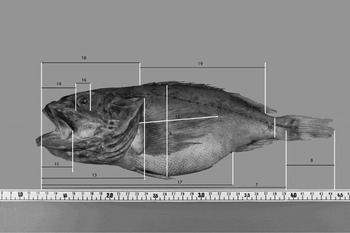
Setarches guentheri Johnson, 1862 is usually caught as by-catch by bottom trawls (Eschmeyer & Collette, Reference Eschmeyer and Collette1966). In August 2009, the vessel ‘San Telmo’ based in Avilés, on the Cantabrian coast (North Spain), trawled a specimen of this scorpionfish. It was caught at a depth of 280 m with a bottom trawl, near the fishing ground called ‘Mar de la Vallina’ (43°47′N 6°20′W). The specimen agreed with the description of Setarches guentheri available in the literature (Eschmeyer & Collette, Reference Eschmeyer and Collette1966; Hureau & Litvinenko, Reference Hureau, Litvinenko, Whitehead, Bauchot, Hureau, Nielsen and Tortonese1986; Queró et al., Reference Queró, Porche and Vaine2003; Froese & Pauly, 2010). The specimen was frozen and then it was fixed in 10% formalin, preserved in 70% ethanol and stored in the fish collection of the Spanish Institute of Oceanography of Santander (Spain), Reference no. IEOSAN1001. The specimen was measured to the nearest 1 mm. Following Eschmeyer's nomenclature (Reference Eschmeyer1965) the counts and measurements taken are shown in a diagram of the Setarches guentheri specimen (Figure 1).
Diagram of a specimen of Setarches guentheri showing the counts and measurements taken (numbers refer to descriptions in Table 1).

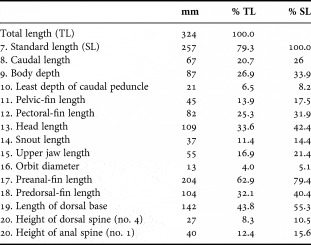
The largest scorpionfish observed until now was 270 mm total length from Portugal (Marques & Saldanha, Reference Marques and Saldanha1998). Ours measures 324 mm. Increased growth at higher latitudes has been found in field studies of a wide variety of fish (i.e. Sebastes pinniger and S. diploproa (Boehlert & Kappenman, Reference Boehlert and Kappenman1980), Cynoscion regalis (Shepherd & Grimes, Reference Shepherd and Grimes1983), Engraulis mordax (Parrish et al., Reference Parrish, Mallicoate and Mais1985)). It seems to be a gradient variation in growth for some species that could explain the relatively large size of Setarches guentheri in the Cantabrian waters. The biometrical data are presented in Table 1. Fins count: dorsal spines, 12; dorsal rays, 9; pectoral rays, 22 (branched pectoral rays, 15). Anal spines: 3; anal soft rays: 5. Lateral line with 28 scales. The Cantabrian specimen is similar to others from the eastern Atlantic (Eschmeyer & Collette, Reference Eschmeyer and Collette1966) despite measurements and counts varying geographically.
Biometrical data of the Setarches guentheri specimen from the Cantabrian Sea.

Predicted increases in water temperature in response to climate change will have large implications for aquatic ecosystems, such as potential range expansion of fish species and differences in growth. Records of rare tropical fish in the Bay of Biscay are not recent, although their number has increased since 1980, mainly in the southern part of the area (Queró, Reference Queró1998; Poulard & Blanchard, Reference Poulard and Blanchard2005). Setarches guentheri was captured in 1995 in southern Portugal (Marques & Saldanha, Reference Marques and Saldanha1998) and fifteen years later it was recorded in Cantabrian waters. The northward extension of other species such as Capros aper (Blanchard & Vandermeirsch, Reference Blanchard and Vandermeirsch2005), Zenopsis conchifer, Cyttopsis roseus and Sphoeroides pachygaster has been even more rapid (Queró, Reference Queró1998). Assuming that increased water temperature may favour subtropical fish species and hinder temperate ones, knowledge about the latitudinal distribution range is important to interpret time trends.
ACKNOWLEDGEMENT
We wish to thank the crew of the vessel ‘San Telmo’ for providing the specimen.