INTRODUCTION
In developing countries of the tropics and subtropics, livestock production is often restricted by inadequate feed supply during prolonged dry seasons (Fresco and Steinfeld, Reference Fresco and Steinfeld1998). In much of Honduras, livestock keepers face a 4–7 month dry season in which feed is scarce and expensive; this particularly affects smallholders. About 20% of smallholders even cease milking during the dry season due to feed shortage (Fujisaka et al., Reference Fujisaka, Holmann, Peters, Schmidt, White, Burgos, Ordóñez, Mena, Posas, Cruz, Davis and Hincapié2005). Forage conservation in the form of silage is an option to increase feed availability in the dry season. However, in the tropics silage adoption among smallholders in general has been limited (Mannetje, Reference Mannetje and Mannetje2000).
Important factors to improve adoption of silage by smallholders in the tropics are low investment costs, low risks, and the potential of rapid and significant returns on investments (Machin, Reference Machin and Mannetje2000). In developing countries, novel techniques are required so that smallholders without access to tractors, forage harvesters or balers can make silage with low storage losses and with a nutritional value that is superior to mature hay or crop residues. Therefore, innovative participatory approaches to forage conservation with technologies such as little bag silage (LBS) are needed (Wilkinson et al., Reference Wilkinson, Bolsen, Lin, Buxton, Muck and Harrison2003).
Research and development activities on LBS started in the late 1980s in Northern Pakistan and Nepal (Lane, Reference Lane2000) and Western Kenya (Otieno et al., Reference Otieno, Onim, Mathuva, Dzowela, Said, Wendem-Agenehu and Kategile1990). Several studies showed that acceptable bag silage quality can be obtained from different crops and suggested LBS to be a suitable low-cost technology for smallholders (Ashbell et al., Reference Ashbell, Kipnis, Titterton, Hen, Azrieli and Weinberg2001; Titterton et al., Reference Titterton, Mhere, Maasdorp, Kipnis, Ashbell, Smith and Weinberg2002). Little bag silage is appreciated because of its low requirements for initial investments and manpower: chopping and compaction can be done manually; LBS is flexible in handling and feeding according to needs; it is marketable because it is easy to transport; and risk of aerobic deterioration during the feeding period is reduced. However, only a few studies refer to LBS smallholder adoption beyond the project phase. Small-bag silage was reported to be widely used, both on the farm of origin and marketed, in smallholder dairy farms in Thailand (Poathong and Phaikaew, Reference Poathong, Phaikaew, Moog, Reynolds and Maaruf2001) and Malaysia (Chin, Reference Chin, Moog, Reynolds and Maaruf2001), and has become popular with small dairy farmers in Nepal (Pariyar, Reference Pariyar, Pariyar, Suttie and Reynolds2005).
The objective of this study is to highlight the potential and constraints of LBS, both technological and socio-economic, in order to evaluate its suitability as a dry-season forage technology and its potential adoption under Honduran smallholder conditions.
METHODS
The study was conducted from 2004 to 2007 in the departments of Yoro, Olancho, Intibucá, Lempira and El Paraíso, Honduras, which are characterized by a 4–7 month dry season and the need and demand for dry-season forage technologies.
Farmer training included principles such as awareness raising, motivation, offering of different technological adaptations and alternatives, multi-actor information and knowledge exchange, as well as joint experimentation and evaluation. The technological contents of farmer training in forage conservation included the principles of silage making (i.e. appropriate cutting time, chopping, rapid silo filling, good compaction and sealing) and the presentation of different low-cost silo types such as LBS, pit and heap silos. In total, about 200 farmers from 13 different locations participated in the training.
In order to evaluate the suitability of LBS technology for Honduran smallholders, silage quality as well as farmers’ perceptions and adoption are taken into consideration. Participatory experimentation was applied during farmer training in which LBS was produced with, for example different plastic materials, forages and treatments (e.g. additives), and evaluated during a further meeting. Statistical analysis of the data is restricted to average numbers, standard error of the mean and tests of significance between silage treatments.
Case study 1: on-station testing of different bag systems
During the 2005 dry season, an experiment was conducted on a research station (Zamorano University, Francisco Morazán Department), in which different bags of commonly available plastic material were used. Three types of bags were compared: nine transparent polyethylene bags (calibre 3, corresponding to 76 μm thickness) of 40 kg carrying capacity; nine recycled polypropylene-woven bags as used for concentrate feed combined with a thinner rubbish bag (calibre 2; 51 μm), also able to hold 40 kg silage (‘double system’); and three large rubbish bags (calibre 4; 102 μm) able to hold 80 kg silage. The cost of the plastic bags ranged from about 0.37 US$ for the double system to 0.53 US$ for the large rubbish bag. Forage sorghum (27% dry matter, DM) was harvested and chopped (2–3 cm length) by a forage harvester. The chopped material was packed in to the bags and then compressed by trampling on the bags. No additives were used. Sealed bags were stored on pallets in a closed barn. Simultaneously, as a control a bunker silo (17 m × 4.5 m × 1.80 m) was filled with the same forage. The silage was tested for pH and weight of feedable and spoiled silage after 4.5 months of storage.
Case study 2: participatory testing of differently treated Brachiaria brizantha cv. Toledo silages using LBS technology
In January 2006, a practical farmer training session was conducted in order to evaluate the effect of wilting and the addition of locally available additives on silage smell, pH and spoilage losses. Brachiaria brizantha cv. Toledo grass of six weeks regrowth was harvested with machete. One part of the grass was distributed over a concrete surface where it wilted for about 4.5 hours in open air while the other part was chopped unwilted using a motor-driven chopper. A plastic material characterized by high density calibre 6 (152 μm) and a high tensile strength was used for the experiment. It is sold in tubular form and needs to be cut according to need. This plastic material is often available even in remote areas and is sold at a price of 0.57–0.81 US$/m. Per silage bag of 30 kg, about 1.4 m of plastic is necessary. The plastic was sealed at one end by twisting the necks of the bags, tying with twine, folding the rest and tying again. A representative sample was taken of both, wilted and unwilted grass for DM determination (oven drying at 105 °C for 24 hours). For unwilted silage (22% DM), treatments were: without additive (T1); and with 6% molasses (T2). For wilted silage (40% DM), treatments were: without additive (T3); with 6% molasses (T4); with 20% chopped sugarcane (T5); and with 6% sugar water prepared from previously dissolved sugar blocks (T6). Application of additives was by thoroughly mixing them with the chopped Toledo grass which was then stamped in layer by layer. The upper end of the bag was sealed in the same way as described for the other end. A total of 21 silage bags, each containing 32 kg silage of chopped grass, were prepared by farmers. The bags were stored in a closed garage to prevent perforation by mice. For simple comparison purposes, an additional three bags were stored in a shed. After 4 months, another farmer meeting was held, during which the bags were opened for evaluation.
Silage fermentation quality was evaluated considering the critical pH value in relation to forage DM content, spoilage losses and smell (DLG, 2004; Weissbach, Reference Weissbach2002). Moreover, silage quality was classified using farmer preference ranking.
On-farm testing and adoption of LBS
Basic farm data (e.g. farm size and number of cattle) of all participants were gathered during training using structured interviews (Bryman, Reference Bryman2004). LBS testers were identified during farm visits. Technology adaptation and adoption were monitored and semi-structured interviews were used to gather quantitative and qualitative diagnostic data (e.g. number of bags, losses, reasons for adoption or rejection).
RESULTS
Case study 1: on-station testing of different bag systems
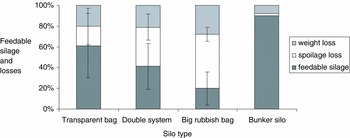
Average pH was below 4.1 for all bag types indicating that sorghum silage fermented well in all systems. All bags suffered at least one perforation with the exception of one of the transparent bags which was intact. Average numbers of bag perforations were 8.3, 26.9, and 16.3 for the transparent bag, the double system and the big rubbish bag, respectively, with significant differences (p < 0.05) between the transparent bag and the double system. During storage, bag weights decreased by 20%, 21% and 28%, respectively. Average spoilage losses were 18.5%, 37.9% and 52.1%, respectively (Figure 1), with significant differences between the transparent and the large rubbish bag system (p < 0.05).
Silage losses with different silo types (bars indicate standard deviations).

The main cause of loss was thought to be mice and/or rats perforating the bags during storage. Higher spoilage losses from the large rubbish bags, which were made of thicker plastic, were probably because these heavy bags were placed directly on pallets, i.e. close to the ground, and therefore, were more exposed to rodents whereas smaller bags were mainly piled on top of the large ones. Compared to the bag systems, spoilage loss from the same forage ensiled at the same time in the control bunker silo, was less than 3%.
Case study 2: participatory testing of differently treated Brachiaria brizantha cv. Toledo silages using LBS technology
In the area of Candelaria, Lempira, farmers reported quality problems with silages prepared from chopped Pennisetum and Brachiaria grasses and ensiled in earthen pit silos. Neighbours complained about a strong smell, and workers refused to handle the silage. Consequently, Brachiaria brizantha cv. Toledo was considered to be unsuitable for silage and some farmers rejected silage making. The reasons for the failures were probably due to the small amount of molasses added, and more importantly, to the high moisture content in the silos, both due to the plant material itself and too much water added to the molasses.
Subsequently, an open farmer meeting was organized to demonstrate: (1) LBS technology as a feasible alternative silo type; and (2) that quality grass silage from Bachiaria brizantha cv. Toledo can be produced by, for example wilting and adequate addition of water-soluble carbohydrates (WSC).
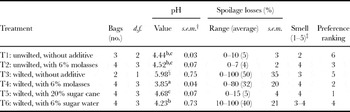
The three bags stored apart were perforated by mice and spoilage losses were 100%. The bags stored in the garage, except for one bag showing many little holes and 100% loss, were intact. Average spoilage loss was about 24% and ranged from 5% to 50% for wilted silage compared to 4–5% for unwilted silage (Table 1). However, the difference between wilted and unwilted silage was not significant (p > 0.05).
Participatory group experimentation with differently treated Brachiaria brizantha cv. Toledo bag silages.

†s.e.m.: Standard error of the mean.
‡1 = rotten, strong; 2 = bad; 3 = acceptable; 4 = good; 5 = very good.
§T3 was excluded from test of significance between groups due to low number of bags and high spoilage losses.
a,b,c Different letters of superscripts mean significant difference (p < 0.05).
pH values were lowest for wilted silages with molasses and highest for wilted silages without additive. Average pH values were significantly different (p < 0.05) between treatments T1 and T4; T2 and T4; T4 and T5; T4 and T6; and T5 and T6. Molasses as an additive in wilted silage (T4) proved more effective for the reduction of pH than other additives (T5 and T6). Farmers’ assessment of smell and their preference ranking were higher for all silages with additives than without, irrespective of DM content. Subsequent feeding as a supplement showed that silage prepared with molasses as an additive was slightly preferred by cows to silage with sugarcane as an additive.
The experiment demonstrated to farmers that: (1) short wilting and the addition of sugar-containing additives, especially molasses, improve fermentation quality of grass silage; and (2) wilted silages, although smelling better, were more prone to increased spoilage losses.
On-farm testing of bag silage
Farmers produced between 1 and about 300 bags per farm with an average of 40 bags. Weight of individual bags ranged from 10 kg to about 200 kg. Similar to the case studies above, on-farm testing revealed generally high spoilage losses of silages prepared in plastic bags commonly available in the market. Results of the LBS tester survey showed that spoilage losses ranged from 0% to 100%. Based on farmer observations, about 30% had spoilage losses below 10% whereas about 20% had 100% loss. Spoilage losses ranged from: 0% to 20% (average 14%) for the tubular plastic material; from 6% to 20% (average 10%) for the double bag system; from 5% to 100% (average 35%) for the transparent bag; and from 70% to 100% (average 71%) for the large rubbish bags. Reasons for aerobic spoilage losses included: (1) pests, mainly rodents, but also insects such as ants perforating the plastic; and (2), inappropriate compaction, sealing, handling and storage of bags. The use of a mould (i.e. a plastic barrel) during bag silage preparation was shown to ease compaction while protecting the plastic bag from tearing and puncturing: the bag is placed inside a vertically cut barrel, which is kept shut, e.g. with ropes, during compaction and subsequently opened to remove the bag. A further problem was malfermentation with bag silages containing wet-chopped and untreated (i.e. without additive) grasses other than forage maize and sorghum.
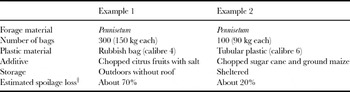
Table 2 presents two selected examples of bag silage testing on a larger scale. In both cases, mainly King Grass (a Pennisetum hybrid) was ensiled after chopping with a motor-driven chopper. In Example 1, the farmer used large black rubbish bags (calibre 4, 102 μm), which were stored in the open air. In Example 2, the farmer used the above mentioned tubular plastic system (calibre 6, 152 μm) and stored the bags in a sheltered place. Large differences in aerobic spoilage losses between the two cases were detected. In Example 1, the upper layer of black bags was exposed to direct sunlight and animals such as chicken and birds. But also many of the bags stored below were damaged. Outside storage in direct sunlight of black calibre 4 plastic bags proved unsuitable whereas sheltered storage of calibre 6 plastic bags showed lower losses.
Description of two examples of bag silage testing.

†Farmer estimates.
LBS adoption
The LBS technique has been demonstrated to about 200 farmers in Honduras. As a result, within the subsequent two years, about 25 farmers tested LBS. Out of 20 respondents, 30% of testers were smallholders with fewer than 10 cows, 60% of testers had between 13 and 24 cows, and 10% had more than 30 cows. Twelve LBS testers (60%) were already making silage and used LBS as an additional silo type, mainly to make use of: i) surplus forage that did not fit into their silo; ii) small amounts of cultivated legumes, namely Cratylia argentea and Vigna unguiculata (cowpea), ensiled together with e.g. maize, sorghum, sugarcane or Pennisetum spp.; and iii) to utilize paid labour when their workload was low. The portion of LBS testers without any previous silage experience (40%) adopted or intended to adopt other silo types of higher capacity, mainly after having had negative experiences with LBS. About 50% of LBS testers, mainly farmers with more than 10 cows, are likely to continue to use plastic bags (mainly tubular plastic and the double bag system) as an additional silage conservation alternative, but the other 50% rejected LBS.
A survey of 137 farmers who had recently adopted silage making revealed that heap silos, which are considered as ‘silos for the poor’, were the most widely adopted (41%) compared to LBS, which was adopted by only about 2% of new silage makers. Advantages of heap silage over bag silos included lower risk of aerobic spoilage losses, lower cost per unit of silage and no need of investment in storage facilities. The most frequently mentioned reasons for non-adoption of silage-making by smallholders were ‘non-availability of a chopper’ (46%) and ‘lack of money coupled with high costs’ (25%).
DISCUSSION
Participatory evaluations during farmer training in different locations showed the following selection criteria for plastic bags to be important: i) availability on the local market; ii) cost; iii) resistance to tearing; and iv) size. The main problem with LBS implementation under Honduran smallholder conditions was the risk of high aerobic spoilage losses due to rodents damaging the plastic bags. Furthermore, factors such as forage DM content and storage conditions were found to be particularly important with LBS.
According to Weissbach (Reference Weissbach2002), a pH ≤ 4.25 is required to inhibit butyric acid fermentation for unwilted silages with a DM content of less than 22%, whereas pH ≤ 4.75 is required for wilted silages of 40% DM. Our results show that pH values of wilted silages with additives were below the critical value, whereas wilted silage without additive as well as unwilted silages, with and without additive, were above the respective thresholds.
As experienced in this study and corroborated by McNamara et al. (Reference McNamara, O'Kiely, Whelan, Forristal and Lenehan2002), even small holes in the plastic have a significant effect on silage preservation and aerobic spoilage losses. Effective sealing to avoid major losses is particularly important with small bags. Reasons include a proportionally greater surface area, greater silage porosity and greater plastic perforation susceptibility, as concluded by Forristal and O'Kiely (Reference Forristal and O'Kiely2005) in their comparison of baled with conventional silage. Furthermore, DM losses would represent a higher proportion in small silos than large ones (Wilkins, Reference Wilkins, Reynolds and Frame2005). Therefore, high quality bags should be used, preferably made from high-density plastic (Lane, Reference Lane2000). Studies from temperate zones showed that reducing gas permeability by increasing the number of film layers reduced the presence of mould in silages, especially when stored for longer periods (Muck et al., Reference Muck, Moser, Pitt, Buxton, Muck and Harrison2003). However, according to Ashbell et al. (Reference Ashbell, Kipnis, Titterton, Hen, Azrieli and Weinberg2001), plastic thickness, i.e. oxygen permeability through the bag material, is not a crucial factor for maintaining acceptable silage quality, as long as the bag is intact, and yeast and mould inhibiting volatile fatty acids are present at levels of 1.5–2% of DM. This study suggests a minimum plastic thickness of 150 μm or several layers of thinner plastic. If carefully handled and still intact after using, plastic can be reused reducing costs.
There are no studies on the effect of storage conditions on silage preservation but González and Rodríguez (Reference González and Rodríguez2003), who worked with round bale silages, suggest that in the tropics high day and night temperatures rather than direct exposure to sunlight may negatively affect the fermentation process and increase aerobic deterioration. However, outside storage in direct sunlight exposes the plastic to ultraviolet radiation and large temperature variations, causing weathering and increased gas permeability of the plastic (Paillat and Gaillard, Reference Paillat and Gaillard2001). Nevertheless, irrespective of light conditions, outside storage as such exposes the plastic to greater risk of damage by pests (e.g. birds, chicken, rodents) resulting in silage deterioration. Rats and mice were reported as problems in Nepal and Malaysia (Lane, Reference Lane2000; Shariffah Noorhani et al., Reference Shariffah Noorhani, Aini, Idris and Mannetje2000). Therefore, some form of protection is recommended, either within an existing store, or in a specialized building, e.g. on stilts (Lane, Reference Lane2000). Pariyar (Reference Pariyar, Pariyar, Suttie and Reynolds2005) reported successful storage of triple-bagged silos on bamboo platforms and in wooden silage store constructions as rodent protection measures in Nepal. In Honduras, safe storage facilities are rarely available on smallholder farms and their construction would require some investment. An inexpensive and handy storage alternative is to bury the bags in a pre-dug trench as described by Otieno et al. (Reference Otieno, Onim, Mathuva, Dzowela, Said, Wendem-Agenehu and Kategile1990); this would assist in maintaining anaerobic conditions, compaction and lower temperatures.
In their review, Wilkinson et al. (Reference Wilkinson, Bolsen, Lin, Buxton, Muck and Harrison2003) point out that DM losses in small silos in the tropics can be extremely high because of poor compaction, which is partly due to the structural rigidity of tropical forages, and partly to the lack of suitable harvesting and chopping equipment on small farms. Increasing compression weight and compaction time per unit of silage, and decreasing (silage) layer thickness favour silage density, which is especially important for optimum fermentation in low-density silages. Good compaction favours anaerobic conditions, thus not only reducing losses caused by deterioration but also reducing storage costs, increasing DM recovery, aerobic stability and in vitro DM digestibility (Muck et al., Reference Muck, Moser, Pitt, Buxton, Muck and Harrison2003). However, as observed by farmers, compacting wilted grass in LBS is difficult. Bag silage density, calculated with the formula for the volume of a cylinder (V = π × r2 × h), was 90 and 100 kg DM/m3 for Brachiaria brizantha cv. Toledo with 40% DM and 22% DM, respectively. This is far below densities of about 160–270 kg DM/m3 reached with bagging machines (Muck and Holmes, Reference Muck and Holmes2006).
In contrast, Titterton et al. (Reference Titterton, Mhere, Maasdorp, Kipnis, Ashbell, Smith and Weinberg2002), working with tropical forages in Southern Africa, found no effect of chop length, compression treatment or type of bag on fermentation and nutritional quality of silages; they claimed that silage can be made with coarsely chopped material (mean 45 mm length) and manual compression in recycled strong plastic bags. In studies by McEniry et al. (Reference McEniry, O'Kiely, Clipson, Forristal and Doyle2007), DM content of herbage and air infiltration had a greater effect on bag silage conservation characteristics than chopping and compaction. However, increasing DM content has a negative effect on the compressibility, regardless of chop length (Wagner and Büscher, Reference Wagner and Büscher2005). Consequently, drier forages need much higher pressure to reach the same density. Williams (Reference Williams1994) suggests this to be the reason why drier silages usually have lower wet bulk densities and tend to be more prone to aerobic deterioration. This could explain the higher spoilage losses with wilted compared to unwilted B. brizantha cv. Toledo observed in case study 2.
Low adoption of LBS was also reported by personnel of an FAO project (PESA – Programa Especial para la Seguridad Alimentaria) working in different areas of Honduras as well as by project staff and farmers in Nicaragua. According to Lentes et al. (Reference Lentes, Holmann, Peters, White and Cruz2006), obstacles for the adoption of forage technologies by resource-poor livestock keepers in Olancho (Honduras) are related to cash scarcity, low genetic potential of cows for milk production (1.8–2.6 litres/cow/day during the dry season) and an insufficient feed base. In his review of reasons for non-adoption of silage making in countries such as Pakistan, India and Thailand, Mannetje (Reference Mannetje and Mannetje2000) points out that cost, trouble and effort of silage making did not provide adequate returns and benefits, and concludes that technology of any kind will only be adopted if it can be part of production systems that generate income. The current input prices for commercial concentrates may favour locally produced marketable high-quality feed such as bale silage. However, hay may be more attractive as maintenance feed and for marketing purposes due to easier handling and lower production costs.
The total cost per bag of maize/sorghum silage (100 kg) was about 5.3 US$ of which about 40% corresponded to labour (including manual chopping) and a further 20% to the tubular plastic. The cost per kg of DM maize/sorghum silage was considerably higher for LBS of 30–45 kg capacity (0.066–0.06.8 US$) compared to pits or bunkers (0.052–0.055 US$), mainly due to a proportionally higher amount of plastic required per unit of bag silage. Results from two participatory on-farm feeding trials, in which LBS of cowpea and maize/sorghum, respectively, were used as supplements for native pasture grazing crossbred Brahman cows, showed that milk production increased by 0.9 litres/cow and 0.8 litres/cow, respectively, equivalent to, on average, 0.27 US$/cow. In the cowpea trial, this hardly paid for the costs (0.22 US$/cow), and in the maize/sorghum trial (0.50 US$/cow) covered only 54% of costs.
Lack of finance restricts silage adoption in general (Mannetje, Reference Mannetje and Mannetje2000) but may also affect LBS adoption. Testing LBS at a small scale does not imply high investments if the forage is hand-chopped; however, chopping with machete is cumbersome and labour-intensive and may restrict adoption. This assumption is supported by the fact that all LBS testers, except for one female group member, owned a chopper or had access to one. In Honduras, availability of a chopper contributed to increased adoption of silage making in general. The same was observed in Nicaragua. Since the purchase of a chopper is hardly possible for smallholders with limited financial resources, its co-operative purchase, administration and use are recommended to reduce costs (Wilkins, Reference Wilkins, Reynolds and Frame2005). When no chopper is available and unchopped tropical grasses are to be ensiled, differently to large round bales which are prepared with high compaction pressure by machines, LBS may not be a suitable silo type. Instead, pit silos may be a good low-cost alternative for smallholders, provided that proper compaction, addition of molasses, airtight sealing and covering the pit with at least 50 cm of soil are carried out (Snijders and Wouters, Reference Snijders, Wouters and Mannetje2000).
A limitation in silage production is the lack of proper understanding of silage-making principles, not only by farmers but also by extensionists (Froemert, Reference Froemert, Speedy and Sansoucy1991; Rangnekar, Reference Rangnekar and Mannetje2000). This becomes especially important when forages low in DM and WSC are to be ensiled. Using LBS technology as a demonstration and learning tool proved to be very useful in order to teach basic technological principles such as chopping, proper compaction and sealing within the course of a one-day farmer training or field day (‘learning by doing’) and could be important to overcome farmers’ potential inhibition threshold. With a sufficient number of experimental silos, the effect of different forage processing practices on silage quality can be demonstrated (Froemert, Reference Froemert, Speedy and Sansoucy1991). Different silages with forages still novel to farmers, e.g. Brachiaria brizantha cv. Toledo, as well as different treatments (e.g. with and without wilting, with and without additive, different kinds of additives) can be prepared easily and rapidly, and silage quality can be assessed and compared directly during subsequent training. Participatory evaluation of losses and organoleptic characteristics combined with palatability tests are simple methods that can be applied for the assessment of silage quality when laboratory analyses are not possible. Furthermore, LBS made from different forages subjected to a range of treatments, e.g. legumes and legume-grass mixtures, can be used by farmers to evaluate the effect of the silage supplements on milk production.
For silage beginners, LBS can be used to gain first-hand experience with small amounts before up-scaling. Silage losses, usually greater when silage is produced for the first time, are kept small avoiding or reducing potential discouragement. As experienced during this study, the use of LBS as introductory silage system led to adaptations and adoption of pits, piles and bunkers in several cases.
CONCLUSIONS
Little bag silage production requires good management consisting of: i) the use of resistant, high-density plastic material, preferably double-bagged; ii) ensiling forages with a DM content of 30–40%; iii) chopping; iv) addition of sugar additives, e.g. molasses, when forage is low in WSC; v) good compaction; vi) air-tight sealing; vii) careful handling to avoid plastic perforations; and viii) sheltered storage protected from pests.
Initial LBS adoption has been low, particularly by smallholders. Restrictions to success with LBS include availability of suitable and cheap plastic bags, high spoilage losses mainly caused by rodents, and lack of adequate storage facilities and chopping equipment in common smallholder farms. Nevertheless, LBS technology proved to be a useful prototype and could play an important role in farmer training and field days: i) as a demonstration, experimentation and learning tool; and ii) to get small-scale silage novices started with the technology at a low risk.
The use of LBS technology as a tool to transfer technological knowledge during training and participatory evaluations is suggested to help: i) stimulate and speed up learning processes; ii) reduce or avoid greater silage and economic losses in the first implementation, and consequently, discouragement and technology rejection; iii) empower farmers by making them confident about manipulating silages and capable and flexible in mastering adaptations (e.g. use of other forages and silos) to fit their own situations; and as a consequence, iv) sustainable silage technology development. Further research and extension activities are needed to support successful smallholder adoption of silage technology.
Acknowledgements
The authors gratefully acknowledge the financial support for this work by BMZ/GTZ. Special thanks to the many farmers for their collaboration and confidence; to the Honduran Institute for Agricultural Research and Extension (Direccción de Ciencia y Tecnología Agropecuaria, DICTA) for the provision of office facilities and collaboration; to Carlos Lascano, Axel Schmidt and Peter Lentes for their ideas, suggestions and collaboration during the study; and last but not least, to the late Ing. Heraldo Cruz (CIAT/DICTA) for having been an inestimable partner in the field: as farmer, technician and extensionist, he enriched hundreds of farmers with his invaluable knowledge and experience in all farm- and especially forage-related subjects.