

I. INTRODUCTION
In the recent years, due to the potential improvements in mechanical properties such as modulus, hardness, proof stress, and tensile strength, particulate-reinforced Al metal matrix composites (MMCs) have become very desirable engineering materials. However, their application is still limited, because of reduction in both tensile ductility and fracture toughness values. Reference Emamy, Oliayee and Tavighi1 In comparison with ex situ processing techniques, in situ processes exhibit thermodynamically stable systems, good particle wetting and even distribution of the reinforcing phase. Reference Tjong and Ma2 This process has a significant potential for ease of production because it forms itself from liquid during freezing easily. Reference Khorshidi, Raouf, Emamy and Campbell3
On account of the high melting temperature, low density, high hardness, and a reasonably high elastic modulus of Mg2Si intermetallic, Al–Mg2Si in situ composites have high potential for several applications. Reference Liu, Kang and Kim4 From pseudobinary Al–Mg2Si phase diagram (Fig. 1), Reference Zhang, Fan, Wang and Zhou5 it is clear that during the initial stage of solidification, Mg2Si phase is formed as a primary phase (Mg2SiP). Then, α-Al and secondary Mg2Si co-solidify from the molten MMC in the narrow ternary phase area. Reference Ghorbani, Emamy, Khorshidi, Rasizadehghani and Emami6 The size, morphology, and distribution of primary Mg2Si and Al–Mg2Si binary eutectic may affect the mechanical properties of final product seriously. Reference Li, Wu, Li, Wu and Liu7 From plenty of researches which have been carried out to modify Al–15% Mg2Si system, chemical modification is the simplest way to modify the microstructure with normal casting procedure. Reference Lu, Thong and Gupta8 For this purpose, several elements or materials have been used for such modification such as Li, Reference Hadian, Emamy and Campbell9 Nd, Reference Wu, Zhang and Wu10 Ni, Reference Li, Wu, Li, Wu and Liu7 and Li2Sb. Reference Yu, Wang, Chen, Zha, Wang, Li and Jiang11 Sun et al. have reported that the combined addition of Sr–Sb can modify the morphology and decrease the size of primary Mg2Si particles. Reference Sun, Ma, Wang, Chen, Gao, Ma and Liu12
Equilibrium phase diagram of Al–Mg2Si pseudobinary section. Reference Zhang, Fan, Wang and Zhou5

The solidification characteristics of alloys can be investigated through various thermal analysis techniques such as computer-aided cooling curve analysis (CA-CCA). The CA-CCA technique, because of successfully applying in investigation of Al and Mg alloy and its ease of use and low cost, is much more appropriate to use in industrial application compared to other methods. Reference Farahany, Bakhsheshi-Rad, Idris, Kadir, Lotfabadi and Ourdjini13–Reference Malekan and Shabestari15
This study is conducted to find out the microstructural evolution of the MMC containing different Sn contents. Besides, effort has been made to understand the effect of microstructural changes in tensile properties of Al–15% Mg2Si in situ composite.
II. EXPERIMENTAL PROCEDURE
A. Alloy design concept
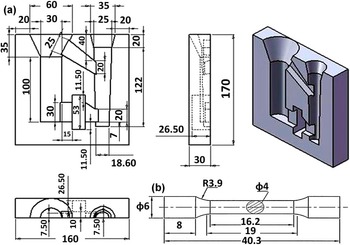
In this work, after preparing molten Al (>99.8%) at 780 °C, pure Si (>99.5% purity) and Mg (>99.9% purity) were added to prepare Al–5.5 wt% Si–9.5 wt% Mg primary ingots. Reference Ghorbani, Emamy, Khorshidi, Rasizadehghani and Emami6 Then, Sn was added into the melt (at 760 °C) to obtain different concentrations (0.1, 0.3, 0.5, 1.0, 3.0, 5.0, 7.0, and 10.0 wt%) in the alloy composition. After cleaning off the slag, alloys with different compositions were poured into a cast iron mold preheated to 200 °C [Fig. 2(a)].
The schematic of (a) cast iron mold (mm) and (b) sketch map of tensile samples (mm).

Cooling curve thermal analysis was performed. The thermocouples (K type) were located in the middle of the mold at a position of 60 mm from the bottom of the mold. The data were acquired by a high-speed data acquisition system (A/D converter) linked to a computer. To record the time–temperature data, ADAM-4000 Utility software was installed on the computer. In each test, data were recorded with the frequency of 20 readings per second and then transferred to origin pro 9.0 for smoothing and plotting the cooling curve, as well as the first derivative curve.
B. Processing and characterization
Then, specimens were polished using standard metallographic procedure and etched with 1% HF at room temperature. Optical microscopy, Vega Tescan scanning electron microscope (SEM; TESCAN Brno Company, Brno, Czech Republic) equipped with energy-dispersive spectroscopy (EDS), and PHILIPS x-ray diffractometer (PANalytical Company, Almelo, The Netherlands) with Cu Kα radiation were used for microstructural, elemental, fractographic, and phase analysis. The tensile specimens were also prepared according to ASTM B557M-10 standard as seen in Fig. 2(b). Tensile testing was carried out on a computerized testing machine (SANTAM STM-20, SANTAM Design & Manufacturing Company, Tehran, Iran) at a strain rate of 0.1 mm/min at room temperature. In current work, the average tensile results were obtained from at least 5 specimens for each test.
III. RESULTS AND DISCUSSION
A. Structural characterization
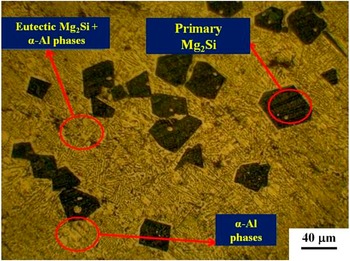
Figure 3 depicts typical microstructures of the Sn-free Mg–Mg2Si composite in as-cast condition.
Micrograph of the as-cast Al–15% Mg2Si composite microstructure.

From Fig. 3 and previous investigations, it can be seen that the microstructure of the unmodified Al–Mg2Si composite consists of coarse dark particles of primary Mg2Si and eutectic Mg2Si + α-Al phases. Reference Khorshidi, Raouf, Emamy and Campbell3 Figure 3 clearly reveals that the morphology of primary Mg2Si particles is often polygonal with hollow inside and also Mg2Si phase in eutectic matrix demonstrates flake-like morphology. Reference Li, Liu and Wu16
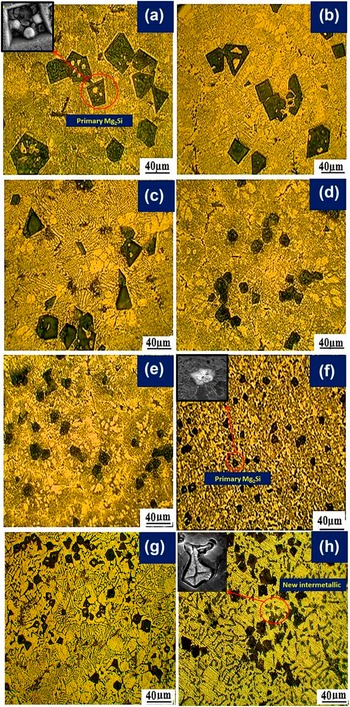
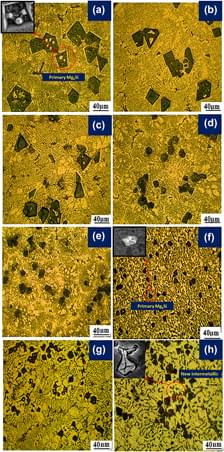
The optical micrographs of thick section casting specimens (with 30 mm diameter) of Al–Mg2Si composite with different Sn contents are shown in Fig. 4.
Optical microscope microstructures of in situ Al–15 wt% Mg2Si composite with different Sn additions: (a) 0 wt%, (b) 0.3 wt%, (c) 0.5 wt%, (d) 1.0 wt%, (e) 3.0 wt%, (f) 5.0 wt%, (g) 7.0 wt% and (h) 10 wt%.

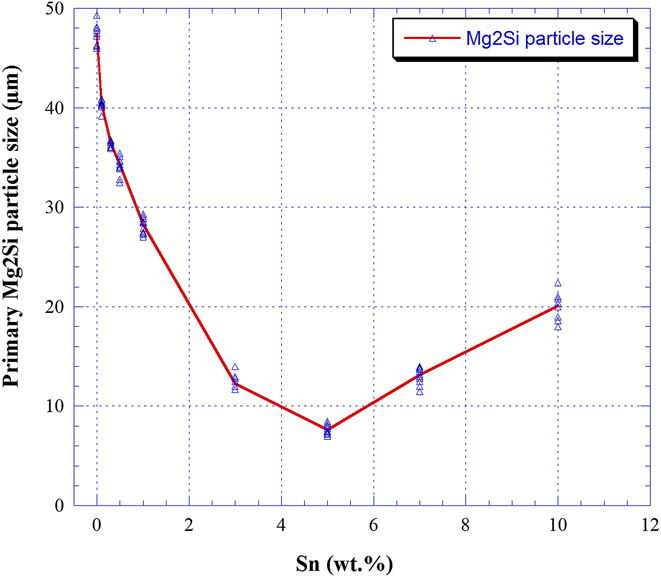
Figure 5 also depicts the variation in particle size of the primary particles with different Sn contents.
The size of primary particles as a function of Sn additions.
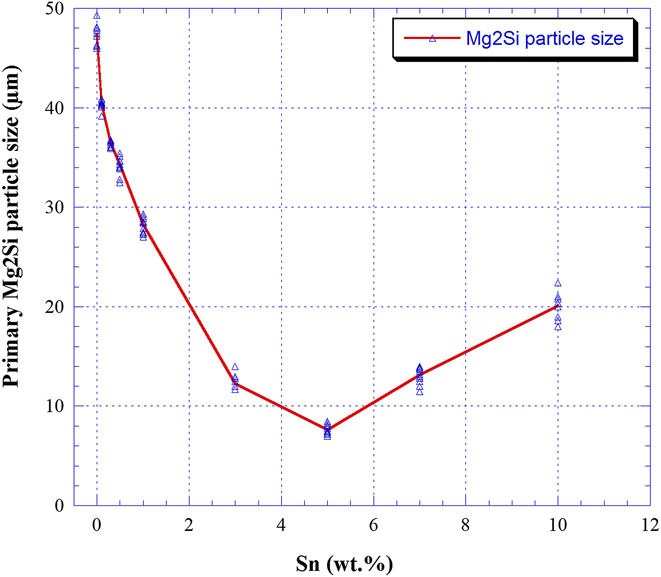
From Fig. 4, it can be seen that the morphology of primary particles does not change seriously with the addition 0.5 wt% Sn to the composite. But, the microstructural study of cast specimens depicts that the use of higher amounts of Sn (>0.5 wt%) does not alter the morphology of primary particles significantly, but its size notably deceases from 48 µm to 7 µm, shown in Figs. 4 and 5. Further reduction in the size of primary phase (7 µm) is observed by the addition of Sn content up to 5 wt%. Figs. 4 and 5 clearly indicate that not only the particle size of primary phases reduces significantly, but also the number of Mg2Si-rich particles increases by adding Sn content. This implies an increase in the number of nuclei for the primary Mg2Si-rich particles during solidification. It has been reported that Sn addition increases the kinetics of forming Mg2Si precipitates. Reference Azarbarmas, Emamy, Rassizadehghani and Alipour17
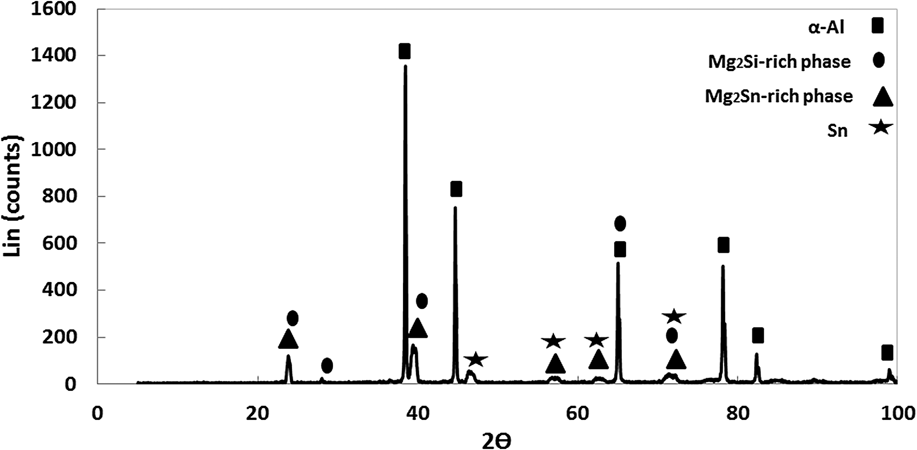
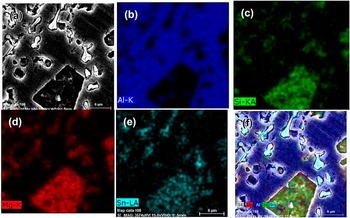
From Figs. 6 and 7, based on the X-ray diffraction (XRD) patterns and EDS analysis results obtained from Al–15% Mg2Si–5% Sn composite, the presence of Mg and Sn-containing products was confirmed.
XRD patterns of the Al–15% Mg2Si–5% Sn composite.

(a) SEM image of Al–15% Mg2Si composite and its related map for: (b) Al, (c) Si, (d) Mg, (e) Sn, and (f) Al–Mg–Si–Sn.

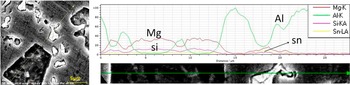
It is important to note that Sn has no solid solubility in both aluminum and silicon and also it does not form any intermetallic phases with Al and Si. But, when the amount of Sn increases in this system, it tends to introduce new intermetallic phase. Reference Mohamed, Samuel, Samuel, Doty and Valtierra18 In this work, the presence of Mg2Sn intermetallic has been confirmed by XRD pattern of Fig. 6, when 5 wt% Sn is added to the Al–15% Mg2Si composite. From Fig. 7(e), Sn element is clearly seen in the Mg2Si intermetallic. From previous investigation, the solubility of Sn in Mg2Si was found to be 4.4 at.% and the value of Si solubility in Mg2Sn was 14 at.%. Reference Jung, Kang, Park, Kim and Ahn19 Some researchers have reported the significant segregation of tin during solidification demonstrates itself in very small precipitates of Mg2Sn and Sn. Reference Hirsch, Skrotzki and Gottstein20 So, it can be concluded when the amount of tin is low, Mg2Si-rich phase [Mg2(Si,Sn)] is formed as primary phase, but when the amount of tin increases up to higher levels (i.e., 10 wt%), the Mg2Sn-rich phase [Mg2(Sn,Si)] may play the role of primary phase, which is confirmed by the result of Kozlov et al. Reference Kozlov, Gröbner and Schmid-Fetzer21 The line scan results obtained from EDS analysis, shown in Fig. 8, indicates the variations of Si and Sn atoms and the presence of Sn atom in the Mg2Si phase.
SEM image of Al–15% Mg2Si–5% Sn composite and its related line scan.

The mechanisms of refinement in Al–Mg2Si composite by adding some elements have been also discussed by several researchers. Reference Ghorbani, Emamy, Khorshidi, Rasizadehghani and Emami6,Reference Wu, Zhang and Wu10
It truly is well known that heterogeneous nucleation and poisoning effect are two major types of modification mechanisms. Reference Ghorbani, Emamy, Khorshidi, Rasizadehghani and Emami6 From the results of the current research, the positive role of Sn (especially at lower content) in refining of Mg2Si can be attributed to the heterogeneous nucleation mechanism. Because, there is a crystallochemical correspondence between Mg2Si and Mg2Sn phases, which have the same cubic CaF2 type crystal structure. Reference Mohamed, Samuel, Samuel, Doty and Valtierra18 And also, solidification path of Al–15% Mg2Si composite confirms that Sn can enhance the nucleation sites for primary Mg2Si phase in Al melt, on the other hand, equilibrium phase diagrams of Al–Mg2Si Reference Azarbarmas, Emamy, Rassizadehghani and Alipour17 and Mg–Sn Reference Nayeb-Hashemi and Clark22 depict that Mg2Si particles form as the primary phase (Mg2SiP) during initial solidification stage (at 600 °C) in Al–15% Mg2Si composite, whereas the formation of Mg2Sn intermetallic occurs at 770 °C. Also, Bramfitt has shown that the disregistry of nucleant planes must be as low as possible (i.e., <12%) for nucleation of a solid from liquid phase. Reference Bramfitt23 In literature, it was reported that Mg2Sn intermetallic has a cubic crystal with lattice parameters; a = 6.739 Å and also the important planes for Mg2Sn phase are (111), (110), and (100).18 Due to the proposed mathematical equation, Eq. (1) can be written as follows Reference Bramfitt23 :
 $$\delta _{{{\left( {hkl} \right)}_{\rm{n}}}}^{{{\left( {hkl} \right)}_{\rm{s}}}} = {1 \over 3}\sum\limits_{i = 0}^3 {{{\left| {{\rm{d}}\left[ {uvw} \right]_{\rm{n}}^i\,\cos \,\theta - d\left( {uvw} \right)_{\rm{s}}^i} \right|} \over {{\rm{d}}\left[ {uvw} \right]_{\rm{s}}^i}}} \times 100\% \quad ,$$
that:
 ${\left( {hkl} \right)_{\rm{s}}}$
= low index plane of the substrate,
 ${\left[ {uvw} \right]_{\rm{s}}}$
= the low index direction in this plane,
 ${\left( {hkl} \right)_{\rm{n}}}$
= low index plane in the nucleated solid,
 ${\left[ {uvw} \right]_{\rm{n}}}$
= the low index direction in this plane,
 ${\rm{d}}{\left[ {uvw} \right]_{\rm{s}}}$
= the atomic spacing's along the
 ${\left[ {uvw} \right]_{\rm{s}}}$
,
 ${\rm{d}}{\left[ {uvw} \right]_{\rm{n}}}$
= the atomic spacing's along the
 ${\left[ {uvw} \right]_{\rm{n}}}$
, and Θ = is the angle between the
 ${\rm{d}}{\left[ {uvw} \right]_{\rm{n}}}$
and
 ${\rm{d}}{\left[ {uvw} \right]_{\rm{s}}}$
.
Table I also shows the results of calculation for some possible crystallographic orientations for Mg2Si nucleation on the Mg2Sn particles.
Calculated values of planer disregistry between Mg2Si and Mg2Sn phases.

From Table I, it can be seen that the lowest disregistry (5.4%) has been found for
 $(001)_{{\rm{Mg}}_2 {\rm{Sn}}} {\parallel} (001)_{{\rm{Mg}}_2 {\rm{Si}}}$
, showing that Mg2Sn acts as a potent heterogeneous nucleation site for Mg2Si phase. The primary Mg2Si particles maintain proper morphology in Al–15% Mg2Si–5% Sn composite.
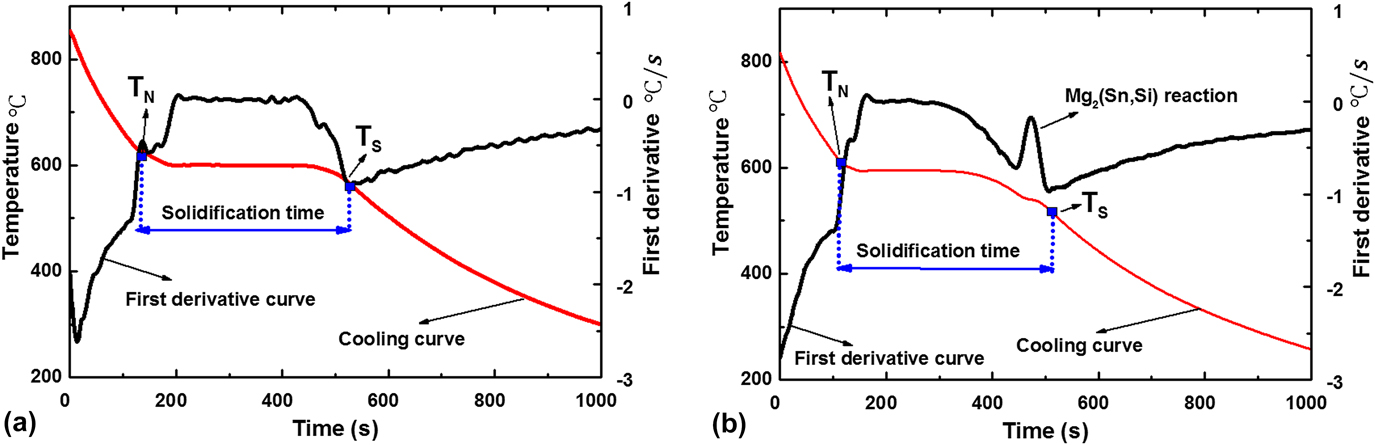
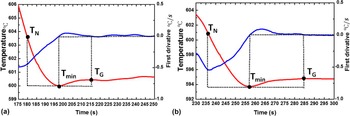
Figure 9 shows the cooling curves recorded during the solidification process of Al–15% Mg2Si alloys without Sn and with 5 wt% Sn addition. There are some temperature arrests in the cooling curve that are hardly recognized by cooling curve. So, the first derivative curves have been used to determine these temperatures. As depicted in Fig. 9, when the melts begin to solidify, the absolute value of first derivate begins to increase, which means that the cooling rate reduces initially and then it start to diminish. In solidification process, the formation of each phase results in an increase in the value of first derivative because of the exothermic nature of phase formation that heats the system and slows down heat release from the system. On the contrary, the minimum value of first derivative is called solidus temperature (T S), after T S point, first derivative value enhances.
Cooling curve, first derivative of in situ Al–15 wt% Mg2Si composite with different Sn additions (a) 0 wt% and (b) 5 wt%.
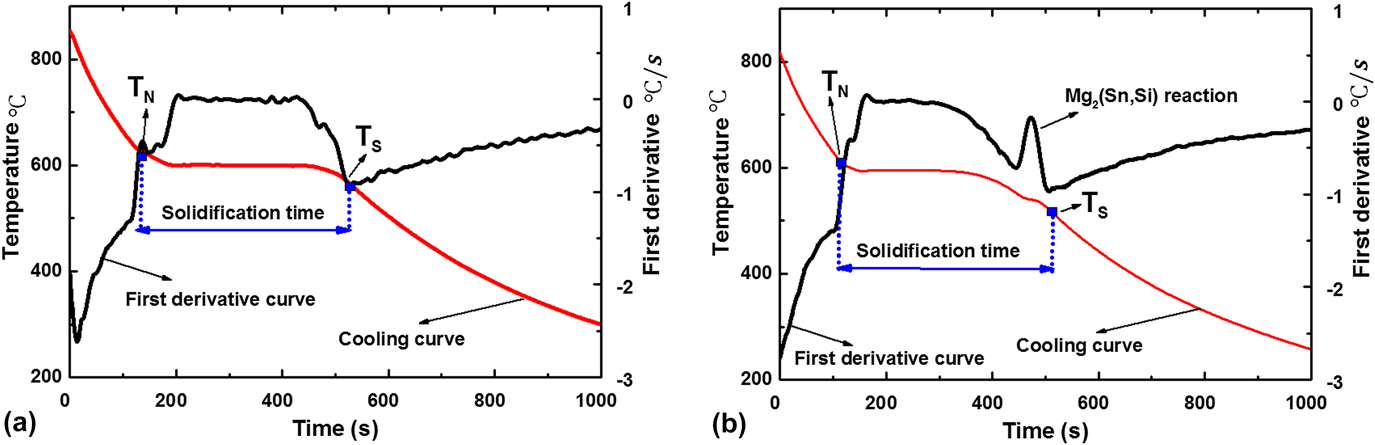
The Mg2Si nucleation temperature (liquidus temperature), T N, is shown in Fig. 9. Slight reduction in nucleation temperature (T N) is seen in the cooling curves, varying from 603 °C for Sn-free specimen to 601 °C for 5% Sn added MMC. As shown in Fig. 9(b), a reaction takes place at 540 °C in Al–15% Mg2Si–5% Sn system, which can be related to the formation of Mg2(Sn,Si)-rich intermetallic (Fig. 7). Also, it can be concluded that the solidification time increases from 379 s for the base alloy to 409 s for the alloy containing 5% Sn.
A magnified liquidus region of the cooling curve and its first derivative curve are shown in Fig. 10. It is seen that minimum temperature (T min) and growth temperature (T G) decrease with the addition of 5% Sn. After T N, the cooling rate decreases due to the growing stable nuclei lessens the energy of the system which results in heat release into the melt. Then, in T min, the formed heat of nucleation overcomes the heat loss of the system. Afterward, the melt becomes hotter up to T G point. After T G point, the growth of the present nucleus occurs without forming new crystal nucleates. The difference between T G and T min is named the recalescence undercooling. It can be concluded from Fig. 10 after adding 5 wt% Sn to the molten alloy, T min and T G are reduced and also the recalescence undercooling temperature is increased from 0.44 °C to 1.13 °C.
Magnified liquidus region of the cooling curve and its first derivative curve for (a) unrefined and (b) 5 wt% Sn refined Al–15 wt% Mg2Si composite.

In similar alloy systems, from several factors affecting the quality of the castings, the role of oxide films has been well understood. Reference Khorshidi, Raouf, Emamy and Campbell3 Previous investigations have shown that Al alloys are generally full of bifilms which not only act as substrates for the precipitation of second phases (like Mg2Si-rich phase) but also introduce real cracks in the solidified castings. Reference Campbell24,Reference Dispinar and Campbell25 Several defects may result from the presence of bifilms such as porosity and hot tearing. Improper morphologies of second phases can be considered as other deleterious effects of bifilms which impair the reliability of mechanical properties. Cracks may form through the centers of particles due to forming particles on both sides of bifilm. Reference Campbell26
Similar investigation on Sn-free composite clearly shows that the favorable formation of Mg2Si on bifilm leads to the evolution of latent heat at a high temperature and delaying the general freezing of the alloy. Because of delayed solidification at higher temperatures, all particles will be coarsened. Reference Khorshidi, Raouf, Emamy and Campbell3 With the addition Sn to this composite, the lower minimum temperature (T min) and growth temperature (T G) of modified composite may be another reason of decreasing the bifilm due to the presence of Sn. So the bifilms appear to become deactivated as substrates for the precipitation of Mg2Si particles.
It is interesting to note that after 5% Sn addition, the cracks on the Mg2Si particle are hardly seen. The addition of Sn seems to render the oxide substrates unfavorable as substrates for precipitation of Mg2Si, therefore the melt now continues to new lower temperatures. Finally, oxide bifilms reach a temperature at which they will act as substrates, or some other nucleation sites become active, this necessarily is accompanied by a refinement of the Mg2Si. But, when the amount of Sn increases up to 10%, some cracks on the particle are observed [Fig. 4(h)]. So, it seems that the effect of Sn on the reduction of bifilm at higher addition is destroyed.
In the current study, although efforts were made to prepare sound castings, the production of a bifilm-free casting is so hard and the use of filtering does not usually eliminate the bifilms completely. If a bifilm-free casting was available, less cracks were expected and with higher Sn content, much Sn or Sn-containing phase would be possible, without the formation of coarse and evidently brittle phases.
B. Mechanical properties
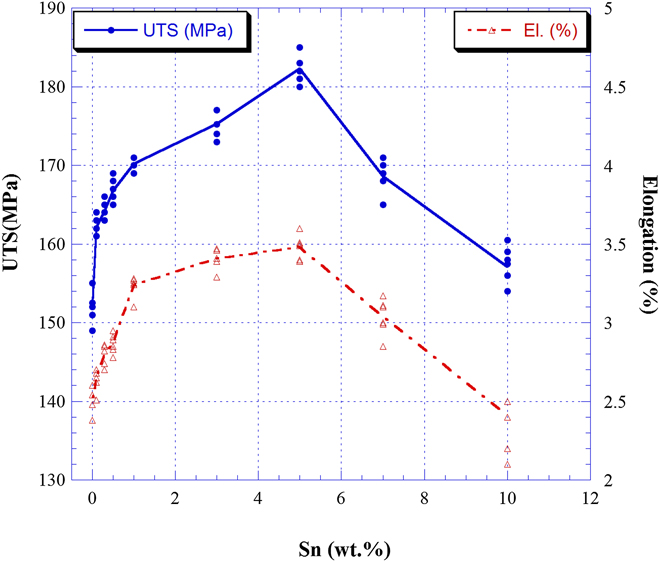
The ultimate tensile strength (UTS) and elongation values of the composite specimens are plotted in Fig. 11 as a function of Sn content in the Al–Mg2Si composite.
UTS and elongation values of the MMC specimens as a function of added Sn contents.
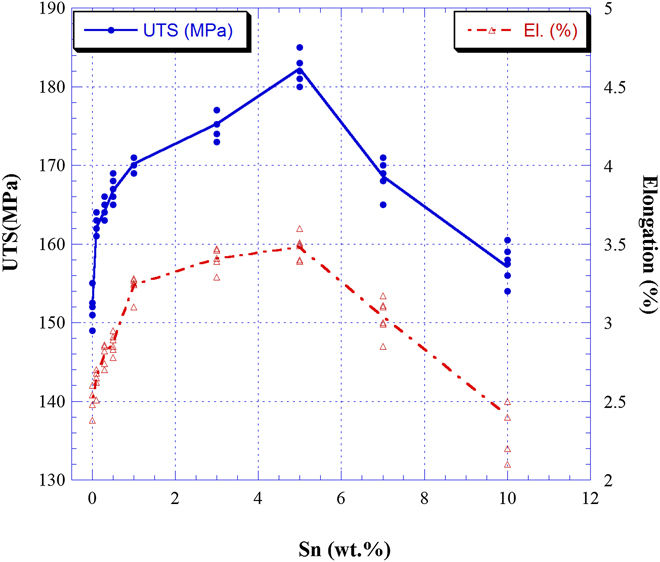
From Fig. 11, it is seen that UTS increases from ∼152 MPa to ∼184 MPa and elongation percentage improves from ∼2.5% to ∼3.4%. The observed improvement in tensile properties of the composite with Sn addition could be a result of the effective refining action of Sn on primary Mg2Si particles.
On the other hand, the discrete Mg2Sn intermetallic precipitates mainly at grain/cell boundaries and may restrain the movement of dislocations, resulting in a strengthening effect. The dispersion strengthening of the Mg2Sn phases also plays an important role in the rising of the tensile strength. Reference Liu, Chen, Tang, Wei and Niu27
Materials with fine microstructures have a lower tendency for low energy brittle cracking. To obtain acceptable morphology and degree of dispersion of the components, one can interfere at the crystallization stage by modifying the structural characteristics of the material. The modifying of the Mg2Si precipitates network and their spheroidization are also very important. This allows the reduction in the stress–concentration factor value [K n in Eq. (2)] in these regions, depending on brittle phase morphology Reference Hertzberg28,Reference Dieter29 :
 $${K_{\rm{n}}} = {{2a} \mathord{\left/ {\vphantom {{2a} b}} \right. \kern-\nulldelimiterspace} b}\quad ,$$
where, a is one-half the length of a particle and b is one-half the width of a particle.
The elongation percentage enhancement in the composite with Sn contents up to 0.5 wt% is probably due to the refined microstructure and also the formation of more α-Al phase in the microstructure, as seen in Figs. 4 and 11. The presence of α-Al phase in the microstructure causes more fine dimples and ductile fracture in the composite. But, Fig. 11 depicts a reducing trend in tensile properties of the Al–Mg2Si composite when Sn content is more than 5 wt%. This reduction can be attributed to the fact that the formation of brittle, coarse, and irregular Mg2Sn intermetallic phase encourages more crack nucleation and crack propagation sites.
C. Fracture characteristics
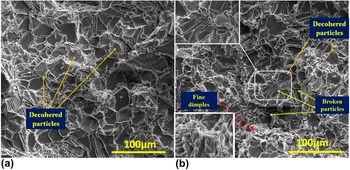
Figure 12 demonstrates the difference between the fracture surfaces of Al–15% Mg2Si MMC castings containing 0 and 5 wt% Sn.
Fracture surfaces of Al–15% Mg2Si composites with different Sn contents: (a) 0 wt% and (b) 5 wt%.

It can be understood from Fig. 12a that fracture planes of coarse Mg2Si particle show clear cleavage characteristic, creating a rapid fracture deriving from their intrinsic and pre-crack structure. Reference Warmuzek30 As can be depicted in Fig. 12(b), by adding 5 wt% Sn to the Al–Mg2Si composite, some dimples and fewer brittle cleavage surfaces and decohered particles are seen on the fracture surfaces of the samples, consequently the Al–15% Mg2Si–5% Sn composite clearly leads to a higher elongation, as compared with the lower elongation of unmodified composite.
According to the modified morphology of Mg2Si particles, it also can be described that with the addition of 5 wt% Sn, the primary Mg2Si phase becomes finer and more compacted that may lead to the reduced stress-concentration sites. The fracture surfaces also show both decohered and cracked particles in the cast MMC, Fig. 12(b). In Sn added composite, decohesion at the interface between aluminum and Mg2Si was rarely found, while the secondary cracks in the brittle phases were often observed. It seems that Sn addition alters the fracture mode from brittle to ductile. As expected, soft matrix surrounds the brittle particles, because of rather strong cohesion at the interface between α-Al and Mg2Si, the matrix is deformed under local active stress. Babout et al. proposed a model to simulate the fracture behavior in MMCs suggesting that regardless of the volume fraction of the particles, interface fracture was strength controlled, and that decohesion occurred when the average tensile stress in the particles surpassed a critical value known as the interface strength. In in situ composites, interface is strong enough and when load is transferred to Mg2Si primary particle, fracture occurs as soon as the threshold stress is reached. However, if the matrix is soft and the interface is weak, decohesion prevails. Reference Babout, Brechet, Maire and Fougeres31
According to Griffith's theory, Reference Dieter29 a particle breaks when its fracture stress exceeds the Griffith criterion given by
 $${\sigma _{\rm{c}}} = {k_{\rm{c}}}{d^{0.5}}\quad ,$$
where, k c is the fracture toughness of the particles and d is the diameter of the particle. Thus, higher strength values are expected in samples containing Sn. As shown in Fig. 5, Sn addition has been resulted in fine and compacted Mg2Si particles. Hence, nucleation sites for cracking were reduced [Fig. 12(b)] which led to the improved tensile properties.
IV. CONCLUSIONS
The effect of different amounts of Sn on the microstructural and mechanical properties of Al–15% Mg2Si alloy was studied. The following conclusions were drawn:
-
(1) Sn addition was found to be powerful in reducing the average size of primary particles in from 45 µm to 8 µm. The reduction in the size of the primary particles in the modified composite was attributed to the effects of the Mg2Sn intermetallic as heterogeneous nucleation sites.
-
(2) Sn addition increased solidification time and recalescence undercooling temperature, but reduced the growth temperature of the alloy slightly. The role of oxide bifilms in the liquid alloy was outstanding in changing the solidification behavior and tensile properties of the composite. It seems that Sn addition deactivates the bifilms to act as substrates for the precipitation of Mg2Si particles.
-
(3) The addition of 5 wt% Sn improved the tensile properties of MMC compared to Sn-free alloy. The fracture surface study via SEM revealed that Sn addition at optimum level changed the fracture mode from brittle to more ductile.
ACKNOWLEDGMENT
The authors gratefully acknowledge University of Tehran for financial support of this work.