Introduction
The African variegated grasshopper Zonocerus variegatus (Linnaeus) (Orthoptera: Pyrgomorphidae) is the main pest of cash crops in over 20 countries of the forest and savanna areas of West and Central Africa (Messi et al., Reference Messi, Kekeunou and Weise2006). The life cycle of Z. variegatus is built around six nymphal stages (Youdeowei, Reference Youdeowei1974). Nymphal development is usually completed in 3–5 months, while the adult stage lasts for about 15 weeks (Muse, Reference Muse2003). It is a polyphagous insect, feeding on a wide variety of wild and cultivated plants (Toye, Reference Toye1982). Toye (Reference Toye1974), however, observed that the insect exhibits food preferences: first to third instars prefer Chromolaena odorata (Linnaeus) King & H.E. Robins (Asteraceae), while later instars and the adult stage prefer cassava leaves Manihot esculenta Crantz (Euphorbiaceae). Similarly, first to third instars have gregarious habit, while the adult stage disperses in all directions. When disturbed, the adult can fly short distances of 8–15 cm, indicating that they possess well-developed flight muscles and are capable of flight (Youdeowei, Reference Youdeowei1974).
The complexity and structure of Z. variegatus increase with age (Ademolu et al., Reference Ademolu, Idowu and Dansu2006) with a remarkable growth rate at sixth (adult stage) phase. The overall body length and hind femur length of Z. variegatus vary throughout the developmental stages. The body length progressively increases from 10 mm in the first instar to over 30 mm in the final instar (Chapman et al., Reference Chapman, Cook, Mitchell and Page1977). During the development in Schistocerca americana (Drury) (Orthoptera: Acrididae), femur mass and muscle mass grow isometrically relative to the body mass (Kirkton et al., Reference Kirkton, Niska and Harrison2005). Similarly, lactate concentration and aerobic metabolic rate of jumping muscles increased with age. Many substrates are metabolized for jumping by grasshoppers suggesting the presence of their enzymes (Chapman, Reference Chapman1990). Generally, two distinct groups exist: one uses carbohydrates while the other uses fat as substrates (Bertram, Reference Bertram1955). However, in Z. variegatus, there is a lacuna of information on enzyme activities in the femoral muscles especially during post-embryonic development. The objective of this work is to study the morphometrics of the developmental stages and examine the enzymatic activities of femoral muscles of Z. variegatus during post-embryonic development.
Materials and methods
Insect collection and maintenance
Newly hatched first-instar nymphs were collected with a sweep net from cultivated farmlands on the campus of the University of Agriculture, Abeokuta (UNAAB), Ogun State, Nigeria, during the months of September and October 2006. The insects were brought to the insectary of the Biological Sciences Department of the University and were reared in wire cages (30 × 30 × 45 cm) and fed daily on fresh leaves of C. odorata and M. esculenta.
Thirty insects/individuals from each instar stage were immobilized by freezing in a deep freezer for 30 min. The length, width and weight of each individual femur were measured with a calibrated ruler and sensitive weighing balance (Mettler model PM-11, Leicester, UK). The different development stages were identified based on the description of Youdeowei (Reference Youdeowei1974) and Chapman et al. (Reference Chapman, Cook, Mitchell and Page1977).
For the enzyme assay, the hind femur was opened with a sharp razor and all muscles were removed by forceps into a test tube containing 0.05 m KCl and pulverized with the forceps. The homogenate was centrifuged at 500 rpm at 5 °C for 30 min. The supernatant was collected in a 30 ml centrifuge bottle and stored in a deep freezer until further analysis.
Determination of enzyme activities
The method described by Adedire and Balogun (Reference Adedire and Balogun1995) was employed for the determination of carbohydrase activities (amylase, cellulase and α-glucosidase), while lipase and proteinase activities were assayed using the method described by Adedire (Reference Adedire1994). The extracting buffer was 0.1 m sodium hydrogen phosphate (pH 6.9). Five millilitres of the enzyme extract was added to 19 ml of 2% casein solution and incubated at 35 °C for 30 min. The mixture was filtered through Whatman No. 1 filter paper. Standard proteinase solution was prepared and treated similarly as above. The absorbance of the sample and the standard proteinase filtrates were read at a wavelength of 275 nm. Proteinase activity was measured as the amount of proteinase capable of catalysing absorbance change of 0.01 in 60 s at a wavelength of 275 nm. All assays were carried out in triplicate.
Statistical analysis
Data collected were subjected to one-way ANOVA using the Minitab (1998) computer package, and in case of significant F-values, means were separated using the Student–Newman–Keuls (SNK) test.
Results and Discussion
Morphology
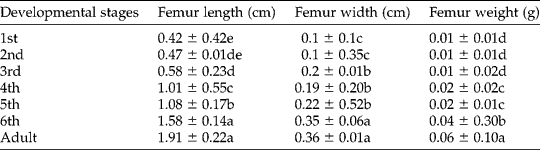
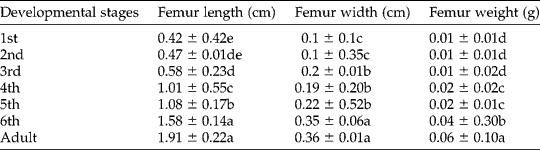
There was a progressive increase in the hind femur length from 0.42 ± 0.40 cm (SE) in the first instar to 1.91 ± 0.22 cm in the adult stage. Similarly, the weight of the hind femur increased with each moult (Table 1) from 0.1 ± 0.01 g in the first instar to 4.6 ± 0.1 g in the adult stage. Chapman et al. (Reference Chapman, Cook, Mitchell and Page1977) similarly reported that body length, antennal length and head width increased during post-embryonic development.
The measurements of the hind femur of Zonocerus variegatus during post-embryonic development (mean±SE)
Mean values in the same column having the same letter are not significantly different, P>0.05 (SNK).
Statistical analyses revealed that there were no differences in mean sizes of first and second instars on one hand and between the sixth instars and the adults on the other, possibly due to the slow pace of development of the femur at this stage. Similar observations were made by Ademolu et al. (Reference Ademolu, Idowu and Dansu2006) for antenna and whole body length in Z. variegatus.
Enzyme activity
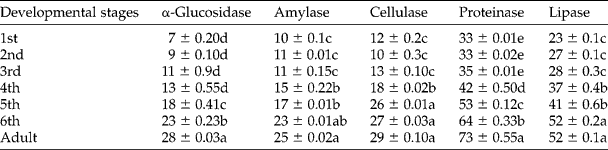
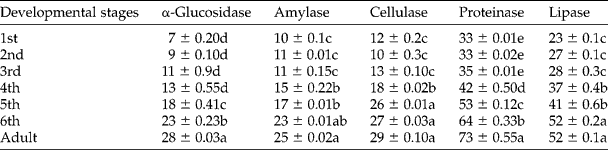
The femoral muscles of all the developmental stages of Z. variegatus exhibited the presence of α-glucosidase, lipase, amylase, proteinase and cellulase, suggesting their ability to metabolize their substrates (Table 2). These enzymes have been reported to be common in the tissues of phytophagous insects like grasshoppers (Morgan, Reference Morgan1976). Similarly, these enzymes are present in the gut of Z. variegatus (Balogun, Reference Balogun1972; Modder, Reference Modder1983). Thus it can be inferred that gut enzymes are similarly present in the femoral muscles. Bertram (Reference Bertram1955) had earlier reported that food substances were converted to utilizable substances prior to or during transport to the muscles.
The enzyme activities (abs/min) of the femoral muscles of Zonocerus variegatus during post-embryonic development (mean±SE)
Mean values in the same column having the same letter are not significantly different, P>0.05 (SNK).
The activities of these enzymes increased as the insect moved from the first instar to the adult stage. The increase in the weight and length of the hind femur as the insect advanced in age actually increased the amount of various substrates in the muscles, thereby increasing the activities of the enzymes. For example, the lactate concentration and aerobic metabolic rate of jumping muscles increased with age in S. americana (Kirkton et al., Reference Kirkton, Niska and Harrison2005). Likewise, an increase in food consumption during post-embryonic development (Idowu and Edema, Reference Idowu and Edema2001) might have increased the activities of these enzymes in the muscle, suggesting an increasing hopping capacity as the insects move from younger to older instars. Toye (Reference Toye1982) had earlier observed that younger instars do not move far because of their gregarious habit.
There were no significant differences in the enzyme activities of the first to the third instars in all the enzymes assayed. Ademolu et al. (Reference Ademolu, Idowu and Amusan2007) reported similar observations in the chemical composition of the somatic tissues of Z. variegatus during its post-embryonic development. The first to third instar stages had been described as building-up phase in the life of the insect (Youdeowei, Reference Youdeowei1974).
Proteinase and lipase activities in the femoral muscles were significantly higher than those of other enzymes. This might be due to the type of food plants consumed by the insects. The proximate analysis of the food plants (Ayodeji and Valentine, Reference Ayodeji and Valentine2005) showed that C. odorata and M. esculenta have higher protein and fat content than carbohydrates. This is in agreement with the findings of Yacoe et al. (Reference Yacoe, Cummings, Myers and Creighton1982): that diets affect the oxidation and metabolism of the substrate in the muscles. Thus it can be inferred that, in Z. variegatus, lipids provide the major vehicle for the femoral muscle performance.