Harry Longueville Jones (1806–70) is well known for his contribution to Welsh antiquarianism as co-founder of Archaeologia Cambrensis in 1846 and the ensuing Cambrian Archaeological Association (CAA) in 1847, initiatives with which he remained closely involved until his death. Yet, while clearly opening an important new phase in the study of the Welsh past, those initiatives may also be seen as the culmination of Jones’s increasing engagement with archaeological developments over the previous decade whose main focus lay, not in Wales, but in France. This article argues that these earlier archaeological interests and endeavours, hitherto largely overlooked, have a two-fold significance. First, they throw revealing light on the making of Jones as a self-styled archaeologist, thereby providing essential background to the assumptions and approaches he brought to the study of Welsh antiquities. Second, they offer a notable instance of the influence on British antiquaries and others of the July Monarchy’s measures to survey and protect historic monuments in France.
BACKGROUND
Previous scholars have considered Jones’s various interests and accomplishments, which extended well beyond archaeology.Footnote 1 However, coverage of these has been uneven. For example, his contributions to the Manchester Statistical Society, of which he became a corresponding member in 1838, have been briefly noticed, while studies of Victorian periodicals and literary culture have highlighted his staunchly Tory political views in some of the twenty-seven essays he published in Blackwood’s Edinburgh Magazine in the 1840s. In particular, Jones has been portrayed as exemplifying a paternalist vision of a hierarchical, organic society under the leadership of the landed aristocracy, a reaction to radical political, social and economic change inspired by a romantic medievalism that also informed his approach to archaeology, as we shall see.Footnote 2 By contrast, much more attention has been given to Jones’s interest in education, above all as Her Majesty’s Inspector for Church Schools in Wales (1848–64).Footnote 3 This appointment helped to sustain his archaeological endeavours by providing him with the financial security he had previously lacked, thanks to an annual salary of £600, as well as ample opportunities to combine his official duties with visits to monuments across the length and breadth of the Principality.Footnote 4
Assessments of the significance of Jones as an archaeologist have focused on his role in the formation of the CAA and its journal, Archaeologia Cambrensis, his close involvement with these until his death in 1870 and aspects of his interpretation of archaeological evidence in Wales.Footnote 5 An important theme to emerge from this work is Jones’s commitment to a critical, ‘scientific’ approach based on fieldwork combined, where appropriate, with analysis of written sources, in sharp contrast to the fanciful bardic interpretations of the Welsh past espoused by his initial collaborator, the Revd John Williams Ab Ithel (1811–62), a divergence of views that helped to precipitate the latter’s break with the CAA at the end of 1853.Footnote 6 As far as Welsh archaeology is concerned, then, Jones has been located in a narrative of scientific progress.
The origins of his interest in the archaeology of Wales have, on the other hand, received little consideration, perhaps because it has been too readily assumed that Jones was Welsh and therefore that no explanation was needed. If so, the assumption requires qualification, as Jones was not only born and raised in London and educated at Cambridge but could claim Welsh descent only through his paternal grandfather, Thomas Jones of Wrexham (d. 1799).Footnote 7 Nevertheless, this partial Welsh pedigree may account for an early interest in Wales and its antiquities evident in his first publication, issued shortly after becoming a Fellow of Magdalene College upon his graduation in 1828: a finely produced elephant folio volume, Illustrations of the Natural Scenery of the Snowdonian Mountains (1829). The ambitious scale of the enterprise was matched (and financed) by the securing of 137 subscribers. These almost certainly included two paternal uncles. Most striking, though, was the appearance in the list of members of the royal family and aristocracy, headed by Princess Mary, Duchess of Gloucester (1776–1857), to whom the volume was also dedicated (a connection possibly facilitated by her residence at Gloucester House in Jones’s birthplace of Piccadilly).Footnote 8
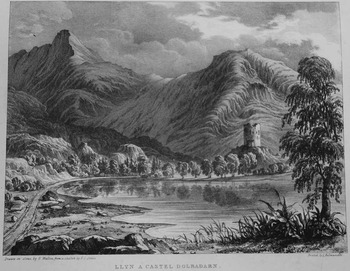
Containing engravings of fifteen drawings he had made, the work was markedly sympathetic to Wales and the Welsh language, as shown by its reliance on the grammatical and lexicographical works of William Owen [Pughe] (1759–1835), whose controversial Welsh orthography it reproduced.Footnote 9 Jones explained that his aim was ‘[t]o supply a partial deficiency in the topographical illustration of Britain’, and that he had not focused on antiquities as these had already been adequately treated by previous writers, notably Thomas Pennant (1726–98).Footnote 10 Accordingly, as its title suggests, the work deals mainly with the landscape, and only one of the drawings includes an ancient monument (fig 1). Yet the book contains an annotated table of antiquities in Caernarfonshire as well as descriptions of individual monuments in the main text, which show that Jones had already developed antiquarian knowledge and interests in two important aspects.Footnote 11 First, he drew extensively on the work of earlier antiquaries – notably Pennant and Sir Richard Colt Hoare (1758–1838), but also Henry Rowlands (1655–1723) and Browne Willis (1682–1760), among others.Footnote 12 Second, his comments on churches, evidently based on personal observation, display a familiarity with recently adopted terms for medieval architectural styles in England, especially Decorated Gothic and Perpendicular Gothic, as influentially defined by Thomas Rickman in 1817.Footnote 13
‘Llyn a Castel Dolbadarn’: engraved from Jones’s sketch of Lake Padarn and the thirteenth-century castle of Dolbadarn, Caerns. Source: Archives and Special Collections, Bangor University; copy of Jones Reference Jones1829, facing p 22

There is also early evidence of Jones’s dislike of restoration practice when this took insufficient notice of the original architectural features of a church.Footnote 14 On the other hand, this scholarly and critical approach coexisted with a romantic, and at times Gothic, sensibility, most apparent in the evocation of episodes in the history of Conwy Castle, where the visitor ‘will often remember, with a pleasing regret, the solemn silence of its halls and the intricate gloom of its passages’.Footnote 15 While he continued to be captivated by the romantic allure of archaeological sites,Footnote 16 his accounts of these from the 1840s onwards demonstrate a capacity for systematic survey and description that is largely absent from his volume in 1829. This difference in approach (and genre) resulted from an increasing engagement with developments in archaeology gained while living in Paris.
JONES IN PARIS: THE APPEAL OF THE MIDDLE AGES AND THE PRESERVATION OF HISTORIC MONUMENTS
Required to resign his Cambridge college Fellowship after his marriage in 1835, Jones took up residence in the French capital, and remained there until he moved to Manchester in March 1842.Footnote 17 In common with others among the city’s numerous English inhabitants at that time, he may have been attracted to Paris by the lower cost of living than in England, having been deprived of the income from his Fellowship and probably with little other financial means.Footnote 18 Jones supported himself as a writer and journalist, contributing to Blackwood’s Edinburgh Magazine and other periodicals as well as working alongside William Makepeace Thackeray (1811–63) on the newspaper Galignani’s Messenger and updating Galignani’s New Paris Guide.Footnote 19 Many of Jones’s writings in Paris comment on political, social and educational issues of the day, including the initiatives under the July Monarchy (1830–48) to record and preserve the historic monuments of France, driven especially by François Guizot (1787–1874), historian, liberal reformer and dominant figure in the Orleanist regime.Footnote 20 The most important of these for the present discussion was the Comité historique des arts et monuments (Historical Committee on Arts and Monuments), under the authority of the Minister of Public Instruction. Originating in 1834 as part of what became known as the Comité des travaux historiques, but only established as a separate committee in 1837, its remit was ‘to make known all the monuments of art in France’.Footnote 21 Accordingly, its main task was the organisation of detailed surveys, based on questionnaires and other information supplied by its members and correspondents, and to identify monuments needing protection or conservation. Its role as a body dedicated to recording and giving expert advice distinguished the Comité from the Service des monuments historiques, headed by the Inspector General of Historical Monuments, first Ludovic Vitet (1830–4), then Prosper Mérimée (1834–60), and supported from 1837 by a Commission des monuments historiques responsible to the Minister of the Interior. This had limited funds available for conservation, whose allocation was governed from 1840 onwards by a system whereby certain monuments were officially classified as ‘Monuments historiques’.Footnote 22
Jones was presumably predisposed to view these developments favourably by the antiquarian interests already evident in his work on the topography of north-west Wales, interests he continued to pursue after his arrival in Paris. He visited the private museum of Alexandre Lenoir (1761–1839) in 1835, and attended a lecture course on ‘Christian archaeology’ given by Adolphe Napoléon Didron (1806–67) and Albert Lenoir (1801–91), speaking respectively on architecture and on art and sculpture, in the Bibliothèque du Roi from late May to July 1838.Footnote 23 For Jones, attendance at these lectures both reflected and further stimulated a deepening engagement with archaeology in France that led to his writing a lengthy article that appeared in The Foreign and Quarterly Review in October 1838. This reviewed the lectures together with publications reflecting recent French approaches to (mainly medieval) art and architecture, namely two works by Alexandre du Sommerard and the annual reports for 1838 of the Comité historique des arts et monuments and Commission des monuments historiques.Footnote 24 (Baron Taylor and Charles Nodier’s Voyages pittoresques et romantiques dans l’ancienne France, a multi-volume work published from 1820 onwards, is also listed at the head of the article, but Jones only referred to this briefly by way of contrast with the more recent developments that chiefly engaged his attention.)Footnote 25 The publication of the article may in turn explain why Jones was nominated as one of the Comité’s eight corresponding members from England in January 1839, although it was only during the subsequent fortnight that he submitted a copy to the Comité, which evidently approved of its noticing ‘the archaeological movement which is starting from France and giving an impetus to England’.Footnote 26 Further recognition of his antiquarian qualifications came with his election in February 1840 as a member of the Société de l’Histoire de France, founded by Guizot in 1833, and as a Fellow of the Society of Antiquaries of London in June 1841.Footnote 27
The article of 1838 not only reveals that Jones had developed his knowledge of antiquarian scholarship, in both Britain and France, since the publication of his volume on north Wales nine years earlier, but also offers valuable insights into why he had become attracted to medieval Paris and the heritage measures of the July Monarchy. One stimulus for its composition may have been an article by Thomas Wright (1810–77) in the same periodical two years earlier. This focused sympathetically on Guizot’s initiatives to publish French historical sources, including the history of the arts, and noticed the establishment of the Comité’s immediate predecessor in January 1835.Footnote 28 However, rather than merely reprising Wright, Jones offered his own perspective. Evidently drawing on a wider range of sources than the French works it reviewed, his article provided a perceptive and wide-ranging comparison of approaches in Britain and on the Continent, especially in France, to ‘the study of the arts, the architecture, and the manners of the middle ages’ from the seventeenth century onwards.Footnote 29 This celebrates the achievements of British antiquaries, from William Camden onwards, while also acknowledging the contribution of their French counterparts, notably the Benedictines; condemns the neglect of historic monuments in France that reached its nadir during the French Revolution; and welcomes the changes instigated by the July Monarchy to survey and protect ‘national antiquities’ and the associated emergence of ‘the Modern Archaeological School of France’.Footnote 30
At first sight, Jones’s praise of the July Monarchy seems out of keeping with his condemnation of it in Blackwood’s Magazine, where he was among its harshest critics, declaring that, in moral and political terms, ‘we have nothing, absolutely nothing, to wish to imitate from the French’.Footnote 31 Moreover, it might be thought that his belief that aristocrats were the natural leaders of society would have engendered little sympathy for measures that smacked of the centralising ambitions of the French state. However, his attitude to the French aristocracy was decidedly ambivalent. There is nothing to suggest support for the legitimist nobility who remained loyal to the Bourbon dynasty after the abdication of Charles x in 1830, some of whom responded to their political marginalisation by engaging in antiquarian pursuits in the provinces.Footnote 32 Much as he hoped for an eventual restoration of aristocratic rule, Jones recognised that the prospects for this were poor. In part, this was due to the severe impact of the French Revolution, but he held that blame also rested with the ‘old aristocracy [for] having passed a suicidal sentence on themselves since 1830, by tacitly withdrawing from the political scene’.Footnote 33
In addition, the aristocracy of western Europe had a poor track record when it came to ‘national monuments’. Thus, while in France the Catholic Church and religious orders ‘were two powerfully conservative causes that kept together the traditional taste and monuments of the middle ages’, the aristocracy had been slow to appreciate a duty ‘closely concerning their own honour’ to protect ‘national antiquities’ that were ‘the works of their ancestors’; it was only ‘the revolutionary violence of popular tumults’ that at last instilled in them ‘a true perception of … the sublime and beautiful [works] of the middle ages’.Footnote 34 For Jones, then, conservation and conservatism went hand in hand. As he put it in 1845, ‘efforts … for the preservation and study of national antiquities … would help the genius of true conservatism, and would foster respect for all that is venerable in our National History’.Footnote 35 He interpreted the heritage measures of Louis-Philippe’s government in a similar light when he maintained that these sought ‘to obliterate the traces of the great revolution’ – something of an exaggeration given the regime’s desire to reconcile the revolutionary and monarchical traditions.Footnote 36
His assessment of the political situation may help to explain why Jones appears to have been fairly detached towards the efforts, led by the notable Norman antiquary and legitimist Arcisse de Caumont (1801–73), to develop provincial antiquarian societies independent, and sometimes sharply critical, of the state’s initiatives.Footnote 37 There is no evidence that he visited Caumont or attended his congresses, unlike a substantial number of British antiquaries at this time, including such other corresponding members of the Comité as Rickman, Whewell and Pugin. Nor, when he came to establish the CAA, did Jones follow the example of Charles Roach Smith, who reportedly urged Thomas Wright that the body, later called the Société française d’archéologie, founded by Caumont in 1834, could serve as a model for the British Archaeological Association.Footnote 38 True, Jones acknowledged that provincial antiquaries had contributed to the formation of ‘the Modern Archaeological School of France’, strongly imbued with a taste for the Middle Ages. Thus, he praised Caumont as an important pioneer of the French antiquarian and archaeological movement, and celebrated the formation of antiquarian societies in French departments.Footnote 39 Nevertheless, Jones was even more admiring of Guizot,Footnote 40 and had no doubt that provincial developments had only been brought to fruition by the central government’s imposition of a coherent and well-funded programme of studying, classifying and preserving historic monuments.Footnote 41
Jones did not explain the July Monarchy’s heritage measures in purely political terms. He also pointed to ‘a secret influence’, promoted by the king, in favour of ‘the works of art and monuments of the middle ages’, as well as the upsurge in romantic medievalism given early expression by Chateaubriand and stimulated above all by Victor Hugo’s evocation of medieval Paris in his novel Notre-Dame de Paris (1831).Footnote 42 The work of Taylor and Nodier was also praised for ‘popularising the taste for medi-aeval [sic] antiquity’.Footnote 43 There can be little doubt that Jones, too, shared this passion for the Middle Ages and found Paris an ideal place in which to indulge it. He noted that ‘the rage … for the Moyen Age’ had seized both ‘the common people’ and ‘the upper classes of society’. Among the former, young men had adopted the clothing, long hair and beards associated with the fifteenth century, whereas the latter amassed antiquarian collections and also refurbished ‘their feudal chateaux’ and erected ‘Gothic villas’. In addition, ‘even shops and cafés are built in the pointed style’, an especially fine example being the Café Musard on the rue Vivienne (and thus close to Galignani’s premises).Footnote 44
If he was struck by how the medieval influenced contemporary culture, what impressed Jones most about Paris was the unrivalled opportunity it offered to experience the Middle Ages themselves:
There are few English visitors of the gay metropolis of France who give themselves the trouble, or who like to expose themselves to the not always pleasant task of piercing through the older parts of the town in search of the remains of the middle ages, with which it still abounds. The heart and core of Paris remains in many respects the same as it was centuries ago; the width of the streets, the height of the houses, the wretched pavements, the dirt and the stench, are in many a quarter that we could point out much about the same as they were in the time of Francis I [King of France, 1515–47].Footnote 45
Likewise, a few years later Jones wrote that enough remained in the rue Saint Denis ‘to show it is a child of the middle ages; and like so many other children of the same kind, it contributes to make its mother Paris, as compared with the modern-built capitals of Europe, a town of former days’.Footnote 46 However, like other contemporaries with romantic sensibilities, Jones also thought that there were limits to the exotic allure of medieval Paris, for all its aesthetic appeal. Thus, while enthusing that ‘[t]here is more of colour, of light and shade, of picturesque, fantastic outline, in a hundred yards of the Rue St Denis, than in all the line from Piccadilly to Whitechapel’, he took pains to reassure his readers that ‘we never dined there! Oh non! il ne faut pas faire ça!’.Footnote 47 Similarly, by February 1840 he resided with his family at 28 rue Bréda, in a recently developed neighbourhood south of Montmartre situated at a safe distance from the city’s malodorous medieval core.Footnote 48
While inspired by romantic medievalism, in engaging with the French Middle Ages Jones did more than take pleasure in their aesthetic delights. He also studied medieval churches and other buildings and campaigned for their preservation. Here he shared the objectives of the bodies set up under the July Monarchy to record and protect France’s artistic and archaeological heritage, including the Comité of which he became a foreign corresponding member in 1839. As the first official recognition of his antiquarian credentials, the status of corresponding member of the Comité probably mattered more to Jones than to the other seven corresponding members for England nominated in 1839, all of whom had well-established reputations in relevant fields, with two having the added distinction of being MPs.Footnote 49 These were all older than Jones, apart from the Gothic Revival architect and designer A W N Pugin (1812–52), who was the only English corresponding member known to have attended a meeting of the Comité in Paris (during a visit to inspect the restoration of the Sainte-Chapelle in May 1844), when colour plates he exhibited from his forthcoming Glossary of Ecclesiastical Ornament and Costume, together with samples of neo-medieval vestments he had designed, elicited an enthusiastic response.Footnote 50 Thomas Rickman (1776–1841), William Whewell (1794–1866) and Henry Gally Knight (1786–1846) had all published extensively on medieval architecture and had previous connections with France, while the illustration, collection and preservation of antiquities were numbered among the accomplishments, respectively, of John Britton (1771–1857), John Heywood Hawkins (1802–77) and John Gage Rokewood (1786–1842), the last of whom was also Director of the Society of Antiquaries of London.Footnote 51
In thanking Didron for his appointment as an English corresponding member, Jones undertook to publicise the work of the Comité among his compatriots and also to send reports on analogies and differences between the antiquities of England and those of France.Footnote 52 He thereby signalled his readiness to conform with the Comité’s expectation that foreign corresponding members would contribute to the study of French art both by commenting on stylistic developments revealed by illuminated manuscripts in libraries across Europe, and by providing information on French paintings, statues, seals and other artefacts held abroad.Footnote 53 As we shall see, Jones was quick to fulfil the first undertaking, and after his relocation to Manchester in 1842 went some way towards fulfilling the second by offering observations on English medieval architecture in Calais, reporting on Roman and medieval antiquities in north Wales and requesting information on Celtic place names in Savoy and Switzerland.Footnote 54 However, unlike other English corresponding members, based in England, he did not initially report on artefacts and sites in Britain.Footnote 55 Rather, his immediate focus remained the historic monuments of France. In particular, he took advantage of his continuing residence in Paris to examine the city’s medieval churches and other buildings, and by the summer of 1839 he had begun a concerted attempt to survey some of these.Footnote 56
JONES AND MEDIEVAL FRENCH CHURCHES
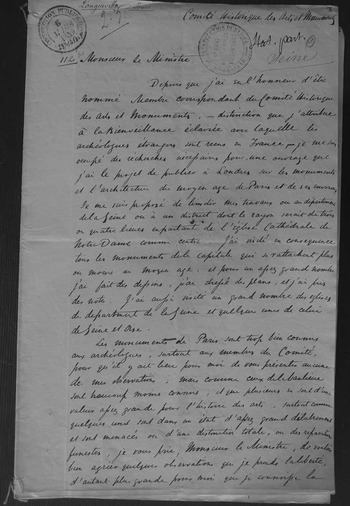
On 27 February 1840 Jones sent the Minister of Public Instruction a lengthy report in French on his survey of Paris churches, which was considered by the Comité the following month (fig 2).Footnote 57 This provides the fullest testimony to Jones’s archaeological endeavours in Paris, and was intended as part of the preparation for:
a work, to be published in London, on the medieval monuments and architecture of Paris and its environs … I have accordingly visited all the monuments of the capital that are more or less connected with the Middle Ages, and for quite a large number I have made drawings, drawn up plans and taken notes.Footnote 58
First page of Jones’s letter to the Minister of Public Instruction, Paris, 27 Feb 1840. Source: Archives Nationales, Pierrefitte-sur-Seine, F17/3313

The drawings and plans have not survived, and the projected publication never appeared, although after his return to Britain Jones offered a chronological assessment, based on his own observation, of the medieval architecture of central Paris in the Archaeological Journal.Footnote 59 This also briefly alludes to the interest of ‘the medieval edifices of a circle of ten miles radius’ of the city.Footnote 60 However, the only evidence of his survey of these is the report submitted to the Minister of Public Instruction, which consists of descriptions of forty-nine churches in the departments of the Seine (S) and Seine-et-Oise (SO): thirty-six of the churches described lay in the former, in contrast to thirteen in the latter, whose survey Jones had still to complete.Footnote 61 However, the treatment was far from comprehensive, and stands in contrast to the detailed coverage demanded by the Comité’s questionnaire, with its thirty questions on medieval churches in each commune.Footnote 62 This was mainly because the work formed the basis of a projected publication on medieval monuments, and therefore Jones deliberately focused his attention on churches dating from the Middle Ages and Renaissance.Footnote 63 Accordingly, fourteen churches dating from the seventeenth century onwards were usually only listed with a brief indication of date. Much the same was true of the well-known medieval churches of Saint-Denis (S), Montmartre (S), the chapel of Sainte-Geneviève at Nanterre (S), Montmorency (SO) and Poissy (SO), which were named ‘only for the record’ with barely any further comment. Moreover, the descriptions of the remaining thirty churches vary considerably in length.Footnote 64 Similarly, though he claims to have recorded the dimensions of the churches surveyed,Footnote 65 Jones gave no measurements in the report, which merely indicates, with respect to twenty-seven of the churches, that many were ‘small’, some of ‘medium size’ and only one, Rueil (SO), ‘large’.
Despite its partial coverage and summary nature, the report illuminates two facets of Jones’s engagement with the medieval buildings of Paris that would later characterise his approach to churches and other monuments in Wales: recording and campaigning.Footnote 66 In addition to fieldwork, he had drawn on published antiquarian accounts, namely ‘the great and scholarly work of the Abbé Lebeuf, and the great topographical collection of the Bibliothèque du Roy’, as well as the plans and illustrations of the abbey church of Montmartre published by Albert Lenoir in the first instalments of his Statistique Monumentale de Paris (1840–67).Footnote 67 Jones also spoke to the priests of the communes he had visited, stating that they had been unfailingly polite and welcoming, with several standing out for their ‘zeal for archaeology and enlightened knowledge’ (an assessment entirely in line with the Comité’s expectations of the clergy).Footnote 68 Accordingly he would tell his compatriots ‘what an admirable passport the simple title of foreign archaeologist may be in the suburbs of Paris, and likewise, as I have already often had the fortune to find, for many departments of France’ – a revealing indication both of his self-identification as an archaeologist and of his travels beyond Paris.Footnote 69 Jones added that he had distributed numerous copies of the Comité’s forms among the clergy, and suggested that its printed Instructions could be very useful if disseminated more widely in the suburbs.Footnote 70
Together with other evidence, the report sheds valuable light on how Jones understood the monuments he studied, especially with respect to the classification and evaluation of architectural styles. As we have seen, in keeping with the medievalist taste of the time, Jones privileged churches and other buildings of the Middle Ages and Renaissance. However, he discriminated between different periods within that era, albeit, in contrast to his publications on such monuments, without recourse to current stylistic terminology (apart from one reference to a modern restoration, mentioned below). This is particularly evident in the distinctions drawn in the report between different phases of fabric. In part, this was simply a matter of descriptive identification. For example, at Colombes (S) he attributed most of the church to the late sixteenth and seventeenth centuries, the surviving apse and possibly the tower to the tenth century.Footnote 71
In addition, though, such dating evidence was also often linked to assessments of a building’s significance informed by two distinct, though sometimes overlapping, criteria: archaeological significance and aesthetic beauty. In his introductory comments Jones stressed that churches of the tenth to twelfth centuries possessed especial archaeological value.Footnote 72 This could be seen as consistent with the growing appreciation of Romanesque architecture by both British and French writers over the previous two decades. However, Jones never describes these churches as beautiful, highlighting instead their primitive and unsophisticated nature, a view that seems to echo earlier condemnations of the Romanesque as ‘uncouth, rude, and unformed’.Footnote 73 The same is true of his later reference to ‘the heavy Romanesque (Romane) period’.Footnote 74 By contrast, beauty was a quality he reserved for Gothic of the late twelfth to fifteenth centuries and the Renaissance architecture that followed, which Jones later referred to as ‘the closing style of the middle ages’.Footnote 75 The distinction is clear in his description of Deuil (SO). On the one hand, ‘the nave with its aisles is probably of the ninth or tenth century, of a remarkable simplicity and rudeness of workmanship’. However, ‘the choir in the apse is of the more beautiful epoch of the thirteenth century’, with a series of columns behind the stalls ‘of an exquisite workmanship’.Footnote 76 Likewise the mainly early thirteenth-century churches of Arcueil (S) and Vitry (S) were both deemed ‘very beautiful’; in the former, the capitals in the nave were ‘of a very unusual boldness’ and ‘the small columns of the galleries and side aisles … of a remarkable elegance and purity’.Footnote 77 From a later period, Aubervilliers (S) was a ‘beautiful church’ of the fifteenth century, remarkable for its bold arcades and delicate capitals, its tower, bearing the date 1541, ‘a very beautiful example of the Renaissance’.Footnote 78
This last comment was consistent with Jones’s praise of French Renaissance buildings as being more magnificent than their sixteenth-century English counterparts in his review article of 1838.Footnote 79 This formed part of a comparison of French and English architectural styles in which Jones also insisted, in contrast to William Whewell and Robert Willis (1800–75), on the superior merits of French Flamboyant architecture over most examples of English Perpendicular.Footnote 80 On the other hand, he agreed with ‘all French and British authorities of weight’ that the Decorated style, which came to an end in England shortly after 1400, marked ‘the perfection of Pointed architecture’, citing the examples of Rouen, Amiens and Lincoln.Footnote 81 By 1846, though, Jones explained his choice of fourteenth-century architecture as a model for a new church he was designing on the grounds that this constituted ‘the truly national style’ of England, without any parallel in France, thereby implicitly rejecting the privileging by Didron – in common with the architects Lassus and Viollet-le-Duc – of thirteenth-century French Gothic as a universally applicable style.Footnote 82 In his treatment of architectural styles, then, Jones showed himself to be both widely read and independent-minded, informed by comparisons between England and France and adopting an eclectic terminology that combined elements from Rickman with frequent use of ‘pointed’ as a general descriptor for Gothic.Footnote 83
The report submitted to the Minister of Public Instruction in 1840 also drew attention to the condition of the churches described and, where necessary, sought to secure their preservation. Montreuil (S) and Stains (S) were well maintained, the western facade of the former a recent construction ‘in the pointed style (style ogival), following the drawings of M. Molinos, architect of the department’; likewise, recent repairs at Poissy (SO) had been ‘conducted with great intelligence’.Footnote 84 By contrast, though, Arcueil (S) and Fontenay-sous-Bois (S) ‘are in a state of degradation that is very painful to see’. The original plan of Arcueil had been spoiled by earlier alterations, soil surrounding the church was causing dampness and children were using stones from it ‘for their ballistic exercises’; indeed, on his last visit Jones had seen stones fall into the nave. He stressed that the priest had long appealed in vain to the communal authorities to undertake repairs; moreover, although the architect of the department had now drawn up a plan for these, the priest feared that ‘many of the most precious details would disappear if these repairs were not made under the control of some very enlightened archaeologists and architects’. Accordingly, Jones concluded that the building merited full attention from ‘the conservators of public monuments’.Footnote 85 At Fontenay-sous-Bois the situation was even graver, as the department’s architect had responded to the church’s ‘deplorable state’ by ordering its almost total demolition. However, Jones held that the church could be repaired, mainly by reducing its height and providing a new roofing without wooden beams.Footnote 86
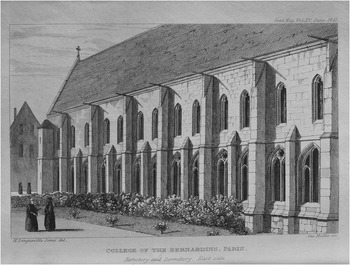
In early March 1840, shortly after submitting his report to the Minister of Public Instruction, Jones warned the Comité of several other monuments under threat, including the church of St-Julien-le-Pauvre and the conventual college of the Bernardins, on the left bank of the Seine, a fourteenth-century edifice which was in danger of being converted into a barracks for the municipal guard.Footnote 87 The following year Jones alerted readers of The Gentleman’s Magazine to the latter building’s importance ‘as a chef d’oeuvre of Gothic Architecture’, illustrated with a drawing he had made of the college (fig 3), and elaborated on the threats it still faced, while noting that these had been temporarily checked by the freeze on new building projects owing to ‘the absurd project of the fortifications of the city of Paris’ (a controversial scheme inaugurated in April 1841).Footnote 88
‘College of the Bernardins, Paris’, drawn by Jones and engraved by George Hollis. Source: Jones Reference Jones1841a, between pp 592 and 593

These campaigning efforts had mixed results. The condition of the Bernardine college still caused concern in 1845.Footnote 89 On the other hand, Jones’s appeal to the Minister of Public Instruction had some effect, as his report was sent to the Comité, which in turn forwarded his information to the Minister of the Interior, expressing the hope that the church of Fontenay-sous-Bois would be preserved from mutilation and that that of Arcueil would receive the urgent repairs it required. By 27 May 1840 a copy of the report had been made for the Minister of the Interior, who agreed that the Inspector General of Historic Monuments would visit those churches whose archaeological merit and state of degradation rendered them eligible for financial support from the budget allocated to ancient monuments.Footnote 90 Although such support appears not to have been immediately forthcoming, the church of Arcueil was classed as a Historic Monument in 1850. Moreover, the plans mentioned by Jones for its restoration were carried out in the early 1840s by their author, the departmental architect Auguste Molinos, while Fontenay-sous-Bois was restored by Molinos’ successor, Claude Naissant, a few years later.Footnote 91
THE COMITÉ HISTORIQUE DES ARTS ET MONUMENTS AS AN EXAMPLE FOR GREAT BRITAIN AND IRELAND
Although Thomas Wright had previously touched on Guizot’s initiatives to treat art and architecture as sources for the French past, including surveys conducted by Mérimée as Inspector General of Historic Monuments,Footnote 92 Jones’s article in 1838 on the restoration and revival of France’s medieval architectural heritage appears to have been the first substantial account of the Comité and related institutions in an English-language publication. The publication of both these contributions in The Foreign and Quarterly Review was symptomatic of a growing interest among antiquarian-minded people in Great Britain and Ireland – and more widely in Europe, in the following years – in the institutions established under the July Monarchy to record and preserve historic monuments. Indeed, the Comité won increasing renown in Europe, thanks in part to its appointment of foreign corresponding members.Footnote 93 Accordingly, it came to be regarded as a model for the study and preservation of historic monuments whose influence extended well beyond France and informed efforts to develop national archaeology elsewhere.
Its energetic secretary, Didron, was quick to make this influence a matter of patriotic pride. In May 1840 he claimed that the Comité had inspired proposals to establish analogous bodies in Austria and Great Britain and to extend state protection from ancient to Byzantine monuments in Greece:
Thus the archaeological movement in which France has taken the glorious initiative is destined to propagate itself in Europe; and the monuments of Christian architecture, unappreciated and ruined and destroyed down to the present, will be placed under the protection of the governments themselves.Footnote 94
However, while such declarations reflect the Comité’s aspirations, the evidence adduced in their support was slender, and their fulfilment depended on factors beyond the Comité’s control. True, many states were introducing measures to preserve historic monuments from the early nineteenth century onwards.Footnote 95 The process was prolonged, however, and the extent to which it was indebted to the Comité and other institutions established under the July Monarchy varied. With respect to the last example cited by Didron, the royal decree of 1837 prohibiting the destruction of Byzantine monuments and subsequent measures to the same end, while consistent with the Comité’s concern to safeguard medieval Christian art and architecture, resulted above all from the legitimising priorities of the regime of Otto, first king of Greece (1833–62).Footnote 96 On the other hand, the steps taken to preserve heritage by German states, especially Prussia from the early 1840s, were modelled on the French government’s initiatives (though not primarily those of the Comité).Footnote 97
The Comité’s influence beyond France was greatest on individuals with antiquarian and archaeological interests. Harry Longueville Jones is an early and important example. His sympathetic account of French heritage measures in 1838 maintained that Great Britain had much to learn from its continental neighbour: not only were the recommendations of the Commission on Historic Monuments ‘applicable to other countries besides France’, but he urged ‘young English architects … to profit by the example of their brethren of France, who are now turning the traditions of the middle ages to profit, in the embellishment of the capital’.Footnote 98 He subsequently kept to his commitment to publicise the Comité’s work in the press. In April 1839 he sent The Gentleman’s Magazine a translation of the questionnaire prepared by the Comité for its correspondents, prefaced by a letter suggesting ‘that a similar set of questions might be modified and adapted to the antiquities of the British islands, and circulated on the authority of any competent body – and none more fit than the Antiquarian Society’. He further recommended they be sent to all the parish clergy of England as well as ‘the local antiquarian and scientific or literary societies of Great Britain’.Footnote 99 Jones also planned, together with Thomas Wright, to publish an English translation of the Comité’s Instructions, complete with woodcuts taken from the accompanying plates.Footnote 100 Although this appears not to have materialised, it is likely that further reports of the Comité’s activities in The Gentleman’s Magazine were indebted, at least in part, to Jones.Footnote 101
As the reference to Wright indicates, Jones was not alone in turning to the measures of the July Monarchy for inspiration in promoting antiquarian endeavours in Great Britain and Ireland. In November 1838 the Royal Institute of British Architects (RIBA) sought information about the institutions responsible for historic monuments from the French Minister of the Interior.Footnote 102 By April 1839 the Liberal MP Joseph Hume had requested two copies of the Comité’s reports, circulars, questionnaire and Instructions, and also declared his intention of pressing for the establishment of a comparable institution in England.Footnote 103 Both John Britton and Jones made similar undertakings the following year.Footnote 104 In 1841 Hume secured the appointment, under his chairmanship, of a parliamentary Select Committee on ‘National Monuments and Works of Art’, which received detailed evidence from Britton, who strongly advocated establishing a body on the lines of the Comité in order to help ensure the preservation of cathedrals and other historic public buildings in England.Footnote 105 However, these and other attempts to establish a British equivalent of the Comité and other French heritage bodies proved unsuccessful. Thus, when Thomas Wyse, MP for Waterford, pressed in June 1845 for the appointment of a royal commission to consider how best to establish ‘a Museum of National Antiquities in conjunction with a Commission for the conservation of National Monuments’, his motion was defeated after the Chancellor of the Exchequer objected that such matters were the responsibility of private owners rather than the state and that they could result in considerable expenditure.Footnote 106
Wyse had already demonstrated a concern for the study and preservation of antiquities in 1843, when he urged the government to follow the example of the French Comité by arranging for ‘a well-digested classification’ of monuments in order ‘to complete a general and complete outline, if no more could be attained, of the antiquities of Ireland’. This formed part of his evidence to a Select Committee established as the result of a campaign to persuade the British government to continue publication of the historical memoirs produced by the Topographical Department of the Irish Ordnance Survey, following the suspension of the scheme in 1840 after the appearance of only one volume, on the parish of Templemore, Co. Londonderry (1837).Footnote 107 Wyse’s references to the Comité were noticed favourably by several commentators who stressed the value of the memoir scheme.Footnote 108 However, neither that testimony nor the Select Committee’s report recommending continuation of the memoirs overcame the opposition of Peel, who announced their termination in July 1844.Footnote 109
By contrast, the Young Irelander Thomas Davis (1814–45) invoked French example to urge all sections of Irish society to ensure the protection of the island’s historic monuments without assistance from the government.Footnote 110 In Britain, too, the Comité proved most influential in the unofficial sphere, as antiquarian and related societies identified with its objectives. The RIBA claimed to have similar aims to the heritage agencies established by the July Monarchy, though not the Comité specifically, as early as November 1838.Footnote 111 By 1844, thanks to Albert Way, both the Society of Antiquaries and the British Archaeological Association (BAA) had formed links with the Comité, and Thomas Wright went so far as to maintain that the BAA was analogous to the French body.Footnote 112 Likewise, Didron numbered among the forty ‘Honorary Foreign Members’ of the Archaeological Institute, being explicitly described as ‘Secretary to the “Comite [sic] des Arts et Monuments”’.Footnote 113 On the other hand, from 1845 the Ecclesiological Society gave a cooler welcome to the Comité’s restoration projects.Footnote 114
There were parallels elsewhere in Britain and Ireland, then, for Jones’s efforts to ensure that French example informed the initiatives he took with respect to Welsh antiquities in the mid-1840s, as co-founder of Archaeologia Cambrensis and the CAA. A full assessment of the impact of those efforts on the CAA lies beyond the scope of the present discussion.Footnote 115 However, they merit attention as evidence of the continuing influence on Jones of connections and approaches established over the previous decade. That he kept an admiring eye on developments in France is shown by his subscribing to Didron’s Annales Archéologiques, founded in 1844, and the warm recommendation, almost certainly from his pen as editor, of both that and other French archaeological publications in Archaeologia Cambrensis.Footnote 116 Indeed, he claimed to Didron that Archaeologia Cambrensis was modelled on the Annales Archéologiques, explaining, in phraseology tailored to his French recipient, that it was intended ‘above all for the Bretons of England and France’, and requesting help in finding correspondents from Brittany.Footnote 117 He thus turned to a figure at the heart of the ‘archaeological movement’ in France in order to try and ensure that his archaeological project in Wales had Breton connections.
Jones again acknowledged his debt to France and emphasised the importance of the French government’s heritage measures in the opening article of the first issue of Archaeologia Cambrensis in January 1846.Footnote 118 This also announced that the journal would ‘follow the example of the French Government Commissions, and … print sets of instructions, questionaries [sic], or formularies, by which the antiquary will be greatly aided in his operation, from knowing what, and how, to observe’.Footnote 119 Such a set of questions duly appeared in the next number of Archaeologia Cambrensis in April 1846, where they were presented as the first of several. They specifically covered ‘Celtic remains’ (thereby echoing the Comité’s monuments Gaulois, and likewise corresponding to what we would call prehistoric monuments), and described as having been ‘derived partly from the “Instructions” and the “Questionnaire” issued by the Comité Historique in France’.Footnote 120 Jones was thus swift to adapt for his archaeological project in Wales what he had envisaged as applicable to British antiquarianism generally in 1839. However, although he continued to mirror the Comité’s categories of monuments by publishing ‘Antiquarian questions and instructions’ on Roman remains later in the year, these marked the end of the series.Footnote 121
As well as adapting forms issued by the Comité, Jones sought its members’ support for the CAA. His efforts had met with success by December 1846, when Sir Stephen Glynne, first president of the CAA, was reportedly ‘very glad to hear of the accession of such distinguished foreign archaeologists, more especially M. Didron whose reputation as an Ecclesiologist is well known to him’.Footnote 122 Didron himself quoted in the Annales Archéologiques from the letter Jones had sent from Manchester soliciting his support. This celebrated the success of Archaeologia Cambrensis and announced Jones’s intention to establish the CAA. Jones added that the association would hold its first congress the following year, to which he hoped foreign members would come, especially from Brittany. Didron stated that he had ‘eagerly accepted’ the invitation to act as the association’s secretary for France, and urged all French archaeologists who wished to be involved in the Welsh initiative to inform him immediately so he could pass their names on to Jones.Footnote 123 The first list of members of the CAA in 1847 duly included both Didron and Mérimée, designated, respectively, Sécrétaire du Comité historique des arts et monuments and Inspecteur général des monuments historiques, together with another member of the Comité, vicomte Héricart de Thury (1776–1854).Footnote 124 Although no Breton or French representatives attended the CAA’s first congress, a complete set of the Comité’s publications, together with engravings from Lenoir’s Statistique monumentale de Paris, were exhibited to the delegates at Aberystwyth in September 1847.Footnote 125 Moreover, Jones remained in contact with Didron until at least 1854, and continued to extol the virtues of French archaeology and the support it received from the French government a decade later.Footnote 126
Nevertheless, it is difficult to avoid the impression that the connections he had sought to foster with France had only a limited, and diminishing, impact on his archaeological project in Wales. While Didron and other French archaeologists acknowledged that Archaeologia Cambrensis and the CAA had a place in the wider European archaeological movement they wished to encourage, it is unlikely that they envisaged anything more than conventional contact through correspondence and reciprocal reports of publications and other activities.Footnote 127 Moreover, it seems that even regular correspondence had ceased by the 1860s, as Didron continued to be named as the CAA’s corresponding secretary for France until 1870 (and was briefly resurrected in 1873), despite having died on 13 November 1867.Footnote 128 This suggests in turn that, for the CAA, Didron’s most important contribution was the prestige his name conferred on the organisation – an instance of the mainly symbolic significance of such correspondents.Footnote 129
CONCLUSION
The significance of Harry Longueville Jones as an antiquary cannot be understood simply by casting him in the role of a founding father of Welsh archaeology. Rather, an adjustment of focus allows us to situate him also in the context of a significant phase of Anglo-French dialogue in the late 1830s and 1840s which influenced British antiquarianism as well as efforts to secure legislation for the preservation of historic monuments. What differentiated Jones from other British antiquaries of the period was his extended residence in Paris, and the advantage he took of the opportunities this gave him to develop his antiquarian interests further by engaging closely both with French historic monuments and with the official measures taken on their behalf. This experience deeply informed his approach to archaeology in a way that set him apart from his fellow English corresponding members of the Comité historique des arts et monuments, none of whom owed such a direct debt to France or used their position as corresponding members to intervene on behalf of French historic monuments in a way comparable to Jones in his report to the Minister of Public Instruction.
Moreover, Jones’s study of medieval churches in Paris and its environs, based on extensive fieldwork, had no close parallels among contemporaneous British antiquarian scholars. Although anglophone readers could find information on a number of the city’s medieval buildings in illustrated topographical volumes, tourist guidebooks and publications on medieval architecture, the coverage of these works was much less comprehensive and systematic than that attempted by Jones.Footnote 130 True, that project remained incomplete and Jones never published the book he planned to write on the medieval monuments of Paris. Nevertheless, while the full potential of his work was never realised, some of its fruits appeared as periodical articles, which, by highlighting the richness of Paris’s medieval heritage, made a distinctive contribution to British antiquarian writing of the day.
In addition, Jones stands out among British antiquaries in his commitment to the July Monarchy’s measures to preserve historic monuments in France. He was the first to provide a detailed account of those measures in an English-language publication and among the earliest to urge their applicability to Britain. While the government rejected calls to follow the lead of its French counterpart with respect to heritage, Jones ensured that the French institutions informed the initiatives he took to promote Welsh archaeology through the establishment of Archaeologia Cambrensis and the CAA. Although his efforts in this regard were almost certainly less successful than he had hoped, they merit attention as a notable instance of French influence on antiquarian endeavour in Britain. More specifically, they represent a significant attempt to adapt the model of an officially supported movement for the recording, study and protection of historic monuments in a major European state to the very different context of a small stateless nation.
By contrast, and unlike some other British antiquaries, Jones seems to have attached much less significance to the provincial antiquarian organisations associated with Arcisse de Caumont. Though by no means hostile to these, Jones probably considered the French government’s measures to be more effective – a view presumably reinforced by his close association with the latter as a corresponding member of the Comité and one who had engaged with the historic monuments of France and the official steps taken to preserve them largely from a Parisian perspective facilitated by his residence in the French capital. Although the focus of his archaeological work shifted from France to Wales after his departure from Paris in 1842, Jones continued to admire the French example. Indeed, almost thirty years later he signalled his enduring identification with the institutions established under the July Monarchy on the title page of a collection of his writings, published in the year of his death, which names the author as ‘H. Longueville Jones, M.A., Membre correspondant du Comité historique des arts et monuments’.Footnote 131
ACKNOWLEDGEMENTS
I am very grateful to Nancy Edwards for commenting on earlier drafts of the article, to Adrian James for searching for material relating to Jones in the archives of the Society of Antiquaries of London, to Rodolphe Leroy for sending me copies of parts of his thesis and to the journal’s two referees for their helpful suggestions.