Introduction
Avian influenza (AI) was recognized as a highly pathogenic viral disease of poultry in 1878 and the disease was used to be called ‘fowl plague’. This is an enveloped virus with single stranded segmented RNA genome belongs to the family Orthomyxoviridae. In 1955, a specific type A influenza virus was identified as the causal agent of this disease. It has since been found that avian influenza viruses (AIV) cause a wide range of disease syndromes, ranging from severe to mild, in domestic poultry. Many species of birds have been shown to be susceptible to infection with influenza A viruses. Since 1995, highly pathogenic avian from influenza (HPAI) virus outbreaks have been reported with increased frequency at various places of the world (Alexander, Reference ALEXANDER2000). The threat of AI has become really critical for the poultry industry. Low pathogenic avian influenza (LPAI) viruses are frequently isolated from wild birds, especially migratory waterfowl (Alexander, Reference ALEXANDER1982) which are a reservoir of the disease.
One special feature of AIV is its ability to mutate easily from low pathogenic (LP) one to highly pathogenic (HP), but this is only observed when low pathogenic avian influenza virus (LPAIV) infects industrial flocks (Saif et al., Reference SAIF, BARNES, GLISSON, FADY, MCDOUGALD L.R. and SWAYNE2003). Mutation from LP to HP virus occurs mainly by antigenic drift after minor changes in the amino acid sequence at the haemagglutinin cleavage site. Mutation can also be the consequence of antigenic shift through recombination between subtypes at the occasion of a mixed infection in the same cell (Saif et al., Reference SAIF, BARNES, GLISSON, FADY, MCDOUGALD L.R. and SWAYNE2003). In domestic species, influenza viruses have caused considerable economic losses. In most cases, losses cannot be predicted when an AI outbreak appears, because many factors influence the outcome of infection. These factors include the variation in the biological characteristics of the virus, concurrent infection, environmental stresses, age and sex of the bird, etc (Islam and Giasuddin, Reference ISLAM and GIASUDDIN2007). The resulting morbidity and mortality rates range from negligible to near 100% (Suarez et al., Reference SUAREZ, SENNE, BANKS, BROWN, ESSEN, LEE, MANVELL, MATHIEU-BENSON, MORENO, PEDERSEN, PANIGRAHY, ROJAS, SPACKMAN E. and ALEXANDER2004).
Avian influenza is a devastating disease not only for birds, but also for humans. From 2003 to April 2010, 15 countries have experienced human casualties comprising 493 infections of which 292 cases (59.2%) were fatal (WHO, Reference WHO2010). Several research trials have been performed at the Bangladesh Livestock Research Institute (BLRI) to understand the nature and magnitude of the disease. This paper presents a review of those and other studies and presents a status of the disease in Bangladesh.
Bangladesh situation
In Bangladesh, HPAI has been identified since March 2007 after passing a long immediate risk period. Among the South Asian countries, Pakistan, India and Myanmar have already experienced HPAI outbreaks in domestic poultry in early 2006. Bangladesh has a long border with India and Myanmar. Moreover, during the winter, open water bodies in Bangladesh are shared by large number of migratory waterfowl and domestic ducks, which may be in contact with village chicken. Small-scale commercial poultry farms with poor biosecurity are widespread throughout the country. Despite all these risk factors existed in Bangladesh, the country remained free from HPAI till February 2007.
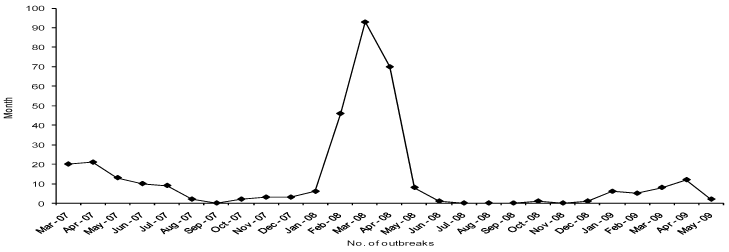
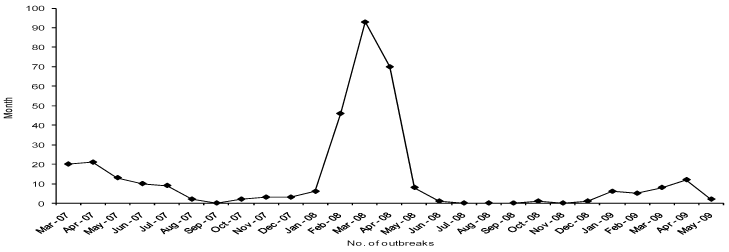
The country first experienced HPAI in early 2007 and the National Reference Laboratory for Avian Influenza (NRL-AI) at BLRI diagnosed and confirmed the presence of H5 sub-type virus on 15 March, 2007. Up to 22 March 2009, NRL-AI has found 323 H5 and three H9 positive cases. Some of the samples were re-examined and reconfirmed with the same results by the International Reference Laboratory in the UK and a regional laboratory in Thailand. The outbreaks may broadly be identified into three waves; the first wave peaked in March 2007 and gradually declined with no cases reported in September 2007. The second wave of reported outbreaks started in October 2007, reached its peak in February and March 2008 and then started to decline (Figure 1). Only 12 outbreaks were reported in April and one outbreak in May as compared to 92 and 79 outbreaks in February and March 2008, respectively. The 3rd wave began in December 2009 and started to decline from May 2009.
Month wise no. of outbreaks (22.03.2007 to 14. 04.2009).
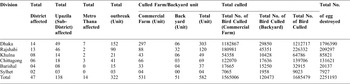
After the outbreak of AI in early 2007, around 1.69 million birds were culled and disposed off. Moreover, 2.25 million eggs were destroyed concurrently (Table 1). The disease was detected from 306 incident points covering 138 Upazillas, 14 Metropolitan Thana of 47 Districts. Nevertheless, Bangladesh was considered free from human infection up to May 21, 2008. However, one human case was announced by the authorities of Bangladesh on May 22, 2008. The case was confirmed by Center for Disease Control and Prevention (CDC) in Atlanta, USA. With this case, Bangladesh has become the 15th country of the world to report human infection with HPAI H5N1 virus.
Division wise Avian Influenza stamping out status of Bangladesh (22.03. 2007 to 14. 04.200.

Research on Avian Influenza at BLRI
BLRI started conducting research, surveillance and monitoring along with the improvement of diagnostic facilities related to AI since 2000. Up to 2004, sero-monitoring of AI was carried out from native chickens of different areas of Bangladesh. In this study, sero-positive cases against avian influenza was found highest in Cox's Bazar (38.6%) followed by Barisal (32.3%) and Bogra (14%) (Alam et al., Reference ALAM, KOIKE, GIASUDDIN and RAHMAN2003). From 2004, virus isolation and identification along with antibody detection was started at BLRI. For virus isolation, chicken embryo inoculation, Haemagglutination test, Haemagglutination inhibition test and quick avian influenza antigen detection test were carried out successfully in this laboratory.
To check the imported day-old chicks, a total of 1170 day-old chicks were used for isolation and identification of virus by inoculating in chicken embryo and 3510 blood samples from imported day-old broiler and layer chicks and were tested at the age of 25 days by indirect ELISA to detect antibody against avian influenza virus. But no virus or antibodies against avian influenza were detected (Giasuddin et al., Reference GIASUDDIN, TAIMUR, ALAM, AL-MAMUN and SAMAD2007).
From early 2005, identification of influenza virus by RT–PCR technique was introduced following internationally accepted protocol. Faecal samples from about 12,000 samples of native chickens, ducks and migratory birds were tested to monitor avian influenza status in Bangladesh. In this study, a total of 2262 samples of native chickens, 405 samples of native ducks and 9552 samples of migratory birds were collected and tested for the presence of Newcastle disease and highly pathogenic avian influenza virus. Newcastle disease was found to be positive in 6.9%, 7.2% and 2.4% samples of native chickens, native ducks and migratory birds, respectively.
To determine the presence of Influenza–A virus, 80 randomly selected samples were inoculated in the chicken embryo through allantoic route and then the allantoic fluid samples were tested by RT-PCR, where 40 samples were selected from migratory birds and the other 40 samples were selected from native ducks and chickens from different areas of Bangladesh. Among the samples of migratory birds, 17.5% of migratory birds and 22.5% of native chickens and ducks showed positive to Influenza A but no sample showed H5 positive during this study (Table 2).
Surveillance of HPAI during 2005-06 in migratory birds, native chickens and ducks.

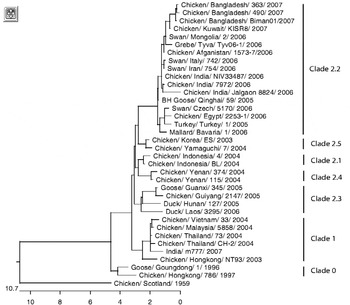
A total of 47 avian influenza virus samples were sent to the FAO/OIE Reference laboratory at the Veterinary Laboratories Agency (VLA), Weybridge, UK. The VLA determined nucleotide sequence of the HA gene segment of 25 isolates which included 15 isolates from 2007 and 10 isolates from 2008. Out of those 25 almost identical virus sequences of Bangladesh origin, three were subject to a wider phylogenetic analysis along with 32 sequences of 20 different countries (Figure 2). All the isolates from Bangladesh were genetically very close to each other, with Bangladeshi isolates from 2007 and 2008 being 99.1 - 100% identical, indicating a single introduction of the virus in Bangladesh.
Moreover, Bangladeshi isolates clustered with those from middle China, south and mid Asia, Middle-East, Europe and Africa belong to the sub-clade 2.2, which is popularly known as Qinghai lineage or Euro-Asian-African lineage. On the other hand, all the South-East and Far-East Asian isolates belong to other clades or sub-clades.
It may be noted from the phylogenetic tree that the closest neighbours of the Bangladeshi isolates were those from Kuwait, Mongolia, Russia and Afghanistan. Three Indian isolates from outbreaks in 2006 also fall in the same sub-clade but these do not appear to be genetically as close to the Bangladeshi isolates.
The origin of HPAI in Bangladesh still remains obscure. Although HPAI isolates from Bangladesh are closely similar to those from Kuwait, Mongolia, Russia and Afghanistan, Bangladesh does not have any poultry trade links with these countries. Therefore, from the findings of this study, the poultry industry cannot be blamed for introduction of HPAI into Bangladesh. The close similarities between the HPAI isolates of these distant countries would suggest that migratory birds might be responsible for initial introduction of HPAI in Bangladesh (Alam et al., Reference ALAM, AMIN, ISLAM, KHAN, BAKI, RAHMAN, GIASUDDIN, SAMAD, TAIMUR, OSMANI, RAHMAN, MAHBUB-E-ELAHI, LOTH, KALAM, HOSSAIN, KHAN, KHAN, AKTARUZZAMAN and POLASH2008).
Phylogenetic relationship based on HA gene of Bangladeshi H5N1 HPAI isolates with those from other countries.

An epidemiology study was conducted in 2008 by BLRI, where 150 cases (n=50) and control farms (n=100) were recruited in this study, selected from 20 districts having relatively higher cluster of outbreaks and from 36 upazillas. The descriptive study (carried out only in HPAI positive farms) found that most of the farms that experienced an outbreak were of layer farms (90%). Layers/layer finisher flocks have been recorded to be significantly associated with the presence of HPAI virus elsewhere in Bangladesh. The reason why layers become more susceptible to HPAI introduction than broilers lies with the nature of management practices, which allows different potential factors including input supply, movement of output off the farms, human traffic or biological carriers and poor practices of bio-security to get this type of poultry exposed for a relatively longer period of time than a short cycle business like broiler (Alexander, Reference ALEXANDER1995). More precise information on affected layer farms was unavailable, because all the farms were depopulated, and farmers were not revisited.
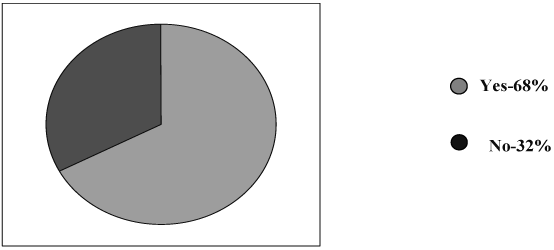
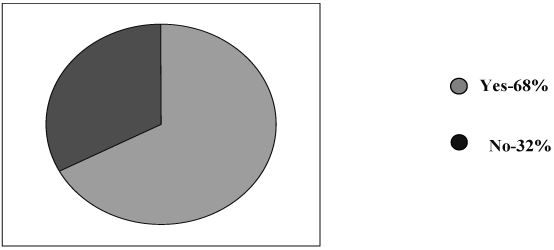
A descriptive study recorded that the mortality in backyard preceded about 68% of the neighbouring layer farms to experience with the HPAI outbreak (Figure 3). On the other hand, it was also reported that the new birds (backyard) were introduced within 21 days before the outbreaks (18%) in or around HPAI affected farms. However, in the absence of a robust surveillance system in place and without having a trace done, it seems difficult to connect these with the reason of introduction in a more plausible way.
Mortality in backyard poultry before the outbreak (N=47).
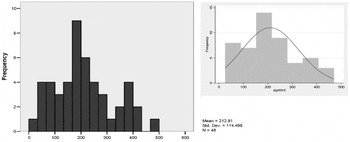
The age distribution of HPAI-affected flocks is shown in Figure 4. The mean age of the affected flock at the time of outbreak was 212 days ± 114.5 (7 months). This would indicate that day-old chicks (from private hatcheries) as input source may not be the major source of AI infection. It is more likely that other mechanical transmission through human/biological contact, poultry transport and bio-security measures have contributed to the spread of the virus. Newcastle disease (ND) and Gambaro disease recorded to be prevalent as the existing disease in the HPAI affected farms. The frequencies of concurrent diseases in HPAI-affected farms, however, reflected endemic status and possibly do not have any role of exposing the farms to HPAI outbreaks.
Histogram showing distribution of age of HPAI affected birds.

Correlation analysis and PCA
A total of 13,340 pair-wise correlation coefficients among the predictor variables were examined. There was moderate to high correlation between 19 variable pairs (Spearman's rho >0.5 and Pearson's Correlation Coefficient >0.5). The highest correlation (0.65) was found between HPAI infection and the practice of using vehicles for feed and egg transportation. All 19 results with a Spearman's rho >0.5 or Pearson's Correlation Coefficient >0.5 (medium to high correlation) were significant (P<0.01).
One thing becomes clear from this study, and indeed has been previously identified in other countries, that biosecurity and the movement of people, animals and vehicles are crucial factors in the spread of the disease. Introduction of birds from market causes spreading of disease into the backyard level which extends to the farm level later on. Simultaneously backyard poultry also plays an important role in spreading the disease. From the epidemiological study, it may be suggested that after introduction of HPAI in Bangladesh the virus spread initially to native chickens and then to commercial farms through the market chain because of the breaches in bio-security practices.
Economic losses due to infection of AI in 2007 and 2008
In this study, 38 avian influenza infected and 30 non-affected farms were surveyed, of which 33 were broiler and 35 were layer farms. The layer farms were largely affected while the broiler farms were of short duration and could not be affected at large.
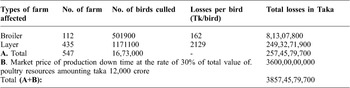
The total losses of poultry farms were estimated and it was found that the direct losses were higher (70%) in broiler farming while that was only 12% in the case of layer farming. This means that loss of productivity of the parent stocks was of a greater magnitude, hence the indirect losses became much higher than that of the broiler (Table 3). It was observed that a lot of market intermediaries were involved in layer farming and they were affected due to AI, while in the case of broiler farming, the owners were directly losing birds. In all cases, the production down-time was considered to be 30% due to the effects of avian influenza. Production down-time losses were calculated for six months over 2007 and 2008 because, during that time, the severity of HPAI was high. Yalcin (Reference YALCIN2006) calculated 12% production losses in the total value of poultry production in Turkey where the duration of avian influenza was only one month. In Bangladesh, the duration of AI in 2007 and 2008 was about six months and the magnitude of incidence was much higher in Bangladesh than that of Turkey.
Total loss of the nations due to the outbreak of Avian Influenza in 2007 and 2008.

Rahman (Reference RAHMAN2004) estimated four years ago that the total value of poultry products was about Taka 50,000 million every year. This has increased significantly in recent years and the present value of poultry products and by-products is estimated at about Taka 120,000 million. Thus, the imputed value of production down time of poultry and poultry products in 2007 and 2008 was worked out at Taka 36,000 millions and the total value of loss for the nation was Taka 38,574.50 million. This estimate seems to be at a lower side than that of the Poultry Association of Bangladesh. It can be imagined that the later estimate (Taka 41,650 millions) might have some margin of upward bias.
The duration of AI outbreaks at the peak of infection lasted for about three months in Bangladesh in 2008 resulting in immediate fall of prices and consumer's panic. The prices of broiler declined by about 28% while the price of eggs decreased by 26.5%. More than one third of consumers refrained from consuming broiler meat and eggs. As a result of this market collapse, many farm owners were compelled to abandon poultry raising because of loss of capital. The affected farmers lost their business and many of them were reluctant to go back to these production system. Nevertheless, after the tension of the severe outbreaks of avian influenza was over, consumers increased their consumption of poultry products and the poultry industry on the whole went back to business, excepting some cases layer farms and small rural and urban broiler farms.
Conclusions
Studies conducted at BLRI suggested that migratory birds might be responsible for initial introduction of the HPAI virus in Bangladesh and the introduction of birds from live markets causes the spreading of disease into the backyard level which extends to the farm level later on. The majority of risk factors leading to an HPAI outbreak in commercial poultry farms are mostly related to market chain and inadequate bio-security, which contributed to spread of the disease. The extent of losses in the Bangladeshi poultry sector and its related industries as a result of outbreaks of AI was indeed very high. In order to stop future outbreaks of HPAI, contact with layer farms, live markets, human traffic, and restricted vehicle entrance to load farm output should be limited as much as possible. This should be the first step in a more sophisticated approach to eradicate the AI virus from the poultry population.
Studies recommend that specific areas should be earmarked as sanctuaries for migratory birds. It is recommended further that measures need to be taken so that native birds (Indigenous birds) do not intermingle with migratory ones. Early detection of HPAI virus, prompt stamping out, efficient surveillance and strict maintenance of bio-security measures both in farms and wet markets should be ensured. A decision on vaccination strategy should be made as soon as possible. The owners of affected poultry farms should be compensated promptly and provided with easier access to bank loans and other incentives. Timely sharing of information and effective coordination between animal and public health personnel must be ensured. It is also necessary to share information and undertake studies on HPAI bi-laterally and regionally to minimize the risk of sustained endemic nature of avian influenza in poultry in the region.
Acknowledgements
The authors are grateful to the members of the study teams namely Professor Dr. Md. Mansurul Amin, Professor Dr. Md. Rafiqul Islam, Professor Dr. Md. Aktaruzzaman, Professor Dr. ATM Mahbub-E-Elahi, Professor Dr. Ashiqur Rahman, Dr. Mohammed Salehuddin Khan, Dr. S. M. Ataur Rahman, Dr. Md. Abdul Baki, Dr. Md. Afzal Hossain, Dr. Abul Kalam Azad, Dr. TABM Goni Osmani, Dr. Ferdous-ur-Rahman Khan and Dr. Salahuddin Polash for their valuable contributions .