Accurate diagnosis of Clostridioides difficile infection (CDI) remains challenging because colonization rates can be as high as 37% in infants aged <1 month, 30% in infants aged 1–6 months, and 10% in infants aged 1 year. Reference Jangi and Lamont1 Hospitalized children, Reference Leibowitz, Soma, Rosen, Ginocchio and Rubin2 children with inflammatory bowel disease, Reference Hourigan, Sears and Oliva-Hemker3 and pediatric oncology patients Reference Dominguez, Dolan and West4 have high rates of C. difficile colonization. Testing limitations further impede accurate diagnosis of CDI. Nucleic acid amplification tests (NAATs) are highly sensitive, but they cannot differentiate CDI from colonization, and toxin enzyme immunoassays (EIA) have relatively low sensitivity leading to false-negative results. Reference Burnham and Carroll5 Additionally, not all C. difficile assays approved by the US food and Drug Administration (FDA) are approved for testing specimens from infants <2 years of age. Reference Antonara and Leber6
The most recent Infectious Disease Society of America (IDSA) and Society for Healthcare Epidemiology of America (SHEA) clinical practice guidelines recommend age-based restrictions for C. difficile testing, Reference McDonald, Gerding and Johnson7 but only 76 of 151 pediatric hospitals surveyed by Kociolek et al Reference Kociolek, Kutty, Polgreen and Beekmann8 in 2018 had implemented such restrictions. We describe implementation of computerized provider order entry (CPOE) for CDI included age-based testing restrictions in infants and restrictions for testing older children with recent laxative, stool softener, or enema use. We aimed to reduce both inappropriate testing for and misdiagnosis of healthcare-onset (HO) CDI.
Methods
Study design, sites, and population
We retrospectively analyzed C. difficile testing data obtained before (October 2017–October 2018) and after (November 2018–October 2020) implementing the restrictive CPOE described below. The study sites are tertiary-care, academically affiliated, children’s hospitals within the same multicampus institution that has a common department of infection prevention and control (IP&C) and common isolation protocols for suspected and confirmed CDI. Hospital A is a ∼250-bed, freestanding, children’s hospital with oncology patients, transplant recipients, a large cardiac and cardiothoracic surgery population that serves children with multiple complex comorbid conditions. Hospital B is a ∼100-bed children’s hospital within a larger hospital with oncology patients that serves children with multiple complex comorbid conditions.
All hospitalized children tested for C. difficile during the study period were included, but from March to May 2020, due to the COVID-19 pandemic, hospital B was closed to admissions and all pediatric patients from our multicampus institution requiring hospitalization were admitted to hospital A. Throughout the study period, testing was done via Xpert C. difficile PCR assay (Cepheid, Sunnyvale, CA), which detects the tcdB gene and IP&C strategies for suspected or confirmed CDI remained unchanged. In accordance with Centers for Disease Control and Prevention (CDC) guidance, our multicampus institution utilizes contact isolation for patients with CDI, which includes the following measures: placement in a single room, door signage, CDI floor decal within the patient room as an additional reminder, gowns and gloves for parents when performing direct patient care, 2% chlorhexidine gluconate soap for hand hygiene after removing personal protective equipment, dedicated patient-care equipment (whenever feasible), and room cleaning twice daily with a hypochlorite solution with sporicidal activity. Discontinuation of isolation occurs only in consultation with the IP&C team. The institutional review board reviewed the study protocol and determined it to be a quality improvement or quality assurance activity, exempt from further review.
Diagnostic stewardship strategies
In May 2018, we implemented CPOE for C. difficile that instructed clinicians to avoid testing young infants and older patients with recent laxative, stool softener, or enema use, but clinicians could order testing at their discretion. In October 2018, the CPOE was changed to be more restrictive; no testing for C. difficile was permitted for infants aged ≤12 months, approval of the infectious disease team was required to test children aged 13–23 months, and the approval of a pathology resident physician was required to test children aged ≥24 months who had received laxatives, stool softeners, or enemas within the previous 24 hours (which was changed to use of these agents within the past 48 hours in February 2020). Clinical microbiology laboratory supervisors reinforced rejection of nondiarrheal stool specimens for testing.
Prior to implementation, all healthcare personnel (HCP) were informed of the new testing guidelines via an e-mail describing the changes to the C. difficile order set that included relevant screen shots and the rationale for these changes. IP&C team members, including infection preventionists, hospital epidemiologists, key stakeholders from nursing, and care providers of high-risk patients developed a slide deck and testing algorithm for education. Education was provided throughout the implementation period via small group huddles and didactic lectures at a pediatric infectious disease conference, a pediatric faculty meeting, and a nursing quality council meeting.
Analysis
A retrospective interrupted time series (ITS) analysis was conducted to examine changes in the monthly number of tests ordered and the number of samples sent and the overall number of positive tests and HO-CDI cases, as defined by the CDC National Healthcare Surveillance Network (NHSN), 9 prior to implementing the restrictive CPOE (October 2017–October 2018) and thereafter (November 2018–October 2020). Because the COVID-19 pandemic had an impact on hospital admission patterns, an ITS was also performed to assess changes in these outcomes prior to the pandemic (October 2017–October 2018 vs November 2018–February 2020).
Because the interventions were different for different age groups and the sample sizes were relatively small, we also conducted an exploratory subanalysis using the Mann-Whitney U test to compare the median number of monthly tests ordered, samples sent, positive tests, and HO-CDI cases prior to implementing the restrictive CPOE (October 2017–October 2018) and thereafter (November 2018–October 2020). These data were analyzed by age group (ie, ≤12 months, 13–23 months, and ≥24 months). All analyses were conducted using SAS version 9.4 software (SAS Institute, Cary, NC). P values <.05 were considered significant.
Results
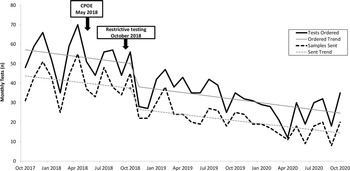
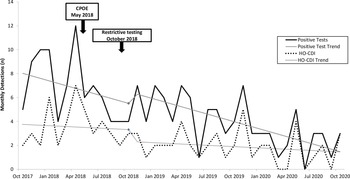
The monthly number of C. difficile tests ordered and samples sent significantly decreased (P = .02 and P = .03, respectively) when comparing the pre- and postimplementation periods (Fig. 1A). The ITS analysis assessing changes prior to the COVID-19 pandemic (October 2017–October 2018 vs November 2018–February 2020) showed similar trends in tests ordered and samples sent (P = .03 and P = .02, respectively). The absolute number of HO-CDI cases decreased during each 12-month period, from 46 cases (October 2017–October 2018) to 34 cases (November 2018–October 2019) to 14 cases (November 2019–October 2020). The standardized infection ratio (SIR) determined according to the NHSN definition 9 at hospital A, the freestanding children’s hospital, decreased from 1.43 in 2018 to 0.76 in 2019 to 0.74 in 2021. However, the ITS analysis did not demonstrate a significant change in the monthly number of positive C. difficile tests and HO-CDI cases (P = .42 and P = .63, respectively) (Fig. 1B).
Number of tests ordered and samples sent for C. difficile before and after implementation of the restricted computerized provider order entry (CPOE) for C. difficile testing. Data from hospitals A and B are combined. CPOE indicates the first implementation phase in which clinicians were asked to avoid testing but could still order testing (May–October 2018). The restrictive testing indicates the second implementation phase whereby clinicians could not order testing for infants aged ≤12 months and needed approval for testing children aged 13–23 months or children aged ≥24 months with laxatitve, stool softener, or enema use within 24 hours. Recent use of these treatments was increased to within 48 hours in February 2020. Interupted time series analysis demostrated that the overall number of tests ordered and samples sent signficantly decreased after the CPOE intervention (P = .02 and P = .03, respectively).

The overall number of positive tests and number of healthcare-onset (HO) C. difficile infections (CDI). Interrupted time series analysis demonstrated that the overall number of positive CDI cases and HO-CDI cases remained similar over time (P = .42 and P = .63, respectively).

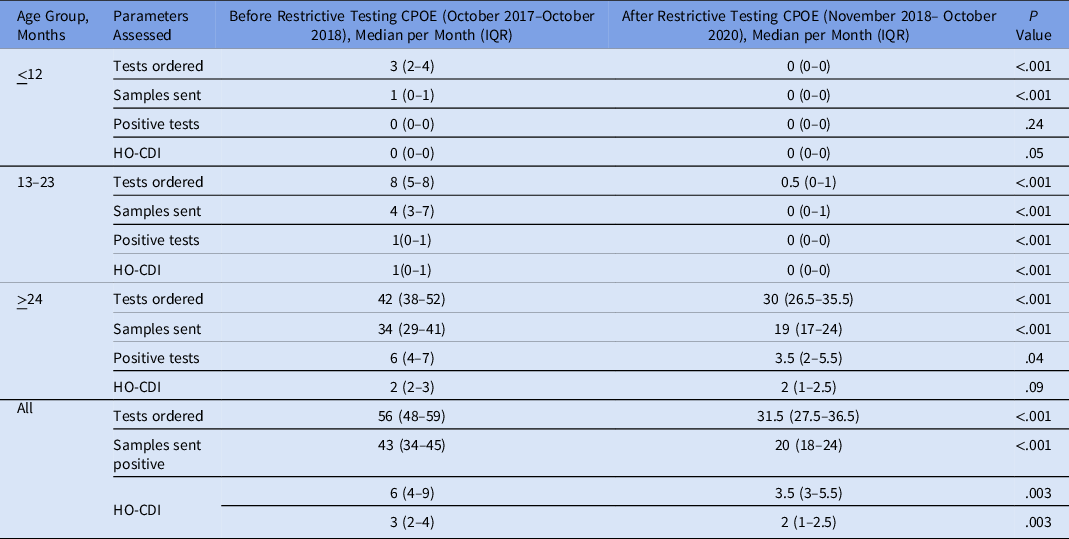
The exploratory subanalysis demonstrated a significant decrease in the monthly median number of tests ordered and samples sent for all age strata after implementing the restrictive CPOE (Table 1). The monthly median number of positive C. difficile tests significantly decreased in children aged 13–23 months, ≥24 months, and all ages combined. The monthly median number of HO-CDI cases significantly decreased in children aged 13–23 months and all ages combined (Table 1).
Comparison of Clostridioides difficile Testing for Different Pediatric Age Strata Before and After Implementation of Restrictive Computerized Provider Order Entry (CPOE)

Note. CPOE, computerized provider order entry; IQR, interquartile range, HO-CDI, healthcare onset C. difficile infection.
After implementing the restrictive CPOE, no cases of toxic megacolon, pneumatosis intestinalis, perforation, surgical intervention, or death occurred due to delayed diagnosis of CDI. No CDI outbreaks occurred.
Discussion
A CPOE that included testing restrictions for age and for recent use of laxatives, stool softeners, or enemas, in conjunction with education of clinicians regarding the rationale for the C. difficile CPOE and education of laboratory staff to reject formed stools, led to a significant and sustained reduction in the number of tests ordered and samples sent. Nonetheless, a substantial number of tests were sent after the intervention in children aged ≥24 months (median, 20 tests per month), suggesting further opportunities to reduce inappropriate testing. However, the small number of positive C. difficile tests limited the power of this study to detect a statistically significant difference in the reduced number of positive tests and HO-CDI cases observed after the intervention.
Our results are consistent with those of previous studies demonstrating that CPOE could be an important diagnostic stewardship tool for CDI, although few studies have assessed the pediatric population. Nicholson et al Reference Nicholson, Freswick and Di Pentima10 used an advisory CPOE in which clinicians could still order C. difficile testing and successfully decreased testing rates in children aged <3 years, but testing in older children did not decrease. Kociolek et al Reference Kociolek, Bovee and Carter11 developed a provider-education intervention that included a notification in the C. difficile order set describing scenarios in which testing should not be ordered. This intervention successfully reduced outpatient testing but not inpatient testing or HO-CDI rates. In an adult population, Truong et al Reference Truong, Gombar and Wilson12 described an intervention that included improving documentation of stool consistency by nursing staff and permitting laboratory personnel to cancel tests for patients not meeting diarrhea criteria. This intervention successfully reduced testing and HO-CDI rates without increasing complication rates in patients with canceled tests.
Other computerized clinical decision support strategies have required clinicians to confirm diarrhea, no recent laxative use, no recent C. difficile testing, presence of abdominal pain, and/or fever prior to placing an order for testing. These strategies successfully reduced testing and/or HO-CDI. Reference Liu, Lan and Krantz13 In the current study, we did not simultaneously employ computerized clinical decision support; rather, we relied on provider education delivered by didactic lectures and e-mails. A recent systematic review by Dunn et al Reference Dunn, Radakovich, Ancker, Donskey and Deshpande14 concluded that electronic alerts for C. difficile testing did reduce overall testing, inappropriate testing, and/or CDI rates. However, these researchers expressed concerns about alert fatigue by providers and unintended consequences due to missed or delayed diagnoses. Reference Dunn, Radakovich, Ancker, Donskey and Deshpande14
Recent guidelines from the IDSA and SHEA recommend testing algorithms to reduce false-positive results due to C. difficile colonization. Reference McDonald, Gerding and Johnson7 For example, a 2-step diagnostic algorithm that uses a NAAT and toxin assay can capitalize on the strengths of both assays. Although 2-step testing has been used increasingly, concern has emerged that certain patient populations, particularly immunocompromised patients, may have discordant results, which could lead to failure to provide appropriate CDI treatment. Reference Erb, Frei, Stranden, Dangel, Tschudin-Sutter and Widmer15
This study had several limitations. The COVID-19 pandemic did alter admission patterns and we did not account for potential differences in demographic and clinical characteristics of hospitalized children that might have affected our results; we only reviewed deidentified laboratory data. Similarly, we could not distinguish probable colonization from true infection because we did not conduct chart review. However, we did demonstrate reduced testing before the pandemic began in New York. We did not systematically assess requests for approval by the infectious disease team or for children aged 13–23 or by the pathology resident for children aged >24 months. Also, we did not systematically access challenges to implementing the interventions. We were also unable to determine the total number of nondiarrheal stool specimens rejected by the laboratory. The small number of positive tests limited the ability of the ITS analysis to detect changes in HO-CDI over time. We were unable to determine whether the decrease in tests ordered and samples sent resulted from the restrictive CPOE, education, rejection of nondiarrheal stool, or a combination of these efforts. Finally, we could only provide SIR for the freestanding children’s hospital, hospital A.
In conclusion, a multipronged diagnostic stewardship intervention that included a restrictive CPOE based on age, recent use of laxatives, stool softeners, and enemas, education of HCP, and laboratory rejection of nondiarrheal stool samples, was associated with decreased testing for C. difficile among hospitalized pediatric patients. Our findings suggest that pediatric-specific diagnostic stewardship strategies for CDI can be successfully and safely implemented for hospitalized children. Further reductions in inappropriate testing could potentially be achieved by the addition of computerized clinical decision support and/or a 2-step testing algorithm.
Acknowledgments
The authors thank Dr Philip Zachariah for his assistance with this project.
Financial support
No financial support was provided relevant to this article.
Conflicts of interest
All authors report no conflicts of interest relevant to this article.