How does political trust matter in emergent democracies? Studies of political trust, based mostly on mature democracies, contend that political trust provides policy capacity, which underpins leeway for the government, or political capacity, which underpins leeway for the political system. Policy capacity occurs when voters accept the government’s direction and do not jeopardise the extraction and use of resources (Miller Reference Miller1974; Polidano Reference Polidano2000; Wagle Reference Wagle2000; Lee and Haque Reference Lee and Haque2006). Political capacity exists when voters embrace or defend the political system even as they eject elected representatives (Citrin Reference Citrin1974; Norris Reference Norris1999; Keele Reference Keele2007; Kim Reference Kim2010; Sander and Putnam Reference Sander and Putnam2010; Marien and Hooghe Reference Marien and Hooghe2011; Dahlberg et al. Reference Dahlberg, Linde and Holmberg2015). Political trust refers to public confidence in the political system to deliver political or policy outcomes fairly and regularly (Hetherington Reference Hetherington1998; Levi and Stoker Reference Levi and Stoker2000; Mishler and Rose Reference Mishler and Rose2001; Lee and Haque Reference Lee and Haque2006; Marien and Hooghe Reference Marien and Hooghe2011). These arguments of the effects of political trust align with Easton’s (Reference Easton1975) framing of specific and diffuse support: specific support captures satisfaction with the incumbent government for policy performance, whereas diffuse support weighs approval of regularised system-level political goods, such as contestable political competition and succession, civil and political liberties and freedom of association and expression (Citrin Reference Citrin1974; Citrin and Green Reference Citrin and Green1986; Hetherington Reference Hetherington1998). Clearly, whether political trust leads to policy capacity for specific support, or the political capacity for diffuse support or both critically affects allocation of scarce resources between the competing pressures of policymaking and institution-building (Catterberg and Moreno Reference Catterberg and Moreno2006; Cooper et al. Reference Cooper, Knotts and Brennan2008; Kim Reference Kim2010). It is surprising, then, that few studies differentiate how political trust matters (Catterberg and Moreno Reference Catterberg and Moreno2006; Cooper et al. Reference Cooper, Knotts and Brennan2008; Kim Reference Kim2010; Marien and Hooghe Reference Marien and Hooghe2011).
This article addresses the critical question for emergent democracies: it evaluates whether political trust provides policy capacity for specific support or incumbent approval; it also assesses whether political trust generates political capacity for diffuse support or system support. These effects are particularly relevant for emergent democracies, given the risks of democratic reversal, whereas embryonic government and political capacities struggle to meet the pressing tasks of policy performance and institution-building (Reich Reference Reich1999; Shin and Lee Reference Shin and Lee2006; Cordova and Seligson Reference Cordova and Seligson2009; Grosjean et al. Reference Grosjean, Ricka and Senik2013). In particular, studies show governments in emergent democracies to be under considerable pressure to deliver on policy performance to broaden support for political survival; meanwhile, the nascent institutions in these democracies need further development to regularise facilities and capacities that will deliver political goods and inspire stalwart “democrats” to uphold democratic processes in the face of poor policy performance (Reich Reference Reich1999; Marien and Hooghe Reference Marien and Hooghe2011; Doorenspleet Reference Doorenspleet2012; Dahlberg et al. Reference Dahlberg, Linde and Holmberg2015). If political trust does not provide the political or policy leeway as suggested, then the government and the political system remain hostage to policy performance; if, however, political trust displaces policy performance, it follows that voters may remain committed to the incumbent or political system or both despite poor policy performance. Understanding the effects of political trust, then, is relevant to the prioritisation of policy performance or institution-building in new democracies for political and social stability that undergirds democratisation progression and consolidation.
We draw on public opinion surveys from the Asian Barometer Survey to ask the following question: does political trust provide political or policy leeway or both in East and Southeast Asia? Critically, we juxtapose political trust with economic performance to evaluate for effects; this takes into consideration that economic voting studies consistently show economic performance to be integral to incumbent approval or system support. Indeed, studies show that citizens throw out government officials for poor economic performance, whereas emergent democracies face significant risk of democratic reversal when economic performance is weak (Mishler and Rose Reference Mishler and Rose2001; Van de Walle and Bouckaert Reference Van de Walle and Bouckaert2003; Cordova and Seligson Reference Cordova and Seligson2009; Kim Reference Kim2010; Doorenspleet Reference Doorenspleet2012). By extant studies then, economic performance exerts a robust and consistent effect on incumbent approval and system support; consequently, the juxtaposition of political trust with economic performance means that results for the effects of political trust will be robust and highly revealing if political trust displaces the effects of economic performance.
The emergent democracies of East and Southeast Asia are useful for study: most of these countries had previously enjoyed high growth credited to political systems where strong, generally unaccountable governments appear to single-mindedly pursue policy outputs, especially economic performance (Haggard and Moon Reference Haggard and Moon1990; Evans and Whitefield Reference Evans and Whitefield1995; Stubbs Reference Stubbs2011). More so than their emergent counterparts, then, East and Southeast Asians may be accepting of, or receptive to, the prioritisation of policy performance over institution-building in their respective countries. This seems to be corroborated by recent developments in the region: public opinion polls from the countries in the region regularly report evidence of spiralling government disapprovals where economies have not performed well, such as Taiwan and South Korea (Taiwan News 2014; Yap Reference Yap2015). Meanwhile, democratic reforms in these countries have also stalled, sometimes because of policy prioritisation of growth over institution-building and sometimes to efforts pushing for such a prioritisation. Examples include the suspension of candidate-nomination reforms in South Korea for legislative and local elections (2014–2016); the formation of the Red-and-White majority coalition in Indonesia to thwart the agenda of the popularly elected President (coalition lasted till January 2016); the delay in popular elections for government in Thailand (expected in 2017, three years after the military coup); and the election of controversial candidate Rodrigo Duterte as president in the Philippines, who campaigned on an anti-crime platform of shoot-to-kill (Jakarta Globe 2014; Korea Herald 2014; BBC News 2015; CNN-Philippines May 2016). These experiences of the East and Southeast Asian emergent democracies mirror the social turmoil and political see-sawing witnessed globally since the Global Financial Crisis, 2007–2013.
To ensure robustness and generalisability of the findings from the public opinion surveys, we use data from non-single-party states in East and Southeast Asia so that political trust for incumbent versus system may be distinguished, and where at least two successive waves of public opinion surveys have been completed, in order to evaluate findings across time and countries. On the basis of these criteria, the countries included for analyses are South Korea, Taiwan, Thailand, the Philippines and Indonesia. The mix of countries comprises useful variations in their economic attainments – that is, industrialised economies such as Taiwan and South Korea, and growing economies such as the Philippines, Indonesia and Thailand – as well as in their democratic development. Consistent results across such variances underline that results may be broadly generalisable.
Three results contribute to the literature: first, in general, they show that where political trust is statistically significant in explaining system support, economic performance is not statistically relevant; however, where political trust is not statistically significant in explaining democratic support, economic performance remains significant. These results support that political trust provides political leeway for the democratising political system to buffer political systems from the pressures of policy performance, such as economic achievements; where political trust is lacking, these policy pressures remain. Second, the results reveal that political trust does not provide policy leeway for incumbent approval; specifically, even where political trust is statistically significant in explaining incumbent approval, economic performance also remains statistically relevant. Thus, as opposed to democratic support, political trust does not buffer the incumbent government from public demands for performance. Instead, economic performance remains relevant to the public assessment of the government, even when there is political trust for the incumbent government. Third, taken together, the results show that a focus on economic growth may keep the government in office, but attention to institution-building that will build political trust undergirds the stability of the political system. For long-term political stability and developments, then, institution-building should be prioritised over policy performance. These results are particularly relevant for expanding study and understanding of the political trust literature to issues of democratic progression and consolidation that are unique to emergent democracies.
In the following, we discuss the tie-ins among economy, government approval and democratic support in the literature to clarify the effects of political trust. We proceed to describe the variables and data used for analyses. Following that, we report the results and describe how these results sit with recent developments in East and Southeast Asia. We conclude with a discussion of the implications of the findings.
Political trust, incumbent approval and system support
We are interested in the effects of political trust, specifically, if political trust provides policy or political leeway in emergent democracies. Political trust captures public confidence in the political system or the government to deliver the respective political and policy goods fairly and regularly; these include political goods such as contestable political succession, regularised competition, civil and political liberties and freedom of association and expression, as well as policy performance such as economic achievement and public service delivery (Evans and Whitefield Reference Evans and Whitefield1995; Hetherington Reference Hetherington1998; Duch Reference Duch2001; Mishler and Rose Reference Mishler and Rose2001; Mattes and Bratton Reference Mattes and Bratton2007; Doorenspleet Reference Doorenspleet2012; Yap Reference Yap2013b). If political trust displaces policy performance, voters may remain committed to the incumbent or political system or both despite poor policy performance; however, if political trust does not provide the political or policy leeway as suggested, then the government or the political system remains hostage to policy performance. Accordingly, we evaluate whether political trust displaces policy performance in explaining incumbent approval and system support.
Importantly, this study of the effects of political trust departs from the vast scholarship on the causes of political trust, motivated largely by declining political trust in the mature democracies of United States (US) and western industrialised countries. Nevertheless, these latter studies are instructive to our examination in at least two regards: first, they underline a critical feature of political trust; specifically, it stems from repeated experience with regularised, fair patterns and is not because of naïvete (Mishler and Rose Reference Mishler and Rose2001; Mattes and Bratton Reference Mattes and Bratton2007; Schafferer Reference Schafferer2009; Yap Reference Yap2013a). Indeed, some studies show that citizens during early democratisation generally express political scepticism or distrust rather than trust (Mishler and Rose Reference Mishler and Rose2001; Mattes and Bratton Reference Mattes and Bratton2007; Schafferer Reference Schafferer2009; Yap Reference Yap2013a). In effect, political disaffection, unfamiliarity with parties in the emergent democracies or competition with other social groups or identities generally fosters distrust or scepticism rather than political trust; with repeated experience of regularised, fair patterns, the public disaffection shifts to political trust. This repeated experience that gives rise to political trust may explain why the trust so developed is considered to be resilient to policy failure. Second, the studies also show that few factors consistently explain political trust, so that the task of rebuilding political trust remains challenging while concerns that political trust is endogenous to outcomes such as incumbent approval or system support are overstated (Damico et al. Reference Damico, Conway and Damico2000; Newton Reference Newton2001; Dalton Reference Dalton2005; Keele Reference Keele2007; Kim Reference Kim2010; Tang and Huhe Reference Tang and Huhe2014). For instance, even as policy performance – including economic performance – may underpin political trust, studies report that the relationship is not clear-cut: they show that political trust develops only with repeated experience over time, and it generally fails to rise or fall in accord with performance (Mishler and Rose Reference Mishler and Rose2001; Torcal Reference Torcal2014; Lacy and Christenson Reference Lacy and Christenson2017). Of particular relevance is the finding by Lacy and Christenson (Reference Lacy and Christenson2017), especially on “partisan rationalisers”: those most likely to exhibit the “endogeneity” problem where perceptions of the economy is affected by, rather than affects, partisanship, trust or the vote are also least likely to base their choice on the economy. According to the authors, these “partisan rationalisers” appear to discount their own delusions when exercising choices (Lacy and Christenson Reference Lacy and Christenson2017, 372). Similarly, and perhaps ironically, democratic support does not explain political trust: authoritarian countries such as China may report higher levels of political trust than their democratic counterparts (Newton Reference Newton2001; Kim Reference Kim2005; Kim Reference Kim2010; Tang and Huhe Reference Tang and Huhe2014). Indeed, studies frequently report gaps – rather than consistencies – between those such as critical citizens who support democracy and their levels of political trust, prompting some to note that the connection between political trust and democracy “seems highly questionable” (Newton Reference Newton2001, 207; Dalton Reference Dalton2005; Kim Reference Kim2005; Kim Reference Kim2010). Clearly, these studies underline that concerns of endogeneity or significant correlation “are overstated” (Lacy and Christenson Reference Lacy and Christenson2017, 348). Our study of the effects of political trust, then, is instructed by the need to consider experience in political trust and address misconceptions regarding endogeneity or high collinearity for political trust.
What are existing arguments regarding the effects of political trust? The limited studies on political trust are distinguished in their accounts of how political trust explains incumbent approval versus democratic support, with some attention to performance. Miller (Reference Miller1974) was among the first to contend that political trust explains incumbent approval, and it is this incumbent approval that subsequently transfers onto the political system; correspondingly, declining levels of political trust feeds into the increasing polarisation of society that leads to a conflictual, hostile public and destabilises politics and the political system (Miller Reference Miller1974; Polidano Reference Polidano2000; Wagle Reference Wagle2000; Lee and Haque Reference Lee and Haque2006). Does political trust provide a policy leeway in explaining incumbent approval? By this approach, policy performance largely underpins incumbent approval: political trust provides the government and political system with support, whereas the lack of political trust portends serious consequences for support of the government and concomitantly destabilises the political system. Thus, continued focus on policy performance and the factors that explain incumbent approval are critical to buttress support for the political system. With the incumbent approval approach, governments need to prioritise policy performance over institution-building to build and broaden support. This policy focus is particularly acute in regard to economic performance: studies show that economic voting intensifies as citizens learn how politics leads to outcomes (Anderson and Tverdova Reference Anderson and Tverdova2003; Duch Reference Duch2001; Gomez and Wilson Reference Gomez and Wilson2006). In effect, citizens throw out elected officials for poor economic performance; not surprisingly, given this possibility, governments in emergent democracies prioritise economic performance over institution-building. It is useful to note that, by these studies, the direction of effect goes from political trust to incumbent approval. In particular, repeated policy performance may give rise to political trust, and the government may be able to leverage that resultant political trust for policy capacity; however, this does not generally translate into incumbent approval leading to political trust (Hetherington Reference Hetherington1998; Uslaner Reference Uslaner2001; Keele Reference Keele2007; Cooper et al. Reference Cooper, Knotts and Brennan2008).
In contrast, the system-support framework draws a distinction between political trust in the incumbent government versus political system support. In particular, Citrin (Reference Citrin1974) challenged Miller’s (Reference Miller1974) framing to contend that system support is distinguished from incumbent approval. In this formulation, voters make different demands of the political system than from their representatives, so that they may reject elected representatives without leading to demands to overturn the political system. Thus, low political trust does not undermine support for the political system: indeed, studies of “critical citizens” – citizens who question government authority and adopt unconventional participation to influence government policies – report low political trust for incumbent governments across mature democracies that does not jeopardise support for the democratic political system (Norris Reference Norris1999; Keele Reference Keele2007; Kim Reference Kim2010; Sander and Putnam Reference Sander and Putnam2010; Marien and Hooghe Reference Marien and Hooghe2011; Dahlberg et al. Reference Dahlberg, Linde and Holmberg2015). Does this mean that political trust provides a political leeway for system support? These studies suggest that, in particular, they note that the founding blocks of political trust is learning and confidence in the political system, so that as citizens learn and experience the democratising political system their political trust in the system means that poor policy performance does not jeopardise support for the political system (Hetherington Reference Hetherington1998; Duch Reference Duch2001; Mattes and Bratton Reference Mattes and Bratton2007; Marien and Hooghe Reference Marien and Hooghe2011; Yap Reference Yap2013b). The imperative for democratising systems, then, is to build political trust in the system’s delivery of the political goods; by extension, the failure to build such political trust jeopardises stability and the government’s policy performance becomes paramount. To the extent that the political trust stems from experience and not naïvete, the direction of effect goes squarely from political trust to system support, rather than from support to trust (Dalton Reference Dalton2005; Kim Reference Kim2005; Kim Reference Kim2010; Tang and Huhe Reference Tang and Huhe2014).
To summarise, studies argue that political trust has different effects on incumbent approval and system support: it may relieve the government’s policy performance and delivery of policy goods if associated with incumbent approval, or it may fill-in for policy performance in a democratising political system from experience with the facility and capacity to deliver political goods. Whether such a differentiation exists, and whether these different effects may provide policy and political leeway as described, is the subject of study here. The question is particularly pertinent in emergent democracies for the stability and development of the political system: if political trust reflects system support, then political goods may fill-in and buffer against public demands of the system, which delivers both political and policy goods; however, if political trust reflects incumbent approval, then policy achievements and delivery are critical to government approval and inexorably tied to system support. Next, we describe the data and analyses for the assessment.
Data and variables
To evaluate whether political trust affects incumbent approval versus system support differently, we heed recent studies that urge comparative assessments to better clarify variations in patterns of trust (Christensen and LÆGreid Reference Christensen and LÆGreid2005; Kim Reference Kim2010; Marien and Hooghe Reference Marien and Hooghe2011). Accordingly, we assess the effects across several East and Southeast Asian countries. Further, we rely on three waves of public opinion survey data collected by the Asian Barometer Survey: the different waves provide citizens’ responses over time and are particularly relevant, given that studies emphasise that political trust emerges over time from experience with the political system (Hetherington Reference Hetherington1998; Duch Reference Duch2001; Gibson Reference Gibson2001; Mattes and Bratton Reference Mattes and Bratton2007; Yap Reference Yap2013a). Indeed, as leading public opinion scholars James Stimson points out, “Public opinion matters. It moves in meaningful ways … change over time is what moves politics … It is movement that matters” (2015, xixx–xx, emphasis in original). Thus, even though the waves do not constitute panel surveys, the responses to the core set of variables over time may be useful indicators of trend. The first wave was conducted between 2001 and 2003 and covers four countries of interest here – Korea, Taiwan, Thailand and the Philippines – whereas the second and third waves include all five countries in this study. The second wave was completed between 2005 and 2007, and the third between 2010 and 2011. On the basis of studies that show that economic performance has a robust and consistent effect on incumbent approval versus system support, we assess whether and how political trust works as an explanatory variable when juxtaposed with economic performance. The following describes the variables used. Summary descriptive statistics are listed in Appendix 1.
Dependent variables: democratic support and government approval
To assess whether and how political trust is incumbent-directed, that is, affects the government, or system-directed, that is, affect the political system, we follow the literature to use public support. Specifically, we use government approval to measure public support that is incumbent-directed, captured through the following question: “How satisfied or dissatisfied are you with the [name of present] government?” Responses are noted on a 4-point scale, with 1 capturing very dissatisfied and 4 reflecting very satisfied (Duch Reference Duch2001; Mishler and Rose Reference Mishler and Rose2001; Mattes and Bratton Reference Mattes and Bratton2007; Yap Reference Yap2013a). To measure public support that is system-directed in the emergent democracies, we follow conventions to use the question regarding democratic support, specifically: “Do you think democracy is suitable for our country”? The responses are captured on a 10-point scale, with one reflecting “Democracy is completely unsuitable” and 10 denoting “Democracy is completely suitable”.
Independent variables of interest: economic performance and political trust
Economy
How is economic performance captured? Studies have responded resoundingly to endogeneity concerns for economic perceptions with incumbent approval or system support. In particular, they underline that suggestions to use actual economic performance data overlook substantive theoretical and empirical considerations, including significant variations across economic sectors often masked by actual data (Gabel and Whitten Reference Gabel and Whitten1997; Sanders Reference Sanders2000; Duch Reference Duch2001; Stevenson and Duch Reference Stevenson and Duch2013). Gabel and Whitten (Reference Gabel and Whitten1997) note that, given such variation – to which citizens should duly assign import – objective measures “serve as poor proxies for the economy’s influence on support” (82). Similarly, Sanders (Reference Sanders2000) notes that using objective performance data assumes the public’s ignorance and, further, that this inevitably leads the public to poor judgements or choices; he goes on to show that the public has a good sense of economic conditions that is applied towards choices. In addition, as noted previously, Lacy and Christenson (Reference Lacy and Christenson2017) find that “partisan rationalisers” discount their own delusions when exercising choices (372).
Given these considerations and responses, we maintain the conventions in the literature to use perception questions on the national economy to capture economic performance. The two questions on national economic conditions capture current and prospective economic evaluation (“How would you rate the overall economic condition of our country today”? “What do you think will be the state of our country’s economy in the next few years from now”?). A 5-point scale accompanies each of these questions, ranging from 1 (much worse/very bad) to 5 (much better/very good), with 3 (about the same, so-so) marking the median. This takes into account findings that sociotropic economic concerns, rather than pocketbook egotropic evaluations, matter; it also eliminates biases from multiple sources of collinearity through the use of multiple sociotropic and egotropic economic perception variables (Gabel and Whitten Reference Gabel and Whitten1997; Sanders Reference Sanders2000; Michelitch et al. Reference Michelitch, Morales, Owen and Tucker2012; Stevenson and Duch Reference Stevenson and Duch2013; Lacy and Christenson Reference Lacy and Christenson2017).
As noted previously, concerns that economic performance may explain political trust fundamentally mischaracterises that relationship. We go further here to show the empirical evidence that economic performance is not endogenous to political trust. In particular, bivariate correlations between economic performance and political trust (captured by the additive index described next) show low statistical relationships, with the highest average correlation for the countries at 0.15 (Taiwan) and the lowest at 0.03 (South Korea). These numbers fall below the 0.29 threshold that is usually used to characterise low statistical relationships.Footnote 1
Political trust
Studies capture political trust broadly as trust in those in government to do right (Hetherington Reference Hetherington1998; Mishler and Rose Reference Mishler and Rose2001; Uslaner Reference Uslaner2001; Mattes and Bratton Reference Mattes and Bratton2007). The use of this question also takes into account findings that other measures of trust, such as trust in specific institutions, likely distort a broad estimation of political trust and, instead, capture responses to personalities in the offices (Hetherington Reference Hetherington1998; Mattes and Bratton Reference Mattes and Bratton2007). Accordingly, we follow the literature to code responses to this question, which range from 0 (none at all) to 4 (a great deal).
Importantly, as the theoretical discussion in the previous section makes clear, studies of political trust underline that a critical feature of political trust taps at political experience, not political naïvete. This political experience may have added relevance for the collectivist societies in East and Southeast Asia, where popular impressions of passive compliance may suggest a passive trust. To ensure that the political trust is based on experience with the political system, we follow studies to use political efficacy to tap at experience with the political system. Political efficacy is generally captured in a question about influence on the government – “People like me can have an influence on the government – is better or worse than before?” – that is scaled from 1 (much worse) to 4 (much better).Footnote 2 Thus, the two variables – trust and influence – in conjunction capture the relevant scope of political trust because of experience and learning of the democratising system.
To capture that conjunctive effect of political trust and influence on the government, we create an additive index comprising political trust and influence.Footnote 3 The use of an additive index for the two variables satisfies several principles for creating aggregate indices: first, the additive index captures the theoretical reasoning; second, the variables are nonsubstitutable, and additive indices are most useful in these cases; and third, in general, additive indices are most common among aggregation methods because they are simple, transparent aggregations that are also simple to interpret (Mazziotta and Pareto Reference Mazziotta and Pareto2013; see also Dalton et al. Reference Dalton, Van Sickle and Weldon2010; Fox Reference Fox2015).
As noted in the previous section, studies underline – both theoretically and empirically – that the direction of effect is from political trust to incumbent approval or system support and not the converse. Nevertheless, we conducted additional robustness tests – specifically, collinearity tests and correlation assessments – to assess for problems of endogeneity or collinearity that may result in bias.Footnote 4 The tests report no problems posed by endogeneity or collinearity to the results.Footnote 5
Additional political and socioeconomic control variables
To ensure that the findings are robust, additional controls are included that may generally be classified as political and socioeconomic controls.
Political controls
The literature counsels the adoption of political controls that, if omitted, may bias the findings. They are as follows: party vote in the previous election, partisanship and politics is too complicated for someone like the respondent to understand. Party vote in the previous election is generally included because citizens who voted for the governing party may be more likely to approve of the government or support political developments under them (Gomez and Wilson Reference Gomez and Wilson2006). However, two considerations prompt our exclusion of the variable: first, the inclusion of the variable leaves out a significant number of respondents owing to missing data or refusal to answer the question; for example, in South Korea, but for wave 1, all subsequent waves that included the variable reduced responses by almost half of the approximately 1,200 cases. Further, the results from excluding the variable were not significantly different. In the interest of preserving the information, the variable is excluded. Partisanship refers to citizens’ willingness to identify with a party. Partisanship, particularly party identification with the governing party, may enhance government approval; partisanship also affects democratic support: it is considered one of the main pillars of democratic development (Stockton Reference Stockton2001; Mainwaring and Zoco Reference Mainwaring and Zoco2007). Given these expected effects, we control for partisanship to ensure that the results are not biased. The variable is coded from the question “Among the political parties listed here, which party if any do you feel closest to?” Respondents picked their responses from a list that ran from about five parties (Taiwan and South Korea) to 28 parties (the Philippines). We code the variable so that 1 captures + and 0 captures parties in the opposition or “none” responses. Politics is too complicated is used in the literature to capture self-perceptions of political ignorance. Studies show that those who self-perceive as politically ignorant are generally less informed about national affairs or politics, and also make less-informed choices (Uslaner Reference Uslaner2001; Cooper et al. Reference Cooper, Knotts and Brennan2008). Including this variable, then, removes any bias of ignorance that may contribute to political trust. We follow studies to capture self-perception of political ignorance with the question “Politics and government seems so complicated that a person like me cannot really understand”. It is scaled from 1 (strongly agree) to 4 (strongly disagree), so that the higher responses reflect the respondent’s confidence that s/he grasps politics and developments in the country.
Socioeconomic controls
We follow the literature to include the controls of education, age, social class and gender (Shin and McDonough Reference Shin and McDonough1999; Mishler and Rose Reference Mishler and Rose2001; Gomez and Wilson Reference Gomez and Wilson2006). Education, age, social class and gender are potentially relevant explanatory variables in the emergent Asia Pacific democracies. For instance, those who are educated may be more likely to support democratisation in spite of economic underperformance, whereas those who are older or from the lower social classes may not be willing to support democratic developments in the face of weak economic performance; studies also suggest that women may be less likely to approve of the government when economic conditions are weak. Education is captured in 10 categories (1=no formal education; 2=incomplete primary education; 3=primary education; 4=incomplete technical vocation; 5=technical vocation; 6=incomplete secondary; 7=secondary; 8=some university; 9=university education; 10=postgraduate degree). Age is captured as a continuous variable, whereas social class reflects five classifications (1=lower class; 2=lower middle class; 3=middle class; 4=upper middle class; 5=upper class).
Results and discussion
We set out to evaluate whether and how political trust provides policy and political leeway in emergent democracies; such leeway affects responses to public demands for the pressing tasks of policy performance and institution-building. An important consideration is endogeneity, specifically simultaneity between the dependent variables of interest – incumbent approval and support system – and the independent variable of interest – political trust. On the basis of the foregoing discussion, we extrapolate the following in regard to how political trust may provide policy leeway for incumbent approval or political leeway in relation to support for the political system:
Incumbent approval: If political trust provides policy leeway for the incumbent, then political trust (based on experience with the political system) will be statistically significant in explaining government approval, whereas the variables capturing economic performance will not be significant, controlling for socioeconomic and political considerations.
System support: If political trust provides political leeway for the political system, then political trust (based on experience with the political system) will be statistically significant in explaining democratic support approval, whereas the variables capturing economic performance will not be significant, controlling for socioeconomic and political considerations.
These are translated into the following equations for hypotheses-testing:
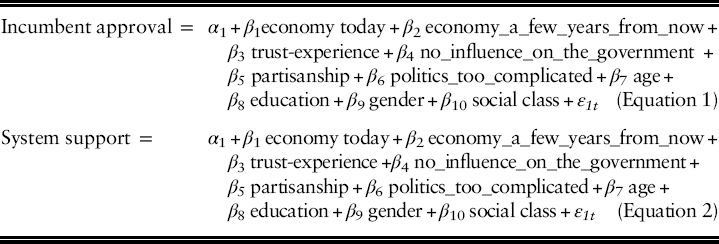
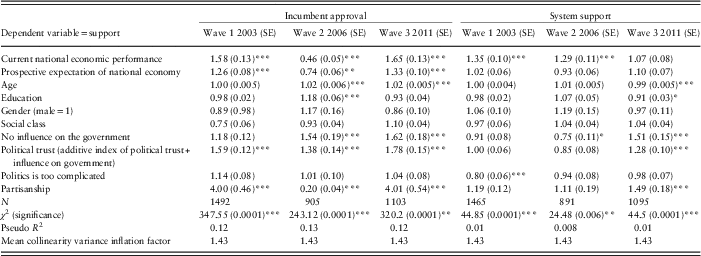
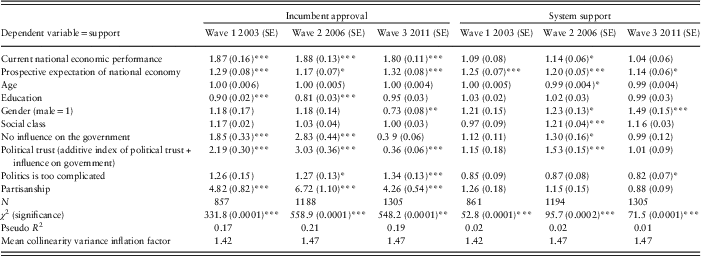
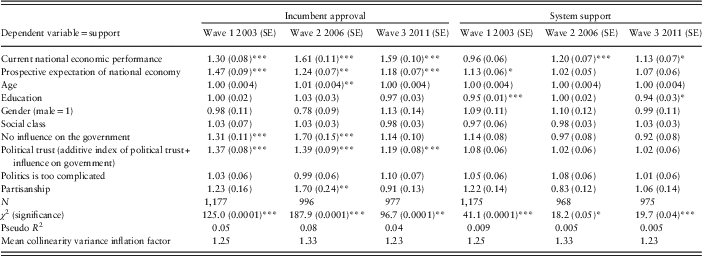
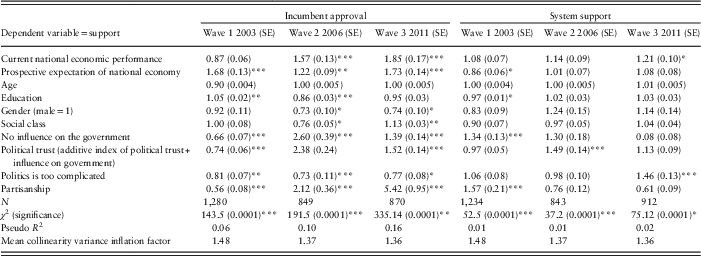
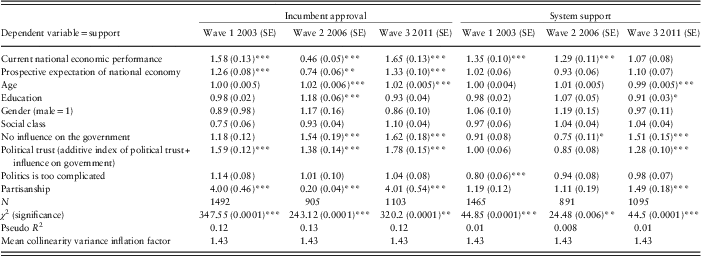
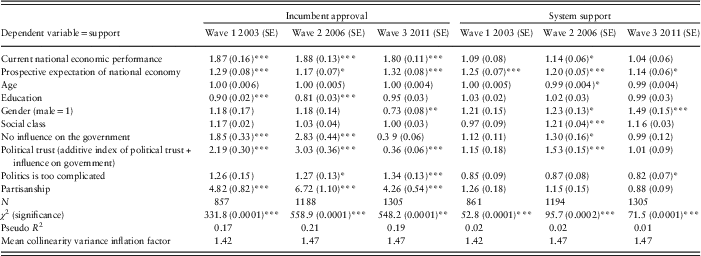
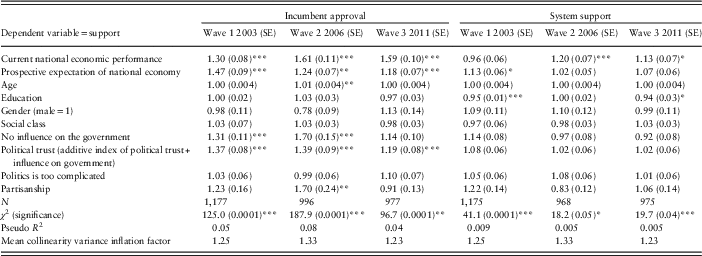
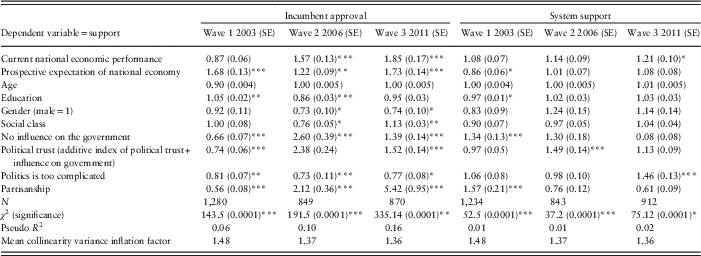
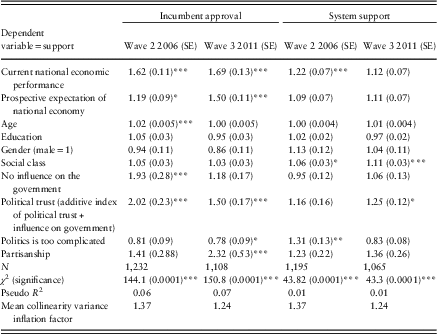
What are the results? In general, the results show that for incumbent approval, where political trust is statistically significant, economic performance remains statistically relevant as a variable to explain incumbent approval. Thus, political trust based on experience does not displace the relevance of economic performance in explaining incumbent approval to underline that it does not provide any policy leeway. For democratic support, the results show that where political trust is statistically significant economic performance is not statistically relevant as a variable to explain democratic support. This supports the argument that political trust based on experience generally provides political leeway for the democratising system. Tables 1–5 present the results from the analyses of the survey data, where Table 1 reports the results for South Korea, Table 2 for Taiwan, Table 3 for the Philippines, Table 4 for Thailand and Table 5 for Indonesia. Columns 1–3 of each of the tables report the results of political trust and economic performance for incumbent approval, controlling for socioeconomic and political considerations, whereas columns 4–6 report the results of political trust and economic performance for system support, controlling for the same socioeconomic and political considerations.
Ordered logit (odds-ratio) of public support through three waves of survey for South Korea
Note: Intercepts included but not reported in the table.
Source: Asian Barometer.
*p<0.05, **p<0.01, ***p<0.005.
Ordered logit (odds-ratio) of public support through three waves of survey for Taiwan
Note: Intercepts included but not reported in the table.
Source: Asian Barometer.
*p<0.05, **p<0.01, ***p<0.005.
Ordered logit (odds-ratio) of public support through three survey waves for the Philippines
Note: Intercepts included but not reported in the table.
Source: Asian Barometer.
*p<0.05, **p<0.01, ***p<0.005.
Ordered logit (odds-ratio) of public support through three waves of survey for Thailand
Note: Intercepts included but not reported in the table.
Source: Asian Barometer.
*p<0.05, **p<0.01, ***p<0.005.
Ordered logit (odds-ratio) of public support through two waves of survey for Indonesia
Note: Intercepts included but not reported in the table.
Source: Asian Barometer.
*p<0.05, **p<0.01, ***p<0.005.
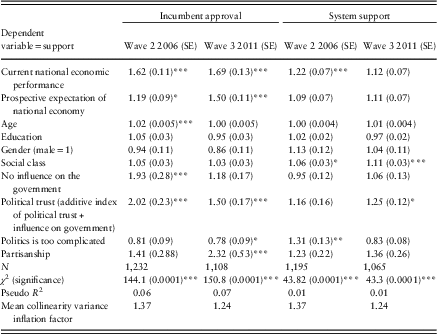
Looking at columns 1–3 across Tables 1–5, the results generally show that economic performance remains statistically significant across all waves of surveys and all the countries studied. The examination through the different waves is useful to show that time and experience do not lead political trust to temper the effect of economic performance: the variables measuring political trust and economic performance remain statistically significant across the different waves of surveys and across all countries. In particular, the findings report that even where political trust is also a statistically significant explanatory factor this trust exists alongside respondents’ valuation of economic performance. These results show that political trust that is incumbent-directed does not displace or buffer against public demands for economic performance. It is useful to note that the other variable that generally explains incumbent approval across the countries is partisanship, coded as respondents who chose the governing party or a party in the governing coalition. This is consistent with the literature and with polling results, to add confidence to the findings here.
Turning to columns 4–6 across Tables 1–5, the results show that where political trust is statistically significant – specifically, for Korea in the third wave, Thailand in the second wave and Indonesia in the third wave – economic performance is no longer pertinent in explaining support for the political system; however, where political trust is not statistically significant, the results show that economic performance is statistically relevant in explaining system support. The one departure from these results is Taiwan in the second wave, where both political trust and economic performance are statistically relevant in explaining system support.
What do these results mean? Given the limited studies of the effects of political trust, particularly on system support, the results bear further discussion. Examination through the different waves highlights that it is the later waves, specifically the second and third waves of surveys, where political trust becomes statistically important. This underlines that experience with the democratising system is relevant to political trust. Of the instances in which political trust matters, one is anomalous: Taiwan. The data from the second wave survey in Taiwan are helpful to clarify the departure from prediction. In particular, the variable capturing the respondent’s support for democracy in the country is low: the average of 6.89 on a 10-point scale is associated with a SD of 2.09 and a negative skewness of −0.20. This means that there are a number of respondents reporting low support for democracy in the country. At the same time, the additive variable capturing political trust with experience also reports low numbers, with an average of 4.80 on an 8-point scale. Further examination of the additive index shows 5.0 at the 75 percentile and 6.0 at the 90 percentile; these numbers underline low political trust among the respondents. The statistical significance for the additive index capturing political trust and experience, then, probably arises from the correlation of low trust with low democratic support. We merged the data to assess for corroboration of this interpretation; the results from the merged data follow expectations to show that political trust is not statistically significant while economic performance is statistically relevant in explaining system support in Taiwan.Footnote 6
Events on the ground in Taiwan in 2006 further corroborate this interpretation: for instance, some refer to it as the year of “political crisis” for the nation (Chu Reference Chu2007; Cooper et al. Reference Cooper, Knotts and Brennan2008). In particular, the island was beset by repeated large protests against President Chen Shui-bian following waves of corruption scandals that incriminated the president and led to indictments of his wife, his closest aides and his appointees (Chu Reference Chu2007).Footnote 7 The fact that the President was reelected in 2004 by the smallest of margins following an assassination attempt the day before the presidential elections probably did nothing to tamp political discontent and opposition in the country.
What of the other findings? The results report that political trust is statistically significant in only three of the 14 total surveys across the five countries: South Korea in the third wave, Thailand in the second wave and Indonesia in the third wave. Events on the ground for South Korea and Indonesia in 2011, and Thailand in 2006, corroborate that political trust may be high in these periods. In particular, South Korea faced upcoming elections in 2012 – general elections in April and presidential elections in December – whereas both Thailand and Indonesia had resounding victories for their respective executives in the preceding 12–18 months. For South Korea, the 2012 elections were tight races: the conservative party was fighting to separate itself from its highly unpopular president, President Lee Myung-bak, whereas the liberal party was trying to eclipse a highly popular political newcomer, the software magnate and former physician Ahn Cheol-Soo. It is safe to say that both sides of the political spectrum battled hard: for instance, one indication that this was not business-as-usual was the multilateral pledge to reform candidate-nomination process towards greater transparency and accountability across all parties (Yap Reference Yap2015). As another indication, the higher election turnout underlines that these elections mattered to voters: general election turnout was almost 10% higher than the previous 2008 election, whereas the turnout for the presidential elections was 75.8% of the registered voters, more than 12% higher than the previous election in 2007 (International Foundation for Electoral Systems 1980–2017). For both Thailand and Indonesia, the survey years followed popular elections in the countries where the executives carried the day: Thailand had a resounding victory for then Prime Minister Thaksin Shinwatra’s Thai Rak Thai (Thai love Thai) Party in 2005; similarly, Indonesia’s President Susilo Bambang Yudhoyono won over 60% of the popular votes in the first round of voting, eliminating the need for a run-off (International Foundation for Electoral Systems 1980–2017). For South Korea and Indonesia in 2011, and Thailand in 2006, then, these events on the ground corroborate that political trust may resonate for these countries to undergird the statistical results.
What of the other cases where political trust was not statistically significant? Taiwan in 2011 was also preparing for elections in 2012; however, unlike South Korea, politics on the island underlined institutional weakness, as events in 2006 may suggest. For instance, President Chen Shui-bian – arrested and charged at the end of his second term in office in 2008 – was found guilty in 2010. President Ma Ying-jeou and the conservative Kuomintang were elected into office with landslide victories in 2008, but by 2011 President Ma’s “unimpressive” administration and general lackluster performance on all grounds – except perhaps the economy – meant that the President’s approval ratings hovered in the low 40s, whereas his party in the legislature lost almost 10% of the popular vote (International Foundation for Electoral Systems 1980–2017; Chen Reference Chen2012, 73). Indeed, in late 2013 in his second term, President Ma’s approval ratings would plummet to single digits, with mass protests calling for his resignation from office (Taipei Times 2013). Given these political conditions in Taiwan, it is not surprising that political trust did not translate meaningfully into democratic support, whereas economic performance held sway in the nation.
Consider, too, the Philippines. Despite the centrality of “people power” to the removal of the strongman executive, President Marcos, political developments fell behind economic achievements in the country. To wit, since 2006, the country’s Freedom House scores have remained stubbornly in the partly free range, and it is considered one of the most dangerous places in the world for journalists; in contrast, the country’s economic growth has been on an upward trajectory, and thus its economic growth of 6.7% in 2015 puts it among the fastest growing economies in the world and second only to China in Asia (Philippine Star 2015; Freedom House 1975–2015). It may be notable that the 30-year anniversary in 2016 of “people power” was marked by an apparent political resurgence for the Marcos family: former First Lady Imelda is a provincial congress representative in Ilocos Norte, daughter Imee is governor of the same province and son Ferdinand Jr. made a competitive run for the vice presidency in the 2016 elections (Philippine Star 2016). The recent election of the mayor of Davao City, Rodrigo Duterte, as President of the Philippines in general elections 2016 is another indication of the need to attend to institution-building in the country: the President-elect, whose nickname “Duterte Harry” is a take-off of the Hollywood-made maverick law-enforcer Dirty Harry, has captured the attention of the world, not the least because he has condoned media-killing of corrupt journalists, as well as killing of criminals and drug-dealers without due process (Manila Times 2016; Philippine Daily Inquirer 2016b). Notwithstanding the country’s presidential system of checks and balances, the party of the President Partido Demokratikong Pilipino-Lakas ng Bayan (PDP-Laban) – which had managed to win only three seats at district elections for the House of Representatives – has a super-majority of 260 seats in the 297-seat Congress through party-switching and alliances (Philippine Daily Inquirer 2016a). Such a super-majority means that the president’s stated agenda – which includes a constitutional change to a federalist system, a reintroduction of the death penalty and economic liberalisation – will not meet significant constraints: indeed, the Supreme Court voted 11 to three with one abstention to support the President’s unlimited martial law powers to counter the insurgency in Mindanao (Philippine Daily Inquirer 2017). Clearly, institution-building in the Philippines will continue to take a backseat.
Perhaps the clearest case of a set-back to institution-building is that of Thailand, where military coups occurred at the end of 2006 and again in May 2014, and clearly reversed democratic trends in the country. In between the military coups were huge political protests in the country in 2008, 2009, 2010 and 2013–2014 that underline political divisions and distrust across the populace (CNN 2010; ABC 2014). Popular elections have yet to be reinstated: the military coup in May 2014 led to the installation of a transition government and a Constitutional Drafting Committee (CDC) to draft a new constitution that would lead to popular elections; however, the National Reform Council rejected the draft constitution in September 2015, necessitating a second CDC and also delaying the conduct of popular elections until late 2017 (BBC News 2015; Prasirtsuk Reference Prasirtsuk2015; Prasirtsuk Reference Prasirtsuk2016; Reuters 2016). Some suggest that the rejection of the constitution gives the transition government time to revive the economy from the anaemic growths of 0.5 and 2.8% in 2014 and 2015, respectively (Prasirtsuk Reference Prasirtsuk2015, Reference Prasirtsuk2016). In any case, these events on the ground in Thailand corroborate the lack of statistical relevance of political trust to democratic support.
To summarise, the results show that where political trust is system-directed, that is, it is statistically significant for democratic support, it provides leeway for the democratising system; however, it does not provide leeway for the government even where it is statistically significant – that is, it does not buffer incumbent approval against citizens’ demands for policy performance. The assessment across the different waves of surveys capture movements in public opinion that are commensurate with ebbs and flows of policy performance and institution-building. From this perspective, the different waves bring additional illumination: with incumbent approval, policy performance such as economic performance remains important and does not change even over time, notwithstanding statistically significant effects of political trust; however, with system support, political trust that emerges with later surveys displaces the statistical relevance of economic performance reported in earlier surveys.
CONCLUSION
How does political trust matter in emergent democracies? Studies suggest that political trust may potentially buffer against public pressures for performance; for emergent democracies that are under pressure to perform on the competing fronts of policy and political performance, the promise of political trust providing policy or political leeway is particularly useful to help with prioritisation of the tasks of nation-building. Unfortunately, limited empirical evidence exists for whether political trust provides such a leeway, and even fewer studies examine the possibility in emergent democracies. This neglect reflects that much of the literature has built around mature democracies, where the trade-off for policy performance versus political performance is unlikely to upend long-standing democratic practices and institutions. However, in emergent democracies where democratic progression and consolidation remain vulnerable, if and how political trust matters is critical.
This article addresses that gap: it considers whether political trust provides political or policy leeway or both in emergent democracies, through assessments of how political trust displaces economic performance in explaining incumbent approval or system support. We use economic performance to take into account findings from economic voting studies that consistently show economic achievements to be integral to support for the government or the political system; consequently, if results show that political trust displaces economic performance in explaining public support for the government or the democratising system, then they are strongly indicative of how political trust directed at incumbent approval or system support may provide leeway against public demands for economic performance. The countries for East and Southeast Asia are interesting for examination: they vary in terms of democratic age and economic levels and, importantly, were countries with high economic achievements. More so than other countries, then, the public in the East and Southeast Asian countries may be inclined towards economic performance over political ones; consequently, if the results indicate that political trust displaces the economic performance in these countries to explain support, the results are likely to be highly generalisable.
The results from successive waves of survey from the Asian Barometer are informative: they show that where political trust is statistically significant in explaining democratic support, economic performance is not relevant. That is, the results show where political trust is directed system support, it displaces economic performance to buffer political systems from the pressures of economic performance. For incumbent approval, both political trust and economic performance are relevant explanators; thus, political trust does not displace economic performance to explain incumbent approval. In conjunction, the results clarify that an economic focus in the respective countries may keep a government in office but political trust undergirds the political system. This emphasises the priority of building political trust to deepen peace and stability in the region.
These results are particularly relevant for expanding study and understanding of the political trust literature to issues of democratic progression and consolidation that are unique to emergent democracies. By these results, recent events in the emergent democracies of East and Southeast Asia – where governments have prioritised growth over institution-building – are cause for concern. In particular, the results show that the pursuing growth in place of institution-building undermines long-term political peace and social stability. Thus, even for governments with primary interests in office tenure, the results highlight an overlooked consideration: the long-term benefits of institution-building that helps build political trust in the emergent democracies.
To round up the discussion, what are some institution-building efforts that will be useful? The results for South Korea and Indonesia in 2011 and Thailand in 2006 – where political trust displaced and buffered against the urgency of economic performance – suggest that one arena may be legislative-executive relations. These cases show coherence or cogency in executive-legislature relations that contrasts against the political jockeying that occurred previously. That political jockeying occurs in emergent democracies is not surprising: ambitious candidates are likely to seize on the opportunity – where rules and institutions are evolving – to dramatise distinct agendas so as to establish political footholds that ensure their survival. Nevertheless, these conditions engender political volatility or even hostile obstructionism, which fails to displace personalistic politics or candidate-centred politics of bygone eras. Unsurprisingly, under these conditions, political trust fails to take root. However, when executive-legislature relations cohere around an ambitious programme – such as in South Korea in 2011, when the candidates across parties moved to pass a multilateral pledge to reform candidate-nomination process towards greater transparency and accountability across all parties – political trust deepens. These cases where political trust succeed in displacing policy performance, then, offers useful insights on how to navigate the hard trade-off between political and policy performance.Footnote 8
Acknowledgements
The author indebted to Professor Anthony Bertelli and the anonymous reviewers for comments and suggestions. .The author thanks the panellists and participants for feedback and comments. This research is funded in part by the Ministry of Education of the Republic of Korea and the National Research Foundation of Korea (NRF-2015S1A3A2047036). The responsibility for all errors and omissions rests with the author. Replication data are available at doi:10.7910/DVN/EUXWZI
Appendix 1
Descriptive summary statistics of variables used