I. INTRODUCTION
The Co–Al compounds attract great interests because of their importance in material science applications.Reference Steurer1–Reference Heggen, Deng and Feuerbacher3 Many work about CoAlReference Mihalkovič and Widom4,Reference Mizuno, Araki and Shirai5 and Co4Al13,Reference Bergman, Girardeaux, Perrin-Pellegrino, Gas, Chatain, Dubois and Rivier6–Reference Dolinšek, Komelj, Jeglič, Vrtnik, Stanić, Popčević, Ivkov, Smontara, Jagličić and Gille8 which focus on sample preparation, structural analysis, and property measurement, has been done. Moreover, there were also some reports on CoAl3,Reference Luo, Zhu, Ma, Xu, Wu, Liu, Qu, Li, Zhu, Jiang and Xu9 Co3Al,Reference Portnoi, Tretyakov and Fadeeva10 Co2Al5,Reference Golubkova, Lomovsky, Kwon, Vlasov and Chuvilin11,Reference Ormeci and Grin12 and Co2Al9.Reference Portnoi, Tretyakov, Fadeeva and Latuch13
The atomistic simulation could help people to understand more structural and physical properties of Co–Al compounds. In 1997, Vailhé and FarkasReference Vailhé and Farkas14 calculated the crystal parameters, elastic constants, and bulk modules of three cubic structures (CoAl, CoAl3, and Co3Al)Reference Vailhé and Farkas14 by using embedded-atom method (EAM) potential. In 2002, Zhang et al.Reference Zhang, Hu and Su15 applied modified analytic EAM (MAEAM) on CoAl and Co3Al alloys. They found that the point defect types are Co antisite defects for the Co-rich side, and Al antisite defects for the Al-rich side in CoAl alloy. In addition, the self-diffusion behavior in Co3Al happens at the first neighbor of the alloy, and diffusion elements are Co atoms. However, the above-mentioned two works did not simulate the hexagonal structure (Co2Al5) and monoclinic structures (Co2Al9 and Co4Al13). In 2007, Dong et al.Reference Dong, Kim, Ko, Lee and Lee16 first utilized 2NN-MEAM (second nearest neighbor modified EAM) to the structural properties of uncubic Co–Al compounds. It is also found that the anisotropy in the γ/γ′ (fcc-Co (γ) and Co3Al (γ′) phases) interfacial energy is relatively small and leaves a room for further modification by alloying with other elements. However, no systematic theoretical study has been reported on the mechanical properties of Co–Al compounds. It seems to be interesting to investigate their hardness, brittleness, and ductility by EAM calculations.
It is noteworthy that the interatomic pair potential can be strictly acquired to arbitrary-distance neighbor by using Chen's lattice inversion. In this paper, as many as six Co–Al compounds are systematically analyzed by Chen's lattice inversion embedded-atom method (CLI-EAM),Reference Zhang, Han, Huang and Shen17,Reference Zhang, Huang, Shen and Chen18 this is the first time to apply well transferable EAM potential to so many Co–Al compounds. Hence, one aim here is to verify the transferability of CLI-EAM potential, the other is to obtain comprehensive data of structural stability and mechanical properties of Co–Al compounds.
II. METHOD OF CALCULATION
A. Embedded-atom method
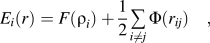
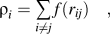
The basic equations of the embedded atom method areReference Daw and Baskes19,Reference Daw and Baskes20
 $${E_i}(r) = F({{\rm{\rho }}_i}) + {1 \over 2}\mathop\sum\limits_{i \ne j} {\Phi ({r_{ij}})} \quad ,$$
 $${{\rm{\rho }}_i} = \mathop\sum\limits_{i \ne j} {f({r_{ij}})\quad ,}$$
where E i(r) is the cohesive energy of each atom in metal, F(ρi) is the energy to embed atom i in the background of the crystal, here ρi is the background electron density (BED) at atom i due to all other atoms, Φ(r ij) is the repulsive pair potential between atom i and atom j, f(r ij) is the atomic electron density (AED) as a function of distance from the center.
In this paper, the formula of pair potential Φ is proposed to use the Morse function,Reference Morse21
 $$\Phi (r) = D_0 \left( {\exp [ - 2{\rm{\alpha }}_0 (r - r_0 )] - 2\exp [ - {\rm{\alpha }}_0 (r - r_0 )]} \right)\quad ,$$
where r 0 is the nearest neighbor distance in the cell, D 0 and α0 are the parameters for pair potential. The form of embedding energy F is proposed by Banerjea and Smith,Reference Banerjea and Smith22 they put forward another form of embedding function based on effective medium theoryReference Norskov and Lang23 and universal energy function.Reference Rose, Smith, Guinea and Ferrante24 The details of pair potential and embedding energy are described in Sec. II. C. Meanwhile, the functions of BED and AED are both exponentially decrease forms:
 $$F({\rm{\rho }}) = - {F_0}[1 - n\ln ({\rm{\rho }}/{{\rm{\rho }}_e})]{({\rm{\rho }}/{{\rm{\rho }}_e})^n}\quad ,$$
 $${\rm{\rho }}(r) = {{\rm{\rho }}_e}\exp [ - {\rm{\lambda }}(r - {r_0})]\quad ,$$
 $$f(r) = {f_e}\exp [ - {\rm{\beta }}(r - {r_0})]\quad ,$$
where all the parameters in Eqs. (4)–(6) are needed for fitting. Equation (5) is the analysis formula of BED. The parameters ρe and λ are obtained by fitting first-principles data. In another word, we calculated some BED points that change with lattice constants by using first-principles method, and then fitted these points with Eq. (5) to obtain the data of parameters ρe and λ. Equation (6) is the analysis formula of AED, and the parameters f e and β are obtained by lattice inversionReference Chen25,Reference Chen, Chen and Wei26 method. More details of BED and AED are described in Sec. II. C.
B. Chen's lattice inversion
It is known that cohesive energy in crystal lattice E(r) is a sum of interatomic pair potentials Φ′, such as
 $$E(r) = {1 \over 2}\mathop\sum\limits_{i \ne j} {\Phi '({r_{ij}})} = {1 \over 2}\mathop\sum\limits_{n = 1} {\Phi '({b_0}(n){r_0})} \quad ,$$
where r 0 is the nearest neighbor distance, b 0(n) is the ratio of the nth neighbor distance to the nearest neighbor distance. According to multiplicative semigroup, for any two integers m and n in semigroup {b(k)}, there always exists an integer l, such that
 $$b(n)b(m) = b(l)\quad .$$
In other words, {b 0(k)} can be replaced by {b(k)}. So Eq. (7) is equivalent to the following equation:
 $$E(r) = {1 \over 2}\mathop\sum\limits_{n = 1}^\infty {r(n)\Phi '(b(n){r_0})} \quad ,$$
where r(n) is the numbers of nth neighbor atoms, in which
 $$r(n) = \left\{ {\matrix{ {r_0 (b_0^{ - 1} [b(n)])} \qquad{b(n) \in \{ b_0 (n)\} } \cr \;\;\;\;\;\;\;0 \qquad\qquad \;{b(n) \notin \{ b_0 (n)\} } \cr } } \right.\quad ,$$
Therefore, pair potential Φ′ is given by
 $$\Phi '(r) = 2\mathop\sum\limits_{n = 1}^\infty {I(n)E(b(n){r_0})} \quad ,$$
 $$\mathop\sum\limits_{b(k)\left| {b(n)} \right.} {I(k)r\left( {b^{ - 1} \left[ {{{b(n)} \mathord{\left/ {\vphantom {{b(n)} {b(k)}}} \right. \kern-\nulldelimiterspace} {b(k)}}} \right]} \right) = {\rm{\delta }}_{n1} } \quad .$$
The inversion coefficient I(n) is structure dependent, such as fcc, bcc, and hcp metal.
As the same theory, Eq. (2) can written as,
 $${\rm{\rho }}(r) =\mathop \sum\limits_{n = 1} {r(n)f[b(n)r]} \quad .$$
This form is important for the following discussion.
C. Chen's lattice inversion embedded atom method
For combination of EAMReference Zhang, Han, Huang and Shen17–Reference Daw and Baskes20,Reference Huang, Zhang, Sun, Li, Zhang and Shen27 and Chen's lattice inversion method,Reference Chen25,Reference Chen, Chen and Wei26 the cohesive energy per atom of metal under homogeneous deformation is given by
 $$E(r) = F[{\rm{\rho }}(r)] + {1 \over 2}\mathop\sum\limits_{n = 1} {\Phi (b(n){r_0})} \quad ,$$
then
 $$2\{ E(r) - F[{\rm{\rho }}(r)]\} = \mathop\sum\limits_{n = 1} {r(m)\Phi [b(n){r_0}]} \quad ,$$
 $${\rm{\rho }}(r) = \mathop\sum\limits_{n = 1} {r(n)f[b(n){r_0}]} \quad .$$
Therefore, the pair potential function and AED function can be acquired by Chen's lattice inversionReference Chen25,Reference Chen, Chen and Wei26
 $$\Phi (r) = 2\mathop\sum\limits_{n = 1} {I(n)\{ E[b(n){r_0}] - F({\rm{\rho }}[b(n){r_0}])\} } \quad ,$$
 $$f(r) =\mathop \sum\limits_{n = 1} {I(n){\rm{\rho }}(b(n){r_0})\quad .}$$
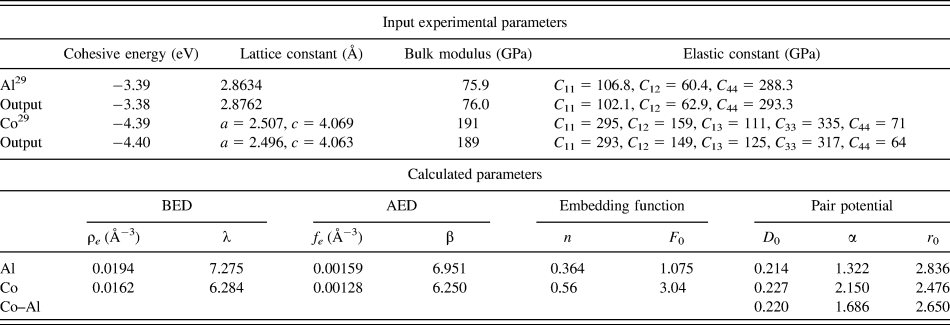
The BED ρ in Eq. (18) can be obtained using first-principles calculations which were carried out with CASTEP code,Reference Segall, Lindan, Probert, Pickard, Hasnip, Clark and Payne28 based on density functional theory (DFT). The cohesive energy, lattice constant, and bulk modulus of pure elements are input parameters (Table I). The Morse function of cohesive energy E in Eq. (18) can be obtained by fitting pure elements' experimental parameters.Reference Villars and Calvert29 The model parameters F 0 and n in the embedding Eq. (4) can be arbitrary initial value at the beginning. Then the parameters are determined by the calculations that are compared between the experimental data in Table I. We obtained the data of pair interaction by inversion of the difference data between E(r) and F[(ρ(r))] in Eq. (15). And then we fitted these data of pair interaction with Morse formula to obtain three parameters D 0, α, and r 0. In addition, the data of E(r) are from the experiment, the calculations of pure elements Al and Co are listed in Table I. It is seen that, the output results are consistent with the input experimental parameters. In CLI-EAM, the cutoff radii of fcc and hcp structures are larger than 8 Å, and the cutoff radius of the bcc structure is less than 3.5 Å, otherwise the phonon spectrum of these three structures would exit imaginary frequency. At the same time, the range which is larger than 10 Å or smaller than 2.0 Å is meaningless. Therefore, we chose 10 Å as the cutoff radius of Al and 3 Å as the cutoff radius of Co, respectively.
The input experimental parameters of pure elements and the calculated parameters of Co–Al compounds.

In binary alloy CLI-EAM, the cohesive energy  $E_{\rm{c}}^{{\rm{AB}}}$ of alloy is written as
 $$E_{\rm{c}}^{{\rm{AB}}} = E_{\rm{c}}^{\rm{A}} + E_{\rm{c}}^{\rm{B}} + \Delta E\quad ,$$
 $$\Delta E = \mathop\sum\limits_n {r(n){\Phi _{{\rm{AB}}}}[b(n){r_0}]} \quad ,$$
where  $E_{\rm{c}}^{\rm{A}}$ and
 $E_{\rm{c}}^{\rm{B}}$ is the binding energy of metal A and B, respectively. The functions of them are both Eq. (1). The data of
 $E_{\rm{c}}^{\rm{A}}$,
 $E_{\rm{c}}^{\rm{B}}$, and
 $E_{\rm{c}}^{{\rm{AB}}}$ come from experiment.Reference Villars and Calvert29–Reference ЛЯКИШeB32 As people know, arbitrary N-body interaction energy term can be represented as sum of some pair interactions for pair potential model. ΦAB is the pair potential between metal A and B. Based on Chen's lattice inversion,Reference Chen25,Reference Chen, Chen and Wei26 ΦAB is assumed to follow the formula,
 $${\Phi _{{\rm{AB}}}} = \mathop\sum\limits_n {I(n)\Delta E[b(n){r_0}]} \quad ,$$
where I(n) is the inversion coefficient (the inversion coefficient bases on B2 structure here). This new-type EAM interatomic potential can be called the CLI-EAM potential; more details of CLI-EAM formalism have been published in the literature.Reference Zhang, Han, Huang and Shen17,Reference Zhang, Huang, Shen and Chen18,Reference Huang, Zhang, Sun, Li, Zhang and Shen27 The input parameters for calculations are listed in Table I.
Because of using Chen's lattice inversion, the advantage of CLI-EAM over other EAM is that all the parameters can be obtained by first-principles calculation. Therefore, the problem of lack of experiments for pure metals is avoided, and the transferability of potential is enhanced.
D. Elastic constants and mechanics modulus
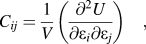
It is known that the elastic constants relating the various components of stress and strain are defined by,
 $${C_{ij}} = {1 \over V}\left( {{{{\partial ^2}U} \over {\partial {{\rm{\varepsilon }}_i}\partial {{\rm{\varepsilon }}_j}}}} \right)\quad ,$$
where V and U are the volume and the Helmholtz free energy of the crystal, ε is the strain tensor. The other mechanics modules are obtained by using Voigt, Reuss, and Hill (VRH) approximations.Reference Anderson33 All the elastic constants and structural properties were carried out with GULP code.Reference Gale and Rohl34 The bulk modulus (B) and shear modulus (G) are obtained from the elastic constants through Eqs. (23) and (24); Young's modulus (Y) and Poisson's ratio (ν) are obtained from the bulk modulus and shear modulus through Eqs. (25) and (26),
 $$B = {{\left[ {2\left( {C_{11} + C_{12} + 2C_{13} } \right) + C_{33} } \right]} \mathord{\left/ {\vphantom {{\left[ {2\left( {C_{11} + C_{12} + 2C_{13} } \right) + C_{33} } \right]} 9}} \right. \kern-\nulldelimiterspace} 9}\quad ,$$
 $$G = {{\left( {7C_{11} - 5C_{12} + 2C_{33} + 12C_{44} - 4C_{13} } \right)} \mathord{\left/ {\vphantom {{\left( {7C_{11} - 5C_{12} + 2C_{33} + 12C_{44} - 4C_{13} } \right)} {30}}} \right. \kern-\nulldelimiterspace} {30}}\quad ,$$
 $$Y = 9BG/(3B + G)\quad ,$$
 $$\nu = (3B - 2G)/2(3B + G)\quad .$$
III. RESULTS AND DISCUSSION
A. Structural properties
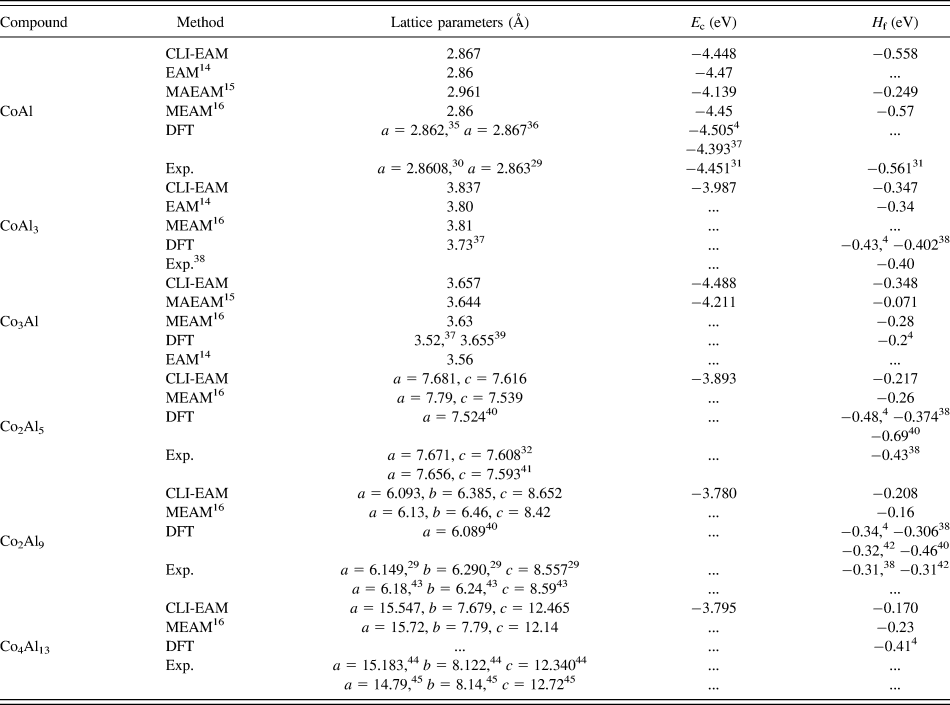
Based on phase diagrams, there are some Co–Al compounds confirmed in experiments, namely, CoAl, CoAl3, Co3Al, Co2Al5, Co2Al9, and Co4Al13. Although there are few available EAM potentials for all these compounds, the CLI-EAM alloy potential is utilized to calculate the lattice parameters, the formation enthalpies, and the cohesive energies of these compounds. The results are shown in Table II. It is seen that the calculated lattice constant of CoAl (2.867 Å) is consistent with the experiments of 2.863 ÅReference Villars and Calvert29 or 2.8608 Å.Reference Cooper30 This result is as good as 2NN-MEAM calculation of 2.86 ÅReference Dong, Kim, Ko, Lee and Lee16 or EAM of 2.86 Å,Reference Vailhé and Farkas14 and the DFT results (2.862Reference Mehl, Osburn, Papaconstantopoulos and Klein35 and 2.867 ÅReference Grosso, Mosca and Bozzolo36), and a little better than the result of MAEAM (2.961 ÅReference Zhang, Hu and Su15). The calculated cohesive energy of CoAl is −4.448 eV, that is also consistent with the EAM theoreticalReference Vailhé and Farkas14,Reference Dong, Kim, Ko, Lee and Lee16 and experimental results,Reference Hultgren, Desai, Hawkins, Gleiser and Kelly31 and a little better than DFT results (−4.505Reference Mihalkovič and Widom4 and −4.393 eVReference Ohtani, Yamano and Hasebe37). In CLI-EAM method, the Morse function is used to describe the energy of crystal, so the acquired lattice constant and cohesive energy of CoAl are consistent with the experimental results.Reference Villars and Calvert29–Reference Hultgren, Desai, Hawkins, Gleiser and Kelly31 Then we apply this alloy potential to the other Co–Al compounds. For two cubic structures CoAl3 and Co3Al, our results are as a similar conclusion to CoAl. For hexagonal structure Co2Al5, the results of lattice constant are a = 7.681 Å and c = 7.606 Å; it is a little larger than the results of 2NN-MEAM (a = 7.79 Å, c = 7.539 Å)Reference Dong, Kim, Ko, Lee and Lee16 and experiment (a = 7.671 Å, c = 7.608 Å and a = 7.656 Å, c = 7.593 Å).Reference ЛЯКИШeB32,Reference Newkirk, Balck and Damjanovic41 For monoclinic structures Co2Al9 and Co4Al13, our calculated lattice constants (a = 6.093 Å, b = 6.385 Å, and c = 8.652 Å) of Co2Al9 are consistent with the relevant experimental resultsReference Villars and Calvert29,Reference Ma and Kuo43 except Co4Al13 (a = 15.547 Å, b = 7.679 Å, c = 12.465 Å) with a difference of 2.1–6.6% for experimental results.Reference Hudd and Taylor44,Reference Grin, Burkhardt, Ellner and Peters45 From Table II, it can be seen that the results of Co4Al13 by 2NN-MEAM also have the difference of 4.3–6.3%.Reference Dong, Kim, Ko, Lee and Lee16 That means the calculations of lattice constants by EAM have the uncertainty. Moreover, EAM cannot describe the nonclose-packed crystal or low-symmetry structures well. These differences may be attributed to the center-symmetry model of the CLI-EAM and the basic postulates of BED. In EAM model, BED is used to describe the many-body interactions. But people suppose it is a homogeneous electron gas in crystal.Reference Daw and Baskes19,Reference Daw and Baskes20 Therefore, it can well describe high-symmetry structures such as cubic crystal but not direction effects in low-symmetry structures.
The calculated lattice parameters, enthalpy of formation (H f), and cohesive energy (E c) of Co–Al intermetallic compounds. Some results of first principles (DFT) and experiments (Exp.) are listed.
It is known that the cohesive energy can be used to describe the stability of the crystal; it is often defined as the total energy released by isolated atoms combined into solid. Hence, the larger the absolute value is, the more stable the crystal structure is. From Table II, the absolute values of cohesive energy of Co2Al5, Co2Al9, and Co4Al13 are smaller than CoAl, which means CoAl is more energetically stable than the rest. Although our results are not as consistent with the experimental ones as some EAM calculations, our potential can well describe the structures and the energies of all the compounds with acceptable differences. As it is known, the transferability of potential is a very important character in atomic scale simulation, and therefore, the CLI-EAM potential has good transferability for Co–Al compounds.
By studying the energies of optimized Co–Al compounds and metals Co and Al, the formation enthalpies (H f) for Co–Al compounds were obtained. As shown in Table II, the calculated H f of CoAl is −0.558 eV, it is consistent with 2NN-MEAM of −0.57 eVReference Dong, Kim, Ko, Lee and Lee16 and experimental results of −0.561 eV,Reference Hultgren, Desai, Hawkins, Gleiser and Kelly31 and a little better than the result of MAEAM (−0.249 eV).Reference Zhang, Hu and Su15 All the results of Co–Al compounds are compared in Fig. 1, the values of H f for CoAl3, Co3Al, Co2Al5, Co2Al9, and Co4Al13 are −0.347, −0.348, −0.217, −0.208, and −0.170 eV, respectively. The absolute value of H f first increases and then decreases when Co concentration increases, and it reaches maximum when the ratio of Co/Al concentration was 1:1. The negative H f of Co–Al compounds means the chemical interactions between Co and Al atoms can increase the stability of compounds. Therefore all the Co–Al compounds are thermodynamically stable.
Calculated enthalpies of formation for Co–Al compounds.
B. Elastic constants and mechanical properties
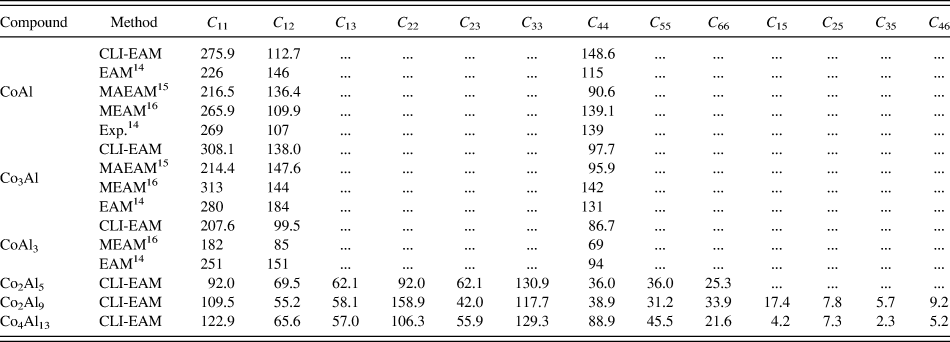
In this section, the elastic constants and the mechanical properties of Co–Al compounds are investigated by using the CLI-EAM alloy potential. All the results are shown in Table III together with the experimentalReference Vailhé and Farkas14 and the EAM calculationReference Zhang, Hu and Su15,Reference Dong, Kim, Ko, Lee and Lee16 results. Our calculated C 11, C 12, and C 44 of CoAl are 275.9, 112.7, and 148.6 GPa respectively; they are similar to 2NN-MEAM of 265.9, 109.9, and 139.1 GPaReference Dong, Kim, Ko, Lee and Lee16 and experimental results of 269, 107, and 139 GPa,Reference Vailhé and Farkas14 and a little larger than the results of MAEAM (216.5, 136.4, and 90.6 GPa) and EAM (226, 146, and 115 GPa).Reference Vailhé and Farkas14,Reference Zhang, Hu and Su15 For cubic structures, the results of Co3Al are as a similar conclusion to CoAl, although smaller differences exist for CoAl3. The elastic constants of other uncubic structures (Co2Al5, Co2Al9, and Co4Al13) are calculated; the results of corresponding elastic constants are smaller than the data of cubic structures.
The calculated elastic properties (C ij in GPa) of Co–Al intermetallic compounds.
As people know, the mechanical stability obeys the restrictions of elastic constants. Different structures have different restrictions. In the Co–Al system, CoAl, Co3Al, and CoAl3 are cubic structures; Co2Al9 and Co4Al13 are monoclinic structures; Co2Al5 is a hexagonal structure. So here needs three restrictions.
For cubic structure, the restriction isReference Nye46
 $${C_{11}} > 0,\quad {C_{44}} > 0,\quad {C_{11}} - {C_{12}} > 0,\quad {C_{11}} + 2{C_{12}} > 0\quad .$$
And for monoclinic structure, the restriction isReference Beckstein, Klepeis, Hart and Pankratov47
$$\eqalignb{ C_{11} > 0,\quad C_{22} > 0,\quad C_{33} > 0,\quad C_{44} > 0,\quad C_{55} > 0,\quad C_{66} > 0, \cr C_{11} + C_{22} + C_{33} + 2\left( {C_{12} + C_{13} + C_{23} } \right) > 0, \cr \left( {C_{11} C_{55} - C_{12}^2 } \right) > 0,\quad \left( {C_{44} C_{66} - C_{46}^2 } \right) > 0,\quad C_{22} + C_{33} - 2C_{23} > 0, \cr C_{22} \left( {C_{33} C_{55} - C_{35}^2 } \right) + 2C_{23} C_{25} C_{35} - C_{23}^2 C_{55} - C_{25}^2 C_{33} > 0, \cr 2\left[ {C_{15} C_{25} \left( {C_{33} C_{12} - C_{13} C_{23} } \right)} \right. + C_{15} C_{35} \left( {C_{22} C_{13} - C_{12} C_{23} } \right) \cr \;\;\;\;\quad\left. { + C_{25} C_{35} \left( {C_{11} C_{23} - C_{12} C_{13} } \right)} \right] \cr \;\;\;\; \,\,\,\,- \left[ {C_{15}^2 \left( {C_{11} C_{22} - C_{12}^2 } \right)} \right. + C_{55} \left( {C_{11} C_{22} C_{33} - C_{11} C_{23}^2 } \right. - C_{22} C_{13}^2 \left. {\left. { - C_{33} C_{12}^2 + C_{12} C_{13} C_{23} } \right)} \right] > 0\quad . \cr} $$For hexagonal structure, the restriction isReference Tsuchiya, Yamanaka and Matsui48
 $$\eqalignb{ C_{11} - \left| {C_{12} } \right| > 0,\quad (C_{11} + C_{12} )C_{13} - 2C_{13}^2 > 0 \cr\quad (C_{11} - C_{12} )C_{44} - 2C_{14}^2 > 0\quad . \cr} $$
From Table III, we find that all the elastic constants of the Co–Al compounds satisfy the above restrictions. That means they are all mechanically stable.
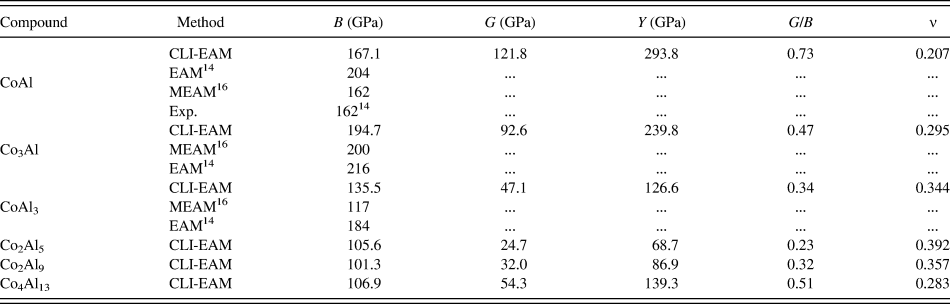
To better understand the mechanical properties of the Co–Al compounds, the bulk modulus B, the shear modulus G, the Young's modulus Y, and the Poisson's ratio ν are calculated and compared with the experimentalReference Fleischer49 and the EAM results.Reference Vailhé and Farkas14,Reference Dong, Kim, Ko, Lee and Lee16 As shown in Table IV, our calculated bulk modulus of CoAl (167.1 GPa) is larger than the experimental (162 GPa)Reference Fleischer49 and the MEAM (162 GPa)Reference Dong, Kim, Ko, Lee and Lee16 data, whereas smaller than EAM (202).Reference Vailhé and Farkas14 The differences may be attributed to two reasons. One is that the defects in the materials are not considered in our calculations; another is that the effects of anisotropy on the elastic properties are not considered in experiments. To interpret our results, the bulk moduli of Co–Al compounds for different Co concentrations are shown in Fig. 2. As can be seen, the bulk modulus of metal Co is larger than metal Al, so the calculated bulk moduli of the compounds increase with increasing Co concentration except CoAl3 (B = 135.5 GPa). The reason may be due to the effects of anisotropy of CoAl3 lead to a little larger elastic constant, and then the larger elastic constant leads to a larger bulk modulus. In Table IV, CoAl has the highest shear modulus and Young's modulus, whereas Co2Al5 has the lowest values. Haines et al. proved that the hardness of a material is closely related to its shear modulus and Young's modulus.Reference Haines, Leger and Bocquillon50 Although the relationships between the hardness and the modulus are not universal, it is generally recognized that the larger the modulus is, the higher hardness the material has. Therefore, CoAl with the largest modulus (G = 118.2 GPa, Y = 285.6 GPa) is the hard phase, whereas Co2Al5 with the smallest modulus (G = 24.7 GPa, Y = 68.7 GPa) is the soft phase. To study the brittleness and the ductility properties of the Co–Al compounds, the ratio of shear modulus to bulk modulus (G/B), which is an empirical criterion of the extent of fracture range of the material,Reference Pugh51 is studied. According to Table IV, CoAl3, Co3Al, Co2Al5, and Co2Al9 are ductile materials, which have lower G/B values of 0.34, 0.47, 0.23, and 0.32, respectively; whereas CoAl is a brittle material with a higher G/B value of 0.78. For Poisson's ratio, it is generally accepted that materials with low Poisson's ratio are brittle.Reference Schroers and Johnson52,Reference Gschneidner, Russell, Pecharsky, Morris, Zhang, Lograsso, Hsu, Lo, Ye, Slager and Kesse53 Thus, CoAl is a brittle material with a lower Poisson's ratio value of 0.207.
The calculated bulk modulus (B), shear modulus (G), Young's modulus (Y), and Poisson's ratio (ν) of Co–Al intermetallic compounds.
Calculated bulk moduli of Co–Al compounds.
IV. SUMMARY
In this paper, the structural stability and the mechanical properties of Co–Al compounds (CoAl, CoAl3, Co3Al, Co2Al5, Co2Al9, and Co4Al13) were investigated by using CLI-EAM potential. The potential is transferable and therefore does well for studying different Co–Al compounds. The calculated lattice parameters and cohesive energies are consistent with the experimental and other EAM results. The formation enthalpies of all the Co–Al compounds are negative; therefore the chemical bonding between Co and Al atoms increase the stability of compounds. According to elastic constant restrictions, all the Co–Al compounds are mechanically stable. The bulk moduli of the compounds increase with the increasing Co concentration. Moreover, CoAl with the largest shear modulus and Young's modulus is the hard phase, and Co2Al5 with the smallest modulus is the soft phase. CoAl3, Co3Al, Co2Al5, and Co2Al9 with lower B/G values are considered to be ductile materials, and CoAl with a lower Poisson's ratio value of 0.207 is a brittle material.
Supplementary Material
Supplementary materials can be viewed in this issue of the Journal of Materials Research by visiting http://journals.cambridge.org/jmr.
ACKNOWLEDGMENT
This work was supported in part by the National Basic Research Program of China under Grant No. 2011CB606400.