Introduction
Mexico, a federation with a three-tier government – federal, state and municipal level – has witnessed different political, administrative and fiscal decentralisation processes. Along with decentralisation, the Mexican welfare regime has also changed over the last three decades. One of these changes relates to the increasing involvement of states in social-policy making, which previously fell within the exclusive domain of the federal government. Several states are developing their own social programmes (Medrano, Reference Medrano2015), including conditional cash transfers programmes (CCTs). Actually, CCTs have become an important social policy instrument at the federal and state levels in Mexico. The most important anti-poverty federal programme is a CCT that targets households living in extreme poverty.Footnote 1 CCTs directed at single mothersFootnote 2 constitute a policy novelty that was introduced at the state level. However, the increasing social policy activism at the subnational level still remains a practically unexplored area of study.
A few states, including Mexico City, have introduced social programmes for lone mothers or working mothers living in poverty. With the exception of Mexico City, such programmes were originally conceived as CCTs.Footnote 3 This is the case for all three states under analysis here: the State of México, Jalisco and Nuevo León. In Mexico, the adoption of these programmes occurred in the context of increasing female participation in extra-domestic work activities since the 1980s. In 2013, Mexico's labour force participation rate for women was 37.8% (INEGI, 2007).
In Mexico, and elsewhere, CCTs, implemented at the national level, are largely studied by their impact on poverty reduction, or the problems associated with narrow targeting or conditionalities (Barrientos and Dejong, 2006; De Brauw and Hoddinott, Reference De Brauw and Hoddinott2009; Dutrey, Reference Dutrey2007; Lund et al., Reference Lund, Noble, Barnes and Wright2009), among other issues. However, analysis of the ideational dimension of CTTs’ policy design – the core assumptions, values and normative groundings, as well as the implications for the target population – has received relatively little attention in the literature. In order to fill this research gap, this work analyses the design of CCTs for female heads of households. The main objective of this study is to compare the design of CCTs for female heads of households implemented in three Mexican states – the State of México, Jalisco and Nuevo León – in order to identify the normative grounding relative to the notion of citizenship embedded in such designs.
This analysis aims to shed light on the implications of social policy design, specifically how social programmes contribute to reproduce, or maintain, certain values and beliefs about welfare recipients, which are held by governmental actors and the general public in a given society. The present work is composed of the following sections. The first section includes the analytical and methodological framework that guides the present research. The second section focuses on the main results of this comparative analysis of the design of the three CCTs under study (the State of México, Jalisco and Nuevo León). The third section comprises a discussion of the main results of the study. Finally, a brief conclusion is given.
An ideational analysis of CCTs
In order to analyse the ideational dimension of CCTs, this study departs from the theory of social construction and policy design (Schneider and Ingram, Reference Schneider and Ingram1993, Reference Schneider and Ingram2005; Ingram et al., Reference Ingram, Schneider and DeLeon2007; Schneider and Sidney, Reference Schneider and Sidney2009), which is widely used to study the design of welfare policy (Pierce et al., Reference Pierce, Siddiki, Jones, Schumacher, Pattison and Peterson2014). According to Schneider and Sidney (Reference Schneider and Sidney2009: 104–05), public policy design includes the following elements: the definition of the problem and objectives, the benefits that public policy distributes, the target population, the norms, the tools, the execution structures, social constructions, foundations and the assumptions that underlie the problem's causes. As this definition departs from a broad notion of policy, for the purpose of this study it is adapted to analyse specific social programmes, as explained below. Additionally, unlike previous analysis of the design of social programmes at the subnational level in Mexico (Medrano and Berrios, Reference Medrano and Berrios2013), this work aims to identify the normative grounding relative to the notion of citizenship embedded in CCTs for lone mothers.
In this study, a social programme design refers to the fundamental components that define the essence and content of such a programme as a coherent policy instrument, and includes the following: (1) definition of the problem that the programme seeks to address, which enables the creation of such programme, and the explicit objective of the programme; (2) definition of target population; (3) characteristics of the goods or services provided by the programme; (4) eligibility rules and (5) characteristics of the conditions, if applicable. Unlike Schneider and Sydney's proposition of public policy design (2009), in this definition, the ideational dimension – that is, the set of social constructions, normative beliefs, values and other assumptions embedded in the design – has a rather transversal character; it is not considered to be a discrete element of the design but one that can be present in practically all components of it.
The definition of the problem comprises a set of ideas, which includes, implicitly at least, a re-count of the ‘adverse causes and consequences’ around a social condition (e.g., poverty), as well as a proposal about how to improve this condition (Weiss, Reference Weiss1989). Similarly, the construction of the target population refers to the attitudes and beliefs related to the population group to which a public policy is directed, such as welfare recipients, and includes prevailing stereotypes or particular attributes linked to such a population. Schneider and Ingram (Reference Schneider and Ingram1997: 75) proposed that these ideas about a specific population group influences whether or not such a group is considered to provide legitimate candidates for receiving particular benefits (or punishments) from a public policy.Footnote 4 According to the classification of Schneider and Ingram (Reference Schneider and Ingram1997, Reference Schneider and Ingram2005), lone mothers are viewed as dependants, that is they have relatively no power but are positively constructed, and, therefore, ‘are expected to receive rhetorical and underfunded benefits and often hidden burdens’ (Pierce et al., Reference Pierce, Siddiki, Jones, Schumacher, Pattison and Peterson2014: 5). However, this classification is not useful to make sense of the meanings and implications of this construction of single mothers – apart from being eligible to receive social assistance – nor of the hidden burdens.
In order to make sense of the ideational basis of CCTs and the implications for specific vulnerable groups, such as sole mothers living in poverty, this study analyses the notion of citizenship that is embedded in them. This study departs from the notion of citizenship that was introduced into welfare policy research by T. H. Marshall (Reference Marshall1964), which ‘refers to the ways in which the relationship of the individual citizen with the welfare state is constructed by welfare state policies’ (Pfau-Effinger, Reference Pfau-Effinger2006: 2). Two contending notions of citizenship capture the nature of such a relationship in contemporary societies: social citizenship and market citizenship. Social citizenship is the foundation of the post-war welfare states in industrialised democracies, as proposed by T. H. Marshall (Reference Marshall1964), and involves the provision of certain social services and benefits for all residents of a given country on the basis of citizenship. Hence, the ‘idea of welfare’ that underpinned the post-war welfare states was framed as a ‘means of compensation or redistribution to redress the vagaries and inequalities created by the operation of market forces’ (Jayasuriya, Reference Jayasuriya2006: 2).
The notion of market citizenship – or ‘active’ citizenship (Pfau-Effinger, Reference Pfau-Effinger2006) – is linked to the emergence of various neoliberal social agendas that arose from core elements of the neo-liberal market model, which have run in parallel to the restructuring of welfare systems in developed and developing countries since the 1980s (Jayasuriya, Reference Jayasuriya2006; Schild, Reference Schild2000). Independently of the specific modes in which market citizenship is adopted in different social policy agendas across the world, including in Latin America countries (Schild, Reference Schild2000), according to Jayasuriya (Reference Jayasuriya2006), some of its key features are the following: (1) it is framed within the market rather than in opposition to or as compensation for the consequences of the market; (2) it is designed so as to make a productive contribution to, or to enhance, greater participation within the economy; and (3) it promotes a contractual version of welfare that makes social benefits conditional on the performance of specified obligations or duties. Hence, ‘economic security for citizenship is increasingly reliant upon an individual's attachment to the labour force’ (Bodsworth, Reference Bodsworth2012: 152).
The notion of market citizenship has been critically analysed from a feminist perspective, particularly in the case of the welfare-to-work programmes for lone mothers (Gazso and McDaniel, Reference Gazso and McDaniel2010; Luccisano and Romagnoli, Reference Luccisano and Romagnoli2007; Breitkreuz, Reference Breitkreuz2005; Fuller et al., Reference Fuller, Pulkingham and Kershaw2007; Walter, Reference Walter2002), which were first introduced in the 1990s in developed countries (Cook et al., Reference Cook, Davis, Smyth and McKenzie2009). Overall, ‘welfare to work policies are those which require people to participate in employment, job search, or training in order to remain eligible for social assistance benefits’ (Cook et al., Reference Cook, Davis, Smyth and McKenzie2009: 476). Taking a feminist critique to examine these welfare-to-work policies, the adoption of market citizenship reveals particular features that can be summarised as follows:
1. Obliviousness to (or underestimation of) the gender, or other structural inequalities, that different groups of women face in society, particularly in the labour market (Breitkreuz, Reference Breitkreuz2005; Bodsworth, Reference Bodsworth2012). As gender also intersects with other social categories, such as socioeconomic status, working mothers living in poverty often experience additional or more acute burdens than better-off working women, such as the need to take ‘short-term, temporary jobs that provide no health care benefits, no avenues for promotion, no job security, and no protection from exploitation of and kind’ (Bodsworth, Reference Bodsworth2012: 144).
2. Individualisation of the problems faced by single mothers, that is problems that are implicitly deemed as individual or personal problems (e.g. lack of training), obviating or neglecting structural disadvantages that lone mothers face in their social context. Therefore, ‘the responsibility for solving these problems lay in their own actions and choices, particularly in relation to labour market engagement’ (Bodsworth, Reference Bodsworth2012: 199). Furthermore, sole mothers living in poverty should behave like ‘responsible risk takers’ (Gazso, Reference Gazso2009).
3. The model of citizenship for all adults, ‘regardless of gender of family form, is that of autonomous and self-sufficient breadwinner’ (Fuller et al., Reference Fuller, Pulkingham and Kershaw2007: 2). Other ‘forms of work that contribute to society outside paid employment, such as unpaid care-work in the family and the community and voluntary work are largely ignored’ (Fuller et al., Reference Fuller, Pulkingham and Kershaw2007: 2). These programmes hence put a strong emphasis on self-sufficiency, autonomy and the work ethic in order to ‘free individuals from their dependent status’ (Breitkreuz, Reference Breitkreuz2005: 154), and thereby poverty. Autonomy is equated to ‘full economic autonomy’ and should be attained through paid work (Bodsworth, Reference Bodsworth2012: 200). The work ethic is ‘both in terms of being a responsible parent’, and ‘in relation to their deservingness of income support’ (Bodsworth, Reference Bodsworth2012: 199). Hence, welfare provision is a contingent and temporary benefit to sustain individuals until they can achieve self-sufficiency through employment. In consequence, welfare-to-work policies ‘place single mothers in a precarious position, as participants are required to engage in paid work to justify support from the state, and are required to ensure their children become “good”, independent working citizens’ (Bodsworth, Reference Bodsworth2012: 187).
4. Conditionality became a central feature of these programmes – ‘employable lone mothers are eligible for income support conditional only on their efforts as citizens workers’ (Gazso and McDaniel, Reference Gazso and McDaniel2010: 378). There is a conceptualisation of welfare dependency as negative – ‘the trap entangling welfare recipients’ – (Breitkreuz, Reference Breitkreuz2005: 153), and as an individual shortcoming which should be addressed. As the meaning of dependency became individualised, and ‘making it the responsibility of the individual in poverty’, ‘society is able to abdicate responsibility for lone mothers in poverty’ (Breitkreuz, Reference Breitkreuz2005: 154).
Based on this analytical framework, this study conducted a qualitative analysis of the design of CCTs for single mothers in three states in Mexico. The main results of this analysis are presented in the next section.
A comparison of the design of CCTs for single mothers at the state-level in Mexico
This study compares the design of three CCTs corresponding to the State of México, Jalisco and Nuevo León. These states were selected because they have introduced CCTs for female-headed households; and they have similar socio-economic conditions, as measured by the Human Development Index (HDI) of the United Nations Organisation (PNUD, 2015).Footnote 5 These three states figure among the wealthiest and most populated states in Mexico, but their social context reflects the current inequalities prevailing in Mexico, a highly unequal country, where half of population, 53.2 per cent, live in income poverty, according to official figures (CONEVAL, 2015). The national welfare regime is a dual system that is highly unequal and fragmented (Valencia Lomelí, Reference Valencia Lomelí2010; Pomar Fernández and Martínez Vázquez, Reference Pomar Fernández and Martínez Vázquez2007; Barba Solano, Reference Barba Solano2004). In this context, social assistance programmes, such as CCTs, constitute practically the only support for vulnerable groups at state and national levels.
This study systematically analyses the current operation rules of the CCTs under study, which are published by state governments and are made available on-line to the public. The operational rules specify the main purposes of the programme, the eligibility rules and conditions, among other relevant information related to the overall implementation of each programme. The analysis was made using the Framework methodology (Ritchie and Lewis, Reference Ritchie and Lewis2003). The identification and organisation of the data (the actual content of operation rules of the programmes) was done by posing key questions related to the four main features of the notion of market citizenship, as explained in the previous section (underestimation of gender and other structural inequalities that single mothers living in poverty face in their social context; individualisation of the problems faced by single mothers; emphasis on economic self-sufficiency and autonomy; the introduction of conditionalities). These features were identified in the core elements of the design of each CCT.Footnote 6 This study also took into consideration other governmental information relevant to these programs in each state, in particular laws related to these programmes, such as in the case of Jalisco. The main results are presented below.
State of México
In 2008, the government of the State of México introduced a CCT programme for working mothers living in poverty, which was the first CCT programme in this state. In 2012, this programme was renamed ‘Mujeres que logran en grande’ (roughly High-achievers Women Programme in English). The current main components of the design of the programme are the following:
Definition of the problem and main objective of the programme
Overall, the definition of the problem implicit in the design of the programme revolves around the precarious living conditions experienced by women, particularly working women, and the lack of social security for working women, ‘55.6% of women with some kind of job’ lack social benefits, and ‘57.1% work more than 40 hours per week’ (Gobierno del Estado de México, 2015: 41). The main objective of the programme is to ‘supplement the income’ of beneficiaries, and relieve their poverty condition by providing cash transfers and ‘training courses for developing work skills’ (Gobierno del Estado de México, 2015: 42). In other words, the programme aims to alleviate poverty for women, primordially female heads of families, and provide some training so they can increase their chances of participating in the labour market and improve their poverty condition by their own means.
Target population
The principal eligibility rules of the programme are the following: being a woman of eighteen to fifty-nine years old and living in poverty.Footnote 7 The programme gives priority to female head of households (Gobierno del Estado de México, 2015), but the rules of operation do not exclude other women. The programme aims to support women living in poverty, female heads of households, principally, but not only lone mothers. In other words, the programme prioritises female heads of households, who participate in the labour market or, at least, are willing to do so.
Benefits and conditionalities
The programme provides beneficiaries with up to five cash transfers of 550 Mexican pesos per year (around £25) (Gobierno del Estado de México, 2015), as well as training to improve work skills. Conditions attached to the programme are referred to as ‘obligations’. The main conditionalities include attending training workshops or courses so the beneficiaries may improve their job skills. The programme also asks beneficiaries to take part in ‘community activities’, as well as other activities that the corresponding authority may determine (Gobierno del Estado de México, 2015: 46).
The operation rules of the programme do not specify the precise content of the aforementioned courses nor the kind of community activities in which beneficiaries should participate as part of the programme. However, in practice, they may involve participation in works to improve local communities, such as painting or cleaning schools or parks (Medrano and Berrios, Reference Medrano and Berrios2013). Furthermore, it is common for beneficiaries to be asked to take part in official events, in which the governor publicly displays the delivery of the programme's material benefits. In addition, officials involved in the implementation of the programme emphasise the importance of ‘responsibilities’ to fulfil the objective of the programme, as well as to eradicate or avoid paternalism or welfare dependency (Medrano and Berrios, Reference Medrano and Berrios2013).
Jalisco
In 2013, the government of Jalisco implemented the programme ‘Jefas de Familia del Estado de Jalisco’ (Female Heads of Households of Jalisco Programme, in English). Unlike in the State of México and Nuevo León, a standing law, known as the Law for the Protection and Support of Female Heads of Families (LPS), enacted the programme in 2012. Whereas social programmes created by state executive decree may disappear from one year to another, the enactment of this law ensures the continuity of this programme over time. The current main components of the design of the programme are the following:
Definition of the problem and main objective(s) of the programme
The programme emphasises the limitations and difficult conditions that single mothers face in trying to participate in the labour market, as well as the disadvantages they face due mainly to their precarious socio-economic conditions and status as single mothers (Gobierno del Estado de Jalisco, 2014, 2015). The main objective of the programme is to improve the income of female heads of households, especially lone mothers, in vulnerable socio-economic positions in the municipalities of Jalisco. The goal is to increase their resources so that they ‘put into practice strategies for surviving and fighting poverty’ (Gobierno del Estado de Jalisco, 2015: 8). Accordingly, the programme includes, among other, the following specific objectives: to promote women's participation in the labour market as a ‘strategy to overcome poverty’; to promote ‘self-reliance of female heads of households in vulnerable conditions’; ‘to encourage the initiation and consolidation of the economic activities of self-employment of women heads of household’; and ‘to promote skills and knowledge to enhance entrepreneurial skills of working mothers’ (Gobierno del Estado de Jalisco, 2015: 8–9). These specific objectives emphasise the importance of supporting the employability of single mothers in the labour market, including self-employment strategies.
Target population
The main eligibility rules of the programme are the following: to be a female head of household of eighteen years old and over, who resides in any of the 125 municipalities of the state of Jalisco; to have an average income of up to 2.5 times the average in the country; to be employed, or unemployed and looking for a job or doing any economic activity (e.g. self-employment); to be a single parent without cohabiting with a partner in the household. In addition, potential beneficiaries should not receive any benefit or income support from another social programme.
Benefits and conditionalities
The programme provides one of two kinds of cash transfers. The first is an annual cash transfer of 12,618.00 Mexican pesos, which is delivered in a single instalment. This money is granted to help lone mothers invest in any type of business or economic activity that renders them an income. The money must be invested in the purchase of equipment, furniture and/or raw materials to initiate and/or consolidate a productive project, preferably by more than two women, who are eligible for programme assistance. This support is delivered to each woman who participates in the project. The second transfer consists of financial support granted for the purchase of food and other household goods, which is $1051.50 Mexican pesos, 50/100 Mexican pesos, delivered every two months by an electronic bank-card.
As part of their ‘obligations’ (the rules of the programme do not use the term conditionalities), beneficiaries are expected to participate in training programmes related to productive activities, as well as in ‘communitarian activities’ or other social or cultural activities or even act as volunteers in civil organisations (Gobierno del Estado de Jalisco, 2015: 13). Beneficiaries must justify the destination of the money, providing any supporting documents for it. In fact, actors involved in the design of the programme favoured including conditions in order to avoid any welfare dependency (Medrano and Berrios, Reference Medrano and Berrios2013). It is important to note, however, that the aforementioned Law for the Protection and Support of Female Heads of Families does not establish any type of conditionalities.
Nuevo León
In 2011, the government of Nuevo León introduced the ‘Programa Jefas de Familia’ (Female Households Programme, in English), and the programme continues to date. The main characteristics of this program are the following:
Definition of the problem and main objective(s) of the programme
The programme recognises the challenges female heads of household face – being the sole breadwinner and childcare-taker (Gobierno del Estado de Nuevo León, 2012). The main objective of the programme is ‘to contribute to the reduction of poverty of female-headed households’, as well as ‘improve the living conditions of female head of households living in poverty and their children’ (Gobierno del Estado de Nuevo León, 2012: 4). The programme also seeks to promote disease prevention among single mothers in the program, as well as to improve basic education and work skills. The programme aims to help beneficiaries acquire the necessary ‘tools’ and ‘skills’ for effective ‘participation in economic, social and cultural processes’ (Gobierno del Estado de Nuevo León, 2012: 3), that is, in the labour market and society.
Target population
The main eligibility rules of the programme include the following: to be a head of the family, to be single, separated, divorced, or widowed, between seventeen and fifty years old, and responsible for the financial support of at least one child up to fifteen years old. In other words, the target population of the programme comprises female heads of family, who do not have a cohabiting partner and live in poverty, and work in the labour market. Potential beneficiaries must have lived in the state of Nuevo León for at least five years prior to claiming any benefits, and are required to prove that they live in poverty.
Benefits and conditionalities
The programme comprises financial support (e.g. cash transfers of 500 Mexican pesos per month), as well as in-kind support for single mothers and their dependent children, such as school materials. The benefits are provided for up to two years. The programme also provides ‘human development workshops’ (Gobierno del Estado de Nuevo León, 2012: 4). The main ‘obligations’ of the beneficiaries (the rules of the programme do not use the term conditionalities) include the enrolment in basic education and regular medical check-ups. Required enrolment in basic education aims to build skills that beneficiaries can employ to participate in the labour market (Gobierno del Estado de Nuevo León, 2012). In addition, programme rules specify that beneficiaries must not spend programme money to purchase cigarettes, alcoholic beverages or drugs, otherwise they face elimination from the programme. The general rhetoric of the programme emphasises the overarching mission to enable beneficiaries to become independent and be responsible for their own development (Gobierno del Estado de Nuevo León, 2012).
Discussion
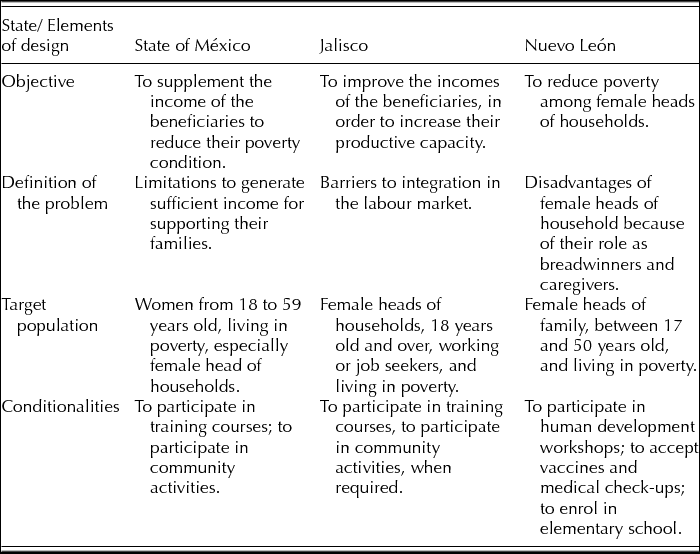
In general, the definition of the problem of these CCTs revolves around the recognition that single mothers face hardships when trying to participate in the labour market, and because of their vulnerability due to their socio-economic condition, that is, living in poverty (see Table 1). The main target population of the CCTs is female heads of households who live in poverty. This means that deserving women on social assistance are essentially lone mothers with a double workload – work in the home and in the marketplace. In Jalisco and Nuevo León, the operation rules of CCTs stipulate that potential beneficiaries must not have a cohabiting partner; this is not the case in the State of México.
Main characteristics of the design of the three CCTs single mothers at state-level in Mexico

In general, CCTs highlight that single mothers bear the entire burden of earning a living and parenting in their families, especially in Jalisco. While CCTs recognise that single mothers enter the workforce with these disadvantages, particularly in Jalisco and Nuevo León, they focus on their socio-economic condition (e.g. being poor), without paying much attention to other structural problems that represent important limitations for single mothers in their social context; for instance, lack of suitable jobs (such as those with flexible conditions, located near to home) and with sufficient pay or access to social security, and being viewed as potentially less employable by prospective employers (who may see single parents as an employment liability), among others. Furthermore, single mothers may also take care of a chronically ill or elderly family members. Nevertheless, the amount the money provided by these programmes, particularly in State of México or Nuevo León, could hardly cover a minimal proportion of the total monthly cost of childcare services.
There is also an implicit individualisation of the limitations that the target population face in their social context. The conditionalities of the three CCTs require beneficiaries to make a contribution (in time and/or labour) to the programme, which consists mainly of tasks that aim to improve the chances of beneficiaries to participate in the market, such as attending training courses or workshops, as well as community activities, or to enrol in basic education. (However, in the rules of all three programmes, it used the term ‘obligations’ of the beneficiaries.) It can be argued that some of these activities may empower lone mothers so they can help themselves to relieve their poverty. However, the imposition of conditionalities may imply that lone mothers intentionally choose not to be better-educated or skilled workers. Lone mothers living in poverty are not a homogenous category in any country (Ypeij and Ypeij, Reference Ypeij and Ypeij2009); depending on their specific social context (rural, urban, inner-city and so on), age or ethnicity, they may face different barriers when attempting to participate in the market, such as lack of time, money or access to the information and facilities necessary to actually get adequate skills or education in the first place. In other words, conditionalities emphasise individuals’ choices and behaviours, without necessarily taking into consideration the structural factors that shape individuals’ choices.
Furthermore, conditionality assumes that single mothers are responsible risk takers, who are entitled to income support conditional on their employability efforts and labour market participation by any means, including self-employment, which may include informal economic activities. The CCT of Nuevo León imposes harder conditionalities, requiring beneficiaries to enrol in basic education and to accept medical check-ups. Moreover, the conditionality of these CCTs reinforces the idea that the poor must avoid any welfare dependency (Medrano, Reference Medrano2013). The strings attached to CCTs for single mothers suggest that the provision of social assistance based on the sole category of being poor or single mother (or both) is unacceptable in Mexico. In fact, the popularity of conditionality at state level is consistent with that federal-level CTT, designed for extremely poor households.
Similarly, there is an implicit or explicit emphasis of economic autonomy and self-sufficiency, which is achieved by participating in the labour market (Bodsworth, Reference Bodsworth2012: 200). Additionally, the normative grounding of the CCTs under study also intersects with certain values and beliefs about motherhood and mothering in Mexico. The idea that mothering is a woman's business and a private issue – that is, individuals, and ultimately families, are in charge of this work with practically no participation by the state in assisting them in this task – is still prevalent in this country (Sánchez Bringas et al., Reference Sánchez Bringas, Espinosa, Ezcurdia and Torres2004). The typical stereotype of a Mexican mother is a loving, selfless and devoted woman (Lagarde, Reference Lagarde1993; Pomar Fernández and Martínez Vázquez, Reference Pomar Fernández and Martínez Vázquez2007; Palomar, Reference Palomar2004), whose caregiving role is also celebrated as being self-sacrificing and martyr-like (Molyneux, Reference Molyneux2006). In other words, good mothers are expected to give everything for the sake of their children and families, that is, to be hard-working mothers at home. In a similar way, the design of the CCTs under study expects female heads of households to be hard workers in the market.
Finally, while programme benefits vary widely from state to state, the payments are quite modest in all cases, particularly in State of México and Nuevo León; Jalisco is the most generous, however. Based on the amount of payments, the CCTs under study are certainly not designed to push single mothers above any poverty line, but are merely meant to supplement other sources of income. Moreover, the design of CCTs may prevent some women from securing assistance, for instance, mothers who do not have a permanent residence or that may need to remain in their homes in order to take care of their children (and an ill or elderly relative). Furthermore, the imposition of conditionalities on women who already struggle to subsist may be a disincentive for potential beneficiaries. In sum, the design of CCTs for single mothers is in line with the values and assumptions related to the notion of market citizenship commonly found in similar welfare-to-work programmes implemented in other countries.
Concluding remarks
This qualitative study identified some of the main values and beliefs in the design of three CCTs for single mothers at the state level in Mexico. The results of this study suggest the design of these programmes is in line with the notion of market citizenship (e.g. economic security is reliant upon an individual's attachment to the labour force, and prescribes the role of working mothers as autonomous, self-sufficient and ‘active’ citizens). In general, the target population of these programmes are female heads of household living in poverty; they are regarded as worthy of government support not only because of their needs, but because they work in the labour market and are willing to improve their employability. Conditionality is fundamental in these CCTs. The strings attached to CCTs for single mothers suggest that the provision of social assistance, based on the sole categories of being poor and a single mother, seems to be unacceptable in Mexico. Conditions are conflictive features, particularly in the case of women living in poverty, who are less able than other groups to assert themselves politically, and therefore they must comply with whatever they are asked to do in order to get a little assistance.
CTTs constitute one of the few if only viable welfare options for women living in poverty. However, the design of the programmes may contribute to perpetuate gender inequalities and cultural bias against people living in poverty. For instance, the design of CCTs is congruent with the idea that child rearing and caring are private matters and the main responsibility of families, and women in particular. Unsurprisingly, the failure of federal and state governments to provide access to good quality public childcare facilities for vulnerable families with children is practically absent from the public debate. Furthermore, it is assumed that the female deserving poor are female heads of households who are clearly hardworking and responsible individuals. Finally, further research is needed to fully assess the design of CCTs and their impact on the wellbeing and empowerment of single mothers in Mexico. As is acknowledged in the policy design literature, social programmes may generate negative effects that may override their intended positive results.