The survival of adult patients with congenital cardiac disease has markedly improved during the last five decades; however, its prevalence is increasing in all developed countries.Reference Borghi, Ciuffreda, Quattrociocchi and Preda1 The prevalence of adult congenital cardiac disease will continue to grow exponentially as more patients survive.Reference Deanfield, Thaulow and Warnes2, Reference Sommerville3 The increasing number of adults with congenital cardiac disease has prompted the development of recommendations for the management of these patients, as well as for the organisation of their health care.Reference de Groot, Natasja and Schalij5 Surgical treatment of adult congenital cardiac disease has been increasing considerably, for example, from about 250,000 to 1,000,000 in the United States of America.Reference Gatzoulis4 The prevalence of adult congenital cardiac disease in Indonesia is approximately 40,000 patients per year. Although the outlook of patients with congenital cardiac disease has changed, most early interventions have not been curative, which is why more than half of adult patients with congenital cardiac disease face the risks of arrhythmias, cardiac failure, further surgery, and even premature death.Reference Gatzoulis4, Reference Reid, Irvine and McCrindle6 In addition, surgical re-interventions are frequently necessary in case of conduit obstruction or residual defects. Furthermore, adequate monitoring of the complexity of the late post-operative sequelae is important.Reference Borghi, Ciuffreda, Quattrociocchi and Preda1, Reference de Groot, Natasja and Schalij5, Reference Kaemmerer, Meijboom, Oechslin and Mulder7 Limited funding, modest medical technologies, and different patient characteristics might change the long-term surgical results of adult congenital cardiac disease in developing countries.
The objective of this study is to achieve risk assessment of surgical continuity care and to elaborate the determinants of late outcome of adult congenital cardiac disease patients in developing countries like Indonesia.
Methods
Patients
We retrospectively reviewed all patients aged 17 years or older who underwent congenital cardiac surgery at the National Cardiovascular Center, Harapan Kita, Indonesia, during the period 1 January 1998 to 31 December 2006. Among them, we identified cardiac rhythm, pre-operative risk factors, co-morbidity, diagnosis leading to surgery, surgical procedures, and post-operative complications. Surgical procedure was categorised into corrective procedures, palliative procedures, and re-operations. Corrective procedure refers to operations carried out to achieve an anatomical or physiological correction with separation of the systemic from the pulmonary circulation. Palliative procedure includes all operations performed to improve the patient's clinical status, without separation between the systemic and pulmonary circulations. Re-operation refers to procedures performed after the initial correction. Secundum atrial septal defect represents the largest group of adult population with congenital cardiac diseases. Morbidity and mortality rates of isolated secundum atrial septal defect were the lowest. A comparison analysis was performed with other congenital cardiac diseases aside from isolated secundum atrial septal defect to evaluate the impact of cardiac surgery on this age group. Hospital ethics committee has approved the study protocol.
Statistical analysis
Statistical analysis was performed using SPSS version 15.0. Continuous data were presented as mean plus or minus standard deviation. Hazard ratio with 95% confidence interval of bivariate and stepwise multivariate Cox regression were used to elaborate correlation between variables. Kaplan–Meier analysis was used to determine the survival rate. Statistical significance was set at a p-value of less than 0.05.
Results
Pre-operative profiles
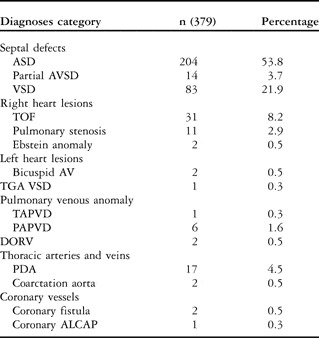
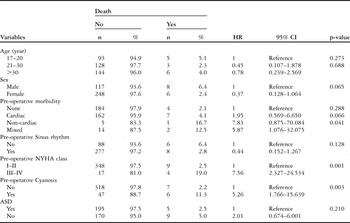
During the study period, we analysed the data of 379 patients. The data comprised 125 (33%) male patients and 254 (67%) female patients. The mean age at surgery was 28 plus or minus 9.46 years. Pre-operative diagnosis was achieved by echocardiography in 376 (99.2%) patients, by cardiac catheterisation in 47 (12.4%) patients, and by magnetic resonance imaging in two (0.5%) patients. Table 1 shows the diagnoses categories. Pre-operative functional evaluation with New York Heart Association class revealed that 357 (94.9%) patients had New York Heart Association class I–II and 21 (5.1%) patients had New York Heart Association class III–IV. The majority of the patients showed sinus rhythm, as revealed by 12-lead electrocardiogram (285 patients or 75.2%). We analysed all the pre-operative characteristics that potentially influenced surgical outcome and presented them in Table 2. Cyanosis, New York Heart Association class III–IV, non-cardiac, and mixed morbidity markedly increased mortality with hazard ratio more than five. Female patients tended to have better prognosis when compared with that of male patients.
Proportion of diseases grouped into several diagnoses category.

ALCAP = Anomaly of left coronary artery from pulmonary artery; ASD = atrial septal defect; AV = atrioventricular; AVSD = atrioventricular septal defect; DORV = double outlet right ventricle; PDA = persistent ductus arteriosus; T/PAPVD = total/partial anomaly of pulmonary vein drainage; TGA = transposition of great artery; TOF = tetralogy of Fallot; VSD = ventricle septal defect
Cox regression analysis of pre-operative variables associated with death.

ASD = atrial septal defect; HR = hazard ratio; NYHA class = New York Heart Association functional classification
Among the non-secundum atrial septal defect patients, analysis showed a mean age of 26 years (standard deviation 8.8), and a majority of them were female (104 patients or 58.1%). Only 20.7% of them showed non-sinus rhythm pre-operatively and about 54% of all non-atrial septal defect patients had either single or multiple co-morbidity.
Operative profiles
Most of the procedures were corrective (338 patients, 89.2%), followed by re-operations (31 patients, 8.2%), and palliative procedures (10 patients, 2.6%). According to Aristotle basic-level complexity, there were 208 patients (54.9%) with basic-level complexity-1, 109 patients (28.8%) with basic-level complexity-2, and 62 patients (16.3%) with basic-level complexity-3. There were 104 (27.4%) additional surgical procedures with 98 (94.2%) for intracardiac anomalies and six (5.8%) for extracardiac anomalies. A pacemaker implantation was necessary in nine (2.3%) patients. Intra-operative ablation was performed concomitantly in two (0.5%) patients with supraventricular tachycardia.
Patients who underwent isolated secundum atrial septal defect closure (156 patients, 41.2%) had less complicated post-operative course, with hospital mortality rate of only 0.6%. If pulmonary hypertension was already present requiring persistent foramen ovale creation procedure, the mortality rate increased to 1.5%. Nevertheless, even after eliminating patients who underwent isolated secundum atrial septal defect closure, the overall mortality rate of the remaining 223 patients was still low (4%).
Post-operative profile
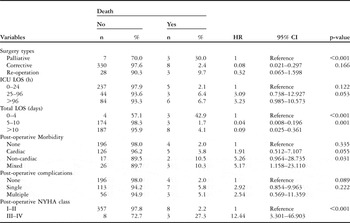
Post-operative morbidity occurred in 179 patients (47.2%), which can be attributed to multiple events in 88 patients (23.3%). Post-operative arrhythmias occurred in 82 (21.7%) patients, which can be attributed to new onset in 52 (13.8%) patients and persistent arrhythmias in 16 (4.2%) patients despite optimal medication. Types of post-operative arrhythmias were atrial fibrillation/flutter in 10 patients (12.2%), right bundle branch block in 48 patients (58.5%), ventricular extra systole in eight patients (9.8%), supraventricular tachycardia in four patients (1.1%), atrioventricular block in eight patients (9.8%), and other types of arrhythmias in six patients (7.3%). We analysed all the post-operative characteristics that potentially influenced surgical outcome and presented them in Table 3.
Cox regression analysis of post-operative variables.

HR = hazard ratio; ICU = intensive care unit; LOS = length of stay; NYHA class = New York Heart Association functional classification
There were 10 cases of in-hospital deaths (2.6%), which were attributable to perioperative bleeding in two patients (22%), sepsis in two patients (22%), low cardiac output syndrome in two patients (22%), arrhythmias in two patients (22%), pulmonary hypertension crisis in one patient (11%), and neurologic deficit in one patient (11%).
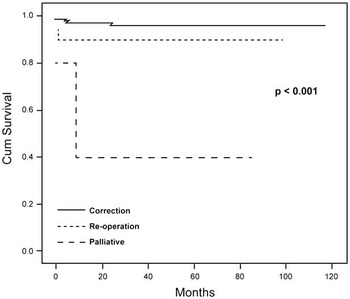
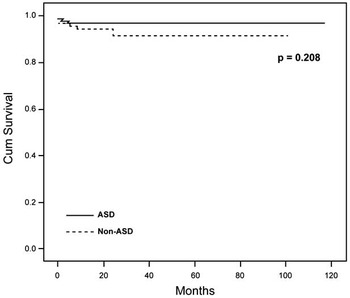
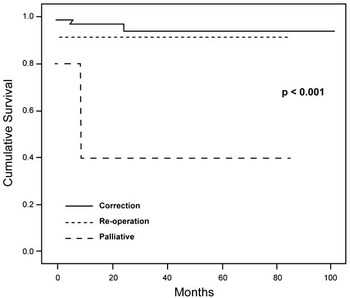
Among all discharged patients, follow-up data were available for 292 patients (77.2%). Late deaths occurred in four patients (1.1%); in three of them, the cause of death was cardiac related, whereas in the fourth patient it was a non-cardiac-related death. The mean follow-up time was 14.3 plus or minus 22.7 months. Kaplan–Meier curve demonstrated that an overall survival rate was 94.3% at 60 months. The survival probability at 60 months based on surgical categories was higher for the corrective procedure (97.6%) compared with that of re-operative (90.3%) or palliative (70%; Fig 1). Survival probability at 60 months after secundum atrial septal defect closure was 97.5% as compared to that of 94.9% for other procedures (Fig 2). Figure 3 shows cumulative survival of patients with non-atrial septal defect (179 patients) categorised on the basis of operation types, which again demonstrates better results for correction surgery when compared with palliative and re-operation.
Overall cumulative survival

Cumulative survival of atrial septal defect (ASD) and non-ASD surgery

Cumulative survival of non-atrial septal defect (ASD) surgery

Re-operation was necessary in 31 of 379 patients (8.2%), with a mean follow-up time of 19.6 plus or minus 10.5 months after surgery. Percentage of patients free of re-operation was 85.4%, 42.7%, and 3% at 5, 10, and 15 years, respectively.
Independent risk factors
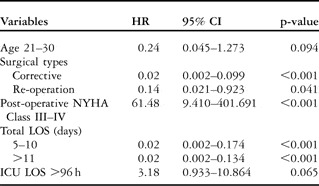
Stepwise multivariate analysis demonstrated that post-operative New York Heart Association class III–IV is the major predictor of mortality during the 60-month follow-up (hazard ratio of 61.48 95% confidence interval 9.410–401.691). Longer Intensive Care Unit stay of more than 96 hours tends to increase mortality (hazard ratio 3.18 95% confidence interval 0.933–10.864), but is not statistically significant (p-value of 0.065; Table 4).
Multivariate Analysis. Post-operative NYHA class of III–IV is the only independent predictor of mortality.

ICU = intensive care unit; LOS = length of stay; NYHA class = New York Heart Association functional classification
Discussion
Main finding
Most of the surgical procedures for adult congenital cardiac disease were corrective (89.2%), followed by re-operations (8.2%), and palliative procedures (2.6%). On the basis of Aristotle basic complexity level, the majority of cases (54.9%) were on level 1. Post-operative New York Heart Association class III–IV was the only independent risk factor causing a 61-fold risk for death in adult congenital cardiac surgery. Survival probability at 60 months after secundum atrial septal defect closure was 97.5% and 94.9% for other procedures.
Surgery of adult congenital cardiac disease
Surgical treatment for congenital cardiac disease in adults is mostly indicated to prolong the patient's life expectancy and to improve the quality of life. Patients with congenital cardiac disease who reach adult age usually remain in good or mildly decreased functional status for several years. They were referred eventually due to increasing symptoms that could not be controlled by medical therapy.Reference Sommerville3, Reference Kaemmerer, Meijboom, Oechslin and Mulder7 There was a selected group of patients who survived into adult age without irreversible damage to their heart and lungs.
According to Aristotle complexity score,Reference Jacobs, Lacour-Gayet and Jacobs8, Reference Somerville9 the majority of the patients (54.9%) had basic-level complexity-1, followed by basic-level complexity-2 (28.8%), and basic-level complexity-3 (16.3%). This classification should be adjusted for adult congenital cardiac disease. Patent ductus arteriosus ligation was classified at level 1, however, it should be classified at a higher level,Reference Ashburn, Williams and Van arsdell10 since surgical procedure in adult congenital cardiac disease tends to be more complex. Surgical performance of adult congenital cardiac disease in our centre had a mortality rate of 0.96% for basic-level complexity-1, 2.8% for basic-level complexity-2, and 8.1% for basic-level complexity-3. These results were comparable to previous study.Reference Srinathan, Bonser, Sethia, Thorne, Brawn and Barron11
Our study demonstrated that corrective surgery in atrial septal defect patient was performed at a median age of 29 with an interquartile range of 11 ranging from 16 to 65 years, which was older compared with the previous study.Reference Ashburn, Williams and Van arsdell10 Mayo Clinic showed that the 25-year result of mortality ratio against the reference population was 178% for 32 atrial septal defect closures in the age group of 25–41 years old patients, whereas the mortality ratio for those who did not have the atrial septal defect repaired, for one reason or another, was considerably worse.Reference Ashburn, Williams and Van arsdell10 However, our survival analysis showed that older patients in this study had a similar survival rate of 97.5% with 20 millimetres – interquartile range 22 – atrial septal defect diameter and higher score of New York Heart Association functional class. The proportion of premature late death in non-surgical patients with cardiac failure increased from 5% to 15% after the third decade and 25% after the fifth decade.Reference Ashburn, Williams and Van arsdell10 Surgical outcome for these patients is satisfactory according to this study and other studies.Reference Kouchoukos, Blackstone, Doty, Hanley and Karp12, Reference Vida, Berggren and Brawn13 However, in 11.9% of the patients, atrial septal defect closure showed evidence of increased pulmonary resistance, and hospital mortality rate markedly increased by three times, although persistent foramen ovale creation was performed.
Decreased functional status – New York Heart Association class III–IV – and prolonged cyanosis with co-morbidity proved to be significant risk factors for an operative mortality. Perioperative morbidities play an important role in the success of the adult congenital cardiac disease operation (p < 0.001).Reference Borghi, Ciuffreda, Quattrociocchi and Preda1, Reference Vida, Berggren and Brawn13, Reference Rossano, Smith and Fraser14 However, this study found that post-operative New York Heart Association functional class was the only independent risk factor of death (hazard ratio 61.48, 95% confidence interval 9.41– 401.69, p < 0.001).
Palliative procedures to decrease cyanosis were offered to adult patients with complex congenital cardiac disease in order to improve clinical condition temporarily. The hospital mortality rate and death on follow-up in this study were quite high – hospital mortality rate was 20% with 5 years survival probability 70% – when compared with other studies.Reference Vida, Berggren and Brawn13 The purpose of palliative procedure in adult tetralogy of Fallot patients with ventricular failure was to at least temporarily improve clinical condition. Despite the fact that operations achieved a decrease in cyanosis, hospital mortality was as high as 16.5%, and we have no long-term functional results of these patients.
Re-operation due to late complications or residual defects, after previous corrective procedures carried a low hospital mortality (9.7%). These include conduit replacement (one patient, 2.6%), aortic valve replacement (two patients, 5.3%), and vegetation endocarditis (one patient, 2.6%). Rate of re-operation was low in Indonesia (8.2%) compared with that in Europe (23.1%),Reference Vida, Berggren and Brawn13, Reference Williams, Ashburn and Downar15 perhaps due to low socio-economic condition.
The overall survival probability at 60 months is 94.3%, which is comparable with that of multi-center European studies (97%).Reference Vida, Berggren and Brawn13 Possible explanation of lower survival in our study population is relatively older patient's age. Interestingly, corrective procedures with longer hospital stay in adult congenital cardiac surgery decrease the mortality rate. We assumed that patients with a longer hospital stay had better control from infection compared with those discharged earlier. In developing countries, in a lot of patients the lack of knowledge of hygiene and poor sanitation led to infection. This is especially true for patients referred from remote peripheral areas.
Clinical-related problems
Arrhythmias are the most common problem and atrial flutter is the most frequent disorder of rhythm, usually related to haemodynamic disturbances.Reference Sommerville3 Common arrhythmias that appeared after operation at our centre were supraventricular, right bundle branch block, and ventricular arrhythmias. The limited availability of the antiarrhythmia drug in our country is an unnecessary challenge that doctors have to overcome. Adenosine and verapamil are treatments of choice to convert the atrioventricular nodal reentrant tachycardia. In two patients (0.5%) with atrioventricular reciprocating tachycardia, accessory pathway ablation was performed concomitantly during surgery. Amiodarone has been our first choice to treat ventricular arrhythmias. Total atrioventricular block, which needs pacemaker implantation, was necessary in nine patients (2.3%). The introduction of three-dimensional mapping techniques for the guidance of endocardial catheter ablation procedures offered a new potentially curative treatment modality for late post-operative atrial tachyarrhythmias in patients with complex arrhythmogenic substrates.Reference de Groot, Natasja and Schalij5
Limitation
A large proportion of the patients referred from primary and secondary care centres were lost to follow-up (22.8%). Those patients who were followed up by the referring physician at a remote peripheral area had limited communication facility. The educational programme to build a good collaboration and active communication needs to be developed by the National Cardiovascular Center.
Conclusion
In developing countries, surgical treatment of adult congenital cardiac disease is effective and safe, with an overall survival rate of 94.3% at 60 months. However, due to high mortality rate (20%) palliative surgery of non-atrial septal defect patient is recommended to be discontinued. The only independent predictor of mortality was the post-operative New York Heart Association functional class III–IV.
Acknowledgements
The authors thank Roger Mee, MD, for his brief review on this paper and Ms Sarah Salmon for supporting data analysis.