Cambodia has a violent past. Even though the primary historical and judicial focus on its past covers the period between 1975 and 1979, during which forces of the Communist Party of Kampuchea, also known as the Khmer Rouge, launched a radical revolution in order to establish a socialist and socially homogeneous state, the country also experienced an extensive period of armed conflict from 1970 until 1997.Footnote 1 Except for the rather selective prosecution of mass crimes during the Khmer Rouge period by the ad hoc Extraordinary Chambers in the Courts of Cambodia (ECCC),Footnote 2 other massive human rights violations and serious violations of international humanitarian law remain unpunished. There are several reasons for this, both political and legal. The absence of the criminalization of international crimes in domestic criminal law, such as genocide, crimes against humanity, and war crimes (hereinafter referred to as international crimes) at the time of the commission of the crimes is yet another legal impediment in that regard. The Cambodian Criminal Code (CCC)Footnote 3 provides for the principle of nullum crimen sine lege or principle of legality.Footnote 4 The ad hoc established ECCC, which addresses more than thirty-year-old crimes, solved the ex post facto legal problem by relying either on domestic statutes or customary norms establishing individual responsibility for certain international crimes.Footnote 5
Since the adoption of the Statute of the International Criminal Court (ICC Statute or Rome Statute),Footnote 6 more and more countries are ensuring that their domestic legal systems adequately criminalize the statutory crimes within the ICC jurisdiction.Footnote 7 This shift towards accountability within many governments derives from an understanding that impunity for mass atrocities—as experienced in the twentieth century—can no longer be tolerated. There is, however, also a legal reason. The ICC is based on the principle of complementarity, and accords the national judiciary primacy for the prosecution of crimes in its jurisdiction. Only in cases where a state is either unwilling or unable does the ICC exercise its jurisdiction to prosecute individuals. There is a growing consensus that Member States should adopt the ICC crimes as domestic law, as the absence of legislation may result in impunity and lead to the state being deemed unable to prosecute under the ICC Statute.
Cambodia has followed this trend and, following its ratification of the ICC Statute on 11 April 2002,Footnote 8 enacted implementing legislation into its criminal code in 2009. This is a welcome development and may ensure that Cambodia retains its criminal jurisdiction over international crimes. However, a closer look at the enacted international crimes provisions in the CCC calls for caution and concern. The present paper will look specifically at the implementing legislation and will discuss it with regard to the question of complementarity. The complementarity principles will be briefly set out in Part I, followed by a detailed analysis of the provisions and definitions of international crimes in the CCC in Part II, and questions relating to modes of attribution, immunities, and bars to prosecutions in Parts III and IV. The core question of whether these criminal provisions comply with the ICC definitions and whether they sufficiently adhere to the complementarity requirements of the ICC Statute will be discussed in Part V.
I. The principle of complementarity in the ICC Statute
The ICC Statute is based on the principle of complementarity, not the primacy of the ICC's jurisdiction. This principle is emphasized in the Preamble and Article 1 of the ICC Statute by stating unequivocally that the Statute shall be “complementary to national criminal jurisdiction”.Footnote 9 The rationale behind the principle is to maintain state sovereignty while ensuring the prosecution of international crimes by obliging Member States to exercise their criminal jurisdiction over genocide, crimes against humanity, and war crimes.Footnote 10 Given the principle of complementarity, domestic courts have primacy over the ICC.Footnote 11 Article 17(1) of the ICC Statute defines situations in which the ICC cannot exercise jurisdiction: (1) the case is being investigated and prosecuted by a state which has jurisdiction over it; (2) the case has been investigated by a state which has jurisdiction over it and the state has decided not to prosecute the person concerned; (3) the person concerned has already been tried for conduct which is the subject of the complaint; and (4) the case is not of sufficient gravity to justify further action by the Court.Footnote 12 Article 17(1) of the ICC Statute therefore clarifies that a case before the ICC is only admissible if a Member State is unable or unwilling to investigate or prosecute a case.Footnote 13
The inability criteria in Article 17(3) of the ICC Statute requires the Court to consider whether, “due to a substantial collapse or unavailability of its national judicial system, the State is unable to obtain the accused or the necessary evidence and testimony or otherwise unable to carry out its proceedings”.Footnote 14 There is an overwhelming consensus that the wording of “otherwise unable to carry out its proceedings” covers the absence or inadequacy of substantive legislation, and that in such circumstances a case would be admissible before the ICC.Footnote 15 Therefore the burden is on Member States to criminalize or harmonize international crimes in their domestic legislation in order to ensure jurisdictional primacy over such crimes.Footnote 16 If the domestic legislative framework does not ensure genuine prosecution of crimes, the ICC will, pursuant to Article 17(3) of the ICC Statute, have to determine that the domestic judicial system is unavailable.Footnote 17
II. The incorporation of international crimes into the Cambodian Criminal Code
Given the above understanding, many ICC Member States have incorporated international crimes legislation into their domestic criminal framework.Footnote 18 The Kingdom of Cambodia incorporated genocide, crimes against humanity, and war crimes into its Criminal Code with its adoption on 30 November 2009. The 2008 Code of Criminal Procedure of the Kingdom of Cambodia (CCP) does not provide for specific procedures regarding such international crimes, except for specific regulations concerning provisional detentionFootnote 19 and the exclusion of any statute of limitations.Footnote 20 This section will evaluate whether the CCC provisions incorporate such crimes adequately and whether it has ensured its primacy over international crimes. The Cambodian legislature opted to incorporate the ICC Statute into the newly adopted Cambodian Criminal Code and not into a separate code. With respect to jurisdictional questions over international crimes, Cambodian courts are competent if such crimes are committed on the territory of the Kingdom of Cambodia.Footnote 21 The CCC does not provide for universal jurisdiction over international crimes, requiring a link to Cambodian territory,Footnote 22 a Cambodian perpetrator,Footnote 23 or a Cambodian victim.Footnote 24
With three exceptions, the definition of genocide in Article 6 of the ICC Statute and the definition of crimes against humanity in Article 7 of the ICC Statute were incorporated ipsissima verba into the CCC. This was, however, not done with respect to the war crimes enumerated in Article 8 of the ICC Statute. The differences in the genocide and crimes against humanity definitions will be briefly highlighted, before a more detailed analysis of the problematic incorporation of war crimes, particularly with respect to questions of complementarity.
A. Genocide
Cambodia acceded to the Genocide Convention on 14 October 1959; the crime of genocide is now defined in Article 183 of the CCC.Footnote 25 The definition of genocide largely resembles that of the Genocide Convention and Article 6 of the ICC Statute. Nonetheless, there are minor deviations worth discussing. With respect to the genocide definition, the Cambodian provision regarding the imposition of measures preventing births as an act of genocide differs from Article 6(d) of the ICC Statute. The ICC Statute provides that “imposing measures intended to prevent births within the group”, if committed with intent to destroy, in whole or in part, a national, ethnic, racial, or religious group, as such, constitutes genocide. The definition under Article 183(4) of the CCC differs, as it requires “imposing forceful measures or voluntary means intended to prevent births within the group”.Footnote 26 The addition of “forceful” measures appears redundant, as the term “imposing” already implies such coercive measures. Therefore, this addition does not appear to alter the definition of the underlying act in any significant way. However, the addition of the words “voluntary means” appears to widen the underlying act of genocide beyond its original construction. Apart from the fact that imposing voluntary means is an oxymoron, it is difficult to devise a scenario were voluntary means are imposed to prevent births.Footnote 27 Rather, any measures imposed must be conducted with coercive measures.Footnote 28 If, for example, a government proposes a programme of family planning within a certain ethnic community with genocidal intent, and hopes for the voluntary co-operation of the community members, the requirements of this crime will hardly be met if the persons are informed and understand the consequences of the family planning programme. In conclusion, it appears that the modification of this provision will not have any effect on any complementarity assessment, as the definition of genocide in Article 183(4) of the CCC is broader than that in Article 6(4) of the ICC Statute.
B. Crimes Against Humanity
Different language is also found in two crimes against humanity provisions articulated in Article 188 of the CCC.Footnote 29 The definition of persecution in Article 7 of the ICC Statute provides that “other grounds that are universally recognized as impermissible under international law, in connection with any act referred to in this paragraph or any crime within the jurisdiction of the Court” could be considered persecutory. Compared with other definitions, this residual clause widens the definition of persecution if the acts are committed with a political, racial, national, ethnic, cultural, religious, or gender intent.Footnote 30 This basket clause is not found in Article 188(8) of the CCC. Persecution is therefore more narrowly defined when compared to the ICC definition. Second, the ICC Statute in Article 7(k) has another basket clause covering any other “inhumane acts of a similar character intentionally causing great suffering, or serious injury to body or to mental or physical health”. The comparable CCC provision in Article 188(11), however, refers only to bodily harm. Serious injury to mental health is not specifically included. It could be argued that mental suffering is equally criminalized through the wording of “causing great suffering”. On the other hand, however, it can reasonably be argued that the legislator intentionally departed from the ICC definition and excluded the requirement of mental suffering from the Cambodian definition and that therefore such harm is not covered. Only judicial application and interpretation will eventually clarify this dispute. Moreover, the definitions of extermination, persecution, and apartheid, as referred to in Article 7(1) of the ICC Statute, which are defined in Article 7(2)(b), (g), and (h), respectively, are not included in the CCC. This is regrettable, as the definitions would have assisted national judges and provided additional clarity. Nevertheless, and apart from these minor differences, the CCC largely complies with the definition of crimes against humanity in the ICC Statute.
C. War Crimes
War crimes are provided for in Article 8 of the ICC Statute, which contains a total of seventy-two specific war crimes provisions. Article 8 of the ICC Statute is further divided into war crimes applicable in international armed conflict in Article 8(2)(a) and (b) of the ICC Statute and non-international armed conflict in Article 8(2)(d) and (e) of the ICC Statute. Article 8(2)(a) of the ICC Statute covers the so-called grave breaches provisions of the four 1949 Geneva Conventions. Article 8(2)(b) of the ICC Statute covers other serious violations of international humanitarian law applicable in international armed conflict deriving from the Geneva Conventions, Additional Protocol I, the Hague Conventions and other international treaties.Footnote 31 Article 8(2)(d) of the ICC Statute covers the so-called Common Article 3 violations of the 1949 Geneva Conventions. Article 8(2)(e) of the ICC Statute provides for other serious violations of international humanitarian law applicable in non-international armed conflict.
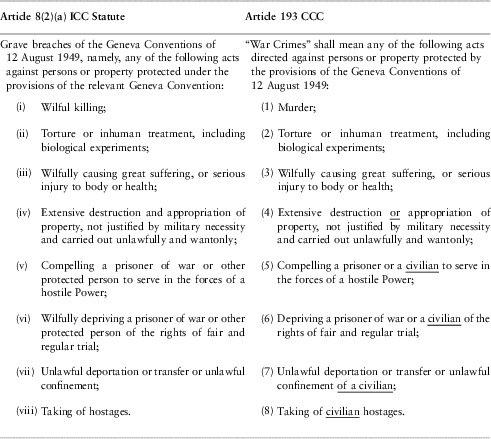
The CCC defines war crimes in Articles 193 and 194. Article 193 of the CCC largely resembles the grave breaches provision of Article 8(2)(a) of the ICC Statute.Footnote 32 It does not, however, expressly refer to the grave breaches provisions or the Geneva Conventions. Furthermore, it does not require a distinction between crimes committed in international and non-international armed conflict. Thus, such crimes are enforceable in a non-international armed conflict. Moreover, the underlying crimes, despite their similarity, are not a verbatim replication of its counterpart in Article 8(2)(a) of the ICC Statute. Table 1, mirroring the provisions, identifies the most significant differences between Article 8(2)(a) of the ICC Statute and Article 193 of the CCC. Significant modifications in the Cambodian provision are underlined.
It can be seen below that the term “protected person” in Article 8(2)(a) of the ICC Statute was altered to “civilian” in Article 193 of the CCC. It is not entirely clear why the Cambodian legislature modified this definition, as legislative motives are not made public in Cambodia. This modification could, however, be explained by the removal of the reference to the grave breaches regime and the fact that Article 193 of the CCC does not distinguish between the nature of the armed conflict, i.e. whether international or non-international. “Protected person” and “civilian” are terms of art, and specify which individuals are protected under international humanitarian law. The term “protected person” under the Geneva Conventions includes four categories of persons, namely the sick and wounded, medical personnel, prisoners of war, and civilians. This distinction is highlighted by Article 4(1) of Geneva Convention IV, defining protected persons as “those who, at a given moment and in any manner whatsoever, find themselves, in case of a conflict or occupation, in the hands of a Party to the Conflict or Occupying Power of which they are not nationals”. The term “civilian” is most clearly defined in Article 50 of Additional Protocol I to the Geneva Conventions, which states:
A civilian is any person who does not belong to one of the categories of persons referred to in Article 4 A (1), (2), (3) and (6) of the Third Convention and in Article 43 of this Protocol. In case of doubt whether a person is a civilian, that person shall be considered to be a civilian.Footnote 33
Article 4(A)(1), (2), (3), and (6) of Geneva Convention III refer to members, militias, or volunteers corps belonging to or forming part of the armed forces, members of other militias, and members of other volunteer corps belonging to a party to the conflict and operating in or outside their own territory, provided that such militias or volunteer corps fulfil the four conditions of combatancy. International humanitarian law applicable in non-international armed conflict does not explicitly distinguish between combatants and civilians, but rather distinguishes between persons taking or not taking active part in hostilities when considering who is afforded protection. By referring only to civilians, Article 193 excludes other persons that would usually find protection under international humanitarian law and the ICC Statute.
It may be argued that this interpretation does in fact comply with the grave breaches provisions of the Geneva Conventions, as Article 193(5) and (6) corresponds with the protection provided to persons in Article 129 of Geneva Convention III (relative to the treatment of prisoners of war) and Article 147 of Geneva Convention IV (relative to the protections of civilian persons in time of war), respectively. However, as the CCC does not take into account the nature of the armed conflict, other protected persons may be excluded. In addition, the ICC Statute appears to widen the definition of those two articles in Geneva Conventions III and IV. Thus, with respect to the distinction between “protected person” and “civilian”, the definition in Article 193(5), (6), and (7) of the CCC are narrower than the equivalent provision in the ICC Statute, as the reference to civilians, rather than protected persons, would exclude the protection of medical or religious personnel belonging to armed forces.Footnote 34 It cannot be argued that they would find protection as prisoners of war, as military medical personnel and military religious personnel may not be taken as prisoners of war.Footnote 35 The inclusion of the word “civilian” instead of “prisoner of war” in Article 193 of the CCC, therefore, narrows the definition of the crime when compared to Article 8(2)(a) of the ICC Statute. In addition, the taking of hostages under Article 193(8) of the CCC applies only to civilians. This does not, however, comply with the corresponding Article 8(2)(a)(viii) of the ICC Statute, as under Cambodian law protected persons other than civilians are excluded as subjects of the offence.
It could be argued that the Preamble of Article 193 refers to protected persons and that therefore the enumerated underlying acts could be widened and constructed more broadly. However, it could equally be argued that through the deliberate choice of changing the wording, the Cambodian legislator intended a narrower construction of this rule.Footnote 36 In this regard, national courts may be guided by the jurisprudential legacy of the ECCC, which addressed the crime of unlawful confinement in one of its decisions. As in the CCC, the ECCC Law restricted the crime to civilian subjects,Footnote 37 as provided for in Article 147 of the Fourth Geneva Convention. The ECCC, however, did not restrict this crime to civilians as provided for in Article 6 of the ECCC Law, but extended it to prisoners of war and other persons.Footnote 38 In any event, a narrow application of Article 193(5) to (8) of the CCC may collide with the principle of complementarity, as will be discussed in greater detail below.
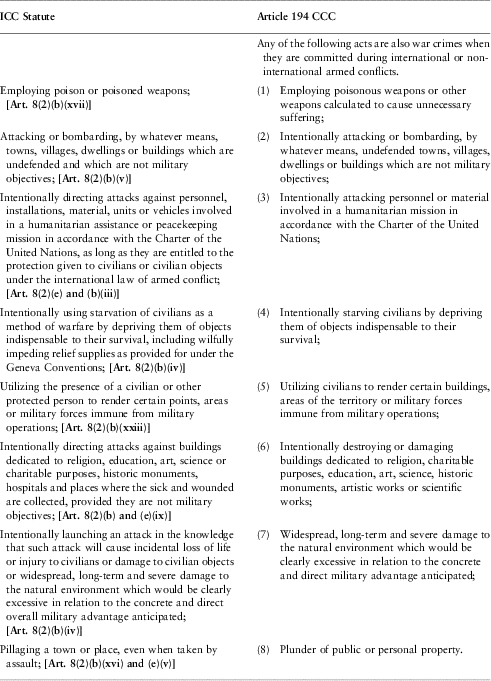
Article 194 of the CCC provides for additional serious violations of international humanitarian law.Footnote 39 A first perusal of Article 194 of the CCC highlights that many important war crimes have, however, not been criminalized. As mentioned previously, Article 8 of the ICC Statute includes sixty-four war crime provisions in addition to the eight specific grave breaches provisions discussed above. Admittedly, as the Rome Statute of the ICC distinguishes between war crimes in international and non-international armed conflict, many crimes are similarly defined. What is nevertheless evident is that Article 194 of the CCC does not criminalize many offences deriving from the Hague or Geneva law. Unfortunately, the legislative motivations for this omission are not publicly available. Table 2 reproduces the war crimes enumerated in the CCC and their corresponding provision under the ICC Statute. However, and unlike the comparison above, Article 194 does not use similar language to the ICC provisions. Therefore, only the corresponding ICC provisions are reproduced in Table 2.

Once again the provisions in Article 194 of the CCC controversially and dangerously employ language different to the ICC offences. For example, Article 194(3) diverges drastically from its corresponding ICC provision. The ICC Statute criminalizes attacks against humanitarian assistance or peacekeeping missions in accordance with the Charter of the United Nations, “as long as they are entitled to the protection given to civilians or civilian objects under the international law of armed conflict”. Article 194(3) does not require that the humanitarian or peacekeeping mission be entitled to the protection given to civilians or civilian objects, but appears to suggest that any attacks, even without such an entitlement to protection, would be criminal. Here, the Cambodian provision goes beyond what is demanded by the ICC Statute and customary international law,Footnote 40 as an attack against peacekeepers who actively participate in hostilities against a warring faction cannot constitute a war crime.Footnote 41 Article 194(5) refers to “civilians” being used as human shields, but does not criminalize such perfidious conduct with respect to other protected persons.Footnote 42 As mentioned above, in that respect the CCC provision lags behind the ICC Statute definition, as the use of subjects other than civilians would appear to be permissible under Article 194(5). Article 194(6) of the CCC does not demand that the protected areas are not being used for military purposes and thereby is more broadly construed than its counterparts in Articles 8(2)(b) and (e)(ix) of the ICC Statute, thereby limiting criminal responsibility for certain conduct.Footnote 43 Furthermore, it is questionable whether Article 194(6) complies with international humanitarian law, as the enumerated objects may lose their protection.Footnote 44
Apart from these differences, it is even more disconcerting that the CCC does not criminalize many of the other serious violations of international humanitarian law provided for in the ICC Statute. For example, the CCC does not criminalize: intentional attacks against the civilian populationFootnote 45 or civilian objects;Footnote 46 making improper use of the flag of truce or other specific insignias or emblems;Footnote 47 declaration that no quarter will be given;Footnote 48 abolishing the rights and actions of the nationals of a hostile party;Footnote 49 use of prohibited weapons;Footnote 50 attacks against persons and objects using distinctive emblems of the Geneva Conventions in conformity with international law;Footnote 51 or the conscription, enlistment, and use of children under the age of fifteen in hostilities.Footnote 52 This last omission is regrettable, as the Cambodian Constitution provides for the special protection of children during wartime.Footnote 53 Moreover, the CCC does not expressly provide for the criminalization of sexual crimes as provided for in the ICC Statute.Footnote 54 Even though it could be argued that such conduct could fall under Article 193(2) or (3) of the CCC, i.e. torture or inhumane treatment or inflicting great suffering,Footnote 55 the absence of an express codification creates difficulties with the principle of complementarity.
As discussed, some of the wording and definitions in Article 194 have been modified to such an extent that the Cambodian offences must be more narrowly construed than their ICC counterparts. Moreover, Cambodian law does not criminalize most of the war crimes found in Article 8 of the ICC Statute. This raises concerns about the ability of the Cambodian judiciary to prosecute and punish certain war crimes and may thereby render it “unable … to carry out its proceedings” under Article 17(3) of the ICC Statute. Even though a judge may, in limited circumstances, have the discretion to interpret the provisions in compliance with the ICC Statute and/or international humanitarian law according to Article 8 of the CCC and Article 31 of the Cambodian Constitution, there is a limit to such discretion imposed by Article 3 of the CCC and the principle nullum crimen sine lege. The implications of the flawed incorporation of the ICC Statute will be considered in Part V below.
III. Modes of attribution and defences
With respect to the modes of liability for international crimes, the general provisions in Book 1, Title 2, Chapter 1 of the CCC apply. The modes of attribution are defined in Articles 24 to 29 of the CCC and cover commission (Article 25), co-perpetration (Article 26), instigation (Article 28), and accomplice liability, i.e. aiding and abetting (Article 30). Attempted acts are also criminalized in Article 27 of the CCC. The planning of genocide is criminalized in Article 185 of the CCC. It provides that the participation in a group or in a conspiracy to plan genocide is punishable by imprisonment for twenty to thirty years.Footnote 56 As in the ICC Statute, this provision does not require the actual commission of genocide, and is therefore an inchoate mode of responsibility. This is also reflected in the sentencing range of twenty to thirty years of imprisonment, as compared to life imprisonment when the crime is successfully committed. The definition of instigation in Article 28 of the CCC expressly provides that an instigator may be punished only if the crime was committed or attempted. Thus, mere incitement to commit genocide cannot lead to liability under the CCC; a specific act or attempt is required. These modes of liability are largely similar to those in the ICC Statute. It is also notable that the CCC does not specifically criminalize any public incitement to commit genocide. However, such a mode of attribution is covered by Articles 494 and 496 of the CCC, criminalizing incitement for felonies and/or discrimination against members of a group of a particular ethnicity, nationality, race, or religion. Incitement here is defined as: (1) any speech made in public or meeting; (2) writings or pictures displayed or distributed publicly; and (3) any audiovisual communication to the public.Footnote 57 In addition to felonies, discriminatory incitements against persons identifiable by ethnicity, nationality, race, or religion are prohibited.Footnote 58 Incitement is an inchoate crime under the CCC, as it expressly states in Article 496 that the incitement has to be ineffective.Footnote 59
Article 499 of the CCC also holds liable those who participate in criminal associations. However, such liability is only targeted at ordinary crimes: genocide, crimes against humanity, and war crimes are not covered by this provision in the CCC.Footnote 60 Moreover, the CCC does not codify any attribution of responsibility for military or civilian superiors. In the framework of the ICC, this mode of attribution criminalizes omissions of a superior for failing to prevent or punish any acts of genocide, crimes against humanity, and war crimes.Footnote 61 Thus, according to Cambodian law, a superior cannot be held responsible under the mode of superior responsibility if he fails to prevent or punish crimes, despite his knowledge that such acts will be or have been committed. This omission could have significant implications for any prosecution of international crimes in Cambodia; superior responsibility is generally considered to be an important tool in adequately prosecuting mass atrocities, as such crimes are often committed with the assistance of hierarchical organizational structures.Footnote 62
With respect to defences, the CCC includes the well-accepted defences of mental disorder (Article 31), self-defence (Article 33), and necessity (Article 35). The conditions under which such defences apply are similar to those in Article 31 of the ICC Statute. In some instances, Cambodian law is stricter than the ICC Statute, as intoxication cannot be claimed as a defence.Footnote 63 Article 32 of the CCC provides for the defence of superior orders or acts committed pursuant to a lawful authority or order. This provision can, however, only be applied to ordinary crimes, as the last paragraph of Article 32 of the CCC expressly provides that there is no such defence of superior orders or “orders of a lawful authority” for acts of genocide, crimes against humanity, and war crimes.Footnote 64
IV. Immunities and other bars to prosecution
Cambodia is a monarchy, and the reigning king enjoys privileges and immunities under the Constitution. According to Article 7 of the Constitution of the Kingdom of Cambodia “[t]he King shall be inviolable”. In addition, the Constitution provides parliamentary immunity to members of the National Assembly (Article 80)Footnote 65 and members of the Senate (Article 104new).Footnote 66 Government members, however, do not enjoy any de jure immunity. In exercising its own jurisdiction, the ICC, pursuant to Article 27 of the ICC Statute, would simply ignore any official capacity as far as it concerns the responsibility for crimes under its mandate. However, the absence of a provision that ensures that such immunities do not apply for international crimes may hinder national prosecutions and co-operation with the ICC. As a result, the CCC may fall short of the complementarity principle.
The ICC Statute does not expressly exclude amnesties for genocide, crimes against humanity, and war crimes. However, there is consensus that such bars to prosecution are contrary to customary international law and undermine the spirit of the ICC Statute.Footnote 67 The CCC provides for the possibility of amnesties in Article 90new(2)(4) of the Cambodian Constitution and Article 149 of the CCC,Footnote 68 and for pardons pursuant to Article 27 of the Cambodian Constitution and Article 147 of the CCC.Footnote 69 Pardons only apply to enforceable sentences following a final judicial decision.Footnote 70 Given the wording of Article 149 of the CCC, this could also be said of amnesties. However, the wording in Article 149 of the CCC contradicts Article 90 of the Cambodian Constitution, which provides that any amnesty awarded by the National Assembly discontinues any prosecution, thereby effectively creating immunity from prosecution.Footnote 71 In any event, Articles 148 and 151 of the CCC provide that, unless otherwise provided by law or a Royal Decree, an amnesty or pardon shall not be an impediment to a victim's right to obtain reparations for the harm suffered.
Amnesties and pardons for mass atrocities are not a concept foreign to Cambodian politics. In 1996, King Sihanouk issued a Royal Decree granting Ieng Sary a pardon with respect to his conviction before the 1979 People's Revolutionary Tribunal and an amnesty under the 1994 Law on the Outlawing of the Democratic Kampuchea Group. Following the decree, Ieng Sary and approximately one thousand remnants of the Khmer Rouge defected and allegedly brought to an end the long-running Cambodian conflict. The ECCC, which charged Ieng Sary as one of the most responsible persons for the crimes committed under the Khmer Rouge regime in the 1970s, dismissed a claim that, pursuant to this Royal Decree and the 1994 Law on the Outlawing of the Democratic Kampuchea Group, he could not be prosecuted before the ad hoc court. It held that the scope of the Royal Decree and the amnesty law excluded crimes of genocide, crimes against humanity, torture, and the grave breaches of the 1949 Geneva Conventions.Footnote 72 It argued that “[w]hile the 1996 amnesty may have been a useful negotiation tool in ending the conflict, the Chamber nonetheless notes that it was unaccompanied by any truth or reconciliation process through which information regarding Accused Ieng Sary's alleged crimes could be revealed or the internationally-enshrined rights of victims to an effective remedy otherwise acknowledged.”Footnote 73 The ECCC is a Cambodian Court and its precedents are, or at least should be, of guidance in Cambodia.Footnote 74 In any event, the decision appears to be in accordance with the general approach of international criminal tribunalsFootnote 75 and human right courtsFootnote 76 that amnesties are null and void for international crimes. Regarding the ICC, it can be argued that Article 21(1)(b) and (3) of the ICC Statute, which states that “[t]he Court shall apply … where appropriate, applicable treaties and the principles and rules of international law” and that “[t]he application and interpretation of law pursuant to this article must be consistent with internationally recognized human rights”, prevent the ICC from recognizing any amnesty laws for crimes under its jurisdiction, as such a practice would be irreconcilable with human rights norms and the rights of victims to an effective remedy for human rights violations.Footnote 77 As a result, failure to exclude amnesties and pardons for international crimes could, if granted, undermine the complementarity principle.
A statute of limitations for crimes is provided for in Articles 142 to 146 of the CCC. No statute of limitations exists for genocide, crimes against humanity, and war crimes. Article 143 of the CCC stipulates that such crimes shall not be subject to any statute of limitations,Footnote 78 as does Article 9 of the 2008 Code of Criminal Procedure of the Kingdom of Cambodia.Footnote 79 This is notable, as Cambodia has not so far joined the 1968 United Nations Conventions on the Non-Applicability of Statutory Limitations to War Crimes and Crimes against Humanity. In any event, Article 143 of the CCC complies with Article 29 of the ICC Statute, which stipulates that “[t]he crimes within the jurisdiction of the Court shall not be subject to any statute of limitations”.
V. Complementarity concerns
The incongruence or disharmony between certain war crimes provisions and the absence of most war crimes provided for in the ICC Statute may have an effect on the complementarity test in Article 17(3) of the ICC Statute. In this respect it is important to distinguish between disharmony or incongruence in the definitions of the crimes in Articles 193 and 194 of the CCC and the total absence of the criminalization of some crimes.
Regarding the incongruence of certain provisions outlined above, it is important to distinguish broader from narrower definitions when comparing them to the ICC Statute. It may be argued that the broader definitions identified above do not pose any difficulty with respect to the principle of complementarity, as they would logically also be covered by the ICC Statute. Narrower definitions give rise to more difficulty, especially if conduct falls outside the Cambodian definition, but would under the ICC provision constitute a crime. As explained above, this is the case for crimes against protected persons other than civilians, as the CCC does not expressly protect this category of subject. In such a scenario, and if the criminal conduct cannot be prosecuted as an ordinary crime, Cambodia is effectively unable to prosecute.
In the case where Cambodian law does not criminalize a war crime provided for in the ICC Statute, the following considerations have to be taken into account. Generally, where criminal legislation is absent, an impossibility scenario arises according to Article 17(3) of the ICC Statute. As shown above, the CCC has adopted only some of the war crimes provisions from the ICC Statute. However, there may be an argument that Article 8 of the CCC provides for an interpretation in favour of opening up prosecutions of offences under international humanitarian law and the ICC Statute. It states that “[t]he provisions of this code may not have the effect of denying justice to the victims of serious offences which, under special legislation, are characterized as violations of international humanitarian law, international custom, or conventions recognized by the Kingdom of Cambodia”. There remains a question, however, regarding the interpretation of this article and its conformity with the principle of legality (nullum crimen sine lege) enshrined in Article 3 of the CCC,Footnote 80lex stricta, and other international human rights conventions that Cambodia is a party to.Footnote 81 Instead, this provision may therefore be understood as authorizing Cambodian judicial institutions to interpret certain provisions in Articles 193 and 194 of the CCC in conformity with their international counterparts. However, Article 8 may not be understood as authorizing the criminalization of additional conduct not provided for under Cambodian law. In addition, Article 31 of the Cambodian Constitution has to be considered. Article 31, subparagraph 1, of the Cambodian Constitution provides:
The Kingdom of Cambodia shall recognize and respect human rights as stipulated in the United Nations Charter, the Universal Declaration of Human Rights, the covenants and conventions related to human rights, women's and children's rights.
In a controversial and ambivalent decision by the Constitutional Council, the highest judicial body in Cambodia, Article 31 appears to have been interpreted by the constitutional judges as providing for an approach of monism with respect to the implementation of international treaties and conventions ratified by the Kingdom of Cambodia. The decision dealt with the Convention on the Rights of the Child and the question whether a Cambodian law, i.e. Article 8 of the Law on Aggravating Circumstances for Felonies, which removed the possibility for a judge to consider attenuating circumstances to reduce or suspend sentences in cases involving felonies, was compatible with the Convention on the Rights of the Child, in particular Article 37(b). The Constitutional Council:
[u]nderstands that at case trial, in principle, a judge shall not only rely on article 8 of the law on the aggravating circumstances, but also relies on law [sic]. The term law here refers to the national law including the Constitution which is the supreme law and other applicable laws as well as the international conventions that Cambodia has recognized, especially the Convention on the Rights of the Child.Footnote 82
This pronouncement, i.e. that the term ‘law’ also refers to international conventions that Cambodia has ratified, may raise the question of whether monism or dualism prevails in Cambodia. The decision of the Constitutional Council would appear to support monism. Given this decision, it could even be argued that the ICC Statute does not require any additional legislation for its implementation, as Cambodia ratified the ICC Statute on 7 January 2002. Such an understanding would provide Cambodia with jurisdiction over all crimes as provided for in the ICC Statute, even though not all of those crimes have been adopted into Cambodian law. In that regard it must be emphasized that the Constitutional Council in the above-mentioned case interpreted the Constitution in favour of a juvenile accused, fair trial rights, and human rights generally. Moreover, the Convention on the Rights of the Child is a Convention that finds two explicit references in the Cambodian Constitution. Therefore, despite the rather unambiguous language, whether this decision is an abandonment of the dualist approach or an exceptionFootnote 83 is disputable. In any event, as the ICC Statute implementation criminalizes conduct, other fundamental legal principles, such as nullum crimen sine lege, lex stricta, and nulla poena sine lege, as found in Article 3 of the CCC, and the need for legal certainty, necessarily demand a specific adoption into domestic law.Footnote 84 In that regard it should be noted that if an express implementation of international crimes would have been superfluous according to the 2007 Constitutional Council decision, then the question arises as to why the legislature incorporated genocide, crimes against humanity, and war crimes into the CCC, creating conflicting norms and unnecessary confusion. The ambiguous conduct of the legislator in implementing international crimes that are not in accordance with the ICC Statute begs the question of whether the Cambodian legislature shared the view of the Constitutional Council, as it would have not only created legal uncertainty, but more importantly contradictory norms, as demonstrated above. Regardless of one's perspective on, and interpretation of, the Constitutional Council decision, a revision of the implementation legislation of the ICC Statute is in any event warranted.
VI. Conclusion
The complementarity principle imposes an obligation on states to implement criminal legislation adopting ICC crimes into domestic law. Cambodia has fulfilled that obligation by criminalizing genocide, crimes against humanity, and war crimes in its criminal code. The implementation of the war crimes provisions is problematic, especially as it diverges significantly from the definitions in the ICC Statute and also fails to criminalize conduct expressly provided for in the ICC Statute. The differences and failure to enact certain ICC provisions may lead the ICC to conclude that Cambodia is unable to prosecute certain war crimes in its domestic courts. If Cambodia wishes to retain its full sovereignty over the prosecution of international crimes, it should amend its criminal code. Otherwise the ICC may step in.