Exeter Cathedral Library and Archives MS 3515 (hereafter EXcl 3515) is the only complete pre-Sarum noted missal with pitch-legible notation representing early Norman and perhaps pre-Conquest traditions.Footnote 1 Because no in-depth study of the manuscript has ever been undertaken – either by a musicologist or any other scholar – essential questions concerning its date, provenance, liturgical texts and chants remain.Footnote 2 The present study will address some of these questions, revealing the unique position of EXcl 3515 as a conveyor of a complete liturgy representing the transitional period before the Use of Salisbury became widespread in England in the thirteenth century.Footnote 3 The main objective is to examine the missal's liturgical and musical contents to determine which traditions of the sacramentary and gradual lie beneath the layers of emendations and additions made to it over a period of perhaps two hundred and fifty years. EXcl 3515 indeed betrays many signs of conscious ‘updating’ to the Sarum Use, often in the form of marginal additions. These provide valuable clues, not only in relation to dating, but also in establishing hitherto unidentified links between the different sections of the manuscript.
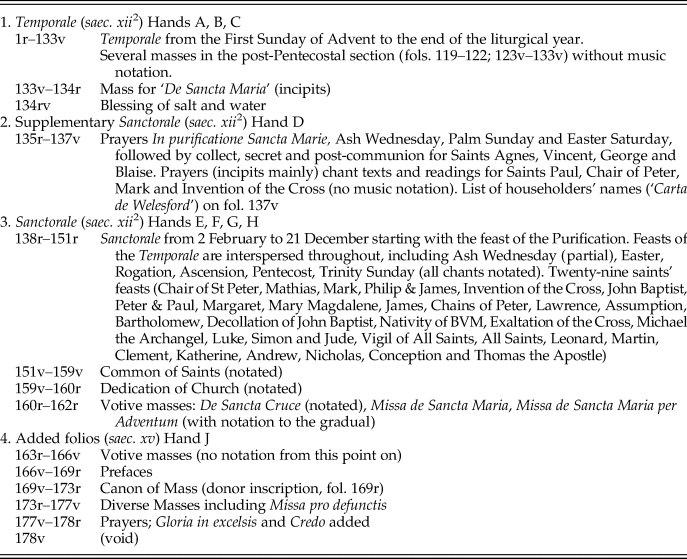
EXcl 3515 comprises 181 parchment leaves measuring 243 x 175 mm, with a written space of approximately 185 x 120 mm. It is generally ruled in two columns of thirty-four lines, although this varies. At quire nineteen (fols. 138–45), for example, the format changes temporarily to a single column. The manuscript was rebound in the fifteenth century.Footnote 4 The complex palaeography of the corpus, which can only be broadly summarised here (see Table 1), points to the last quarter of the twelfth century as the time when the missal's three main sections – Temporale, Sanctorale and Commune Sanctorum with some Votive masses – were copied.Footnote 5 The fourth section (fols. 163r–177v), which comprises two additional fifteenth-century quires (without notation) containing votive masses, prefaces and the Canon of the Mass, will not be examined in detail.
Summary of the contents, dating and palaeography of EXcl 3515.

Scholars including Walter Howard Frere, Peter J. Underwood and David Hiley have acknowledged the diversity of medieval English liturgies,Footnote 6 Hiley asserting that these ‘liturgies are composed of layers of material, each with its own history’.Footnote 7 Yet to date our understanding of the medieval Mass liturgy of Exeter from the Anglo-Saxon period through the liturgical reforms of Bishop John de Grandisson (d. 1369) has not taken account of all the relevant sources, including EXcl 3515. It has instead been based mainly on GB-Ob Bodley 579, the Leofric Missal, compiled during the tenth and eleventh centuries, and GB-Mr Crawford MS Lat. 24, the thirteenth-century Sarum Missal of Henry of Chichester, canon of Exeter Cathedral. Frere recognised even in these two sources, widely separated in date, a distinctive Use of Exeter.Footnote 8 For his part, however, Richard Pfaff observed that ‘there is little, if any, discernible continuity between his [Bishop Leofric's] liturgical program and that of Grandisson’, a difference of opinion which is not especially surprising since he too omitted EXcl 3515 from consideration.Footnote 9 The following comparative study of the Leofric Missal and EXcl 3515 will shed new light on the question of liturgical continuity in post-Conquest Exeter.
Let us begin by surveying the contents and structural format of EXcl 3515. The inventory in K.D. Hartzell's recent Catalogue of pre-thirteenth-century English sources recognises four sections ‘of disparate format which, despite overlaps, form a single book’.Footnote 10 Table 1 summarises the basic structure, dating, liturgical contents and scribal hands.
Both Hartzell and Neil KerFootnote 11 identify only two scribal hands, but my own palaeographical analysis of text and music notation reveals the work of multiple copyists with strong links to the Protogothic script and a late twelfth-century notational style of point-neumes characterised by spikes or finials on three notational figures: the virga, torculus and pes.Footnote 12 The Anglo-Norman neumes are inserted on staves of four red or black lines including a wide variety of clefs (on c, d, g, a and b).
The first section of EXcl 3515 (fols. 1r–134v) encompasses the Temporale from the First Sunday of Advent through the Twenty-Third Sunday after Pentecost. (Several masses in the post-Pentecostal section lack music notation.) The feast of St Thomas of Canterbury (29 December), which one might expect to find after Christmas, is lacking.Footnote 13 This is noteworthy considering that Bartholomew, bishop of Exeter (1161–84) and staunch supporter of the archbishop, preached the sermon on the occasion of Thomas's canonisation at Canterbury in 1173. Provision for this feast was made in a twelfth-century kalendar of Exeter provenance, GB-Lbl Harley 863, closely contemporary with EXcl 3515, which suggests a terminus ante quem of c.1173 for the latter.
Section two (fols. 135r–137v), though comprising only three leaves, provides the key to unlocking the relationship of the manuscript's sections, indicating a conscious effort to complete the book's liturgical cycle. Among other contents it gives prayers, blessings and chants for three feasts in January, supplementing the Sanctorale (section three), which begins with February.Footnote 14 It also supplies two missing feasts (St George and St Blaise) and serves as a guide to the revision and/or upgrading of three others (the Chair of Peter, St Mark and the Invention of the Cross).Footnote 15 The latter three feasts had been supplied with collects, secrets and post-communions in the Sanctorale. The added, supplementary folios do not duplicate these – the prayers are indicated as incipits – but give the texts of chants and readings in full, indicating that the scribe had the main Sanctorale in hand during redaction.
Added to folio 137v is a list, presumably of householders’ names, referring to a place (parish?) called ‘Welsford’. Both Ker and Hartzell agree that this addition indicates the location of the manuscript in an Exeter parish at the time of writing. Accompanying the names, many crossed through, are varying amounts of monetary value (farthing, halfpenny or penny)Footnote 16 connected perhaps with a Pentecostal tithe introduced by Bishop Marshall (1194–1206) at the beginning of the thirteenth century.Footnote 17 The scribe who copied this list (Hand D) in a distinctive hand employing lengthened ascenders appears also to have made marginal and interlinear additions to the Temporale (section one), suggesting that it predates addition of the Sanctorale to the three-sections corpus of the manuscript.
Section three (fols. 138r–162v) comprises thirty-eight feasts of the Sanctorale beginning with the Feast of the Purification (Feb. 2) – as noted previously, January is missing. There is no saint of obvious local importance, although Christopher Hohler draws attention to the feast of St Leonard and the special grading it received in the twelfth-century Exeter kalendar, Harley 863.Footnote 18 Section three also includes six feasts of the Temporale, namely Ash Wednesday (partial), Easter, Rogation, Ascension, Pentecost and Trinity Sunday, duplicating material found in section one. In sum, both external and internal evidence indicates that the first three sections of EXcl 3515 were assembled so as to constitute a complete liturgical cycle for the church year. Let us now consider the liturgical and melodic traditions represented in the manuscript.
EXcl 3515 in historical context
Hiley has noted that ‘while the derivation of the monastic uses in England is reasonably clear, the use of the secular cathedrals survives in a frustratingly incomplete state’.Footnote 19 From the nine secular cathedrals of post-Conquest England, namely Salisbury, York, Wells, St Paul's, Lincoln, Exeter, Hereford, Lichfield and Chichester, very few complete service books from before c.1200 survive.Footnote 20 The question whether EXcl 3515 more closely corresponds to an earlier (Anglo-Saxon) or later (Sarum) practice will be addressed by framing it within a tripartite comparative investigation: the Anglo-Saxon Leofric Missal on one side and sources representing the Sarum Use on the other.Footnote 21
These sources have been chosen as representatives of secular liturgies from pre- and post-Conquest England. Comparison with the Leofric Missal will determine the extent to which EXcl 3515 represents, at Exeter, continuity in liturgical observance from the Anglo-Saxon period to the later Middle Ages.Footnote 22 Conversely, it is important to assess the extent to which EXcl 3515 is dependent or independent of the liturgical models that gave rise to the Use of Salisbury. Not only does EXcl 3515 provide prayers, chants and readings for the entire liturgical year, it also supplies additional prayers inserted as marginal entries or replacements in the body of the text by various scribes over a period of at least 200 years. These marginalia – evidence of a book in continuous use – reflect changes of place and fashions in liturgy.
Nicholas Orchard describes the Leofric Missal as a complex book, a ‘combined sacramentary, pontifical and ritual’.Footnote 23 He accepts Frederick Edward Warren's division of the manuscript into three sections, reflecting the chronology of its creation: Leofric A (the main Sacramentary), Leofric B (three quires, comprising a calendar and computus tables) and Leofric C (numerous later additions and emendations).Footnote 24 Though copied in Lotharingia, Orchard argues that the sacramentary (Leofric A) was prepared for Plegmund, archbishop of Canterbury (890–923), from a book of English origin, this correspondence rendering possible the preservation of an insular liturgy dating back to the eight century.Footnote 25 In a form comprising Leofric A and B, the manuscript arrived in eleventh-century Exeter as Bishop Leofric's personal possession. Emendations were made during his episcopate, a process which continued through the end of the eleventh century (Leofric C).
Many scholars of medieval liturgy and chant have examined the origins and development of the Sarum rite.Footnote 26 Nicholas Sandon observes that ‘like virtually every other Use of medieval Europe, that of Salisbury was liturgically and musically a dialect of the Romano-Frankish lingua franca’.Footnote 27 Matthew Cheung Salisbury has recently challenged prior assumptions regarding the stability and/or fixity of the tradition,Footnote 28 but scholars generally acknowledge the melodic stability of the Mass chants.Footnote 29 In this study, Frere's Gradual Sarisiburiense, a facsimile edition of GB-Lbl Add. 12194 (13th cent.), is the main source of the chant melodies.Footnote 30
As for other Mass texts, J. Wickham Legg points to specific prayers that distinguish Sarum books, in particular a group of secrets and post-communions unrelated to other secular Uses including the secrets for Ember Friday in Advent (Sacrificiis quesumus) or the Second Sunday after the Epiphany (Ubi tibi gratia).Footnote 31 The assignment of the Feast of Relics to 15 September and the numbering of summer and autumn Sundays from the feast of the Trinity rather than Pentecost are also often used to classify thirteenth-century Sarum sources.Footnote 32
The earliest layers of EXcl 3515 display no affinity to Sarum Use; none of the hallmarks just listed is present. Yet the numerous additions and emendations cannot be ignored since many of these replace original prayers or chant texts with Sarum substitutes. Although some would date the introduction of the Sarum Use at Exeter to the period of Bishop Grandisson's reforms, that is, the early fourteenth century,Footnote 33 Frere asserts that the identification of books in the 1327 Exeter inventory as ‘non de usu’ or ‘de veteri usu’ indicates that some type of liturgical reform had been undertaken prior to Grandisson's episcopacy.Footnote 34 Moreover, we should not overlook the fact that GB-Mr Crawford MS Lat. 24 (‘Manuscript C’ in Legg's edition) is a Sarum missal copied c.1240–60 for a canon of Exeter Cathedral.
The Sacramentary of EXcl 3515
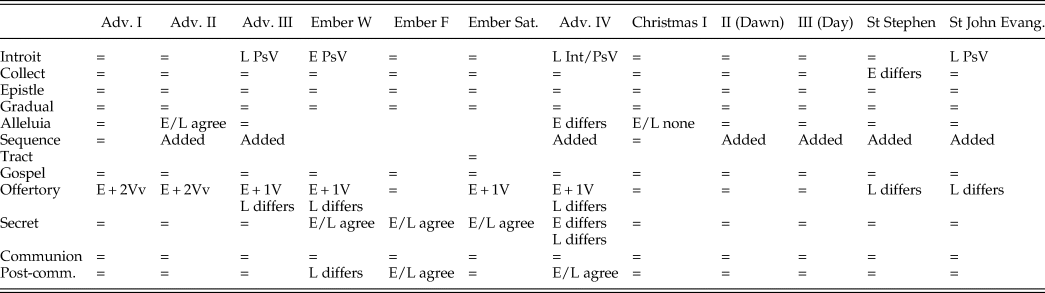
In light of the earlier history of Gregorian sacramentaries, we would expect many elements to survive in later medieval sources.Footnote 35 This is indeed the case with EXcl 3515, the Leofric Missal and the Sarum witnesses compared in Table 2, which surveys the opening of the church year for purposes of demonstration.Footnote 36
Comparison of prayers and chants in EXcl 3515 (E), the Leofric Missal (L) and Sarum Use (S) for the period from the First Sunday of Advent through the feast of St John the Evangelist.

Notes: The abbreviations E, L and S represent EXcl 3515, Leofric Missal and Sarum sources, respectively.
Equal signs indicate agreement; other entries signal divergence.
‘E/L agree’ indicates that the two sources agree but differ from Sarum.
Plus signs in the entries indicate additions of some kind.
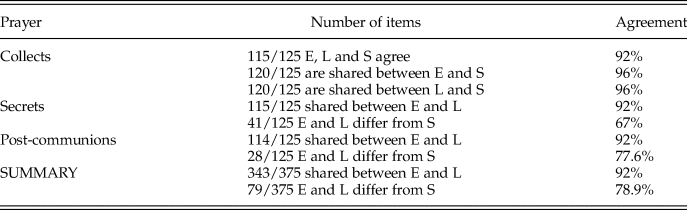
Table 3 summarises Mass prayers in E, L and S for the entire Temporale; degrees of correspondences are tabulated as percentages. Note that the collects are remarkably uniform (92%), with still closer connections between the Leofric Missal and Sarum (96%) and EXcl 3515 and Sarum (96%). It is instead among the secrets that L and E show near complete agreement (92%) between them with forty-one examples of disagreement with Sarum (67%). These figures clearly point to a close connection between the two Exeter missals on days which notably include the Ember days of Advent, the Second, Third and Fifth Sundays after Epiphany, and Lent. Finally, post-communions in E and L have a higher rate of concordance (92%) than with Sarum (77.6%). In sum, the evidence suggests that E and L either share a common source of secret and post-communion prayers, or that E is for the most part based on L.
Summary of prayers for the Temporale in EXcl 3515 (E), the Leofric Missal (L) and Sarum Use (S).

A connection between the Leofric Missal and EXcl 3515 can now be confirmed, the high rates of concordance among Mass prayers pointing to their retention into the later twelfth century. Let us now expand the comparative investigation to the chants.
The repertory of chants in EXcl 3515
The following repertorial study will shed new light on questions of transmission and chronology.Footnote 37 The Alleluias for Easter Week, Paschal Time and the Sundays after Pentecost will be a particular focus since comparisons of lists of these chants have proven useful in establishing relationships between ecclesiastical centres, as demonstrated by Karl-Heinz Schlager,Footnote 38 Hiley,Footnote 39 David HughesFootnote 40 and others. As regards the assignments of other genres of chant throughout the church year, some prove to be more stable than others. A high level of uniformity is for instance noticeable throughout Lent, with the exception of the Second Sunday and Saturday in the Fifth Week of Lent, which is not surprising since both days are aliturgical in the early unnotated graduals of the Antiphonale missarum sextuplex (hereafter AMS).Footnote 41 Last but not least, in order to identify the predominant musical tradition of EXcl 3515, melodic variants among its notated chants will be collated and compared with melodies of the Leofric Missal and ultimately a select group of English, Irish and French sources.Footnote 42
Introits and communions
McKinnon remarks on the uniformity of introits within a core group of some 144 chants.Footnote 43 One thus expects to encounter few discrepancies in assignment, a level of consistency indeed reflected in the sources under consideration. For example, there is full agreement on the liturgical assignment of introits between Easter Sunday and the Twenty-Fifth Sunday after Pentecost, a uniformity that is only slightly less complete in other seasons.
Certain differences of assignments among introit antiphons and psalm verses in AMS sources are, however, reflected in our sources.Footnote 44 For example, three different introits are assigned to the Fourth Sunday in Advent. Leofric follows AMS: S (Rorate caeli) while EXcl 3515 and Sarum both agree with AMS: C (Memento noster). Memento noster is also assigned to the Fourth Sunday in Advent in twelfth-century English sources from Haughmond (GB-SHRs XXX) and St Albans (GB-Lbl Royal 2. B. IV).Footnote 45 Thus EXcl 3515 represents a new link in the chain of insular liturgical influences in the transition between the Anglo-Saxon and post-Conquest periods at Exeter.
Further examples of discontinuity between the Leofric Missal and EXcl 3515 occur. For example, the psalm verse for the introit Miserere mihi (Monday in the Fifth Week of Lent) is Ab altitudine (AMS: S) in Leofric, but Conculcaverunt (AMS: C, K) in EXcl 3515 and Sarum. On Passion Sunday, the psalm verse Quare me is indicated in EXcl 3515 (introit Iudica me [AMS:K]) while both Leofric and Sarum have Emitte lucem (AMS: C, S). The assignments in EXcl 3515 can also be found in two insular sources: GB-Ob Bodley 775 and the Lismore Gradual, GB-Ob Rawl. C.892.Footnote 46 Winchester, Lismore and Exeter all follow Corbie (AMS: K).
As previously observed, there is a striking level of stability in the assignment of the communions between the Exeter missals and the Sarum Use. Yet there is evidence of an Exeter Use when EXcl 3515 differs from other sources. For example, it designates Acceptabis for the Saturday after Ash Wednesday; Leofric and Sarum have Servite. Hartzell's Catalogue includes a total of twenty-four entries for Acceptabis with alternate designations in English witnesses but EXcl 3515 alone gives this unusual liturgical assignment.Footnote 47
Besides Winchester, there is evidence of some Breton influence with the offertory Domine deus meus and the communion Custodi me for the Second Sunday of Lent; Leofric also preserves the tract Confitemini dominus.Footnote 48 Breton influence in Leofric thus survives in EXcl 3515, onto which is also superimposed elements of the Winchester tradition. Equally striking, the liturgy for Saturday in the Fifth Week of Lent in twelfth-century Exeter includes prayers of Breton provenance as well as the communion Ne tradideris. EXcl 3515 would appear to be a rare example of Breton influence extending into the Mass Proper tradition of south England in the late twelfth century, but this may not be so remarkable considering its brief but significant presence at Canterbury, not to mention the connection between Leofric and EXcl 3515.
Offertories and graduals
It is among the offertories that one encounters a relatively high incidence of discontinuity between the earlier and later Exeter Missals, four offertories in EXcl 3515 pointing to a break in the tradition. On Thursday in the Fourth Week of Lent, for example, EXcl 3515 has Domine in auxilium, the Leofric Missal and Sarum Domine adjuvandum. The remaining three cases occur during the Paschal season: Vigil of Ascension, Ascension and Saturday after Pentecost. The order of Ascendit Deus (assigned to the Vigil of Ascension) and Viri Galilaei (assigned to Ascension) in section one (Temporale) of EXcl 3515 is interesting because it contrasts with that encountered in most other graduals and missals.Footnote 49 (The customary assignment – Viri Galilaei for the Vigil and Ascendit Deus for Ascension day – is indeed found in the later AMS sources: English Mass books from Winchester, Canterbury, St Albans, Haughmond and indeed in section three (Sanctorale) of EXcl 3515.) Only two of fourteen manuscripts in Hartzell's Catalogue agree with EXcl 3515 section one, namely GB-Oas, Miscel. (missal fragment, early twelfth century) and GB-Ob b.18, f. A.7 (a fragmentary gradual). That this arrangement is highly unusual is confirmed by the scarcity in concordances among English sources.
As for the graduals, there are very few repertorial differences among the sources under consideration. Where EXcl 3515 diverges from Leofric and Sarum one finds links with two English uses. For instance, EXcl 3515 concords in assigning Domine refugiam to the Friday after Ash Wednesday with the Hereford and Westminster Missals, as well as AMS: C.Footnote 50 (The Leofric Missal and Sarum have Unam petii a domine, in agreement with most early AMS sources, namely BCKS.) EXcl 3515 agrees with the same two insular sources in assigning the graduals Venite filii and Propitius esto to the Seventeenth Sunday after Pentecost and Ember Wednesday (in September), respectively. Considering the late date of the Hereford and Westminster Missals, EXcl 3515 is possibly the earliest English witness to the assignment of these graduals.
Alleluias
It is well known that identical series of post-Pentecost alleluias can indicate similar origins and/or close relations between ecclesiastical centres. Because the alleluia series in many English graduals and missals have an affinity with those of predominantly Norman origin, the unusual presence of the Fleury series, to which Hiley draws attention, is noteworthy.Footnote 51 During the eleventh century, the impact of reforms undertaken at Canterbury by Lanfranc of Bec and his successor, Anselm, can be seen in the widespread adoption of the Bec alleluia series in manuscripts not only from Christchurch, Canterbury, but also from St Albans, Worcester, Durham and Whitby.Footnote 52 Hiley observes that the Dijon alleluia tradition makes a very limited appearance in British sources, most noticeably in the Lismore Gradual with two differences as does the Amiens series which is closely linked to the Leofric Missal.Footnote 53 Pre-Conquest books from Winchester, such as F-LH 330 and Bodley 775, are strongly connected to the St Denis/Corbie tradition.Footnote 54 With regard to Sarum, Hiley observes that the sources display an affinity with Norman secular Uses, predominantly from Rouen and Evreux.Footnote 55 By contrast, the series in EXcl 3515 stands apart from all these traditions. One could even argue that EXcl 3515 preserves a series from the Anglo-Saxon past, pointing to continental influences which may have been imported at the time of the liturgical revival.Footnote 56
By contrast, the Easter Week alleluias in EXcl 3515 may be linked to missals of Hereford Use, which share four of the five alleluias.Footnote 57 The fifth, Surrexit pastor bonus, assigned to Feria vi, is a very rare text and melody found in sources from Lotharingia, Auberive and a select few German books.Footnote 58 It appears to be a unique among extant medieval English chant sources to EXcl 3515, perhaps reflecting a local preference.
Identifying musical traditions in English Sources
Quite a number of chant scholars have identified musical traditions in medieval English chant sources, and their investigations have given us a clear idea of the various influences to which chant in England was subject in pre- and post-Conquest times.Footnote 59 Hiley identifies three distinct traditions: St Denis/Corbie, Bec and Dijon/Fecamp. The first is encountered in books from Winchester, Worcester, Crowland, Ely and Downpatrick. The Bec tradition is most noticeable in books from St Albans, although the Haughmond gradual (SHRs XXX, c.1175) shows an affinity to the Dijon tradition.Footnote 60 As a pre-Sarum service book, one would expect to find affiliations in the chant tradition of EXcl 3515 with one of the three groups.
The Solesmes monks omitted the Leofric Missal from their survey on melodic variants due to the scarcity of examples, thus the chant tradition behind both Exeter missals has remained unidentified to date. Despite the obvious limitations, I have compared the incipits in the Leofric Missal with the corresponding items in EXcl 3515.Footnote 61 In total, the former includes twenty-seven notated items, mostly incipits. Remarkably, even within this limited group, there was a noticeable lack of disagreement (55%) between the sources.
I have based my collation of melodic variants in EXcl 3515 on the Solesmes survey despite Hiley's having drawn attention to the omission of significant English sources, including the English tropers Bodley 775 and GB-Ccc 473.Footnote 62 To compensate for the lack of insular representatives, I have included the Winchester missal GB-LH 330 (despite its many lacunae) and the York gradual OB-Lat.lit.b.5, an important late witness to a secular tradition. I have also examined two service books from the Loire region, namely the twelfth-century Fleury missal (F-H 187) and the Tours missal (F-O 117), since both bear witness to possible liturgical influence on EXcl 3515, as observed in the post-Pentecost alleluia series and the liturgical assignment of other chants.Footnote 63
The findings of the present analysis offer compelling evidence of a strong relationship not only with the Worcester gradual GB-WO F.160 (86% agreement), but also with the Lismore and York graduals, confirming a clear affiliation to the St Denis/Corbie tradition which, as mentioned above, was a predominant influence on many insular sources prior to the introduction of the Sarum Use.Footnote 64 Evidence drawn from various comparative surveys, both repertorial and musical, indicates that the liturgical continuity of the Anglo-Saxon past and witnessed in the Leofric Missal was maintained into the twelfth century at Exeter. The musical tradition behind EXcl 3515 thus differs from that of both the Leofric Missal and the Sarum sources in its being closely linked to Winchester, which in turn was influenced by the St Denis/Corbie tradition.
Departures from the tradition
Ruth Steiner refers to the benefits of utilising the Solesmes method for grouping manuscripts, but warns that it is less useful in identifying salient features of a chant tradition – the features by which it would be remembered as distinctive. For this, more conspicuous musical features need to be focused upon: unusual melodies or melodies with unexpected turns of phrase.Footnote 65
A select number of chants in EXcl 3515 emerged as potentially interesting because of their departure, either melodically or modally, from their Sarum counterparts: the introit Accipite jocunditatem, a group of ten alleluias including Dies sanctificatus, Hodie Sancti Innocentes and Rex noster, and the communion Oportet te fili. (Some of these chants, including the introit Accipite jocunditatem and the alleluia Dies sanctificatus, have been previously studied.)Footnote 66 Analysing the workings and behaviour of this group of chants should shed light on the distinctiveness of the liturgy in EXcl 3515. For the present study, we will turn our attention to three of these items.
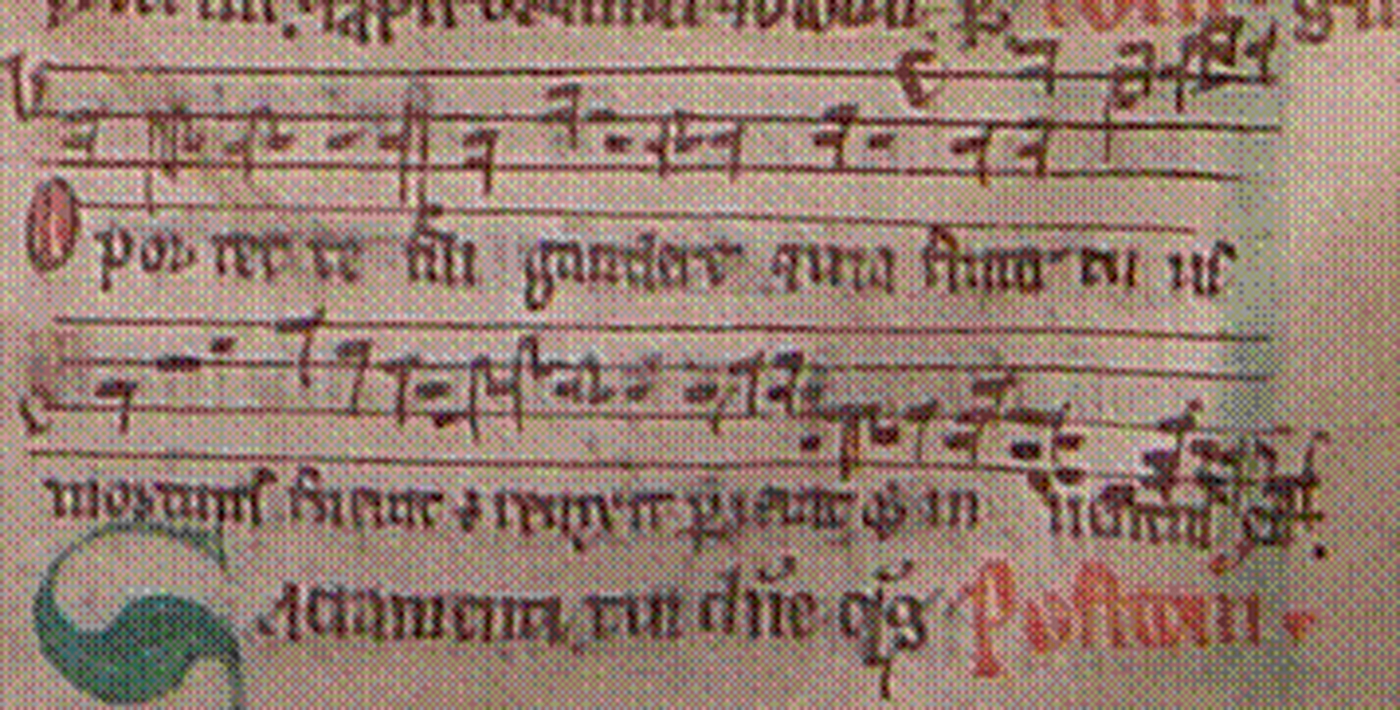
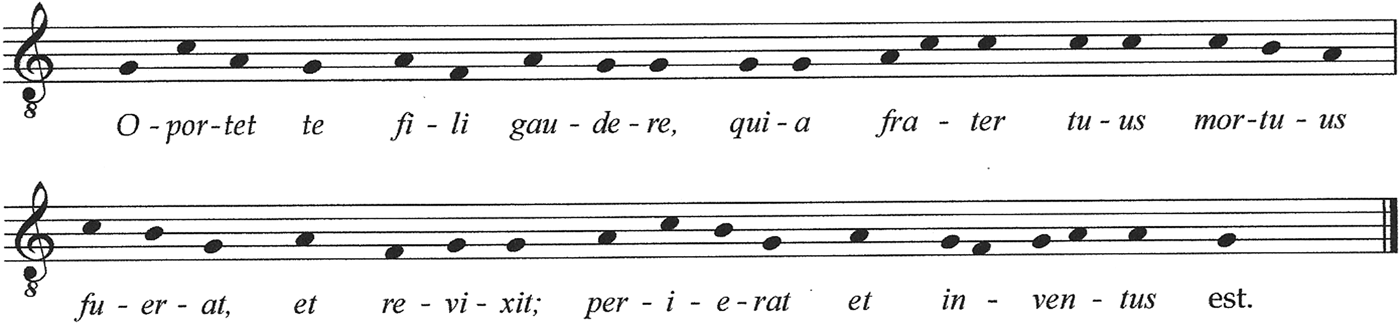
Oportet te fili (Fig. 1) belongs to a group of communions for Lent referred to as Gospel communions because their texts come from the Gospel pericope of the day.Footnote 67 It is assigned to the Second Saturday of Lent.Footnote 68 The melody in EXcl 3515 deviates considerably from the Sarum version (from Frere's Graduale Sarisburiense) and is indeed rare among insular and continental sources. The most widely known (syllabic) setting of Oportet te fili is given in Figure 2.Footnote 69 Categorised as melody A-4 by Steiner, it is found in at least sixty manuscript sources of east and west Frankish provenance; among English sources, representatives come from Lismore and Salisbury.Footnote 70
Communion, Oportet te fili, EXcl 3515, fol. 40r.

Communion, Oportet te fili, syllabic version, Graduale Triplex (Steiner's A-4).

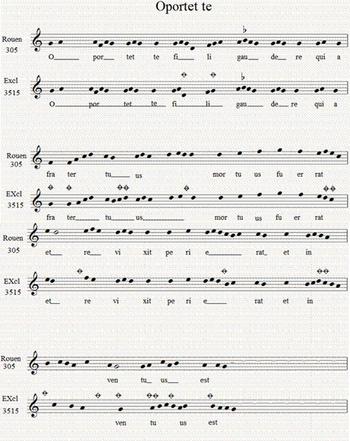
In contrast to the widely disseminated A melody, only two versions of Steiner's B melody have to date been located: B-1 in three adiastematic northern Italian sources (I-VCd 146, 161 and 162) and B-2, which survives in only one pitch-readable Norman source (F-R 305).Footnote 71 Comparison of the latter with the melody in EXcl 3515 reveals unexpectedly close correspondences but also significant differences (see Ex. 1, in which variants are indicated by symbols above the staves).Footnote 72
Comparison of Oportet te fili, F-R 305 and EXcl 3515.

If an ornate style signals a more recent melody, then EXcl 3515 is possibly unique among the insular secular sources, not only in presenting a modern chant, but also in providing a new variant of the melody.
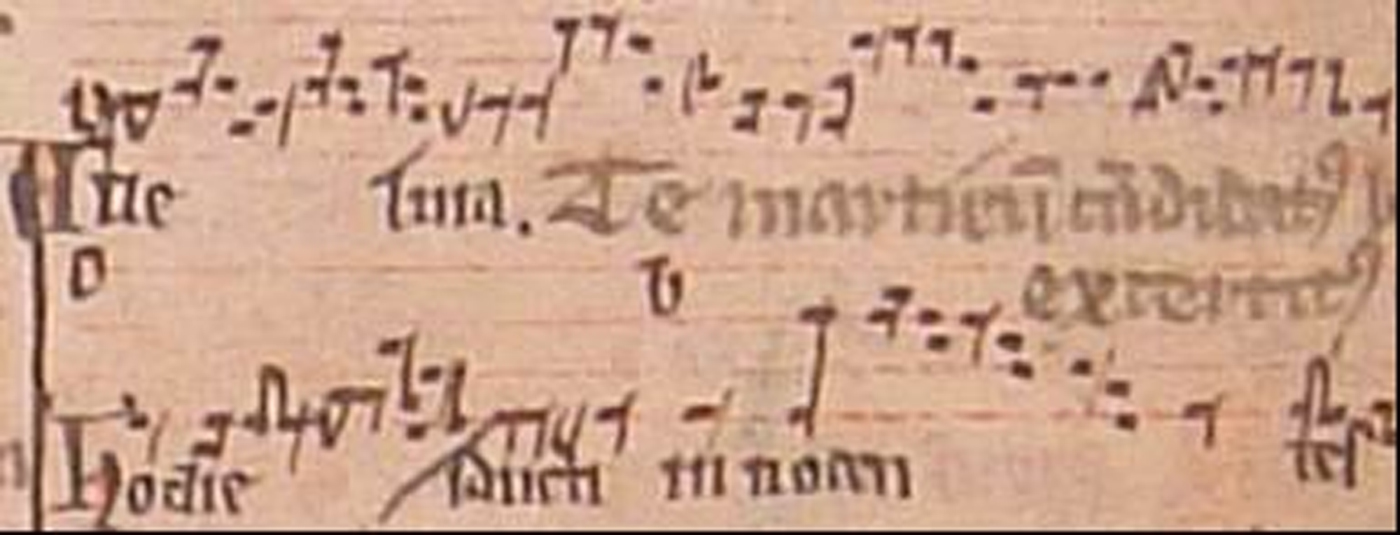
EXcl 3515 is one of the very few sources to preserve the alleluia Hodie Sancti Innocentes for the feast of the Holy Innocents (see Fig. 3).Footnote 73 No alleluia is assigned to this day in Sextuplex; among later notated sources the alleluia Te martyrum is a common insular choice, being found, for example, in the English tropers Bodley 775 and GB-CCC 473, in Rawlinson C 892 and virtually all Sarum books.Footnote 74 Because Te martyrum enjoyed popular and widespread usage in England both before and after the Conquest and indeed into the later Middle Ages, it is not surprising that a reviser inserted it – the Sarum choice – into EXcl 3515.
Alleluia Hodie sancti innocentes, EXcl 3515, fol. 12r.

A far smaller number of manuscripts include the lesser-known alleluia Hodie Sancti Innocentes for Holy Innocents.Footnote 75 Besides EXcl 3515, Hartzell cites only two English sources copied before 1200: GB-DRu Cosin V.v.6 and F-SK A 128 (a fragment).Footnote 76 Not until the thirteenth century does it reappear in books from Worcester Cathedral (F 160) and Hanley Castle (GB-CUL KK. ii.6). As to when and how it was adopted at Exeter, we may presume that it was in circulation at Canterbury in the latter part of the eleventh century, and in use at Exeter in the later twelfth. At the very least, the selection of Hodie Sancti Innocentes is indicative of the English provenance of EXcl 3515.
The inclusion of the alleluia Rex noster (Schlager ThK 7) is also an insular preference.Footnote 77 The earliest sources give Veni domine et noli for the Fourth Sunday of Advent. By contrast, the alleluia Rex noster is assigned to the Fourth Sunday of Advent in eleventh-century chant books from Winchester and Canterbury; it is also found in two twelfth-century insular sources: EXcl 3515 and Lismore gradual Rawlinson C.892.Footnote 78 Exeter thus retained a pre-Conquest tradition in the liturgical assignment of this alleluia.
Conclusion
The findings presented here reveal the importance of EXcl 3515 to chant scholarship. It retains prayers from the Anglo-Saxon past and preserves a full cycle of Mass liturgies independent of Sarum influence. Its chants are rooted in the St Denis/Corbie tradition, thus presenting us with a significant and previously overlooked insular witness to this pre-Conquest influence. Yet among the various unusual chants the diversity of liturgical influences emanating eastwards from Lotharingia to Aquitaine in the south of France may be seen. These rare items offer a lens with which to view the shaping of the post-Conquest liturgy in Exeter. That EXcl 3515 preserves a Fleury post-Pentecost alleluia series suggest the retention of a tradition whose origins are found in the historic period of the monastic revival when the monks of Fleury contributed to the formation of Anglo-Saxon liturgy. EXcl 3515 may possibly be the sole surviving witness to a tenth-century continental influence. Both old and new influences co-exist together in the various sections of the missal. Of special significance is the recognition of its representing a distinctive ‘Use’, the Use of Exeter, for which further evidence should be sought and assessed. EXcl 3515 deserves a prominent place as a representative of that Use, standing alongside the sources of the other established secular Uses of Sarum, York and Hereford.