Implications
It is an animal welfare issue that high-starch diets, which are associated with health problems, are fed to horses. The need for diets that support the natural behavior and digestive and metabolic systems of horses is therefore high, and the introduction of such diets will reduce welfare problems and health-care costs for the horse industry. Until now, there have been no long-term studies on how young horses in training may grow and develop on a forage-only diet.
Introduction
In Thoroughbred and Standardbred racehorses, health problems are common. Several studies show that the risk for problems from the digestive tract is high; that is, 40% to 90% of these horses have gastric ulcers (Murray et al., Reference Murray, Schusser, Pipers and Gross1996; Dionne et al., Reference Dionne, Vrins, Doucet and Pare2003), and 10.9% of the Thoroughbreds may suffer from colic every year (Traub-Dargatz et al., Reference Traub-Dargatz, Kopral, Seitzinger, Garber, Forde and White2001). In addition, 5% have rhabdomyolysis yearly (Isgren et al., Reference Isgren, Upjohn, Fernandez-Fuente, Massey, Pollott, Verheyen and Piercy2010), and up to 5.7% of Standardbred horses and 25.6% of Thoroughbred horses show stereotypic behavior (Redbo et al., Reference Redbo, Redbo-Torstensson, Odberg, Hedendahl and Holm1998). However, the most common problem among both Standardbred and Thoroughbred horses appears to be lameness (Vigre et al., Reference Vigre, Chriel, Hesselholt, Falk-Ronne and Ersboll2002; Dyson et al., Reference Dyson, Jackson, Pfeiffer and Price2008). Taken together, these figures indicate that there is a need for improved management of racehorses to prevent health-related problems and promote a successful career. Surprisingly, there are very few, if any, holistic studies in which training, diet, growth and health in young racehorses have been documented and evaluated under long-term, controlled conditions. However, there are some field studies documenting age and/or training-induced metabolic changes (Lindholm and Piehl, Reference Lindholm and Piehl1974), growth (Thompson, Reference Thompson1995) and health (Vigre et al., Reference Vigre, Chriel, Hesselholt, Falk-Ronne and Ersboll2002; Dyson et al., Reference Dyson, Jackson, Pfeiffer and Price2008) separately.
The use of high-starch diets is a well-documented health risk in horses. Such diets are associated with colic (Tinker et al., Reference Tinker, White, Lessard, Thatcher, Pelzer, Davis and Carmel1997), rhabdomyolysis (Valberg, Reference Valberg1998; MacLeay et al., Reference MacLeay, Valberg, Pagan, Xue, De la Corte and Roberts2000), gastric ulcers (Luthersson et al., Reference Luthersson, Nielsen, Harris and Parkin2009) and stereotypic behavior (Redbo et al., Reference Redbo, Redbo-Torstensson, Odberg, Hedendahl and Holm1998). Starch-rich diets have also been associated with altered cartilage development in growing horses (Glade and Belling, Reference Glade and Belling1984). Despite this, young racehorses are fed high-concentrate diets (Redbo et al., Reference Redbo, Redbo-Torstensson, Odberg, Hedendahl and Holm1998). However, studies show that the energy requirements in adult Standardbred horses in training can be met by using forage-only diets (Connysson et al., Reference Connysson, Muhonen, Lindberg, Essen-Gustavsson, Nyman, Nostell and Jansson2006; Jansson and Lindberg, Reference Jansson and Lindberg2012) and that muscle glycogen levels, known to have an impact on performance, can be comparable to (Essen-Gustavsson et al., Reference Essen-Gustavsson, Connysson and Jansson2010) or only slightly lower (13%, Jansson and Lindberg, Reference Jansson and Lindberg2012) than levels in horses fed concentrate diets.
The aim of this study was to, from a holistic perspective, describe the effects of a forage-only feeding system and a conventional training program on young Standardbred horses and compare data with similar observations from the literature.
Material and methods
Horses
Sixteen American Standardbred colts (age at the start of the study 464 ± 31 days, range 400 to 518) from four Swedish breeders and after eight different sires were used. The horses had mainly American ancestors. The horses were transported to and kept at the National Centre of Trotting Education (Wången, Sweden) in August 2010, and the study started on the 20th of August and ended on the 20th of December 2010. Two horses entered the study 8 and 12 weeks after the start of the study. The experiment was approved by the Umeå local ethics committee.
Management and training
Two months before arrival at Wången, all horses had been pastured at the breeders. The final week before the study began, they were kept together on pasture at Wången for 24 h per day. For the first 1.5 months of the study the horses were stabled individually in 9 m2 boxes for ∼8 h a day, 5 days a week, and spent the rest of the time together in a paddock (∼20 000 m2). The following month, horses were stabled for ∼16 h a day, 5 days a week, and during the last month they were stabled for 16 h a day on all days because of wet and cold weather conditions. From the beginning of November, rugs were used when horses were outside. Sawdust was used as litter in the boxes. Training started in September with breaking. The progress in training was adjusted for each horse, but most horses were walked on long reins for 2 to 3 weeks before they were adapted to a jog cart. Within 5 weeks, all horses were trotted slowly (∼3.7 m/s) for 3 km a day on an oval racetrack for 4 days a week. During weeks 7 to 9, horses were trotted 5 km 4 days a week (∼3.7 m/s). For weeks 10 to 17, the horses were trained 4 days a week and speed was increased gradually up to 5.6 m/s. In these weeks, approximately one-third of the training was performed at the racetrack (5 to 7 km) and the rest was performed on a slightly hilly track (4.5 km), in addition to 2.5 km on the racetrack where the last 250 m was performed as fast as the horse was willing to trot. The type of training and distance were documented, and horses that, according to the trainer's opinion, were unhealthy were left out of training for as long as needed. The goal for all horses was to vigorously trot 5 to 7 km at a speed of 5.6 m/s (3 min per km) in December, and it was defined together with a reference group consisting of four professional trainers with international experience.
Diet and feed intake
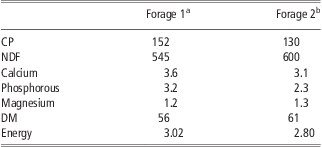
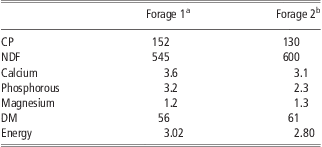
Horses were fed squared baled grass haylage ad libitum. In the box, haylage was provided in a crib placed in one corner of the floor to minimize wastage, and in the paddock haylage was provided from three feeding stations. New haylage was provided once a day in the box and in the paddock every 3 to 4 days. From August to October, some grass was available in the paddock. On the basis of weight, dry matter (DM) content and number of bales provided in the paddock, the consumption of haylage in the paddock was calculated as 9.7 kg DM per horse and day in September when horses spent ∼65% of their time in the paddock and as 7.0 kg DM per horse and day in October when 50% of their time was spent in the paddock. Because of the high consumption of haylage in the paddock, the fresh grass intake was considered to have little contribution to the total energy and nutrient intake. Water was offered from two 20 l buckets in the box that were refilled twice a day and from a big tub in the paddock. The haylage used in the experiment (Table 1) was harvested in Enköping, Sweden (latitude: N 59° 37.8; longitude: E 17° 04.5). It was a first cut fertilized with 126 kg N in spring. The grass was a mixture of meadow fescue and timothy, sown 5 years earlier. The first 172 bales (Forage 1), used from August until the last 2 weeks, were cut on the 8th of June, and the next bales, used for the last 2 weeks (Forage 2), were harvested 6 days later. The diet was complemented with 1 kg of a pelleted lucerne product (95% lucerne, 5% molasses, Krafft AB, Falkenberg, Sweden), 100 g molassed beet pulp (Betfor® Nordic Sugar A/S, Copenhagen, Denmark), which was soaked before feeding, and 150 g of a mineral supplement along with Forage 1 and 130 g along with Forage 2 (Miner Röd, Krafft AB, Sweden. Content/kg: Ca, 110 g; P, 17 g; Mg, 60 g; NaCl, 125 g; Cu, 1 200 mg; Se, 15 mg; vitamin A, 200 000 IU; vitamin D3, 10 000 IU; and vitamin E, 15 000 mg).
Chemical composition (g/kg DM), DM (%) and estimated digestible energy content (Mcal/kg DM) of forages fed ad libitum to 16 yearlings in training from breaking in August to December the same year
DM = dry matter.
aFed from August to November.
bFed in December.
Total feed intake was registered for 3 consecutive days around the 20th of every month in October, November and December. During these days, the horses were kept in their boxes except during training. Ad libitum was defined as a minimum of 2.0 kg of haylage leftovers per 24 h. Feed samples were taken from the bales used during feed intake registrations and from ∼10% of the remaining bales using a drill. Before analysis, samples were dried (60°C, 16 h) and milled. DM content was determined by drying samples at 103°C for 16 h. Chemical analysis of feed samples was performed with NIRS (FOSS, Sweden). Mineral content was analyzed by inductively coupled plasma–atomic emission spectroscopy (Spectro Flame, SPECTRO Analytical Instruments, Kleve, Germany) after digestion with nitric acid.
Body development
Body measurements were taken by the same person around the 20th of every month, except for the initial measurements, which were taken on the 29th of August. The body condition score (BCS) was evaluated according to Henneke et al. (Reference Henneke, Potter, Kreider and Yeates1983) by dividing the body into back, ribs, tailhead and neck and shoulders, with each area given a score. Total BCSs were calculated as the mean of the four area scores. BW was recorded using a scale (weight indicator U-137, UNI Systems and Vågspecialisten, Skara, Sweden). Thickness of the m. longissimus dorsi and subcutaneous rump fat was measured with a DP-6600 Vet ultrasound system (Mindray Medical International, Shenzhen, China) using a 7.5 MHz, 38 mm linear probe. Measurement of the m. longissimus dorsi was performed right above the 18th rib by the first lumbar vertebra. Subcutaneous fat thickness was measured 5 cm from the middle line at croup according to Westervelt et al. (Reference Westervelt, Stouffer, Hintz and Schryver1976) (rump fat 1) and 15 cm caudal from this (rump fat 2). A mean of three measurements was calculated for each horse each time for both m. longissimus dorsi and fat thickness. Height at withers and height at croup were measured using a ruler with a precision of 0.5 cm. In horses shoed with spikes, the heights were subtracted by 0.8 cm. Body length was measured from September to December with a folding ruler from the shoulder point to the point of the buttocks. Cannon bone circumference was measured using a tape measure right below the carpus at the left front leg. Hoof width, frog length and coronet circumference were registered before every trimming by the farrier. Frog length and coronet circumference were measured directly on the horse. For width measurement, the hoof was placed on a sheet of paper and a plot of the hoof was made, which was measured. Trimming was performed at ∼5-week intervals.
Muscle fiber composition and glycogen content
A muscle biopsy was taken from the m. gluteus medius in December according to the method of Lindholm and Piehl (Reference Lindholm and Piehl1974). The horses had not been exercised for 2 days before sampling but had spent 8 h/day in a paddock. A local ointment anesthesia of Lidocain and Prilokain (Emla®, 25 mg/g, Astra Zeneca, London, UK) was applied to the skin 10 min before the application of a nose twitch and subcutaneous injection of 100 mg Mepivacaine (Carbocaine® 20 mg/ml, Astra Zeneca). After another 5 min, a biopsy sample was collected along a line from the tuber coxae to the tailhead at 1/3 of the distance from the tuber coxae at a fixed depth of 5 cm. Samples were rolled in talcum powder, frozen in liquid nitrogen and stored at −80°C. The histochemical analysis of the muscle samples has been described earlier in the study by Essen-Gustavsson et al. (Reference Essen-Gustavsson, Lindholm, McMiken, Persson and Thornton1983). At least 200 fibers were identified and fiber-type distribution (types I, IIA, IIB) was investigated using a morphometric computer program (Leica QWin Pro V 3.5.1) modified for muscle analyses. The content of glycogen was analyzed on freeze-dried muscle that had been dissected free from fat, blood and connective tissue. The muscle sample was then boiled for 2 h in 1 mol/l HCl and glucose was analyzed by a fluorometric method according to Lowry and Passonneau (Reference Lowry and Passonneau1973).
Health
Health-related disorders that required veterinary treatment were noted in a protocol. On two occasions (October and November), the health status of each horse was evaluated by an independent veterinarian using a standardized health assessment protocol similar to the protocol described by Darenius et al. (Reference Darenius, Philipsson, Fredricson, Thafvelin, Bergsten, Rådberg and Elowson-Anda1983) and used in the Swedish warmblood riding horse 4-year-old quality test. In those tests, equal amounts of time (10 + 10 min) were spent on orthopedic and medical inspections. In the present study, ∼8 and 2 min were spent on orthopedic and medical inspection, respectively. The health assessment included: (a) remarks on hoof to back in hind legs and hoof to shoulder in front legs (number of swellings, heat and soreness, where the severity of each observation was graded from 1 to 3); (b) movements at walk and trot by hand (baseline) and after a 30-s flexion test of all joints in all four legs (for handling reasons performed only in November) where the severity of a lameness was graded 1–5; and (c) an assessment of the overall impression of the horse (graded 1 to 10, where 10 is the best health condition) including all observations above, an auscultation of lungs and heart as well as a brief inspection of hair coat, skin and mucous membranes (oral cavity and conjunctivae).
Plasma lactate and heart rate (HR)
HR was measured (Polar CS600X, Polar Electro, Finland) in October and December during and after a standardized exercise test at an oval track (5 km at a speed of ∼5.6 m/s). Data were downloaded and analyzed by Polar ProTrainer 5 Equine Edition Software (Polar Electro, Kempele, Finland). The mean HR during the third kilometer and HR 3 min after the exercise (end of trot) were recorded and used for further analysis. In December, another exercise test was conducted (5 km at a speed of ∼5.6 m/s; during the last 200 m the horse was allowed to trot at fast as it could without galloping). A blood sample was taken within 1 min after the final speed. Blood was collected from the jugular vein in Lithium Heparin tubes (10 ml) and stored cool until centrifugation. After centrifuging (10 min, 2700 rpm, 920 G), the plasma was frozen (−20°C) for later analysis. Plasma was analyzed for lactate using an enzymatic method in a LM5 lactate analyzer (Analox Instruments, London, UK)
Statistical analyses
All variables were analyzed by ANOVA (GLM procedure in the Statistical Analysis Systems package 9.2) using a model including fixed effects (month and horse). Values are presented as least square means and root mean square error for each parameter except for age, muscle glycogen content, muscle fiber composition and plasma lactate concentrations, which are presented as means ± s.d. Differences were considered statistically significant at P < 0.05. Tukey's test was used to define differences between months. Analysis of correlations was performed on all parameters using Pearson's Correlations test including horse and period as fixed effects.
Results
Feed intake and body development
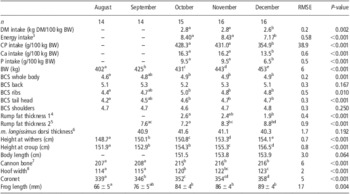
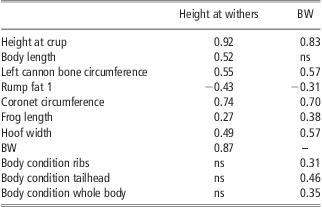
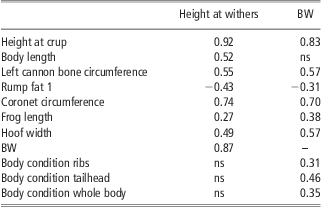
DM, energy and CP intake were similar from October to November and decreased (P < 0.05) in December (Table 2). There was an increase (P < 0.05) in BW (+51 kg), total BCS (+0.3), height at withers (+5.4 cm), height at croup (+4.6 cm), cannon bone circumference (+9 mm) and hoof size (hoof width +9 mm, coronet circumference +19 mm and frog length +23 mm) from August to December (Table 2). Body size, height at withers and BW were correlated with several other size parameters (Table 3). The thickness of rump fat 1 decreased from October to December (−0.7 mm, P < 0.001), but rump fat 2 increased during the same period (+1.2 mm, P < 0.05, Table 2). The glycogen content in the m. gluteus medius was 532 ± 56 mmol/kg dry weight (DW) in December. Muscle fiber-type composition was 29 ± 7% type I, 40 ± 7% type IIA and 31 ± 7% type IIB fibers.
Daily DM, energy, CP, Ca and P intake, BW, BCS1 and body measurements in yearlings in training fed a forage-only diet ad libitum from breaking in August to December the same year2

DM = dry matter; Ca = calcium; P = phosphorus; BCS = body condition score; RMSE = root mean standard error.
1According to Henneke et al. (Reference Henneke, Potter, Kreider and Yeates1983).
2Values presented as least square means and RMSE.
3Mcal digestible energy/100 kg BW.
4Measured 5 cm from the middle line at croup (mm).
5Measured 15 cm caudal from rump fat 1 (mm).
6Measured at the first lumbar vertebra (mm).
7Circumference below carpus (mm).
8Measured at the bottom before trimming (mm).
a,b,c,dSmall letters indicate differences between months (Tukey's test, P < 0.05).
Correlations between monthly body size measurements1 in yearlings in training fed a forage-only diet ad libitum from breaking in August to December the same year
1For explanations see Table 2.
Correlations were considered significant if P < 0.05, ns = no significant correlation.
Training
The number of training days varied between months (P < 0.05), but the total distance trained increased from October to December (P < 0.05, Table 4). There was a tendency for a reduced mean HR during the third kilometer (P < 0.07), and HR 3 min after exercise was significantly lower in December than in October (Table 4). The plasma lactate concentration after exercise in December was 1.7 ± 1.8 mmol/l (range 0.6 to 7.6 mmol/l for all horses; range 0.6 to 2.5 for 15 horses and 7.6 mmol/l for one horse).
Amount of training and HR during and following an exercise test performed in October and December in yearlings fed a forage-only diet ad libitum from breaking in August to December1

HR = heart rate; RMSE = root mean standard error.
1Values presented as least square means and RMSE.
2The amount was to some extent dependent on track conditions and the amount of staff available.
3Mean HR during the third km of the exercise test.
4HR 3 min after the exercise test.
a,b,cSmall letters indicate differences between months (Tukey's test, P < 0.05).
Health
There were no differences in total health scores, leg remarks and lameness between October and November (Table 5). During the whole study, 13 horses received veterinary treatment. Six horses had hoof-related problems, four had wounds and three horses had both hoof-related problems and wounds that required veterinary treatment. One of the wounded horses also had an esophageal impaction when fed dry pelleted lucerne. No other possible feed-related disorders or stereotypic behaviors were observed. The number of training days lost because of health-related problems was less than one per month, except during November when more than 5 days were lost (Table 5).
Possible training days and lost training days per month due to health problems, total health points, sum of remarks on legs and lameness assessed by an independent veterinarian in yearlings in training fed a forage-only diet ad libitum from breaking in August to December the same year1

RMSE = root mean standard error.
1Values presented as least square means and RMSE.
2Days per month when training was possible because training staff was available.
a,bSmall letters indicate differences between months (Tukey's test, P < 0.05).
Muscle and exercise response correlations
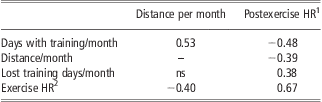
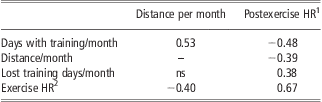
HR 3 min after exercise was negatively correlated to the amount of training (Table 6), and HR during exercise was positively correlated to the percentage of type IIB fiber (R = 0.67, P < 0.01). The percentage of fiber type IIA was positively correlated to rump fat (site 2; R = 0.62, P < 0.05). Muscle fiber type I was positively correlated to BCS at the back (R = −0.52, P < 0.05), and the thickness of m. longissimus dorsi was positively correlated to BCS total (0.32, P < 0.05), BCS ribs (R = 0.33, P < 0.01) and BCS tailhead (R = 0.28, P < 0.05) but not to BCS back. There were no correlations between muscle glycogen and the other parameters.
Correlations between training distance and postexercise HR and other parameters in yearlings in training fed a forage-only diet ad libitum from breaking in August to December the same year
HR = heart rate.
1HR 3 min after a standardized exercise test.
2Mean HR during the third km of a standardized exercise test.
Correlations were considered significant if P < 0.05, ns = no significant correlation.
Discussion
Growth and diet
All body measurements, except body length and m. longissimus dorsi thickness, increased as well as body condition and rump fat thickness at site 2 closest to the tail, showing that growth and also some fattening occurred. Many of the body measurements were also highly correlated to BW and height at withers. The body measurement that was amplified the most was frog length, which increased by 35% from August to December. There are no studies on growth in American Standardbreds in the same age as in the present study, but the height at withers at 18 months was similar to that found in French Standardbred horses (152 cm (Valette et al., Reference Valette, Robert and Denoix2008)). Horses in the present study were on average 2.8 cm taller at croup than at withers, which is similar (2.1 cm) to what was reported by Sandgren et al. (Reference Sandgren, Dalin, Carlsten and Lundeheim1993) for 14.5-month-old colts. However, the increase in BW (12.7%) was numerically larger in the present study than described earlier in horses of other light breeds (9.4% to 10.6% (Bigot et al., Reference Bigot, Trillaud-Geyl, Jussiaux and Martin-Rosset1987; Thompson, Reference Thompson1995)). In addition, the increase in withers height (3.6%) was larger than described in other light breeds (1.7% to 2.3% (Trillaud-Geyl et al., Reference Trillaud-Geyl, Bigot, Jurquet, Bayle, Arnaud, Dubroeucq, Jussiaux and Martin-Rosset1992; Thompson, Reference Thompson1995)). We therefore suggest that a forage-only diet with a high-energy and -nutrient content fed ad libitum appears not to limit the growth of horses in training. One reason for a high growth rate in the present study might be that the horses had free access to feed. Cymbaluk et al. (Reference Cymbaluk, Christison and Leach1989) reported that horses aged 6 to 24 months fed ad libitum gained on average 24% more BW and 11% more height than yearlings fed according to recommendations by National Research Council (NRC, 1978). Our results indicate that NRC, still in the 2007 issue, may underestimate the needs of yearlings in training, as the estimated daily energy intake in the present study was 48% higher than the requirements suggested by NRC for 18-month-old horses subjected to moderate exercise. The reason for the lowered feed intake in December is unclear but might be because of a forage change 2 weeks before the measurement.
The muscle glycogen content in the horses in the present study was 35% higher than previously reported in Standardbred yearlings (Lindholm and Piehl, Reference Lindholm and Piehl1974). The reason for this large difference might be that our horses were more trained and ∼6 months older, as age and training have been shown to increase muscle glycogen content (Lindholm and Piehl, Reference Lindholm and Piehl1974). The diet may also have supported a high glycogen content, as earlier observations on adult horses show that a high CP in forage, as in the present study, elevates glycogen content (Essen-Gustavsson et al., Reference Essen-Gustavsson, Connysson and Jansson2010). This study indicates that glycogen levels of young horses in training fed a high-energy forage-only diet are almost similar to what has been reported in adult Standardbred horses in training on both concentrate (572 mmol/kg DW (Jansson et al., Reference Jansson, Nyman, Lindholm and Lindberg2002)) and forage diets (552 to 630 mmol/kg DW (Essen-Gustavsson et al., Reference Essen-Gustavsson, Connysson and Jansson2010)).
Health
To our knowledge, there are no other studies on health in group-housed colts in training; thus, comparisons are difficult to make. However, the horses had high health scores, slightly higher than reported in, for example, 4-year-old riding horses (7.8 to 8.2, Wallin et al. (Reference Wallin, Strandberg and Philipsson2001)). Training days lost due to health problems were also low, generally lower than 1 day/month and in total <10%, which is lower than has been reported (27%) for 2-year-old Thoroughbred horses in training (Dyson et al., Reference Dyson, Jackson, Pfeiffer and Price2008). Most of the problems appeared not to be training induced but traumatic (hoof boils and wounds) and probably happened during the time that horses spent outside in the paddock. Yearling stallions housed together can be expected to play and thereby accidentally injure themselves or each other. In November, when most training days were lost due to health problems, the horses were shoed with spikes, which may have caused some of the wounds that required treatment. Only one health problem could be linked directly to the feeding (esophageal impaction in one horse). This occurred early in the study; after this incident the pelleted lucerne was soaked in water before being fed to all horses and no further impactions were observed.
Body condition and fat
The horses had a similar BCS as described earlier for Standardbred horses in training (Gallagher et al., Reference Gallagher, Leech and Stowe1992). The positive correlation between BW and BCS total (R = 0.35) is in agreement with the studies conducted by both Leleu and Cotrel (Reference Leleu and Cotrel2006), who reported a similar correlation (R = 0.34) in 2-year-old Standardbreds in training, and Henneke et al. (Reference Henneke, Potter, Kreider and Yeates1983), who observed adult quarter horse mares (R = 0.50). In the present study, there was no correlation between BCS total and rump fat 1, which may have been because all horses were in quite similar body condition (s.e. for BCS total = 0.05), but Henneke et al. (Reference Henneke, Potter, Kreider and Yeates1983) and Leleu and Cotrel (Reference Leleu and Cotrel2006) found correlations of 0.65 and 0.64, respectively, for BCS and percentage total body fat calculated using rump fat 1 and equations by Westervelt et al. (Reference Westervelt, Stouffer, Hintz and Schryver1976) and Kane et al. (Reference Kane, Fisher, Parret and Lawrence1987). Using the original equation of Westerveldt et al. (% body fat = 8.64 + 4.70 × rump fat 1 in cm), body fat content of the horses in the present study was calculated to be 9.9%, 9.8% and 9.5% in October, November and December, respectively. This is similar to what that reported by Kearns et al. (Reference Kearns, McKeever, Kumagai and Abe2002) in elite Standardbred horses (7% to 10% body fat). However, although Kearns et al. (Reference Kearns, McKeever, Kumagai and Abe2002) and Leleu and Cotrel (Reference Leleu and Cotrel2006) measured rump fat 1, they used an equation developed by Kane et al. (Reference Kane, Fisher, Parret and Lawrence1987), which includes a rump fat measurement more caudal than rump fat 1. Therefore, their results are difficult to interpret. Using Kane et al.'s (Reference Kane, Fisher, Parret and Lawrence1987) equation and rump fat 1 (% body fat = 2.47 + 5.47 × rump fat 1 in cm) in the present study also resulted in comparatively low estimated body fat contents (3.9%, 3.8% and 3.5% in October, November and December, respectively). Kearns et al. (Reference Kearns, McKeever, Kumagai and Abe2002) also measured the thickest part in the observed position, whereas we measured at the center of the position. The discrepancy shows the importance of standardization of body fat measurements and equations. However, a body fat content around 9% in the present horses is also supported by the results of Martin-Rosset et al. (Reference Martin-Rosset, Vernet, Dubroeucq, Arnaud, Picard and Vermorel2008) who showed a high correlation (R 2 = 0.99) between BCS and total body fat content. Using the equation (% body fat = 5.868 exp. 0.563 × BCS) suggested by Martin-Rosset et al. (Reference Martin-Rosset, Vernet, Dubroeucq, Arnaud, Picard and Vermorel2008) and converted BCS (BCS 4 and 5 in the scale by Henneke et al. (Reference Henneke, Potter, Kreider and Yeates1983) was converted to BCS 3 and 3.25 in the scale used by these authors (Martin-Rosset, W., pers. comm.) the body fat content of the horses in the present study would be 8.6% and 8.4% in August and September, respectively, and 7.9% in October, November and December. The relevance of the positive correlation between BCS total, but not BCS back, and thickness of m. longissimus dorsi is unclear, as well as the positive correlation between rump fat (site 2) and amount of muscle fiber type IIA.
Training
According to the trainer, the horses underwent sufficient training to improve fitness and reach the goal of trotting 5 to 7 km at a speed of ∼5.6 m/s in a vigorous way at the end of the study. This is supported by the fact that all 16 horses completed the standardized exercise test in December and showed a lowered HR during recovery and a tendency for a lowered HR during exercise. However, the racetrack surface was in October sand and in December ice and horses were shoed with spikes, which may have affected the HR response to exercise. Interestingly, but not surprisingly, there was a negative correlation between training distance and HR during exercise, a positive correlation between lost training days and recovery HR and a negative correlation between the amount of training (days and distance) and recovery HR, indicating the importance of training for improved circulatory response (i.e. reduced HR during and after exercise). In addition, the lack of correlations between any of the body size parameters and HR during or after exercise implies that the reduction in HR was mainly a result of training and not due to growth. The horse that underwent the most training exercised for a total of 68 days and 271 km during the study, and the horse that underwent the least training exercised for 35 days and 132 km. Therefore, a difference in training in the range of 33 days and 139 km during a 4-month period seems to be enough to cause differences in the training response. That a few weeks of submaximal training may improve aerobic capacity (oxygen uptake) has been shown earlier in adult horses (Knight et al., Reference Knight, Sinha and Rose1991). However, the response to exercise was also affected by the amount of type IIB fibers (fast twitch, low oxidative) indicated by the positive correlation with HR during exercise. Training is known to decrease the amount of IIB fibers (Essen-Gustavsson et al., Reference Essen-Gustavsson, Lindholm, McMiken, Persson and Thornton1983), and in 2-year-old Standardbreds a correlation between type IIB and plasma lactate concentration has been shown earlier (Roneus et al., Reference Roneus, Essen-Gustavsson, Johnston, Drevemo and Persson1995). A similar correlation was also observed in the present study (data not shown); however, the significance of this correlation depended on the horse with the highest plasma lactate concentration. In agreement with earlier studies on yearlings, fiber-type composition was shown to vary among the horses. The proportion of muscle fibers in the present study was in accordance with earlier observations on Standardbred yearlings by Lindholm and Piehl (Reference Lindholm and Piehl1974), but the proportion of type I fibers was somewhat higher and the proportion of IIB lower than reported by Essen-Gustavsson et al. (Reference Essen-Gustavsson, Lindholm, McMiken, Persson and Thornton1983). The variation in fiber types among yearlings is mostly due to hereditary factors, whereas training is an important factor known to alter fiber composition when horses get older (Essen-Gustavsson et al., Reference Essen-Gustavsson, Lindholm, McMiken, Persson and Thornton1983).
Conclusions
This is the first time that a holistic, long-term study on growth, training response and health in 1.5-year-old Standardbred horses on a forage-only diet has been conducted. The study indicates that yearlings in training fed high-energy forage ad libitum may: (1) grow at least as well as earlier observations on yearlings; (2) have a body condition and muscle glycogen content within the normal range of athletic horses; (3) reach a conventional exercise goal and dependent on the amount of training, showing a reduced exercise HR response; and (4) have high health scores in veterinary examination and few training days lost due to health problems.
Acknowledgements
The authors thank Karin Ericson, Roger Persson, Jan Halberg, Lars Åke Svärdfeldt, Johanna Svensson, Malin Connysson and the facility services and farriers at Wången, Polar Finland, the trainers Stig H. Johansson and Thomas Uhrberg, pupils and students at Wången and SLU, Kristina Karlström and Kristina Andersson at SLU and the breeders Staffan Nilsson (Staro International AB), Sune Svedberg (Broline International AB), Karl Erik Bender (Stuteri Palema) and Arendt Cederqvist.