I. INTRODUCTION
The 7XXX series aluminum alloys are very attractive to automotive and aerospace industries due to their high strength to density ratio, Reference Heinz, Haszler, Keidel, Moldenhauer, Benedictus and Miller1–Reference Willliams James and Starke Jr Edgar3 high fracture toughness and good resistance to the stress corrosion cracking. Reference Grant4–Reference Yan, Chen, Liu and Li6 Although the high zinc content in this type of alloys improve the mechanical properties, Reference Davis7,Reference Juarez-Islas, Perez, Lengsfeld and Lavernia8 it also causes grain coarsening and macrosegregation due to the relatively low cooling rate in conventional casting process. Reference Wang, Xiong, Zhang, Zhang, Wangg, Zhu and Liu9,Reference Bai, Hou, Zhang, Zhao and Xing10 Previous work indicated that the majority of such disadvantages associated with the cast Al–Zn–Mg–Cu alloys containing up to 12% Zn can be overcome by spray deposition, because of it's high solidification cooling rate. Reference Jia, Cao, Ning and Sun11–Reference Cai, Lang, Cao and Zhang16 In this process, the molten metal is atomized in a high pressure inert gas, producing tiny liquid droplets. Such droplets are then cooled and accelerated by the high pressure gas towards a rotating substrate, finally it can be built up to form a high density deposit with the required shape. Reference Jia, Cao, Guo and Sun17,Reference Ning, Guo, Cao, Wang and Sun18 Generally, the spray-formed alloys have higher tensile strength, compared with the conventional castings.
The strength of the Al–Zn–Mg–Cu alloys can be effectively improved by increasing the Zn and Mg contents through precipitation hardening. However, high contents of Zn and Mg can lead to the decrease in hot workability. Reference Ning, Guo, Cao, Wang and Sun18,Reference Zhang, Li, Yuan, Peng and Peng19 As typical wrought Al alloys, 7XXX series alloys are subject to hot forming after casting to minimize and even eliminated the cast defects and refine the grains. Reference Bergsma, Kassner, Li and Wall20–Reference Li, Li, Cai, Wang, Yuan and Xue23
Thermo-mechanical process has been regarded as an emerging technology for hot forming of the 7XXX series alloys. In the past years, the microstructural evolution of this type of alloy during thermo-mechanical process has been considerable studied, including the 7075 alloy, Reference Rokni, Zarei-Hanzake, Roostaei and Abedi24–Reference Kim, Yeom, lee, Lim and Park26 the 7150 alloy, Reference Jin, Zhang, Han, Wu and Chen27,Reference Oliveira, de Barros, Cardoso and Travessa28 and the 7050 alloy. Reference Hu, Zhen, Yang, Shao and Zhang29
Normally, the spray formed Al–Zn–Mg–Cu–Zr–Sc alloy contains higher alloy contents than the cast alloy. For example, Zn can be up to 12 wt%. Because the spray formed alloys are subjected to hot compression to minimize the casting defects, the microstructural evolution during this process is critical in controlling the mechanical properties of the alloys. Reference Jia, Cao, Guo, Ma, Liu and Sun30 But, it is still unclear and not fully understood how the microstructure changes during hot compression process. This limits the potential to further improve the mechanical behavior of this type of alloys, such as the strength and the ductility. Hence, the overall aim of the present work is to investigate the microstructural evolution of a spray deposited Al–Zn–Mg–Cu–Zr–Sc alloy in a hot compression process.
II. EXPERIMENTAL PROCEDURE
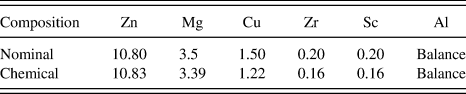
An Al–10.83Zn–3.39Mg–1.22Cu–0.16Zr–0.16Sc alloy was firstly melted and then superheated to 1073 K in an induction furnace followed by atomization in nitrogen gas with 1.8 MPa pressure. The atomizer–substrate distance was 480 mm, and a 3.2 mm in diameter delivery tube was used. The substrate was rotated at 85 rpm and simultaneously withdrawn at 60 mm/min. The chemical composition of the ally was measured by inductively coupled plasma-atomic emission spectroscopy (ICP-AES).
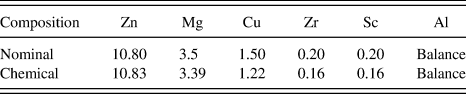
The nominal composition and chemical composition of the alloy investigated were shown in Table I.
The nominal composition and chemical composition of the alloy (wt%).
The deposited ingot was machined into 8 mm in diameter and 12 mm high cylindrical samples. Then the samples were compressed along the cylindrical axis at elevated temperatures in a Gleeble-1500D Instron electronic universal material testing machine (Dynamic Systems Inc., New York, New York). The compression temperature varied from 613 K to 733 K and the initial strain rates of the compression were 1 s−1, 10−1 s−1, 10−2 s−1, and 10−3 s−1, respectively. Before testing, the samples were heated to the designed temperatures at heating rate of 5 K/s, followed by isothermal holding for 5 min to obtain temperature uniformity. To minimize the friction between specimen and punch, graphite powder was used as a lubricant. The compressed samples were then water quenched.
Specimens for transmission electron microscope (TEM) analysis were prepared in the following steps: 3 mm in diameter discs were cut from the hot deformed billets, followed by mechanical grinding to 0.07 mm thick. The thin foils were then thinned by twin-jet electropolishing using an electrolyte of 30% nitride acid and ethanol at −40 °C. All thin TEM foils were examined in a PHILIPS CM12 TEM operated at 120 kV (FEI Company, Almelo, The Netherlands).
III. RESULTS AND DISCUSSION
A. Dissolution of the secondary phase during hot compression
Previous work
Reference Jia, Cao, Ning and Sun11,Reference Guo, Ning, Zhang, Cao and Sun31,Reference Ning, Guo, Cao, Wang, Li and Sun32
showed that the microstructure of the Al–Zn–Mg–Cu–Sc–Zr alloy produced through spray deposition contains large amount of secondary phases, including the η-MgZn2 phase distributed either along the grain boundaries or within the grains and the Al3(ScZr) phase along the grain boundaries. TEM examination indicated that these secondary phases were fragmented and partially dissolved during hot compression process. Figure 1 shows typical TEM bright field (BF) images and the corresponding selected area electron diffraction (SAED) patterns taken from the sample that was hot compressed at 613 K with strain rate of 10−3 s−1. The large particles along grain boundaries shown in Fig. 1(a) are the Al3(ScZr) phase. However, in some areas, Al3(ScZr) particle pairs were observed along the grain boundaries as shown in Fig. 1(b). Indexing of the corresponding nanobeam diffraction pattern shown in Fig. 1(c) verified that the particle pair has twin relationship with twinning plane of
 $\left( {\bar 111} \right)$
and twinning direction of [211]. It is considered that the twinning particle pairs were resulted from the breakage of the primarily formed Al3(ScZr) particle during the hot compression because some of the primary Al3(ScZr) particles in the spray deposited alloy has already had twin relation.
Reference Ning, Guo, Cao, Wang, Li and Sun32,Reference Guo and Ohtera33
In addition, due to the low diffusion rate, it was very hard to completely dissolve the Al3(ScZr) phase into the matrix.
Reference Liebermann34
Thus, some of the primary Al3(ScZr) particles remained after the hot compression. However, the primary MgZn2 phase was completely dissolved into the matrix. TEM examination of the samples that were deformed at 693 K with strain rate of 10−3 s−1 observed nanometer scaled(∼200 nm) secondary η-MgZn2 particles as shown in Fig. 2(b). The morphology of the secondary η-MgZn2 phase is different from that of the primary η-MgZn2. The former is nanometer scaled particles in elliptical shape, but the latter is formed within the grains during the spray deposition,
Reference Guo, Ning, Zhang, Cao and Sun31
and in irregular bulk shape as shown in Fig. 2(a).
TEM micrographs and the corresponding SAED patterns of the spray formed Al–Zn–Mg–Cu–Sr–Zr alloy after hot compression at 613 K with strain rate of 10−3 s−1. (a) TEM and SAED patterns showing the intergranular Al3(ScZr) phase; (b) BF image showing the twin Al3(ScZr) particles; (c) the corresponding nanobeam diffraction pattern showing the twin relationship.

TEM micrograph and SAED patterns of secondary phases in as-deposited and hot-deformed alloy at 693 K with strain rate of 10−3 s−1. (a) As-deposited alloy; (b) BF image showing the η-MgZn2 phase; (c) the SAED pattern of MgZn2 phase; (d) microdiffraction pattern of CuMgZn phase.

In addition, in the hot compressed sample, nanometer scaled CuMgZn particles were also observed and were identified by the SAED pattern, as shown in Fig. 2(d). It is considered that the observed CuMgZn particles along the grain boundaries were formed from the fracture of the eutectic phase formed during the solidification of the spray deposition. They were then embedded within the grains due to the strain-induced boundary migration after the compression process. Furthermore, the dissolution process of the primary phase is also closely related to the deformation temperature. More primary phase can be dissolved into the matrix at higher compression temperatures.
B. Precipitation of secondary phase and its effect on recrystallization
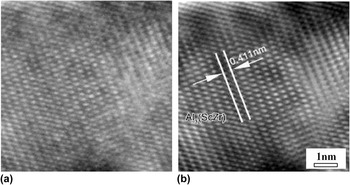
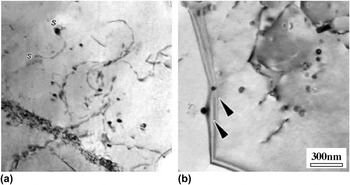
In addition to the dissolution of the primary phase, it was found that new phase also precipitated from the matrix during the hot compression process. Figure 3 shows typical TEM BF images of the nanometer scaled secondary precipitates. Figure 4 is the associated high-resolution electron microscopy (HREM) image and the Fourier transformation (FFT) filtered image. TEM examination confirmed that these nanoparticles are Al3(ScZr) phase that has L12 structure with lattice parameter of a = 0.411 nm. Coffee Bean-Like contrast indicates that these secondary particles are coherent with the matrix. Reference Yin, Pan, Zhang and Jiang35 In addition, the deformation temperature was also very crucial in precipitation of the Al3(ScZr). Increasing the hot compression temperature from 613 K to 733 K led to an significant increase in the volume fraction of the Al3(ScZr) phase even within a short deformation duration. Dispersive fine secondary Al3(ScZr) particles can act as barriers for the movement of both dislocations and grain boundaries. As a result, the recrystallization of the matrix was slowed down because of the formed metals recrystallization nucleation of recrystallization that relies on the movement of both dislocations and grain boundaries. Reference Jia, Royset, Solberg and Liu36 The TEM BF images in Fig. 5 shows the interaction between the Al3(ScZr) particles and the dislocations and grain boundaries as pointed by the arrows.
TEM micrographs showing dispersive Al3(ScZr) particles in the spray formed Al alloy after hot compression. (a) 613 K with strain rate of 10−3 s−1; (b) 693 K with strain rate of 10−2 s−1.

Dispersive Al3(ScZr) particles in the spray formed Al alloy after hot compression at 693 K with strain rate of 10−2 s−1. (a) HREM micrograph; (b) FFT filtered image.

TEM BF micrograph of the dispersive Al3(ScZr) particles in the hot compression spray formed Al alloy showing the interaction of the particles. (a) Dislocations; (b) grain boundary.

Dislocations normally tend to cut through coherent small particle. Hence, in addition to the coherent stress field surrounding the particle that suppresses the dislocation movement, the so called antiphase-domain boundary also formed associated with the Al3(ScZr) second particles, which contributed to the strengthening. The resist shear force to the dislocation caused by such boundary can be expressed by the following equation: Reference Huang37
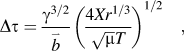 $${\rm{\Delta }}\tau = {{\gamma ^{{3 \mathord{\left/ {\vphantom {3 2}} \right. \kern-\nulldelimiterspace} 2}} } \over {\mathord{\buildrel{\lower3pt\hbox{$\scriptscriptstyle\rightharpoonup$}}\over b} }}\left( {{{4Xr^{{1 \mathord{\left/ {\vphantom {1 3}} \right. \kern-\nulldelimiterspace} 3}} } \over {\sqrt \mu T}}} \right)^{{1 \mathord{\left/ {\vphantom {1 2}} \right. \kern-\nulldelimiterspace} 2}} \quad ,$$
where γ denotes the antidomain boundary energy, X is the volume fraction of precipitate, r represents the radius of the particle,
 $\mathord{\buildrel{\lower3pt\hbox{$\scriptscriptstyle\rightharpoonup$}}\over b}$
is the Burger vector of the passing dislocation, μ is the shear modulus, and T is the dislocation line tension.
The critical shear stress increment due to the forming of the antiphase-domain boundary is much higher than that of coherent interface energy. Therefore, the secondary Al3(ScZr) particles were very effective in pinning the dislocations. Reference Riddle and Sanders38
The resist force from the secondary phase particles to the sub-grain and grain boundaries can be expressed by the following equation: Reference Yu, Li, Li and Zhao39
 $${F_{\rm{z}}} = {{3X\gamma } \over {2r}}\quad ,$$
where γ denotes interfacial energy. Thus, higher volume fraction of the secondary particles and smaller particle size correspond to a higher resist force. Because of the large fraction and nanometer scaled size, the secondary Al3(ScZr) particles formed in the hot compression process in the spray formed Al alloy can effectively increase the recrystallization temperature of the alloy. Reference Zou, Pan, He, Wang and Liang40,Reference Senkov, Shagiev, Senkova and Miracle41
The secondary precipitation of the η-MgZn2 phase was only observed in the sample deformed at the higher temperature of 733 K. TEM examination showed that this type of precipitates are in disk-shape and precipitated on the {111} planes of the α-Al phase as shown in Fig. 6. The TEM micrograph shown in Fig. 6(a) was taken along the
 ${\left[ {\bar 110} \right]_{{\rm{Al}}}}$
zone axis. The average sizes of these precipitates are around 155 nm along the
 $\left( {11\bar 1} \right)$
plane and 26 nm along (111) plane.
TEM BF micrograph with beam direction
 $\left[ {\bar 110} \right]$
showing η phase precipitates in spray formed Al alloy after hot-deformed at 733 K with strain rate of 10−3 s−1. (a) Plate-liked η precipitates; (b) interaction between the η precipitates and the subgrain boundaries.

The η-MgZn2 precipitates can also pin down the grain boundary movement. Reference Ning, Cao, Guo, Wang, Zhao, Li and Sun42,Reference Salamci43 Fig. 6(b) shows the interaction between the η-MgZn2 particles and the grain boundaries as pointed by the arrows.
Due to the large size and incoherency with the matrix, dislocations tended to bypass the disk-shaped η-MgZn2 precipitates by means of Orowan mechanism. The resultant resist force can be calculated using the following equation: Reference Yu, Li, Li and Zhao39
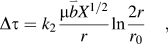 $${\rm{\Delta }}\tau = k_2 {{\mu \mathord{\buildrel{\lower3pt\hbox{$\scriptscriptstyle\rightharpoonup$}}\over b} X^{{1 \mathord{\left/ {\vphantom {1 2}} \right. \kern-\nulldelimiterspace} 2}} } \over r}\ln {{2r} \over {r_0 }}\quad ,$$
where k 2 is constant, X denotes volume fraction of the secondary phase, μ is shear modulus, r represents radius of precipitate, r 0 is radius of dislocation core. The Eq. (3) can be simplified to Eq. (4):
 $$\Delta \tau \approx \alpha {X^{{1 \mathord{\left/ {\vphantom {1 2}} \right. \kern-\nulldelimiterspace} 2}}}{r^{ - 1}}\quad .$$
Thus, the resist force generated by disk-shaped η-MgZn2 precipitates also increased with the increase in volume fraction and decrease in size of the η-MgZn2 particles. Hence, the η-MgZn2 particles can also contributed to the retardation of matrix recrystallization.
C. Slip of dislocation
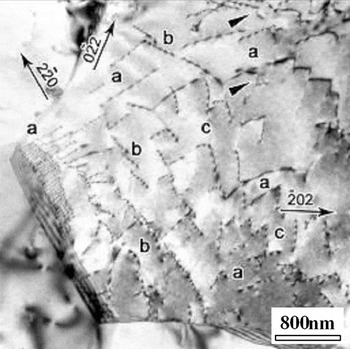
As a typical face centered cubic metal, the deformation of spray formed Al alloy at elevated temperatures occurs through dislocation slip. Figure 7 shows typical dislocation slip within an Al grain in the sample that was deformed at 693 K with strain rate of 10−3 s−1. The dislocation slipped in three directions 〈111〉Al. The morphologies and moving direction indicate that they were perfect dislocation. The slip systems at positions a, b, and c were determined to be (111)
 $\left[ {1\bar 10} \right]$
,
 $( {\bar 111} ) [ {0\bar 11} ]$
and
 $( {1\bar 11} ) [ {\bar 101} ]$
. Furthermore, most dislocations are associated with Super jog, as pointed by arrows in Fig. 7.
TEM BF image taken along the beam direction of [111], showing dislocation configuration of spray formed Al alloy after hot compression at 693 K with strain rate of 10−3 s−1.

Horizontal movement of some dislocations was observed as exhibited in Fig. 8. They were also perfect dislocations due to the same Burger vector. The beam direction of
 $\left[ {\bar 10\bar 1} \right]$
was defined by both
 $\mathord{\buildrel{\lower3pt\hbox{$\scriptscriptstyle\rightharpoonup$}}\over g} = \left( {020} \right)$
and
 $\mathord{\buildrel{\lower3pt\hbox{$\scriptscriptstyle\rightharpoonup$}}\over g} = \left( {11\bar 1} \right)$
. When the sample was rotated to
 $\left[ {\bar 21\bar 1} \right]$
direction and imaged by double-beams
 $\mathord{\buildrel{\lower3pt\hbox{$\scriptscriptstyle\rightharpoonup$}}\over g} = \left( {1\bar 1\bar 3} \right)$
, the dislocations were still contrasted. According to light extinction criterion
 $\mathord{\buildrel{\lower3pt\hbox{$\scriptscriptstyle\rightharpoonup$}}\over g} \cdot \mathord{\buildrel{\lower3pt\hbox{$\scriptscriptstyle\rightharpoonup$}}\over b} = 0$
, they were confirmed to be 1/2
 $\left[ {01\bar 1} \right]$
typical perfect dislocations.
TEM two-beam BF images showing dislocation structure of the spray formed Al alloy after hot compression at 693 K with strain rate of 10−3 s−1. (a) Image taken in (020) two-beam direction; (b) in
 $\left( {11\bar 1} \right)$
two-beam conditions.

IV. CONCLUSIONS
The study on the microstructure evolution of a spray formed Al–10.83Zn–3.39Mg–1.22Cu–0.16Zr–0.16Sc alloy during hot compression process within the temperature range from 613 K to 733 K and at different initial strain rate has led to following conclusions:
-
(1) The primarily formed MgZn2 phase completely dissolved and the Al3(ScZr) particles partially dissolved into the matrix, new and nanometer scaled secondary phases (MgZn2) and Al3(ScZr) precipitated during hot compression of the spray formed Al–Zn–Mg–Cu–Sc–Zr alloy.
-
(2) The high volume fraction of the fine secondary Al3(ScZr) and MgZn2 particles precipitated during hot compression effectively retarded the recrystallization of the matrix in the spray formed Al–Zn–Mg–Cu–Sc–Zr alloy through pinning down the movement of dislocations and grain boundaries.
-
(3) During hot compression of the spray formed Al–Zn–Mg–Cu–Sc–Zr, perfect dislocations slipped in three different directions of the 〈110〉Al, which was responsible for the deformation.