Introduction
Sorghum, maize and pearl millet are important crops in Eritrea. They are mainly grown for human food, and their stalks are used for animal feed, construction and fuel (Haile and Hofsvang, Reference Haile and Hofsvang2001). The productivity of these crops in Eritrea is very low due to the damage caused by various pests (Haile and Hofsvang, Reference Haile and Hofsvang2001). Among the insect pests that affect these crops, stemborers, including Busseola fusca (Fuller) (Lepidoptera: Noctuidae) and Chilo partellus (Swinhoe) (Lepidoptera: Pyralidae), are very important. Busseola fusca is dominant in the highlands (over 1500 m), whereas C. partellus is more common at the lower attitudes (less than 1500 m) of Eritrea (Haile and Hofsvang, Reference Haile and Hofsvang2001). Yield losses due to stemborers vary from region to region, and are estimated to range from 20 to 80% depending on the level of infestation of the pest and the growth stage of the crop (Walker and Hodson, Reference Walker and Hodson1976; Gebre-Amlak, Reference Gebre-Amlak1985; Macfarlane, Reference Macfarlane1990; Seshu Reddy, Reference Seshu Reddy1991). Busseola fusca causes severe damage and sometimes complete crop failure (Walker and Hodson, Reference Walker and Hodson1976; Seshu Reddy, Reference Seshu Reddy1991). Damage includes leaf perforation, stem tunnelling and deadheart of young sorghum seedlings.
In Nigeria, planting sorghum late in the season resulted in severe stemborer damage and reduced yield (Harris, Reference Harris1962; Macfarlane, Reference Macfarlane1990). Khan and Khan (Reference Khan and Khan1969) in Pakistan found that maize sown early (May) had a lower infestation than maize planted late (end of May to mid-June) when over 71% of the plants became infested. Similar results have been reported from East and southern Africa where maize and sorghum sown in April and early May had a lower infestation than the those planted in late May and June (Van Rensburg et al., Reference Van Rensburg, Walters and Giliomee1987; Gebre-Amlak et al., Reference Gebre-Amlak, Sigvald and Pettersson1989; Mchowa, Reference Mchowa1990). Jotwani et al. (Reference Jotwani, Chandra, Young, Sukhani and Saxena1971) found that resistant varieties integrated with chemical treatment and early sowing date gave good control of stemborers and was found to be economical for small farmers in Africa.
Stemborers are able to survive from one season to another on crop residues as diapausing larvae, in temporally overlapping crop cultivation and on wild host plants (Jepson, Reference Jepson1954; Ingram, Reference Ingram1958; Harris, Reference Harris1962; Haile and Hofsvang, Reference Haile and Hofsvang2001). Many cultivated and wild plants serve as hosts of stemborers (Swaine, Reference Swaine1957; Mathez, Reference Mathez1972; Girling, Reference Girling1978; Seshu Reddy, Reference Seshu Reddy1983; Gebre-Amlak, Reference Gebre-Amlak1988; Khan et al., Reference Khan, Ampong-Nyarko, Chiliswa, Hassanali, Kimani, Lwande, Overholt, Pickett, Smart and Woodcock1997; Le Ru et al., Reference Le Ru, Ong'amo, Moyal, Ngala, Musyoka, Abdullah, Cugala, Defabachew, Haile, Kauma Matama, Lada, Negassi, Pallangyo, Ravolonandrianina, Sidumo, Omwega, Schulthess, Calatayud and Silvain2006). Jepson (Reference Jepson1954) and Ingram (Reference Ingram1958) reported that Poaceae, Cyperaceae and Typhaceae might serve as host plants (Jepson, Reference Jepson1954; Ingram, Reference Ingram1958; Hutter, Reference Hutter1996). The wild host plants act as a reservoir for the stemborers that later migrate to neighbouring crops (Van Emden and Way, Reference Van Emden, Way and van Emden1972). Khan et al. (Reference Khan, Chiliswa, Ampong-Nyarko, Smart, Polaszek, Wandera and Mulaa2003) reported that some wild host plants are preferred and can be used as trap crops in control strategies. A survey of host plants in Eritrea revealed that there are 17 cultivated and wild host plants (Haile and Hofsvang, Reference Haile and Hofsvang2001), and that some of the wild host plants have a higher infestation rate than the cultivated crops.
The aims of the current study were threefold. First, the study aimed to investigate the effect of sowing date on B. fusca incidence in sorghum. Second, the study aimed to identify the preferred host plants of B. fusca for possible future research in trap plants or intercropping. And last, the study aimed to assess the damage caused by the stemborer and to identify the cheapest and most effective pesticides for short-term control of the pest.
Materials and methods
Field studies on sowing date were conducted in Eritrea at Halhal Begos in 2003–2005, at an altitude of 1850 m above the sea level. The trials were conducted on a plot sized 3.75 m by 5 m, with a population of 125 plants per plot using a randomized complete block design with four replications. The spacing between rows and plants was 75 and 20 cm, respectively.
There were six sowing dates planted at 15-day intervals, starting in April and ending in mid-June.
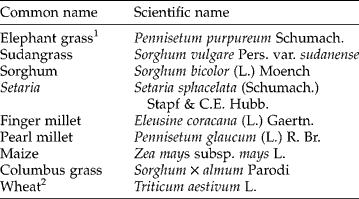
In the host preference trial, eight host plants in the Poaceae family were selected: Sudangrass, Columbus grass, sorghum, maize, pearl millet, finger millet, Setaria and wheat (Table 1). The plot size and the number of replication used were similar to the sowing date. Before planting of the host plants, furrow ridges with a spacing of 75 cm were made. Wheat, Setaria and finger millet were sown on both sides of the ridges, while the rest were sown only on one side of the ridge. The host plants were sown as seed on the same date, except Setaria, which grows very slowly and was seeded 1 month earlier to achieve good establishment and to allow an infestation at the same time as the other hosts.
Common and scientific names of host plants used in the study
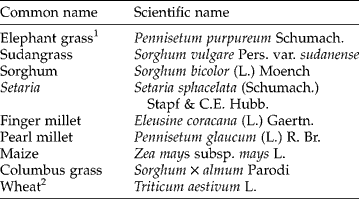
1 Only used in the laboratory study.
2 Only used in the field study.
The insecticide control trials were planted each year in mid-May. Four chemicals plus an untreated plot as a control were used. The chemicals were Thiodan 35% EC (endosulfan), Carbaryl 85% WP, Cymbush 1G (cypermethrin) and Furadan 5G (carbofuran). Thiodan and Carbaryl were sprayed using a knapsack sprayer at 30 and 45 days after germination. Cymbush 1G was applied on the leaf whorl of the plants. Furadan granules were applied manually in the furrow during seeding and 45 days after crop emergence on the leaf whorl of the plants.
Fertilizer, diammonium phosphate (48% P and 18% N), was applied at the rate of 100 kg/ha to all the plots of sowing dates and insecticide trials during seeding. Urea (48% N) was applied 30 days after the emergence of the crops at a rate of 100 kg/ha. All agronomic practices recommended for sorghum production in the area such as seeding rate, weeding schedule, sowing and cultivation were applied to all the trials and treatments uniformly.
Data on egg and larval numbers were recorded at 30, 45 and 60 days after germination from 10 randomly selected plants from the border rows in each plot of the sowing dates and control trials. The selected plants were cut at ground level and the stem and leaf sheaths dissected for egg and larval counts.
Data on percent infestation and pupal counts were taken from the central row of each plot. Percent infestation was measured 60 days after germination from 20 randomly selected plants of the central row of each plot based on the number of infested plants or deadhearts and uninfected plants. Plants that showed a leaf pinhole or leaf perforation and a dead central shoot were considered infested. Plants without pinhole or deadhearts were considered to be uninfected. Pupal counts were made 80 days after germination of the host plants from 10 randomly selected plants in each plot. Losses (mortality) were assessed by calculating the difference between the initial larval count on each host and the final number of pupae per host.
Data of host preference were transformed using square root transformation, and the data in all trials were analysed by analysis of variance of a randomized complete block design (Montgomery, Reference Montgomery1984). Standard error and least significant differences (Student–Newman–Keuls multiple range test) were used to separate the means.
Results
Sowing dates
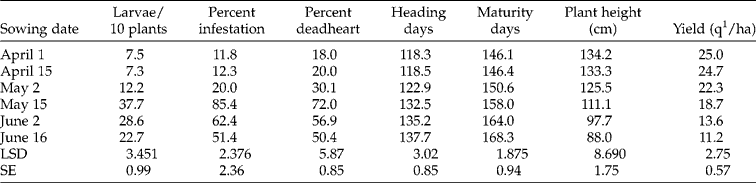
There was a significant (P= 0.01) effect of sowing date on B. fusca larval populations (Table 2). Few larvae were recorded in the April 1 and 15 sowings. The highest number of larvae per 10 plants (38) was obtained from mid-May sowings. June 2 and 16 sowings had higher larval counts than April or early-May sowings. Sowing date also had an effect on time to heading and maturity, plant height and yield of the crop. The early sown crops (April and early-May) had taller plants that matured earlier and produced higher yields. Delay of planting up to mid-May caused a yield reduction of about 25% (Table 2).
Influence of sowing date on Busseola fusca attack in sorghum at Halhal Begos, Eritrea, 2003–2005
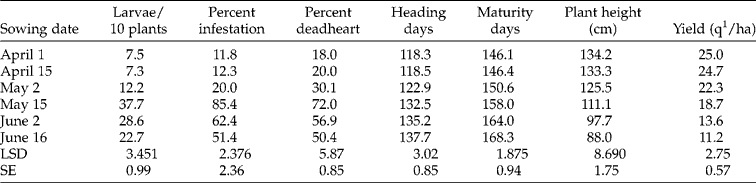
LSD, least significant difference; SE, standard error.
1 q, quintal = 100 kg.
Host preference
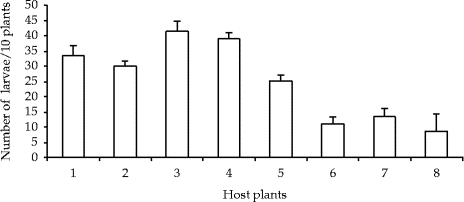
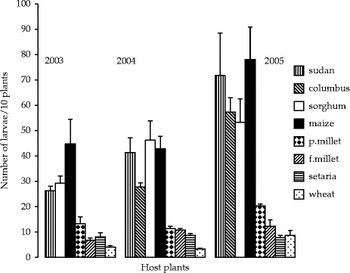
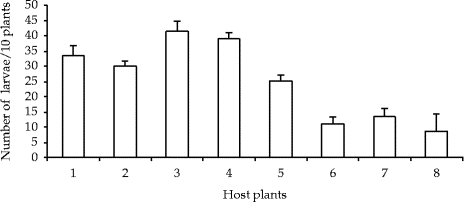
Infestation of host plants by B. fusca larvae is shown in Fig. 1. Infestation varied (1–91%) at the extent of leaf perforations and deadhearts. Sudangrass, Columbus grass, sorghum and maize had more damage than pearl millet, finger millet, Setaria and wheat.
Number of Busseola fusca larvae on different host plants at Halhal Begos in 2003–2005 (error bars represent standard errors). 1, Sudangrass; 2, Columbus grass; 3, sorghum; 4, maize; 5, pearl millet; 6, finger millet; 7, Setaria; and 8, wheat.

Oviposition preference
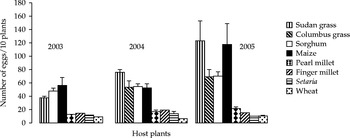
The B. fusca population was variable during the study period. The lowest egg population was recorded in 2003 and then gradually increased in 2004 and 2005. Most eggs were recorded in 2005 (Fig. 2). More oviposition was recorded on Sudangrass, Columbus grass and sorghum compared with pearl millet, finger millet, Setaria and wheat. In 2003, maize had significantly (P= 0.05) more eggs, followed by sorghum and Sudangrass. Pearl millet, finger millet, Setaria and wheat showed no significant differences in oviposition (Fig. 2). In 2004, Sudangrass had significantly (P= 0.01) greater oviposition than maize. The oviposition on maize, sorghum and Columbus grass was not statistically different during 2004. The oviposition in 2005 was higher than that in previous years. The data of 2005 showed that Sudangrass and maize had significantly (P= 0.01) more eggs per plant than the other host plants. Likewise, sorghum and Columbus grass had significantly (P= 0.05) more eggs than pearl millet, finger millet, Setaria and wheat. There were no differences in oviposition preference among the last four host plant species (Fig. 2).
Oviposition preference of Busseola fusca on different host plants at Halhal Begos in 2003–2005 (error bars represent standard errors). 1, Sudangrass; 2, Columbus grass; 3, sorghum; 4, maize; 5, pearl millet; 6, finger millet; 7, Setaria; and 8, wheat.
In general, B. fusca moths preferred to oviposit on Sudangrass, Columbus grass, sorghum and maize rather than on pearl millet, finger millet, Setaria and wheat.
Larval density
Larval density on the different host plants is given in Fig. 2. Busseola fusca larvae were observed on all the host plants tested. In 2003, maize had significantly (P= 0.01) more larvae than other host plants tested (Fig. 3). The number of larvae on Sudangrass and sorghum was significantly (P= 0.05) greater than that on pearl millet, finger millet, Setaria and wheat (Fig. 3). In 2004, B. fusca larvae on maize, sorghum and Sudangrass were significantly (P= 0.05) greater than on Columbus grass. Likewise, Columbus grass had significantly (P= 0.05) more larvae than wheat and Setaria because of their thin stems that are less able to support stemborer larvae than the other hosts (Fig. 3). In 2005, Sudangrass and maize had a greater (P= 0.05) number of larvae than Columbus grass and sorghum. Fewer larvae were recorded on pearl millet, finger millet, Setaria and wheat (Fig. 3). The larval study as a whole showed that maize, Sudangrass, sorghum and Columbus grass had a greater larval population compared with pearl millet, finger millet, Setaria and wheat (Fig. 2).
Number of Busseola fusca larvae on different host plants at Halhal Begos 1997–1999 (Error bars represent standard errors).

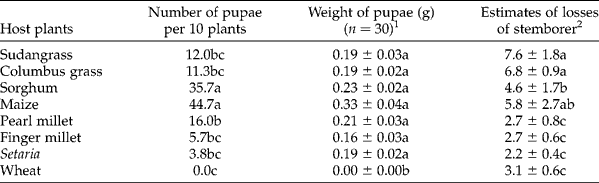
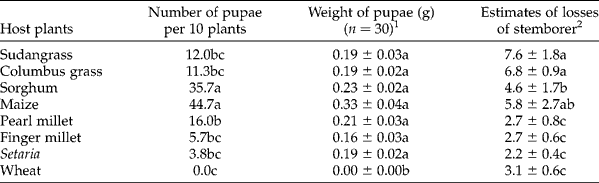
Pupae were recorded in all the hosts except wheat in 2005 (Table 3). Maize and sorghum had significantly (P= 0.05) more pupae than other plants, 44.7 and 35.7 per 10 plants, respectively. There were no significant differences in the pupal weight on different host species.
Number of pupae per plant, weight of pupae and losses of stemborer Busseola fusca on different host plants at Halhal Begos, 2005
Mean values followed by the different letters are significantly different (P= 0.05; Student–Newman–Keuls multiple range test).
1 Mean values ± standard error, df = 14.
2 Losses: see the Materials and Methods section. IPM = Integrated Pest Management; DDT = dichlorodiphenyltrichloroethane; df = degree of freedom.
The difference between larval and pupal populations showed that there was high mortality in all host species. Highest pupal mortality was recorded on Sudangrass and Columbus grass, followed by maize and sorghum (Table 3).
Effect of pesticide
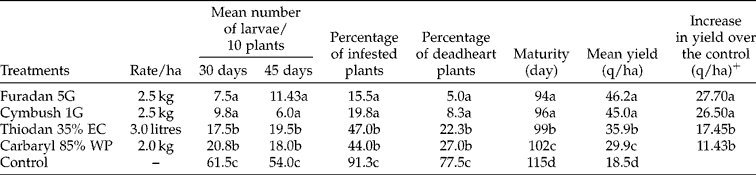
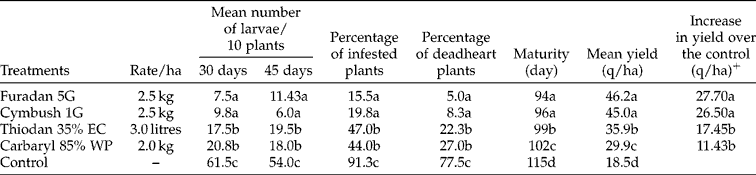
There were significant differences in the number of larvae in the treated and untreated sorghum plots at Halhal Begos in 2003, 2004 and 2005. Furadan and Cymbush had significantly fewer larvae and lower infestation levels and percent deadheart plants than did Thiodan and Carbaryl plots at Halhal Begos (Tables 4–6).
Mean number of stemborer larvae, percent infestation, percent deadheart, number of holes, tunnel length, maturity and yield (q/ha) of sorghum in the insecticide-treated and control plots at Halhal Begos in 2003

Mean values followed by the different letters are significantly different (P= 0.05; Student–Newman–Keuls multiple range test).
+ q = 100 kg.
Mean number of stemborer larvae, percent infestation, percent deadheart, number of holes, tunnel length, maturity and yield (q/ha) of sorghum in the insecticide-treated and untreated plots at Halhal Begos in 2004

Mean values followed by the different letters are significantly different (P= 0.05; Student–Newman–Keuls multiple range of test).
+ q, quintal = 100 kg.
Mean number of stemborer larvae, percent infested plants, percent deadheart plants, maturity and yield (q/ha) of sorghum in the insecticide-treated and control plots at Halhal Begos in 2005
Mean values followed by the different letters are significantly different (P= 0.05; Student–Newman–Keuls multiple range of test).
+ q, quintal = 100 kg.
The number of holes and tunnel length per stalk were used to measure the degree of stemborer infestation. Cymbush and Furadan significantly reduced the number of holes and tunnel length per plant compared with other treatments, whereas Thiodan, Carbaryl and the untreated plots were not significantly different (Tables 3 and 4). Plants in untreated plots were shorter and required longer period to produce panicles and mature compared with treated plots (Tables 4 and 5).
Greatest yields were obtained from Furadan and Cymbush treatments and ranged from 24.3 to 47 q (quintal)/ha (Tables 4–6). Thiodan and Carbaryl also gave significantly greater yields than the untreated controls in all years. Yields for the untreated plots ranged from 16.8 to 21.5 q/ha (Tables 4 and 5). The yield increase in the treated plots ranged from 11.43 to 27.7 q/ha (Table 6).
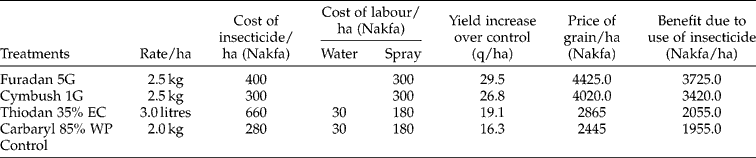
Monetary gain due to the control of B. fusca was calculated for Halhal Begos. The analysis considered rate of application per hectare for each insecticide, cost of labour for spraying, and water collection and transport from a nearby source to the field and price of grain per quintal. All insecticide applications reduced borer infestations, which resulted in increased yields, and income compared with the untreated plots (Table 7). The greatest benefit (29.5 q/ha or 3725.0 Nakfa/ha) was obtained with Furadan treatment. Cymbush, Thiodan and Carbaryl gave benefits of 3420.0, 2055.0 and 1955.0 Nakfa/ha compared with the untreated plots, respectively.
Cost and amount of insecticide, labour wage, yield increase over control, price of grain and benefit due to control of Busseola fusca at Halhal Begos in 2003–2005+
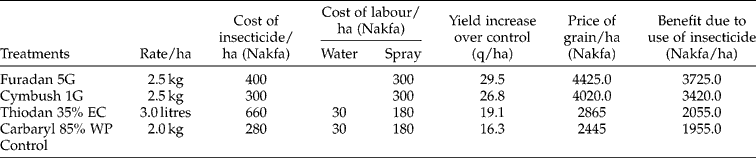
+ Wage per mandays = 15.00 Nakfa, 1 USD = 8.00 Nakfa, 1 quintal = 100 kg, price of 100 kg sorghum grain at harvest = 150.0 Nakfa.
Discussion
The density of B. fusca varied greatly with date of sowing. Sowing sorghum early in the season (April 1 and 15) avoided the likelihood of damage caused by B. fusca. The reason for low damage is that the population of the moth that emerged from diapausing larvae of the previous season is probably very low (Harris, Reference Harris1962). Several earlier workers noted that planting time influenced infestation of stemborers (Swaine, Reference Swaine1957; Gebre-Amlak, et al., Reference Gebre-Amlak, Sigvald and Pettersson1989). Lower rate of damage by the first-generation larvae is due to high mortality of the diapausing larvae during the dry season (Haile A., unpublished observation). In addition, early-planted crops escape the second-generation infestation (June–July) because they are not at a susceptible stage.
Mid-May to mid-June sowing dates showed severe damage from stemborers. In addition, the large populations of the larvae coincide with the susceptible stage of the crop in June–July to cause more damage in sorghum. Harris (Reference Harris1962) found in Nigeria that late planting helps to escape the attack of the first generation, but the younger late-developing plants are much more susceptible to damage by the first generation in June–July and second generation in September–October. During the present study, it was observed that the last three sowing dates (May 15–June 15) were severely infested and damaged both at young (3–6 weeks) and at grain filling stages.
There is an indication for yield increase in the late sowing date; this is due to the damaged plants producing tillers that compensate for yield loss. The damage of stemborer is more severe on maize compared with sorghum and pearl millet because these crops produce tillers that yield grain. Ayalew and Wale (Reference Ayalew and Wale1996) reported in Ethiopia that infestation and damage of B. fusca increased progressively with delay in planting dates. They also reported that early and late sowing dates had 15 and 90% infestation and a yield of 2710 and 87 kg/ha, respectively. In Yemen, several high-yielding varieties of sorghum tested by Ba-Angood and Hubaishan (Reference Ba-Angood and Hubaishan1983) gave significantly higher yields in response to lower infestation in March and April than in May and June. The present results showed high yield losses for every 2 weeks of delayed planting.
In general, cultural control based on the time of planting follows the principle of growing the crop when the pest is not present, or of planting at such a time that the most susceptible stage of crop development coincides with the time when the pest is least abundant (National Research Council, 1969). It has been reported that for centuries, Chinese farmers have used the proper selection of planting dates to prevent damage by the rice borer (Schoenobious incertellus L., Lepidoptera: Pyralidae) (Lawani, Reference Lawani1982).
This study clearly showed that early planting (April) has low B. fusca infestations. Hence, farmers in the highlands of Eritrea should be advised to plant sorghum in April to avoid high losses due to B. fusca damage.
Several cultivated and wild plants serve as host plants of stemborers in Eritrea (Haile and Hofsvang, Reference Haile and Hofsvang2001). Jepson (Reference Jepson1954) and Khan et al. (Reference Khan, Chiliswa, Ampong-Nyarko, Smart, Polaszek, Wandera and Mulaa2003) reported that over 30 plant species serve as host plants in Africa. The majority of the hosts are used for oviposition; few of these hosts support stemborer development from egg to pupal stage (Ingram, Reference Ingram1958; Hutter, Reference Hutter1996). This could be due to the host plants having a thin stem that cannot provide enough food and space for development. The mechanism of host preference during oviposition in relation to the chemistry or physiology of Sudangrass and Columbus grass needs further investigation. The larval field study indicated that maize is the most suitable host for B. fusca (Fig. 3). The greater larval and pupal population and the heaviest pupal weight were recorded on this crop. This could be due to the fact that maize has the higher nutritional value, less deleterious secondary metabolites and a larger stalk to support the development of the pest. The study also showed that fewer larvae and pupae were recorded on finger millet and Setaria. No pupae were recorded on wheat (Table 3). Sudangrass and Columbus grass showed highest pupal mortality (Table 3); this mortality possibly could be again due to small stem size.
In general, the study showed that Sudan and Columbus grasses are preferred host plants of B. fusca for oviposition and larval infestation, but higher larval mortality resulted. This can be useful in pest management strategies where host plants and plant diversity are very important for the development of sound Integrated Pest Management (IPM) programmes (Watt, Reference Watt and J.M.1981; Khan et al., Reference Khan, Chiliswa, Ampong-Nyarko, Smart, Polaszek, Wandera and Mulaa2003). The use of intercropping is based on the principle of minimizing insect pest populations by increasing the diversity of agroecosystems (Van Emden and Dabrowski, Reference Van Emden and Dabrowski1994). Hence, intercropping of Sudangrass with sorghum or growing Sudangrass along the edges of sorghum field can reduce oviposition and larval infestation of the stemborer on sorghum. Extensive studies on the effect of intercropping in Africa and India have shown that intercropping of sorghum or maize with cowpea or other legumes reduces the incidence of stemborers (Matteson, Reference Matteson1982; Amoako-Atta et al., Reference Amoako-Atta, Omolo and Kidega1983; Päts et al., Reference Päts, Ekbom and Skovgård1997; Skovgård and Päts, Reference Skovgård and Päts1997). Khan et al. (Reference Khan, Ampong-Nyarko, Chiliswa, Hassanali, Kimani, Lwande, Overholt, Pickett, Smart and Woodcock1997) found that maize fields interplanted with Sudan and molasses grasses had lower stemborer infestation compared with a maize mono crop. In addition, Sudangrass is a forage crop and intercropping or growing of this crop along the edges of sorghum fields may improve pest control and provide animal feed. Trap and repellent plants such as Sudangrass and molasses grass, respectively, can be used to control stemborers (Khan et al., Reference Khan, Ampong-Nyarko, Chiliswa, Hassanali, Kimani, Lwande, Overholt, Pickett, Smart and Woodcock1997).
The net benefit due to insecticide application was very great in terms of yield and income (Table 7). Benefit because of Furadan and Cymbush applications achieved 147 and 134% yield increases, respectively, compared with the untreated control. This is similar to the results reported by Chatterji et al. (Reference Chatterji, Sarup, Bhambukar, Marwaha, Panwar and Siddiqui1972) in India, where they found that sorghum treated with carbofuran had significantly less stemborer damage than untreated sorghum and produced greater yields. Similar studies in Africa and India showed that carbofuran, cypermethrin, endosulfan and deltamethrin were more effective than phorate, dichlorodiphenyltrichloroethane (DDT) or aldicarb in controlling stemborers, and gave greater yields (Walker and Hodson, Reference Walker and Hodson1976; Drinkwater et al., Reference Drinkwater, Walters and Van Rensburg1979; Egwuatu and Ita, Reference Egwuatu and Ita1982; Jotwani, Reference Jotwani1983; Getu, Reference Getu1996).
The greater yields in Furadan treatments may be due to granular formulation that was applied to the soil at planting, which gave protection to the plants for 40–60 days (Van Rensburg and Walters, Reference Van Rensburg and Walters1978). Raros (Reference Raros1974) reported that a soil application of carbofuran at 2.5 kg active ingredient/ha to maize provided control and residual protection against the corn borer Ostrinia furnacalis Guenée (Lepidoptera: Crambidae) for 30–47 days. The application of insecticide granules at planting has several advantages for stemborer control in sorghum and maize, including ease and safety of handling by farmers, accurate and controlled application, and release of the toxicant (Van Rensburg and Walters, Reference Van Rensburg and Walters1978; Egwuatu and Ita, Reference Egwuatu and Ita1982). This method of insecticide application has been reported to be effective against stemborers in South Africa (Drinkwater et al., Reference Drinkwater, Walters and Van Rensburg1979), India (Sekhon et al., Reference Sekhon, Kanta and Sajjan1989; Ganguli et al., Reference Ganguli, Chaudhary and Ganguli1997) and East Africa (Getu, Reference Getu1996; Medvecky and Zalom, Reference Medvecky and Zalom1992).
Conclusion
The yield loss due to the stemborer (B. fusca) was significant. The yield advantage due to the use of insecticides varied from 16.3 to 29.5 q/ha, and the net benefit ranged between 1955 and 3725 Nakfa/ha over the untreated control. To reduce sorghum yield loss, an integrated approach to stemborer control should be used, including biological control, resistant varieties, cultural practices (such as providing susceptible host plants for trapping pests, e.g. Sudangrass), repellent plants (molasses), selecting the best sowing date, intercropping and the judicious use of insecticides. Combined use of natural enemies (e.g. Cotesia sesamiae Cameron), cultural practices and wise use of systemic insecticides can reduce B. fusca populations and damage.
Some integrated pest control practices can be synergistic. Berger (Reference Berger1994) reported that insecticidal efficacy was increased in resistant varieties of sorghum compared with susceptible varieties. Larval number and mean larval masses were significantly influenced by the host plant resistance–insecticide interaction. This indicates that proper use of insecticides combined with other practices can be used in integrated control of stemborers.