Introduction
Antidepressants are effective treatments for depression, but adherence is low among the elderly (Maidment et al., Reference Maidment, Livingston and Katona2002; Cooper et al., Reference Cooper2005), even though older patients are more likely to adhere to medication than younger patients (Akincigil et al., Reference Akincigil, Bowblis, Levin, Walkup, Jan and Crystal2007; Bambauer et al., Reference Bambauer, Soumerai, Adams, Zhang and Ross-Degnan2007). Predictors of adherence are poorly understood (Osterberg and Blaschke, Reference Osterberg and Blaschke2005) and studies have been inconsistent in identifying them. No association has yet been found between sociodemographic variables (age, sex, marital status, number of people in the household, social class) and adherence to antidepressants in adults (Lin et al., Reference Lin1995; Ayalon et al., Reference Ayalon, Arean and Alvidrez2005) nor in the elderly (Maidment et al., Reference Maidment, Livingston and Katona2002). Although some associations have been found, the direction of these associations has been inconsistent between studies (Vermeire et al., Reference Vermeire, Hearnshaw, van Royen and Denekens2001).
Predictors of antidepressant adherence that were identified in elderly patients include concerns about side-effects, stigma, attitudes (Ayalon et al., Reference Ayalon, Arean and Alvidrez2005), poly-drug use (Cooper et al., Reference Cooper2005), fear of addiction, not accepting depression as a medical illness, concerns that antidepressants will prevent feelings of natural sadness and previous negative experiences with antidepressants (Givens et al., Reference Givens2006). Maidment et al. (Reference Maidment, Livingston and Katona2002) found better adherence when information about medication was given and in patients with cognitive impairment (possibly due to carer involvement) and less adherence in patients concerned about taking antidepressants or experiencing side-effects.
Medication side-effects are consistently identified as predictors of adherence. A meta-analysis of the side-effects of antidepressants in the elderly comparing tricyclics (TCAs) with selective serotonin reuptake inhibitors (SSRIs) found classical TCAs to be associated with significant side-effects (dry mouth, constipation, dizziness) affecting tolerability and likely to jeopardize adherence when compared to SSRIs (Wilson and Mottram, Reference Wilson and Mottram2004). However, TCA-related antidepressants (mianserin, trazodone, maprotiline) compared favorably and were similar to SSRIs in tolerability.
Studies investigating carer aspects of adherence looked at social support and non-family interactions. These were associated with better adherence in patients who believed they had control over their health (Voils et al., Reference Voils, Steffens, Flint and Bosworth2005). Attribution of depression to cognitive and attitudinal problems by carers significantly predicted poor adherence in patients. However, adherence was not related to caregivers’ attribution of depression to medical and biological causes or caregivers’ perceived stigma (Sher et al., Reference Sher, McGinn, Sirey and Meyers2005).
In a landmark paper on adherence, Blackwell (Reference Blackwell1976) stated that “none of the methods of detecting or studying nonadherence are without shortcomings or difficulties.” Defining and measuring adherence remains difficult and most studies use an arbitrary cut-off of 80% of tablets administered as an indicator of good adherence, but this has not been consistent and other criteria are commonly used including response to treatment. Self-report measures tend to overestimate medication intake, while serum level estimates are inaccurate for antidepressants. The Medication Events Monitoring System (MEMS), considered to be the “gold standard”, only measures the number of times the medication bottle has been opened, but not if and how many tablets have been taken (George et al., Reference George, Peveler, Heiliger and Thompson2000). Studies looking at adherence to antidepressants in the elderly showed variable rates depending on the population studied and methods used. Rates varied between 80% non-adherence (Topinkova et al., Reference Topinkova, Fialova, Carpenter and Bernabei2006) in the Czech Republic and 77.6% adherence (missing no more than one dose per week) in the UK (Maidment et al., Reference Maidment, Livingston and Katona2002).
The aim of this study is to investigate the variables associated with adherence to antidepressants in older Egyptian patients, focusing on beliefs as a potential predictor, but also sociodemographic characteristics, medication, and illness-related variables. To our knowledge, this is the first study of its kind in an Egyptian population, who are likely to have very different experiences with and knowledge about the benefits and side-effects of psychiatric medication compared to other cultures. Understanding cultural variations in medication adherence and how these might interact with other factors has great potential usefulness for clinicians working in a variety of settings.
Methods
The study was approved by the departmental committee at Cairo University. Informed consent was obtained from all patients prior to inclusion. Patients presenting for follow-up treatment of a depressive disorder in two university clinics (Cairo University and Ain Shams University) over a period of six months were invited to participate in the study. Patients were either self-presenting or had been referred from primary care or other specialties with concomitant depressive symptoms and/ or somatization. There is no particular catchment area and patients present from all over the country as both clinics have a good reputation nationally. Assessment and follow-up are provided at a nominal fee and medications are dispensed free of charge, depending on availability.
Inclusion criteria were: (1) age over 55 years; (2) a primary ICD-10 diagnosis of a depressive disorder or adjustment disorder with depressed mood by the attending psychiatrist (a lecturer, assistant lecturer or a junior trainee supervised by a senior member of staff from the department); (3) being prescribed antidepressants at a therapeutic dose as a main line of treatment for a minimum of one month prior to inclusion in the study; and (4) not having a diagnosis of bipolar affective disorder, dementia, organic brain damage, predominant anxiety disorder, alcohol or drug misuse.
Carers accompanying patients were encouraged to participate in the study by completing a questionnaire assessing their general beliefs about medicines.
A total of 113 eligible patients were identified; two refused to participate, one withdrew consent before completing the questionnaires and two were suffering from undiagnosed dementia. Of the 108 patients included in the study 33 were accompanied by carers who agreed to participate.
Study measures
Adherence was assessed using two scales: a global adherence measure (GAM) with five anchor points: (1) always took medication exactly as prescribed,; (2) non-adherence up to once a week; (3) non-adherence between one and five days a week; (4) non-adherence six days per week; and (5) never adhered to the prescription and the Medication Adherence Rating Scale (MARS) (Thompson et al., Reference Thompson, Kulkarni and Sergejew2000b), which is a ten-item adherence questionnaire. The MARS was developed in a sample of 66 psychiatric patients. In the original development study the scale was reliable (Cronbach's α = 0.75) and valid. The construct validity was assessed using a multitrait-multimethod matrix, which correlated the total score with carers’ estimates of adherence and blood levels of mood stabilizers (if prescribed). The MARS was also significantly correlated with other self-report measures of adherence. The internal validity was assessed using the Item Response Theory and found to be good as all the items fitted the model.
Potential predictors of adherence investigated in the study were sociodemographic, medication and illness variables.
Sociodemographic variables included age, sex, marital status, living arrangements, occupation, education and medication affordability.
Medication variables were the number of psychiatric and non-psychiatric medications prescribed, dosage, duration of treatment since first prescription of antidepressants, side-effects (measured using the Udvalg for Kliniske Undersøgelser (UKU) side-effects rating scale (Lingjaerde et al., Reference Lingjaerde, Ahlfors, Bech, Dencker and Elgen1987)), educational messages about antidepressants (assessed using the Questionnaire on Patient Education (QPE) (Lin et al., Reference Lin1995)), and beliefs about medicines in general and antidepressants in particular (assessed using the Beliefs about Medicines Questionnaire – Antidepressant Version (BMQ) (Horne et al., Reference Horne, Weinman and Hankins1999)).
The UKU side-effects scale is an interviewer-rated global assessment of side-effects interfering with patients’ performance. It is composed of four subscales relating to psychiatric (10 items), neurological (8 items), autonomic (11 items) and other side-effects (19 items). Items are rated on a scale from 0 to 3 depending on severity (0 = absent side-effect, 1 = mild, 2 = moderate, 3 = severe).
The QPE checks how many messages were provided out of 12 educational and 6 cognitive behavioral strategies, which psychiatrists generally give to patients when initially prescribing antidepressants.
The BMQ comprises two scales: a general scale and a prescribed-medication specific scale (antidepressant-specific for the purpose of this study). The general scale examines the beliefs about the intrinsic nature of medicines and the degree to which they are perceived as fundamentally harmful (general harm) and the beliefs about the way in which medicines are used, particularly the extent to which they are perceived to be over-prescribed by doctors (general overuse).
The specific scale is again formed of two subscales which assess beliefs regarding the necessity of the prescribed medication for maintaining or improving health (specific necessity) and beliefs about potential side-effects of taking the medication (specific concern). Each question is rated on a scale from 1 to 5 (1 = strongly disagree, 2 = disagree, 3 uncertain, 4 = agree, 5 = strongly agree). Each scale is calculated by dividing the total score over the number of items in the scale to obtain a score from 1 to 5.
Additionally, a necessity/concern differential can be extrapolated from the specific scales. This differential is the difference between specific necessity and concern scores and has a possible range of -20 to 20. It may be thought of as “the result of a cost benefit analysis for each patient in which their perceptions of cost (concerns) are weighed against their perceptions of benefit (necessity). If the difference is positive the patient perceives that the benefit of medication outweighs the risks” (Horne, Reference Horne and McGavock2000).
Illness variables included diagnosis, first onset of depressive symptoms and severity of depressive symptoms (assessed using the Geriatric Mental State Schedule – Depression Scale (GMSS-DS) (Ravindran et al., Reference Ravindran, Welburn and Copeland1994).) This is a 33-item semi-structured interview measuring depression severity. Items are rated on a scale of 0 = absent, 1 = abnormal (mild to moderate intensity), 2 = abnormal (severe, frequent or persistent), 8 = no reply elicited and 9 = question not asked. The minimum score on the scale is 0 indicating absence of depressive symptoms and the maximum score is 71. In the original validation study a score of 25 or above indicated a true positive rate for depression of 100%. Cognitive functions were assessed using the Mini-Mental State Examination (MMSE) (Folstein et al., Reference Folstein, Folstein and McHugh1975).
All instruments used in the study were translated forward and backward and tested on older patients for comprehensibility of Egyptian Arabic.
Carers were close family members; they were assessed for their beliefs about medicines in general (BMQ general), and asked to corroborate responses on the GAM if they were involved in administering medications to their relatives.
Statistical analysis
Data were entered and analyzed using SPSS version 15 for Windows. Adherence was calculated as the total score on the MARS and analyzed as the dependent variable. The independent variables were sociodemographic, medication and illness characteristics. Correlation coefficients were calculated using Pearson's r for parametric data and Spearman's ρ for non-parametric data. Means were compared using independent samples t test for two groups and one-way analysis of variance (ANOVA) for three or more groups. Preliminary analysis was conducted to ensure no violation of the assumptions of normality, linearity, multicolinearity and homoscedasticity. Significant correlations at the 5% significance level and with a correlation coefficient at or above 0.20 were entered in the linear regression model to identify their level of contribution to the overall model. There were no significant t-test or ANOVA findings (used to investigate sociodemographic and medication variables) and hence they were not included in the linear regression model.
Results
Sample description
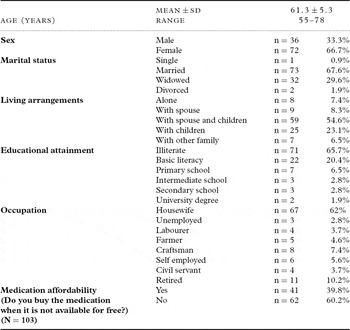
The mean sample age was 61.3 years. As shown in Table 1, there were 72 females and 36 males; 67.6% of patients were married; 29.6% were widowed; 54.6% were living with a spouse and children; 65.7% were illiterate while 20.4% had only basic literacy skills; 62% were housewives; and only 10% were retired.
Sociodemographic characteristics

Medication variables
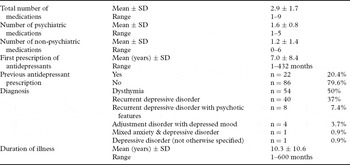
Maprotiline was prescribed in 66 patients (mean dose 95.7 mg/day). Twenty-seven patients were prescribed a tricyclic antidepressant (TCA), 15 patients were on a selective serotonin reuptake inhibitor (SSRI), six on a dual action antidepressant (venlafaxine or mirtazapine) and two were on trazodone. Twenty-six patients (23.4%) were receiving a combination of two antidepressants and two were on a combination of three antidepressants. As shown in Table 2, patients were prescribed, on average, 1.64 (SD ± 0.8) psychiatric medications and in total 2.9 medications (SD ± 1.68). The mean duration since first prescription was seven years (SD ± 8.42) with periods of discontinuation in 20.4% of patients. Some 79.6% of patients had been on antidepressants continuously since the initial prescription.
Medication and illness characteristics

On the UKU scale the mean score was 7.42 (SD ± 6.16). The most common side-effects were autonomic (mean 3.74, SD ± 3.34) and psychiatric (mean 2.11, SD ± 2.75). On the QPE, patients reported receiving on average less than 5 out of 18 suggested educational messages and CBT strategies (mean 4.79, SD ± 3.48).
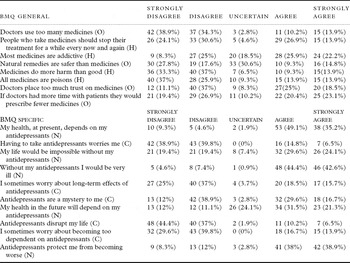
Table 3 describes findings from the BMQ general and specific scales. Patients had mixed general beliefs about medicines. Of note is that more than 70% of patients disagreed or strongly disagreed that doctors use too many medicines and thought medicines did more good than harm. However, 48% agreed or strongly agreed that most medicines are addictive and 43.5% believed that doctors placed too much trust in medicines and that if doctors spent more time with patients they would prescribe fewer medicines. Positive attitudes were more pronounced on the antidepressant specific scales. More than 80% of patients agreed or strongly agreed that their health at present depended on antidepressants, believed they would be very ill without antidepressants and did not think antidepressants disrupted their lives.
Frequency of responses on the Beliefs about Medicines Questionnaire (BMQ General and Specific subscales)

O = BMQ general overuse scale; H = BMQ general harm scale; N = BMQ specific necessity scale; C = BMQ specific concern scale.
llness variables
The most common diagnoses were dysthymia in 54 patients (48 females and 6 males) and recurrent depressive disorder in 40 patients (19 females and 21 males) (Table 2). The average duration since first onset of depressive symptoms was 10.25 years.
The mean score on the GMSS-DS was 27.5 (SD ± 14.88) and the mean score on the MMSE was 23.51 (SD ± 3.97).
Adherence
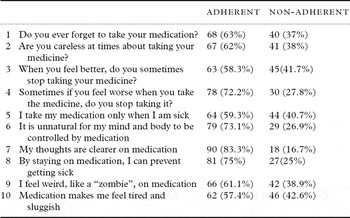
As shown in Table 4, 56.4% of patients adhered to antidepressants 80% of the time or more often on the GAM, including 44.4% reporting full adherence. Only six patients (5.6%) reported never complying. The mean score on the MARS was 6.65 (score of 10 indicates highest adherence). Spearman's ρ for the correlation between the two adherence scales was 0.66, p < 0.000.
Frequency of responses on the Medication Adherence Rating Scale (MARS)

Note: Adherent = “No” response for questions 1, 2, 3, 4, 5 6, 9, 10 and “Yes” response for questions 7 and 8.
Correlations with adherence
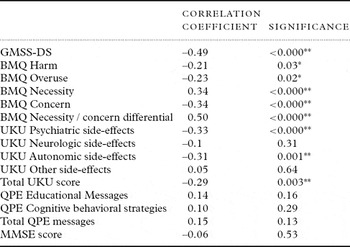
Adherence on the MARS was not related to any of the sociodemographic variables investigated using independent samples t test for two groups and ANOVA for three or more groups. As shown in Table 5, medication variables that were significantly correlated with adherence on the MARS were the general BMQ harm (r = −0.21, p = 0.03) and overuse (r = −0.23, p = 0.02) subscales; the BMQ specific necessity (r = 0.34, p < 0.001), and specific concern subscales (r = −0.34, p < 0.001); and medication side-effects on the UKU scale (r = −0.29, p = 0.003). This last correlation was found only with psychiatric (e.g. difficulty in concentrating and poor memory) and autonomic side-effects (e.g. dry mouth and urinary retention), but not with neurological or other side-effects.
Pearson's correlations for adherence on the Medication Adherence Rating Scale

** Correlation is significant at the 0.01 level (2-tailed).
* Correlation is significant at the 0.05 level (2-tailed).
GMSS-DS = Geriatric Mental State Schedule-Depression Scale; BMQ = Beliefs about Medicines Questionnaire; UKU = Udvalg for Kliniske Undersøgelser Side-Effects Rating Scale; MMSE = Mini-Mental State Examination; QPE = Questionnaire on Patient Education.
The number of educational messages on antidepressants (QPE) did not correlate significantly with adherence. An independent-samples t-test was conducted to compare any adherence advantage for individual questions. The two questions which showed the highest adherence advantage when comparing mean scores on the MARS were: “Were you told how long to expect to continue taking the medication?”. The MARS score for yes was M = 8 (SD ± 1.34) and the score for no M = 6.5 (SD ± 2.29); (t = −3.01, df = 106, p = 0.007). Also being given instructions to “keep taking it even if you start to feel better” had a significant advantage; the MARS score for a “yes” answer was M = 7.22 (SD ± 2.16) and for “no” it was M = 6.3 (SD ± 2.16) (t = −2.09, df = 106, p = 0.04).
Patients with more severe depression on the GMSS-DS were significantly less adherent on the MARS (r = −0.49, p < 0.00). There was no correlation between different diagnoses or MMSE scores and adherence.
Carers’ beliefs
Thirty-three carers were interviewed using the general subscales of the BMQ. There was no correlation between carers’ beliefs and patient adherence measured on the MARS.
Linear regression
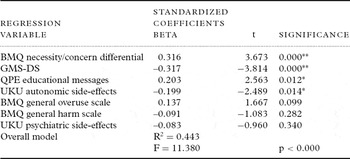
Significant correlations were entered in the linear regression model using the MARS score as the dependent variable. The independent variables entered were the BMQ specific necessity/concern differential for antidepressants, the harm and overuse subscales of the general BMQ scale, the UKU psychiatric and autonomic side-effects subscales and the GMSS-DS. The QPE educational messages (although not significantly correlated with the MARS) were also entered in the regression model as previous studies in the same population had shown provision of information to be a significant factor in adherence.
The model predicted 44.3% of the variance (F = 11.38, p < 0.000) (see Table 6). In this model, adherence increased with higher scores on the necessity/concern differential and the number of educational messages (QPE) given on antidepressants, and decreased with autonomic side-effects and higher GMSS-DS depression scores. General medication beliefs (harm and overuse) and psychiatric side-effects did not reach significance in the regression model.
Linear regression with total score on the Medication Adherence Rating Scale (MARS) as the dependent variable

* = p < 0.05; ** = p < 0.001.
GMSS-DS = Geriatric Mental State Schedule-Depression Scale; BMQ = Beliefs about Medicines Questionnaire; UKU = Udvalg for Kliniske Undersøgelser Side-Effects Rating Scale; MMSE = Mini-Mental State Examination; QPE = Questionnaire on Patient Education.
Discussion
This is the first study to look at adherence to antidepressants and to explore possible predictors among older Egyptians. Adherence research is fraught with difficulties; defining and measuring adherence is the first obstacle. As there is no “Gold Standard” for measuring adherence, Osterberg and Blaschke (Reference Osterberg and Blaschke2005) recommended combining several methods consistent with the clinical setting in order to maximize accuracy. George et al. (Reference George, Peveler, Heiliger and Thompson2000) found self-report measures reliable and consistent with findings using other measures, including pharmacy refill records and the Medication Events Monitoring System (MEMS). In this study two self-report scales were used to measure adherence; the Medication Adherence Rating Scale (MARS) was chosen because it was developed by drawing on the two most commonly used scales for adherence, namely the Drugs Attitude Inventory (DAI) (Hogan et al., Reference Hogan, Awad and Eastwood1983) and the Medication Adherence Questionnaire (MAQ) (Morisky et al., Reference Morisky, Green and Levine1986), which are both widely used in psychiatric populations and it was also validated in a psychiatric sample. The second scale used was a Global Adherence Measure (GAM), which is a crude measure of adherence. Patients are asked to estimate how many doses they missed in the last week. Scores on the GAM were discussed/corroborated with carers when available and checked against prescription refills in the outpatient department for confirmation.
This sample was composed of a heterogeneous group of mainly chronic patients frequenting outpatient clinics seeking treatment for depression (only 15% of patients had reported first onset of illness in the previous year). This would explain the relatively long mean duration since the initial antidepressant prescription (7 years, SD ± 8.4) and the overrepresentation of dysthymia as a primary diagnosis. On the whole, the sample was mixed and probably representative of an outpatient population suffering from chronic depression or presenting in remission and also some new onset cases.
Predicting poor adherence has been the holy grail of adherence research since inception. Sociodemographic variables have generally been poor predictors, the only consistent finding is that older patients are more likely to adhere to medication compared to younger patients (Akincigil et al., Reference Akincigil, Bowblis, Levin, Walkup, Jan and Crystal2007; Bambauer et al., Reference Bambauer, Soumerai, Adams, Zhang and Ross-Degnan2007).
Medication variables have also been inconsistent, apart from side-effects which are consistently associated with poor adherence. Our findings show psychiatric and autonomic side-effects correlate with poor adherence, with 81% of patients being on maprotiline or a TCA. SSRIs did not have an adherence advantage over TCAs in agreement with other studies (Thompson et al., Reference Thompson, Peveler, Stephenson and McKendrick2000a).
Generally, patients reported receiving limited information about the prescribed medication on the QPE, and even though receiving information did show a significant positive impact on adherence in the final regression model, this should be interpreted with caution due to low educational attainment in the sample.
There is mounting evidence that specific beliefs predict adherence with antidepressants in older patients. Maidment and colleagues (Reference Maidment, Livingston and Katona2002) found a correlation with necessity in a sample of elderly depressed patients, but this did not reach the level of significance required to be included in their final model. However, the concern subscale was significant (r = 0.355, p ≤ 0.01) and explained 17% of the variance in their final regression model (p ≤ 0.05). In younger patients, Hunot and colleagues (Reference Hunot, Horne, Leese and Churchill2007) identified specific concerns and general worry about taking antidepressants (measured by the BMQ) as independent predictors of non-adherence in a follow-up study in five primary care practices in England. Brown et al. (Reference Brown, Battista, Bruehlman, Sereika, Thase and Dunbar-Jacob2005) identified specific concerns about taking antidepressants as a predictor of adherence, but did not find a correlation between adherence and necessity. The BMQ concerns subscale explained 18% of the variance in their sample of 192 depressed primary care patients (p = 0.025).
Statistically, there was no significant difference in adherence between different diagnoses, but small group sizes preclude making inferences from this. However, poorly adherent patients suffered more severe GMSS-DS depressive symptoms. This suggests that non-adherence may be an important factor in poor response to treatment and should be considered before switching or augmenting treatment.
Although Maidment et al. (Reference Maidment, Livingston and Katona2002) found a correlation between low MMSE scores and better adherence, which they attributed to carer input, this was not replicated in our study, possibly due to the younger sample age.
Limitations of the study:
Studies looking at predictors of adherence should ideally utilize a longitudinal design, following a cohort (preferably an inception cohort) identified from case registers, as failure to comply with therapy is a central issue in the investigation (Feinstein, Reference Feinstein, Haynes and Sackett1979). Loss to follow-up is an important aspect of adherence: for example, 17% of patients in primary care in the UK were lost to follow-up within six months (Hunot et al., Reference Hunot, Horne, Leese and Churchill2007), and 19% were lost over a two-year period in Sweden (Akerblad et al., Reference Akerblad, Bengtsson, von Knorring and Ekselius2006). This influenced our decision to utilize a cross-sectional design and recruit current clinic attendees, as the drop-out rates in Egypt are very high and patients travel long distances to attend clinics.
The MARS has two items related to medication side-effects; “I feel weird, like a zombie on medication” and “medication makes me feel tired and sluggish,” which are somewhat similar to the fatigability and sedation items from the UKU psychiatric side-effects scale. However, they only account for two out of ten items on the subscale.
Prescribing in university outpatient departments in Egypt depends on availability of free medication. Maprotiline has been continuously available in clinics for over ten years and is preferred over TCAs as it offers a relatively low side-effects profile and is possibly associated with better tolerability compared to the classical TCAs (Mottram et al., Reference Mottram, Wilson and Strobl2006). The findings with regards to beliefs are unlikely to be affected by the choice of drug, although the side-effects profile may be different. Also small group sizes did not allow for comparing different medications and their effect on adherence.
Strengths of the study
This study adds to the limited literature on adherence to antidepressants in this age group. The findings support evidence for a role for beliefs. The sample was broadly comparable to the older population in Egypt; life expectancy at birth is 65 years for males and 69 years for females. Sociodemographic variables such as years of education, marital status and living arrangements were also similar to the population norms (Central Agency of Public Mobilization and Statistics, 2005). The low MMSE scores in the sample are probably related to poor education and are similar to the findings of the study by Inzelberg et al. (Reference Inzelberg2007) conducted in an elderly cognitively normal Arab community in northern Israel (MMSE score of 26.3 (SD ± 4.1) in males and 23.6 (SD ± 4.2) in females).
Implications
Our findings support evidence that specific beliefs about antidepressants can predict adherence. They also show that beliefs transcend culture and education. Poor response to treatment and medication side-effects can be pointers to poor adherence and must be considered before changing treatment. Educational messages were significant in the regression model and clinicians should offer them to patients more frequently, as they are likely to improve the doctor–patient relationship and help in establishing trust.
Conflict of interest
None.
Description of authors' roles
W.F. designed the study, collected and analyzed the data and wrote the paper; M.Y.A. and A.H. supervised the study and reviewed the manuscripts; S.M. assisted with data collection, E.C. translated the questionnaires, and assisted with data collection and writing the paper; K.W. formulated the research question, assisted with study design and supervised the study.
Acknowledgments
The authors would like to thank Professor Rob Horne for help in translating the BMQ; Shymaa Nasr, Shahira Selim, Inji Sadek, Shahira Kamal who were involved in data collection and entry; Dr Mizanur Khondoker and Dr Pat Mottram for help with statistical analysis; Professor Rob Howard for for his unwavering support and for reviewing the manuscripts; Dr Adrian Treloar and Dr Michael Hadjulis for reviewing the manuscripts; and the reviewers for their excellent comments.