

Introduction
Nordmann’s (or Spotted) Greenshanks (Tringa guttifer) (hereafter, greenshanks) are listed as Endangered on the IUCN Red List (BirdLife International 2020) and, with a small and declining population of 1,200–2,000 individuals, are considered one of the rarest shorebirds in the world (Maleko et al. Reference Maleko, Pronkevich, Maslovsky, Billerman, Rodewald and Keeney2021). Greenshanks are endemic to the East Asian–Australasian Flyway and are regularly observed staging and wintering at key coastal sites in China and South-East Asia during the non-breeding season (Peng et al. Reference Peng, Anderson, Chang, Choi, Chowdhury, Clark, Gan, Hearn, Li, Lappo, Liu, Ma, Melville, Phillips, Syroechkovskiy, Tong, Wang, Zhang and Zöckler2017, Zöckler et al. Reference Zöckler, Li, Chowdhury, Iqbal and Chenxing2018, Li et al. Reference Li, Hughes and Dudgeon2019, Yu et al. Reference Yu, Ngoprasert, Round, Pierce, Savini and Gale2019, Reference Yu, Ngoprasert, Savini, Round and Gale2020). However, to construct an effective, species-specific, and flyway-wide conservation plan, more knowledge about their breeding and distribution ecology is needed.
Greenshanks only breed in the Russian Far East where they inhabit remote bays and estuaries along the Sea of Okhotsk coast. Until 2019, the only description of greenshank nests was from one old and four active arboreal nests found during the summer of 1976 in Chaivo Bay, north-eastern Sakhalin Island, Russia (Figure 1A) (Nechaev Reference Nechaev1978). Greenshank nesting habitat was described as the edge of semi-dry, boggy, and sparse or “thinned” larch forest stands, near small lakes, rivers, and other inland water bodies, 0.75–2.5 km from coastal intertidal flats. Consequently, a preliminary understanding of breeding habitat requirements can be summarised as Cajander larch (Larix cajanderi) forests and hummocky inland bogs along the Sea of Okhotsk for nesting, adjacent coastal meadows for brood-rearing, and intertidal mudflats for foraging (Nechaev Reference Nechaev1978).
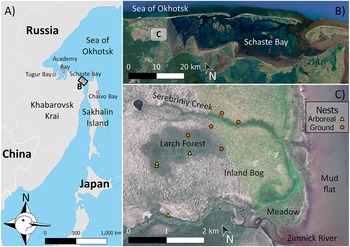
Nest-searching area. (A) A portion of the Russian Far East, China, and Japan, with Schaste Bay highlighted in B. (B) The entirety of Schaste Bay with our study area highlighted in (C). (C) Our study area in north-western Schaste Bay where greenshank nest searching took place during the summers of 2019–2021. Highlighted in (C) are the four habitat types greenshanks require for breeding (i.e. inland bogs, larch forest patches, coastal meadow, and intertidal mudflat) as well as Zimnick River and Serebriniy Creek. Orange dots represent ground nests and yellow triangles represent arboreal nests.

Since Nechaev’s (Reference Nechaev1978) work, greenshank abundance throughout Sakhalin Island has declined drastically due to wildfires, hunting, reindeer herding, and habitat degradation related to the fossil fuel industry (Nechaev Reference Nechaev1989, Blokhin Reference Blokhin1998, Leonov Reference Leonov2000, Blokhin and Kokorin Reference Blokhin and Kokorin2001, Tiunov Reference Tiunov2016) and no more nests have been found. Despite greenshank-focused expeditions to other coastal sites along the Sea of Okhotsk with seemingly suitable habitat, including Sakhalin Island (Reviakina and Zikov Reference Reviakina and Zikov2011, Reference Reviakina and Zikov2018) and Magadan Oblast (Kondratyev and Andreev Reference Kondratyev and Andreev1997, Bergmann Reference Bergmann1998, Dorogoy Reference Dorogoy2013), no nests were found and the extent of suitable and occupied habitats throughout the rest of the species’ breeding range remained uncertain.
In 2009–2013, a series of avian surveys conducted throughout the greater Academy, Schaste, and Tugur Bay regions in central Khabarovsk Krai revealed that Schaste Bay (mainland Russia, ~20 km west of Sakhalin Island) may be an important breeding area for greenshanks as numerous pairs were found displaying brood-rearing behaviours (Pronkevich and Oleinikov Reference Pronkevich and Oleinikov2010, Pronkevich et al. Reference Pronkevich, Roslyakov and Voronov2011a, Reference Pronkevich, Voronov, Atrokhova, Antonov, Adnagulov and Oleinikovb, Pronkevich Reference Pronkevich2013, Pronkevich and Voronov Reference Pronkevich and Voronov2013). During 2019–2021, we concentrated nest-searching efforts here and found a total of nine (six active and three inactive) greenshank nests. Herein, we describe these nests and the habitats in which they were found to inform nest searching for future studies and enhance understanding of greenshank breeding ecology.
Methods
Study site
We searched for greenshank nests in Schaste Bay, a shallow lagoon on the western coast of the Sea of Okhotsk (53.47°N, 140.91°E) (Figure 1B). The bay is relatively accessible compared with other potential greenshank breeding sites as it is near populated areas with adequate infrastructure. We focused nest-searching efforts between Zimnick River and Serebriniy Creek, an area of ~330 ha, 3 km south of the Sea of Okhotsk coast in north-western Schaste Bay. This site is characterised by isolated patches of larch forest, dispersed larches, and dwarf Siberian pines (Pinus pumila), and a strip of larch forest running along Serebriniy Creek, all on an elevated inland hummock bog. The area is bordered by a dense mixed-species forest to the south-west and a mixed-species forest band, coastal meadow, and intertidal estuarine mudflat to the south-east (Figure 1C).
Nest searching
We searched for nests from the beginning or middle to the end of June, 2019–2021. Due to various site-related logistical constraints, as well as travel restrictions stemming from the Covid-19 pandemic, search effort varied among years (three days in 2019, six days in 2020, and four days in 2021). We used binoculars and spotting scopes to locate and observe greenshank activity within inland bogs and around forests. Typically, one bird incubated the nest while the other of the pair either foraged on the intertidal mudflat or perched on tall structures near the nest, acting as a sentinel (Maleko et al. Reference Maleko, Pronkevich, Maslovsky, Billerman, Rodewald and Keeney2021). We considered a location a potential breeding territory if we repeatedly observed a greenshank perched on a tree in the area, and if it stayed in the immediate vicinity even when flushed. After identifying a territory, we thoroughly searched the area within a 100-m radius by approaching any clumps of moss or twigs that resembled a nest and carefully scanning all larch trees hoping to spot an incubating bird. Although Nechaev (Reference Nechaev1978) found only arboreal nests, we did not exclude the possibility that greenshanks may nest elsewhere, thus, we also scanned the ground and checked under larches. If we did not find a nest within an hour, we returned to the area in the following days and watched, from afar, for the pair to switch incubation bouts and reveal the nest location. Our secondary approach was to trek throughout the inland bog checking under larches and low hanging branches. All nest searching was conducted following the guidance of Fair et al. (Reference Fair, Paul, Jones, Clark, Davie and Kaiser2010).
Results
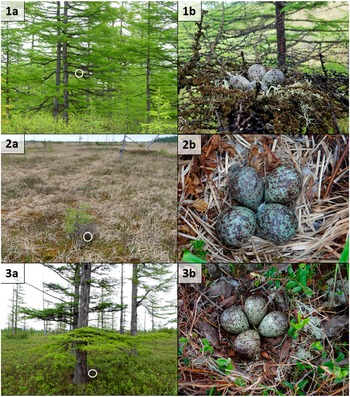
We found nine greenshank nests, six active (one each in 2019 and 2020, and four in 2021) and three inactive (all in 2020), in or around semi-dry, boggy, and sparse larch forest stands. Two nests were located at the edge of a larch forest (Figure 2-1a), four on an inland hummock bog surrounded by dispersed sapling larches (Figure 2-2a), and three within a sparse larch forest (Figure 2-3a). All nests were directly associated with larch trees and were underneath broad overhanging larch branches. The microhabitat where we found these nests can be separated into three broad categories: on a larch branch (one active and three inactive) (Figure 2-1a), on the ground underneath a sapling larch (four active) (Figure 2-2a), and at the base of a mature larch (one active) (Figure 2-3a). The flora community in the vicinity was a varying combination of Cajander larch, dwarf Siberian pine, Middendorf birch (Betula middendorffii), pussy willow (Salix caprea), alder shrubs (Duschekia spp.), wild rosemary (Ledum palustre), Lapland (Carex lapponica) and woolly (C. pallida) sedge, marsh reedgrass (Calamagrostis langsdorffii), bog myrtle (Myrica gale), crowberry (Empetrum nigrum), cloudberry (Rubus chamaemorus), bog cranberry (Oxycoccus palustris), lingonberry (Vaccinium vitis-idaea), bog bilberry (V. uliginosum), various lichens, and Sphagnum peat moss. Based on structural integrity, we concluded that inactive nests were likely from previous nesting seasons (2018 or 2019) as Schaste Bay’s strong winds and heavy precipitation hasten nest disintegration (pers. obs.).
Arboreal nests (n = 4) (Figure 2-1b) were 17–23 cm in diameter (mean 19.8 ± 3.0) and 4.0–5.5 cm thick (mean 4.5 ± 0.1), with a nest cup 12–13 cm wide (mean 12.3 ± 0.6) and 2.5–4.0 cm deep (mean 3.0 ± 0.1). These nests were composed of small larch twigs, some with small cones attached, as the base (80%), with nests lined (20%) with speckled horsehair (Bryoria fuscescens), small pieces of larch bark, dwarf Siberian pine needles, and lichens such as melanelia (Melanohalea olivacea), rim (Lecanora symmicta), ring (Evernia mesomorpha), tube (Hypogymnia sachalinensis), Bering reindeer (Cladonia cf. arbuscula), and bearded (Usnea sp.). The light-coloured lichens (ring, tube, and Bering reindeer) were not found on the nest trees, indicating the birds brought them from elsewhere, likely to better camouflage their blue-green eggs (Figure 2). These nests were found in larches that were 12–15 m tall with a 20–46 cm diameter at breast height (dbh). Nests were placed on branches approximately 3.8–8.0 m off the ground, and 0.6–1.0 m from the tree trunk, with broad overhanging branches 7–40 cm above them. Arboreal nests generally faced south and were characterised by a wide (~50 cm) platform in front of the nest on the supporting branch.
Nest microhabitat and composition. The three general habitat types (a) throughout north-western Schaste Bay in which we found greenshank nests during the summers of 2019–2021 and the corresponding nests (b) found in those habitat types. Exact nest locations are highlighted with white circles. (1a) Greenshank arboreal nesting habitat at the edge of a larch forest fragment. (1b) The arboreal nest situated on a larch branch, mostly composed of larch twigs and various lichens. (2a) Greenshank nesting habitat on the inland bog with abundant Carex sedges, many dispersed saplings, and live and dead trees in the vicinity with the nest situated under a sapling larch tree. (2b) A typical greenshank nest found on the inland bogs under sapling larch trees mostly composed of dry Carex sedge stems, various dry leaves, and small twigs. (3a) Greenshank nesting habitat on an inland bog that is close to a larch forest fragment with many live and dead tall trees in the vicinity, with flowering lingonberry bushes as the main ground cover feature and the nest situated at the base of a mature larch. (3b) The nest under the mature larch is composed mostly of small pieces of larch bark and twigs, some Cladonia spp. moss, with a few lingonberry seedlings around the outside.

Ground nests (n = 5) (Figure 2-2b and 3b) were 12–15 cm in diameter (mean 13.2 ± 1.1) with a nest cup 1–3 cm deep (mean 1.7 ± 01.2), and their composition differed based on location. Nests under sapling larches (n = 4) were 90% composed of Carex stems and 10% larch twigs, dry cloudberry leaves, and lichen thalluses. The lone ground nest found under a mature larch was 90% composed of larch twigs and bark, and 10% of wild rosemary, lingonberry leaves and crowberry stems, pinecone scales, Sphagnum peat moss, and various lichens. Ground nest lichens included striped Iceland (Cetraria laevigata), curled snow (Nephromopsis cucullata), cup (Cladonia gracilis), and Bering reindeer, with striped Iceland not found in the nesting area. Sapling larches were 0.6–1.9 m tall, with a 3–8 cm base diameter while the mature larch was 12 m tall with a 26 cm dbh. Ground nests were also underneath overhanging branches, with sapling larches providing 30–45 cm wide canopies 15–37 cm above the nests, while the mature larch provided a 1.5 m-wide canopy 1.4 m above the nest.
Active nests were found between 17 June and 22 June 2019–2021; five nests contained four eggs and the sixth had three eggs. Eggs (n = 23) were 46.4–51.0 mm long (mean 48.7 ± 1.2), 33.1–35.0 mm wide (mean 34.2 ± 0.6), and weighed 23.0–29.7 g (mean 26.2 ± 2.0). We were unable to regularly monitor nests, but in general eggs hatched between 25 June and 28 June. All ground nest eggs hatched; however, the only active arboreal nest was depredated. Given that incubation is ~25 days (Maleko et al. Reference Maleko, Pronkevich, Maslovsky, Billerman, Rodewald and Keeney2021), nest initiation probably occurred in late May or early June.
Discussion
The nests we found at Schaste Bay were not only the first greenshank nests found in over 40 years, but also the first nests found on mainland Russia. Unlike Green (Tringa ochropus), Solitary (T. solitaria), or Wood (T. glareola) Sandpipers, which occasionally nest arboreally but inhabit old passerine nests (Oring Reference Oring1966, Pulliainen and Saari Reference Pulliainen and Saari1991, Zwdarek Reference Zwdarek1999, Houston Reference Houston2012), Nordmann’s Greenshanks are the only shorebird known to build their own arboreal nests (Nechaev Reference Nechaev1978). However, we discovered that greenshanks do not exclusively nest in trees, as expected based on the descriptions of Nechaev (Reference Nechaev1978), but exhibit nesting plasticity by also placing nests on the ground at the base of mature or sapling larches. We also found greenshanks alter nest composition depending on nest location (Figure 2b), and use materials obtained within and without the nesting area to match the surrounding environment and improve nest or egg camouflage.
It is possible that vegetation greening or snow cover at the time of nest initiation may influence nest-site selection (Cunningham et al. Reference Cunningham, Kessler and Lanctot2016, Ims et al. Reference Ims, Henden, Strømeng, Thingnes, Garmo and Jepsen2019). Larches are deciduous conifers; if larch needles have not emerged when greenshanks are establishing nest locations, an arboreal nest may be more visible to predators, primarily Large-billed (Corvus macrorhynchos) and Carrion (C. corone) Crows and Red Foxes (Vulpes vulpes), but also potentially Eurasian Hobbies (Falco subbuteo), Short-eared Owls (Asio flammeus), and Brown Bears (Ursus arctos), and also unduly exposed to wind and precipitation, ultimately influencing birds to nest on the ground instead. Similarly, if snow cover is abundant, the ground may be unavailable for nesting and influence greenshanks to nest in trees.
Of the nine nests we found, seven were located within 40 m of a Cajander larch forest or forest fragment, and two were 150 m from a larch forest but surrounded by sapling larches. Furthermore, all nest sites contained tall (12–15m) larch trees (live or dead), which greenshanks use as perches to watch for potential threats (Pronkevich et al. Reference Pronkevich, Maleko, Maslovsky and Slaght2022). The arboreal nests found on Sakhalin Island were situated directly underneath broad overhanging larch branches, presumably to provide concealment from avian predators and to shield nests from strong winds and precipitation while allowing birds an unobstructed view of their surroundings (Nechaev Reference Nechaev1978). Similarly, all the nests we found at Schaste Bay, arboreal and ground, were characterised by overhanging larch branches. These elements support the belief that greenshanks are obligates of coastal larch ecosystems during the breeding season (Nechaev Reference Nechaev1978, Maleko et al. Reference Maleko, Pronkevich, Maslovsky, Billerman, Rodewald and Keeney2021). This reliance on larch trees for nesting presents an uncertain future for breeding greenshanks as possible climate change effects on coastal larch ecosystems remain unclear. Larch trees are very cold-climate adapted and a small increase in global air or ground temperatures may cause larch forests to shrink, retreat northward, or leave southern patches weak and unstable (Leng et al. Reference Leng, He, Bu, Dai, Hu and Wang2008, Bai et al. Reference Bai, Zhang, Li, Duan, Jin and Chen2019, Zhang et al. Reference Zhang, Bai, Hou, Chen and Manzanedo2019). Likewise, unpredictable precipitation patterns may cause unstable wildfire regimes throughout boreal ecosystems, including in larch forests (Heim et al. Reference Heim, Hölzel, Heinken, Kamp, Thomas, Darman, Smirenski and Heim2019).
On Sakhalin Island, greenshanks nested near small lakes, rivers, and other inland water bodies (Nechaev Reference Nechaev1978). Although there were plentiful pools and small inland lakes throughout Schaste Bay bogs, we did not find them to be prominent features of nest sites. While three nests were near small creeks, the channels were either subterranean or overgrown with larch trees and it is most likely the trees were the main attracting feature. Given that we never observed greenshanks loafing on the ground throughout the bogs, it is unlikely inland water bodies provide foraging habitat and may not be significant components of nesting areas in Schaste Bay.
Nechaev (Reference Nechaev1978) noted that greenshanks may breed in “loose nesting colonies” or “diffuse settlements” as the nests he found were relatively close together (minimal distance 70 m apart). Although the closest active nests we found were ~300 m apart, we likely did not find all the nests in the area in any year. Additionally, whenever we found a nesting territory, a sentinel bird would give an alarm call and draw in nearby greenshanks, which would either quietly perch on top of a tree or join the chorus of alarm calls. Perhaps this behavioural observation is anecdotal evidence of loose colonial or diffused breeding. It is more probable however that greenshanks nest relatively close together due to a patchy distribution of suitable nesting habitat rather than intraspecies social cohesion (Harwood et al. Reference Harwood, Gill and Powell2016).
Similarly to the findings of Nechaev (Reference Nechaev1978), we observed greenshanks using four different habitats: larch forests and hummocky inland bogs during nesting as well as adjacent coastal meadows and intertidal mudflats during foraging and brood-rearing. Given the extremely small number of greenshanks remaining, the protection of these habitats in the Russian Far East may be crucial for the conservation of this Endangered species. In addition, Schaste Bay is currently the only confirmed breeding site for Nordmann’s Greenshank and thus can be a priority for protected area designation.
Our observations were biased to a small sample of mid-incubation or inactive nests. More research of tagged individuals and direct observations of birds during the breeding season are needed to determine greenshank breeding phenology, nest-site selection, and factors determining nest survival. Similarly, a detailed analysis is needed into the distributions of landscape features identified as important to greenshanks at various stages of the breeding season: coastal larch forests and hummocky inland bogs in close proximity to coastal meadows and intertidal mudflats. For example, remote sensing can be used to identify prospective areas along the Sea of Okhotsk coast with the confluence of possible suitable habitats (e.g. Academy and Tugur Bays), followed by targeted ground truthing and avian surveys. Furthermore, research is needed to determine whether habitat availability on the breeding grounds is limiting the global greenshank population, in addition to habitat reclamation, invasive species, and subsistence hunting throughout their non-breeding range (MacKinnon et al. Reference MacKinnon, Verkuil and Murray2012, Murray et al. Reference Murray, Clemens, Phinn, Possingham and Fuller2014, Murray and Fuller Reference Murray and Fuller2015, Jackson et al. Reference Jackson, Fuller, Gan, Li, Mao, Melville, Murray, Wang and Choi2021).
Acknowledgements
Logistical and technical support was provided by the Wildlife Conservation Society, BirdsRussia, University of Florida, US Fish and Wildlife Service, Wader Quest, and the Russian Academy of Sciences branches in Khabarovsk (Institute of Water and Ecology Problems) and Vladivostok (Federal Scientific Center of the East Asia Terrestrial Biodiversity). We thank V. Roslyakov, A. Kalchenko, A. Grebennik, M. Fedoseev, and B. Knyazev for field operations, and I. Skirina, F. Skirin, and I. Galanina for flora identification. We thank K. Sieving, Z. Ma, and an anonymous reviewer for providing comments that improved our manuscript, and S. Troy for illustrating the Nordmann’s Greenshank compass used in Figure 1. The data that support the findings of this study are not publicly available due to privacy or ethical restrictions but are available upon request from the corresponding author. This work was financially supported by the Wildlife Conservation Society and the East Asian–Australasian Flyway Partnership. The research was carried out within the state assignment of Ministry of Science and Higher Education of the Russian Federation (theme No. 121031000116-2).
Supplementary Materials
To view supplementary material for this article, please visit http://doi.org/10.1017/S095927092200051X.