INTRODUCTION
Ascidians from the coastal waters of the Andaman and Nicobar Islands are almost unknown. The Andaman and Nicobar group of islands is located in the south-east of the Bay of Bengal. They are the part of the mountain chain and lie on a ridge that extends southwards from the Irrawaddy delta of Burma, containing the trend of the Arakan Yoma range (Venkataraman et al., Reference Venkataraman, Satyanarayana, Alfred and Wolstenholme2003). Huge parts of the bottoms contain hard rock, and a series of ridges and depressions, which include Alcock Sea Mount and Narcodum-Barren Basis (Sewell, Reference Sewell1925). The ascidian specimens were collected from the Andaman and Nicobar Islands during an expedition, by scuba diving. All of the six specimens collected are newly recorded species for this area – Botrylloides leachi (Savigny, Reference Savigny1816), Botrylloides pizoni (Brunetti & Mastrototaro, Reference Brunetti and Mastrototaro2012), Clavelina picta (Verrill, Reference Verrill1900), Clavelina robusta (Kott, Reference Kott1992), Phallusia julinea (Sluiter, Reference Sluiter1915) and Polycarpa pigmentate (Herdman, Reference Herdman1906) – all of which are widely distributed in Indian waters elsewhere. These species dominate benthic rocky communities at depths of 5–20 m. In the Andaman and Nicobar region, corals, mussels and barnacles are likely to cover rocks down to a depth of 5 m. Between 5 and 21 m, ascidians appear to be the dominant group; here, there are a group of idle areas of rock that are appropriate for their habitation. This paper deals with the morphological, as well as the taxonomic, characters of six newly recorded species from the Andaman and Nicobar Islands.
MATERIALS AND METHODS
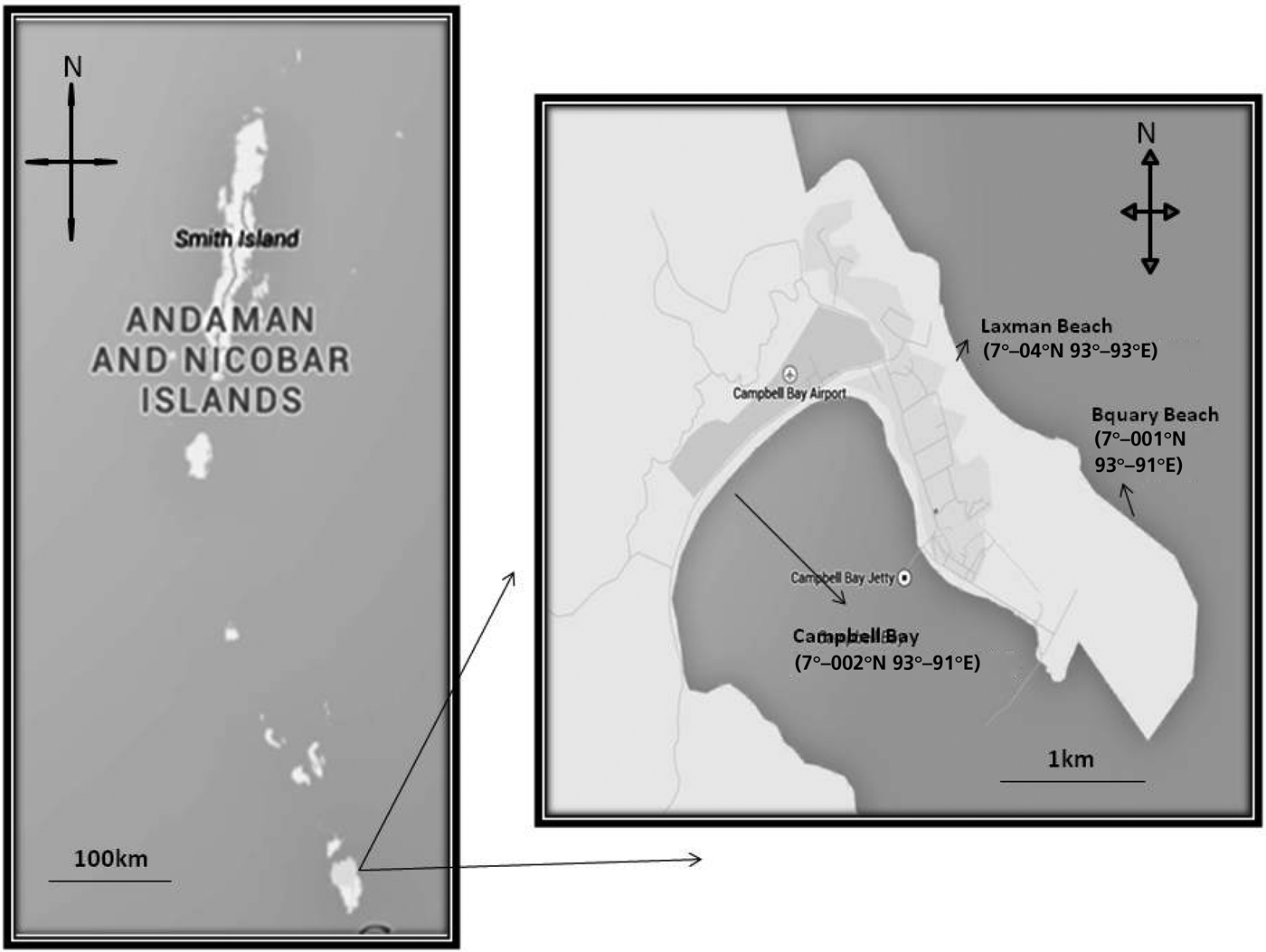
Samples were collected by scuba diving and snorkelling in the Andaman and Nicobar Islands (6°–14°N and 91°–94°E) in September 2013 (Figure 1). Ascidian colonies were photographed in situ before being collected. Colonies were subsequently anesthetized with menthol and 0.37 m MgCl2 for approximately 2 h, and then fixed with 10% formalin-seawater. Formalin-fixed colonies were dissected under a binocular stereomicroscope. The ascidian's taxa was identified and the work by Shenkar et al. (Reference Shenkar, Gittenberger, Lambert, Rius, Moreira Da Rocha, Swalla and Turron2014) was also consulted for synonyms. The specimens were deposited in the Marine Biology Reference Museum (MBRM) and the Ascidians Museum Database (AMD), Annamalai University, India.
Map of study area.

RESULTS
The morphological and taxonomical characters of the newly recorded ascidian species are described below.
SYSTEMATICS
Phylum CHRODATA
Subphylum TUNICATA
Class ASCIDIACEA
Order STOLIDOBRANCHIA
Family BOTRYLLINAE
Genus Botrylloides
Botrylloides leachi Savigny, Reference Savigny1816 (Figure 2A)
Synonyms: Botrylloides leachii (Milne-Edwards, Reference Milne-Edwards1841), Metrocarpa leachi (Arnback & Christie, Reference Arnback and Christie1923), Botrylloids sparsa Alder, Reference Alder1863, Sarcobotrylloides Pannosum (Herdman, Reference Herdman1899).
In situ photographs of ascidians from the Andaman and Nicobar Islands. (A) Botrylloides leachi; (B) Botrylloides pizoni; (C) Clavelina picta; (D) Clavelina robusta; (E) Phallusia julinea; (F) Polycarpa pigmentate.

Specimen: MBRM and AMD. Asc. 46.
Collection site: Campbell Bay (7°–002°N 93°–91°E) subtidal coral reef at approximately 8 m in depth (Figure 1).
Remarks: Colonies are thin, very soft test, smooth surface, long, crowded and curved double-row systems with unevenly distributed spherical terminal ampullae in the narrow spaces between the systems. Specimens with the same trumpet-shaped stomach, small caecum and extensive atrial aperture, circular systems separated by expanses of zooid-free raised test.
Distribution: Western Australia, Indonesia, New Zealand, West Indian Ocean, Red Sea and South Africa.
SYSTEMATICS
Phylum CHRODATA
Subphylum TUNICATA
Class ASCIDIACEA
Order STOLIDOBRANCHIA
Family BOTRYLLINAE
Genus Botrylloides
Botrylloides pizoni Brunetti & Mastrototaro, Reference Brunetti and Mastrototaro2012 (Figure 2B)
Synonyms: Botryllus perspicuus Monniot, Reference Monniot2001, Botryllus firmus (Monniot, Reference Monniot1996), Botryllus eilatensis Shenkar & Monniot, Reference Shenkar and Monniot2006.
Specimen: MBRM and AMD. Asc. 47.
Collection site: Campbell Bay (7°–002°N 93°–91°E) intertidal at approximately 1–2 m in depth (Figure 1).
Remarks: Living specimens are mainly violet or from lilac to violet in colour, but red and orange colonies were also found. Thicknesses of up to 2–3 cm. Zooids are arranged in ‘leachii type’ systems (Brunetti, Reference Brunetti2009). Zooid systems are usually in close proximity, large zooids, with branchial sacs with numerous rows of stigmata, of which the second is complete, and furnished with a stomach larger at the cardiac than the pyloric end, but devoid of the large ovoid swelling at their cardiac end. Swimming larvae are approximately 1.8 mm long (without fins), of which the trunk is about 600 µm. They have eight ampullae and three adhesive papillae.
Distribution: Gulf of Taranto (southern Italy).
SYSTEMATICS
Phylum CHRODATA
Subphylum TUNICATA
Class ASCIDIACEA
Order APLOUSOBRANCHIA
Family CLAVELINIDAE
Genus Clavelina
Clavelina picta Verrill, Reference Verrill1900 (Figure 2C)
Synonyms: Aplidium crassum Herdman, Reference Herdman1886, Chondrostachys picta (Verrill, Reference Verrill1900), Diazona picta Verrill, Reference Verrill1900, Rhodozona picta (Verrill, Reference Verrill1900).
Specimen: MBRM and AMD. Asc. 48.
Collection site: Bquary Beach (7°–001°N 93°–91°E) subtidal coral reef at a depth of approximately 12 m (Figure 1).
Remarks: Grow in clusters varying from a few to many individuals. Zooids up to 2 cm long, transparent and often shaded with white, red or purple. Siphon rims and internal body parts are typically carmine to purple, although there may be a few variations. The zooids are joined at their bases through stolons.
Distribution: Florida, Bahamas and the Caribbean.
SYSTEMATICS
Phylum CHRODATA
Subphylum TUNICATA
Class ASCIDIACEA
Order APLOUSOBRANCHIA
Family CLAVELINIDAE
Genus Clavelina
Clavelina robusta Kott, Reference Kott1992 (Figure 2D)
Synonyms: Podaclavelia meridionalis Pizon, Reference Pizon1908, Podaclavelia moluccensis (Van Name, Reference Van Name1918), Clavelina moluccensis Tokioka, Reference Tokioka1967.
Specimen: MBRM and AMD. Asc. 49.
Collection site: Bquary Beach (7°–001°N 93°–91°E) subtidal coral reef ata depth of approximately 17 m (Figure 1).
Remarks: The colours of the living colonies are opaque, with white, yellow or green spread over the thorax in speckles. In the present species, this colour is confined to sharp bands around the siphons. These zooids are more robust in their size and colony; the oesophageal long-narrow neck, median pigment patches, the absence of brooding embryos from the upper part of the oesophageal neck and their much smaller larvae, which have relatively long tails.
Distribution: Western Australia, Queensland, Philippines, Palau Islands and Japan.
SYSTEMATICS
Phylum CHRODATA
Subphylum TUNICATA
Class ASCIDIACEA
Order PHLEBOBRANCHIA
Family ASCIDIIDAE
Genus Plallusia
Phallusia julinea Sluiter, Reference Sluiter1915 (Figure 2E)
Synonyms: Phallusia arabica (Kott, Reference Kott1964), Phallusia millar (Vasseur, Reference Vasseur1967).
Specimen: MBRM and AMD. Asc. 50.
Collection site: Laxman Beach (7°–04°N 93°–93°E) subtidal coral reef at a depth of approximately 10 m (Figure 1).
Remarks: Individuals are long and club-shaped, or curved and slightly irregular, and often laterally flattened. Chromatophores: fringed lobes around the apertures; rather large dorsal tubercle and slit; relatively few accessory opening of neural gland; short, robust and relatively few tentacles; oesophageal opening toward the posterior end of the dorsal lamina; rectum well-separated from the oesophagus; narrow branchial papillae without basal prominences; and atrial siphon from mid-body level.
Distribution: Western Australia, Queensland, Arafura Sea, New Caledonia, Palau Islands, Indonesia and Madagascar.
SYSTEMATICS
Phylum CHRODATA
Subphylum TUNICATA
Class ASCIDIACEA
Order STOLIDOBRANCHIA
Family STYELIDAE
Genus Polycarpa
Polycarpa pigmentate Herdman, Reference Herdman1906 (Figure 2F)
Synonyms: Styela pigmentata Herdman, Reference Herdman1906, Polycarpa picteti (Pizon, Reference Pizon1908), Polycarpa cryptocarpa (Hartmeyer, Reference Hartmeyer1906), Polycarpa pedunculata Hartmeyer, Reference Hartmeyer1919.
Specimen: MBRM and AMD. Asc. 51.
Collection site: Laxman Beach (7°–04°N 93°–93°E) subtidal coral reef at a depth of approximately 15 m (Figure 1).
Remarks: Living specimens are a brownish in colour with deep- to pale-blue siphon linings. Individuals are laterally flattened, upright and more-or-less pear-shaped and rectangular in outline. The apertures are placed on very short siphons. The branchial sac is robust, as the internal longitudinal vessels are indistinct. The gut loop is generally small in relation to the size of the body. The gonads are embedded in the leathery, opaque inner layer of the body wall.
Distribution: Western Australia, Queensland, Palau Islands, New Caledonia, Philippines, Solomon, Indonesia, Japan, Sri Lanka and Red Sea.
DISCUSSION
Research into Indian ascidians began in 1915, and previous to this study, the total number of ascidian species reported from India was 359, belonging to 38 Genera and 10 families (Meenakshi, Reference Meenakshi2010). The Andaman and Nicobar Islands harbour a great deal of ascidians, which makes this area one of the most highly diversified reef areas in the Indo-Pacific region. Six ascidians were recorded in the present survey, comprising six new records of species in India: two species of Botrylloides leachi and Botrylloides pizoni in Campbell Bay, two species of Clavelina picta and Clavelina robusta on Bquary Beach and two species of Phallusia julinea and Polycarpa pigmentate in Laxman Beach. The genera Clavelina is reported for the first time in India. The six species listed here may be far from representative of the entire coverage of the ascidian fauna in the Andaman and Nicobar Islands, since the present survey was undertaken over a very short period of time and at only four sites. It is this area of the Andaman and Nicobar Islands that has the greatest variety of ascidians.
KEY FOR ASCIDIANS RECORDED FROM THE ANDAMAN AND NICOBAR ISLANDS
1. Systems, usually crowded, do not surround protruding areas of well-vascularised test………Botrylloides leachi
2. Systems surrounding protruding areas of well-vasculartsed test………Botrylloides perspkuum
3. Zooids are arranged in ‘leachii type’ systems………1
4. Zooid systems are large zooids, with branchial sacs with numerous rows of stigmata and furnished with a stomach larger at the cardiac than the pyloric end………Botrylloides pizoni
5. Thoracic muscles circa 20; no median pigment patches alternating with apertures………Clavelina robusta
6. Thoraces and at least part of abdomen free of common test………9
7. The zooids are joined at their bases through stolons………Clavelina picta
8. Stellate chromatophores in surface test………Phallusia julinea
9. Anal border with few shallow indentations………5
10. Test hard, rigid; apertures on short siphons with blue lining in life; test not jet black in preservative………Polycarpa pigmentata
11. Dark, spherical vesicles usually present in body wall………7
ACKNOWLEDGEMENTS
The authors wish to thank The Dean and Director of CAS – Marine Biology, the authorities of Annamalai University for providing facilities and the Ministry of Environment and Forests (MoEF) New Delhi, India for their financial support.