Introduction
The past two decades have seen a widespread adoption of endoscopic skull base surgery in both otolaryngology and neurosurgery. Significant progress has been made in the treatment of anterior skull base lesions, ranging from endoscopic visualisation of pituitary macroadenomasReference Jho and Carrau1 to utilisation of robotic surgery.Reference Campbell2
The use of vascularised nasoseptal flaps has recently become many institutions’ primary endoscopic reconstructive technique after endoscopic skull base surgery. It reduces the risk of post-operative cerebrospinal fluid (CSF) leak after reconstruction,Reference Hadad, Bassagasteguy, Carrau, Mataza, Kassam and Snyderman3 and can be useful even for difficult-to-treat CSF leaks.Reference Zanation, Carrau, Snyderman, Germanwala, Gardner and Prevedello4
While multiple studiesReference de Almeida, Snyderman, Gardner, Carrau and Vescan5–Reference Komotar, Starke, Raper, Anand and Schwartz7 have been conducted to assess the morbidity and mortality of patients who have undergone endoscopic skull base surgery, more attention has been diverted, in recent times, to evaluate the quality of life (QoL) of these patients.
Quality of life can be defined in many ways; it is a complex, multifaceted construct, for which assessment requires multiple approaches from different theoretical angles.Reference Theofilou8 Quality of life is influenced by: patient factors, including emotional, family, social and financial; disease factors, including visual, endocrinological, nasal and neurological; and treatment factors, such as side effects, complications and prolonged hospitalisation.
As the majority of anterior skull base lesions treated by endoscopic skull base surgery are benign, the patient has to be adequately counselled pre-operatively regarding the expected QoL post-operatively. It is not uncommon to forego clear surgical margins when a patient chooses to prioritise QoL, in view of the location of these tumours.
This systematic review aimed to evaluate the available literature to compare QoL after endoscopic skull base surgery with or without a nasoseptal flap.
Materials and methods
Literature search and study retrieval
This systemic review was conducted according to the Preferred Reporting Items for Systematic Reviews and Meta-Analyses (‘PRISMA’) statement.Reference Moher, Liberati, Tetzlaff and Altman9 In order to identify relevant studies, two authors independently searched PubMed, Embase and Cochrane Library databases. A search of the following combinations of terms was conducted: ‘quality of life’ or ‘QoL’, and ‘endoscopic skull base surgery’ or ‘skull base surgery’ or ‘skull base’, and ‘nasoseptal flap’ or ‘surgical flap’. Only studies published in English language were included. The shortlisted studies were subsequently reviewed to determine eligibility for inclusion.
Inclusion criteria
Both prospective and retrospective studies were included. Only studies investigating QoL after endoscopic skull base surgery were included. At least one of the study arms was required to include the use of nasoseptal flaps. Studies were also required to report demographic and clinical details, such as patient age, number of participants, tumour type, scoring system and surgical technique. When there were duplicated studies, only the most recent and comprehensive report was selected.
Exclusion criteria
Studies conducted earlier than 2010 were excluded as nasoseptal flaps were less commonly utilised then. Case reports and series were also excluded given the high risk of publication bias. Conference abstracts, editorials and non-human studies were similarly excluded.
Results
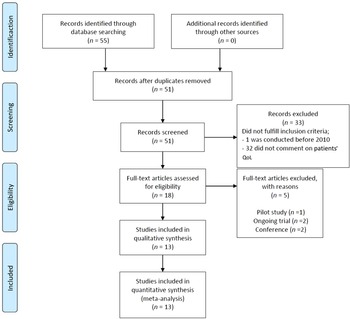
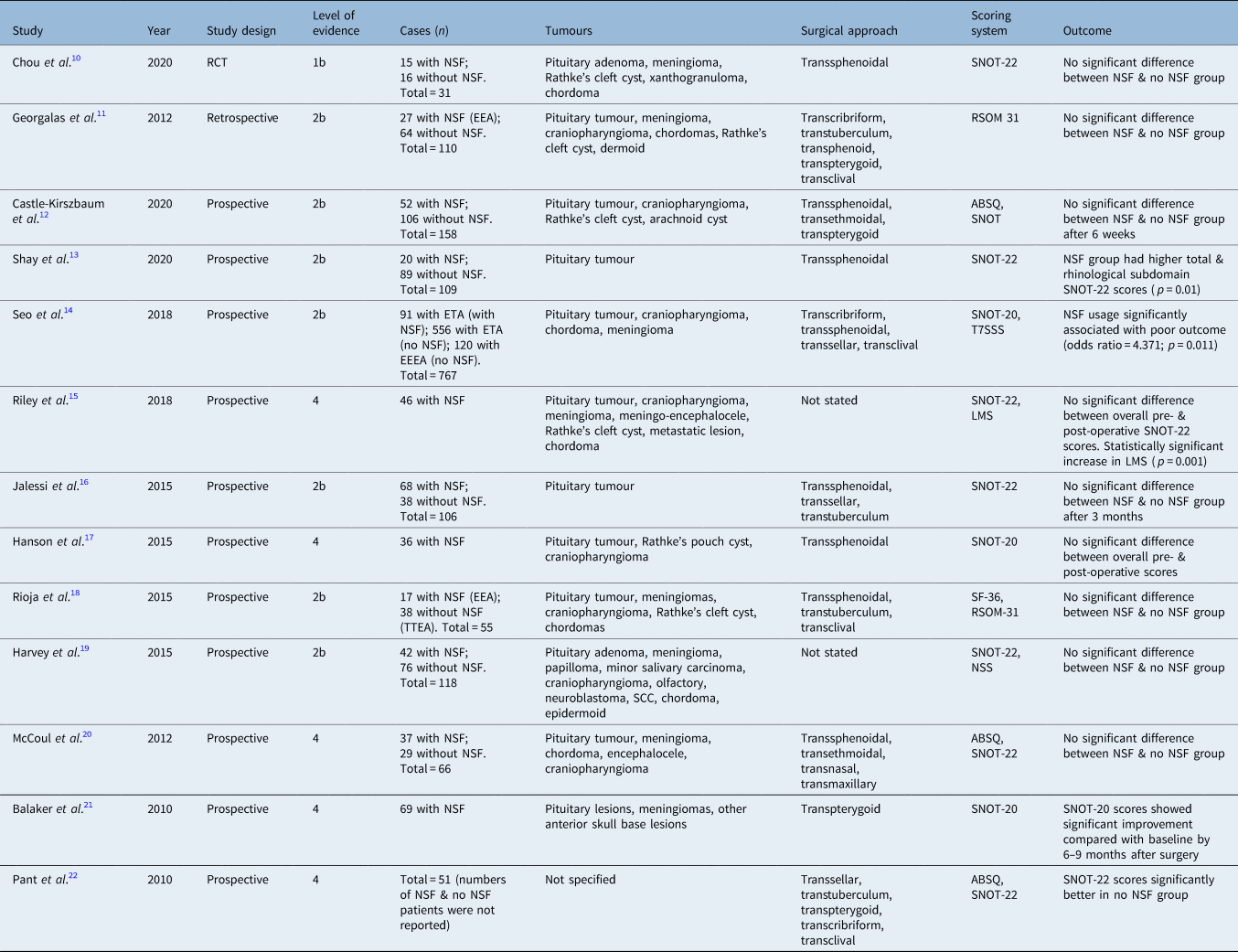
The systemic search yielded 55 studies (Figure 1). Fifty-one studies remained after duplicates were removed. Two independent researchers subsequently screened the titles and abstracts of the remaining studies, identifying 13 studies that fulfilled the inclusion and exclusion criteria. The full texts of these articles were reviewed, and all 13 studies were shortlisted and deemed eligible for this systematic review. These 13 studies consisted of: 1 randomised, controlled trial,Reference Chou, Valappil, Mattos, Snyderman, Gardner and Fernandez-Miranda10 1 retrospective studyReference Georgalas, Badloe, van Furth, Reinartz and Fokkens11 and 11 prospective studies (Table 1).Reference Castle-Kirszbaum, Wang, King, Uren, Dixon and Zhao12–Reference Pant, Bhatki, Snyderman, Vescan, Carrau and Gardner22 A total of 1722 participants were included in this systematic review.
Preferred Reporting Items for Systematic Reviews and Meta-Analyses (‘PRISMA’) flow diagram. QoL = quality of life

Summary of included studies

RCT = randomised, controlled trial; NSF = nasoseptal flap; SNOT = Sinonasal Outcome Test; EEA = extended/expanded endonasal approach; RSOM 31 = 31-item Rhinosinusitis Outcome Measure; ABSQ = Anterior Skull Base Questionnaire; ETA = endoscopic transsellar approach; EEEA = extended endoscopic endonasal approach; T7SSS = total seven-sinonasal-symptom score; LMS = Lund–Mackay score; TTEA = transnasal transsphenoidal endoscopic approach; SF-36 = 36-item Short-Form Health Survey; SCC = squamous cell carcinoma; NSS = nasal symptom score
Quality of life scoring system
Of the 13 included studies, 11 utilised the 20-item or 22-item Sinonasal Outcome Test (SNOT-20 or SNOT-22),Reference Piccirillo, Merritt and Richards23 the Anterior Skull Base (QoL) Questionnaire,Reference Gil, Abergel, Spektor, Shabtai, Khafif and Fliss24 or a combination of both. Other less commonly used measures included the 31-item Rhinosinusitis Outcome Measure, the total seven-sinonasal-symptom score, the nasal symptom score, the Lund–Mackay score and the 36-item Short-Form Health Survey.Reference Ware and Sherbourne25
Tumour types
Twelve studies included patients with pituitary tumours, both functioning and non-functioning, while the remaining studyReference Pant, Bhatki, Snyderman, Vescan, Carrau and Gardner22 did not specify the type of pituitary lesion. Of these 12 studies, 2 studiesReference Shay, Sturgis, Ritz, Beer-Furlan, Muñoz and Byrne13,Reference Jalessi, Jahanbakhshi, Amini, Kamrava and Farhadi16 included only patients with pituitary tumours. In the remaining 10 studies, other tumours included (but were not limited to): craniopharyngioma, meningioma, Rathke's cleft cyst and chordoma.
Two studiesReference Georgalas, Badloe, van Furth, Reinartz and Fokkens11,Reference Jalessi, Jahanbakhshi, Amini, Kamrava and Farhadi16 (n = 8 and n = 27 respectively) found that hormone-secreting tumours negatively affected post-operative QoL, especially in patients with adrenocorticotropic hormone secretory adenomas. This could be associated with the elevated risk of overall post-operative complications in patients with Cushing disease.Reference Semple and Laws26 In contrast, two other studiesReference Rioja, Bernal-Sprekelsen, Enriquez, Enseñat, Valero and de Notaris18,Reference McCoul, Anand and Schwartz20 (n = 23 and n = 22 respectively) found that functioning tumours had no further negative effect on QoL post-operatively. The remaining nine studies did not comment on how tumour heterogeneity in endoscopic skull base surgery may affect QoL.
Surgical technique
While the transsphenoidal or transsellar approach was utilised in nearly all of the studies included, more than half of these studies also described other approaches, such as transcribriform, transtuberculum, transpterygoid and transclival approaches. These studies tended to include patients who required more extensive resection.
As expected, more extensive surgery was associated with poorer QoL post-operatively, as reported by two of the studies.Reference Seo, Nam, Kong, Lee, Ryu and Kim14,Reference Rioja, Bernal-Sprekelsen, Enriquez, Enseñat, Valero and de Notaris18 While both studies compared a more localised approach without use of a nasoseptal flap to more extensive surgery with the use of a nasoseptal flap, they did not comment on whether the use of a nasoseptal flap in these extended approaches was the reason for the lower QoL. The study conducted by Georgalas et al.Reference Georgalas, Badloe, van Furth, Reinartz and Fokkens11 also revealed no significant difference between the different types of extended approaches in terms of nasal morbidity, but this is confounded by the small sample size in the study. Of note, patients who had undergone transcribriform approaches for cribriform plate lesions became anosmic, which negatively affected their QoL.
Nasoseptal flap use
While all 13 studies included a patient group with nasoseptal flaps, only 10 of the studiesReference Chou, Valappil, Mattos, Snyderman, Gardner and Fernandez-Miranda10–Reference Seo, Nam, Kong, Lee, Ryu and Kim14,Reference Jalessi, Jahanbakhshi, Amini, Kamrava and Farhadi16,Reference Rioja, Bernal-Sprekelsen, Enriquez, Enseñat, Valero and de Notaris18–Reference McCoul, Anand and Schwartz20,Reference Pant, Bhatki, Snyderman, Vescan, Carrau and Gardner22 compared patients with and without a nasoseptal flap. Seven of these studiesReference Chou, Valappil, Mattos, Snyderman, Gardner and Fernandez-Miranda10–Reference Castle-Kirszbaum, Wang, King, Uren, Dixon and Zhao12,Reference Jalessi, Jahanbakhshi, Amini, Kamrava and Farhadi16,Reference Rioja, Bernal-Sprekelsen, Enriquez, Enseñat, Valero and de Notaris18–Reference McCoul, Anand and Schwartz20 found no statistically significant difference in QoL associated with the use of a nasoseptal flap. In fact, Hanson et al.Reference Hanson, Patel, Betz, Olson, Panizza and Wallwork17 even reported significant nasal airway improvement following nasoseptal flap reconstruction. Three of the seven studiesReference Castle-Kirszbaum, Wang, King, Uren, Dixon and Zhao12,Reference Jalessi, Jahanbakhshi, Amini, Kamrava and Farhadi16,Reference Rioja, Bernal-Sprekelsen, Enriquez, Enseñat, Valero and de Notaris18 noted an initial deterioration in QoL, but there was no associated long-term detriment to QoL. The remaining studiesReference Shay, Sturgis, Ritz, Beer-Furlan, Muñoz and Byrne13,Reference Seo, Nam, Kong, Lee, Ryu and Kim14,Reference Pant, Bhatki, Snyderman, Vescan, Carrau and Gardner22 found that nasoseptal flap use was significantly associated with poorer QoL.
Follow-up time
In the 12 prospective studies, all participants were given questionnaires to complete pre-operatively. Eight of these 12 studiesReference Castle-Kirszbaum, Wang, King, Uren, Dixon and Zhao12–Reference Seo, Nam, Kong, Lee, Ryu and Kim14,Reference Jalessi, Jahanbakhshi, Amini, Kamrava and Farhadi16,Reference Hanson, Patel, Betz, Olson, Panizza and Wallwork17,Reference McCoul, Anand and Schwartz20,Reference Balaker, Bergsneider, Martin and Wang21,Reference Pant, Bhatki, Snyderman, Vescan, Carrau and Gardner22 followed up with the same questionnaire three months post-operatively. Only one of the studies, by Castle-Kirszbaum et al.Reference Castle-Kirszbaum, Wang, King, Uren, Dixon and Zhao12 repeated the questionnaire on post-operative days 1, 3 and 7. Castle-Kirszbaumn et al. reported worsening of nasal symptoms and otalgia in the first post-operative week associated with the use of a nasoseptal flap. However, this association had disappeared six weeks post-operatively.
Seven of the 12 studies followed patients up at 12 months.Reference Chou, Valappil, Mattos, Snyderman, Gardner and Fernandez-Miranda10,Reference Castle-Kirszbaum, Wang, King, Uren, Dixon and Zhao12,Reference Riley, Tabaee, Conley, Amine, Soneru and Anand15,Reference Jalessi, Jahanbakhshi, Amini, Kamrava and Farhadi16,Reference Rioja, Bernal-Sprekelsen, Enriquez, Enseñat, Valero and de Notaris18,Reference Balaker, Bergsneider, Martin and Wang21,Reference Pant, Bhatki, Snyderman, Vescan, Carrau and Gardner22 Notably, the three studiesReference Castle-Kirszbaum, Wang, King, Uren, Dixon and Zhao12,Reference Jalessi, Jahanbakhshi, Amini, Kamrava and Farhadi16,Reference Rioja, Bernal-Sprekelsen, Enriquez, Enseñat, Valero and de Notaris18 mentioned above that reported an initial deterioration of QoL which subsequently returned to baseline levels were three of the seven studies that provided data on QoL up to 12 months post-operatively. These three studies found that QoL returned to baseline levels after 6 weeks, 3 months and 12 months, respectively. Two of these studiesReference Shay, Sturgis, Ritz, Beer-Furlan, Muñoz and Byrne13,Reference Seo, Nam, Kong, Lee, Ryu and Kim14 only had questionnaire data for up to three months and six months post-operatively, respectively.
Patients’ history
While the majority of the studies excluded patients with prior nasal conditions, Shay et al.Reference Shay, Sturgis, Ritz, Beer-Furlan, Muñoz and Byrne13 found that previous sinonasal surgery and concurrent septoplasty did not influence QoL. The use of peri-operative radiotherapy (usually adjuvant)Reference Harvey, Malek, Winder, Davidson, Steel and Mrad19 was associated with a poorer QoL, as one would predict.
Age and gender
Riley et al.Reference Riley, Tabaee, Conley, Amine, Soneru and Anand15 concluded that while long-term sinonasal QoL improved in the majority of patients following nasoseptal flap use, younger patients had a greater likelihood of worse QoL post-operatively. Shay et al.Reference Shay, Sturgis, Ritz, Beer-Furlan, Muñoz and Byrne13 also found that advanced age was not associated with a worse initial post-operative SNOT-22 total score.
Few studies commented on gender having an effect on QoL after endoscopic skull base surgery. Shay et al.Reference Shay, Sturgis, Ritz, Beer-Furlan, Muñoz and Byrne13 found that female sex correlated with a worse post-operative SNOT-22 score, but had no effect on healing time.
Smoking
Shay et al.Reference Shay, Sturgis, Ritz, Beer-Furlan, Muñoz and Byrne13 found that patients with a history of smoking (both current and previous smokers) had higher total and rhinological subdomain SNOT-22 scores following endoscopic skull base surgery. Smoking was also found to be one of the main factors adversely affecting QoL and healing after endoscopic skull base surgery.
Discussion
Since its inception, early studies on endoscopic skull base surgery have commonly emphasised outcomes such as overall survival, disease-free survival and complications. While these factors are no doubt relevant and essential, we have since progressed to also focus on patient-reported outcomes in the last decade. Moreover, although having a clear margin is important following tumour resection, patients may not fully appreciate this as much should they have a worse QoL post-operatively.
Patients’ QoL after endoscopic skull base surgery is affected by multiple factors, with the use of a nasoseptal flap being one of the more significant. In our systematic review, Most of the studies analysed concluded there was no statistically significant difference in QoL associated with the use of a nasoseptal flap. While it has been demonstrated that QoL worsens in the immediate peri-operative period, QoL improved to baseline levels after a few weeks. Furthermore, of the three studies that reported a significant association between nasoseptal flap use and poorer QoL, two of themReference Shay, Sturgis, Ritz, Beer-Furlan, Muñoz and Byrne13,Reference Seo, Nam, Kong, Lee, Ryu and Kim14 only had questionnaire data for up to three months and six months post-operatively, respectively. A repeat questionnaire completed at 12 months is beneficial to evaluate the long-term outcome, and may reveal an improved QoL, back to baseline levels, as was observed by Castle-Kirszbaum et al.Reference Castle-Kirszbaum, Wang, King, Uren, Dixon and Zhao12 and Jalessi et al.Reference Jalessi, Jahanbakhshi, Amini, Kamrava and Farhadi16
Of note, Harvey et al.Reference Harvey, Malek, Winder, Davidson, Steel and Mrad19 found that despite more extensive resection and post-operative radiotherapy in the nasoseptal flap group, QoL related to sinonasal symptoms was similar to that of the group without nasoseptal flaps. Hanson et al.Reference Hanson, Patel, Betz, Olson, Panizza and Wallwork17 even found significant nasal airway improvement following the use of a nasoseptal flap. This is interesting as there is usually crust formation at the nasoseptal donor site, which can result in nasal blockage. Reduction of the septal swell body at the donor site could explain the subjective improvement in nasal airway.
Hanson et al.Reference Hanson, Patel, Betz, Olson, Panizza and Wallwork17 also reported that clinical examination findings were often not in line with patient-reported experiences. There were significant differences in nasal endoscopic examination scores for both the flap and non-flap sides post-operatively, but the patients did not report a significant reduction in QoL, despite the significant differences observed on endoscopic examination.
In contrast, Seo et al.Reference Seo, Nam, Kong, Lee, Ryu and Kim14 reported that findings of significantly worse QoL after surgery in the nasoseptal flap group were confirmed to last for at least six months post-operatively. When multivariate analysis was performed to assess those factors leading to decreased QoL related to sinonasal symptoms at six months after surgery, it was revealed that nasoseptal flap usage was the only significantly associated factor. This study should be given high regard given that it had the highest sample size of the included studies (n = 767), with almost the same number of participants as all of the other studies combined (n = 955).
In another study, Rioja et al.Reference Rioja, Bernal-Sprekelsen, Enriquez, Enseñat, Valero and de Notaris18 concluded, based on their initial findings (at three months post-surgery), that the use of a nasoseptal flap for skull base tumours induces more sinonasal symptoms than routine pituitary surgery. However, this study was limited by the small sample size (n = 55) and the study design (patients with a pituitary adenoma were treated with a transnasal transsphenoidal endoscopic approach without a nasoseptal flap, while patients with other benign parasellar tumours underwent an expanded endonasal approach with the use of a nasoseptal flap). Furthermore, no significant changes in QoL were detected at 12 months after surgery.
Our systematic review revealed that extensive surgical approaches are associated with significantly worse QoL, whereas other factors such as tumour type and patient factors (age, gender and previous nasal symptoms) proved inconclusive.
In comparison with other systematic reviews on QoL, SchabergReference Schaberg27 studied the QoL of patients after endoscopic approaches to intracranial tumours. These authors found no significant difference in mean SNOT-22 scores post-operatively among patients who underwent reconstruction with a nasoseptal flap as compared with those who underwent transsphenoidal approaches without reconstruction. More recent studies have been published since then, three of which are included in our review. Our systemic review is also more specific, as we only included studies that used nasoseptal flaps and evaluated their association with QoL.
To the best of our knowledge, our study is the first to specifically explore the QoL of patients after endoscopic skull base surgery with or without the use of nasoseptal flaps. We also evaluated various patient and tumour factors that affect patients’ QoL following endoscopic skull base surgery.
Regarding limitations, our review included only one study with level 1 evidence.Reference Chou, Valappil, Mattos, Snyderman, Gardner and Fernandez-Miranda10 The remaining studies have levels of evidence of 2–4. We also note that although the randomised, controlled trial by Chou et al. randomised their patients pre-operatively to a side of nasoseptal flap harvest, they did not randomise their patients according to whether or not a nasoseptal flap was utilised. The decision to use a nasoseptal flap was made by the surgeon at the time of surgery based on conventional criteria. In addition, none of the studies included in this review specifically split patients into different subgroups after endoscopic skull base surgery, such as randomising patients into groups according to whether a nasoseptal flap was utilised or not. However, we acknowledge that this is not realistic, as larger defects are associated with a higher chance of CSF leak, which in turn require reconstruction with a nasoseptal flap. Our study also did not investigate cases that utilised other viable reconstruction options, such as the use of other locoregional or free flaps, as these are less commonly used.
In conclusion, this systematic review found no difference in QoL associated with the use of a nasoseptal flap after endoscopic skull base surgery, based on the findings of most studies analysed. Nonetheless, skull base surgeons should be aware that use of a nasoseptal flap may negatively affect patients’ QoL related to sinonasal symptoms. While the use of a nasoseptal flap is indispensable to reconstruct skull base defects when high-flow CSF leak is expected, patients must be counselled adequately regarding the medical risks and benefits, and the potential change in QoL.
Competing interests
None declared