Introduction
This article will focus on the growing sub-field of archaeology concerned with the excavation of human remains and associated artefacts of those killed in war or political violence, particularly episodes from the recent past. This work is usually undertaken by specialists in forensic or conflict archaeology and is accompanied by a particular set of challenges in terms of the archaeologist's role and relationship with the public. These challenges are primarily shaped by the possibility that the dead may be uniquely identifiable individuals, with their own descendants living in the present. Other members of the public may possess a strong biographical link to the graves, as witnesses, or even perpetrators, of the deaths being investigated. That these deaths are part of larger historical episodes produces further challenges. The memory and meaning of these episodes are still contested and continue to reverberate strongly in the present day (Verdery Reference Verdery1999). Unlike the majority of archaeological work which proactively seeks public engagement, through press releases, education and outreach initiatives, the excavation of mass graves can find itself the focus of intense public interest and critical scrutiny. In addition to the recent time frames and traumatic histories behind the graves, the visually disturbing and emotionally evocative nature of these discoveries means that mass-grave excavations can elicit strong public reactions, provoking debate and sometimes polarizing opinion.
This article will focus on two recent examples of mass-grave excavations, the Republican graves of the Spanish Civil War and the excavation of First World War soldiers from the Battle of Fromelles. In both these cases, the excavations occurred as the direct result of sustained public activism and campaigning over many years, overcoming the initial resistance of state authorities and some academic specialists. Both cases inspired the formation of concerted memory campaigns, specific issue networks that formed around a shared interest in raising awareness of a particular group of war dead, and pursuing the concrete aims of locating, identifying and commemorating the remains of the dead. This article will explore the challenges and opportunities for archaeologists working in these contexts to make a contribution as public intellectuals. It will also explore the concept of the issue network as a useful analytical tool for thinking about how new publics form around archaeological work and how archaeologists can conceptualize their relationships with these publics. Finally, it will consider what is particularly ‘archaeological’ in the archaeologist's potential contribution as a public intellectual.
Forensic and conflict archaeologists as public intellectuals
As post-war and forensic exhumations become more widespread, and as the development of the discipline focuses primarily on its methodological or technical development, it is possible to forget that the exhumation of the recent dead poses profound metaphysical, ethical and political questions (Steele Reference Steele2008). Such questions include: will the dead be ‘disturbed’ by exhumation or ‘laid to rest’ by reburial? For war dead in particular, can the movement of their remains bring about some resolution or redemption of violent acts committed in the past? Another question arises over who owns the dead, particularly if they died for a cause or a country, and to what extent are the recent dead the private concern of relatives, or are they our shared collective ancestors? Furthermore, to what extent should the commemorative acts and monuments that accompany exhumation and reburial reflect the era in which the dead lived and died, or instead reflect our contemporary values and concerns? Lastly, how can the discovery and identification of human remains provoke new and intense feelings of emotional attachment and mourning, even for individuals whom one has never known, who may have died decades before our own lifetime?
For societies and individuals drawn into the exhumation process, these questions are new, immediate and highly charged (Wagner Reference Wagner2008). For archaeologists working with the recent dead, it is a responsibility inherent in this kind of work to formulate a rationale for exhumation and offer some possible answers to questions of the kind enumerated above, or at least an intellectual framework for debating these questions. As a discipline steeped in the complex relationship between societies and the material traces of their past, the intellectual tools of archaeology must be of value in the process of reckoning with these histories. The intense levels of public feeling, the ready interest of news media to provide a platform for comment, and the necessarily close working relationship with constituencies such as witnesses and relatives should all serve to create a clear opportunity for archaeologists to make a valuable intellectual contribution to these far-reaching questions, but in reality a number of factors may militate against this.
In the discussion that surrounded the original presentation of these papers, on the theme of the archaeologist as public intellectual, a number of speakers reflected the general feeling that archaeology was overlooked as an intellectual discipline, particularly in the mass media and other platforms for cultural commentary. Archaeology is not seen as an area of expertise that confers any particular insights on the ‘big’ questions, the urgent or complex matters of popular concern. This seems particularly the case when compared with practitioners of a range of other disciplines such as historians, philosophers, theologians, evolutionary biologists or physicists, all of whom possess a subject-informed perspective that may confer insights into broader societal or existential concerns. They are all acknowledged as having their own narrow disciplinary expertise, but also the potential to make far-reaching comments on the broad sweep of time and space, the past and the future, human nature and ethics. In considering these comparisons, the important distinction may be that archaeology is still popularly seen as a practical technique or method rather than as a fully realized discipline with a corpus of theory and debate. It is perceived as a primarily physical or material practice, the discovery and recovery of evidence, and therefore something we do, rather than something we think or talk about doing.
It is useful to reflect upon this narrow definition of the archaeologist's role, the archaeologist as technician, when assessing the intellectual contribution of archaeologists to mass-grave excavations. Working on sites that are the focus of such widely constituted and passionately engaged publics, and at the intersection of so many complex political and ethical questions, there is a greater opportunity for the archaeologist to make a significant intellectual contribution but also greater risks and potential controversies associated with doing so, and these risks may prompt a retreat into the technical. In this case, the primary rationale for an archaeologist's participation in a project is that the excavation follows the wishes of a particular constituency generally recognized as having some privileged moral or ethical claim over the dead, be it their family and community or, in the case of military deaths, the army or the state. The archaeologist is the skilled practitioner or operative with the technical expertise to successfully implement the wishes of this privileged constituency to excavate the dead. In this conceptualization of an excavation, the archaeologist becomes an extension of the agency of a particular constituency, and works on its behalf.
Of course, most archaeologists engaged in this work have a number of strongly felt motives or rationales for their participation. Saunders (Reference Saunders, Schofield, Johnson and Beck2002) presents a comprehensive summary of the different rationales for the excavation of mass graves. These include: to allow for an accurate accounting of who has died and reconstruct the cause and manner of their death and burial; to enable legal action against the perpetrators, if applicable to the historical context; to counter historical revisionism or denial that these deaths occurred; to enable culturally appropriate funerary rites to be enacted for the dead; and to bring some form of psychological and emotional solace to the families and communities of those who died. Taken on the general level, as guiding principles, these all appear ethically sound and intellectually valid aims, but in the particularity of each excavation they become more complex: who has the authority to take legal action? Whose version of history constitutes a ‘revision’? Which funerary rites are ‘appropriate’? How close must a relative be to constitute ‘family’?
A further consideration militating against the role of the forensic or conflict archaeologist as public intellectual is the difficult question of objectivity in the discovery and recovery of evidence. In such historically contested environments, it is precisely the apparent objectivity and neutrality of physical evidence that carries weight. Domanska (2006) has referred to this maintenance of professional objectivity as the creation of ‘radical distance’ between the archaeologist and the dead, pointing to the ethical complexity of this position. The absence of mediation and authorship associated with the archaeological process, widely perceived as an act of discovery, is part of what gives archaeologists their authority to work in these contexts. It is understandable, then, that archaeologists may feel that an intellectual engagement with the larger questions of mass-grave excavation may compromise their authority and trusted status as expert practitioners, and worse, that the physical evidence they recover may be tainted by association.
The risk is that formulating an intellectual position on the meaning, political significance, rationale or desired outcomes of a mass-grave excavation could be viewed as partisan, it could alienate certain constituencies from working with the archaeologists, and, by invoking their expert status in formulating this position, archaeologists could unduly influence families and communities as they struggle to reckon with the past. Overall, it is apparent that working on excavations that have strong repercussions in the present confers some intellectual responsibilities on the archaeologist, and that an archaeologically informed perspective may be constructively applied to the metaphysical, political or ethical questions that arise from these cases, yet it is equally clear that to tackle these questions in a public forum invites complexity and incurs risk. In order to think through this, it is instructive to consider the definition of a public and the way in which publics are constituted around particular issues, in order to reassess how the archaeologist's relationship and communication with a public are conceptualized.
Archaeology sparks a public into being
To consider the concept of a public in more detail it is useful to look at the work of sociologist of technology Noortje Marres, whose starting point is that there is no pre-existing or ongoing entity called a ‘public’ but instead it is the issue itself – a set of connected problems, concerns or opportunities – that sparks a public into being. Marres (Reference Marres, Latour and Weibel2005) revisits the ‘Lippmann–Dewey’ debates of the 1920s centred on the growing technological complexity of public policy decisions which it was presumed would lead to a technocratic era at the expense of public engagement in democracy. In an early attempt to explain the formation of public opinion, the journalist and commentator Walter Lippmann wrote on the problems of complexity, the imperfect sources of information that the public had access to, and the role of the expert in shaping opinion. In response, philosopher John Dewey argued that even if complex issues went beyond the expertise or energies of single individuals, communities would form around the issue and engage in collective deliberation. Following this view, fears regarding participation in democracy or the public sphere are misplaced, and, indeed, complex issues should ignite higher levels of public engagement.
In her own work, Marres (Reference Marres, Dean, Anderson and Lovink2006) has applied these theories to the formation of publics around environmental issues, particularly the adoption of green technologies, studying online activity to trace the mechanisms by which diverse groups coalesce and contribute to issues. This is part of the growing body of work on the significance of the Internet in the creation of new public spheres, and the concept of the network in analysing community and identity politics (Castells Reference Castells2004; Reference Castells2008). Working within actor-network theory, she favours the issue network as an alternative concept to a public. Some key points in this approach are that publics are never static or homogeneous, nor a passive audience deliberating the issues presented to them by an expert or authority; instead issue networks are constantly identifying new questions and framing the terms of debate. Publics cannot be reduced to their constituent stakeholders, each with a discreet perspective to be addressed, as they are networked and thus constantly acting upon and responding to each other. The model of the issue network means that simplistic distinctions between expert and layperson are undermined as they are both within the network, subject to mutual influence and able to support or contest each other's positions on the issue.
Following the principles of actor-network theory, this approach calls attention to the importance of the material actors within a network (Marres and Lezaun Reference Marres and Lezaun2011), such as print media and the Internet, and intangible parts of an issue, such as competing theories and paradigms. In the case of those issue networks that form around mass-grave excavations, the material actors would include the sites, artefacts and human remains themselves, as recognized in the Latourian turn in recent archaeological theory (Domanska 2006; Webmoor Reference Webmoor2007). The most active publics are sparked into being by issues that are complex, with implications that are far-reaching and distributed beyond the concerns of any single individual or constituency, particularly issues that are novel and evolving, and for which no pre-existing authority or template for action seems to be adequate. This model of an issue that is novel, evolving, which has widely distributed implications, seems well suited to archaeological work and highlights the potency for archaeology to spark a public into being. The emergence of two memory campaigns, surrounding the excavation of the Republican civilian victims of Francoist violence, and the project to locate and identify the remains of missing soldiers from the Battle of Fromelles, appears to bear this out. These cases can be considered in greater detail to examine the role of the archaeologist in relation to these issue networks.
The Spanish Civil War
The Spanish Civil War from 1936 to 1939 resulted in widespread trauma to the civilian population of Spain. Tens of thousands of civilians were killed by summary execution with victims rounded up, shot and disposed of in clandestine mass graves throughout Spain. The most widespread and sustained political killings were conducted by Francoist forces against the Republicans, a term which encompassed a broad spectrum of leftist and socially progressive political identities (Preston Reference Preston2012). Following Franco's victory there was an elaborate national programme of commemoration to honour Franco's forces and supporters. In contrast, the mourning or public acknowledgement of Republican deaths was strictly prohibited, with many relatives of the dead experiencing decades of repressive measures under dictatorship. The transition to democracy in the 1970s, although successful by many measures, was accompanied by a so-called pact of silence, a pervading climate of self-censorship that made the revisiting of the events of war and dictatorship taboo (Renshaw Reference Renshaw, Bille, Hastrup and Flohr Soerensen2010a). Although there were signs of a growing consciousness of this repressed history during the 1980s and 1990s, a radical departure from the pact of silence was initiated by the founding of Republican memory campaign groups, particularly the Association for the Recovery of Historical Memory (known by its Spanish acronym, ARMH) with its primary focus on locating, exhuming, identifying and commemorating the Republican civilian dead of the Civil War and its immediate aftermath (González-Ruibal Reference González-Ruibal2007).
The origin of the campaign is significant as it started with journalist Emilio Silva attempting to locate and exhume the remains of his own Republican grandfather, murdered in the war (Silva and Macías Reference Silva and Macías2003). He published a brief newspaper article about this endeavour which included his contact details. He was inundated with messages from relatives of Republican war dead asking for and offering practical advice and moral support. He was contacted by well-wishers who were politically or ethically in favour of his endeavour and, crucially, by a group of archaeologists and anthropologists who offered their expertise and equipment for free. The newspaper article clearly sparked a public into being and formed an incipient network that has gone on to be a nationwide organization and a major player in Spanish civil society, frequently commenting in the national press, collaborating with international organizations such as the UN and Amnesty International, and influencing the formation of new legislation, Spain's Law of Memory, passed in 2007 (Ferrandiz Reference Ferrándiz2006).
The Internet enables a wide nexus of interlinked but distinct memory groups associated with geographical regions, trade unions, political parties or university departments. People identify and affiliate with these memory groups through a broad range of identities and interests, and not solely through a familial connection to the past. In fact, in order to produce such logistically complex outcomes as exhumations and reburials, the network is much more diverse, with the significant participation of amateur or local historians, archivists, lawyers, activists and local bureaucrats and politicians. Those motivated to support the exhumations may be ideologically aligned to Republican or leftist politics, be sympathetic to the demands of the living descendants, or view the exhumations as a necessary corrective to the distortions of the Francoist history that dominated Spain during the dictatorship. The network also includes a broad range of academics – archaeologists, anthropologists, forensic scientists – and is financed by NGOs and philanthropists. The exhumations are also the subject of intensive coverage from journalists, film-makers and artists seeking to represent and interpret the process (Ferrándiz and Baer Reference Ferrándiz and Baer2008).
Despite the considerable complexity of the networks that form around exhumations, the self-representation of the memory campaign is simplified as a movement that seeks to empower relatives of the Republican war dead to locate and rebury their family members, primarily by connecting relatives with those experts and operatives, particularly archaeologists, who will enable them to realize this goal and rebury the dead. The primacy of the families is fundamental to the success and momentum of the Republican memory campaign. Basing the campaign on the individual rights of descendants, and the norms of decency and respect for human remains, has proved very effective in garnering a wide base of support. It is very difficult for their political opponents to counter this representation without appearing to be inhumane or regressive. This position sidesteps the accusation that the Republican memory campaign is a leftist group changing the historical representation of the Civil War in order to gain political capital in the present day (Renshaw Reference Renshaw2011).
However, this rationale has implications for the intellectual contribution that archaeologists can make. To take the example of two rural communities in Burgos that underwent mass-grave exhumations in 2003 and 2004, as part of the investigative process surrounding the exhumation, oral history and archival sources built a picture of the political identities of the dead and the political turbulence that preceded the killings. The murdered men had held public office, were members of trade unions and political parties, and had initiated the improvement of municipal facilities. Some of the victims also refused to attend church and rejected organized religion, and there were rumours that some had been denounced to the authorities by local clerics (Renshaw Reference Renshaw2011). In addition to this locally specific background information, many of the archaeologists and campaigners working on these exhumations were historically well informed and situated these deaths in the context of the systematic political killings that had occurred in the region, finding points of comparison with other similar mass graves they had previously worked on, both in the modus operandi of the killings and in the ideological and socio-economic profile of the victims.
In contrast, some of the older relatives of the dead, who had experienced repression and intimidation under dictatorship, completely rejected a political reading of the mass grave and of the political identities of the dead. Instead, they offered alternative explanations as to why their relative had been targeted, claiming their particular relative's death as an exceptional case, or a bureaucratic mistake (Renshaw Reference Renshaw2011; see also Fernández de Mata Reference Fernández de Mata, Jerez-Farrán and Amago2010 for comparable accounts). In small communities, the precise political motives behind the killings are highly sensitive (Gassiot Ballbé and Steadman Reference Gassiot Ballbé and Steadman2008) as they may resonate with political divisions and power relations that persist into the present day and could implicate the perpetrators of the killings or their descendants, something that is scrupulously avoided in all public discussion of the graves. The result is that at many sites no explicit references or representations of the cause or circumstances of these killings are made during the exhumation, despite hundreds of people attending the grave site and viewing the bodies.
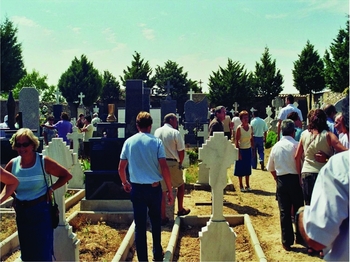
At key moments in the exhumation process, the relatives of the dead come together to reach collective decisions on the form and content of the commemorative ceremonies, monuments and plaques that accompany reburial (Figure 1). The position of the archaeologists and campaign co-ordinators was that these decisions should emerge organically through debate amongst the network of relatives of the dead and that only relatives should be the arbiters of these decisions. In some locations this process results in reburials that are accompanied by a Catholic Mass or elements of Christian ritual and symbolism. This has attracted strong criticism from some leftist memory groups, with a representative aligned to the Spanish Communist Party commenting, ‘If, in a hundred years, all the dead killed by Franco are lying buried under crosses, they are going to think they were killed for being Catholics’ (Renshaw Reference Renshaw2011, 206). This is a striking phrase as it is a direct appeal to an archaeological sensibility, an awareness of the responsibilities inherent in any intervention which destroys the material record of a historical event and constitutes in its place a new one which will be interpreted by future generations.
A reburial ceremony for Republican civilians killed in the Spanish Civil War, Burgos Province, Castile-Leon, Spain.

The archaeologists and campaigners bring a historical and political consciousness to their understanding of a mass grave, informed by their experience of other grave sites from the Civil War and the detailed background research undertaken at each site, and they use this to contextualize and interpret the evidence they encounter in the grave. This perspective is shared and acknowledged amongst a circle of archaeologists and campaign activists but it is not publicly represented or debated with others in the issue network, such as the relatives of the dead. However, the archaeologists do share their technical expertise on the skeletal remains, location, injuries and associated artefacts in the form of public presentations and widely disseminated scientific reports (Renshaw Reference Renshaw2010b). In this way archaeologists are positioning themselves as primarily technical operators, facilitating the work but without a broader interpretation of the graves, or commentary upon the meaning and legacy of the exhumations.
Arguably, this is an appropriate position for the archaeologist, given the potentially explosive and divisive history of these graves, and shows a necessary sensitivity to the extreme emotion and anguish experienced by many relatives of the dead, who may simply want to see their family member get a proper burial without revisiting the traumatic past. But this position fails to recognize the breadth and diversity of the issue network that surrounds the Republican dead. It also misunderstands the operation of networks around these issues, as by explicitly articulating an intellectual position on the exhumations, even if this adds complexity or controversy, levels of public engagement are stimulated. Fears about unduly influencing a debate from a position of intellectual or technical expertise are unfounded if all interventions on an issue ultimately serve to democratize it.
The Battle of Fromelles
In 2010 a new Commonwealth War Graves Commission cemetery opened in the village of Fromelles in northern France (Summers Reference Summers2010). It was constructed for the reburial of 250 First World War soldiers, mainly those of the Australian Imperial Force who fought as part of the British Empire on the Western Front. These particular soldiers had fallen behind enemy lines, fighting in the disastrous battle of Fromelles in July 1916 which claimed over 5,000 casualties (Cobb Reference Cobb2007; Corfield Reference Corfield2009). In the immediate aftermath of the battle, their remains were gathered up by German soldiers and buried in mass graves, where they stayed for over ninety years (Lindsay Reference Lindsay2008). The complex narrative of the discovery of the mass graves; the painstaking exhumation; the sophisticated genetic testing that enabled identification of the dead; the hugely successful outreach programme to recruit relatives of the dead to submit genetic samples; and lastly the decision to construct a purpose-built cemetery, and soon a new museum, dedicated to these men, are an example of a highly effective issue network in action.
The existence of these missing graves was initially denied, as it was thought that all the dead had been gathered by the recovery teams that operated on the Western Front after the armistice in 1918 and buried at the original commemorative site for Fromelles, the Commonwealth War Graves Commission cemetery known as VC Corner. This cemetery at VC Corner does not take the usual form of individual grave plots with headstones, because the losses of the battle were so heavy and the remains of many were in such poor condition. Instead, there is a shared monument naming the fallen with a number of large group graves surrounding it. Through the remarkable initiative of Australian amateur historian Lambis Englezos, and his supporters, it was demonstrated that not all the remains had been recovered in the post-war period, and the probable location of the missing bodies was identified through aerial photographs (Corfield Reference Corfield2009; Lindsay Reference Lindsay2008). Although there are conventions against prospecting for soldier's remains on the Western Front, the compelling evidence for the location of these mass graves and the identity of those buried in them meant this was deemed an exceptional case.
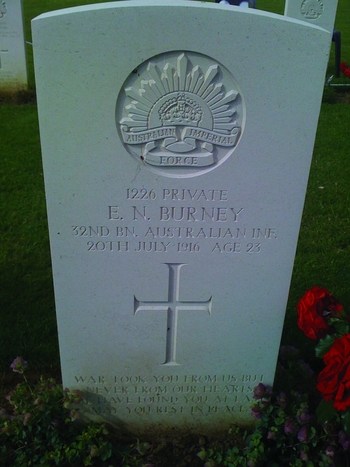
However, in excavating these newly discovered mass graves, a decision was taken not to reuse group burials at the original cemetery at VC Corner. Given the historical evidence for the probable identities of the dead, and the potential to attain unique identifications through DNA analysis, it was decided to construct a new cemetery with the more conventional format of individually marked plots and headstones. Following the remarkable technical success of both the excavation and the subsequent laboratory analysis, half of these headstones now bear the name of the individual soldier buried under them (Figure 2). The burial of the missing soldiers in the new cemetery at Fromelles undoubtedly represents a success for the techniques of conflict and forensic archaeology (Loe Reference Loe2010). For many of the relatives of the dead, the project has been a source of profound comfort and pride, as well as emotional turmoil, as they seek to resolve this particular strand of their family's history (Whitford and Pollard Reference Whitford and Pollard2009). However, the Fromelles project also sets some potentially significant precedents and raises a number of intellectual questions that archaeologists need to engage with.
Headstone of Private E.N. Burney in the new cemetery at Fromelles, Nord-Pas-de-Calais, France.

By opting to use current DNA technology to achieve unique identifications for the recently recovered Fromelles dead, a break has been made with the past. This has created a disparity in the post-mortem treatment of two groups of soldiers from the same battle (Leach Scully and Woodward Reference Leach Scully and Woodward2012). Taken alongside the much-publicized identification of the Vietnam Unknown Warrior from an American military cemetery (Holland and Parsons Reference Holland and Parsons1999), the break with the past made at Fromelles is an indicator not only of changing technological capabilities, but also of changes in commemorative sensibilities regarding the significance of individual identity and familial bonds with the dead (Blair, Balthrop and Michel Reference Blair, Balthrop and Michel2011). It is possible to envisage that, in the near future, the principle of anonymous burial may be more widely challenged by issue networks that form around the dead of particular battles or particular cemeteries. This challenge may extend beyond the kind of clandestine mass graves encountered in Spain, or the missing bodies of Fromelles, and also include the thousands of anonymous ‘Known unto God’ burials in military cemeteries around the world, or the kind of group interments at VC Corner.
Any issue concerning the dead of the First World War will bring a large public into being, due to the number of people who are strongly and variously engaged with this past. The battlefields and cemeteries of the First World War are examples of a shared cultural property which fulfils a pedagogic, commemorative and contemplative role for a broad cross-section, regardless of their personal, familial or national connection to the dead. For some, they are redemptive places of peace, the material manifestation of an authentic collective desire to honour the dead, whilst for others these cemeteries and monuments represent the inadequate conciliatory rhetoric of the same militaristic regimes who led their citizens into war. Since their introduction after the First World War, the ‘Known unto God’ headstones have become a powerful trope of 20th-century conflict, evoking the double loss of both life and identity (Laqueur Reference Laqueur, Schatzki and Natter1996). Through their number and uniformity, these headstones form a composite monument to the scale of loss in the world wars. For some people, the ‘Known unto God’ are a reminder of our shared responsibility to remember all war dead, regardless of our familial affiliations to a particular soldier, whilst for others the anonymous graves represent a task unfinished due to the technological limitations of the past.
Conclusion
More issue networks will undoubtedly form in the future, committed to the recovery of war dead who are missing, or to bring about changes in the burial and commemoration of those already found. Archaeologists will be called upon to lend their technical expertise but they must also be prepared to offer an archaeologically informed intellectual perspective on the meaning and outcomes of these interventions. The potential intellectual contribution of an archaeologist can be located in some of the interpretive tools of archaeology, particularly the perspectives conferred by an awareness of context and scale, and a highly developed sensitivity to how the meaning of material culture can change through time. An important contribution is to contextualize the archaeological intervention itself, asking why the network has formed and why the proposed excavation is occurring at that particular moment in the history of the site, in order to highlight the extent to which the resulting archaeology will be informed by contemporary society's preoccupation with and framing of the issue. Archaeologists can also highlight the potential for destruction and preservation inherent in any archaeological intervention, offering a longer time perspective on the future ramifications of changing the material record, and the legacy of the commemorative acts and monuments that accompany exhumation and reburial.
Carrying out archaeology in the name of the public good, or on behalf of a perceived constituency of the public, such as the relatives of the dead, is not the same as a full and authentic intellectual engagement with an issue and the wider network that surrounds it. Archaeologists should formulate an intellectual rationale for their work which acknowledges the full complexity of the debates that can arise around excavations, and which also reflexively acknowledges their own affective or personal involvement in these debates, and represent this position clearly and publicly. The concept of the issue network suggests that the public which forms around an archaeological project is not static, and through their intellectual contribution archaeologists may widen the network and the debate. The model of the issue network also suggests that complicating or problematizing an issue is part of democratizing it, the opposite of the elitist perspective that some aspects of a problem are too challenging or contentious to articulate in public. The archaeologist can advance the public's deliberation of an issue, even if this occurs by the network contesting, or ultimately refuting, the archaeologist's intellectual contribution.