

This article is not a traditional research article. It should instead be read as a conceptual article with a purpose to reflect over existing perspectives on disability management (DM) in different welfare state contexts, and argue for a stronger focus on welfare state issues in DM research. Focus in this article is set on Sweden.
Three Traditional Welfare Models
The welfare state has been a favoured topic of research for many years. This is not surprising when considering the pace of its growth in most countries during the last 50 years. Those which were previously night-watchman states, law-and-order states, and militarist states are now institutions preoccupied with the production and distribution of social wellbeing. To study the welfare state is therefore a means of understanding a relatively novel phenomenon in the history of capitalist societies. A basic definition of a welfare state is that it involves the states’ responsibility for securing a basic modicum of welfare for its citizens.
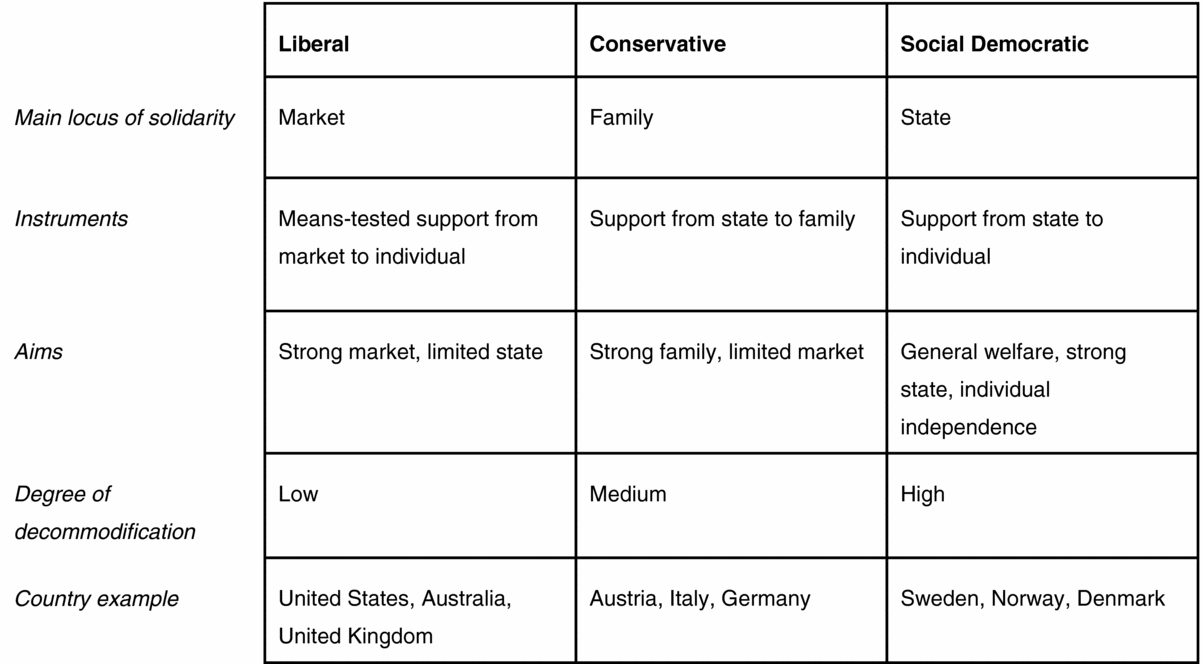
Over the years, different types of welfare models have been established in different countries. Perhaps the most prominent researcher within the field, Gosta Esping-Andersen, has identified three major types of welfare models: the liberal, the conservative, and the social-democratic (Esping-Andersen, Reference Esping-Anderson1990). The rationale behind his categorisation is the individual's degree of decommodification. But what is decommodification? In precapitalist societies, few workers were properly commodities in the sense that their survival was contingent upon the sale of their labour power. It is when the market becomes universal and hegemonic that the welfare of individuals comes to depend entirely on the cash nexus. Stripping society of the institutional layers that guaranteed social reproduction outside the labour contract meant that people were commodified. In turn, the introduction of modern social rights implies a loosening of the pure commodity status. Decommodification occurs when a service is rendered as a matter of right, and when a person can maintain a livelihood without reliance on the market. It is the degree of decommodification that differs between the different welfare models. Some of the characteristics of the three different models identified by Esping-Andersen are now provided (also see Figure 1).
Characteristics of the three welfare models.

Liberal Welfare States
The main features of liberal welfare states are means-tested assistance, modest universal transfers or modest social-insurance plans. Benefits cater mainly to a clientele of low income, usually working class state dependents. In it, the limits of welfare equal the marginal propensity to opt for welfare instead of work. Entitlement rules are therefore strict and often associated with stigma; benefits are typically modest. In many aspects, the liberal welfare model is relatively limited and the degree of decommodification is low. Examples of liberal welfare states are the United States, Australia and the United Kingdom.
Conservative Welfare States
The conservative welfare states feature social insurance more than means-tested social assistance. In other words, most of the benefits for unemployment or sickness are entitlements based on insurance contributions previously made. Also, the contributions made and the benefits received vary according to the income of the individual. This is known as the Bismark model — as opposed to the Beveridge model in which all contributions and benefits were to be at a flat rate.
The conservative regimes are also typically shaped by religion and culture, and hence strongly committed to the preservation of traditional familyhood. Social insurance typically excludes nonworking wives, and family benefits encourage motherhood. The state will only interfere when the family's capacity to service its members is exhausted. The conservative welfare model has greater social ambitions than the liberal model, and the degree of decommodification is medium. Countries with this model include Austria, France, Germany, and Italy.
Social-Democratic Welfare States
High levels of benefits and services are provided by the social-democratic state. All strata are incorporated under one universal insurance system, yet benefits are graduated according to accustomed earnings. The ideal is not to maximise dependence on the family, but capacities for individual independence. The state opts to take direct responsibility for caring for children, the aged and the helpless. It is committed to allowing women to choose work rather than the household, with an abundance of state-provided childcare from an early age. The social-democratic welfare model is comprehensive and in many ways has greater social ambitions than both the liberal and the conservative models. In the social-democratic welfare states, the degree of decommodification is high. Countries with this model include the Scandinavian countries, Sweden in particular.
Against the different welfare models’ sizes, structures and ambitions it could be hypothesised that the functions of DM (i.e., disability prevention and assistance in return to work) are already included and built into the most comprehensive welfare models, and perhaps especially so in social-democratic welfare states, and that employer-based DM is therefore not required. The aim of the current article is to discuss and reflect over that hypothesis.
What is Disability Management?
DM can be defined in several ways. What most definitions have in common is that DM focuses on absences from work as a result of illness, injury or disability, and on preventing the risks that cause these absences. It is a deliberate and coordinated effort by employers to reduce the occurrence and effect of illness and injury on workforce productivity, and to promote employee attachment. In this article, DM is defined as a workplace prevention and remediation strategy that seeks to prevent disability from occurring or, lacking that, to intervene early following the onset of disability, using coordinated, cost-conscious, high-quality rehabilitation services that reflect an organisational commitment to continued employment of those experiencing functional work limitations. The remediation goal of DM is successful job maintenance, or optimum timing for return to work. This definition is also used by Akabas, Gates, and Galvin (Reference Akabas, Gates and Galvin1992).
Some Facts About Sweden
Sweden is a relatively large country in northern Europe. Most of its 9.7 million inhabitants live in the capital, Stockholm, and further south. Only around 1.5 million live north of Stockholm. Politically, the Social Democrats have been in power for the last 80 years, with only some exceptions. Sweden is an export-oriented economy with a large number of well established companies, such as IKEA, Ericsson, Volvo, and H&M. The degree of labour participation is high for both men (86%) and women (80%). Sweden has a large public sector employing predominantly women (74%). To finance the large public sector, income taxes in Sweden are high. Both men and women receive the guaranteed pension from the age of 65. Unemployment in 2015 was around the 7% mark.
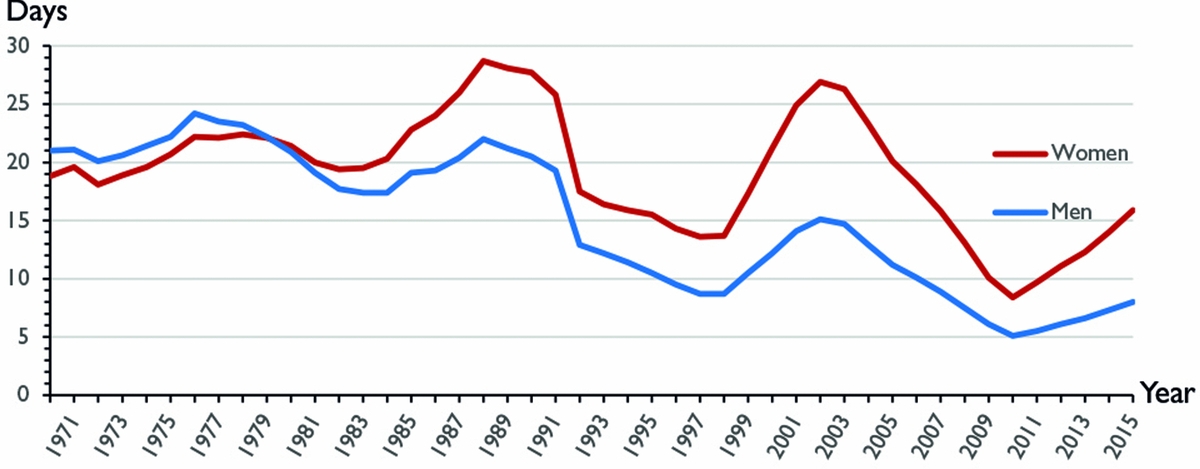
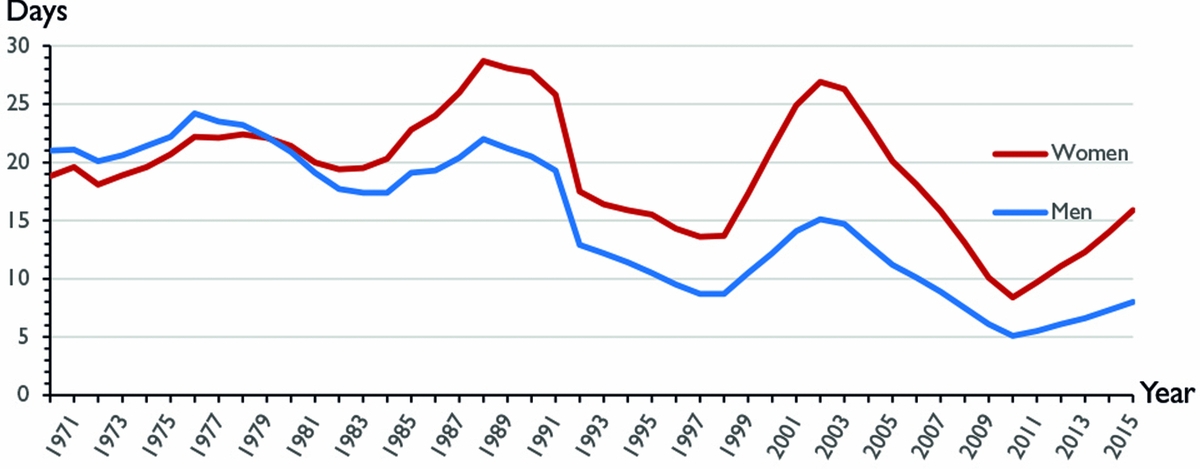
Sweden has a generous welfare system when it comes to sickness and disability. Everyone is covered by a social insurance system and eligible for benefit regardless of whether the accident or illness is work-related. Sickness benefits are income-related and amount to around 80% of an individual's income. If sickness or disability is permanent, the individual receives a disability pension. The average number of sickness days paid by the social insurance agency in 2015 was 13 for women, and 8 for men. However, historically, the number of sickness days has varied greatly for both women and men. As can be seen in Figure 2, women are more often on sickness absence than men. These variances have a number of different explanations; however, such discussion is outside the scope of this article.
Average days on sick leave per year for men and women in Sweden, 1970 to 2015.
Ill-health Prevention and Return to Work in Sweden
When it comes to ill-health prevention and return to work (RTW) in Sweden, there are two major stakeholders involved: (a) the employer, and (b) the social insurance agency (SIA). The employer has responsibilities for both ill-health prevention and RTW, while the SIA is involved solely in the RTW process. Regarding ill-health prevention, the labour law and work environment determines that the employer is always obliged to ensure that work can be carried out without risk of ill-health or accidents. The employer shall take all steps necessary to prevent employees from being subject to ill-health or accidents. A point of departure shall therefore be that everything which can lead to ill-health or accidents shall be changed or replaced so that the risk of ill-health or accidents is removed. The work environment encompasses all factors and relations at work: technical, physical, organisational, social, and work content.
The laws regarding employer responsibilities in return to work are written and applied at an organisational level. The law states that the employer must have an organisation for rehabilitation and workplace adjustments, and must also ensure that rehabilitation activities can be provided at the workplace. The employer must be able to offer work training and modified work as well as finance measures that can be taken within the organisation.
The SIA's responsibilities regarding RTW are comprehensive. The SIA is responsible for investigating the individual's potential need for rehabilitation, initiating activities for effective rehabilitation, and establishing a rehabilitation plan (at case level) that includes information regarding what shall be done, when it shall be done, and by whom. The SIA is also responsible for coordinating the different actors involved (i.e., the employer, the physician, the psychologist and perhaps the physiotherapist), and also supervises the rehabilitation process. As the law is written, the officer at the SIA is responsible for convening rehabilitation meetings and chairing such meetings, and in cases where the rehabilitation plan is not followed, the officer at the SIA is the person who should be in command and force the actors involved to fulfill their duties and follow the plan.
How Do Ill-Health Prevention and RTW Work in Practice?
Overall, the work environment in Sweden is good, at least from a physical perspective. As can be seen in Figure 3 and Figure 4, accidents at work are relatively few and in comparison, not that severe.
Fatal accidents at work, 2011 and 2012. Standardised incidence rates per 100,000 persons employed.

Non-Fatal accidents at work, 2011 and 2012. Standardised incidence rates per 100,000 persons employed.

When it comes to more psychosocial aspects of the work environment, the picture is less clear. In relation to other European countries there is no reason to believe that the psychosocial environment in Sweden is either worse or better. The results from a comparative study from 2010 (European Working Conditions Survey, 2010) show that Swedes are more satisfied than French and Spanish workers with their working conditions, but less satisfied than Norwegians, Danes and the British. When it comes to experienced support and help from managers, Swedes are less satisfied than most other Europeans. Germans and Italians are the only ones scoring as low as the Swedes. Swedes, however, report that they, more than others, have very good friends at work. And finally, on the question ‘Will you be able to do your job when you are 60 years old’, Swedes, Norwegians, and Germans score the highest. In summary, ill-health prevention — both physical and psychosocial — seems to work fairly well in Sweden.
But how about RTW? Does the employer fulfill their statutory duties? And how about the SIA? Does this agency act in accordance with the intentions of the laws and regulations?
Regarding employers, problems exist, but there are signs of improvement. In a study by Selander, Marnetoft, Bergroth, and Ekholm (Reference Selander, Marnetoft, Bergroth and Ekholm1998), a major finding was that RTW was beset with general problems and did not work well. Employers did not fulfill their statutory duties in the rehabilitation process. Only few rehabilitation investigations (which at that time were the responsibility of the employer) were carried out, and at a late stage. In a later study by Kärrholm, Ekholm, Ekholm, Bergroth, and Ekholm (Reference Kärrholm, Ekholm, Ekholm, Bergroth and Ekholm2008), it was concluded that employers needed to cooperate more effectively with other stakeholders than they currently did. Studies also show that employers care more for employees with high socioeconomic status (Burström, Nylén, Clayton, Whitehead, Reference Burström, Nylén, Clayton and Whitehead2011) and that workplace adjustment seldom takes place (Wåhlin, Ekberg, Persson, Bernfort, & Oberg, Reference Wåhlin, Ekberg, Persson, Bernfort and Oberg2012). A recent study shows that employers do not take responsibility for RTW and that financial considerations take precedence over legal and ethical considerations (Seing, MacEachen, Ekberg, & Stahl, Reference Seing, MacEachen, Ekberg and Stahl2015). But there are also more positive findings, and one example is a recent comprehensive study by Selander, Tjulin, Mussner, and Ekberg (Reference Selander, Tjulin, Mussner and Ekberg2015). The results from that study show that Swedish employees on long-term sick leave have frequent and valuable contact with their supervisors, and that contact is initiated by both the employee and the supervisor. The results also show that contact and communication is not only concerned with work-related issues, but also more social aspects and everyday life. The same study shows that communication with colleagues at work is frequent and appreciated during long-term absence from work. Moreover, the results from an ongoing study (April, 2016), where human resource managers and employers at larger public and private companies were interviewed regarding their work with RTW, indicate that a substantial majority of companies operate effective strategies and systems. Among those interviewed, there is a great awareness of the necessity of effective RTW.
Also, when it comes to the SIA and its work with RTW, problems exist, but here there are now actual signs of improvement. The existing knowledge provides an unsatisfactory picture of the SIA's work with RTW. Selander et al. (Reference Selander, Marnetoft, Bergroth and Ekholm1998) concluded that RTW at the SIA in general is beset with problems. Rehabilitation plans are seldom established, and are often of poor quality. Rehabilitation activities are far too few and there is a lack of communication between the SIA and other stakeholders. That similar problems also exist today is shown in a recent study by Marklund et al. (Reference Marklund, Lundh, Gustafsson, Linder, Svedberg and Alexandersson2015). Studies also show that the SIA experiences problems with doctors’ medical certificates (Forsakringskassan, 2012), that the SIA's work with rehabilitation plans does not function (Dubois, Reference Dubois2013), and that the rehabilitation chain does not work according to plan (Inspektionen för socialförsäkring [ISF], 2015). Another study, from ISF (2014), shows that the SIA's rehabilitation investigations lead to a stalemate which in turn results in longer rather than shorter periods of absence from work. In summary, the SIA's role and function in the RTW process does not work to a satisfactory degree.
Why Does RTW Not Work in Sweden?
From the employer's perspective, one problem is linked to unclear responsibilities. Employers experience the vaguely written laws as problematic. What is to be done by the employer and SIA, respectively? Another problem has to do with lack of incentives. After two weeks of sick pay, the employer has no further financial responsibilities for the absent employee. In an international perspective, this is a very light obligation. In several other European countries employer incentives are much greater. A third problem is that the Swedish system lacks the scope to impose sanctions on employers that do not fulfill their statutory obligations. The SIA has the responsibility to supervise the rehabilitation process, but in cases where the employer does not fulfill its obligations, sanctions cannot be imposed.
Regarding the unsatisfactory work by the SIA, there are several explanations. One is that there is a lack of RTW culture at the SIA. Historically, the SIA has focused mainly on financial support and sickness benefits, and that is also the case today. RTW is something to be handled ‘on the side’. Also, workloads at the agency constitute a problem. An officer at the SIA commonly has more than 100 individual cases to handle, and it is easy to see that it is problematic (impossible!) to coordinate and supervise 100 cases simultaneously. In addition, it should not be forgotten that the responsibility put on the SIA is comprehensive — to investigate needs, plan activities, coordinate different actors involved, and supervise is difficult. The individual officer at the SIA does not always possess the skills required to competently perform all these duties.
Is DM Necessary in a Traditional Social-Democratic Welfare State like Sweden?
The main aim of this article is to discuss and reflect over that question. As can be seen, much of the thought behind DM is indeed built into the comprehensive welfare system in Sweden. In addition to the employer's responsibilities regarding ill-health prevention, the Acts and regulations regarding the SIA's responsibilities regarding RTW are comprehensive. As can be seen, however, this is no guarantee that the established process will work in practice. In too many cases, RTW in Sweden is suffering from organisational and case-level related problems. Against this background, a suggestion is to remove the current responsibility for RTW from the SIA and instead allow the employer and Swedish Work Environment Authority to take on the responsibilities for the work associated with RTW. There are several reasons for this:
-
• In the current Swedish system, the employer has responsibilities regarding rehabilitative measures at the workplace. These responsibilities could well be extended with responsibilities that currently lie with the SIA; that is, to investigate, plan and coordinate. A system such as the current one, where responsibilities are shared with the SIA, is considered by many employers to be unclear and confusing.
-
• Research shows that the workplace and the different actors there play a significant role in the RTW process. The supervisor's attitude is paramount for successful RTW. With extended employer responsibilities, the incentives increase for effective work concerning the work environment and RTW
-
• By removing responsibilities for RTW from the SIA, the officer at the SIA will no longer be burdened by the role conflict which arises when he/she is simultaneously expected to support the employee on long-term sickness absence and also act as the agent who decides on the employee's entitlement to sickness benefit.
-
• For employers that do not fulfill their responsibilities, it must be possible to impose sanctions (this is not the case in today's system). The SIA's legal responsibility to supervise the different rehabilitation actors involved could therefore be transferred to the Swedish Work Environment Authority, whose role and function is to ensure that laws and regulations regarding work environment are complied with. The Swedish Work Environment Authority has long experience in dealing with financial sanctions.
Conclusion
Sickness absence in Sweden has historically and in an international perspective been high. Work health prevention works well, while RTW appears to be beset with problems. The current system, with comprehensive legal responsibilities placed on the SIA, does not work well. In order for RTW to be more effective, more focus and responsibilities should be placed on the employer. The answer to the main question stated in this article (i.e., ‘Is employer based disability management necessary in a social-democratic welfare state like Sweden?’) is obviously yes.