I speak with Havana resident and music fan Pascual through a WhatsApp voice call in February 2021 from my home in Chapel Hill, North Carolina. After multiple failed attempts, I finally reach Pascual through Cuba's notoriously terrible internet service.Footnote 1 We discuss a short list of problems that his Black Cuban family has experienced recently. Long lines at food stores, a lack of available work, disappearing access to ‘MLC’ (Moneda Libremente Convertible, a new form of Cuban currency), and concerns about police harassment are all considered during our exchange. While Pascual does not address COVID-19 directly, he explains that many of his concerns are a direct result of the government's heavy-handed and racialized response to the pandemic. The state is using the coronavirus as an excuse to detain citizens – many of whom are Black – for propagar una epidemia (‘spreading an epidemic’), a dubious legal charge enacted by the Cuban state during the pandemic.Footnote 2 In practice, the measure is used primarily against Cubans of colour, leading commentators to wonder if the goal is to eliminate biological viruses, or if there is a different kind of ‘contagion’ with which the government is concerned.Footnote 3 The Cuban state regards the mainly Black residents of reparto (‘residential district’) as especially susceptible to spreading disease.Footnote 4 Havana-based rapper Maykel Osorbo, for instance, is currently in jail (as of the time of this writing) for crimes that include resistencia (‘resistance’) and desacato (‘disrespect’).Footnote 5
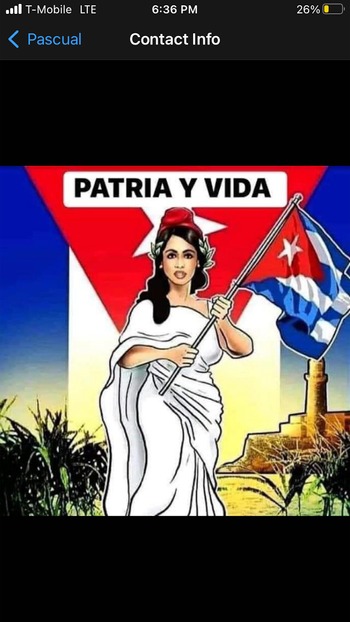
During our conversation, I notice that Pascual recently changed his WhatsApp profile photo to an image containing the phrase ‘Patria y Vida’ (‘Fatherland and Life’), a play on the common Cuban phrase ‘Patria o Muerte’ (Figure 1). The quote ‘Patria o Muerte’ (‘Fatherland or Death’) is a Cuban symbol of national pride first expressed by Fidel Castro during a funeral for the victims of a steamship explosion in 1960 and today printed on currency and learned by schoolchildren from a young age.
(Colour online) The classical image of ‘Marianne’, a French republican symbol also associated with Cuban nationalism from the early twentieth century, updated here to include the Cuban flag with the text ‘Patria y vida’ overhead.

The double entendre embedded in the image draws my attention. Figure 1 displays the image of Marianne, a French republican symbol signifying reason and liberty.Footnote 6 The juxtaposition of the image alongside the words ‘Patria y vida’ present a stark reversal to rhetoric typically found in Cuban state propaganda. I promptly paste the phrase ‘Patria y vida’ into Google and discover its origin: a recently released hip hop track featuring several popular Cuban and Cuban American artists. The song and its accompanying video make an appeal to national unity through visceral criticism of the Cuban state.
Yotuel Romero from Orishas (an internationally successful hip hop group that paved the way for hip hop's legitimacy in Cuba), Alexander Delgado and Randy Malcom Martínez from duo Gente de Zona (one of the most successful reggaetón groups to hail from Cuba), and singer/songwriter Descemer Bueno each contribute a verse. All reside across Cuba's diaspora (but mainly in the South Florida area). Rappers Eliécer Márquez (more commonly known as ‘El Funky’) and Maykel Castillo ‘Osorbo’ also contribute verses. They continue to live in their hometown of Havana. Each artist identifies as Black and hails from working-class repartimientos, outlying districts populated by lower-class residents who include a high percentage of Black Cuban nationals.Footnote 7
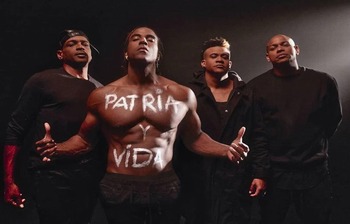
Production, as well, spans the Cuban diaspora. The song was completed in Miami, but sections of the video were clandestinely filmed in Havana to include artists from Movimiento San Isidro (MSI), a Cuban group of artists and political activists. El Funky and Maykel Osorbo (members of MSI) met in an abandoned house in Havana and tapped into a power line to provide energy for lighting equipment. From Miami, Yotuel Romero coordinated production by stitching together footage recorded in both locations.Footnote 8 These elements connect Cuban nationals to friends and family across the diaspora. From footage of protesting MSI artists in Havana, to the arresting image of Yotuel's bare chest etched with the phrase ‘Patria y vida’ in the United States, the song and video mount a transnational musical assault against the Cuban state (Figure 2).Footnote 9
(Colour online) Screenshot from ‘Patria y vida’ taken from YouTube.

Pascual confirms the song's impact in Cuba during our conversation. ‘The video for “Patria y vida” has gone viral, and everyone around me is singing it on guaguas [‘buses’]. They are using the hashtag #PatriaYVida on social media. It's incredible. The government does not know how to handle this.’ In just over a month since its initial release, ‘Patria y vida’ has garnered over 3 million views on YouTube (it has received another 8 million views at the time of this writing), creating an impetus for protests mounted within Cuba in which activists have chanted the song's title, etched the phrase into graffiti tags (most prominently from activist Anyell Valdés Cruz), took selfies of themselves with the expression written on their chests, and worn t-shirts where the saying is printed atop the Cuban flag.Footnote 10 Protests of equal proportions have occurred across the Straits of Florida in neighbouring Miami. For instance, a caravan of hundreds of cars waving Cuban flags and playing the song at high volumes proceeded through La Feria de la Juventud on 6 March 2021.Footnote 11 Most significantly, on 11 July 2021, massive and unprecedented protests occurred across Cuba where participants shouted ‘Patria y vida’ while demanding economic and political freedoms.Footnote 12 Considering Cuba's technological scarcity (which, for many repartimiento residents, makes it difficult to share content directly through the internet), it is remarkable that a work positioned so strongly against the state has become a popular rallying cry for Cubans and Cuban Americans.
While journalists and academics have written of its impact, most writing ignores the question of how the controversial song and music video spread so quickly and widely.Footnote 13 Equally troubling is that explanations remove agency from the Black Cuban nationals responsible for propagating the video in repartimiento districts through the peer-to-peer trade of USB drives. Black Cuban nationals who live in these districts possess significantly less access to the internet than white Cubans, echoing their overall economic disadvantage as compared with white peers.Footnote 14 To get around this restriction and trade media unavailable through Cuba's state-owned media channels, digital information travels through an underground USB network referred to as el paquete semanal (‘the weekly package’).Footnote 15 El paquete semanal is an offline trade of downloaded data circulated through USB drives across Cuba and informally sold to subscribers for approximately US$2.Footnote 16 Subscribers routinely customize paquete packages to include controversial music and other media traded privately among friends and family.
I argue that the circulation of ‘Patria y vida’ within USB drives marks a powerful demonstration of offline virality.Footnote 17 Through their efforts, participants who shared ‘Patria y vida’ through offline digital networks not only contested an official political discourse, but also assumptions about how the internet operates and the infrastructure required to generate viral events. Theorized by Paula Harper, viral musicking is ‘participation in a performance of viral music in any capacity (whether performing, providing, viewing/listening, remixing, remediating, or sharing material) giving it the potential to pass on and “infect” new “hosts”’.Footnote 18 In this article, I examine the social and political affordances of Cuba's USB-based internet and its role in generating conditions for offline viral musicking.
Digital virality performs a crucial role in the spread of music around Cuba and, I would suggest, in challenging the command economic and political structures of the nation more generally. As Cuban blogger Yoani Sánchez notes of its irreversible power: ‘the virus that is the internet irremediably infected the Cuban people’.Footnote 19 Likewise, José Raúl Concepción Llanes and Martín Oller Alonso remark of the political effects of Cuba's emerging digital landscape that ‘access to new technologies has gradually contributed, firstly, to the privatization of the lives of Cubans and, secondly, to an irreversible loss of the government's ability to influence people based on revolutionary control-and-command mechanisms’.Footnote 20 Even in spaces where citizens manage situations of acute technological precarity, access to tools of digital connectivity contributes to both of these conditions.
Memory sticks are commonly used to exchange music and information across the Global South.Footnote 21 In northern Uganda for instance, residents trade movies that are later broadcast publicly in video halls (bibanda).Footnote 22 Similar structures exist in Mali, Afghanistan, and South Africa where informal networks rely on the Bluetooth transfer of digital products.Footnote 23 In Cuba, digital media is traded in physically shared spaces such as parks, guaguas, and El Malecón (Havana's famous seawall) through USB-based systems of digital content delivery. USB networks such as el paquete are created and shared on the island between any number of participants, from small groups of friends to millions of subscribers.Footnote 24 In these spaces, connectivity is not accessed, its constructed. Alexandrine Boudreault-Fournier writes that ‘the sharing of data based on mobile storage devices rapidly becomes an effective network of transmission and circulation in Cuba, supplementing other modes of online sharing’.Footnote 25 Thomas Astley likewise considers the consequences of offline data sharing, writing that ‘it is an act, potentially, of political and cultural dissidence’.Footnote 26
In the first section, I outline how el paquete semanal operates and introduce the group of repartimiento residents who use and re-use the system in their daily lives. In the following section, I examine the Cuban state's failed response to ‘Patria y vida’ as a misunderstanding of the effects of offline viral musicking. In both sections, I reveal the hidden power of music shared through a USB-based internet.
El paquete semanal and Los Reparteros
At first glance, residents of repartimiento districts (often referred to as reparteros) do not appear a likely group of people to benefit from viral musicking. The underprivileged, Havana-based, mainly Black Cuban communities have little legal access to food, work, or the world wide web. This is partially because of programmes such as the ‘MLC’ currency (begun on 1 January 2021) enacted to shore up the Cuban economy amidst a lack of tourism during the COVID-19 pandemic.Footnote 27 MLC works differently from past Cuban currencies: citizens obtain and fill MLC cards at Cuban banks with foreign currencies such as euros and US dollars, then use these cards at select stores to purchase food and household items that are otherwise difficult to obtain. Black Cubans, however, do not typically have access to foreign currencies, as they possess less foreign and local currency than white peers.Footnote 28 Instead, remittances mainly flow to citizens with relatives that have the financial ability to send money to family members from overseas. Relatives who, according to Katrin Hansing and Uwe Optenhögel, are often white.Footnote 29 These economic disparities force Black Cubans to resort to piracy to procure basic goods.
Piracy is rampant in Cuba, serving as an important mode of representation for participants.Footnote 30 Ravi Sundaram notes that ‘pirate culture produces a significant enabling resource for subaltern populations unable to enter the legal city’.Footnote 31 Highly organized systems of piracy operate in Cuba to deliver all manner of items to residents, from food, to rum, and furniture.Footnote 32 A complex mula (a person who transports illegal products by concealing them during travel) trade imports these products to Cuba's airports from neighbouring countries.Footnote 33 Jennifer Cearns writes that ‘the island is part of informal networks of circulation spanning at least twelve countries’. Pirate infrastructures such as the mula trade rely upon informal networks built atop existing formal infrastructures. The same roads, bridges, and airplanes utilized for legal commerce in other words, also allow Cuban nationals to import goods to a thriving black market. Utilizing piracy, residents of reparto districts skirt around the Cuban state's rigid official rules that dictate access to food and other scarce materials, but the practice has the negative effect of turning their communities into targets by the state.
Piracy also has a digital equivalent nearly as valuable as the trade of food. Though internet connectivity in Cuba is difficult to come by, it is increasingly necessary for Cubans (especially those of a younger generation) to utilize digital devices to communicate, trade information, and stream entertainment with family and friends. Brian Larkin writes of the liberatory role of media piracy that it ‘represents the potential of technologies of reproduction – the supple ability to store, reproduce, and retrieve data – when shorn from the legal frameworks that limit their application’.Footnote 34 While 3G is accessible, it is costly, often unreliable, and prevents the sharing of content as most media is stored on personal devices instead of streamed from applications. Because of this, most Cubans use 3G to communicate with friends and family, not for music streaming. As Heikel Pro (a Cuban reggaetón artist) bluntly put it to me during an interview: ‘La memoria es para escuchar música’ (‘memory sticks are for listening to music’).
To get around internet restrictions and the high cost of 3G mobile internet plans, residents trade pirated data with one another through USB drives (rather than sharing data over a modem/router version of a computer network). Through this system, participants discretely trade a variety of digital content, including movies, phone applications, and video games. Just as material piracy allows the residents of reparto districts the ability to find food they are otherwise denied through legal means, digital piracy allows participants to use USB-based networks to multiply the impact of banned content accessed by individual users in internet-poor destinations such as Cuba.
In Cuba, the most widely traded system of USB internet delivery is a package of digital media sold to customers through a system colloquially referred to as el paquete semanal. El paquete semanal is one of the most highly organized systems of internet delivery in Cuba. The terrestrial network is a terabyte of internet media downloaded weekly from satellite dishes, placed on USB drives, and distributed across the nation through a hierarchically arranged network of distributors. It has the benefit (compared with wired versions of the internet) of being cheap, accessible, and easily shared. It is so popular that many consider el paquete semanal one of the nation's top employers. Approximately 3 million people use el paquete semanal daily (although that number is likely below the actual count).Footnote 35 It has grown so popular that, as Laura-Zoë Humphreys notes, ‘the paquete also gave rise to new forms of cultural production on the island’.Footnote 36 Though technically illegal, the government tacitly allows the trade of el paquete semanal if content includes ‘no politics and no pornography’.Footnote 37
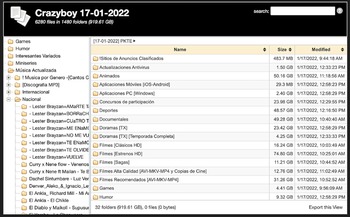
The digital media distribution system developed from its earliest appearances as a locally traded sneakernet around Havana in 2008 into a complex and vertically arranged business structure circulated nationwide in 2021.Footnote 38 At the top of the network's hierarchy are matrices. Matrices are responsible for downloading content discretely through privately accessed internet channels.Footnote 39 The media they curate on each week's paquete ranges from international films to video games and phone applications. They also package domestically produced content such as hip hop and reggaetón music, a trading platform called Revolico, and various PDF-based news magazines. Files are organized in folders categorized alphabetically, save for the addition of low-tech hacks such as exclamation marks prepended to the left of folder names. The exclamation mark forces the folder to the top of the listing, and presumably as the first folder a viewer's eyes move towards when opening the containing folder. Figure 3 for instance, displays a folder listing with the sub-folder marked ‘!Sitios de Anuncios Clasificados’ forced to the top of its containing folder (Figure 3).
(Colour online) An image of the Crazyboy edition of el paquete semanal (released on 17 January 2022) opened to the ‘Nacional’ subfolder of the ‘Música Actualizada’ (‘latest music’) folder.

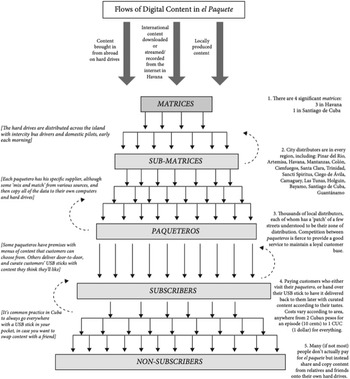
While there are only a few matrices, at the next level of hierarchy sub-matrices represent specific districts throughout Cuba (Figure 4). Sub-matrices take content from matrices and curate it into designs applicable to residents located in specific regions around the island. Once matrices and sub-matrices design the paquete released each week, they distribute the content to distributors, or paqueteros, who deliver the package to individual customers via USB drives. Through this system of terrestrial trade, a terabyte of content is downloaded weekly and distributed across the island for the subscription price of the equivalent of approximately US$2 weekly.Footnote 40
Hierarchy of the el paquete semanal ecosystem. Diagram used with permission from Jennifer Cearns. Cearns, ‘Introduction to el Paquete’, 102.

Yet calling el paquete semanal a business hardly addresses the many customizations in which the package is ultimately traded across the island. Although el paquete semanal begins as a hierarchically produced package of digital content, it is also traded in variously customized formats between peers. Since the nascent beginnings of the network, el paquete semanal has circulated to an ever-growing number of subscribers. With this growth, an increasing degree of control has become redistributed between subscribers, paqueteros, sub-matrices, and matrices, each with their own ideas of what content should (and should not) appear on the package. As Leo Paquetero (a pseudonym for a Havana-based paquetero) informs me: ‘Content spreads in Cuba through sub-matrices and individual paqueteros when people ask them to give them specific pieces of content.’Footnote 41 Requests from subscribers, in other words, exert upwards pressure upon the paquete ecosystem. For instance, the song ‘Bajanda’, by controversial reparto reggaetón artist Chocolate MC, was banned from the paquete because of paqueteros’ own self-censorship.Footnote 42 Later, the song was re-added to the network as it became clear that the track had become popular through alternative and secretive modes of private circulation.Footnote 43
In this case, a pirate system (the requests of individual customers) is constructed upon the infrastructure of another system of piracy (el paquete semanal). The construction of new networks atop existing illegal infrastructures is a common feature of piracy. Brian Larkin, in his research in Nigeria, relates this aspect of piracy as a type of virality: media is circulated through ‘the pirating of a system's mode of communication – the viruses that attach to other kinds of official or recognized movement’.Footnote 44
According to interlocutors, the video for ‘Patria y vida’ was similarly added by music fans to USB drives traded among smaller, intimate circles of friends and asked for from select paqueteros. During an interview with a paquetero, he made clear that because the song and video were popularly requested, sub-matrices and paqueteros placed it on custom versions of the paquete.Footnote 45 As Sujatha Fernandes notes, there is a ‘high degree of customization of the contents of the package’.Footnote 46 These were not paqueteros working directly for matrices, but independent deliverers of the paquete who make choices regarding the content and the organization of that content into folders that reflect the desires of the communities they represent. Local communities use the network to import media and music, then further customize contents as a horizontally based, peer-to-peer model of local internet delivery. Residents of repartimiento districts rely on this unique balance between hierarchical, business-driven interests and a clandestine peer-to-peer trade to trade new content with one another. The practice displays the agency of the participants of pirate infrastructures. Paqueteros make choices regarding how a version of the USB network will look (and how it sounds). Subscribers make similar decisions after downloading new material from paqueteros and friends.
Zapya, an application frequently downloaded from el paquete semanal, is a popular method in which digital content is simply and discretely shared between participants. The mobile application is a wireless, Bluetooth-enabled platform that allows participants to easily send songs to one another's mobile handsets. The application was developed by Xiaodong Wang in Silicon Valley for a Chinese market in 2012, but demand quickly spread to countries (such as Cuba) that contended with poor internet penetration.Footnote 47 Zapya effectively creates a private peer-to-peer bridge between users’ mobile phones while they are in close physical vicinity without requiring a WIFI or mobile internet connection. In effect, the application maps offline spaces where music fans gather as available digital networks, allowing subscribers to construct private internet infrastructures to trade the contents of their digital devices discreetly with one another.Footnote 48 Zapya's networks generate powerful effects, allowing for the conditions of virality, but connections are also tenuous and dependent upon the copresent pathways of individual users.
Participants vacillate in a complex dance between embodied and virtual interactions defined by both the storage and the connective capacities of memory sticks and the physical geographies of participants. Members form social bonds during these temporary interactions not unlike those forged between the human body and console hardware while playing dance video games. These relationships, according to Kiri Miller, ‘don't simply bring together music and movement but construct a mutually reinforcing relationship between the pleasures of listening and the pleasures of movement’.Footnote 49 Alexandrine Boudreault-Fournier relates human-body interactions to how music is made in Cuba amid technological precarity, stating that ‘in such a liminal state between scarcity and invention, when electronic musicians acquire a computer it becomes part of their body, a prosthesis that they cherish day and night’.Footnote 50 Similarly, one's memory stick is as important to interlocutors’ identities as their clothing choices (indeed, USB drives are often found within the pockets of clothing), connecting participants intimately to their musical choices and the role they perform when sharing songs within a music community.
Some of the music shared through Zapya will come from el paquete semanal. Other songs are taken from participants’ personal libraries. In either case, a system of horizontally traded content closely embeds the choices of local communities, restructuring Zapya's proprietary platform into what Nick Seaver refers to as ‘heterogeneous and diffuse sociotechnical systems, with entanglements beyond the boundaries of proprietary software’.Footnote 51 Through this system, media travels far (and fast) from its source. Customized USB drives are seemingly traded everywhere, from El Malécon to barber shops, printing stores, and private parties. Indeed, where traditional ‘wired’ media networks deliver information from a stationary location to listeners, the people delivering versions of the paquete instead use city infrastructure itself as a media network, transporting USB drives discreetly from buses, trains, and automobiles to private residences and media resellers. The decentralized nature of sneakernet delivery guarantees that if a single node is removed (e.g., a bus is shut down or a paquetero is arrested), another participant makes up for the loss by transporting USB drives through an adjacent mode of transportation. This creative use of public transportation in place of a ‘modem/router’ form of internet allows the network to act as a robust and flexible infrastructure. Jussi Pariki notes of pirate internet networks:
Infrastructure becomes critical, as it is imagined through this automated zombie network of vehicles, innocently becoming infected, messages carry themselves. Such a reference to zombies, parasites, botnets, viruses, sneaking, and somnambulism is made to employ the idea of cultural techniques of the unconscious and barely alive (found in infrastructure) to make sense of the processes of contagion as well as non-semantic communication.Footnote 52
Pariki's quote speaks to el paquete semanal's creative uses for Havana's public infrastructure. The people delivering the paquete reinvent buses as a viral network in motion, capable of spreading non-state messages to thousands of subscribers. During the height of the COVID-19 pandemic for example, unable to travel outside their homes due to shelter-in-place orders, delivery of el paquete semanal mainly happened through medical buses. Meant to taxi patients to and from hospitals, many of these buses inadvertently also carried the contents of an illegal internet infrastructure to residents across the island.
During moments when the internet is disconnected (e.g., protests), this flexible model allows the trade of USB drives to continue functioning as a useful means to connect to music, media, and the news. The decentralized model of internet delivery remakes participants as individual nodes within a larger network that includes both humans and machines as connective infrastructure. In this regard, el paquete's infrastructure is not unlike highly connected regions such as South Asia, a globally connected area that Anaar Desai Stephens discusses elsewhere in this volume as including ‘rapidly shifting networks of highly entangled communications systems and human actors’.Footnote 53
The ability to hijack a network and use it to promote new ideas is endemic to digital piracy, but it is also a hallmark of virality. Paula Harper notes that virality involves ‘an ambivalent relationship between voluntary and conscripted behaviours, predetermined digital pathways and innovative individual maneuverings, top-down corporate coercion and bottom-up collective involvement’.Footnote 54 The USB network that Cuban citizens invented to circulate both sanctioned and banned media similarly embeds an ambivalent relationship between hierarchically driven networks such as el paquete semanal and peer-to-peer sneakernets that appear and disappear at social gatherings. When asked where he first heard the song for instance, Pascual tells me that a friend came by his apartment with a USB memory stick containing songs taken from el paquete semanal. The friend then opened the Zapya application and shared the contents of their USB drive. The next section examines the consequences of the virality of ‘Patria y vida’ amid the Cuban state's misunderstanding of the situation.
We made it viral
While the peer-to-peer digital network is novel, there are parallels with the Cuban state's past use of media. Since at least the 1959 revolution, state media has been explicitly tied to nationalist projects. All television and radio stations on the island are owned and operated by the Cuban state. Fidel Castro has called his use of media ‘one of the most potent weapons in his foreign policy arsenal’.Footnote 55 His Movimiento 26 de Julio, for instance, utilized the pirate radio station Radio Rebelde to broadcast speeches from jungles to urban centres across Cuba's terrain. Castro similarly harnessed the power of international media to paint a sympathetic portrait of his rebel army for the US media. Journal, magazine, and television pieces were influential in turning public sympathies towards the guerrillas. Broadcasts were heard over wide distances that spanned national boundaries, while the tools for their deployment were controlled by the Cuban state and international media corporations.
Similarly, the music video for ‘Patria y vida’ is a potent, globally circulated video centring on the art and protest of a small group of Cuban radicals using mass media to challenge nationalist discourse. In this case, the radicals are a group of Black Cuban nationals residing in repartimiento districts that call themselves Movimiento de San Isidro (MSI). MSI is a group of controversial artists who live and work in El Cerro, a repartimiento municipality located in the heart of Havana, not far from the normally tourist-heavy area of Habana Vieja. The district is both one of the poorest barrios in the city and, ironically, the birthplace of José Martí, the nineteenth-century poet and intellectual considered the father of Cuba's long revolution. A few blocks from Martí's home, MSI is housed in a rundown, multi-family residence commonly referred to as a solar.Footnote 56 The organization comprises mainly artists of colour who protest the government's censorship of artistic expression. Their efforts reflect a significant source for criticisms of the state, which in Cuba is led in large part by the efforts of Black Cubans who live in repartimiento districts.Footnote 57 Members include performance artist Luis Manuel Otero Alcántara and rapper Denis Solís. The artists who produced ‘Patria y vida’ were inspired by MSI to create the song and accompanying video. The video for ‘Patria y vida’ in fact features Alcántara with the word ‘MSI’ etched to his chest. It also features scenes and rapped commentary regarding the group's harassment by state police, issues relevant to Black Cuban repartimiento residents. The centring of these concerns in a song released from well-known artists did not sit well with the Cuban state.
Authorities attempted to smear the song, labelling it a foreign product and therefore ‘un-Cuban’. In a video posted to Facebook (that has since been deleted) called ‘Cuba no es Miami’, Cuban journalist Edmundo Garcia makes forceful comments against ‘Patria y vida’, attempting to convince readers that the song's inclusion of Miami-based Black Cuban artists disqualifies its arguments.Footnote 58 Garcia contends that, due to their US residency, Gente de Zona are not properly representative of Cuba and therefore have no right to criticize its government. Unsurprisingly, his ideas did not gain much traction.
This line of thinking, where Black artists are regarded as non-citizens, echoes longer histories surrounding Afro-diasporic cultures and their cultural products as sources of virality. Barbara Browning, in her 1998 work Infectious Rhythm, discusses the historical circulation of African diasporic products in terms of disease: ‘The metaphor of contagion, even when invoked by Europeans, often takes seemingly benign forms, but it can also often lead to hostile, even violent, reactions to cultural expressions.’Footnote 59 Black Cubans, frequently finding their actions located along borders of racial acceptability, are historically positioned as embodying opposed uses of the word ‘contagion’: regarded alternately as an outside force responsible for carrying a virus to spaces in which they do not belong, or as a group of people that produce a contagion from inside of Cuba's culture and whose viral flows threaten to overtake ‘proper’ Cuban sensibilities. This discourse, which results in the cultural and economic separation of Black bodies from the rest of the population, is used to justify the sanctioned abuse of Black citizens by the state. Marc D. Perry states that ‘governmental efforts to regulate and police the incongruencies introduced by what amounted to a Cuban neoliberal turn have compounded, at times significantly, the racial marginalization of black and darker-skinned Cubans’.Footnote 60
Despite their marginalization and positioning by Cuban authorities as foreign, Black Cuban artists and music fans use whatever connective technologies are available to bring their concerns to Cuba's public sphere, facilitating the virality of songs such as ‘Patria y vida’ despite the island's relative technological scarcity. Barbara Browning notes of the role of technologies in the propagation of viral events: ‘Rapidly developing communications technologies are facilitating transnational economic relationships, as well as global cultural exchanges.’Footnote 61 Alexander Weheliye connects this idea to the circulation of Black popular music more generally: ‘Popular music, generally in the form of recordings, has and still continues to function as one of the main channels of communication between the different geographical and cultural points in the African diaspora, allowing artists to articulate and perform their diasporic citizenship to international audiences and establish conversations with other diasporic communities.’Footnote 62 The offline circulation of ‘Patria y vida’ is such an example. Music fans, whether using USB networks or 3G-enabled mobile devices, spread a recorded message from its source towards international audiences that include both the Cuban and the African diasporas. The ‘Patria y vida’ slogan has been taken up not only by Black Cuban repartimiento residents, but also by groups as varied as white, right-leaning politicians from Miami, members of Black Lives Matter, and across Latin America.Footnote 63 Despite varied agendas, each of these groups use ‘Patria y vida’ as a common refrain, confirming the complicated consequences of viral musicking: the more viral the music, the larger the number of its interpretations.
Perhaps the most heated commentary used against ‘Patria y vida’ was expressed by Cuban journalist Pedro Jorge Velázquez, who claims that the virality of the song devalues the Cuban nation. ‘Esa canción empantanada de odio … esa canción que intenta cambiar a Cuba por un millón de vistas en YouTube. … esa canción trapera y cobarde no me representa. Su odio no me representa. Su asquerosa letra no me representa. Gente de Zona no me representa’ (‘This song full of hate … it tries to exchange Cuba for 1 million YouTube views. Its hate doesn't represent me. It's horrible lyrics don't represent me. Gente de Zona doesn't represent me’).Footnote 64 The mention of ‘exchange’ in the quote is telling. While recognizing the power of social media, Velázquez denies that the music video represents the will of the Cuban people. Instead, he equates its viral success as proof that millions of foreigners challenge Cuban sovereignty. National loyalty, according to him, is callously exchanged for social media views obtained through global (and therefore non-Cuban) sources. While Velázquez regards the video's viral penetration of YouTube's network as evidence that the message of ‘Patria y vida’ has been co-opted by foreign sources, fans of the video regard its popularity as proof that their message has found common cause outside of Cuba.
Cuban president Miguel Díaz-Canel also weighed in on ‘Patria y vida’ several times from his personal Twitter account. On 19 February 2021, for instance, he tweeted a public repudiation of the song: ‘#PatriaOMuerte! gritamos miles anoche. Quisieron borrar nuestra consigna y #Cuba la viralizó en las redes’ (‘#Patriaomuerte (Country or Death) thousands of us shouted last night. They wanted to erase our slogan and we made it viral’).Footnote 65 Díaz-Canel's framing of ‘Patria o Muerte’, however, arguably created an effect opposed to what he intended. Though ‘Patria o Muerte’ certainly remains a popular saying in Cuba, the popularity of the alternative slogan ‘Patria y vida’ has transformed ‘Patria o Muerte’ from a statement of national pride to a symbol anachronistically related to the government's defence of the Cuban state.
The music video ‘Patria o Muerte por la Vida’ (released by Cubadebate, a media company owned and operated by the Cuban state) makes this connection clear.Footnote 66 The video is a direct response to the viral success of ‘Patria y vida’. Lyrics (written by Cuban singer/songwriter Raúl Torres) accuse the singers of ‘Patria y vida’ of betraying the Cuban nation to make a profit and incite hate. The fact that the Cuban state felt the need to respond to ‘Patria y vida’ demonstrates an awareness of the power of digital virality and the threat it poses for their control of the government. Even given the scarcity of connective technologies on the island, the Cuban state is aware that citizens are overcoming previously impenetrable barriers of digital connectivity.Footnote 67 The attempt to use the music video to defang the sting of ‘Patria y vida’, however, misreads the memetic power of virality. Øyvind Vada defines memes as ‘sustainable information units influencing and forming us, impacting the social systems that we belong to’.Footnote 68 Users deploy memes, according to Hannah Judd, to signal both their belonging and their individuality within a larger community (this volume). In this regard, ‘Patria o Muerte por la Vida’ is not a replacement for ‘Patria y vida’. Instead, it has become another node in the song's memetic activity, engaged in a derivative discourse that only brings more attention to the original video. At the time of this writing, ‘Patria o Muerte por la Vida’ has almost 1 million views, 8,000 likes, and over 107,000 dislikes on YouTube. While the video contains a relatively high number of views, reactions in dislikes and comments continue reinforcing the anti-Castroist message of ‘Patria y vida’. In addition, few interlocutors that have seen the video report downloading it to their personal USB drives. While widely shared, viewers have the final say regarding where the video is positioned among other media stemming from ‘Patria y vida’.
Powerful and fragile
Successful viral musicking connects local concerns to participants in far-off destinations. Despite their relative position of technological precarity, participants using el paquete semanal and Zapya circulated a controversial song fast and far, proving that Cuba provides a viable space to share digital media. As the internet slowly gains accessibility on the island, these episodes may happen more often, but, of course, it is just as likely that the government will respond by increasing their surveillance of social networks and the Cuban citizens that rely on digital applications to privately communicate with one another. As Zeynep Tufecki notes, online protest movements are simultaneously powerful and fragile.Footnote 69 Likewise, K. E. Goldschmitt contends that corporations, institutions, and state authorities use music technologies to police marginalized bodies.Footnote 70 USB-based networks perform an important role in negotiating these digital threats, as their infrastructure incubates the trade of music through digital platforms that are experienced offline in privately shared spaces, offering a degree of protection from surveillance or internet blackouts.
It is equally important to note that the participants who generate an event of viral musicking do not usually share the same interpretation of a song. There are as many differences in politics between Cuba and Miami as there are between political groups within Cuba, but a shared musical experience has the power to cut across group boundaries even when individual meanings of that music are contested. Alone, a single USB drive is not capable of producing much of an effect, but its ease of replicability and infiltration of existing distribution networks allows media stored and traded on USB networks to generate substantial viral effects.
The efforts of the artists responsible for ‘Patria y vida’ and the music fans that shared the recording both within and outside of Cuba have turned a song produced on a limited budget into a rare protest shared on both sides of the Florida Straits. On 11 July 2020, Cubans took to the streets through the island, many shouting ‘Patria y vida’ throughout the demonstrations.Footnote 71 Footage of Cuban nationals protesting on Havana's streets transformed into universal symbols of freedom and human rights for a diasporic community of Cuban Americans and sympathetic Latin Americans. From there, the message came full circle: Yotuel Romero plans on donating all earnings from ‘Patria y vida’ to the members of MSI.Footnote 72
For reparteros, these actions are among the most effective defences against a state determined to blame the consequences of a biological virus on the occupants of Black neighbourhoods. As Michael Veal writes of dub's impact at another point along the African diaspora (Jamaica), ‘local politics and global economics have extracted a heavy toll here, and it takes a powerful music to transform the harsher aspects of this reality’.Footnote 73 ‘Patria y vida’ likewise challenges these harsher aspects of reality, even when virally circulated through a USB-based network.