Introduction
Re-election seeking incumbents in liberal democracies have powerful incentives to attract votes by manipulating the public policies at their disposal, for instance, by timing the fiscal and monetary expansion during election periods (electioneering), by implementing ideologically valued policies for their electoral base (partisanship), or by indicating their ability to do so (competence signalling). Politicians can be expected to select those particular policy domains that are more targetable and directly palpable to the relevant voters and most timeable, such as public spending, direct benefit provision and public employment (Tufte Reference Tufte1978; Tepe and Vanhuysse Reference Tepe and Vanhuysse2009). This article investigates the strategic manipulation of public policies in the case of state-level police employment in Germany. This policy domain eminently meets the criteria of targetability, palpability and timeability, as this regards immediately “visible” jobs dealing with electorally salient issues of crime and domestic security.
Domestic security and police employment in Germany tend to be regulated, financed and administered at the state (land) level. This makes police employment a potentially important tool for at least three distinct forms of political manipulation. Firstly, timing police hiring during election periods (electioneering) may increase votes as this regards “street-visible” jobs dealing with politically salient issues. Secondly, the need to signal competence towards conservative voters makes police hiring especially attractive for conservative parties that generally promote law-and-order oriented policy platforms (partisanship). Accompanying these classical political economy expectations, on the demand side, popularly perceived causes of crime such as migration levels, and street-visible forms of crime such as violent crime and subjectively “immediate” types of street crime can be expected to have a particular salience among voters. Vote-seeking incumbents may then attach special importance to being seen to respond strongly to increases in migration levels and in street-visible crime statistics.
We test these hypotheses for civil servant police employment in the German states from 1992 to 2010. We find officer numbers to be strongly driven by structural variables, notably population density. But beyond this, we find evidence corroborating the two core political manipulation hypotheses: (1) Electioneering: state incumbents tend to hire more officers before elections. (2) Partisan patronage: right-wing party power increases, and left-wing party power decreases officer numbers. Regarding the two auxiliary demand-side salience hypotheses, we find that (3) the incidence of street-visible forms of crime and (4) larger population shares of foreign residents both tend to increase police hiring.
The article proceeds as follows. The next section discusses the constitutional and institutional context of police employment in German federalism. The third section discusses the theoretical and empirical literatures used to derive our three testable theoretical hypotheses – electioneering, partisanship and demand-side salience. The fourth section sets out the identification strategy and empirical analysis. The fifth section discusses our main findings. The last section concludes.
Police employment in Germany: the institutional context
Crime and domestic security is a policy domain in which there may be substantial room for political manipulation owing to the particular constitutional context of German federalism. One of the latter's distinct features, which sets it apart from other systems, is the institutionalised interlocking of three levels of government: federal (Bund), state (Länder) and local (Gemeinden). While the allocation of competences follows the subsidiarity principle, in the decades since the federal constitution was passed in 1949, the federal level has generally extended its reach through a number of constitutional adjustments (Benz Reference Benz1999, 62). Today, German federalism is characterised by a relatively strong federal government with legislative power in most major policy areas (Benz Reference Benz1999, 55).
Importantly, however, three policy domains have always been an exception to this general tendency towards centralisation: public education, cultural affairs and inner security. The legislation, financing and administrative competencies in these areas are exclusively set at the state level (Basic Law, articles 30 and 70).Footnote 1 The organisation and funding of police employment are determined directly through the State Interior Ministries. The Conference of Interior Ministers, founded in 1954, passes regulatory recommendations for the uniform treatment of policies, but its decisions have no binding character for the states. In other words, inner security is a domain where the idea of subsidiarity is particularly pronounced and where state independence is highest, including on public employment decisions.
Historically, there have been major East–West differences within Germany in this domain. After World War II, the rebuilding of police services in the new German Democratic Republic involved a centralised organisation of police forces, whereas the Federal Republic of Germany implemented a decentralised, federal organisation to improve checks and balances on policing (Frevel and Groß Reference Frevel and Groß2008, 69). Re-unification in 1990 caused a substantial rebuilding of police forces in the former Eastern Germany aimed at replacing “political” officers, and at implementing a federal organisational model. This is reflected in overall police staffing in Eastern states between 1992 and 1995 in a strong increase in civil servants, whereas in Western Germany there has hardly been any change in the composition of police employment after re-unification.
Theory: electioneering, partisanship, demand-side salience
Political business cycles
There is strong cumulative evidence that incumbents in liberal democracies benefit from favourable economic conditions (Drazen Reference Drazen2000; Hibbs Reference Hibbs2006). Building on this logic, political business cycle theory specifies how incumbents can time the use of monetary, fiscal and other policy instruments to reap electoral benefits. However, the empirical evidence on electioneering in these domains has been mixed and inconclusive, especially in recent decades. Franzese and Jusko (Reference Franzese and Jusko2006) argue that institutional constraints such as transparency and accountability requirements, and consequently better informed voters, have made it increasingly difficult for politicians in advanced democracies to manipulate monetary and budget cycles (Alt and Lassen Reference Alt and Lassen2006). But if voters evaluate incumbents on their recent performance, incumbents’ incentives to manipulate public policy increase as elections approach. Since the electoral benefits of such manipulations presumably remain large, politicians can be expected to merely shift the use of cycle mechanisms towards policy domains that are easier for them to manipulate, such as public employment.
Earlier work on Germany has primarily investigated monetary business cycles, while more recent publications focus on budget cycles. Berger and Woitek (Reference Berger and Woitek1997) find no evidence for country-level monetary cycles, though results are very sensitive to data quality and estimation methodology. Jochimsen and Nuscheler (Reference Jochimsen and Nuscheler2011) find that public deficits decrease in pre-election years. Investigating 11 West German states with respect to seven different budget categories, Galli and Rossi (Reference Galli and Rossi2002) find little evidence of cycles. Potrafke (Reference Potrafke2011) finds weak evidence that politicians increase expenditures for schooling in election years and adds that government partisan ideology has no effect on any of six expenditure categories. Oberndorfer and Steiner (Reference Oberndorfer and Steiner2007) find that conservative governments or social-democratic-conservative coalitions in West German states spend more, not less, on higher education than pure social-democratic governments.
The ambiguity of these findings might appear to confirm that German politicians have little scope to manipulate monetary policies or fiscal budget decisions. This article considers a dependent variable that differs in a fundamental way from prior research, by shifting attention away from monetary or fiscal policy manipulation towards public employment policies. The only such study on Germany to date investigates teachers and finds that against a backdrop of a continuously shrinking total teachers’ pool, states have accelerated the hiring of new teachers during election periods, only to partly reverse this later in the electoral cycle (Tepe and Vanhuysse Reference Tepe and Vanhuysse2009). We argue that the allocation of legal competences among the federal and state levels in Germany also makes police employment a fruitful case for analysing political business cycles.Footnote 2 The lack of room for manoeuvre in other policy fields may turn domestic security into a particularly important arena for electoral manipulation at the state level.
The institutional context of German federalism provides state incumbents with both the “opportunity” and the “means” for manipulating police employment to gain votes (Tufte Reference Tufte1978; Franzese and Jusko Reference Franzese and Jusko2006). The “motive” to do so appears strong as well. The high salience of local-level domestic security provides some circumstantial evidence for its electoral importance in Germany (Frevel and Groß Reference Frevel and Groß2008, 85; Gerber et al. Reference Gerber, Hirternlehrer and Jackson2010). Criminologists indicate that the fear of crime affects far more citizens than actual experiences with crime (Warr Reference Warr2000; Gray et al. Reference Gray, Jackson and Farrall2008). Economists show that increases in the size of police forces substantially reduce violent crime (Levitt Reference Levitt1997) and crime generally (Levitt and Miles Reference Levitt and Miles2006; Benson Reference Benson2010). Police officers generally tend to be perceived by the public as symbolic “moral guardians” of social stability and order (Jackson and Bradford Reference Jackson and Bradford2009; Norris Reference Norris2007) and confidence in police tends to reflect public perceptions of crime and property crime rates (Sindall et al. Reference Sindall, Sturgis and Jennings2012). The quality of public goods such as inner security is hard to measure. Whereas, more sophisticated policy success indicators (e.g. crime clearance rates) require substantial information search and processing efforts, changes in police employment figures are easy for politicians to communicate and for voters to register. Voters may thus use these figures as a heuristic, or proxy, for incumbents’ policy effort.
A key distinction within German police employment is the one between civil servants (Beamter) and public employees (Angestellten). Here we focus on civil servant positions, which are numerically the most important category by far as they accounted for 84 per cent of all police officers on average in 1992–2008. We expect electioneering to be especially attractive for these jobs as they are tenured and financially most coveted. Moreover, since civil servant officers are highly street-visible “bobbies on the beat”, they are more likely to make electioneering pay off politically. Seeing regular police patrols on the street, and feeling informed about police activities, is associated with higher opinions about police effectiveness (Bradford et al. Reference Bradford, Jackson and Stanko2009). Hiring civil servant officers is therefore more likely to sway voters who care strongly about state-level crime and security at the time of elections. This is a “street-visible security provision” effect. Moreover, this effect on voters generally goes hand in hand with separate patronage motives towards police officers specifically. Above and beyond the visibility to voters of more officers in the streets, civil servant jobs are coveted benefits in and of themselves to officers. Being newly hired, or upgraded, into a tenured position is likely to influence the voting behaviour of officers. This is a straightforward “patronage” effect, and it regards relatively few voters, albeit ones that may be pivotal. Hence we hypothesise:
(H1) Electioneering: Employment of police officers will increase in election years.
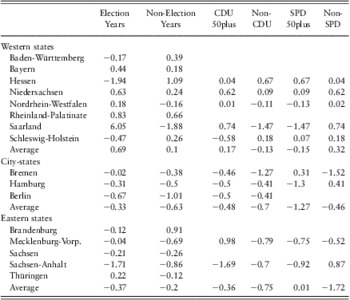
By way of initial exploration of H1, Table 1 compares average annual growth rates for civil servant police employment in election versus non-election years, excluding Eastern states in the immediate post-unification period 1992–1995. These descriptive statistics show very different dynamics in the two parts of Germany. In Western Germany, growth rates of officers are more positive or less negative in election years (0.69 per cent versus 0.10 per cent for civil servants). This is especially the case in Saarland and Niedersachsen, though there are deviations from this pattern in states such as Baden-Württemberg and Hessen.
Average annual growth rates of civil servant police officers in election and non-election years, and by partisan governments

Note: Election is dummy coded and equals 1 in election years. 1993–1995 excluded for Eastern states. CDU/SPD 50plus = 50 per cent or more of the cabinet ministers belong to the CDU, respectively SPD.
Partisanship
Partisan theories in the spirit of Tufte (Reference Tufte1978) and Korpi (Reference Korpi1983) assume that politicians are not purely opportunistic vote-seekers, but decide the course of policy, at least partly, according to their ideological preferences and how policies benefit their core constituencies. Traditional partisanship theory predicts left-wing governments to pursue more expansive or Keynesian strategies when it comes to public employment and social policy, and right-wing governments to aim primarily at fiscal conservatism and low tax burdens. At least when it comes to social policy, empirical support for the partisan thesis is increasingly mixed or altogether waning (Huber and Stephens Reference Huber and Stephens2001; but see Tepe and Vanhuysse Reference Tepe and Vanhuysse2010, Reference Tepe and Vanhuysse2012). Prior research on Western Germany has found that state governments manipulate the budget cycle in pre-election periods by increasing transfer payments on social security (Schneider Reference Schneider2010). Oberndorfer and Steiner (Reference Oberndorfer and Steiner2007) find that state governments under conservative parties or coalitions between social democrats and conservatives spend more, not less, on public higher education. Potrafke (Reference Potrafke2011) finds that leftist governments slightly increase spending for schooling, whereas right-wing governments spend more on universities and cultural affairs.
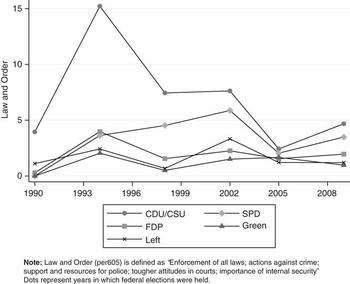
Applying partisan theory to police employment, we would expect conservative voters to be especially likely to reward increases and to punish reductions in police employment levels. Moreover, more conservative parties proposing “law-and-order” platforms can naturally be assumed to benefit from a higher value proximity, both among conservative voters generally and among police officers specifically. Figure 1 shows the policy position of federal parties in Germany towards law and order, taken from the Party Manifesto project (Klingemann et al. Reference Klingemann, Volkens, Bara, Budge and Mc-Donald2006).Footnote 3 Despite differences in the magnitude of this issue dimension over time, there is a rather stable preference order throughout the post-unification period: the mainstream conservative party union CDU/CSU most clearly and consistently emphasises inner security issues. If conservative parties can visibly show themselves to be systematically in favour of more police hiring, law-and-order sensitive voters’ attitudinal support can be turned into actual votes, both from such voters generally (a straightforward “competence signalling” effect) and from law-and-order producing officers specifically (a mixed “patronage and competence signalling” effect).
German parties’ policy position towards law and order.
Note: Law and order (per605) is defined as “Enforcement of all laws; actions against crime; support and resources for police; tougher attitudes in courts; importance of internal security” (Source: https://manifesto-project.wzb.eu/data/MPDataset_full_codebook.pdf). Dots represent years in which federal elections were held.

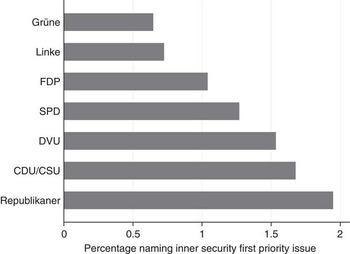
Figure 2 provides evidence for why the first strategy, straightforward “competence signalling”, is electorally important. It shows the party-specific average perception of inner security as a salient policy issue, with data from GESIS (2010) for the years 1993–2007. Choosing from a list of public policy issues, participants were asked to name their first priority policy issue. Since participants were also asked to name the political party they would vote for in the next election, we could calculate the percentage of respondents considering inner security as the single most important issue for each political party.Footnote 4 Supporters of the mainstream conservative CDU/CSU and the extreme right-wing parties DVU and Republikaner consider inner security as an important policy issue more often than supporters of left-wing (SPD, Linke) and green parties (Grüne). Even supporters of the liberal party (FDP), the natural coalition partner for conservative parties, seem not to have particularly strong attitudes towards inner security.
Inner security preferences among German voters by party affiliation. Question: What do you consider as the most urgent issue in Germany? … Inner Security.
Sample: Politbarometer 1993–2007 (GESIS 2010), Obs.: 146,831. Percentage points represent the share of party supporters within parties considering inner security as the most urgent issue, using all other policy issues (e.g. unemployment, economic growth, education, etc.) as the reference category.

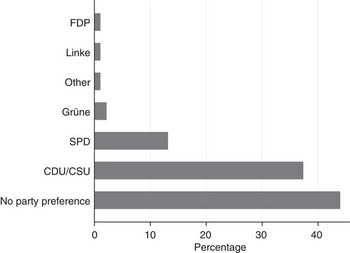
The second partisan strategy, mixed “patronage and competence signalling” towards police officers, is important also because the conservative CDU/CSU party family clearly appears to be the “police officers party”. Relying on survey data from Socio-Economic Panel Study (SOEP) (2008) for the waves 2003–2007, Figure 3 shows the party preference among all 91 respondents in the Panel who were police officers or detectives employed as civil servants.Footnote 5 Officers clearly lean much more towards CDU/CSU (37 per cent) than towards the other major mainstream party SPD (13 per cent) or any of the smaller parties (close to 0 per cent). A CDU/CSU effort to prove itself the “police-hiring” party would thus promise to be effective in consolidating this natural electoral base. We therefore hypothesise:
Party preferences among German police officers.
Question: Many people in Germany lean towards one party in the long term, even if they occasionally vote for another party. Do you lean towards a particular party? Towards which party do you lean?.
Sample: SOEP 2007–2003 (SOEP 2008), Obs.: 91, respondents are working in the Civil Service (oeffd) as Police, Inspector Detective (ISCO88 Code 3450). Responses refer to the most recent panel wave.

(H2) Partisanship: State governments with more conservative party ministers will increase employment of civil servant officers.
Table 1 compares average annual police employment growth in states where the share of ministers from CDU/CSU (top panel) and SPD (bottom panel) in cabinet was 50 per cent or higher and where it was not (again excluding East German states immediately after re-unification). These “partisan majority growth rates” can only be compared if there has been a change in state-level political majorities within the observation period. Hence, states such as Bavaria and Baden-Württemberg (where the CDU/CSU held the absolute majority over the entire observation period) and Rheinland-Pfalz (idem for the SPD) are excluded. Police employment growth is more positive or less negative with a strong CDU government in just five out of ten relevant states. But in seven out of nine relevant states employment growth is less positive or more negative under a strong SPD government. This simple 50 per cent dichotomy does not account for potential government coalition dynamics: these will be analysed in the multivariate dynamic panel analysis below.
Perceived demand-side salience
Moving beyond the standard political economy questions that are the main motivation of our article, we also query how demand-side salience might affect incumbents’ police employment strategies. On the demand side of law and order, voters are likely to perceive some alleged “causes” and some “forms” of crime as particularly worrying (Benson and Zimmerman Reference Benson and Zimmerman2010). Regarding causes of crime, the popular perception that immigrants are disproportionately crime prone may be no more than a myth – but it is a persistent one (Bersani Reference Bersani2012; Fitzgerald et al. Reference Fitzgerald, Curtis and Corliss2012). Vote-seeking incumbents may therefore respond to such voter perceptions by increasing police employment because of two possible mechanisms, which we refer to as reactive functionalism and opportunistic prejudice. Policy-makers tend to respond to public attitudes on migration issues (Hartmann Reference Hartmann2009). One particularly salient issue refers to the link between migration and crime. In 2007, 21.4 per cent of all criminal suspects in Germany did not have a German passport (Hartmann Reference Hartmann2009, 191). As non-Germans are just 9 per cent of the total population, they appear to be highly overrepresented in crime statistics. Even if violations against the immigration law were excluded from the list of delinquencies, non-Germans have a higher likelihood of becoming crime suspects.Footnote 6 German citizens appear to blame migrants when anxious about crime (Fitzgerald et al. Reference Fitzgerald, Curtis and Corliss2012). This “genuine” perception of a link between migrants and crime could then lead incumbents to increase street-visible police employment as a functional reaction to larger shares of non-Germans in the population. Alternatively, increased police hiring, especially of street-visible officers, could result from opportunistic prejudice, whereby politicians understand, but need not share, their voters’ cognitive linkage between crimes and the share of non-Germans and accommodate these beliefs by politically motivated hiring. In both cases we would expect that:
(H3) Immigration effect: Employment of police officers will increase with the share of non-German residents.
Voters are also likely to perceive some forms of crime as more salient than others (Gerber et al. Reference Gerber, Hirternlehrer and Jackson2010). Clearly, violent crimes such as murder, manslaughter, rape and sexual assault can be expected to have a particularly high salience among voters, intermediated by media coverage (if it bleeds, it leads). But as broken-windows theory indicates, also other forms of subjectively and locally “immediate” street-level crime, such as robberies of cash and valuables, bag-snatching and serious injury on roads, paths and squares, tend to be highly salient as they are visible in the local neighbourhood and are prominently covered in local newspapers (Wilson and Kelling Reference Wilson and Kelling1982). Vote-seeking policy-makers should thus put particular emphasis on being seen to respond strongly to increases in both forms of salient crime statistics, by means of street-visible police hiring. We therefore hypothesise:
(H4) Street-visible crime effect: Employment of police officers will increase with the share of violent crime and other forms of street-visible crime.
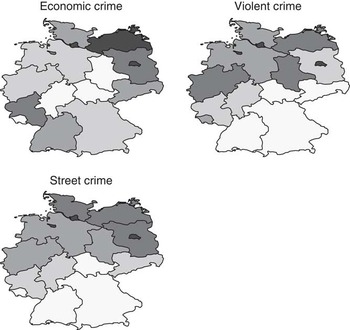
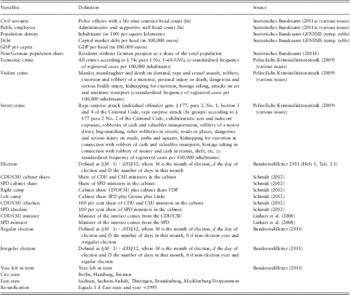
To present an overview of the distribution of crime burdens among the 16 German states, Figure 4 shows the frequency of three types of crime measured as an overall period mean, with data from various issues of German Crime Statistics (see Appendix Table A.1). Economic crime is more frequent in states bordering another country, especially Poland. All three forms of crime are particularly high in the city-states, Bremen, Hamburg and Berlin (Birkel Reference Birkel2008, 91). Moreover, there is a clear North–South divide in crime rates for violent crime and street crime, with southern states such as Baden-Württemberg, Bayern and Thüringen showing systematically lower crime rates.Footnote 7
Types of crime across German states (1993–2010).
Note: The five shades of grey represent five quantiles. Darker shades represent higher crime rates, measured as the frequency of registered cases per 100,000 inhabitants.

Methods
Dependent and independent variables
The empirical analysis is based on a balanced panel data set comprising annual data for the 16 German states from 1992 to 2010. The dependent variable measures the number of civil servant officers scaled as head counts.Footnote 8 The two independent variables of main theoretical interest are electioneering and partisanship. Following Franzese (Reference Franzese2000), the variable for electioneering (Election Year) captures the precise timing of the elections and is defined as follows:
 $$Election\,Yea{{r}_{i,t}}\,{\rm{ = }}\,{\rm{[(}}M{\rm{ - 1)}}\,{\rm{ + }}\,d{\rm{/}}D{\rm{]/12}}$$
where M represents the month, d the day of the election and D the number of days in that month. In other words, if elections take place on 1 January, the Franzese measure is close to 0 [(1–1) + 1/31]/12 = 0.003. For elections on 15 June it takes the value [(6–1) + 15/30]/12 = 0.46, and for elections on 31 December, it equals [(12–1) + 31/31]/12 = 1. In non-election years this variable is set to 0. Partisan ideology in government is captured as the share of cabinet members belonging to, respectively, CDU/CSU and SPD. As Figures 1 and 2 show, inner security is a traditional value of conservative voters. To this end we focus particularly on the CDU/CSU – Germany's main conservative party union.
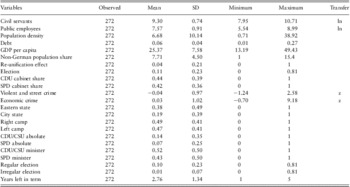
We control for population density, debt per capita, gross domestic product (GDP) per capita and a dummy for the re-unification effect among East German states. Since budgetary constraints may influence employment decisions, debt per capita is expected to have a negative effect on both forms of police employment. Population density is expected to have the opposite effect as urban areas tend to have higher crime rates. Before the independent variables enter the statistical models they have been tested for multicollinearity using the variance inflation factor, whose mean for the full set of variables is 2.93 with a minimum of 1.04 and a maximum of 4.79. These are considered as unproblematic values (Kleinbaum et al. Reference Kleinbaum, Kupper and Muller1988, 210). In line with Potrafke (Reference Potrafke2011), we exclude city-states from the regressions, as a series of t-tests shows that city-states, compared to surface states (Flächenländer), record significantly higher debt, population density, GDP per capita, non-German population and crime rates. Variable definitions, sources and summary statistics are given in Appendix Tables A.1 and A.2.
Estimation method
Following Gujarati (Reference Gujarati2003, 178) we choose a log-lin model for the function form. We start from the following dynamic panel data model to examine the determinants of police officer numbers:
 $$ {{y}_{i,t}}\, = \,{{\beta }_{\rm{1}}}\,{{y}_{i,t - {\rm{1}}}}\, + \,{{\beta }_{\rm{2}}}\,{{x}_{i,t}}\, + \,{{\beta }_{\rm{3}}}\,{{z}_{i,t}}\, + \,{{\mu }_i}\, + \,{{{\epsilon}}_{i,t}} $$
where yi,t denotes the log of civil servant officers, which is a stationary variable (see Appendix Table A.1), in state i at time t. The variables of substantive theoretical interest are summarised in vector zi,t. The control variables are summarised in vector xi,t. μi are the unit effects and εi,t is an unobserved white-noise disturbance with constant variance. Since there is arguably little room for randomness in a sample that includes states, the time unit effect μi is considered to be fixed rather than random (Judson and Owen Reference Judson and Owen1999, 11). The Hausman test for random country effects further supports the use of a fixed-effects specification (χ 2(10) = 560.03***; ***p < 0.01).
The fixed-effect estimator or least-square dummy variable (LSDV) estimator including a lagged dependent variable is known to generate biased estimates (Nickell Reference Nickell1981). Nickell bias decreases with T, but can still be sizeable when T ⩽ 20 as in our panel, which has a maximum length of 17 time periods (Judson and Owen Reference Judson and Owen1999, 9). With respect to macro-panels the econometric literature distinguishes two general procedures to resolve the Nickell bias problem: an instrumental-variables or generalised method of moments (GMM) approach, and approximating the bias of the LSDV estimator (Baltagi Reference Baltagi2008, 148).
Following the GMM approach, Equation (1) is transformed into first-differencing in order to wipe out time-invariant effects (Anderson and Hsiao Reference Anderson and Hsiao1982; Arellano and Bond Reference Arellano and Bond1991) and instruments are then used for the transformed lagged dependent variable in order to eliminate the correlation with the transformed error term (Jochimsen and Thomasius Reference Jochimsen and Thomasius2012, 17). Arellano and Bond (Reference Arellano and Bond1991) propose a GMM procedure that exploits all valid lags of the dependent variable as instruments. While suited for large samples, the GMM approach generates biased estimates for small samples (Bond and Windmeijer Reference Bond and Windmeijer2005; see also Angrist and Pischke Reference Angrist and Pischke2009, 245). The second approach, the bias-corrected estimator (LSDVc) relies on the standard fixed-effects estimator (LSDV), but uses an approximation to resolve the Nickell bias (Jochimsen and Thomasius Reference Jochimsen and Thomasius2012, 17). Judson and Owen (Reference Judson and Owen1999), Bruno (Reference Bruno2005a, Reference Bruno2005b) and Bun and Kiviet (Reference Bun and Kiviet2006) show that with a balanced panel such as ours, LSDVc consistently outperforms GMM. Only with an unbalanced panel and T ⩾ 30 does the uncorrected LSDV estimator performs as well as GMM (Judson and Owen Reference Judson and Owen1999, 13). Given the difficulties that arise in estimating Equation (1), we check the robustness of our findings using alternative identifying assumptions (Angrist and Pischke Reference Angrist and Pischke2009, 245). While the econometric analysis primarily relies on the LSDVc estimator, we explore the robustness of this estimation approach using the uncorrected LSDV estimator, the GMM(AB) estimator with varying numbers of instruments, and the LSDVc estimator with alternative specifications.Footnote 9
Identification strategy
A perennial challenge in econometrics is to identify causal relationships from non-experimental data. Identification strategies describe the way in which researchers treat such data to approximate “real” experiments. Without the benefit of random assignment and controlled environment, regression estimates may or may not offer a causal interpretation (Angrist and Pischke Reference Angrist and Pischke2009, 29). Omitted variables, functional form misspecifications and endogeneity of explanatory variables are just a few ways in which the identification of key model parameters can be jeopardised (Cameron and Trivedi Reference Cameron and Trivedi2005, 36, also see Angrist and Krueger Reference Angrist and Krueger1999). Acknowledging the limitations in drawing causal interpretations from estimating Equation 1, our identification strategy not only takes into account alternative estimators, but also attempts to address potential issues of endogeneity. In the context of German federalism where federal and state elections may take place simultaneously, the identification of electioneering needs to handle the possible endogeneity of state elections and the relationship with elections at other government levels (e.g. Berry and Gersen Reference Berry and Gersen2011). The identification of partisan effects in turn needs to deal with possible endogenous partisan strengths, and in particular how party strength influences policy outcomes. In order to elaborate on whether the two key political economy factors are determinants in our data, the identification strategy also investigates alternative measures of electioneering and partisanship that take into account the context of German federalism, explores alternative ways of including social and economic controls, and uses an alternative dependent variable to cross-validate findings from the baseline regressions. The same reasons why incumbents have strong motives to manipulate the hiring of coveted and street-visible civil servant officers indicate why such manipulation motives are weaker in the case of public employee officers, who are non-tenured and who exclusively perform less-visible work in administration or guarding and transport. We therefore expect that re-running our model specifications on this alternative dependent variable will provide weaker findings for partisanship and electioneering.
Findings
Baseline regression analysis
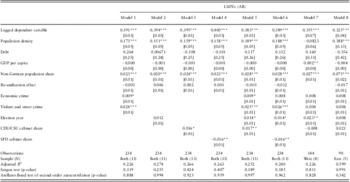
The baseline dynamic panel data model explores the impact of partisanship and electioneering on the number of civil servant officers using the LSDVc estimator with AB for initial bias correction and O(1/NT) to determine the accuracy of the approximation (Table 2). Both the Sargan's test for over-identifying restrictions and the AB test of second-order autocorrelation give reason to accept the model specifications.Footnote 10 In the log-lin specification, the β-coefficients express the constant proportional change in the dependent variable for a given absolute change in the value of the independent variable. The percentage point change in the dependent variable associated with a unit change in the independent variable can be calculated as (eβ−1) × 100.
Determinants of civil servant police officers: general models
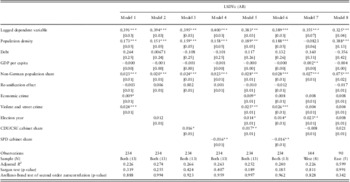
Note: LSDVc using Arellano-Bond (Reference Arellano and Bond1991) for initial bias correction and O(1/TN) to determine the accuracy of the approximation (Kiviet Reference Kiviet1995), standard errors are bootstrapped with 1,000 repetitions, standard errors are in brackets.
LSDVc = Bias-corrected least-squares dummy variable.
***p < 0.01, **p < 0.05, *p < 0.1.
The Wooldridge test (Reference Wooldridge2002, 283) for autocorrelation in panel data strongly rejects the null hypothesis of no first-order autocorrelation (F(1,12) = 26.184, p = 0.0003). This suggests the use of a lagged dependent variable as a technical means to deal with a violation of the estimator assumptions (see Keele and Kelly Reference Keele and Kelly2006 for discussion). In addition, the lagged dependent variable enables us to model the dynamics of the independent variables in terms of short-run (β 2) and long-run (β 2/[1−β 1]) effects (Cochrane and Orcutt Reference Cochrane and Orcutt1949; De Boef and Keele Reference De Boef and Keele2008). The lagged dependent variable is statistically significant at the highest margin and associated with a 38–49 percentage point increase in officer numbers in the last period, ceteris paribus (see Table 2). Among the three macro-structural variables, only population density systematically exerts a statistically significant impact on the number of police officers. In the short run, a unit increase in the change of population density is associated with a 16–21 percentage point increase in officers in the last period, ceteris paribus. In the long run, such an increase is associated with a 28–36 percentage point increase in officers. Assuming a certain rigidity and stickiness of changes in police employment, it is plausible to find larger long and smaller short-run effects. The positive and highly significant coefficient for population density is largely driven by findings for Eastern Germany (Model 8).Footnote 11 We caution, however, that the split sample approach utilised in Models 7 and 8 is a rather rough approach to account for East–West differences since the size and statistical power of the two sub-samples varies. Hence the findings on our electioneering and partisanship hypotheses from these models also need to be taken with caution. To account for adjustment in police staffing due to German re-unification, Models 1–6 include a reunification dummy equalling 1 for Eastern states in 1992–1995, which slightly fails to reach conventional significance levels.Footnote 12
The coefficient for Election Year slightly fails to reach conventional levels of significance in Model 2 (p = 0.149), but it is positive and statistically significant in the full Models 5 and 6 (supporting H1). In the short run, a unit increase in Election Year, equivalent to moving elections from the first to the last day of the year, is associated with a 1.4 percentage points increase in officer numbers over its value in the last period, while in the long run, the association increases to 2.3 percentage points. Models 7 and 8 indicate that this electioneering result stems from Western Germany, where it is associated with a 2.3 percentage point increase in the short run and 3.7 percentage point increase in the long run.
Models 3–6 provide evidence supporting H2. In the short run, a unit increase in the change of the share of CDU/CSU cabinet ministers is associated with a 1.6–1.7 percentage point increase in officers in the last period, ceteris paribus, and in the long run with a 2.6–2.8 percentage point increase. Conversely, for a unit change in the share of SPD ministers the association in the short run is −1.6, and −2.6 in the long run. Substantively, the electioneering and partisanship effects are rather small. The preliminary exploration of East–West differences with respect to partisanship shows no significant differences (Models 7 and 8). We therefore continue to explore the full state sample, while controlling for different temporal dynamics with a re-unification dummy.
In line with our auxiliary H3, a larger share of non-Germans is systematically positively associated with an increase in police officers. In the short run, a unit increase in the change in this variable is associated with a 2.0–2.8 percentage point increase in officers in the last period, ceteris paribus. In the long run, the association amounts 3.4–4.6 percentage points. While the statistical association is robust, this analysis cannot determine whether reactive functionalism or opportunistic prejudice lie behind it. Concerning our auxiliary H4, we find that z-standardised frequency indicators of an additive index of violent and street crime, and of economic crime, both exert a statistically significant positive impact on police employment.Footnote 13 Consistent with H4, a unit increase in the change of violent and street crime and economic crime are associated with, respectively, a 2.4 and 0.9 point increase in officers in the short run, and 4.1 and 1.5 point increases in the long run. These differences in effect sizes support our theoretical expectation, as the former type of crime is hypothesised to be politically more salient. Moreover, fighting violent and street crime may be more personnel intensive than fighting ‘white-collar’ economic crime.
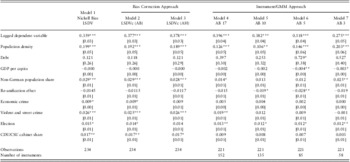
Models 5 and 6 thus provide tentative support for our four hypotheses. As the next step in our identification strategy we now use this model specification to explore the robustness of findings with alternative estimators (Appendix Table A.3). Substantial findings remain unchanged using the (uncorrected) LSDV estimator (Model 1). The same applies to the LSDVc estimator with an accuracy approximation of O(1/T) rather than O(1/NT) and AB for initial bias correction (Model 2). Using the LSDVc estimator with the AH estimator for initial bias correction causes the variables for economic crime and electioneering to slightly fail reaching the conventional level of statistical significance (Model 3). Applying the Arellano-Bond (Reference Arellano and Bond1991) GMM approach (Models 4–7), rather than bias correction suggested by Kiviet (Reference Kiviet1995), provides almost similar results to the LSDVc estimator, when the GMM(AB) specification uses the maximum number of instruments (17 lagged values of the dependent variable). In Model 4, electioneering exerts a statistically significant effect on officer numbers while partisanship remains insignificant. Reducing the number of instruments provides stable results for electioneering and population density, but weaker findings for alternative determinants. This points out to prior research on the poor finite sample performance of GMM estimators in the context of macro-panels (Baltagi Reference Baltagi2008, 164). In sum, the analysis of alternative estimators generally supports our primary findings but also points to caution about the marginal significance and substantial impact of the political determinants (Table 3).
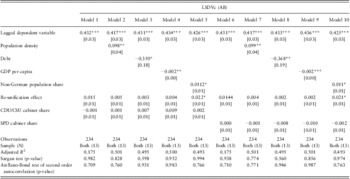
Determinants of civil servant police officers: stepwise
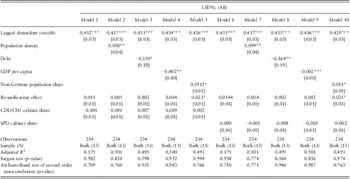
Note: LSDVc using Arellano-Bond (Reference Arellano and Bond1991) for initial bias correction and O(1/TN) to determine the accuracy of the approximation (Kiviet Reference Kiviet1995), standard errors are bootstrapped with 1,000 repetitions, standard errors are in brackets.
LSDVc = Bias-corrected least-squares dummy variable.
***p < 0.01, **p < 0.05, *p < 0.1.
Probing deeper: issues of endogeneity
The next step in the identification strategy is to take into account that findings on the effect of electioneering and partisanship might suffer from endogeneity problems. These could stem from interactions between different levels of government and electoral competition in German federalism. Alternatively, our partisan variable may represent background social and economic factors influencing police employment. To address this issue we re-run Models 3 and 4 from Table 2 and stepwise include the social and economic controls. The analysis shows three things. Firstly, the direction of the impact of the social and economic controls remains stable. Secondly, the effect of partisanship vanishes once we exclude social and economic controls. Thirdly, substantively it is the social and economic control variables that contribute most in explaining variance in the dependent variable. This shows that controlling for relevant confounders is essential to reveal the relevance of political determinants (Cameron and Trivedi Reference Cameron and Trivedi2005, 37). Only after taking into account structural social and economic controls do the partisan composition of the government helps to explain the remaining variance in civil servant police employment.
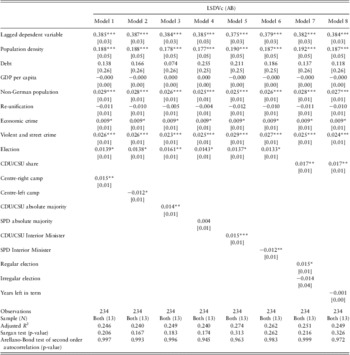
The next step in the identification strategy is to explore the robustness of findings on partisanship and electioneering by using refined measures of electioneering and partisanship that more explicitly take into account the context of German federalism. Since state-level elections in Germany are run according to a mixed electoral system that emphasises proportional representation, most states have coalition governments. In Table 4 we therefore go beyond single party power to analyse the joint share of cabinet positions of the “natural” coalition partners in Germany: CDU/CSU with FDP (the “centre-right camp”), and SPD with Greens and Linke (the “centre-left camp”). Models 1 and 2 again support H2, with negative signs for the left-camp and positive signs for the right-camp variable. In the short run, a unit increase in the change of “centre-right camp” is associated with 1.5 percentage point increase in officers in the last period, and a unit increase in the change of “centre-left camp” is associated with a 1.2 percentage point decrease in officers in the last period. In the long run, these associations are, respectively, +2.4 and −1.9 percentage points. Models 3 and 4, which explore the effect of absolute majorities for the main centre parties CDU/CSU and SPD, find that absolute majority power for the main centre-right party CDU/CSU is associated with a 1.4 percentage point increase in police in the short run and a 2.3 point increase in the long run. This further corroborates H2. The specific allocation to left-wing or right-wing parties of the Interior Ministry portfolio, which is directly responsible for police staffing, may be as important as general left-wing or right-wing party power in government. We find that in the short run a CDU/CSU Interior Minister is associated with a 1.5 (Model 5) percentage point increase in police officers, and an SPD minister with a 1.2 (Model 6) point decrease. This again supports H2.
Determinants of civil servant police officers: further partisan and electoral effects

Note: See Table 2.
We also probe further into the role of electioneering by taking into account early elections and an alternative measure for electoral timing. Where incumbents can call early elections, they might more easily schedule elections to coincide with economic expansions (Tufte Reference Tufte1978, 14, fn. 16; Franzese Reference Franzese2002, 381). Evidence on such endogenous timing of elections is still mixed (Smith Reference Smith1996; Palmer and Whitten Reference Palmer and Whitten2000). For an established federal democracy such as Germany, we distinguish regular scheduled elections from irregular (snap) elections. Irregular elections, however, are not easily timeable by state incumbents. Rather, they are usually the result of unexpected coalition breakdowns, which leave little time for manipulating public employment. Therefore, we would expect that irregular elections have no effect on police employment numbers. This expectation finds support in Model 7: only regular elections are positively and significantly associated with civil servant employment. These results, however, need to be interpreted carefully, since irregular elections are very rare events in state-level politics.Footnote 14 We also use a variable measuring the number of years left in the current term in Model 8, rather than the Franzese measure. As expected, the coefficient is negative, though it fails to reach conventional levels of significance (p = 0.296).
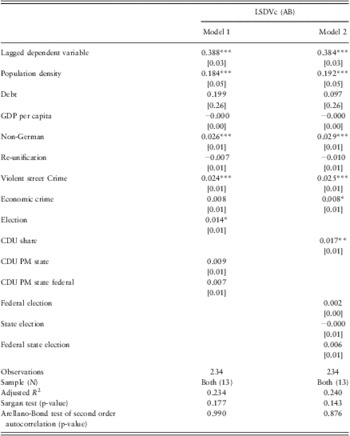
The next step in the identification strategy is to explore the potential role of interactions between federal- and state-level elections and partisan strength (Table 5). In electoral terms, this sort of interaction has been explored mainly with respect to federal government popularity, on the grounds that stronger declines in this latter variable may lead to bigger losses of federal government parties in state elections (Jeffery and Hough Reference Jeffery and Hough2001; Burkhart Reference Burkhart2004, 3; Berry and Gersen Reference Berry and Gersen2011). There are no studies, to our knowledge, of the effect of federal-local interactions on state employment policies. Nor do we expect to find such an interaction. As argued earlier, state-level employment policies in police, education and cultural affairs are constitutionally largely independent from the federal level in Germany. We constructed categorical variables accounting for whether the PM in the state belongs to the same party as the PM at the federal level (Model 1) and for whether state and federal elections were held simultaneously (Model 2). In neither case did we find evidence supporting the role of federal–state-level interactions when it comes to partisanship and electioneering in police employment.
Interactions: federal/state party strength and federal/state elections

Definition: CDU PM state = 1 if the PM of the state (Land) is from the CDU, otherwise 0; CDU PM state–federal = 1 if the PM of the state (Land) and federal (Bund, resp. Bundeskanzler) are from the CDU, otherwise 0; federal election = 1 in federal election years (Bundestagswahl), otherwise 0; state election = 1 in state election years (Landtagswahl), otherwise 0; federal–state election = 1 if federal and state elections take place in the same year, otherwise 0.
Note: LSDVc using Arellano-Bond (Reference Arellano and Bond1991) for initial bias correction and O(1/TN) to determine the accuracy of the approximation (Kiviet Reference Kiviet1995), standard errors are bootstrapped with 1,000 repetitions, standard errors are in brackets.
LSDVc = Bias corrected least-squares dummy variable.
*** p < 0.01, ** p < 0.05, * p < 0.1.
The last step in our identification strategy is to alter the dependent variable by looking at police officers with public employee status, rather than civil servant status as we have done so far. We expect the electoral benefit of manipulating public employees in police service to be lower than for civil servants (bobbies on the beat), since the electoral signal that stems from an increase in public employee police servicemen is less visible to voters. Re-estimating the model specifications presented in Tables 2 and 4 using public police employees as the alternative dependent variable confirms that apart from the role of years left in term, which is associated with a short-run reduction of employees by about 0.5 percentage points per year left, none of these operationalisations resulted in significant findings (Online Appendix Tables 4 and 5). As expected, these findings provide very little support for the electoral and partisan hypotheses.
We can thus summarise the overall estimation results as follows. Firstly, partisanship and electioneering have a robust but substantively small impact on the number of civil servant police officers. Secondly, structural social and economic controls are more influential determinants of police staffing than political determinants. Thirdly, after controlling for these essential confounders there is robust evidence that the ideological composition of government as well as party membership of the Interior Minister are associated with distinct changes in police staffing. Finally, we find no signs of interaction between electioneering and partisanship on other levels of government: police staffing remains a policy field where state governments enjoy a large degree of autonomy from the federal government – which they may use to reap electoral benefits from the strategic manipulation of police employment.
Conclusions
This article has aimed to contribute to the literature on the politics of public policy in two ways. Firstly, we argued that police employment is a good domain for investigating political manipulation tactics. The vote-increasing effect of electioneering towards law-and-order sensitive voters generally goes hand in hand here with that of patronage towards police officers specifically. Applying political business cycle theory to the case of civil servant officers in Germany, we found that electoral timing has a significant, if small, impact. More generally, our evidence on this large, affluent and well-established democracy in Europe qualifies recent claims that electioneering today is prevalent mainly in younger and/or less consolidated democracies (Alt and Lassen Reference Alt and Lassen2006; Shi and Svensson Reference Shi and Svensson2006). Instead, vote-seeking incumbents in advanced democracies may select those particular policy domains for manipulation that are still targetable and timeable (Tufte Reference Tufte1978; Franzese and Jusko Reference Franzese and Jusko2006; Tepe and Vanhuysse Reference Tepe and Vanhuysse2009).
Secondly, while German police employment is predominantly driven by structural variables such as population density, we have also found robust evidence of partisan effects. Using a number of alternative specifications of party power, we have shown police employment to be systematically subject to partisan effects. Greater right-wing (resp. left-wing) party power leads to more (resp. fewer) officers. This can be attributed to straightforward competence signalling towards law-and-order sensitive voters, combined with mixed competence signalling and patronage towards police officers themselves. Lastly, we have also found that auxiliary demand-side considerations such as salient forms of crime and presumed causes of crime matter. Both the share of the non-Germans and the incidence of salient types of crime are associated with increases in police employment.
As we have noted, the challenges posed by inference about causal parameters when econometric estimation is based on observational macro-panel data may be tackled by checking the robustness of findings using alternative identifying assumptions (Cameron and Trivedi Reference Cameron and Trivedi2005, 32; Angrist and Pischke Reference Angrist and Pischke2009, 245). We have therefore explored broadly similar electioneering and partisanship effects with plausible alternative models, giving special attention to potential issues of endogeneity that might stem from the structure of German federalism. Future work may fruitfully move beyond aggregated employment figures to focus on how specific institutional settings (such as centralised versus federal government) and public employment domains (such as education, inner security and culture) condition the electoral profitability of manipulation strategies. Lastly, future research might explore whether the timing of promotion decisions (rather than employment levels) in tenured and non-tenured types of public employment can be linked to electoral cycles or partisan motivations.
Such research could further test the argument that in times of an alleged waning of political business cycles and partisan policy-making, vote-seeking policy-makers can generally be expected to merely try and shift the use of political manipulation mechanisms away from “classic” domains (such as monetary, social and fiscal policy) and towards other domains in which the larger institutional environment still allows them significant leverage. Public employment currently amounts to 15 per cent of OECD labour forces on average (OECD 2011, 103). So it is likely to remain a key domain for such manipulation tactics. Regarding Germany specifically, a recent constitutional amendment, the “Föderalismusreform I”, has further strengthened the competences of the states in civil service employment (Frevel and Groß Reference Frevel and Groß2008, 84). This is likely to further boost the political manipulation of police employment.
Acknowledgements
Equal authors, listed alphabetically. For helpful comments, we are grateful to Thomas Däubler, Patrick Marier, Harvey Tucker, the editor and reviewers of Journal of Public Policy, and seminar participants at the ECPR Joint Sessions in Antwerp, April 2012, and at the EPSA conference in Berlin, June 2012. All errors remain our own.
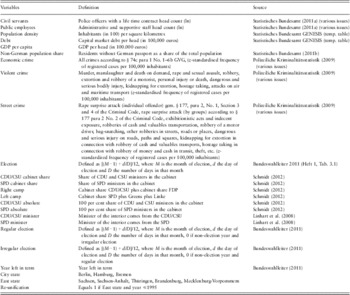
Definition and source of variables
Summary statistics

Exploration of alternative estimators: bias correction and instrument/GMM approach