INTRODUCTION
The development of effective taxation systems has been regarded as a crucial phase in the process of statebuilding. Focusing on the historical European experience, fiscal sociology has emphasised the connection between political representation and taxation (Moore Reference Moore2004) and highlighted the emergence of a twofold process of institutional development and reinforcement of state accountability around the issue of revenue collection (Brautigam Reference Brautigam, Brautigam, Fjeldstad and Moore2008). Although the traditional argument points to the positive effect of broad-based taxes on political representation, a symmetrical argument has also been made, stating that citizens would be more willing to pay taxes to a more legitimate and responsive government.
As democracy diffuses around the globe, even to the poorest parts of the world, it is worth asking what effects democratisation is having on the extractive capacities of developing states, and if it is fostering a social bargaining process between taxpayers and the state. This article explores the impact of democratisation and democracy on a state's extractive capacity by looking at the evolution of the Beninese tax revenues and fiscal system. Benin, a small country born out of decolonisation, with a fragile economy and a heritage of administrative weakness, is a good case study for exploring the interaction between democracy, taxation and statebuilding.
The analysis confirms that several theoretical hypotheses inspired by the history of Western Europe are not applicable to contemporary developing countries such as Benin. It also argues, however, that a democratic environment may have a positive effect in enhancing effective taxation and reinforcing its statebuilding potential through different causal mechanisms.
TAXATION, DEMOCRACY AND STATEBUILDING IN HISTORICAL AND CONTEMPORARY PERSPECTIVE
The power of collecting taxes has often been presented as one of the core, defining features of a modern state (North 1981; Levi Reference Levi1989; Tilly, Reference Tilly1993). The politico-economic approach to the study of taxation has considered the capacity of states to tax their citizens as both a central phase in the process of statebuilding and a key indicator of the capacities and consolidation of a nation state (Bates and Lien Reference Bates and Lien1985; Levi Reference Levi1989; Tilly Reference Tilly1993; Lieberman Reference Lieberman2002; Di John Reference Di John2010).
Since the writings of Joseph Schumpeter (Reference Schumpeter1918) a central tenet of fiscal sociology has been that there is a causal connection between the dependence of governments on broadly levied taxes and the existence of binding constraints on governments and institutionalised political representation (Moore Reference Moore2004: 298). The ‘tax state’ – a state that relies on broadly levied taxes as its prime source of financing – will tend toward accountable, representative government.
The core assumption of the fiscal sociology approach is that taxes can be extracted in two ways: through coercion, or in a semi-consensual way that requires the cooperation of the taxpayer. Examples of coercive taxation are poll taxes historically levied in agrarian societies and in many countries under colonial rule, which did not differentiate between taxpayers’ capacities to pay. Although the coercive collection of taxes is easier from an administrative point of view, it tends to generate resistance and non-compliance on the part of taxpayers and to be thus inefficient. Thus, these taxes are labelled ‘low quality’ taxes. Taxes that are collected at specific points, such as custom duties, are also assumed to be relatively easy to collect. However, they have less perverse effects than poll taxes and can be designed in a way to have some moderate redistributive effect (Lieberman Reference Lieberman2002). Progressive and administratively sophisticated forms of taxation, such as direct taxes on income and profits, are more efficient and more equitable, and are thus considered ‘high quality’ taxes, but require fine-grained information on social and economic activities that cannot be obtained by coercion alone. Thus, these taxes tend to stimulate the development of a state's administrative apparatus.
The fiscal sociology approach emphasises not so much the quantitative expansion of fiscal revenues but rather the structural transformation of taxation systems. ‘High quality’ taxes would be particularly appropriate for spurring a dual process of statebuilding and reinforcement of state accountability (Lieberman Reference Lieberman2002; Brautigam Reference Brautigam, Brautigam, Fjeldstad and Moore2008; Baskaran & Bigsten, Reference Baskaran and Bigsten2013). The introduction of these taxes would encourage citizens in pushing for government accountability and representation. Since effective tax collection requires a high level of compliance on the part of the taxpayers, governments would have to be responsive to citizens’ demands (Schumpeter Reference Schumpeter1918; Bates & Lien Reference Bates and Lien1985; Levi Reference Levi1989; Moore Reference Moore2004).
A subsequent causal relationship would link taxation and statebuilding. Higher levels of taxation extracted by consent can finance state-provided services and goods. Moreover, the process of effective tax collection itself, because of its administrative sophistication, will further stimulate the development of state capabilities (Moore Reference Moore2004; Brautigam Reference Brautigam, Brautigam, Fjeldstad and Moore2008).
Taxation would reinforce accountability, but the causal relationship would also go in the other way, with accountable and representative governance facilitating effective tax collection. Two causal arguments have been advanced in order to argue that the introduction of forms of democratic representation would produce ‘better funded states’ (Schmitter Reference Schmitter2005: 8). First, in a virtuous circle, citizens will be more willing to pay taxes to a government in which they feel represented and that they see as responsive to their needs (Bird Reference Bird2012). Because of the crucial importance of citizens’ compliance for ‘high quality’ taxation, governments that are authoritarian and unresponsive to citizens’ needs would be handicapped in expanding it. Given the fact that they enjoy more legitimacy in the eyes of the citizens, and that they are usually under pressure for redistributing wealth, democracies may have the upper hand in employing taxation as a statebuilding mechanism over autocracies. Second, in a context of democratic politics, political parties and civil society actors would push for redistributive policies, which require higher levels of taxation (Cheibub Reference Cheibub1998).
The threefold link between democracy, taxation and statebuilding has been emphasised by historical accounts focusing on Europe and Great Britain in particular (Levi Reference Levi1989; North & Weingast Reference North and Weingast1989; Hoffman & Norberg Reference Hoffman and Norberg1994). However, the proposition that democracy enhances tax collection has been theoretically and empirically contested with respect to contemporary democratic and authoritarian countries. Rational choice theorists have argued that citizens in a democratic system will vote for lower taxation. On the other hand, since they are less dependent on tax payer supports, autocratic government would impose higher levels of taxes (Olson Reference Olson1993; Mulligan et al. Reference Mulligan, Gil and Sala-i-Martin2004). Since these theories concentrate on states’ preferences and pay little attention to the actual capacity to collect taxes, other authors have argued that preferences and capacities would compensate for each other and the effect of political regime would be thus undetermined (Cheibub Reference Cheibub1998; Schmitter Reference Schmitter2005).
A number of cross-country quantitative studies have been conducted in order to test different theories of tax extraction and compare the taxation performances of democracies and autocracies. However, they reach contradictory conclusions, with some scholars finding that democracies collect more taxes than non-democratic states (Boix Reference Boix2001; Thies Reference Thies2007: 65), others that they collect as much taxes as autocracies (Cheibub Reference Cheibub1998; Schmitter Reference Schmitter2005: 8) and others that they collect less (Mulligan et al. Reference Mulligan, Gil and Sala-i-Martin2004). Most of these studies do not distinguish between ‘low quality’ and ‘high quality’ forms of taxation, and are thus of limited utility in analysing taxation from a statebuilding angle.
Moreover, it has been argued that taking the history of the development of taxation in Europe as a point of departure for analysing revenue collection in contemporary developing countries could be inappropriate (Moore Reference Moore2004). In these countries, the experience of colonialism (Mkandawire Reference Mkandawire2010) and the forces of a globalised economy (Moore Reference Moore2004) would shape state-society relations in distinctive ways. The next section looks at the problem of taxation in Sub-Saharan Africa, questioning the impact of the introduction of democracy on taxation in this particular historical and geographic context.
DEMOCRACY, TAXATION AND AID DEPENDENCY IN SUB-SAHARAN AFRICA
The relation between democracy and state capacity is particularly important today, as some of the poorest and weakest countries of the world have adopted democratic institutions. In many of these countries, encouraging democratisation has been seen not only as an end in itself but also as a means to improve the way they are governed. The problem is particularly relevant for Sub-Saharan Africa as, since independence, most African states have been affected by diffuse problems such as widespread corruption, poor economic management and political instability, and have experienced periodic fiscal crises.
In spite of their general administrative weaknesses, African states differ widely in their capacities to extract taxes. The tax systems of most Sub-Saharan African states were first established under colonialism (Fjeldstad et al. Reference Fjeldstad, Therkildsen, Rakner and Semboja2000), and it has been argued that the mode of economic exploitation of African colonies has had a substantial effect on today's African states' extractive capacities (Mkandawire Reference Mkandawire2010). Labour reserve economies would have allowed for the emergence of relatively strong states with high extractive capacities (Mkandawire Reference Mkandawire2010: 1651). On the other hand, former cash crop economies, a category that encompasses most of the former French and British colonies of West Africa, would experience more difficulties in collecting taxes today (Mkandawire Reference Mkandawire2010: 1649). They generally present lower levels of industrialisation and higher levels of informalisation of the economy with respect to former labour reserves and tend to collect more trade taxes and fewer direct taxes.
Since the end of the Cold War several former cash crop economies, such as Benin, Senegal and Ghana, have undertaken a fairly successful transition to democracy. If the hypothesis of the existence of a ‘virtuous circle’ between effective taxation and representative government is correct, democracy may have helped these countries in overcoming a negative historical legacy. Stimulated by citizens’ demands for more equitable taxation and better services, these states would have developed more sophisticated and efficient taxation systems, reinforcing their administrative capacities in the process. However, the possibility that democracy may have had a positive effect is complicated by the fact that many former cash crop economies have a long history of dependence on rents (Clapham Reference Clapham1996; Bayart Reference Bayart2000).
Rents are ‘unearned’ income, which typically do not require high administrative capacities, nor a bargaining process with citizens (Karl Reference Karl1997; Ross Reference Ross1999, Reference Ross2001; Moore Reference Moore2004). Much scholarly attention has been devoted to natural resource rents, particularly oil (Ross Reference Ross1999, 2001; Jensen & Wantchenkon Reference Jensen and Wantchekon2004). However, especially in low income countries, strategic rents have long played a crucial role (Moore Reference Moore2004: 305). In the post Cold War era, development aid has become arguably the most important strategic rent available to poor countries and many institutionally weak and natural resource-poor African countries have become heavily dependent on it (Brautigam Reference Brautigam2000; Moore Reference Moore2004; Moss et al. Reference Moss, Pettersson and Van de Walle2006).
Concerns have been raised that aid might undermine the ‘social contract’ that is believed to stem from broad-based taxation (Moss et al. Reference Moss, Pettersson and Van de Walle2006; Knack Reference Knack2009). However, the modalities of disbursement of development aid makes it sensibly different from natural resource rents (Collier Reference Collier2006) and donors are making aid disbursement increasingly conditional on the capacity of the state to increase its own revenues. Even authors who claim that a correlation between high levels of aid and low levels of taxes has been established, recognise that low tax levels in aid-dependent states might be caused by factors that simultaneously determine both (Moss et al. Reference Moss, Pettersson and Van de Walle2006). Others claim that there is no evidence of aid harming tax collection efforts (Di John Reference Di John2010: 26). Moreover, from an institution-building perspective, the fact that aid might displace taxes may not always be a problem. Deterioration in the quality of tax administration and policy would be a more worrying indicator (Knack Reference Knack2009). To date, there exists only one large-N study about the relation between aid and extractive capacities defined in these terms and, while it seems to confirm the existence of the ‘aid curse’, it is based on World Bank indicators available only for a relatively short number of years (Knack Reference Knack2009).
The impact of aid rents need to be taken into account when exploring the relation between democratisation and taxation as, at least in principle, since the end of the Cold War donors have made aid available to democratising states on a privileged basis. Although some authors dispute the association of aid with democracy (Djankov et al. Reference Djankov, Montalvo and Reynal-Querol2008), at least two cross-country studies based on African data have found a correlation between aid dependency and democratisation (Jensen & Wantchekon Reference Jensen and Wantchekon2004; Pfeiffer & Englebert Reference Pfeiffer and Englebert2012). In particular, Pfeiffer and Englebert argue that the relative importance of aid vis-à-vis other strategic rents (what they call ‘extraversion portfolio’) has been a major determinant of democratisation in Africa (Pfeiffer & Englebert Reference Pfeiffer and Englebert2012). Low-income countries that are poor in natural resources, are not key security players and have weak links to foreign patrons need to show some commitment to democratic reforms in order to attract aid flows that they are unable to substitute with other rents. From a political economy perspective, aid-dependent countries may become ‘democratic rentier states’, using their status of ‘democratic successes’ to attract even more aid (Bierschenk Reference Bierschenk2009). In this way, the virtuous circle that was supposed to link taxation and democracy in the fiscal sociology literature is undermined, and we might expect both a quantitative and qualitative deterioration of taxation following a transition to democracy.
BENIN: FROM FISCAL CRISIS TO DEMOCRATISATION
A small coastal state of West Africa, Benin provides a good case study for investigating the relation between democratisation and extractive capacities in Sub-Saharan Africa for several reasons. A former French colony and cash crop economy, Benin is a resource-poor country, with a weak economy and a large part of the population employed in subsistence agriculture and small-scale informal trade. In spite of these handicaps, Benin holds at least one record, as it was the first former French Sub-Saharan African colony to start a successful democratisation process at the beginning of the 1990s. In particular, its formula of convening a National Conference to manage the transition to democracy has provided a model of political liberalisation for the rest of French-speaking Africa (Heilbrunn Reference Heilbrunn1993; Banégas Reference Banégas2003; Gazibo Reference Gazibo2005; Gisselquist Reference Gisselquist2008).
Benin's fiscal system was first established under colonial rule. After the country gained independence in 1960 under the name of Dahomey, a series of reforms officially abolished the colonial fiscal system. However, these reforms were partial: they suppressed the most repressive practices, such as poll taxes, but did not restructure the Beninese fiscal system in depth (Raynaud et al. Reference Raynaud, Akuesson and Aliha2007). The single-party Marxist-Leninist regime of Mathieu Kérékou, which lasted from 1972 to 1990, did not undertake any major reform in the domain of tax policy and administration. Thus, taxation, especially internal taxation, remained underdeveloped. In 1990, at the eve of democratisation, the Beninese state collected less than 4% of its gross national product (GNP) in internal taxes (excluding custom duties and other taxes on international trade). While most analyses have concentrated on the spending side, the weakness of the Beninese revenue collection system was arguably one of the causes for the fiscal crisis that affected the Kérékou regime in the 1980s (Allen Reference Allen1992; Banégas Reference Banégas2003; Gisselquist Reference Gisselquist2008; Bierschenk Reference Bierschenk2009). Public debt accumulated and, by the end of the 1980s, the state was so bankrupt that it could not pay its employees’ salaries (Allen Reference Allen1992). Democratisation in Benin was also a response to the state's financial failure. It is worth asking if it has resulted in a better-funded state and has made a fiscal crisis unlikely to happen in Benin again.
Several authors have deplored the fact that democratic Benin is still affected by several governance problems, such as diffuse electoral clientelism (Wantchekon Reference Wantchekon2003), extensive corruption (Bako-Arifari Reference Bako-Arifari2001; Blundo & Olivier de Sardan Reference Blundo and Olivier de Sardan2006) and a heritage of weak institutional capacities (Olivier de Sardan Reference Olivier de Sardan2004; Bierschenk Reference Bierschenk2009). It has been contended that the country's dependence on external rents is one of the main causes of Benin's problems (Bierschenk Reference Bierschenk2009). The so-called Renouveau Démocratique – the regime change of 1990 – would have in the end reinforced the trend towards rentierism, by encouraging the influx of aid (Bierschenk Reference Bierschenk2009: 349).
If democracy has reinforced rentierism, however, we should expect tax revenues to have stagnated or even shrunk since democratisation and aid dependency to have increased. We should also expect no significant change or a negative change in the quality of taxation.
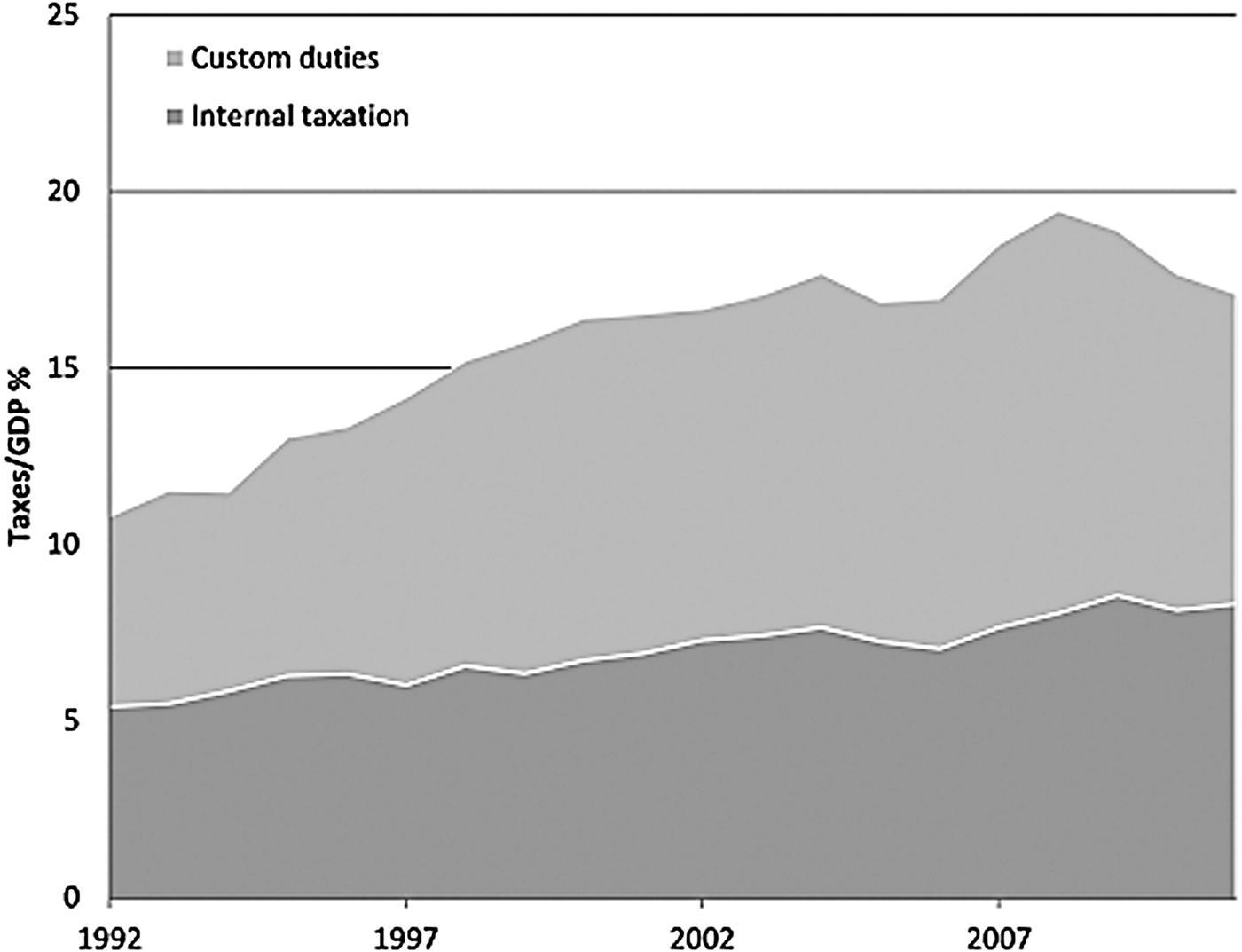
Data on revenues collected since the Renouveau Démocratique appear to contradict the hypothesis that democracy has reinforced rentierism and dependence on aid in Benin (Figure 1). The increase in tax revenues is one of the clearest trends. In 1992, Benin's tax to gross domestic product (GDP) ratio was 10·79%. In 2011, it had risen to 17·11%, which represented a fall with respect to figures from 2008, when the country achieved its best performance of 19·45%. The country is today in line with the 15% tax ratio target recommended by the World Bank for low income countries (Gupta & Tareq Reference Gupta and Tareq2008). Analyses based on tax effort, rather than on the tax ratio, have even found Benin to slightly over-perform (Sen Gupta Reference Sen Gupta2007; Mkandawire Reference Mkandawire2010).
Evolution of tax revenues in Benin (in Tax/Gross Domestic Product ratio). Source: Author elaboration from Direction Générale des Impôts et de Domaines (DGID) and Direction Générale des Douanes et Droits Indirects (DGDDI), Benin.

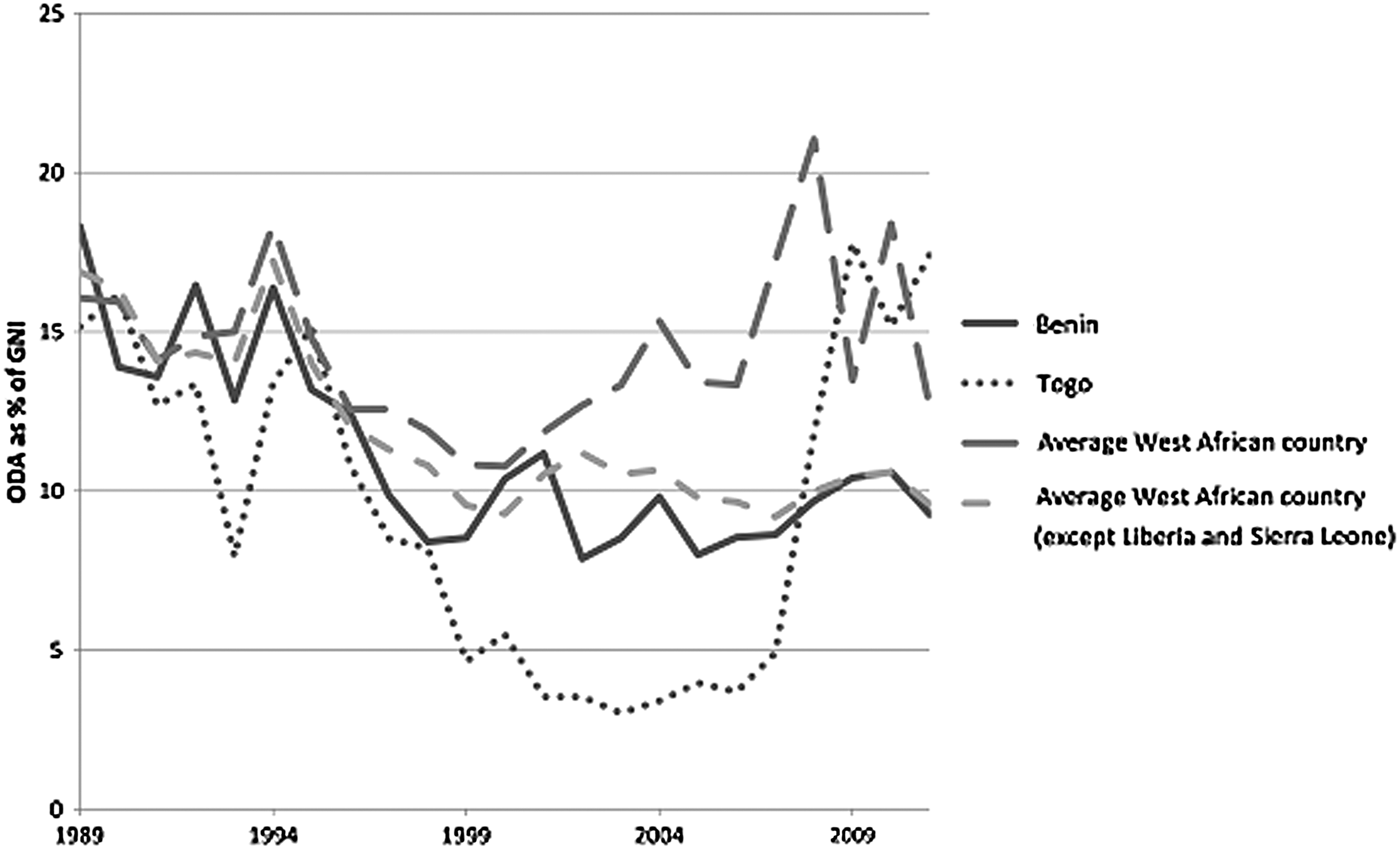
Moreover, Benin appears to have reduced its dependence on aid since the early 1990s. In 1992, at the beginning of the Renouveau Démocratique, the country received an amount of aid representing 16·46% of its gross national income (GNI) and it has been argued that the massive influx of aid substantially contributed to democratisation (Gazibo Reference Gazibo2005: 80). However, the prime de la démocratie has tended to dry up over the years, due to donor fatigue and increasing frustration with the country's levels of corruption and public mismanagement. Benin still receives considerable aid flow and remains dependent on aid for many important state investments (Gazibo Reference Gazibo2012) but its level of aid dependency has to be put into the context of West Africa, where it is far from exceptional (Figure 2). Moreover, when seen in a comparative perspective, Benin's level of aid dependency seems to have little to do with the democratic transition experienced by the country, as authoritarian or semi-authoritarian West African states have analogous or superior official development assistance (ODA)/GNI ratios. A particularly significant example of the latter is Togo, the West African country more easily comparable to Benin in terms of size, population and economic structure (Figure 2).
Benin's aid dependency in the regional context of West Africa (ECOWAS members plus Mauritania). Benin ODA/Gross National Income (GNI) ratio is compared to Togo and to the average ODA/GNI of West Africa. Liberia and Sierra Leone, because of their status of post-conflict countries, received much higher ratios of external aid in the last two decades than any other West African countries, so the graphic also includes the average without these two outliers. Source: Author elaboration from World Development Indicators (WDI), World Bank.
Benin is in fact often cited as an example of an African state with an essentially fiscal budget (Bako Arifari Reference Bako-Arifari2001). The attitude of Beninese government elites and civil servants is shaped by this acknowledgement and there is a diffuse feeling among Beninese civil servants, as well as consultants and donors, that the country's tax budget represents its most important source of revenues (Senior tax officer A 2013 Int.).
Benin's expansion of tax revenues looks less impressive in qualitative terms, as the country has yet to fully overcome its dependence on ‘low quality’ custom taxes. International trade taxes have constantly represented more than half of total tax revenues. However, internal revenue mobilisation has also risen, from 5·40% in 1992 to 8·31% in 2011 (Figure 1). Custom taxes in Benin are often seen as stemming from ‘unproductive’ speculative activities because part of them is levied on goods imported in Benin and then re-exported – often by smuggling – towards Nigeria. The existence and the lucrative character of this business, however, has been made possible in the past by the differences in Benin's and Nigeria's trade and monetary policies (Igué & Soule Reference Igue and Soulé1992). With the introduction of the ECOWAS custom union this year the situation could change. Another reduction in international trade taxes is likely to stem from the parallel implementation of the Economic Partnership Agreement (EPA) with the EU (Busse & Großmann Reference Busse and Großmann2007; Bilal et al. Reference Bilal, Dalleau and Lui2012). Thus, there is a growing pressure on the government to find a replacement for the potential loss of custom revenues.
In conclusion, looking at the quantitative trends, democratisation does not appear to have had the harmful consequences on revenue collection in Benin predicted by some specialists (Bierschenk Reference Bierschenk2009). It is, however, more difficult to see if there has been a causal relationship between the expansion of revenues that has taken place since the 1990s in Benin and democratisation and, in particular, if democracy has favoured the emergence of some kind of ‘social bargaining’ between taxpayers and the state. Given that many different historical developments have affected Benin at the same time, indicators of the amount of tax collected are insufficient to determine which causal processes mattered and which did not. The next two sections rely on interviews with Beninese stakeholders, including tax officials, representatives of taxpayers’ organisations and members of parliament, in order to understand the process that has determined Benin's expansion of state revenues and its limits.
DEMOCRATIC SOCIAL CONTRACT VERSUS TECHNOCRATIC REFORM
The global tax reform agenda in Benin
Theories of state rentierism point to the harmful role of globalisation for taxation. However, other global processes that could have an opposite effect on tax extraction have occurred in the post-Cold War years. The most important alternative explanation for Benin's expansion of tax revenues points to the role of the International Financial Institutions (IFIs), particularly the International Monetary Fund (IMF), and regional organisations such as the Union Economique et Monétaire Ouest Africaine (UEMOA). Spearheaded by the IMF, a global tax reform agenda has developed, aiming at making taxation a more simple and effective process. This agenda has been supported by an ‘increasingly organized epistemic community’ (Fjeldstad & Moore Reference Fjeldstad, Moore, Brautigam, Fjeldstad and Moore2008: 240) of international bureaucrats and national tax officials, which has been highly influential thanks to its cohesion, its highly specialised expertise and its capacity to present its agenda as coherent and easily understandable.
The impact of tax reform is cited as one of the main determinants of the improvements in Benin's extractive capacities by Beninese tax officials. They point out that the largest increase in the tax ratio in Benin happened in the early 1990s, when the new elected government of Nicéphore Soglo implemented the Structural Adjustment Programme (SAP) agreed with the IFIs. Some tax reforms concerned fiscal policy: the most important was the introduction of value added tax (VAT) in 1993. Other new taxes included a tax on industrial profits and commercial profits and a tax on non-commercial profits (Senior tax officer A 2013 Int.; Secretary of employer association 2013 Int.). Other reforms addressed the way taxes were collected and introduced administrative rationalisation, for instance the attribution between 1989 and 1990 of tax collection competences to the Direction Générale des Impôts et de Domaines (DGID, Directorate General of National Revenues and State-owned Estates) (Senior tax officer B 2013 Int.).
Benin's fiscal reforms were among the first undertaken by a Francophone African country and served as a model for other countries (Fossat and Bua Reference Fossat and Bua2013: 18). IMF technical assistance is now channelled through the African Technical Assistance Center (AFRITAC) established in Bamako in June 2003. Since its creation in 1994, UEMOA has partially taken over the IMF's role of driver of fiscal reforms. UEMOA has imposed a common external tariff in the framework of its custom union and has launched a programme of fiscal harmonisation. Benin pre-dated UEMOA on the implementation of some reforms on its agenda, such as the introduction of VAT. On the other hand, tax officials are currently discussing how to implement the 2006 UEMOA's Fiscal Transition Program (PTF) (UEMOA 2006), which aims to gradually shift the tax burden from customs duties to domestic taxes.
The main protagonists of the first fiscal reforms were national and international bureaucrats, notably the staff of the DGID, and the IFIs (Senior tax officer A 2013 Int.). Reforms were adopted by the Nicéphore Soglo elected government in a top-down technocratic fashion, rather than through an open democratic debate. This attitude was justified by the situation of emergency caused by the dimensions of the fiscal crisis (Senior tax officer A 2013 Int.). Even at a later stage, Benin's debate on taxation has been dominated by internal and external experts.
Because the expansion of fiscal revenues in Benin has happened mostly through top-down technocratic reforms and as a consequence of the expansion of the formal private sector, its statebuilding impact has been relatively modest, as current evidence on the spread of corruption and political clientelism suggests. While the upward trend in the collection of taxes is in itself beneficial, it does not appear to have substantially altered Benin's mode of governance and to have put in motion a ‘virtuous circle’ of reinforcement of the state and of its accountability. This conclusion confirms the findings of case studies of other countries, where the expansion of central state revenues through the implementation of externally sponsored technocratic reform has been consistent with a neopatrimonial rationale (Soest Reference Von Soest2007; Soest et al. Reference Von Soest, Bechle and Korte2011).
The next section addresses the question of why democratisation has mattered relatively little. It does so by looking at the role of institutionalised political representation. While classical theories suggest that elected parliaments are key fora where taxpayers and governments develop a ‘social contract’, the Beninese parliament appears to have been able to play this role only to a limited extent.
The marginal role of institutional representation
The transition to democracy has turned the Beninese parliament into an elected body and has attributed to it a role of control on fiscal policy, which is exercised mainly through the annual vote of the budget law. While the parliament has been occasionally successful at advocating minor amendments to the budget law, it has never managed to set the agenda and, particularly during the 1990s, has failed repeatedly in its effort to impose on the government a major revision of its fiscal policy orientations. A series of factors have indeed negatively affected the capacity of the parliament to influence policy in general and fiscal policy in particular.
In their detailed analysis of parliamentary control in Benin, Francis Akindés and Victor Topanou (Reference Akindés and Topanou2005) point at four sources of limitation. First, the Constitutional and legislative architecture of the Republic of Benin institutionalises a strong presidential regime and sets several important legal limits to the power of the parliament, in particular in the domain of economic policy. Second, the influence of the IFIs and external donors has undermined the parliament's influence. Third, the parliament has insufficient human and technical resources to scrutinise properly the action of the government. Fourth, corruption and neo-patrimonial politics have hampered the parliament's ability to play its role in full.
These four factors have interacted and reinforced each other. According to the law, the Beninese national assembly votes on the budget law and can propose amendments, but cannot alter the budget equilibrium and has to find alternative resources to finance possible tax cuts. Article 68 of the Beninese constitution imposes the most insidious limitation on the influence of the parliament. It stipulates that the president of the Republic can bypass the parliament and take exceptional measures in a number of circumstances, including when the execution of international commitments is threatened in a serious and immediate manner.
Article 68 has had important implications in Benin, as the most serious clashes between the parliament and the government on economic and fiscal matters have revolved around the implementation of international commitments: the SAPs. In 1994 and 1996, the parliament refused to vote for the budget law, opposing potentially unpopular austerity measures and privatisations. Interpreting article 68 in a broad fashion, the government and the president repeatedly won the battle, forcing the hand of the parliament and passing the budget law by decree.
In Benin, as in other countries, the growing technical complexity of tax policy has also negatively affected the parliament's influence. The parliament enjoys insufficient support on technical issues (Beninese Member of Parliament A 2013 Int.; Akindés & Topanou 2005) and has limited time to examine the budget: if it misses the deadline for voting on it, the president can adopt the budget law by decree (Akindés & Topanou Reference Akindés and Topanou2005).
There is also a growing complaint that the professional quality of the MPs has decreased with respect to the first years of the Renouveau Démocratique and that the debate in parliament has been impoverished by partisan struggles and by neo-patrimonial practices (Political analyst 2013 Int.; Beninese MP B 2013 Int.). Beninese MPs, whose allowances are already insufficient to perform their institutional duties (Political analyst 2013 Int.; Beninese MP A 2013 Int.; Beninese MP B 2013 Int.) are under constant pressure to find additional resources necessary to entertain a political clientele. This situation encourages MPs to gravitate towards the political side that has more to offer, usually the governmental coalition (Engels et al. Reference Engels, Stroh and Wantchékon2008). Personal allegiances and coalitions in the Beninese parliament are often shifting, and the phenomenon is decried under the label of ‘political transhumance’ (Awoudo Reference Awoudo2005; Beninese MP B 2013 Int.). A controversial practice allowed by the Beninese law has also been the so-called vote by delegation – the possibility for an absentee MP to have a colleague voting on his or her behalf. It has been alleged that vote by delegation has facilitated the corruption of MPs (Political analyst 2013 Int.).
The parliament has also played the more ‘soft’ role of transmitting recommendations from pressure groups, such as syndicates or employers’ associations, to the government (Beninese MP B 2013 Int.; Entrepreneur representative, 2013 Int.). The organisations having access to the parliament, however, represent only a small fraction of Beninese potential taxpayers – workers and entrepreneurs of the formal sector (Parliamentary assistant 2013 Int.). This points to the second main issue affecting the connection between the principle of representation and taxation in Benin: the fact that few people pay taxes.
At the beginning of the 1990s, the fact that there were few national taxpayers helped the new Beninese democratic regime to carry out reforms with little opposition (Senior tax officer A 2013 Int.). The number of taxpayers increased in the subsequent years, but the bulk of national-level taxation is still extracted by a small number of people and enterprises. According to a senior tax official, about 70,000–75,000 public employees and 700–800 large enterprises currently provide more than 80% of internal revenues (Senior tax officer C 2013 Int.). More citizens arguably pay local taxes, but, given the very recent introduction of decentralisation in Benin, it is difficult to evaluate the importance of these taxes. The fiscal administration has taken a few initiatives to encourage small enterprises to register and pay taxes. In 2001, a decree providing for the creation of Centres de Gestion Agréés (CGA), aiming at supporting small enterprises and encouraging their formalisation, was adopted. However, in 2009, only two centres had been created and only 400 enterprises had adhered to the initiative (Gnansounou et al. Reference Gnansounou, Houetohossou and Houedokou2010). There are reasons to believe that the objective of broadening the tax base has not been pursued with the same vigour as that of increasing tax revenues in the short term, all the more so as the tendency to concentrate on a small number of taxpayers has been in line with global tax reform trends (Fjeldstad & Moore Reference Fjeldstad, Moore, Brautigam, Fjeldstad and Moore2008: 256). For instance, the tax on the registration of enterprises, abolished in 2009 with the aim of encouraging small enterprises to enter the formal sector, was reintroduced barely three years later (Entrepreneur representative 2013 Int.).
A cause and a consequence of this failure is the fact that Benin has one of the largest informal sectors of the region. The 2010 enterprise census undertaken by the Institut Nationale de Statistique et d'Analyse Economique counted 143,031 informal enterprises versus only 2,047 formal enterprises (INSAE 2010: 21). In 2011, the informal sector employed 90·4% of the active population of Benin. Although a number of taxes are applicable to the informal sector, in practice its contribution to fiscal revenues is very small. According to an official estimate, revenues from the informal sector represented in 2010 less than 1% of total internal taxes collected by the DGID (Republic of Benin 2011).
In the public debate democracy has been accused of having favoured the over-expansion of the informal sector by encouraging a laissez-faire attitude, but in fact the boom of the informal economy appears to have taken place before the transition to democracy (Igué & Soule Reference Igue and Soulé1992; Republic of Benin 2011).
Impressions that the informal sector was smaller under Kérékou stem rather from the fact that at the time the informal economy was kept out of public debate. INSAE figures suggest that it has shrunk rather slightly since democratisation, from representing 99·6% of enterprises in 1991 to 95·7% in 2008. This trend has been mainly due to the expansion of the formal private sector, which employed only 1·4% of the Beninese workforce in 2004 and now represents 6% of the workforce (INSAE 2012: 18). Up to now, the narrowness of the tax base has limited the possibility that citizenship and state-society relations could be reinforced by the way in which revenues are collected (Fjeldstad & Moore Reference Fjeldstad, Moore, Brautigam, Fjeldstad and Moore2008: 257). Moreover, the small number of registered taxpayers that sustain the bulk of taxation feel increasingly overburdened (Entrepreneur representative 2013 Int.) and there are signs that a perverse circle may be in motion, with fiscal pressure itself becoming a disincentive for informal economic operators to enter the formal sector (Governance consultant 2013 Int.).
TOWARDS A DEVELOPMENTAL FISCAL SYSTEM?
The weakness of the political representation of the taxpayers does not mean that democratisation has not played any role in Benin and does not have the potential to influence positively the future evolution of taxation. Indeed, several Beninese stakeholders point to a positive effect of democracy on taxation, although this influence has taken place in a mediated and indirect manner. This section identifies alternative channels neglected by current theories through which democracy has positively affected taxation in Benin. In Benin, democracy appears to have facilitated tax reform by increasing the legitimacy of the state; it has encouraged a non-coercive approach to taxation through the diffusion of a non-authoritarian ethos among tax and custom officials; and has prompted an open debate about appropriate tax policy by guaranteeing freedom of speech and association.
During the transition phase, democratisation was an enabling factor for fiscal reforms. The legitimacy enjoyed by the post-1990 democratic governments, as well as the momentum created by the Conférence des Forces Vives, helped with pushing ahead the reforms and in establishing a relationship of confidence between the Beninese government and the IFIs (Senior tax officer B 2013 Int.; Senior tax officer A 2013 Int.).
According to senior tax officers, democratisation also facilitated the effort to bring the tax administration closer to the taxpayers (Senior tax officer A 2013 Int.). Tax reform in Benin has aimed, at least on paper, at making the administration less distant from citizens and more consent-based, with initiatives such as the introduction of easier procedures to pay taxes and the creation of an office for small enterprises. The official ideology of the tax administration has become one of treating taxpayers as ‘partners’ and ‘clients’ (Senior tax officer B 2013 Int.).
The picture is nuanced, because these reforms followed a rather standardised global pattern, and similar solutions were applied in the same years by authoritarian or semi-authoritarian countries (Fossat & Bua Reference Fossat and Bua2013). The process of paying taxes in Benin has remained a cumbersome one and the tax and custom administrations after democratisation are still plagued by diffuse corruption and embezzlement (Bako Arifari 2001: 41). Several recent surveys have found that the tax administration enjoys a very low level of trust (Afrobarometer 2011: 60f; INSAE 2011: 77).
However, the formal embrace of a consensual approach seems to have had some positive effects. While the literature neglects custom duties, because it does not consider them a form of high quality taxation, the case of the Beninese custom administration shows that reforms aiming at making taxation more consent based can enhance the effectiveness also of this type of taxation. Under the Kérékou single party regime, the current Direction Générale des Douanes et Droits Indirects (DGDDI) (the custom administration) was militarised and was seen as responsible first of all for security. Little importance was given to its economic and fiscal role. In 1992, the new democratic regime took the decision to disaffiliate the customs administration from the security forces (Custom officer 2013 int.). A second reform of the custom administration was undertaken in 2011 with the simplification of custom procedures and the institution of a guichet unique (one-stop window) at the Cotonou Port. These reforms have helped the custom administration to collect more revenues, and there are grounds to think that the democratic environment has been a key factor in determining a positive outcome (Researcher 2013 Int.).
The ongoing emergence of a debate on what has become known as fiscalité de développement (developmental taxation) points to another possible causal channel through which democratisation could have a positive influence over revenue collection and statebuilding. The expression fiscalité de développement is used by taxpayers, employers, donors and civil society activists to indicate a taxation system that is compatible with the promotion of economic growth and productive investment (Governance consultant 2013 Int.). Although it shares some aspects of the global tax reform agenda, the developmental taxation agenda does not focus on the expansion of tax revenues per se and takes a longer-term and more sustainable approach. The main points of the developmental taxation agenda are the enlargement of the fiscal base, the struggle against corruption in the tax administration, the promotion of fiscal equity and the modernisation of the fiscal system (Gnansounou et al. Reference Gnansounou, Houetohossou and Houedokou2010).
Under authoritarian rule, there was no public debate in Benin over fiscal issues. Moreover, certain topics, such as the informal sector and its expansion, were treated as taboo and ignored by the public administration. In contrast, the process that has led to the emergence of the developmental taxation debate in Benin shows that, even when institutionalised channels of representation and dialogue between the state and the citizens show limitations, freedom of speech and association can allow civil society and interest groups to express their views and put on the agenda issues that were previously neglected.
The developmental taxation debate has emerged in Benin in the last decade. During this period, the limits of technocratic fiscal reforms have become increasingly perceptible, and fiscal revenues have expanded at a slower pace or have contracted.
Public sector employees and formal sector entrepreneurs, who currently sustain most of the burden of taxation are becoming increasingly mobilised. The syndicates, which in Benin essentially represent the public sector, have protested several times, asking for the reduction of taxation on salaries (Governance consultant 2013 Int.). In 2006, the Conseil National du Patronat du Bénin (Beninese National Council of Employers, CNP-B) and the Conseil des Investisseurs Privés du Bénin (Council of the Private Investors of Benin, CIPB), together with other associations representing the formal private sector, have launched a Working Group on Fiscal Issues (Groupe de Travail Fiscalité 2012). Their initiative was a response to what they saw as increasing ‘fiscal harassment’ on the part of the state, stemming both from the state's need for funding and from corruption in the tax administration (Entrepreneur representative 2013 Int.). The Working Group, which includes several associations of independent professionals, such as lawyers and pharmacists, and a team of international consultants, prepares a platform of fiscal proposals every year, which is presented to the Ministry of Economy and Finance and to the Finance Commission of the National Assembly (Groupe de Travail Fiscalité 2012). Another preoccupation of the formal private sector has been to encourage the government to expand the tax base by engaging with the informal sector in a pragmatic manner. The CNP-B, the CIPB, the Chamber of Commerce and Industry of Benin and two other associations have sponsored a major enquiry over the informal sector, involving more than 4000 enterprises (Igué & Puech Reference Igué and Puech2008).
External partners have also been sensitive to the problem. The German Cooperation Agency GIZ has a representative in the Working Group on Fiscal Issues and the European Commission has co-financed an evaluation of the Beninese fiscal sector (Raynaud et al. Reference Raynaud, Akuesson and Aliha2007). The experts’ report came to quite critical conclusions about the Beninese fiscal system. It argued that reforms had not been deep enough and that the Beninese fiscal system had yet to be adapted to the contemporary economic reality of the country. It blamed the lack of transparency created by the number of taxes and insufficient information. It also pointed out the excessive fiscal pressure on productive activities (Raynaud et al. Reference Raynaud, Akuesson and Aliha2007).
Prompted by these private sector initiatives, the Ministry of Economy and Finance has been obliged to open an institutionalised channel of dialogue, the Public-Private Platform for the relaunch of the economy, established by a 2008 law (Republic of Benin 2008). The Platform meets every six months under the chairmanship of the Minister of Economy and Finance and every two months under the chairmanship of the Cabinet Director of the Ministry. It includes representatives of the different directions of the Ministry on the government side, and, on the side of the private sector, the CNP-B, the CIPB, the Chamber of Commerce and other professional associations.
As representatives of the formal private sector themselves recognise, the Boni Yayi administration has shown openness to dialogue (Entrepreneur representative 2013 Int.). Up to now, however, the outcome of initiatives aiming to promote a better taxation system has been mixed. A new reform has also been adopted in 2011, with the creation of a single income tax on physical persons. From the viewpoint of fiscal sociology theory, this is particularly significant, as personal income taxes are considered ‘high quality’ taxation par excellence. However, and in spite of the fact that the introduction of an income tax was a long-term demand of the formal private sector, the Working Group on Fiscal Issues has complained that the new Impôt sur le Revenu des Personnes Physiques (IRPP) has been designed in an excessively burdensome way (Groupe de Travail Fiscalité 2012). Moreover, there has been up to now no attempt to include actors from the informal sector in the Public-Private Platform or to open with them another institutionalised, regular channel of dialogue. This would not have been impossible, as some informal sector operators, such as artisans or motorcycle taxi drivers, have their own recognisable professional associations.
The government appears to be caught between pressures to make taxation more fair and sustainable and short-term concerns with raising revenues, partly encouraged by IMF and UEMOA targets. The potential reduction of custom revenues stemming from the introduction of the ECOWAS CET and the conclusion of the EPA is creating further pressure. However, the consequences of these developments could be negative as well as positive. The threat of a loss of external revenues could push the government to take more seriously the problem of the expansion of the internal tax base. While the informal sector used to be a ‘blind spot’ in the past, the Beninese government has accumulated in the last few years a considerable knowledge base with regard to it (INSAE 2011, 2012; Republic of Benin 2011) and a new census specifically targeted at micro-enterprises is in preparation (Senior tax officer C 2013 Int.). The tax administration prefers not to take part openly in initiatives aimed at improving knowledge of the informal sector, as it fears that showing too clearly that there is a fiscal objective beyond them could compromise their success (Senior tax officer C 2013 Int.), but closely follows them.
A potential expansion of the tax base through the inclusion of the informal sector necessarily would have to be based on some form of negotiated deal. Thus, in the end, the growing dependence of the Beninese government on internal tax revenues could lead to the development of a more meaningful social contract revolving around taxation.
CONCLUSION
The case study of Benin suggests that, even when democratisation leads in the short term to an increase in the availability of international rents, democracy is not harmful to a state's extractive capacities, and that the transition and consolidation of democracy may be accompanied by a noticeable increase in state revenues. However, it also highlights the fact that there is no clear and automatic causal connection between democratisation and effective taxation. The positive effect of democracy appears indirect and mediated.
Political representation is not likely to have a clear impact on taxation in contemporary low income democracies because of two factors that reduce its significance. The first is the weakness of parliaments and the neopatrimonial character of politics in many of these countries. The second is the small number of people who are effectively taxed in many developing countries, at least at the national government level. Taxation for statebuilding, in these countries, means to a large extent broadening of the fiscal base. The main obstacle to effective taxation in Benin does not seem dependence on rents, but the informalisation of the economy and its fragmentation in micro-enterprises.
Most gains in terms of expansion of revenues in Benin have been reaped due to the application of reforms promoted by international and national technocrats. While theories of the rentier state suggest that globalisation is likely to have a negative impact on taxation because it generates rents, the Beninese case also suggests that it might have the opposite effect, due to the global diffusion of a fairly standardised fiscal reform agenda and international pressures on states to increase revenues.
The Beninese case suggests, however, that the technocratic path to the expansion of state revenues, albeit in some respects successful, is not likely to deliver fully in terms of statebuilding and good governance. One of the limits of the technocratic approach to reform has been the inability to expand the tax base, with the consequence that the burden of the country's fiscal revenues still falls on a small number of Beninese citizens and enterprises and that the country's economy continues to be predominantly informal.
The case of Benin suggests that democracy can have a positive impact on taxation in two ways. First, democratic legitimacy can help a government to push ahead a package of potentially controversial fiscal reforms. Second, the climate of civil freedoms and open debate generated by democracy can help with putting on the agenda issues that previously received little attention, such as the impact of taxation on equity and economic development or the role of the informal sector. Thus, a democratic environment can create the preconditions for effective fiscal reforms.
As the limits of the technocratic approach have become increasingly evident in Benin, the space for a more contractual approach to taxation and for an increasing role to be played by democratic practices and institutions may be opening. This is evident in the establishment of formal channels of discussion between the government and major taxpayers and in the growing debate about a developmental taxation. Indeed, the case of Benin may ultimately confirm that, although the formal channels of democracy may matter relatively little for expanding extractive capacities, successful taxation depends in the end on the consent of the taxpayers and on quasi-contractual relations between them and the state. Because it allows for public debate and contestation of decisions taken by the government, democracy may offer a better environment for a consensual approach to taxation. However, as the positive influence of dialogue and freedom of speech does not pass through the institutional channels of a democratic system, such as elections and representative bodies, it cannot be excluded that an enlightened autocratic or semi-autocratic administration may also be able to create a similar atmosphere of openness and dialogue on fiscal issues, while maintaining an authoritarian grip on other issues.
The case of Benin also lends ground to the hypothesis that a shrinking of rents and ‘low quality’ taxation, such as custom duties, could encourage the state to shift towards more consensual and contractual forms of taxation. Faced with the menace of a reduction in custom revenues, the Beninese state will be forced to confront the problem of the fiscalisation of the informal sector. This could be attained only with the collaboration of informal sector entrepreneurs themselves. While it is still too early to tell if the government will be able to develop a successful long-term strategy to address these problems, democracy could at the same time contribute to its resolution and be reinforced by it.