Introduction
Depression is a significant public-health problem, and one of the leading causes of disease burden worldwide (Wulsin et al., Reference Wulsin, Vaillant and Wells1999; Egede, Reference Egede2007; Eaton et al., Reference Eaton, Martins, Nestadt, Bienvenu, Clark and Alexandre2008). The prevalence of depression in community samples of elderly people varies from 12% to 28%, and in about half of those, depression persists for years (Livingston et al., Reference Livingston, Watkin, Milne, Manela and Katona1997; Beckman et al., Reference Beckman, Copeland and Prince1999; van der Weele et al., Reference van der Weele, Gussekloo, de Waal, de Craen and van der Mast2009). Depression is a potential risk factor for mortality in adults (Brettingham, Reference Brettingham2004; Surtees et al., Reference Surtees, Wainwright, Luben, Wareham, Bingham and Khaw2008; Mykletun et al., Reference Mykletun, Bjerkeset, Overland, Prince, Dewey and Stewart2009). The general finding that populations of patients with depression have an increased mortality is most evident among the aged (Murphy et al., Reference Murphy, Smith, Lindesay and Slatterly1988; Barefoot and Schroll, Reference Barefoot and Schroll1996; Whooley and Browner, Reference Whooley and Browner1998). It has been suggested that depression is an independent factor for mortality; however, studies examining the relationship between depression and mortality among the elderly population did not take into consideration factors that may also influence survival (Murphy et al., Reference Murphy, Smith, Lindesay and Slatterly1988; Fredman et al., Reference Fredman1989; Barefoot and Schroll, Reference Barefoot and Schroll1996; Whooley and Browner, Reference Whooley and Browner1998; Rapp et al., Reference Rapp, Gerstorf, Helmchen and Smith2008; Schoevers et al., Reference Schoevers, Geerlings, Deeg, Holwerda, Jonker and Beekman2009; Zhang et al., Reference Zhang, Kahana, Kahana, Hu and Pozuelo2009). Moreover, depression in old age is often comorbid with other chronic diseases and it is also associated with unhealthy lifestyles that may in turn affect mortality (Herbert and Cohen, Reference Herbert and Cohen1993; Livingston et al., Reference Livingston, Watkin, Milne, Manela and Katona1997; Beckman et al., Reference Beckman, Copeland and Prince1999; Moussavi et al., Reference Moussavi, Chatterji, Verdes, Tandon, Patel and Ustun2007; Rapp et al., Reference Rapp, Gerstorf, Helmchen and Smith2008). Therefore, it seemed an important step to investigate the association between depression and mortality while simultaneously assessing for all possible confounding factors. The present study was undertaken to investigate the association between depression in old age and mortality, controlling for socio-demographic, health, nutritional, and life-style factors.
Methods
Participants were drawn from a home for older people in Rome, Italy (Casa di Riposo Roma III). Between March and May 1993, 209 elderly people (62 male, 147 females; mean age 81 and 80 years, respectively) who were residing in the home, were contacted. To be admitted to the institution, pensioners have to submit an application to the Department of Social Services of the municipality. Only self-sufficient people are admitted since it is not a long-term care nursing facility, although some facilities are provided such as medical services. On the basis of an initial review of clinical records available at the home and interviews with medical staff individuals, residents who could not collaborate in the study (with mental health problems and/or suffering from terminal diseases) were excluded.
Out of the 209 contacted, 23 (11%) refused to participate in the study and 19 subjects were excluded. The participants (167) in the cohort study were largely healthy, self-caring, and mobile.
The ten-year cohort study of mortality was conducted in 2010 and involved examining files from the Registry Office to obtain information on vital status and cause-specific mortality. The International Classification of Diseases (ICD-9) was used to classify death due to cancer (codes 140–239). We calculated the length of follow-up for each subject as the number of days from the first visit to the date of death or to the end of the ten years of follow-up, whichever came first.
The standardized health questionnaire included information about marital status, education, and smoking habits. The presence of chronic diseases (diabetes, cardiovascular diseases, stroke, chronic bronchitis, and liver and renal diseases) was determined by the medical staff in the home, using data from clinical records.
Primary activities of daily living were evaluated using the Barthel Index (Royal College of Physicians of London and British Geriatrics Society, 1992). Subjects scoring 8 or less out of 20 were considered disabled. We used the abbreviated mental test to assess cognitive function, with a score of 7 or less, out of a possible 10, indicating abnormal cognitive function (Royal College of Physicians of London and British Geriatrics Society, 1992).
Socio-demographic data were collected and a standardized health questionnaire, which included information on alcohol consumption and smoking habits, was administered by a trained researcher. The Geriatric Depression Scale (GDS-15; Royal College of Physicians of London and British Geriatrics Society, 1992) was used to detect symptoms of depression. GDS-15 is a short, 15-item instrument specifically designed to assess depression in geriatric populations and validated in many settings and languages (Segulin and Deponte, Reference Segulin and Deponte1997; Almeida and Almeida, Reference Almeida and Almeida1999; Osborn et al., Reference Osborn2002; Rinaldi et al., Reference Rinaldi2003). Anthropometric measurements (weight, height) were taken by a single observer according to a standardized procedure (Lohman et al., Reference Lohman, Roche and Martorell1988). Body mass index (BMI) was used to assess nutritional status (kg/m2). Education attainment was used as a proxy measure for social class. Former smokers were defined as those who had stopped smoking at least six months before being interviewed for this study.
The study protocol was approved by the local Ethics Committee of the Catholic University of Rome. A written consent form was signed by the participants. Before accepting and signing the consent form, all participants were informed about the objective of the study.
Statistical analysis
The primary outcome was all-cause mortality and the secondary outcome was cancer-specific mortality. We used the Kaplan-Meir method to calculate crude survival by baseline characteristics and by depression. We assessed the potential for violation of the proportional hazards assumption by comparing the survival curves for each variable and by fitting models containing interaction between the variable of interest and depression. Cox proportional hazards regression, with stepwise adjustment, was used to examine the association between depressive symptoms and mortality, controlling for potential confounders. Martingale residuals analysis was also carried out.
In the multivariate Cox proportional hazards model, data were adjusted for established risk factors for mortality (sex, age, education) and for variables that emerged predictors of mortality in the present study (p-value was less than 0.05). The following potential confounders were taken into consideration in the multivariable analysis: BMI (low: <25; high: ≥25), cigarette smoking (non-smokers, ever-smokers), duration of smoking (years), cognitive status and disability, and the presence of chronic diseases (diabetes mellitus, cardiovascular disease, stroke, chronic bronchitis, and liver and renal diseases). Since benzodiazepine use was reported by 20 subjects in the study (12.4%), and it could confound the study results, it was also introduced in the model.
The effect modification by sex, age, education, smoking, chronic diseases, BMI, cognitive status, disability, and depression status was also assessed.
Data were analyzed with STATA software (Stata 11.0; StataCorp LP, College Station, TX, USA).
Results
The mean age of the participants at baseline was 80 years (SD = 7.8); 67% were women and 33% men. Among those 167 subjects, 110 (66%) died during the ten years of follow-up. The median follow-up was 7.2 years for a total 1,034.2 person-years of follow-up. Out of the 110 deaths, 20 were from cancer. Out of the 167 elderly subjects, 44% were classified as having depression (scoring above the depression cut-off of 7). Elderly people with seven or more symptoms of depression according to the GDS-15 had a lower ten-year survival rate (25% versus 39%) than those with less than seven symptoms of depression (p = 0.03). Depressed elderly who ever smoked had an extremely low ten-year overall survival rate (7%).
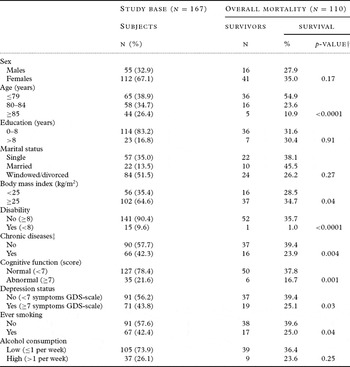
Table 1 shows the main characteristics of the study population and ten-year survival. The risk of mortality increased with older age, depression, smoking, disability, abnormal cognitive status, the presence of chronic diseases, and lower BMI.
Characteristics of the subjects at enrollment and ten-year survival

* Totals may vary because of missing values.
† Log-rank test.
‡ At least one of the following physician-reported diagnosis: diabetes mellitus, cardiovascular diseases, stroke, chronic bronchitis, and liver and renal diseases.
The risk of death was 53% higher for depressed subjects (RR: 1.53; 95%CI: 1.05–2.24) than for non-depressed after controlling for confounding variables. Duration of smoking was higher among depressed subjects than non-depressed (p = 0.002). Number of cigarettes was not different between depressed and non-depressed (p = 0.35).
Since a statistically significant interaction was observed between depression and smoking (RR: 2.19; 95%CI: 1.09–4.84; p = 0.05), the findings were presented separately for ever-smokers. No effect modification by sex, age, education, smoking, alcohol, chronic diseases, cognitive status, BMI, and depression status was observed. A statistical interaction was present between disability and depression (p < 0.0001).
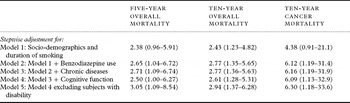
Table 2 shows the adjusted relative risks (RRs) and 95% confidence intervals (95%CI) of five- and ten-year overall mortality and ten-year cancer mortality. In the first model, socio-demographic factors (age, sex, marital status, years of education) and duration of smoking were entered. In the second and the third models, benzodiazepine and chronic diseases respectively were entered. In the fourth model, cognitive status was entered. In the multivariable analysis, controlling for age, sex, marital status, years of education, cognitive status, chronic diseases, and benzodiazepine, the risk of death was two and a half times higher for depressed subjects who ever smoked (RR: 2.61; 95%CI: 1.28–5.31). The risk of dying of cancer was six times higher for depressed who ever smoked (RR: 6.09; 95%CI: 1.13–32.9).
Adjusted relative risk (RR) and 95% confidence intervals (95%CI) for depression and smoking

To further confirm the findings, we re-ran the model excluding subjects with disability and the risk remained (RR: 2.94; 95%CI: 1.37–6.28), showing that the effect of depression on mortality is independent of the presence of disability (Model 5).
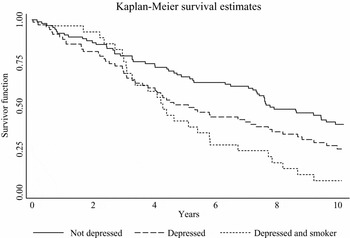
Figure 1 illustrates the survival curve over ten years for the participants, by depression status and depression and smoking.
Survival curve over ten years for the participants, by depression and depression and smoking.

Discussion
The results of our study suggest a negative effect of depression on overall mortality. Elderly people with depression (scoring above the depression cut-off of 7) had a 53% increased risk of mortality (RR: 1.53; 95%CI: 1.05–2.24) compared to non-depressed subjects. The combination of depressive symptoms with smoking was associated with a particularly higher risk of overall mortality (RR: 2.61; 95%CI: 1.28–5.31). Depressed elderly people who ever smoked had a six-fold greater risk of dying from cancer.
When cancer mortality is also increased, it is likely that unhealthy behavior and lifestyles (Antoni et al., Reference Antoni2006; Colditz et al., Reference Colditz, Sellers and Trapido2006) may also play a role in this association. In fact, in our study, elderly people with seven or more symptoms of depression tended to smoke for many years, drink more alcohol, and make use of benzodiazepines for sleeping problems. Therefore, as well as routinely adjusting for age, sex, education, marital status, cognitive status, and the presence of chronic diseases, we also adjusted for these additional confounders. We also excluded subjects with disability. However, those factors did not change the results.
Our study confirms the results of other studies published elsewhere that depression is an independent risk factor for mortality (Yaffe et al., Reference Yaffe, Edwuards, Covinsky, Lui and Eng2003; Rapp et al., Reference Rapp, Gerstorf, Helmchen and Smith2008; Schoevers et al., Reference Schoevers, Geerlings, Deeg, Holwerda, Jonker and Beekman2009; Zhang et al., Reference Zhang, Kahana, Kahana, Hu and Pozuelo2009) and cancer mortality (Kawamura et al., Reference Kawamura, Shioiri, Takahashi, Ozdemir and Someya2007), and suggests that the combination of depression and smoking worsens the outcome effect.
A ten-year prospective epidemiological study showed that depression predicted earlier (three- and five-year) overall mortality but not later (ten-year) mortality (Ganguli et al., Reference Ganguli, Dodge and Mulsant2002). Our study, however, showed that depression is associated with both five- and ten-year overall mortality.
A recent study conducted by Giese-Davis et al. (Reference Giese-Davis, Collie, Rancourt, Neri, Kraemer and Spiegel2011) suggests that by decreasing depression symptoms breast cancer survival increases, reinforcing the findings of our study.
A limitation of our study is that we had small numbers of cancer deaths to conduct meaningful analysis of five-year cancer mortality. The strength of our study is that it is the first study to investigate the effect of depression among the very old with adequate control for nutrition and life-style factors.
Depression may not only complicate coping with cancer and adherence to medical treatment but also affects endocrine and immune functions (Fortes et al., Reference Fortes2003) to tumor progression. We found that the combination of depression and smoking increases mortality. It has been suggested that depression leads to smoking (Okoro et al., Reference Okoro, Strine, Balluz, Crews and Mokdad2010) and smoking alleviates depression probably through nicotine acetylcholine receptor (nAChRs) modulation (Paradiso and Steinbach, Reference Paradiso and Steinbach2003; Mineur and Picciotto, Reference Mineur and Picciotto2009). However, by altering signaling of nAChRs, cancer cells may be triggered (Schuller, Reference Schuller2009).
The results of this study suggest that depression is associated with a higher risk of mortality and the combination of both depression and smoking shorten life expectancy among the aged. Fortunately, depression is a potentially modifiable factor. Therefore, diagnosis and treatment of depression among the aged seems an important goal for improving survival.
Conflict of interest
None.
Description of authors' roles
C. Fortes designed the study, supervised data collection, and wrote the paper; S. Mastroeni was responsible for carrying out the statistical analysis, and commenting on the paper; S. Alessandra collected mortality data; J. Lindau participated in the interpretation of the data and commented on the paper; S. Farchi conducted the preliminary statistical analysis; F. Franco was responsible for data handling; R. Pacifici collected data; P. Zuccaro collected data; E. Mazzotti participated in the interpretation of the data and commented on the paper; P. Pasquini participated in the interpretation of the data and commented on the paper; P. Borgia supervised the work and commented on the paper.
Acknowledgments
The authors thank Sergio Tortora, Nidia Salcedo, and Valentina Salvatori for assistance with references and editing. This work was supported by grants from the Italian Ministry of Health.