Introduction
On 2 November 2006, the Japanese Agricultural Minister, Matsuoka Toshikatu, announced the government's plans to introduce a new certification system to promote Japanese cuisine overseas. In the new system, the Japanese government would certify those restaurants overseas that served authentic Japanese food. Minister Matsuoka commented that this system would inform foreign consumers of the restaurants that served authentic Japanese food. The government is concerned that there are many restaurants overseas that serve low-quality, non-authentic, and even fake Japanese food, and this may have some negative impacts on the recent increase in the popularity of Japanese cuisine in Europe, Asia, and North America. Some media outside Japan alarmingly reported on the Japanese government's announcement. For instance, an article in the Financial Times warned that the Japanese government is planning to send ‘sushi police’ abroad, as the system would require the government to send several undercover agents to evaluate restaurants.Footnote 1
However, the real motive behind the government's policy is not to police Japanese restaurants overseas but to promote exports of Japanese agricultural products. The proposed certification system is modeled after a similar system adopted by the Italian government. The Italian system requires restaurants to use a certain amount of Italian-made products in their dishes to be certified by the government, and the Japanese government hopes to imitate the system to encourage restaurants overseas to buy more Japanese agricultural products. This development is therefore an example of the recent attempts by the Japanese government to increase exports of Japanese agricultural products to overseas markets, and it marks a significant change in its agricultural policy.
For much of the post-World War II period, Japan firmly maintained traditional protectionist agricultural trade policies, which were often characterized by heavy emphasis on protection of the domestic agricultural sector, and thus the government was often criticized by exporters of agricultural products, such as the United States and Australia, for not liberalizing its markets, resulting in a series of heated trade disputes. Though it has not completely abandoned these protection measures yet and may not do so anytime soon, the Japanese government has introduced various new policies to promote export of Japanese agricultural products to overseas markets, particularly to neighboring Asian countries. In fact, recently, agricultural export promotion has become one of the main trade policies of the Japanese government, which has allotted an increasing amount of its budget to agricultural export promotion. Agricultural export promotion policy first appeared in 2003, and it was referred to as a policy to establish ‘agriculture in an offensive posture’ [seme no nosei], as opposed to the traditional ‘defensive’ protection policies.
However, researchers are yet to pay sufficient attention to this intriguing development in Japan's agricultural trade policy, in spite of its analytical significance. This paper tries to explain the introduction of export promotion policy by focusing on the impacts of changes in legislators' incentives as a result of the electoral reform of 1994. My argument is that the changed electoral environment after the reform made certain policies that only serve particularistic interests, such as the protection of the agricultural sector, less attractive to politicians, because politicians must now appeal to a broader constituency – what Krauss and Pekkanen (2004) call ‘constituency span’.Footnote 2 The paper will first review the Japanese government's protectionist policies for agriculture during the post-World War II period, and then discuss the recent changes towards export promotion. It will then turn its attention to the impact of the 1994 electoral reform and examine how the reform has changed electoral incentives and legislative strategies. Then, I will explain how the new electoral environment has specifically encouraged legislators to initiate and support an export promotion policy for the agricultural sector. Finally, I discuss why other seemingly important factors, such as foreign pressure [gaiatsu] and budget tightness, cannot adequately lead to the introduction of the new policy.
Japan's traditional protectionist agricultural policies
Throughout the post-World War II period, Japanese agricultural trade policies have been marked by a strong tendency towards protectionism. The government, particularly the Ministry of Agriculture, Forestry, and Fishery (MAFF), firmly defended the interests of domestic farmers with various measures, in spite of tremendous pressure from foreign governments. There have been heated disputes between Japan and numerous countries over liberalization of Japanese agricultural markets resulting in ongoing tensions.
Traditional policies for agricultural industries included price support for agricultural products, trade restrictions for agricultural imports, heavy investment in agriculture-related infrastructures, and various subsidies for farmers. In particular, trade restrictions and price support were designed to maintain farmers' income at a high level, despite the cost to consumers. According to a report by a research institution of the Australian government, ‘Food prices are now an issue for Japanese consumers and they are questioning the wisdom of having to pay over six times the world price for rice and over four times the world price for milk’ (these figures are from 1995).Footnote 3 Besides the various measures to keep the prices of agricultural products high, the Japanese agricultural sector was heavily subsidized by the government. Calder (1988) says, ‘Japanese agricultural spending has been high largely due to an unusually wide range of subsidies to agricultural groups and individual farmers, particularly to reward or discourage the production of major commodities such as rice and wheat. In fiscal year 1984, for example, approximately 15.5% of Japan's extraordinarily high subsidy budget went to agriculture, to support nearly one-third of the 1,500 line items subsidized in the national budget as a whole’.Footnote 4 This is striking when we consider the fact that agricultural production accounted only for 3.2% of Japan's GDPFootnote 5 in 1984. Even though trade barriers and price support mechanisms have been abolished or significantly reduced recently, as will be discussed below, Japanese farmers remain heavily subsidized. According to a report by the USTR, the total amount of Japan's agricultural subsidies accounted for 59% of Japan's agricultural production in 2002, and the number was much higher than its European (36.5%) and American (17.6%) counterparts.Footnote 6
In short, the Japanese agricultural sector was protected by trade barriers and price support mechanisms for decades, and it has been heavily protected and subsidized by the government at the costs of consumers, taxpayers, and foreign producers. Before discussing the primary reasons for such generous and unfair treatment of farmers and the agricultural sector, let us turn our attention to recent changes in Japanese agricultural policies, which seem to have been a redirecting of the focus of the government' s agricultural policies towards more market-oriented policies.
Japan's new agricultural trade policy: ‘Agriculture in an offensive posture [seme no nosei]’
Although the Japanese government was highly protective of domestic agriculture for several decades, it introduced a new agricultural policy in 2003 that had not been previously widely discussed before by politicians and government bureaucrats.Footnote 7 The new policy is the promotion of Japanese agricultural products to overseas markets. The Japanese agricultural sector was often considered as inefficient and non-competitive in the world market for decades following the end of World War II; thus, government policies focused primarily on protection of the sector from foreign competitors.Footnote 8
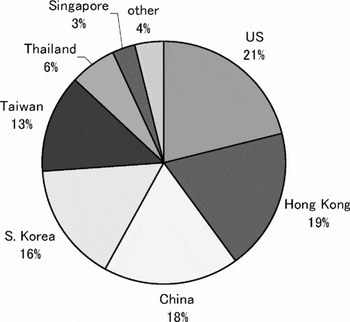
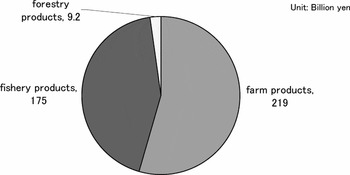
Yet, recently, there were some favorable changes in overseas markets, creating many opportunities for the Japanese agricultural sector. First, economic growth in Asian countries – the major destination of Japanese agricultural exports – has significantly increased the disposable income of customers in those countries. Therefore, the demands for Japan's luxurious and high-quality agricultural products have increased. The agricultural exports to Asian markets accounted for 59% of Japan's total agricultural exports in 1989, but the figure has risen to 75% by 2006 as shown in Figure 1 below.Footnote 9 Second, Japanese agricultural products have been recognized in overseas markets – Asian markets in particular – for their high quality and safety. Ruan Wei, Chief Researcher at Norin Chukin Research Institution, claims that the popularity of Japanese agricultural and food products is increasing among consumers in Asian markets such as China, Taiwan, and South Korea. In spite of their relatively high price, Asian consumers think Japanese products are ‘high quality, safe, healthy, and stylish’.Footnote 10 Wei explains that those Asian countries have a tradition of seasonal gift exchanges, and luxurious fruits (apples, pears, melons, strawberries, etc.) from Japan became popular items as gifts. Also, Japanese food products (instant noodles, snacks, candy) have become popular among young Asian consumers. Furthermore, the growing popularity of Japanese cuisine in Asia, North America, and Europe has increased the number of Japanese restaurants throughout the world. Some, if not all, of those restaurants use certain products (rice, sake, seafood, seasonings) imported from Japan. In 2005, Japan's agriculture-related exports amounted about to 400 billion yen, consisting of farm products (219 billon yen), fishery products (175 billion yen), and forestry products (9.2 billion yen).Footnote 11
Major Destinations of Japanese Agricultural Exports in 2006.
Source: The MAFF Policy Report: http://www.maff.go.jp/sogo_shokuryo/yusyutu/kyougikai/siryo.pdf

Japan's agriculture-related exports in 2005.
Source: The MAFF Web site. <http://www.maff.go.jp/www/info/shihyo/ichiran.html>

Since Japan has been gradually increasing exports of its agricultural products in recent years, the Japanese government has decided to initiate a campaign to further expand exports of Japanese agricultural products. The government describes this policy change as a change from ‘defensive tactics’ to ‘offensive tactics’. For the purpose of export promotion, the government has started several new policies including: (1) assistance in building marketing networks, (2) protection of intellectual property rights and brands, (3) establishment of an export-oriented production system, and (4) the removal of trade barriers. For example, the government is assisting exporters of Japanese agricultural products to build overseas marketing networks by sponsoring trade fairs and stores featuring Japanese agricultural productsFootnote 12 in various countries, collecting and distributing to overseas markets information using government agencies such as JETRO (Japan Export Trade Organization), and disseminating product information to overseas consumers. JETRO is a quasi-governmental trade promotion agency fully sponsored by the Ministry of Economy, Trade, and Industry (METI) and has more than 100 branches throughout the world.Footnote 13 It has played a critical role in assisting Japanese manufacturing firms to export their products to overseas market. By utilizing JETRO's experiences and networks, the government is hoping to cultivate new markets for Japanese agricultural products. That is to say, the Japanese government is trying to apply the ‘Japan Model’, which is often considered as key to Japan's manufacturing industry in the postwar period, to agricultural.
Also, as a part of the export promotion campaign, the government has announced its plan to introduce the certification system for Japanese restaurants outside Japan, as discussed at the beginning of this paper. In a press release, the MAFF reveals its intention to use the certification system to promote export of Japanese agricultural products.
There are an increasing number of Japanese restaurants outside Japan providing Japanese cuisine that is removed from traditional Japanese cooking, i.e. do not use Japanese ingredients or cooking methods however continue to operate under the guise of a Japanese restaurant. For this reason, an advisory council will be established to put into effect a certification system for Japanese restaurants outside of Japan for the purpose of increasing consumer confidence in Japanese restaurants and promoting the export of Japanese agricultural and marine products while also popularizing the food culture of Japan and further establishing the food industry of Japan in overseas destinations.Footnote 14
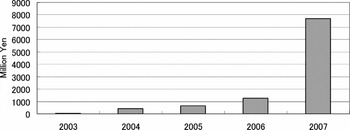
The government's enthusiasm for the agricultural export promotion policy is evident in the rapid increase in budget allocation for policies related to agricultural export promotion. Even though the total amount of agriculture-related budget shrunk by 3.1% from the previous year, it budgeted 7.7 billion yen for the agricultural export promotion policy for 2007, which is 19 times larger than the 2004 budget [0.4 billion yen] for the same category. Figure 3 shows a dramatic increase in the government budget for export promotion in the recent years.
Government Budget for Agricultural Export Promotion Policies 2003–2007.
Source: The MAFF Annual Budget Report.

Along with the agricultural export promotion policy, the Japanese government has significantly reduced market price support for major commodities (such as rice, wheat, soy beans, and milk) and non-export domestic support.Footnote 15 However, it is important to note that these changes do not simply mean that Japan has completely abandoned its protective agricultural policies and is pursuing liberal open-market policies at this stage. Nor does it mean Japan will liberalize its agriculture markets in the near future. Japan and the EU countries still show a reluctant attitude toward multinational liberalization negotiations of agricultural products in the WTO framework. The MAFF claims that Japan has already introduced various liberalization measures, and further radical reforms would suppress commercial firms and cause deterioration in food sufficiency. Also, it stresses the special nature of the agriculture, and requests ‘special treatment in multilateral trading rules’.Footnote 16 Concerns for domestic farmers, food safety, and self-sufficiency in food have slowed down negotiations, as they have for years, with other countries for free trade agreements (FTAs), which Japan is currently negotiating with a number of Asian countries.
However, the introduction of an agricultural export promotion policy is significant in the sense that the Japanese government is starting to redirect its policy objectives, at least in some areas. It now pays greater attention to the productivity and competitiveness of the domestic agriculture, rather than just to the negative consequences of trade liberalization. Although it prefers a much more gradual transition towards liberalization than the Americans or Australians, Japan's agricultural policy is showing some signs of change. The government hopes to make the agricultural sector Japan's new major exporting star, while encouraging farmers' self-sufficiency and an eventual reduction in subsidies.
This new offensive agricultural policy is widely supported by the government, the MAFF, and the members of the cabinet. For example, commenting on an agricultural trade fair in Shanghai sponsored by the Japanese government, Agricultural Minister Nakagawa Shoichi stated at a press conference on 15 November 2005 that:
the prime minister and I have been very interested in exports of agricultural products to make Japanese agriculture take an offensive posture. Japan is currently exporting agricultural products worth about 300 billion yen, but we are planning to double this amount within five years. The government and private sector is jointly working on this project at a conference called ‘the National Conference on Export Promotion of Agricultural, Forestry, and Fishery Products’. We will continue this effort jointly with the Ministry of Economy, Trade, and Industry's overseas branch offices, JETRO, and other institutions to promote export.Footnote 17
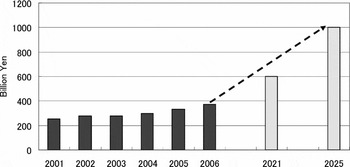
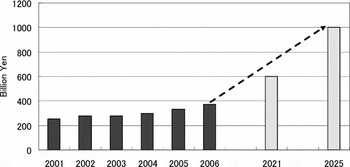
Furthermore, the Abe administration announced its plan to expand Japan's agricultural exports to 1 trillion yen by 2025. Figure 4 illustrates this ambitious plan for export promotion.
Agricutural Exports and the Government's Goals.
Source: The MAFF website. <http://www.maff.go.jp/sogo_shokuryo/yusyutu/kyougikai/siryo.pdf>
In sum, Japan maintained protectionist policies for the domestic agricultural industries for several decades, in spite of the tremendous pressures from its foreign trade partners and some influential domestic political actors. However, it recently introduced an agricultural export promotion policy, which is fundamentally different from Japan's traditional protectionist agricultural policies. What explains the introduction of this new agricultural trade policy? In this paper I argue that the most important factor that induced the introduction of a new agricultural trade policy is the change in Japanese legislators' electoral incentives due to the introduction of a new electoral system in 1994. The following sections will review Japan's new and old electoral systems and explain how the electoral reform altered legislators' electoral incentives and strategies.
Japan's electoral system before 1994 and agricultural politics
In the postwar period (between 1947 and 1994), Japan had an unusual electoral system.Footnote 18 It was a multimember-district system with a single nontransferable vote (MMD/SNTV). In the system, voters cast only one vote, and each district elects more than one candidate (usually three to five, depending on the size of population).
One of the consequences of this electoral setting is that there could be more than one candidate from the same party in one district. This was often the case for a large party such as the Liberal Democratic Party (LDP). Because votes were nontransferable from one candidate to another, the party with multiple candidates had to find a way to evenly divide the vote among its candidates. This intra-party competition encouraged candidates to engage in personalized campaigns and utilize particularistic appeals.Footnote 19 Krauss (1995) argues ‘because more than one candidate represented the district and because LDP candidates in particular competed with each other, ideology and policy differences were not terribly important . . . the LDP candidates competed more on the basis of personal appeal and how they could bring benefits to voters and the district’.Footnote 20 Additionally, politicians had a strong incentive to use pork-barrel methods, resulting in competition to bring higher subsidies to their districts, particularly in the form of public works, such as building dams, bridges, and highways to distinguish themselves from other candidates of the same party.
Another consequence of the pre-reform system is that politicians had strong incentives to build close ties with particular groups of loyal constituents rather than trying to appeal to the entire district. This is because a candidate could win a seat with a much smaller percentage of votes in a multi-member district system than in a single-member district system. For instance, in a five-seat district, a mere 20% of votes guarantees a victory for a candidate. Thus, it was very common for politicians, particularly among the members of the LDP, to specialize in a single issue area – such as an issue associated with agriculture, construction, social welfare, or the postal service – and establish a clientalistic relationship with a group that represented that particular issue. Those so-called ‘zoku [tribe]’ politicians were very sensitive to the interests of the group they are associated with. For example, agricultural zoku politicians received strong support from Nokyo [the Agricultural Cooperative Organization], and, thus, they often pressured the government to provide subsidies, trade protection, and other benefits to farmers in their districts. What this implies is that politicians tended to focus much more on the interests of a small group of voters in their districts than on the interests of the median voters in their districts.
Furthermore, Japan's old electoral system had a severe problem with the malapportionment of votes between urban and rural regions, resulting in over-representation of rural interests in national politics. The electoral districts in the pre-reform system were distributed reflecting the demographic conditions immediately after the end of World War II, and were not fundamentally changed for about a half century, in spite of the significant flow of population from the rural areas to urban cities during the period. Curtis (1988) illustrates the problem of malapportionment: ‘In 1985, for example, there were 4.4 times as many voters per lower house seat in Chiba prefecture's most populous election district as there were in Hyogo prefecture's least populated one’.Footnote 21 Hrebernar (1992) writes, ‘this [rural] bias can be seen in LDP public policies, which are geared to benefit the agricultural sectors in such basic areas as rice production – all at the expense of the urban consumer’.Footnote 22 In other words, more seats were allocated to rural regions than urban regions. Thus, rural votes weighed significantly more than urban votes.
Taking advantage of this electoral system, which gave disproportional advantages to well-organized political groups in rural areas, the agricultural sector possessed tremendous political influence. The main political vehicle of the agricultural sector was Nokyo, which was one of the most politically influential pressure groups in the postwar Japan. Nokyo is an organization of agricultural cooperatives and has branches throughout the nation.Footnote 23 Nokyo's main functions are assistance to farmers by providing loans and insurance, selling necessities for farming (e.g. machines, fertilizers, and pesticides) to members, giving technical support, and marketing of agricultural products in the domestic market. But it also functions as a pressure group that advances the interests of farmers. It mobilizes farmers' votes and provides campaign funds to some politicians – agricultural zoku politicians in the LDP in particular. Hayes (2005) describes the clientalistic relationship between the ruling LDP and farmers as follows:
Farmers have been consistent in their political loyalties. The LDP has been able to rely on a staunchly reliable voting bloc in farmers. In return, the party resisted reforms that would dilute agriculture's influence by eliminating farmers' overrepresentation in the Diet . . . The government has also protected agriculture's economic interests by maintaining a high price for rice and other products.Footnote 24
In sum, this political environment is the primary reason why Japanese politicians maintained a strong commitment to protect the domestic agriculture for over six decades.
Evidently, many politicians, who support the export promotion policy today, advocated protectionist policies before the electoral reform. For example, Matsuoka Toshikatsu – the former Agricultural Minister who announced the government's plan for the certification system of Japanese restaurants – used to be a hard-line opponent of liberalization of agricultural products. Matsuoka, elected from a rural district of the Kumamoto Prefecture, is sometimes considered the ‘Don’ of agricultural zoku politicians. Defending the interests of farmers and cattle growers in his district, Matsuoka harshly criticized the Hosokawa administration, which agreed to partially liberalize the Japanese rice market at the GATT Uruguay Round in 1994. Matsuoka made the following statements in the Diet Subcommittee on Agriculture on 15 March, 1994.Footnote 25
[With the terribly poor harvest last year], I think farmers are in an economically and psychologically depressed condition now . . . While they still trying to find the way out, [the government started] liberalization of rice, liberalization and tariffication of dairy products, and reduction of tariff rates for beef and oranges, and tariffication of timbers. There is no way [for farmers] to recover from the last years' damage, I think the farmers have no choice but to kill themselves or go to hell.Footnote 26
Matsuoka went on to criticize the government bureaucrats and manufacturing industries, who he thought were forcing farmers to pay the prices of Japan's high trade surplus with the United States.
Every time we negotiates with the United States, in the end the Americans ask us ‘what are you going to do with the 60 billion dollar trade deficit?’ I told them, ‘then, what differences does it make if Japan imports your rice for about 300 thousand tons? It is only about 100 million dollars. It does not make your condition any better. We should not fight over such a thing and waste our time and energy. ‘. . . After returning from the United States, I told the same thing to the Ministry of Foreign Affairs (MOFA) and the MITI. But, now it is clear. It is you guys who are switching the subject to liberalization of agricultural products. So, the business executives, the MITI, and the MOFA, you shall not try to get away from it. And, you, who created the 60 billion surplus, should make a plan to cut it in half or by one third.Footnote 27
Finally, he urged the government to change its liberalization policies expressing his concerns about their impacts on national security. ‘When I think about security and the future of the nation, I firmly believe that we should go back to basics and rethink our policies’.Footnote 28 It is hard to believe, but these are the statements made by Matsuoka Toshikatsu, the very person who is leading the agricultural export promotion policy and the reforms in agricultural subsidies as Agricultural Minister. Like Matsuoka, many LDP agricultural zoku politicians used to defend the interests of farmers with an uncompromising attitude.
The 1994 electoral reform and changes in electoral incentives
As one can easily imagine, the pre-reform system brought about numerous cases of corruption, and a rise in demands from the general public for a cleaner and more accountable political process forced the government to introduce a new electoral system, which was believed to alleviate the shortcomings of the old system. The new electoral system of the House of Representatives, introduced in 1994, is a mixed member system (MM), which combines 300 single member districts and 200 (later reduced to 180) proportional representation seats. This electoral reform has drastically changed incentives and campaign strategies of legislators.
First, each candidate must appeal to the voters on the quality of their policies. Competition among candidates is no longer based on their personality or personal ties to a particular industry, because there is no intra-party competition in the single-member district system. If only one seat is allocated to each district, each party will put up only one candidate in a district. Thus, candidates who belong to different parties will differentiate themselves from their rivals through their policies.
Second, candidates must now represent the interests of the median voter, rather than particular client groups. This is because candidates must obtain support from the broader constituency in a single-member district system. Whereas only one fifth of votes guaranteed a victory in a five-seat district in the multimember district system, it requires a much higher percentage of votes in the single-member district system. Hence, in order to be successful, candidates must make themselves attractive to a wide range of voters by presenting policies that represent the interests of the general public.Footnote 29 Krauss and Pekkanen (2004) call this change of electoral incentives ‘constituency span’.Footnote 30
Third, the use of pork-barrel tactics is less effective in the single-member district system. This is because those who benefit from pork-barrel policies are usually small and well-connected groups. Though it was an effective strategy in the old multimember district system, it is not so in the new system, for it does not allow politicians to win a broad base of support. Also, it became increasingly difficult for politicians to use pork-barrel tactics in their districts, as the government has been making all-out efforts to cut down government spending due to the ever-increasing budget deficits. Thus, politicians now have less incentive to bring pork-barrel to their district.
Lastly, the problem of malapportionment of electoral districts in the older system has been alleviated to some extent under the new system, weakening the political influence of the rural political groups such as Nokyo, the construction industry, and local post offices. According to Mulgan (2005), ‘The reduction in the disparity of voting values at the extreme from 5:1 to something over 2:1 in the Lower House as a result of the 1994 electoral reforms has considerably moderated the electoral bias in favor of less densely populated areas (i.e., rural voters)’.Footnote 31
Explaining the introduction of export promotion policy
How did this change in legislators' electoral incentives lead to the introduction of an agricultural export promotion policy? First, many politicians began to support the new agricultural policies, because the new electoral system encouraged them to advocate policies' that would benefit the Japanese economy as a whole. The new electoral system makes politicians compete on policy differences, rather than on personality or ties to a particular industry. That means candidates must present policies that would convince voters of their merits. In the time of globalization, protectionist policies in general have become increasingly difficult to justify. In the past, Japanese politicians made various claims to defend Japan's protectionist policies using rhetoric ranging from cultural/spiritual arguments to biological arguments.Footnote 32 But, politicians were unable to win support even from the general public using such rhetoric. More people think it is better to liberalize agricultural markets rather than protect them. A survey titled ‘The Public Opinion Survey on Agricultural Trade’ conducted by the Cabinet Office in 2000 revealed that 40.3% of people supported liberalization or further liberalization of the agricultural market, whereas only 14.3% opposed the statement.Footnote 33
Furthermore, a very influential political group, big business, has been calling for liberalization of agricultural markets in order to avoid trade disputes with Japan's trade partners. For example, Keidanren [the Japanese Federation of Economic Organizations], Japan's biggest business association has strongly advocated liberalization policies in the agricultural sector for decades. For example, Kosai Akio, Vice Chairman of Keidanren, sent a strong message to politicians calling for changes in the government's agricultural policy in March 2002. Kosai stated ‘We must improve productivity and strengthen the international competitiveness of Japanese agriculture, so that the younger generation engaged in agriculture can aspire to realize their hopes and dreams. I believe the time has come for political leaders to make a significant policy change, establish a vision for revitalization of Japanese agriculture, and create a market economy for it’.Footnote 34
Yet, these pressures for the liberalization of agricultural trade from within Japan were not new. What enhanced the political salience of the domestic outcry for liberalization was the electoral reform in 1994, which induced politicians to represent the general interest in their districts. Under the old system, those politicians who won their seats primarily through the support of agricultural groups could ignore or pay little attention to the interests of the general public and big business, because their seats were secured as long as the agricultural groups supported them. Through close ties with agricultural zoku politicians, agricultural groups used to be able to find extremely loyal and reliable allies in the legislature, who pressured the government to maintain protectionist policies for farmers. However, strong ties with agricultural groups do not guarantee electoral success in a single-member district system. In other words, for most politicians, agricultural groups have become just one of many pressure groups in their districts after the electoral reform. Therefore, politicians have to present policies that would gain extensive support in their consituencies. Thus, particularistic policies, such as trade protection for the agriculture, became less attractive to candidates, as they contradict with the interests of many groups in their districts. The introduction of the agricultural export promotion policy made sense to many politicians because such policies do not conflict with today's globalized economy, as they encourage farmers to become less dependent on subsidies, while avoiding disputes with Japan's trade partners.
Second, as pork-barrel policies became less effective as a campaign tool, politicians started to abandon the old agricultural policies, which relied heavily on subsidies and compensation for uncompetitive farmers. First, pork-barrel policies only benefit a small group of farmers, and most voters will not enjoy the benefits of such policies. Under a system in which politicians needed extensive support in their constituencies, pork-barrel is not a very effective strategy. Furthermore, it has become increasingly difficult for politicians to bring pork-barrel into their districts due to the recent trends towards austerity in fiscal policy. Japan's demand stimulation policies through issuing government bonds in the 1990s resulted in a tremendous amount of government debts.Footnote 35 The Koizumi administration made a strong commitment to cut government expenditures to cope with the ever-growing budget deficits, and the policy has been maintained by the succeeding administrations. Thus, politicians have less incentive to undertake efforts to bring pork-barrel to their districts in the new system, and the agricultural export promotion policy appears as an alternative to pork-barrel policies, as such market-oriented policies would foster productive and competitive farmers who would be less dependent on the government's financial support.
Lastly, the declining importance of the agricultural sector in electoral campaign further facilitated the politicians to prefer an export promotion policy over protectionist policies. First, as mentioned earlier, the condition of malapportionment, which vested disproportional political power to rural regions, has somewhat improved. This means more seats were allocated to urban districts with larger populations, and fewer to rural districts. Also, the number of farmers has declined significantly. Only 3.24 million people were registered as farmers in 2006 – a 77.7% decline from its peak in 1960, when there were 14.54 million farmers.Footnote 36 The farming population is merely 3.1% of the total voters (102.9 million in 2005). Moreover, the farming population is overwhelmingly old (58% is 65 years or olderFootnote 37) and is expected to shrink rapidly in the near future. Thus, the agricultural sector is becoming less reliable as a political support base for many politicians, and the introduction of the single-member district system has further weakened the political salience of agricultural sector.Footnote 38 These factors have certainly contributed to the politicians' change of heart. In the following sections, let me illustrate how politicians – members of the ruling parties in particular – have changed their agricultural policies before and after the electoral reform.
Enthusiasm for the agricultural export promotion policy
The changed attitude towards the agricultural trade policy is clearly seen in platforms and policy ‘manifestos’ of the LDP and its members. For example, The LDP's ‘Basic Plan for Food, Agriculture, and Agricultural Village’, issued by the party in March 2005, unambiguously states that: ‘The protection of domestic agricultural sector with a high level of tariffs has reached its limit.’ It also views the LDP's old agricultural policies critically, saying ‘We indirectly compensated all farmers' income by providing subsidies to each products and maintaining prices at certain level.’ Then, it presents its new plan to ‘drastically change this traditional policy and push forward the policies from the view point of consumers’. It also advocates ‘policies to nurture producers of agricultural products with a certain size [larger than 4 hectares] and ‘strong incentives’ and aims at strengthening international competitiveness, stabilizing farmers’ businesses, and promoting ‘strong farmers’.Footnote 39
What is remarkable in the LDP's policy plan is that the LDP advocates policies that advance the interests of consumers rather than farmers. This new policy contrasts clearly with the party's old policy, which rarely reflected the interests of consumers. Consumers have paid the costs of agricultural policies by paying unreasonably high prices for agricultural products, but the party is trying to change this situation. Another important point is that the LDP plan only supports the farmers who can become competitive and self-sufficient. It shows the party's reluctance to support those farmers who cannot survive without subsidies and price support. As indicated above, small-scale farmers were one of the main electoral support bases of the LDP in the rural areas. However, the LDP's new agricultural policies turned its focus away from small-scale farmers to consumers.
Moreover, the LDP has taken some steps to promote export of agricultural products at the party level. For example, Matsuoka Toshikatsu, Chairman of the LDP's Agriculture Committee, and Chou Chiang, Senior Secretary of the Central Committee of the Chinese Communist Youth Organization, signed an agreement on 16 January 2006 that promotes agricultural trade between the two countries. Matsuoka was reported to have said that the two countries have built ‘an extremely important political foundation’ for further expansion of agricultural trade.Footnote 40 The LDP was trying to use this agreement to assist the Japanese government's attempt to liberalize the Chinese rice market, which was not open to Japanese products at the time.Footnote 41
It is not just the LDP politicians that have dramatically changed their agricultural policies. Komeito – the LDP's coalition partner – also advocates abolition of price support and calls for agricultural policies that promote efficiency of the farming business in its 2005 policy manifesto.Footnote 42 Although the party has not adopted export promotion as a part of its main agricultural policy yet, a number of Komeito politicians have publicly announced their support for the policy. For example, Taniaki Masaaki, a Komeito Diet member, presented his support for the government's agricultural export promotion policy in his statement in the Diet Sub Committee on Agriculture on 15 March 2005. Taniaki asked several questions of the Agricultural Minister regarding the export promotion policy. Taniaki commented ‘by all means, I expect the government to further promote those policies.’ He also stated ‘There are various agricultural products whose production must be cut [by the government] due to overproduction. A typical example is rice . . . I think we should also aggressively export those agricultural products, in which the domestic producers have surplus in production capacity’.Footnote 43
The Democratic Party's agricultural policy: a deviant behavior? Not really
At the election of the House of Council in July 2007, the Democratic Party of Japan (DPJ), the biggest opposition party, put forward its election manifesto, including an agricultural policy that seemed to challenge my argument. In its manifesto, the DPJ announced its plan to introduce ‘an individual household income support system for farmers’, in which the government pays farmers the difference between production costs and the market price. The party expects to allocate about one trillion yen for this program. Ozawa Ichiro, the current party leader, calls it ‘a comprehensive policy to revive rural communities so that they can make a living through the small-scale production methods they have employed up until now’ and criticizes the LDP's plan to cut subsidies for small-scale farmers by stating ‘The policies of the LDP administration that simply call for production efficiency and have abandoned small-scale farmers, are inviting the destruction of rural communities and the devastation of our traditional culture’.Footnote 44 This behavior seems to go against my expectation of the post-reform condition, as the party seems to have introduced a pork-barrel policy.
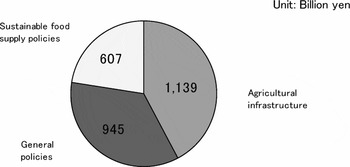
However, that is not really the case. The DPJ's plan is subtly disguised as a distributive policy on the surface to attract farmers' votes, and it is too naïve to assume that the DPJ's policy leads to lavish spending of government expenditure on agriculture. Indeed, many media and scholars alike were deceived by it and described the DPJ's agricultural subsidy plan as pork-barrel [baramaki seisaku] and a ‘return to the old LDP-style agricultural policies’.Footnote 45 Perhaps, this misunderstanding was one of the reasons why the party did very well in rural districts, as it may have appeased farmers. But, if you look at DPJ's manifesto carefully, you find that it is not necessarily pork-barrel. First, it does not plan to increase the government's agriculture-related expenditures. It plans to raise the money for the subsidy by cutting the budget for other agriculture-related spending, namely the subsidies for public investment in agricultural infrastructure, which account for 1.14 trillion yen in 2007.Footnote 46 Currently, 42.3% of the government's agriculture-related expenditure is spent on agricultural infrastructure development, and the money goes to construction companies (see Figure 5 for breakdown of agricultural subsides). What the DPJ is trying to do is to reallocate the existing agricultural subsidies from construction projects to support for the farmers.Footnote 47 Second, and more importantly, the DPJ strongly advocates trade liberalization, including the agricultural market. Ozawa clearly states that the party will promote ‘free trade negotiations through the World Trade Organization and the signing of free trade agreements (FTAs) with various countries’, and he thinks it would allow the Japanese agricultural sector to ‘maintain and expand the domestic production of agricultural products’.Footnote 48 Thus, the party is planning to push forward trade liberalization and use the subsidies as compensation [i.e. safeguard] for domestic farmers. So, the party considers the subsidy as a necessary tool to push forward liberalization of theagricultural market.
Japan's agriculture-related expenditure in 2007.
Source: The MAFF Web site. <http://www.maff.go.jp/j/budget/index.html>.

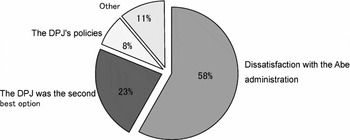
It is also important to note that though the DPJ won the 2007 election, its policies did not allow the party to win support from many constituencies, perhaps because some of its policies, including the agriculture subsidy, were considered as pork-barrel policies. Data suggest that the DPJ's policies were not an important reason why people voted for the party. In a poll taken shortly after the 2007 election by the Yomiuri Shinbun,Footnote 49 the majority of respondents (58%) said they thought the DPJ won ‘because of the dissatisfaction with the Abe administration’; 23% of them said ‘because the DPJ was the second best option to the LDP;’ and only 8% of them said ‘because the voters supported the DPJ's manifesto’ (see Figure 6). Reflecting on this result, the Yomiuri Shinbun claims that the DPJ won the election thanks to the LDP's ‘misplays’, such as the Abe administration's scandals, not because of its policies.
Opinion Poll: “Why do you think the DPJ won the 2007 election?”
Source: The Yomiuri Shinbun, 5 August, 2007.

In December 2007, the LDP announced that it will introduce a subsidy plan similar to the DPJ's to counter its rival's policyFootnote 50. But, given the unpopularity of such distributive policies among the general public, it is highly unlikely that the parties will ‘return to the old LDP-style agricultural policies’, and I expect the parties will eventually downsize their subsidy plans, whether they are safeguard or pork-barrel.
Alternative explanations
Lastly, I will examine two alternative explanations for Japan's new agricultural trade policy, namely foreign pressure [gaiatsu] and budget tightness. I attempt to demonstrate the inadequacy of alternative explanations in addressing the issue, and establish the validity of my argument that the electoral reform is the most important factor in the introduction of the new policy. I contend that though these factors may have encouraged politicians to introduce the new policy to a lesser extent, they are by no means the main cause of the policy introduction.
Foreign pressure [gaiatsu]
The first alternative explanation is the impact of foreign pressure against Japan's protectionist agricultural trade policies. Since the late 1960s, when Japanese textile products started to advance into foreign markets, Japan has faced massive foreign pressure. For instance, the United States urged Japan to ‘voluntarily’ restrain its exports (e.g. steel, TV, VCR, automobiles) to the U.S. markets, open its markets to the U.S. producers (e.g. oranges, beef, apples, rice), and reform its economic policies (e.g. land policy, distribution system, macroeconomic policies). Also, multilateral trade negotiations in the GATT/WTO frameworks obligated Japan to liberalize its markets. On the issue of agriculture, the world's major exporters of agricultural products, such as the United States and Australia, have been strongly criticizing Japan for not taking necessary measures to open up its agricultural market.
Foreign pressure, or gaiatsu, has been an important political force in the Japanese policymaking process, although it did not always lead to policy change. For instance, the pressure from the US government made Japan agree to reform its distribution system and macroeconomic policy, but Japan refused the US's demands to abolish the keiretsu system in its negotiation with the United States in the Structural Impediments Initiative talk (1989–90). Schoppa (1997) examines several cases of US-Japan trade negotiations using the two-level game model and argues that ‘gaiatsu does indeed have the power to influence Japanese policy outcomes and that its influence is greatest when the Japanese domestic political arena offers opportunities for employing synergistic strategies that take advantage of divisions of opinion and interests on the Japanese side’.Footnote 51 That is, when foreigners find support for their demands from some influential political groups in Japan, gaiatsu is likely to induce policy change. On the issue of agricultural trade policy, foreigners had powerful allies in Japan. The Japanese business leaders advocated liberalization of the agricultural market, and the public in general was supportive as well, as discussed above. Therefore, one could argue that gaiatsu along with some support from within Japan made the Japanese government introduce the change in its agricultural trade policy.
However, this explanation has two critical problems that seriously undermine its validity. First, the gaiatsu explanation cannot explain why the policy was introduced in the early 2000s, but not earlier. Foreign pressure on Japan to liberalize its agricultural trade policy is not a new phenomenon. It was 1970 when Prime Minister Sato gave in to the pressure from the Nixon administration and agreed to apply voluntary export restraints on Japanese textile exports to the US market. Also, the existence of pro-liberalization groups within Japan is not new either. Japanese business leaders have been calling for trade liberalization for decades. For instance, the Federation of Economic Organizations [Keidanren] – Japan's peak business association – called for ‘complete liberalization of trade and capital’ in the resolution adopted at its annual meeting in 1971 and continued to do so in the subsequent meetings.Footnote 52 Thus, Japan could have introduced this new trade policy much earlier, but it did not. Why it took over 30 years for gaiatsu to make Japan introduce this policy? The gaiatsu explanation cannot account for the timing of the introduction of the policy, and that leads us to believe some other factor must have caused the policy introduction.
Second, and more importantly, though a number of countries urged Japan to liberalize its agricultural market, no country has ever pressured Japan to promote its agricultural exports. Foreign pressure focuses mostly on alleviation of trade impediments in Japanese markets and reduction of Japan's ever-growing trade surplus. It does not make any sense for foreign governments to encourage Japan to spend billions of yen to promote its agricultural exports, because it would only strengthen their potential competitor and could increase Japan's trade surplus even more. It is hard to imagine, for instance, that American rice producers would lobby the US government to pressure Japan to promote export of Japanese rice products. There was no pressure on Japan to introduce an agricultural export promotion policy, because such a policy has no merit to foreign countries. If gaiatsu were the most important determinant of Japanese agricultural trade policy, the Japanese government would have only introduced open-market policies, but not export promotion policy.
Budget tightness
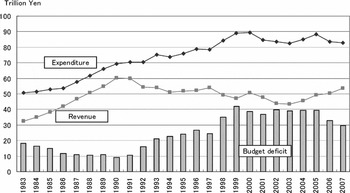
The second alternative explanation is the Japanese government's budget deficit, which might have encouraged politicians to introduce frugal policies that would allow the government to reduce its expenditures. The budget deficit has been a huge problem for the Japanese government since 1965 when it first issued deficit-covering bonds. The budget deficit has steadily increased for decades, and the deficit in the government's general account in 2007 is 29.4 trillion yen (see Figure 7). The sum of accumulated deficits, including those of the local governments, is about 1.2 quadrillion yen today.Footnote 53 Certainly, there is a strong pressure on politicians' shoulders to put a halt on the ever-growing deficit, and this might explain why politicians were eager to introduce the agricultural export promotion policy.
Budget Deficit in the Japanese government's general account (1983–2007).
Source: Japan Statistical Year Book, MIAC, annual.

However, the agricultural export promotion policy is not very cheap, as noted above. The government allocated 7.7 billion yen in 2007 from its already tight budget and plans to spend even more to achieve its ambitious goal of doubling the value of agricultural exports in five years. The total amount of the agriculture-related budget shrunk by 3.1% in 2007 from the previous year, but the budget for the agricultural export promotion policy grew by 770%. If politicians merely want to just reduce government expenditure, they could accomplish the goal just by cutting the subsidies to farmers, rather than introducing another costly policy. But, they chose this policy, because the new electoral environment after the reform requires politicians to present policies that have multiple merits, which would satisfy a majority of their constituents. According to the LDP's ‘Basic Plans for Food, Agriculture, and Rural Community’, what the party tries to achieve through the agricultural export promotion policy is manifold: First, it aims at motivating the existing farmers and those who may become farmers by making agricultural business more profitable. Japanese rural communities are suffering from depopulation, as the young population move to urban cities searching for more attractive jobs. By making agiculture potentially more profitable and promising, it hopes to alleviate the problem. Second, it tries to stimulate the rural economy by assisting the agricultural sector and reducing the income gap between cities and the countryside. Third, it tries to introduce the pro-market principle in to agricultural trade policy. The export promotion policy rewards those farmers who strive and discourages farmers from relying on subsidies permanently.
The agricultural export promotion policy may alleviate the deficit problem in the long-run by reducing farmers' reliance on subsidies and increasing the future tax revenue from agricultural business. However, it is only one of many goals politicians tried to accomplish through this policy. They also expect the policy to alleviate the problems of rural depopulation, the rural-urban income disparity, and the international competitiveness of Japanese agricultural products. They advocated such a policy, because they believed that its multiple merits not just to farmers but to the general public would appeal to a broad constituency. If they were solely concerned with budget tightness, they would have just cut agricultural subsidies and would not have needed such a policy that requires more spending. Additionally, Japan started accumulating the budget deficit in 1965, but the government maintained the protectionist agricultural trade policy for about four decades. As with the gaiatsu argument, the budget tightness explanation has a problem when addressing the issue of timing; it cannot explain why it happened in the early 2000s, but not earlier.
Conclusion
Japan stubbornly maintained protectionist policies for the sake of its domestic agricultural producers for several decades, in spite of the tremendous pressures from its foreign trade partners and some influential domestic political actors such as big business. However, it has recently introduced an agricultural export promotion policy, which is fundamentally different from its traditional protectionist agricultural policies. My analysis demonstrates that the introduction of this new agricultural trade policy can be explained by the change in the electoral incentives of legislators. Under the new electoral system, particularistic interests of farmers have less political influence on most politicians' electoral success, and politicians must present policies that appeal to a wide range of voters. Also, the new electoral system made use of pork-barrel policies, such as subsidies and price support, less effective. Therefore, protectionist policies became less attractive to many politicians, and they began to advocate the agricultural export promotion policy, which aims at facilitating farmers' self-sufficiency, strengthening their competitiveness, stimulating the rural economy, and reducing the income gap between cities and the countryside. Also, the multiple merits of such a policy are more likely to win support from the general public.
It does not mean that Japan will completely abandon protection for the agricultural sector in the immediate future and pursue liberal open-market policies. But, it is expected that Japan continues to pursue ‘offensive’ agricultural trade policies for the future in the hopes of promoting more agricultural exports and strengthening the farmers' self-sufficiency. With its experiences in export promotion policies in industrial sectors and the growing popularity of certain Japanese agricultural products, it is not so far-fetched to assume that Japan will become a major exporter of agricultural products in the future. Also, I suppose the agricultural export promotion policy to have positive impacts on the WTO and FTA negotiations in the long run, because as Japan's exports increase, so should demand for free trade.
Yet, there are a few reasons to be concerned about the future of Japan's agricultural trade policy. First, a series of scandals shook the LDP and brought about an unusually high level of political instability in 2007. The scandals of the Agricultural Ministers disrupted agricultural administration, as the head of the Ministry changed six times within one year. The lack of leadership and confusion may be hindering the Ministry's effort to push forward the new policy and other positive changes. Second, the victory of the DPJ in the House of Council resulted in a divided Diet, in which different parties dominate the two houses. It makes it extremely hard for the ruling party to pass legislations. This political gridlock can seriously slow down potential developments in agricultural policy. Lastly, the Japanese government is concerned with the declining self-sufficiency of food and does not prefer a rapid transition to liberalization. Thus, it takes some time for Japan to fundamentally reform its agricultural sector. Nonetheless, the emergence of export promotion policy due to the changes in politicians' electoral incentives suggests change in Japanese agricultural trade policy is not only feasible but is currently under way, at least in some areas.