INTRODUCTION
The effect of organotin contamination is different in each affected group of organisms. Neogastropod molluscs respond to the organotin exposure by developing a syndrome called imposex, in which females develop masculine secondary structures as penis and/or vas deferens (Gibbs et al., Reference Gibbs, Bryan, Pascoe and Burt1987).
Nassarius species have great potential for environmental impacts research, because of their wide distribution and resistance to pollution (Coelho et al., Reference Coelho, Pimenta, Gomes, Barroso, Pereira, Pardal and Duarte2006). Nassariids have been used in imposex studies in many different countries, such as N. reticulatus (Barreiro et al., Reference Barreiro, Gonzáles, Quintela and Ruiz2001; Barroso et al., Reference Barroso, Moreira and Bebianno2002a,Reference Barroso, Reis-Henriques, Ferreira and Moreirab, Reference Barroso, Moreira and Richardson2005a,Reference Barroso, Reis-Henriques, Ferreira, Gibbs and Moreirab; Sousa et al., Reference Sousa, Mendo and Barroso2005) in Spain and Portugal, N. kraussianus in South Africa (Marshall & Rajkumar, Reference Marshall and Rajkumar2003) and N. festivus in China (Chan & Morton, Reference Chan, Morton and Morton2003).
Nassarius vibex (Say, 1822) is distributed from Cape Cod to Florida in the USA, West Indies, Venezuela and Brazil. On the Brazilian coast, this species is distributed from the state of Pará to Santa Catarina (Rios, Reference Rios1994). It is commonly found in north-eastern Brazil in estuaries, over muddy sand flats (Matthews, Reference Matthews1968). Demaintenon (Reference Demaintenon2001a,Reference Demaintenonb) first reported the occurrence of imposex in N. vibex populations from the USA.
The first studies on the occurrence of imposex in South America were accomplished by Gooding et al. (Reference Gooding, Gallardo and Leblanc1999) in Chile, Castro et al. (Reference Castro, Matthews-Cascon and Fernandez2000) in Brazil and Penchaszadeh et al. (Reference Penchaszadeh, Averbuj and Cledón2001) in Argentina.
Species used as bioindicators of organotin compounds contamination in those countries are habitants of sandy or rocky shores, such as: Stramonita haemastoma, (Fernandez et al., Reference Fernandez, Wagener, Limaverde, Scofield, Pinheiro and Rodrigues2005; Castro et al., Reference Castro, Bemvenuti and Fillmann2007a,Reference Castro, Lima, Braga and Rocha-Barreirab; Limaverde et al., Reference Limaverde, Fernandez and Coutinho2007), S. rustica (Castro et al., Reference Castro, Lima, Braga and Rocha-Barreira2007b; Limaverde et al., Reference Limaverde, Fernandez and Coutinho2007) and Odontocymbiola magellanica (Bigatti & Penchaszadeh, Reference Bigatti and Penchaszadeh2005). Therefore, this study evaluates the potential of Nassarius vibex as an indicator of the presence of organotin compounds in estuarine environments and its application to monitor the spatial extent of OTC contamination along the Ceará River estuary.
MATERIALS AND METHODS
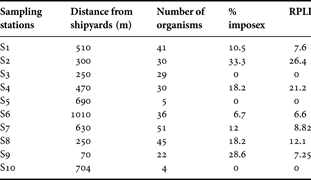
The Ceará River estuary is located in the metropolitan region of Fortaleza City, north-eastern Brazil. Two shipyards, whose activities are the maintenance of medium and small ships, are present in the estuary. To monitor the contamination extent along the estuary 10 sampling stations were selected, 5 on each river margin, in October 2006. Distance in metres from the shipyards area was obtained using GPS (Table 1).
Imposex quantification in Nassarius vibex at the sampling stations along Ceará River estuary.
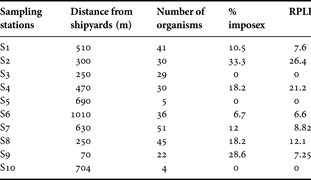
RPLI, relative penis length index.
In the laboratory, individuals were narcotized with saline solution of MgCl2 (7%) for a minimum time of 1 hour 30 minutes. Shell length was measured with a vernier caliper of 0.05 mm precision and soft parts were removed using a lathe. Sex was determined based on the presence of capsule gland and/or bursa copulatrix in females and seminal vesicle in males. Penis length of males and imposexed females were measured using a graduated graph paper with 1.0 mm precision. Imposex development level in the population was quantified using the percentage of imposexed females and relative penis length index (RPLI) [(female mean penis length)/(male mean penis length) × 100]. RPLI is a more appropriate index for nassariids since this species presents dorso/ventral flattened penis (Bryan et al., Reference Bryan, Burt, Gibbs and Pascoe1993; Barroso & Moreira, Reference Barroso and Moreira1998).
The animals were partially deposited in the Professor Henry Ramos Matthews's Malacological Collection of the Universidade Federal do Ceará, Fortaleza.
Data were analysed using software STATISTICA v.7.0. Non-parametric Kruskal–Wallis tests (P < 0.05) were used to determine significant statistical differences between sampling stations and imposex levels. Spearman tests (P < 0.05) measured the correlation between the shipyards distance and imposex expression in the population.
RESULTS
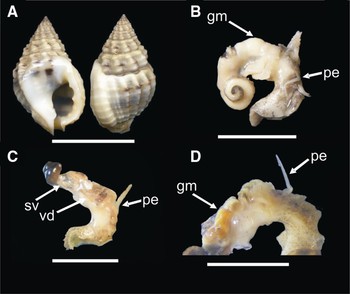
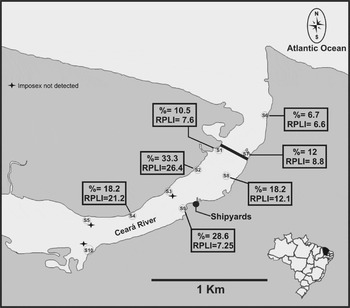
Penis is located, in Nassarius vibex, behind the right cephalic tentacle. This characteristic is common to other neogastropods. Imposexed females were characterized by the presence of strictly female structures such as glandular mass (capsule and albumen glands) and the presence of male structures such as penis or papillae, located in the equivalent region to males (Figure 1). The higher value of penis length observed in females was 4.5 mm. Percentage of imposexed females varied along the sampling stations (Figure 2; Table 1). The highest percentage occurred on Station S2, 300 m distant from the shipyards, with 33.3% of affected females. Sampling Station S9, 70 m distant from the shipyards, also presented high percentage of imposexed females (28.6%). Three sampling stations displayed an absence of any imposex level in the population (Stations 3, 5 and 10), however two stations did not achieve the required sampling number for analysis. The RPLI, which correlates male and female penis sizes, ranged from 0 to 26.4% and presented the higher value in sampling Station S2.
Nassarius vibex. (A) Adult shell; (B and D) soft parts of an imposexed female; (C) soft part of a male. Abbreviations: gm, glandular mass; pe, penis; sv, seminal vesicle; vd, vas deferens.

Map of the Ceará River estuary with sampling stations locations. Imposex percentage and relative penis length index (RPLI) can be observed near each sampling station.

The non-parametric Kruskal–Wallis test (P = 0.4373) revealed no significant differences between imposex expression along the sampling stations for the imposex quantification indices used in the monitoring. Spearman correlation between the shipyards distance and the percentage of imposexed females along the sampling station was negative (rs = –0.58, P = 0.075) and not significant, although it indicated a tendency to increased imposex levels near the shipyards.
DISCUSSION
The present research is the first application of Nassarius vibex as a bioindicator of organotin compounds in Brazil. Nassarius vibex is widely distributed along Brazilian coast estuaries and therefore has great potential to be a reliable sentinel organism to monitor estuaries. It is important to mention that the main OTC sources in the environment are harbours and marinas that are commonly located inside estuarine areas (Michaud & Pelletier, Reference Michaud and Pelletier2006). Although the International Maritime Organization (IMO) global banning of OTCs in antifouling paints started in 2003 and banning of ships painted with organotin compounds in 2008, the prohibition has not yet come into force in many developing countries (Shi et al., Reference Shi, Huang, Zhu, Yu and Xie2005). Therefore, it is extremely important to monitor organotin contamination in order to inspect the enforcement of IMO rulings.
The assessment of imposex quantification indices along the Ceará River estuary demonstrated that they were low, with maximum percentage of imposexed females of 33.3% and RPLI of 26.4%.
Previous studies accomplished in the Ceará River estuary by Lima-Verde et al. (Reference Lima-Verde, Rocha-Barreira and Castro2006) showed imposex indices similar to those found in the present study. Lima-Verde et al. (Reference Lima-Verde, Rocha-Barreira and Castro2006) observed an imposex incidence of 23.5% and 33.3% and RPLI of 37.8 and 60.1%. In Rio de Janeiro, Cardoso et al. (Reference Cardoso, Caetano and Cabrini2009) found 100% of imposexed females, with RPLI equal to 39.1%. In another study, N. nitidus presented imposex incidence of 88% up to 100% and RPLI between 6.1 and 46.7% in Lagoon of Venice, Italy (Pavoni et al., Reference Pavoni, Centanni, Valcanover, Fasolato, Ceccato and Tagliapietra2007). Nassarius reticulatus presented imposex incidence of 0 up to 100% and RPLI ranged between 0 and 64% along the Portuguese coast (Rato et al., Reference Rato, Gaspar, Takahashi, Yano, Tanabe and Barroso2008).
Despite the reduced percentage, imposex occurrence is directly related to organotin contamination in that site, since imposex only develops in gastropods exposed to OTCs (Smith, Reference Smith1981; Matthiessen & Gibbs, Reference Matthiessen and Gibbs1998). It is irrefutable that the N. vibex population in the present study is sensitive to OTCs and responded to its presence in the environment by developing this syndrome.
Pavoni et al. (Reference Pavoni, Centanni, Valcanover, Fasolato, Ceccato and Tagliapietra2007) accomplished imposex determinations and OTC chemical analyses in N. nitidus and observed a positive correlation between both results. Similarly other studies proved the relationship between OTC concentration and imposex alterations (Barroso et al., Reference Barroso, Moreira and Bebianno2002a; Rato et al., Reference Rato, Gaspar, Takahashi, Yano, Tanabe and Barroso2008). Additional experiments of imposex induction under TBT exposure were accomplished by Chan & Morton (Reference Chan, Morton and Morton2003) in N. festivus. Those results showed a strong cause–effect relationship between imposex and the presence of OTC in the environment.
Low imposex indices in N. vibex can be explained by the following hypotheses: (1) low local organotin contamination due to a small influence of the shipyards; (2) variable residency time of water due to tidal fluctuations; and (3) low sensitivity of the chosen species. More detailed studies are needed to test these hypotheses and to determine the minimum OTC concentration capable of causing imposex in females.
Bigatti et al. (Reference Bigatti, Primost, Cledón, Averbuj, Theobald, Gerwinski, Arntz, Morriconi and Penchaszadeh2009) in a study on TBT biomonitoring contamination and imposex incidence along the Argentinean coast showed that species inhabiting soft or mixed bottoms are the ones that best reflect the imposex phenomenon in low and medium TBT polluted zones.
The present research focused on sampling adult specimens, however, according to Barroso et al. (Reference Barroso, Moreira and Richardson2005a), to implement systematic monitoring programmes, the age of the sampled specimens has to be considered. Considering that the concentrations of OTCs in the environment would remain stable or reduced due to the IMO ban and that imposex is irreversible, if only adult individuals were used in research, there would be no need to repeat sampling frequently (annually or every 2 years) because animals with equal ages would be sampled again and results would not reflect time-dependent changes in TBT pollution. If sampling intervals were shorter, younger specimens would have to be sampled (Barroso et al., Reference Barroso, Moreira and Richardson2005a). Imposex levels observed in N. vibex sampled in the Ceará River estuary indicated that this species represents a potential bioindicator of organotin compounds because of its wide distribution, abundance, easy field identification and easy sampling.
In conclusion, Nassarius vibex females in the Ceará River estuary developed imposex, constituting an alternative tool for the detection of OTCs in estuarine environments. Monitoring results suggest that shipyards in the Ceará River are the probable source of OTC contamination demonstrated by a tendency of increased imposex levels in sampling points near the shipyards.